

Modern Era
Chapter 26: Crisis of Populism 2017 ― Today


Make America Great Again 2017-2021
Build Back Better 2021-2025
America First 2025-Today
War on Terror 2001 ― 2017
Yet to Happen

Documents
Master Index

03/25/1584
Elizabeth I granted a charter to Sir Walter Raleigh, authorizing him to discover, occupy, and govern remote lands not already claimed by a Christian prince, shortly after the death of his half-brother Sir Humphrey Gilbert in 1583. The charter empowered Raleigh to establish colonies and exercise civil authority over settlers, laying the legal groundwork for England’s first sustained attempts at colonization in North America.
Elizabeth I
Charter to Sir Walter Raleigh

09/17/1603
Issued by James I of England to address poverty and social unrest in England while supporting colonial expansion. It ordered that “idle” or vagrant individuals be removed from English society and sent to early colonial outposts such as Newfoundland and the West Indies. The policy aimed to relieve domestic disorder, enforce social control, and provide labor for nascent colonies, representing an early example of using colonization as a means of managing marginalized populations in the English Empire.
James I
Proclamation Banishing Vagabonds to America

12/18/1603
A charter to Pierre Dugua, Sieur de Mons, authorizing him to colonize and govern the territory of Acadia in North America under a royal trading monopoly. The charter empowered de Mons to establish settlements, promote the Catholic faith, and administer justice, laying the legal foundation for France’s early colonial presence in what is now Nova Scotia and the Canadian Maritimes.
Henry IV
Charter of Acadia
04/10/1606
The First Charter of Virginia, granted the Virginia Company of London the authority to establish colonies in North America. The charter authorized the formation of a joint-stock enterprise to fund settlement, trade, and resource extraction, laying the legal foundation for the Jamestown expedition and marking England’s formal entry into sustained colonization of the Atlantic seaboard.
James I
First Charter of Virginia
05/23/1609
James I of England issued the Second Charter of Virginia, expanding the authority of the Virginia Company and restructuring governance of the Jamestown colony. The charter broadened territorial claims, increased investor rights, and replaced the original council-based leadership model with a more centralized system.
James I
Second Charter of Virginia

03/12/1611
Third Charter of Virginia significantly restructured the governance of the Virginia Company following the near-collapse of Jamestown during the Starving Time and ongoing conflict with the Powhatan Confederacy. The charter expanded the company’s territory, reorganized its leadership into a more centralized corporate system, and reinforced royal backing for renewed colonization efforts.
James I
Third Charter of Virginia

1612
A strict legal code imposed on the colony of Jamestown during a period of crisis and instability. Enforced under the leadership of Sir Thomas Dale, the laws established a harsh, military-style regime intended to restore order, discipline, piety, and productivity among struggling settlers.
Thomas Dale
Laws Divine, Moral, and Martial

10/11/1614
Granted by the States General of the Netherlands, the charter was issued in the form of an patent or monopoly grant to the New Netherland Company, a consortium of Amsterdam and Hoorn merchants. It granted the company an exclusive four-year monopoly on trade in the territory, encompassing much of what later became New Netherland.
Netherlands
Charter of New Netherland

07/30/1619
The House of Burgesses convened for its first legislative assembly at Jamestown marking the beginning of representative government in English North America. Composed of elected burgesses from Virginia’s settlements and presided over by colonial officials such as Governor Sir George Yeardley, the body enacted local laws addressing trade, labor, and colonial governance, establishing a precedent for self-government that would later influence political development in British America.
House of Burgesses
House of Burgesses First Meeting and Resolves

08/20/1619
The first recorded sale of African slaves in Virginia took place in 1619 at Point Comfort (present-day Hampton, Virginia). A ship of approximately 20 Africans, captured from a Portuguese slave ship and traded by English privateers, was brought to the colony and sold to local planters. This event marked the beginning of the system of African chattel slavery in English North America, introducing a labor force that would become central to the colony’s tobacco economy and establishing a racialized institution.
House of Burgesses
First African Slaves Sold in Virginia
11/03/1620
Granted by James I of England to the Plymouth Council for New England. It gave the Council the authority to establish settlements, govern the land, distribute property, and regulate trade with Indigenous peoples. The charter’s purpose was to formalize English claims in the region, encourage settlement, and promote economic development while consolidating control under a single corporate authority.
James I
Charter of New England

11/11/1620
An agreement signed by the passengers of the Mayflower before they disembarked at Plymouth. Drafted primarily by the Pilgrims, it established a self-governing colony based on majority rule and mutual consent, with signers pledging to create “just and equal laws” for the good of the community.
Pilgrims
Mayflower Compact
Biographies

William McKinley (1843-1901) was the 25th president of the United States, serving from 1897 to 1901. His presidency was defined by protective tariffs, the adoption of the gold standard, and the Spanish-American War, which resulted in the United States acquiring Puerto Rico, Guam, and the Philippines. Assassinated in 1901, McKinley left a legacy as the president who helped transform the United States into an emerging world power at the dawn of the twentieth century.
William
McKinley
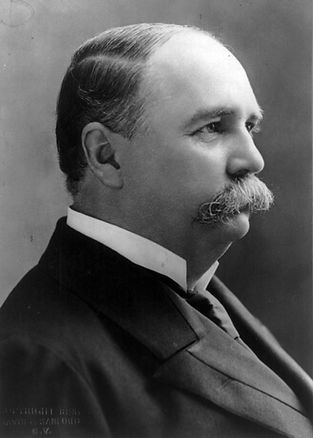
Garret Hobart (1844-1899) was a New Jersey lawyer, businessman, and Republican legislative leader who became William McKinley's vice president in 1897. He was an unusually active vice president who worked closely with McKinley until declining health forced him from public activity. Hobart died in 1899, leaving the vice presidency vacant until Theodore Roosevelt took the office in 1901.
Garret
Hobart

Charles W. Fairbanks (1852-1918) was a successful railroad attorney who became one of Indiana's leading Republicans and served in the U.S. Senate. He became Theodore Roosevelt's vice president in 1905 and presided over the Senate during Roosevelt's second term. Fairbanks later ran unsuccessfully for vice president again in 1916 and died in 1918.
Charles
Fairbanks

Thomas R. Marshall (1854-1925) was an Indiana lawyer and governor who became Woodrow Wilson's vice president in 1913. He served for eight years, including during World War I and the constitutional uncertainty surrounding Wilson's incapacitation in 1919. After leaving office, Marshall returned to law and public speaking before dying in Washington in 1925.
Thomas
Marshall
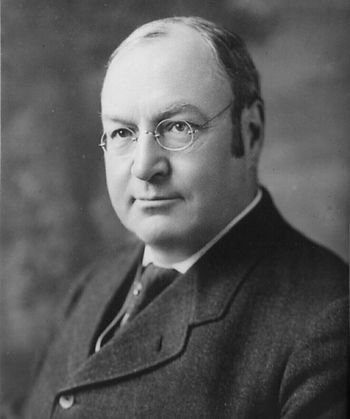
James S. Sherman (1855-1912) was a New York lawyer and longtime Republican congressman who became William Howard Taft's vice president in 1909. He served as a congressional leader and presided over the Senate while the Republican Party increasingly divided between Taft and Theodore Roosevelt. Sherman died six days before the 1912 election, and the Republican Party substituted Nicholas Murray Butler as his electoral running mate.
James
Sherman

Woodrow Wilson (1856-1924) was the 28th president of the United States, serving from 1913 to 1921. His administration established the Federal Reserve, strengthened federal regulation of business, and ultimately brought the United States into World War I, after which Wilson championed his Fourteen Points and the League of Nations. His legacy is complicated by his administration’s racial segregation, suppression of speech, and expansion of presidential power.
Woodrow
Wilson