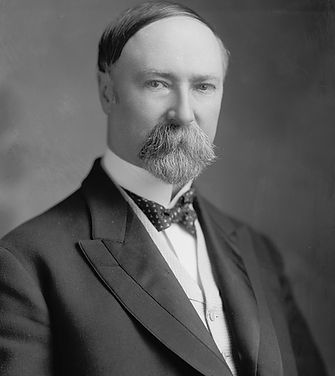
Charles Fairbanks
Charles Warren Fairbanks was an Ohio-born lawyer, businessman, U.S. senator from Indiana, and the twenty-sixth vice president of the United States. After establishing himself as a railroad attorney in Indianapolis, he became one of Indiana's most influential Republicans and served in the U.S. Senate from 1897 to 1905. He became Theodore Roosevelt's vice-presidential running mate in 1904 and served during Roosevelt's second term.
Fairbanks was born on May 11, 1852, near Unionville Center, Ohio, to Loriston Monroe Fairbanks and Mary Adelaide Smith. His father was a farmer and Methodist lay preacher. Fairbanks attended Ohio Wesleyan University, graduating in 1872, and subsequently studied law at Cleveland Law School. He moved to Indianapolis after completing his legal training and was admitted to the Indiana bar in 1874.
Fairbanks built his fortune as an attorney representing railroad interests, particularly the Illinois Central Railroad. His success in business enabled him to become increasingly active in Republican politics. He was a delegate to Republican national conventions and became an important political adviser within Indiana. His influence eventually led to his election to the U.S. Senate in 1896.
In the Senate, Fairbanks became one of the Republican Party's leading legislators. He served as chairman of the Committee on Public Buildings and Grounds and later the Committee on Pacific Railroads, and he became a close political associate of President William McKinley. He was also involved in foreign-policy issues, including the debate surrounding the Spanish-American War and its aftermath. In 1904, Republicans nominated him for vice president alongside Theodore Roosevelt. The ticket won decisively, and Fairbanks became vice president on March 4, 1905.
Fairbanks presided over the Senate during Roosevelt's second term and remained an important Republican figure, although he differed with Roosevelt on several questions concerning the role of government and the direction of the Republican Party. In particular, Fairbanks was associated with the more conservative wing of the party while Roosevelt increasingly advocated progressive reforms. After Roosevelt's presidency ended, Fairbanks returned to Indiana and resumed his legal career. He was the Republican vice-presidential nominee again in 1916, running alongside Charles Evans Hughes, but they lost to Woodrow Wilson and Thomas R. Marshall.
Fairbanks died in Indianapolis on June 4, 1918, at the age of sixty-six. His legacy rests largely on his role as a leading Senate Republican and as a representative of the more conservative Republican tradition during the Progressive Era. His career also illustrates the growing importance of vice-presidential candidates as representatives of particular factions within national political parties.
Vice President, Senator