

Modern Era
Chapter 26: Crisis of Populism 2017 ― Today


Make America Great Again 2017-2021
Build Back Better 2021-2025
America First 2025-Today
War on Terror 2001 ― 2017
Yet to Happen

Documents
Master Index

1513
Spanish jurists, led by Juan López de Palacios Rubios and the Council of the Indies, drafted the Requerimiento to be read to Indigenous peoples before conquest, asserting Spain’s claim by divine and papal authority, demanding submission to Spanish rule and Christianity, and warning of war or enslavement; often read perfunctorily, it revealed the gap between law and colonial practice.
Ferdinand of Aragon
El Requerimiento

07/28/1513
Issued by Ferdinand II of Aragon and Juana of Castile at Valladolid; a revision and expansion of the 1512 Laws of Burgos refining regulations on Indigenous labor, settlement organization, and religious instruction in the Americas, reinforcing royal oversight while attempting to address abuses within the encomienda system.
Ferdinand of Aragon
Valladolid Amendments

12/10/1513
A political treatise offering pragmatic advice to rulers on how to gain and maintain power. It was dedicated to Lorenzo de’ Medici, intended as both a plea for political employment and a manual for effective rule. Machiavelli argued that leaders should prioritize stability and authority, even through deception, fear, or cruelty when necessary, famously noting it is better for a prince to be feared than loved if he cannot be both.
Niccolò Machiavelli
De Principatibus (The Prince)

10/16/1515
On September 25, 1513, Vasco Núñez de Balboa crossed the Isthmus of Panama and became the first recorded European to sight the Pacific Ocean from the Americas. He formally claimed the vast body of water—then called the “South Sea” (Mar del Sur)—for the Crown of Spain, establishing Spain’s strategic awareness of a western ocean that would shape future exploration and imperial expansion. These events were recorded in a letter he wrote as a report to Spain.
Vasco Nunez de Balboa
Letter from de Balboa on the Pacific Ocean

1516
Thomas More’s Utopia was composed as a humanist critique of early modern European society, using satire to expose corruption, inequality, and the moral failures of politics in Tudor England and beyond. Framed as a dialogue describing an imaginary island, the work explores communal property, religious toleration, rational law, and civic virtue, inviting readers to weigh ideal theory against human nature, power, and moral responsibility rather than accept reform schemes uncritically. Its lasting influence lies in shaping political philosophy and social criticism—coining the very concept of “utopia.”
Thomas More
Utopia

10/31/1517
Martin Luther circulates his Ninety-Five Theses in Wittenberg, attacking the sale of indulgences and questioning papal authority over salvation. This act sparks widespread debate and marks the beginning of the Protestant Reformation by transforming a theological dispute into a mass movement.
Martin Luther
95 Theses

10/30/1520
Hernán Cortés reported to King Charles I of Spain (Charles V) on his march into the Aztec Empire, the seizure of Tenochtitlan, and the complex alliances he forged with Indigenous rivals of the Mexica. The letter justified his unauthorized actions by portraying the conquest as both a service to the Crown and a campaign to expand Christian rule and Spanish sovereignty in the newly claimed territories.
Hernan Cortes
Second Letter to Charles V

07/08/1524
Giovanni da Verrazzano’s first voyage was undertaken in the service of King Francis I of France to find a western sea route to Asia. Sailing along the Atlantic coast of North America Verrazzano made some of the earliest European descriptions of the region, including New York Harbor. His voyage strengthened France’s claims to North America and laid the groundwork for later French exploration and colonization.
Giovanni da Verrazano
Letter of His First Voyage to Francis I

11/10/1542
King Charles I of Spain (Emperor Charles V) tried to reform colonial administration and curb abuses against Indigenous peoples in Spanish America. The laws sought to end Indigenous enslavement, restrict the power of encomenderos, and protect native communities following advocacy from reformers such as Bartolomé de Las Casas. Although intended as a major humanitarian reform, enforcement sparked resistance among colonists—especially in Peru—demonstrating the limits of royal authority in the early Spanish Empire.
Charles I of Spain
Leyes Nuevas (New Laws of the Indies)

1552
A passionate denunciation of Spanish colonial abuses against Indigenous peoples in the Americas. Drawing on his experiences as a former encomendero turned Dominican friar, Las Casas described acts of violence, exploitation, and depopulation to persuade King Charles I of Spain (Charles V) to strengthen reforms and enforcement of earlier protective legislation. The work became highly influential in shaping European debates over empire, Indigenous rights, and Spanish colonial policy.
Bartolomé de las Casas
A Brief Account of the Destruction of the Indies

1576
A vast ethnographic study of Aztec society, religion, language, and daily life based on testimony from Indigenous Nahua informants in central Mexico. Often known as the Florentine Codex, the manuscript preserves one of the most detailed contemporary records of pre-conquest and early colonial New Spain, blending Nahuatl and Spanish text with hundreds of illustrations.
Bernardino de Sahagun
General History of New Spain

06/11/1578
Elizabeth I granted letters patent to Sir Humphrey Gilbert, authorizing him to discover, claim, and govern remote “heathen and barbarous lands” not already possessed by any Christian prince in the name of England. The patent empowered Gilbert to establish colonies, exercise civil and criminal jurisdiction over settlers, and retain a share of profits, laying early legal foundations for English overseas expansion.
Elizabeth I
Patent to Sir Humphrey Gilbert
Biographies

William McKinley (1843-1901) was the 25th president of the United States, serving from 1897 to 1901. His presidency was defined by protective tariffs, the adoption of the gold standard, and the Spanish-American War, which resulted in the United States acquiring Puerto Rico, Guam, and the Philippines. Assassinated in 1901, McKinley left a legacy as the president who helped transform the United States into an emerging world power at the dawn of the twentieth century.
William
McKinley
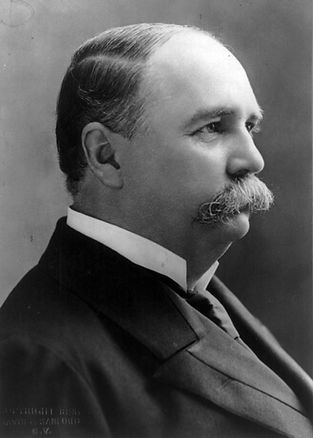
Garret Hobart (1844-1899) was a New Jersey lawyer, businessman, and Republican legislative leader who became William McKinley's vice president in 1897. He was an unusually active vice president who worked closely with McKinley until declining health forced him from public activity. Hobart died in 1899, leaving the vice presidency vacant until Theodore Roosevelt took the office in 1901.
Garret
Hobart

Charles W. Fairbanks (1852-1918) was a successful railroad attorney who became one of Indiana's leading Republicans and served in the U.S. Senate. He became Theodore Roosevelt's vice president in 1905 and presided over the Senate during Roosevelt's second term. Fairbanks later ran unsuccessfully for vice president again in 1916 and died in 1918.
Charles
Fairbanks

Thomas R. Marshall (1854-1925) was an Indiana lawyer and governor who became Woodrow Wilson's vice president in 1913. He served for eight years, including during World War I and the constitutional uncertainty surrounding Wilson's incapacitation in 1919. After leaving office, Marshall returned to law and public speaking before dying in Washington in 1925.
Thomas
Marshall
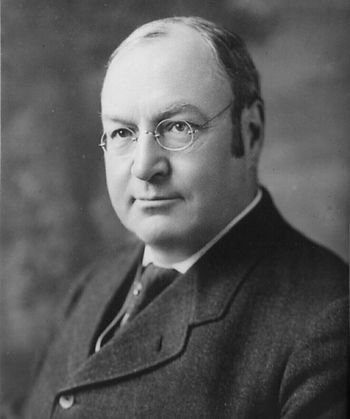
James S. Sherman (1855-1912) was a New York lawyer and longtime Republican congressman who became William Howard Taft's vice president in 1909. He served as a congressional leader and presided over the Senate while the Republican Party increasingly divided between Taft and Theodore Roosevelt. Sherman died six days before the 1912 election, and the Republican Party substituted Nicholas Murray Butler as his electoral running mate.
James
Sherman

Woodrow Wilson (1856-1924) was the 28th president of the United States, serving from 1913 to 1921. His administration established the Federal Reserve, strengthened federal regulation of business, and ultimately brought the United States into World War I, after which Wilson championed his Fourteen Points and the League of Nations. His legacy is complicated by his administration’s racial segregation, suppression of speech, and expansion of presidential power.
Woodrow
Wilson