Search this site
1696 results found with an empty search
- 154th State of the Union FDR’s Tenth Annual Message
154th State of the Union FDR’s Tenth Annual Message January 07, 1943 Mr. Vice President, Mr. Speaker, Members of the Seventy-eighth Congress: This Seventy-eighth Congress assembles in one of the great moments in the history of the Nation. The past year was perhaps the most crucial for modern civilization; the coming year will be filled with violent conflicts- yet with high promise of better things. We must appraise the events of 1942 according to their relative importance; we must exercise a sense of proportion. First in importance in the American scene has been the inspiring proof of the great qualities of our fighting men. They have demonstrated these qualities in adversity as well as in victory. As long as our flag flies over this Capitol, Americans will honor the soldiers, sailors, and marines who fought our first battles of this war against overwhelming odds the heroes, living and dead, of Wake and Bataan and Guadalcanal, of the Java Sea and Midway and the North Atlantic convoys. Their unconquerable spirit will live forever. By far the largest and most important developments in the whole world-wide strategic picture of 1942 were the events of the long fronts in Russia: first, the implacable defense of Stalingrad; and, second, the offensives by the Russian armies at various points that started in the latter part of November and which still roll on with great force and effectiveness. The other major events of the year were: the series of Japanese advances in the Philippines, the East Indies, Malaya, and Burma; the stopping of that Japanese advance in the mid-Pacific, the South Pacific, and the Indian Oceans; the successful defense of the Near East by the British counterattack through Egypt and Libya; the American-British occupation of North Africa. Of continuing importance in the year 1942 were the unending and bitterly contested battles of the convoy routes, and the gradual passing of air superiority from the Axis to the United Nations. The Axis powers knew that they must win the war in 1942 -or eventually lose everything. I do not need to tell you that our enemies did not win the war in 1942. In the Pacific area, our most important victory in 1942 was the air and naval battle off Midway Island. That action is historically important because it secured for our use communication lines stretching thousands of miles in every direction. In placing this emphasis on the Battle of Midway, I am not unmindful of other successful actions in the Pacific, in the air and on land and afloat —especially those on the Coral Sea and New Guinea and in the Solomon Islands. But these actions were essentially defensive. They were part of the delaying strategy that characterized this phase of the war. During this period we inflicted steady losses upon the enemy -great losses of Japanese planes and naval vessels, transports and cargo ships. As early as one year ago, we set as a primary task in the war of the Pacific a day-by-day and week-by-week and month-by-month destruction of more Japanese war materials than Japanese industry could replace. Most certainly, that task has been and is being performed by our fighting ships and planes. And a large part of this task has been accomplished by the gallant crews of our American submarines who strike on the other side of the Pacific at Japanese ships—right up at the very mouth of the harbor of Yokohama. We know that as each day goes by, Japanese strength in ships and planes is going down and down, and American strength in ships and planes is going up and up. And so I sometimes feel that the eventual outcome can now be put on a mathematical basis. That will become evident to the Japanese people themselves when we strike at their own home islands, and bomb them constantly from the air. And in the attacks against Japan, we shall be joined with the heroic people of China—that great people whose ideals of peace are so closely akin to our own. Even today we are flying as much lend-lease material into China as ever traversed the Burma Road, flying it over mountains 17,000 feet high, flying blind through sleet and snow. We shall overcome all the formidable obstacles, and get the battle equipment into China to shatter the power of our common enemy. From this war, China will realize the security, the prosperity and the dignity, which Japan has sought so ruthlessly to destroy. The period of our defensive attrition in the Pacific is drawing to a close. Now our aim is to force the Japanese to fight. Last year, we stopped them. This year, we intend to advance. Turning now to the European theater of war, during this past year it was clear that our first task was to lessen the concentrated pressure on the Russian front by compelling Germany to divert part of her manpower and equipment to another theater of war. After months of secret planning and preparation in the utmost detail, an enormous amphibious expedition was embarked for French North Africa from the United States and the United Kingdom in literally hundreds of ships. It reached its objectives with very small losses, and has already produced an important effect upon the whole situation of the war. It has opened to attack what Mr. Churchill well described as "the under-belly of the Axis," and it has removed the always dangerous threat of an Axis attack through West Africa against the South Atlantic Ocean and the continent of South America itself. The well-timed and splendidly executed offensive from Egypt by the British Eighth Army was a part of the same major strategy of the United Nations. Great rains and appalling mud and very limited communications have delayed the final battles of Tunisia. The Axis is reinforcing its strong positions. But I am confident that though the fighting will be tough, when the final Allied assault is made, the last vestige of Axis power will be driven from the whole of the south shores of the Mediterranean. Any review of the year 1942 must emphasize the magnitude and the diversity of the military activities in which this Nation has become engaged. As I speak to you, approximately one and a half million of our soldiers, sailors, marines, and fliers are in service outside of our continental limits, all through the world. Our merchant seamen, in addition, are carrying supplies to them and to our allies over every sea lane. Few Americans realize the amazing growth of our air strength, though I am sure our enemy does. Day in and day out our forces are bombing the enemy and meeting him in combat on many different fronts in every part of the world. And for those who question the quality of our aircraft and the ability of our fliers, I point to the fact that, in Africa, we are shooting down two enemy planes to every one we lose, and in the Pacific and the Southwest Pacific we are shooting them down four to one. We pay great tribute—the tribute of the United States of America— to the fighting men of Russia and China and Britain and the various members of the British Commonwealth- the millions of men who through the years of this war have fought our common enemies, and have denied to them the world conquest which they sought. We pay tribute to the soldiers and fliers and seamen of others of the United Nations whose countries have been overrun by Axis hordes. As a result of the Allied occupation of North Africa, powerful units of the French Army and Navy are going into action. They are in action with the United Nations forces. We welcome them as allies and as friends. They join with those Frenchmen who, since the dark days of June, 1940, have been fighting valiantly for the liberation of their stricken country. We pay tribute to the fighting leaders of our allies, to Winston Churchill, to Joseph Stalin, and to the Generalissimo Chiang Kai-shek. Yes, there is a very great unanimity between the leaders of the United Nations. This unity is effective in planning and carrying out the major strategy of this war and in building up and in maintaining the lines of supplies. I cannot prophesy. I cannot tell you when or where the United Nations are going to strike next in Europe. But we are going to strike- and strike hard. I cannot tell you whether we are going to hit them in Norway, or through the Low Countries, or in France, or through Sardinia or Sicily, or through the Balkans, or through Poland- or at several points simultaneously. But I can tell you that no matter where and when we strike by land, we and the British and the Russians will hit them from the air heavily and relentlessly. Day in and day out we shall heap tons upon tons of high explosives on their war factories and utilities and seaports. Hitler and Mussolini will understand now the enormity of their miscalculations—that the Nazis would always have the advantage of superior air power as they did when they bombed Warsaw, and Rotterdam, and London and Coventry. That superiority has gone—forever. Yes, the Nazis and the Fascists have asked for it—and they are going to get it. Our forward progress in this war has depended upon our progress on the production front. There has been criticism of the management and conduct of our war production. Much of this self-criticism has had a healthy effect. It has spurred us on. It has reflected a normal American impatience to get on with the job. We are the kind of people who are never quite satisfied with anything short of miracles. But there has been some criticism based on guesswork and even on malicious falsification of fact. Such criticism creates doubts and creates fears, and weakens our total effort. I do not wish to suggest that we should be completely satisfied with our production progress today, or next month, or ever. But I can report to you with genuine pride on what has been accomplished in 1942. A year ago we set certain production goals for 1942 and for 1943. Some people, including some experts, thought that we had pulled some big figures out of a hat just to frighten the Axis. But we had confidence in the ability of our people to establish new records. And that confidence has been justified. Of course, we realized that some production objectives would have to be changed- some of them adjusted upward, and others downward; some items would be taken out of the program altogether, and others added. This was inevitable as we gained battle experience, and as technological improvements were made. Our 1942 airplane production and tank production fell short, numerically—stress the word numerically of the goals set a year ago. Nevertheless, we have plenty of reason to be proud of our record for 1942. We produced 48,000 military planes—more than the airplane production of Germany, Italy, and Japan put together. Last month, in December, we produced 5,500 military planes and the rate is rapidly rising. Furthermore, we must remember that as each month passes by, the averages of our types weigh more, take more man-hours to make, and have more striking power. In tank production, we revised our schedule- and for good and sufficient reasons. As a result of hard experience in battle, we have diverted a portion of our tank-producing capacity to a stepped-up production of new, deadly field weapons, especially self-propelled artillery. Here are some other production figures: In 1942, we produced 56,000 combat vehicles, such as tanks and self-propelled artillery. In 1942, we produced 670,000 machine guns, six times greater than our production in 1941 and three times greater than our total production during the year and a half of our participation in the first World War. We produced 21,000 anti-tank guns, six times greater than our 1941 production. We produced ten and a quarter billion rounds of small-arms ammunition, five times greater than our 1941 production and three times greater than our total production in the first World War. We produced 181 million rounds of artillery ammunition, twelve times greater than our 1941 production and ten times greater than our total production in the first World War. I think the arsenal of democracy is making good. These facts and figures that I have given will give no great aid and comfort to the enemy. On the contrary, I can imagine that they will give him considerable discomfort. I suspect that Hitler and Tojo will find it difficult to explain to the German and Japanese people just why it is that "decadent, inefficient democracy" can produce such phenomenal quantities of weapons and munitions- and fighting men. We have given the lie to certain misconceptions—which is an extremely polite word- especially the one which holds that the various blocs or groups within a free country cannot forego their political and economic differences in time of crisis and work together toward a common goal. While we have been achieving this miracle of production, during the past year our armed forces have grown from a little over 2,000,000 to 7,000,000. In other words, we have withdrawn from the labor force and the farms some 5,000,000 of our younger workers. And in spite of this, our farmers have contributed their share to the common effort by producing the greatest quantity of food ever made available during a single year in all our history. I wonder is there any person among us so simple as to believe that all this could have been done without creating some dislocations in our normal national life, some inconveniences, and even some hardships? Who can have hoped to have done this without burdensome Government regulations which are a nuisance to everyone- including those who have the thankless task of administering them? We all know that there have been mistakes- mistakes due to the inevitable process of trial and error inherent in doing big things for the first time. We all know that there have been too many complicated forms and questionnaires. I know about that. I have had to fill some of them out myself. But we are determined to see to it that our supplies of food and other essential civilian goods are distributed on a fair and just basis—to rich and poor, management and labor, farmer and city dweller alike. We are determined to keep the cost of living at a stable level. All this has required much information. These forms and questionnaires represent an honest and sincere attempt by honest and sincere officials to obtain this information. We have learned by the mistakes that we have made. Our experience will enable us during the coming year to improve the necessary mechanisms of wartime economic controls, and to simplify administrative procedures. But we do not intend to leave things so lax that loopholes will be left for cheaters, for chiselers, or for the manipulators of the black market. Of course, there have been disturbances and inconveniences -and even hardships. And there will be many, many more before we finally win. Yes, 1943 will not be an easy year for us on the home front. We shall feel in many ways in our daily lives the sharp pinch of total war. Fortunately, there are only a few Americans who place appetite above patriotism. The overwhelming majority realize that the food we send abroad is for essential military purposes, for our own and Allied fighting forces, and for necessary help in areas that we occupy. We Americans intend to do this great job together. In our common labors we must build and fortify the very foundation of national unity- confidence in one another. It is often amusing, and it is sometimes politically profitable, to picture the City of Washington as a madhouse, with the Congress and the Administration disrupted with confusion and indecision and general incompetence. However—what matters most in war is results. And the one pertinent fact is that after only a few years of preparation and only one year of warfare, we are able to engage, spiritually as well as physically, in the total waging of a total war. Washington may be a madhouse- but only in the sense that it is the Capital City of a Nation which is fighting mad. And I think that Berlin and Rome and Tokyo, which had such contempt for the obsolete methods of democracy, would now gladly use all they could get of that same brand of madness. And we must not forget that our achievements in production have been relatively no greater than those of the Russians and the British and the Chinese who have developed their own war industries under the incredible difficulties of battle conditions. They have had to continue work through bombings and blackouts. And they have never quit. We Americans are in good, brave company in this war, and we are playing our own, honorable part in the vast common effort. As spokesmen for the United States Government, you and I take off our hats to those responsible for our American production—to the owners, managers, and supervisors, to the draftsmen and the engineers, and to the workers- men and women—in factories and arsenals and shipyards and mines and mills and forests—and railroads and on highways. We take off our hats to the farmers who have faced an unprecedented task of feeding not only a great Nation but a great part of the world. We take off our hats to all the loyal, anonymous, untiring men and women who have worked in private employment and in Government and who have endured rationing and other stringencies with good humor and good will. Yes, we take off our hats to all Americans who have contributed so magnificently to our common cause. I have sought to emphasize a sense of proportion in this review of the events of the war and the needs of the war. We should never forget the things we are fighting for. But, at this critical period of the war, we should confine ourselves to the larger objectives and not get bogged down in argument over methods and details. We, and all the United Nations, want a decent peace and a durable peace. In the years between the end of the first World War and the beginning of the second World War, we were not living under a decent or a durable peace. I have reason to know that our boys at the front are concerned with two broad aims beyond the winning of the war; and their thinking and their opinion coincide with what most Americans here back home are mulling over. They know, and we know, that it would be inconceivable—it would, indeed, be sacrilegious —if this Nation and the world did not attain some real, lasting good out of all these efforts and sufferings and bloodshed and death. The men in our armed forces want a lasting peace, and, equally, they want permanent employment for themselves, their families, and their neighbors when they are mustered out at the end of the war. Two years ago I spoke in my Annual Message of four freedoms. The blessings of two of them- freedom of speech and freedom of religion—are an essential part of the very life of this Nation; and we hope that these blessings will be granted to all men everywhere. 'The people at home, and the people at the front, are wondering a little about the third freedom—freedom from want. To them it means that when they are mustered out, when war production is converted to the economy of peace, they will have the right to expect full employment—full employment for themselves and for all able-bodied men and women in America who want to work. They expect the opportunity to work, to run their farms, their stores, to earn decent wages. They are eager to face the risks inherent in our system of free enterprise. They do not want a postwar America which suffers from undernourishment or slums- or the dole. They want no get-rich-quick era of bogus "prosperity" which will end for them in selling apples on a street corner, as happened after the bursting of the boom in 1929. When you talk with our young men and our young women, you will find they want to work for themselves and for their families; they consider that they have the right to work; and they know that after the last war their fathers did not gain that right. When you talk with our young men and women, you will find that with the opportunity for employment they want assurance against the evils of all major economic hazards- assurance that will extend from the cradle to the grave. And this great Government can and must provide this assurance. I have been told that this is no time to speak of a better America after the war. I am told it is a grave error on my part. I dissent. And if the security of the individual citizen, or the family, should become a subject of national debate, the country knows where I stand. I say this now to this Seventy-eighth Congress, because it is wholly possible that freedom from want—the right of employment, the right of assurance against life's hazards—will loom very large as a task of America during the coming two years. I trust it will not be regarded as an issue—but rather as a task for all of us to study sympathetically, to work out with a constant regard for the attainment of the objective, with fairness to all and with injustice to none. In this war of survival we must keep before our minds not only the evil things we fight against but the good things we are fighting for. We fight to retain a great past- and we fight to gain a greater future. Let us remember, too, that economic safety for the America of the future is threatened unless a greater economic stability comes to the rest of the world. We cannot make America an island in either a military or an economic sense. Hitlerism, like any other form of crime or disease, can grow from the evil seeds of economic as well as military feudalism. Victory in this war is the first and greatest goal before us. Victory in the peace is the next. That means striving toward the enlargement of the security of man here and throughout the world —and, finally, striving for the fourth freedom- freedom from fear. It is of little account for any of us to talk of essential human needs, of attaining security, if we run the risk of another World War in ten or twenty or fifty years. That is just plain common sense. Wars grow in size, in death and destruction, and in the inevitability of engulfing all Nations, in inverse ratio to the shrinking size of the world as a result of the conquest of the air. I shudder to think of what will happen to humanity, including ourselves, if this war ends in an inconclusive peace, and another war breaks out when the babies of today have grown to fighting age. Every normal American prays that neither he nor his sons nor his grandsons will be compelled to go through this horror again. Undoubtedly a few Americans, even now, think that this Nation can end this war comfortably and then climb back into an American hole and pull the hole in after them. But we have learned that we can never dig a hole so deep that it would be safe against predatory animals. We have also learned that if we do not pull the fangs of the predatory animals of this world, they will multiply and grow in strength- and they will be at our throats again once more in a short generation. Most Americans realize more clearly than ever before that modern war equipment in the hands of aggressor Nations can bring danger overnight to our own national existence or to that of any other Nation—or island—or continent. It is clear to us that if Germany and Italy and Japan- or any one of them- remain armed at the end of this war, or are permitted to rearm, they will again, and inevitably, embark upon an ambitious career of world conquest. They must be disarmed and kept disarmed, and they must abandon the philosophy, and the teaching of that philosophy, which has brought so much suffering to the world. After the first World War we tried to achieve a formula for permanent peace, based on a magnificent idealism. We failed. But, by our failure, we have learned that we cannot maintain peace at this stage of human development by good intentions alone. Today the United Nations are the mightiest military coalition in all history. They represent an overwhelming majority of the population of the world. Bound together in solemn agreement that they themselves will not commit acts of aggression or conquest against any of their neighbors, the United Nations can and must remain united for the maintenance of peace by preventing any attempt to rearm in Germany, in Japan, in Italy, or in any other Nation which seeks to violate the Tenth Commandment -"Thou shalt not covet." There are cynics, there are skeptics who say it cannot be done. The American people and all the freedom-loving peoples of this earth are now demanding that it must be done. And the will of these people shall prevail. The very philosophy of the Axis powers is based on a profound contempt for the human race. If, in the formation of our future policy, we were guided by the same cynical contempt, then we should be surrendering to the philosophy of our enemies, and our victory would turn to defeat. The issue of this war is the basic issue between those who believe in mankind and those who do not—the ancient issue between those who put their faith in the people and those who put their faith in dictators and tyrants. There have always been those who did not believe in the people, who attempted to block their forward movement across history, to force them back to servility and suffering and silence. The people have now gathered their strength. They are moving forward in their might and power—and no force, no combination of forces, no trickery, deceit, or violence, can stop them now. They see before them the hope of the world- a decent, secure, peaceful life for men everywhere. I do not prophesy when this war will end. But I do believe that this year of 1943 will give to the United Nations a very substantial advance along the roads that lead to Berlin and Rome and Tokyo. I tell you it is within the realm of possibility that this Seventy-eight Congress may have the historic privilege of helping greatly to save the world from future fear. Therefore, let us all have confidence, let us redouble our efforts. A tremendous, costly, long-enduring task in peace as well as in war is still ahead of us. But, as we face that continuing task, we may know that the state of this Nation is good—the heart of this Nation is sound -the spirit of this Nation is strong—the faith of this Nation is eternal. Source: https://www.presidency.ucsb.edu/documents/state-the-union-address-0
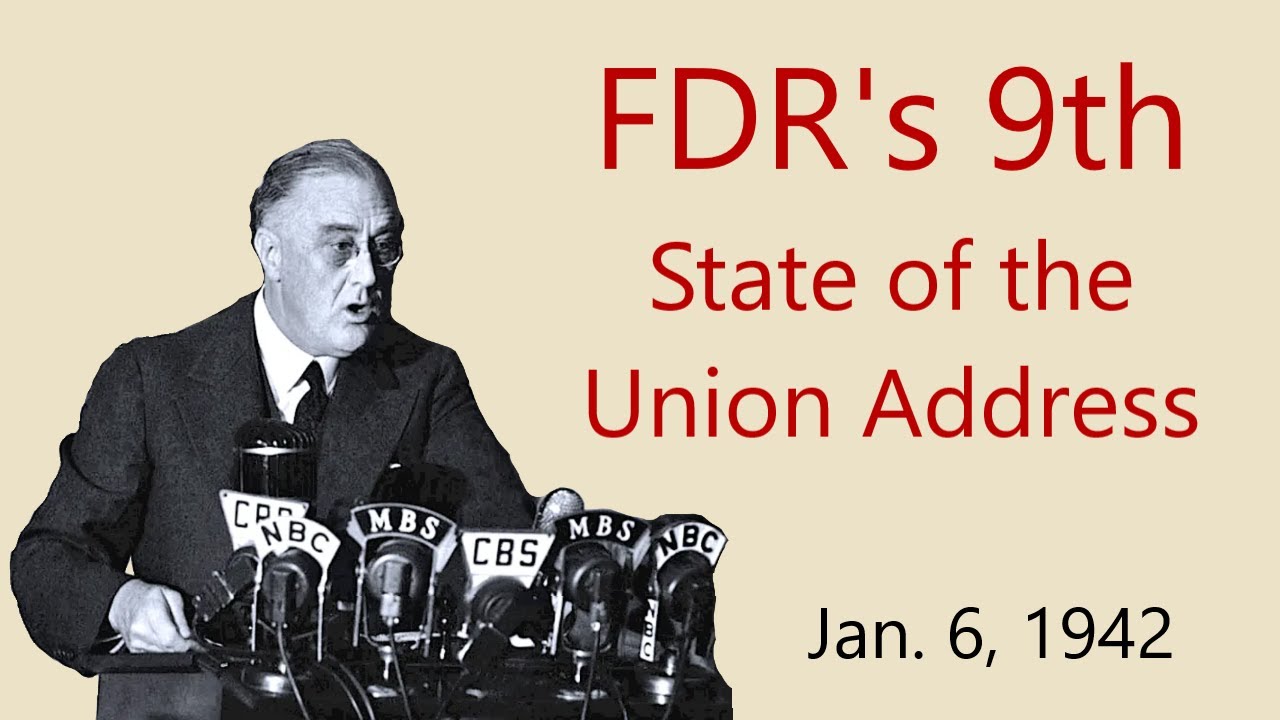
- FDR's 9th State of the Union Address
January 06, 1942 IN FULFILLING my duty to report upon the State of the Union, I am proud to say to you that the spirit of the American people was never higher than it is today—the Union was never more closely knit together—this country was never more deeply determined to face the solemn tasks before it. The response of the American people has been instantaneous, and it will be sustained until our security is assured. Exactly one year ago today I said to this Congress: "When the dictators. . . are ready to make war upon us, they will not wait for an act of war on our part. . . . They—not we—will choose the time and the place and the method of their attack." We now know their choice of the time: a peaceful Sunday morning— December 7, 1941. We know their choice of the place: an American outpost in the Pacific. We know their choice of the method: the method of Hitler himself. Japan's scheme of conquest goes back half a century. It was not merely a policy of seeking living room: it was a plan which included the subjugation of all the peoples in the Far East and in the islands of the Pacific, and the domination of that ocean by Japanese military and naval control of the western coasts of North, Central, and South America. The development of this ambitious conspiracy was marked by the war against China in 1894; the subsequent occupation of Korea; the war against Russia in 1904; the illegal fortification of the mandated Pacific islands following 1920; the seizure of Manchuria in 1931; and the invasion of China in 1937. A similar policy of criminal conquest was adopted by Italy. The Fascists first revealed their imperial designs in Libya and Tripoli. In 1935 they seized Abyssinia. Their goal was the domination of all North Africa, Egypt, parts of France, and the entire Mediterranean world. But the dreams of empire of the Japanese and Fascist leaders were modest in comparison with the gargantuan aspirations of Hitler and his Nazis. Even before they came to power in 1933, their plans for that conquest had been drawn. Those plans provided for ultimate domination, not of any one section of the world, but of the whole earth and all the oceans on it. When Hitler organized his Berlin-Rome-Tokyo alliance, all these plans of conquest became a single plan. Under this, in addition to her own schemes of conquest, Japan's role was obviously to cut off our supply of weapons of war to Britain, and Russia and China- weapons which increasingly were speeding the day of Hitler's doom. The act of Japan at Pearl Harbor was intended to stun us—to terrify us to such an extent that we would divert our industrial and military strength to the Pacific area, or even to our own continental defense. The plan has failed in its purpose. We have not been stunned. We have not been terrified or confused. This very reassembling of the Seventy-seventh Congress today is proof of that; for the mood of quiet, grim resolution which here prevails bodes ill for those who conspired and collaborated to murder world peace. That mood is stronger than any mere desire for revenge. It expresses the will of the American people to make very certain that the world will never so suffer again. Admittedly, we have been faced with hard choices. It was bitter, for example, not to be able to relieve the heroic and historic defenders of Wake Island. It was bitter for us not to be able to land a million men in a thousand ships in the Philippine Islands. But this adds only to our determination to see to it that the Stars and Stripes will fly again over Wake and Guam. Yes, see to it that the brave people of the Philippines will be rid of Japanese imperialism; and will live in freedom, security, and independence. Powerful and offensive actions must and will be taken in proper time. The consolidation of the United Nations' total war effort against our common enemies is being achieved. That was and is the purpose of conferences which have been held during the past two weeks in Washington, and Moscow and Chungking. That is the primary objective of the declaration of solidarity signed in Washington on January 1, 1942, by 26 Nations united against the Axis powers. Difficult choices may have to be made in the months to come. We do not shrink from such decisions. We and those united with us will make those decisions with courage and determination. Plans have been laid here and in the other capitals for coordinated and cooperative action by all the United Nations—military action and economic action. Already we have established, as you know, unified command of land, sea, and air forces in the southwestern Pacific theater of war. There will be a continuation of conferences and consultations among military staffs, so that the plans and operations of each will fit into the general strategy designed to crush the enemy. We shall not fight isolated wars—each Nation going its own way. These 26 Nations are united-not in spirit and determination alone, but in the broad conduct of the war in all its phases. For the first time since the Japanese and the Fascists and the Nazis started along their blood-stained course of conquest they now face the fact that superior forces are assembling against them. Gone forever are the days when the aggressors could attack and destroy their victims one by one without unity of resistance. We of the United Nations will so dispose our forces that we can strike at the common enemy wherever the greatest damage can be done him. The militarists of Berlin and Tokyo started this war. But the massed, angered forces of common humanity will finish it. Destruction of the material and spiritual centers of civilization-this has been and still is the purpose of Hitler and his Italian and Japanese chessmen. They would wreck the power of the British Commonwealth and Russia and China and the Netherlands—and then combine all their forces to achieve their ultimate goal, the conquest of the United States. They know that victory for us means victory for freedom. They know that victory for us means victory for the institution of democracy— the ideal of the family, the simple principles of common decency and humanity. They know that victory for us means victory for religion. And they could not tolerate that. The world is too small to provide adequate "living room" for both Hitler and God. In proof of that, the Nazis have now announced their plan for enforcing their new German, pagan religion all over the world—a plan by which the Holy Bible and the Cross of Mercy would be displaced by Mein Kampf and the swastika and the naked sword. Our own objectives are clear; the objective of smashing the militarism imposed by war lords upon their enslaved peoples the objective of liberating the subjugated Nations—the objective of establishing and securing freedom of speech, freedom of religion, freedom from want, and freedom from fear everywhere in the world. We shall not stop short of these objectives—nor shall we be satisfied merely to gain them and then call it a day. I know that I speak for the American people- and I have good reason to believe that I speak also for all the other peoples who fight with us—when I say that this time we are determined not only to win the war, but also to maintain the security of the peace that will follow. But we know that modern methods of warfare make it a task, not only of shooting and fighting, but an even more urgent one of working and producing. Victory requires the actual weapons of war and the means of transporting them to a dozen points of combat. It will not be sufficient for us and the other United Nations to produce a slightly superior supply of munitions to that of Germany, Japan, Italy, and the stolen industries in the countries which they have overrun. The superiority of the United Nations in munitions and ships must be overwhelming—so overwhelming that the Axis Nations can never hope to catch up with it. And so, in order to attain this overwhelming superiority the United States must build planes and tanks and guns and ships to the utmost limit of our national capacity. We have the ability and capacity to produce arms not only for our own forces, but also for the armies, navies, and air forces fighting on our side. And our overwhelming superiority of armament must be adequate to put weapons of war at the proper time into the hands of those men in the conquered Nations who stand ready to seize the first opportunity to revolt against their German and Japanese oppressors, and against the traitors in their own ranks, known by the already infamous name of "Quislings." And I think that it is a fair prophecy to say that, as we get guns to the patriots in those lands, they too will fire shots heard 'round the world. This production of ours in the United States must be raised far above present levels, even though it will mean the dislocation of the lives and occupations of millions of our own people. We must raise our sights all along the production line. Let no man say it cannot be done. It must be done—and we have undertaken to do it. I have just sent a letter of directive to the appropriate departments and agencies of our Government, ordering that immediate steps be taken: First, to increase our production rate of airplanes so rapidly that in this year, 1942, we shall produce 60,000 planes, 10,000 more than the goal that we set a year and a half ago. This includes 45,000 combat planes- bombers, dive bombers, pursuit planes. The rate of increase will be maintained and continued so that next year, 1943, we shall produce 125,000 airplanes, including 100,000 combat planes. Second, to increase our production rate of tanks so rapidly that in this year, 1942, we shall produce 45,000 tanks; and to continue that increase so that next year, 1943, we shall produce 75,000 tanks. Third, to increase our production rate of anti-aircraft guns so rapidly that in this year, 1942, we shall produce 20,000 of them; and to continue that increase so that next year, 1943, we shall produce 35,000 anti-aircraft guns. And fourth, to increase our production rate of merchant ships so rapidly that in this year, 1942, we shall build 6,000,000 deadweight tons as compared with a 1941 completed production of 1,100,000. And finally, we shall continue that increase so that next year, 1943, we shall build 10,000,000 tons of shipping. These figures and similar figures for a multitude of other implements of war will give the Japanese and the Nazis a little idea of just what they accomplished in the attack at Pearl Harbor. And I rather hope that all these figures which I have given will become common knowledge in Germany and Japan. Our task is hard- our task is unprecedented—and the time is short. We must strain every existing armament-producing facility to the utmost. We must convert every available plant and tool to war production. That goes all the way from the greatest plants to the smallest—from the huge automobile industry to the village machine shop. Production for war is based on men and women—the human hands and brains which collectively we call Labor. Our workers stand ready to work long hours; to turn out more in a day's work; to keep the wheels turning and the fires burning twenty-four hours a day, and seven days a week. They realize well that on the speed and efficiency of their work depend the lives of their sons and their brothers on the fighting fronts. Production for war is based on metals and raw materials-steel, copper, rubber, aluminum, zinc, tin. Greater and greater quantities of them will have to be diverted to war purposes. Civilian use of them will have to be cut further and still further —and, in many cases, completely eliminated. War costs money. So far, we have hardly even begun to pay for it. We have devoted only 15 percent of our national income to national defense. As will appear in my Budget Message tomorrow, our war program for the coming fiscal year will cost 56 billion dollars or, in other words, more than half of the estimated annual national income. That means taxes and bonds and bonds and taxes. It means cutting luxuries and other non-essentials. In a word, it means an "all-out" war by individual effort and family effort in a united country. Only this all-out scale of production will hasten the ultimate all-out victory. Speed will count. Lost ground can always be regained- lost time never. Speed will save lives; speed will save this Nation which is in peril; speed will save our freedom and our civilization—and slowness has never been an American characteristic. As the United States goes into its full stride, we must always be on guard against misconceptions which will arise, some of them naturally, or which will be planted among us by our enemies. We must guard against complacency. We must not underrate the enemy. He is powerful and cunning—and cruel and ruthless. He will stop at nothing that gives him a chance to kill and to destroy. He has trained his people to believe that their highest perfection is achieved by waging war. For many years he has prepared for this very conflict- planning, and plotting, and training, arming, and fighting. We have already tasted defeat. We may suffer further setbacks. We must face the fact of a hard war, a long war, a bloody war, a costly war. We must, on the other hand, guard against defeatism. That has been one of the chief weapons of Hitler's propaganda machine—used time and again with deadly results. It will not be used successfully on the American people. We must guard against divisions among ourselves and among all the other United Nations. We must be particularly vigilant against racial discrimination in any of its ugly forms. Hitler will try again to breed mistrust and suspicion between one individual and another, one group and another, one race and another, one Government and another. He will try to use the same technique of falsehood and rumor-mongering with which he divided France from Britain. He is trying to do this with us even now. But he will find a unity of will and purpose against him, which will persevere until the destruction of all his black designs upon the freedom and safety of the people of the world. We cannot wage this war in a defensive spirit. As our power and our resources are fully mobilized, we shall carry the attack against the enemy—we shall hit him and hit him again wherever and whenever we can reach him. We must keep him far from our shores, for we intend to bring this battle to him on his own home grounds. American armed forces must be used at any place in all the world where it seems advisable to engage the forces of the enemy. In some cases these operations will be defensive, in order to protect key positions. In other cases, these operations will be offensive, in order to strike at the common enemy, with a view to his complete encirclement and eventual total defeat. American armed forces will operate at many points in the Far East. American armed forces will be on all the oceans- helping to guard the essential communications which are vital to the United Nations. American land and air and sea forces will take stations in the British Isles- which constitute an essential fortress in this great world struggle. American armed forces will help to protect this hemisphere—and also help to protect bases outside this hemisphere, which could be used for an attack on the Americas. If any of our enemies, from Europe or from Asia, attempt long-range raids by "suicide" squadrons of bombing planes, they will do so only in the hope of terrorizing our people and disrupting our morale. Our people are not afraid of that. We know that we may have to pay a heavy price for freedom. We will pay this price with a will. Whatever the price, it is a thousand times worth it. No matter what our enemies, in their desperation, may attempt to do to us- we will say, as the people of London have said, "We can take it." And what's more we can give it back and we will give it back—with compound interest. When our enemies challenged our country to stand up and fight, they challenged each and every one of us. And each and every one of us has accepted the challenge—for himself and for his Nation. There were only some 400 United States Marines who in the heroic and historic defense of Wake Island inflicted such great losses on the enemy. Some of those men were killed in action; and others are now prisoners of war. When the survivors of that great fight are liberated and restored to their homes, they will learn that a hundred and thirty million of their fellow citizens have been inspired to render their own full share of service and sacrifice. We can well say that our men on the fighting fronts have already proved that Americans today are just as rugged and just as tough as any of the heroes whose exploits we celebrate on the Fourth of July. Many people ask, "When will this war end?" There is only one answer to that. It will end just as soon as we make it end, by our combined efforts, our combined strength, our combined determination to fight through and work through until the end —the end of militarism in Germany and Italy and Japan. Most certainly we shall not settle for less. That is the spirit in which discussions have been conducted during the visit of the British Prime Minister to Washington. Mr. Churchill and I understand each other, our motives and our purposes. Together, during the past two weeks, we have faced squarely the major military and economic problems of this greatest world war. All in our Nation have been cheered by Mr. Churchill's visit. We have been deeply stirred by his great message to us. He is welcome in our midst, and we unite in wishing him a safe return to his home. For we are fighting on the same side with the British people, who fought alone for long, terrible months, and withstood the enemy with fortitude and tenacity and skill. We are fighting on the same side with the Russian people who have seen the Nazi hordes swarm up to the very gates of Moscow, and who with almost superhuman will and courage have forced the invaders back into retreat. We are fighting on the same side as the brave people of China—those millions who for four and a half long years have withstood bombs and starvation and have whipped the invaders time and again in spite of the superior Japanese equipment and arms. Yes, we are fighting on the same side as the indomitable Dutch. We are fighting on the same side as all the other Governments in exile, whom Hitler and all his armies and all his Gestapo have not been able to conquer. But we of the United Nations are not making all this sacrifice of human effort and human lives to return to the kind of world we had after the last world war. We are fighting today for security, for progress, and for peace, not only for ourselves but for all men, not only for one generation but for all generations. We are fighting to cleanse the world of ancient evils, ancient ills. Our enemies are guided by brutal cynicism, by unholy contempt for the human race. We are inspired by a faith that goes back through all the years to the first chapter of the Book of Genesis: "God created man in His own image." We on our side are striving to be true to that divine heritage. We are fighting, as our fathers have fought, to uphold the doctrine that all men are equal in the sight of God. Those on the other side are striving to destroy this deep belief and to create a world in their own image—a world of tyranny and cruelty and serfdom. That is the conflict that day and night now pervades our lives. No compromise can end that conflict. There never has been—there never can be—successful compromise between good and evil. Only total victory can reward the champions of tolerance, and decency, and freedom, and faith. Source: https://www.presidency.ucsb.edu/documents/state-the-union-address-1
- Day of Infamy Speech
Mr. Vice President, Mr. Speaker, Members of the Senate and House of Representatives: YESTERDAY, December 7, 1941 a date which will live in infamy the United States of America was suddenly and deliberately attacked by naval and air forces of the Empire of Japan. The United States was at peace with that Nation and, at solicitation of Japan, was still in conversation with its Government and its Emperor looking toward the maintenance of peace in the Pacific. Indeed, one hour after Japanese air squadrons had commenced bombing in the American Island of Oahu, the Japanese Ambassador to the United States and his colleague delivered to our Secretary of State a formal reply to a recent American Message. And while this reply stated that it seemed useless to continue the existing diplomatic negotiations, it contained no threat or hint of war or of armed attack. It will be recorded that the distance of Hawaii from Japan makes it obvious that the attack was deliberately planned many days or even weeks ago. During the intervening time the Japanese Government has deliberately sought to deceive the United States by false statements and expressions of hope for continued peace. The attack yesterday on the Hawaiian Islands has caused severe damage to American naval and military forces. I regret to tell you that very many American lives have been lost. In addition American ships have been reported torpedoed on the high seas between San Francisco and Honolulu. Yesterday the Japanese Government also launched an attack against Malaya. Last night Japanese forces attacked Hong Kong. Last night Japanese forces attacked Guam. Last Night Japanese forces attacked the Philippine Islands. Last night the Japanese attacked Wake Island. And this morning the Japanese attacked Midway Island. Japan has, therefore, undertaken a surprise offensive extending throughout the Pacific area. The facts of yesterday and today speak for themselves. The people of the United States have already formed their opinions and well understand the implications to the very life and safety of our Nation. As Commander in Chief of the Army and Navy I have directed that all measures be taken for our defense. But always will our whole Nation remember the character of the onslaught against us. No matter how long it may take us to overcome this premeditated invasion, the American people in their righteous might will win through to absolute victory. I believe that I interpret the will of the Congress and of the people when I assert that we will not only defend ourselves to the utmost but will make it very certain that this form of treachery shall never again endanger us. Hostilities exist. There is no blinking at the fact that our people, our territory, and our interests are in grave danger. With confidence in our armed forces with the unbounding determination of our people we will gain the inevitable triumph so help us God. I ask that the Congress declare that since the unprovoked and dastardly attack by Japan on Sunday, December 7, 1941, a state of war has existed between the United States and the Japanese Empire. Source: https://www.presidency.ucsb.edu/documents/state-the-union-address-1
- 151st State of the Union FDR’s Seventh Annual Message
151st State of the Union FDR’s Seventh Annual Message January 03, 1940 Mr. Vice President, Mr. Speaker, Members of the Senate and the House of Representatives: I wish each and every one of you a very happy New Year. As the Congress reassembles, the impact of war abroad makes it natural to approach "the state of the union" through a discussion of foreign affairs. But it is important that those who hear and read this message should in no way confuse that approach with any thought that our Government is abandoning, or even overlooking, the great significance of its domestic policies. The social and economic forces which have been mismanaged abroad until they have resulted in revolution, dictatorship and war are the same as those which we here are struggling to adjust peacefully at home. You are well aware that dictatorships—and the philosophy of force that justifies and accompanies dictatorships—have originated in almost every case in the necessity for drastic action to improve internal conditions in places where democratic action for one reason or another has failed to respond to modern needs and modern demands. It was with far-sighted wisdom that the framers of our Constitution brought together in one magnificent phrase three great concepts—"common defense," "general welfare" and "domestic tranquility." More than a century and a half later we, who are here today, still believe with them that our best defense is the promotion of our general welfare and domestic tranquillity. In previous messages to the Congress I have repeatedly warned that, whether we like it or not, the daily lives of American citizens will, of necessity, feel the shock of events on other continents. This is no longer mere theory; because it has been definitely proved to us by the facts of yesterday and today. To say that the domestic well-being of one hundred and thirty million Americans is deeply affected by the well-being or the ill-being of the populations of other nations is only to recognize in world affairs the truth that we all accept in home affairs. If in any local unit-a city, county, State or region—low standards of living are permitted to continue, the level of the civilization of the entire nation will be pulled downward. The identical principle extends to the rest of the civilized world. But there are those who wishfully insist, in innocence or ignorance or both, that the United States of America as a self-contained unit can live happily and prosperously, its future secure, inside a high wall of isolation while, outside, the rest of Civilization and the commerce and culture of mankind are shattered. I can understand the feelings of those who warn the nation that they will never again consent to the sending of American youth to fight on the soil of Europe. But, as I remember, nobody has asked them to consent—for nobody expects such an undertaking. The overwhelming majority of our fellow citizens do not abandon in the slightest their hope and their expectation that the United States will not become involved in military participation in these wars. I can also understand the wishfulness of those who oversimplify the whole situation by repeating that all we have to do is to mind our own business and keep the nation out of war. But there is a vast difference between keeping out of war and pretending that this war is none of our business. We do not have to go to war with other nations, but at least we can strive with other nations to encourage the kind of peace that will lighten the troubles of the world, and by so doing help our own nation as well. I ask that all of us everywhere think things through with the single aim of how best to serve the future of our own nation. I do not mean merely its future relationship with the outside world. I mean its domestic future as well—the work, the security, the prosperity, the happiness, the life of all the boys and girls in the United States, as they are inevitably affected by such world relationships. For it becomes clearer and clearer that the future world will be a shabby and dangerous place to live in-yes, even for Americans to live in—if it is ruled by force in the hands of a few. Already the crash of swiftly moving events over the earth has made us all think with a longer view. Fortunately, that thinking cannot be controlled by partisanship. The time is long past when any political party or any particular group can curry or capture public favor by labeling itself the "peace party" or the "peace bloc." That label belongs to the whole United States and to every right thinking man, woman and child within it. For out of all the military and diplomatic turmoil, out of all the propaganda, and counter-propaganda of the present conflicts, there are two facts which stand out, and which the whole world acknowledges. The first is that never before has the Government of the United States of America done so much as in our recent past to establish and maintain the policy of the Good Neighbor with its sister nations. The second is that in almost every nation in the world today there is a true public belief that the United States has been, and will continue to be, a potent and active factor in seeking the reestablishment of world peace. In these recent years we have had a clean record of peace and good-will. It is an open book that cannot be twisted or defamed. It is a record that must be continued and enlarged. So I hope that Americans everywhere will work out for themselves the several alternatives which lie before world civilization, which necessarily includes our own. We must look ahead and see the possibilities for our children if the rest of the world comes to be dominated by concentrated force alone—even though today we are a very great and a very powerful nation. We must look ahead and see the effect on our own future if all the small nations of the world have their independence snatched from them or become mere appendages to relatively vast and powerful military systems. We must look ahead and see the kind of lives our children would have to lead if a large part of the rest of the world were compelled to worship a god imposed by a military ruler, or were forbidden to worship God at all; if the rest of the world were forbidden to read and hear the facts—the daily news of their own and other nations—if they were deprived of the truth that makes men free. We must look ahead and see the effect on our future generations if world trade is controlled by any nation or group of nations 'which sets up that control through military force. It is, of course, true that the record of past centuries includes destruction of many small nations, the enslavement of peoples, and the building of empires on the foundation of force. But wholly apart from the greater international morality which we seek today, we recognize the practical fact that with modern weapons and modern conditions, modern man can no longer lead a civilized life if we are to go back to the practice of wars and conquests of the seventeenth and eighteenth centuries. Summing up this need of looking ahead, and in words of common sense and good American citizenship. I hope that we shall have fewer American ostriches in our midst. It is not good for the ultimate health of ostriches to bury their heads in the sand. Only an ostrich would look upon these wars through the eyes of cynicism or ridicule. Of course, the peoples of other nations have the right to choose their own form of Government. But we in this nation still believe that such choice should be predicated on certain freedoms which we think are essential everywhere. We know that we ourselves shall never be wholly safe at home unless other governments recognize such freedoms. Twenty-one American Republics, expressing the will of two hundred and fifty million people to preserve peace and freedom in this Hemisphere, are displaying a unanimity of ideals and practical relationships which gives hope that what is being done here can be done on other continents. We in all the Americas are coming to the realization that we can retain our respective nationalities without, at the same time, threatening the national existence of our neighbors. Such truly friendly relationships, for example, permit us to follow our own domestic policies with reference to our agricultural products, while at the same time we have the privilege of trying to work out mutual assistance arrangements for a world distribution of world agricultural surpluses. And we have been able to apply the same simple principle to many manufactured products—surpluses of which must be sold in the world export markets if we intend to continue a high level of production and employment. For many years after the World War blind economic selfishness in most countries, including our own, resulted in a destructive mine-field of trade restrictions which blocked the channels of commerce among nations. Indeed, this policy was one of the contributing causes of existing wars. It dammed up vast unsalable surpluses, helping to bring about unemployment and suffering in the United States and everywhere else. To point the way to break up that log-jam our Trade Agreements Act was passed-based upon a policy of equality of treatment among nations and of mutually profitable arrangements of trade. It is not correct to infer that legislative powers have been transferred from the Congress to the Executive Branch of the Government. Everyone recognizes that general tariff legislation is a Congressional function; but we know that, because of the stupendous task involved in the fashioning and the passing of a general tariff law, it is advisable to provide at times of emergency some flexibility to make the general law adjustable to quickly changing conditions. We are in such a time today. Our present trade agreement method provides a temporary flexibility and is, therefore, practical in the best sense. It should be kept alive to serve our trade interests—agricultural and industrial—in many valuable ways during the existing wars. But what is more important, the Trade Agreements Act should be extended as an indispensable part of the foundation of any stable and enduring peace. The old conditions of world trade made for no enduring peace; and when the time comes, the United States must use its influence to open up the trade channels of the world, in all nations, in order that no one nation need feel compelled in later days to seek by force of arms what it can well gain by peaceful conference. For that purpose, too, we need the Trade Agreements Act even more today than when it was passed. I emphasize the leadership which this nation can take when the time comes for a renewal of world peace. Such an influence will be greatly weakened if this Government becomes a dog in the manger of trade selfishness. The first President of the United States warned us against entangling foreign alliances. The present President of the United States subscribes to and follows that precept. I hope that most of you will agree that trade cooperation with the rest of the world does not violate that precept in any way. Even as through these trade agreements we prepare to cooperate in a world that wants peace, we must likewise be prepared to take care of ourselves if the world cannot attain peace. For several years past we have been compelled to strengthen our own national defense. That has created a very large portion of our Treasury deficits. This year in the light of continuing world uncertainty, I am asking the Congress for Army and Navy increases which are based not on panic but on common sense. They are not as great as enthusiastic alarmists seek. They are not as small as unrealistic persons claiming superior private information would demand. As will appear in the annual budget tomorrow, the only important increase in any part of the budget is the estimate for national defense. Practically all other important items show a reduction. But you know, you can't eat your cake and have it too. Therefore, in the hope that we can continue in these days of increasing economic prosperity to reduce the Federal deficit, I am asking the Congress to levy sufficient additional taxes to meet the emergency spending for national defense. Behind the Army and Navy, of course, lies our ultimate line of defense—"the general welfare" of our people. We cannot report, despite all the progress that we have made in our domestic problems—despite the fact that production is back to 1929 levels—that all our problems are solved. The fact of unemployment of millions of men and women remains a symptom of a number of difficulties in our economic system not yet adjusted. While the number of the unemployed has decreased very greatly, while their immediate needs for food and clothing-as far as the Federal Government is concerned—have been largely met, while their morale has been kept alive by giving them useful public work, we have not yet found a way to employ the surplus of our labor which the efficiency of our industrial processes has created. We refuse the European solution of using the unemployed to build up excessive armaments which eventually result in dictatorships and war. We encourage an American way—through an increase of national income which is the only way we can be sure will take up the slack. Much progress has been made; much remains to be done. We recognize that we must find an answer in terms of work and opportunity. The unemployment problem today has become very definitely a problem of youth as well as of age. As each year has gone by hundreds of thousands of boys and girls have come of working age. They now form an army of unused youth. They must be an especial concern of democratic Government. We must continue, above all things, to look for a solution of their special problem. For they, looking ahead to life, are entitled to action on our part and not merely to admonitions of optimism or lectures on economic laws. Some in our midst have sought to instill a feeling of fear and defeatism in the minds of the American people about this problem. To face the task of finding jobs faster than invention can take them away—is not defeatism. To warble easy platitudes that if we would only go back to ways that have failed, everything would be all right—is not courage. In 1933 we met a problem of real fear and real defeatism. We faced the facts—with action and not with words alone. The American people will reject the doctrine of fear, confident that in the 'thirties we have been building soundly a new order of things, different from the order of the 'twenties. In this dawn of the decade of the 'forties, with our program of social improvement started, we will continue to carry on the processes of recovery, so as to preserve our gains and provide jobs at living wages. There are, of course, many other items of great public interest which could be enumerated in this message—the continued conservation of our natural resources, the improvement of health and of education, the extension of social security to larger groups, the freeing of large areas from restricted transportation discriminations, the extension of the merit system and many others. Our continued progress in the social and economic field is important not only for the significance of each part of it but for the total effect which our program of domestic betterment has upon that most valuable asset of a nation in dangerous times—its national unity. The permanent security of America in the present crisis does not lie in armed force alone. What we face is a set of world-wide forces of disintegration—vicious, ruthless, destructive of all the moral, religious and political standards which mankind, after centuries of struggle, has come to cherish most. In these moral values, in these forces which have made our nation great, we must actively and practically reassert our faith. These words-"national unity"-must not be allowed to be come merely a high-sounding phrase, a vague generality, a pious hope, to which everyone can give lip-service. They must be made to have real meaning in terms of the daily thoughts and acts of every man, woman and child in our land during the coming year and during the years that lie ahead. For national unity is, in a very real and a very deep sense, the fundamental safeguard of all democracy. Doctrines that set group against group, faith against faith, race against race, class against class, fanning the fires of hatred in men too despondent, too desperate to think for themselves, were used as rabble-rousing slogans on which dictators could ride to power. And once in power they could saddle their tyrannies on whole nations and on their weaker neighbors. This is the danger to which we in America must begin to be more alert. For the apologists for foreign aggressors, and equally those selfish and partisan groups at home who wrap themselves in a false mantle of Americanism to promote their own economic, financial or political advantage, are now trying European tricks upon us, seeking to muddy the stream of our national thinking, weakening us in the face of danger, by trying to set our own people to fighting among themselves. Such tactics are what have helped to plunge Europe into war. We must combat them, as we would the plague, if American integrity and American security are to be preserved. We cannot afford to face the future as a disunited people. We must as a united people keep ablaze on this continent the flames of human liberty, of reason, of democracy and of fair play as living things to be preserved for the better world that is to come. Overstatement, bitterness, vituperation, and the beating of drums have contributed mightily to ill-feeling and wars between nations. If these unnecessary and unpleasant actions are harmful in the international field, if they have hurt in other parts of the world, they are also harmful in the domestic scene. Peace among ourselves would seem to have some of the advantage of peace between us and other nations. In the long run history amply demonstrates that angry controversy surely wins less than calm discussion. In the spirit, therefore, of a greater unselfishness, recognizing that the world—including the United States of America—passes through perilous times, I am very hopeful that the closing session of the Seventy-sixth Congress will consider the needs of the nation and of humanity with calmness, with tolerance and with cooperative wisdom. May the year 1940 be pointed to by our children as another period when democracy justified its existence as the best instrument of government yet devised by mankind. Source: https://www.presidency.ucsb.edu/documents/annual-message-the-congress
- 150th State of the Union FDR’s Sixth Annual Message
150th State of the Union FDR’s Sixth Annual Message January 4, 1939 Mr. Vice President, Mr. Speaker, Members of the Senate and the Congress: In Reporting on the state of the nation, I have felt it necessary on previous occasions to advise the Congress of disturbance abroad and of the need of putting our own house in order in the face of storm signals from across the seas. As this Seventy-sixth Congress opens there is need for further warning. A war which threatened to envelop the world in flames has been averted; but it has become increasingly clear that world peace is not assured. All about us rage undeclared wars—military and economic. All about us grow more deadly armaments—military and economic. All about us are threats of new aggression military and economic. Storms from abroad directly challenge three institutions indispensable to Americans, now as always. The first is religion. It is the source of the other two—democracy and international good faith. Religion, by teaching man his relationship to God, gives the individual a sense of his own dignity and teaches him to respect himself by respecting his neighbors. Democracy, the practice of self-government, is a covenant among free men to respect the rights and liberties of their fellows. International good faith, a sister of democracy, springs from the will of civilized nations of men to respect the rights and liberties of other nations of men. In a modern civilization, all three—religion, democracy and international good faith- complement and support each other. Where freedom of religion has been attacked, the attack has come from sources opposed to democracy. Where democracy has been overthrown, the spirit of free worship has disappeared. And where religion and democracy have vanished, good faith and reason in international affairs have given way to strident ambition and brute force. An ordering of society which relegates religion, democracy and good faith among nations to the background can find no place within it for the ideals of the Prince of Peace. The United States rejects such an ordering, and retains its ancient faith. There comes a time in the affairs of men when they must prepare to defend, not their homes alone, but the tenets of faith and humanity on which their churches, their governments and their very civilization are founded. The defense of religion, of democracy and of good faith among nations is all the same fight. To save one we must now make up our minds to save all. We know what might happen to us of the United States if the new philosophies of force were to encompass the other continents and invade our own. We, no more than other nations, can afford to be surrounded by the enemies of our faith and our humanity. Fortunate it is, therefore, that in this Western Hemisphere we have, under a common ideal of democratic government, a rich diversity of resources and of peoples functioning together in mutual respect and peace. That Hemisphere, that peace, and that ideal we propose to do our share in protecting against storms from any quarter. Our people and our resources are pledged to secure that protection. From that determination no American flinches. This by no means implies that the American Republics disassociate themselves from the nations of other continents. It does not mean the Americas against the rest of the world. We as one of the Republics reiterate our willingness to help the cause of world peace. We stand on our historic offer to take counsel with all other nations of the world to the end that aggression among them be terminated, that the race of armaments cease and that commerce be renewed. But the world has grown so small and weapons of attack so swift that no nation can be safe in its will to peace so long as any other powerful nation refuses to settle its grievances at the council table. For if any government bristling with implements of war insists on policies of force, weapons of defense give the only safety. In our foreign relations we have learned from the past what not to do. From new wars we have learned what we must do. We have learned that effective timing of defense, and the distant points from which attacks may be launched are completely different from what they were twenty years ago. We have learned that survival cannot be guaranteed by arming after the attack begins—for there is new range and speed to offense. We have learned that long before any overt. military act, aggression begins with preliminaries of propaganda, subsidized penetration, the loosening of ties of good will, the stirring of prejudice and the incitement to disunion. We have learned that God-fearing democracies of the world which observe the sanctity of treaties and good faith in their dealings with other nations cannot safely be indifferent to international lawlessness anywhere. They cannot forever let pass, without effective protest, acts of aggression against sister nations-acts which automatically undermine all of us. Obviously they must proceed along practical, peaceful lines. But the mere fact that we rightly decline to intervene with arms to prevent acts of aggression does not mean that we must act as if there were no aggression at all. Words may be futile, but war is not the only means of commanding a decent respect for the opinions of mankind. There are many methods short of war, but stronger and more effective than mere words, of bringing home to aggressor governments the aggregate sentiments of our own people. At the very least, we can and should avoid any action, or any lack of action, which will encourage, assist or build up an aggressor. We have learned that when we deliberately try to legislate neutrality, our neutrality laws may operate unevenly and unfairly—may actually give aid to an aggressor and deny it to the victim. The instinct of self-preservation should warn us that we ought not to let that happen any more. And we have learned something else—the old, old lesson that probability of attack is mightily decreased by the assurance of an ever ready defense. Since 1931, nearly eight years ago, world events of thunderous import have moved with lightning speed. During these eight years many of our people clung to the hope that the innate decency of mankind would protect the unprepared who showed their innate trust in mankind. Today we are all wiser—and sadder. Under modern conditions what we mean by "adequate defense"—a policy subscribed to by all of us—must be divided into three elements. First, we must have armed forces and defenses strong enough to ward off sudden attack against strategic positions and key facilities essential to ensure sustained resistance and ultimate victory. Secondly, we must have the organization and location of those key facilities so that they may be immediately utilized and rapidly expanded to meet all needs without danger of serious interruption by enemy attack. In the course of a few days I shall send you a special message making recommendations for those two essentials of defense against danger which we cannot safely assume will not come. If these first two essentials are reasonably provided for, we must be able confidently to invoke the third element, the underlying strength of citizenship—the self-confidence, the ability, the imagination and the devotion that give the staying power to see things through. A strong and united nation may be destroyed if it is unprepared against sudden attack. But even a nation well armed and well organized from a strictly military standpoint may, after a period of time, meet defeat if it is unnerved by self-distrust, endangered by class prejudice, by dissension between capital and labor, by false economy and by other unsolved social problems at home. In meeting the troubles of the world we must meet them as one people—with a unity born of the fact that for generations those who have come to our shores, representing many kindreds and tongues, have been welded by common opportunity into a united patriotism. If another form of government can present a united front in its attack on a democracy, the attack must and will be met by a united democracy. Such a democracy can and must exist in the United States. A dictatorship may command the full strength of a regimented nation. But the united strength of a democratic nation can be mustered only when its people, educated by modern standards to know what is going on and where they are going, have conviction that they are receiving as large a share of opportunity for development, as large a share of material success and of human dignity, as they have a right to receive. Our nation's program of social and economic reform is therefore a part of defense, as basic as armaments themselves. Against the background of events in Europe, in Africa and in Asia during these recent years, the pattern of what we have accomplished since 1933 appears in even clearer focus. For the first time we have moved upon deep-seated problems affecting our national strength and have forged national instruments adequate to meet them. Consider what the seemingly piecemeal struggles of these six years add up to in terms of realistic national preparedness. We are conserving and developing natural resources-land, water power, forests. We are trying to provide necessary food, shelter and medical care for the health of our population. We are putting agriculture—our system of food and fibre supply—on a sounder basis. We are strengthening the weakest spot in our system of industrial supply- its long smouldering labor difficulties. We have cleaned up our credit system so that depositor and investor alike may more readily and willingly make their capital available for peace or war. We are giving to our youth new opportunities for work and education. We have sustained the morale of all the population by the dignified recognition of our obligations to the aged, the helpless and the needy. Above all, we have made the American people conscious of their interrelationship and their interdependence. They sense a common destiny and a common need of each other. Differences of occupation, geography, race and religion no longer obscure the nation's fundamental unity in thought and in action. We have our difficulties, true—but we are a wiser and a tougher nation than we were in 1929, or in 1932. Never have there been six years of such far-flung internal preparedness in our history. And this has been done without any dictator's power to command, without conscription of labor or confiscation of capital, without concentration camps and without a scratch on freedom of speech, freedom of the press or the rest of the Bill of Rights. We see things now that we could not see along the way. The tools of government which we had in 1933 are outmoded. We have had to forge new tools for a new role of government operating in a democracy—a role of new responsibility for new needs and increased responsibility for old needs, long neglected. Some of these tools had to be roughly shaped and still need some machining down. Many of those who fought bitterly against the forging of these new tools welcome their use today. The American people, as a whole, have accepted them. The Nation looks to the Congress to improve the new machinery which we have permanently installed, provided that in the process the social usefulness of the machinery is not destroyed or impaired. All of us agree that we should simplify and improve laws if experience and operation clearly demonstrate the need. For instance, all of us want better provision for our older people under our social security legislation. For the medically needy we must provide better care. Most of us agree that for the sake of employer and employee alike we must find ways to end factional labor strife and employer-employee disputes. Most of us recognize that none of these tools can be put to maximum effectiveness unless the executive processes of government are revamped—reorganized, if you will—into more effective combination. And even after such reorganization it will take time to develop administrative personnel and experience in order to use our new tools with a minimum of mistakes. The Congress, of course, needs no further information on this. With this exception of legislation to provide greater government efficiency, and with the exception of legislation to ameliorate our railroad and other transportation problems, the past three Congresses have met in part or in whole the pressing needs of the new order of things. We have now passed the period of internal conflict in the launching of our program of social reform. Our full energies may now be released to invigorate the processes of recovery in order to preserve our reforms, and to give every man and woman who wants to work a real job at a living wage. But time is of paramount importance. The deadline of danger from within and from without is not within our control. The hour-glass may be in the hands of other nations. Our own hour-glass tells us that we are off on a race to make democracy work, so that we may be efficient in peace and therefore secure in national defense. This time element forces us to still greater efforts to attain the full employment of our labor and our capital. The first duty of our statesmanship is to bring capital and man-power together. Dictatorships do this by main force. By using main force they apparently succeed at it—for the moment. However we abhor their methods, we are compelled to admit that they have obtained substantial utilization of all their material and human resources. Like it or not, they have solved, for a time at least, the problem of idle men and idle capital. Can we compete with them by boldly seeking methods of putting idle men and idle capital together and, at the same time, remain within our American way of life, within the Bill of Rights, and within the bounds of what is, from our point of view, civilization itself? We suffer from a great unemployment of capital. Many people have the idea that as a nation we are overburdened with debt and are spending more than we can afford. That is not so. Despite our Federal Government expenditures the entire debt of our national economic system, public and private together, is no larger today than it was in 1929, and the interest thereon is far less than it was in 1929. The object is to put capital—private as well as public—to work. We want to get enough capital and labor at work to give us a total turnover of business, a total national income, of at least eighty billion dollars a year. At that figure we shall have a substantial reduction of unemployment; and the Federal Revenues will be sufficient to balance the current level of cash expenditures on the basis of the existing tax structure. That figure can be attained, working within the framework of our traditional profit system. The factors in attaining and maintaining that amount of national income are many and complicated. They include more widespread understanding among business men of many changes which world conditions and technological improvements have brought to our economy over the last twenty years—changes in the interrelationship of price and volume and employment, for example- changes of the kind in which business men are now educating themselves through excellent opportunities like the so-called "monopoly investigation. They include a perfecting of our farm program to protect farmers' income and consumers' purchasing power from alternate risks of crop gluts and crop shortages. They include wholehearted acceptance of new standards of honesty in our financial markets. They include reconcilement of enormous, antagonistic interests—some of them long in litigation—in the railroad and general transportation field. They include the working out of new techniques—private, state and federal—to protect the public interest in and to develop wider markets for electric power. They include a revamping of the tax relationships between federal, state and local units of government, and consideration of relatively small tax increases to adjust inequalities without interfering with the aggregate income of the American people. They include the perfecting of labor organization and a universal ungrudging attitude by employers toward the labor movement, until there is a minimum of interruption of production and employment because of disputes, and acceptance by labor of the truth that the welfare of labor itself depends on increased balanced out-put of goods. To be immediately practical, while proceeding with a steady evolution in the solving of these and like problems, we must wisely use instrumentalities, like Federal investment, which are immediately available to us. Here, as elsewhere, time is the deciding factor in our choice of remedies. Therefore, it does not seem logical to me, at the moment we seek to increase production and consumption, for the Federal Government to consider a drastic curtailment of its own investments. The whole subject of government investing and government income is one which may be approached in two different ways. The first calls for the elimination of enough activities of government to bring the expenses of government immediately into balance with income of government. This school of thought maintains that because our national income this year is only sixty billion dollars, ours is only a sixty billion dollar country; that government must treat it as such; and that without the help of government, it may some day, somehow, happen to become an eighty billion dollar country. If the Congress decides to accept this point of view, it will logically have to reduce the present functions or activities of government by one-third. Not only will the Congress have to accept the responsibility for such reduction; but the Congress will have to determine which activities are to be reduced. Certain expenditures we cannot possibly reduce at this session, such as the interest on the public debt. A few million dollars saved here or there in the normal or in curtailed work of the old departments and commissions will make no great saving in the Federal budget. Therefore, the Congress would have to reduce drastically some of certain large items, very large items, such as aids to agriculture and soil conservation, veterans' pensions, flood control, highways, waterways and other public works, grants for social and health security, Civilian Conservation Corps activities, relief for the unemployed, or national defense itself. The Congress alone has the power to do all this, as it is the appropriating branch of the government. The other approach to the question of government spending takes the position that this Nation ought not to be and need not be only a sixty billion dollar nation; that at this moment it has the men and the resources sufficient to make it at least an eighty billion dollar nation. This school of thought does not believe that it can become an eighty billion dollar nation in the near future if government cuts its operations by one-third. It is convinced that if we were to try it, we would invite disaster—and that we would not long remain even a sixty billion dollar nation. There are many complicated factors with which we have to deal, but we have learned that it is unsafe to make abrupt reductions at any time in our net expenditure program. By our common sense action of resuming government activities last spring, we have reversed a recession and started the new rising tide of prosperity and national income which we are now just beginning to enjoy. If government activities are fully maintained, there is a good prospect of our becoming an eighty billion dollar country in a very short time. With such a national income, present tax laws will yield enough each year to balance each year's expenses. It is my conviction that down in their hearts the American public—industry, agriculture, finance—want this Congress to do whatever needs to be done to raise our national income to eighty billion dollars a year. Investing soundly must preclude spending wastefully. To guard against opportunist appropriations, I have on several occasions addressed the Congress on the importance of permanent long-range planning. I hope, therefore, that following my recommendation of last year, a permanent agency will be set up and authorized to report on the urgency and desirability of the various types of government investment. Investment for prosperity can be made in a democracy. I hear some people say, "This is all so complicated. There are certain advantages in a dictatorship. It gets rid of labor trouble, of unemployment, of wasted motion and of having to do your own thinking." My answer is, "Yes, but it also gets rid of some other things which we Americans intend very definitely to keep—and we still intend to do our own thinking." It will cost us taxes and the voluntary risk of capital to attain some of the practical advantages which other forms of government have acquired. Dictatorship, however, involves costs which the American people will never pay: The cost of our spiritual values. The cost of the blessed right of being able to say what we please. The cost of freedom of religion. The cost of seeing our capital confiscated. The cost of being cast into a concentration camp. The cost of being afraid to walk down the street with the wrong neighbor. The cost of having our children brought up, not as free and dignified human beings, but as pawns molded and enslaved by a machine. If the avoidance of these costs means taxes on my income; if avoiding these costs means taxes on my estate at death, I would bear those taxes willingly as the price of my breathing and my children breathing the free air of a free country, as the price of a living and not a dead world. Events abroad have made it increasingly clear to the American people that dangers within are less to be feared than dangers from without. If, therefore, a solution of this problem of idle men and idle capital is the price of preserving our liberty, no formless selfish fears can stand in the way. Once I prophesied that this generation of Americans had a rendezvous with destiny. That prophecy comes true. To us much is given; more is expected. This generation will "nobly save or meanly lose the last best hope of earth. . . . The way is plain, peaceful, generous, just-a way which if followed the world will forever applaud and God must forever bless." Source: https://www.presidency.ucsb.edu/documents/annual-message-congress
- 149th State of the Union FDR’s Fifth Annual Message
149th State of the Union FDR’s Fifth Annual Message January 03, 1938 Mr. President, Mr. Speaker, Members of the Senate and of the House of Representatives: In addressing the Congress on the state of the Union present facts and future hazards demand that I speak clearly and earnestly of the causes which underlie events of profound concern to all. In spite of the determination of this Nation for peace, it has become clear that acts and policies of nations in other parts of the world have far-reaching effects not only upon their immediate neighbors but also on us. I am thankful that I can tell you that our Nation is at peace. It has been kept at peace despite provocations which in other days, because of their seriousness, could well have engendered war. The people of the United States and the Government of the United States have shown capacity for restraint and a civilized approach to the purposes of peace, while at the same time we maintain the integrity inherent in the sovereignty of 130,000,000 people, lest we weaken or destroy our influence for peace and jeopardize the sovereignty itself. It is our traditional policy to live at peace with other nations. More than that, we have been among the leaders in advocating the use of pacific methods of discussion and conciliation in international differences. We have striven for the reduction of military forces. But in a world of high tension and disorder, in a world where stable civilization is actually threatened, it becomes the responsibility of each nation which strives for peace at home and peace with and among others to be strong enough to assure the observance of those fundamentals of peaceful solution of conflicts which are the only ultimate basis for orderly existence. Resolute in our determination to respect the rights of others, and to command respect for the rights of ourselves, we must keep ourselves adequately strong in self-defense. There is a trend in the world away from the observance both of the letter and the spirit of treaties. We propose to observe, as we have in the past, our own treaty obligations to the limit; but we cannot be certain of reciprocity on the part of others. Disregard for treaty obligations seems to have followed the surface trend away from the democratic representative form of government. It would seem, therefore, that world peace through international agreements is most safe in the hands of democratic representative governments—or, in other words, peace is most greatly jeopardized in and by those nations where democracy has been discarded or has never developed. I have used the words "surface trend," for I still believe that civilized man increasingly insists and in the long run will insist on genuine participation in his own government. Our people believe that over the years democracies of the world will survive, and that democracy will be restored or established in those nations which today know it not. In that faith lies the future peace of mankind. At home, conditions call for my equal candor. Events of recent months are new proof that we cannot conduct a national government after the practice of 1787, or 1837 or 1887, for the obvious reason that human needs and human desires are infinitely greater, infinitely more difficult to meet than in any previous period in the life of our Republic. Hitherto it has been an acknowledged duty of government to meet these desires and needs: nothing has occurred of late to absolve the Congress, the Courts or the President from that task. It faces us as squarely, as insistently, as in March, 1933. Much of trouble in our own lifetime has sprung from a long period of inaction—from ignoring what fundamentally was happening to us, and from a time-serving unwillingness to face facts as they forced themselves upon us. Our national life rests on two nearly equal producing forces, agriculture and industry, each employing about one-third of our citizens. The other third transports and distributes the products of the first two, or performs special services for the whole. The first great force, agriculture—and with it the production of timber, minerals and other natural resources—went forward feverishly and thoughtlessly until nature rebelled and we saw deserts encroach, floods destroy, trees disappear and soil exhausted. At the same time we have been discovering that vast numbers of our farming population live in a poverty more abject than that of many of the farmers of Europe whom we are wont to call peasants; that the prices of our products of agriculture are too often dependent on speculation by non-farming groups; and that foreign nations, eager to become self-sustaining or ready to put virgin land under the plough are no longer buying our surpluses of cotton and wheat and lard and tobacco and fruit as they had before. Since 1933 we have knowingly faced a choice of three remedies. First, to cut our cost of farm production below that of other nations—an obvious impossibility in many crops today unless we revert to human slavery or its equivalent. Second, to make the government the guarantor of farm prices and the underwriter of excess farm production without limit-a course which would bankrupt the strongest government in the world in a decade. Third, to place the primary responsibility directly on the farmers themselves, under the principle of majority rule, so that they may decide, with full knowledge of the facts of surpluses, scarcities, world markets and domestic needs, what the planting of each crop should be in order to maintain a reasonably adequate supply which will assure a minimum adequate price under the normal processes of the law of supply and demand. That means adequacy of supply but not glut. It means adequate reserves against the day of drought. It is shameless misrepresentation to call this a policy of scarcity. It is in truth insurance before the fact, instead of government subsidy after the fact. Any such plan for the control of excessive surpluses and the speculation they bring has two enemies. There are those well meaning theorists who harp on the inherent right of every free born American to do with his land what he wants-to cultivate it well—or badly; to conserve his timber by cutting only the annual increment thereof—or to strip it clean, let fire burn the slash, and erosion complete the ruin; to raise only one crop-and if that crop fails, to look for food and support from his neighbors or his government. That, I assert is not an inherent right of citizenship. For if a man farms his land to the waste of the soil or the trees, he destroys not only his own assets but the Nation's assets as well. Or if by his methods he makes himself, year after year, a financial hazard of the community and the government, he becomes not only a social problem but an economic menace. The day has gone by when it could be claimed that government has no interest in such ill-considered practices and no right through representative methods to stop them. The other group of enemies is perhaps less well-meaning. It includes those who for partisan purposes oppose each and every practical effort to help the situation, and also those who make money from undue fluctuations in crop prices. I gladly note that measures which seek to initiate a government program for a balanced agriculture are now in conference between the two Houses of the Congress. In their final consideration, I hope for a sound consistent measure which will keep the cost of its administration within the figure of current government expenditures in aid of agriculture. The farmers of this Nation know that a balanced output can be put into effect without excessive cost and with the cooperation of the great majority of them. If this balance can be created by an all-weather farm program, our farm population will soon be assured of relatively constant purchasing power. From this will flow two other practical results: the consuming public will be protected against excessive food and textile prices, and the industries of the Nation and their workers will find a steadier demand for wares sold to the agricultural third of our people. To raise the purchasing power of the farmer is, however, not enough. It will not stay raised if we do not also raise the purchasing power of that third of the Nation which receives its income from industrial employment. Millions of industrial workers receive pay so low that they have little buying power. Aside from the undoubted fact that they thereby suffer great human hardship, they are unable to buy adequate food and shelter, to maintain health or to buy their share of manufactured goods. We have not only seen minimum wage and maximum hour provisions prove their worth economically and socially under government auspices in 1933, 1934 and 1935, but the people of this country, by an overwhelming vote, are in favor of having the Congress—this Congress—put a floor below which industrial wages shall not fall, and a ceiling beyond which the hours of industrial labor shall not rise. Here again let us analyze the opposition. A part of it is sincere in believing that an effort thus to raise the purchasing power of lowest paid industrial workers is not the business of the Federal Government. Others give "lip service" to a general objective, but do not like any specific measure that is proposed. In both cases it is worth our while to wonder whether some of these opponents are not at heart opposed to any program for raising the wages of the underpaid or reducing the hours of the overworked. Another group opposes legislation of this type on the ground that cheap labor will help their locality to acquire industries and outside capital, or to retain industries which today are surviving only because of existing low wages and long hours. It has been my thought that, especially during these past five years, this Nation' has grown away from local or sectional selfishness and toward national patriotism and unity. I am disappointed by some recent actions and by some recent utterances which sound like the philosophy of half a century ago. There are many communities in the United States where the average family income is pitifully low. It is in those communities that we find the poorest educational facilities and the worst conditions of health. Why? It is not because they are satisfied to live as they do. It is because those communities have the lowest per capita wealth and income; therefore, the lowest ability to pay taxes; and, therefore, inadequate functioning of local government. Such communities exist in the East, in the Middle West, in the Far West, and in the South. Those who represent such areas in every part of the country do their constituents ill service by blocking efforts to raise their incomes, their property values and, therefore, their whole scale of living. In the long run, the profits from Child labor, low pay and overwork enure not to the locality or region where they exist but to the absentee owners who have sent their capital into these exploited communities to gather larger profits for themselves. Indeed, new enterprises and new industries which bring permanent wealth will come more readily to those communities which insist on good pay and reasonable hours, for the simple reason that there they will find a greater industrial efficiency and happier workers. No reasonable person seeks a complete uniformity in wages in every part of the United States; nor does any reasonable person seek an immediate and drastic change from the lowest pay to the highest pay. We are seeking, of course, only legislation to end starvation wages and intolerable hours; more desirable wages are and should continue to be the product of collective bargaining. Many of those who represent great cities have shown their understanding of the necessity of helping the agricultural third of the Nation. I hope that those who represent constituencies primarily agricultural will not underestimate the importance of extending like aid to the industrial third. Wage and hour legislation, therefore, is a problem which is definitely before this Congress for action. It is an essential part of economic recovery. It has the support of an overwhelming majority of our people in every walk of life. They have expressed themselves through the ballot box. Again I revert to the increase of national purchasing power as an underlying necessity of the day. If you increase that purchasing power for the farmers and for the industrial workers, especially for those in both groups who have least of it today, you will increase the purchasing power of the final third of our population—those who transport and distribute the products of farm and factory, and those of the professions who serve all groups. I have tried to make clear to you, and through you to the people of the United States, that this is an urgency which must be met by complete and not by partial action. If it is met, if the purchasing power of the Nation as a whole—in other words, the total of the Nation's income—can be still further increased, other happy results will flow from such increase. We have raised the Nation's income from thirty-eight billion dollars in the year 1932 to about sixty-eight billion dollars in the year 1937. Our goal, our objective is to raise it to ninety or one hundred billion dollars. We have heard much about a balanced budget, and it is interesting to note that many of those who have pleaded for a balanced budget as the sole need now come to me to plead for additional government expenditures at the expense of unbalancing the budget. As the Congress is fully aware, the annual deficit, large for several years, has been declining the last fiscal year and this. The proposed budget for 1939, which I shall shortly send to the Congress, will exhibit a further decrease in the deficit, though not a balance between income and outgo. To many who have pleaded with me for an immediate balancing of the budget, by a sharp curtailment or even elimination of government functions, I have asked the question: "What present expenditures would you reduce or eliminate?" And the invariable answer has been "that is not my business—I know nothing of the details, but I am sure that it could be done." That is not what you or I would call helpful citizenship. On only one point do most of them have a suggestion. They think that relief for the unemployed by the giving of work is wasteful, and when I pin them down I discover that at heart they are actually in favor of substituting a dole in place of useful work. To that neither I nor, I am confident, the Senators and Representatives in the Congress will ever consent. I am as anxious as any banker or industrialist or business man or investor or economist that the budget of the United States Government be brought into balance as quickly as possible. But I lay down certain conditions which seem reasonable and which I believe all should accept. The first condition is that we continue the policy of not permitting any needy American who can and is willing to work to starve because the Federal Government does not provide the work. The second is that the Congress and the Executive join hands in eliminating or curtailing any Federal activity which can be eliminated or curtailed or even postponed without harming necessary government functions or the safety of the Nation from a national point of view. The third is to raise the purchasing power of the Nation to the point that the taxes on this purchasing power—or, in other words, on the Nation's income—will be sufficient to meet the necessary expenditures of the national government. I have hitherto stated that, in my judgment, the expenditures of the national government cannot be cut much below seven billion dollars a year without destroying essential functions or letting people starve. That sum can be raised and will be cheerfully provided by the American people, if we can increase the Nation's income to a point well beyond the present level. This does not mean that as the Nation's income goes up the Federal expenditures should rise in proportion. On the contrary, the Congress and the Executive should use every effort to hold the normal Federal expenditures to approximately the present level, thus making it possible, with an increase in the Nation's income and the resulting increase in tax receipts, not only to balance future budgets but to reduce the debt. In line with this policy fall my former recommendations for the reorganization and improvement of the administrative structure of the government, both for immediate Executive needs and for the planning of future national needs. I renew those recommendations. In relation to tax changes, three things should be kept in mind. First, the total sum to be derived by the Federal Treasury must not be decreased as a result of any changes in schedules. Second, abuses by individuals or corporations designed to escape tax-paying by using various methods of doing business, corporate and otherwise—abuses which we have sought, with great success, to end—must not be restored. Third, we should rightly change certain provisions where they are proven to work definite hardship, especially on the small business men of the Nation. But, speculative income should not be favored over earned income. It is human nature to argue that this or that tax is responsible for every ill. It is human nature on the part of those who pay graduated taxes to attack all taxes based on the principle of ability to pay. These are the same complainants who for a generation blocked the imposition of a graduated income tax. They are the same complainants who would impose the type of flat sales tax which places the burden of government more on those least able to pay and less on those most able to pay. Our conclusion must be that while proven hardships should be corrected, they should not be corrected in such a way as to restore abuses already terminated or to shift a greater burden to the less fortunate. This subject leads naturally into the wider field of the public attitude toward business. The objective of increasing the purchasing power of the farming third, the industrial third and the service third of our population presupposes the cooperation of what we call capital and labor. Capital is essential; reasonable earnings on capital are essential; but misuse of the powers of capital or selfish suspension of the employment of capital must be ended, or the capitalistic system will destroy itself through its own abuses. The overwhelming majority of business men and bankers intend to be good citizens. Only a small minority have displayed poor citizenship by engaging in practices which are dishonest or definitely harmful to society. This statement is straightforward and true. No person in any responsible place in the Government of the United States today has ever taken any position contrary to it. But, unfortunately for the country, when attention is called to, or attack is made on specific misuses of capital, there has been a deliberate purpose on the part of the condemned minority to distort the criticism into an attack on all capital. That is wilful deception but it does not long deceive. If attention is called to, or attack made on, certain wrongful business practices, there are those who are eager to call it "an attack on all business." That, too, is wilful deception that will not long deceive. Let us consider certain facts: There are practices today which most people believe should be ended. They include tax avoidance through corporate and other methods, which I have previously mentioned; excessive capitalization, investment write-ups and security manipulations; price rigging and collusive bidding in defiance of the spirit of the antitrust laws by methods which baffle prosecution under the present statutes. They include high-pressure salesmanship which creates cycles of overproduction within given industries and consequent recessions in production until such time as the surplus is consumed; the use of patent laws to enable larger corporations to maintain high prices and withhold from the public the advantages of the progress of science; unfair competition which drives the smaller producer out of business locally, regionally or even on a national scale; intimidation of local or state government to prevent the enactment of laws for the protection of labor by threatening to move elsewhere; the shifting of actual production from one locality or region to another in pursuit of the cheapest wage scale. The enumeration of these abuses does not mean that business as a whole is guilty of them. Again, it is deception that will not long deceive to tell the country that an attack on these abuses is an attack on business. Another group of problems affecting business, which cannot be termed specific abuses, gives us food for grave thought about the future. Generically such problems arise out of the concentration of economic control to the detriment of the body politic-control of other people's money, other people's labor, other people's lives. In many instances such concentrations cannot be justified on the ground of operating efficiency, but have been created for the sake of securities profits, financial control, the suppression of competition and the ambition for power over others. In some lines of industry a very small numerical group is in such a position of influence that its actions are of necessity followed by the other units operating in the same field. That such influences operate to control banking and finance is equally true, in spite of the many efforts, through Federal legislation, to take such control out of the hands of a small group. We have but to talk with hundreds of small bankers throughout the United States to realize that irrespective of local conditions, they are compelled in practice to accept the policies laid down by a small number of the larger banks in the Nation. The work undertaken by Andrew Jackson and Woodrow Wilson is not finished yet. The ownership of vast properties or the organization of thousands of workers creates a heavy obligation of public service. The power should not be sought or sanctioned unless the responsibility is accepted as well. The man who seeks freedom from such responsibility in the name of individual liberty is either fooling himself or trying to cheat his fellow men. He wants to eat the fruits of orderly society without paying for them. As a Nation we have rejected any radical revolutionary program. For a permanent correction of grave weaknesses in our economic system we have relied on new applications of old democratic processes. It is not necessary to recount what has been accomplished in preserving the homes and livelihood of millions of workers on farms and in cities, in reconstructing a sound banking and credit system, in reviving trade and industry, in reestablishing security of life and property. All we need today is to look upon the fundamental, sound economic conditions to know that this business recession causes more perplexity than fear on the part of most people and to contrast our prevailing mental attitude with the terror and despair of five years ago. Furthermore, we have a new moral climate in America. That means that we ask business and finance to recognize that fact, to cure such inequalities as they can cure without legislation but to join their government in the enactment of legislation where the ending of abuses and the steady functioning of our economic system calls for government assistance. The Nation has no obligation to make America safe either for incompetent business men or for business men who fail to note the trend of the times and continue the use of machinery of economics and practices of finance as outworn as the cotton spindle of 1870. Government can be expected to cooperate in every way with the business of the Nation provided the component parts of business abandon practices which do not belong to this day and age, and adopt price and production policies appropriate to the times. In regard to the relationship of government to certain processes of business, to which I have referred, it seems clear to me that existing laws undoubtedly require reconstruction. I expect, therefore, to address the Congress in a special message on this subject, and I hope to have the help of business in the efforts of government to help business. I have spoken of labor as another essential in the three great groups of the population in raising the Nation's income. Definite strides in collective bargaining have been made and the right of labor to organize has been nationally accepted. Nevertheless in the evolution of the process difficult situations have arisen in localities and among groups. Unfortunate divisions relating to jurisdiction among the workers themselves have retarded production within given industries and have, therefore, affected related industries. The construction of homes and other buildings has been hindered in some localities not only by unnecessarily high prices for materials but also by certain hourly wage scales. For economic and social reasons our principal interest for the near future lies along two lines: first, the immediate desirability of increasing the wages of the lowest paid groups in all industry; and, second, in thinking in terms of regularizing the work of the individual worker more greatly through the year—in other words, in thinking more in terms of the worker's total pay for a period of a whole year rather than in terms of his remuneration by the hour or by the day. In the case of labor as in the case of capital, misrepresentation of the policy of the government of the United States is deception which will not long deceive. In both cases we seek cooperation. In every case power and responsibility must go hand in hand. I have spoken of economic causes which throw the Nation's income out of balance; I have spoken of practices and abuses which demand correction through the cooperation of capital and labor with the government. But no government can help the destinies of people who insist in putting sectional and class consciousness ahead of general weal. There must be proof that sectional and class interests are prepared more greatly than they are today to be national in outlook. A government can punish specific acts of spoliation; but no government can conscript cooperation. We have improved some matters by way of remedial legislation. But where in some particulars that legislation has failed we cannot be sure whether it fails because some of its details are unwise or because it is being sabotaged. At any rate, we hold our objectives and our principles to be sound. We will never go back on them. Government has a final responsibility for the well-being of its citizenship. If private cooperative endeavor fails to provide work for willing hands and relief for the unfortunate, those suffering hardship from no fault of their own have a right to call upon the Government for aid; and a government worthy of its name must make fitting response. It is the opportunity and the duty of all those who have faith in democratic methods as applied in industry, in agriculture and in business, as well as in the field of politics, to do their utmost to cooperate with government—without regard to political affiliation, special interests or economic prejudices—in whatever program may be sanctioned by the chosen representatives of the people. That presupposes on the part of the representatives of the people, a program, its enactment and its administration. Not because of the pledges of party programs alone, not because of the clear policies of the past five years, but chiefly because of the need of national unity in ending mistakes of the past and meeting the necessities of today, we must carry on. I do not propose to let the people down. I am sure the Congress of the United States will not let the people down. Source: https://www.presidency.ucsb.edu/documents/annual-message-congress-0
- 148th State of the Union: FDR's Fourth Annual Message to Congress
148th State of the Union FDR’s Fourth Annual Message January 06, 1937 Mr. President, Mr. Speaker, Members of the Congress of the United States: For the first time in our national history a President delivers his Annual Message to a new Congress within a fortnight of the expiration of his term of office. While there is no change in the Presidency this year, change will occur in future years. It is my belief that under this new constitutional practice, the President should in every fourth year, in so far as seems reasonable, review the existing state of our national affairs and outline broad future problems, leaving specific recommendations for future legislation to be made by the President about to be inaugurated. At this time, however, circumstances of the moment compel me to ask your immediate consideration of: First, measures extending the life of certain authorizations and powers which, under present statutes, expire within a few weeks; second, an addition to the existing Neutrality Act to cover specific points raised by the unfortunate civil strife in Spain; and, third, a deficiency appropriation bill for which I shall submit estimates this week. In March, 1933, the problems which faced our Nation and which only our national Government had the resources to meet were more serious even than appeared on the surface. It was not only that the visible mechanism of economic life had broken down. More disturbing was the fact that long neglect of the needs of the underprivileged had brought too many of our people to the verge of doubt as to the successful adaptation of our historic traditions to the complex modern world. In that lay a challenge to our democratic form of Government itself. Ours was the task to prove that democracy could be made to function in the world of today as effectively as in the simpler world of a hundred years ago. Ours was the task to do more than to argue a theory. The times required the confident answer of performance to those whose instinctive faith in humanity made them want to believe that in the long run democracy would prove superior to more extreme forms of Government as a process of getting action when action was wisdom, without the spiritual sacrifices which those other forms of Government exact. That challenge we met. To meet it required unprecedented activities under Federal leadership to end abuses, to restore a large measure of material prosperity, to give new faith to millions of our citizens who had been traditionally taught to expect that democracy would provide continuously wider opportunity and continuously greater security in a world where science was continuously making material riches more available to man. In the many methods of attack with which we met these problems, you and I, by mutual understanding and by determination to cooperate, helped to make democracy succeed by refusing to permit unnecessary disagreement to arise between two of our branches of Government. That spirit of cooperation was able to solve difficulties of extraordinary magnitude and ramification with few important errors, and at a cost cheap when measured by the immediate necessities and the eventual results. I look forward to a continuance of that cooperation in the next four years. I look forward also to a continuance of the basis of that cooperation- mutual respect for each other's proper sphere of functioning in a democracy which is working well, and a common-sense realization of the need for play in the joints of the machine. On that basis, it is within the right of the Congress to determine which of the many new activities shall be continued or abandoned, increased or curtailed. On that same basis, the President alone has the responsibility for their administration. I find that this task of Executive management has reached the point where our administrative machinery needs comprehensive overhauling. I shall, therefore, shortly address the Congress more fully in regard to modernizing and improving the Executive branch of the Government. That cooperation of the past four years between the Congress and the President has aimed at the fulfillment of a twofold policy: first, economic recovery through many kinds of assistance to agriculture, industry and banking; and, second, deliberate improvement in the personal security and opportunity of the great mass of our people. The recovery we sought was not to be merely temporary. It was to be a recovery protected from the causes of previous disasters. With that aim in view—to prevent a future similar crisis-you and I joined in a series of enactments—safe banking and sound currency, the guarantee of bank deposits, protection for the investor in securities, the removal of the threat of agricultural surpluses, insistence on collective bargaining, the outlawing of sweat shops, child labor and unfair trade practices, and the beginnings of security for the aged and the worker. Nor was the recovery we sought merely a purposeless whirring of machinery. It is important, of course, that every man and woman in the country be able to find work, that every factory run, that business and farming as a whole earn profits. But Government in a democratic Nation does not exist solely, or even primarily, for that purpose. It is not enough that the wheels turn. They must carry us in the direction of a greater satisfaction in life for the average man. The deeper purpose of democratic government is to assist as many of its citizens as possible, especially those who need it most, to improve their conditions of life, to retain all personal liberty which does not adversely affect their neighbors, and to pursue the happiness which comes with security and an opportunity for recreation and culture. Even with our present recovery we are far from the goal of that deeper purpose. There are far-reaching problems still with us for which democracy must find solutions if it is to consider itself successful. For example, many millions of Americans still live in habitations which not only fail to provide the physical benefits of modern civilization but breed disease and impair the health of future generations. The menace exists not only in the slum areas of the very large cities, but in many smaller cities as well. It exists on tens of thousands of farms, in varying degrees, in every part of the country. Another example is the prevalence of an un-American type of tenant farming. I do not suggest that every farm family has the capacity to earn a satisfactory living on its own farm. But many thousands of tenant farmers, indeed most of them, with some financial assistance and with some advice and training, can be made self-supporting on land which can eventually belong to them. The Nation would be wise to offer them that chance instead of permitting them to go along as they do now, year after year, with neither future security as tenants nor hope of ownership of their homes nor expectation of bettering the lot of their children. Another national problem is the intelligent development of our social security system, the broadening of the services it renders, and practical improvement in its operation. In many Nations where such laws are in effect, success in meeting the expectations of the community has come through frequent amendment of the original statute. And, of course, the most far-reaching and the most inclusive problem of all is that of unemployment and the lack of economic balance of which unemployment is at once the result and the symptom. The immediate question of adequate relief for the needy unemployed who are capable of performing useful work, I shall discuss with the Congress during the coming months. The broader task of preventing unemployment is a matter of long-range evolutionary policy. To that we must continue to give our best thought and effort. We cannot assume that immediate industrial and commercial activity which mitigates present pressures justifies the national Government at this time in placing the unemployment problem in a filing cabinet of finished business. Fluctuations in employment are tied to all other wasteful fluctuations in our mechanism of production and distribution. One of these wastes is speculation. In securities or commodities, the larger the volume of speculation, the wider become the upward and downward swings and the more certain the result that in the long run there will be more losses than gains in the underlying wealth of the community. And, as is now well known to all of us, the same net loss to society comes from reckless overproduction and monopolistic underproduction of natural and manufactured commodities. Overproduction, underproduction and speculation are three evil sisters who distill the troubles of unsound inflation and disastrous deflation. It is to the interest of the Nation to have Government help private enterprise to gain sound general price levels and to protect those levels from wide perilous fluctuations. We know now that if early in 1931 Government had taken the steps which were taken two and three years later, the depression would never have reached the depths of the beginning of 1933. Sober second thought confirms most of us in the belief that the broad objectives of the National Recovery Act were sound. We know now that its difficulties arose from the fact that it tried to do too much. For example, it was unwise to expect the same agency to regulate the length of working hours, minimum wages, child labor and collective bargaining on the one hand and the complicated questions of unfair trade practices and business controls on the other. The statute of N.R.A. has been outlawed. The problems have not. They are still with us. That decent conditions and adequate pay for labor, and just return for agriculture, can be secured through parallel and simultaneous action by forty-eight States is a proven impossibility. It is equally impossible to obtain curbs on monopoly, unfair trade practices and speculation by State action alone. There are those who, sincerely or insincerely, still cling to State action as a theoretical hope. But experience with actualities makes it clear that Federal laws supplementing State laws are needed to help solve the problems which result from modern invention applied in an industrialized Nation which conducts its business with scant regard to State lines. During the past year there has been a growing belief that there is little fault to be found with the Constitution of the United States as it stands today. The vital need is not an alteration of our fundamental law, but an increasingly enlightened view with reference to it. Difficulties have grown out of its interpretation; but rightly considered, it can be used as an instrument of progress, and not as a device for prevention of action. It is worth our while to read and reread the preamble of the Constitution, and Article I thereof which confers the legislative powers upon the Congress of the United States. It is also worth our while to read again the debates in the Constitutional Convention of one hundred and fifty years ago. From such reading, I obtain the very definite thought that the members of that Convention were fully aware that civilization would raise problems for the proposed new Federal Government, which they themselves could not even surmise; and that it was their definite intent and expectation that a liberal interpretation in the years to come would give to the Congress the same relative powers over new national problems as they themselves gave to the Congress over the national problems of their day. In presenting to the Convention the first basic draft of the Constitution, Edmund Randolph explained that it was the purpose "to insert essential principles only, lest the operation of government should be clogged by rendering those provisions permanent and unalterable which ought to be accommodated to times and events." With a better understanding of our purposes, and a more intelligent recognition of our needs as a Nation, it is not to be assumed that there will be prolonged failure to bring legislative and judicial action into closer harmony. Means must be found to adapt our legal forms and our judicial interpretation to the actual present national needs of the largest progressive democracy in the modern world. That thought leads to a consideration of world problems. To go no further back than the beginning of this century, men and women everywhere were seeking conditions of life very different from those which were customary before modern invention and modern industry and modern communications had come into being. The World war, for all of its tragedy, encouraged these ,demands, and stimulated action to fulfill these new desires. Many national Governments seemed unable adequately to respond; and, often with the improvident assent of the masses of the people themselves, new forms of government were set up with oligarchy taking the place of democracy. In oligarchies, militarism has leapt forward, while in those Nations which have retained democracy, militarism has waned. I have recently visited three of our sister Republics in South America. The very cordial receptions with which I was greeted were in tribute to democracy. To me the outstanding observation of that visit was that the masses of the peoples of all the Americas are convinced that the democratic form of government can be made to succeed and do not wish to substitute for it any other form of government. They believe that democracies are best able to cope with the changing problems of modern civilization within themselves, and that democracies are best able to maintain peace among themselves. The Inter-American Conference, operating on these fundamental principles of democracy, did much to assure peace in this Hemisphere. Existing peace machinery was improved. New instruments to maintain peace and eliminate causes of war were adopted. Wider protection of the interests of the American Republics in the event of war outside the Western Hemisphere was provided. Respect for, and observance of, international treaties and international law were strengthened. Principles of liberal trade policies, as effective aids to the maintenance of peace, were reaffirmed. The intellectual and cultural relationships among American Republics were broadened as a part of the general peace program. In a world unhappily thinking in terms of war, the representatives of twenty-one Nations sat around a table, in an atmosphere of complete confidence and understanding, sincerely discussing measures for maintaining peace. Here was a great and a permanent achievement directly affecting the lives and security of the two hundred and fifty million human beings who dwell in this Western Hemisphere. Here was an example which must have a wholesome effect upon the rest of the world. In a very real sense, the Conference in Buenos Aires sent forth a message on behalf of all the democracies of the world to those Nations which live otherwise. Because such other Governments are perhaps more spectacular, it was high time for democracy to assert itself. Because all of us believe that our democratic form of government can cope adequately with modern problems as they arise, it is patriotic as well as logical for us to prove that we can meet new national needs with new laws consistent with an historic constitutional framework clearly intended to receive liberal and not narrow interpretation. The United States of America, within itself, must continue the task of making democracy succeed. In that task the Legislative branch of our Government will, I am confident, continue to meet the demands of democracy whether they relate to the curbing of abuses, the extension of help to those who need help, or the better balancing of our interdependent economies. So, too, the Executive branch of the Government must move forward in this task, and, at the same time, provide better management for administrative action of all kinds. The Judicial branch also is asked by the people to do its part in making democracy successful. We do not ask the Courts to call non-existent powers into being, but we have a right to expect that conceded powers or those legitimately implied shall be made effective instruments for the common good. The process of our democracy must not be imperiled by the denial of essential powers of free government. Your task and mine is not ending with the end of the depression. The people of the United States have made it clear that they expect us to continue our active efforts in behalf of their peaceful advancement. In that spirit of endeavor and service I greet the 75th Congress at the beginning of this auspicious New Year. Source: https://www.presidency.ucsb.edu/documents/annual-message-congress-1
- FDR's Third Annual Message to Congress
147th State of the Union FDR’s Third Annual Message January 03, 1936 Mr. President, Mr. Speaker, Members of the Senate and of the House of Representatives: We are about to enter upon another year of the responsibility which the electorate of the United States has placed in our hands. Having come so far, it is fitting that we should pause to survey the ground which we have covered and the path which lies ahead. On the fourth day of March, 1933, on the occasion of taking the oath of office as President of the United States, I addressed the people of our country. Need I recall either the scene or the national circumstances attending the occasion? The crisis of that moment was almost exclusively a national one. In recognition of that fact, so obvious to the millions in the streets and in the homes of America, I devoted by far the greater part of that address to what I called, and the Nation called, critical days within our own borders. You will remember that on that fourth of March, 1933, the world picture was an image of substantial peace. International consultation and widespread hope for the bettering of relations between the Nations gave to all of us a reasonable expectation that the barriers to mutual confidence, to increased trade, and to the peaceful settlement of disputes could be progressively removed. In fact, my only reference to the field of world policy in that address was in these words: "I would dedicate this Nation to the policy of the good neighbor—the neighbor who resolutely respects himself and, because he does so, respects the rights of others—a neighbor who respects his obligations and respects the sanctity of his agreements in and with a world of neighbors." In the years that have followed, that sentiment has remained the dedication of this Nation. Among the Nations of the great Western Hemisphere the policy of the good neighbor has happily prevailed. At no time in the four and a half centuries of modern civilization in the Americas has there existed—in any year, in any decade, in any generation in all that time—a greater spirit of mutual understanding, of common helpfulness, and of devotion to the ideals of self-government than exists today in the twenty-one American Republics and their neighbor, the Dominion of Canada. This policy of the good neighbor among the Americas is no longer a hope, no longer an objective remaining to be accomplished. It is a fact, active, present, pertinent and effective. In this achievement, every American Nation takes an understanding part. There is neither war, nor rumor of war, nor desire for war. The inhabitants of this vast area, two hundred and fifty million strong, spreading more than eight thousand miles from the Arctic to the Antarctic, believe in, and propose to follow, the policy of the good neighbor. They wish with all their heart that the rest of the world might do likewise. The rest of the world—Ah! there is the rub. Were I today to deliver an Inaugural Address to the people of the United States, I could not limit my comments on world affairs to one paragraph. With much regret I should be compelled to devote the greater part to world affairs. Since the summer of that same year of 1933, the temper and the purposes of the rulers of many of the great populations in Europe and in Asia have not pointed the way either to peace or to good-will among men. Not only have peace and good-will among men grown more remote in those areas of the earth during this period, but a point has been reached where the people of the Americas must take cognizance of growing ill-will, of marked trends toward aggression, of increasing armaments, of shortening tempers—a situation which has in it many of the elements that lead to the tragedy of general war. On those other continents many Nations, principally the smaller peoples, if left to themselves, would be content with their boundaries and willing to solve within themselves and in cooperation with their neighbors their individual problems, both economic and social. The rulers of those Nations, deep in their hearts, follow these peaceful and reasonable aspirations of their peoples. These rulers must remain ever vigilant against the possibility today or tomorrow of invasion or attack by the rulers of other peoples who fail to subscribe to the principles of bettering the human race by peaceful means. Within those other Nations—those which today must bear the primary, definite responsibility for jeopardizing world peace -what hope lies? To say the least, there are grounds for pessimism. It is idle for us or for others to preach that the masses of the people who constitute those Nations which are dominated by the twin spirits of autocracy and aggression, are out of sympathy with their rulers, that they are allowed no opportunity to express themselves, that they would change things if they could. That, unfortunately, is not so clear. It might be true that the masses of the people in those Nations would change the policies of their Governments if they could be allowed full freedom and full access to the processes of democratic government as we understand them. But they do not have that access; lacking it they follow blindly and fervently the lead of those who seek autocratic power. Nations seeking expansion, seeking the rectification of injustices springing from former wars, or seeking outlets for trade, for population or even for their own peaceful contributions to the progress of civilization, fail to demonstrate that patience necessary to attain reasonable and legitimate objectives by peaceful negotiation or by an appeal to the finer instincts of world justice. They have therefore impatiently reverted to the old belief in the law of the sword, or to the fantastic conception that they, and they alone, are chosen to fulfill a mission and that all the others among the billion and a half of human beings in the world must and shall learn from and be subject to them. I recognize and you will recognize that these words which I have chosen with deliberation will not prove popular in any Nation that chooses to fit this shoe to its foot. Such sentiments, however, will find sympathy and understanding in those Nations where the people themselves are honestly desirous of peace but must constantly align themselves on one side or the other in the kaleidoscopic jockeying for position which is characteristic of European and Asiatic relations today. For the peace-loving Nations, and there are many of them, find that their very identity depends on their moving and moving again on the chess board of international politics. I suggested in the spring of 1933 that 85 or 90 percent of all the people in the world were content with the territorial limits of their respective Nations and were willing further to reduce their armed forces if every other Nation in the world would agree to do likewise. That is equally true today, and it is even more true today that world peace and world good-will are blocked by only 10 or 15 percent of the world's population. That is why efforts to reduce armies have thus far not only failed, but have been met by vastly increased armaments on land and in the air. That is why even efforts to continue the existing limits on naval armaments into the years to come show such little current success. But the policy of the United States has been clear and consistent. We have sought with earnestness in every possible way to limit world armaments and to attain the peaceful solution of disputes among all Nations. We have sought by every legitimate means to exert our moral influence against repression, against intolerance, against autocracy and in favor of freedom of expression, equality before the law, religious tolerance and popular rule. In the field of commerce we have undertaken to encourage a more reasonable interchange of the world's goods. In the field of international finance we have, so far as we are concerned, put an end to dollar diplomacy, to money grabbing, to speculation for the benefit of the powerful and the rich, at the expense of the small and the poor. As a consistent part of a clear policy, the United States is following a twofold neutrality toward any and all Nations which engage in wars that are not of immediate concern to the Americas. First, we decline to encourage the prosecution of war by permitting belligerents to obtain arms, ammunition or implements of war from the United States. Second, we seek to discourage the use by belligerent Nations of any and all American products calculated to facilitate the prosecution of a war in quantities over and above our normal exports of them in time of peace. I trust that these objectives thus clearly and unequivocally stated will be carried forward by cooperation between this Congress and the President. I realize that I have emphasized to you the gravity of the situation which confronts the people of the world. This emphasis is justified because of its importance to civilization and therefore to the United States. Peace is jeopardized by the few and not by the many. Peace is threatened by those who seek selfish power. The world has witnessed similar eras— as in the days when petty kings and feudal barons were changing the map of Europe every fortnight, or when great emperors and great kings were engaged in a mad scramble for colonial empire. We hope that we are not again at the threshold of such an era. But if face it we must, then the United States and the rest of the Americas can play but one role: through a well-ordered neutrality to do naught to encourage the contest, through adequate defense to save ourselves from embroilment and attack, and through example and all legitimate encouragement and assistance to persuade other Nations to return to the ways of peace and good-will. The evidence before us clearly proves that autocracy in world affairs endangers peace and that such threats do not spring from those Nations devoted to the democratic ideal. If this be true in world affairs, it should have the greatest weight in the determination of domestic policies. Within democratic Nations the chief concern of the people is to prevent the continuance or the rise of autocratic institutions that beget slavery at home and aggression abroad. Within our borders, as in the world at large, popular opinion is at war with a power-seeking minority. That is no new thing. It was fought out in the Constitutional Convention of 1787. From time to time since then, the battle has been continued, under Thomas Jefferson, Andrew Jackson, Theodore Roosevelt and Woodrow Wilson. In these latter years we have witnessed the domination of government by financial and industrial groups, numerically small but politically dominant in the twelve years that succeeded the World War. The present group of which I speak is indeed numerically small and, while it exercises a large influence and has much to say in the world of business, it does not, I am confident, speak the true sentiments of the less articulate but more important elements that constitute real American business. In March, 1933, I appealed to the Congress of the United States and to the people of the United States in a new effort to restore power to those to whom it rightfully belonged. The response to that appeal resulted in the writing of a new chapter in the history of popular government. You, the members of the Legislative branch, and I, the Executive, contended for and established a new relationship between Government and people. What were the terms of that new relationship? They were an appeal from the clamor of many private and selfish interests, yes, an appeal from the clamor of partisan interest, to the ideal of the public interest. Government became the representative and the trustee of the public interest. Our aim was to build upon essentially democratic institutions, seeking all the while the adjustment of burdens, the help of the needy, the protection of the weak, the liberation of the exploited and the genuine protection of the people's property. It goes without saying that to create such an economic constitutional order, more than a single legislative enactment was called for. We, you in the Congress and I as the Executive, had to build upon a broad base. Now, after thirty-four months of work, we contemplate a fairly rounded whole. We have returned the control of the Federal Government to the City of Washington. To be sure, in so doing, we have invited battle. We have earned the hatred of entrenched greed. The very nature of the problem that we faced made it necessary to drive some people from power and strictly to regulate others. I made that plain when I took the oath of office in March, 1933. I spoke of the practices of the unscrupulous money-changers who stood indicted in the court of public opinion. I spoke of the rulers of the exchanges of mankind's goods, who failed through their own stubbornness and their own incompetence. I said that they had admitted their failure and had abdicated. Abdicated? Yes, in 1933, but now with the passing of danger they forget their damaging admissions and withdraw their abdication. They seek the restoration of their selfish power. They offer to lead us back round the same old corner into the same old dreary street. Yes, there are still determined groups that are intent upon that very thing. Rigorously held up to popular examination, their true character presents itself. They steal the livery of great national constitutional ideals to serve discredited special interests. As guardians and trustees for great groups of individual stockholders they wrongfully seek to carry the property and the interests entrusted to them into the arena of partisan politics. They seek-this minority in business and industry—to control and often do control and use for their own purposes legitimate and highly honored business associations; they engage in vast propaganda to spread fear and discord among the people—they would "gang up" against the people's liberties. The principle that they would instill into government if they succeed in seizing power is well shown by the principles which many of them have instilled into their own affairs: autocracy toward labor, toward stockholders, toward consumers, toward public sentiment. Autocrats in smaller things, they seek autocracy in bigger things. "By their fruits ye shall know them." If these gentlemen believe, as they say they believe, that the measures adopted by this Congress and its predecessor, and carried out by this Administration, have hindered rather than promoted recovery, let them be consistent. Let them propose to this Congress the complete repeal of these measures. The way is open to such a proposal. Let action be positive and not negative. The way is open in the Congress of the United States for an expression of opinion by yeas and nays. Shall we say that values are restored and that the Congress will, therefore, repeal the laws under which we have been bringing them back? Shall we say that because national income has grown with rising prosperity, we shall repeal existing taxes and thereby put off the day of approaching a balanced budget and of starting to reduce the national debt? Shall we abandon the reasonable support and regulation of banking? Shall we restore the dollar to its former gold content? Shall we say to the farmer, "The prices for your products are in part restored. Now go and hoe your own row?" Shall we say to the home owners, "We have reduced your rates of interest. We have no further concern with how you keep your home or what you pay for your money. That is your affair?" Shall we say to the several millions of unemployed citizens who face the very problem of existence, of getting enough to eat, "We will withdraw from giving you work. We will turn you back to the charity of your communities and those men of selfish power who tell you that perhaps they will employ you if the Government leaves them strictly alone?" Shall we say to the needy unemployed, "Your problem is a local one except that perhaps the Federal Government, as an act of mere generosity, will be willing to pay to your city or to your county a few grudging dollars to help maintain your soup kitchens?" Shall we say to the children who have worked all day in the factories, "Child labor is a local issue and so are your starvation wages; something to be solved or left unsolved by the jurisdiction of forty-eight States?" Shall we say to the laborer, "Your right to organize, your relations with your employer have nothing to do with the public interest; if your employer will not even meet with you to discuss your problems and his, that is none of our affair?" Shall we say to the unemployed and the aged, "Social security lies not within the province of the Federal Government; you must seek relief elsewhere?" Shall we say to the men and women who live in conditions of squalor in country and in city, "The health and the happiness of you and your children are no concern of ours?" Shall we expose our population once more by the repeal of laws which protect them against the loss of their honest investments and against the manipulations of dishonest speculators? Shall we abandon the splendid efforts of the Federal Government to raise the health standards of the Nation and to give youth a decent opportunity through such means as the Civilian Conservation Corps? Members of the Congress, let these challenges be met. If this is what these gentlemen want, let them say so to the Congress of the United States. Let them no longer hide their dissent in a cowardly cloak of generality. Let them define the issue. We have been specific in our affirmative action. Let them be specific in their negative attack. But the challenge faced by this Congress is more menacing than merely a return to the past—bad as that would be. Our resplendent economic autocracy does not want to return to that individualism of which they prate, even though the advantages under that system went to the ruthless and the strong. They realize that in thirty-four months we have built up new instruments of public power. In the hands of a people's Government this power is wholesome and proper. But in the hands of political puppets of an economic autocracy such power would provide shackles for the liberties of the people. Give them their way and they will take the course of every autocracy of the past —power for themselves, enslavement for the public. Their weapon is the weapon of fear. I have said, "The only thing we have to fear is fear itself." That is as true today as it was in 1933. But such fear as they instill today is not a natural fear, a normal fear; it is a synthetic, manufactured, poisonous fear that is being spread subtly, expensively and cleverly by the same people who cried in those other days, "Save us, save us, lest we perish." I am confident that the Congress of the United States well understands the facts and is ready to wage unceasing warfare against those who seek a continuation of that spirit of fear. The carrying out of the laws of the land as enacted by the Congress requires protection until final adjudication by the highest tribunal of the land. The Congress has the right and can find the means to protect its own prerogatives. We are justified in our present confidence. Restoration of national income, which shows continuing gains for the third successive year, supports the normal and logical policies under which agriculture and industry are returning to full activity. Under these policies we approach a balance of the national budget. National income increases; tax receipts, based on that income, increase without the levying of new taxes. That is why I am able to say to this, the Second Session of the 74th Congress, that it is my belief based on existing laws that no new taxes, over and above the present taxes, are either advisable or necessary. National income increases; employment increases. Therefore, we can look forward to a reduction in the number of those citizens who are in need. Therefore, also, we can anticipate a reduction in our appropriations for relief. In the light of our substantial material progress, in the light of the increasing effectiveness of the restoration of popular rule, I recommend to the Congress that we advance; that we do not retreat. I have confidence that you will not fail the people of the Nation whose mandate you have already so faithfully fulfilled. I repeat, with the same faith and the same determination, my words of March 4, 1933: "We face the arduous days that lie before us in the warm courage of national unity; with a clear consciousness of seeking old and precious moral values; with a clean satisfaction that comes from the stern performance of duty by old and young alike. We aim at the assurance of a rounded and permanent national life. We do not distrust the future of essential democracy." I cannot better end this message on the state of the Union than by repeating the words of a wise philosopher at whose feet I sat many, many years ago. "What great crises teach all men whom the example and counsel of the brave inspire is the lesson: Fear not, view all the tasks of life as sacred, have faith in the triumph of the ideal, give daily all that you have to give, be loyal and rejoice whenever you find yourselves part of a great ideal enterprise. You, at this moment, have the honor to belong to a generation whose lips are touched by fire. You live in a land that now enjoys the blessings of peace. But let nothing human be wholly alien to you. The human race now passes through one of its great crises. New ideas, new issues—a new call for men to carry on the work of righteousness, of charity, of courage, of patience, and of loyalty. . . . However memory bring back this moment to your minds, let it be able to say to you: That was a great moment. It was the beginning of a new era. . . . This world in its crisis called for volunteers, for men of faith in life, of patience in service, of charity and of in- sight. I responded to the call however I could. I volunteered to give myself to my Master—the cause of humane and brave living. I studied, I loved, I labored, unsparingly and hopefully, to be worthy of my generation." Source: https://www.presidency.ucsb.edu/documents/annual-message-congress-2
- FDR's Second Inaugural Address
January 20, 1937 My fellow Americans When four years ago we met to inaugurate President, the Republic, single-minded in anxiety, stood in spirit here. We dedicated ourselves to the fulfillment of a vision—to speed the time when there would be for all the people that security and peace essential to the pursuit of happiness. We of the Republic pledged ourselves to drive from the temple of our ancient faith those who had profaned it; to end by action, tireless and unafraid, the stagnation and despair of that day. We did those first things first. Our covenant with ourselves did not stop there. Instinctively we recognized a deeper need—the need to find through government the instrument of our united purpose to solve for the individual the ever-rising problems of a complex civilization. Repeated attempts at their solution without the aid of government had left us baffled and bewildered. For, without that aid, we had been unable to create those moral controls over the services of science which are necessary to make science a useful servant instead of a ruthless master of mankind. To do this we knew that we must find practical controls over blind economic forces and blindly selfish men. We of the Republic sensed the truth that democratic government has innate capacity to protect its people against disasters once considered inevitable, to solve problems once considered unsolvable. We would not admit that we could not find a way to master economic epidemics just as, after centuries of fatalistic suffering, we had found a way to master epidemics of disease. We refused to leave the problems of our common welfare to be solved by the winds of chance and the hurricanes of disaster. In this we Americans were discovering no wholly new truth; we were writing a new chapter in our book of self-government. This year marks the one hundred and fiftieth anniversary of the Constitutional Convention which made us a nation. At that Convention our forefathers found the way out of the chaos which followed the Revolutionary War; they created a strong government with powers of united action sufficient then and now to solve problems utterly beyond individual or local solution. A century and a half ago they established the Federal Government in order to promote the general welfare and secure the blessings of liberty to the American people. Today we invoke those same powers of government to achieve the same objectives. Four years of new experience have not belied our historic instinct. They hold out the clear hope that government within communities, government within the separate States, and government of the United States can do the things the times require, without yielding its democracy. Our tasks in the last four years did not force democracy to take a holiday. Nearly all of us recognize that as intricacies of human relationships increase, so power to govern them also must increase power to stop evil; power to do good. The essential democracy of our Nation and the safety of our people depend not upon the absence of power, but upon lodging it with those whom the people can change or continue at stated intervals through an honest and free system of elections. The Constitution of 1787 did not make our democracy impotent. In fact, in these last four years, we have made the exercise of all power more democratic; for we have begun to bring private autocratic powers into their proper subordination to the public's government. The legend that they were invincible above and beyond the processes of a democracy has been shattered. They have been challenged and beaten. Our progress out of the depression is obvious. But that is not all that you and I mean by the new order of things. Our pledge was not merely to do a patchwork job with second-hand materials. By using the new materials of social justice we have undertaken to erect on the old foundations a more enduring structure for the better use of future generations. In that purpose we have been helped by achievements of mind and spirit. Old truths have been relearned; untruths have been unlearned. We have always known that heedless self-interest was bad morals; we know now that it is bad economics. Out of the collapse of a prosperity whose builders boasted their practicality has come the conviction that in the long run economic morality pays. We are beginning to wipe out the line that divides the practical from the ideal; and in so doing we are fashioning an instrument of unimagined power for the establishment of a morally better world. This new understanding undermines the old admiration of worldly success as such. We are beginning to abandon our tolerance of the abuse of power by those who betray for profit the elementary decencies of life. In this process evil things formerly accepted will not be so easily condoned. Hard-headedness will not so easily excuse hardheartedness. We are moving toward an era of good feeling. But we realize that there can be no era of good feeling save among men of good will. For these reasons I am justified in believing that the greatest change we have witnessed has been the change in the moral climate of America. Among men of good will, science and democracy together offer an ever-richer life and ever-larger satisfaction to the individual. With this change in our moral climate and our rediscovered ability to improve our economic order, we have set our feet upon the road of enduring progress. Shall we pause now and turn our back upon the road that lies ahead? Shall we call this the promised land? Or, shall we continue on our way? For "each age is a dream that is dying, or one that is coming to birth." Many voices are heard as we face a great decision. Comfort says, "Tarry a while." Opportunism says, "This is a good spot." Timidity asks, "How difficult is the road ahead?" True, we have come far from the days of stagnation and despair. Vitality has been preserved. Courage and confidence have been restored. Mental and moral horizons have been extended. But our present gains were won under the pressure of more than ordinary circumstance. Advance became imperative under the goad of fear and suffering. The times were on the side of progress. To hold to progress today, however, is more difficult. Dulled conscience, irresponsibility, and ruthless self-interest already reappear. Such symptoms of prosperity may become portents of disaster! Prosperity already tests the persistence of our progressive purpose. Let us ask again: Have we reached the goal of our vision of that fourth day of March, 1933? Have we found our happy valley? I see a great nation, upon a great continent, blessed with a great wealth of natural resources. Its hundred and thirty million people are at peace among themselves; they are making their country a good neighbor among the nations. I see a United States which can demonstrate that, under democratic methods of government, national wealth can be translated into a spreading volume of human comforts hitherto unknown, and the lowest standard of living can be raised far above the level of mere subsistence. But here is the challenge to our democracy: In this nation I see tens of millions of its citizens—a substantial part of its whole population—who at this very moment are denied the greater part of what the very lowest standards of today call the necessities of life. I see millions of families trying to live on incomes so meager that the pall of family disaster hangs over them day by day. I see millions whose daily lives in city and on farm continue under conditions labeled indecent by a so-called polite society half a century ago. I see millions denied education, recreation, and the opportunity to better their lot and the lot of their children. I see millions lacking the means to buy the products of farm and factory and by their poverty denying work and productiveness to many other millions. I see one-third of a nation ill-housed, ill-clad, ill-nourished. It is not in despair that I paint you that picture. I paint it for you in hope—because the Nation, seeing and understanding the injustice in it, proposes to paint it out. We are determined to make every American citizen the subject of his country's interest and concern; and we will never regard any faithful, law-abiding group within our borders as superfluous. The test of our progress is not whether we add more to the abundance of those who have much; it is whether we provide enough for those who have too little. If I know aught of the spirit and purpose of our Nation, we will not listen to Comfort, Opportunism, and Timidity. We will carry on. Overwhelmingly, we of the Republic are men and women of good will; men and women who have more than warm hearts of dedication; men and women who have cool heads and willing hands of practical purpose as well. They will insist that every agency of popular government use effective instruments to carry out their will. Government is competent when all who compose it work as trustees for the whole people. It can make constant progress when it keeps abreast of all the facts. It can obtain justified support and legitimate criticism when the people receive true information of all that government does. If I know aught of the will of our people, they will demand that these conditions of effective government shall be created and maintained. They will demand a nation uncorrupted by cancers of injustice and, therefore, strong among the nations in its example of the will to peace. Today we reconsecrate our country to long-cherished ideals in a suddenly changed civilization. In every land there are always at work forces that drive men apart and forces that draw men together. In our personal ambitions we are individualists. But in our seeking for economic and political progress as a nation, we all go up, or else we all go down, as one people. To maintain a democracy of effort requires a vast amount of patience in dealing with differing methods, a vast amount of humility. But out of the confusion of many voices rises an understanding of dominant public need. Then political leadership can voice common ideals, and aid in their realization. In taking again the oath of office as President of the United States, I assume the solemn obligation of leading the American people forward along the road over which they have chosen to advance. While this duty rests upon me I shall do my utmost to speak their purpose and to do their will, seeking Divine guidance to help us each and every one to give light to them that sit in darkness and to guide our feet into the way of peace. Source: https://millercenter.org/the-presidency/presidential-speeches/january-20-1937-second-inaugural-address
- First Inaugural Address of Franklin D. Roosevelt
SATURDAY, MARCH 4, 1933 President Hoover, Mr. Chief Justice, my friends: This is a day of national consecration. And I am certain that on this day my fellow Americans expect that on my induction into the Presidency I will address them with a candor and a decision which the present situation of our people impels. This is preeminently the time to speak the truth, the whole truth, frankly and boldly. Nor need we shrink from honestly facing conditions in our country today. This great Nation will endure as it has endured, will revive and will prosper. So, first of all, let me assert my firm belief that the only thing we have to fear is fear itself—nameless, unreasoning, unjustified terror which paralyzes needed efforts to convert retreat into advance. In every dark hour of our national life a leadership of frankness and vigor has met with that understanding and support of the people themselves which is essential to victory. I am convinced that you will again give that support to leadership in these critical days. In such a spirit on my part and on yours we face our common difficulties. They concern, thank God, only material things. Values have shrunken to fantastic levels; taxes have risen; our ability to pay has fallen; government of all kinds is faced by serious curtailment of income; the means of exchange are frozen in the currents of trade; the withered leaves of industrial enterprise lie on every side; farmers find no markets for their produce; the savings of many years in thousands of families are gone. More important, a host of unemployed citizens face the grim problem of existence, and an equally great number toil with little return. Only a foolish optimist can deny the dark realities of the moment. Yet our distress comes from no failure of substance. We are stricken by no plague of locusts. Compared with the perils which our forefathers conquered because they believed and were not afraid, we have still much to be thankful for. Nature still offers her bounty and human efforts have multiplied it. Plenty is at our doorstep, but a generous use of it languishes in the very sight of the supply. Primarily this is because rulers of the exchange of mankind's goods have failed through their own stubbornness and their own incompetence, have admitted their failure, and have abdicated. Practices of the unscrupulous money changers stand indicted in the court of public opinion, rejected by the hearts and minds of men. True they have tried, but their efforts have been cast in the pattern of an outworn tradition. Faced by failure of credit they have proposed only the lending of more money. Stripped of the lure of profit by which to induce our people to follow their false leadership, they have resorted to exhortations, pleading tearfully for restored confidence. They know only the rules of a generation of self-seekers. They have no vision, and when there is no vision the people perish. The money changers have fled from their high seats in the temple of our civilization. We may now restore that temple to the ancient truths. The measure of the restoration lies in the extent to which we apply social values more noble than mere monetary profit. Happiness lies not in the mere possession of money; it lies in the joy of achievement, in the thrill of creative effort. The joy and moral stimulation of work no longer must be forgotten in the mad chase of evanescent profits. These dark days will be worth all they cost us if they teach us that our true destiny is not to be ministered unto but to minister to ourselves and to our fellow men. Recognition of the falsity of material wealth as the standard of success goes hand in hand with the abandonment of the false belief that public office and high political position are to be valued only by the standards of pride of place and personal profit; and there must be an end to a conduct in banking and in business which too often has given to a sacred trust the likeness of callous and selfish wrongdoing. Small wonder that confidence languishes, for it thrives only on honesty, on honor, on the sacredness of obligations, on faithful protection, on unselfish performance; without them it cannot live. Restoration calls, however, not for changes in ethics alone. This Nation asks for action, and action now. Our greatest primary task is to put people to work. This is no unsolvable problem if we face it wisely and courageously. It can be accomplished in part by direct recruiting by the Government itself, treating the task as we would treat the emergency of a war, but at the same time, through this employment, accomplishing greatly needed projects to stimulate and reorganize the use of our natural resources. Hand in hand with this we must frankly recognize the overbalance of population in our industrial centers and, by engaging on a national scale in a redistribution, endeavor to provide a better use of the land for those best fitted for the land. The task can be helped by definite efforts to raise the values of agricultural products and with this the power to purchase the output of our cities. It can be helped by preventing realistically the tragedy of the growing loss through foreclosure of our small homes and our farms. It can be helped by insistence that the Federal, State, and local governments act forthwith on the demand that their cost be drastically reduced. It can be helped by the unifying of relief activities which today are often scattered, uneconomical, and unequal. It can be helped by national planning for and supervision of all forms of transportation and of communications and other utilities which have a definitely public character. There are many ways in which it can be helped, but it can never be helped merely by talking about it. We must act and act quickly. Finally, in our progress toward a resumption of work we require two safeguards against a return of the evils of the old order: there must be a strict supervision of all banking and credits and investments, so that there will be an end to speculation with other people's money; and there must be provision for an adequate but sound currency. These are the lines of attack. I shall presently urge upon a new Congress, in special session, detailed measures for their fulfillment, and I shall seek the immediate assistance of the several States. Through this program of action we address ourselves to putting our own national house in order and making income balance outgo. Our international trade relations, though vastly important, are in point of time and necessity secondary to the establishment of a sound national economy. I favor as a practical policy the putting of first things first. I shall spare no effort to restore world trade by international economic readjustment, but the emergency at home cannot wait on that accomplishment. The basic thought that guides these specific means of national recovery is not narrowly nationalistic. It is the insistence, as a first considerations, upon the interdependence of the various elements in and parts of the United States-a recognition of the old and permanently important manifestation of the American spirit of the pioneer. It is the way to recovery. It is the immediate way. It is the strongest assurance that the recovery will endure. In the field of world policy I would dedicate this Nation to the policy of the good neighbor—the neighbor who resolutely respects himself and, because he does so, respects the rights of others—the neighbor who respects his obligations and respects the sanctity of his agreements in and with a world of neighbors. If I read the temper of our people correctly, we now realize as we have never realized before our interdependence on each other; that we cannot merely take but we must give as well; that if we are to go forward, we must move as a trained and loyal army willing to sacrifice for the good of a common discipline, because without such discipline no progress is made, no leadership becomes effective. We are, I know, ready and willing to submit our lives and property to such discipline, because it makes possible a leadership which aims at a larger good. This I propose to offer, pledging that the larger purposes will bind upon us all as a sacred obligation with a unity of duty hitherto evoked only in time of armed strife. With this pledge taken, I assume unhesitatingly the leadership of this great army of our people dedicated to a disciplined attack upon our common problems. Action in this image and to this end is feasible under the form of government which we have inherited from our ancestors. Our Constitution is so simple and practical that it is possible always to meet extraordinary needs by changes in emphasis and arrangement without loss of essential form. That is why our constitutional system has proved itself the most superbly enduring political mechanism the modern world has produced. It has met every stress of vast expansion of territory, of foreign wars, of bitter internal strife, of world relations. It is to be hoped that the normal balance of Executive and legislative authority may be wholly adequate to meet the unprecedented task before us. But it may be that an unprecedented demand and need for undelayed action may call for temporary departure from that normal balance of public procedure. I am prepared under my constitutional duty to recommend the measures that a stricken Nation in the midst of a stricken world may require. These measures, or such other measures as the Congress may build out of its experience and wisdom, I shall seek, within my constitutional authority, to bring to speedy adoption. But in the event that the Congress shall fail to take one of these two courses, and in the event that the national emergency is still critical, I shall not evade the clear course of duty that will then confront me. I shall ask the Congress for the one remaining instrument to meet the crisis—broad Executive power to wage a war against the emergency, as great as the power that would be given to me if we were in fact invaded by a foreign foe. For the trust reposed in me I will return the courage and the devotion that befit the time. I can do no less. We face the arduous days that lie before us in the warm courage of national unity; with the clear consciousness of seeking old and precious moral values; with the clean satisfaction that comes from the stern performance of duty by old and young alike. We aim at the assurance of a rounded and permanent national life. We do not distrust the future of essential democracy. The people of the United States have not failed. In their need they have registered a mandate that they want direct, vigorous action. They have asked for discipline and direction under leadership. They have made me the present instrument of their wishes. In the spirit of the gift I take it. In this dedication of a Nation we humbly ask the blessing of God. May He protect each and every one of us. May He guide me in the days to come. Source: https://millercenter.org/the-presidency/presidential-speeches/march-4-1933-first-inaugural-address
- Fortieth Inauguration: Fourth Inaugural Address of Franklin D. Roosevelt
Mr. Chief Justice, Mr. Vice President, my friends: You will understand and, I believe, agree with my wish that the form of this inauguration be simple and its words brief. We Americans of today, together with our allies, are passing through a period of supreme test. It is a test of our courage—of our resolve—of our wisdom—of our essential democracy. If we meet that test—successfully and honorably—we shall perform a service of historic importance which men and women and children will honor throughout all time. As I stand here today, having taken the solemn oath of office in the presence of my fellow countrymen—in the presence of our God—I know that it is America's purpose that we shall not fail. In the days and the years that are to come, we shall work for ajust and honorable peace, a durable peace, as today we work and fight for total victory in war. We can and we will achieve such a peace. We shall strive for perfection. We shall not achieve it immediately—but we still shall strive. We may make mistakes—but they must never be mistakes which result from faintness of heart or abandonment of moral principle. I remember that my old schoolmaster, Dr. Peabody, said in days that seemed to us then to be secure and untroubled, "Things in life will not always run smoothly. Sometimes we will be rising toward the heights—then all will seem to reverse itself and start downward. The great fact to remember is that the trend of civilization itself is forever upward; that a line drawn through the middle of the peaks and the valleys of the centuries always has an upward trend." Our Constitution of 1787 was not a perfect instrument; it is not perfect yet. But it provided a firm base upon which all manner of men, of all races and colors and creeds, could build our solid structure of democracy. Today, in this year of war, 1945, we have learned lessons—at a fearful cost—and we shall profit by them. We have learned that we cannot live alone, at peace; that our own well-being is dependent on the well-being of other Nations, far away. We have learned that we must live as men and not as ostriches, nor as dogs in the manger. We have learned to be citizens of the world, members of the human community. We have learned the simple truth, as Emerson said, that, "The only way to have a friend is to be one." We can gain no lasting peace if we approach it with suspicion and mistrust or with fear. We can gain it only if we proceed with the understanding and the confidence and the courage which flow from conviction. The Almighty God has blessed our land in many ways. He has given our people stout hearts and strong arms with which to strike mighty blows for freedom and truth. He has given to our country a faith which has become the hope of all peoples in an anguished world. So we pray to Him now for the vision to see our way clearly to see the way that leads to a better life for ourselves and for all our fellow men—and to the achievement of His will to peace on earth.
- FDR's Address to Congress on Yalta
I hope that you will pardon me for this unusual posture of sitting down during the presentation of what I want to say, but I know that you will realize that it makes it a lot easier for me not to have to carry about ten pounds of steel around on the bottom of my legs; and also because of the fact that I have just completed a fourteen-thousand-mile trip. First of all, I want to say, it is good to be home. It has been a long journey. I hope you will also agree that it has been, so far, a fruitful one. Speaking in all frankness, the question of whether it is entirely fruitful or not lies to a great extent in your hands. For unless you here in the halls of the American Congress- with the support of the American people—concur in the general conclusions reached at Yalta, and give them your active support, the meeting will not have produced lasting results. That is why I have come before you at the earliest hour I could after my return. I want to make a personal report to you—and, at the same time, to the people of the country. Many months of earnest work are ahead of us all, and I should like to feel that when the last stone is laid on the structure of international peace, it will be an achievement for which all of us in America have worked steadfastly and unselfishly—together. I am returning from this trip—that took me so far—refreshed and inspired. I was well the entire time. I was not ill for a second, until I arrived back in Washington, and there I heard all of the rumors which had occurred in my absence. I returned from the trip refreshed and inspired. The Roosevelts are not, as you may suspect, averse to travel. We seem to thrive on it! Far away as I was, I was kept constantly informed of affairs in the United States. The modern miracles of rapid communication have made this world very small. We must always bear in mind that fact, when we speak or think of international relations. I received a steady stream of messages from Washington—I might say from not only the executive branch with all its departments, but also from the legislative branch—and except where radio silence was necessary for security purposes, I could continuously send messages any place in the world. And of course, in a grave emergency, we could have even risked the breaking of the security rule. I come from the Crimea Conference with a firm belief that we have made a good start on the road to a world of peace. There were two main purposes in this Crimea Conference. The first was to bring defeat to Germany with the greatest possible speed, and the smallest possible loss of Allied men. That purpose is now being carried out in great force. The German Army, and the German people, are feeling the ever-increasing might of our fighting men and of the Allied armies. Every hour gives us added pride in the heroic advance of our troops in Germany—on German soil—toward a meeting with the gallant Red Army. The second purpose was to continue to build the foundation for an international accord that would bring order and security after the chaos of the war, that would give some assurance of lasting peace among the Nations of the world. Toward that goal also, a tremendous stride was made. At Teheran, a little over a year ago, there were long-range military plans laid by the Chiefs of Staff of the three most powerful Nations. Among the civilian leaders at Teheran, however, at that time, there were only exchanges of views and expressions of opinion. No political arrangements were made—and none was attempted. At the Crimea Conference, however, the time had come for getting down to specific cases in the political field. There was on all sides at this Conference an enthusiastic effort to reach an agreement. Since the time of Teheran, a year ago, there had developed among all of us a—what shall I call it?—a greater facility in negotiating with each other, that augurs well for the peace of the world. We know each other better. I have never for an instant wavered in my belief that an agreement to insure world peace and security can be reached. There were a number of things that we did that were concrete—that were definite. For instance, the lapse of time between Teheran and Yalta without conferences of civilian representatives of the three major powers has proved to be too long-fourteen months. During that long period, local problems were permitted to become acute in places like Poland and Greece and Italy and Yugoslavia. Therefore, we decided at Yalta that, even if circumstances made it impossible for the heads of the three Governments to meet more often in the future, we would make sure that there would be more frequent personal contacts for the exchange of views, between the Secretaries of State and the Foreign Ministers of these three powers. We arranged for periodic meetings at intervals of three or four months. I feel very confident that under this arrangement there will be no recurrences of the incidents which this winter disturbed the friends of world-wide cooperation and collaboration. When we met at Yalta, in addition to laying our strategic and tactical plans for the complete and final military victory over Germany, there were other problems of vital political consequence. For instance, first, there were the problems of the occupation and control of Germany—after victory—the complete destruction of her military power, and the assurance that neither the Nazis nor Prussian militarism could again be revived to threaten the peace and the civilization of the world. Second—again for example—there was the settlement of the few differences that remained among us with respect to the International Security Organization after the Dumbarton Oaks Conference. As you remember, at that time, I said that we had agreed ninety percent. Well, that's a pretty good percentage. I think the other ten percent was ironed out at Yalta. Third, there were the general political and economic problems common to all of the areas which had been or would be liberated from the Nazi yoke. This is a very special problem. We over here find it difficult to understand the ramifications of many of these problems in foreign lands, but we are trying to. Fourth, there were the special problems created by a few instances such as Poland and Yugoslavia. Days were spent in discussing these momentous matters and we argued freely and frankly across the table. But at the end, on every point, unanimous agreement was reached. And more important even than the agreement of words, I may say we achieved a unity of thought and a way of getting along together. Of course, we know that it was Hitler's hope—and the German war lords'—that we would not agree—that some slight crack might appear in the solid wall of Allied unity, a crack that would give him and his fellow gangsters one last hope of escaping their just doom. That is the objective for which his propaganda ma- chine has been working for many months. But Hitler has failed. Never before have the major Allies been more closely united—not only in their war aims but also in their peace aims. And they are determined to continue to be united with each other-and with all peace-loving Nations—so that the ideal of lasting peace will become a reality. The Soviet, British, and United States Chiefs of Staff held daily meetings with each other. They conferred frequently with Marshal Stalin, and with Prime Minister Churchill and with me, on the problem of coordinating the strategic and tactical efforts of the Allied powers. They completed their plans for the final knock-out blows to Germany. At the time of the Teheran Conference, the Russian front was removed so far from the American and British fronts that, while certain long-range strategic cooperation was possible, there could be no tactical, day-by-day coordination. They were too far apart. But Russian troops have now crossed Poland. They are fighting on the Eastern soil of Germany herself; British and American troops are now on German soil close to the Rhine River in the West. It is a different situation today from what it was fourteen months ago; a closer tactical liaison has become possible for the first time in Europe—and, in the Crimea Conference, that was something else that was accomplished. Provision was made for daily exchange of information between the armies under the command of General Eisenhower on the western front, and those armies under the command of the Soviet marshals on that long eastern front, and also with our armies in Italy—without the necessity of going through the Chiefs of Staff in Washington or London as in the past. You have seen one result of this exchange of information in the recent bombings by American and English aircraft of points which are directly related to the Russian advance on Berlin. From now on, American and British heavy bombers will be used—in the day-by-day tactics of the war—and we have begun to realize, I think, that there is all the difference in the world between tactics on the one side, and strategy on the other—day-by-day tactics of the war in direct support of the Soviet armies, as well as in the support of our own on the western front. They are now engaged in bombing and strafing in order to hamper the movement of German reserves and materials to the eastern and western fronts from other parts of Germany or from Italy. Arrangements have been made for the most effective distribution of all available material and transportation to the places where they can best be used in the combined war effort—American, British, and Russian. Details of these plans and arrangements are military secrets, of course; but this tying of things in together is going to hasten the day of the final collapse of Germany. The Nazis are learning about some of them already, to their sorrow. And I think all three of us at the Conference felt that they will learn more about them tomorrow and the next day—and the day after that! There will be no respite for them. We will not desist for one moment until unconditional surrender. You know, I've always felt that common sense prevails in the long run—quiet, overnight thinking. I think that is true in Germany, just as much as it is here. The German people, as well as the German soldiers must realize that the sooner they give up and surrender by groups or as individuals, the sooner their present agony will be over. They must realize that only with complete surrender can they begin to reestablish themselves as people whom the world might accept as decent neighbors. We made it clear again at Yalta, and I now repeat that unconditional surrender does not mean the destruction or enslavement of the German people. The Nazi leaders have deliberately withheld that part of the Yalta declaration from the German press and radio. They seek to convince the people of Germany that the Yalta declaration does mean slavery and destruction for them—they are working at it day and night for that is how the Nazis hope to save their own skins, and deceive their people into continued and useless resistance. We did, however, make it clear at the Conference just what unconditional surrender does mean for Germany. It means the temporary control of Germany by Great Britain, Russia, France, and the United States. Each of these Nations will occupy and control a separate zone of Germany—and the administration of the four zones will be coordinated in Berlin by a Control Council composed of representatives of the four Nations. Unconditional surrender means something else. It means the end of Nazism. It means the end of the Nazi Party—and of all its barbaric laws and institutions. It means the termination of all militaristic influence in the public, private, and cultural life of Germany. It means for the Nazi war criminals a punishment that is speedy and just—and severe. It means the complete disarmament of Germany; the destruction of its militarism and its military equipment; the end of its production of armament; the dispersal of all its armed forces; the permanent dismemberment of the German General Staff which has so often shattered the peace of the world. It means that Germany will have to make reparations in kind for the damage which has been done to the innocent victims of its aggression. By compelling reparations in kind—in plants, in machinery, in rolling stock, and in raw materials—we shall avoid the mistake that we and other Nations made after the last war, the demanding of reparations in the form of money which Germany could never pay. We do not want the German people to starve, or to become a burden on the rest of the world. Our objective in handling Germany is simple—it is to secure the peace of the rest of the world now and in the future. Too much experience has shown that that objective is impossible if Germany is allowed to retain any ability to wage aggressive warfare. These objectives will not hurt the German people. On the contrary, they will protect them from a repetition of the fate which the General Staff and Kaiserism imposed on them before, and which Hitlerism is now imposing upon them again a hundredfold. It will be removing a cancer from the German body politic which for generations has produced only misery and only pain to the whole world. During my stay in Yalta, I saw the kind of reckless, senseless fury, the terrible destruction that comes out of German militarism. Yalta, on the Black Sea, had no military significance of any kind. It had no defenses. Before the last war, it had been a resort for people like the Czars and princes and for the aristocracy of Russia—and the hangers-on. However, after the Red Revolution, and until the attack on the Soviet Union by Hitler, the palaces and the villas of Yalta had been used as a rest and recreation center by the Russian people. The Nazi officers took these former palaces and villas—took them over for their own use. The only reason that the so-called former palace of the Czar was still habitable, when we got there, was that it had been given—or he thought it had been given—to a German general for his own property and his own use. And when Yalta was so destroyed, he kept soldiers there to protect what he thought would become his own, nice villa. It was a useful rest and recreation center for hundreds of thousands of Russian workers, farmers, and their families, up to the time that it was taken again by the Germans. The Nazi officers took these places for their own use, and when the Red Army forced the Nazis out of the Crimea—almost just a year ago—all of these villas were looted by the Nazis, and then nearly all of them were destroyed by bombs placed on the inside. And even the humblest of the homes of Yalta were not spared. There was little left of it except blank walls, ruins, destruction and desolation. Sevastopol—that was a fortified port, about forty or fifty miles away—there again was a scene of utter destruction—a large city with great navy yards and fortifications—I think less than a dozen buildings were left intact in the entire city. I had read about Warsaw and Lidice and Rotterdam and Coventry—but I saw Sevastopol and Yalta! And I know that there is not room enough on earth for both German militarism and Christian decency. Of equal importance with the military arrangements at the Crimea Conference were the agreements reached with respect to a general international organization for lasting world peace. The foundations were laid at Dumbarton Oaks. There was one point, however, on which agreement was not reached at Dumbarton Oaks. It involved the procedure of voting in the Security Council. I want to try to make it clear by making it simple. It took me hours and hours to get the thing straight in my own mind—and many conferences. At the Crimea Conference, the Americans made a proposal on this subject which, after full discussion was, I am glad to say, unanimously adopted by the other two Nations. It is not yet possible to announce the terms of that agreement publicly, but it will be in a very short time. When the conclusions reached with respect to voting in the Security Council are made known, I think and I hope that you will find them a fair solution of this complicated and difficult problem. They are founded in justice, and will go far to assure international cooperation in the maintenance of peace. A conference of all the United Nations of the world will meet in San Francisco on April 25, 1945. There, we all hope, and confidently expect, to execute a definite charter of organization under which the peace of the world will be preserved and the forces of aggression permanently outlawed. This time we are not making the mistake of waiting until the end of the war to set up the machinery of peace. This time, as we fight together to win the war finally, we work together to keep it from happening again. I—as you know—have always been a believer in the document called the Constitution of the United States. And I spent a good deal of time in educating two other Nations of the world in regard to the Constitution of the United States. The charter has to be—and should be—approved by the Senate of the United States, under the Constitution. I think the other Nations all know it now. I am aware of that fact, and now all the other Nations are. And we hope that the Senate will approve of what is set forth as the Charter of the United Nations when they all come together in San Francisco next month. The Senate of the United States, through its appropriate representatives, has been kept continuously advised of the program of this Government in the creation of the International Security Organization. The Senate and the House of Representatives will both be represented at the San Francisco Conference. The Congressional delegates to the San Francisco Conference will consist of an equal number of Republican and Democratic members. The American Delegation is—in every sense of the word—bipartisan. World peace is not a party question. I think that Republicans want peace just as much as Democrats. It is not a party question—any more than is military victory—the winning of the war. When the Republic was threatened, first by the Nazi clutch for world conquest back in 1940 and then by the Japanese treachery in 1941, partisanship and politics were laid aside by nearly every American; and every resource was dedicated to our common safety. The same consecration to the cause of peace will be expected, I think, by every patriotic American, and by every human soul overseas. The structure of world peace cannot be the work of one man, or one party, or one Nation. It cannot be just an American peace, or a British peace, or a Russian, a French, or a Chinese peace. It cannot be a peace of large Nations- or of small Nations. It must be a peace which rests on the cooperative effort of the whole world. It cannot be a structure of complete perfection at first. But it can be a peace—and it will be a peace—based on the sound and just principles of the Atlantic Charter—on the concept of the dignity of the human being—and on the guarantees of tolerance and freedom of religious worship. As the Allied armies have marched to military victory, they have liberated people whose liberties had been crushed by the Nazis for four long years, whose economy has been reduced to ruin by Nazi despoilers. There have been instances of political confusion and unrest in these liberated areas—that is not unexpected—as in Greece or in Poland or in Yugoslavia, and there may be more. Worse than that, there actually began to grow up in some of these places queer ideas of, for instance, "spheres of influence" that were incompatible with the basic principles of international collaboration. If allowed to go on unchecked, these developments might have had tragic results in time. It is fruitless to try to place the blame for this situation on one particular Nation or on another. It is the kind of development that is almost inevitable unless the major powers of the world continue without interruption to work together and to assume joint responsibility for the solution of problems that may arise to endanger the peace of the world. We met in the Crimea, determined to settle this matter of liberated areas. Things that might happen that we cannot foresee at this moment might happen suddenly, unexpectedly, next week or next month. And I am happy to confirm to the Congress that we did arrive at a settlement—and, incidentally, a unanimous settlement. The three most powerful Nations have agreed that the political and economic problems of any area liberated from Nazi conquest, or of any former Axis satellite, are a joint responsibility of all three Governments. They will join together, during the temporary period of instability—after hostilities—to help the people of any liberated area, or of any former satellite state, to solve their own problems through firmly established democratic processes. They will endeavor to see to it that the people who carry on the interim government between occupation of Germany and true independence, will be as representative as possible of all democratic elements in the population, and that free elections are held as soon as possible thereafter. Responsibility for political conditions thousands of miles away can no longer be avoided by this great Nation. Certainly, I do not want to live to see another war. As I have said, the world is smaller—smaller every year. The United States now exerts a tremendous influence in the cause of peace throughout all the world. What we people over here are thinking and talking about is in the interest of peace, because it is known all over the world. The slightest remark in either House of the Congress is known all over the world the following day. We will continue to exert that influence, only if we are willing to continue to share in the responsibility for keeping the peace. It will be our own tragic loss, I think, if we were to shirk that responsibility. The final decisions in these areas are going to be made jointly; and therefore they will often be a result of give-and-take compromise. The United States will not always have its way a hundred percent—nor will Russia nor Great Britain. We shall not always have ideal answers—solutions to complicated international problems, even though we are determined continuously to strive toward that ideal. But I am sure that under the agreements reached at Yalta, there will be a more stable political Europe than ever before. Of course, once there has been a free expression of the people's will in any country, our immediate responsibility ends- with the exception only of such action as may be agreed on in the International Security Organization that we hope to set up. The United Nations must also soon begin to help these liberated areas adequately to reconstruct their economy so that they are ready to resume their places in the world. The Nazi war machine has stripped them of raw materials and machine tools and trucks and locomotives. They have left the industry of these places stagnant and much of the agricultural areas are unproductive. The Nazis have left a ruin in their wake. To start the wheels running again is not a mere matter of relief. It is to the national interest that all of us see to it that these liberated areas are again made self-supporting and productive so that they do not need continuous relief from us. I should say that was an argument based on plain common sense. One outstanding example of joint action by the three major Allied powers in the liberated areas was the solution reached on Poland. The whole Polish question was a potential source of trouble in postwar Europe—is it has been sometimes before and we came to the Conference determined to find a common ground for its solution. And we did—even though everybody does not agree with us, obviously. Our objective was to help to create a strong, independent, and prosperous Nation. That is the thing we must always remember, those words, agreed to by Russia, by Britain, and by the United States: the objective of making Poland a strong, independent, and prosperous Nation, with a government ultimately to be selected by the Polish people themselves. To achieve that objective, it was necessary to provide for the formation of a new government much more representative than had been possible while Poland was enslaved. There were, as you know, two governments—one in London, one in Lublin—practically in Russia. Accordingly, steps were taken at Yalta to reorganize the existing Provisional Government in Poland on a broader democratic basis, so as to include democratic leaders now in Poland and those abroad. This new, reorganized government will be recognized by all of us as the temporary government of Poland. Poland needs a temporary government in the worst way—an ad interim government, I think is another way of putting it. However, the new Polish Provisional Government of National Unity will be pledged to holding a free election as soon as possible on the basis of universal suffrage and a secret ballot. Throughout history, Poland has been the corridor through which attacks on Russia have been made. Twice in this generation, Germany has struck at Russia through this corridor. To insure European security and world peace, a strong and independent Poland is necessary to prevent that from happening again. The decision with respect to the boundaries of Poland was, frankly, a compromise. I did not agree with all of it, by any means, but we did not go as far as Britain wanted, in certain areas; we did not go so far as Russia wanted, in certain areas; and we did not go so far as I wanted, in certain areas. It was a compromise. The decision is one, however, under which the Poles will receive compensation in territory in the North and West in exchange for what they lose by the Curzon Line in the East. The limits of the western border will be permanently fixed in the final Peace Conference. We know, roughly, that it will include, in the new, strong Poland, quite a large slice of what now is called Germany. And it was agreed, also, that the new Poland will have a large and long coast line, and many new harbors. Also, that most of East Prussia will go to Poland. A corner of it will go to Russia. Also, that the anomaly of the Free State of Danzig will come to an end; I think Danzig would be a lot better if it were Polish. It is well known that the people east of the Curzon Line—just for example, here is why I compromised—are predominantly white Russian and Ukrainian, they are not Polish; and a very great majority of the people west of the line are predominantly Polish, except in that part of East Prussia and eastern Germany, which will go to the new Poland. As far back as 1919, representatives of the Allies agreed that the Curzon Line represented a fair boundary between the two peoples. And you must remember, also, that there had not been any Polish government before 1919 for a great many generations. I am convinced that the agreement on Poland, under the circumstances, is the most hopeful agreement possible for a free, independent, and prosperous Polish state. The Crimea Conference was a meeting of the three major military powers on whose shoulders rested chief responsibility and burden of the war. Although, for this reason, France was not a participant in the Conference, no one should detract from the recognition that was accorded there of her role in the future of Europe and the future of the world. France has been invited to accept a zone of control in Germany, and to participate as a fourth member of the Allied Control Council of Germany. She has been invited to join as a sponsor of the International Conference at San Francisco next month. She will be a permanent member of the International Security Council together with the other four major powers. And, finally, we have asked that France be associated with us in our joint responsibility over all the liberated areas of Europe. Agreement was reached on Yugoslavia, as announced in the communique; and we hope that it is in process of fulfillment. But, not only there but in some other places, we have to remember that there are a great many prima donnas in the world. All of them wish to be heard before anything becomes final, so we may have a little delay while we listen to more prima donnas. Quite naturally, this Conference concerned itself only with the European war and with the political problems of Europe and not with the Pacific war. In Malta, however, our combined British and American staffs made their plans to increase the attack against Japan. The Japanese war lords know that they are not being over looked. They have felt the force of our B-29's, and our carrier planes; they have felt the naval might of the United States, and do not appear very anxious to come out and try it again. The Japs now know what it means to hear that "The United States Marines have landed." And I think I can add that, having Iwo Jima in mind, "The situation is well in hand." They also know what is in store for the homeland of Japan now that General MacArthur has completed his magnificent march back to Manila and now that Admiral Nimitz is establishing air bases right in the back yard of Japan itself—in Iwo Jima. But, lest somebody else start to stop work in the United States, I repeat what I have so often said, in one short sentence, even in my sleep: "We haven't won the wars yet"—with an s on "wars." It is still a long, tough road to Tokyo. It is longer to go to Tokyo than it is to Berlin, in every sense of the word. The defeat of Germany will not mean the end of the war against Japan. On the contrary, we must be prepared for a long and costly struggle in the Pacific. But the unconditional surrender of Japan is as essential as the defeat of Germany. I say that advisedly, with the thought in mind that that is especially true if our plans for world peace are to succeed. For Japanese militarism must be wiped out as thoroughly as German militarism. On the way back from the Crimea, I made arrangements to meet personally King Farouk of Egypt, Halle Selassie, the Emperor of Ethiopia, and King Ibn Saud of Saudi Arabia. Our conversations had to do with matters of common interest. They will be of great mutual advantage because they gave me, and a good many of us, an opportunity of meeting and talking face to face, and of exchanging views in personal conversation instead of formal correspondence. For instance, on the problem of Arabia, I learned more about that whole problem—the Moslem problem, the Jewish problem—by talking with Ibn Saud for five minutes, than I could have learned in the exchange of two or three dozen letters. On my voyage, I had the benefit of seeing the Army and Navy and the Air Force at work. All Americans, I think, would feel as proud of our armed forces as I am, if they could see and hear what I saw and heard. Against the most efficient professional soldiers and sailors and airmen of all history, our men stood and fought—and won. This is our chance to see to it that the sons and the grandsons of these gallant fighting men do not have to do it all over again in a few years. The Conference in the Crimea was a turning point—I hope in our history and therefore in the history of the world. There will soon be presented to the Senate of the United States and to the American people a great decision that will determine the fate of the United States—and of the world—for generations to come. There can be no middle ground here. We shall have to take the responsibility for world collaboration, or we shall have to bear the responsibility for another world conflict. I know that the word "planning" is not looked upon with favor in some circles. In domestic affairs, tragic mistakes have been made by reason of lack of planning; and, on the other hand, many great improvements in living. and many benefits to the human race, have been accomplished as a result of adequate, intelligent planning—reclamation of desert areas, developments of whole river valleys, and provision for adequate housing. The same will be true in relations between Nations. For the second time in the lives of most of us this generation is face to face with the objective of preventing wars. To meet that objective, the Nations of the world will either have a plan or they will not. The groundwork of a plan has now been furnished, and has been submitted to humanity for discussion and decision. No plan is perfect. Whatever is adopted at San Francisco will doubtless have to be amended time and again over the years, just as our own Constitution has been. No one can say exactly how long any plan will last. Peace can endure only so long as humanity really insists upon it, and is willing to work for it—and sacrifice for it. Twenty-five years ago, American fighting men looked to the statesmen of the world to finish the work of peace for which they fought and suffered. We failed them then. We cannot fail them again, and expect the world again to survive. The Crimea Conference was a successful effort by the three leading Nations to find a common ground for peace. It ought to spell the end of the system of unilateral action, the exclusive alliances, the spheres of influence, the balances of power, and all the other expedients that have been tried for centuries—and have always failed. We propose to substitute for all these, a universal organization in which all peace-loving Nations will finally have a chance to join. I am confident that the Congress and the American people will accept the results of this Conference as the beginnings of a permanent structure of peace upon which we can begin to build, under God, that better world in which our children and grandchildren—yours and mine, the children and grandchildren of the whole world- must live, and can live. And that, my friends, is the principal message I can give you. But I feel it very deeply, as I know that all of you are feeling it today, and are going to feel it in the future. Text and audio from: https://millercenter.org/the-presidency/presidential-speeches/march-1-1945-address-congress-yalta