Search this site
1696 results found with an empty search
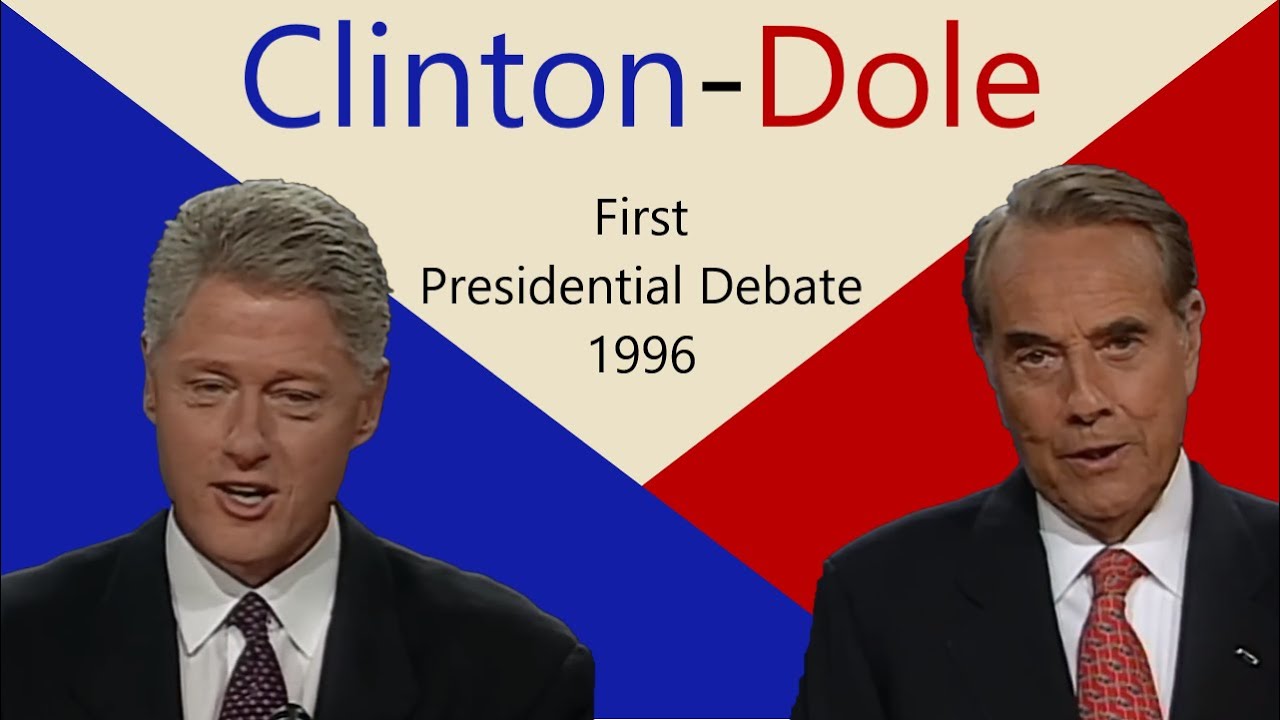
- Clinton vs Dole: Second 1996 Debate
October 16, 1996 Jim Lehrer. Good evening from the Shiley Theatre at the University of San Diego, San Diego, California. I'm Jim Lehrer of the "NewsHour" on PBS. Welcome to this second 1996 Presidential debate between Senator Bob Dole, the Republican nominee, and President Bill Clinton, the Democratic nominee. It is sponsored by the Commission on Presidential Debates. We will follow a townhall-type format tonight. The questions over the next 90 minutes will come from 113 citizens of the greater San Diego area. They were chosen in the past week by the Gallup organization to represent a rough cross-section of voters as to political views, age, gender, and other factors. Each said he or she is undecided about this Presidential race. They were told to come tonight with questions. Nobody from the Debate Commission or the two campaigns has any idea what those questions are; neither do I. We will all be hearing them for the first time at the same time. I met with this group 3 hours ago, and we spoke only about how it was going to work tonight. They are sitting in five sections. I will call on individuals at random, moving from one section to another with each new question, alternating the questions between the two candidates. My job is to keep things fair and the subjects as clear and as varied as possible. The rules, drawn by the campaigns, are basically the same as they were for the Hartford and St. Petersburg debates: 90-second answers, 60-second rebuttals, 30-second responses for each question. The candidates are not allowed to question each other directly. There will be 2-minute opening and closing statements. The order for this evening was set by coin toss. We begin now with Senator Dole and his opening statement. Senator Dole. Opening Statements Senator Bob Dole. Thank you very much, Jim. Let me first give you a sports update: the Braves, one; Cardinals, nothing—early on. I want to thank you and I want to thank everybody here tonight, and I want a special thanks to my wife, Elizabeth, and my daughter, Robin, for their love and support, and thank the people who are listening and watching all over America. In 20 days, you will help decide who will lead this country into the next century. It's an awesome responsibility. And you must ask yourself, do you know enough about the candidates? You should know as much as possible about each of us. Sometimes the views have been distorted—and millions and millions of dollars in negative advertising spent distorting my views— but I hope tonight you'll get a better feel of who Bob Dole is and what he's all about. And I think first you should—I should understand that the question on your mind is, do I understand your problem? But I understand it if—it occurred to me and I might just say that I'm from a large family. I've got lots of relatives, and they're good, average, middle class, hard-working Americans. They live all across the country. They're not all Republicans—maybe all but one. [ Laughter ] But in any event, I understand the problems, whether it's two parents working because one has to pay the taxes and one has to provide for the family; whether it's a single parent who just barely pays the pressing bills; or whether you're worried about an education for your children—are they going to the best schools; or whether you're worried about safe playgrounds, drug-free schools, crime-free schools. This is what this election is all about. And hopefully tonight when we conclude this debate, you will have a better understanding and the viewing and listening audience will have a better understanding. Thank you. [ Applause ] Mr. Lehrer. Mr. President, 2 minutes, opening statement. The President. I was going to applaud, too. [ Laughter ] Well, thank you, Jim, and thanks to the people of San Diego for giving us this opportunity to have another discussion about the decision we all face in front of people who will make the decision. Again I will say, I'll do my best to make this a discussion of ideas and issues, not insults. What really matters is what happens to your future and what happens to our country as we stand on the brink of a new century, a time of extraordinary possibility. I have a simple philosophy that I've tried to follow for the last 4 years: Do what creates opportunity for all, what reinforces responsibility from all of us, and what will help us build a community where everybody's got a role to play and a place at the table. Compared to 4 years ago, we're clearly better off. We've got 10 1/2 million more jobs; the deficit's been reduced by 60 percent; incomes are rising for the first time in a decade; the crime rates, the welfare rolls are falling; we're putting 100,000 more police on the street; 60,000 felons, fugitives, and stalkers have been denied handguns. But that progress is only the beginning. What we really should focus on tonight is what we still have to do to help the American people make the most of this future that's out there. I think what really matters is what we can do to help build strong families. Strong families need a strong economy. To me, that means we have to go on and balance this budget while we protect Medicare and Medicaid and education and the environment. We should give a tax cut targeted to childrearing and education, to buying a first home and paying for health care. We ought to help protect our kids from drugs and guns and gangs and tobacco. We ought to help move a million people from welfare to work. And we ought to create the finest education system in the world, where every 18-year-old can go on to college and all of our younger children have great educational opportunities. If we do those things, we can build that bridge to the 21st century. That's what I hope to get to talk about tonight. Thank you. Mr. Lehrer. All right, let's go now to the first question from this section, and it's for Senator Dole. Yes, ma'am? Yes? Q. Hello, Senator Dole. Senator Dole. Hi. Leadership To Promote Unity Q. My name is Shannon MacAfee. I'm a beginning educator in this country, and I really think it's important what children have to say. They're still very idealistic, and everything they say comes from the heart. I have a quote for you from "If I Were President," compiled by Peggy Gavin. A sixth grader says, "If I were President, I would think about Abraham Lincoln and George Washington and what they did to make our country great. We should unite the white and black people and people of all cultures. Democrats and Republicans should unite also. We should all come together and think of the best ways to solve the economic problems of our country. I believe that when we are able to come together and stop fighting amongst ourselves, we will get along a lot better." These are the ideals and morals that we are trying to teach our children in these days, yet we don't seem to be practicing them in our Government, in anything. If you are President, how will you begin to practice what we are preaching to our children, the future of our Nation? Senator Dole. Well, I would say, first of all, I think it's a very good question, and I appreciate the quote from the young man. There's no doubt about it that many American people have lost their faith in government. They see scandals almost on a daily basis. They see ethical problems in the White House today. They see 900 FBI files of private persons being gathered up by somebody in the White House; nobody knows who hired this man. So there's a great deal of cynicism out there. But I've always tried, in whatever I've done, to bring people together. I said in my acceptance speech in San Diego about 2 months ago that the exits are clearly marked. If you think the Republican Party is someplace for you to come if you're narrow-minded or bigoted or don't like certain people in America, the exits are clearly marked for you to walk out of, as I stand here without compromise because this is the party of Lincoln. I think we have a real obligation, obviously, public officials. I'm no longer a public official; I left public life on June 11th of this year. But it is very important. Young people are looking to us. They're looking to us for leadership. They're watching what we do, what we say, what we promise, and what we finally deliver. And I would think—it seems to me that there are opportunities here. When I'm President of the United States, I will keep my word. My word is my bond. Mr. Lehrer. Mr. President? The President. One of the reasons that I ran for President, Sandy, is because not just children, a lot of grownups felt that way. If you remember, 4 years ago we had not only rising unemployment but a lot of rising cynicism. I'd never worked in Washington as an elected official. It seemed to me that most of the arguments were partisan: Republican, Democrat; left, right; liberal, conservative. That's why I said tonight I'm for opportunity, responsibility, and community. And we've gotten some real progress in the last 4 years. I've also done everything I could at every moment of division in this country—after Oklahoma City, when these churches were burned—to bring people together and remind people that we are stronger because of our diversity. We have to respect one another. You mentioned Washington and Lincoln; they were Presidents at historic times. This is an historic time. It's important that we go beyond those old partisan arguments and focus on people and their future. When we do that, instead of shutting the Government down over a partisan fight on the budget, we're a better country, and that's why we're making progress now. Mr. Lehrer. Senator? Senator Dole. Well, bringing people together again is obviously a responsibility we all have. I know you do it. Everybody here does it. You do a lot of things nobody knows about. I have a little foundation for the disabled called the Dole Foundation. We've raised about $10 million. We don't talk about it. We try to help people with disabilities. We bring them back into the mainstream of public life. So it seems to me that there's also a public trust. When you're the President of the United States, you have a public trust, and you have to keep that public trust, as George Washington did and as Abraham Lincoln did. And I think now that trust is being violated. And it seems to me we ought to face up to it, and the President ought to say tonight that he's not going to pardon anybody that he was involved in business with who might implicate him later on. Mr. Lehrer. All right, the next question from this section right here. Right there in the middle, sir. Yes, sir? Health Care Q. Dr. Robert Berkeley; I'm a cardiologist from Fallbrook, California. Mr. President, I'd like to know if you'd please explain your plans for—in a substantive fashion, for addressing the problems with the health care system in our country. The President. I will. First of all, let me say what we have done: In the last 4 years, we've worked hard to promote more competition to bring down the rate of inflation in health care costs without eroding health care quality. The Government pays for Medicare and Medicaid, as you know, and that's very important. Secondly, we've added a million more children to the ranks of the insured through the Medicaid program. We have protected 25 million people through the passage of the Kennedy-Kassebaum bill that says you can't lose your health insurance if you change jobs or if someone in your family's been sick. We just recently ended those drive-by deliveries, saying people couldn't be kicked out of the hospital by insurance companies when they'd just had babies. So this is—that's a good start. In the next 4 years, I want to focus on the following things: Number one, add another million children to the insured ranks through the Medicaid program; number two, keep working with the States, as we are now, to add 2.2 million more people to the insurance system; number three, cover people who are between jobs for up to 6 months—that could protect 3 million families, 700,000 kids; and number four, make sure we protect the integrity of the Medicare program and the Medicaid program and not do anything in cutting costs which would cause hundreds of hospitals to close, as could have been the case if the $270 billion Medicare cut that I vetoed had been enacted into law. Senator Dole. First, let me say there you go again, Mr. President, talking about a Medicare cut. Now, I've heard you say this time after time, and I've heard you say on one TV appearance, "The media made me do it." You were trying to defend your cut, which was not a cut either—a reduction in the growth of spending. And we always had at least 7 percent. You've said publicly that it's now 3 times the rate of inflation, we ought to cut the growth to twice the rate of inflation. That's about where we are now. So let's stop talking about cutting Medicare. In my economic plan we increase it 39 percent. Don't forget what he tried to do with health care: 17 new taxes, spend $1.5 trillion, 50 new bureaucracies. Can you believe that? You couldn't even have been a cardiologist because they had quotas. You had—you couldn't—you're a cardiologist; it wouldn't affect you. But if somebody wanted to be a cardiologist 10 years from now, you'd have to be certain that you complied with some of the rules in this extreme medical plan the Government was going to take over for all Americans. There are things we can do like the Kassebaum bill, that retains many provisions I authored, to cover preexisting—existing—portability. And there are other things we can do. We still need to cover about 20 million people and a lot of children. The President. I don't have time in 30 seconds to respond to fix all that. But let me just say, the American Hospital Association said that the budget I vetoed could have closed 700 hospitals, not me. And on a per-person basis, it did cut way below the rate of inflation in medical costs. But the important thing is, what are we going to do now? We need to help people who are between jobs. We need to cover more kids. We need to provide more preventive care. My balanced budget covers mammograms for ladies on—women on Medicare and also gives respite care to the million-plus families who have someone with Alzheimer's. These things are paid for in the balanced budget plan. It will move us forward. Mr. Lehrer. The next question is for Senator Dole from here. Yes, sir? Armed Forces Q. Senator Dole, my name is Jason Milligan, active-duty military and a small-business owner. And my question is, what is your position on closing the gap between military and civilian pay scales? Senator Dole. Jason, I appreciate that very much, being a former military man myself. You know, we have 17,000 men and women today wearing our uniform that receive food stamps. It shouldn't happen in America. We have men and women wearing our uniform in substandard housing. It shouldn't happen in America. And it's time we take a look at the pay scales. You did get a 3 percent increase this year, but that's not enough. If we're going to ask young men and young women to protect us and defend us around the world, and we've had more deployments under this administration than any time in history— 50 times we deployed troops around the world. Every time you do that, you take a risk—somebody you know, maybe your son, maybe your grandson, maybe somebody else. But I think anybody who wears a uniform is a great American. Remember Vietnam, remember when people almost used to walk across the street rather than have contact with somebody who was in Vietnam—that's all behind us now, and it should be behind us—and the forgotten war, the Korean war. But I guess, I can just answer you very plainly, Jason: Thank you for doing what you're doing. America owes you a debt of gratitude. The President. May I ask you a question? What kind of—which service are you in? Q. I'm in the United States Navy, sir. The President. And what kind of small business do you have? Q. I have an Amway business. The President. Good for you. Well, let me say—Senator Dole mentioned this. I just signed a bill that we got through Congress to increase the amount of pay increase we could give for military personnel and to make sure the pay increase this year was above the rate of inflation. I also had presented to the Congress, and they adopted, a large package of quality-of-life improvements which are very important. I've spent a lot of time talking to military families, as well as military members, all over the world and in bases all across the United States. And I became convinced, after talking to the families and the personnel in uniform, that we needed to not only have the pay raise but we needed to invest more in child care, housing, and other things to support families, especially when there are longer deployments because of the downsizing of the military. So we're going to do better, and we'll do better still. But this is a commitment I think that all Americans share, without regard to party. Mr. Lehrer. Senator Dole? Senator Dole. Well, Jason, I don't disagree with anything the President said except he waited 4 years to do these things. And my view is it ought to be—it'll be done on day one. We'll start working on it on day one in the Dole-Kemp administration. This is important. Now, we only have 10 divisions now; we used to have 18. We had 25 fighter wings; we're down to 13. We had 536 ships; we're down to 336 ships. I mean, we've cut defense spending too much in the first place. The President told you in '92 he would cut it $67 billion; he cut $112 billion. So we're right on the edge right now. But the last thing we ought to do is make those who wear the uniform sacrifice. Mr. Lehrer. Next question here for President Clinton. Yes, ma'am, here on the front row. Middle East Peace Process Q. President Clinton, my name is Cecily Kelly. Yesterday Yasser Arafat said in Palestine that he thinks the key to success in the Middle East is the commitment of Americans. Would you, as President, send American troops to Israel or the West Bank as peacekeepers? The President. Let me just take 2 seconds of my time, because I'm the Commander in Chief, to respond to one thing that was said. I propose to spend $1.6 trillion on defense between now and the year 2002. And there's less than one percent difference between my budget and the Republican budget on defense. Now, on the Middle East, as you know, I've worked very hard for peace in the Middle East. The agreement between the Palestinians and the Israelis was signed at the White House. And the agreement, the peace treaty with Jordan, I went to Jordan to sign that, to be there. But— and I think the United States could do whatever we reasonably can. I can say this: I do not believe Yasser Arafat wants us to send troops to the West Bank. We have never been asked to send troops to the West Bank. I saw the agreement that Prime Minister Rabin and Yasser Arafat signed on the West Bank. It had 26 separate maps they had to sign, literally thousands of delineations of who would do what on the West Bank. And I believe if the parties will get together and in a good faith manner make that agreement, that they'll be able to do it. We cannot impose a peace on the Middle East. My position has always been that the job of the United States was to minimize the risks of peace. You know, if they ask me to be part of some monitoring force—as we are in the Sinai and have been since 1978 to monitor the peace between Egypt and Israel—frankly, I would have to think about it; I would have to see what they wanted to do. But I don't believe that will be the request. I think what Mr. Arafat wants us to do is to make sure that everybody honors the agreements they've already made. That's why I brought the leaders to Washington a few days ago. I think they will, and I think we'll get there. Don't be too discouraged. Senator Dole. Well, let me, Jason, come back to you a minute because there is a big difference in the defense budget. We had $7 billion this year, and $10 billion more than the President. He puts his money in the out years— even if he were reelected, you know, he'd be gone before anything happened. And nothing's going to happen, because we don't have modernization now. If we don't build more B-2 bombers in California—and we lost about 500,000 jobs out in California because of this devastation, these big, big cuts. We had to make cuts; we didn't have to make the cuts the President promised he'd make and then he doubled. And so I think we need to go back and take a look. We're increasing defense reasonably, not too much but we are increasing defense some, because we want to be prepared in case somebody here gets called up, Jason. I would say I didn't hear what Yasser Arafat had to say, but I don't want to—you know, I think foreign policy is something we want to be very careful about. And I'm not here to argue about the President on some ongoing foreign policy matter. What I want the President to do, and I think he may have done it in his last statement, is call for an unconditional end to the violence and have the parties keep on talking as they should talk and have a resolution. The last thing we want to do is commit more forces anywhere. But let's sort of keep this out of politics, because it's pretty dicey right now. The President. When the change of government occurred in Israel, the people of Israel were saying, "We don't want to abandon the peace process. We want more security." Then, a lot of mutual distrust developed. A lot of things happened which maybe shouldn't have happened. When I asked Yasser Arafat and Prime Minister Netanyahu to come to Washington and got them together and they talked alone for 3 hours, I was convinced that they had to have a chance to make that peace. Again, I'd say if they ask us to play some reasonable role, I don't know how I would respond. It would depend entirely on what they ask us to do. But the real secret there is for them to abide by the agreements they've made and find a way to trust each other. And they're going to have to spend some time and trust each other. Prime Minister Rabin gave his life believing that that trust could be materialized, and I still think it can be. Mr. Lehrer. All right, next question from this section, and it is for Senator Dole. Back in the back. Yes, sir, right there. Yes, sir. Tobacco Q. Senator Dole, Oscar Delgado. Senator Dole . Oscar. Q. Ex-smoker for 30 years. About 30 years ago I was a pack-plus-a-day man, okay? You mentioned in a statement, you said some time ago that you didn't think nicotine was addictive. Would you care to—you still hold to that statement, or do you wish to recant or explain yourself? Senator Dole. Oh, that—that's very easy. My record going back to 1965 in the Congress, the first vote we had was whether or not you should put a little notice on cigarettes that they may be dangerous—I voted—I voted for everything since that time. In fact, in 1992 we had a bill come before us that all the States had to comply or they're going to lose certain money. We sent it to the Clinton administration for implementation. They waited 3 1/2 years. And during that period about 3,000 young kids every day started smoking. If you add it up, that's about 3 million—not until again 1996. I don't want anybody to smoke. My brother probably died partly because of cigarettes. I was asked a technical question: Are they addictive? Maybe they—they probably are addictive. I don't know; I'm not a doctor. You shouldn't smoke. You ought to be glad you quit, Oscar— 30 years? Q. Yes. Senator Dole. And it seems to me that what we need to do is to talk about not only tobacco but drugs, because drug use in 12- and 17year-olds has doubled in this administration, the last 44 months. Marijuana use is up 141 percent; cocaine use, up 160 percent. They're your kids. It's all happened in this administration because they cut funding and they cut interdiction. When I'm President of the United States, we're going to use the National Guard and whatever resources we need to stop some of the drugs coming into America. If you stop the drugs, nobody is going to use the drugs. So don't smoke, don't drink, don't use drugs. Just don't do it. The President. Oscar, the question of what the Federal Government should do to limit the access of tobacco to young people is one of the biggest differences between Senator Dole and me. We did propose a regulation 6 months after I became President under the law he mentioned. It simply says all these States—it made it illegal for kids to smoke—now they have to try harder if they want to keep getting Federal funds. Then we took comments, as we always do, and there were tens of thousands of comments about how we ought to do it. That's what drug it out. Meanwhile, we started, also in '93, to look into whether cigarettes were addictive enough for the Federal Food and Drug Administration to ban the ability of cigarette companies to advertise, market, and distribute tobacco products to our kids. No President had ever taken on the tobacco lobby before. I did. Senator Dole opposed me. He went down and made a speech to people who were on his side, saying that I did the wrong thing. I think I did the right thing. On drugs, I have repeatedly said drugs are wrong and illegal and can kill you. We have strengthened enforcement, and everybody in San Diego knows we've strengthened control of the border. We've done a lot more; I hope we get a chance to talk about it. Senator Dole. Well, they also know, if they live in San Diego, Mr. President, if you're caught with 125 pounds of marijuana or less, you go back to Mexico; you're not prosecuted. You have a U.S. Attorney here that sends them back home. So I think that's pretty important. That's a lot of marijuana. That's a big supply. But don't—you know, don't get into this smokescreen here, Oscar. The President, in the election year, decided, "Well, I ought to do something. I haven't done anything on drugs. I've been AWOL for 44 months. So let's take on smoking." But see, they haven't even done it. They haven't said what's going to happen, whether they're going to have it declared addictive; it's going to apply just to—once it's a drug, does it apply only to teenagers or to everybody in America? Nobody should smoke, young or old. But particularly, young people should not smoke. And my record is there. It's been there. I've voted 8, 10 times since 1965. Mr. Lehrer. The next question is for President Clinton, and it comes from right here. Yes, sir? Social Security and Medicare Q. President Clinton, my name is Jack Fleck. I'm a retired Air Force pilot. Sir, it's officially forecast that our annual Medicare and Social Security deficits are measured in the trillions of dollars next century. Depending upon who you listen to, Social Security will be bankrupt in either 2025 or 2030. I feel this is grossly unfair, especially to our younger generations, who are losing faith in the system. My question is this: Assuming you agree that our entitlement programs are on an unsustainable course, what specific reforms do you propose? The President. First of all, they're two different things. Social Security and Medicare are entirely different in terms of the financial stabilities. Let's talk about them separately. Social Security is stable until, as you pointed out, at least the third decade of the next century. But we'd like to have a Social Security fund that has about 70 years of life instead of about 30 years of life. What we have to do is simply to make some adjustments that take account of the fact that the baby boomers, people like me, are bigger in number than the people that went just before us and the people that come just after us. And I think what we'll plainly do is what we did in 1983, when Senator Dole served—and this is something I think he did a good job on— when he served on the Social Security Commission and they made some modest changes in Social Security to make sure that it would be alive and well into the 21st century. And we will do that. It's obvious that there are certain things that have to be done, and there are 50 to 60 different options. And a bipartisan commission, to take it out of politics, will make recommendations and build support for the people. Medicare is different. Medicare needs help now. I have proposed a budget which would put 10 years on the life of the Medicare Trust Fund; that's more than it's had a lot of the time for the last 20 years. It would save a lot of money through more managed care but giving more options, more preventive care, and lowering the inflation rate in the prices we're paying providers without having the kind of big premium increases and outof-pocket costs that the budget I vetoed would provide. Then that will give us 10 years to do with Medicare what we're going to do with Social Security: have a bipartisan group look at what we have to do to save it when the baby boomers retire. But now we ought to pass this budget now and put 10 years on it right away so no one has to worry about it. Senator Dole. Well, again, you know, if you're somebody thinking about the future, I think it's fair to say that it'll be—we'll work it out. I mean, this is a political year, and the President's playing politics with Medicare. But after this year's over we'll resolve it just as we did with Social Security in 1983. It was a nonpartisan commission. Ronald Reagan got together with Tip O'Neill and Howard Baker—two Republicans and one Democrat—and they formed a commission. I was on that commission. We resolved—we rescued Social Security. We suggested—I think it's been over a year ago now— we do the same with Medicare, and the White House called it a gimmick. Now last week, I guess it was, Donna Shalala said, "Well, we'll cut Medicare a hundred billion, and we'll appoint a commission." It will probably have to be done by a commission. Take it out of politics. I think if I were a senior citizen I'd be a little fed up with all these ads scaring seniors, scaring veterans, and scaring students about education. But when you don't have any ideas, when you don't have any agenda, and all you have is fear, that's all you can use. We have ideas in the Dole-Kemp campaign, and we'll rescue Medicare as we did Social Security. The President. Their idea was to have the poorest seniors in the country pay $270 more a year this year. Their idea was to budget— that the American Hospital Association said could close 700 hospitals. Their idea was to charge everybody more out-of-pocket costs in their budget that I vetoed—not in an election year, sir, I told them in early '95. Senator Dole said 30 years ago he was one of 12 people that voted against Medicare and he was proud of it. A year ago he said, "I was right then; I knew it wouldn't work." American seniors have the highest life expectancy in the world. We need to reform it, not wreck it. Mr. Lehrer. Next question from here, and it's for Senator Dole. Yes, ma'am, right here. Q. Me? Mr. Lehrer. Yes. Welfare Reform Q. Senator Dole, my name is Suzanne Gonzalez, and I would like to know what you are— what would be your first step in reforming welfare. Senator Dole. Well, we've taken the first step. We took it three steps. Twice we sent welfare reform to the President, and he vetoed it. On the third time we sent welfare reform to the President, he signed it but announced he would change it next year. And the Vice President said they were going to do something else through the line item veto, which I've never understood, but that's sort of inside baseball. What we need to do is make certain we try to return people to work. And I'm standing here as someone who a long time ago—as the county attorney in Russell, Kansas, one of our jobs every month was to go through all the welfare checks and sign them. And three of those checks were my grandparents'. So I know what it's like to have to look welfare head-on. Obviously some people are going to need help. This is the United States of America. You're not going to go without food, and you're not going to go without medical care. This is America. But at the same time, if you want to get off Medicare, get back in the mainstream, we're going to provide jobs. We're going to say you have a 5-year limit that you can be on welfare. You've got 2 years to look for a job. We provided more money for day care in the bill that passed the Senate and was vetoed. Then it came back, and the President signed pretty much the same bill. But this is an important issue. I don't think we ought to be giving welfare payments to illegal immigrants. I mean, it puts a heavy burden on a State like—except for emergencies. It puts a heavy burden on States like California. It costs California taxpayers $3 billion a year. Mr. Lehrer. President Clinton? Senator Dole. I'll get out of your way here. The President. It's illegal right now and has been for years for illegal immigrants to get welfare benefits. Let me say that this is one of the most important issues in the world to me. I started working on welfare reform in 1980 because I was sick of seeing people trapped in a system that was increasingly physically isolating them and making their kids more vulnerable to get in trouble. So I'd been working on it when I was a Governor for a long time. When I became President, I used the authority I had in this law to get out from under certain Federal rules to help States move people to work. We've reduced the welfare rolls by 2 million already. Now I've got a plan with this new welfare reform law to work with the private sector to give employers specific tax incentives to hire people off welfare and to do some other things which will create more jobs in the private sector, at least a million, to move more people from welfare to work. It's very important. And I hope we get a chance to talk about this more. There is not a more important issue. I still remember a woman that I met 10 years ago who said she wanted to get off welfare so her kids could tell—give an answer when they say, "What does your mother do for a job?" I met that woman again. She's got four kids. One's got a good job; one's studying to be a doctor; one's in technical school; one's an honor student in high school. I want to make more people like that woman, Lillie Harden. So I've got a plan to do it. And it's just beginning. Senator Dole. Well, another thing we can do—we talk about growth—we've got a great economic package which I hope we'll discuss later: across the board tax cut; child credits, $500 per child under 18; reduce the capital gains rate; create more jobs and opportunities for people on and off welfare. And we have other provisions: less litigation. The trial lawyers—big supporters of the President—the trial lawyers, of course they like lawsuits, so every time they have a bill that they want vetoed, the President vetoes it for them. We've got to understand in America that we've got to have growth, create more jobs and more opportunities in the private sector. The President takes credit for all of these people off welfare—the Governors did that. Federal Government doesn't do that. And the Government doesn't create jobs, they're created in the private sector. Mr. Lehrer. This section, question? Yes, ma'am, on the back row. This is for the President. Capital Gains Tax Q. Mr. President, my name is Pamela Johnson, and I'm a landlord. My question is, does your party have any future plans to reduce the capital gains tax, especially for retired Americans? The President. First of all, we have a big plan to reduce the capital gains tax when people sell their homes. Part of my tax package, which is paid for in my balanced budget plan, would exempt up to half a million dollars in gains for people when they sell their home, which I think is the biggest capital gains benefit we could give to most ordinary Americans. We also have a capital gains now for people that invest in new small businesses and hold the investment for 5 years. It was part of our other economic plan. And these are things I think that will go a long way toward helping America build a stronger economy and a better tax system. I think the most important thing to emphasize, though, is that we also have to help people in other ways to build a stronger economy. And we can't have any tax cut that's not paid for. One of the big differences between Senator Dole and myself is that I told you how I'm going to pay for every penny of the tax cuts I recommend. We've worked hard to bring this deficit down, and that's helped people in the real estate business, because the interest rates are lower. We've got homeownership at a 15year high. We've got this country going in the right direction. So we can have a tax cut, but my priority would be to help the families who need it with childrearing and education and buying a firsttime home and helping for health care costs. So from your business, helping in buying the first-time home, exempting the capital gains on the sale of the home would be the most important things that you asked about. Thank you, Pamela. Mr. Lehrer. Senator Dole. Senator Dole. Well, Pamela, what the President didn't tell you is that all his tax cuts expire at the year 2000, but all his increases go on forever. That's the liberal approach. You know, give you a little tax cut, give you a couple of years, then make the tax increases go on forever. So the net tax increase in his plan is somewhere between $60 billion and $80 billion. We have in the Dole-Kemp economic plan, unless your home is worth over $500,000—and if it is, I appreciate it, congratulate you—but in any event, no tax. And it's a good idea. They saw it, and they picked it up and put in theirs, but it's only temporary. Ours is permanent. Ours is a good plan: create jobs and opportunities; capital gains rate, cut it in half, cut it from 28 percent to 14 percent. There are $7 trillion in assets locked up in America. If we cut the capital gains rate—I'm told every day— I got a letter from a former constituent in Kansas saying, "I want to sell property in California, put it in my business in Kansas. I can't because the capital gains rate is too high." We need to get the economy going. That will help Social Security. That will create more jobs. That will help people who want to get off welfare. It's the American way. The President. Before Senator Dole left the Senate, he and Mr. Gingrich also were recommending that we pass these tax cuts only insofar as we could pay for them. And we all assume that the tax cuts will be permanent, but we have to prove we can pay for them. After he left the Senate, we abandoned that. That's why most experts say that this tax scheme will blow a huge hole in the deficit, raise interest rates, and weaken the economy. And that will take away all the benefits of the tax cut with a weaker economy. That's why we have to balance the budget. And I'll tell you how I'm going to pay for anything I promise you, line by line. You should expect that from both of us. Mr. Lehrer. All right. The next question is for Senator Dole. Yes, ma'am, right there. Responding to American Youth Q. My name is Melissa Lydeana, and I'm a third-year student out at UC-San Diego. And I just want to say that it's a great honor representing the voices of America. My question is concerning you, Mr. Dole, all the controversy regarding your age. How do you feel you can respond to young voices of America today and tomorrow? Senator Dole. Well, I think age is very—you know, wisdom comes from age, experience, and intelligence. And if you have some of each— and I have some age, some experience, some intelligence—[ laughter ]—that adds up to wisdom. I think it also is a strength; it's an advantage. And I have a lot of young people work in my office, work in my campaign. This is about America. This is about—somebody said earlier, one of the first questions, we're together. It's one America, one nation. I'm looking at our economic plan because I'm concerned about the future for young people. I'm looking about drugs. The President's been AWOL for 4 years. I'm looking about crime. He'll claim credit now for crime going down, but it happened because mayors and Governors and others have brought crime down. Rudy Giuliani, the mayor of New York, brought crime down 25 percent just in New York City, but of course the President will take credit for that. My view is we want to find jobs and opportunities and education. This year the Republican Congress, as far as student loans, went from 24 billion to 36 billion over the next 6 years— a 50 percent increase; the highest appropriation ever, $6 billion for Pell grants. Very, very important. And we also raised the amount of each Pell grant. In our economic plan, the $500 child credit can be used for young people. Rolled over and over and over—of course, not this age, but if you have a child 2 years old, 7 percent interest, it would be worth about $18,000 by the time that child was ready for college. The President. I can only tell you that I don't think Senator Dole is too old to be President. It's the age of his ideas that I question. You're almost not old enough to remember this, but we've tried this before, promising people an election-year tax cut that's not paid for—— Senator Dole. We tried it last time you ran. The President. ——telling you you can have everything you got—and let me just say this: Did you hear him say the Congress just voted to increase student loans and scholarships? They did, after he left. The last budget he led cut Pell grants, cut student loans. I vetoed it when they shut the Government down. My plan would give students a dollar-for-dollar reduction for the cost of the typical community college tuition, a $10,000 deduction a year for the cost of college tuition, would let families save in an IRA and withdraw tax-free to pay for the cost of education. And it's all paid for. My whole administration is about your future, it's about what the 21st century is going to be like for you. And I hope you'll look at the ideas in it. Thank you. Senator Dole. Well, when you don't have any ideas, I guess you say the other person's ideas are old. As I said earlier, they don't have any ideas. Their idea is to raise taxes and spend more money. That's the liberal philosophy. If that's what you like, you've got a perfect candidate. President Clinton came to California in 1992 and said, "The centerpiece in my first 4 years is going to be a middle class tax cut." Now, to all you who got that tax cut, congratulations, because you got a big tax increase. You got a $265 billion tax increase. And he stands here and says politicians who make promises like that ought to be ignored. Well, he made the promise. I keep my word, and you'll have a tax cut. It will help you in whatever you're going to do in the next few years. Thank you. Mr. Lehrer. Next question is for President Clinton, and it's from—yes, ma'am? Yes? Affirmative Action Q. Hello. My name is Chessie Sanders, and my question is do you feel that America has grown enough and has educated itself enough to totally cut out affirmative action? The President. No, ma'am, I don't. I am against quotas; I'm against giving anybody any kind of preference for something they're not qualified for, but because I still believe that there is some discrimination and that not everybody has an opportunity to prove they are qualified, I favor the right kind of affirmative action. I've done more to eliminate programs—affirmative action programs that I didn't think were fair and to tighten others up than my predecessors have since affirmative action has been around, but I have also worked hard to give people a chance to prove that they are qualified. Let me just give you some examples. We've doubled the number of loans from the Small Business Administration, tripled the number of loans to women business people—no one unqualified. Everybody had to meet the standards. We've opened 260,000 new jobs in the military to women since I've been President, but the Joint Chiefs say we're stronger and more competent and solid than ever. Let me give you another example of what I mean. To me, affirmative action is making that extra effort. It's sort of like what Senator Dole did when he sponsored the Americans with Disabilities Act that said to certain stores, "Okay, you've got to make it accessible to people with wheelchairs." We weren't guaranteeing anything—anybody anything except the chance to prove they were qualified, the chance to prove that they could do it. And that's why I must say I agree with General Colin Powell that we're not there yet. We ought to keep making those extra-effort affirmative action programs the law and the policy of the land. Mr. Lehrer. Senator Dole. Senator Dole. Well, we may not be there yet, but we're not going to get there by giving preferences and quotas. I supported that route for some time, and again, I think it gets back to experience—a little experience, a little age, a little intelligence. And I noticed that nobody was really benefiting except a very small group at the top. The average person wasn't benefiting. People who had the money were benefiting. People who got all the jobs were benefiting. It seems to me that we ought to support the California civil rights initiative. It ought to be not based on gender or ethnicity or color or disability. I'm disabled. I shouldn't have a preference. I would like to have one in this race, come to think of it. But I don't get one. Maybe we can work that out. I get a 10-point spot. [ Laughter ] This is America. No discrimination. Discrimination ought to be punished, but there ought to be equal opportunity. We ought to reach out and make certain everybody has a chance to participate. Equal opportunity, but we cannot guarantee equal results in America. That's not how America became the greatest country on the face of the Earth. The President. I have never supported quotas. I've always been against them. They don't favor equal results. But I do favor making sure everybody has a chance to prove they're competent. The reason I have opposed that initiative is because I'm afraid it will end those extra-effort programs. Again I say think of the American with Disabilities Act. Make an effort to put a ramp up there so someone in a wheelchair can get up. You don't guarantee that they get the job; you guarantee they have a chance to prove they're competent. And as I've said, this is not a partisan thing with me. General Powell, Colin Powell said the same thing. He fears that the initiative would take away the extra-effort programs. No preferences to unqualified people, no quotas, but don't give up on making an extra effort till you're sure everybody has a chance to prove they're qualified. Mr. Lehrer. All right, the next question is for Senator Dole, and it comes from this section right here. The back row, there, in the blue shirt. Yes, sir. Senator Dole's Tax Cut Proposal Q. My name's Tim David. I'm a mechanical engineer. Senator Dole, how do you reduce taxes and balance the budget? Senator Dole. Oh, I'm glad you asked. The President. So am I. I am too. Senator Dole. What's your first name? Tim? I first want to say the President didn't quite give you all the stuff on quotas, because the Justice Department entered what we call the Piscataway case up in New Jersey. It's pretty clear that was a quota case. And just because one teacher was white and one teacher was black and they had the same qualification, you know, they decided who would stay there. It shouldn't be that way. Now, the President can say, well, he wants to mend it, not end it. There are 168 Federal programs that allow quotas. He ended one. Now this economic package, Tim, I'm glad you asked because you look like the type that might be able to benefit from the 15 percent, across-the-board tax cut and $500-per-child tax credit or, you know, estate tax relief, which you're not interested in right now, but capital gains rate reduction—if you're taking care of an elderly parent, you get a $1,000 deduction. We think that's very important because a lot of people take care of their parents. How do we pay for it? We're going to have a constitutional amendment to balance the budget, which the President opposed and defeated. He twisted arms, got six Democrats to vote with him. We lost by one vote. We're going to balance the budget by the year 2002. The President wants to spend 20 percent more over the next 6 years; I want to spend 14 percent more and give that 6 percent back to the people. Remember, it's your money. It's not his money, and it's not my money. It's your money, and you shouldn't have to apologize for wanting to keep all you can of it, but he ought to apologize for wanting to take more and more. He wants to give you sort of a Government tax cut which really doesn't mean anything. The President. You know, one of the responsibilities of growing older, it seems to me, is being able to tell people something they may not want to hear just because it's truth. When they had a $250 billion tax scheme—that is half the size of this one, this one is 550—they passed a budget that had $270 billion in Medicare cuts, the first education cuts in history, cut environmental enforcement by 25 percent, took away the guarantee of quality standards in nursing homes, took away the guarantee of health care to folks with disabilities. Don't take my word for this. The Economist magazine polled lots of economists. Seven Nobel Prize winners have said, if this tax scheme passes, it will require huge cuts—40 percent— in the environment, in law enforcement, in education. It will require bigger cuts in Medicare than I vetoed last time. My targeted tax cut gives tax cuts for education, childrearing, buying a first-time home, paying for health care costs, and it's paid for. And I've told you how I'll pay for it. He won't tell you because he can't. Senator Dole. Your targeted tax cut, Mr. President, never hits anybody. That's the problem with it. Nobody ever gets it. But I must say I'm a little offended by this word "scheme." You talked about—last time you talked about a risky scheme, and then Vice President Gore repeated it about 10 times in St. Petersburg. If I have anything in politics, it's my word. My colleagues, Democrats and Republicans, will tell you that Bob Dole kept his word. I'm going to keep my word to you. I'm going to keep my word to the American people. We're going to cut taxes and balance the budget. We're not going to touch Medicare. It's going to grow 39 percent, and Social Security is going to grow 34 percent. Now, the President doesn't have any ideas so he's out trashing ours. This isn't going to blow a hole in the deficit. He promised you a tax cut in 1992, and if you got one, you ought to vote for him. Mr. Lehrer. Sir. The next question is for the President. Yes, sir, right there—white shirt. Family and Medical Leave Act Q. My name is Dwayne Burns. I'm a martial arts instructor and a father. Mr. President, could you outline any plans you have to expand the family leave act? The President. Thank you. Well, first let me say that I signed the family leave act. It was my very first bill, and I'm very proud of it because it symbolizes what I think we ought to be doing. I don't take credit for all the good things that have happened in America, but I take credit for what I've tried to do to work with others to make good things happen. The most important good things that happen in America happen in families. Just about every family I know, the main concern is how am I going to succeed at work and still do right by my children? Family and medical leave has let 12 million families take a little time off for the birth of a child or a family illness without losing their job. I'd like to see it expanded in two ways: I'd like to say you can also take a little time off without losing your job to go to a regular parent-teacher conference or to go to a regular doctor's appointment with a family member; I'd also like to see the overtime laws change so that we could have some more flextime so that at the discretion of the worker— the worker—if you earn overtime you could decide whether you want that time to be taken in cash or in time with your family if you've got a family problem. I never go anywhere, it seems like, where I don't meet somebody who's benefited from the family leave law. In Longview, Texas, the other day, I met a woman who was almost in tears because she had been able to keep her job while spending time with her husband who had cancer. One of the people who's here with me today met a woman in the airport saying that her son just was able to be present at the birth of his child because of the family leave law. So yes, I think it should be expanded. We have to help people succeed at home and at work. Senator Dole. Well, 88 percent of the people the President claims, or 11 million, are already covered. And only 5 percent—keep in mind, only 5 percent of the employers were even affected by the family leave act. We had a better idea. We didn't win, but we had a better idea. Now we have a majority; we need to get a President. That was a tax credit to the employer. Instead of the Federal Government reaching out, we had a tax credit to pick up some of the cost, because if you have to hire a replacement worker, that's a cost. This is the way it ought to work. Give more power back to the States and back to the people, back to the taxpayers, not always the long arm of the Federal Government. But keep in mind this bill covers 5 percent of the employers; 95 percent of the employers and all those employees they employ are not covered in this act. And according to Investors Daily, which I read just a couple of days ago, 88 percent of the people he claims credit for were already covered in collective bargaining agreements or other agreements. We had family leave in our office. I'm certain—I see my friend Senator Mitchell. He had family leave. I work every day with people. I spent a lot of time in hospitals. I know what it's like to be in a hospital. Sure, we want family leave, but there's a better way to do it. The President. I only have 30 seconds. I can't fix the statistics. It covers the majority of the work force. Employers of under 50 are exempted. The bill originally covered employers of 25 and more, but because of opposition, we went up to 50. Senator Dole led the opposition to it. He filibustered it. He said it was a mistake. He said it would hurt the economy. We've had record numbers of new small businesses and 10 1/2 million jobs. It didn't hurt the economy. He still believes it's a mistake. I believe it was right. You can decide which of us you think are right. It's up to you. Mr. Lehrer. Next question for Senator Dole. This side. Yes, ma'am. Domestic Manufacturing Q. Hi. My name is Bridget Gianotti, and I'm a wife and mother of two sons from Carlsbad. And my question for you, Senator Dole, is as the wife of a San Diego business owner, I see one of our biggest problems is the U.S. does not manufacture enough of our own products. How would you help this problem out? Senator Dole. Well, right, we've lost 357,000 manufacturing jobs. And the Bureau of Labor Statistics said today that they made a mistake, it's probably going to be a much, much higher figure. So we're talking about all these new jobs, we'd better wait and see what the results are. We're going to do that with a more aggressive trade policy. We're going to do that with an economic package. We're going to do that with regulatory reform. You know, regulations cost the average family—right here, Democrat or Republican—about $7,000 a year—7,000. It's like a tax. Put a lot of people out of business. I met a lady in Colorado Springs about 7 weeks ago, now. She had a small business with 63 employees. She finally gave it up. Why? Because of paperwork and regulation. Congress passed the Paperwork Reduction Act. The President exempts the IRS, which creates threefourths of the paperwork. We're going to have regulatory—we're going to have litigation reform. You know, I fell off a platform out in California, in Chico, a while back. Before I hit the ground, my cell phone rang, and this trial lawyer says, "I think we've got a case here." [ Laughter ] You know, we've got to stop some of these frivolous lawsuits. They're putting people out of business, men and women. Get the economy going, cut the capital gains rate, create more jobs and opportunities for everybody in America—that's what we will do, and my word is good. I keep my promises. I don't break my promises after the election, and I don't make new promises on an election year. We're going to get it done; we're going to grow some of these jobs in America because we need to get it. They're going the wrong way. The President. Let's look at the facts. We lost a lot of manufacturing jobs in the 12 years before I became President. We've gained manufacturing jobs since I've been President. We've negotiated over 200 separate trade agreements. Let's just take California. In California, we made $37 billion worth of telecommunications equipment eligible for exports for the first time. We're selling everything from telephones to CD's to rice in Japan. We're selling American automobiles in Japan now. I visited a Chrysler dealership in Japan. We're number one in automobile manufacturing, production, and sales around the world again for the first time since the 1970's. Why? Because we've had tough, aggressive trade policies, and because we got interest rates down, and we had a good, stable economic policy, because we've reduced the deficit 4 years in a row for the first time in the 20th century that a President's done that in all 4 years. And that's why I don't want to see us blow a big hole in the deficit with a tax program we can't pay for so your interest rates will go up and you'll have to pay back in higher interest rates what you allegedly will get in a tax cut. So I say keep working on expanding the markets. More than half of these 10 1/2 million new jobs were in higher wage areas, and we'll have more manufacturing and more sales at home and around the world. Senator Dole. Well, you may think the biggest employer in America is General Motors, but I've got news for you. It's manpower services, hiring people temporarily who've lost their jobs and they go to work for 30 days or 60 days. That's a good economy? I don't think so. They're setting new records this year. We have the worst economy in a century. We have the slowest growth, about 2.5 percent. The President inherited a growth of over 5 percent. We don't have the S&L crisis anymore. Republicans have cut $53 billion in spending. That's why the budget can look good. It didn't look too good the first 2 years when we had a Democratic President and a Democratic Congress. Mr. Lehrer. The next question is for President Clinton. Yes, sir? Gay Rights Q. I'm Bob Goldfarb. I'm a travel agent. And can you please explain your policy on the employment nondiscrimination act that would have prohibited discrimination, would have prohibited people from being fired from their jobs simply for being gay or lesbian? The President. I'm for it. That's my policy. I'm for it. I believe that any law-abiding taxpaying citizen who shows up in the morning and doesn't break the law and doesn't interfere with his or her neighbors ought to have the ability to work in our country and shouldn't be subject to unfair discrimination. I'm for it. Now, I have a little time left, so let me just say that I get attacked so many times on these questions it's hard to answer all those things. In February—Senator Dole just said we had the worst economy in a century. In February he said we had the best economy in 30 years— just February. And I don't want to respond in kind to all these things. I could; I could answer a lot of these things tit for tat. But I hope we can talk about what we're going to do in the future. No attack ever created a job or educated a child or helped a family make ends meet. No insult ever cleaned up a toxic waste dump or helped an elderly person. Now, for 4 years that's what I've worked on. If you'll give me 4 years more, I'll work on it some more. And I'll try to answer these charges, but I prefer to emphasize direct answers to the future, and I gave you a direct answer. Mr. Lehrer. Senator Dole? Senator Dole. Well, I'm opposed to discrimination in any form, but I'm—but I don't favor creating special rights for any group. That would be my answer to this question. And I'm—you know, there'd be special rights for different groups in America, but I'm totally opposed to discrimination, don't have any policy against hiring anyone—whether it's lifestyle or whatever, we don't have any policy of that kind, never have had in my office, nor will we have in the future. But as far as special rights, I'm opposed to same-sex marriages, which the President signed well after midnight one morning, in the dark of night—he opposed it. But I'll get back to the economic package because again, I think this is very important. If there is anything that's going to change America, it's get the economy to grow. The President inherited a good economy—sure. The S&L crisis ended, we were selling assets, we had a Republican Congress cutting spending finally, and he says we've had the best 4 years ever. That's not true. We've had over 1.2 million bankruptcies—set a new record. Credit card debt has never been higher. I just told you about this manufacturing job loss which is going to increase. We need a good, strong economic package. Let the private sector create the jobs. And they can do it. Mr. Lehrer. Mr. President? The President. If you believe that the California economy was better in 1992 than it is today, you should vote for Bob Dole. I have worked so hard out here to help turn this economy around. Let me just give you one tiny example. In San Diego, where we had some defense cutbacks, we funded a project with the University of California, San Diego to use airplane composite materials to build lighter, stronger bridges— a little project, and a program that Senator Dole opposed—and that composite now is going to be built around the bridges on the Santa Monica freeway to help minimize the impact of earthquakes and create more jobs. That's just one tiny example. Maybe we'll talk about some more before it's over. Mr. Lehrer. The next question is for Senator Dole and it's from this section. Yes, ma'am? Yes? Health Care Q. Senator Dole, I am Verda Stratigus, and I work in health care. And it's truly an honor to be here tonight to address both of you. Senator Dole. Thank you. Q. Being in health care—we have talked a little bit about health care tonight, but mainly MediCal and Medicare have been mentioned, but the private sector is a problem. Managed care is taking over, especially in California, and because of that, the quality of care is going downhill. There are many, many people who cannot get the tests that they need when they need them. And because of that, they are dying needlessly. There are many, many more lawsuits being presented against the managed care industry because of this. And I think it's a real problem that needs to be addressed. What would you do if you were President? Senator Dole. Well, one thing I did was to oppose the Government takeover of health care that President Clinton offered in 1993, which created 17 new taxes and 50 new bureaucracies and price controls, because we were afraid the very thing you mentioned would have happened. Everybody would have been forced into managed care. You couldn't have chosen your own doctor. And that would have been the end. And I think right now we've got to go back— I know they've appointed a commission to take a look at managed care. Maybe that's part of the answer. But it seems to me, if we start to take choices away from people and if we drive them into one type care, if we eliminate fee-for-service altogether or eliminate the fact you can go to your own doctor, you've got to go somewhere else, then I think we've taken a giant step backward in the United States of America. We have the best health care delivery system in the world, and we want to keep it that way. That's why we opposed the Government takeover health care plan that President Clinton tried and tried and tried to get through Congress. Didn't get it done. When it ended up we had more votes than he had, then they decided to pull the plug. It was a big, big mistake. Now, whether or not he'll do that again, I've heard some of the people say, "Well, that's the model we ought to use." And if he's reelected, maybe he'll come back and try it again. I hope not. I hope not in both cases. But it does seem to me that you've raised a very important point that needs to be addressed. We're going to have to watch it, going to have to take a look at all the managed care going on in California, or we're going to end up losing our best care that we have in the world. The President. I'm just curious. How many of you are under managed care plans? Raise your hand if you're in managed care. Senator Dole. Probably the young people here. The President. How many of you like it? Well—— Senator Dole. Two. The President. One of the things that I tried to do was to make sure that everybody in the country who was under a managed care plan should at least have three choices of plans and would have the right to get out without penalty every year. Now, that's not a Government takeover, that's like the family and medical leave law. It just tries to set the rules of the game. I'm strongly in favor of a Federal bill to repeal the—any gag rules on providers. In other words, I believe that doctors should not be able to be kicked out of managed care plans just because they tell the patients what they need and what more expensive care options might be. If we're saving money and managing resources better, that's a good thing. If we're saving money and depriving people of care, that's a bad thing. A good place to start is to say no managed care provider can gag a doctor and kick the doctor out of the managed care plan for the doctor telling the patient, "You need a more expensive test, you need a more expensive procedure. Your health requires it." Mr. Lehrer. Senator Dole? Senator Dole. Well, I don't have any quarrel with that. I think that would help. But I think what we want to avoid is falling back into this nationalized health care system that President Clinton wanted to give us in 1993. If that isn't a liberal idea, I've never heard one: 17 new taxes; price controls; 50 new bureaucracies. We'd have that trouble all over America. We need to deal with managed care. It not only happened in California, it's happening in other States that we visit too. It's a national problem, not just a State problem. Mr. Lehrer. The next question is for President Clinton, and in this section. Yes, ma'am. Yes. Participation in Electoral Process Q. All right, I'd sort of like to—Coleen O'Connor. I teach history and political science at San Diego Mesa College right up the road here. And I'd like to tee off from the original question by another teacher and speak for those people that aren't here tonight. Sixty-three percent of the American people are not participating, that are eligible to vote, not even participating in the process. Several parties can't even get into the debate: the Green Party, the Reform Party, the Natural Law Party. All of these people have basically opted out of what we're still participating in. And if we in fact are going to bring the country back together and be all faces around the table, the new American family, what do you see as something the President can do to begin that process to bring them back in? The President. First of all, I think it's important to make voting more accessible. That's why I strongly supported the motor voter law. There was a big story, I think, in USA Today about the millions of people who've now registered because of it. Secondly, I think we need to look at making the elections more accessible. You know, several States now are letting people vote over 3 weeks. A lot of people are busy, and it's hard for them to just get there and vote. The third thing I think we need is more forums like this, which is one of the reasons I have so strongly supported campaign finance reform, because if you want to cut the cost of campaigns, you have to open the airwaves, because what drives the cost of a campaign are the costs of advertising on television, radio, newspaper, mass mailing. And if you open the airwaves to more things like this—you see, it's not just you that are participating here. For every one of you who stood up here and asked a question tonight, I promise you, there's 100,000 Americans that said, "I wish I could have asked that question." So I think we have to change the nature of politics. The last thing I think we should do is something I've been trying to do since I've been President, is every time I do something in a public way, I try to have a real American citizen there who is directly affected by it so that people can see the connection of what happens way across the country in Washington with more police on the street in San Diego, clean up the sewage here in San Diego, doubling the border guards here in southern California, that there is a connection between what we do way back there and what we do here. Those are my best ideas about it. Senator Dole. Well, I don't know of any perfect solution. I've been in politics for some time, and I worry about people who don't vote. And I wonder if it's our fault, the candidates' fault. People say "I don't care. One vote doesn't make a difference." I can give you hundreds of cases—you can probably give me 200 cases where one vote made a difference. I know it made a lot of difference many times in the Congress. Campaign finance might help, might help contributions coming in from Indonesia or other foreign countries, rich people in those countries, and then being sent back after the L.A. Times discovers it—$250,000. But maybe there ought to be more debates. I'd be willing to have another debate this year where we'd invite all of the candidates and talk about the economy. If we don't get the economy to grow, if we don't cut taxes, and give people child credits, and cut the capital gains rate, and get this economy growing, we're going to limp into the next century. If we grow the economy, it's going to help Social Security, it's going to help jobs, it's going to help everything. The President. Let me make one other suggestion. As you're a teacher, you can have an impact on that. One of the things I think that really frustrates people is that so often, political campaigns seem to be more about the politicians that are running than the people. Now, there is a connection, and I think what we have to do is convince people there's a big difference. If you vote one way, you will have a Department of Education in the 21st century; if you vote the other way, you won't. If you vote one way, you'll have an expansion of family leave; if you vote the other way, you'll be lucky to save it. But these are important questions, and people have to decide. I think that the American people also need to be a little more responsible and think about whether there's a connection in their lives and what we do in Washington. Mr. Lehrer. For Senator Dole, in this section. On the back row, yes, ma'am. Social Security and Alternatives Q. I'm Iris Seiffert, and I'm unemployed. Senator Dole. Iris? Q. Iris. Senator Dole, we talked about Social Security for us baby boomers, but shouldn't we be saving and investing for our own retirement as well? Are you planning any incentives to encourage us to take care of ourselves rather than to rely on the Government and on Social Security when we retire? Senator Dole . Well, we have in our economic pack individual retirement accounts where we think it'll encourage savings. You could also use those accounts for health care or education or a first home. We're doing that precisely. And I think one thing sooner or later we're going to have to consider is to take a look at the Social Security system, because we've got a lot of people advocating that, well, we don't want to put our money into Social Security. Now, you've got to be very careful about that, because you have to protect the people who are already in the pipeline. But it's something you might consider. I'm not suggesting it will be done, but at least we ought to look at it. It's been looked—when I was chairman of the Finance Committee, which handles Social Security, we looked at all these options, and one thing we've got to make certain—when I used to go home, my mother would tell me, "All I've got is my Social Security; don't touch it." And we didn't touch it. We preserved it. And I'm an optimist. Your Social Security is going to be there when you retire. We'll fix it. It will probably happen in the year 2012 or 2015. In 1983, we thought we had a 75year fix. It didn't work—much, much less. But at least we fixed it for some time, and 37 to 40 million people get their checks on time. So we need to preserve the system, and we need to make it stronger. But we also need to look at some options whether or not we— it would depend on what the options are. In fact, they've got a commission right now in Congress, a bipartisan commission, looking at all the different options they're going to present to the next Congress. So I think we'll wait and see what they present, take a look at it. The President. This is one where we have some agreement, I think. Only about half the people in this country have pension plans, and Social Security is not enough for a lot of people to live on, or at least it's not enough for them to maintain anything like their previous lifestyle. So we've got to figure out how we're going to have more people with pension plans. And pension coverage has been declining as more and more people work for small businesses and fewer people work for big businesses. So what is in my plan—and I think it's almost identical to what's in Senator Dole's plan—is we make more people than are now eligible to save in an IRA, and we'd let couples—married couples save more, and then they could withdraw from it tax-free if they needed to for medical emergencies or to buy a home or for an education, but they could also save to supplement their retirement. In addition to that, we just passed a sweeping small business reform that makes it easier for small-business people to take out 401(k) plans for themselves and their employees and then much easier for employees to carry it from job to job. My best friend from grade school is a computer software salesman, and he told me last time he changed employers it took him 9 months to figure out how to transfer his 401(k) plan. Now, none of that will happen anymore. And so I hope that over the next 10 years you'll see a big increase in the percentage of people that have pension plans plus a secure Social Security System. Senator Dole. Did you say you're unemployed? The first thing we ought to do is get you a job. And that's the economic package again: Create jobs and opportunities, reduce the capital gains rate, reduce regulatory reform, stop some of this senseless litigation, and let people work in America. And I think that's the thrust we will make. Obviously, Social Security is a very important program. It'll be preserved—Democrats or Republicans. It'll be preserved. We want to make certain we protect those in the pipeline, just as we did back in 1983. And we did it on a bipartisan basis. We took it out of politics. People get so tired of politics. And we ought to do the same with Medicare. Maybe we could make a deal here tonight. Mr. Lehrer. All right, the question is for President Clinton. Does anybody have a foreign affairs question in this section? Yes, sir. Trade With Japan Q. Good evening. I'm Michael Smith. I'm an electronics technician in the Navy. My question was how you plan to deal with the trade deficit with Japan? The President. Let me tell you what we have done. We have concluded with Japan 21, about to be 22 trade agreements now. And since we did that, in the areas where we concluded trade agreements, our exports to Japan have gone up by 85 percent in the last 4 years, and our trade deficit with Japan has gone down. Until about 5 months ago, the Japanese economy was in a deep recession. It's coming back now, so they can buy even more American products, and I think it'll go down more. But I'm very—that's one of the real success stories here of the work we've done. We're selling Japanese rice from California for the first time. I visited a Chrysler dealership in Tokyo. I visited a Jeep plant, the oldest auto plant in America, in Toledo, Ohio, where they're going to export 41,000 right-hand-drive Jeeps this year, and they've got 700 new jobs because of it. There is no easy way to do this. When you're dealing with an economy that's traditionally been more closed and one that's traditionally been more open, you just have to gut it out issue by issue by issue. We agreed in principle on our insurance agreement, and we're working on three or four other areas now. But the way you have to do it is make sure you're competitive—we're the most competitive country in the world now—and then just fight to open those markets and go try to make the sale. And that's what our trade ambassador, our Commerce Secretary, and all the other people in our administration have tried to do. Mr. Lehrer. Senator? Senator Dole. Well, the bottom line is we've got to stop exporting jobs. We need to keep jobs here. I said there are 357,000 good jobs, manufacturing jobs, which were lost. And I assume some of those because of our trading partners; we didn't have access to their markets. We ought to insist on access. If we don't have access to their markets the same way they have access to our markets, we ought to say, "Wait, that's enough. Time out. When you give us access, we'll give you access." It's very hard to get into the Japanese market, as everybody knows. They want to get into our market. They sell a lot of automobiles here, create a lot of jobs—those who sell exports. And it's very important to the economy. But I think we want to make certain. I supported the President's trade policy, but we've got to be more aggressive. Once you have a policy, then you've got to go out and be aggressive and enforce that policy. There are American jobs that are being lost. This is what Ross Perot complains about. And I'd say to the Reform Party, take a look at the Republican Party. We're the reform party, and we're going to make things better. And one of the things we're going to do is stop exporting jobs in America. The President. Let me say again, we've had over 200 separate trade agreements in the last 4 years, by far the largest number in American history, not just the big ones you've read about but a lot of smaller ones. And now what we have to do is to focus on those things we're real good at and make sure we're getting a fair deal. We just had a pretty serious dispute with China because they were copying our CD's and costing thousands of jobs in places like California. But we said, "You know, if you want to keep doing business and selling your products over here, you're going to have to quit pirating our CD's." And they agreed to do a number of things and to let us verify that they'd done it. But I think they're going to make the problem much better. But there is not a simple, easy answer. You just have to work on this day-in and day-out, every month, every year, every issue to make sure that we have not only free trade but fair trade. I'm proud that we're better off on that than we were 4 years ago. Mr. Lehrer. All right, the next question is for Senator Dole, and it's in this section. Yes, sir. Religion and Values Q. Ron Kite, minister. Senator Dole. Hi, Ron. Q. This great Nation has been established by the Founding Fathers, who possessed very strong Christian beliefs and godly principles. If elected President of the United States, what could you do to return this Nation to these basic principles? And also, do you feel that the office of the President has the responsibility to set the role example to inspire our young people? Senator Dole. Well, no doubt about it, our Founding Fathers had a great deal of wisdom. And in addition to what you mentioned, they also were concerned about this all-powerful central Government in Washington, DC, that would in effect confiscate your property. So I carry around in my pocket—I can't pull it out, I'd violate the rules—a copy of the 10th amendment, which says that we ought to return power to the States and power to the people—people here. You ought to make more decisions. Honor, duty, and country: that's what America is all about. Certainly the President of the United States, in the highest office in the world, the most important office in the world, has a responsibility to young people, as we talked about earlier—to everyone, by example. And when it comes to public ethics, he has a responsibility. When you have 30-some in your administration who've either left or are being investigated or in jail or whatever, then you've got an ethical problem. It's public ethics—I'm not talking about private, we're talking about public ethics—when you have 900 files gathered up by some guy who was a bouncer in a bar and hired as a security officer to collect files. In Watergate, I know a person who went to jail for looking at one file, one FBI file. There are 900 sequestered in the White House—900— people like you. Why should they be rifling through your files? So the President has a great responsibility. And it's one that I understand and would certainly carry out. The President. This is the most religious great country in history, and yet, interestingly enough, we have the most religious freedom of any country in the world, including the freedom not to believe. And now we have all these people— just up the road in Los Angeles County we've got people from 150 different racial and ethnic groups, and they've got tons of different religions. But the fundamental tenets of virtually every religion are the same. And what I've tried to do is to support policies that would respect religion, and then help parents inculcate those values to their children. Let me very briefly give you some examples. One of my proudest moments was signing the Religious Freedom Restoration Act, which says the Government's got to bend over backwards before we interfere with religious practice. So I changed a Justice Department effort to get a church to pay back a man's tithe because he was bankrupt when he gave it. I've supported character education programs in our schools, drug-free schools programs. I've supported giving parents a V-chip on their television so if they don't want their young kids to watch things they shouldn't watch, they wouldn't have to. That's the kind of thing we need to do, give people like you and our families the power to give those values to our children. Senator Dole. Well, I think it's—you know, before I came in tonight, my wife and daughter and I had a prayer because if it's God's will, whatever happens—if it's God's will, it will happen. A constitutional amendment for voluntary prayer in school in my view would be a great idea. I support it, and the President opposes it. I mean, it seems to me the President, whoever the President may be, this is one of his highest responsibilities. People look to the President of the United States more than any other person in America. And that's the way it's always been, and that's the way it always will be. Mr. Lehrer. All right, this is our last question. It goes to President Clinton, and it's from this section. Yes, ma'am? "Special Rights" Q. My name is Evette Duby, and I too am a minister; I'm with the Universal Fellowship of Metropolitan Community Churches. President Clinton, perhaps you can help me with something tonight. I've heard Mr. Dole say several times, "all of us together." And when he was asked if he would support equal rights in employment for gay and lesbian people, you said that you favored that, and he said that he did not believe in special rights. And I thought the question was equal rights for all people, and I don't understand why people are using the term "special rights" when the question is equal rights. Could you help me in understanding that? The President. I want to answer your question, but let me say one other thing. We don't need a constitutional amendment for kids to pray. And what I did was to have the Justice Department and the Education Department, for the first time ever, issue a set of guidelines that we gave to every school in America saying that children could not be interfered with in religious advocacy, when they were praying, when they were doing whatever they could do under the Constitution just because they were on a public school grounds. And I think anyone who has experienced this would tell you that our administration has done more than any in 30 years to clarify the freedom of religion in the public square, including in the public schools. Now, I think I have to let Senator Dole speak for himself. It wouldn't be fair for me to do that. I would wind up—I mean, it's the last question, and I'd mischaracterize it to try to make you happy. Let me tell you what I feel. We have a lot of differences in our country, and some of us believe that other people's decisions are wrong, even immoral. But under our Constitution, if you show up tomorrow and obey the law, and you work hard, and you do what you are supposed to do, you're entitled to equal treatment. That's the way the system works. All over the world, people are being torn apart—Bosnia, the Middle East, Northern Ireland, Rwanda, Burundi, you name it—because of all their differences. We still have some of that hatred inside us; you see it in the church burnings. And one of the things I've tried hardest to do is to tell the American people that we have to get beyond that, we have to understand that we're stronger when we unite around shared values instead of being divided by our differences. Mr. Lehrer. Senator Dole? Senator Dole. Well, I hope I made my answer clear. I said I'm opposed to discrimination. You know, we've suffered discrimination in the disability community. There are 43 million of us. And I can recall cases where people would cross the street rather than meet somebody in a wheelchair. So we want to end discrimination. I think that answers itself. No discrimination in America. We've made that clear. And I would just say that it seems to me that that's the way it ought to be. We shouldn't discriminate—race, color, whatever, lifestyle, disability. This is America, and we're all proud of it. But we're not there yet. What we need is good, strong leadership going into the next century. I'm sorry we didn't have a foreign policy question, because just this week Secretary Christopher said, "Well, we really didn't know much the first couple of years about foreign policy." Now, that was quite an admission. It underscores what I had to say in the Hartford debate, that there is really no foreign policy in this administration. It's sort of ad hoc: "Whatever comes up, we'll deal with it." Unfortunately, we didn't have more questions on that. The President. Let me say again, there is no more important responsibility for the President than to say, "If you believe in the Constitution, the Bill of Rights, and the Declaration of Independence, that's all we need to know. And you can be part of our America, and you can walk across that bridge to the 21st century with us." And we are not well served when we attack each other in a kind of an ad hominem way. It doesn't create jobs. It doesn't educate children. It doesn't solve problems. We need to be disagreeing on ideas honestly and talking about the future. The future will be the greatest time in this country's history if we can beat this division that is bedeviling the whole rest of the world. Closing Statements Mr. Lehrer. All right. Now we go to the closing statements. Senator Dole, you're first. Two minutes, sir. Senator Dole. Well, let me thank everybody here at the university, and Jim, thank you, all the people who may still be watching or viewing. This is what it's all about. It's not about me. It's not about President Clinton. It's about the process. It's about selecting a President of the United States. So we have our differences. We should have our differences. I mentioned other parties. They have their differences. If we all agreed, it'd be a pretty dull place. We should have more debates. Maybe we'll have another debate on the economy. But I would just say this: This is the highest honor that I have ever had in my life, to think that somebody from Russell, Kansas, somebody who grew up living in a basement apartment, somebody whose parents didn't finish high school, somebody who spent about 39 months in hospitals after World War II, somebody who uses a buttonhook every day to get dressed, somebody who understands that there are real Americans out there with real problems, whether soccer moms or the single parents or families working or seniors or people with disabilities, whoever it may be. But there are some very fundamental differences in this campaign. President Clinton opposes term limits. President Clinton opposes a constitutional amendment to balance the budget. President Clinton opposes a voluntary prayer amendment. He opposes an amendment to protect the flag of the United States of America. People give their lives—a couple of servicemen here—they sacrifice, they give everything for America. We ought to protect the American flag with a constitutional amendment. But beyond that, we need to address the economy. And I would just say, with my time running out here, it's a very proud moment for me. And what I want the voters to do is to make a decision. And I want them to be proud of their vote in the years ahead, proud that they voted for the right candidate, proud that they voted, hopefully, for me. And I'll just make you one promise. My word is good. Democrats and Republicans have said Bob Dole's word is good. I keep my word. I promise you, the economy is going to get better, we're going to have a good economic package, and we're going into the next century a better America. Thank you. Mr. Lehrer. Mr. President. The President. Thank you, Jim. And thank you, ladies and gentlemen, and all the people who are watching. One thing I'd like to say is I agree with what Senator Dole said. It's a remarkable thing in a country like ours that a man who grew up in Russell, Kansas, and one who was born to a widowed mother in Hope, Arkansas, could wind up running for President, could have a chance to serve as President. So the first thing I want to say is thank you for giving me the chance to be President. This election is about two different visions about how we should go into the 21st century. Would we be better off—as I believe—working together to give each other the tools we need to make the most of our God-given potential, or are we better off saying, "You're on your own"? Would we be better off building that bridge to the future together so we can all walk across it, or saying, "You can get across yourself"? If you don't leave this room with anything else tonight and if the people watching us don't leave with anything else, I hope you'll leave with this: This is a real important election. The world is changing dramatically in how we work and how we live, how we relate to each other— huge changes. And the decisions we make will have enormous practical consequences. So we've talked about our responsibilities tonight. I want to talk about your responsibility and your responsibility. Your responsibility is to show up on November 5th, because you're going to decide whether we're going to balance the budget now but protect Medicare, Medicaid, education, and the environment. You'll decide whether we're going to keep fighting crime with the Brady bill, the assault weapons, and finish putting those 100,000 police; whether we're going to move a million people from welfare to work; whether we're going to give our families more protection for their kids against drugs and tobacco and gangs and guns; whether we're going to give our children world-class education where every 8-year-old can read, every 12-yearold can log in on the Internet, every 18-yearold can go to college. If we do those things, we'll build that bridge to the 21st century, and the greatest country in history will be even greater. Thank you. Mr. Lehrer. Thank you, Senator. Thank you, Mr. President. This concludes—this is the last of the three 1996 Presidential and Vice Presidential debates. Source: https://www.presidency.ucsb.edu/documents/presidential-debate-san-diego
- Gore vs Kemp: 1996's VP Debate
October 09, 1996 LEHRER: Good evening from the Mahaffey Theater at the Bayfront Center in St. Petersburg, Florida. I'm Jim Lehrer of the "News Hour" on PBS. Welcome to the 1996 Vice Presidential Debate between Vice President Al Gore, the democratic nominee, and Jack Kemp, the republican nominee. This event is sponsored by the Commission on Presidential Debates. The rules and format, as drawn and agreed to by the two campaigns are almost identical to those of the presidential debate last Sunday night in Hartford. It is 90 minutes long. The candidates are not permitted to question each other directly. I will ask the questions with no limitations on the subjects. There will be a 90-second answer, a 60-second rebuttal, and a 30-second response to each question. And with the help of some lights, I will help the candidates abide by those time limits. The order for everything was determined by a coin toss. There will be three-minute closing statements, but no opening statements. So, we go now to the first question and to Mr. Kemp. Some supporters of Senator Dole have expressed disappointment over his unwillingness in Hartford Sunday night to draw personal and ethical differences between him and President Clinton. How do you feel about it? KEMP: Wow, in 90 seconds? I can't clear my throat in 90 seconds. Jim, Bob Dole and myself do not see Al Gore and Bill Clinton as our enemy. We see them as our opponents. This is the greatest democracy in the world. People are watching not only throughout this country, but all over the world as to how this democracy can function with civility and respect, and decency and integrity. Bob Dole, um, is one of those men who served in the United States Senate, his public life is a public record. He fought on the battlefield. He has worked with Democrats and Republicans. In my opinion, it is beneath Bob Dole to go after anyone personally. Clearly, Abraham Lincoln put it best when he said you serve your party best by serving the nation first. And I can't think of a better way of serving this nation in 1996 than by electing Bob Dole as the President of the United States of America. These issues are fully capable of being understood and reflected upon by the American people. This is a democracy in which we have the freest press and the greatest First Amendment rights in the history of mankind. And Bob and I respect that. These issues will be aired, but they'll be aired with dignity and respect, and, ultimately, leave it to the American people to make up their minds about who should be the leader of this country into the 21st Century. LEHRER: Mr. Vice President? GORE: Thank you, Mr. Lehrer. And I would like to thank the people of St. Petersburg for being such wonderful hosts. My family and I are very glad to be here and I would like to thank Jack Kemp for the answer that he just gave. I think we have an opportunity tonight to have a positive debate about this country's future. I'd like to start by offering you a deal, Jack. If you won't use any football stories, I won't tell any of my warm and humorous stories about chlorofluorocarbon abatement. KEMP: It's a deal. I can't even pronounce it. GORE: What I do want to talk about tonight is Bill Clinton's positive plan for America's future. We have a plan to balance the budget while protecting Medicare, Medicaid, education and the environment. Creating millions of new jobs, including one million new jobs in America's inner cities. I'm excited about the chance to talk about this plan and even more excited about the chance to work on it, if you, the people of this country, will give Bill Clinton and me the privilege of doing so for four more years. LEHRER: Mr. Kemp? KEMP: I really only got two differences with Bill Clinton -- Vice President Clinton and Mr. Gore, foreign policy and domestic policy. Our foreign policy is ambivalent, confusing, it is sending strong signals to the wrong people, and we have learned over the years that weakness is provocative, but domestic economy is not doing what it can do. This President believes we are at our capacity. Bob Dole and I believe we can do a lot better. It is about the potential of the American people to lift themselves up and not have their lives controlled by the United States Government and Washington. LEHRER: Mr. Vice President, what do you see as the political philosophy differences in a general way between you and President Clinton on the one hand, Mr. Kemp and Senator Dole on the other? GORE: The differences are very clear. We have a positive plan based on three principles. We want to provide opportunity for all Americans. We insist on responsibility being accepted in turn by everyone, and we want to strengthen our communities and their ability to support families and individuals in our common effort to create a bright future. Here's how we plan to do that: We have a balanced budget plan that has targeted tax cuts for middle-income families. We've already giving tax cuts to 15 million of the hardest pressed working families in America. Our plan for the next four years features a $1,500 tax credit, called a Hope Scholarship, for tuition at community college, junior college or college. A $10,000 tax deduction for college tuition for those who go further, so that, in essence, no American family will ever be taxed on the money they spend for college tuition. Also, tax relief for first-time home buyers, tax encouragement for savings and help in paying health care expenses, and a tax break, actually, the elimination of capital gains taxes on the -- on the profits from the sale of a home. All of this is within a balanced budget plan, which protects Medicare, Medicaid, education and the environment. KEMP: Jim, this economy is overtaxed, overregulated, too many people suing each other, there's too much litigation. Our education is not up to the standards that the American family and the American people want for their children. And, clearly, the welfare system is a disgrace to our Judeo-Christian principles. It is not the values of the poor that should be called into question, it is the values of the welfare system from Washington and uh that prevent people from climbing out of poverty. Our biggest debate with this administration on domestic policy is that they think we're at our fullest capacity, reached our potential and 2.5 is enough growth for America. Frankly, that is not good enough for this country. We can not just run the clock out on the 20th Century. It, clearly, we need to lower the tax rate across the board on working and saving and investing. I know my friend, Al, will suggest that is trickle-down economics. Well, Al, if it's trickle-down economics, ask Van Woods, a young entrepreneur who owns a restaurant in Harlem, if it's trickle down. He said he would hire 60 more people if we cut the Capital Gains Tax. GORE: I talked about the positive agenda for the future a moment ago. Your original answer was about the contrast. The plan from Senator Dole and Mr. Kemp is a risky, $550-billion tax scheme that actually raises taxes on 9 million of the hardest pressed working families. It would blow a hole in the deficit, cause much deeper cuts in Medicare, Medicaid, education and the environment and knock our economy off track, raising interest rates, mortgage rates and car payments. We stopped that plan before. We will stop it again. We want a positive plan for growth and more jobs. LEHRER: Mr. Kemp, back to the philosophy question. Do you think there's a basic philosophy difference between these two tickets, or is it about specifics, which both of you have talked about? KEMP: Well, this is a perfect example. Bob Dole and I want to cut the tax rates across the board on each and every American, working, saving, investing and taking risks in America. All wealth is created, and all growth is generated by risk-taking entrepreneurs. The tax rate on capital in America is way too high. It's too high on the family and it's particularly too high on working men and women. The average family in America, at median level of income, probably is spending 25 to 26 percent of their income sent to the federal government. That's more than shelter, food, clothing, and energy. That's just not right. When I was growing up in Los Angeles, my parents were a one working family, one breadwinner per family was all that was necessary. Now if a woman wants to go to work or a man wants to go to work, it ought to be their choice, not the choice of the Washington, D.C. establishment. Bill Clinton, the President, and Al Gore, suggest that they'll give us a tax cut, but only if we do exactly what they want us to do. That isn't America. That's social engineering. The tax code should reflect our values in a Judeo-Christian sense, that work, honesty and integrity and contracts and property and investment and savings should be rewarded, and Bob Dole and Jack Kemp are not only going to cut the tax rates across the board and lower the Capital Gain Tax. I'll be glad to talk about it a little later, there's not enough time, but we are going to repeal the 83-year-old code and replace the seven and a half million words with a flatter, fairer, simpler code that will take this country roaring in the 21st Century. GORE: This risky tax scheme would blow a hole in the deficit. You don't have to take my word for it. "Time," "Newsweek," "U.S. News & World Report," "Business Week," 83 percent of hundreds of economists in a random survey just recently all said it would blow a hole in the deficit. There's another feature I would like to hear Mr. Kemp speak about. Just before he joined Senator Dole on the ticket, he said that the plan -- the part of the plan that raises taxes on 9 million of the hardest working families in America was unconscionable, that means it's wrong and it shouldn't happen. I agree, it is still part of the plan. We believe that taxes should not be increased on those families. We have a plan to cut taxes on middle income families within a balanced budget plan, eliminating the deficit and protecting Medicare, Medicaid, education and the environment. LEHRER: Mr. Kemp? KEMP: Every time this country in the 20th Century has cut tax rates across the board, revenues went up, the economy grew, and I am surprised at this point in his career that Vice President Gore and the President cannot understand that you get more revenue from a bigger pie, and clearly, creating more jobs reduces the social welfare drain, clearly makes more opportunity for capital to be invested in our inner cities. And frankly, Al, we shouldn't just tinker with the Capital Gain Tax, we should eliminate it in the inner cities of America to put capital to work to make democratic capitalism and jobs available in our inner cities of the United States. LEHRER: Mr. Vice President, should federal government Affirmative Action programs be continued? GORE: Yes. President Clinton addressed this issue when he said, "Mend it, don't end it." Diversity is a great strength in America. Look around the world at other places where they have not paid attention to the necessity of promoting harmony of, between different ethnic, racial and religious, and cultural groups. We ought to be very proud in our country, as most Americans are, that we've made tremendous progress, but we ought to recognize that we have more work to do. Now, the first thing that we are trying to do is to create a million new jobs in the inner cities of this country, with tax credits for employers who hire people who are now unemployed. We are seeking to have vigorous enforcement of the laws that bar discrimination. Now, I want to congratulate Mr. Kemp for being a lonely voice in the Republican party over the years on this question. It is -- it is with some sadness that I refer to the fact that the day after he joined Senator Dole's ticket, he announced that he was changing his position and was hereto, thereafter going to adopt Senator Dole's position to end all affirmative action. That's not good for our country. Bill Clinton and I believe that the United States of America has its brightest days ahead, and we will see them even brighter if we promote diversity and harmony among all our people. LEHRER: Mr. Kemp? KEMP: Jim, my position on Affirmative Action has been clear ever since I left the professional football career for Congress in 1970. Some people think I quit playing a few years earlier, but I retired in 1970. My life has been dedicated to equality of opportunity and our democracy should provide that, not equality of reward. Uh, Affirmative Action should be predicated upon need, not equality of reward, not equality of outcome. Quotas have always been against the American ideal. We should promote diversity and we should do it the way Bob Dole has been talking about, with a new civil rights agenda, based upon expanding access to credit and capital, job opportunities, educational choice in our inner cities for a young urban mother who can't get the type of an education she wants for her child, and, ultimately, the type of ownership and entrepreneurship from public housing in, D.C. to Nickerson Gardens in Watts, Los Angeles. People need to own. And that's what Abraham Lincoln believed. That when people own something, they have a stake in the American dream. That is Affirmative Action in America. LEHRER: Mr. Vice President. GORE: With all due respect, I do not believe that Abraham Lincoln would have adopted Bob Dole's position to end all affirmative action. There is a specific measure on the ballot in California. It was embodied in legislation, introduced by Senator Dole, to apply to the whole nation. Mr. Kemp campaigned against it, spoke against it, wrote letters against it, went to California to fight against it, and now has endorsed it. I don't think it's a minor matter. I think this is one of the most important challenges that our country has to face in the future, and I hope that Mr. Kemp will try to persuade Senator Dole to adopt Mr. Kemp's position, instead of the other way around. LEHRER: Mr. Kemp, what is your position? KEMP: That red light means we're supposed to stop? LEHRER: Right. GORE: You thought that was going to be your problem, not mine. [ Laughter ] KEMP: Yeah, right. I can't believe I'm keeping within the time limit. LEHRER: Mr. Kemp, do we have a serious race problem in the United States right now? KEMP: Yeah, we really do. Um, this country has yet to deal with the type of exclusionary policies. It is so very important for Americans, white and black, Jew and Christian, immigrant and native-born, to sit down and talk and listen and begin to understand what it's like to come from that different perspective. Our country is as the Kerner Commission Report suggested a number of years ago was being split, but they said between white and black. I think it's being split, Jim, not so much between white and black, although that's still a very serious problem. We really have two economies. Our general economy, our national economy, our mainstream economy is democratic, is based on incentives, a small "d" Al, it's capitalism and incentives for working and saving and investing and producing, and families and the things that really lead to progress up that ladder that we call "The American Dream," but is what is really universal. But unfortunately, in urban America, and I was glad to hear the Vice President talk a little bit about it, uh there -- they have abandoned the inner cities. There's a socialist economy. There's no private housing. There's mostly public housing. You're told where to go to school, you're told what to buy with food stamps. It is a welfare system that is more like a third-world socialist country than what we would expect from the world's greatest democratic free-enterprise system. That must change, and it will under Bob Dole and Jack Kemp. GORE: Remember what I said just a moment ago. If it were not so, he would have told you. The problems between races in America must be addressed. The good news is we're making progress. We've seen 10.5 million new jobs created in the last four years. We've seen the unemployment rate come down dramatically. We've seen the African-American unemployment rate go below double digits for the first time in 25 years and stayed below for 25 months in a row. We have empowerment zones and enterprise communities, 105 of them in communities all across the United States of America. Let me tell you a story about Joann Crowder in Detroit. She was on welfare for eight years until the empowerment zone was created there. She just got a job in the new business that -- that launched its enterprise right in that empowerment zone. We want to do that for millions more all across the country. KEMP: Well, with all due respect, Jim, there are nine empowerment zones, a few little tinkering with tax credits around the country for inner cities. Los Angeles, after the riots, did not even get an empowerment zone, believe it or not. That is just unconscionable in America to have left Watts, South Central and East L.A. out. Earl Graves of "Black Enterprise" magazine said the single greatest deterrent to black advancement is the lack of access to capital, the credit and ownership. We will green-line every city in the United States where there is unemployment and welfare and we will eliminate the Capital Gains Tax, eliminated the tax on a on a welfare mother that takes a job. That is the answer. Give ownership and entrepreneurship to low income people based on need, not the color of their skin. LEHRER: Mr. Vice President, if re-elected, what would, what could we look forward to in the way of an inner city policy from a Clinton/Gore second term? GORE: Before I answer that specific question, let me say that we did put an empowerment zone in South Central, Los Angeles. It is in the form of the largest community development financial institution ever created in the United States or in any other country and it is creating jobs in South Central, Los Angeles right now. The Congress passed uh an enterprise zone after the Los Angeles riots five years ago. It was vetoed by the prior administration. Now, to your question. We have a specific plan to create 1 million new jobs in the inner cities of America with tax credits for employers who hire people coming off welfare, 'cause we've passed welfare reform now, we promised to end welfare as we know it. And we are implementing this new legislation. We have moved 1.9 million people off of the welfare rolls and into good jobs in the last four years. Our new plan is to have 1 million more jobs in the inner cities, but that's not all. We are also implementing the plan to put 100,000 community police officers in our cities. We've already got 20,000 out there. We're ahead of our six-year schedule. As a matter of fact, there're 8 here in St. Petersburg, already on the beat, you may run into one of them leaving this auditorium tonight. St. Petersburg is safer because of this urban agenda that we're following. We want the focus to be on millions more jobs, and we're very optimistic that it's gonna happen. KEMP: Well, we've had four years and there's no enterprise zone. There are empowerment zones, but you have to do what Bill Clinton and Al Gore want you to do. You get a $5,000 tax credit if you hire somebody that's unemployed, but you've already got to have an existing business. The answer is to say, once again, green-line any area in America that has been red-lined for lack of mortgage money, lack of credit and capital. Just say that area qualifies for no Capital Gains Tax, zero, nada. That's what Eleanor Holmes Norton wants to do in the District of Columbia and this administration said to D.C., Drop dead. Drop dead. We don't want to change the legislation that would lower the tax rate in D.C., allow welfare mothers to take a job without any tax on the first 10 percent of her income and no Capital Gain Tax that should be done in every urban area of America that would make capital flow back, and you can't have capitalism, Al, without capital. You may want give a tax credit, but it won't work. GORE: Well, we have 105 empowerment zones and enterprise communities all across the United States of America, and with all due respect, that's 105 more than there were when we came into the White House. We have been implementing them in a determined way. They are making a difference. You know, that empowerment zone that I mentioned in Detroit is creating jobs not only for Joann Crowder, who feels proud that she's off of welfare now, and we're proud of her. It's creating jobs for hundreds of others, and similar initiatives are working in the other empowerment zones. LEHRER: Mr. Kemp, you said recently that one of the problems related to this was that all the capital was in the hands of the white people. What did you mean by that? KEMP: The single greatest problem in our opinion, domestic -- in the domestic economy, is that this tax code, 83 years old, a relic of the Cold War and Hot War, inflation and depression, seven-and-a-half million words long, overtaxes capital, overtaxes working men and women and families. Clearly, the Gordian knot needs to be broken in one fell swoop. Bob Dole and Jack Kemp, as soon as we get through this first step of cutting tax rates across the board, are going to repeal the whole code while Bill Clinton and my friend, Al Gore, defend the status quo. We're going to repeal the seven-and-a-half million words of the U.S. tax code, make it tax income once, not twice, three, four, and if you die, it confiscates your estate. We must have a tax code going into the 21st Century that does not protect the establishment and this tax code does. And by cutting and eliminating the Capital Gains, by cutting and eliminating the Estate Tax, by bringing the top tax rate down to something reasonable, like -- here he goes again -- I think in peacetime, it shouldn't be higher, Bob, and I don't think it should be higher than 25 percent, phased in. But capital would flow out into the economy. We have people getting access to capital. Small businessmen and women, African-American, Asian Americans, Latino Americans, female Americans would be able to start their businesses. Dana Crist of Lancaster said the day the tax bill is passed in Congress, she will open a new factory with 40 or 50 or 60 employees in Lancaster, Pennsylvania. He'll call that trickle down. I'll call it Niagara Falls. GORE: The problem with this version of my Niagara Falls is that Senator Dole and Mr. Kemp would put the economy in a barrel and send it over the falls. [ Laughter ] It is a risky, $550-billion tax scheme that actually raises taxes on 9 million of the hardest working families. Again, Mr. Kemp opposed that and called it unconscionable. Now, it is part of the plan he is supporting. Not only that, though, it would blow a hole in the deficit, it would raise interest rates. That means higher mortgage payments, particularly those with the variable rate mortgages, higher car payments, he would also lead to much deeper cuts in Medicare, Medicaid, education and the environment. It is extremely risky. And as for these harsh words, I don't take them personally. He said much worse about Bob Dole when he said Bob Dole never met a tax that he didn't hike. He wrote about 450 separate provisions in that code. You better check with him before you eliminate it completely. He may be getting royalties. KEMP: Jim, a $550-billion tax cut, this is something that Al does not want to mention, has to be viewed against the context of a $50-trillion U.S. economy output of goods and services over the next six years. A $550-billion tax cut in a $50-trillion economy over six years is one-and-a-half percent, and the only hole it would blow is a hole in the plans of this administration to try to tinker with the tax code and defend the indefensible. It would blow up the bureaucracy, but you would expand the economy. That's important for America. LEHRER: Mr. Vice President, what about Mr. Kemp's point that he's made a couple of times that what we need is to throw away the current -- the present tax code and write a whole new tax system. Do you agree with that? GORE: We've passed the Taxpayer Bill of Rights. We have fought for new provisions that now make it possible to file over the telephone. We are fighting for tax reforms across-the-board, and most importantly, we have a plan on the table right now to cut taxes on middle income families with several specific provisions. We already cut taxes on 15 million working families in this county, with an average of about $1,000 in tax relief to those making $25,000 a year or less. And for the last two years, we have had middle-income tax cuts on the table in the Congress and they would not -- they weren't accepted by Bob Dole and Newt Gingrich, because they said they would not pass them without cutting deeply into Medicare, Medicaid, education and the environment. We are determined to move forward during these next four years, with the tax cuts that president Bill Clinton has proposed. Here they are again: A $1500 tax credit for tuition, a $10,000 tax deduction so that no family pays taxes on the money for college tuition, capital gains eliminated for the sale of a home, a tax break for first-time home buyers and for health care expenses and a $500 child tax credit. KEMP: You only get a tax cut in the Clinton administration if you do exactly what Al Gore and Bill Clinton want you to do. That's not America. When John F. Kennedy cut tax rates, the economy grew, unemployment went down and we balanced the budget, and revenues went up. Indeed, the Secretary of Treasury under John F. Kennedy and the Deputy Secretary of Treasury under John F. Kennedy endorsed Bob Dole's plan to cut rates, cut the Capital Gains Tax, balance the budget, provide a $500 tax credit, and, clearly, the plan should be to lift the economy, to get more revenues. Medicare will be saved because it will be put into a commission where both Bill Clinton and Bob Dole recognize it has to be studied by the same people that would study -- or did study, I should say, the Social Security System and saved it in 1983 and '84. Look, we can bring down government -- the growth of government spending, but we have to grow the economy. And Bob Dole and Jack Kemp's opinion, we should aim at doubling the side of the American economy under the next 15 years. Under their policies, it will take 30 to 40 years. That's not acceptable. GORE: The chairman of their national campaign steering committee, Senator D'Amato, said that Bob Dole would have to cut into Medicare in order to pay for this proposal, but that he would wait until after the election to do it. The proposal to cut Medicare that Senator Dole pushed before, and shut down the government to try to enact, would have already raised by $268, the fees paid by the average couple now on Medicare. He tried to double the deductibles and give people less in return. We have a balanced budget plan that protects Medicare and gives tax cuts. LEHRER: Mr. Kemp, is it really possible to balance the budget without reforming drastically the entitlements programs, including Social Security and Medicare? KEMP: Before I answer that, Jim, let me just say it is disgraceful, the campaign being waged to scare the American senior citizens, in this state and my home state of, well, New York and California, about Medicare. GORE: One other one in there, isn't there? KEMP: about Medicare Yeah, Maryland now. The amount of money being spent to try to mislead the American people is demagoguery, and only in the Clinton White House and in Al Gore's mind could an increase in spending per capita on a senior citizen from $4l00 in 1996 to $7200 over the next five years be considered a cut. Does anybody think that Bob Dole, who almost gave his life for his country, who has served in the Senate, who helped save Social Security, crawled out of a fox hole on Riva Ridge in Northern Italy in 1945 to save a wounded radioman? Does anybody think in this country that he could possibly want to move our country ahead and leave anybody behind? Of course, we can balance the budget. Of course, we have to hold down the growth in entitlement spending. But clearly, you cannot balance the budget, Jim, without growing this economy. It's only growing at about two-and-a-half percent. We should double the rate of growth and double the size of American economy. This means more jobs, more wealth, more income and more capital, particularly for our nation's poor and those left behind. GORE: Mr. Lehrer, our balanced budget plan extends the Medicare Trust Fund ten years into the future. A commission is fine, but a commission would not do any good if we adopted this risky $550-billion tax scheme. The word "scary" has been used. A couple of days ago I went with Governor Lawton Chiles, who was here, to Sarasota to the Friendship Senior Center. I talked with a woman there named Dorothy Wornell and she said, "You know, we may not be as sophisticated as some of those people in Washington, but we can add and subtract." Here are the numbers she's adding and subtracting. Bob Dole's plan would have already imposed an extra $268 on the average Medicare receiving couple, and his plan would have doubled deductibles. It would have cost an extra $1,700 over the lifetime of his plan and eliminated nursing home standards and guarantees of nursing home care for seniors. Bill Clinton prevented it from happening. We will never allow that to happen. KEMP: Jim, Medicare is too important to senior citizens around this country to play the type of politics that is being played on this issue. It is losing $8 billion as we stand here tonight. By the President's own trustees of Medicare, three members of which serve in his cabinet, it will be losing $23 billion a year by 1998. Something must be done. Bob Dole is -- has suggested a commission, but, clearly, you cannot save Medicare, Social Security, or any program for the social welfare net of American people, under which they should not be allowed to fall, unless we grow this economy at least twice the rate it is growing today. That is the issue, not scaring people in America. LEHRER: Mr. Vice President, Mr. Kemp has accused you of demagoguery. GORE: Well, as I said before, he used much harsher language when he talked about Bob Dole. He said that Bob Dole's solution for every single problem was to increase taxes. He said just two years ago that the Bob Dole tax increase of 1982 was the largest tax increase in the history of the world, but let's get to the point. Medicare has been adjusted 23 times since it was created in 1965. Bob Dole, incidentally, just bragged this year that he was one of only 12 people who voted against the creation of Medicare in the first place. I don't think he's -- he didn't believe in it then, and the plan that he promoted last year would have certainly been devastating to Medicare. Again, don't take my word for it. The American Hospital Association said it could have closed 700 hospitals. The Catholic Health Association, the AARP, and many other groups who pay careful attention to Medicare said that the Dole/Gingrich plan on Medicare would have led to deep cuts, possibly set up a two-tiered system, and would have ended the kind of Medicare system that we have. Our plan extends Medicare ten years into the future. We will always protect Medicare within the context of a balanced budget plan. KEMP: Folks, they have no plan. They have absolutely no plan. The President himself suggested that the reduction in the growth of Medicare over the next five or six years ought to be held to 6 percent under the Republican plan, irrespective of the numbers, it will grow at 7 or even more percent, but that is beside the point. What has to be discussed is how we, as a nation, are going to create the size of average economy, create a national wealth that would at least double this 6 or 7 trillion economy. We would have $6 trillion in 15 years extra wealth for the American people. Another trillion dollars of revenue, with which to save Medicare and Social Security. And you can't do it with a tax code and a regulatory code and people suing each other with frivolous suits, as this administration is allowing to happen. That has to change, and it will under Bob Dole and Jack Kemp. GORE: I think Mr. Kemp has unintentionally made a mistake in saying that President Clinton called for reduction of -- to 6 percent or whatever you said. I believe you were referring to the "Money" magazine interview, and the publisher of "Money" magazine just sent Mr. Kemp a letter two days ago asking him to please stop inaccurately citing "Money" magazine. It is not what the President said. It is not the President's position. Let me make clear what his position is. We will save Medicare. We will stop efforts to hurt Medicare, and we'll do it within a balanced budget plan. LEHRER: Mr. Kemp, what, if anything, would a Dole/Kemp administration do to change the current legal status of abortion in this country? KEMP: I will answer the question, but for the record, I would like to release the letter to our friends in the press of the letter I got from "Money" magazine, suggesting that Bill Clinton wanted and did lower the cost of living allowance for senior citizens as a way of reducing Social Security. Putting that aside, the -- we recognize there's no consensus in America. This country is split between those who call themselves pro-choice, and I'm sure, very sincerely, and those of us who call ourselves pro-life, this is a very emotional issue. I'm sure it is for a woman. It certainly is for those of us like my wife and myself who have three adopted grandchildren. We thank God every night of our life that a young woman was given a choice, was given the opportunity to choose life. This country should not be torn asunder over this debate, it has to be carried out with civility and respect, and Bob and I believe it can be. But we should recognize that every human life is precious and there should be all of the protection that we can give for an unborn human being. And to think that in this country, for every three births, there is one abortion. But even worse than that, as ugly as that might be -- and I know it's a tragedy to many people both on the pro-choice and pro-life position -- we have a President who vetoed a congressional ban on the ugly and gruesome practice of snatching life away from a child just moments before he or she enters the world. That is unacceptable. LEHRER: Mr. Vice President? GORE: President Clinton has made it clear that he will sign legislation outlawing procedures such as this if there is a -- an exception to protect the health of the mother where serious health consequences, such as the inability to have any further children, are involved and her doctor advises her so. What is really at stake here is whether or not women will have the right to choose. The platform on which Mr. Kemp and Senator Dole are running pledges a constitutional amendment to take away a woman's right to choose and to have the government come in and order that woman to do what the government says, no matter what the circumstances. Mr. Kemp has voted 47 out of 47 times to have such an amendment and to restrict this completely, no matter what the circumstances, even where rape and incest is involved. We will never allow a woman's right to choose to be taken away. KEMP: There is no consensus. A constitutional amendment would not pass. We must use persuasion, not intimidation. Bob Dole and Jack Kemp will try to remind the American people of what a tremendous asset our children are and why there should be protection for innocent human life, including that of the unborn. But to think that this administration vetoed the one chance they had to ban that practice without working with people in the Congress who would have loved to have had the opportunity to stop that gruesome practice is just unacceptable to the American people. And Bob Dole would never have vetoed that ban on partial-birth abortions in the third trimester of a woman's pregnancy. LEHRER: Mr. Vice President, is the war in Bosnia really over, or is it going to break out again once the U.S. and the NATO troops leave? GORE: The fighting has stopped in Bosnia. President Clinton showed tremendous courage, vision, wisdom, and leadership in having our country take the lead in rallying our allies, bringing the warring factions together in Dayton, Ohio, and hammering out a peace agreement that has ended the war in Bosnia. We hope that it will stay over with. Elections having just been held. There is great progress towards peace and reconciliation in Bosnia. We ought to be very proud of our soldiers who have played such a critical role in bringing about this peace in Bosnia. It's not the only case where Bill Clinton has provided such leadership. We have restored democracy to Haiti, with scarcely a shot being fired. We have seen movement towards reconciliation in Northern Ireland and in the Middle East. The Bible says there will always be wars and rumors of wars. As the President said the other night, there will always be troubles in this ol' world, but the United States of America can be counted on to provide the vision that the world looks for from the United States of America. Bill Clinton, as President, has provided that kind of leadership. We are more secure and stronger today because of Bill Clinton's handling of foreign policy. KEMP: Bob Dole supported the deployment of troops in Bosnia, but the problem with the foreign policy in this administration, there is none. It is ambiguous, it is contradictory. It is precipitous to go into Iraq with bombing before we had even consulted with our allies. To think that Sam Nunn of Georgia or Colin Powell helped put together the coalition in the Persian Gulf were not even consulted. It was not only precipitous, it was a sign, not of strength, but of weakness. What's worse, they declared victory. They've declared victory in every deployment. We've had more deployments in four years than any previous four years I can think of, and I'm 61 years of age. It's unbelievable that ambiguity can be called foreign policy. Let me say what a friend told me, and I believed it for my whole career, weakness is provocative and our message should be clear. And that's what our message would be to the world under Bob Dole as Commander-in-Chief of the United States of America. GORE: We did, of course, consult with our allies before we bombed Saddam Hussein, but sometimes the United States has to take unilateral action when our interests are at stake. General Schwarzkopf is in the audience tonight. We're awfully proud of the way he led our coalition, organized under former President Bush. When the United States toward the repulsing of Saddam Hussein from Kuwait, three times as he's tried to get out of that box, Saddam Hussein has felt the sting of a swift, certain response from the United States of America under President Bill Clinton. LEHRER: Mr. Kemp, Senator Dole has criticized the President on Haiti, that he handled that wrong. What did he do wrong? KEMP: Well, it was Bob Dole that suggested that there be a fact-finding commission. President Carter was on it. Colin Powell was on it. You cannot say, in our opinion, that Haiti is a great success. Clearly, uh it was maybe the right thing to do, but we did not go in with enough information. We caused problems in the first place by denying Caribbean countries and third-world countries a chance to trade freely in the United States. It causes economic problems and turmoil, and then we turn around, as we did in Mexico, having to bail them out. We caused the problem in the first place, and it cost us 20 to 50 billion to bail them out. Haiti is very ambiguous at best. We pray that democracy comes to Haiti, but so far, the message from Haiti is quite ambiguous, notwithstanding the declaration of victory by this administration. GORE: Well, I didn't hear anything wrong. The fact is, we restored democracy to Haiti. When I say "restored" actually, it's the first real democracy that Haiti has ever had. And it happened with scarcely any shots being fired. I was in the Oval Office the night when President Clinton dispatched our troops from Ft. Bragg. It was a tense moment. The planes were in the air and our negotiators were talking with the dictator down there. And when that dictator got the news from his spies outside the gate that all these planes were taking off, he said, let's get out of here. That's how it was done. It was one of the most defense uses of diplomacy and military force in combination that you will find anywhere in the annals of the history of this country. I was so proud of our President in the way he handled that, and the result, so far, is excellent. And we hope and pray that it will remain that way. KEMP: Many more results like Bosnia and Haiti and Mexico, and the Middle East, and we won't have much success. One of the most serious -- one of the most serious problems was the tremendous effort by this administration to force on Mexico a devaluation of their peso. The economy has dropped by almost 40 to 50 percent. Then we go in and bail them out. We cause the problem, then we have to bail them out. We should have a foreign policy that's predicated upon trade, on spreading democracy, by giving people opportunities to trade freely with us, and making sure that everybody recognizes a rule of the Golden Rule, "To do unto others to have them do unto you." Diplomacy first, and don't bomb before breakfast. LEHRER: Mr. Vice President, Mexico, we caused the problem, then had to go in and bail them out? GORE: No, that's not right. When Mr. Kemp started talking about the Golden Rule, I thought he was going to talk about the gold standard again. That used to be an integral part of this so-called "Supply Side Economics," but it may be something else that he now agrees with Bob Dole on, because Bob Dole voted to take us off the gold standard, a wise vote in my opinion. Most -- all economists say if we did that, it would throw us into a deep recession or depression and put millions out of work, but let me come directly to this question. No, when there was a crisis involving the Mexican peso, again, President Bill Clinton showed bold and dynamic leadership. I want to hasten to add that Senator Bob Dole gave critical bipartisan support at the time. He agreed with the President. He supported the President. He said this is a wise move. He could not get a majority in the Senate, and Speaker Gingrich could not get a majority in the house to go on record in support of it. So, the President, as presidents often have to do, went alone and did the right thing. You know, people said it was a big risk at that time. We've ended up making a $500 million profit. All of the loans have been paid back. We're using that $500 million to further reduce the deficit. It's come down 60 percent already. It's going down even more toward a balanced budget, and this is helping. KEMP: It's unbelievable that we could cause a drop in the standard of living of a friendly country like Mexico by nearly 40 to 50 percent. Unemployment goes up, we send U.S. tax dollars and IMF monies to Mexico, and we make a profit. At that level, that is -- gives new meaning to the word "profitability" for U.S. foreign policy. The pain, the suffering, the unemployment, the bankruptcies, the loss of the standard of living, the people who have had to come across the border of California, Arizona, New Mexico and Texas if that's our foreign policy for the third-world or Latin America, I believe more than ever, we have to elect a president who understands trade, who understands honest money, who understands private enterprise, who understands democratic capitalism, not socialism caused by the IMF and the Clinton administration. GORE: Well, I fail to understand the basis of the charge that we caused the monetary crisis in Mexico. They managed their own monetary policy. Years ago, we used to hear this phrase in American politics, the "Blame America First" crowd. I never liked that phrase, but if it was going to be applied today, it would have to be applied to this statement. The United States of America shouldn't be blamed for the management of Mexico's monetary policy. We helped our neighbor in an hour of need, and they survived. They're stronger. They're coming back. They paid us back, and we got a dividend in the process. LEHRER: Mr. Kemp, Senator Dole the other night criticized President Clinton for cutting defense spending and, thus, cutting jobs in California. Is that how defense spending should be seen, as a jobs program as well? KEMP: I don't think, Jim, that Bob Dole was suggesting that the defense of our country is a jobs or a socioeconomic program, but it's clear that the defense budget of this administration has taken defense as a percent of our national economy to a lower level than it was prior to Pearl Harbor. That's dangerous and it's provocative. And the mixed message, the ambiguities of U.S. foreign policy, uh are -- I believe, and Bob Dole believes, is causing not only problems for this country throughout the world, but particularly here at home. And the type of changes that were made overnight in California caused very severe dislocations. And then, of course, the President ran out to California and announced, well, maybe we'll have another B-1or B-2 Bomber. But that is not the way policy should be made. It should be predicated upon the defense needs, the security needs, the strategic needs of the United States of America, and that's how they'll be made under Bob Dole as president. GORE: Well, first of all, there are virtually no large differences in the defense budgets put forward by President Clinton and put forward by the majority in the Congress in the last two years. They're very, very similar. There is a huge difference in our economic plan. This risky $550-billion tax scheme that I talked about earlier is said by the Concord Coalition, including Republicans like Pete Peterson and Warren Rudman, to pose a threat to our nation's ability to have a sensible defense budget in the future. They've gone on record as saying that this tax scheme would not only raise taxes on 9 million hard-working American families, but would also lead, almost inevitably, to deep cuts in Medicare and in defense. We have a balanced budget plan that protects the defense budget, also Medicare, Medicaid, education, the environment, and give tax -- gives tax cuts to middle-income families. KEMP: Jim, Al has to hear one more time. Every time in this century we've lowered the tax rates across-the-board on employment, on saving, investment, and risk-taking in this economy, revenues went up, not down. Now, if the purpose of the tax code is to raise revenue. We ought to think, as John F. Kennedy did, about lowering the rates. We can't go to zero. They can't go too low, because there's not enough revenue, but President Clinton apologized in Houston for saying, whoops, I raised your taxes and they're too high. President Bush apologized for raising taxes. Bob Dole knows that the rates have to come down across-the-board and then we'll get to the most important part, to repeal this code and go to a new system for the 21st Century. LEHRER: Mr. Vice President, some Democrats have charged that the environment would be in jeopardy if Mr. Kemp and Senator Dole are elected. Do you share that fear? GORE: I certainly do. In citing John F. Kennedy's tax cut in the 1960s, I want to also remind you that, Mr. Kemp, pointed out in the past, Bob Dole was in the Congress then. He was one of those who voted against John F. Kennedy's tax cut. The environment faces dire threats from the kind of legislation that Senator Dole and Speaker Newt Gingrich tried to pass by shutting down the government and attempting to force President Clinton to accept it. They invited the lobbyists for the biggest polluters in America to come into the Congress and literally rewrite the Clean Water Act and the Clean Air Act. President Clinton stopped them dead in their tracks. We have a positive agenda on the environment because we believe very deeply that it's about our children and our future. Clean air and clean water, cleaning up toxic waste sites, when millions of children live within one mile of them. That's important. We have a plan to clean up two-thirds of the toxic waste sites in America over the next four years. We've already cleaned up more in the last three years than the previous two administrations did in 12. The President just set aside the Utah National Monument. He is protecting the Everglades here in Florida. Bob Dole is opposed to that plan. President Bill Clinton will protect our environment and prevent the kind of attacks on it that we saw in the last Congress and are included in the Republican platform. KEMP: And so will Bob Dole. I mean, Al, get real. Franklin Roosevelt said in 1932 that the only thing we have to fear is fear itself. The only thing, Jim, they have to offer is fear. Fear of the environment, fear of the climate, fear of Medicare, fear of Newt, fear of Republicans, fear of Bob, and probably fear of cutting tax rates. They ain't seen nothing yet. Look, we recognize that this country has to live in balance with our environment. Every one of us who have children and grandchildren recognize how we have to reach a balance. It is not jobs versus our environment. Both are important. This is the most overregulated, overly litigated economy in our nation's history. And to call a businessman or woman who sits down and has a chance to express his or her interest in how to make these laws work and call them a polluter is just outrageous. It is typical of the anti-capitalistic mentality of this administration. That will change, because we believe in democratic capitalism for everybody. GORE: There are lots of jobs to be created in cleaning up the environment. All around the world we're seeing problems that people want to solve because they love their children. They want them to be able to drink clean water and breathe clean air. They don't want them to live next to toxic waste sites. When the United States of America takes the lead in protecting the environment, we do right by our children, and we also create new business opportunities, new jobs, new sources of prosperity for the United States of America, and we're going about it in a common sense way. LEHRER: Mr. Kemp, you mentioned it already before and you said on "Meet the Press" Sunday that the federal government engages in "regulation reign of terror." What exactly do you mean? KEMP: Well, exactly just what I said. Regulations that would take property or reduce the value of some farmer or rancher or homeowner's property for wetlands or endangered species and take that property or reduce its value without compensating the owner. That is a reign of terror. It's happening. In Oregon, not too long ago, a farmer took 25 percent of his property and declared it a wetland. It had the runoff of snow that allowed it to be declared a wetland, but he did it himself voluntarily. He found within a couple of years that the Bald Eagle began to use it as a habitat. The Corporations of Engineers, the Bureau of Wildlife and Fisheries, all of the federal agencies came onto his property, declared it a federal wetland and said he couldn't drive. They took away the road, he couldn't mend his fences and they wouldn't pay the value of the loss of the -- they wouldn't pay -- or compensate, I should say, for the loss of value to that property. How can we, as a free society, turn people into enemies or adversaries of the United States government? OSHA does it, EPA does it, ERDA does it. We should recognize that this country lives in such a way as to build an alliance with our free enterprise system that can build a better America for our children and our grandchildren. We can do it. But it's got to take new leadership in Washington. GORE: Well, it takes values that recognize the importance of the environment. Mr. Kemp voted against the Clean Water Act, voted against the renewal of the Superfund Act. We have been taking a new approach, protecting the environment, but getting rid of unnecessary regulations. We're eliminating 16,000 pages of regulations. We've entered a -- into a new project called project XL. This is at the EPA. Where we enter into a bargain with businesses. When they say we'll exceed the standards, give the EPA a way to measure the progress and throw away the rulebook all together. Now this is the kind of common sense approach that can clean up the environment while eliminating unnecessary red tape. Make no mistake about it, though, there are those who would like to go much further. Some have even proposed and this bill he cites would do it, that polluters ought to be paid if they agree to stop dumping poisons into the river. The pay polluters provision is wrong. We fought against it. We'll never allow that. KEMP: When I went to Congress from Buffalo in 1970, you could almost walk across Lake Erie because of the pollution. Today, thanks to the secondary and tertiary treatment plants, which many of us voted for on both sides of the aisle, which actually started under Richard Nixon, a Republican president, our water is cleaner in the Great Lakes. We've got a lot of progress that we've made and we've got to make more, but to turn the country into a regulatory effort by the federal government to suggest that we can't work in harmony, "A" with the environment, and with business is a big mistake. We should use incentives, not always using uh sticks against business in America and the jobs it creates. LEHRER: Mr. Vice President, does the government of the -- of the United States has now operated by the Clinton Administration operate on a reign of terror, through a reign of terror? GORE: No, of course not. We're taking a brand new approach to eliminate unnecessary regulations, unnecessary bureaucracy. We've got lots of examples of this there was a story in the newspaper the other day about a home testing kit that the FDA had held up. That happened under a rule in the last administration. We said change that rule. It's being changed now. It's under consideration by the FDA right now and it will be changed. There are thousands of other examples. We believe that there is a new approach. Let me give you an example from OSHA. We're reinventing the way OSHA does its job. Some people would like to eliminate OSHA. We think that the protection of job safety in the workplace is very, very important, but what we've said is look, start, start measuring the results. We found that the inspectors were being rewarded on the basis of how many fines they issued. We changed that completely. They used to go in and give somebody a fine if they didn't have a poster on the wall informing employees of their rights. To use this as an example of our new approach, now if they go in and see that poster is not there, they go out to the trunk of the car and give them a poster. It's the same approach that we're taking in all the regulatory agencies. We're making a lot of progress. We want the protection with common sense, not nonsense. KEMP: Well, we have to have the type of economic prosperity that will allow us to generate the revenues to provide this technology. 10% of all the emissions -- 10% of the all the hydrocarbon emissions oxides going going into the air caused by 10% -- 100% of the all the emissions are caused by 10% of the automobiles. Now there is technology that would allow infrared technology to be used to identify those cars that are providing or the pollution in our atmosphere. It is not being able to be used because we are going to take every automobile driver in America, all 110 million automobiles, and charge them 17 or 20 or $25. Look, we ought to go after the ones that pollute, not go after the men and women who want to be able to drive their automobile to work or to school and to make sure that they have the type of opportunity to live like everyone else without having themselves regulated by Washington establishment. We can use technology. That's the answer, but to get the technology, you've got to have a growing economy. This economy is not growing fast enough and it will under Bob Dole and Jack Kemp. GORE: Well, the economy is growing very strongly right now. We've had 10.5 million new jobs created just in the last four years. In the last quarter, the growth rate was 4.7%. The average growth rate is also coming up. It is higher than in either of the last two Republican administrations. Bob Dole said in February of this year this is the strongest economy in 30 years. The conservative business journal, "Barron's," says this is the strongest economy in 30 years. We've got good solid growth. Let's don't risk it on some $550-billion risky scheme. LEHRER: What measurement do you use, Mr. Kemp, in saying the economy is not growing the way it should be? KEMP: Well, as I said earlier, Jim, it takes two bread winners to do what one breadwinner could have done just a relatively few short few years ago. As long as a woman or man wants to go to work it ought to be their choice, but in America today that woman or man must work in a family to, one to pay the tax and the other to help the family. That's not America. It doesn't leave enough time for the children. It doesn't leave enough time for people to enjoy their families. It doesn't allow people to save. The family is the most overtaxed institution in the United States of America. When I was growing up in Los Angeles, a family that median level of income might have sent four or five percent of their income to the federal government. Today, it's close to 30, or at least 27 or 28%. That's just unacceptable, and for Al Gore to keep suggesting that we can't afford to reduce the tax rates across-the-board on the American people and on the formation of the capital necessary to create the new jobs for America is just totally at odds with the experience of both Ronald Reagan, John F. Kennedy and other times in this century. One other thing that's very, very important. To call it a risky scheme reminds me of the fact that this administration is suggesting that they're going to give you a tax cut if you'll do what they want you to do. They want to cut the Capital Gain Tax, but only for home owners. How about the small businessmen and women of America that create 91% of all the new jobs? My Daddy was a truck driver who bought the truck and started a company. We need more truck drivers becoming truck owners and they can't do it if they don't have access to the capital and the seed corn for the next generation of truck and jobs for America. GORE: We've had the creation of more new small businesses in the last four years in each of the last three years than in any other year in all of American history. We've seen the creation of 10.5 million new jobs. We have the lowest combined rate of inflation and unemployment in 30 years. "Business Week" magazine said these are the kind of results that you want. Lower inflation, lower interest rates, more jobs and more growth, all within the context of a balanced budget. We have reduced the budget deficit four years in a row. We've cut it down 60 percent. After it went up by almost 300 percent during the previous two administrations. Now, this is the kind of growth that we want more of. We think we can do much better still. That's why we're pumping these income tax cuts for middle income families in the context of a balanced budget that protects important programs. KEMP: Four years too late. You told us that four years ago. And we still don't have it. How can we trust an administration that, all of a sudden, four years into or the last year of its four years tells us that now they're going to follow through on the promise they made four years ago? This economy is not growing fast enough. The haves are doing well, but Jim the have-nots are not doing well. There's people hurting, there're families that can't stay together. There's jobs that are not being created, and the unemployment rate in our nations' inner cities is somewhere between 16 and 25 percent. That is morally and socially unacceptable in a modern day economy. LEHRER: Mr Vice President, Senator Dole raised the same question to President Clinton the other night about keeping promises made. What is your reaction to that? What is your response to that charge against you and the President. GORE: President Bill Clinton promised to create 8 million jobs. He's created 10 and a half million new jobs. He's promised to cut the budget deficit in half. He has cut it by 60 percent. He promised to end welfare as we know it. He passed and signed the Welfare Reform Law. He has already moved 1.9 million people off the welfare rolls into good jobs. We've got a plan to move 1 million more off welfare during the next four years. He promised to implement the death penalty. We passed an anti-crime Bill that has 60 new death penalty provisions. He promised to pass a plan that would put 100,000 new police officers on the streets It is law, over the opposition of Senator Dole, and 20,000 of them are already on the streets, 2,000 of them have been funded already for here in Florida. We're ahead of schedule and we're going to get the additional 80,000 new police officers on the streets in the coming four years, 45,000 of them are now already funded. That is a record of promises made and promises kept. He promised middle-income tax cuts. We've cut taxes for 15 million families and our plan to cut them for all middle income families has been waiting for action in the Congress for two full years. In the next four years, we will pass it. KEMP: Well, to say that this is the best economy in 30 years just staggers the imagination. We have a growth rate of the last four years of about two and a half percent. My friend Al Gore says is better than the Reagan years. It isn't. But irrespective of whether he thinks it is or not means less than fact that this country cannot morally and socially and economically accept an economy running out the clock on the 20th Century. We're treading water. We have families that are hurting. We have people who are unemployed. We have people with no property. We have an administration that is demolishing public housing in our inner cities and not providing anything else but more public housing. Their solution to the inner city is more -- excuse the expression but it's true, "socialism." It is not for the people. It is for the government to tell them where to live, where to go to school. We need school choice. We need to privatize public housing, we need to sell it to the residents, we need to put enterprise zone into, in, America and need to lower the rates of taxation on labor, capital and the factors of production. That'll happen under Bob Dole. GORE: We are demolishing the outdated projects that did not work and we're replacing them with new units that do work. And we have private vouchers so that individuals can choose for themselves where they live and we're selling these units to many of those who want to buy them. Mr. Kemp had a good idea when he advocated that years ago. He talked about it we did it and we're going to do a lot more of it, if we have the opportunity with the help of the American people. LEHRER: Mr. Kemp, uh some are saying these days that something's gone terribly wrong with the American soul, that we've become too mean, too selfish, too uncaring and the spitting incident, how it was handled, the baseball players used as a recent example. What do you think about that? KEMP: Civility, responsibility, racial reconciliation, healing the wounds of our country has to be one of the greatest, most singularly important goals for this country here on the edge of the 21st Century. How in the name of American democracy can we say to eastern Europe that democratic capitalism will work there if we can't make it work in East L.A. or East Harlem or East Palo Alto, California? How can we tell South Africa and the new Mandela government that democracy and private property and limited government and the rule of law and civility will work there if it's not working in our own backyard here at home or the South Bronx? How can America go into the next century and leave so many people behind? "USA Today," just few weeks ago did a study. They said the affluent is doing very well in America, the haves, the have-nots and the poor are being left behind. It is a giant, in my opinion, zero sum game. Kind of like musical chairs when we were young boys and girls growing up. And it seemed like when the music stopped the big guy elbowed out the little guy from that last chair that's not America folks. We need more chairs, we need a bigger table, we need a greater banquet. We need to create more wealth. We need to create more jobs and more access to credit and capital and educational choice and opportunity for any man or woman and child to be what God meant them to be, not what Washington, D.C. wants them to be. GORE: I think Mr. Lehrer, that throughout most of his career, Jack Kemp has been a powerful and needed voice against the kind of coarseness and incivility that you refer to in the question. I think it's an extremely valuable service to have a voice within the Republican party who says we ought to be one nation. We ought to cross all of the racial and ethnic and cultural barriers. I think that is a very important message to deliver. And we ought to speak out against these violations of civility when they do occur. You asked about the incident involving Roberto Alomar. I won't hesitate to tell you what I think. I think he should have been severely disciplined, suspended perhaps, immediately. I don't understand why that action was not taken, but the same could be said of so many incidents in all kinds of institutions in our society, but I compliment Mr. Kemp for the leadership he has shown in moving us away from that kind of attitude. KEMP: Well, I thank you, Al. I mean that very, very sincerely, but I'm trying to make a bigger point. That civility cannot return to our country unless every person feels that they have an equal shot at the American dream. That if you're born in this country to be a mezzo-soprano or a master carpenter or a school teacher, like my daughter, or a professional football quarterback, nothing should be in your way. And removing those barriers is what Bob Dole is all about, moving our country forward and leaving no one behind. LEHRER: Mr. Vice President, do you agree with that thesis that in order to solve the problem of civility, the problems in the American soul, you have to -- it's an economic problem more than it is something else? GORE: I think that economics is one of the single most important parts of this problem. That's why we're focusing on tax credits, to hire 1 million more people coming off welfare in the inner city. That's why we're focusing on an economic policy that has already created 10.and a half million new jobs and is going to create millions more within the context, again, of a balanced budget that protects important programs. We have focused especially on the most distressed areas, because we cannot leave anyone behind. Our empowerment zones and enterprise communities, the tax credits that will encourage the formation of new businesses, the new approach by the small business administration to get more loans out to individuals that have not had equal access to capital in the past. These are parts of the plan. Another part of it is the community development financial institutions. And the -- and the law that says deposits that are made in a community, in the inner cities say, should be kept in the community, not entirely, but some percentage of them should be kept there. That prevents that money being taken from the community and invested in some go-go investment on the other side of the world. And when they invest in the community, they find that there's a better payback rate, more small businesses are created and the community improves. That's happening in America today, not fast enough, but faster than before and we think we can accelerate it with our plan. KEMP: There really is no separation between a strong community and a strong economy. And you can't have a strong economy without strong communities and strong families. The word "economics" in Greek came from the word family, or law or custom of the family. A family without a job where both breadwinners are away from home and cannot spend time with their children or can't send the child to the school of their choice rather than just the choice of the federal bureaucracy, cannot possibly be as strong as a family that has the nurture, the love, the dignity and the justice that goes along with one breadwinner, a strong job, and if that man or woman wants to work, it's their choice, not just to pay taxes. So we need both. We need strong commun -- we need strong schools, we need schools that nurture the type of discipline and respect from teachers and parents. And Bob Dole wants to empower the public school districts and the teachers, not the federal bureaucracy at the Department of Education. GORE: Well, Senator Dole has said he wants to abolish the Department of Education. He voted against the creation of Head Start. He vigorously opposed the Family and Medical Leave Act, which was the first law that President Clinton signed as president. Now, Senator Dole has suggested he would repeal the Family and Medical Leave Act if he had the chance if he was elected president. We believe in more educational opportunity and measures to strengthen families, not restrict their access to education. LEHRER: Mr. Kemp, speaking of the family, where do you come down on it? Do you believe it should be repealed? The Family Leave Act? KEMP: I wouldn't have voted for it. It's in place. Their answer, this administration to every single problem is another regulation and another tax. Clearly, in America, we need -- I am astounded to think that you can have a strong Family Leave Act or policy by a business if they're not making a profit. If there aren't a lot of jobs, if there isn't the types of policies that will enhance the formation of the seed corn and the oxygen and the capital that would allow that company not only retain that profit but invest it. As I said earlier, Dana Crist of Lancaster, Pennsylvania who runs a small little manufacturing or distribution center in Lancaster, said that she as an entrepreneur, would start a whole new factory if the federal government would cut the cost of capital. She wants the capital gains rate reduced. And if, to Al Gore and Bill Clinton that is somehow, trickle-down economics. Tell that to Dana Crist, tell it to Van Woods, tell it to the men and women I met in South Central. Tell it to anybody who understands how to makes democratic capitalism work. I want to say it one more time. The real excitement of a Dole/Kemp Administration would be to get out of this current tax code that redistributes wealth and create a brand new system for the 21st Century that's pro-family, pro-growth and stops the double, triple and quadruple taxation of income from work, savings, investment and entrepreneurial risk taking in America. GORE: The question as I recall, it was about Family and Medical Leave. Here's how it works. If you have a child who is critically ill or has been seriously injured and you have to stay with that child in the hospital, some employers, have said you can't take too much time off in spite of these circumstances. I personally know people who have been fired because they made the choice to be with their child. Don't tell me this doesn't happen. It happens all across the United States. But since Bill Clinton made this the first law he signed, it has been use 12 million times by American families to reconcile the demands of work with the responsibilities to the family. We now want to extend it to PTA meetings and scheduled doctors appointments. It shouldn't be repealed. It ought to be extended. 75 percent of businesses who have been -- had experience with it say they like it. It works. KEMP: Well, it was here before Bill Clinton and it will be here after Bill Clinton. Senator Tsongas a good friend of Senator Gore, Vice President Gore suggested that he was afraid his party was fall nothing the trap of loving the employee, but hating the employer. You cannot love labor and hate employers. You cannot drive this wedge between workers and management. And businesses were providing family leave. They will continue. They should. They've got to make a profit and the tax on business, capital, labor and families is too high and it will -- we want to reduce that regulatory burden and that tax burden in a new Dole/Kemp Administration. LEHRER: Gentlemen, that was the last question, so now we go to the closing statements. There will be three minutes each and Mr. Kemp, you are first. KEMP: Thank you, Jim and thanks to the people of St. Petersburg for a fantastic hospitality and my friend, Al Gore, for a vigorous debate. I think this is the most exciting time in the history of the world to be alive. We have lived through what Jean Kirpatrick called the bloodiest century in mankind's history. We have defeated in this system of ours fascism, Nazism, communism, socialism is defunct or debunked around the world, the evil of apartheid has ended. There is only one last question remaining for the next century, indeed the next millennium. Can we, in America, make the world's greatest liberal democracy, this democratic experiment in private property, limited government, the rule of law, respect for families and traditional Judeo-Christian values work, so it can be a blessing to our country and a blessing to the rest of the world? With all due respect to this administration, they've got a foreign policy in disarray. They have a lack of credibility around the world. Weakness, I said earlier, is provocative and clearly, this economy is not performing up to the standards that we would expect from this great nation going into the most exciting global economy the world has ever known. There's something amiss. Our culture seems to be weakening all around us. Families are under tremendous pressure. People do not -- do not feel safe in their homes. A mother doesn't feel safe sending her child to school. Our schools are not educating. It's not the problem of the teachers. They are overworked and my daughter will tell you, they are underpaid and we know that, they need to be empowered. We need to reform education. We need to reform welfare. We need to reform litigation and regulation. And we certainly need to reform this tax code that is a product of this terrible century of war and recession and inflations. It can be done. We need somebody who understands the potential of the American people, who are not just doing well for ourselves, we need to do well for the rest of the world, because they're looking at us. And we need to make it work in every neighborhood and community in America and for every family, so that no one as Bob Dole said in his San Diego acceptance speech is left behind. Bob Dole, as I said earlier, is a man of courage, a man of principles, a man who crawled out of a fox hole on Riva Ridge in 1945 to save a wounded brethren. The bible says no greater love hath a man than he gave his life. Well, Bob Dole did, just about, he'd been through the valley of the shadow and he as Commander-in-Chief can take this country with the courage of Churchill. The principles of Lincoln and the indefatigable optimism and spirit that this nation expects from its Commander-in-Chief and the next President of the United States, Bob Dole. LEHRER: Mr. Vice President? GORE: Thank you very much, Mr. Lehrer. Thanks again to the people of St. Petersburg and thanks again to Jack Kemp. I have enormous respect for Jack Kemp and for Bob Dole. They're good men. I don't agree with their plan. I've tried to make that clear tonight. And one reason I've tried to make it clear is that in just 27 days, the United States of America has an important choice to make. Between two approaches to the future of this country. We have a plan that will create millions more jobs, bring the deficits down further and balance the budget, while protecting Medicare, protecting Medicaid, protecting and preserving the environment, our air, our water, the Everglades, the Tongas, the Mojave Desert in California, the Utah-Red Rocks area, all of which have been protected by President Bill Clinton. We also have a plan to expand access to education. There's a family in the audience tonight, the McNeil family, who lives right here in St. Petersburg. Both parents are teachers, they're not rich in money, but they have strong values and they value education. They're oldest son is a freshman at St. Petersburg Junior High -- Junior College. Their younger son, Roderick, is a sophomore in the same high school that Don McNeil teaches at. Roderick is concerned that he may not be able to get the tuition he needs to go to college when the time comes. Our plan gives a $1500 tax credit to make that junior college essentially free. And a $10,000 tax deduction to make it so that no American family, or almost no family, will have to pay taxes on the money they pay for college tuition. This plan also gives tax breaks on the sale of a home, up to $500,000 in profit tax free. It gives the new break for first-time home buyers, and, again, all all in the context of a balanced budget. We have seen progress during the last four years because policies like these have been working. This risky scheme that I've described tonight has been said by many objective observers to not add up, it would be a serious risk. Our plan, by contrast, has been working and will work more. We want to build a bridge to the 21st Century and we want it to be strong enough and broad enough for all families to cross and we want it to lead to a brighter future for America, 'cause our best days are ahead. LEHRER: Thank you. (APPLAUSE) Source: https://www.presidency.ucsb.edu/documents/vice-presidential-debate-st-petersburg-florida
- Clinton vs Dole: First 1996 Presidential Debate
October 06, 1996 Jim Lehrer. Good evening from the Bushnell Theater in Hartford, Connecticut. I'm Jim Lehrer, of the "NewsHour" on PBS. Welcome to the first of the 1996 Presidential debates between President Bill Clinton, the Democratic nominee, and Senator Bob Dole, the Republican nominee. This event is sponsored by the Commission on Presidential Debates. It will last 90 minutes, following a format and rules worked out by the two campaigns. There will be 2-minute opening and closing statements; in between, a series of questions, each having three parts: a 90-second answer, a 60-second rebuttal, and a 30-second response. I will assist the candidates in adhering to those time limits, with the help of a series of lights visible to both. Under their rules, the candidates are not allowed to question each other directly. I will ask the questions. There are no limitations on the subjects. The order for everything tonight was determined by coin toss. Now to the opening statements and to President Clinton. Mr. President. Opening Statements The President. Thank you, Jim, and thank you to the people of Hartford, our hosts. I want to begin by saying again how much I respect Senator Dole and his record of public service, and how hard I will try to make this campaign and this debate one of ideas, not insults. Four years ago I ran for President at a time of high unemployment and rising frustration. I wanted to turn this country around with a program of opportunity for all, responsibility from all, and an American community where everybody has a role to play. I wanted a Government that was smaller and less bureaucratic to help people have the tools to make the most of their own lives. Four years ago you took me on faith. Now there's a record: 10 1/2 million more jobs, rising incomes, falling crime rates and welfare rolls, a strong America at peace. We are better off than we were 4 years ago. Let's keep it going. We cut the deficit by 60 percent. Now let's balance the budget and protect Medicare, Medicaid, education, and the environment. We cut taxes for 15 million working Americans. Now let's pass the tax cuts for education and childrearing, help with medical emergencies, and buying a home. We passed family and medical leave. Now let's expand it so more people can succeed as parents and in the work force. We passed the 100,000 police, the assault weapons ban, the Brady bill. Now let's keep going by finishing the work of putting the police on the street and tackling juvenile gangs. We passed welfare reform. Now let's move a million people from welfare to work. And most important, let's make education our highest priority so that every 8-year-old will be able to read, every 12-year-old can log on to the Internet, every 18-year-old can go to college. We can build that bridge to the 21st century, and I look forward to discussing exactly how we're going to do it. Mr. Lehrer. Senator Dole, 2 minutes. Senator Bob Dole. Thank you. Thank you, Mr. President, for those kind words. And I thank the people of Hartford, the commission, and all those out here who may be listening or watching. It's a great honor for me to be here, standing here as the Republican nominee. I'm very proud to be the Republican nominee, reaching out to Democrats and independents. I have three very special people with me: my wife, Elizabeth, my daughter, Robin, who have never let me down; and a fellow named Frank Carafa from New York, who along with Ollie Manninen helped me out in the mountains of Italy a few years back. I've learned from them that people do have tough times and sometimes you can't go it alone. And that's what America's all about. I remember getting my future back from doctors and nurses and a doctor in Chicago named Dr. Kelikian, and ever since that time I've tried to give something back to my country, to the people who are watching us tonight. America is the greatest place on the face of the Earth. And I know millions of you still have anxieties. You work harder and harder to make ends meet and put food on the table. You worry about the quality and the safety of your children and the quality of education. But even more importantly, you worry about the future and will they have the same opportunities that you and I have had. And Jack Kemp and I want to share with you some ideas tonight. Jack Kemp is my running mate, doing an outstanding job. Now, I'm a plain-speaking man, and I learned long ago that your word was your bond. And I promise you tonight that I'll try to address your concerns and not try to exploit them. It's a tall order, but I've been running against the odds for a long time. And again, I'm honored to be here this evening. Federal Government's Role Mr. Lehrer. Mr. President, first question: There's a major difference in your view of the role of the Federal Government and that of Senator Dole. How would you define the difference? The President. Well, Jim, I believe that the Federal Government should give people the tools and try to establish the conditions in which they can make the most of their own lives. That, to me, is the key. And that leads me to some different conclusions from Senator Dole. For example, we have reduced the size of the Federal Government to its smallest size in 30 years. We've reduced more regulations, eliminated more programs than my two Republican predecessors. But I have worked hard for things like the family and medical leave law, the Brady bill, the assault weapons ban, the program to put 100,000 police on the street. All of these are programs that Senator Dole opposed, that I supported because I felt they were a legitimate effort to help people make the most of their own lives. I've worked hard to help families impart values to their own children. I supported the Vchip so that parents would be able to control what their kids watch on television when they're young, along with the ratings system for television and educational television. I supported strong action against the tobacco companies to stop the marketing, advertising, and sale of tobacco to young people. I supported a big increase in the safe and drug-free schools program. These were areas on which Senator Dole and I differed, but I believed that they were the right areas for America to be acting together as one country to help individuals and families make the most of their own lives and raise their kids with good values and a good future. Mr. Lehrer. Senator Dole, one minute. Senator Dole. I think the basic difference is— and I have had some experience in this—I think the basic difference—I trust the people; the President trusts the Government. If you go back and look at the health care plan that he wanted to impose on the American people—one-seventh the total economy, 17 new taxes, price controls, 35 to 50 new bureaucracies, a cost of $1.5 trillion. Don't forget that; that happened in 1993. A tax increase that taxed everybody in America, not just the rich. If you made $25,000—that's the original proposal—you got your Social Security taxes increased. We had a BTU tax that turned into a $35 billion gas tax, a $265 billion tax increase. I guess I rely more on the individual. I carry a little card around in my pocket called the 10th amendment. Where possible, I want to give power back to the States and back to the people. That's my difference for the present, and we'll have specific differences later. He noted a few, but there are others. Mr. Lehrer. Mr. President, 30 seconds. The President. I trust the people. We've done a lot to give the people more powers to make their own decisions over their own lives. But I do think we are right when we try to, for example, give mothers and newborns 48 hours before they can be kicked out of the hospital, ending these drive-by deliveries. I think we were right to pass the Kassebaum-Kennedy bill, which states you can't lose your health insurance just because you change jobs or because someone in your family has been sick. Our Government is smaller and less bureaucratic and has given more authority to the States than its two predecessors under Republican Presidents. But I do believe we have to help our people get ready to succeed in the 21st century. State of the Nation Mr. Lehrer. Senator Dole, the President said in his opening statement, we are better off today than we were 4 years ago. Do you agree? Senator Dole. Well, he's better off than he was 4 years ago. [ Laughter ] The President. I agree with that. That's right. Senator Dole. And I may be better off 4 years from now. But—[ laughter ]—I don't know, I look at the slowest growth in a century. He inherited a growth of 4.7, 4.8 percent; now it's down to about 2.4 percent. We're going to pass a million bankruptcies this year for the first time in history. We've got stagnant wages; in fact, women's wages have dropped 2.2 percent. Men's wages haven't gone up, gone down. So we have stagnation. We have the highest foreign debt in history. And it seems to me that if you take a look— are you better off? Well, I guess some may be better off. Saddam Hussein is probably better off than he was 4 years ago. Rene Preval is probably better off than he was 4 years ago. But are the American people? They're working harder and harder and paying more taxes. For the first time in history, you pay about 40 percent of what you earn, more than you spend for food, clothing, and shelter combined, for taxes under this administration. So some may be better off. They talk about family income being up. That's not true in Connecticut; family income is down. And it's up in some cases because both parents are working; one works for the family, and one works to pay taxes for the Government. We're going to give them a tax cut so they can spend more time with their children, maybe even take a vacation. That's what America is all about. Mr. Lehrer. Mr. President, one minute. The President. Well, let me say, first of all, in February, Senator Dole acknowledged that the American economy was in the best shape it's been in in 30 years. We have 10 1/2 million more jobs, a faster job growth rate than under any Republican administration since the 1920's. Wages are going up for the first time in a decade. We have record number of new small businesses. We had the biggest drop in the number of people in poverty in 27 years. All groups of people are growing—we had the biggest drop in income inequality in 27 years in 1995. The average family's income has gone up over $1,600 just since our economic plan passed. So I think it's clear that we're better off than we were 4 years ago. Now we need to focus on, what do we need to do to be better off still? How can we help people—as we are— to get their retirements when they work for small businesses, to be able to afford health insurance, to be able to educate their children? That's what I want to focus on. But we're clearly better off than we were 4 years ago, as Senator Dole acknowledged this year. Mr. Lehrer. Senator Dole? Senator Dole. I doubt that I acknowledged that this year, but in any event, I think we just look at the facts. We ask the people that are viewing tonight, "Are you better off than you were 4 years ago?" It's not whether we're better off; it's whether they're better off. Are you working harder to put food on the table, to feed your children? Are your children getting a better education? Drug use has doubled the past 44 months all across America. Crime has gone down, but it's because of mayors like Rudy Giuliani, where one-third of the drop happened in one city, New York City. So, yes, some may be better off. But of the people listening tonight, the working families who will benefit from our economic package, they'll be better off when Bob Dole is President and Jack Kemp is Vice President. Medicare Reform Mr. Lehrer. Mr. President, Senator Dole has come pretty close in the last few days to accusing you of lying about his position on Medicare reform. Have you done so? The President. Absolutely not. Let's look at the position. First of all, remember that in this campaign season, since Senator Dole has been a candidate, he has bragged about the fact that he voted against Medicare in the beginning, in 1965, one of only 12 Members. He said he did the right thing then; he knew it wouldn't work at the time. That's what he said. Then his budget, that he passed along with Speaker Gingrich, cut Medicare $270 billion, more than was necessary to repair the Medicare Trust Fund. It would have charged seniors more for out-of-pocket costs, as well as more in premiums, because doctors could have charged them more. The American Hospital Association, the nurses association, the Catholic Hospital Association all said hundreds of hospitals could close and people would be hurt badly under the Dole-Gingrich Medicare plan that I vetoed. And now, with this risky $550 billion tax scheme of Senator Dole's, even his own friends—his campaign cochair, Senator D'Amato, says that they can't possibly pay for it without cutting Medicare more and cutting Social Security as well, according to him. Now, my balanced budget plan adds 10 years to the life of the Medicare Trust Fund—10 years. And we'll have time to deal with the long-term problems of the baby boomers. But it was simply wrong to finance their last scheme to cut Medicare $270 billion, to run the risk of it withering on the vine. We always have to reform it over the years, but we need someone who believes in it to reform it. Mr. Lehrer. Senator Dole. Senator Dole. Well, I must say I looked back at the vote on Medicare in 1965—we had a program called Eldercare that also provided drugs and was means-tested so people who needed medical attention received it. I thought it was a good program. But I have supported Medicare ever since. In fact, I used to go home and my mother would tell me—said, "Bob, all I've got is my Social Security and my Medicare. Don't cut it." I wouldn't violate anything my mother said. In fact, we had a conversation about our mothers one day, a very poignant conversation in the White House. I'm concerned about health care. I've had the best health care in Government hospitals, Army hospitals, and I know its importance. But we've got to fix it. It's his trustees, the President's trustees, not mine, who say it's going to go broke. He doesn't fix it for 10 years. We ought to appoint a commission, just as we did with Social Security in 1983 when we rescued Social Security. And I was proud to be on that commission, along with Claude Pepper, the champion of senior citizens from Florida. And we can do it again if we take politics out of it. Stop scaring the seniors, Mr. President. You've already spent $45 million scaring seniors and tearing me apart. I think it's time to have a truce. Mr. Lehrer. Mr. President. The President. Well, let me say first of all, I'd be happy to have a commission deal with this, and I appreciate what Senator Dole did on the '83 Social Security commission. But it won't be possible to do if his tax scheme passes, because even his own campaign cochair, Senator D'Amato, says he'll have to cut Medicare even more than was cut in the bill that I vetoed. I vetoed that bill because it cut more Medicare and basically ran the risk of breaking up the system. My balanced budget plan puts 10 years onto Medicare. We ought to do that; then we can have a commission. But Senator Dole's plans are not good for the country. Senator Dole's Tax Cut Proposal Mr. Lehrer. Senator Dole, speaking of your tax plan, do you still think that's a good idea, the 15 percent across-the-board tax cut? Senator Dole. Oh, yes, and you'll be eligible. [ Laughter ] The President. Me too? Senator Dole. And so will the former President, yes. [ Laughter ] The President. That's good. I need it. Senator Dole. Well, the people need it; that's the point. This is not a Wall Street tax cut. This is a family tax cut. This is a Main Street tax cut. Fifteen percent across—let's take a family making $30,000 a year—that's $1,261. Now, maybe to some in this Bushnell Memorial that's not a lot of money, but people watching tonight with a couple of kids, a working family—that's 4 or 5 months of day care, maybe a personal computer; it may be 3 or 4 months of mortgage payments. This economic package is about families, but it's a six-point package. First of all, it's a balanced budget amendment to the Constitution, which President Clinton defeated. He twisted arms and got six Democrats to vote the other way. We lost by one vote. It's balancing the budget by the year 2002. It's the tax cut, cutting capital gains 50 percent, so that you can go out and create more jobs and more opportunities. It's estate tax relief. It's a $500-per-child tax credit. It's about litigation reform. Now that the President gets millions of dollars from the trial lawyers, he probably doesn't like this provision. In fact, when I fell off that podium in Chico, before I hit the ground I had a call on my cell phone from a trial lawyer saying, "I think we've got a case here." [ Laughter ] And it's also regulatory reform. So it's a good package, Mr. President, and we'd like to have your support. Mr. Lehrer. Mr. President. The President. Well, here's the problem with it. It sounds very good, but there's a reason that 500 economists, including 7 Nobel Prize winners, and business periodicals like Business Week and even Senator Dole's friend Senator Warren Rudman, former Republican Senator from New Hampshire, says it is not a practical program. It's a $550 billion tax scheme that will cause a big hole in the deficit, which will raise interest rates and slow down the economy and cause people to pay more for home mortgages, car payments, credit card payments, college loans, and small business loans. It's not good to raise the deficit; we've worked too hard to lower it. It will actually raise taxes on 9 million people. And in addition to that, it will force bigger cuts in Medicare, Medicaid, education, and the environment than the ones that he and Mr. Gingrich passed that I vetoed last year. So it sounds great. But our targeted tax cut for education, childrearing, health care, and homebuying, which is paid for in my balanced budget plan—something that he has not done— certified by the Congressional Budget Office, that's the right way to go. Mr. Lehrer. Senator Dole. Senator Dole. The President wants to increase spending 20 percent over the next 6 years. I want to increase spending 14 percent. That's how simple it is. I want the Government to pinch pennies for a change, instead of the American families. We're talking about 6 percentage points over 6 years. And with that money, you give it back to the working people. You also provide opportunity scholarships so low-income parents will have the same choice that others have in sending their children to better schools. And it will work. And when it does work, Mr. President, I know you will congratulate me. Campaign Financing Mr. Lehrer. Mr. President, the Senator mentioned trial lawyers, and that means campaign financing. How do you personally avoid being unduly influenced by people who give you money or give you services in your campaigns? The President. Well, I try to articulate my positions as clearly as possible, tell people what I stand for, and let them decide whether they're going to support me or not. The Senator mentioned the trial lawyers. In the case of the product liability bill, which they passed and I vetoed—I think that's what he's talking about— I actually wanted to sign that bill, and I told the people exactly what—the Congress—exactly what kind of bill I would sign. Now, a lot of the trial lawyers didn't want me to sign any bill at all, but I thought we ought to do what we could to cut frivolous lawsuits. But they wouldn't make some of the changes that I thought should be made. And let me just give you an example. I had a person in the Oval Office who lost a child in a schoolbus accident where a drunk driver caused the accident directly, but there were problems with the schoolbus. The drunk driver had no money. Under the new bill, if I had signed it, a person like that could never have had any recovery. I thought that was wrong. So I gave four or five specific examples to the Congress, and I said, "Prove to me that these people could recover, but we're going to eliminate frivolous lawsuits; I'll sign the bill." But generally, I believe that a President has to be willing to do what he thinks is right. I've done a lot of things that were controversial: my economic plan, my trade position, Bosnia, Haiti, taking on the NRA for the first time, taking on the tobacco companies for the first time. Sometimes you just have to do that because you know it's right for the country over the long run. That's what I've tried to do, and that's what I will continue to do as President. Mr. Lehrer. Senator Dole? Senator Dole. You mean, how does he avoid the conflict? Well, I don't know in the case of the trial lawyers. When I look at the trial lawyers, and when you're a few million short you run out to Hollywood and pick up $2 million to $4 million, and organized labor comes to Washington, DC, and puts $35 million into the pot—now, if these aren't special interests, then I've got a lot to learn. I was there for a while before I left on June 11th. The trial lawyers—I don't—my wife is a lawyer. We're the only two lawyers in Washington that trust each other, but we're lawyers. I like lawyers. I don't dislike trial lawyers. But it seems to me there has got to be some end to the frivolous lawsuits, and there's got to be some cap on punitive damage. You're putting a lot of business people out of business, small-business men and small-business women who paid 70 percent of your $265 billion tax increase, the largest tax increase in the history of America. I said that one day, and Pat Moynihan—and the Democrats say no—he said, "in the history of the world." So I modified it—the largest tax increase in the history of the world. And it seems to me that there is a problem there, Mr. President. And I will address you as Mr. President. You didn't do that with President Bush in 1992. Mr. Lehrer. Mr. President. The President. Let me say, first of all, I signed a tort reform bill that dealt with civilian aviation a couple of years ago. I've proved that I will sign reasonable tort reform. Secondly, Senator Dole has had some pretty harsh comments about special interest money, but it wasn't me who opposed what we tried to do to save the lives of children who are subject to tobacco and then went to the tobacco growers and bragged about standing up to the Federal Government when we tried to stop the advertising, marketing, and sales of tobacco to children. And it wasn't me that let the polluters actually come into the Halls of Congress, into the rooms, and rewrite the environmental laws. That's what Speaker Gingrich and Senator Dole did, not me. Senator Dole. That's not true. The President. So I believe that we should take a different approach to this and talk about how we stand on the issues instead of trying to characterize each other's motivations. I think Senator Dole and I just honestly disagree. Mr. Lehrer. Well, Senator Dole, let me ask you the same question I asked the President: How do you avoid being influenced by people who contribute money and services to your campaigns? Senator Dole. I think it's very difficult. Let's be honest about it. That's why we need campaign finance reform. That's why I reach out to the Perot voters, and we've done about all that—we are the reform party, the Republican Party, and the Perot voters who are looking for a home ought to take a look at the Republican record. Whatever it is, whatever the checklist was in '92, it's all done but campaign finance reform. I worked with Senator Mitchell, who played me, I guess, in the debate warmup. We tried 6 or 8 years ago to—he appointed three people, I appointed three people—to get campaign finance reform. We couldn't get it done because it wasn't enforceable. You suggested a commission; Newt Gingrich did. I've suggested that, at least 4 or 5 years ago, we have a commission on campaign finance reform, they send it to Congress, and we have to vote it up or down. That's how it works. We're never going to fix it by the parties, because Democrats want a better advantage for themselves, we want a better advantage as Republicans, and that's not how it's going to work. But I want to touch on this tobacco thing. I know the President's been puffing a lot on that. But I want to go back to 1965. That was my first vote against tobacco companies when I said we ought to label cigarettes, and I've had a consistent record ever since 1965. We passed a bill in 1992 to encourage the States to adopt programs to stop kids from smoking. All 50 States did it. It took 3 1/2 years. It wasn't until election year, Mr. President, that you ever thought about stopping smoking. What about drugs that have increased—doubled in the last 44 months? Cocaine is up 141 percent—or marijuana; cocaine up 166 percent. And it seems to me that you have a selective memory. Mine doesn't work that way, so I just want to try to correct it as we go along. Mr. Lehrer. Mr. President. The President. Mr. Lehrer, I hope we'll have a chance to discuss drugs later in the program, but let me respond to what you said. I agree that too many incumbent politicians in Washington in both parties have consistently opposed campaign finance reform. That was certainly the case from the minute I got there. So after Speaker Gingrich and Senator Dole took over the Congress, I went to New Hampshire and a man suggested—a gentleman that, unfortunately, just passed away a couple of days ago suggested that we appoint a commission. And I shook hands with him on it, and I appointed my members, and the commission never met. And then Senator Dole's ardent supporter Senator McCain, who is out there today, along with Senator Feingold, supported—sponsored a campaign finance reform proposal. I strongly supported it, and members of Senator Dole's own party in the Senate killed it. And he was not out there urging them to vote for the McCain-Feingold bill. So I think the American people, including the Perot supporters, know that I've had a consistent record in favor of campaign finance reform, and I will continue to have. And I hope we can finally get it in the next session of Congress, because we need it badly. Mr. Lehrer. Senator Dole, 30 seconds. Senator Dole. Well, on campaign reform itself we're going to get it when we have a bipartisan commission, take it out of politics, get people who don't have any interest in politics but understand the issue, and let them make a recommendation to Congress. Now, we're not kidding anybody, Mr. President. These are sophisticated people watching tonight, millions and millions of Americans. They know the Republican Party hasn't done it. They know the Democratic Party won't do it. We ought to agree that somebody else should do it, and then we have to vote it up or down. The President. I agree. Teenage Drug Use Mr. Lehrer. Mr. President, the Senator mentioned drugs. He's suggested in the past that you bear some responsibility for the rise in drug use of teenagers in the United States. Is he right? The President. Well, Jim, I think every American in any position of responsibility should be concerned about what's happened. I am. But let's look at the overall record. Overall in America, cocaine use has dropped 30 percent in the last 4 years, casual drug use down 13 percent. The tragedy is that our young people are still increasing their use of drugs, up to about 11 percent total with marijuana. And I regret it. Let me tell you what I've tried to do about it. I appointed a four-star general, who led our efforts south of the border to keep drugs from coming into the country, as our Nation's drug czar—the most heavily decorated soldier in uniform when he retired. We submitted the biggest drug budget ever. We have dramatically increased control and enforcement at the border. We supported a crime bill that had 60 death penalties, including the death penalty for drug kingpins. And I supported a big expansion in the safe and drug-free schools program to support things like the D.A.R.E. program, because I thought all those things were very important. Do I think that I bear some responsibility for the fact that too many of our children still don't understand drugs are wrong, drugs can kill you, even though I have consistently opposed the legalization of drugs all my public life and worked hard against them? I think we all do. And I hope we can do better. I don't think this issue should be politicized, because my record is clear and I don't think Senator Dole supports using drugs. I think we just have to continue to work on this until those who think it isn't dangerous and won't kill them and won't destroy their lives get the message and change. Mr. Lehrer. Senator. Senator Dole. Again, you're very selective, Mr. President. You don't want to politicize drugs, but it's all right to politicize Medicare and go out and scare senior citizens and other vulnerable groups, veterans and people who get Pell grants and things like this. I mean, you say we have done all these bad things, which isn't the case. But it seems to me the record is clear. The record was pretty clear in Arkansas when you were Governor: Drug use doubled. You resisted the appointment of a drug czar there because you thought it might interfere with treatment. But here you cut the drug czar's office 83 percent. You have cut interdiction substantially. That's what—I want to stop it from coming across the border. And in my administration we're going to train the National Guard to stop it from coming across the border. This is an invasion of drugs from all over the world. And we have a responsibility. You had a Surgeon—or before General McCaffrey, you had a lady who said we ought to consider legalizing drugs. Is that the kind of leadership we need? And I won't comment on other things that have happened in your administration or your past about drugs. But it seems to me the kids ought to—if they have started they ought to stop, and just don't do it. Mr. Lehrer. Mr. President. The President. Let me say again, we did have a drug czar in Arkansas, but he answered to the Governor, just like this one answers to the President. That's what I thought we ought to do. Secondly, Senator Dole, you voted against the crime bill that had the death penalty for drug kingpins in it, and you voted to cut services to 23 million school children under the safe and drug-free schools act. I don't think that means you're soft on drugs. We just have a different approach. But let me remind you that my family has suffered from drug abuse. I know what it's like to see somebody you love nearly lose their lives, and I hate drugs, Senator. We need to do this together, and we can. Gun Control Mr. Lehrer. Senator Dole, on the Government—continuing to talk about the Government's role—if elected President, would you seek to repeal the Brady bill and the ban on assault weapons? Senator Dole. Not if I didn't have a better idea, but I've got a better idea. It's something I've worked on for 15 years. It's called the automated check or the instant check. It's being used in 17 States right now, States like Florida, Colorado, Virginia, and other States. You don't buy any gun—you don't get any gun. We've got 20 million names on a computer in Washington, DC, of people who should not have a gun. We ought to keep guns out of the hands of criminals, and there are eight other categories that should not have guns. I've been working on this for a long, long time. You walk in, you put your little card in there. If it says "tilt," you don't get any gun. You don't get a handgun; you don't get a rifle; you don't get a shotgun. You get zippo. If we're going to protect American children and American families and people who live as prisoners in their own home, we've got to stop guns from being dumped on the street. The administration says they support the instant check. They've appropriated about $200 million but only spent about $3 million to get it underway. In our administration, in my administration, we will expedite this. It keeps up the technology. It keeps guns out of the hands of people who should not have guns. That is the bottom line. And I believe it's a good idea. It has strong bipartisan support, and perhaps that's another thing we can depoliticize. You talk about the Brady bill. There's only been one prosecution under the Brady bill— only one under the assault weapon ban and only seven under the Brady bill that you talk about all the time. And on the assault weapons ban, out of 17 weapons that were banned, only 6 are banned now because 11 have been modified and they're back on the street. Let's get together on this instant check, because that will really make a difference. Mr. Lehrer. Mr. President. The President. Let me say, first of all, Senator Dole has gone back and forth about whether he'd be for repealing the Brady bill or repealing the assault weapons ban, and I think his present position is that he would not do so. And if that's true, I'm grateful for it. But let's look at the facts here. The Brady bill has kept at least 60,000 felons, fugitives, and stalkers from getting handguns. Senator Dole led the fight against the Brady bill. He tried to keep it from coming to my desk. He didn't succeed, and I signed it, and I'm glad I did. Then when we had the assault weapons ban in the Senate, Senator Dole fought it bitterly and opposed the entire crime bill and almost brought the entire crime bill down because the National Rifle Association didn't want the assault weapons ban, just like they didn't want the Brady bill. But 2 years later, nobody has lost their handguns—I mean, their rifles. We've expanded the Brady bill to cover people who beat up their spouses and their kids. And this is a safer country. So I'm glad I took on that fight. And I believe, with all respect, I was right, and he was wrong. Senator Dole. Well, the President doesn't have it quite right. I mean, it seemed to me at the time that the assault weapon ban was not effective. But that's history. As I told the NRA, that's history: You're not going to worry about it anymore; I'm not going to worry about it anymore. Let's do something better. Let's stop playing the political game, Mr. President, talking about this and this. You add up all the States who have used the instant check and how many weapons they've kept out of the hands of criminals, it would far surpass the number you mentioned. So in my view, if you want to be protected, you ought to vote for Bob Dole, and we'll get the instant check passed, and we'll keep guns out of the hands of criminals. Foreign Policy Mr. Lehrer. Mr. President, Senator Dole said the other day that you practiced a photo-op foreign policy that has lessened the credibility of the United States throughout the world. Is he wrong about that? The President. If that's what he said, he's not right about that. Look at where we are today. The United States is still the indispensable nation in the aftermath of the cold war and on the brink of the 21st century. I have worked to support our country as the world's strongest force for peace and freedom, prosperity and security. We have done the following things: Number one, we've managed the aftermath of the cold war, supporting a big drop in nuclear weapons in Russia, the removal of Russian troops from the Baltics, the integration of Central and Eastern European democracies into a new partnership with NATO and, I might add, with a democratic Russia. There are no nuclear missiles pointed at the children of the United States tonight and have not been in our administration for the first time since the dawn of the nuclear age. We have worked hard for peace and freedom. When I took office, Haiti was governed by a dictator that had defied the United States. When I took office, the worst war in Europe was waging in Bosnia. Now there is a democratically elected President in Haiti, peace in Bosnia. We have just had elections there. We have made progress in Northern Ireland and the Middle East. We've also stood up to the new threats of terrorism, the proliferation of weapons of mass destruction, organized crime. And we have worked hard to expand America's economic presence around the world with the biggest increase in trade, with the largest number of new trade agreements in history. That's one of the reasons America is number one in auto production again. Mr. Lehrer. Senator. Senator Dole. Well, I have a different view again. I've supported the President on Bosnia. And I think we were told the troops would be out in a year. Now I understand it's been extended till sometime next year. But let's start with Somalia, where they dragged Americans through the streets and where 18 Americans were killed one day because they didn't have—they were pinned down for 8 hours, the Rangers; they didn't have the weapons; they didn't have the tanks. They asked for the tanks. They didn't get the tanks from this administration, because we were nation building. It's called mission creep. We turned it over to the United Nations. The President didn't have much to do about it. Look at Haiti, where we've spent about $3 billion, and we got an alarm call there about 2 weeks ago: "You've got to send down some more people because the President has found out there are death squads on his own property, so we need more protection from America." Bosnia, Northern Ireland—there is no ceasefire in Bosnia. I think there are still lots of problems in Bosnia. We agreed to train and arm the Muslims so they could defend themselves—the policy you had when you ran in 1992. We haven't done that. We're way behind, which means Americans can't come home. Americans shouldn't have gone there in the first place, had we let them defend themselves as they have a right to do under Article 57 of the United Nations Charter. Mr. Lehrer. Mr. President. The President. First of all, I take full responsibility for what happened in Somalia, but the American people must remember that those soldiers were under an American commander when that happened. I believe they did the best they could under the circumstances. And let's not forget that hundreds of thousands of lives were saved there. Secondly, in Haiti, political violence is much, much smaller than it was. Thirdly, in Bosnia, it's a virtual miracle that there has been no return to war. And at least there has now been an election, and the institutions are beginning to function. In Northern Ireland and the Middle East, we are better off than we were 4 years ago. There will always be problems in this old world, but if we're moving in the right direction and America is leading, we're better off. Mr. Lehrer. Senator Dole, if elected President, what criteria would you use to decide when to send U.S. troops into harm's way? Senator Dole. Well, after World War I we had a policy of disengagement. Then from World War I to World War II we had sort of a compulsory engagement policy. Now, I think we have to have a selective engagement policy. We have to determine when our interests are involved, not the United Nations' interests. And many of the things the President talked about he turned over to the United Nations; they decided. He's deployed more troops than any President in history around the world. It's cost us billions and billions of dollars for peacekeeping operations. These are facts. And it seems to me that when you make a decision, the decision is made by the President of the United States, by the Commander in Chief. He makes that decision when he commits young men or young women who are going to go around and defend our liberty and our freedom. That would be my position. Then I'm going to have a top-down review at the Pentagon, not a bottom-up review where you all fight over how much money is there. I want a top-down review to determine what our priorities are and what we should do in defense and then follow that policy, instead of this bottom-up review with all of the services fighting for the money. The President said he was going to cut defense $60 billion; he cut defense $112 billion, devastated States like California and others. And I think now we've got a problem. We've got to go back and look. It's just like you said in Texas one day, you know, you raised taxes too much—and you did—and you cut defense too much, Mr. President—and you did—and you may have said that, too. But the bottom line is, we are the strongest nation in the world, we provide the leadership, and we're going to have to continue to provide the leadership. But let's do it on our terms when our interests are involved and not when somebody blows a whistle at the United Nations. The President. Our military is the strongest military in the world. It is the strongest, best prepared, best equipped it has ever been. There is very little difference in the budget that I have proposed and the Republican budget over the next 6-year period. We are spending a lot of money to modernize our weapons system. I have proposed a lot of new investments to improve the quality of life for our soldiers, for our men and women in uniform, for their families, for their training. That is my solemn obligation. You asked, when do you decide to deploy them? The interests of the American people must be at stake; our values must be at stake; we have to be able to make a difference. And frankly, we have to consider what the risks are to our young men and women in uniform. But I believe the evidence is that our deployments have been successful in Haiti, in Bosnia, when we moved to Kuwait to repel Saddam Hussein's threatened invasion of Kuwait, when I have sent the fleet into the Taiwan Straits, when we've worked hard to end the North Korean nuclear threat. I believe the United States is at peace tonight in part because of the disciplined, careful, effective deployment of our military resources. Mr. Lehrer. Senator Dole. Senator Dole. Well, I failed to mention North Korea and Cuba a while ago. You look at North Korea, where they have enough plutonium to build six nuclear bombs, where we've sort of distanced ourselves from our ally, South Korea. They lost about a million people in the war, the Korean war, the forgotten war. We lost 53,000 Americans. We shouldn't be doing any favors for North Korea. It's a closed society. We don't have any inspection. We don't know whether it's going to work or not. But we keep giving them these incentives—some would call them something else—incentives. We don't know what's going to happen. Here we have Cuba, 90 miles from our shores. And what have we done? We've passed a law that gave people the right to sue, and the President postponed it for 6 months. And it seems to me if you want to send a signal you've got to send a signal, Mr. President. The sooner, the better off we'll be if we put tougher sanctions on Castro, not try to make it easier for him. Mr. Lehrer. Well, Mr. President, what is your attitude toward Cuba and how Cuba should be treated? The President. Well, first of all, for the last 4 years we have worked hard to put more and more pressure on the Castro government to bring about more openness and a move toward democracy. In 1992, before I became President, Congress passed the Cuba Democracy Act, and I enforced it vigorously. We made the embargo tougher, but we increased contacts, people to people, with the Cubans, including direct telephone service, which was largely supported by the Cuban-American community. Then Cuba shot down two of our planes and murdered four people in international airspace. They were completely beyond the pale of the law, and I signed the Helms-Burton legislation. Senator Dole is correct. I did give about 6 months before the effective date of the act before lawsuits can actually be filed, even though they're effective now and can be legally binding, because I want to change Cuba. And the United States needs help from other countries. Nobody in the world agrees with our policy on Cuba now. But this law can be used as leverage to get other countries to help us to move Cuba to democracy. Every single country in Latin America, Central America, and the Caribbean is a democracy tonight but Cuba. And if we stay firm and strong, we will be able to bring Cuba around as well. Senator Dole. Well, that's the point I made; we have to be firm and strong. And I hope that will happen. It will happen starting next January and maybe can happen the balance of this year. We have not been firm and strong. If you look at the poor people who still live in Cuba, it's a haven for drug smugglers, and we don't have a firm policy when it comes to Fidel Castro. In my view, the policy has failed. So Congress passes a law, the President signs it like he does a lot of things, but he—like welfare reform, "Well, I'm going to sign it, but I'm going to try to change it next year." I mean, a lot of these election-year conversions the President is talking about—all the drug money and all the other things, all this antismoking campaign—all happened in 1996. And I think the people viewing out there ought to go back and take a look at the record. When he fought a balanced budget amendment, when he gave you that biggest tax increase in history, when he tried to take over your health care system, when he fought regulatory reform that costs the average family $6,000 to $7,000 a year—this is serious business. It's about your family. It's about your business. And in this case, it's about a firmer policy with Cuba. The President. There were several off-the-subject whoppers in that litany. Let me just mention, Senator Dole voted for $900 billion in tax increases. His running mate, Jack Kemp, once said that Bob Dole never met a tax he didn't hike. [ Laughter ] And everybody knows, including the Wall Street Journal, hardly a friend of the Democratic Party or this administration, that the '82 tax increase he sponsored, in inflationadjusted dollars, was the biggest tax increase in American history. So we ought to at least get the facts out here on the table so we can know where to go from here. Health Care Reform Mr. Lehrer. Senator Dole, you mentioned health reform several times. What do you think should be done about the health care system? Senator Dole. Let me first answer that question about the 1982 tax cut. You know, we were closing loopholes; we were going after big corporations. I know you probably would oppose it, Mr. President, but I think we should have a fairer system and a flatter system. And we will have a fairer, flatter system, and we're going to make the economic package work. Health care: Well, we finally passed the Kassebaum bill. The President was opposed to it in 1993. He wanted to give us this big system that took over about one-seventh the economy, that put on price controls, created all these State alliances, and would cost $1.5 trillion and force people into managed care whether they wanted it or not. Most people want to see their own doctor. They're going to see their own doctor when Bob Dole is President. We won't threaten anybody. So we passed the Kassebaum-Kennedy bill; that will cover about 20 to 25 million people. We've been for that for 4, 5, or 6 years. The President held it up. And even when it finally got near passage, Senator Kennedy held it up for 100 days because he wasn't satisfied with one provision. But it will cover a preexisting condition. If you change your job you're going to be covered. So there are a lot of good things in this bill that we should have done instead of trying this massive, massive takeover by the Federal Government. But then, of course, you had a Democratic Congress, and they didn't want to do that. Until we got a Republican Congress—we finally got action, and I'm very proud of my colleagues in the Republican Party for getting that done. It means a lot to a lot of people watching us tonight. The President. Well, that sounds very good, but it's very wrong. Senator Dole remembers well that we actually offered not to even put in a health care bill in 1994—'93—but instead to work with the Senate Republicans and write a joint bill. And they said no, because they got a memo from one of their political advisers saying that instead they should characterize whatever we did as big Government and make sure nothing was done to aid health care before the '94 elections so they could make that claim. Well, maybe we bit off more than we could chew. But we're pursuing a step-by-step reform now. The Kennedy-Kassebaum bill that I signed will make it possible for 25 million people to keep their health insurance when they change jobs or when somebody in their family has been sick. I signed a bill to stop these drive-by deliveries where insurance companies can force people out of the hospital after 24 hours. And I vetoed Senator Dole's Medicare plan that would have forced a lot of seniors into managed care and taken a lot more money out of their pockets and led to Medicare withering on the vine. Mr. Lehrer. Senator. Senator Dole. Well, many of the provisions in the Kassebaum bill were provisions—my provisions, like deductions for long-term care, making certain that self-employed people who are watching tonight can deduct not 30 percent but 80 percent of what you pay for premiums; you can also deduct long-term care now. So it's a good start. I think—we're even looking at our tax cut proposal, our economic package. There may be a way there to reach out to the uninsured, because there are a lot of uninsured people in this country, particularly children, that should be covered. Another way you can do it is to expand Medicaid. In America, no one will go without health care, no one will go without food—— Mr. Lehrer. Senator—go ahead and finish your sentence, sorry. Senator Dole. Food. [ Laughter ] Iraq Mr. Lehrer. Back to foreign affairs for a moment. Mr. President, are you satisfied with the way you handled this last Iraq crisis and the end result? The President. Well, I believe that we did the appropriate thing under the circumstances. Saddam Hussein is under a U.N. resolution not to threaten his neighbors or repress his own citizens. Unfortunately, a lot of people have never been as concerned about the Kurds as the United States has tried to be, and we've been flying an operation to protect them out of Turkey for many years now. What happened was, one of the Kurdish leaders invited him to go up north. But we felt, since the whole world community had told him not to do it, that once he did it we had to do something. We did not feel that I could commit—I certainly didn't feel I should commit American troops to throw him out of where he had gone, and that was the only way to do that. So the appropriate thing strategically to do was to reduce his ability to threaten his neighbors. We did that by expanding what's called the no-fly zone, by increasing our allies' control of the airspace, now from the Kuwait border to the suburbs of Baghdad. Was it the right thing to do? I believe it was. Is it fully effective? Did it make him withdraw from the north? Well, he has a little bit, and I hope he will continue. We have learned that if you give him an inch he'll take a mile. We had to do something. And even though not all of our allies supported it at first, I think most of them now believe that what we did was an appropriate thing to do. Mr. Lehrer. Senator Dole. Senator Dole. Well, the President's own CIA Director says that Saddam is stronger now than he was. And I don't understand extending the no-fly zone in the south when the trouble was in the north. And what we've done—during the Bush administration the Kurds were at the State Department negotiating, trying to work their differences out. Now we've got all—thousands and thousands of refugees. We're even shipping, I guess, 3,000 Kurds to Guam. It involves Turkey. It's a real problem, and Saddam is probably stronger than he ever was. We shot, what, 44 cruise missiles—they're worth about $1.2 million apiece—and hit some radar that—repaired in a couple, 3 days. Did we inflict any damage? No. Did we have any of our allies helping? Well, we have Great Britain. They're always very loyal to us, and I appreciate that. And of course Kuwait, even though they had to find out they had 5,000 troops coming. They didn't even understand that. We had to get their permission. The bottom line is, we went in there alone. We're supposed to be operating under a U.N. resolution. We did it without any of our allies that helped us in the Gulf. The President. Senator Dole has, two or three times before, tonight criticized me for working with the U.N. Now I'm being criticized for not working with the U.N. Senator Dole. That's not the U.N. The President. Sometimes the United States has to act alone, or at least has to act first. Sometimes we cannot let other countries have a veto on our foreign policy. I could not send soldiers into the north of Iraq; that would have been wrong. I could reduce Saddam Hussein's ability to threaten Kuwait and his other neighbors again. That's what I did. I still believe it was the right thing to do. Middle East Peace Process Mr. Lehrer. Senator Dole, on your photo-op foreign policy charge against the President—— Senator Dole. Not mine. Mr. Lehrer. No, no, I mean your charge against the President that he has a photo-op foreign policy; does the Middle East summit last week fall into that category? Senator Dole. Well, there were some good pictures, but does it fall into that category? I don't know. I want to be very serious. I have supported the President when I thought he was right on Bosnia; I supported him on NAFTA and GATT. So it's not that we always disagree; others disagreed with us. The Mideast is very difficult. But it seemed to me just as an observer that before you would call somebody to America, you would have some notion what the end result might be. Now, maybe it's better just to get together and sit down and talk; maybe that was the purpose. And I know talks have— [ inaudible ]—started again today. But again, it's almost like an ad hoc foreign policy. It's ad hoc. It's sort of, "Well, we get up in the morning and read the papers and what country's in trouble; we'll have a meeting." To me, that's not the strategy that I think that people expect from America. I think we have lost credibility. And I say this very honestly, without any partisanship. We've lost credibility around the world. Our allies don't—they're not certain what we're going to do, what our reaction, what our response is going to be. Nobody suggested sending troops to Iraq, if that was the hint there from the President. But I do think that Saddam Hussein is stronger than he was, and I do believe that we didn't gain a great deal in the Mideast by bringing three of the four leaders—one refused to come—to Washington, DC. The President. We have a very consistent policy in the Middle East: It is to support the peace process, to support the security of Israel, and to support those who are prepared to take risks for peace. It is a very difficult environment. The feelings are very strong. There are extremists in all parts of the Middle East who want to kill that peace process. Prime Minister Rabin gave his life because someone in his own country literally hated him for trying to bring peace. I would liked to have had a big, organized summit, but those people were killing each other rapidly. Innocent Arab children, innocent Israeli people, they were dying. So much trust has broken down in the aftermath of the change of government. I felt that if I could just get the parties together to say, let's stop the violence, start talking, commit to the negotiations, that would be a plus. Now, today the Secretary of State is in the Middle East, and they've started negotiations. And all of those leaders promised me they would not quit until they resolved the issues between them and got the peace process going forward again. Mr. Lehrer. Senator Dole. Senator Dole. Well, I was disappointed the President did not call for an unconditional end to the violence. I mean, it seemed to me the violence would stop when these leaders came to America. The killing and the tragedies had taken place, and it's unfortunate. And it is a difficult area, no doubt about it. It shouldn't be politicized in any way, by the President or by his opponent, and I don't intend to politicize it. I hope that they have talked, and I hope they've reached some result and that the killing will end. Vision for the Future Mr. Lehrer. Mr. President, in your acceptance speech in Chicago, you said the real choice in this race is, quote, "whether we build a bridge to the future or a bridge to the past, about whether we believe our best days are still out there or our best days are behind us, about whether we want a country of people all working together or one where you're on your own." End quote. Are you saying that you believe Senator Dole is a man of the past and if elected President he would lead the country backward? The President. Well, I'm saying that Senator Dole said in his fine speech in San Diego that he wanted to build a bridge to the past. And I think I know what he meant by that. He is troubled, as I am, by some of the things that go on today. But I believe America is the greatest country in human history because we have maintained freedom and increasing prosperity by relentlessly pushing the barriers of knowledge, the barriers of the present, always moving into the future. That's why when I became President I was determined to kind of move beyond this old, stale debate that had gone on in Washington for too long, to get this country moving again. And that's why we've got a country with 10 1/2 million more jobs and record numbers of new businesses and rising incomes and falling crime rates and welfare roll rates. That's why we're moving in the right direction. And I'm trying to emphasize that what I want to do is to continue to do that. That's why my balanced budget plan will still invest and grow this economy. That's why I want a tax cut for education and childrearing, but it's got to be paid for. That's why I want to continue the work we have done, over partisan opposition, to work with communities to bring that crime rate down until our streets are all safe again. These are my commitments. I am very oriented toward the future. I think this election has to be geared toward the future. I think America's best days are still ahead. But we've got to build the right bridge. Mr. Lehrer. Senator Dole. Senator Dole. You know, the President reminds me sometimes of my brother, Kenny, who is no longer alive, but Kenny was a great talker. And he used to tell me things that I knew were not quite accurate, so we always had a rule, we divided by 6. Now, maybe in your case, maybe just 2. But 11 million new jobs and everything—I mean, the President can't take credit for everything that Governors are doing or that's happening in New York City when it comes to the murder rate and then not be responsible for the bad things that happen, whether it's drug use or something else in America. And so it seems to me that we can talk about—well, we called Kenny the great exaggerator because he just liked to make it sound a little better; it made him feel better. When it comes to bridges, I want a bridge to the future. I also want a bridge to the truth. We have to tell the truth. We've got people watching tonight and listening tonight trying to find the truth. And the truth is, there's a lot wrong with America. We need a strong economic package. We need a tax cut. We need the $500 child credit. And we'll have that soon. Mr. Lehrer. Mr. President. The President. I do not for a moment think I'm entitled to all the credit for the good things that have happened in America. But where I have moved to work with the American people to help them have the tools to make the most of their own lives, I think I should get some credit for that. I also personally took responsibility tonight when Senator Dole asked me about the drug problem. But you know, I think my ideas are better for the future. Senator Dole voted against student loans, against Head Start, against creating the Department of Education. If he gets elected President, we'll start the new century without anyone in the Cabinet of the President representing education and our children. I personally don't think that's the right kind of future for America, and I think we ought to take a different tack. Education Mr. Lehrer. Senator Dole, do you still favor eliminating the Department of Education? Senator Dole. Yes. I didn't favor it when it was started. I voted against it. It was a tribute after President Carter's election to the National Education Association, who sent a lot of delegates to the Democratic Convention, who give 99.5 percent of their money to Democrats and the President. And a lot of the teachers send their kids to private schools or better public schools. So what we want to do is called opportunity scholarships. Now, some say, "Oh, you're Republican; you can't be reaching out to these people." I've reached out to people all my life. I've worked on the food stamp program proudly and the WIC program and the school lunch program with Senators like George McGovern, Hubert Humphrey, and others, to name a few of my Democratic friends. I'm not some extremist out here. I care about people. I have my own little foundation that's raised about $10 million for the disabled. I don't advertise it—just did, haven't before. I try to do a lot of things that I think might be helpful to people. So it seems to me that we ought to take that money we can save from the Department of Education, put it into opportunity scholarships, and tell little Landel Shakespeare out in Cleveland, Ohio, and tell your mother and father you're going to get to go to school because we're going to match what the State puts up, and you're going to get to go to the school of your choice. I don't fault the President or the Vice President for sending their children to private schools or better schools; I applaud them for it. I don't criticize them. But why shouldn't everybody have that choice? Why shouldn't low-income Americans and low-middle-income Americans? I'm excited about it. It's going to be a big, big opportunity for a lot of people. The President. Let me say, first of all, I'm all for students having more choices. We've worked hard to expand public school choice. In my balanced budget bill there are funds for 3,000 new schools, created by teachers and parents, sometimes by business people, called charter schools, that have no rules. They're free of bureaucracy and can only stay in existence if they perform and teach children. The ones that are out there are doing well. What I'm against is Senator Dole's plan to take money away from all of the children we now help with limited Federal funds and help far fewer. If we're going to have a private voucher plan, that ought to be done at the local level or the State level. But Senator Dole has consistently opposed Federal help to education. He voted against student loans, he voted against my improved student loan plan, he voted against the national service bill, against the Head Start bill. He voted against our efforts in safe and drug-free schools. He has voted against these programs. He does not believe it. That's the issue. Ninety percent of our kids are out there in those public schools, and we need to lift their standards and move them forward with the programs like those I've outlined in this campaign. Senator Dole. I had better correct the President. I don't know what time it is, but it's probably getting late. But I want to correct—all of these things I voted against, they were probably part of some big package that had a lot of pork in it or a lot of things that we shouldn't have had, and we probably voted no. I've supported all of the education programs; I've supported Head Start. I think we ought to look at it. So I don't want anybody out there to think that we've just been voting no, no, no. Let's give low-income parents the same right that people of power and prestige have in America and let them go to better schools. Let's turn the schools back to the teachers and back to the parents and take it away from the National Education Association. Mr. Lehrer. Mr. President, what's wrong with the school choice proposal? The President. I support school choice. I support school choice. I have advocated expansions of public school choice alternatives and, I said, the creation of 3,000 new schools that we are going to help the States to finance. But if you're going to have a private voucher plan, that ought to be determined by States and localities where they're raising and spending most of the money. I simply think it's wrong to take money away from programs that are helping build basic skills for kids—90 percent of them are in the public schools—to take money away from programs that are helping fund the school lunch program, that are helping to fund the other programs, that are helping our schools to improve their standards. Our schools are getting better. And our schools can be made to be even better still with the right kind of community leadership and partnership at the school level. I have been a strong force for reform. And Senator, I remind you that a few years ago, when I supported a teacher testing law in my home State, I was pretty well lambasted by the teachers association. I just don't believe we ought to be out there running down teachers and attacking them the way you did at the Republican Convention. I think we ought to be lifting them up and moving our children forward. And let me just say, that budget you passed that I vetoed would have cut 50,000 kids out of Head Start. It would have eliminated the AmeriCorps plan. And it would have cut back on student loans and scholarships. Now, it would have; that's a fact. That's one of the big reasons I vetoed it. We need to be doing more in education, not less. Senator Dole. Well, the AmeriCorps program, I must say, if that's one of your successes I wouldn't speak about it too loudly. It's cost about $27,000 to pay people to volunteer. We've got 4 million young people volunteering every year. The number hasn't gone down. And you pick out 20,000, whether they need the money or not, and they get paid for volunteering. I like young people. I like teachers. I'm a product of public schools. You attended a private school for some time in your life. I like teachers. You're not for school choice. You can't be for school choice, because it's that special interest money again. When you're getting 99.5 percent of the money—we don't know what happened to the other .5 percent; we're looking for it. Somebody got it. But it all went to Democrats, and this is part of that liberal establishment, one of those liberal things that you just can't do. You're for school uniforms and curfews, and you're opposed to truancy. Now, that's not reform, Mr. President. Why can't Landel Shakespeare in Cleveland or Pilar Gonzalez in Milwaukee give their children an opportunity to go to a better school? Some schools aren't safe; some schools aren't even safe. Your choice is nothing. Let's give them a real choice, the kind of choice you have and the kind of choice a lot of people have in America. If we want to stop crime and teenage pregnancy, let's start with education. The President. First of all, Senator Dole, let's set the record straight. I was able, for 2 years when I was a very young boy, to go to a Catholic school, but I basically went to public schools all my life. And I've worked hard for a long time to make them better. Ninety percent of our kids are there. It's amazing to me—you are all for having more responsibility at the local level for everything except schools, where we don't have very much money at the Federal level to spend on education. We ought to spend it helping the 90 percent of the kids that we can help. If a local school district in Cleveland or anyplace else wants to have a private school choice plan like Milwaukee did, let them have at it. I might say, the results are highly ambiguous. But I want to get out there and give a better education opportunity to all of our children. And that's why I vetoed the budget that you passed with $30 billion in education cuts. It was wrong, and my plan for the future is better. Political Philosophy Mr. Lehrer. Mr. President. Senator Dole, at the Republican Convention you said the following, and I quote: "It is demeaning to the Nation that within the Clinton administration, a corps of the elite who never grew up, never did anything real, never sacrificed, never suffered, and never learned should have the power to fund with your earnings their dubious and self-serving schemes." End quote. Whom, precisely, and what, precisely, did you have in mind? Senator Dole. I had precisely in mind a lot of the people that were in the White House and other agencies who have never been—had any experience, who came to Washington without any experience. They're all very liberal, of course, or they wouldn't be in the administration. And their idea was that they knew what was best for the American people. Now, I feel very strongly about a lot of things. I feel strongly about education. I want to help young people have an education, just as I had an education after World War II with the GI bill of rights. And we've had millions of young men and women in subsequent wars change the face of the Nation because the Government helped with their education. Now, the reason they don't want to have— you know, the reason the President can't support this is pretty obvious. It's not taking anything away from schools. It's new money. It's not going to be taken away from anybody else except it will downsize the Department of Education. But this is a very liberal administration. This is the administration that gave you the big tax cut. This is the administration that tried to take over health care and impose a governmental system. This is the administration that fought regulatory reform and that's putting a lot of smallbusiness men and small-business women out of business. This is the administration that fought the balanced budget amendment and vetoed a balanced budget and vetoed welfare reform twice. And the list goes on and on and on. That's what I had in mind. I want people in my administration and will have people in my administration who understand America. There won't be 10 millionaires and 14 lawyers in the Cabinet. They'll be people with experience and people who understand America and people who know the hard knocks in life. The President. When Senator Dole made that remark about all the elitists, young elitists in the administration, one of the young men who works for me who grew up in a house trailer looked at me and said, "Mr. President, I know how you grew up. Who is he talking about?" And you know, this liberal charge, that's what their party always drags out when they get in a tight race. It's sort of their golden oldie, you know, it's a record they think they can play that everybody loves to hear. [ Laughter ] And I just don't think that dog will hunt this time. The American people should make up their own mind. Here's the record: We cut the deficit 4 years in a row for the first time since before the Civil War—I mean, before World War II— and maybe before the Civil War, too. [ Laughter ] We've got 10 1/2 million new jobs. We've got record numbers of new small businesses. We made every one of them eligible for a tax cut. We've got declining crime rates, 2 million fewer people on welfare rolls before welfare reform passed, and a 50 percent increase in child support, and a crime bill with 60 death penalties, 100,000 police, and the assault weapons ban. The American people can make up their mind about whether that's a liberal record or a record that's good for America. Liberal, conservative, you put whatever label you want on it. Senator Dole. Well, I think it's pretty liberal; I'll put that label on it. When you take a look at all the programs you've advocated, Mr. President, thank goodness we had a Republican Congress there. The first thing you did when you came into office was send up a stimulus package that said, we've got a little pork we want to scatter around America, $16 billion. And even some in your own party couldn't buy that. I remember talking by the telephone—I'm not even certain you were too excited about it—I'll never repeat what I talked with the President about, but in any event, we saved the taxpayers $16 billion. And then came some other programs and then came health care and then came the tax increase. And a lot of these things just stopped in 1994 because then the Congress changed, and I think we've done a good job. Mr. Lehrer. Mr. President, if you're not a liberal, describe your political philosophy. The President. I believe that the purpose of politics is to give people the tools to make the most of their own lives, to reinforce the values of opportunity and responsibility, and to build a sense of community so we're all working together. I don't believe in discrimination. I believe you can protect the environment and grow the economy. I believe that we have to do these things with a Government that's smaller and less bureaucratic, but that we have to do them nonetheless. It's inconvenient for Senator Dole, but the truth is I've reduced the size of Government more than my Republican predecessors. And I did stop them, I admit that; I sure stopped their budget. Their budget cut enforcement for the Environmental Protection Agency by a third. It cut funds to clean up toxic waste dumps— with 10 million of our kids still living within 4 miles of a toxic waste dump—by a third. It ended the principle of the polluters should pay for those toxic waste dumps unless it was very recent. Their budget weakened our support for education $30 billion, even cut funds for scholarships and college loans. Their budget cut $270 billion in Medicare. And finally, their budget withdrew the national guarantee of health care to poor children, families with children with handicaps, the elderly in nursing homes, poor pregnant women. It was wrong for the country, and calling it conservative won't make it right. It was a bad decision for America and would have been bad for our future if I hadn't stopped it. Senator Dole. Well, the President can define himself in any way he wants, but I think we have to look at the record. Go back to the time he was, what, Texas director for George McGovern. George McGovern is a friend of mine, so I don't mean—but he was a liberal, proud liberal. I've just finished reading a book. I think it's called, what is it, "The Demise of the Democratic Party" by Ronald Radosh or something, talking about all the liberal influences in the administration, whether it's organized labor or whether it's the Hollywood elite or whether it's some of the media elite or whether it's the labor unions or whatever. And so I think—you take a look at it, but the bottom line is this: I think the American people probably lose sight of all of these bills and all these things. They want to know what's going to happen to them. They've all got a lot of anxieties out there. Did anybody complain when you raised taxes? Did anybody go out and ask the people, "How are you going to pay the extra money?" That's why we want an economic package. We want the Government to pinch their pennies for a change instead of the people pinching their pennies. That's what our message is to people watching, not all this back and forth—you voted this way, you voted that way. We want a better America as we go into the next century. The President. The way to get a better America is to balance the budget and protect Medicare, Medicaid, education, and the environment; to give a targeted tax cut—and let me talk about the education tax cut—to let people have a $10,000 deduction for the cost of college tuition in any year, any kind of college tuition; to give families a tax credit, a dollar-for-dollar reduction in their taxes for the cost of a typical community college so we can open that to everybody; and then to let people save in an IRA and withdraw from it without a tax penalty for education, homebuying, or medical expenses. That's the right way to go into the 21st century: balance the budget and cut taxes, not balloon with this $550 billion tax scheme. Personal Differences Mr. Lehrer. Senator Dole, we've talked mostly now about differences between the two of you that relate to policy issues and that sort of thing. Are there also significant differences in the more personal area that are relevant to this election? Senator Dole. Let me say first on the President's promise for another tax cut—I mean, I've told people as I travel around, "All of you who got the tax cut he promised last time, vote for him in '96," and not many hands go up. So the question is, would you buy a used election promise from my opponent? The people want economic reform. They're having a hard time making ends meet. You got one parent working for the Government, the other parent working for the family. And this is important business. This is about getting the economy moving again. This is about American jobs and opportunities. It's about the Government, as I said before, pinching its pennies for a change instead of the poor taxpayer. When they raise your taxes, nobody runs around asking people, "Where are you going to get the extra money?" I think the Government can do better. Are there personal differences? Mr. Lehrer. That are relevant to this. Senator Dole. Well, my blood pressure is lower and my weight, my cholesterol. But I will not make health an issue in this campaign. [ Laughter ] I think he's a bit taller than I am. But I think there are personal differences. I mean, I don't like to get into personal matters. As far as I'm concerned, this is a campaign about issues. It's about my vision for America and about his liberal vision for America, and not about personal things. And I think his liberal vision is a thing of the past. I know he wants to disown it. I wouldn't want to be a liberal either, Mr. President, but you're stuck with it because that's your record. It's your record in Arkansas: the biggest tax increase in history, the biggest crime increase in history, biggest drug increase in history in Arkansas. Mr. Lehrer. Mr. President. The President. Well, just for the record, when I was a Governor, we had the lowest—second lowest tax burden of any State in the country, the highest job growth rate of any State when I ran for President, and were widely recognized for a lot of other advances. But the important thing is, what are we going to do now? I think a targeted tax cut is better for our future, targeted to education and childrearing, with the rest of the education plan—hooking up all of our classrooms to the Internet by the year 2000, making sure we've got an army of reading volunteers, trained people to teach with parents and teachers so that our 8-year-olds can learn to read; investing in our environment, cleaning up two-thirds of the worst toxic waste dumps. Those plans are better than this $550 billion tax scheme. Now, remember, folks, even Senator Dole's campaign cochair, Senator D'Amato, says he's got to cut Medicare to pay for this. Everybody who has looked at it, 500 economists, 7 Nobel Prize winners, say it's bad for the economy. It's going to blow a hole in the deficit, raise taxes on 9 million people, and require bigger cuts than the one I vetoed. Our plan is better. It will take us into the future with a growing economy and healthier families. Senator Dole. Well, I'm really encouraged to know of your renewed friendship with Al D'Amato, and I know he appreciates it. [ Laughter ] You didn't even have tax cuts in your budget, Mr. President, the first 2 years you were President. It wasn't until we had a Republican Congress that you even thought about—you talked about tax cuts. And getting back to personal differences, I think, Jim, if you're a little more specific, but I think the President could clarify one thing tonight, and that's the question of pardons. I know you talked about it with Jim Lehrer on the PBS show. And I've never discussed Whitewater, as I've told you personally; I'm not discussing Whitewater now. But I am discussing a power the President has to grant pardons, and hopefully in the next segment you could lay that to rest. Mr. Lehrer. Mr. President. The President. Well, first of all, he made that remark about Senator D'Amato. He's arranged for me to spend a lot more time with Senator D'Amato in the last couple of years, and so I'm more familiar with his comments than I used to be. [ Laughter ] Let me say what I've said already about this pardon issue. This is an issue they brought up. There has been no consideration of it, no discussion of it. I'll tell you this: I will not give anyone special treatment, and I will strictly adhere to the law. And that is what every President has done, as far as I know, in the past. But whatever other Presidents have done, this is something I take seriously, and that's my position. Senator Dole. But it seems to me the President shouldn't have any comment at all, particularly where it's someone where you've had business dealings. I mean, you may be sending a signal; I don't know. I'm not questioning anybody. But as the President of the United States, when somebody asks you about pardons, you say "no comment," period. And I think he made a mistake, and I think when you make a mistake, you say, "I made a mistake." But apparently his position hasn't changed. If there are other specific areas—but beyond that, I haven't gotten into any of these things, as the President knows. We've had that discussion. And again, I know Senator D'Amato I think may have had a hearing or two on Whitewater; I can't remember. [ Laughter ] But he's not my general chairman, he's a friend of mine. And so is Senator Kennedy a friend of yours—— The President. You bet. Senator Dole. I remember one day on the floor, I said, "Now, gentlemen, let me tax your memories," and Kennedy jumped up and said, "Why haven't we thought of that before?" [ Laughter ] One of your liberal friends. The President. That's right. Thank you. Mr. Lehrer. Mr. President, 30 seconds. The President. No comment. [ Laughter ] Senator Dole. What's the subject matter? [ Laughter ] Mr. Lehrer. Senator Dole, if you could single out one thing that you would like for the voters to have in their mind about President Clinton, on a policy matter or a personal matter, what would it be? Something to know about him, understand it, and appreciate it. Senator Dole. See, if I say anything, it's going to be misconstrued. I don't think this is even a race between the two—it's about our vision for America. I happen to like President Clinton personally. I'm addressing him all evening as Mr. President. I said in 1992 he didn't extend that courtesy to President Bush. But I respect the Presidency. I've served under a number of Presidents; they all have their strengths, and they all have their weaknesses. So I'd rather talk about my strengths. I think I have my strengths. I think the best thing going for Bob Dole is that Bob Dole keeps his word. It's a question between trust and fear. And I would say I think, Mr. President, about all you've got going in this campaign is fear. You're spending millions and millions of dollars in negative ads, frightening senior citizens. I know this to be a fact, because I had one tell me last week, "Senator, don't cut my Medicare." I'm trying to save your Medicare, just as I rescued Social Security with a bipartisan commission. I have relatives on Medicare. I used to sign welfare checks for my grandparents. I know all about poverty and all about need and all about taking care of people, and that's been my career in the United States Senate. And I'll keep my word on the economic package. If I couldn't cut taxes and balance the budget at the same time, I wouldn't look you in the eye tonight in your living room, or wherever you may be, and say that this is good for America. People will tell you who have served with Bob Dole, agree or disagree, he kept his word. That's what this race is all about. The President. I'd like the American people to know that I have worked very hard to be on their side and to move this country forward, and we're better off than we were 4 years ago. But the most important thing is my plan for the 21st century is a better plan: a targeted tax cut; a real commitment to educational reform; a deep commitment to making welfare reform work, with incentives to the private sector to move people from welfare to work—now we have to create those jobs, now that we're requiring people to go to work; a commitment to step-by-step health care reform, with the next step helping people who are between jobs to access health care and not lose it just because they're out of work for a while; a commitment to grow the economy while protecting the environment. That's what I'd like them to know about me, that I've gotten up every day and worked for the American people and worked so that their children could have their dreams come true. And I believe we've got the results to show we're on the right track. The most important thing is I believe we've got the right ideas for the future. And like Senator Dole—I like Senator Dole. You can probably tell we like each other. We just see the world in different ways, and you folks out there are going to have to choose who you think is right. Senator Dole. Well, I'd say, you know, the first homeless bill in the Senate was the Dole-Byrd bill, part of the Byrd-Dole bill—I can't remember who was in control then. I remember working with Senator Ribicoff from Connecticut on the hospice program; we now have 2,500 hospices. As I said, I remember, I've worked all my life while I was in the Congress—I left on June 11th because I wanted the American people to know that I was willing to give up something. President Clinton ran for Governor in 1990 and said he was going to fill out his term, but he didn't. He's President, so I guess it's a little better deal. But I wanted the American people to know that I was willing to give up something; it wasn't just getting more power and more power. So I rolled the dice. I put my career on the line because I really believe the future of America is on the line. We can give you all these numbers. They don't mean a thing if you're out of work, you have nothing to eat, or you can't have medical care, or you're holding a crack baby in your arms right now, and what do you do next? You know, America's best days are ahead of us. I've seen the tough times. I know they can be better. And I'll lead America to a brighter future. Mr. Lehrer. Mr. President, what do you say to Senator Dole's point that this election is about keeping one's word? The President. Let's look at that. When I ran for President, I said we'd cut the deficit in half in 4 years; we've cut it by 60 percent. I said that our economic plan would produce 8 million jobs; we have 10 1/2 million new jobs. We're number one in autos again, record numbers of new small businesses. I said we'd pass a crime bill that would put 100,000 police on the street, ban assault weapons, and deal with the problems that ought to be dealt with with capital punishment, including capital punishment for drug kingpins. And we did that. I said we would change the way welfare works. And even before the bill passed, we had moved nearly 2 million people from welfare to work, working with States and communities. I said we'd get tougher on child support, and child support enforcement is up 50 percent. I said that I would work for tax relief for middle class Americans. The deficit was bigger than I thought it was going to be, and I think they're better off, all of us are, that we got those interest rates down and the deficit down. The Republicans talk about it, but we're the first administration in anybody's lifetime looking at this program to bring that deficit down 4 years in a row. We still gave tax cuts to 15 million working Americans. And now I've got a plan that has been out there for 2 years— it could have been passed already, but instead the Republicans shut the Government down to try to force their budget and their plan on me, and I couldn't take that. But we'll get the rest of that tax relief. And so I think when you can look at those results, you know that the plan I have laid out for the future has a very good chance of being enacted if you'll give me a chance to build that bridge to the 21st century. Mr. Lehrer. Senator. Senator Dole. Well, there he goes again— I mean, it's a line that has been used before— but exaggerating all of the things he did. He didn't do all these things. Let's take all of these 4, you know, years in a row. He came in with a high growth rate. The 1990 budget agreement, which some didn't like, had some very tough cost controls. It put a lot of pressure on Congress. The S&L crisis was over. They were starting to sell assets; all of that money was coming in. And he cut defense an extra $60 billion, threw a lot of people out of work. He talks about a smaller Government. There are actually more people in Government, except for the people in defense-related jobs. They're gone. The Government is bigger than it was when President Kennedy was around, even though he says it's not. In addition, the Republican Congress cut $53 billion. So let's give credit where credit is due. Governor Engler in Michigan cut taxes 21 times, created a lot of new jobs. So did Governor Thompson. So did Governor Rowland. And a lot of people out there deserve credit, Mr. President. When I'm President of the United States, we're going to have a Governors council, and we're going to work directly with the Governors, Republicans and Democrats, to get power back to the people and back to the States. The President. I think a lot of people deserve credit, and I've tried to give it to them. But I believe that my plan is better than Senator Dole's ill-advised $550 billion scheme, which I will say again will blow a hole in the deficit. Our plan will balance the budget and grow the economy, preserve the environment, and invest in education. We have the right approach for the future. And look at the results: It is not midnight in America, Senator. We are better off than we were 4 years ago. Closing Statements Mr. Lehrer. All right, that's the last question, the last answer. Let's go now to the closing statements. Senator Dole. Are we done? Mr. Lehrer. Mr. President, you're first. Two minutes. The President. Well, first, Jim, let me thank you, and thank you, Senator Dole, and thank you, ladies and gentlemen, all of you listening tonight, for the chance you've given us to appear. I want to say in the beginning that I am profoundly grateful for the chance that you have given me to serve as President for the last 4 years. I never could have dreamed anything like this would come my way in life, and I've done my best to be faithful to the charge you've given me. I'm proud of the fact that America is stronger and more prosperous and more secure than we were 4 years ago. I'm glad we're going in the right direction. And I've done my best tonight to lay out my plans for going forward to an even better future in the next century. I'd like to leave you with the thought that the things I do as President are basically driven by the people whose lives I have seen affected by what does or doesn't happen in this country: the autoworker in Toledo who was unemployed when I was elected and now has a great job, because we're number one in auto production again; all the people I've met who used to be on welfare who are now working and raising their children—and I think what others could do for our country and for themselves if we did the welfare reform thing in the proper way. I think of the man who grabbed me by the shoulder once with tears in his eyes and said his daughter was dying of cancer, and he thanked me for giving him a chance to spend some time with her without losing his job, because of the Family and Medical Leave Act. I think of all the people that I grew up with and went to school with whom I stay in touch with and who never let me forget how what we do in Washington affects all of you out there in America. Folks, we can build that bridge to the 21st century, big enough and strong enough for all of us to walk across. And I hope that you will help me build it. Mr. Lehrer. Senator Dole, your closing statement, sir. Senator Dole. Thank you, Jim. Thank you, Mr. President. Thank everyone for watching and listening. I want to address my remarks to the young people of America, because they're the ones that are going to spend most of their life in the 21st century. They're the ones who have the challenges. And there are people out there making predictions that it's not going to be the same; you're not going to have the opportunity; there is going to be more deficits, more drugs, more crime, and less confidence in the American people. And that's what you're faced with, what the parents are faced with and the grandparents are faced with. It's important. It's their future. And I would say to those—I know there are more young people experimenting with drugs today than ever before. Drug use has gone up. And if you care about the future of America, if you care about your future, just don't do it. And I know that I am someone older than you, but I've had my anxious moments in my life. I've learned to feed myself and to walk and to dress. I'm standing here as proof that in America, the possibilities are unlimited. I know who I am, and I know where I'm from, and I know where I want to take America. We are the greatest country on the face of the Earth. We do more good things for more people in our communities, our neighborhoods than anywhere that I know of. This is important business. This election is important. I ask for your support. I ask for your help. If you really want to get involved, just tap into my home page, www.dolekemp96.org . Thank you. God bless America. Source: https://www.presidency.ucsb.edu/documents/presidential-debate-hartford
- Eisenhower Doctrine
First may I express to you my deep appreciation of your courtesy in giving me, at some inconvenience to yourselves, this early opportunity of addressing you on a matter I deem to be of grave importance to our country. In my forthcoming State of the Union Message, I shall review the international situation generally. There are worldwide hopes which we can reasonably entertain, and there are worldwide responsibilities which we must carry to make certain that freedom—including our own—may be secure. There is, however, a special situation in the Middle East which I feel I should, even now, lay before you. Before doing so it is well to remind ourselves that our basic national objective in international affairs remains peace—a world peace based on justice. Such a peace must include all areas, all peoples of the world if it is to be enduring. There is no nation, great or small, with which we would refuse to negotiate, in mutual good faith, with patience and in the determination to secure a better understanding between us. Out of such understandings must, and eventually will, grow confidence and trust, indispensable ingredients to a program of peace and to plans for lifting from us all the burdens of expensive armaments. To promote these objectives, our government works tirelessly, day by day, month by month, year by year. But until a degree of success crowns our efforts that will assure to all nations peaceful existence, we must, in the interests of peace itself, remain vigilant, alert and strong. I. The Middle East has abruptly reached a new and critical stage in its long and important history. In past decades many of the countries in that area were not fully self-governing. Other nations exercised considerable authority in the area and the security of the region was largely built around their power. But since the First World War there has been a steady evolution toward self-government and independence. This development the United States has welcomed and has encouraged. Our country supports without reservation the full sovereignty and independence of each and every nation of the Middle East. The evolution to independence has in the main been a peaceful process. But the area has been often troubled. Persistent crosscurrents of distrust and fear with raids back and forth across national boundaries have brought about a high degree of instability in much of the Mid East. Just recently there have been hostilities involving Western European nations that once exercised much influence in the area. Also the relatively large attack by Israel in October has intensified the basic differences between that nation and its Arab neighbors. All this instability has been heightened and, at times, manipulated by International Communism. II. Russia's rulers have long sought to dominate the Middle East. That was true of the Czars and it is true of the Bolsheviks. The reasons are not hard to find. They do not affect Russia's security, for no one plans to use the Middle East as a base for aggression against Russia. Never for a moment has the United States entertained such a thought. The Soviet Union has nothing whatsoever to fear from the United States in the Middle East, or anywhere else in the world, so long as its rulers do not themselves first resort to aggression. That statement I make solemnly and emphatically. Neither does Russia's desire to dominate the Middle East spring from its own economic interest in the area. Russia does not appreciably use or depend upon the Suez Canal. In 1955 Soviet traffic through the Canal represented only about three fourths of 1 percent of the total. The Soviets have no need for, and could provide no market for, the petroleum resources which constitute the principal natural wealth of the area. Indeed, the Soviet Union is a substantial exporter of petroleum products. The reason for Russia's interest in the Middle East is solely that of power politics. Considering her announced purpose of Communizing the world, it is easy to understand her hope of dominating the Middle East. This region has always been the crossroads of the continents of the Eastern Hemisphere. The Suez Canal enables the nations of Asia and Europe to carry on the commerce that is essential if these countries are to maintain well-rounded and prosperous economies. The Middle East provides a gateway between Eurasia and Africa. It contains about two thirds of the presently known oil deposits of the world and it normally supplies the petroleum needs of many nations of Europe, Asia and Africa. The nations of Europe are peculiarly dependent upon this supply, and this dependency relates to transportation as well as to production! This has been vividly demonstrated since the closing of the Suez Canal and some of the pipelines. Alternate ways of transportation and, indeed, alternate sources of power can, if necessary, be developed. But these cannot be considered as early prospects. These things stress the immense importance of the Middle East. If the nations of that area should lose their independence, if they were dominated by alien forces hostile to freedom, that would be both a tragedy for the area and for many other free nations whose economic life would be subject to near strangulation. Western Europe would be endangered just as though there had been no Marshall Plan, no North Atlantic Treaty Organization. The free nations of Asia and Africa, too, would be placed in serious jeopardy. And the countries of the Middle East would lose the markets upon which their economies depend. All this would have the most adverse, if not disastrous, effect upon our own nation's economic life and political prospects. Then there are other factors which transcend the material. The Middle East is the birthplace of three great religions-Moslem, Christian and Hebrew. Mecca and Jerusalem are more than places on the map. They symbolize religions which teach that the spirit has supremacy over matter and that the individual has a dignity and rights of which no despotic government can rightfully deprive him. It would be intolerable if the holy places of the Middle East should be subjected to a rule that glorifies atheistic materialism. International Communism, of course, seeks to mask its purposes of domination by expressions of good will and by superficially attractive offers of political, economic and military aid. But any free nation, which is the subject of Soviet enticement, ought, in elementary wisdom, to look behind the mask. Remember Estonia, Latvia and Lithuania! In 1939 the Soviet Union entered into mutual assistance pacts with these then dependent countries; and the Soviet Foreign Minister, addressing the Extraordinary Fifth Session of the Supreme Soviet in October 1939, solemnly and publicly declared that "we stand for the scrupulous and punctilious observance of the pacts on the basis of complete reciprocity, and we declare that all the nonsensical talk about the Sovietization of the Baltic countries is only to the interest of our common enemies and of all anti-Soviet provocateurs." Yet in 1940, Estonia, Latvia and Lithuania were forcibly incorporated into the Soviet Union. Soviet control of the satellite nations of Eastern Europe has been forcibly maintained in spite of solemn promises of a contrary intent, made during World War II. Stalin's death brought hope that this pattern would change. And we read the pledge of the Warsaw Treaty of 1955 that the Soviet Union would follow in satellite countries "the principles of mutual respect for their independence and sovereignty and noninterference in domestic affairs." But we have just seen the subjugation of Hungary by naked armed force. In the aftermath of this Hungarian tragedy, world respect for and belief in Soviet promises have sunk to a new low. International Communism needs and seeks a recognizable success. Thus, we have these simple and indisputable facts: 1. The Middle East, which has always been coveted by Russia, would today be prized more than ever by International Communism. 2. The Soviet rulers continue to show that they do not scruple to use any means to gain their ends. 3. The free nations of the Mid East need, and for the most part want, added strength to assure their continued independence. III. Our thoughts naturally turn to the United Nations as a protector of small nations. Its charter gives it primary responsibility for the maintenance of international peace and security. Our country has given the United Nations its full support in relation to the hostilities in Hungary and in Egypt. The United Nations was able to bring about a cease-fire and withdrawal of hostile forces from Egypt because it was dealing with governments and peoples who had a decent respect for the opinions of mankind as reflected in the United Nations General Assembly. But in the case of Hungary, the situation was different. The Soviet Union vetoed action by the Security Council to require the withdrawal of Soviet armed forces from Hungary. And it has shown callous indifference to the recommendations, even the censure, of the General Assembly. The United Nations can always be helpful, but it cannot be a wholly dependable protector of freedom when the ambitions of the Soviet Union are involved. IV. Under all the circumstances I have laid before you, a greater responsibility now devolves upon the United States. We have shown, so that none can doubt, our dedication to the principle that force shall not be used internationally for any aggressive purpose and that the integrity and independence of the nations of the Middle East should be inviolate. Seldom in history has a nation's dedication to principle been tested as severely as ours during recent weeks. There is general recognition in the Middle East, as elsewhere, that the United States does not seek either political or economic domination over any other people. Our desire is a world environment of freedom, not servitude. On the other hand many, if not all, of the nations of the Middle East are aware of the danger that stems from International Communism and welcome closer cooperation with the United States to realize for themselves the United Nations goals of independence, economic well-being and spiritual growth. If the Middle East is to continue its geographic role of uniting rather than separating East and West; if its vast economic resources are to serve the well-being of the peoples there, as well as that of others; and if its cultures and religions and their shrines are to be preserved for the uplifting of the spirits of the peoples, then the United States must make more evident its willingness to support the independence of the freedom-loving nations of the area. V. Under these circumstances I deem it necessary to seek the cooperation of the Congress. Only with that cooperation can we give the reassurance needed to deter aggression, to give courage and confidence to those who are dedicated to freedom and thus prevent a chain of events which would gravely endanger all of the free world. There have been several Executive declarations made by the United States in relation to the Middle East. There is the Tripartite Declaration of May 25, 1950, followed by the Presidential assurance of October 31, 1950, to the King of Saudi Arabia. There is the Presidential declaration of April 9, 1956, that the United States will within constitutional means oppose any aggression in the area. There is our Declaration of November 29, 1956, that a threat to the territorial integrity or political independence of Iran, Iraq, Pakistan, or Turkey would be viewed by the United States with the utmost gravity. Nevertheless, weaknesses in the present situation and the increased danger from International Communism, convince me that basic United States policy should now find expression in joint action by the Congress and the Executive. Furthermore, our joint resolve should be so couched as to make it apparent that if need be our words will be backed by action. VI. It is nothing new for the President and the Congress to join to recognize that the national integrity of other free nations is directly related to our own security. We have joined to create and support the security system of the United Nations. We have reinforced the collective security system of the United Nations by a series of collective defense arrangements. Today we have security treaties with 42 other nations which recognize that our peace and security are intertwined. We have joined to take decisive action in relation to Greece and Turkey and in relation to Taiwan. Thus, the United States through the joint action of the President and the Congress, or, in the case of treaties, the Senate, has manifested in many endangered areas its purpose to support free and independent governments—and peace—against external menace, notably the menace of International Communism. Thereby we have helped to maintain peace and security during a period of great danger. It is now essential that the United States should manifest through joint action of the President and the Congress our determination to assist those nations of the Mid East area, which desire that assistance. The action which I propose would have the following features. It would, first of all, authorize the United States to cooperate with and assist any nation or group of nations in the general area of the Middle East in the development of economic strength dedicated to the maintenance of national independence. It would, in the second place, authorize the Executive to undertake in the same region programs of military assistance and cooperation with any nation or group of nations which desires such aid. It would, in the third place, authorize such assistance and cooperation to include the employment of the armed forces of the United States to secure and protect the territorial integrity and political independence of such nations, requesting such aid, against overt armed aggression from any nation controlled by International Communism. These measures would have to be consonant with the treaty obligations of the United States, including the Charter of the United Nations and with any action or recommendations of the United Nations. They would also, if armed attack occurs, be subject to the overriding authority of the United Nations Security Council in accordance with the Charter. The present proposal would, in the fourth place, authorize the President to employ, for economic and defensive military purposes, sums available under the Mutual Security Act of 1954, as amended, without regard to existing limitations. The legislation now requested should not include the authorization or appropriation of funds because I believe that, under the conditions I suggest, presently appropriated funds will be adequate for the balance of the present fiscal year ending June 30. I shall, however, seek in subsequent legislation the authorization of $200,000,000 to be available during each of the fiscal years 1958 and 1959 for discretionary use in the area, in addition to the other mutual security programs for the area hereafter provided for by the Congress. VII. This program will not solve all the problems of the Middle East. Neither does it represent the totality of our policies for the area. There are the problems of Palestine and relations between Israel and the Arab States, and the future of the Arab refugees. There is the problem of the future status of the Suez Canal. These difficulties are aggravated by International Communism, but they would exist quite apart from that threat. It is not the purpose of the legislation I propose to deal directly with these problems. The United Nations is actively concerning itself with all these matters, and we are supporting the United Nations. The United States has made clear, notably by Secretary Dulles' address of August 26, 1955, that we are willing to do much to assist the United Nations in solving the basic problems of Palestine. The proposed legislation is primarily designed to deal with the possibility of Communist aggression, direct and indirect. There is imperative need that any lack of power in the area should be made good, not by external or alien force, but by the increased vigor and security of the independent nations of the area. Experience shows that indirect aggression rarely if ever succeeds where there is reasonable security against direct aggression; where the government disposes of loyal security forces, and where economic conditions are such as not to make Communism seem an attractive alternative. The program I suggest deals with all three aspects of this matter and thus with the problem of indirect aggression. It is my hope and belief that if our purpose be proclaimed, as proposed by the requested legislation, that very fact will serve to halt any contemplated aggression. We shall have heartened the patriots who are dedicated to the independence of their nations. They will not feel that they stand alone, under the menace of great power. And I should add that patriotism is, throughout this area, a powerful sentiment. It is true that fear sometimes perverts true patriotism into fanaticism and to the acceptance of dangerous enticements from without. But if that fear can be allayed, then the climate will be more favorable to the attainment of worthy national ambitions. And as I have indicated, it will also be necessary for us to contribute economically to strengthen those countries, or groups of countries, which have governments manifestly dedicated to the preservation of independence and resistance to subversion. Such measures will provide the greatest insurance against Communist inroads. Words alone are not enough. VIII. Let me refer again to the requested authority to employ the armed forces of the United States to assist to defend the territorial integrity and the political independence of any nation in the area against Communist armed aggression. Such authority would not be exercised except at the desire of the nation attacked. Beyond this it is my profound hope that this authority would never have to be exercised at all. Nothing is more necessary to assure this than that our policy with respect to the defense of the area be promptly and clearly determined and declared. Thus the United Nations and all friendly governments, and indeed governments which are not friendly, will know where we stand. If, contrary to my hope and expectation, a situation arose which called for the military application of the policy which I ask the Congress to join me in proclaiming, I would of course maintain hour-by-hour contact with the Congress if it were in session. And if the Congress were not in session, and if the situation had grave implications, I would, of course, at once call the Congress into special session. In the situation now existing, the greatest risk, as is often the case, is that ambitious despots may miscalculate. If power-hungry Communists should either falsely or correctly estimate that the Middle East is inadequately defended, they might be tempted to use open measures of armed attack. If so, that would start a chain of circumstances which would almost surely involve the United States in military action. I am convinced that the best insurance against this dangerous contingency is to make clear now our readiness to cooperate fully and freely with our friends of the Middle East in ways consonant with the purposes and principles of the United Nations. I intend promptly to send a special mission to the Middle East to explain the cooperation we are prepared to give. IX. The policy which I outline involves certain burdens and indeed risks for the United States. Those who covet the area will not like what is proposed. Already, they are grossly distorting our purpose. However, before this Americans have seen our nation's vital interests and human freedom in jeopardy, and their fortitude and resolution have been equal to the crisis, regardless of hostile distortion of our words, motives and actions. Indeed, the sacrifices of the American people in the cause of freedom have, even since the close of World War II, been measured in many billions of dollars and in thousands of the precious lives of our youth. These sacrifices, by which great areas of the world have been preserved to freedom, must not be thrown away. In those momentous periods of the past, the President and the Congress have united, without partisanship, to serve the vital interests of the United States and of the free world. The occasion has come for us to manifest again our national unity in support of freedom and to show our deep respect for the rights and independence of every nation—however great, however small. We seek not violence, but peace. To this purpose we must now devote our energies, our determination, ourselves. Source: https://millercenter.org/the-presidency/presidential-speeches/january-5-1957-eisenhower-doctrine
- FDR's Quarantine Speech
I am glad to come once again to Chicago and especially to have the opportunity of taking part in the dedication of this important project of civic betterment. On my trip across the continent and back I have been shown many evidences of the result of common sense cooperation between municipalities and the Federal Government, and I have been greeted by tens of thousands of Americans who have told me in every look and word that their material and spiritual well-being has made great strides forward in the past few years. And yet, as I have seen with my own eyes, the prosperous farms, the thriving factories and the busy railroads, as I have seen the happiness and security and peace which covers our wide land, almost inevitably I have been compelled to contrast our peace with very different scenes being enacted in other parts of the world. It is because the people of the United States under modern conditions must, for the sake of their own future, give thought to the rest of the world, that I, as the responsible executive head of the Nation, have chosen this great inland city and this gala occasion to speak to you on a subject of definite national importance. The political situation in the world, which of late has been growing progressively worse, is such as to cause grave concern and anxiety to all the peoples and nations who wish to live in peace and amity with their neighbors. Some fifteen years ago the hopes of mankind for a continuing era of international peace were raised to great heights when more than sixty nations solemnly pledged themselves not to resort to arms in furtherance of their national aims and policies. The high aspirations expressed in the Briand-Kellogg Peace Pact and the hopes for peace thus raised have of late given way to a haunting fear of calamity. The present reign of terror and international lawlessness began a few years ago. It began through unjustified interference in the internal affairs of other nations or the invasion of alien territory in violation of treaties; and has now reached a stage where the very foundations of civilization are seriously threatened. The landmarks and traditions which have marked the progress of civilization toward a condition of law, order and justice are being wiped away. Without a declaration of war and without warning or justification of any kind, civilians, including vast numbers of women and children, are being ruthlessly murdered with bombs from the air. In times of so-called peace, ships are being attacked and sunk by submarines without cause or notice. Nations are fomenting and taking sides in civil warfare in nations that have never done them any harm. Nations claiming freedom for themselves deny it to others. Innocent peoples, innocent nations, are being cruelly sacrificed to a greed for power and supremacy which is devoid of all sense of justice and humane considerations. To paraphrase a recent author "perhaps we foresee a time when men, exultant in the technique of homicide, will rage so hotly over the world that every precious thing will be in danger, every book and picture and harmony, every treasure garnered through two millenniums, the small, the delicate, the defenseless—all will be lost or wrecked or utterly destroyed." If those things come to pass in other parts of the world, let no one imagine that America will escape, that America may expect mercy, that this Western Hemisphere will not be attacked and that it will continue tranquilly and peacefully to carry on the ethics and the arts of civilization. If those days come "there will be no safety by arms, no help from authority, no answer in science. The storm will rage till every flower of culture is trampled and all human beings are leveled in a vast chaos." If those days are not to come to pass—if we are to have a world in which we can breathe freely and live in amity without fear—the peace-loving nations must make a concerted effort to uphold laws and principles on which alone peace can rest secure. The peace-loving nations must make a concerted effort in opposition to those violations of treaties and those ignorings of humane instincts which today are creating a state of international anarchy and instability from which there is no escape through mere isolation or neutrality. Those who cherish their freedom and recognize and respect the equal right of their neighbors to be free and live in peace, must work together for the triumph of law and moral principles in order that peace, justice and confidence may prevail in the world. There must be a return to a belief in the pledged word, in the value of a signed treaty. There must be recognition of the fact that national morality is as vital as private morality. A bishop wrote me the other day: "It seems to me that something greatly needs to be said in behalf of ordinary humanity against the present practice of carrying the horrors of war to helpless civilians, especially women and children. It may be that such a protest might be regarded by many, who claim to be realists, as futile, but may it not be that the heart of mankind is so filled with horror at the present needless suffering that that force could be mobilized in sufficient volume to lessen such cruelty in the days ahead. Even though it may take twenty years, which God forbid, for civilization to make effective its corporate protest against this barbarism, surely strong voices may hasten the day." There is a solidarity and interdependence about the modern world, both technically and morally, which makes it impossible for any nation completely to isolate itself from economic and political upheavals in the rest of the world, especially when such upheavals appear to be spreading and not declining. There can be no stability or peace either within nations or between nations except under laws and moral standards adhered to by all International anarchy destroys every foundation for peace. It jeopardizes either the immediate or the future security of every nation, large or small. It is, therefore, a matter of vital interest and concern to the people of the United States that the sanctity of international treaties and the maintenance of international morality be restored. The overwhelming majority of the peoples and nations of the world today want to live in peace. They seek the removal of barriers against trade. They want to exert themselves in industry, in agriculture and in business, that they may increase their wealth through the production of wealth-producing goods rather than striving to produce military planes and bombs and machine guns and cannon for the destruction of human lives and useful property. In those nations of the world which seem to be piling armament on armament for purposes of aggression, and those other nations which fear acts of aggression against them and their security, a very high proportion of their national income is being spent directly for armaments. It runs from thirty to as high as fifty percent. We are fortunate. The proportion that we in the United States spend is far less- eleven or twelve percent. How happy we are that the circumstances of the moment permit us to put our money into bridges and boulevards, dams and reforestation, the conservation of our soil and many other kinds of useful works rather than into huge standing armies and vast supplies of implements of war. I am compelled and you are compelled, nevertheless, to look ahead. The peace, the freedom and the security of ninety percent of the population of the world is being jeopardized by the remaining ten percent. who are threatening a breakdown of all international order and law. Surely the ninety percent who want to live in peace under law and in accordance with moral standards that have received almost universal acceptance through the centuries, can and must find some way to make their will prevail. The situation is definitely of universal concern. The questions involved relate not merely to violations of specific provisions of particular treaties; they are questions of war and of peace, of international law and especially of principles of humanity. It is true that they involve definite violations of agreements, and especially of the Covenant of the League of Nations, the Briand-Kellogg Pact and the Nine Power Treaty. But they also involve problems of world economy, world security and world humanity. It is true that the moral consciousness of the world must recognize the importance of removing injustices and well-founded grievances; but at the same time it must be aroused to the cardinal necessity of honoring sanctity of treaties, of respecting the rights and liberties of others and of putting an end to acts of international aggression. It seems to be unfortunately true that the epidemic of world lawlessness is spreading. When an epidemic of physical disease starts to spread, the community approves and joins in a quarantine of the patients in order to protect the health of the community against the spread of the disease. It is my determination to pursue a policy of peace. It is my determination to adopt every practicable measure to avoid involvement in war. It ought to be inconceivable that in this modern era, and in the face of experience, any nation could be so foolish and ruthless as to run the risk of plunging the whole world into war by invading and violating, in contravention of solemn treaties, the territory of other nations that have done them no real harm and are too weak to protect themselves adequately. Yet the peace of the world and the welfare and security of every nation, including our own, is today being threatened by that very thing. No nation which refuses to exercise forbearance and to respect the freedom and rights of others can long remain strong and retain the confidence and respect of other nations. No nation ever loses its dignity or its good standing by conciliating its differences, and by exercising great patience with, and consideration for, the rights of other nations. War is a contagion, whether it be declared or undeclared. It can engulf states and peoples remote from the original scene of hostilities. We are determined to keep out of war, yet we cannot insure ourselves against the disastrous effects of war and the dangers of involvement. We are adopting such measures as will minimize our risk of involvement, but we cannot have complete protection in a world of disorder in which confidence and security have broken down. If civilization is to survive the principles of the Prince of Peace must be restored. Trust between nations must be revived. Most important of all, the will for peace on the part of peace-loving nations must express itself to the end that nations that may be tempted to violate their agreements and the rights of others will desist from such a course. There must be positive endeavors to preserve peace. America hates war. America hopes for peace. Therefore, America actively engages in the search for peace. Source: https://millercenter.org/the-presidency/presidential-speeches/october-5-1937-quarantine-speech
- Clinton's Farewell Address
Clinton’s Farewell Address January 18, 2001 My fellow citizens, tonight is my last opportunity to speak to you from the Oval Office as your President. I am profoundly grateful to you for twice giving me the honor to serve, to work for you and with you to prepare our Nation for the 21st century. And I'm grateful to Vice President Gore, to my Cabinet Secretaries, and to all those who have served with me for the last 8 years. This has been a time of dramatic transformation, and you have risen to every new challenge. You have made our social fabric stronger, our families healthier and safer, our people more prosperous. You, the American people, have made our passage into the global information age an era of great American renewal. In all the work I have done as President— every decision I have made, every executive action I have taken, every bill I have proposed and signed—I've tried to give all Americans the tools and conditions to build the future of our dreams in a good society with a strong economy, a cleaner environment, and a freer, safer, more prosperous world. I have steered my course by our enduring values: opportunity for all, responsibility from all, a community of all Americans. I have sought to give America a new kind of Government, smaller, more modern, more effective, full of ideas and policies appropriate to this new time, always putting people first, always focusing on the future. Working together, America has done well. Our economy is breaking records with more than 22 million new jobs, the lowest unemployment in 30 years, the highest homeownership ever, the longest expansion in history. Our families and communities are stronger. Thirty-five million Americans have used the family leave law; 8 million have moved off welfare. Crime is at a 25-year low. Over 10 million Americans receive more college aid, and more people than ever are going to college. Our schools are better. Higher standards, greater accountability, and larger investments have brought higher test scores and higher graduation rates. More than 3 million children have health insurance now, and more than 7 million Americans have been lifted out of poverty. Incomes are rising across the board. Our air and water are cleaner. Our food and drinking water are safer. And more of our precious land has been preserved in the continental United States than at any time in a 100 years. America has been a force for peace and prosperity in every corner of the globe. I'm very grateful to be able to turn over the reins of leadership to a new President with America in such a strong position to meet the challenges of the future. Tonight I want to leave you with three thoughts about our future. First, America must maintain our record of fiscal responsibility. Through our last four budgets we've turned record deficits to record surpluses, and we've been able to pay down $600 billion of our national debt—on track to be debt-free by the end of the decade for the first time since 1835. Staying on that course will bring lower interest rates, greater prosperity, and the opportunity to meet our big challenges. If we choose wisely, we can pay down the debt, deal with the retirement of the baby boomers, invest more in our future, and provide tax relief. Second, because the world is more connected every day, in every way, America's security and prosperity require us to continue to lead in the world. At this remarkable moment in history, more people live in freedom than ever before. Our alliances are stronger than ever. People all around the world look to America to be a force for peace and prosperity, freedom and security. The global economy is giving more of our own people and billions around the world the chance to work and live and raise their families with dignity. But the forces of integration that have created these good opportunities also make us more subject to global forces of destruction, to terrorism, organized crime and narcotrafficking, the spread of deadly weapons and disease, the degradation of the global environment. The expansion of trade hasn't fully closed the gap between those of us who live on the cutting edge of the global economy and the billions around the world who live on the knife's edge of survival. This global gap requires more than compassion; it requires action. Global poverty is a powder keg that could be ignited by our indifference. In his first Inaugural Address, Thomas Jefferson warned of entangling alliances. But in our times, America cannot and must not disentangle itself from the world. If we want the world to embody our shared values, then we must assume a shared responsibility. If the wars of the 20th century, especially the recent ones in Kosovo and Bosnia, have taught us anything, it is that we achieve our aims by defending our values and leading the forces of freedom and peace. We must embrace boldly and resolutely that duty to lead—to stand with our allies in word and deed and to put a human face on the global economy, so that expanded trade benefits all peoples in all nations, lifting lives and hopes all across the world. Third, we must remember that America cannot lead in the world unless here at home we weave the threads of our coat of many colors into the fabric of one America. As we become ever more diverse, we must work harder to unite around our common values and our common humanity. We must work harder to overcome our differences, in our hearts and in our laws. We must treat all our people with fairness and dignity, regardless of their race, religion, gender, or sexual orientation, and regardless of when they arrived in our country—always moving toward the more perfect Union of our Founders' dreams. Hillary, Chelsea, and I join all Americans in wishing our very best to the next President, George W. Bush, to his family and his administration, in meeting these challenges, and in leading freedom's march in this new century. As for me, I'll leave the Presidency more idealistic, more full of hope than the day I arrived, and more confident than ever that America's best days lie ahead. My days in this office are nearly through, but my days of service, I hope, are not. In the years ahead, I will never hold a position higher or a covenant more sacred than that of President of the United States. But there is no title I will wear more proudly than that of citizen. Thank you. God bless you, and God bless America. Source: https://www.presidency.ucsb.edu/documents/farewell-address-the-nation-1
- Clinton's 2000 State of the Union Address
214th State of the Union Clinton’s Eighth Annual Message January 27, 2000 Mr. Speaker, Mr. Vice President, Members of Congress, honored guests, my fellow Americans: We are fortunate to be alive at this moment in history. Never before has our Nation enjoyed, at once, so much prosperity and social progress with so little internal crisis and so few external threats. Never before have we had such a blessed opportunity and, therefore, such a profound obligation to build the more perfect Union of our Founders' dreams. We begin the new century with over 20 million new jobs; the fastest economic growth in more than 30 years; the lowest unemployment rates in 30 years; the lowest poverty rates in 20 years; the lowest African-American and Hispanic unemployment rates on record; the first back-to-back surpluses in 42 years; and next month, America will achieve the longest period of economic growth in our entire history. We have built a new economy. And our economic revolution has been matched by a revival of the American spirit: crime down by 20 percent, to its lowest level in 25 years; teen births down 7 years in a row; adoptions up by 30 percent; welfare rolls cut in half, to their lowest levels in 30 years. My fellow Americans, the state of our Union is the strongest it has ever been. As always, the real credit belongs to the American people. My gratitude also goes to those of you in this Chamber who have worked with us to put progress over partisanship. Eight years ago, it was not so clear to most Americans there would be much to celebrate in the year 2000. Then our Nation was gripped by economic distress, social decline, political gridlock. The title of a best-selling book asked: "America: What Went Wrong?" In the best traditions of our Nation, Americans determined to set things right. We restored the vital center, replacing outmoded ideologies with a new vision anchored in basic, enduring values: opportunity for all, responsibility from all, a community of all Americans. We reinvented Government, transforming it into a catalyst for new ideas that stress both opportunity and responsibility and give our people the tools they need to solve their own problems. With the smallest Federal work force in 40 years, we turned record deficits into record surpluses and doubled our investment in education. We cut crime with 100,000 community police and the Brady law, which has kept guns out of the hands of half a million criminals. We ended welfare as we knew it, requiring work while protecting health care and nutrition for children and investing more in child care, transportation, and housing to help their parents go to work. We've helped parents to succeed at home and at work with family leave, which 20 million Americans have now used to care for a newborn child or a sick loved one. We've engaged 150,000 young Americans in citizen service through AmeriCorps, while helping them earn money for college. In 1992, we just had a roadmap. Today, we have results. Even more important, America again has the confidence to dream big dreams. But we must not let this confidence drift into complacency. For we, all of us, will be judged by the dreams and deeds we pass on to our children. And on that score, we will be held to a high standard, indeed, because our chance to do good is so great. My fellow Americans, we have crossed the bridge we built to the 21st century. Now, we must shape a 21st century American revolution of opportunity, responsibility, and community. We must be now, as we were in the beginning, a new nation. At the dawn of the last century, Theodore Roosevelt said, "The one characteristic more essential than any other is foresight . . . it should be the growing Nation with a future that takes the long look ahead." So tonight let us take our long look ahead and set great goals for our Nation. To 21st century America, let us pledge these things: Every child will begin school ready to learn and graduate ready to succeed. Every family will be able to succeed at home and at work, and no child will be raised in poverty. We will meet the challenge of the aging of America. We will assure quality, affordable health care, at last, for all Americans. We will make America the safest big country on Earth. We will pay off our national debt for the first time since 1835.* We will bring prosperity to every American community. We will reverse the course of climate change and leave a safer, cleaner planet. America will lead the world toward shared peace and prosperity and the far frontiers of science and technology. And we will become at last what our Founders pledged us to be so long ago: One Nation, under God, indivisible, with liberty and justice for all. These are great goals, worthy of a great nation. We will not reach them all this year, not even in this decade. But we will reach them. Let us remember that the first American Revolution was not won with a single shot; the continent was not settled in a single year. The lesson of our history and the lesson of the last 7 years is that great goals are reached step by step, always building on our progress, always gaining ground. Of course, you can't gain ground if you're standing still. And for too long this Congress has been standing still on some of our most pressing national priorities. So let's begin tonight with them. Again, I ask you to pass a real Patients' Bill of Rights. I ask you to pass commonsense gun safety legislation. I ask you to pass campaign finance reform. I ask you to vote up or down on judicial nominations and other important appointees. And again, I ask you—I implore you to raise the minimum wage. Now, 2 years ago—let me try to balance the seesaw here—[laughter]—2 years ago, as we reached across party lines to reach our first balanced budget, I asked that we meet our responsibility to the next generation by maintaining our fiscal discipline. Because we refused to stray from that path, we are doing something that would have seemed unimaginable 7 years ago. We are actually paying down the national debt. Now, if we stay on this path, we can pay down the debt entirely in just 13 years now and make America debt-free for the first time since Andrew Jackson was President in 1835. In 1993 we began to put our fiscal house in order with the Deficit Reduction Act, which you'll all remember won passages in both Houses by just a single vote. Your former colleague, my first Secretary of the Treasury, led that effort and sparked our long boom. He's here with us tonight. Lloyd Bentsen, you have served America well, and we thank you. Beyond paying off the debt, we must ensure that the benefits of debt reduction go to preserving two of the most important guarantees we make to every American, Social Security and Medicare. Tonight I ask you to work with me to make a bipartisan downpayment on Social Security reform by crediting the interest savings from debt reduction to the Social Security Trust Fund so that it will be strong and sound for the next 50 years. But this is just the start of our journey. We must also take the right steps toward reaching our great goals. First and foremost, we need a 21st century revolution in education, guided by our faith that every single child can learn. Because education is more important than ever, more than ever the key to our children's future, we must make sure all our children have that key. That means quality preschool and afterschool, the best trained teachers in the classroom, and college opportunities for all our children. For 7 years now, we've worked hard to improve our schools, with opportunity and responsibility, investing more but demanding more in turn. Reading, math, college entrance scores are up. Some of the most impressive gains are in schools in very poor neighborhoods. But all successful schools have followed the same proven formula: higher standards, more accountability, and extra help so children who need it can get it to reach those standards. I have sent Congress a reform plan based on that formula. It holds States and school districts accountable for progress and rewards them for results. Each year, our National Government invests more than $15 billion in our schools. It is time to support what works and stop supporting what doesn't. Now, as we demand more from our schools, we should also invest more in our schools. Let's double our investment to help States and districts turn around their worst performing schools or shut them down. Let's double our investments in after-school and summer school programs, which boost achievement and keep people off the streets and out of trouble. If we do this, we can give every single child in every failing school in America—everyone—the chance to meet high standards. Since 1993, we've nearly doubled our investment in Head Start and improved its quality. Tonight I ask you for another $1 billion for Head Start, the largest increase in the history of the program. We know that children learn best in smaller classes with good teachers. For 2 years in a row, Congress has supported my plan to hire 100,000 new qualified teachers to lower class size in the early grades. I thank you for that, and I ask you to make it 3 in a row. And to make sure all teachers know the subjects they teach, tonight I propose a new teacher quality initiative, to recruit more talented people into the classroom, reward good teachers for staying there, and give all teachers the training they need. We know charter schools provide real public school choice. When I became President, there was just one independent public charter school in all America. Today, thanks to you, there are 1,700. I ask you now to help us meet our goal of 3,000 charter schools by next year. We know we must connect all our classrooms to the Internet, and we're getting there. In 1994, only 3 percent of our classrooms were connected. Today, with the help of the Vice President's E-rate program, more than half of them are, and 90 percent of our schools have at least one Internet connection. But we cannot finish the job when a third of all our schools are in serious disrepair. Many of them have walls and wires so old, they're too old for the Internet. So tonight I propose to help 5,000 schools a year make immediate and urgent repairs and, again, to help build or modernize 6,000 more, to get students out of trailers and into high-tech classrooms. I ask all of you to help me double our bipartisan GEAR UP program, which provides mentors for disadvantaged young people. If we double it, we can provide mentors for 1.4 million of them. Let's also offer these kids from disadvantaged backgrounds the same chance to take the same college test-prep courses wealthier students use to boost their test scores. To make the American dream achievable for all, we must make college affordable for all. For 7 years, on a bipartisan basis, we have taken action toward that goal: larger Pell grants, more affordable student loans, education IRA's, and our HOPE scholarships, which have already benefited 5 million young people. Now, 67 percent of high school graduates are going on to college. That's up 10 percent since 1993. Yet millions of families still strain to pay college tuition. They need help. So I propose a landmark $30 billion college opportunity tax cut, a middle class tax deduction for up to $10,000 in college tuition costs. The previous actions of this Congress have already made 2 years of college affordable for all. It's time make 4 years of college affordable for all. If we take all these steps, we'll move a long way toward making sure every child starts school ready to learn and graduates ready to succeed. We also need a 21st century revolution to reward work and strengthen families by giving every parent the tools to succeed at work and at the most important work of all, raising children. That means making sure every family has health care and the support to care for aging parents, the tools to bring their children up right, and that no child grows up in poverty. From my first days as President, we've worked to give families better access to better health care. In 1997, we passed the Children's Health Insurance Program—CHIP—so that workers who don't have coverage through their employers at least can get it for their children. So far, we've enrolled 2 million children. We're well on our way to our goal of 5 million. But there are still more than 40 million of our fellow Americans without health insurance, more than there were in 1993. Tonight I propose that we follow Vice President Gore's suggestion to make low income parents eligible for the insurance that covers their children. Together with our children's initiative—think of this—together with our children's initiative, this action would enable us to cover nearly a quarter of all the uninsured people in America. Again, I want to ask you to let people between the ages of 55 and 65, the fastest growing group of uninsured, buy into Medicare. And this year I propose to give them a tax credit to make that choice an affordable one. I hope you will support that, as well. When the baby boomers retire, Medicare will be faced with caring for twice as many of our citizens; yet, it is far from ready to do so. My generation must not ask our children's generation to shoulder our burden. We simply must act now to strengthen and modernize Medicare. My budget includes a comprehensive plan to reform Medicare, to make it more efficient and more competitive. And it dedicates nearly $400 billion of our budget surplus to keep Medicare solvent past 2025. And at long last, it also provides funds to give every senior a voluntary choice of affordable coverage for prescription drugs. Lifesaving drugs are an indispensable part of modern medicine. No one creating a Medicare program today would even think of excluding coverage for prescription drugs. Yet more than three in five of our seniors now lack dependable drug coverage which can lengthen and enrich their lives. Millions of older Americans, who need prescription drugs the most, pay the highest prices for them. In good conscience, we cannot let another year pass without extending to all our seniors this lifeline of affordable prescription drugs. Record numbers of Americans are providing for aging or ailing loved ones at home. It's a loving but a difficult and often very expensive choice. Last year, I proposed a $1,000 tax credit for long-term care. Frankly, it wasn't enough. This year, let's triple it to $3,000. But this year, let's pass it. We also have to make needed investments to expand access to mental health care. I want to take a moment to thank the person who led our first White House Conference on Mental Health last year and who for 7 years has led all our efforts to break down the barriers to decent treatment of people with mental illness. Thank you, Tipper Gore. Taken together, these proposals would mark the largest investment in health care in the 35 years since Medicare was created—the largest investment in 35 years. That would be a big step toward assuring quality health care for all Americans, young and old. And I ask you to embrace them and pass them. We must also make investments that reward work and support families. Nothing does that better than the earned-income tax credit, the EITC. The "E" in the EITC is about earning, working, taking responsibility, and being rewarded for it. In my very first address to you, I asked Congress to greatly expand this credit, and you did. As a result, in 1998 alone, the EITC helped more than 4.3 million Americans work their way out of poverty toward the middle class. That's double the number in 1993. Tonight I propose another major expansion of the EITC: to reduce the marriage penalty, to make sure it rewards marriage as it rewards work, and also to expand the tax credit for families that have more than two children. It punishes people with more than two children today. Our proposal would allow families with three or more children to get up to $1,100 more in tax relief. These are working families; their children should not be in poverty. We also can't reward work and family unless men and women get equal pay for equal work. Today the female unemployment rate is the lowest it has been in 46 years. Yet, women still only earn about 75 cents for every dollar men earn. We must do better, by providing the resources to enforce present equal pay laws, training more women for high-paying, high-tech jobs, and passing the "Paycheck Fairness Act." Many working parents spend up to a quarter—a quarter—of their income on child care. Last year, we helped parents provide child care for about 2 million children. My child care initiative before you now, along with funds already secured in welfare reform, would make child care better, safer, and more affordable for another 400,000 children. I ask you to pass that. They need it out there. For hard-pressed middle income families, we should also expand the child care tax credit. And I believe strongly we should take the next big step and make that tax credit refundable for low income families. For people making under $30,000 a year, that could mean up to $2,400 for child care costs. You know, we all say we're pro-work and pro-family. Passing this proposal would prove it. Ten of millions of Americans live from paycheck to paycheck. As hard as they work, they still don't have the opportunity to save. Too few can make use of IRA's and 401k plans. We should do more to help all working families save and accumulate wealth. That's the idea behind the Individual Development Accounts, the IDA's. I ask you to take that idea to a new level, with new retirement savings accounts that enable every low and moderate income family in America to save for retirement, a first home, a medical emergency, or a college education. I propose to match their contributions, however small, dollar for dollar, every year they save. And I propose to give a major new tax credit to any small business that will provide a meaningful pension to its workers. Those people ought to have retirement as well as the rest of us. Nearly one in three American children grows up without a father. These children are 5 times more likely to live in poverty than children with both parents at home. Clearly, demanding and supporting responsible fatherhood is critical to lifting all our children out of poverty. We've doubled child support collections since 1992. And I'm proposing to you tough new measures to hold still more fathers responsible. But we should recognize that a lot of fathers want to do right by their children but need help to do it. Carlos Rosas of St. Paul, Minnesota, wanted to do right by his son, and he got the help to do it. Now he's got a good job, and he supports his little boy. My budget will help 40,000 more fathers make the same choices Carlos Rosas did. I thank him for being here tonight. Stand up, Carlos. [Applause] Thank you. If there is any single issue on which we should be able to reach across party lines, it is in our common commitment to reward work and strengthen families. Just remember what we did last year. We came together to help people with disabilities keep their health insurance when they go to work. And I thank you for that. Thanks to overwhelming bipartisan support from this Congress, we have improved foster care. We've helped those young people who leave it when they turn 18, and we have dramatically increased the number of foster care children going into adoptive homes. I thank all of you for all of that. Of course, I am forever grateful to the person who has led our efforts from the beginning and who's worked so tirelessly for children and families for 30 years now, my wife, Hillary, and I thank her. If we take the steps just discussed, we can go a long, long way toward empowering parents to succeed at home and at work and ensuring that no child is raised in poverty. We can make these vital investments in health care, education, support for working families, and still offer tax cuts to help pay for college, for retirement, to care for aging parents, to reduce the marriage penalty. We can do these things without forsaking the path of fiscal discipline that got us to this point here tonight. Indeed, we must make these investments and these tax cuts in the context of a balanced budget that strengthens and extends the life of Social Security and Medicare and pays down the national debt. Crime in America has dropped for the past 7 years—that's the longest decline on record— thanks to a national consensus we helped to forge on community police, sensible gun safety laws, and effective prevention. But nobody, nobody here, nobody in America believes we're safe enough. So again, I ask you to set a higher goal. Let's make this country the safest big country in the world. Last fall, Congress supported my plan to hire, in addition to the 100,000 community police we've already funded, 50,000 more, concentrated in high-crime neighborhoods. I ask your continued support for that. Soon after the Columbine tragedy, Congress considered commonsense gun legislation, to require Brady background checks at the gun shows, child safety locks for new handguns, and a ban on the importation of large capacity ammunition clips. With courage and a tie-breaking vote by the Vice President—[laughter]—the Senate faced down the gun lobby, stood up for the American people, and passed this legislation. But the House failed to follow suit. Now, we have all seen what happens when guns fall into the wrong hands. Daniel Mauser was only 15 years old when he was gunned down at Columbine. He was an amazing kid, a straight-A student, a good skier. Like all parents who lose their children, his father, Tom, has borne unimaginable grief. Somehow he has found the strength to honor his son by transforming his grief into action. Earlier this month, he took a leave of absence from his job to fight for tougher gun safety laws. I pray that his courage and wisdom will at long last move this Congress to make commonsense gun legislation the very next order of business. Tom Mauser, stand up. We thank you for being here tonight. Tom. Thank you, Tom. [Applause] We must strengthen our gun laws and enforce those already on the books better. Federal gun crime prosecutions are up 16 percent since I took office. But we must do more. I propose to hire more Federal and local gun prosecutors and more ATF agents to crack down on illegal gun traffickers and bad-apple dealers. And we must give them the enforcement tools that they need, tools to trace every gun and every bullet used in every gun crime in the United States. I ask you to help us do that. Every State in this country already requires hunters and automobile drivers to have a license. I think they ought to do the same thing for handgun purchases. Now, specifically, I propose a plan to ensure that all new handgun buyers must first have a photo license from their State showing they passed the Brady background check and a gun safety course, before they get the gun. I hope you'll help me pass that in this Congress. Listen to this—listen to this. The accidental gun rate—the accidental gun death rate of children under 15 in the United States is 9 times higher than in the other 25 industrialized countries combined. Now, technologies now exist that could lead to guns that can only be fired by the adults who own them. I ask Congress to fund research into smart gun technology to save these children's lives. I ask responsible leaders in the gun industry to work with us on smart guns and other steps to keep guns out of the wrong hands, to keep our children safe. You know, every parent I know worries about the impact of violence in the media on their children. I want to begin by thanking the entertainment industry for accepting my challenge to put voluntary ratings on TV programs and video and Internet games. But frankly, the ratings are too numerous, diverse, and confusing to be really useful to parents. So tonight I ask the industry to accept the First Lady's challenge to develop a single voluntary rating system for all children's entertainment that is easier for parents to understand and enforce. The steps I outline will take us well on our way to making America the safest big country in the world. Now, to keep our historic economic expansion going, the subject of a lot of discussion in this community and others, I believe we need a 21st century revolution to open new markets, start new businesses, hire new workers right here in America, in our inner cities, poor rural areas, and Native American reservations. Our Nation's prosperity hasn't yet reached these places. Over the last 6 months, I've traveled to a lot of them, joined by many of you and many far-sighted business people, to shine a spotlight on the enormous potential in communities from Appalachia to the Mississippi Delta, from Watts to the Pine Ridge Reservation. Everywhere I go, I meet talented people eager for opportunity and able to work. Tonight I ask you, let's put them to work. For business, it's the smart thing to do. For America, it's the right thing to do. And let me ask you something: If we don't do this now, when in the wide world will we ever get around to it? So I ask Congress to give businesses the same incentives to invest in America's new markets they now have to invest in markets overseas. Tonight I propose a large new markets tax credit and other incentives to spur $22 billion in private-sector capital to create new businesses and new investments in our inner cities and rural areas. Because empowerment zones have been creating these opportunities for 5 years now, I also ask you to increase incentives to invest in them and to create more of them. And let me say to all of you again what I have tried to say at every turn: This is not a Democratic or a Republican issue. Giving people a chance to live their dreams is an American issue. Mr. Speaker, it was a powerful moment last November when you joined Reverend Jesse Jackson and me in your home State of Illinois and committed to working toward our common goal by combining the best ideas from both sides of the aisle. I want to thank you again and to tell you, Mr. Speaker, I look forward to working with you. This is a worthy joint endeavor. Thank you. I also ask you to make special efforts to address the areas of our Nation with the highest rates of poverty, our Native American reservations and the Mississippi Delta. My budget includes a $110 million initiative to promote economic development in the Delta and a billion dollars to increase economic opportunity, health care, education, and law enforcement for our Native American communities. We should begin this new century by honoring our historic responsibility to empower the first Americans. And I want to thank tonight the leaders and the members from both parties who've expressed to me an interest in working with us on these efforts. They are profoundly important. There's another part of our American community in trouble tonight, our family farmers. When I signed the farm bill in 1996, I said there was great danger it would work well in good times but not in bad. Well, droughts, floods, and historically low prices have made these times very bad for the farmers. We must work together to strengthen the farm safety net, invest in land conservation, and create some new markets for them by expanding our programs for bio-based fuels and products. Please, they need help. Let's do it together. Opportunity for all requires something else today, having access to a computer and knowing how to use it. That means we must close the digital divide between those who've got the tools and those who don't. Connecting classrooms and libraries to the Internet is crucial, but it's just a start. My budget ensures that all new teachers are trained to teach 21st century skills, and it creates technology centers in 1,000 communities to serve adults. This spring, I'll invite high-tech leaders to join me on another new markets tour, to close the digital divide and open opportunity for our people. I want to thank the high-tech companies that already are doing so much in this area. I hope the new tax incentives I have proposed will get all the rest of them to join us. This is a national crusade. We have got to do this and do it quickly. Now, again I say to you, these are steps, but step by step, we can go a long way toward our goal of bringing opportunity to every community. To realize the full possibilities of this economy, we must reach beyond our own borders to shape the revolution that is tearing down barriers and building new networks among nations and individuals and economies and cultures: globalization. It's the central reality of our time. Of course, change this profound is both liberating and threatening to people. But there's no turning back. And our open, creative society stands to benefit more than any other if we understand and act on the realities of interdependence. We have to be at the center of every vital global network, as a good neighbor and a good partner. We have to recognize that we cannot build our future without helping others to build theirs. The first thing we have got to do is to forge a new consensus on trade. Now, those of us who believe passionately in the power of open trade, we have to ensure that it lifts both our living standards and our values, never tolerating abusive child labor or a race to the bottom in the environment and worker protection. But others must recognize that open markets and rule-based trade are the best engines we know of for raising living standards, reducing global poverty and environmental destruction, and assuring the free flow of ideas. I believe, as strongly tonight as I did the first day I got here, the only direction forward for America on trade—the only direction for America on trade is to keep going forward. I ask you to help me forge that consensus. We have to make developing economies our partners in prosperity. That's why I would like to ask you again to finalize our groundbreaking African and Caribbean Basin trade initiatives. But globalization is about more than economics. Our purpose must be to bring together the world around freedom and democracy and peace and to oppose those who would tear it apart. Here are the fundamental challenges I believe America must meet to shape the 21st century world. First, we must continue to encourage our former adversaries, Russia and China, to emerge as stable, prosperous, democratic nations. Both are being held back today from reaching their full potential: Russia by the legacy of communism, an economy in turmoil, a cruel and self-defeating war in Chechnya; China by the illusion that it can buy stability at the expense of freedom. But think how much has changed in the past decade: 5,000 former Soviet nuclear weapons taken out of commission; Russian soldiers actually serving with ours in the Balkans; Russian people electing their leaders for the first time in 1,000 years; and in China, an economy more open to the world than ever before. Of course, no one, not a single person in this Chamber tonight can know for sure what direction these great nations will take. But we do know for sure that we can choose what we do. And we should do everything in our power to increase the chance that they will choose wisely, to be constructive members of our global community. That's why we should support those Russians who are struggling for a democratic, prosperous future; continue to reduce both our nuclear arsenals; and help Russia to safeguard weapons and materials that remain. And that's why I believe Congress should support the agreement we negotiated to bring China into the WTO, by passing permanent normal trade relations with China as soon as possible this year. I think you ought to do it for two reasons: First of all, our markets are already open to China; this agreement will open China's markets to us. And second, it will plainly advance the cause of peace in Asia and promote the cause of change in China. No, we don't know where it's going. All we can do is decide what we're going to do. But when all is said and done, we need to know we did everything we possibly could to maximize the chance that China will choose the right future. A second challenge we've got is to protect our own security from conflicts that pose the risk of wider war and threaten our common humanity. We can't prevent every conflict or stop every outrage. But where our interests are at stake and we can make a difference, we should be, and we must be, peacemakers. We should be proud of our role in bringing the Middle East closer to a lasting peace, building peace in Northern Ireland, working for peace in East Timor and Africa, promoting reconciliation between Greece and Turkey and in Cyprus, working to defuse these crises between India and Pakistan, in defending human rights and religious freedom. And we should be proud of the men and women of our Armed Forces and those of our allies who stopped the ethnic cleansing in Kosovo, enabling a million people to return to their homes. When Slobodan Milosevic unleashed his terror on Kosovo, Captain John Cherrey was one of the brave airmen who turned the tide. And when another American plane was shot down over Serbia, he flew into the teeth of enemy air defenses to bring his fellow pilot home. Thanks to our Armed Forces' skill and bravery, we prevailed in Kosovo without losing a single American in combat. I want to introduce Captain Cherrey to you. We honor Captain Cherrey, and we promise you, Captain, we'll finish the job you began. Stand up so we can see you. [Applause] A third challenge we have is to keep this inexorable march of technology from giving terrorists and potentially hostile nations the means to undermine our defenses. Keep in mind, the same technological advances that have shrunk cell phones to fit in the palms of our hands can also make weapons of terror easier to conceal and easier to use. We must meet this threat by making effective agreements to restrain nuclear and missile programs in North Korea, curbing the flow of lethal technology to Iran, preventing Iraq from threatening its neighbors, increasing our preparedness against chemical and biological attack, protecting our vital computer systems from hackers and criminals, and developing a system to defend against new missile threats, while working to preserve our ABM missile treaty with Russia. We must do all these things. I predict to you, when most of us are long gone but some time in the next 10 to 20 years, the major security threat this country will face will come from the enemies of the nation-state, the narcotraffickers and the terrorists and the organized criminals who will be organized together, working together, with increasing access to ever more sophisticated chemical and biological weapons. And I want to thank the Pentagon and others for doing what they're doing right now to try to help protect us and plan for that, so that our defenses will be strong. I ask for your support to ensure they can succeed. I also want to ask you for a constructive bipartisan dialog this year to work to build a consensus which I hope will eventually lead to the ratification of the Comprehensive Nuclear-Test-Ban Treaty. I hope we can also have a constructive effort to meet the challenge that is presented to our planet by the huge gulf between rich and poor. We cannot accept a world in which part of humanity lives on the cutting edge of a new economy and the rest live on the bare edge of survival. I think we have to do our part to change that with expanded trade, expanded aid, and the expansion of freedom. This is interesting: From Nigeria to Indonesia, more people got the right to choose their leaders in 1999 than in 1989, when the Berlin Wall fell. We've got to stand by these democracies, including and especially tonight Colombia, which is fighting narcotraffickers, for its own people's lives and our children's lives. I have proposed a strong 2-year package to help Colombia win this fight. I want to thank the leaders in both parties in both Houses for listening to me and the President of Colombia about it. We have got to pass this. I want to ask your help. A lot is riding on it. And it's so important for the long-term stability of our country and for what happens in Latin America. I also want you to know I'm going to send you new legislation to go after what these drug barons value the most, their money. And I hope you'll pass that as well. In a world where over a billion people live on less than a dollar a day, we also have got to do our part in the global endeavor to reduce the debts of the poorest countries, so they can invest in education, health care, and economic growth. That's what the Pope and other religious leaders have urged us to do. And last year, Congress made a downpayment on America's share. I ask you to continue that. I thank you for what you did and ask you to stay the course. I also want to say that America must help more nations to break the bonds of disease. Last year in Africa, 10 times as many people died from AIDS as were killed in wars—10 times. The budget I give you invests $150 million more in the fight against this and other infectious killers. And today I propose a tax credit to speed the development of vaccines for diseases like malaria, TB, and AIDS. I ask the private sector and our partners around the world to join us in embracing this cause. We can save millions of lives together, and we ought to do it. I also want to mention our final challenge, which, as always, is the most important. I ask you to pass a national security budget that keeps our military the best trained and best equipped in the world, with heightened readiness and 21st century weapons, which raises salaries for our service men and women, which protects our veterans, which fully funds the diplomacy that keeps our soldiers out of war, which makes good on our commitment to our U.N. dues and arrears. I ask you to pass this budget. I also want to say something, if I might, very personal tonight. The American people watching us at home, with the help of all the commentators, can tell, from who stands and who sits and who claps and who doesn't, that there's still modest differences of opinion in this room. [Laughter] But I want to thank you for something, every one of you. I want to thank you for the extraordinary support you have given, Republicans and Democrats alike, to our men and women in uniform. I thank you for that. I also want to thank, especially, two people. First, I want to thank our Secretary of Defense, Bill Cohen, for symbolizing our bipartisan commitment to national security. Thank you, sir. Even more, I want to thank his wife, Janet, who, more than any other American citizen, has tirelessly traveled this world to show the support we all feel for our troops. Thank you, Janet Cohen. I appreciate that. Thank you. These are the challenges we have to meet so that we can lead the world toward peace and freedom in an era of globalization. I want to tell you that I am very grateful for many things as President. But one of the things I'm grateful for is the opportunity that the Vice President and I have had to finally put to rest the bogus idea that you cannot grow the economy and protect the environment at the same time. As our economy has grown, we've rid more than 500 neighborhoods of toxic waste, ensured cleaner air and water for millions of people. In the past 3 months alone, we've helped preserve 40 million acres of roadless lands in the national forests, created three new national monuments. But as our communities grow, our commitment to conservation must continue to grow. Tonight I propose creating a permanent conservation fund, to restore wildlife, protect coastlines, save natural treasures, from the California redwoods to the Florida Everglades. This lands legacy endowment would represent by far the most enduring investment in land preservation ever proposed in this House. I hope we can get together with all the people with different ideas and do this. This is a gift we should give to our children and our grandchildren for all time, across party lines. We can make an agreement to do this. Last year the Vice President launched a new effort to make communities more liberal—livable—[laughter]—liberal, I know. [Laughter] Wait a minute, I've got a punchline now. That's this year's agenda; last year was livable, right? [Laughter] That's what Senator Lott is going to say in the commentary afterwards—[laughter]—to make our communities more livable. This is big business. This is a big issue. What does that mean? You ask anybody that lives in an unlivable community, and they'll tell you. They want their kids to grow up next to parks, not parking lots; the parents don't have to spend all their time stalled in traffic when they could be home with their children. Tonight I ask you to support new funding for the following things, to make American communities more liberal—livable. [Laughter] I've done pretty well with this speech, but I can't say that. One, I want you to help us to do three things. We need more funding for advanced transit systems. We need more funding for saving open spaces in places of heavy development. And we need more funding—this ought to have bipartisan appeal—we need more funding for helping major cities around the Great Lakes protect their waterways and enhance their quality of life. We need these things, and I want you to help us. The greatest environmental challenge of the new century is global warming. The scientists tell us the 1990's were the hottest decade of the entire millennium. If we fail to reduce the emission of greenhouse gases, deadly heat waves and droughts will become more frequent, coastal areas will flood, and economies will be disrupted. That is going to happen, unless we act. Many people in the United States, some people in this Chamber, and lots of folks around the world still believe you cannot cut greenhouse gas emissions without slowing economic growth. In the industrial age, that may well have been true. But in this digital economy, it is not true anymore. New technologies make it possible to cut harmful emissions and provide even more growth. For example, just last week, automakers unveiled cars that get 70 to 80 miles a gallon, the fruits of a unique research partnership between Government and industry. And before you know it, efficient production of bio-fuels will give us the equivalent of hundreds of miles from a gallon of gasoline. To speed innovation in these kind of technologies, I think we should give a major tax incentive to business for the production of clean energy and to families for buying energy-saving homes and appliances and the next generation of superefficient cars when they hit the showroom floor. I also ask the auto industry to use the available technologies to make all new cars more fuel-efficient right away. And I ask this Congress to do something else. Please help us make more of our clean energy technology available to the developing world. That will create cleaner growth abroad and a lot more new jobs here in the United States of America. In the new century, innovations in science and technology will be key not only to the health of the environment but to miraculous improvements in the quality of our lives and advances in the economy. Later this year, researchers will complete the first draft of the entire human genome, the very blueprint of life. It is important for all our fellow Americans to recognize that Federal tax dollars have funded much of this research and that this and other wise investments in science are leading to a revolution in our ability to detect, treat, and prevent disease. For example, researchers have identified genes that cause Parkinson's, diabetes, and certain kinds of cancer. They are designing precision therapies that will block the harmful effect of these genes for good. Researchers already are using this new technique to target and destroy cells that cause breast cancer. Soon, we may be able to use it to prevent the onset of Alzheimer's. Scientists are also working on an artificial retina to help many blind people to see and—listen to this—microchips that would actually directly stimulate damaged spinal cords in a way that could allow people now paralyzed to stand up and walk. These kinds of innovations are also propelling our remarkable prosperity. Information technology only includes 8 percent of our employment but now accounts for a third of our economic growth along with jobs that pay, by the way, about 80 percent above the private sector average. Again, we ought to keep in mind, Government-funded research brought supercomputers, the Internet, and communications satellites into being. Soon researchers will bring us devices that can translate foreign languages as fast as you can talk, materials 10 times stronger than steel at a fraction of the weight, and— this is unbelievable to me—molecular computers the size of a teardrop with the power of today's fastest supercomputers. To accelerate the march of discovery across all these disciplines in science and technology, I ask you to support my recommendation of an unprecedented $3 billion in the 21st century research fund, the largest increase in civilian research in a generation. We owe it to our future. Now, these new breakthroughs have to be used in ways that reflect our values. First and foremost, we have to safeguard our citizens' privacy. Last year we proposed to protect every citizen's medical record. This year we will finalize those rules. We've also taken the first steps to protect the privacy of bank and credit card records and other financial statements. Soon I will send legislation to you to finish that job. We must also act to prevent any genetic discrimination whatever by employers or insurers. I hope you will support that. These steps will allow us to lead toward the far frontiers of science and technology. They will enhance our health, the environment, the economy in ways we can't even imagine today. But we all know that at a time when science, technology, and the forces of globalization are bringing so many changes into all our lives, it's more important than ever that we strengthen the bonds that root us in our local communities and in our national community. No tie binds different people together like citizen service. There's a new spirit of service in America, a movement we've tried to support with AmeriCorps, expanded Peace Corps, unprecedented new partnerships with businesses, foundations, community groups; partnerships, for example, like the one that enlisted 12,000 companies which have now moved 650,000 of our fellow citizens from welfare to work; partnerships to battle drug abuse, AIDS, teach young people to read, save America's treasures, strengthen the arts, fight teen pregnancy, prevent violence among young people, promote racial healing. The American people are working together. But we should do more to help Americans help each other. First, we should help faithbased organizations to do more to fight poverty and drug abuse and help people get back on the right track, with initiatives like Second Chance Homes that do so much to help unwed teen mothers. Second, we should support Americans who tithe and contribute to charities but don't earn enough to claim a tax deduction for it. Tonight I propose new tax incentives that would allow low and middle income citizens who don't itemize to get that deduction. It's nothing but fair, and it will get more people to give. We should do more to help new immigrants to fully participate in our community. That's why I recommend spending more to teach them civics and English. And since everybody in our community counts, we've got to make sure everyone is counted in this year's census. Within 10 years—just 10 years—there will be no majority race in our largest State of California. In a little more than 50 years, there will be no majority race in America. In a more interconnected world, this diversity can be our greatest strength. Just look around this Chamber. Look around. We have Members in this Congress from virtually every racial, ethnic, and religious background. And I think you would agree that America is stronger because of it. [Applause] You also have to agree that all those differences you just clapped for all too often spark hatred and division even here at home. Just in the last couple of years, we've seen a man dragged to death in Texas just because he was black. We saw a young man murdered in Wyoming just because he was gay. Last year we saw the shootings of African-Americans, Asian-Americans, and Jewish children just because of who they were. This is not the American way, and we must draw the line. I ask you to draw that line by passing without delay the "Hate Crimes Prevention Act" and the "Employment Non-Discrimination Act." And I ask you to reauthorize the Violence Against Women Act. Finally tonight, I propose the largest ever investment in our civil rights laws for enforcement, because no American should be subjected to discrimination in finding a home, getting a job, going to school, or securing a loan. Protections in law should be protections in fact. Last February, because I thought this was so important, I created the White House Office of One America to promote racial reconciliation. That's what one of my personal heroes, Hank Aaron, has done all his life. From his days as our all-time home run king to his recent acts of healing, he has always brought people together. We should follow his example, and we're honored to have him with us tonight. Stand up, Hank Aaron. [Applause] I just want to say one more thing about this, and I want every one of you to think about this the next time you get mad at one of your colleagues on the other side of the aisle. This fall, at the White House, Hillary had one of her millennium dinners, and we had this very distinguished scientist there, who is an expert in this whole work in the human genome. And he said that we are all, regardless of race, genetically 99.9 percent the same. Now, you may find that uncomfortable when you look around here. [Laughter] But it is worth remembering. We can laugh about this, but you think about it. Modern science has confirmed what ancient faiths have always taught: the most important fact of life is our common humanity. Therefore, we should do more than just tolerate our diversity; we should honor it and celebrate it. My fellow Americans, every time I prepare for the State of the Union, I approach it with hope and expectation and excitement for our Nation. But tonight is very special, because we stand on the mountaintop of a new millennium. Behind us we can look back and see the great expanse of American achievement, and before us we can see even greater, grander frontiers of possibility. We should, all of us, be filled with gratitude and humility for our present progress and prosperity. We should be filled with awe and joy at what lies over the horizon. And we should be filled with absolute determination to make the most of it. You know, when the Framers finished crafting our Constitution in Philadelphia, Benjamin Franklin stood in Independence Hall, and he reflected on the carving of the Sun that was on the back of a chair he saw. The Sun was low on the horizon. So he said this—he said, "I've often wondered whether that Sun was rising or setting. Today," Franklin said, "I have the happiness to know it's a rising Sun." Today, because each succeeding generation of Americans has kept the fire of freedom burning brightly, lighting those frontiers of possibility, we all still bask in the glow and the warmth of Mr. Franklin's rising Sun. After 224 years, the American revolution continues. We remain a new nation. And as long as our dreams outweigh our memories, America will be forever young. That is our destiny. And this is our moment. Thank you, God bless you, and God bless America. Source: https://www.presidency.ucsb.edu/documents/address-before-joint-session-the-congress-the-state-the-union-7
- Clinton's 1999 State of the Union Address
213th State of the Union Clinton’s Seventh Annual Message January 19, 1999 Mr. Speaker, Mr. Vice President, Members of Congress, honored guests, my fellow Americans: Tonight I have the honor of reporting to you on the State of the Union. Let me begin by saluting the new Speaker of the House and thanking him especially tonight for extending an invitation to two guests sitting in the gallery with Mrs. Hastert: Lyn Gibson and Wenling Chestnut are the widows of the two brave Capitol Hill police officers who gave their lives to defend freedom's house. Mr. Speaker, at your swearing-in, you asked us all to work together in a spirit of civility and bipartisanship. Mr. Speaker, let's do exactly that. Tonight I stand before you to report that America has created the longest peacetime economic expansion in our history with nearly 18 million new jobs, wages rising at more than twice the rate of inflation, the highest homeownership in history, the smallest welfare rolls in 30 years, and the lowest peacetime unemployment since 1957. For the first time in three decades, the budget is balanced. From a deficit of $290 billion in 1992, we had a surplus of $70 billion last year. And now we are on course for budget surpluses for the next 25 years. Thanks to the pioneering leadership of all of you, we have the lowest violent crime rate in a quarter century and the cleanest environment in a quarter century. America is a strong force for peace from Northern Ireland to Bosnia to the Middle East. Thanks to the leadership of Vice President Gore, we have a Government for the information age, once again, a Government that is a progressive instrument of the common good— rooted in our oldest values of opportunity, responsibility, and community; devoted to fiscal responsibility; determined to give our people the tools they need to make the most of their own lives in the 21st century—a 21st century Government for 21st century America. My fellow Americans, I stand before you tonight to report that the state of our Union is strong. Now, America is working again. The promise of our future is limitless. But we cannot realize that promise if we allow the hum of our prosperity to lull us into complacency. How we fare as a nation far into the 21st century depends upon what we do as a nation today. So with our budget surplus growing, our economy expanding, our confidence rising, now is the moment for this generation to meet our historic responsibility to the 21st century. Our fiscal discipline gives us an unsurpassed opportunity to address a remarkable new challenge, the aging of America. With the number of elderly Americans set to double by 2030, the baby boom will become a senior boom. So first, and above all, we must save Social Security for the 21st century. Early in this century, being old meant being poor. When President Roosevelt created Social Security, thousands wrote to thank him for eliminating what one woman called "the stark terror of penniless, helpless old age." Even today, without Social Security, half our Nation's elderly would be forced into poverty. Today, Social Security is strong. But by 2013, payroll taxes will no longer be sufficient to cover monthly payments. By 2032, the Trust Fund will be exhausted and Social Security will be unable to pay the full benefits older Americans have been promised. The best way to keep Social Security a rocksolid guarantee is not to make drastic cuts in benefits, not to raise payroll tax rates, not to drain resources from Social Security in the name of saving it. Instead, I propose that we make the historic decision to invest the surplus to save Social Security. Specifically, I propose that we commit 60 percent of the budget surplus for the next 15 years to Social Security, investing a small portion in the private sector, just as any private or State Government pension would do. This will earn a higher return and keep Social Security sound for 55 years. But we must aim higher. We should put Social Security on a sound footing for the next 75 years. We should reduce poverty among elderly women, who are nearly twice as likely to be poor as our other seniors. And we should eliminate the limits on what seniors on Social Security can earn. Now, these changes will require difficult but fully achievable choices, over and above the dedication of the surplus. They must be made on a bipartisan basis. They should be made this year. So let me say to you tonight, I reach out my hand to all of you in both Houses, in both parties, and ask that we join together in saying to the American people: We will save Social Security now. Now, last year we wisely reserved all of the surplus until we knew what it would take to save Social Security. Again, I say, we shouldn't spend any of it, not any of it, until after Social Security is truly saved. First things first. Second, once we have saved Social Security, we must fulfill our obligation to save and improve Medicare. Already, we have extended the life of the Medicare Trust Fund by 10 years, but we should extend it for at least another decade. Tonight I propose that we use one out of every $6 in the surplus for the next 15 years to guarantee the soundness of Medicare until the year 2020. But again, we should aim higher. We must be willing to work in a bipartisan way and look at new ideas, including the upcoming report of the bipartisan Medicare Commission. If we work together, we can secure Medicare for the next two decades and cover the greatest growing need of seniors, affordable prescription drugs. Third, we must help all Americans, from their first day on the job, to save, to invest, to create wealth. From its beginning, Americans have supplemented Social Security with private pensions and savings. Yet today, millions of people retire with little to live on other than Social Security. Americans living longer than ever simply must save more than ever. Therefore, in addition to saving Social Security and Medicare, I propose a new pension initiative for retirement security in the 21st century. I propose that we use a little over 11 percent of the surplus to establish universal savings accounts—USA accounts—to give all Americans the means to save. With these new accounts, Americans can invest as they choose and receive funds to match a portion of their savings, with extra help for those least able to save. USA accounts will help all Americans to share in our Nation's wealth and to enjoy a more secure retirement. I ask you to support them. Fourth, we must invest in long-term care. I propose a tax credit of $1,000 for the aged, ailing or disabled, and the families who care for them. Long-term care will become a bigger and bigger challenge with the aging of America, and we must do more to help our families deal with it. I was born in 1946, the first year of the baby boom. I can tell you that one of the greatest concerns of our generation is our absolute determination not to let our growing old place an intolerable burden on our children and their ability to raise our grandchildren. Our economic success and our fiscal discipline now give us an opportunity to lift that burden from their shoulders, and we should take it. Saving Social Security, Medicare, creating USA accounts, this is the right way to use the surplus. If we do so—if we do so—we will still have resources to meet critical needs in education and defense. And I want to point out that this proposal is fiscally sound. Listen to this: If we set aside 60 percent of the surplus for Social Security and 16 percent for Medicare, over the next 15 years, that saving will achieve the lowest level of publicly held debt since right before World War I, in 1917. So with these four measures—saving Social Security, strengthening Medicare, establishing the USA accounts, supporting long-term care— we can begin to meet our generation's historic responsibility to establish true security for 21st century seniors. Now, there are more children from more diverse backgrounds in our public schools than at any time in our history. Their education must provide the knowledge and nurture the creativity that will allow our entire Nation to thrive in the new economy. Today we can say something we couldn't say 6 years ago: With tax credits and more affordable student loans, with more work-study grants and more Pell grants, with education IRA's and the new HOPE scholarship tax cut that more than 5 million Americans will receive this year, we have finally opened the doors of college to all Americans. With our support, nearly every State has set higher academic standards for public schools, and a voluntary national test is being developed to measure the progress of our students. With over $1 billion in discounts available this year, we are well on our way to our goal of connecting every classroom and library to the Internet. Last fall, you passed our proposal to start hiring 100,000 new teachers to reduce class size in the early grades. Now I ask you to finish the job. You know, our children are doing better. SAT scores are up; math scores have risen in nearly all grades. But there's a problem. While our fourth graders outperform their peers in other countries in math and science, our eighth graders are around average, and our twelfth graders rank near the bottom. We must do better. Now, each year the National Government invests more than $15 billion in our public schools. I believe we must change the way we invest that money, to support what works and to stop supporting what does not work. First, later this year, I will send to Congress a plan that, for the first time, holds States and school districts accountable for progress and rewards them for results. My "Education Accountability Act" will require every school district receiving Federal help to take the following five steps. First, all schools must end social promotion. No child should graduate from high school with a diploma he or she can't read. We do our children no favors when we allow them to pass from grade to grade without mastering the material. But we can't just hold students back because the system fails them. So my balanced budget triples the funding for summer school and after-school programs, to keep a million children learning. Now, if you doubt this will work, just look at Chicago, which ended social promotion and made summer school mandatory for those who don't master the basics. Math and reading scores are up 3 years running, with some of the biggest gains in some of the poorest neighborhoods. It will work, and we should do it. Second, all States and school districts must turn around their worst performing schools or shut them down. That's the policy established in North Carolina by Governor Jim Hunt. North Carolina made the biggest gains in test scores in the Nation last year. Our budget includes $200 million to help States turn around their own failing schools. Third, all States and school districts must be held responsible for the quality of their teachers. The great majority of our teachers do a fine job. But in too many schools, teachers don't have college majors or even minors in the subjects they teach. New teachers should be required to pass performance exams, and all teachers should know the subjects they're teaching. This year's balanced budget contains resources to help them reach higher standards. And to attract talented young teachers to the toughest assignments, I recommend a sixfold increase in our program for college scholarships for students who commit to teach in the inner cities and isolated rural areas and in Indian communities. Let us bring excellence to every part of America. Fourth, we must empower parents with more information and more choices. In too many communities, it's easier to get information on the quality of the local restaurants than on the quality of the local schools. Every school district should issue report cards on every school. And parents should be given more choices in selecting their public school. When I became President, there was just one independent public charter school in all America. With our support, on a bipartisan basis, today there are 1,100. My budget assures that early in the next century, there will be 3,000. Fifth, to assure that our classrooms are truly places of learning and to respond to what teachers have been asking us to do for years, we should say that all States and school districts must both adopt and implement sensible discipline policies. Now, let's do one more thing for our children. Today, too many schools are so old they're falling apart, or so over-crowded students are learning in trailers. Last fall, Congress missed the opportunity to change that. This year, with 53 million children in our schools, Congress must not miss that opportunity again. I ask you to help our communities build or modernize 5,000 schools. If we do these things—end social promotion; turn around failing schools; build modern ones; support qualified teachers; promote innovation, competition and discipline—then we will begin to meet our generation's historic responsibility to create 21st century schools. Now, we also have to do more to support the millions of parents who give their all every day at home and at work. The most basic tool of all is a decent income. So let's raise the minimum wage by a dollar an hour over the next 2 years. And let's make sure that women and men get equal pay for equal work by strengthening enforcement of equal pay laws. [Applause] That was encouraging, you know. [Laughter] There was more balance on the seesaw. I like that. Let's give them a hand. That's great. [Applause] Working parents also need quality child care. So again this year, I ask Congress to support our plan for tax credits and subsidies for working families, for improved safety and quality, for expanded after-school programs. And our plan also includes a new tax credit for stayat-home parents, too. They need support, as well. Parents should never have to worry about choosing between their children and their work. Now, the Family and Medical Leave Act, the very first bill I signed into law, has now, since 1993, helped millions and millions of Americans to care for a newborn baby or an ailing relative without risking their jobs. I think it's time, with all the evidence that it has been so little burdensome to employers, to extend family leave to 10 million more Americans working for smaller companies. And I hope you will support it. Finally on the matter of work, parents should never have to face discrimination in the workplace. So I want to ask Congress to prohibit companies from refusing to hire or promote workers simply because they have children. That is not right. America's families deserve the world's best medical care. Thanks to bipartisan Federal support for medical research, we are now on the verge of new treatments to prevent or delay diseases, from Parkinson's to Alzheimer's to arthritis to cancer. But as we continue our advances in medical science, we can't let our medical system lag behind. Managed care has literally transformed medicine in America, driving down costs but threatening to drive down quality as well. I think we ought to say to every American: You should have the right to know all your medical options, not just the cheapest. If you need a specialist, you should have a right to see one. You have a right to the nearest emergency care if you're in an accident. These are things that we ought to say. And I think we ought to say: You should have a right to keep your doctor during a period of treatment, whether it's a pregnancy or a chemotherapy treatment, or anything else. I believe this. Now, I've ordered these rights to be extended to the 85 million Americans served by Medicare, Medicaid, and other Federal health programs. But only Congress can pass a Patients' Bill of Rights for all Americans. Now, last year, Congress missed that opportunity, and we must not miss that opportunity again. For the sake of our families, I ask us to join together across party lines and pass a strong, enforceable Patients' Bill of Rights. As more of our medical records are stored electronically, the threats to all our privacy increase. Because Congress has given me the authority to act if it does not do so by August, one way or another, we can all say to the American people, "We will protect the privacy of medical records, and we will do it this year." Now 2 years ago, the Congress extended health coverage to up to 5 million children. Now we should go beyond that. We should make it easier for small businesses to offer health insurance. We should give people between the ages of 55 and 65 who lose their health insurance the chance to buy into Medicare. And we should continue to ensure access to family planning. No one should have to choose between keeping health care and taking a job. And therefore, I especially ask you tonight to join hands to pass the landmark bipartisan legislation proposed by Senators Kennedy and Jeffords, Roth, and Moynihan to allow people with disabilities to keep their health insurance when they go to work. We need to enable our public hospitals, our community, our university health centers to provide basic, affordable care for all the millions of working families who don't have any insurance. They do a lot of that today, but much more can be done. And my balanced budget makes a good downpayment toward that goal. I hope you will think about them and support that provision. Let me say we must step up our efforts to treat and prevent mental illness. No American should ever be afraid—ever—to address this disease. This year we will host a White House Conference on Mental Health. With sensitivity, commitment, and passion, Tipper Gore is leading our efforts here, and I'd like to thank her for what she's done. Thank you. [Applause] Thank you. As everyone knows, our children are targets of a massive media campaign to hook them on cigarettes. Now, I ask this Congress to resist the tobacco lobby, to reaffirm the FDA's authority to protect our children from tobacco, and to hold tobacco companies accountable while protecting tobacco farmers. Smoking has cost taxpayers hundreds of billions of dollars under Medicare and other programs. You know, the States have been right about this: Taxpayers shouldn't pay for the cost of lung cancer, emphysema, and other smokingrelated illnesses; the tobacco companies should. So tonight I announce that the Justice Department is preparing a litigation plan to take the tobacco companies to court and, with the funds we recover, to strengthen Medicare. Now, if we act in these areas—minimum wage, family leave, child care, health care, the safety of our children—then we will begin to meet our generation's historic responsibility to strengthen our families for the 21st century. Today, America is the most dynamic, competitive, job-creating economy in history. But we can do even better in building a 21st century economy that embraces all Americans. Today's income gap is largely a skills gap. Last year, the Congress passed a law enabling workers to get a skills grant to choose the training they need. And I applaud all of you here who were part of that. This year, I recommend a 5-year commitment to the new system so that we can provide, over the next 5 years, appropriate training opportunities for all Americans who lose their jobs and expand rapid response teams to help all towns which have been really hurt when businesses close. I hope you will support this. Also, I ask your support for a dramatic increase in Federal support for adult literacy, to mount a national campaign aimed at helping the millions and millions of working people who still read at less than a fifth grade level. We need to do this. Here's some good news: In the past 6 years, we have cut the welfare rolls nearly in half. You can all be proud of that. Two years ago, from this podium, I asked five companies to lead a national effort to hire people off welfare. Tonight, our Welfare to Work Partnership includes 10,000 companies who have hired hundreds of thousands of people. And our balanced budget will help another 200,000 people move to the dignity and pride of work. I hope you will support it. We must do more to bring the spark of private enterprise to every corner of America, to build a bridge from Wall Street to Appalachia to the Mississippi Delta to our Native American communities, with more support for community development banks, for empowerment zones, for 100,000 more vouchers for affordable housing. And I ask Congress to support our bold new plan to help businesses raise up to $15 billion in private sector capital to bring jobs and opportunities to our inner cities and rural areas with tax credits, loan guarantees, including the new "American Private Investment Company" modeled on the Overseas Private Investment Company. For years and years and years, we've had this OPIC, this Overseas Private Investment Corporation, because we knew we had untapped markets overseas. But our greatest untapped markets are not overseas; they are right here at home. And we should go after them. We must work hard to help bring prosperity back to the family farm. As this Congress knows very well, dropping prices and the loss of foreign markets have devastated too many family farms. Last year, the Congress provided substantial assistance to help stave off a disaster in American agriculture. And I am ready to work with lawmakers of both parties to create a farm safety net that will include crop insurance reform and farm income assistance. I ask you to join with me and do this. This should not be a political issue. Everyone knows what an economic problem is going on out there in rural America today, and we need an appropriate means to address it. We must strengthen our lead in technology. It was Government investment that led to the creation of the Internet. I propose a 28-percent increase in long-term computing research. We also must be ready for the 21st century from its very first moment, by solving the so-called Y2K computer problem. We had one Member of Congress stand up and applaud. [Laughter] And we may have about that ratio out there applauding at home, in front of their television sets. But remember, this is a big, big problem. And we've been working hard on it. Already, we've made sure that the Social Security checks will come on time. But I want all the folks at home listening to this to know that we need every State and local government, every business, large and small, to work with us to make sure that this Y2K computer bug will be remembered as the last headache of the 20th century, not the first crisis of the 21st. For our own prosperity, we must support economic growth abroad. You know, until recently, a third of our economic growth came from exports. But over the past year and a half, financial turmoil overseas has put that growth at risk. Today, much of the world is in recession, with Asia hit especially hard. This is the most serious financial crisis in half a century. To meet it, the United States and other nations have reduced interest rates and strengthened the International Monetary Fund. And while the turmoil is not over, we have worked very hard with other nations to contain it. At the same time, we have to continue to work on the long-term project, building a global financial system for the 21st century that promotes prosperity and tames the cycle of boom and bust that has engulfed so much of Asia. This June I will meet with other world leaders to advance this historic purpose, and I ask all of you to support our endeavors. I also ask you to support creating a freer and fairer trading system for 21st century America. I'd like to say something really serious to everyone in this Chamber in both parties. I think trade has divided us, and divided Americans outside this Chamber, for too long. Somehow we have to find a common ground on which business and workers and environmentalists and farmers and Government can stand together. I believe these are the things we ought to all agree on. So let me try. First, we ought to tear down barriers, open markets, and expand trade. But at the same time, we must ensure that ordinary citizens in all countries actually benefit from trade, a trade that promotes the dignity of work and the rights of workers and protects the environment. We must insist that international trade organizations be more open to public scrutiny, instead of mysterious, secret things subject to wild criticism. When you come right down to it, now that the world economy is becoming more and more integrated, we have to do in the world what we spent the better part of this century doing here at home. We have got to put a human face on the global economy. We must enforce our trade laws when imports unlawfully flood our Nation. I have already informed the Government of Japan that if that nation's sudden surge of steel imports into our country is not reversed, America will respond. We must help all manufacturers hit hard by the present crisis with loan guarantees and other incentives to increase American exports by nearly $2 billion. I'd like to believe we can achieve a new consensus on trade, based on these principles. And I ask the Congress again to join me in this common approach and to give the President the trade authority long used and now overdue and necessary to advance our prosperity in the 21st century. Tonight I issue a call to the nations of the world to join the United States in a new round of global trade negotiations to expand exports of services, manufactures, and farm products. Tonight I say we will work with the International Labor Organization on a new initiative to raise labor standards around the world. And this year, we will lead the international community to conclude a treaty to ban abusive child labor everywhere in the world. If we do these things—invest in our people, our communities, our technology, and lead in the global economy—then we will begin to meet our historic responsibility to build a 21st century prosperity for America. You know, no nation in history has had the opportunity and the responsibility we now have to shape a world that is more peaceful, more secure, more free. All Americans can be proud that our leadership helped to bring peace in Northern Ireland. All Americans can be proud that our leadership has put Bosnia on the path to peace. And with our NATO allies, we are pressing the Serbian Government to stop its brutal repression in Kosovo, to bring those responsible to justice, and to give the people of Kosovo the self-government they deserve. All Americans can be proud that our leadership renewed hope for lasting peace in the Middle East. Some of you were with me last December as we watched the Palestinian National Council completely renounce its call for the destruction of Israel. Now I ask Congress to provide resources so that all parties can implement the Wye agreement to protect Israel's security, to stimulate the Palestinian economy, to support our friends in Jordan. We must not—we dare not—let them down. I hope you will help. As we work for peace, we must also meet threats to our Nation's security, including increased dangers from outlaw nations and terrorism. We will defend our security wherever we are threatened, as we did this summer when we struck at Usama bin Ladin's network of terror. The bombing of our Embassies in Kenya and Tanzania reminds us again of the risks faced every day by those who represent America to the world. So let's give them the support they need, the safest possible workplaces, and the resources they must have so America can continue to lead. We must work to keep terrorists from disrupting computer networks. We must work to prepare local communities for biological and chemical emergencies, to support research into vaccines and treatments. We must increase our efforts to restrain the spread of nuclear weapons and missiles, from Korea to India and Pakistan. We must expand our work with Russia, Ukraine, and other former Soviet nations to safeguard nuclear materials and technology so they never fall into the wrong hands. Our balanced budget will increase funding for these critical efforts by almost two-thirds over the next 5 years. With Russia, we must continue to reduce our nuclear arsenals. The START II treaty and the framework we have already agreed to for START III could cut them by 80 percent from their cold war height. It's been 2 years since I signed the Comprehensive Test Ban Treaty. If we don't do the right thing, other nations won't either. I ask the Senate to take this vital step: Approve the treaty now, to make it harder for other nations to develop nuclear arms, and to make sure we can end nuclear testing forever. For nearly a decade, Iraq has defied its obligations to destroy its weapons of terror and the missiles to deliver them. America will continue to contain Saddam, and we will work for the day when Iraq has a Government worthy of its people. Now, last month in our action over Iraq, our troops were superb. Their mission was so flawlessly executed that we risk taking for granted the bravery and the skill it required. Captain Jeff Taliaferro, a 10-year veteran of the Air Force, flew a B-1B bomber over Iraq as we attacked Saddam's war machine. He's here with us tonight. I'd like to ask you to honor him and all the 33,000 men and women of Operation Desert Fox. Captain Taliaferro. [Applause] It is time to reverse the decline in defense spending that began in 1985. Since April, together we have added nearly $6 billion to maintain our military readiness. My balanced budget calls for a sustained increase over the next 6 years for readiness, for modernization, and for pay and benefits for our troops and their families. We are the heirs of a legacy of bravery represented in every community in America by millions of our veterans. America's defenders today still stand ready at a moment's notice to go where comforts are few and dangers are many, to do what needs to be done as no one else can. They always come through for America. We must come through for them. The new century demands new partnerships for peace and security. The United Nations plays a crucial role, with allies sharing burdens America might otherwise bear alone. America needs a strong and effective U.N. I want to work with this new Congress to pay our dues and our debts. We must continue to support security and stability in Europe and Asia, expanding NATO and defining its new missions, maintaining our alliance with Japan, with Korea, with our other Asian allies, and engaging China. In China, last year, I said to the leaders and the people what I'd like to say again tonight: Stability can no longer be bought at the expense of liberty. But I'd also like to say again to the American people: It's important not to isolate China. The more we bring China into the world, the more the world will bring change and freedom to China. Last spring, with some of you, I traveled to Africa, where I saw democracy and reform rising but still held back by violence and disease. We must fortify African democracy and peace by launching Radio Democracy for Africa, supporting the transition to democracy now beginning to take place in Nigeria, and passing the "African Trade and Development Act." We must continue to deepen our ties to the Americas and the Caribbean, our common work to educate children, fight drugs, strengthen democracy and increase trade. In this hemisphere, every government but one is freely chosen by its people. We are determined that Cuba, too, will know the blessings of liberty. The American people have opened their hearts and their arms to our Central American and Caribbean neighbors who have been so devastated by the recent hurricanes. Working with Congress, I am committed to help them rebuild. When the First Lady and Tipper Gore visited the region, they saw thousands of our troops and thousands of American volunteers. In the Dominican Republic, Hillary helped to rededicate a hospital that had been rebuilt by Dominicans and Americans working side by side. With her was someone else who has been very important to the relief efforts. You know, sports records are made, and sooner or later they're broken. But making other people's lives better and showing our children the true meaning of brotherhood, that lasts forever. So, for far more than baseball, Sammy Sosa, you're a hero in two countries tonight. [Applause] Thank you. So I say to all of you, if we do these things— if we pursue peace, fight terrorism, increase our strength, renew our alliances—we will begin to meet our generation's historic responsibility to build a stronger 21st century America in a freer, more peaceful world. As the world has changed, so have our own communities. We must make them safer, more livable, and more united. This year, we will reach our goal of 100,000 community police officers ahead of schedule and under budget. The Brady bill has stopped a quarter million felons, fugitives, and stalkers from buying handguns. And now, the murder rate is the lowest in 30 years and the crime rate has dropped for 6 straight years. Tonight I propose a 21st century crime bill to deploy the latest technologies and tactics to make our communities even safer. Our balanced budget will help put up to 50,000 more police on the street in the areas hardest hit by crime and then to equip them with new tools, from crime-mapping computers to digital mug shots. We must break the deadly cycle of drugs and crime. Our budget expands support for drug testing and treatment, saying to prisoners: If you stay on drugs, you have to stay behind bars; and to those on parole: If you want to keep your freedom, you must stay free of drugs. I ask Congress to restore the 5-day waiting period for buying a handgun and extend the Brady bill to prevent juveniles who commit violent crimes from buying a gun. We must do more to keep our schools the safest places in our communities. Last year, every American was horrified and heartbroken by the tragic killings in Jonesboro, Paducah, Pearl, Edinboro, Springfield. We were deeply moved by the courageous parents now working to keep guns out of the hands of children and to make other efforts so that other parents don't have to live through their loss. After she lost her daughter, Suzann Wilson of Jonesboro, Arkansas, came here to the White House with a powerful plea. She said, "Please, please, for the sake of your children, lock up your guns. Don't let what happened in Jonesboro happen in your town." It's a message she is passionately advocating every day. Suzann is here with us tonight, with the First Lady. I'd like to thank her for her courage and her commitment. [Applause] Thank you. In memory of all the children who lost their lives to school violence, I ask you to strengthen the Safe and Drug-Free School Act, to pass legislation to require child trigger locks, to do everything possible to keep our children safe. A century ago, President Theodore Roosevelt defined our "great, central task" as "leaving this land even a better land for our descendants than it is for us." Today, we're restoring the Florida Everglades, saving Yellowstone, preserving the red rock canyons of Utah, protecting California's redwoods and our precious coasts. But our most fateful new challenge is the threat of global warming; 1998 was the warmest year ever recorded. Last year's heat waves, floods, and storms are but a hint of what future generations may endure if we do not act now. Tonight I propose a new clean air fund to help communities reduce greenhouse and other pollution, and tax incentives and investments to spur clean energy technology. And I want to work with Members of Congress in both parties to reward companies that take early, voluntary action to reduce greenhouse gases. All our communities face a preservation challenge, as they grow and green space shrinks. Seven thousand acres of farmland and open space are lost every day. In response, I propose two major initiatives: First, a $1-billion livability agenda to help communities save open space, ease traffic congestion, and grow in ways that enhance every citizen's quality of life; and second, a $1-billion lands legacy initiative to preserve places of natural beauty all across America, from the most remote wilderness to the nearest city park. These are truly landmark initiatives, which could not have been developed without the visionary leadership of the Vice President, and I want to thank him very much for his commitment here. Now, to get the most out of your community, you have to give something back. That's why we created AmeriCorps, our national service program that gives today's generation a chance to serve their communities and earn money for college. So far, in just 4 years, 100,000 young Americans have built low-income homes with Habitat for Humanity, helped to tutor children with churches, worked with FEMA to ease the burden of natural disasters, and performed countless other acts of service that have made America better. I ask Congress to give more young Americans the chance to follow their lead and serve America in AmeriCorps. Now, we must work to renew our national community as well for the 21st century. Last year the House passed the bipartisan campaign finance reform legislation sponsored by Representatives Shays and Meehan and Senators McCain and Feingold. But a partisan minority in the Senate blocked reform. So I'd like to say to the House: Pass it again, quickly. And I'd like to say to the Senate: I hope you will say yes to a stronger American democracy in the year 2000. Since 1997, our initiative on race has sought to bridge the divides between and among our people. In its report last fall, the initiative's advisory board found that Americans really do want to bring our people together across racial lines. We know it's been a long journey. For some, it goes back to before the beginning of our Republic; for others, back since the Civil War; for others, throughout the 20th century. But for most of us alive today, in a very real sense, this journey began 43 years ago, when a woman named Rosa Parks sat down on a bus in Alabama and wouldn't get up. She's sitting down with the First Lady tonight, and she may get up or not, as she chooses. We thank her. [Applause] Thank you, Rosa. We know that our continuing racial problems are aggravated, as the Presidential initiative said, by opportunity gaps. The initiative I've outlined tonight will help to close them. But we know that the discrimination gap has not been fully closed either. Discrimination or violence because of race or religion, ancestry or gender, disability or sexual orientation, is wrong, and it ought to be illegal. Therefore, I ask Congress to make the "Employment Non-Discrimination Act" and the "Hate Crimes Prevention Act" the law of the land. Now, since every person in America counts, every American ought to be counted. We need a census that uses modern scientific methods to do that. Our new immigrants must be part of our One America. After all, they're revitalizing our cities; they're energizing our culture; they're building up our economy. We have a responsibility to make them welcome here, and they have a responsibility to enter the mainstream of American life. That means learning English and learning about our democratic system of government. There are now long waiting lines of immigrants that are trying to do just that. Therefore, our budget significantly expands our efforts to help them meet their responsibility. I hope you will support it. Whether our ancestors came here on the Mayflower, on slave ships, whether they came to Ellis Island or LAX in Los Angeles, whether they came yesterday or walked this land a thousand years ago, our great challenge for the 21st century is to find a way to be one America. We can meet all the other challenges if we can go forward as one America. You know, barely more than 300 days from now, we will cross that bridge into the new millennium. This is a moment, as the First Lady has said, "to honor the past and imagine the future." I'd like to take just a minute to honor her. For leading our Millennium Project, for all she's done for our children, for all she has done in her historic role to serve our Nation and our best ideals at home and abroad, I honor her. [Applause] Last year, I called on Congress and every citizen to mark the millennium by saving America's treasures. Hillary has traveled all across the country to inspire recognition and support for saving places like Thomas Edison's invention factory or Harriet Tubman's home. Now we have to preserve our treasures in every community. And tonight, before I close, I want to invite every town, every city, every community to become a nationally recognized "millennium community" by launching projects that save our history, promote our arts and humanities, prepare our children for the 21st century. Already, the response has been remarkable. And I want to say a special word of thanks to our private sector partners and to Members in Congress of both parties for their support. Just one example: Because of you, the Star-Spangled Banner will be preserved for the ages. In ways large and small, as we look to the millennium we are keeping alive what George Washington called "the sacred fire of liberty." Six years ago, I came to office in a time of doubt for America, with our economy troubled, our deficit high, our people divided. Some even wondered whether our best days were behind us. But across this country, in a thousand neighborhoods, I have seen, even amidst the pain and uncertainty of recession, the real heart and character of America. I knew then that we Americans could renew this country. Tonight, as I deliver the last State of the Union Address of the 20th century, no one anywhere in the world can doubt the enduring resolve and boundless capacity of the American people to work toward that "more perfect Union" of our Founders' dream. We're now at the end of a century when generation after generation of Americans answered the call to greatness, overcoming depression, lifting up the disposed, bringing down barriers to racial prejudice, building the largest middle class in history, winning two World Wars and the long twilight struggle of the cold war. We must all be profoundly grateful for the magnificent achievement of our forebears in this century. Yet perhaps, in the daily press of events, in the clash of controversy, we don't see our own time for what it truly is, a new dawn for America. A hundred years from tonight, another American President will stand in this place and report on the state of the Union. He—or she—he or she will look back on a 21st century shaped in so many ways by the decisions we make here and now. So let it be said of us then that we were thinking not only of our time but of their time, that we reached as high as our ideals, that we put aside our divisions and found a new hour of healing and hopefulness, that we joined together to serve and strengthen the land we love. My fellow Americans, this is our moment. Let us lift our eyes as one Nation, and from the mountaintop of this American Century, look ahead to the next one, asking God's blessing on our endeavors and on our beloved country. Thank you, and good evening. Source: https://www.presidency.ucsb.edu/documents/address-before-joint-session-the-congress-the-state-the-union-6
- Clinton's 1998 State of the Union Address
212th State of the Union Clinton’s Sixth Annual Message January 27, 1998 The President. Mr. Speaker, Mr. Vice President, Members of the 105th Congress, distinguished guests, my fellow Americans: Since the last time we met in this Chamber, America has lost two patriots and fine public servants. Though they sat on opposite sides of the aisle, Representatives Walter Capps and Sonny Bono shared a deep love for this House and an unshakable commitment to improving the lives of all our people. In the past few weeks, they've both been eulogized. Tonight I think we should begin by sending a message to their families and their friends that we celebrate their lives and give thanks for their service to our Nation. For 209 years, it has been the President's duty to report to you on the state of the Union. Because of the hard work and high purpose of the American people, these are good times for America. We have more than 14 million new jobs, the lowest unemployment in 24 years, the lowest core inflation in 30 years; incomes are rising; and we have the highest homeownership in history. Crime has dropped for a record 5 years in a row, and the welfare rolls are at their lowest levels in 27 years. Our leadership in the world is unrivaled. Ladies and gentlemen, the state of our Union is strong. But with barely 700 days left in the 20th century, this is not a time to rest. It is a time to build, to build the America within reach, an America where everybody has a chance to get ahead with hard work; where every citizen can live in a safe community; where families are strong, schools are good, and all our young people can go on to college; an America where scientists find cures for diseases from diabetes to Alzheimer's to AIDS; an America where every child can stretch a hand across a keyboard and reach every book ever written, every painting ever painted, every symphony ever composed; where government provides opportunity and citizens honor the responsibility to give something back to their communities; an America which leads the world to new heights of peace and prosperity. This is the America we have begun to build; this is the America we can leave to our children if we join together to finish the work at hand. Let us strengthen our Nation for the 21st century. Rarely have Americans lived through so much change in so many ways in so short a time. Quietly, but with gathering force, the ground has shifted beneath our feet as we have moved into an information age, a global economy, a truly new world. For 5 years now, we have met the challenge of these changes, as Americans have at every turning point in our history, by renewing the very idea of America: widening the circle of opportunity, deepening the meaning of our freedom, forging a more perfect Union. We shaped a new kind of Government for the information age. I thank the Vice President for his leadership and the Congress for its support in building a Government that is leaner, more flexible, a catalyst for new ideas, and most of all, a Government that gives the American people the tools they need to make the most of their own lives. We have moved past the sterile debate between those who say government is the enemy and those who say government is the answer. My fellow Americans, we have found a third way. We have the smallest Government in 35 years, but a more progressive one. We have a smaller Government, but a stronger Nation. We are moving steadily toward an even stronger America in the 21st century: an economy that offers opportunity, a society rooted in responsibility, and a nation that lives as a community. First, Americans in this Chamber and across our Nation have pursued a new strategy for prosperity: fiscal discipline to cut interest rates and spur growth; investments in education and skills, in science and technology and transportation, to prepare our people for the new economy; new markets for American products and American workers. When I took office, the deficit for 1998 was projected to be $357 billion and heading higher. This year, our deficit is projected to be $10 billion and heading lower. For three decades, six Presidents have come before you to warn of the damage deficits pose to our Nation. Tonight I come before you to announce that the Federal deficit, once so incomprehensibly large that it had 11 zeros, will be, simply, zero. I will submit to Congress for 1999 the first balanced budget in 30 years. And if we hold fast to fiscal discipline, we may balance the budget this year—4 years ahead of schedule. You can all be proud of that, because turning a sea of red ink into black is no miracle. It is the product of hard work by the American people and of two visionary actions in Congress: the courageous vote in 1993 that led to a cut in the deficit of 90 percent, and the truly historic bipartisan balanced budget agreement passed by this Congress. Here's the really good news: If we maintain our resolve, we will produce balanced budgets as far as the eye can see. We must not go back to unwise spending or untargeted tax cuts that risk reopening the deficit. Last year, together, we enacted targeted tax cuts so that the typical middle class family will now have the lowest tax rates in 20 years. My plan to balance the budget next year includes both new investments and new tax cuts targeted to the needs of working families, for education, for child care, for the environment. But whether the issue is tax cuts or spending, I ask all of you to meet this test: Approve only those priorities that can actually be accomplished without adding a dime to the deficit. Now, if we balance the budget for next year, it is projected that we'll then have a sizable surplus in the years that immediately follow. What should we do with this projected surplus? I have a simple four-word answer: Save Social Security first. Tonight I propose that we reserve 100 percent of the surplus—that's every penny of any surplus—until we have taken all the necessary measures to strengthen the Social Security system for the 21st century. Let us say to all Americans watching tonight—whether you're 70 or 50 or whether you just started paying into the system—Social Security will be there when you need it. Let us make this commitment: Social Security first. Let's do that together. I also want to say that all the American people who are watching us tonight should be invited to join in this discussion, in facing these issues squarely and forming a true consensus on how we should proceed. We'll start by conducting nonpartisan forums in every region of the country, and I hope that lawmakers of both parties will participate. We'll hold a White House conference on Social Security in December. And one year from now, I will convene the leaders of Congress to craft historic, bipartisan legislation to achieve a landmark for our generation: a Social Security system that is strong in the 21st century. In an economy that honors opportunity, all Americans must be able to reap the rewards of prosperity. Because these times are good, we can afford to take one simple, sensible step to help millions of workers struggling to provide for their families: We should raise the minimum wage. The information age is, first and foremost, an education age, in which education must start at birth and continue throughout a lifetime. Last year, from this podium, I said that education has to be our highest priority. I laid out a 10point plan to move us forward and urged all of us to let politics stop at the schoolhouse door. Since then, this Congress—across party lines— and the American people have responded, in the most important year for education in a generation, expanding public school choice, opening the way to 3,000 new charter schools, working to connect every classroom in the country to the information superhighway, committing to expand Head Start to a million children, launching America Reads, sending literally thousands of college students into our elementary schools to make sure all our 8-year-olds can read. Last year I proposed and you passed 220,000 new Pell grant scholarships for deserving students. Student loans, already less expensive and easier to repay—now you get to deduct the interest. Families all over America now can put their savings into new tax-free education IRA's. And this year, for the first 2 years of college, families will get a $1,500 tax credit—a HOPE scholarship that will cover the cost of most community college tuition. And for junior and senior year, graduate school, and job training, there is a lifetime learning credit. You did that, and you should be very proud of it. And because of these actions, I have something to say to every family listening to us tonight: Your children can go on to college. If you know a child from a poor family, tell her not to give up; she can go on to college. If you know a young couple struggling with bills, worried they won't be able to send their children to college, tell them not to give up; their children can go on to college. If you know somebody who's caught in a dead-end job and afraid he can't afford the classes necessary to get better jobs for the rest of his life, tell him not to give up; he can go on to college. Because of the things that have been done, we can make college as universal in the 21st century as high school is today. And my friends, that will change the face and future of America. We have opened wide the doors of the world's best system of higher education. Now we must make our public elementary and secondary schools the world's best, as well, by raising standards, raising expectations, and raising accountability. Thanks to the actions of this Congress last year, we will soon have, for the very first time, a voluntary national test based on national standards in fourth grade reading and eighth grade math. Parents have a right to know whether their children are mastering the basics. And every parent already knows the key: good teachers and small classes. Tonight I propose the first ever national effort to reduce class size in the early grades. My balanced budget will help to hire 100,000 new teachers who've passed a State competency test. Now, with these teachers—listen—with these teachers, we will actually be able to reduce class size in the first, second, and third grades to an average of 18 students a class, all across America. If I've got the math right, more teachers teaching smaller classes requires more classrooms. So I also propose a school construction tax cut to help communities modernize or build 5,000 schools. We must also demand greater accountability. When we promote a child from grade to grade who hasn't mastered the work, we don't do that child any favors. It is time to end social promotion in America's schools. Last year, in Chicago, they made that decision—not to hold our children back but to lift them up. Chicago stopped social promotion and started mandatory summer school to help students who are behind to catch up. I propose to help other communities follow Chicago's lead. Let's say to them: Stop promoting children who don't learn, and we will give you the tools to make sure they do. I also ask this Congress to support our efforts to enlist colleges and universities to reach out to disadvantaged children, starting in the sixth grade, so that they can get the guidance and hope they need so they can know that they, too, will be able to go on to college. As we enter the 21st century, the global economy requires us to seek opportunity not just at home but in all the markets of the world. We must shape this global economy, not shrink from it. In the last 5 years, we have led the way in opening new markets, with 240 trade agreements that remove foreign barriers to products bearing the proud stamp "Made in the USA." Today, record high exports account for fully one-third of our economic growth. I want to keep them going, because that's the way to keep America growing and to advance a safer, more stable world. All of you know, whatever your views are, that I think this is a great opportunity for America. I know there is opposition to more comprehensive trade agreements. I have listened carefully, and I believe that the opposition is rooted in two fears: first, that our trading partners will have lower environmental and labor standards which will give them an unfair advantage in our market and do their own people no favors, even if there's more business; and, second, that if we have more trade, more of our workers will lose their jobs and have to start over. I think we should seek to advance worker and environmental standards around the world. I have made it abundantly clear that it should be a part of our trade agenda. But we cannot influence other countries' decisions if we send them a message that we're backing away from trade with them. This year I will send legislation to Congress, and ask other nations to join us, to fight the most intolerable labor practice of all: abusive child labor. We should also offer help and hope to those Americans temporarily left behind by the global marketplace or by the march of technology, which may have nothing to do with trade. That's why we have more than doubled funding for training dislocated workers since 1993. And if my new budget is adopted, we will triple funding. That's why we must do more, and more quickly, to help workers who lose their jobs for whatever reason. You know, we help communities in a special way when their military base closes; we ought to help them in the same way if their factory closes. Again, I ask the Congress to continue its bipartisan work to consolidate the tangle of training programs we have today into one single "GI bill" for workers, a simple skills grant so people can, on their own, move quickly to new jobs, to higher incomes, and brighter futures. We all know, in every way in life, change is not always easy, but we have to decide whether we're going to try to hold it back and hide from it or reap its benefits. And remember the big picture here: While we've been entering into hundreds of new trade agreements, we've been creating millions of new jobs. So this year we will forge new partnerships with Latin America, Asia, and Europe. And we should pass the new "African Trade Act"; it has bipartisan support. I will also renew my request for the fast-track negotiating authority necessary to open more new markets, create more new jobs, which every President has had for two decades. You know, whether we like it or not, in ways that are mostly positive, the world's economies are more and more interconnected and interdependent. Today, an economic crisis anywhere can affect economies everywhere. Recent months have brought serious financial problems to Thailand, Indonesia, South Korea, and beyond. Now, why should Americans be concerned about this? First, these countries are our customers. If they sink into recession, they won't be able to buy the goods we'd like to sell them. Second, they're also our competitors. So if their currencies lose their value and go down, then the price of their goods will drop, flooding our market and others with much cheaper goods, which makes it a lot tougher for our people to compete. And finally, they are our strategic partners. Their stability bolsters our security. The American economy remains sound and strong, and I want to keep it that way. But because the turmoil in Asia will have an impact on all the world's economies, including ours, making that negative impact as small as possible is the right thing to do for America and the right thing to do for a safer world. Our policy is clear: No nation can recover if it does not reform itself. But when nations are willing to undertake serious economic reform, we should help them do it. So I call on Congress to renew America's commitment to the International Monetary Fund. And I think we should say to all the people we're trying to represent here that preparing for a far-off storm that may reach our shores is far wiser than ignoring the thunder till the clouds are just overhead. A strong nation rests on the rock of responsibility. A society rooted in responsibility must first promote the value of work, not welfare. We can be proud that after decades of fingerpointing and failure, together we ended the old welfare system. And we're now replacing welfare checks with paychecks. Last year, after a record 4-year decline in welfare rolls, I challenged our Nation to move 2 million more Americans off welfare by the year 2000. I'm pleased to report we have also met that goal, 2 full years ahead of schedule. This is a grand achievement, the sum of many acts of individual courage, persistence, and hope. For 13 years, Elaine Kinslow of Indianapolis, Indiana, was on and off welfare. Today, she's a dispatcher with a van company. She's saved enough money to move her family into a good neighborhood, and she's helping other welfare recipients go to work. Elaine Kinslow and all those like her are the real heroes of the welfare revolution. There are millions like her all across America. And I'm happy she could join the First Lady tonight. Elaine, we're very proud of you. Please stand up. [Applause] We still have a lot more to do, all of us, to make welfare reform a success—providing child care, helping families move closer to available jobs, challenging more companies to join our welfare-to-work partnership, increasing child support collections from deadbeat parents who have a duty to support their own children. I also want to thank Congress for restoring some of the benefits to immigrants who are here legally and working hard, and I hope you will finish that job this year. We have to make it possible for all hardworking families to meet their most important responsibilities. Two years ago we helped guarantee that Americans can keep their health insurance when they change jobs. Last year we extended health care to up to 5 million children. This year I challenge Congress to take the next historic steps. A hundred and sixty million of our fellow citizens are in managed care plans. These plans save money, and they can improve care. But medical decisions ought to be made by medical doctors, not insurance company accountants. I urge this Congress to reach across the aisle and write into law a consumer bill of rights that says this: You have the right to know all your medical options, not just the cheapest. You have the right to choose the doctor you want for the care you need. You have the right to emergency room care, wherever and whenever you need it. You have the right to keep your medical records confidential. Traditional care or managed care, every American deserves quality care. Millions of Americans between the ages of 55 and 65 have lost their health insurance. Some are retired; some are laid off; some lose their coverage when their spouses retire. After a lifetime of work, they are left with nowhere to turn. So I ask the Congress, let these hardworking Americans buy into the Medicare system. It won't add a dime to the deficit, but the peace of mind it will provide will be priceless. Next, we must help parents protect their children from the gravest health threat that they face: an epidemic of teen smoking, spread by multimillion-dollar marketing campaigns. I challenge Congress: Let's pass bipartisan, comprehensive legislation that will improve public health, protect our tobacco farmers, and change the way tobacco companies do business forever. Let's do what it takes to bring teen smoking down. Let's raise the price of cigarettes by up to a dollar and a half a pack over the next 10 years, with penalties on the tobacco industry if it keeps marketing to our children. Tomorrow, like every day, 3,000 children will start smoking, and 1,000 will die early as a result. Let this Congress be remembered as the Congress that saved their lives. In the new economy, most parents work harder than ever. They face a constant struggle to balance their obligations to be good workers and their even more important obligations to be good parents. The Family and Medical Leave Act was the very first bill I was privileged to sign into law as President in 1993. Since then, about 15 million people have taken advantage of it, and I've met a lot of them all across this country. I ask you to extend that law to cover 10 million more workers and to give parents time off when they have to go see their children's teachers or take them to the doctor. Child care is the next frontier we must face to enable people to succeed at home and at work. Last year I cohosted the very first White House Conference on Child Care with one of our foremost experts, America's First Lady. From all corners of America, we heard the same message, without regard to region or income or political affiliation: We've got to raise the quality of child care. We've got to make it safer. We've got to make it more affordable. So here's my plan: Help families to pay for child care for a million more children; scholarships and background checks for child care workers, and a new emphasis on early learning; tax credits for businesses that provide child care for their employees; and a larger child care tax credit for working families. Now, if you pass my plan, what this means is that a family of four with an income of $35,000 and high child care costs will no longer pay a single penny of Federal income tax. I think this is such a big issue with me because of my own personal experience. I have often wondered how my mother, when she was a young widow, would have been able to go away to school and get an education and come back and support me if my grandparents hadn't been able to take care of me. She and I were really very lucky. How many other families have never had that same opportunity? The truth is, we don't know the answer to that question. But we do know what the answer should be: Not a single American family should ever have to choose between the job they need and the child they love. A society rooted in responsibility must provide safe streets, safe schools, and safe neighborhoods. We pursued a strategy of more police, tougher punishment, smarter prevention, with crimefighting partnerships with local law enforcement and citizen groups, where the rubber hits the road. I can report to you tonight that it's working. Violent crime is down; robbery is down; assault is down; burglary is down—for 5 years in a row, all across America. We need to finish the job of putting 100,000 more police on our streets. Again, I ask Congress to pass a juvenile crime bill that provides more prosecutors and probation officers, to crack down on gangs and guns and drugs, and bar violent juveniles from buying guns for life. And I ask you to dramatically expand our support for after-school programs. I think every American should know that most juvenile crime is committed between the hours of 3 in the afternoon and 8 at night. We can keep so many of our children out of trouble in the first place if we give them someplace to go other than the streets, and we ought to do it. Drug use is on the decline. I thank General McCaffrey for his leadership, and I thank this Congress for passing the largest antidrug budget in history. Now I ask you to join me in a groundbreaking effort to hire 1,000 new Border Patrol agents and to deploy the most sophisticated available new technologies to help close the door on drugs at our borders. Police, prosecutors, and prevention programs, as good as they are, they can't work if our court system doesn't work. Today, there are large numbers of vacancies in our Federal courts. Here is what the Chief Justice of the United States wrote: "Judicial vacancies cannot remain at such high levels indefinitely without eroding the quality of justice." I simply ask the United States Senate to heed this plea and vote on the highly qualified judicial nominees before you, up or down. We must exercise responsibility not just at home but around the world. On the eve of a new century, we have the power and the duty to build a new era of peace and security. But make no mistake about it; today's possibilities are not tomorrow's guarantees. America must stand against the poisoned appeals of extreme nationalism. We must combat an unholy axis of new threats from terrorists, international criminals, and drug traffickers. These 21st century predators feed on technology and the free flow of information and ideas and people. And they will be all the more lethal if weapons of mass destruction fall into their hands. To meet these challenges, we are helping to write international rules of the road for the 21st century, protecting those who join the family of nations and isolating those who do not. Within days, I will ask the Senate for its advice and consent to make Hungary, Poland, and the Czech Republic the newest members of NATO. For 50 years, NATO contained communism and kept America and Europe secure. Now, these three formerly Communist countries have said yes to democracy. I ask the Senate to say yes to them, our new allies. By taking in new members and working closely with new partners, including Russia and Ukraine, NATO can help to assure that Europe is a stronghold for peace in the 21st century. Next, I will ask Congress to continue its support of our troops and their mission in Bosnia. This Christmas, Hillary and I traveled to Sarajevo with Senator and Mrs. Dole and a bipartisan congressional delegation. We saw children playing in the streets, where 2 years ago they were hiding from snipers and shells. The shops are filled with food; the cafes were alive with conversation. The progress there is unmistakable, but it is not yet irreversible. To take firm root, Bosnia's fragile peace still needs the support of American and allied troops when the current NATO mission ends in June. I think Senator Dole actually said it best. He said, "This is like being ahead in the fourth quarter of a football game. Now is not the time to walk off the field and forfeit the victory." I wish all of you could have seen our troops in Tuzla. They're very proud of what they're doing in Bosnia, and we're all very proud of them. One of those brave soldiers is sitting with the First Lady tonight: Army Sergeant Michael Tolbert. His father was a decorated Vietnam vet. After college in Colorado, he joined the Army. Last year he led an infantry unit that stopped a mob of extremists from taking over a radio station that is a voice of democracy and tolerance in Bosnia. Thank you very much, Sergeant, for what you represent. Please stand up. [Applause] In Bosnia and around the world, our men and women in uniform always do their mission well. Our mission must be to keep them welltrained and ready, to improve their quality of life, and to provide the 21st century weapons they need to defeat any enemy. I ask Congress to join me in pursuing an ambitious agenda to reduce the serious threat of weapons of mass destruction. This year, four decades after it was first proposed by President Eisenhower, a comprehensive nuclear test ban is within reach. By ending nuclear testing, we can help to prevent the development of new and more dangerous weapons and make it more difficult for non-nuclear states to build them. I'm pleased to announce that four former Chairmen of the Joint Chiefs of Staff—Generals John Shalikashvili, Colin Powell, and David Jones and Admiral William Crowe—have endorsed this treaty. And I ask the Senate to approve it this year. Together, we must confront the new hazards of chemical and biological weapons and the outlaw states, terrorists, and organized criminals seeking to acquire them. Saddam Hussein has spent the better part of this decade and much of his nation's wealth not on providing for the Iraqi people but on developing nuclear, chemical, and biological weapons and the missiles to deliver them. The United Nations weapons inspectors have done a truly remarkable job finding and destroying more of Iraq's arsenal than was destroyed during the entire Gulf war. Now Saddam Hussein wants to stop them from completing their mission. I know I speak for everyone in this chamber, Republicans and Democrats, when I say to Saddam Hussein, "You cannot defy the will of the world," and when I say to him, "You have used weapons of mass destruction before. We are determined to deny you the capacity to use them again." Last year the Senate ratified the Chemical Weapons Convention to protect our soldiers and citizens from poison gas. Now we must act to prevent the use of disease as a weapon of war and terror. The Biological Weapons Convention has been in effect for 23 years now. The rules are good, but the enforcement is weak. We must strengthen it with a new international inspection system to detect and deter cheating. In the months ahead, I will pursue our security strategy with old allies in Asia and Europe and new partners from Africa to India and Pakistan, from South America to China. And from Belfast to Korea to the Middle East, America will continue to stand with those who stand for peace. Finally, it's long past time to make good on our debt to the United Nations. More and more, we are working with other nations to achieve common goals. If we want America to lead, we've got to set a good example. As we see so clearly in Bosnia, allies who share our goals can also share our burdens. In this new era, our freedom and independence are actually enriched, not weakened, by our increasing interdependence with other nations. But we have to do our part. Our Founders set America on a permanent course toward a more perfect Union. To all of you I say, it is a journey we can only make together, living as one community. First, we have to continue to reform our Government, the instrument of our national community. Everyone knows elections have become too expensive, fueling a fundraising arms race. This year, by March 6th, at long last the Senate will actually vote on bipartisan campaign finance reform proposed by Senators McCain and Feingold. Let's be clear: A vote against McCain-Feingold is a vote for soft money and for the status quo. I ask you to strengthen our democracy and pass campaign finance reform this year. At least equally important, we have to address the real reason for the explosion in campaign costs: the high cost of media advertising. [At this point, audience members responded.] The President. To the folks watching at home, those were the groans of pain in the audience. [Laughter] I will formally request that the Federal Communications Commission act to provide free or reduced-cost television time for candidates who observe spending limits voluntarily. The airwaves are a public trust, and broadcasters also have to help us in this effort to strengthen our democracy. Under the leadership of Vice President Gore, we've reduced the Federal payroll by 300,000 workers, cut 16,000 pages of regulation, eliminated hundreds of programs, and improved the operations of virtually every Government agency. But we can do more. Like every taxpayer, I'm outraged by the reports of abuses by the IRS. We need some changes there: new citizen advocacy panels, a stronger taxpayer advocate, phone lines open 24 hours a day, relief for innocent taxpayers. Last year, by an overwhelming bipartisan margin, the House of Representatives passed sweeping IRS reforms. This bill must not now languish in the Senate. Tonight I ask the Senate: Follow the House; pass the bipartisan package as your first order of business. I hope to goodness before I finish I can think of something to say "follow the Senate" on, so I'll be out of trouble. [Laughter] A nation that lives as a community must value all its communities. For the past 5 years, we have worked to bring the spark of private enterprise to inner city and poor rural areas, with community development banks, more commercial loans in the poor neighborhoods, cleanup of polluted sites for development. Under the continued leadership of the Vice President, we propose to triple the number of empowerment zones to give business incentives to invest in those areas. We should also give poor families more help to move into homes of their own, and we should use tax cuts to spur the construction of more low-income housing. Last year, this Congress took strong action to help the District of Columbia. Let us renew our resolve to make our Capital City a great city for all who live and visit here. Our cities are the vibrant hubs of great metropolitan areas. They are still the gateways for new immigrants from every continent, who come here to work for their own American dreams. Let's keep our cities going strong into the 21st century; they're a very important part of our future. Our communities are only as healthy as the air our children breathe, the water they drink, the Earth they will inherit. Last year we put in place the toughest-ever controls on smog and soot. We moved to protect Yellowstone, the Everglades, Lake Tahoe. We expanded every community's right to know about the toxins that threaten their children. Just yesterday, our food safety plan took effect, using new science to protect consumers from dangers like E. coli and salmonella. Tonight I ask you to join me in launching a new clean water initiative, a far-reaching effort to clean our rivers, our lakes, and our coastal waters for our children. Our overriding environmental challenge tonight is the worldwide problem of climate change, global warming, the gathering crisis that requires worldwide action. The vast majority of scientists have concluded unequivocally that if we don't reduce the emission of greenhouse gases, at some point in the next century, we'll disrupt our climate and put our children and grandchildren at risk. This past December, America led the world to reach a historic agreement committing our Nation to reduce greenhouse gas emissions through market forces, new technologies, energy efficiency. We have it in our power to act right here, right now. I propose $6 billion in tax cuts and research and development to encourage innovation, renewable energy, fuel-efficient cars, energy-efficient homes. Every time we have acted to heal our environment, pessimists have told us it would hurt the economy. Well, today, our economy is the strongest in a generation, and our environment is the cleanest in a generation. We have always found a way to clean the environment and grow the economy at the same time. And when it comes to global warming, we'll do it again. Finally, community means living by the defining American value, the ideal heard 'round the world, that we are all created equal. Throughout our history, we haven't always honored that ideal and we've never fully lived up to it. Often it's easier to believe that our differences matter more than what we have in common. It may be easier, but it's wrong. What we have to do in our day and generation to make sure that America becomes truly one nation—what do we have to do? We're becoming more and more and more diverse. Do you believe we can become one nation? The answer cannot be to dwell on our differences but to build on our shared values. We all cherish family and faith, freedom and responsibility. We all want our children to grow up in a world where their talents are matched by their opportunities. I've launched this national initiative on race to help us recognize our common interests and to bridge the opportunity gaps that are keeping us from becoming one America. Let us begin by recognizing what we still must overcome. Discrimination against any American is un-American. We must vigorously enforce the laws that make it illegal. I ask your help to end the backlog at the Equal Employment Opportunity Commission. Sixty thousand of our fellow citizens are waiting in line for justice, and we should act now to end their wait. We also should recognize that the greatest progress we can make toward building one America lies in the progress we make for all Americans, without regard to race. When we open the doors of college to all Americans, when we rid all our streets of crime, when there are jobs available to people from all our neighborhoods, when we make sure all parents have the child care they need, we're helping to build one nation. We, in this Chamber and in this Government, must do all we can to address the continuing American challenge to build one America. But we'll only move forward if all our fellow citizens, including every one of you at home watching tonight, is also committed to this cause. We must work together, learn together, live together, serve together. On the forge of common enterprise, Americans of all backgrounds can hammer out a common identity. We see it today in the United States military, in the Peace Corps, in AmeriCorps. Wherever people of all races and backgrounds come together in a shared endeavor and get a fair chance, we do just fine. With shared values and meaningful opportunities and honest communication and citizen service, we can unite a diverse people in freedom and mutual respect. We are many; we must be one. In that spirit, let us lift our eyes to the new millennium. How will we mark that passage? It just happens once every 1,000 years. This year Hillary and I launched the White House Millennium Program to promote America's creativity and innovation, and to preserve our heritage and culture into the 21st century. Our culture lives in every community, and every community has places of historic value that tell our stories as Americans. We should protect them. I am proposing a public-private partnership to advance our arts and humanities and to celebrate the millennium by saving American's treasures, great and small. And while we honor the past, let us imagine the future. Now, think about this: The entire store of human knowledge now doubles every 5 years. In the 1980's, scientists identified the gene causing cystic fibrosis; it took 9 years. Last year scientists located the gene that causes Parkinson's disease in only 9 days. Within a decade, "gene chips" will offer a roadmap for prevention of illnesses throughout a lifetime. Soon we'll be able to carry all the phone calls on Mother's Day on a single strand of fiber the width of a human hair. A child born in 1998 may well live to see the 22d century. Tonight, as part of our gift to the millennium, I propose a 21st century research fund for pathbreaking scientific inquiry, the largest funding increase in history for the National Institutes of Health, the National Science Foundation, the National Cancer Institute. We have already discovered genes for breast cancer and diabetes. I ask you to support this initiative so ours will be the generation that finally wins the war against cancer and begins a revolution in our fight against all deadly diseases. As important as all this scientific progress is, we must continue to see that science serves humanity, not the other way around. We must prevent the misuse of genetic tests to discriminate against any American. And we must ratify the ethical consensus of the scientific and religious communities and ban the cloning of human beings. We should enable all the world's people to explore the far reaches of cyberspace. Think of this: The first time I made a State of the Union speech to you, only a handful of physicists used the World Wide Web—literally, just a handful of people. Now, in schools, in libraries, homes, and businesses, millions and millions of Americans surf the Net every day. We must give parents the tools they need to help protect their children from inappropriate material on the Internet, but we also must make sure that we protect the exploding global commercial potential of the Internet. We can do the kinds of things that we need to do and still protect our kids. For one thing, I ask Congress to step up support for building the next generation Internet. It's getting kind of clogged, you know, and the next generation Internet will operate at speeds up to 1,000 times faster than today. Even as we explore this inner space in the new millennium, we're going to open new frontiers in outer space. Throughout all history, humankind has had only one place to call home, our planet, Earth. Beginning this year, 1998, men and women from 16 countries will build a foothold in the heavens, the international space station. With its vast expanses, scientists and engineers will actually set sail on an uncharted sea of limitless mystery and unlimited potential. And this October, a true American hero, a veteran pilot of 149 combat missions and one 5-hour space flight that changed the world, will return to the heavens. Godspeed, John Glenn. [Applause] John, you will carry with you America's hopes. And on your uniform, once again, you will carry America's flag, marking the unbroken connection between the deeds of America's past and the daring of America's future. Nearly 200 years ago, a tattered flag, its broad stripes and bright stars still gleaming through the smoke of a fierce battle, moved Francis Scott Key to scribble a few words on the back of an envelope, the words that became our national anthem. Today, that Star-Spangled Banner, along with the Declaration of Independence, the Constitution, and the Bill of Rights, are on display just a short walk from here. They are America's treasures, and we must also save them for the ages. I ask all Americans to support our project to restore all our treasures so that the generations of the 21st century can see for themselves the images and the words that are the old and continuing glory of America, an America that has continued to rise through every age, against every challenge, a people of great works and greater possibilities, who have always, always found the wisdom and strength to come together as one nation to widen the circle of opportunity, to deepen the meaning of our freedom, to form that more perfect Union. Let that be our gift to the 21st century. God bless you, and God bless the United States. Source: https://www.presidency.ucsb.edu/documents/address-before-joint-session-the-congress-the-state-the-union-8
- Clinton's 1997 State of the Union Address
211th State of the Union Clinton’s Fifth Annual Message February 04, 1997 Mr. Speaker, Mr. Vice President, Members of the 105th Congress, distinguished guests, and my fellow Americans: I think I should start by saying thanks for inviting me back. I come before you tonight with a challenge as great as any in our peacetime history and a plan of action to meet that challenge, to prepare our people for the bold new world of the 21st century. We have much to be thankful for. With 4 years of growth, we have won back the basic strength of our economy. With crime and welfare rolls declining, we are winning back our optimism, the enduring faith that we can master any difficulty. With the cold war receding and global commerce at record levels, we are helping to win an unrivaled peace and prosperity all across the world. My fellow Americans, the state of our Union is strong. But now we must rise to the decisive moment, to make a nation and a world better than any we have ever known. The new promise of the global economy, the information age, unimagined new work, life-enhancing technology, all these are ours to seize. That is our honor and our challenge. We must be shapers of events, not observers, for if we do not act, the moment will pass, and we will lose the best possibilities of our future. We face no imminent threat, but we do have an enemy. The enemy of our time is inaction. So tonight I issue a call to action: action by this Congress, action by our States, by our people, to prepare America for the 21st century; action to keep our economy and our democracy strong and working for all our people; action to strengthen education and harness the forces of technology and science; action to build stronger families and stronger communities and a safer environment; action to keep America the world's strongest force for peace, freedom, and prosperity; and above all, action to build a more perfect Union here at home. The spirit we bring to our work will make all the difference. We must be committed to the pursuit of opportunity for all Americans, responsibility from all Americans, in a community of all Americans. And we must be committed to a new kind of Government, not to solve all our problems for us but to give our people, all our people, the tools they need to make the most of their own lives. And we must work together. The people of this Nation elected us all. They want us to be partners, not partisans. They put us all right here in the same boat, they gave us all oars, and they told us to row. Now, here is the direction I believe we should take. First, we must move quickly to complete the unfinished business of our country, to balance the budget, renew our democracy, and finish the job of welfare reform. Over the last 4 years, we have brought new economic growth by investing in our people, expanding our exports, cutting our deficits, creating over 11 million new jobs, a 4-year record. Now we must keep our economy the strongest in the world. We here tonight have an historic opportunity. Let this Congress be the Congress that finally balances the budget. [Applause] Thank you. In 2 days I will propose a detailed plan to balance the budget by 2002. This plan will balance the budget and invest in our people while protecting Medicare, Medicaid, education, and the environment. It will balance the budget and build on the Vice President's efforts to make our Government work better, even as it costs less. It will balance the budget and provide middle class tax relief to pay for education and health care, to help to raise a child, to buy and sell a home. Balancing the budget requires only your vote and my signature. It does not require us to rewrite our Constitution. I believe it is both unnecessary and unwise to adopt a balanced budget amendment that could cripple our country in time of economic crisis and force unwanted results, such as judges halting Social Security checks or increasing taxes. Let us at least agree, we should not pass any measure—no measure should be passed that threatens Social Security. Whatever your view on that, we all must concede: We don't need a constitutional amendment; we need action. Whatever our differences, we should balance the budget now. And then, for the long-term health of our society, we must agree to a bipartisan process to preserve Social Security and reform Medicare for the long run, so that these fundamental programs will be as strong for our children as they are for our parents. And let me say something that's not in my script tonight. I know this is not going to be easy. But I really believe one of the reasons the American people gave me a second term was to take the tough decisions in the next 4 years that will carry our country through the next 50 years. I know it is easier for me than for you to say or do. But another reason I was elected is to support all of you, without regard to party, to give you what is necessary to join in these decisions. We owe it to our country and to our future. Our second piece of unfinished business requires us to commit ourselves tonight, before the eyes of America, to finally enacting bipartisan campaign finance reform. Now, Senators McCain and Feingold, Representatives Shays and Meehan have reached across party lines here to craft tough and fair reform. Their proposal would curb spending, reduce the role of special interests, create a level playing field between challengers and incumbents, and ban contributions from noncitizens, all corporate sources, and the other large soft money contributions that both parties receive. You know and I know that this can be delayed. And you know and I know the delay will mean the death of reform. So let's set our own deadline. Let's work together to write bipartisan campaign finance reform into law and pass McCain-Feingold by the day we celebrate the birth of our democracy, July the fourth. There is a third piece of unfinished business. Over the last 4 years, we moved a record 2 1/4 million people off the welfare rolls. Then last year, Congress enacted landmark welfare reform legislation, demanding that all able-bodied recipients assume the responsibility of moving from welfare to work. Now each and every one of us has to fulfill our responsibility, indeed, our moral obligation, to make sure that people who now must work, can work. Now we must act to meet a new goal: 2 million more people off the welfare rolls by the year 2000. Here is my plan: Tax credits and other incentives for businesses that hire people off welfare; incentives for job placement firms and States to create more jobs for welfare recipients; training, transportation, and child care to help people go to work. Now I challenge every State: Turn those welfare checks into private sector paychecks. I challenge every religious congregation, every community nonprofit, every business to hire someone off welfare. And I'd like to say especially to every employer in our country who ever criticized the old welfare system, you can't blame that old system anymore. We have torn it down. Now do your part. Give someone on welfare the chance to go to work. Tonight I am pleased to announce that five major corporations, Sprint, Monsanto, UPS, Burger King, and United Airlines, will be the first to join in a new national effort to marshal America's businesses, large and small, to create jobs so that people can move from welfare to work. We passed welfare reform. All of you know I believe we were right to do it. But no one can walk out of this Chamber with a clear conscience unless you are prepared to finish the job. And we must join together to do something else, too, something both Republican and Democratic Governors have asked us to do, to restore basic health and disability benefits when misfortune strikes immigrants who came to this country legally, who work hard, pay taxes, and obey the law. To do otherwise is simply unworthy of a great nation of immigrants. Now, looking ahead, the greatest step of all, the high threshold of the future we must now cross, and my number one priority for the next 4 years is to ensure that all Americans have the best education in the world. Let's work together to meet these three goals: Every 8-year-old must be able to read; every 12-year-old must be able to log on to the Internet; every 18-year-old must be able to go to college; and every adult American must be able to keep on learning for a lifetime. My balanced budget makes an unprecedented commitment to these goals, $51 billion next year. But far more than money is required. I have a plan, a call to action for American education, based on these 10 principles: First, a national crusade for education standards, not Federal Government standards but national standards, representing what all our students must know to succeed in the knowledge economy of the 21st century. Every State and school must shape the curriculum to reflect these standards and train teachers to lift students up to them. To help schools meet the standards and measure their progress, we will lead an effort over the next 2 years to develop national tests of student achievement in reading and math. Tonight I issue a challenge to the Nation: Every State should adopt high national standards, and by 1999, every State should test every fourth grader in reading and every eighth grader in math to make sure these standards are met. Raising standards will not be easy, and some of our children will not be able to meet them at first. The point is not to put our children down but to lift them up. Good tests will show us who needs help, what changes in teaching to make, and which schools need to improve. They can help us end social promotions, for no child should move from grade school to junior high or junior high to high school until he or she is ready. Last month our Secretary of Education, Dick Riley, and I visited northern Illinois, where eighth-grade students from 20 school districts, in a project aptly called First in the World, took the Third International Math and Science Study. That's a test that reflects the world-class standards our children must meet for the new era. And those students in Illinois tied for first in the world in science and came in second in math. Two of them, Kristen Tanner and Chris Getsler, are here tonight, along with their teacher, Sue Winski. They're up there with the First Lady. And they prove that when we aim high and challenge our students, they will be the best in the world. Let's give them a hand. Stand up, please. [Applause] Second, to have the best schools, we must have the best teachers. Most of us in this Chamber would not be here tonight without the help of those teachers; I know that I wouldn't be here. For years, many of our educators, led by North Carolina's Governor Jim Hunt and the National Board for Professional Teaching Standards, have worked very hard to establish nationally accepted credentials for excellence in teaching. Just 500 of these teachers have been certified since 1995. My budget will enable 100,000 more to seek national certification as master teachers. We should reward and recognize our best teachers, and as we reward them, we should quickly and fairly remove those few who don't measure up. And we should challenge more of our finest young people to consider teaching as a career. Third, we must do more to help all our children read. Forty percent—40 percent—of our 8-year-olds cannot read on their own. That's why we have just launched the America Reads initiative, to build a citizen army of one million volunteer tutors to make sure every child can read independently by the end of the third grade. We will use thousands of AmeriCorps volunteers to mobilize this citizen army. We want at least 100,000 college students to help, and tonight I am pleased that 60 college presidents have answered my call, pledging that thousands of their work-study students will serve for one year as reading tutors. This is also a challenge to every teacher and every principal: You must use these tutors to help students read. And it is especially a challenge to our parents: You must read with your children every night. This leads to the fourth principle: Learning begins in the first days of life. Scientists are now discovering how young children develop emotionally and intellectually from their very first days and how important it is for parents to begin immediately talking, singing, even reading to their infants. The First Lady has spent years writing about this issue, studying it. And she and I are going to convene a White House conference on early learning and the brain this spring, to explore how parents and educators can best use these startling new findings. We already know we should start teaching children before they start school. That's why this balanced budget expands Head Start to one million children by 2002. And that is why the Vice President and Mrs. Gore will host their annual family conference this June on what we can do to make sure that parents are an active part of their children's learning all the way through school. They've done a great deal to highlight the importance of family in our life, and now they're turning their attention to getting more parents involved in their children's learning all the way through school. And I thank you, Mr. Vice President, and I thank you especially, Tipper, for what you do. Fifth, every State should give parents the power to choose the right public school for their children. Their right to choose will foster competition and innovation that can make public schools better. We should also make it possible for more parents and teachers to start charter schools, schools that set and meet the highest standards and exist only as long as they do. Our plan will help America to create 3,000 of these charter schools by the next century, nearly 7 times as there are in the country today, so that parents will have even more choices in sending their children to the best schools. Sixth, character education must be taught in our schools. We must teach our children to be good citizens. And we must continue to promote order and discipline, supporting communities that introduce school uniforms, impose curfews, enforce truancy laws, remove disruptive students from the classroom, and have zero tolerance for guns and drugs in school. Seventh, we cannot expect our children to raise themselves up in schools that are literally falling down. With the student population at an all-time high and record numbers of school buildings falling into disrepair, this has now become a serious national concern. Therefore, my budget includes a new initiative, $5 billion to help communities finance $20 billion in school construction over the next 4 years. Eighth, we must make the 13th and 14th years of education, at least 2 years of college, just as universal in America by the 21st century as a high school education is today, and we must open the doors of college to all Americans. To do that, I propose America's HOPE scholarship, based on Georgia's pioneering program: 2 years of a $1,500 tax credit for college tuition, enough to pay for the typical community college. I also propose a tax deduction of up to $10,000 a year for all tuition after high school, an expanded IRA you can withdraw from tax-free for education, and the largest increase in Pell grant scholarships in 20 years. Now, this plan will give most families the ability to pay no taxes on money they save for college tuition. I ask you to pass it and give every American who works hard the chance to go to college. Ninth, in the 21st century, we must expand the frontiers of learning across a lifetime. All our people, of whatever age, must have the chance to learn new skills. Most Americans live near a community college. The roads that take them there can be paths to a better future. My "GI bill" for America's workers will transform the confusing tangle of Federal training programs into a simple skill grant to go directly into eligible workers' hands. For too long, this bill has been sitting on that desk there without action. I ask you to pass it now. Let's give more of our workers the ability to learn and to earn for a lifetime. Tenth, we must bring the power of the information age into all our schools. Last year, I challenged America to connect every classroom and library to the Internet by the year 2000, so that, for the first time in our history, children in the most isolated rural towns, the most comfortable suburbs, the poorest inner-city schools, will have the same access to the same universe of knowledge. That is my plan, a call to action for American education. Some may say that it is unusual for a President to pay this kind of attention to education. Some may say it is simply because the President and his wonderful wife have been obsessed with this subject for more years than they can recall. That is not what is driving these proposals. We must understand the significance of this endeavor. One of the greatest sources of our strength throughout the cold war was a bipartisan foreign policy. Because our future was at stake, politics stopped at the water's edge. Now I ask you and I ask all our Nation's Governors, I ask parents, teachers, and citizens all across America for a new nonpartisan commitment to education, because education is a critical national security issue for our future, and politics must stop at the schoolhouse door. To prepare America for the 21st century, we must harness the powerful forces of science and technology to benefit all Americans. This is the first State of the Union carried live in video over the Internet. But we've only begun to spread the benefits of a technology revolution that should become the modern birthright of every citizen. Our effort to connect every classroom is just the beginning. Now we should connect every hospital to the Internet, so that doctors can instantly share data about their patients with the best specialists in the field. And I challenge the private sector tonight to start by connecting every children's hospital as soon as possible, so that a child in bed can stay in touch with school, family, and friends. A sick child need no longer be a child alone. We must build the second generation of the Internet so that our leading universities and national laboratories can communicate in speeds 1,000 times faster than today, to develop new medical treatments, new sources of energy, new ways of working together. But we cannot stop there. As the Internet becomes our new town square, a computer in every home, a teacher of all subjects, a connection to all cultures, this will no longer be a dream but a necessity. And over the next decade, that must be our goal. We must continue to explore the heavens, pressing on with the Mars probes and the international space station, both of which will have practical applications for our everyday living. We must speed the remarkable advances in medical science. The human genome project is now decoding the genetic mysteries of life. American scientists have discovered genes linked to breast cancer and ovarian cancer and medication that stops a stroke in progress and begins to reverse its effects and treatments that dramatically lengthen the lives of people with HIV and AIDS. Since I took office, funding for AIDS research at the National Institutes of Health has increased dramatically to $1.5 billion. With new resources, NIH will now become the most powerful discovery engine for an AIDS vaccine, working with other scientists to finally end the threat of AIDS. Remember that every year— every year—we move up the discovery of an AIDS vaccine will save millions of lives around the world. We must reinforce our commitment to medical science. To prepare America for the 21st century, we must build stronger families. Over the past 4 years, the family and medical leave law has helped millions of Americans to take time off to be with their families. With new pressures on people in the way they work and live, I believe we must expand family leave so that workers can take time off for teacher conferences and a child's medical checkup. We should pass flextime, so workers can choose to be paid for overtime in income or trade it in for time off to be with their families. We must continue, step by step, to give more families access to affordable, quality health care. Forty million Americans still lack health insurance. Ten million children still lack health insurance; 80 percent of them have working parents who pay taxes. That is wrong. My balanced budget will extend health coverage to up to 5 million of those children. Since nearly half of all children who lose their insurance do so because their parents lose or change a job, my budget will also ensure that people who temporarily lose their jobs can still afford to keep their health insurance. No child should be without a doctor just because a parent is without a job. My Medicare plan modernizes Medicare, increases the life of the Trust Fund to 10 years, provides support for respite care for the many families with loved ones afflicted with Alzheimer's, and for the first time, it would fully pay for annual mammograms. Just as we ended drive-through deliveries of babies last year, we must now end the dangerous and demeaning practice of forcing women home from the hospital only hours after a mastectomy. I ask your support for bipartisan legislation to guarantee that a woman can stay in the hospital for 48 hours after a mastectomy. With us tonight is Dr. Kristen Zarfos, a Connecticut surgeon whose outrage at this practice spurred a national movement and inspired this legislation. I'd like her to stand so we can thank her for her efforts. Dr. Zarfos, thank you. [Applause] In the last 4 years, we have increased child support collections by 50 percent. Now we should go further and do better by making it a felony for any parent to cross a State line in an attempt to flee from this, his or her most sacred obligation. Finally, we must also protect our children by standing firm in our determination to ban the advertising and marketing of cigarettes that endanger their lives. To prepare America for the 21st century, we must build stronger communities. We should start with safe streets. Serious crime has dropped 5 years in a row. The key has been community policing. We must finish the job of putting 100,000 community police on the streets of the United States. We should pass the victims' rights amendment to the Constitution. And I ask you to mount a full-scale assault on juvenile crime with legislation that declares war on gangs with new prosecutors and tougher penalties; extends the Brady bill so violent teen criminals will not be able to buy handguns; requires child safety locks on handguns to prevent unauthorized use; and helps to keep our schools open after hours, on weekends, and in the summer, so our young people will have someplace to go and something to say yes to. This balanced budget includes the largest antidrug effort ever, to stop drugs at their source, punish those who push them, and teach our young people that drugs are wrong, drugs are illegal, and drugs will kill them. I hope you will support it. Our growing economy has helped to revive poor urban and rural neighborhoods. But we must do more to empower them to create the conditions in which all families can flourish and to create jobs through investment by business and loans by banks. We should double the number of empowerment zones. They've already brought so much hope to communities like Detroit, where the unemployment rate has been cut in half in 4 years. We should restore contaminated urban land and buildings to productive use. We should expand the network of community development banks. And together we must pledge tonight that we will use this empowerment approach, including private-sector tax incentives, to renew our Capital City, so that Washington is a great place to work and live and once again the proud face America shows the world. We must protect our environment in every community. In the last 4 years, we cleaned up 250 toxic waste sites, as many as in the previous 12. Now we should clean up 500 more, so that our children grow up next to parks, not poison. I urge you to pass my proposal to make big polluters live by a simple rule: If you pollute our environment, you should pay to clean it up. In the last 4 years, we strengthened our Nation's safe food and clean drinking water laws. We protected some of America's rarest, most beautiful land in Utah's Red Rocks region, created three new national parks in the California desert, and began to restore the Florida Everglades. Now we must be as vigilant with our rivers as we are with our lands. Tonight I announce that this year I will designate 10 American Heritage Rivers, to help communities alongside them revitalize their waterfronts and clean up pollution in the rivers, proving once again that we can grow the economy as we protect the environment. We must also protect our global environment, working to ban the worst toxic chemicals and to reduce the greenhouse gases that challenge our health even as they change our climate. Now, we all know that in all of our communities, some of our children simply don't have what they need to grow and learn in their own homes or schools or neighborhoods. And that means the rest of us must do more, for they are our children, too. That's why President Bush, General Colin Powell, former Housing Secretary Henry Cisneros will join the Vice President and me to lead the Presidents' Summit of Service in Philadelphia in April. Our national service program, AmeriCorps, has already helped 70,000 young people to work their way through college as they serve America. Now we intend to mobilize millions of Americans to serve in thousands of ways. Citizen service is an American responsibility which all Americans should embrace, and I ask your support for that endeavor. I'd like to make just one last point about our national community. Our economy is measured in numbers and statistics, and it's very important. But the enduring worth of our Nation lies in our shared values and our soaring spirit. So instead of cutting back on our modest efforts to support the arts and humanities, I believe we should stand by them and challenge our artists, musicians, and writers, challenge our museums, libraries, and theaters. We should challenge all Americans in the arts and humanities to join with our fellow citizens to make the year 2000 a national celebration of the American spirit in every community, a celebration of our common culture in the century that has passed and in the new one to come in the new millennium, so that we can remain the world's beacon not only of liberty but of creativity long after the fireworks have faded. To prepare America for the 21st century, we must master the forces of change in the world and keep American leadership strong and sure for an uncharted time. Fifty years ago, a farsighted America led in creating the institutions that secured victory in the cold war and built a growing world economy. As a result, today more people than ever embrace our ideals and share our interests. Already we have dismantled many of the blocs and barriers that divided our parents' world. For the first time, more people live under democracy than dictatorship, including every nation in our own hemisphere but one, and its day, too, will come. Now we stand at another moment of change and choice and another time to be farsighted, to bring America 50 more years of security and prosperity. In this endeavor, our first task is to help to build, for the very first time, an undivided, democratic Europe. When Europe is stable, prosperous, and at peace, America is more secure. To that end, we must expand NATO by 1999, so that countries that were once our adversaries can become our allies. At the special NATO summit this summer, that is what we will begin to do. We must strengthen NATO's Partnership For Peace with non-member allies. And we must build a stable partnership between NATO and a democratic Russia. An expanded NATO is good for America, and a Europe in which all democracies define their future not in terms of what they can do to each other but in terms of what they can do together for the good of all—that kind of Europe is good for America. Second, America must look to the East no less than to the West. Our security demands it. Americans fought three wars in Asia in this century. Our prosperity requires it. More than 2 million American jobs depend upon trade with Asia. There, too, we are helping to shape an Asia-Pacific community of cooperation, not conflict. Let our progress there not mask the peril that remains. Together with South Korea, we must advance peace talks with North Korea and bridge the cold war's last divide. And I call on Congress to fund our share of the agreement under which North Korea must continue to freeze and then dismantle its nuclear weapons program. We must pursue a deeper dialog with China for the sake of our interests and our ideals. An isolated China is not good for America; a China playing its proper role in the world is. I will go to China, and I have invited China's President to come here, not because we agree on everything but because engaging China is the best way to work on our common challenges like ending nuclear testing and to deal frankly with our fundamental differences like human rights. The American people must prosper in the global economy. We've worked hard to tear down trade barriers abroad so that we can create good jobs at home. I am proud to say that today America is once again the most competitive nation and the number one exporter in the world. Now we must act to expand our exports, especially to Asia and Latin America, two of the fastest growing regions on Earth, or be left behind as these emerging economies forge new ties with other nations. That is why we need the authority now to conclude new trade agreements that open markets to our goods and services even as we preserve our values. We need not shrink from the challenge of the global economy. After all, we have the best workers and the best products. In a truly open market, we can out-compete anyone, anywhere on Earth. But this is about more than economics. By expanding trade, we can advance the cause of freedom and democracy around the world. There is no better example of this truth than Latin America, where democracy and open markets are on the march together. That is why I will visit there in the spring to reinforce our important tie. We should all be proud that America led the effort to rescue our neighbor Mexico from its economic crisis. And we should all be proud that last month Mexico repaid the United States 3 full years ahead of schedule, with half a billion dollar profit to us. America must continue to be an unrelenting force for peace from the Middle East to Haiti, from Northern Ireland to Africa. Taking reasonable risks for peace keeps us from being drawn into far more costly conflicts later. With American leadership, the killing has stopped in Bosnia. Now the habits of peace must take hold. The new NATO force will allow reconstruction and reconciliation to accelerate. Tonight I ask Congress to continue its strong support of our troops. They are doing a remarkable job there for America, and America must do right by them. Fifth, we must move strongly against new threats to our security. In the past 4 years, we agreed to ban—we led the way to a worldwide agreement to ban nuclear testing. With Russia, we dramatically cut nuclear arsenals, and we stopped targeting each other's citizens. We are acting to prevent nuclear materials from falling into the wrong hands and to rid the world of landmines. We are working with other nations with renewed intensity to fight drug traffickers and to stop terrorists before they act and hold them fully accountable if they do. Now we must rise to a new test of leadership, ratifying the Chemical Weapons Convention. Make no mistake about it. It will make our troops safer from chemical attack. It will help us to fight terrorism. We have no more important obligations, especially in the wake of what we now know about the Gulf war. This treaty has been bipartisan from the beginning, supported by Republican and Democratic administrations and Republican and Democratic Members of Congress and already approved by 68 nations. But if we do not act by April 29th, when this convention goes into force with or without us, we will lose the chance to have Americans leading and enforcing this effort. Together we must make the Chemical Weapons Convention law, so that at last we can begin to outlaw poison gas from the Earth. Finally, we must have the tools to meet all these challenges. We must maintain a strong and ready military. We must increase funding for weapons modernization by the year 2000, and we must take good care of our men and women in uniform. They are the world's finest. We must also renew our commitment to America's diplomacy and pay our debts and dues to international financial institutions like the World Bank and to a reforming United Nations. Every dollar we devote to preventing conflicts, to promoting democracy, to stopping the spread of disease and starvation, brings a sure return in security and savings. Yet international affairs spending today is just one percent of the Federal budget, a small fraction of what America invested in diplomacy to choose leadership over escapism at the start of the cold war. If America is to continue to lead the world, we here who lead America simply must find the will to pay our way. A farsighted America moved the world to a better place over these last 50 years. And so it can be for another 50 years. But a shortsighted America will soon find its words falling on deaf ears all around the world. Almost exactly 50 years ago, in the first winter of the cold war, President Truman stood before a Republican Congress and called upon our country to meet its responsibilities of leadership. This was his warning; he said, "If we falter, we may endanger the peace of the world, and we shall surely endanger the welfare of this Nation." That Congress, led by Republicans like Senator Arthur Vandenberg, answered President Truman's call. Together, they made the commitments that strengthened our country for 50 years. Now let us do the same. Let us do what it takes to remain the indispensable nation, to keep America strong, secure, and prosperous for another 50 years. In the end, more than anything else, our world leadership grows out of the power of our example here at home, out of our ability to remain strong as one America. All over the world, people are being torn asunder by racial, ethnic, and religious conflicts that fuel fanaticism and terror. We are the world's most diverse democracy, and the world looks to us to show that it is possible to live and advance together across those kinds of differences. America has always been a nation of immigrants. From the start, a steady stream of people in search of freedom and opportunity have left their own lands to make this land their home. We started as an experiment in democracy fueled by Europeans. We have grown into an experiment in democratic diversity fueled by openness and promise. My fellow Americans, we must never, ever believe that our diversity is a weakness. It is our greatest strength. Americans speak every language, know every country. People on every continent can look to us and see the reflection of their own great potential, and they always will, as long as we strive to give all of our citizens, whatever their background, an opportunity to achieve their own greatness. We're not there yet. We still see evidence of abiding bigotry and intolerance in ugly words and awful violence, in burned churches and bombed buildings. We must fight against this, in our country and in our hearts. Just a few days before my second Inauguration, one of our country's best known pastors, Reverend Robert Schuller, suggested that I read Isaiah 58:12. Here's what it says: "Thou shalt raise up the foundations of many generations, and thou shalt be called the repairer of the breach, the restorer of paths to dwell in." I placed my hand on that verse when I took the oath of office, on behalf of all Americans, for no matter what our differences in our faiths, our backgrounds, our politics, we must all be repairers of the breach. I want to say a word about two other Americans who show us how. Congressman Frank Tejeda was buried yesterday, a proud American whose family came from Mexico. He was only 51 years old. He was awarded the Silver Star, the Bronze Star, and the Purple Heart fighting for his country in Vietnam. And he went on to serve Texas and America fighting for our future here in this Chamber. We are grateful for his service and honored that his mother, Lillie Tejeda, and his sister, Mary Alice, have come from Texas to be with us here tonight. And we welcome you. Gary Locke, the newly elected Governor of Washington State, is the first Chinese-American Governor in the history of our country. He's the proud son of two of the millions of Asian-American immigrants who have strengthened America with their hard work, family values, and good citizenship. He represents the future we can all achieve. Thank you, Governor, for being here. Please stand up. [Applause] Reverend Schuller, Congressman Tejeda, Governor Locke, along with Kristen Tanner and Chris Getsler, Sue Winski and Dr. Kristen Zarfos, they're all Americans from different roots whose lives reflect the best of what we can become when we are one America. We may not share a common past, but we surely do share a common future. Building one America is our most important mission, the foundation for many generations of every other strength we must build for this new century. Money cannot buy it. Power cannot compel it. Technology cannot create it. It can only come from the human spirit. America is far more than a place. It is an idea, the most powerful idea in the history of nations. And all of us in this Chamber, we are now the bearers of that idea, leading a great people into a new world. A child born tonight will have almost no memory of the 20th century. Everything that child will know about America will be because of what we do now to build a new century. We don't have a moment to waste. Tomorrow there will be just over 1,000 days until the year 2000; 1,000 days to prepare our people; 1,000 days to work together; 1,000 days to build a bridge to a land of new promise. My fellow Americans, we have work to do. Let us seize those days and the century. Thank you, God bless you, and God bless America. Source: https://www.presidency.ucsb.edu/documents/address-before-joint-session-the-congress-the-state-the-union-9
- Clinton's 1996 State of the Union Address
210th State of the Union Clinton’s Fourth Annual Message January 23, 1996 Thank you very much. Mr. Speaker, Mr. Vice President, Members of the 104th Congress, distinguished guests, my fellow Americans all across our land: Let me begin tonight by saying to our men and women in uniform around the world and especially those helping peace take root in Bosnia and to their families, I thank you. America is very, very proud of you. My duty tonight is to report on the state of the Union, not the state of our Government but of our American community, and to set forth our responsibilities, in the words of our Founders, to form a more perfect Union. The state of the Union is strong. Our economy is the healthiest it has been in three decades. We have the lowest combined rates of unemployment and inflation in 27 years. We have completed—created nearly 8 million new jobs, over a million of them in basic industries like construction and automobiles. America is selling more cars than Japan for the first time since the 1970's. And for 3 years in a row, we have had a record number of new businesses started in our country. Our leadership in the world is also strong, bringing hope for new peace. And perhaps most important, we are gaining ground in restoring our fundamental values. The crime rate, the welfare and food stamp rolls, the poverty rate, and the teen pregnancy rate are all down. And as they go down, prospects for America's future go up. We live in an age of possibility. A hundred years ago we moved from farm to factory. Now we move to an age of technology, information, and global competition. These changes have opened vast new opportunities for our people, but they have also presented them with stiff challenges. While more Americans are living better, too many of our fellow citizens are working harder just to keep up, and they are rightly concerned about the security of their families. We must answer here three fundamental questions: First, how do we make the American dream of opportunity for all a reality for all Americans who are willing to work for it? Second, how do we preserve our old and enduring values as we move into the future? And third, how do we meet these challenges together, as one America? We know big Government does not have all the answers. We know there's not a program for every problem. We know, and we have worked to give the American people a smaller, less bureaucratic Government in Washington. And we have to give the American people one that lives within its means. The era of big Government is over. But we cannot go back to the time when our citizens were left to fend for themselves. Instead, we must go forward as one America, one nation working together to meet the challenges we face together. Self-reliance and teamwork are not opposing virtues; we must have both. I believe our new, smaller Government must work in an old-fashioned American way, together with all of our citizens through State and local governments, in the workplace, in religious, charitable, and civic associations. Our goal must be to enable all our people to make the most of their own lives, with stronger families, more educational opportunity, economic security, safer streets, a cleaner environment in a safer world. To improve the state of our Union, we must ask more of ourselves, we must expect more of each other, and we must face our challenges together. Here, in this place, our responsibility begins with balancing the budget in a way that is fair to all Americans. There is now broad bipartisan agreement that permanent deficit spending must come to an end. I compliment the Republican leadership and the membership for the energy and determination you have brought to this task of balancing the budget. And I thank the Democrats for passing the largest deficit reduction plan in history in 1993, which has already cut the deficit nearly in half in 3 years. Since 1993, we have all begun to see the benefits of deficit reduction. Lower interest rates have made it easier for businesses to borrow and to invest and to create new jobs. Lower interest rates have brought down the cost of home mortgages, car payments, and credit card rates to ordinary citizens. Now it is time to finish the job and balance the budget. Though differences remain among us which are significant, the combined total of the proposed savings that are common to both plans is more than enough, using the numbers from your Congressional Budget Office, to balance the budget in 7 years and to provide a modest tax cut. These cuts are real. They will require sacrifice from everyone. But these cuts do not undermine our fundamental obligations to our parents, our children, and our future by endangering Medicare or Medicaid or education or the environment or by raising taxes on working families. I have said before, and let me say again, many good ideas have come out of our negotiations. I have learned a lot about the way both Republicans and Democrats view the debate before us. I have learned a lot about the good ideas that each side has that we could all embrace. We ought to resolve our remaining differences. I am willing to work to resolve them. I am ready to meet tomorrow. But I ask you to consider that we should at least enact these savings that both plans have in common and give the American people their balanced budget, a tax cut, lower interest rates, and a brighter future. We should do that now and make permanent deficits yesterday's legacy. Now it is time for us to look also to the challenges of today and tomorrow, beyond the burdens of yesterday. The challenges are significant. But our Nation was built on challenges. America was built on challenges, not promises. And when we work together to meet them, we never fail. That is the key to a more perfect Union. Our individual dreams must be realized by our common efforts. Tonight I want to speak to you about the challenges we all face as a people. Our first challenge is to cherish our children and strengthen America's families. Family is the foundation of American life. If we have stronger families, we will have a stronger America. Before I go on, I'd like to take just a moment to thank my own family and to thank the person who has taught me more than anyone else over 25 years about the importance of families and children, a wonderful wife, a magnificent mother, and a great First Lady. Thank you, Hillary. All strong families begin with taking more responsibility for our children. I've heard Mrs. Gore say that it's hard to be a parent today, but it's even harder to be a child. So all of us, not just as parents but all of us in our other roles—our media, our schools, our teachers, our communities, our churches and synagogues, our businesses, our governments—all of us have a responsibility to help our children to make it and to make the most of their lives and their God-given capacities. To the media, I say you should create movies and CD's and television shows you'd want your own children and grandchildren to enjoy. I call on Congress to pass the requirement for a V-chip in TV sets so that parents can screen out programs they believe are inappropriate for their children. When parents control what their young children see, that is not censorship; that is enabling parents to assume more personal responsibility for their children's upbringing. And I urge them to do it. The Vchip requirement is part of the important telecommunications bill now pending in this Congress. It has bipartisan support, and I urge you to pass it now. To make the V-chip work, I challenge the broadcast industry to do what movies have done, to identify your program in ways that help parents to protect their children. And I invite the leaders of major media corporations in the entertainment industry to come to the White House next month to work with us in a positive way on concrete ways to improve what our children see on television. I am ready to work with you. I say to those who make and market cigarettes, every year a million children take up smoking, even though it's against the law. Three hundred thousand of them will have their lives shortened as a result. Our administration has taken steps to stop the massive marketing campaigns that appeal to our children. We are simply saying: Market your products to adults, if you wish, but draw the line on children. I say to those who are on welfare, and especially to those who have been trapped on welfare for a long time: For too long our welfare system has undermined the values of family and work instead of supporting them. The Congress and I are near agreement on sweeping welfare reform. We agree on time limits, tough work requirements, and the toughest possible child support enforcement. But I believe we must also provide child care so that mothers who are required to go to work can do so without worrying about what is happening to their children. I challenge this Congress to send me a bipartisan welfare reform bill that will really move people from welfare to work and do the right thing by our children. I will sign it immediately. Let us be candid about this difficult problem. Passing a law, even the best possible law, is only a first step. The next step is to make it work. I challenge people on welfare to make the most of this opportunity for independence. I challenge American businesses to give people on welfare the chance to move into the work force. I applaud the work of religious groups and others who care for the poor. More than anyone else in our society, they know the true difficulty of the task before us, and they are in a position to help. Every one of us should join them. That is the only way we can make real welfare reform a reality in the lives of the American people. To strengthen the family we must do everything we can to keep the teen pregnancy rate going down. I am gratified, as I'm sure all Americans are, that it has dropped for 2 years in a row. But we all know it is still far too high. Tonight I am pleased to announce that a group of prominent Americans is responding to that challenge by forming an organization that will support grassroots community efforts all across our country in a national campaign against teen pregnancy. And I challenge all of us and every American to join their efforts. I call on American men and women in families to give greater respect to one another. We must end the deadly scourge of domestic violence in our country. And I challenge America's families to work harder to stay together. For families who stay together not only do better economically, their children do better as well. In particular, I challenge the fathers of this country to love and care for their children. If your family has separated, you must pay your child support. We're doing more than ever to make sure you do, and we're going to do more. But let's all admit something about that, too: A check will never substitute for a parent's love and guidance. And only you—only you can make the decision to help raise your children. No matter who you are, how low or high your station in life, it is the most basic human duty of every American to do that job to the best of his or her ability. Our second challenge is to provide Americans with the educational opportunities we'll all need for this new century. In our schools, every classroom in America must be connected to the information superhighway, with computers and good software and well-trained teachers. We are working with the telecommunications industry, educators, and parents to connect 20 percent of California's classrooms by this spring, and every classroom and every library in the entire United States by the year 2000. I ask Congress to support this education technology initiative so that we can make sure this national partnership succeeds. Every diploma ought to mean something. I challenge every community, every school, and every State to adopt national standards of excellence, to measure whether schools are meeting those standards, to cut bureaucratic redtape so that schools and teachers have more flexibility for grassroots reform, and to hold them accountable for results. That's what our Goals 2000 initiative is all about. I challenge every State to give all parents the right to choose which public school their children will attend and to let teachers form new schools with a charter they can keep only if they do a good job. I challenge all our schools to teach character education, to teach good values and good citizenship. And if it means that teenagers will stop killing each other over designer jackets, then our public schools should be able to require their students to wear school uniforms. I challenge our parents to become their children's first teachers. Turn off the TV. See that the homework is done. And visit your children's classroom. No program, no teacher, no one else can do that for you. My fellow Americans, higher education is more important today than ever before. We've created a new student loan program that's made it easier to borrow and repay those loans, and we have dramatically cut the student loan default rate. That's something we should all be proud of because it was unconscionably high just a few years ago. Through AmeriCorps, our national service program, this year 25,000 young people will earn college money by serving their local communities to improve the lives of their friends and neighbors. These initiatives are right for America, and we should keep them going. And we should also work hard to open the doors of college even wider. I challenge Congress to expand work-study and help one million young Americans work their way through college by the year 2000, to provide a $1,000 merit scholarship for the top 5 percent of graduates in every high school in the United States, to expand Pell grant scholarships for deserving and needy students, and to make up to $10,000 a year of college tuition tax deductible. It's a good idea for America. Our third challenge is to help every American who is willing to work for it achieve economic security in this new age. People who work hard still need support to get ahead in the new economy. They need education and training for a lifetime. They need more support for families raising children. They need retirement security. They need access to health care. More and more Americans are finding that the education of their childhood simply doesn't last a lifetime. So I challenge Congress to consolidate 70 overlapping, antiquated job training programs into a simple voucher worth $2,600 for unemployed or underemployed workers to use as they please for community college tuition or other training. This is a "GI bill" for America's workers we should all be able to agree on. More and more Americans are working hard without a raise. Congress sets the minimum wage. Within a year, the minimum wage will fall to a 40-year low in purchasing power. Four dollars and 25 cents an hour is no longer a minimum wage, but millions of Americans and their children are trying to live on it. I challenge you to raise their minimum wage. In 1993, Congress cut the taxes of 15 million hard-pressed working families to make sure that no parents who work full time would have to raise their children in poverty and to encourage people to move from welfare to work. This expanded earned-income tax credit is now worth about $1,800 a year to a family of four living on $20,000. The budget bill I vetoed would have reversed this achievement and raised taxes on nearly 8 million of these people. We should not do that. We should not do that. But I also agree that the people who are helped under this initiative are not all those in our country who are working hard to do a good job raising their children and at work. I agree that we need a tax credit for working families with children. That's one of the things most of us in this Chamber, I hope, can agree on. I know it is strongly supported by the Republican majority. And it should be part of any final budget agreement. I want to challenge every business that can possibly afford it to provide pensions for your employees. And I challenge Congress to pass a proposal recommended by the White House Conference on Small Business that would make it easier for small businesses and farmers to establish their own pension plans. That is something we should all agree on. We should also protect existing pension plans. Two years ago, with bipartisan support that was almost unanimous on both sides of the aisle, we moved to protect the pensions of 8 million working people and to stabilize the pensions of 32 million more. Congress should not now let companies endanger those workers' pension funds. I know the proposal to liberalize the ability of employers to take money out of pension funds for other purposes would raise money for the Treasury, but I believe it is false economy. I vetoed that proposal last year, and I would have to do so again. Finally, if our working families are going to succeed in the new economy, they must be able to buy health insurance policies that they do not lose when they change jobs or when someone in their family gets sick. Over the past 2 years, over one million Americans in working families have lost their health insurance. We have to do more to make health care available to every American. And Congress should start by passing the bipartisan bill sponsored by Senator Kennedy and Senator Kassebaum that would require insurance companies to stop dropping people when they switch jobs and stop denying coverage for preexisting conditions. Let's all do that. And even as we enact savings in these programs, we must have a common commitment to preserve the basic protections of Medicare and Medicaid, not just to the poor but to people in working families, including children, people with disabilities, people with AIDS, senior citizens in nursing homes. In the past 3 years, we've saved $15 billion just by fighting health care fraud and abuse. We have all agreed to save much more. We have all agreed to stabilize the Medicare Trust Fund. But we must not abandon our fundamental obligations to the people who need Medicare and Medicaid. America cannot become stronger if they become weaker. The "GI bill" for workers, tax relief for education and childrearing, pension availability and protection, access to health care, preservation of Medicare and Medicaid, these things, along with the Family and Medical Leave Act passed in 1993, these things will help responsible, hardworking American families to make the most of their own lives. But employers and employees must do their part as well, as they are doing in so many of our finest companies, working together, putting the long-term prosperity ahead of the short-term gain. As workers increase their hours and their productivity, employers should make sure they get the skills they need and share the benefits of the good years as well as the burdens of the bad ones. When companies and workers work as a team they do better, and so does America. Our fourth great challenge is to take our streets back from crime and gangs and drugs. At last we have begun to find a way to reduce crime, forming community partnerships with local police forces to catch criminals and prevent crime. This strategy, called community policing, is clearly working. Violent crime is coming down all across America. In New York City, murders are down 25 percent; in St. Louis, 18 percent; in Seattle, 32 percent. But we still have a long way to go before our streets are safe and our people are free from fear. The crime bill of 1994 is critical to the success of community policing. It provides funds for 100,000 new police in communities of all sizes. We're already a third of the way there. And I challenge the Congress to finish the job. Let us stick with a strategy that's working and keep the crime rate coming down. Community policing also requires bonds of trust between citizens and police. I ask all Americans to respect and support our law enforcement officers. And to our police, I say, our children need you as role models and heroes. Don't let them down. The Brady bill has already stopped 44,000 people with criminal records from buying guns. The assault weapons ban is keeping 19 kinds of assault weapons out of the hands of violent gangs. I challenge the Congress to keep those laws on the books. Our next step in the fight against crime is to take on gangs the way we once took on the mob. I'm directing the FBI and other investigative agencies to target gangs that involve juveniles in violent crime, and to seek authority to prosecute as adults teenagers who maim and kill like adults. And I challenge local housing authorities and tenant associations: Criminal gang members and drug dealers are destroying the lives of decent tenants. From now on, the rule for residents who commit crime and peddle drugs should be "one strike and you're out." I challenge every State to match Federal policy to assure that serious violent criminals serve at least 85 percent of their sentence. More police and punishment are important, but they're not enough. We have got to keep more of our young people out of trouble, with prevention strategies not dictated by Washington but developed in communities. I challenge all of our communities, all of our adults, to give our children futures to say yes to. And I challenge Congress not to abandon the crime bill's support of these grassroots prevention efforts. Finally, to reduce crime and violence we have to reduce the drug problem. The challenge begins in our homes, with parents talking to their children openly and firmly. It embraces our churches and synagogues, our youth groups and our schools. I challenge Congress not to cut our support for drug-free schools. People like the D.A.R.E. officers are making a real impression on grade-school children that will give them the strength to say no when the time comes. Meanwhile, we continue our efforts to cut the flow of drugs into America. For the last 2 years, one man in particular has been on the front lines of that effort. Tonight I am nominating him, a hero of the Persian Gulf war and the commander in chief of the United States Military Southern Command, General Barry McCaffrey, as America's new drug czar. General McCaffrey has earned three Purple Hearts and two Silver Stars fighting for this country. Tonight I ask that he lead our Nation's battle against drugs at home and abroad. To succeed, he needs a force far larger than he has ever commanded before. He needs all of us. Every one of us has a role to play on this team. Thank you, General McCaffrey, for agreeing to serve your country one more time. Our fifth challenge: to leave our environment safe and clean for the next generation. Because of a generation of bipartisan effort we do have cleaner water and air, lead levels in children's blood has been cut by 70 percent, toxic emissions from factories cut in half. Lake Erie was dead, and now it's a thriving resource. But 10 million children under 12 still live within 4 miles of a toxic waste dump. A third of us breathe air that endangers our health. And in too many communities the water is not safe to drink. We still have much to do. Yet Congress has voted to cut environmental enforcement by 25 percent. That means more toxic chemicals in our water, more smog in our air, more pesticides in our food. Lobbyists for polluters have been allowed to write their own loopholes into bills to weaken laws that protect the health and safety of our children. Some say that the taxpayer should pick up the tab for toxic waste and let polluters who can afford to fix it off the hook. I challenge Congress to reexamine those policies and to reverse them. This issue has not been a partisan issue. The most significant environmental gains in the last 30 years were made under a Democratic Congress and President Richard Nixon. We can work together. We have to believe some basic things. Do you believe we can expand the economy without hurting the environment? I do. Do you believe we can create more jobs over the long run by cleaning the environment up? I know we can. That should be our commitment. We must challenge businesses and communities to take more initiative in protecting the environment, and we have to make it easier for them to do it. To businesses this administration is saying, if you can find a cheaper, more efficient way than Government regulations require to meet tough pollution standards, do it, as long as you do it right. To communities we say, we must strengthen community right-toknow laws requiring polluters to disclose their emissions, but you have to use the information to work with business to cut pollution. People do have a right to know that their air and their water are safe. Our sixth challenge is to maintain America's leadership in the fight for freedom and peace throughout the world. Because of American leadership, more people than ever before live free and at peace. And Americans have known 50 years of prosperity and security. We owe thanks especially to our veterans of World War II. I would like to say to Senator Bob Dole and to all others in this Chamber who fought in World War II, and to all others on both sides of the aisle who have fought bravely in all our conflicts since: I salute your service, and so do the American people. All over the world, even after the cold war, people still look to us and trust us to help them seek the blessings of peace and freedom. But as the cold war fades into memory, voices of isolation say America should retreat from its responsibilities. I say they are wrong. The threats we face today as Americans respect no nation's borders. Think of them: terrorism, the spread of weapons of mass destruction, organized crime, drug trafficking, ethnic and religious hatred, aggression by rogue states, environmental degradation. If we fail to address these threats today, we will suffer the consequences in all our tomorrows. Of course, we can't be everywhere. Of course, we can't do everything. But where our interests and our values are at stake, and where we can make a difference, America must lead. We must not be isolationist. We must not be the world's policeman. But we can and should be the world's very best peacemaker. By keeping our military strong, by using diplomacy where we can and force where we must, by working with others to share the risk and the cost of our efforts, America is making a difference for people here and around the world. For the first time since the dawn of the nuclear age—for the first time since the dawn of the nuclear age—there is not a single Russian missile pointed at America's children. North Korea has now frozen its dangerous nuclear weapons program. In Haiti, the dictators are gone, democracy has a new day, the flow of desperate refugees to our shores has subsided. Through tougher trade deals for America, over 80 of them, we have opened markets abroad, and now exports are at an all-time high, growing faster than imports and creating good American jobs. We stood with those taking risks for peace: in Northern Ireland, where Catholic and Protestant children now tell their parents violence must never return; in the Middle East, where Arabs and Jews who once seemed destined to fight forever now share knowledge and resources and even dreams. And we stood up for peace in Bosnia. Remember the skeletal prisoners, the mass graves, the campaign to rape and torture, the endless lines of refugees, the threat of a spreading war. All these threats, all these horrors have now begun to give way to the promise of peace. Now our troops and a strong NATO, together with our new partners from central Europe and elsewhere, are helping that peace to take hold. As all of you know, I was just there with a bipartisan congressional group, and I was so proud not only of what our troops were doing but of the pride they evidenced in what they were doing. They knew what America's mission in this world is, and they were proud to be carrying it out. Through these efforts, we have enhanced the security of the American people, but make no mistake about it: Important challenges remain. The START II treaty with Russia will cut our nuclear stockpiles by another 25 percent. I urge the Senate to ratify it now. We must end the race to create new nuclear weapons by signing a truly comprehensive nuclear test ban treaty this year. As we remember what happened in the Japanese subway, we can outlaw poison gas forever if the Senate ratifies the Chemical Weapons Convention this year. We can intensify the fight against terrorists and organized criminals at home and abroad if Congress passes the antiterrorism legislation I proposed after the Oklahoma City bombing, now. We can help more people move from hatred to hope all across the world in our own interest if Congress gives us the means to remain the world's leader for peace. My fellow Americans, the six challenges I have just discussed are for all of us. Our seventh challenge is really America's challenge to those of us in this hallowed Hall tonight: to reinvent our Government and make our democracy work for them. Last year this Congress applied to itself the laws it applies to everyone else. This Congress banned gifts and meals from lobbyists. This Congress forced lobbyists to disclose who pays them and what legislation they are trying to pass or kill. This Congress did that, and I applaud you for it. Now I challenge Congress to go further, to curb special interest influence in politics by passing the first truly bipartisan campaign finance reform bill in a generation. You, Republicans and Democrats alike, can show the American people that we can limit spending and we can open the airwaves to all candidates. I also appeal to Congress to pass the line item veto you promised the American people. Our administration is working hard to give the American people a Government that works better and costs less. Thanks to the work of Vice President Gore, we are eliminating 16,000 pages of unnecessary rules and regulations, shifting more decisionmaking out of Washington, back to States and local communities. As we move into the era of balanced budgets and smaller Government, we must work in new ways to enable people to make the most of their own lives. We are helping America's communities, not with more bureaucracy but with more opportunities. Through our successful empowerment zones and community development banks, we're helping people to find jobs, to start businesses. And with tax incentives for companies that clean up abandoned industrial property, we can bring jobs back to places that desperately, desperately need them. But there are some areas that the Federal Government should not leave and should address and address strongly. One of these areas is the problem of illegal immigration. After years of neglect, this administration has taken a strong stand to stiffen the protection of our borders. We are increasing border controls by 50 percent. We are increasing inspections to prevent the hiring of illegal immigrants. And tonight I announce I will sign an Executive order to deny Federal contracts to businesses that hire illegal immigrants. Let me be very clear about this: We are still a nation of immigrants; we should be proud of it. We should honor every legal immigrant here, working hard to be a good citizen, working hard to become a new citizen. But we are also a nation of laws. I want to say a special word now to those who work for our Federal Government. Today the Federal work force is 200,000 employees smaller than it was the day I took office as President. Our Federal Government today is the smallest it has been in 30 years, and it's getting smaller every day. Most of our fellow Americans probably don't know that. And there's a good reason—a good reason: The remaining Federal work force is composed of hard-working Americans who are now working harder and working smarter than ever before to make sure the quality of our services does not decline. I'd like to give you one example. His name is Richard Dean. He's a 49-year-old Vietnam veteran who's worked for the Social Security Administration for 22 years now. Last year he was hard at work in the Federal Building in Oklahoma City when the blast killed 169 people and brought the rubble down all around him. He reentered that building four times. He saved the lives of three women. He's here with us this evening, and I want to recognize Richard and applaud both his public service and his extraordinary personal heroism. But Richard Dean's story doesn't end there. This last November, he was forced out of his office when the Government shut down. And the second time the Government shut down he continued helping Social Security recipients, but he was working without pay. On behalf of Richard Dean and his family, and all the other people who are out there working every day doing a good job for the American people, I challenge all of you in this Chamber: Let's never, ever shut the Federal Government down again. On behalf of all Americans, especially those who need their Social Security payments at the beginning of March, I also challenge the Congress to preserve the full faith and credit of the United States, to honor the obligations of this great Nation as we have for 220 years, to rise above partisanship and pass a straightforward extension of the debt limit and show people America keeps its word. I know that this evening I have asked a lot of Congress and even more from America. But I am confident: When Americans work together in their homes, their schools, their churches, their synagogues, their civic groups, their workplace, they can meet any challenge. I say again, the era of big Government is over. But we can't go back to the era of fending for yourself. We have to go forward to the era of working together as a community, as a team, as one America, with all of us reaching across these lines that divide us—the division, the discrimination, the rancor—we have to reach across it to find common ground. We have got to work together if we want America to work. I want you to meet two more people tonight who do just that. Lucius Wright is a teacher in the Jackson, Mississippi, public school system. A Vietnam veteran, he has created groups to help inner-city children turn away from gangs and build futures they can believe in. Sergeant Jennifer Rodgers is a police officer in Oklahoma City. Like Richard Dean, she helped to pull her fellow citizens out of the rubble and deal with that awful tragedy. She reminds us that in their response to that atrocity the people of Oklahoma City lifted all of us with their basic sense of decency and community. Lucius Wright and Jennifer Rodgers are special Americans. And I have the honor to announce tonight that they are the very first of several thousand Americans who will be chosen to carry the Olympic torch on its long journey from Los Angeles to the centennial of the modern Olympics in Atlanta this summer, not because they are star athletes but because they are star citizens, community heroes meeting America's challenges. They are our real champions. Please stand up. [Applause] Now each of us must hold high the torch of citizenship in our own lives. None of us can finish the race alone. We can only achieve our destiny together, one hand, one generation, one American connecting to another. There have always been things we could do together, dreams we could make real which we could never have done on our own. We Americans have forged our identity, our very Union, from the very point of view that we can accommodate every point on the planet, every different opinion. But we must be bound together by a faith more powerful than any doctrine that divides us, by our belief in progress, our love of liberty, and our relentless search for common ground. America has always sought and always risen to every challenge. Who would say that having come so far together, we will not go forward from here? Who would say that this age of possibility is not for all Americans? Our country is and always has been a great and good nation. But the best is yet to come if we all do our parts. Thank you. God bless you, and God bless the United States of America. Thank you. Source: https://www.presidency.ucsb.edu/documents/address-before-joint-session-the-congress-the-state-the-union-10
- Clinton's 1995 State of the Union Address
209th State of the Union Clinton’s Third Annual Message January 24, 1995 Mr. President, Mr. Speaker, Members of the 104th Congress, my fellow Americans: Again we are here in the sanctuary of democracy, and once again our democracy has spoken. So let me begin by congratulating all of you here in the 104th Congress and congratulating you, Mr. Speaker. If we agree on nothing else tonight, we must agree that the American people certainly voted for change in 1992 and in 1994. And as I look out at you, I know how some of you must have felt in 1992. [Laughter] I must say that in both years we didn't hear America singing, we heard America shouting. And now all of us, Republicans and Democrats alike, must say, "We hear you. We will work together to earn the jobs you have given us." For we are the keepers of a sacred trust, and we must be faithful to it in this new and very demanding era. Over 200 years ago, our Founders changed the entire course of human history by joining together to create a new country based on a single powerful idea: "We hold these truths to be self-evident, that all men are created equal, . . . endowed by their Creator with certain unalienable Rights, and among these are Life, Liberty and the pursuit of Happiness." It has fallen to every generation since then to preserve that idea, the American idea, and to deepen and expand its meaning in new and different times: to Lincoln and to his Congress to preserve the Union and to end slavery; to Theodore Roosevelt and Woodrow Wilson to restrain the abuses and excesses of the industrial revolution and to assert our leadership in the world; to Franklin Roosevelt to fight the failure and pain of the Great Depression and to win our country's great struggle against fascism; and to all our Presidents since to fight the cold war. Especially, I recall two who struggled to fight that cold war in partnership with Congresses where the majority was of a different party: to Harry Truman, who summoned us to unparalleled prosperity at home and who built the architecture of the cold war; and to Ronald Reagan, whom we wish well tonight and who exhorted us to carry on until the twilight struggle against communism was won. In another time of change and challenge, I had the honor to be the first President to be elected in the post-cold-war era, an era marked by the global economy, the information revolution, unparalleled change and opportunity and insecurity for the American people. I came to this hallowed Chamber 2 years ago on a mission, to restore the American dream for all our people and to make sure that we move into the 21st century still the strongest force for freedom and democracy in the entire world. I was determined then to tackle the tough problems too long ignored. In this effort I am frank to say that I have made my mistakes, and I have learned again the importance of humility in all human endeavor. But I am also proud to say tonight that our country is stronger than it was 2 years ago. [Applause] Thank you. Record numbers of Americans are succeeding in the new global economy. We are at peace, and we are a force for peace and freedom throughout the world. We have almost 6 million new jobs since I became President, and we have the lowest combined rate of unemployment and inflation in 25 years. Our businesses are more productive. And here we have worked to bring the deficit down, to expand trade, to put more police on our streets, to give our citizens more of the tools they need to get an education and to rebuild their own communities. But the rising tide is not lifting all boats. While our Nation is enjoying peace and prosperity, too many of our people are still working harder and harder, for less and less. While our businesses are restructuring and growing more productive and competitive, too many of our people still can't be sure of having a job next year or even next month. And far more than our material riches are threatened, things far more precious to us, our children, our families, our values. Our civil life is suffering in America today. Citizens are working together less and shouting at each other more. The common bonds of community which have been the great strength of our country from its very beginning are badly frayed. What are we to do about it? More than 60 years ago, at the dawn of another new era, President Roosevelt told our Nation, "New conditions impose new requirements on Government and those who conduct Government." And from that simple proposition, he shaped the New Deal, which helped to restore our Nation to prosperity and define the relationship between our people and their Government for half a century. That approach worked in its time. But we today, we face a very different time and very different conditions. We are moving from an industrial age built on gears and sweat to an information age demanding skills and learning and flexibility. Our Government, once a champion of national purpose, is now seen by many as simply a captive of narrow interests, putting more burdens on our citizens rather than equipping them to get ahead. The values that used to hold us all together seem to be coming apart. So tonight we must forge a new social compact to meet the challenges of this time. As we enter a new era, we need a new set of understandings, not just with Government but, even more important, with one another as Americans. That's what I want to talk with you about tonight. I call it the New Covenant. But it's grounded in a very, very old idea, that all Americans have not just a right but a solemn responsibility to rise as far as their God-given talents and determination can take them and to give something back to their communities and their country in return. Opportunity and responsibility: They go hand in hand. We can't have one without the other. And our national community can't hold together without both. Our New Covenant is a new set of understandings for how we can equip our people to meet the challenges of a new economy, how we can change the way our Government works to fit a different time, and, above all, how we can repair the damaged bonds in our society and come together behind our common purpose. We must have dramatic change in our economy, our Government, and ourselves. My fellow Americans, without regard to party, let us rise to the occasion. Let us put aside partisanship and pettiness and pride. As we embark on this new course, let us put our country first, remembering that regardless of party label, we are all Americans. And let the final test of everything we do be a simple one: Is it good for the American people? Let me begin by saying that we cannot ask Americans to be better citizens if we are not better servants. You made a good start by passing that law which applies to Congress all the laws you put on the private sector, and I was proud to sign it yesterday. But we have a lot more to do before people really trust the way things work around here. Three times as many lobbyists are in the streets and corridors of Washington as were here 20 years ago. The American people look at their Capital, and they see a city where the well-connected and the well-protected can work the system, but the interests of ordinary citizens are often left out. As the new Congress opened its doors, lobbyists were still doing business as usual; the gifts, the trips, all the things that people are concerned about haven't stopped. Twice this month you missed opportunities to stop these practices. I know there were other considerations in those votes, but I want to use something that I've heard my Republican friends say from time to time, "There doesn't have to be a law for everything." So tonight I ask you to just stop taking the lobbyists' perks. Just stop. We don't have to wait for legislation to pass to send a strong signal to the American people that things are really changing. But I also hope you will send me the strongest possible lobby reform bill, and I'll sign that, too. We should require lobbyists to tell the people for whom they work what they're spending, what they want. We should also curb the role of big money in elections by capping the cost of campaigns and limiting the influence of PAC's. And as I have said for 3 years, we should work to open the airwaves so that they can be an instrument of democracy, not a weapon of destruction, by giving free TV time to candidates for public office. When the last Congress killed political reform last year, it was reported in the press that the lobbyists actually stood in the Halls of this sacred building and cheered. This year, let's give the folks at home something to cheer about. More important, I think we all agree that we have to change the way the Government works. Let's make it smaller, less costly, and smarter; leaner, not meaner. [Applause] I just told the Speaker the equal time doctrine is alive and well. [Laughter] The New Covenant approach to governing is as different from the old bureaucratic way as the computer is from the manual typewriter. The old way of governing around here protected organized interests. We should look out for the interests of ordinary people. The old way divided us by interest, constituency, or class. The New Covenant way should unite us behind a common vision of what's best for our country. The old way dispensed services through large, top-down, inflexible bureaucracies. The New Covenant way should shift these resources and decisionmaking from bureaucrats to citizens, injecting choice and competition and individual responsibility into national policy. The old way of governing around here actually seemed to reward failure. The New Covenant way should have built-in incentives to reward success. The old way was centralized here in Washington. The New Covenant way must take hold in the communities all across America. And we should help them to do that. Our job here is to expand opportunity, not bureaucracy, to empower people to make the most of their own lives, and to enhance our security here at home and abroad. We must not ask Government to do what we should do for ourselves. We should rely on Government as a partner to help us to do more for ourselves and for each other. I hope very much that as we debate these specific and exciting matters, we can go beyond the sterile discussion between the illusion that there is somehow a program for every problem, on the one hand, and the other illusion that the Government is a source of every problem we have. Our job is to get rid of yesterday's Government so that our own people can meet today's and tomorrow's needs. And we ought to do it together. You know, for years before I became President, I heard others say they would cut Government and how bad it was, but not much happened. We actually did it. We cut over a quarter of a trillion dollars in spending, more than 300 domestic programs, more than 100,000 positions from the Federal bureaucracy in the last 2 years alone. Based on decisions already made, we will have cut a total of more than a quarter of a million positions from the Federal Government, making it the smallest it has been since John Kennedy was President, by the time I come here again next year. Under the leadership of Vice President Gore, our initiatives have already saved taxpayers $63 billion. The age of the $500 hammer and the ashtray you can break on "David Letterman" is gone. Deadwood programs, like mohair subsidies, are gone. We've streamlined the Agriculture Department by reducing it by more than 1,200 offices. We've slashed the small business loan form from an inch thick to a single page. We've thrown away the Government's 10,000 page personnel manual. And the Government is working better in important ways: FEMA, the Federal Emergency Management Agency, has gone from being a disaster to helping people in disasters. You can ask the farmers in the Middle West who fought the flood there or the people in California who have dealt with floods and earthquakes and fires, and they'll tell you that. Government workers, working hand in hand with private business, rebuilt southern California's fractured freeways in record time and under budget. And because the Federal Government moved fast, all but one of the 5,600 schools damaged in the earthquake are back in business. Now, there are a lot of other things that I could talk about. I want to just mention one because it will be discussed here in the next few weeks. University administrators all over the country have told me that they are saving weeks and weeks of bureaucratic time now because of our direct college loan program, which makes college loans cheaper and more affordable with better repayment terms for students, costs the Government less, and cuts out paperwork and bureaucracy for the Government and for the universities. We shouldn't cap that program. We should give every college in America the opportunity to be a part of it. Previous Government programs gathered dust. The reinventing Government report is getting results. And we're not through. There's going to be a second round of reinventing Government. We propose to cut $130 billion in spending by shrinking departments, extending our freeze on domestic spending, cutting 60 public housing programs down to 3, getting rid of over 100 programs we do not need, like the Interstate Commerce Commission and the Helium Reserve Program. And we're working on getting rid of unnecessary regulations and making them more sensible. The programs and regulations that have outlived their usefulness should go. We have to cut yesterday's Government to help solve tomorrow's problems. And we need to get Government closer to the people it's meant to serve. We need to help move programs down to the point where States and communities and private citizens in the private sector can do a better job. If they can do it, we ought to let them do it. We should get out of the way and let them do what they can do better. Taking power away from Federal bureaucracies and giving it back to communities and individuals is something everyone should be able to be for. It's time for Congress to stop passing on to the States the cost of decisions we make here in Washington. I know there are still serious differences over the details of the unfunded mandates legislation, but I want to work with you to make sure we pass a reasonable bill which will protect the national interests and give justified relief where we need to give it. For years, Congress concealed in the budget scores of pet spending projects. Last year was no difference. There was a $1 million to study stress in plants and $12 million for a tick removal program that didn't work. It's hard to remove ticks. Those of us who have had them know. [Laughter] But I'll tell you something, if you'll give me line-item veto, I'll remove some of that unnecessary spending. But I think we should all remember, and almost all of us would agree, that Government still has important responsibilities. Our young people—we should think of this when we cut— our young people hold our future in their hands. We still owe a debt to our veterans. And our senior citizens have made us what we are. Now, my budget cuts a lot. But it protects education, veterans, Social Security, and Medicare, and I hope you will do the same thing. You should, and I hope you will. And when we give more flexibility to the States, let us remember that there are certain fundamental national needs that should be addressed in every State, North and South, East and West: Immunization against childhood disease, school lunches in all our schools, Head Start, medical care and nutrition for pregnant women and infants, all these things, all these things are in the national interest. I applaud your desire to get rid of costly and unnecessary regulations. But when we deregulate, let's remember what national action in the national interest has given us: safer food for our families, safer toys for our children, safer nursing homes for our parents, safer cars and highways, and safer workplaces, cleaner air, and cleaner water. Do we need common sense and fairness in our regulations? You bet we do. But we can have common sense and still provide for safe drinking water. We can have fairness and still clean up toxic dumps, and we ought to do it. Should we cut the deficit more? Well, of course we should. Of course we should. But we can bring it down in a way that still protects our economic recovery and does not unduly punish people who should not be punished but instead should be helped. I know many of you in this Chamber support the balanced budget amendment. I certainly want to balance the budget. Our administration has done more to bring the budget down and to save money than any in a very, very long time. If you believe passing this amendment is the right thing to do, then you have to be straight with the American people. They have a right to know what you're going to cut, what taxes you're going to raise, and how it's going to affect them. We should be doing things in the open around here. For example, everybody ought to know if this proposal is going to endanger Social Security. I would oppose that, and I think most Americans would. Nothing has done more to undermine our sense of common responsibility than our failed welfare system. This is one of the problems we have to face here in Washington in our New Covenant. It rewards welfare over work. It undermines family values. It lets millions of parents get away without paying their child support. It keeps a minority but a significant minority of the people on welfare trapped on it for a very long time. I've worked on this problem for a long time, nearly 15 years now. As a Governor, I had the honor of working with the Reagan administration to write the last welfare reform bill back in 1988. In the last 2 years, we made a good start at continuing the work of welfare reform. Our administration gave two dozen States the right to slash through Federal rules and regulations to reform their own welfare systems and to try to promote work and responsibility over welfare and dependency. Last year I introduced the most sweeping welfare reform plan ever presented by an administration. We have to make welfare what it was meant to be, a second chance, not a way of life. We have to help those on welfare move to work as quickly as possible, to provide child care and teach them skills, if that's what they need, for up to 2 years. And after that, there ought to be a simple, hard rule: Anyone who can work must go to work. If a parent isn't paying child support, they should be forced to pay. We should suspend drivers' license, track them across State lines, make them work off what they owe. That is what we should do. Governments do not raise children, people do. And the parents must take responsibility for the children they bring into this world. I want to work with you, with all of you, to pass welfare reform. But our goal must be to liberate people and lift them up from dependence to independence, from welfare to work, from mere childbearing to responsible parenting. Our goal should not be to punish them because they happen to be poor. We should, we should require work and mutual responsibility. But we shouldn't cut people off just because they're poor, they're young, or even because they're unmarried. We should promote responsibility by requiring young mothers to live at home with their parents or in other supervised settings, by requiring them to finish school. But we shouldn't put them and their children out on the street. And I know all the arguments, pro and con, and I have read and thought about this for a long time. I still don't think we can in good conscience punish poor children for the mistakes of their parents. My fellow Americans, every single survey shows that all the American people care about this without regard to party or race or region. So let this be the year we end welfare as we know it. But also let this be the year that we are all able to stop using this issue to divide America. No one is more eager to end welfare— [applause]—I may be the only President who has actually had the opportunity to sit in a welfare office, who's actually spent hours and hours talking to people on welfare. And I am telling you, the people who are trapped on it know it doesn't work; they also want to get off. So we can promote, together, education and work and good parenting. I have no problem with punishing bad behavior or the refusal to be a worker or a student or a responsible parent. I just don't want to punish poverty and past mistakes. All of us have made our mistakes, and none of us can change our yesterdays. But every one of us can change our tomorrows. And America's best example of that may be Lynn Woolsey, who worked her way off welfare to become a Congresswoman from the State of California. I know the Members of this Congress are concerned about crime, as are all the citizens of our country. And I remind you that last year we passed a very tough crime bill: longer sentences, "three strikes and you're out," almost 60 new capital punishment offenses, more prisons, more prevention, 100,000 more police. And we paid for it all by reducing the size of the Federal bureaucracy and giving the money back to local communities to lower the crime rate. There may be other things we can do to be tougher on crime, to be smarter with crime, to help to lower that rate first. Well, if there are, let's talk about them, and let's do them. But let's not go back on the things that we did last year that we know work, that we know work because the local law enforcement officers tell us that we did the right thing, because local community leaders who have worked for years and years to lower the crime rate tell us that they work. Let's look at the experience of our cities and our rural areas where the crime rate has gone down and ask the people who did it how they did it. And if what we did last year supports the decline in the crime rate— and I am convinced that it does—let us not go back on it. Let's stick with it, implement it. We've got 4 more hard years of work to do to do that. I don't want to destroy the good atmosphere in the room or in the country tonight, but I have to mention one issue that divided this body greatly last year. The last Congress also passed the Brady bill and, in the crime bill, the ban on 19 assault weapons. I don't think it's a secret to anybody in this room that several Members of the last Congress who voted for that aren't here tonight because they voted for it. And I know, therefore, that some of you who are here because they voted for it are under enormous pressure to repeal it. I just have to tell you how I feel about it. The Members of Congress who voted for that bill and I would never do anything to infringe on the right to keep and bear arms to hunt and to engage in other appropriate sporting activities. I've done it since I was a boy, and I'm going to keep right on doing it until I can't do it anymore. But a lot of people laid down their seats in Congress so that police officers and kids wouldn't have to lay down their lives under a hail of assault weapon attack, and I will not let that be repealed. I will not let it be repealed. I'd like to talk about a couple of other issues we have to deal with. I want us to cut more spending, but I hope we won't cut Government programs that help to prepare us for the new economy, promote responsibility, and are organized from the grassroots up, not by Federal bureaucracy. The very best example of this is the national service corps, AmeriCorps. It passed with strong bipartisan support. And now there are 20,000 Americans, more than ever served in one year in the Peace Corps, working all over this country, helping people person-to-person in local grassroots volunteer groups, solving problems, and in the process earning some money for their education. This is citizenship at its best. It's good for the AmeriCorps members, but it's good for the rest of us, too. It's the essence of the New Covenant, and we shouldn't stop it. All Americans, not only in the States most heavily affected but in every place in this country, are rightly disturbed by the large numbers of illegal aliens entering our country. The jobs they hold might otherwise be held by citizens or legal immigrants. The public service they use impose burdens on our taxpayers. That's why our administration has moved aggressively to secure our borders more by hiring a record number of new border guards, by deporting twice as many criminal aliens as ever before, by cracking down on illegal hiring, by barring welfare benefits to illegal aliens. In the budget I will present to you, we will try to do more to speed the deportation of illegal aliens who are arrested for crimes, to better identify illegal aliens in the workplace as recommended by the commission headed by former Congresswoman Barbara Jordan. We are a nation of immigrants. But we are also a nation of laws. It is wrong and ultimately self-defeating for a nation of immigrants to permit the kind of abuse of our immigration laws we have seen in recent years, and we must do more to stop it. The most important job of our Government in this new era is to empower the American people to succeed in the global economy. America has always been a land of opportunity, a land where, if you work hard, you can get ahead. We've become a great middle class country. Middle class values sustain us. We must expand that middle class and shrink the under class, even as we do everything we can to support the millions of Americans who are already successful in the new economy. America is once again the world's strongest economic power: almost 6 million new jobs in the last 2 years, exports booming, inflation down. High-wage jobs are coming back. A record number of American entrepreneurs are living the American dream. If we want it to stay that way, those who work and lift our Nation must have more of its benefits. Today, too many of those people are being left out. They're working harder for less. They have less security, less income, less certainty that they can even afford a vacation, much less college for their kids or retirement for themselves. We cannot let this continue. If we don't act, our economy will probably keep doing what it's been doing since about 1978, when the income growth began to go to those at the very top of our economic scale and the people in the vast middle got very little growth, and people who worked like crazy but were on the bottom then fell even further and further behind in the years afterward, no matter how hard they worked. We've got to have a Government that can be a real partner in making this new economy work for all of our people, a Government that helps each and every one of us to get an education and to have the opportunity to renew our skills. That's why we worked so hard to increase educational opportunities in the last 2 years, from Head Start to public schools, to apprenticeships for young people who don't go to college, to making college loans more available and more affordable. That's the first thing we have to do. We've got to do something to empower people to improve their skills. The second thing we ought to do is to help people raise their incomes immediately by lowering their taxes. We took the first step in 1993 with a working family tax cut for 15 million families with incomes under $27,000, a tax cut that this year will average about $1,000 a family. And we also gave tax reductions to most small and new businesses. Before we could do more than that, we first had to bring down the deficit we inherited, and we had to get economic growth up. Now we've done both. And now we can cut taxes in a more comprehensive way. But tax cuts should reinforce and promote our first obligation: to empower our citizens through education and training to make the most of their own lives. The spotlight should shine on those who make the right choices for themselves, their families, and their communities. I have proposed the middle class bill of rights, which should properly be called the bill of rights and responsibilities because its provisions only benefit those who are working to educate and raise their children and to educate themselves. It will, therefore, give needed tax relief and raise incomes in both the short run and the long run in a way that benefits all of us. There are four provisions. First, a tax deduction for all education and training after high school. If you think about it, we permit businesses to deduct their investment, we permit individuals to deduct interest on their home mortgages, but today an education is even more important to the economic well-being of our whole country than even those things are. We should do everything we can to encourage it. And I hope you will support it. Second, we ought to cut taxes $500 for families with children under 13. Third, we ought to foster more savings and personal responsibility by permitting people to establish an individual retirement account and withdraw from it, tax-free, for the cost of education, health care, first-time homebuying, or the care of a parent. And fourth, we should pass a "GI bill" for America's workers. We propose to collapse nearly 70 Federal programs and not give the money to the States but give the money directly to the American people, offer vouchers to them so that they, if they're laid off or if they're working for a very low wage, can get a voucher worth $2,600 a year for up to 2 years to go to their local community colleges or wherever else they want to get the skills they need to improve their lives. Let's empower people in this way, move it from the Government directly to the workers of America. Now, any one of us can call for a tax cut, but I won't accept one that explodes the deficit or puts our recovery at risk. We ought to pay for our tax cuts fully and honestly. Just 2 years ago, it was an open question whether we would find the strength to cut the deficit. Thanks to the courage of the people who were here then, many of whom didn't return, we did cut the deficit. We began to do what others said would not be done. We cut the deficit by over $600 billion, about $10,000 for every family in this country. It's coming down 3 years in a row for the first time since Mr. Truman was President, and I don't think anybody in America wants us to let it explode again. In the budget I will send you, the middle class bill of rights is fully paid for by budget cuts in bureaucracy, cuts in programs, cuts in special interest subsidies. And the spending cuts will more than double the tax cuts. My budget pays for the middle class bill of rights without any cuts in Medicare. And I will oppose any attempts to pay for tax cuts with Medicare cuts. That's not the right thing to do. I know that a lot of you have your own ideas about tax relief, and some of them I find quite interesting. I really want to work with all of you. My test for our proposals will be: Will it create jobs and raise incomes; will it strengthen our families and support our children; is it paid for; will it build the middle class and shrink the under class? If it does, I'll support it. But if it doesn't, I won't. The goal of building the middle class and shrinking the under class is also why I believe that you should raise the minimum wage. It rewards work. Two and a half million Americans, two and a half million Americans, often women with children, are working out there today for $4.25 an hour. In terms of real buying power, by next year that minimum wage will be at a 40-year low. That's not my idea of how the new economy ought to work. Now, I've studied the arguments and the evidence for and against a minimum wage increase. I believe the weight of the evidence is that a modest increase does not cost jobs and may even lure people back into the job market. But the most important thing is, you can't make a living on $4.25 an hour, especially if you have children, even with the working families tax cut we passed last year. In the past, the minimum wage has been a bipartisan issue, and I think it should be again. So I want to challenge you to have honest hearings on this, to get together, to find a way to make the minimum wage a living wage. Members of Congress have been here less than a month, but by the end of the week, 28 days into the new year, every Member of Congress will have earned as much in congressional salary as a minimum wage worker makes all year long. Everybody else here, including the President, has something else that too many Americans do without, and that's health care. Now, last year we almost came to blows over health care, but we didn't do anything. And the cold, hard fact is that, since last year, since I was here, another 1.1 million Americans in working families have lost their health care. And the cold, hard fact is that many millions more, most of them farmers and small business people and self-employed people, have seen their premiums skyrocket, their copays and deductibles go up. There's a whole bunch of people in this country that in the statistics have health insurance but really what they've got is a piece of paper that says they won't lose their home if they get sick. Now, I still believe our country has got to move toward providing health security for every American family. But I know that last year, as the evidence indicates, we bit off more than we could chew. So I'm asking you that we work together. Let's do it step by step. Let's do whatever we have to do to get something done. Let's at least pass meaningful insurance reform so that no American risks losing coverage for facing skyrocketing prices, that nobody loses their coverage because they face high prices or unavailable insurance when they change jobs or lose a job or a family member gets sick. I want to work together with all of you who have an interest in this, with the Democrats who worked on it last time, with the Republican leaders like Senator Dole, who has a longtime commitment to health care reform and made some constructive proposals in this area last year. We ought to make sure that self-employed people in small businesses can buy insurance at more affordable rates through voluntary purchasing pools. We ought to help families provide long-term care for a sick parent or a disabled child. We can work to help workers who lose their jobs at least keep their health insurance coverage for a year while they look for work. And we can find a way—it may take some time, but we can find a way—to make sure that our children have health care. You know, I think everybody in this room, without regard to party, can be proud of the fact that our country was rated as having the world's most productive economy for the first time in nearly a decade. But we can't be proud of the fact that we're the only wealthy country in the world that has a smaller percentage of the work force and their children with health insurance today than we did 10 years ago, the last time we were the most productive economy in the world. So let's work together on this. It is too important for politics as usual. Much of what the American people are thinking about tonight is what we've already talked about. A lot of people think that the security concerns of America today are entirely internal to our borders. They relate to the security of our jobs and our homes and our incomes and our children, our streets, our health, and protecting those borders. Now that the cold war has passed, it's tempting to believe that all the security issues, with the possible exception of trade, reside here at home. But it's not so. Our security still depends upon our continued world leadership for peace and freedom and democracy. We still can't be strong at home unless we're strong abroad. The financial crisis in Mexico is a case in point. I know it's not popular to say it tonight, but we have to act, not for the Mexican people but for the sake of the millions of Americans whose livelihoods are tied to Mexico's wellbeing. If we want to secure American jobs, preserve American exports, safeguard America's borders, then we must pass the stabilization program and help to put Mexico back on track. Now let me repeat: It's not a loan. It's not foreign aid. It's not a bailout. We will be given a guarantee like cosigning a note, with good collateral that will cover our risks. This legislation is the right thing for America. That's why the bipartisan leadership has supported it. And I hope you in Congress will pass it quickly. It is in our interest, and we can explain it to the American people because we're going to do it in the right way. You know, tonight, this is the first State of the Union Address ever delivered since the beginning of the cold war when not a single Russian missile is pointed at the children of America. And along with the Russians, we're on our way to destroying the missiles and the bombers that carry 9,000 nuclear warheads. We've come so far so fast in this post-cold-war world that it's easy to take the decline of the nuclear threat for granted. But it's still there, and we aren't finished yet. This year I'll ask the Senate to approve START II to eliminate weapons that carry 5,000 more warheads. The United States will lead the charge to extend indefinitely the Nuclear Non-Proliferation Treaty, to enact a comprehensive nuclear test ban, and to eliminate chemical weapons. To stop and roll back North Korea's potentially deadly nuclear program, we'll continue to implement the agreement we have reached with that nation. It's smart. It's tough. It's a deal based on continuing inspection with safeguards for our allies and ourselves. This year I'll submit to Congress comprehensive legislation to strengthen our hand in combating terrorists, whether they strike at home or abroad. As the cowards who bombed the World Trade Center found out, this country will hunt down terrorists and bring them to justice. Just this week, another horrendous terrorist act in Israel killed 19 and injured scores more. On behalf of the American people and all of you, I send our deepest sympathy to the families of the victims. I know that in the face of such evil, it is hard for the people in the Middle East to go forward. But the terrorists represent the past, not the future. We must and we will pursue a comprehensive peace between Israel and all her neighbors in the Middle East. Accordingly, last night I signed an Executive order that will block the assets in the United States of terrorist organizations that threaten to disrupt the peace process. It prohibits financial transactions with these groups. And tonight I call on all our allies and peace-loving nations throughout the world to join us with renewed fervor in a global effort to combat terrorism. We cannot permit the future to be marred by terror and fear and paralysis. From the day I took the oath of office, I pledged that our Nation would maintain the best equipped, best trained, and best prepared military on Earth. We have, and they are. They have managed the dramatic downsizing of our forces after the cold war with remarkable skill and spirit. But to make sure our military is ready for action and to provide the pay and the quality of life the military and their families deserve, I'm asking the Congress to add $25 billion in defense spending over the next 6 years. I have visited many bases at home and around the world since I became President. Tonight I repeat that request with renewed conviction. We ask a very great deal of our Armed Forces. Now that they are smaller in number, we ask more of them. They go out more often to more different places and stay longer. They are called to service in many, many ways. And we must give them and their families what the times demand and what they have earned. Just think about what our troops have done in the last year, showing America at its best, helping to save hundreds of thousands of people in Rwanda, moving with lightning speed to head off another threat to Kuwait, giving freedom and democracy back to the people of Haiti. We have proudly supported peace and prosperity and freedom from South Africa to Northern Ireland, from Central and Eastern Europe to Asia, from Latin America to the Middle East. All these endeavors are good in those places, but they make our future more confident and more secure. Well, my fellow Americans, that's my agenda for America's future: expanding opportunity, not bureaucracy; enhancing security at home and abroad; empowering our people to make the most of their own lives. It's ambitious and achievable, but it's not enough. We even need more than new ideas for changing the world or equipping Americans to compete in the new economy, more than a Government that's smaller, smarter, and wiser, more than all of the changes we can make in Government and in the private sector from the outside in. Our fortunes and our posterity also depend upon our ability to answer some questions from within, from the values and voices that speak to our hearts as well as our heads; voices that tell us we have to do more to accept responsibility for ourselves and our families, for our communities, and yes, for our fellow citizens. We see our families and our communities all over this country coming apart, and we feel the common ground shifting from under us. The PTA, the town hall meeting, the ball park, it's hard for a lot of overworked parents to find the time and space for those things that strengthen the bonds of trust and cooperation. Too many of our children don't even have parents and grandparents who can give them those experiences that they need to build their own character and their sense of identity. We all know that while we here in this Chamber can make a difference on those things, that the real differences will be made by our fellow citizens, where they work and where they live and that it will be made almost without regard to party. When I used to go to the softball park in Little Rock to watch my daughter's league and people would come up to me, fathers and mothers, and talk to me, I can honestly say I had no idea whether 90 percent of them were Republicans or Democrats. When I visited the relief centers after the floods in California, northern California, last week, a woman came up to me and did something that very few of you would do. She hugged me and said, "Mr. President, I'm a Republican, but I'm glad you're here." [Laughter] Now, why? We can't wait for disasters to act the way we used to act every day, because as we move into this next century, everybody matters. We don't have a person to waste. And a lot of people are losing a lot of chances to do better. That means that we need a New Covenant for everybody. For our corporate and business leaders, we're going to work here to keep bringing the deficit down, to expand markets, to support their success in every possible way. But they have an obligation when they're doing well to keep jobs in our communities and give their workers a fair share of the prosperity they generate. For people in the entertainment industry in this country, we applaud your creativity and your worldwide success, and we support your freedom of expression. But you do have a responsibility to assess the impact of your work and to understand the damage that comes from the incessant, repetitive, mindless violence and irresponsible conduct that permeates our media all the time. We've got to ask our community leaders and all kinds of organizations to help us stop our most serious social problem, the epidemic of teen pregnancies and births where there is no marriage. I have sent to Congress a plan to target schools all over this country with antipregnancy programs that work. But Government can only do so much. Tonight I call on parents and leaders all across this country to join together in a national campaign against teen pregnancy to make a difference. We can do this, and we must. And I would like to say a special word to our religious leaders. You know, I'm proud of the fact the United States has more houses of worship per capita than any country in the world. These people who lead our houses of worship can ignite their congregations to carry their faith into action, can reach out to all of our children, to all of the people in distress, to those who have been savaged by the breakdown of all we hold dear. Because so much of what must be done must come from the inside out and our religious leaders and their congregations can make all the difference, they have a role in the New Covenant as well. There must be more responsibility for all of our citizens. You know, it takes a lot of people to help all the kids in trouble stay off the streets and in school. It takes a lot of people to build the Habitat for Humanity houses that the Speaker celebrates on his lapel pin. It takes a lot of people to provide the people power for all of the civic organizations in this country that made our communities mean so much to most of us when we were kids. It takes every parent to teach the children the difference between right and wrong and to encourage them to learn and grow and to say no to the wrong things but also to believe that they can be whatever they want to be. I know it's hard when you're working harder for less, when you're under great stress, to do these things. A lot of our people don't have the time or the emotional stress, they think, to do the work of citizenship. Most of us in politics haven't helped very much. For years, we've mostly treated citizens like they were consumers or spectators, sort of political couch potatoes who were supposed to watch the TV ads either promise them something for nothing or play on their fears and frustrations. And more and more of our citizens now get most of their information in very negative and aggressive ways that are hardly conducive to honest and open conversations. But the truth is, we have got to stop seeing each other as enemies just because we have different views. If you go back to the beginning of this country, the great strength of America, as de Tocqueville pointed out when he came here a long time ago, has always been our ability to associate with people who were different from ourselves and to work together to find common ground. And in this day, everybody has a responsibility to do more of that. We simply cannot want for a tornado, a fire, or a flood to behave like Americans ought to behave in dealing with one another. I want to finish up here by pointing out some folks that are up with the First Lady that represent what I'm trying to talk about—citizens. I have no idea what their party affiliation is or who they voted for in the last election. But they represent what we ought to be doing. Cindy Perry teaches second graders to read in AmeriCorps in rural Kentucky. She gains when she gives. She's a mother of four. She says that her service inspired her to get her high school equivalency last year. She was married when she was a teenager—stand up, Cindy. She was married when she was a teenager. She had four children. But she had time to serve other people, to get her high school equivalency, and she's going to use her AmeriCorps money to go back to college. Chief Stephen Bishop is the police chief of Kansas City. He's been a national leader—stand up, Steve. He's been a national leader in using more police in community policing, and he's worked with AmeriCorps to do it. And the crime rate in Kansas City has gone down as a result of what he did. Corporal Gregory Depestre went to Haiti as part of his adopted country's force to help secure democracy in his native land. And I might add, we must be the only country in the world that could have gone to Haiti and taken Haitian-Americans there who could speak the language and talk to the people. And he was one of them, and we're proud of him. The next two folks I've had the honor of meeting and getting to know a little bit, the Reverend John and the Reverend Diana Cherry of the A.M.E. Zion Church in Temple Hills, Maryland. I'd like to ask them to stand. I want to tell you about them. In the early eighties, they left Government service and formed a church in a small living room in a small house, in the early eighties. Today that church has 17,000 members. It is one of the three or four biggest churches in the entire United States. It grows by 200 a month. They do it together. And the special focus of their ministry is keeping families together. Two things they did make a big impression on me. I visited their church once, and I learned they were building a new sanctuary closer to the Washington, DC, line in a higher crime, higher drug rate area because they thought it was part of their ministry to change the lives of the people who needed them. The second thing I want to say is that once Reverend Cherry was at a meeting at the White House with some other religious leaders, and he left early to go back to this church to minister to 150 couples that he had brought back to his church from all over America to convince them to come back together, to save their marriages, and to raise their kids. This is the kind of work that citizens are doing in America. We need more of it, and it ought to be lifted up and supported. The last person I want to introduce is Jack Lucas from Hattiesburg, Mississippi. Jack, would you stand up? Fifty years ago, in the sands of Iwo Jima, Jack Lucas taught and learned the lessons of citizenship. On February 20th, 1945, he and three of his buddies encountered the enemy and two grenades at their feet. Jack Lucas threw himself on both of them. In that moment, he saved the lives of his companions, and miraculously in the next instant, a medic saved his life. He gained a foothold for freedom, and at the age of 17, just a year older than his grandson who is up there with him today— and his son, who is a West Point graduate and a veteran—at 17, Jack Lucas became the youngest Marine in history and the youngest soldier in this century to win the Congressional Medal of Honor. All these years later, yesterday, here's what he said about that day: "It didn't matter where you were from or who you were, you relied on one another. You did it for your country." We all gain when we give, and we reap what we sow. That's at the heart of this New Covenant. Responsibility, opportunity, and citizenship, more than stale chapters in some remote civic book, they're still the virtue by which we can fulfill ourselves and reach our God-given potential and be like them and also to fulfill the eternal promise of this country, the enduring dream from that first and most sacred covenant. I believe every person in this country still believes that we are created equal and given by our Creator the right to life, liberty and the pursuit of happiness. This is a very, very great country. And our best days are still to come. Thank you, and God bless you all. Source: https://www.presidency.ucsb.edu/documents/address-before-joint-session-the-congress-the-state-the-union-11