Search this site
1696 results found with an empty search
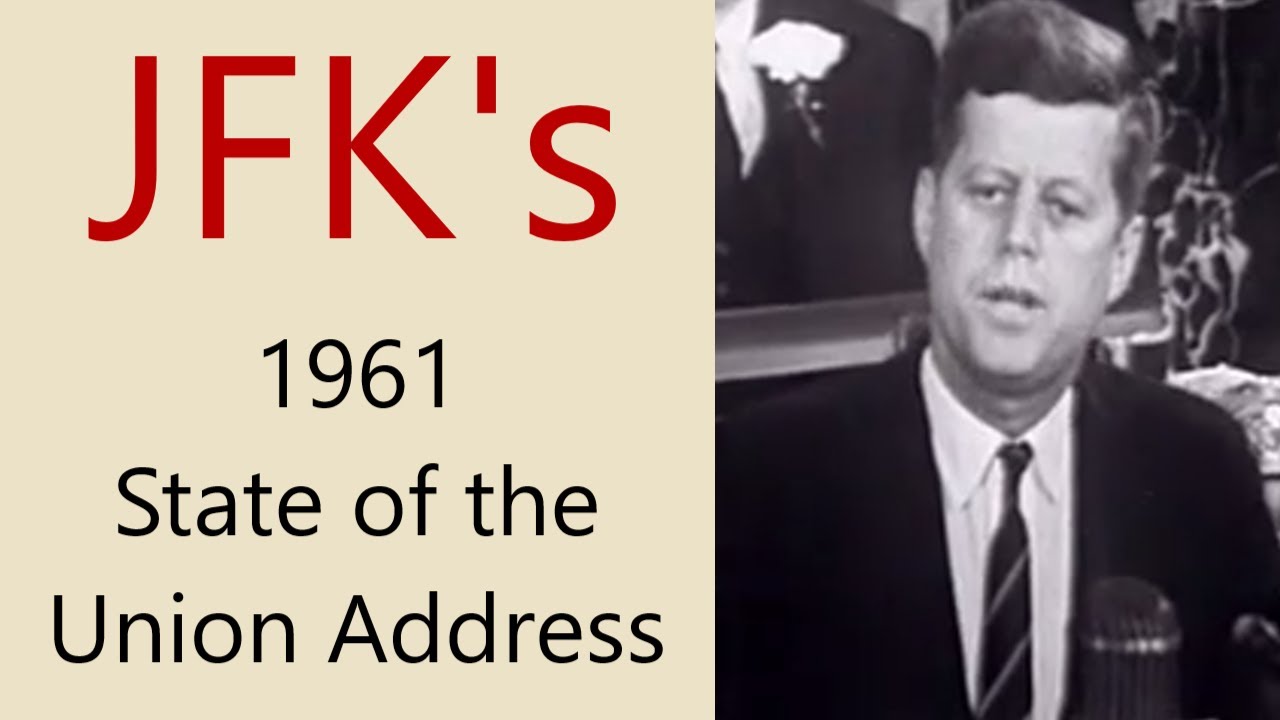
- JFK's 1961 State of the Union Address
JFK’s First Annual Message January 30, 1961 [As delivered in person before a joint session] Mr. Speaker, Mr. Vice President, Members of the Congress: It is a pleasure to return from whence I came. You are among my oldest friends in Washington--and this House is my oldest home. It was here, more than 14 years ago, that I first took the oath of Federal office. It was here, for 14 years, that I gained both knowledge and inspiration from members of both parties in both Houses--from your wise and generous leaders--and from the pronouncements which I can vividly recall, sitting where you now sit--including the programs of two great Presidents, the undimmed eloquence of Churchill, the soaring idealism of Nehru, the steadfast words of General de Gaulle. To speak from this same historic rostrum is a sobering experience. To be back among so many friends is a happy one. I am confident that that friendship will continue. Our Constitution wisely assigns both joint and separate roles to each branch of the government; and a President and a Congress who hold each other in mutual respect will neither permit nor attempt any trespass. For my part, I shall withhold from neither the Congress nor the people any fact or report, past, present, or future, which is necessary for an informed judgment of our conduct and hazards. I shall neither shift the burden of executive decisions to the Congress, nor avoid responsibility for the outcome of those decisions. I speak today in an hour of national peril and national opportunity. Before my term has ended, we shall have to test anew whether a nation organized and governed such as ours can endure. The outcome is by no means certain. The answers are by no means clear. All of us together--this Administration, this Congress, this nation-must forge those answers. But today, were I to offer--after little more than a week in office--detailed legislation to remedy every national ill, the Congress would rightly wonder whether the desire for speed had replaced the duty of responsibility. My remarks, therefore, will be limited. But they will also be candid. To state the facts frankly is not to despair the future nor indict the past. The prudent heir takes careful inventory of his legacies, and gives a faithful accounting to those whom he owes an obligation of trust. And, while the occasion does not call for another recital of our blessings and assets, we do have no greater asset than the willingness of a free and determined people, through its elected officials, to face all problems frankly and meet all dangers free from panic or fear. The present state of our economy is disturbing. We take office in the wake of seven months of recession, three and one-half years of slack, seven years of diminished economic growth, and nine years of falling farm income. Business bankruptcies have reached their highest level since the Great Depression. Since 1951 farm income has been squeezed down by 25 percent. Save for a brief period in 1958, insured unemployment is at the highest peak in our history. Of some five and one-half million Americans who are without jobs, more than one million have been searching for work for more than four months. And during each month some 150,000 workers are exhausting their already meager jobless benefit rights. Nearly, one-eighth of those who are without jobs live almost without hope in nearly one hundred especially depressed and troubled areas. The rest include new school graduates unable to use their talents, farmers forced to give up their part-time jobs which helped balance their family budgets, skilled and unskilled workers laid off in such important industries as metals, machinery, automobiles and apparel. Our recovery from the 1958 recession, moreover, was anemic and incomplete. Our Gross National Product never regained its full potential. Unemployment never returned to normal levels. Maximum use of our national industrial capacity was never restored. In short, the American economy is in trouble. The most resourceful industrialized country on earth ranks among the last in the rate of economic growth. Since last spring our economic growth rate has actually receded. Business investment is in a decline. Profits have fallen below predicted levels. Construction is off. A million unsold automobiles are in inventory. Fewer people are working--and the average work week has shrunk well below 40 hours. Yet prices have continued to rise--so that now too many Americans have less to spend for items that cost more to buy. Economic prophecy is at best an uncertain art--as demonstrated by the prediction one year ago from this same podium that 1960 would be, and I quote, "the most prosperous year in our history." Nevertheless, forecasts of continued slack and only slightly reduced unemployment through 1961 and 1962 have been made with alarming unanimity-and this Administration does not intend to stand helplessly by. We cannot afford to waste idle hours and empty plants while awaiting the end of the recession. We must show the world what a free economy can do--to reduce unemployment, to put unused capacity to work, to spur new productivity, and to foster higher economic growth within a range of sound fiscal policies and relative price stability. I will propose to the Congress within the next 14 days measures to improve unemployment compensation through temporary increases in duration on a self-supporting basis--to provide more food for the families of the unemployed, and to aid their needy children--to redevelop our areas of chronic labor surplus--to expand the services of the U.S. Employment Offices--to stimulate housing and construction--to secure more purchasing power for our lowest paid workers by raising and expanding the minimum wage--to offer tax incentives for sound plant investment--to increase the development of our natural resources--to encourage price stability--and to take other steps aimed at insuring a prompt recovery and paving the way for increased long-range growth. This is not a partisan program concentrating on our weaknesses--it is, I hope, a national program to realize our national strength. II. Efficient expansion at home, stimulating the new plant and technology that can make our goods more competitive, is also the key to the international balance of payments problem. Laying aside all alarmist talk and panicky solutions, let us put that knotty problem in its proper perspective. It is true that, since 1958, the gap between the dollars we spend or invest abroad and the dollars returned to us has substantially widened. This overall deficit in our balance of payments increased by nearly $11 billion in the 3 years--and holders of dollars abroad converted them to gold in such a quantity as to cause a total outflow of nearly $5 billion of gold from our reserve. The 1959 deficit was caused in large part by the failure of our exports to penetrate foreign markets-the result both of restrictions on our goods and our own uncompetitive prices. The 1960 deficit, on the other hand, was more the result of an increase in private capital outflow seeking new opportunity, higher return or speculative advantage abroad. Meanwhile this country has continued to bear more than its share of the West's military and foreign aid obligations. Under existing policies, another deficit of $2 billion is predicted for 1961--and individuals in those countries whose dollar position once depended on these deficits for improvement now wonder aloud whether our gold reserves will remain sufficient to meet our own obligations. All this is cause for concern--but it is not cause for panic. For our monetary and financial position remains exceedingly strong. Including our drawing rights in the International Monetary Fund and the gold reserve held as backing for our currency and Federal Reserve deposits, we have some $22 billion in total gold stocks and other international monetary reserves available-and I now pledge that their full strength stands behind the value of the dollar for use if needed. Moreover, we hold large assets abroad-the total owed this nation far exceeds the claims upon our reserves--and our exports once again substantially exceed our imports. In short, we need not--and we shall not-take any action to increase the dollar price of gold from $35 an ounce--to impose exchange controls--to reduce our anti-recession efforts--to fall back on restrictive trade policies--or to weaken our commitments around the world. This Administration will not distort the value of the dollar in any fashion. And this is a commitment. Prudence and good sense do require, however, that new steps be taken to ease the payments deficit and prevent any gold crisis. Our success in world affairs has long depended in part upon foreign confidence in our ability to pay. A series of executive orders, legislative remedies and cooperative efforts with our allies will get underway immediately--aimed at attracting foreign investment and travel to this country-promoting American exports, at stable prices and with more liberal government guarantees and financing--curbing tax and customs loopholes that encourage undue spending of private dollars abroad--and (through OECD, NATO and otherwise) sharing with our allies all efforts to provide for the common defense of the free world and the hopes for growth of the less developed lands. While the current deficit lasts, ways will be found to ease our dollar outlays abroad without placing the full burden on the families of men whom we have asked to serve our Flag overseas. In short, whatever is required will be done to back up all our efforts abroad, and to make certain that, in the future as in the past, the dollar is as "sound as a dollar." III. But more than our exchange of international payments is out of balance. The current Federal budget for fiscal 1961 is almost certain to show a net deficit. The budget already submitted for fiscal 1962 will remain in balance only if the Congress enacts all the revenue measures requested--and only if an earlier and sharper up-turn in the economy than my economic advisers now think likely produces the tax revenues estimated. Nevertheless, a new Administration must of necessity build on the spending and revenue estimates already submitted. Within that framework, barring the development of urgent national defense needs or a worsening of the economy, it is my current intention to advocate a program of expenditures which, including revenues from a stimulation of the economy, will not of and by themselves unbalance the earlier Budget. However, we will do what must be done. For our national household is cluttered with unfinished and neglected tasks. Our cities are being engulfed in squalor. Twelve long years after Congress declared our goal to be "a decent home and a suitable environment for every American family," we still have 25 million Americans living in substandard homes. A new housing program under a new Housing and Urban Affairs Department will be needed this year. Our classrooms contain 2 million more children than they can properly have room for, taught by 90,000 teachers not properly qualified to teach. One third of our most promising high school graduates are financially unable to continue the development of their talents. The war babies of the 1940's, who overcrowded our schools in the 1950's, are now descending in 1960 upon our colleges-with two college students for every one, ten years from now--and our colleges are ill prepared. We lack the scientists, the engineers and the teachers our world obligations require. We have neglected oceanography, saline water conversion, and the basic research that lies at the root of all progress. Federal grants for both higher and public school education can no longer be delayed. Medical research has achieved new wonders--but these wonders are too often beyond the reach of too many people, owing to a lack of income (particularly among the aged), a lack of hospital beds, a lack of nursing homes and a lack of doctors and dentists. Measures to provide health care for the aged under Social Security, and to increase the supply of both facilities and personnel, must be undertaken this year. Our supply of clean water is dwindling. Organized and juvenile crimes cost the taxpayers millions of dollars each year, making it essential that we have improved enforcement and new legislative safeguards. The denial of constitutional rights to some of our fellow Americans on account of race--at the ballot box and elsewhere--disturbs the national conscience, and subjects us to the charge of world opinion that our democracy is not equal to the high promise of our heritage. Morality in private business has not been sufficiently spurred by morality in public business. A host of problems and projects in all 50 States, though not possible to include in this Message, deserves-and will receive--the attention of both the Congress and the Executive Branch. On most of these matters, Messages will be sent to the Congress within the next two weeks. IV. But all these problems pale when placed beside those which confront us around the world. No man entering upon this office, regardless of his party, regardless of his previous service in Washington, could fail to be staggered upon learning--even in this brief 10 day period--the harsh enormity of the trials through which we must pass in the next four years. Each day the crises multiply. Each day their solution grows more difficult. Each day we draw nearer the hour of maximum danger, as weapons spread and hostile forces grow stronger. I feel I must inform the Congress that our analyses over the last ten days make it clear that--in each of the principal areas of crisis--the tide of events has been running out and time has not been our friend. In Asia, the relentless pressures of the Chinese Communists menace the security of the entire area--from the borders of India and South Viet Nam to the jungles of Laos, struggling to protect its newly-won independence. We seek in Laos what we seek in all Asia, and, indeed, in all of the world-freedom for the people and independence for the government. And this Nation shall persevere in our pursuit of these objectives. In Africa, the Congo has been brutally torn by civil strife, political unrest and public disorder. We shall continue to support the heroic efforts of the United Nations to restore peace and order--efforts which are now endangered by mounting tensions, unsolved problems, and decreasing support from many member states. In Latin America, Communist agents seeking to exploit that region's peaceful revolution of hope have established a base on Cuba, only 90 miles from our shores. Our objection with Cuba is not over the people's drive for a better life. Our objection is to their domination by foreign and domestic tyrannies. Cuban social and economic reform should be encouraged. Questions of economic and trade policy can always be negotiated. But Communist domination in this Hemisphere can never be negotiated. We are pledged to work with our sister republics to free the Americas of all such foreign domination and all tyranny, working toward the goal of a free hemisphere of free governments, extending from Cape Horn to the Arctic Circle. In Europe our alliances are unfulfilled and in some disarray. The unity of NATO has been weakened by economic rivalry and partially eroded by national interest. It has not yet fully mobilized its resources nor fully achieved a common outlook. Yet no Atlantic power can meet on its own the mutual problems now facing us in defense, foreign aid, monetary reserves, and a host of other areas; and our close ties with those whose hopes and interests we share are among this Nation's most powerful assets. Our greatest challenge is still the world that lies beyond the Cold War--but the first great obstacle is still our relations with the Soviet Union and Communist China. We must never be lulled into believing that either power has yielded its ambitions for world domination--ambitions which they forcefully restated only a short time ago. On the contrary, our task is to convince them that aggression and subversion will not be profitable routes to pursue these ends. Open and peaceful competition--for prestige, for markets, for scientific achievement, even for men's minds--is something else again. For if Freedom and Communism were to compete for man's allegiance in a world at peace, I would look to the future with ever increasing confidence. To meet this array of challenges--to fulfill the role we cannot avoid on the world scene--we must reexamine and revise our whole arsenal of tools: military, economic and political. One must not overshadow the other: On the Presidential Coat of Arms, the American eagle holds in his right talon the olive branch, while in his left he holds a bundle of arrows. We intend to give equal attention to both. First, we must strengthen our military tools. We are moving into a period of uncertain risk and great commitment in which both the military and diplomatic possibilities require a Free World force so powerful as to make any aggression clearly futile. Yet in the past, lack of a consistent, coherent military strategy, the absence of basic assumptions about our national requirements and the faulty estimates and duplication arising from inter-service rivalries have all made it difficult to assess accurately how adequate--or inadequate--our defenses really are. I have, therefore, instructed the Secretary of Defense to reappraise our entire defense strategy--our ability to fulfill our commitments-the effectiveness, vulnerability, and dispersal of our strategic bases, forces and warning systems--the efficiency and economy of our operation and organization-the elimination of obsolete bases and installations-and the adequacy, modernization and mobility of our present conventional and nuclear forces and weapons systems in the light of present and future dangers. I have asked for preliminary conclusions by the end of February--and I then shall recommend whatever legislative, budgetary or executive action is needed in the light of these conclusions. In the meantime, I have asked the Defense Secretary to initiate immediately three new steps most clearly needed now: First, l have directed prompt attention to increase our air-lift capacity. Obtaining additional air transport mobility--and obtaining it now--will better assure the ability of our conventional forces to respond, with discrimination and speed, to any problem at any spot on the globe at any moment's notice. In particular it will enable us to meet any deliberate effort to avoid or divert our forces by starting limited wars in widely scattered parts of the globe. (b) I have directed prompt action to step up our Polaris submarine program. Using unobligated ship-building funds now (to let contracts originally scheduled for the next fiscal year) will build and place on station--at least nine months earlier than planned-substantially more units of a crucial deterrent--a fleet that will never attack first, but possess sufficient powers of retaliation, concealed beneath the seas, to discourage any aggressor from launching an attack upon our security. (c) I have directed prompt action to accelerate our entire missile program. Until the Secretary of Defense's reappraisal is completed, the emphasis here will be largely on improved organization and decision making--on cutting down the wasteful duplications and the time-lag that have handicapped our whole family of missiles. If we are to keep the peace, we need an invulnerable missile force powerful enough to deter any aggressor from even threatening an attack that he would know could not destroy enough of our force to prevent his own destruction. For as I said upon taking the oath of office: "Only when our arms are sufficient beyond doubt can we be certain beyond doubt that they will never be employed." Secondly, we must improve our economic tools. Our role is essential and unavoidable in the construction of a sound and expanding economy for the entire non-communist world, helping other nations build the strength to meet their own problems, to satisfy their own aspirations--to surmount their own dangers. The problems in achieving this goal are towering and unprecedented-the response must be towering and unprecedented as well, much as Lend-Lease and the Marshall Plan were in earlier years, which brought such fruitful results. (a) I intend to ask the Congress for authority to establish a new and more effective program for assisting the economic, educational and social development of other countries and continents. That program must stimulate and take more effectively into account the contributions of our allies, and provide central policy direction for all our own programs that now so often overlap, conflict or diffuse our energies and resources. Such a program, compared to past programs, will require --more flexibility for short run emergencies --more commitment to long term development --new attention to education at all levels --greater emphasis on the recipient nation's role, their effort, their purpose, with greater social justice for their people, broader distribution and participation by their people and more efficient public administration and more efficient tax systems of their own --and orderly planning for national and regional development instead of a piecemeal approach. I hope the Senate will take early action approving the Convention establishing the Organization for Economic Cooperation and Development. This will be an important instrument in sharing with our allies this development effort--working toward the time when each nation will contribute in proportion to its ability to pay. For, while we are prepared to assume our full share of these huge burdens, we cannot and must not be expected to bear them alone. To our sister republics to the south, we have pledged a new alliance for progress-alianza para progreso. Our goal is a free and prosperous Latin America, realizing for all its states and all its citizens a degree of economic and social progress that matches their historic contributions of culture, intellect and liberty. To start this nation's role at this time in that alliance of neighbors, I am recommending the following: --That the Congress appropriate in full the $500 million fund pledged by the Act of Bogota, to be used not as an instrument of the Cold War, but as a first step in the sound development of the Americas. --That a new Inter-Departmental Task Force be established under the leadership of the Department of State, to coordinate at the highest level all policies and programs of concern to the Americas. --That our delegates to the OAS, working with those of other members, strengthen that body as an instrument to preserve the peace and to prevent foreign domination anywhere in the Hemisphere. --That, in cooperation with other nations, we launch a new hemispheric attack on illiteracy and inadequate educational opportunities to all levels; and, finally, --That a Food-for-Peace mission be sent immediately to Latin America to explore ways in which our vast food abundance can be used to help end hunger and malnutrition in certain areas of suffering in our own hemisphere. This Administration is expanding its Food-for-Peace Program in every possible way. The product of our abundance must be used more effectively to relieve hunger and help economic growth in all corners of the globe. And I have asked the Director of this Program to recommend additional ways in which these surpluses can advance the interests of world peace--including the establishment of world food reserves. An even more valuable national asset is our reservoir of dedicated men and women-not only on our college campuses but in every age group--who have indicated their desire to contribute their skills, their efforts, and a part of their lives to the fight for world order. We can mobilize this talent through the formation of a National Peace Corps, enlisting the services of all those with the desire and capacity to help foreign lands meet their urgent needs for trained personnel. Finally, while our attention is centered on the development of the noncommunist world, we must never forget our hopes for the ultimate freedom and welfare of the Eastern European peoples. In order to be prepared to help re-establish historic ties of friendship, I am asking the Congress for increased discretion to use economic tools in this area whenever this is found to be clearly in the national interest. This will require amendment of the Mutual Defense Assistance Control Act along the lines I proposed as a member of the Senate, and upon which the Senate voted last summer. Meanwhile, I hope to explore with the Polish government the possibility of using our frozen Polish funds on projects of peace that will demonstrate our abiding friendship for and interest in the people of Poland. Third, we must sharpen our political and diplomatic tools the means of cooperation and agreement on which an enforceable world order must ultimately rest. I have already taken steps to coordinate and expand our disarmament effort--to increase our programs of research and study-and to make arms control a central goal of our national policy under my direction. The deadly arms race, and the huge resources it absorbs, have too long overshadowed all else we must do. We must prevent that arms race from spreading to new nations, to new nuclear powers and to the reaches of outer space. We must make certain that our negotiators are better informed and better prepared--to formulate workable proposals of our own and to make sound judgments about the proposals of others. I have asked the other governments concerned to agree to a reasonable delay in the talks on a nuclear test ban--and it is our intention to resume negotiations prepared to reach a final agreement with any nation that is equally willing to agree to an effective and enforceable treaty. We must increase our support of the United Nations as an instrument to end the Cold War instead of an arena in which to fight it. In recognition of its increasing importance and the doubling of its membership --we are enlarging and strengthening our own mission to the U.N. --we shall help insure that it is properly financed. --we shall work to see that the integrity of the office of the Secretary-General is maintained. --And I would address a special plea to the smaller nations of the world--to join with us in strengthening this organization, which is far more essential to their security than it is to ours--the only body in the world where no nation need be powerful to be secure, where every nation has an equal voice, and where any nation can exert influence not according to the strength of its armies but according to the strength of its ideas. It deserves the support of all. Finally, this Administration intends to explore promptly all possible areas of cooperation with the Soviet Union and other nations "to invoke the wonders of science instead of its terrors." Specifically, I now invite all nations--including the Soviet Union--to join with us in developing a weather prediction program, in a new communications satellite program and in preparation for probing the distant planets of Mars and Venus, probes which may someday unlock the deepest secrets of the universe. Today this country is ahead in the science and technology of space, while the Soviet Union is ahead in the capacity to lift large vehicles into orbit. Both nations would help themselves as well as other nations by ten moving these endeavors from the bitter and wasteful competition of the Cold War. The United States would be willing to join with the Soviet Union and the scientists of all nations in a greater effort to make the fruits of this new knowledge available to all-and, beyond that, in an effort to extend farm technology to hungry nations--to wipe out disease--to increase the exchanges of scientists and. their knowledge--and to make our own laboratories available to technicians of other lands who lack the facilities to pursue their own work. Where nature makes natural allies of us all, we can demonstrate that beneficial relations are possible even with those with whom we most deeply disagree-and this must someday be the basis of world peace and world law. V. I have commented on the state of the domestic economy, our balance of payments, our Federal and social budget and the state of the world. I would like to conclude with a few remarks about the state of the Executive branch. We have found it full of honest and useful public servants--but their capacity to act decisively at the exact time action is needed has too often been muffled in the morass of committees, timidities and fictitious theories which have created a growing gap between decision and execution, between planning and reality. In a time of rapidly deteriorating situations at home and abroad, this is bad for the public service and particularly bad for the country; and we mean to make a change. I have pledged myself and my colleagues in the cabinet to a continuous encouragement of initiative, responsibility and energy in serving the public interest. Let every public servant know, whether his post is high or low, that a man's rank and reputation in this Administration will be determined by the size of the job he does, and not by the size of his staff, his office or his budget. Let it be clear that this Administration recognizes the value of dissent and daring--that we greet healthy controversy as the hallmark of healthy change. Let the public service be a proud and lively career. And let every man and woman who works in any area of our national government, in any branch, at any level, be able to say with pride and with honor in future years: "I served the United States government in that hour of our nation's need." For only with complete dedication by us all to the national interest can we bring our country through the troubled years that lie ahead. Our problems are critical. The tide is unfavorable. The news will be worse before it is better. And while hoping and working for the best, we should prepare ourselves now for the worst. We cannot escape our dangers--neither must we let them drive us into panic or narrow isolation. In many areas of the world where the balance of power already rests with our adversaries, the forces of freedom are sharply divided. It is one of the ironies of our time that the techniques of a harsh and repressive system should be able to instill discipline and ardor in its servants--while the blessings of liberty have too often stood for privilege, materialism and a life of ease. But I have a different view of liberty. Life in 1961 will not be easy. Wishing it, predicting it, even asking for it, will not make it so. There will be further setbacks before the tide is turned. But turn it we must. The hopes of all mankind rest upon us--not simply upon those of us in this chamber, but upon the peasant in Laos, the fisherman in Nigeria, the exile from Cuba, the spirit that moves every man and Nation who shares our hopes for freedom and the future. And in the final analysis, they rest most of all upon the pride and perseverance of our fellow citizens of the great Republic. In the words of a great President, whose birthday we honor today, closing his final State of the Union Message sixteen years ago, "We pray that we may be worthy of the unlimited opportunities that God has given us." Source: https://www.presidency.ucsb.edu/documents/annual-message-the-congress-the-state-the-union-5
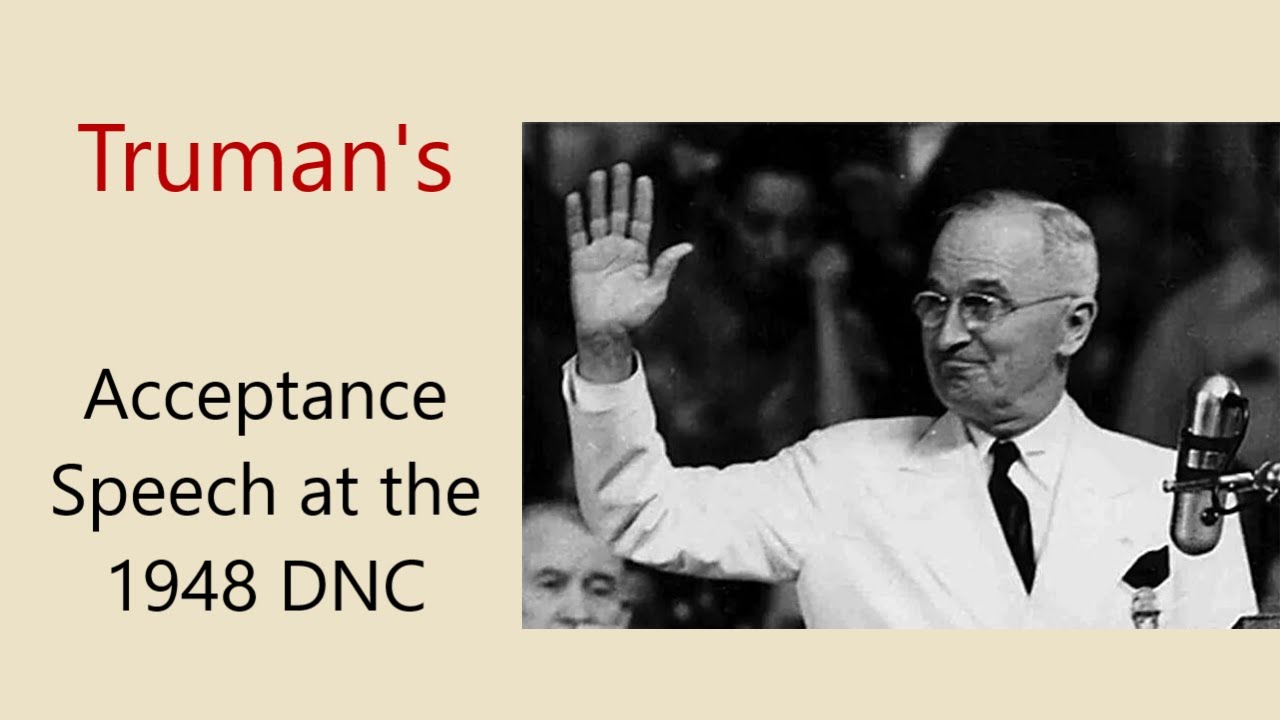
- Truman's Acceptance Speech at the 1948 DNC
July 15, 1948 I am sorry that the microphones are in the way, but I must leave them the way they are because I have got to be able to see what I am doing--as I am always able to see what I am doing. I can't tell you how very much I appreciate the honor which you have just conferred upon me. I shall continue to try to deserve it. I accept the nomination. And I want to thank this convention for its unanimous nomination of my good friend and colleague, Senator Barkley of Kentucky. He is a great man, and a great public servant. Senator Barkley and I will win this election and make these Republicans like it--don't you forget that! We will do that because they are wrong and we are right, and I will prove it to you in just a few minutes. This convention met to express the will and reaffirm the beliefs of the Democratic Party. There have been differences of opinion, and that is the democratic way. Those differences have been settled by a majority vote, as they should be. Now it is time for us to get together and beat the common enemy. And that is up to you. We have been working together for victory in a great cause. Victory has become a habit of our party. It has been elected four times in succession, and I am convinced it will be elected a fifth time next November. The reason is that the people know that the Democratic Party is the people's party, and the Republican Party is the party of special interest, and it always has been and always will be. The record of the Democratic Party is written in the accomplishments of the last 16 years. I don't need to repeat them. They have been very ably placed before this convention by the keynote speaker, the candidate for Vice President, and by the permanent chairman. Confidence and security have been brought to the people by the Democratic Party. Farm income has increased from less than $2 ¼ billion in 1932 to more than $18 billion in 1947. Never in the world were the farmers of any republic or any kingdom or any other country as prosperous as the farmers of the United States; and if they don't do their duty by the Democratic Party, they are the most ungrateful people in the world! Wages and salaries in this country have increased from 29 billion in 1933 to more than $128 billion in 1947. That's labor, and labor never had but one friend in politics, and that is the Democratic Party and Franklin D. Roosevelt. And I say to labor what I have said to the farmers: they are the most ungrateful people in the world if they pass the Democratic Party by this year. The total national income has increased from less than $40 billion in 1933 to $203 billion in 1947, the greatest in all the history of the world. These benefits have been spread to all the people, because it is the business of the Democratic Party to see that the people get a fair share of these things. This last, worst 80th Congress proved just the opposite for the Republicans. The record on foreign policy of the Democratic Party is that the United States has been turned away permanently from isolationism, and we have converted the greatest and best of the Republicans to our viewpoint on that subject. The United States has to accept its full responsibility for leadership in international affairs. We have been the backers and the people who organized and started the United Nations, first started under that great Democratic President, Woodrow Wilson, as the League of Nations. The League was sabotaged by the Republicans in 1920. And we must see that the United Nations continues a strong and growing body, so we can have everlasting peace in the world. We removed trade barriers in the world, which is the best asset we can have for peace. Those trade barriers must not be put back into operation again. We have started the foreign aid program, which means the recovery of Europe and China, and the Far East. We instituted the program for Greece and Turkey, and I will say to you that all these things were done in a cooperative and bipartisan manner. The Foreign Relations Committees of the Senate and House were taken into the full confidence of the President in every one of these moves, and don't let anybody tell you anything else. As I have said time and time again, foreign policy should be the policy of the whole Nation and not the policy of one party or the other. Partisanship should stop at the water's edge; and I shall continue to preach that through this whole campaign. I would like to say a word or two now on what I think the Republican philosophy is; and I will speak from actions and from history and from experience. The situation in 1932 was due to the policies of the Republican Party control of the Government of the United States. The Republican Party, as I said a while ago, favors the privileged few and not the common everyday man. Ever since its inception, that party has been under the control of special privilege; and they have completely proved it in the 80th Congress. They proved it by the things they did to the people, and not for them. They proved it by the things they failed to do. Now, let's look at some of them--just a few. Time and time again I recommended extension of price control before it expired June 30, 1946. I asked for that extension in September 1945, in November 1945, in a Message on the State of the Union in 1946; and that price control legislation did not come to my desk until June 30, 1946, on the day on which it was supposed to expire. And it was such a rotten bill that I couldn't sign it. And 30 days after that, they sent me one just as bad. I had to sign it, because they quit and went home. They said, when OPA died, that prices would adjust themselves for the benefit of the country. They have been adjusting themselves all right! They have gone all the way off the chart in adjusting themselves, at the expense of the consumer and for the benefit of the people that hold the goods. I called a special session of the Congress in November 1947--November 17, 1947--and I set out a 10-point program for the welfare and benefit of this country, among other things standby controls. I got nothing. Congress has still done nothing. Way back 4 1/2 years ago, while I was in the Senate, we passed a housing bill in the Senate known as the Wagner-Ellender-Taft bill. It was a bill to clear the slums in the big cities and to help to erect low-rent housing. That bill, as I said, passed the Senate 4 years ago. It died in the House. That bill was reintroduced in the 80th Congress as the Taft-Ellender-Wagner bill. The name was slightly changed, but it is practically the same bill. And it passed the Senate, but it was allowed to die in the House of Representatives; and they sat on that bill, and finally forced it out of the Banking and Currency Committee, and the Rules Committee took charge, and it still is in the Rules Committee. But desperate pleas from Philadelphia in that convention that met here 3 weeks ago couldn't get that housing bill passed. They passed a bill they called a housing bill, which isn't worth the paper it's written on. In the field of labor we needed moderate legislation to promote labor-management harmony, but Congress passed instead that so-called Taft-Hartley Act, which has disrupted labor-management relations and will cause strife and bitterness for years to come if it is not repealed, as the Democratic platform says it ought to be repealed. On the Labor Department, the Republican platform of 1944 said, if they were in power, that they would build up a strong Labor Department. They have simply torn it up. Only one bureau is left that is functioning, and they cut the appropriation of that so it can hardly function. I recommended an increase in the minimum wage. What did I get? Nothing. Absolutely nothing. I suggested that the schools in this country are crowded, teachers underpaid, and that there is a shortage of teachers. One of our greatest national needs is more and better schools. I urged the Congress to provide $300 million to aid the States in the present educational crisis. Congress did nothing about it. Time and again I have recommended improvements in the social security law, including extending protection to those not now covered, and increasing the amount of benefits, to reduce the eligibility age of women from 65 to 60 years. Congress studied the matter for 2 years, but couldn't find the time to extend or increase the benefits. But they did find time to take social security benefits away from 750,000 people, and they passed that over my veto. I have repeatedly asked the Congress to pass a health program. The Nation suffers from lack of medical care. That situation can be remedied any time the Congress wants to act upon it. Everybody knows that I recommended to the Congress the civil rights program. I did that because I believed it to be my duty under the Constitution. Some of the members of my own party disagree with me violently on this matter. But they stand up and do it openly! People can tell where they stand. But the Republicans all professed to be for these measures. But Congress failed to act. They had enough men to do it, they could have had cloture, they didn't have to have a filibuster. They had enough people in that Congress that would vote for cloture. Now everybody likes to have low taxes, but we must reduce the national debt in times of prosperity. And when tax relief can be given, it ought to go to those who need it most, and not those who need it least, as this Republican rich man's tax bill did when they passed it over my veto on the third try. The first one of these was so rotten that they couldn't even stomach it themselves. They finally did send one that was somewhat improved, but it still helps the rich and sticks a knife into the back of the poor. Now the Republicans came here a few weeks ago, and they wrote a platform. I hope you have all read that platform. They adopted the platform, and that platform had a lot of promises and statements of what the Republican Party is for, and what they would do if they were in power. They promised to do in that platform a lot of things I have been asking them to do that they have refused to do when they had the power. The Republican platform cries about cruelly high prices. I have been trying to get them to do something about high prices ever since they met the first time. Now listen! This is equally as bad, and as cynical. The Republican platform comes out for slum clearance and low-rental housing. I have been trying to get them to pass that housing bill ever since they met the first time, and it is still resting in the Rules Committee, that bill. The Republican platform favors educational opportunity and promotion of education. I have been trying to get Congress to do something about that ever since they came there, and that bill is at rest in the House of Representatives. The Republican platform is for extending and increasing social security benefits. Think of that! Increasing social security benefits! Yet when they had the opportunity, they took 750,000 off the social security rolls! I wonder if they think they can fool the people of the United States with such poppycock as that! There is a long list of these promises in that Republican platform. If it weren't so late, I would tell you all about them. I have discussed a number of these failures of the Republican 80th Congress. Every one of them is important. Two of them are of major concern to nearly every American family. They failed to do anything about high prices, they failed to do anything about housing. My duty as President requires that I use every means within my power to get the laws the people need on matters of such importance and urgency. I am therefore calling this Congress back into session July 26th. On the 26th day of July, which out in Missouri we call "Turnip Day," I am going to call Congress back and ask them to pass laws to halt rising prices, to meet the housing crisis--which they are saying they are for in their platform. At the same time I shall ask them to act upon other vitally needed measures such as aid to education, which they say they are for; a national health program; civil rights legislation, which they say they are for; an increase in the minimum wage, which I doubt very much they are for; extension of the social security coverage and increased benefits, which they say they are for; funds for projects needed in our program to provide public power and cheap electricity. By indirection, this 80th Congress has tried to sabotage the power policies the United States has pursued for 14 years. That power lobby is as bad as the real estate lobby, which is sitting on the housing bill. I shall ask for adequate and decent laws for displaced persons in place of this anti-Semitic, anti-Catholic law which this 80th Congress passed. Now, my friends, if there is any reality behind that Republican platform, we ought to get some action from a short session of the 80th Congress. They can do this job in 15 days, if they want to do it. They will still have time to go out and run for office. They are going to try to dodge their responsibility. They are going to drag all the red herrings they can across this campaign, but I am here to say that Senator Barkley and I are not going to let them get away with it. Now, what that worst 80th Congress does in this special session will be the test. The American people will not decide by listening to mere words, or by reading a mere platform. They will decide on the record, the record as it has been written. And in the record is the stark truth, that the battle lines of 1948 are the same as they were in 1932, when the Nation lay prostrate and helpless as a result of Republican misrule and inaction. In 1932 we were attacking the citadel of special privilege and greed. We were fighting to drive the money changers from the temple. Today, in 1948, we are now the defenders of the stronghold of democracy and of equal opportunity, the haven of the ordinary people of this land and not of the favored classes or the powerful few. The battle cry is just the same now as it was in 1932, and I paraphrase the words of Franklin D. Roosevelt as he issued the challenge, in accepting nomination in Chicago: "This is more than a political call to arms. Give me your help, not to win votes alone, but to win in this new crusade to keep America secure and safe for its own people." Now my friends, with the help of God and the wholehearted push which you can put behind this campaign, we can save this country from a continuation of the 80th Congress, and from misrule from now on. I must have your help. You must get in and push, and win this election. The country can't afford another Republican Congress. Source: https://www.presidency.ucsb.edu/documents/address-philadelphia-upon-accepting-the-nomination-the-democratic-national-convention
- Carter's 1980 State of the Union Address
Carter’s Third Annual Message January 23, 1980 Mr. President, Mr. Speaker, Members of the 96th Congress, fellow citizens: This last few months has not been an easy time for any of us. As we meet tonight, it has never been more clear that the state of our Union depends on the state of the world. And tonight, as throughout our own generation, freedom and peace in the world depend on the state of our Union. The 1980's have been born in turmoil, strife, and change. This is a time of challenge to our interests and our values and it's a time that tests our wisdom and our skills. At this time in Iran, 50 Americans are still held captive, innocent victims of terrorism and anarchy. Also at this moment, massive Soviet troops are attempting to subjugate the fiercely independent and deeply religious people of Afghanistan. These two acts—one of international terrorism and one of military aggression-present a serious challenge to the United States of America and indeed to all the nations of the world. Together, we will meet these threats to peace. I'm determined that the United States will remain the strongest of all nations, but our power will never be used to initiate a threat to the security of any nation or to the rights of any human being. We seek to be and to remain secure—a nation at peace in a stable world. But to be secure we must face the world as it is. Three basic developments have helped to shape our challenges: the steady growth and increased projection of Soviet military power beyond its own borders; the overwhelming dependence of the Western democracies on oil supplies from the Middle East; and the press of social and religious and economic and political change in the many nations of the developing world, exemplified by the revolution in Iran. Each of these factors is important in its own right. Each interacts with the others. All must be faced together, squarely and courageously. We will face these challenges, and we will meet them with the best that is in us. And we will not fail. In response to the abhorrent act in Iran, our Nation has never been aroused and unified so greatly in peacetime. Our position is clear. The United States will not yield to blackmail. We continue to pursue these specific goals: first, to protect the present and long-range interests of the United States; secondly, to preserve the lives of the American hostages and to secure, as quickly as possible, their safe release, if possible, to avoid bloodshed which might further endanger the lives of our fellow citizens; to enlist the help of other nations in condemning this act of violence, which is shocking and violates the moral and the legal standards of a civilized world; and also to convince and to persuade the Iranian leaders that the real danger to their nation lies in the north, in the Soviet Union and from the Soviet troops now in Afghanistan, and that the unwarranted Iranian quarrel with the United States hampers their response to this far greater danger to them. If the American hostages are harmed, a severe price will be paid. We will never rest until every one of the American hostages are released. But now we face a broader and more fundamental challenge in this region because of the recent military action of the Soviet Union. Now, as during the last 3 1/2 decades, the relationship between our country, the United States of America, and the Soviet Union is the most critical factor in determining whether the world will live at peace or be engulfed in global conflict. Since the end of the Second World War, America has led other nations in meeting the challenge of mounting Soviet power. This has not been a simple or a static relationship. Between us there has been cooperation, there has been competition, and at times there has been confrontation. In the 1940's we took the lead in creating the Atlantic Alliance in response to the Soviet Union's suppression and then consolidation of its East European empire and the resulting threat of the Warsaw Pact to Western Europe. In the 1950's we helped to contain further Soviet challenges in Korea and in the Middle East, and we rearmed to assure the continuation of that containment. In the 1960's we met the Soviet challenges in Berlin, and we faced the Cuban missile crisis. And we sought to engage the Soviet Union in the important task of moving beyond the cold war and away from confrontation. And in the 1970's three American Presidents negotiated with the Soviet leaders in attempts to halt the growth of the nuclear arms race. We sought to establish rules of behavior that would reduce the risks of conflict, and we searched for areas of cooperation that could make our relations reciprocal and productive, not only for the sake of our two nations but for the security and peace of the entire world. In all these actions, we have maintained two commitments: to be ready to meet any challenge by Soviet military power, and to develop ways to resolve disputes and to keep the peace. Preventing nuclear war is the foremost responsibility of the two superpowers. That's why we've negotiated the strategic arms limitation treaties—SALT I and SALT II. Especially now, in a time of great tension, observing the mutual constraints imposed by the terms of these treaties will be in the best interest of both countries and will help to preserve world peace. I will consult very closely with the Congress on this matter as we strive to control nuclear weapons. That effort to control nuclear weapons will not be abandoned. We superpowers also have the responsibility to exercise restraint in the use of our great military force. The integrity and the independence of weaker nations must not be threatened. They must know that in our presence they are secure. But now the Soviet Union has taken a radical and an aggressive new step. It's using its great military power against a relatively defenseless nation. The implications of the Soviet invasion of Afghanistan could pose the most serious threat to the peace since the Second World War. The vast majority of nations on Earth have condemned this latest Soviet attempt to extend its colonial domination of others and have demanded the immediate withdrawal of Soviet troops. The Moslem world is especially and justifiably outraged by this aggression against an Islamic people. No action of a world power has ever been so quickly and so overwhelmingly condemned. But verbal condemnation is not enough. The Soviet Union must pay a concrete price for their aggression. While this invasion continues, we and the other nations of the world cannot conduct business as usual with the Soviet Union. That's why the United States has imposed stiff economic penalties on the Soviet Union. I will not issue any permits for Soviet ships to fish in the coastal waters of the United States. I've cut Soviet access to high-technology equipment and to agricultural products. I've limited other commerce with the Soviet Union, and I've asked our allies and friends to join with us in restraining their own trade with the Soviets and not to replace our own embargoed items. And I have notified the Olympic Committee that with Soviet invading forces in Afghanistan, neither the American people nor I will support sending an Olympic team to Moscow. The Soviet Union is going to have to answer some basic questions: Will it help promote a more stable international environment in which its own legitimate, peaceful concerns can be pursued? Or will it continue to expand its military power far beyond its genuine security needs, and use that power for colonial conquest? The Soviet Union must realize that its decision to use military force in Afghanistan will be costly to every political and economic relationship it values. The region which is now threatened by Soviet troops in Afghanistan is of great strategic importance: It contains more than two-thirds of the world's exportable oil. The Soviet effort to dominate Afghanistan has brought Soviet military forces to within 300 miles of the Indian Ocean and close to the Straits of Hormuz, a waterway through which most of the world's oil must flow. The Soviet Union is now attempting to consolidate a strategic position, therefore, that poses a grave threat to the free movement of Middle East oil. This situation demands careful thought, steady nerves, and resolute action, not only for this year but for many years to come. It demands collective efforts to meet this new threat to security in the Persian Gulf and in Southwest Asia. It demands the participation of all those who rely on oil from the Middle East and who are concerned with global peace and stability. And it demands consultation and close cooperation with countries in the area which might be threatened. Meeting this challenge will take national will, diplomatic and political wisdom, economic sacrifice, and, of course, military capability. We must call on the best that is in us to preserve the security of this crucial region. Let our position be absolutely clear: An attempt by any outside force to gain control of the Persian Gulf region will be regarded as an assault on the vital interests of the United States of America, and such an assault will be repelled by any means necessary, including military force. During the past 3 years, you have joined with me to improve our own security and the prospects for peace, not only in the vital oil-producing area of the Persian Gulf region but around the world. We've increased annually our real commitment for defense, and we will sustain this increase of effort throughout the Five Year Defense Program. It's imperative that Congress approve this strong defense budget for 1981, encompassing a 5-percent real growth in authorizations, without any reduction. We are also improving our capability to deploy U.S. military forces rapidly to distant areas. We've helped to strengthen NATO and our other alliances, and recently we and other NATO members have decided to develop and to deploy modernized, intermediate-range nuclear forces to meet an unwarranted and increased threat from the nuclear weapons of the Soviet Union. We are working with our allies to prevent conflict in the Middle East. The peace treaty between Egypt and Israel is a notable achievement which represents a strategic asset for America and which also enhances prospects for regional and world peace. We are now engaged in further negotiations to provide full autonomy for the people of the West Bank and Gaza, to resolve the Palestinian issue in all its aspects, and to preserve the peace and security of Israel. Let no one doubt our commitment to the security of Israel. In a few days we will observe an historic event when Israel makes another major withdrawal from the Sinai and when Ambassadors will be exchanged between Israel and Egypt. We've also expanded our own sphere of friendship. Our deep commitment to human rights and to meeting human needs has improved our relationship with much of the Third World. Our decision to normalize relations with the People's Republic of China will help to preserve peace and stability in Asia and in the Western Pacific. We've increased and strengthened our naval presence in the Indian Ocean, and we are now making arrangements for key naval and air facilities to be used by our forces in the region of northeast Africa and the Persian Gulf. We've reconfirmed our 1959 agreement to help Pakistan preserve its independence and its integrity. The United States will take action consistent with our own laws to assist Pakistan in resisting any outside aggression. And I'm asking the Congress specifically to reaffirm this agreement. I'm also working, along with the leaders of other nations, to provide additional military and economic aid for Pakistan. That request will come to you in just a few days. In the weeks ahead, we will further strengthen political and military ties with other nations in the region. We believe that there are no irreconcilable differences between us and any Islamic nation. We respect the faith of Islam, and we are ready to cooperate with all Moslem countries. Finally, we are prepared to work with other countries in the region to share a cooperative security framework that respects differing values and political beliefs, yet which enhances the independence, security, and prosperity of all. All these efforts combined emphasize our dedication to defend and preserve the vital interests of the region and of the nation which we represent and those of our allies—in Europe and the Pacific, and also in the parts of the world which have such great strategic importance to us, stretching especially through the Middle East and Southwest Asia. With your help, I will pursue these efforts with vigor and with determination. You and I will act as necessary to protect and to preserve our Nation's security. The men and women of America's Armed Forces are on duty tonight in many parts of the world. I'm proud of the job they are doing, and I know you share that pride. I believe that our volunteer forces are adequate for current defense needs, and I hope that it will not become necessary to impose a draft. However, we must be prepared for that possibility. For this reason, I have determined that the Selective Service System must now be revitalized. I will send legislation and budget proposals to the Congress next month so that we can begin registration and then meet future mobilization needs rapidly if they arise. We also need clear and quick passage of a new charter to define the legal authority and accountability of our intelligence agencies. We will guarantee that abuses do not recur, but we must tighten our controls on sensitive intelligence information, and we need to remove unwarranted restraints on America's ability to collect intelligence. The decade ahead will be a time of rapid change, as nations everywhere seek to deal with new problems and age-old tensions. But America need have no fear. We can thrive in a world of change if we remain true to our values and actively engaged in promoting world peace. We will continue to work as we have for peace in the Middle East and southern Africa. We will continue to build our ties with developing nations, respecting and helping to strengthen their national independence which they have struggled so hard to achieve. And we will continue to support the growth of democracy and the protection of human rights. In repressive regimes, popular frustrations often have no outlet except through violence. But when peoples and their governments can approach their problems together through open, democratic methods, the basis for stability and peace is far more solid and far more enduring. That is why our support for human rights in other countries is in our own national interest as well as part of our own national character. Peace—a peace that preserves freedom-remains America's first goal. In the coming years, as a mighty nation we will continue to pursue peace. But to be strong abroad we must be strong at home. And in order to be strong, we must continue to face up to the difficult issues that confront us as a nation today. The crises in Iran and Afghanistan have dramatized a very important lesson: Our excessive dependence on foreign oil is a clear and present danger to our Nation's security. The need has never been more urgent. At long last, we must have a clear, comprehensive energy policy for the United States. As you well know, I have been working with the Congress in a concentrated and persistent way over the past 3 years to meet this need. We have made progress together. But Congress must act promptly now to complete final action on this vital energy legislation. Our Nation will then have a major conservation effort, important initiatives to develop solar power, realistic pricing based on the true value of oil, strong incentives for the production of coal and other fossil fuels in the United States, and our Nation's most massive peacetime investment in the development of synthetic fuels. The American people are making progress in energy conservation. Last year we reduced overall petroleum consumption by 8 percent and gasoline consumption by 5 percent below what it was the year before. Now we must do more. After consultation with the Governors, we will set gasoline conservation goals for each of the 50 States, and I will make them mandatory if these goals are not met. I've established an import ceiling for 1980 of 8.2 million barrels a day—well below the level of foreign oil purchases in 1977. I expect our imports to be much lower than this, but the ceiling will be enforced by an oil import fee if necessary. I'm prepared to lower these imports still further if the other oil-consuming countries will join us in a fair and mutual reduction. If we have a serious shortage, I will not hesitate to impose mandatory gasoline rationing immediately. The single biggest factor in the inflation rate last year, the increase in the inflation rate last year, was from one cause: the skyrocketing prices of OPEC oil. We must take whatever actions are necessary to reduce our dependence on foreign oil-and at the same time reduce inflation. As individuals and as families, few of us can produce energy by ourselves. But all of us can conserve energy—every one of us, every day of our lives. Tonight I call on you—in fact, all the people of America—to help our Nation. Conserve energy. Eliminate waste. Make 1980 indeed a year of energy conservation. Of course, we must take other actions to strengthen our Nation's economy. First, we will continue to reduce the deficit and then to balance the Federal budget. Second, as we continue to work with business to hold down prices, we'll build also on the historic national accord with organized labor to restrain pay increases in a fair fight against inflation. Third, we will continue our successful efforts to cut paperwork and to dismantle unnecessary Government regulation. Fourth, we will continue our progress in providing jobs for America, concentrating on a major new program to provide training and work for our young people, especially minority youth. It has been said that "a mind is a terrible thing to waste." We will give our young people new hope for jobs and a better life in the 1980's. And fifth, we must use the decade of the 1980's to attack the basic structural weaknesses and problems in our economy through measures to increase productivity, savings, and investment. With these energy and economic policies, we will make America even stronger at home in this decade—just as our foreign and defense policies will make us stronger and safer throughout the world. We will never abandon our struggle for a just and a decent society here at home. That's the heart of America—and it's the source of our ability to inspire other people to defend their own rights abroad. Our material resources, great as they are, are limited. Our problems are too complex for simple slogans or for quick solutions. We cannot solve them without effort and sacrifice. Walter Lippmann once reminded us, "You took the good things for granted. Now you must earn them again. For every right that you cherish, you have a duty which you must fulfill. For every good which you wish to preserve, you will have to sacrifice your comfort and your ease. There is nothing for nothing any longer." Our challenges are formidable. But there's a new spirit of unity and resolve in our country. We move into the 1980's with confidence and hope and a bright vision of the America we want: an America strong and free, an America at peace, an America with equal rights for all citizens-and for women, guaranteed in the United States Constitution—an America with jobs and good health and good education for every citizen, an America with a clean and bountiful life in our cities and on our farms, an America that helps to feed the world, an America secure in filling its own energy needs, an America of justice, tolerance, and compassion. For this vision to come true, we must sacrifice, but this national commitment will be an exciting enterprise that will unify our people. Together as one people, let us work to build our strength at home, and together as one indivisible union, let us seek peace and security throughout the world. Together let us make of this time of challenge and danger a decade of national resolve and of brave achievement. Thank you very much. Source: https://www.presidency.ucsb.edu/documents/the-state-the-union-address-delivered-before-joint-session-the-congress
- Carter's Victory Speech
November 03, 1976 Thank you. Thank you very much. Thank you everybody. Let me say just a word. Let me say just a word to you. This...this tremendous crowd at 4 o'clock in the morning represents hundreds of millions of American people who are now ready to see our nation unified, and I want to congratulate the toughest and most formidable opponent that anyone could possibly have, President Gerald Ford. As I've said many times throughout this nation, he's a good, a decent man and no one could have a campaign that had to be so thoroughly organized, hard fought, and which has marshaled so much cooperation from hundreds of thousands of people around this country who have had confidence in me. And I pray that I can live up to your confidence and never disappoint you. We have...we have a great nation as you know, and sometimes in the past we've been disappointed at our own government. But I think it's time to tap the tremendous strength and vitality and idealism and hope and patriotism and a sense of brotherhood and sisterhood in this country to unify our nation, to make it great once again. It's not...it's not going to be easy for any of us. I don't claim to know all the answers, but I have said many times in my campaign around all 50 states that I'm not afraid to take on the responsibilities of President of the United States, because my strength and my courage and my advice and my counsel and my criticism comes from you. And if I can tap the greatness that's in you and in the American people, we can make our nation's government great and a source of pride once again. Are you proud of our nation? [ crowd shouts back "Yes." ] Do you think we can help to unify it and bring it back together? [ crowd shouts "Yes." ] So do I. And I'll do the best I can. I'll do the best I can during this transition period from now until next January to continue to learn how to be a good President. And I've learned in the last 22 months, I believe as well as any human being could have learned, what our people are, what we have been in the past and what we can be. And I believe that in the next four years, we will have a sense of purpose, a sense that the government belongs to us, a sense that participated in this campaign. And now I welcome all those in the United States whether they, like you, (were) supporting me, or supporting Mr. Ford or someone else. It's time for us to get together to correct our mistakes, to answer difficult questions and to make our nation great. I want to thank all of you. I love everybody here, you've been great to me. Thank you...thank you very much. It's been a good campaign. It's going to be a good administration. Let's all get to work to make our country great once again. I'm depending on you like I have in the past. I'll try not to disappoint you. Thank you very much. We're all in it together. We're partners. And I'm looking forward to the next four years. Thank you very much, everybody. Jimmy Carter, Remarks in Atlanta Accepting Election as the 39th President of the United States Online by Gerhard Peters and John T. Woolley, The American Presidency Project https://www.presidency.ucsb.edu/node/345919
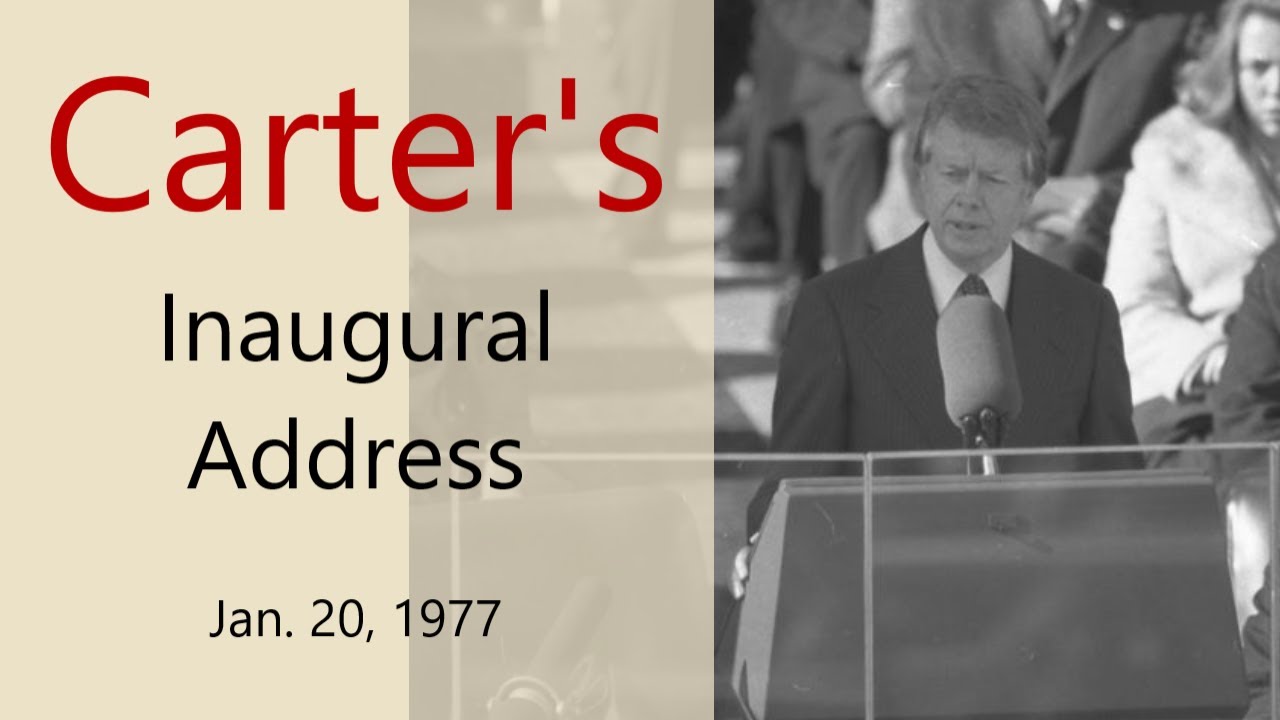
- Carter's Inaugural Address
48th Inauguration: Inaugural Address of Jimmy Carter THURSDAY, JANUARY 20, 1977 For myself and for our Nation, I want to thank my predecessor for all he has done to heal our land. In this outward and physical ceremony we attest once again to the inner and spiritual strength of our Nation. As my high school teacher, Miss Julia Coleman, used to say: "We must adjust to changing times and still hold to unchanging principles." Here before me is the Bible used in the inauguration of our first President, in 1789, and I have just taken the oath of office on the Bible my mother gave me a few years ago, opened to a timeless admonition from the ancient prophet Micah: "He hath showed thee, O man, what is good; and what doth the Lord require of thee, but to do justly, and to love mercy, and to walk humbly with thy God." (Micah 6: 8) This inauguration ceremony marks a new beginning, a new dedication within our Government, and a new spirit among us all. A President may sense and proclaim that new spirit, but only a people can provide it. Two centuries ago our Nation's birth was a milestone in the long quest for freedom, but the bold and brilliant dream which excited the founders of this Nation still awaits its consummation. I have no new dream to set forth today, but rather urge a fresh faith in the old dream. Ours was the first society openly to define itself in terms of both spirituality and of human liberty. It is that unique self- definition which has given us an exceptional appeal, but it also imposes on us a special obligation, to take on those moral duties which, when assumed, seem invariably to be in our own best interests. You have given me a great responsibility--to stay close to you, to be worthy of you, and to exemplify what you are. Let us create together a new national spirit of unity and trust. Your strength can compensate for my weakness, and your wisdom can help to minimize my mistakes. Let us learn together and laugh together and work together and pray together, confident that in the end we will triumph together in the right. The American dream endures. We must once again have full faith in our country--and in one another. I believe America can be better. We can be even stronger than before. Let our recent mistakes bring a resurgent commitment to the basic principles of our Nation, for we know that if we despise our own government we have no future. We recall in special times when we have stood briefly, but magnificently, united. In those times no prize was beyond our grasp. But we cannot dwell upon remembered glory. We cannot afford to drift. We reject the prospect of failure or mediocrity or an inferior quality of life for any person. Our Government must at the same time be both competent and compassionate. We have already found a high degree of personal liberty, and we are now struggling to enhance equality of opportunity. Our commitment to human rights must be absolute, our laws fair, our natural beauty preserved; the powerful must not persecute the weak, and human dignity must be enhanced. We have learned that "more" is not necessarily "better," that even our great Nation has its recognized limits, and that we can neither answer all questions nor solve all problems. We cannot afford to do everything, nor can we afford to lack boldness as we meet the future. So, together, in a spirit of individual sacrifice for the common good, we must simply do our best. Our Nation can be strong abroad only if it is strong at home. And we know that the best way to enhance freedom in other lands is to demonstrate here that our democratic system is worthy of emulation. To be true to ourselves, we must be true to others. We will not behave in foreign places so as to violate our rules and standards here at home, for we know that the trust which our Nation earns is essential to our strength. The world itself is now dominated by a new spirit. Peoples more numerous and more politically aware are craving and now demanding their place in the sun--not just for the benefit of their own physical condition, but for basic human rights. The passion for freedom is on the rise. Tapping this new spirit, there can be no nobler nor more ambitious task for America to undertake on this day of a new beginning than to help shape a just and peaceful world that is truly humane. We are a strong nation, and we will maintain strength so sufficient that it need not be proven in combat--a quiet strength based not merely on the size of an arsenal, but on the nobility of ideas. We will be ever vigilant and never vulnerable, and we will fight our wars against poverty, ignorance, and injustice--for those are the enemies against which our forces can be honorably marshaled. We are a purely idealistic Nation, but let no one confuse our idealism with weakness. Because we are free we can never be indifferent to the fate of freedom elsewhere. Our moral sense dictates a clearcut preference for these societies which share with us an abiding respect for individual human rights. We do not seek to intimidate, but it is clear that a world which others can dominate with impunity would be inhospitable to decency and a threat to the well-being of all people. The world is still engaged in a massive armaments race designed to ensure continuing equivalent strength among potential adversaries. We pledge perseverance and wisdom in our efforts to limit the world's armaments to those necessary for each nation's own domestic safety. And we will move this year a step toward ultimate goal--the elimination of all nuclear weapons from this Earth. We urge all other people to join us, for success can mean life instead of death. Within us, the people of the United States, there is evident a serious and purposeful rekindling of confidence. And I join in the hope that when my time as your President has ended, people might say this about our Nation: - that we had remembered the words of Micah and renewed our search for humility, mercy, and justice; - that we had torn down the barriers that separated those of different race and region and religion, and where there had been mistrust, built unity, with a respect for diversity; - that we had found productive work for those able to perform it; - that we had strengthened the American family, which is the basis of our society; - that we had ensured respect for the law, and equal treatment under the law, for the weak and the powerful, for the rich and the poor; - and that we had enabled our people to be proud of their own Government once again. I would hope that the nations of the world might say that we had built a lasting peace, built not on weapons of war but on international policies which reflect our own most precious values. These are not just my goals, and they will not be my accomplishments, but the affirmation of our Nation's continuing moral strength and our belief in an undiminished, ever-expanding American dream. Source: https://avalon.law.yale.edu/20th_century/carter.asp
- Constitution of South Carolina 1776
Constitution of South Carolina March 26, 1776 Whereas the British Parliament, claiming of late years a right to bind the North American colonies by law in all cases whatsoever, have enacted statutes for raising a revenue in those colonies and disposing of such revenue as they thought proper, without the consent and against the will of the colonists. And whereas it appearing to them that (they not being represented in Parliament) such claim was altogether unconstitutional, and, if admitted, would at once reduce them from the rank of freemen to a state of the most abject slavery; the said colonies, therefore, severally remonstrated against the passing, and petitioned for the repeal, of those acts, but in vain, and whereas the said claim being persisted in, other unconstitutional anal oppressive statutes have been since enacted by which the powers of admiralty courts in the colonies are extended beyond their ancient limits, and jurisdiction is given to such courts in cases similar to those which in Great Britain are triable by jury; persons are liable to be sent to and tried in Great Britain for an offence created and made capital by one of those statutes, though committed in the colonies; the harbor of Boston was blocked up; people indicted for murder in the Massachusetts Bay may, at the will of a governor, be sent for trial to any other colony, or even to Great Britain; the chartered constitution of government in that colony is materially altered; the English laws and a free government, to which the inhabitants of Quebec were entitled by the King's royal proclamation, are abolished and French laws are restored; the Roman Catholic religion (although before tolerated and freely exercised there) and an absolute government are established in that province, and its limits extended through a vast tract of country so as to border on the free Protestant English settlements, with design of using a whole people differing in religious principles from the neighboring colonies, and subject to arbitrary power, as fit instruments to overawe and subdue the colonies. And whereas the delegates of all the colonies on this continent, from Nova Scotia to Georgia, assembled in a general Congress at Philadelphia, in the most dutiful manner laid their complaints at the foot of the throne, and humbly implored their sovereign that his royal authority and interposition might be used for their relief from the grievances occasioned by those statutes, and assured His Majesty that harmony between Great Britain and America, ardently desired by the latter, would be thereby immediately restored, and that the colonists confided in the magnanimity and justice of the King and Parliament for redress of the many other grievances under which they labored. And whereas these complaints being Only disregarded, statutes still more cruel than those above mentioned have been enacted, prohibiting the intercourse of the colonies with each other, restricting their trade, and depriving many thousands of people of the means of subsistence, by restraining them from fishing on the American coast. And whereas large fleets and armies having been sent to America in order to enforce the execution of those laws, and to compel an absolute and implicit submission to the will of a corrupt and despotic administration, and in consequence thereof, hostilities having been commenced in the Massachusetts Bay, by the troops under command of General Gage, whereby a number of peaceable, helpless, and unarmed people were wantonly robbed and murdered, and there being just reason to apprehend that like hostilities would be committed in all the other colonies. The colonists were therefore driven to the necessity of taking up arms, to repel force by force, and to defend themselves and their properties against lawless invasions and depredations. Nevertheless, the delegates of the said colonies assembled in another Congress at Philadelphia, anxious to procure a reconciliation with Great Britain upon just and constitutional principles, supplicated His Majesty to direct some mode by which the united applications of his faithful colonists might be improved into a happy and permanent reconciliation, that in the mean time measures might be taken for preventing the further destruction of their lives, and that such statutes as immediately distressed any of the colonists might be repealed. And whereas, instead of obtaining that justice, to which the colonists were and are of right entitled, the unnatural civil war into which they were thus precipitated and are involved, hath been prosecuted with unremitted violence, and the governors and others bearing the royal commission in the colonies having broken the most solemn promises and engagements, and violated every obligation of honor, Justice, and humanity, have caused the persons of divers good people to be seized and imprisoned, and their properties to be forcibly taken and detained' or destroyed, without any crime or forfeiture; excited domestic insurrections; proclaimed freedom to servants and slaves, enticed or stolen them from, and armed them against their masters; instigated and encouraged the Indian nations to war against the colonies; dispensed with the law of the land, and substituted the law martial in its stead; killed many of the colonists; burned several towns, and threatened to burn the rest, and daily endeavor by a conduct which has sullied the British arms, and would disgrace even savage nations, to effect the ruin and destruction of the colonies; and whereas a statute hath been lately passed, whereby, under presence that the said colonies are in open rebellion, all trade and commerce whatsoever with them is prohibited; vessels belonging to their inhabitants trading in, to, or from the said colonies, with the cargoes and effects on board such vessels, are made lawfull prize, and the masters and crews of such vessels are subjected by force to act on board the King's ships against their country and dearest friends; and all seizures and detention or destruction of the persons and properties of the colonists which have at any time been made or committed for withstanding or suppressing the said pretended rebellion, and which' shell be made in pursuance of the said act, or for the service of the public, are justified, and persons suing for damages in such cases are, on failing in their suits, subjected to payment of very heavy expenses. And whereas large reenforcements of troops and ships have been ordered and are daily expected in America for carrying on war against each of the united colonies by the most vigorous exertions. And whereas in consequence of a plan recommended by- the governors, and which seems to have been concerted between them and their ministerial masters to withdraw the usual officers and thereby loosen the bands of government and create anarchy and confusion in the colonies. Lord William (Jampbell, late governor, on the fifteenth day of September last, dissolved the general assembly of this colony, and no other hath been since called, although by law the sitting and holding of general assemblies cannot be intermitted above six months, and having used his utmost efforts to destroy the lives, liberties, and properties of the good people here, whom by the duty of his station he was bound to protect, withdrew himself from the colony and carried oft the great seal and the royal instructions to governors. And whereas the judges of courts of law here have refused to exercise their respective functions, so that it is become indispensably necessary that during the present situation of American affairs, and until an accommodation of the unhappy differences between Great Britain and America can be obtained, (an event which, though traduced and treated as rebels, we still earnestly desire,) some mode should be established by common consent, and for the good of the people, the origin and end of all governments, for regulating the internal polity of this colony. The congress being vested with powers competent for the purpose, and having fully deliberated touching the premises, do therefore resolve: I. That this congress being a full and free representation of the people of this colony, shall henceforth be deemed and called the general assembly of South Carolina, and as such shall continue until the twenty-first day of October next, and no longer. II. That the general assembly shall, out of their own body, elect by ballot a legislative council, to consist of thirteen members, (seven of whom shall be a quorum,) and to continue for the same time as the general assembly. III. That the general assembly and the said legislative council shall jointly choose by ballot from among themselves, or from the people at large, a president and commander-in-chief and a vice-president of the colony. IV. That a member of the general assembly being chosen and acting as president and commander-in-chief, or vice-president, or one of the legislative council shall vacate his seat in the general assembly and another person shall be elected in his room; and if one of the legislative council is chosen president and commander-in-chief or vice-president, he shall lose his seat and another person shall be elected in his stead. V. That there be a privy council, whereof the vice-president of the colony shall of course be a member and president of the privy council, gild that six other members be chosen by ballot, three by the general assembly, and three by the legislative council: Provided always, That no officer in the army or navy in the service of the continent, or of this colony, shall be eligible. And a member of the general assembly, or of the legislative council, being chosen of the privy council, shall not thereby lose his seat in the general assembly, or in the legislative council, unless he be elected vice-president of the colony, in which case he shall, and another person shall be chosen in his stead. The privy council (of which four to be a quorum) to advise the president and commander-in-chief when required, but he shall not be bound to consult them, unless in cases after mentioned. VI. That the qualifications of president and commander-in-chief, and vice-president of the colony, and members of the legislative and privy council, shall be the same as of members of the general assembly, and on being elected they shall take an oath of qualification in the general assembly. VII. That the legislative authority be vested in the president and commander-in-chief, the general assembly and legislative council. All money-bills for the support of government shall originate in the general assembly, and shall not be altered or amended by the legislative council, but may be rejected by them. All other bills and ordinances may take rise in the general assembly or legislative council, and may be altered, amended, or rejected by either. Bills having passed the general assembly and legislative council may be assented to or rejected by the president and commander-in-chief. Having received his assent, they shall have all the force and validity of an act of general assembly of this colony. And the general assembly and legislative council, respectively, shall enjoy all other privileges which have at any time been claimed or exercised by the commons house of assembly, but the legislative council shall have no power of expelling their own members. VIII. That the general assembly and legislative council may adjourn themselves respectively, and the president and commander-in-chief shall have no power to adjourn, prorogue, or dissolve them, but may, if necessary, call them before the time to which they shall stand adjourned. And where a bill has been rejected, it may, on a meeting after adjournment of not less than three days of the general assembly and legislative council, be brought in again. IX. That the general assembly and legislative council shall each choose their respective speakers and their own officers without control. X. That if a member of the general assembly or of the legislative council shall accept any place of emolument or any commission except in the militia, he shall vacate his seat, and there shall thereupon be a new election, but he shall not be disqualified from serving upon being reelected. XI. That on the last Monday in October next, and the day following, and on the same days of every second year thereafter, members of the general assembly shall be chosen, to meet on the first Monday iI1 December then next, and continue for two years from the said last Monday in October. The general assembly to consist of the same number of members as this congress does, each parish and district having the same representation as at present, viz: the parish of Saint Philip and Saint Michael, Charlestown, thirty members; the parish of Christ Church, six members; the parish of Saint John, in Berkely County, six members; the parish of Saint Andrew, six members; the parish of Saint George Dorchester, six members; the parish of Saint James Goose Creek, six members; the parish of Saint Thomas and Saint Dennis, six members; the parish of Saint Paul, six members; the parish of Saint Bartholemew, six members; the parish of Saint Helena, six members; the parish of Saint James Santee, six members; the parish of Prince George, Winyaw, six members; the parish of Prince Frederick, six members; the parish of Saint John, in Colleton County, six members; the parish of Saint Peter, six members; the parish of Prince William, six members; the parish of Saint Stephen, six members; the district to the eastward of Stereo River, ten members; the district of Ninety-six, ten members; the district of Saxe Gotha, six members; the district between Broad and Saluda Rivers, in three divisions, viz: the Lower district, four members; the Little River district, four members; the Upper or Spartan district, four members; the district between Broad and Catawba Rivers, ten members; the district called the New Acquisition, ten members; the parish of Saint Mathew, six members; the parish of Saint David, six members; the district between Savannah River and the North Fork of Edisto, six members. And the election of the said members shall be conducted as near as may be agreeable to the directions of the election act, and where there are no churches or church wardens in a district or parish, the general assembly, at some convenient time before their expiration, shall appoint places of election and persons to receive votes and make returns. The qualifications of electors shall be the same as required by law, but persons having property, which, according to the rate of the last preceding tax, is taxable at the sums mentioned in the election act, shall be entitled to vote, though it was no actually taxed, having the other qualifications mentioned in that act; electors shall take an oath of qualification, if required by the returning-officer. The qualification of the elected to be the same as mentioned in the election act, and construed to mean clear of debt. XII. That if any parish or district neglects or refuses to elect members, or if the members chosen do not meet in general assembly those who do meet shall have the powers of a general assembly; not less than forty-nine members shall make a house to do business, but the speaker or any seven members may adjourn from day to day. XIII. That as soon as may be, after the first meeting of the general assembly, a president and commander-in-chief, a vice-president of the colony and privy council, shall be chosen in manner and for the time above mentioned, and till such choice be made the former president and commander-in-chief and vice-president of the colony and privy council shall continue to act as such. XIV. That in case of the death of the president and commander-in-chief, or his absence from the colony, the vice-president of the colony shall succeed to his office, and the privy council shall choose out of their own body a vice-president of the colony, and in case of the death of the vice-president of the colony, or his absence from the colony, one of the privy council (to be chosen by themselves) shall succeed to his office, until a nomination to those offices, respectively, by the general assembly and legislative council for the remainder of the time for which the officer so dying or being absent was appointed. XV. That the delegates of this colony in the Continental Congress be chosen by the general assembly and legislative council jointly by ballot in the general assembly. XVI. That the vice-president of the colony and the privy council, or the vice-president and a majority of the privy council for the time being, shall exercise the powers of a court of chancery, and there shall be an ordinary who shall exercise the powers heretofore exercised by that officer in this colony. XVII. That the jurisdiction of the court of admiralty be confined to maritime causes. XVIII. That all suits and process depending in any court of law or equity may, if either party shall be so inclined, be proceeded in and continued to a final ending, without being obliged to commence de nova. And the judges of the courts of law shall cause jury-lists to be made, and juries to be summoned, as near as may be, according to the directions of the acts of the general assembly in such cases provided. XIX. That justices of the peace shall be nominated by the general assembly and commissioned by the president and commander-in-chief, during pleasure. They shall not be entitled to fees except on prosecutions for felony, and not acting in the magistracy, they shall not be entitled to the privileges allowed to them by law. XX. That all other judicial officers shall be chosen by ballot, jointly by the general assembly and legislative council, and except the judges of the court of chancery, commissioned by the president and commander-in-chief, during good behavior, but shall be removed on address of the general assembly and legislative council XXI. That sheriffs, qualified as by law directed, shall be chosen in like manner by the general assembly and legislative council, and commissioned by the president and commander-in-chief, for two years only. XXII. That the commissioners of the treasury, the secretary of the colony, register of mesne conveyances, attorney-general, and powder receiver, be chosen by the general assembly and legislative council, jointly by ballot, and commissioned by the president and commander-in-chief during good behavior, but shall be removed on address of the general assembly and legislative council. XXIII. That all field-officers in the army, and all captains in the navy, shall be, by the general assembly and legislative council, chosen jointly by ballot, and commissioned by the president and commander-in-chief, and that all other officers in the army or navy shall be commissioned by the president and commander-in-chief XXIV. That in case of vacancy in any of the offices above directed to be filled by the general assembly and legislative council, the president and commander-in-chief, with the advice and consent of the privy council, may appoint others in their stead, until there shall be an election by the general assembly and legislative council to fill their vacancies respectively. XXV. That the president and commander-in-chief, with the advice and consent of the privy council, may appoint during pleasure, until otherwise directed by resolution of the general assembly and legislative council, all other necessary officers, except such as are by law directed to be otherwise chosen. XXVI. That the president and commander-in-chief shall have no power to make war or peace, or enter into any final treaty,- without the consent of the general assembly and legislative council. XXVII. That if any parish or district shall neglect to elect a member or members on the day of election, or in case any person chosen a member of the general assembly shall refuse to qualify and take his seat as such, or die or depart the colony, the said general assembly shall appoint proper days for electing a member or members of the said general assembly in such cases respectively; and on the death of a member of the legislative or privy council, another member shall be chosen in his room, in manner above mentioned, for the election of members of the legislative and privy council respectively XXVIII. That the resolutions of the Continental Congress, now of force in this colony, shall so continue until altered or revoked by them. XXIX. That the resolutions of this or any former congress of this colony, and all laws now of force here, (and not hereby altered,) shall so continue until altered or repealed by the legislature of this colony, unless where they are temporary, in which case they shall expire at the times respectively limited for their duration. XXX. That the executive authority be vested in the president and commander-in-chief, limited and restrained as aforesaid. XXXI. That the president and commander-in-chief, the vice-president of the colony, and privy council, respectively, shall have the same personal privileges as are allowed by act of assembly to the governor, lieutenant-governor, and privy council. XXXII. That all persons now in office shall hold their commissions until there shall be a new appointment in manner above directed, at which time all commissions not derived from authority of the congress of this colony shall cease and be void XXXIII. That all persons who shall be chosen and appointed to any office or to any place of trust, before entering upon the execution of office, shall take the following oath: " I, A. B., do swear that I will, to the utmost of my power, support, maintain, and defend the constitution of South Carolina, as established by Congress on the twenty-sixth day of March, one thousand seven hundred and seventy-six, until an accommodation of the differences between Great Britain and America shall take place, or I shall be released from this oath by the legislative authority of the said colony: So help me God." find all such persons shall also take an oath of office. XXXIV. That the following yearly salaries be allowed to the public officers undermentioned: The president and commander-in-chief nine thousand pounds; the chief justice and the assistant judges, the salaries, respectively, as by act of assembly established; the attorneygeneral, two thousand one hundred pounds, in lieu of all charges against the public for fees upon criminal prosecutions; the ordinary, one thousand pounds; the three commissioners of the treasury, two thousand pounds each; and all other public officers shall have the same salaries as are allowed such officers, respectively, by act of assembly. By order of the congress, March 26, 1776. WILLIAM HENRY DRAYTON, President. Attested: PETER TIMOTHY, Secretary. Source: https://avalon.law.yale.edu/18th_century/sc01.asp Image Source: https://www.consource.org/document/constitution-of-south-carolina-1776-3-26/
- From John Adams to Horatio Gates,23 March 1776
To Horatio Gates Philadelphia March 23. 1776 Dear Sir I had the Pleasure, a few days ago, of your Favour of 8th. Instant, for which I esteem myself under great obligations to you. We rejoice here at the Prospect there is of your driving the Enemy from Boston. If you should Succeed in this I hope effectual Measures will be taken to fortify the Harbour, that the Navy may never enter it again. I think the Narrows may be So obstructed that large Ships will not be able to pass, and the Channell between Long Island and the Moon may be commanded by Batteries upon each of those Islands in such a manner that Boston may be Safe from Men of War. I hope my Countrymen will hesitate at no Expence to attain this End, if in order to accomplish it, they should be obliged to remove the rocky Mountains of my Town of Braintree into the Harbour. But I cannot yet clearly Satisfy myself that they will leave Boston. It will be a greater Disgrace to the British Arms than to be taken Prisoners in the Town in a Body. If they should abandon the Persons and Property of their dear Friends the Tories in Boston, will any other Tories in any other Part of the Continent ever trust to their Protection? It will be considered as such Impotence, or such Infidelity that I am inclined to think, few Professors of Toryism would ever afterwards be found any where. I agree with you, that in Politicks the Middle Way is none at all. If We finally fail in this great and glorious Contest, it will be by bewildering ourselves in groping after this middle Way. We have hither to conducted half a War, acted upon the Line of Defence &c. &c. But you will See by tomorrows Paper, that for the future We are likely to wage three Quarters of a War. The Continental ships of War, and Provincial ships of War, and Letters of Mark and Privateers are permitted to cruise upon British Property, whenever found on the ocean. This is not Independency you know, nothing like it. If a Post or two more, should bring you unlimited Latitude of Trade to all Nations, and a polite Invitation to all Nations to trade with you, take care that you dont call it, or think it Independency. No such Matter. Independency is an Hobgoblin, of So frightful Mein, that it would throw a delicate Person into Fits to look it in the Face. I know not whether you have seen the Act of Parliament call’d the restraining Act, or prohibitory Act, or piratical Act, or plundering Act, or Act of Independency, for by all these Titles is it call’d. I think the most apposite is the Act of Independency, for King Lords and Commons have united in Sundering this Country and that I think forever. It is a compleat Dismemberment of the British Empire. It throws thirteen Colonies out of the Royal Protection, levels all Distinctions and makes us independent in Spight of all our supplications and Entreaties. It may be fortunate that the Act of Independency should come from the British Parliament, rather than the American Congress: But it is very odd that Americans should hesitate at accepting Such a Gift from them. However, my dear Friend Gates, all our Misfortunes arise from a Single Source, the Reluctance of the Southern Colonies to Republican Government. The success of this War depends upon a Skillfull Steerage of the political Vessell. The Difficulty lies in forming Constitutions for particular Colonies, and a Continental Constitution for the whole, each Colony should establish its own Government, and then a League should be formed, between them all. This can be done only on popular Principles and Maxims which are so abhorrent to the Inclinations of the Barons of the south, and the Proprietary Interests in the Middle Colonies, as well as to that Avarice of Land, which has made upon this Continent so many Votaries to Mammon that I Sometimes dread the Consequences. However Patience, Fortitude and Perseverance, with the Help of Time will get us over these obstructions. Thirteen Colonies under such a Form of Government as that of Connecticutt, or one, not quite so popular leagued together in a faithfull Confederacy might bid Defyance to all the Potentates of Europe if united against them. Pray continue to make me happy with your Favours, accept of my most cordial Wishes for your safety, Happiness and Honour, make my most respectfull Compliments to the General and the Ladies, and the whole Family, and believe me to be with great Respect your affectionate Friend and servant John Adams Source: https://founders.archives.gov/documents/Adams/06-04-02-0023
- Constitution of New Hampshire 1776
Constitution of New Hampshire - 1776 IN CONGRESS AT EXETER, January 5, 1776. VOTED, That this Congress take up CIVIL GOVERNMENT for this colony in manner and form following, viz. WE, the members of the Congress of New Hampshire, chosen and appointed by the free suffrages of the people of said colony, and authorized and empowered by them to meet together, and use such means and pursue such measures as we should judge best for the public good; and in particular to establish some form of government, provided that measure should be recommended by the Continental Congress: And a recommendation to that purpose having been transmitted to us from the said Congress: Have taken into our serious consideration the unhappy circumstances, into which this colony is involved by means of many grievous and oppressive acts of the British Parliament, depriving us of our natural and constitutional rights and privileges; to enforce obedience to which acts a powerful fleet and army have been sent to this country by the ministry of Great Britain, who have exercised a wanton and cruel abuse of their power, in destroying the lives and properties of the colonists in many places with fire and sword, taking the ships and lading from many of the honest and industrious inhabitants of this colony employed in commerce, agreeable to the laws and customs a long time used here. The sudden and abrupt departure of his Excellency John Wentworth, Esq., our late Governor, and several of the Council, leaving us destitute of legislation, and no executive courts being open to punish criminal offenders; whereby the lives and properties of the honest people of this colony are liable to the machinations and evil designs of wicked men, Therefore, for the preservation of peace and good order, and for the security of the lives and properties of the inhabitants of this colony, we conceive ourselves reduced to the necessity of establishing A FORM OF GOVERNMENT to continue during the present unhappy and unnatural contest with Great Britain; PROTESTING and DECLARING that we neaver sought to throw off our dependence upon Great Britain, but felt ourselves happy under her protection, while we could enjoy our constitutional rights and privileges. And that we shall rejoice if such a reconciliation between us and our parent State can be effected as shall be approved by the CONTINENTAL CONGRESS, in whose prudence and wisdom we confide. Accordingly pursuant to the trust reposed in us, WE DO Resolve, that this Congress assume the name, power and authority of a house of Representatives or Assembly for the Colony of New-Hampshire And that said House then proceed to choose twelve persons, being. reputable freeholders and inhabitants within this colony, in the following manner, viz. five in the county of Rockingham, two in the county of Stratford, two in the county of Hillsborough, two in the county of Cheshire, and one in the county of Grafton, to be a distinct and separate branch of the Legislature by the name of a COUNCIL for this colony, to continue as such until the third Wednesday in December next; any seven of whom to be a quorum to do business. That such Council appoint their President, and in his absence that the senior counsellor preside; that a Secretary be appointed by both branches, who may be a counssellor, or otherwise, as they shall choose: That no act or resolve shall be valid and put into execution unless agreed to, and passed by both branches of the legislature. That all public officers for the said colony, and each county, for the current year, be appointed by the Council and Assembly, except the several clerks of the Executive Courts, who shall be appointed by the Justices of the respective Courts. That all bills, resolves, or votes for raising, levying and collecting money originate in the house of Representatives. That at any session of the Council and Assembly neither branch shall adjourn from any longer time than from Saturday till the next Monday without consent of the other. And it is further resolved, That if the present unhappy dispute with Great Britain should continue longer than this present year, and the Continental Congress give no instruction or direction to the contrary, the Council be chosen by the people of each respective county in such manner as the Council and house of Representatives shall order. That general and field officers of the militia, on any vacancy, be appointed by the two houses, and all inferior officers be chosen by the respective companies. That all officers of the Army be appointed by the two houses, except they should direct otherwise in case of any emergency. That all civil officers for the colony and for each county be appointed, and the time of their continuance in office be determined by the two houses, except clerks of Courts, and county treasurers, and recorders of deeds. That a treasurer, and a recorder of deeds for each county be annually chosen by the people of each county respectively; the votes for such officers to be returned to the respective courts of General Sessions of the Peace in the county, there to be ascertained as the Council and Assembly shall hereafter direct. That precepts in the name of the Council and Assembly, signed by the President of the Council, and Speaker of the house of Representatives, shall issue annually at or before the first day of November, for the choice of a Council and house of Representatives to be returned by the third Wednesday in December then next ensuing, in such manner as the Council and Assembly shall hereafter prescribe. Source: https://avalon.law.yale.edu/18th_century/nh09.asp