Search this site
1696 results found with an empty search
- JFK's Statement Following the Soviet Decision To Withdraw Missiles From Cuba.
October 28, 1962 I WELCOME Chairman Khrushchev's statesmanlike decision to stop building bases in Cuba, dismantling offensive weapons and returning them to the Soviet Union under United Nations verification. This is an important and constructive contribution to peace. We shall be in touch with the Secretary General of the United Nations with respect to reciprocal measures to assure peace in the Caribbean area. It is my earnest hope that the governments of the world can, with a solution of the Cuban crisis, turn their urgent attention to the compelling necessity for ending the arms race and reducing world tensions. This applies to the military confrontation between the Warsaw Pact and NATO countries as well as to other situations in other parts of the world where tensions lead to the wasteful diversion of resources to weapons of war. Source: https://www.presidency.ucsb.edu/documents/statement-the-president-following-the-soviet-decision-withdraw-missiles-from-cuba
- Second Letter From Khrushchev to President Kennedy
Second Letter From Chairman Khrushchev to President Kennedy, October 28, 1962 OFFICIAL ENGLISH TEXT OF KHRUSHCHEV MESSAGE MOSCOW TASS IN ENGLISH TO EUROPE NO.11, 28 OCT 1962 Dear Mr. President: I have received your message of October 27. I express my satisfaction and thank you for the sense of proportion you have displayed and for realization of the responsibility which now devolves on you for the preservation of the peace of the world. I regard with great understanding your concern and the concern of the United States people in connection with the fact that the weapons you describe as offensive are formidable weapons indeed. Both you and we understand what kind of weapons these are. In order to eliminate as rapidly as possible the conflict which endangers the cause of peace, to give an assurance to all people who crave peace, and to reassure the American people, who, I am certain, also want peace, as do the people of the Soviet Union, the Soviet Government, in addition to earlier instructions on the discontinuation of further work on weapons construction sites, has given a new order to dismantle the arms which you described as offensive, and to crate and return them to the Soviet Union. Mr. President, I should like to repeat what I had already written to you in my earlier messages--that the Soviet Government has given economic assistance to the Republic of Cuba, as well as arms, because Cuba and the Cuban people were constantly under the continuous threat of an invasion of Cuba. A piratic vessel had shelled Havana. They say that this shelling was done by irresponsible Cuban emigres. Perhaps so, however, the question is from where did they shoot. It is a fact that these Cubans have no territory, they are fugitives from their country, and they have no means to conduct military operations. This means that someone put into their hands these weapons for shelling Havana and for piracy in the Caribbean in Cuban territorial waters. It is impossible in our time not to notice a piratic ship, considering the concentration in the Caribbean of American ships from which everything can be seen and observed. In these conditions, pirate ships freely roam around and shell Cuba and make piratic attacks on peaceful cargo ships. It is known that they even shelled a British cargo ship. In a word, Cuba was under the continuous threat of aggressive forces, which did not conceal their intention to invade its territory. The Cuban people want to build their life in their own interests without external interference. This is their right, and they cannot be blamed for wanting to be masters of their own country and disposing of the fruits of their own labor. The threat of invasion of Cuba and all other schemes for creating tension over Cuba are designed to strike the Cuban people with a sense of insecurity, intimidate them, and prevent them from peacefully building their new life. Mr. President, I should like to say clearly once more that we could not remain indifferent to this. The Soviet Government decided to render assistance to Cuba with the means of defense against aggression--only with means for defense purposes. We have supplied the defense means which you describe as offensive means. We have supplied them to prevent an attack on Cuba--to prevent rash acts. I regard with respect and trust the statement you made in your message of October 27, 1962, that there would be no attack, no invasion of Cuba, and not only on the part of the United States, but also on the part of other nations of the Western Hemisphere, as you said in your same message. Then the motives which induced us to render assistance of such a kind to Cuba disappear. It is for this reason that we instructed our officers--these means as I had already informed you earlier are in the hands of the Soviet officers--to take appropriate measures to discontinue construction of the aforementioned facilities, to dismantle them, and to return them to the Soviet Union. As I had informed you in the letter of October 27, we are prepared to reach agreement to enable United Nations Representatives to verify the dismantling of these means. Thus in view of the assurance you have given and our instructions on dismantling, there is every condition for eliminating the present conflict. I note with satisfaction that you have responded to the desire I expressed with regard to elimination of the aforementioned dangerous situation, as well as with regard to providing conditions for a more thoughtful appraisal of the internal situation, fraught as it is with great dangers in our age of thermonuclear weapons, rocketry, spaceships, global rockets, and other deadly weapons. All people are interested in insuring peace. Therefore, vested with trust and great responsibility, we must not allow the situation to become aggravated and must stamp out the centers where a dangerous situation fraught with grave consequences to the cause of peace has arisen. If we, together with you, and with the assistance of other people of good will, succeed in eliminating this tense atmosphere, we should also make certain that no other dangerous conflicts which could lead to a world nuclear catastrophe would arise. In conclusion, I should like to say something about a detente between NATO and the Warsaw Treaty countries that you have mentioned. We have spoken about this long since and are prepared to continue to exchange views on this question with you and to find a reasonable solution. We should like to continue the exchange of views on the prohibition of atomic and thermonuclear weapons, general disarmament, and other problems relating to the relaxation of international tension. Although I trust your statement, Mr. President, there are irresponsible people who would like to invade Cuba now and thus touch off a war. If we do take practical steps and proclaim the dismantling and evacuation of the means in question from Cuba, in so doing we, at the same time, want the Cuban people to be certain that we are with them and are not absolving ourselves of responsibility for rendering assistance to the Cuban people. We are confident that the people of all countries, like you, Mr. President, will understand me correctly. We are not threatening. We want nothing but peace. Our country is now on the upsurge. Our people are enjoying the fruits of their peaceful labor. They have achieved tremendous successes since the October Revolution, and created the greatest material, spiritual, and cultural values. Our people are enjoying these values; they want to continue developing their achievements and insure their further development on the way of peace and social progress by their persistent labor. I should like to remind you, Mr. President, that military reconnaissance planes have violated the borders of the Soviet Union. In connection with this there have been conflicts between us and notes exchanged. In 1960 we shot down your U-2 plane, whose reconnaissance flight over the USSR wrecked the summit meeting in Paris. At that time, you took a correct position and denounced that criminal act of the former U.S. Administration. But during your term of office as President another violation of our border has occurred, by an American U-2 plane in the Sakhalin area. We wrote you about the violation on 30 August. At that time you replied that that violation had occurred as a result of poor weather, and gave assurances that this would not be repeated. We trusted your assurance, because the weather was indeed poor in that area at that time. But had not your planes been ordered to fly about our territory, even poor weather could not have brought an American plane into our airspace. Hence, the conclusion that this is being done with the knowledge of the Pentagon, which tramples on international norms and violates the borders of other states. A still more dangerous case occurred on 28 October, when one of your reconnaissance planes intruded over Soviet borders in the Chukotka Peninsula area in the north and flew over our territory. The question is, Mr. President: How should we regard this. What is this: A provocation? [ sic ] One of your planes violates our frontier during this anxious time we are both experiencing, when everything has been put into combat readiness. Is it not a fact that an intruding American plane could be easily taken for a nuclear bomber, which might push us to a fateful step? And all the more so since the U.S. Government and Pentagon long ago declared that you are maintaining a continuous nuclear bomber patrol. Therefore, you can imagine the responsibility you are assuming especially now, when we are living through such anxious times. I should like to express the following wish; it concerns the Cuban people. You do not have diplomatic relations. But through my officers in Cuba, I have reports that American planes are making flights over Cuba. We are interested that there should be no war in the world, and that the Cuban people should live in peace. And besides, Mr. President, it is no secret that we have our people in Cuba. Under such a treaty with the Cuban Government we have sent there officers, instructors, mostly plain people: specialists, agronomists, zoo technicians, irrigators, land reclamation specialists, plain workers, tractor drivers, and others. We are concerned about them. I should like you to consider, Mr. President, that violation of Cuban airspace by American planes could also lead to dangerous consequences. And if you do not want this to happen, it would [be] better if no cause is given for a dangerous situation to arise. We must be careful now and refrain from any steps which would not be useful to the defense of the states involved in the conflict, which could only cause irritation and even serve as a provocation for a fateful step. Therefore, we must display sanity, reason, and refrain from such steps. We value peace perhaps even more than other peoples because we went through a terrible war with Hitler. But our people will not falter in the face of any test. Our people trust their Government, and we assure our people and world public opinion that the Soviet Government will not allow itself to be provoked. But if the provocateurs unleash a war, they will not evade responsibility and the grave consequences a war would bring upon them. But we are confident that reason will triumph that war will not be unleashed and peace and the security of the peoples will be insured. In connection with the current negotiations between Acting Secretary General U Thant and representatives of the Soviet Union, the United States, and the Republic of Cuba, the Soviet Government has sent First Deputy Foreign Minister V. V. Kuznetsov to New York to help U Thant in his noble efforts aimed at eliminating the present dangerous situation. Signed: Respectfully yours, N. Khrushchev October 28, 1962 Source: https://microsites.jfklibrary.org/cmc/oct28/doc1.html
- Nixon's 1974 State of the Union Address
Nixon’s Fifth Annual Message to a Joint Session of Congress January 30, 1974 Mr. Speaker, Mr. President, my colleagues in the Congress, our distinguished guests, my fellow Americans: We meet here tonight at a time of great challenge and great opportunities for America. We meet at a time when we face great problems at home and abroad that will test the strength of our fiber as a nation. But we also meet at a time when that fiber has been tested, and it has proved strong. America is a great and good land, and we are a great and good land because we are a strong, free, creative people and because America is the single greatest force for peace anywhere in the world. Today, as always in our history, we can base our confidence in what the American people will achieve in the future on the record of what the American people have achieved in the past. Tonight, for the first time in 12 years, a President of the United States can report to the Congress on the state of a Union at peace with every nation of the world. Because of this, in the 22,000-word message on the state of the Union that I have just handed to the Speaker of the House and the President of the Senate, I have been able to deal primarily with the problems of peace with what we can do here at home in America for the American people--rather than with the problems of war. The measures I have outlined in this message set an agenda for truly significant progress for this Nation and the world in 1974. Before we chart where we are going, let us see how far we have come. It was 5 years ago on the steps of this Capitol that I took the oath of office as your President. In those 5 years, because of the initiatives undertaken by this Administration, the world has changed. America has changed. As a result of those changes, America is safer today, more prosperous today, with greater opportunity for more of its people than ever before in our history. Five years ago, America was at war in Southeast Asia. We were locked in confrontation with the Soviet Union. We were in hostile isolation from a quarter of the world's people who lived in Mainland China. Five years ago, our cities were burning and besieged. Five years ago, our college campuses were a battleground. Five years ago, crime was increasing at a rate that struck fear across the Nation. Five years ago, the spiraling rise in drug addiction was threatening human and social tragedy of massive proportion, and there was no program to deal with it. Five years ago--as young Americans bad done for a generation before that-America's youth still lived under the shadow of the military draft. Five years ago, there was no national program to preserve our environment. Day by day, our air was getting dirtier, our water was getting more foul. And 5 years ago, American agriculture was practically a depressed industry with 100,000 farm families abandoning the farm every year. As we look at America today, we find ourselves challenged by new problems. But we also find a record of progress to confound the professional criers of doom and prophets of despair. We met the challenges we faced 5 years ago, and we will be equally confident of meeting those that we face today. Let us see for a moment how we have met them. After more than 10 years of military involvement, all of our troops have returned from Southeast Asia, and they have returned with honor. And we can be proud of the fact that our courageous prisoners of war, for whom a dinner was held in Washington tonight, that they came home with their heads high, on their feet and not on their knees. In our relations with the Soviet Union, we have turned away from a policy of confrontation to one of negotiation. For the first time since World War II, the world's two strongest powers are working together toward peace in the world. With the People's Republic of China after a generation of hostile isolation, we have begun a period of peaceful exchange and expanding trade. Peace has returned to our cities, to our campuses. The 17-year rise in crime has been stopped. We can confidently say today that we are finally beginning to win the war against crime. Right here in this Nation's Capital--which a few years ago was threatening to become the crime capital of the world--the rate in crime has been cut in half. A massive campaign against drug abuse has been organized. And the rate of new heroin addiction, the most vicious threat of all, is decreasing rather than increasing. For the first time in a generation, no young Americans are being drafted into the armed services of the United States. And for the first time ever, we have organized a massive national effort to protect the environment. Our air is getting cleaner, our water is getting purer, and our agriculture, which was depressed, is prospering. Farm income is up 70 percent, farm production is setting all-time records, and the billions of dollars the taxpayers were paying in subsidies has been cut to nearly zero. Overall, Americans are living more abundantly than ever before, today. More than 2 1/2 million new jobs were created in the past year alone. That is the biggest percentage increase in nearly 20 years. People are earning more. What they earn buys more, more than ever before in history. In the past 5 years, the average American's real spendable income--that is, what you really can buy with your income, even after allowing for taxes and inflation--has increased by 16 percent. Despite this record of achievement, as we turn to the year ahead we hear once again the familiar voice of the perennial prophets of gloom telling us now that because of the need to fight inflation, because of the energy shortage, America may be headed for a recession. Let me speak to that issue head on. There will be no recession in the United States of America. Primarily due to our energy crisis, our economy is passing through a difficult period. But I pledge to you tonight that the full powers of this Government will be used to keep America's economy producing and to protect the jobs of America's workers. We are engaged in a long and hard fight against inflation. There have been, and there will be in the future, ups and downs in that fight. But if this Congress cooperates in our efforts to hold down the cost of Government, we shall win our fight to hold down the cost of living for the American people. As we look back over our history, the years that stand out as the ones of signal achievement are those in which the Administration and the Congress, whether one party or the other, working together, had the wisdom and the foresight to select those particular initiatives for which the Nation was ready and the moment was right--and in which they seized the moment and acted. Looking at the year 1974 which lies before us, there are 10 key areas in which landmark accomplishments are possible this year in America. If we make these our national agenda, this is what we will achieve in 1974: We will break the back of the energy crisis; we will lay the foundation for our future capacity to meet America's energy needs from America's own resources. And we will take another giant stride toward lasting peace in the world--not only by continuing our policy of negotiation rather than confrontation where the great powers are concerned but also by helping toward the achievement of a just and lasting settlement in the Middle East. We will check the rise in prices without administering the harsh medicine of recession, and we will move the economy into a steady period of growth at a sustainable level. We will establish a new system that makes high-quality health care available to every American in a dignified manner and at a price he can afford. We will make our States and localities more responsive to the needs of their own citizens. We will make a crucial breakthrough toward better transportation in our towns and in our cities across America. We will reform our system of Federal aid to education, to provide it when it is needed, where it is needed, so that it will do the most for those who need it the most. We will make an historic beginning on the task of defining and protecting the right of personal privacy for every American. And we will start on a new road toward reform of a welfare system that bleeds the taxpayer, corrodes the community, and demeans those it is intended to assist. And together with the other nations of the world, we will establish the economic framework within which Americans will share more fully in an expanding worldwide trade and prosperity in the years ahead, with more open access to both markets and supplies. In all of the 186 State of the Union messages delivered from this place, in our history this is the first in which the one priority, the first priority, is energy. Let me begin by reporting a new development which I know will be welcome news to every American. As you know, we have committed ourselves to an active role in helping to achieve a just and durable peace in the Middle East, on the basis of full implementation of Security Council Resolutions 242 and 338. The first step in the process is the disengagement of Egyptian and Israeli forces which is now taking place. Because of this hopeful development, I can announce tonight that I have been assured, through my personal contacts with friendly leaders in the Middle Eastern area, that an urgent meeting will be called in the immediate future to discuss the lifting of the oil embargo. This is an encouraging sign. However, it should be clearly understood by our friends in the Middle East that the United States will not be coerced on this issue. Regardless of the outcome of this meeting, the cooperation of the American people in our energy conservation program has already gone a long way towards achieving a goal to which I am deeply dedicated. Let us do everything we can to avoid gasoline rationing in the United States of America. Last week, I sent to the Congress a comprehensive special message setting forth our energy situation, recommending the legislative measures which are necessary to a program for meeting our needs. If the embargo is lifted, this will ease the crisis, but it will not mean an end to the energy shortage in America. Voluntary conservation will continue to be necessary. And let me take this occasion to pay tribute once again to the splendid spirit of cooperation the American people have shown which has made possible our success in meeting this emergency up to this time. The new legislation I have requested will also remain necessary. Therefore, I urge again that the energy measures that I have proposed be made the first priority of this session of the Congress. These measures will require the oil companies and other energy producers to provide the public with the necessary information on their supplies. They will prevent the injustice of windfall profits for a few as a result of the sacrifices of the millions of Americans. And they will give us the organization, the incentives, the authorities needed to deal with the short-term emergency and to move toward meeting our long-term needs. Just as 1970 was the year in which we began a full-scale effort to protect the environment, 1974 must be the year in which we organize a full-scale effort to provide for our energy needs, not only in this decade but through the 21st century. As we move toward the celebration 2 years from now of the 200th anniversary of this Nation's independence, let us press vigorously on toward the goal I announced last November for Project Independence. Let this be our national goal: At the end of this decade, in the year 1980, the United States will not be dependent on any other country for the energy we need to provide our jobs, to heat our homes, and to keep our transportation moving. To indicate the size of the Government commitment, to spur energy research and development, we plan to spend $10 billion in Federal funds over the next 5 years. That is an enormous amount. But during the same 5 years, private enterprise will be investing as much as $200 billion-and in 10 years, $500 billion--to develop the new resources, the new technology, the new capacity America will require for its energy needs in the 1980's. That is just a measure of the magnitude of the project we are undertaking. But America performs best when called to its biggest tasks. It can truly be said that only in America could a task so tremendous be achieved so quickly, and achieved not by regimentation, but through the effort and ingenuity of a free people, working in a free system. Turning now to the rest of the agenda for 1974, the time is at hand this year to bring comprehensive, high quality health care within the reach of every American. I shall propose a sweeping new program that will assure comprehensive health insurance protection to millions of Americans who cannot now obtain it or afford it, with vastly improved protection against catastrophic illnesses. This will be a plan that maintains the high standards of quality in America's health care. And it will not require additional taxes. Now, I recognize that other plans have been put forward that would cost $80 billion or even $100 billion and that would put our whole health care system under the heavy hand of the Federal Government. This is the wrong approach. This has been tried abroad, and it has failed. It is not the way we do things here in America. This kind of plan would threaten the quality of care provided by our whole health care system. The right way is one that builds on the strengths of the present system and one that does not destroy those strengths, one based on partnership, not paternalism. Most important of all, let us keep this as the guiding principle of our health programs. Government has a great role to play, but we must always make sure that our doctors will be working for their patients and not for the Federal Government. Many of you will recall that in my State of the Union Address 3 years ago, I commented that "Most Americans today are simply fed up with government at all levels," and I recommended a sweeping set of proposals to revitalize State and local governments, to make them more responsive to the people they serve. I can report to you today that as a result of revenue sharing passed by the Congress, and other measures, we have made progress toward that goal. After 40 years of moving power from the States and the communities to Washington, D.C., we have begun moving power back from Washington to the States and communities and, most important, to the people of America. In this session of the Congress, I believe we are near the breakthrough point on efforts which I have suggested, proposals to let people themselves make their own decisions for their own communities and, in particular, on those to provide broad new flexibility in Federal aid for community development, for economic development, for education. And I look forward to working with the Congress, with members of both parties in resolving whatever remaining differences we have in this legislation so that we can make available nearly $5 1/2 billion to our States and localities to use not for what a Federal bureaucrat may want, but for what their own people in those communities want. The decision should be theirs. I think all of us recognize that the energy crisis has given new urgency to the need to improve public transportation, not only in our cities but in rural areas as well. The program I have proposed this year will give communities not only more money but also more freedom to balance their own transportation needs. It will mark the strongest Federal commitment ever to the improvement of mass transit as an essential element of the improvement of life in our towns and cities. One goal on which all Americans agree is that our children should have the very best education this great Nation can provide. In a special message last week, I recommended a number of important new measures that can make 1974 a year of truly significant advances for our schools and for the children they serve. If the Congress will act on these proposals, more flexible funding will enable each Federal dollar to meet better the particular need of each particular school district. Advance funding will give school authorities a chance to make each year's plans, knowing ahead of time what Federal funds they are going to receive. Special targeting will give special help to the truly disadvantaged among our people. College students faced with rising costs for their education will be able to draw on an expanded program of loans and grants. These advances are a needed investment in America's most precious resource, our next generation. And I urge the Congress to act on this legislation in 1974. One measure of a truly free society is the vigor with which it protects the liberties of its individual citizens. As technology has advanced in America, it has increasingly encroached on one of those liberties--what I term the right of personal privacy. Modern information systems, data banks, credit records, mailing list abuses, electronic snooping, the collection of personal data for one purpose that may be used for another--all these have left millions of Americans deeply concerned by the privacy they cherish. And the time has come, therefore, for a major initiative to define the nature and extent of the basic rights of privacy and to erect new safeguards to ensure that those rights are respected. I shall launch such an effort this year at the highest levels of the Administration, and I look forward again to working with this Congress in establishing a new set of standards that respect the legitimate needs of society, but that also recognize personal privacy as a cardinal principle of American liberty. Many of those in this Chamber tonight will recall that it was 3 years ago that I termed the Nation's welfare system "a monstrous, consuming outrage--an outrage against the community, against the taxpayer, and particularly against the children that it is supposed to help." That system is still an outrage. By improving its administration, we have been able to reduce some of the abuses. As a result, last year, for the first time in 18 years, there has been a halt in the growth of the welfare caseload. But as a system, our welfare program still needs reform as urgently today as it did when I first proposed in 1969 that we completely replace it with a different system. In these final 3 years of my Administration, I urge the Congress to join me in mounting a major new effort to replace the discredited present welfare system with one that works, one that is fair to those who need help or cannot help themselves, fair to the community, and fair to the taxpayer. And let us have as our goal that there will be no Government program which makes it more profitable to go on welfare than to go to work. I recognize that from the debates that have taken place within the Congress over the past 3 years on this program that we cannot expect enactment overnight of a new reform. But I do propose that the Congress and the Administration together make this the year in which we discuss, debate, and shape such a reform so that it can be enacted as quickly as possible. America's own prosperity in the years ahead depends on our sharing fully and equitably in an expanding world prosperity. Historic negotiations will take place this year that will enable us to ensure fair treatment in international markets for American workers, American farmers, American investors, and American consumers. It is vital that the authorities contained in the trade bill I submitted to the Congress be enacted so that the United States can negotiate flexibly and vigorously on behalf of American interests. These negotiations can usher in a new era of international trade that not only increases the prosperity of all nations but also strengthens the peace among all nations. In the past 5 years, we have made more progress toward a lasting structure of peace in the world than in any comparable time in the Nation's history. We could not have made that progress if we had not maintained the military strength of America. Thomas Jefferson once observed that the price of liberty is eternal vigilance. By the same token, and for the same reason, in today's world the price of peace is a strong defense as far as the United States is concerned. In the past 5 years, we have steadily reduced the burden of national defense as a share of the budget, bringing it down from 44 percent in 1969 to 29 percent in the current year. We have cut our military manpower over the past 5 years by more than a third, from 3.5 million to 2.2 million. In the coming year, however, increased expenditures will be needed. They will be needed to assure the continued readiness of our military forces, to preserve present force levels in the face of rising costs, and to give us the military strength we must have if our security is to be maintained and if our initiatives for peace are to succeed. The question is not whether we can afford to maintain the necessary strength of our defense, the question is whether we can afford not to maintain it, and the answer to that question is no. We must never allow America to become the second strongest nation in the world. I do not say this with any sense of belligerence, because I recognize the fact that is recognized around the world. America's military strength has always been maintained to keep the peace, never to break it. It has always been used to defend freedom, never to destroy it. The world's peace, as well as our own, depends on our remaining as strong as we need to be as long as we need to be. In this year 1974, we will be negotiating with the Soviet Union to place further limits on strategic nuclear arms. Together with our allies, we will be negotiating with the nations of the Warsaw Pact on mutual and balanced reduction of forces in Europe. And we will continue our efforts to promote peaceful economic development in Latin America, in Africa, in Asia. We will press for full compliance with the peace accords that brought an end to American fighting in Indochina, including particularly a provision that promised the fullest possible accounting for those Americans who are missing in action. And having in mind the energy crisis to which I have referred to earlier, we will be working with the other nations of the world toward agreement on means by which oil supplies can be assured at reasonable prices on a stable basis in a fair way to the consuming and producing nations alike. All of these are steps toward a future in which the world's peace and prosperity, and ours as well as a result, are made more secure. Throughout the 5 years that I have served as your President, I have had one overriding aim, and that was to establish a new structure of peace in the world that can free future generations of the scourge of war. I can understand that others may have different priorities. This has been and this will remain my first priority and the chief legacy I hope to leave from the 8 years of my Presidency. This does not mean that we shall not have other priorities, because as we strengthen the peace, we must also continue each year a steady strengthening of our society here at home. Our conscience requires it, our interests require it, and we must insist upon it. As we create more jobs, as we build a better health care system, as we improve our education, as we develop new sources of energy, as we provide more abundantly for the elderly and the poor, as we strengthen the system of private enterprise that produces our prosperity as we do all of this and even more, we solidify those essential bonds that hold us together as a nation. Even more importantly, we advance what in the final analysis government in America is all about. What it is all about is more freedom, more security, a better life for each one of the 211 million people that live in this land. We cannot afford to neglect progress at home while pursuing peace abroad. But neither can Ave afford to neglect peace abroad while pursuing progress at home. With a stable peace, all is possible, but without peace, nothing is possible. In the written message that I have just delivered to the Speaker and to the President of the Senate, I commented that one of the continuing challenges facing us in the legislative process is that of the timing and pacing of our initiatives, selecting each year among many worthy projects those that are ripe for action at that time. What is true in terms of our domestic initiatives is true also in the world. This period we now are in, in the world--and I say this as one who has seen so much of the world, not only in these past 5 years but going back over many years--we are in a period which presents a juncture of historic forces unique in this century. They provide an opportunity we may never have again to create a structure of peace solid enough to last a lifetime and more, not just peace in our time but peace in our children's time as well. It is on the way we respond to this opportunity, more than anything else, that history will judge whether we in America have met our responsibility. And I am confident we will meet that great historic responsibility which is ours today. It was 27 years ago that John F. Kennedy and I sat in this Chamber, as freshmen Congressmen, hearing our first State of the Union address delivered by Harry Truman. I know from my talks with him, as members of the Labor Committee on which we both served, that neither of us then even dreamed that either one or both might eventually be standing in this place that I now stand in now and that he once stood in, before me. It may well be that one of the freshmen Members of the 93d Congress, one of you out there, will deliver his own State of the Union message 27 years from now, in the year 2001. Well, whichever one it is, I want you to be able to look back with pride and to say that your first years here were great years and recall that you were here in this 93d Congress when America ended its longest war and began its longest peace. [At this point, the President paused to acknowledge applause from the audience. He then resumed speaking.] Mr. Speaker, and Mr. President, and my distinguished colleagues and our guests: I would like to add a personal word with regard to an issue that has been of great concern to all Americans over the past year. I refer, of course, to the investigations of the so-called Watergate affair. As you know, I have provided to the Special Prosecutor voluntarily a great deal of material. I believe that I have provided all the material that he needs to conclude his investigations and to proceed to prosecute the guilty and to clear the innocent. I believe the time has come to bring that investigation and the other investigations of this matter to an end. One year of Watergate is enough. And the time has come, my colleagues, for not only the Executive, the President, but the Members of Congress, for all of us to join together in devoting our full energies to these great issues that I have discussed tonight which involve the welfare of all of the American people in so many different ways, as well as the peace of the world. I recognize that the House Judiciary Committee has a special responsibility in this area, and I want to indicate on this occasion that I will cooperate with the Judiciary Committee in its investigation. I will cooperate so that it can conclude its investigation, make its decision, and I will cooperate in any way that I consider consistent with my responsibilities to the Office of the Presidency of the United States. There is only one limitation. I will follow the precedent that has been followed by and defended by every President from George Washington to Lyndon B. Johnson of never doing anything that weakens the Office of the President of the United States or impairs the ability of the Presidents of the future to make the great decisions that are so essential to this Nation and the world. Another point I should like to make very briefly: Like every Member of the House and Senate assembled here tonight, I was elected to the office that I hold. And like every Member of the House and Senate, when I was elected to that office, I knew that I was elected for the purpose of doing a job and doing it as well as I possibly can. And I want you to know that I have no intention whatever of ever walking away from the job that the people elected me to do for the people of the United States. Now, needless to say, it would be understatement if I were not to admit that the year 1973 was not a very easy year for me personally or for my family. And as I have already indicated, the year 1974 presents very great and serious problems, as very great and serious opportunities are also presented. But my colleagues, this I believe: With the help of God, who has blessed this land so richly, with the cooperation of the Congress, and with the support of the American people, we can and we will make the year 1974 a year of unprecedented progress toward our goal of building a structure of lasting peace in the world and a new prosperity without war in the United States of America. Source: https://www.presidency.ucsb.edu/documents/address-the-state-the-union-delivered-before-joint-session-the-congress
- Alexander Stephens' Cornerstone Speech
Savannah, Georgia, March 21, 1861 By Alexander H. Stephens When perfect quiet is restored, I shall proceed. I cannot speak so long as there is any noise or confusion. I shall take my time I feel quite prepared to spend the night with you if necessary. I very much regret that everyone who desires cannot hear what I have to say. Not that I have any display to make, or anything very entertaining to present, but such views as I have to give, I wish all, not only in this city, but in this State, and throughout our Confederate Republic, could hear, who have a desire to hear them. I was remarking that we are passing through one of the greatest revolutions in the annals of the world. Seven States have within the last three months thrown off an old government and formed a new. This revolution has been signally marked, up to this time, by the fact of its having been accomplished without the loss of a single drop of blood. This new constitution. or form of government, constitutes the subject to which your attention will be partly invited. In reference to it, I make this first general remark: it amply secures all our ancient rights, franchises, and liberties. All the great principles of Magna Charta are retained in it. No citizen is deprived of life, liberty, or property, but by the judgment of his peers under the laws of the land. The great principle of religious liberty, which was the honor and pride of the old constitution, is still maintained and secured. All the essentials of the old constitution, which have endeared it to the hearts of the American people, have been preserved and perpetuated. Some changes have been made. Some of these I should have preferred not to have seen made; but other important changes do meet my cordial approbation. They form great improvements upon the old constitution. So, taking the whole new constitution, I have no hesitancy in giving it as my judgment that it is decidedly better than the old. Allow me briefly to allude to some of these improvements. The question of building up class interests, or fostering one branch of industry to the prejudice of another under the exercise of the revenue power, which gave us so much trouble under the old constitution, is put at rest forever under the new. We allow the imposition of no duty with a view of giving advantage to one class of persons, in any trade or business, over those of another. All, under our system, stand upon the same broad principles of perfect equality. Honest labor and enterprise are left free and unrestricted in whatever pursuit they may be engaged. This old thorn of the tariff, which was the cause of so much irritation in the old body politic, is removed forever from the new. Again, the subject of internal improvements, under the power of Congress to regulate commerce, is put at rest under our system. The power, claimed by construction under the old constitution, was at least a doubtful one; it rested solely upon construction. We of the South, generally apart from considerations of constitutional principles, opposed its exercise upon grounds of its inexpediency and injustice. Notwithstanding this opposition, millions of money, from the common treasury had been drawn for such purposes. Our opposition sprang from no hostility to commerce, or to all necessary aids for facilitating it. With us it was simply a question upon whom the burden should fall. In Georgia, for instance, we have done as much for the cause of internal improvements as any other portion of the country, according to population and means. We have stretched out lines of railroads from the seaboard to the mountains; dug down the hills, and filled up the valleys at a cost of not less than $25,000,000. All this was done to open an outlet for our products of the interior, and those to the west of us, to reach the marts of the world. No State was in greater need of such facilities than Georgia, but we did not ask that these works should be made by appropriations out of the common treasury. The cost of the grading, the superstructure, and the equipment of our roads was borne by those who had entered into the enterprise. Nay, more not only the cost of the iron no small item in the aggregate cost was borne in the same way, but we were compelled to pay into the common treasury several millions of dollars for the privilege of importing the iron, after the price was paid for it abroad. What justice was there in taking this money, which our people paid into the common treasury on the importation of our iron, and applying it to the improvement of rivers and harbors elsewhere? The true principle is to subject the commerce of every locality, to whatever burdens may be necessary to facilitate it. If Charleston harbor needs improvement, let the commerce of Charleston bear the burden. If the mouth of the Savannah river has to be cleared out, let the sea-going navigation which is benefited by it, bear the burden. So with the mouths of the Alabama and Mississippi river. Just as the products of the interior, our cotton, wheat, corn, and other articles, have to bear the necessary rates of freight over our railroads to reach the seas. This is again the broad principle of perfect equality and justice, and it is especially set forth and established in our new constitution. Another feature to which I will allude is that the new constitution provides that cabinet ministers and heads of departments may have the privilege of seats upon the floor of the Senate and House of Representatives and may have the right to participate in the debates and discussions upon the various subjects of administration. I should have preferred that this provision should have gone further, and required the President to select his constitutional advisers from the Senate and House of Representatives. That would have conformed entirely to the practice in the British Parliament, which, in my judgment, is one of the wisest provisions in the British constitution. It is the only feature that saves that government. It is that which gives it stability in its facility to change its administration. Ours, as it is, is a great approximation to the right principle. Under the old constitution, a secretary of the treasury for instance, had no opportunity, save by his annual reports, of presenting any scheme or plan of finance or other matter. He had no opportunity of explaining, expounding, enforcing, or defending his views of policy; his only resort was through the medium of an organ. In the British parliament, the premier brings in his budget and stands before the nation responsible for its every item. If it is indefensible, he falls before the attacks upon it, as he ought to. This will now be the case to a limited extent under our system. In the new constitution, provision has been made by which our heads of departments can speak for themselves and the administration, in behalf of its entire policy, without resorting to the indirect and highly objectionable medium of a newspaper. It is to be greatly hoped that under our system we shall never have what is known as a government organ. Another change in the constitution relates to the length of the tenure of the presidential office. In the new constitution it is six years instead of four, and the President rendered ineligible for a re-election. This is certainly a decidedly conservative change. It will remove from the incumbent all temptation to use his office or exert the powers confided to him for any objects of personal ambition. The only incentive to that higher ambition which should move and actuate one holding such high trusts in his hands, will be the good of the people, the advancement, prosperity, happiness, safety, honor, and true glory of the confederacy. But not to be tedious in enumerating the numerous changes for the better, allow me to allude to one other though last, not least. The new constitution has put at rest, forever, all the agitating questions relating to our peculiar institution African slavery as it exists amongst us the proper status of the negro in our form of civilization. This was the immediate cause of the late rupture and present revolution. Jefferson in his forecast, had anticipated this, as the "rock upon which the old Union would split." He was right. What was conjecture with him, is now a realized fact. But whether he fully comprehended the great truth upon which that rock stood and stands, may be doubted. The prevailing ideas entertained by him and most of the leading statesmen at the time of the formation of the old constitution, were that the enslavement of the African was in violation of the laws of nature; that it was wrong in principle, socially, morally, and politically. It was an evil they knew not well how to deal with, but the general opinion of the men of that day was that, somehow or other in the order of Providence, the institution would be evanescent and pass away. This idea, though not incorporated in the constitution, was the prevailing idea at that time. The constitution, it is true, secured every essential guarantee to the institution while it should last, and hence no argument can be justly urged against the constitutional guarantees thus secured, because of the common sentiment of the day. Those ideas, however, were fundamentally wrong. They rested upon the assumption of the equality of races. This was an error. It was a sandy foundation, and the government built upon it fell when the "storm came and the wind blew." Our new government is founded upon exactly the opposite idea; its foundations are laid, its corner-stone rests, upon the great truth that the negro is not equal to the white man; that slavery subordination to the superior race is his natural and normal condition. This, our new government, is the first, in the history of the world, based upon this great physical, philosophical, and moral truth. This truth has been slow in the process of its development, like all other truths in the various departments of science. It has been so even amongst us. Many who hear me, perhaps, can recollect well, that this truth was not generally admitted, even within their day. The errors of the past generation still clung to many as late as twenty years ago. Those at the North, who still cling to these errors, with a zeal above knowledge, we justly denominate fanatics. All fanaticism springs from an aberration of the mind from a defect in reasoning. It is a species of insanity. One of the most striking characteristics of insanity, in many instances, is forming correct conclusions from fancied or erroneous premises; so with the anti-slavery fanatics. Their conclusions are right if their premises were. They assume that the negro is equal, and hence conclude that he is entitled to equal privileges and rights with the white man. If their premises were correct, their conclusions would be logical and just but their premise being wrong, their whole argument fails. I recollect once of having heard a gentleman from one of the northern States, of great power and ability, announce in the House of Representatives, with imposing effect, that we of the South would be compelled, ultimately, to yield upon this subject of slavery, that it was as impossible to war successfully against a principle in politics, as it was in physics or mechanics. That the principle would ultimately prevail. That we, in maintaining slavery as it exists with us, were warring against a principle, a principle founded in nature, the principle of the equality of men. The reply I made to him was, that upon his own grounds, we should, ultimately, succeed, and that he and his associates, in this crusade against our institutions, would ultimately fail. The truth announced, that it was as impossible to war successfully against a principle in politics as it was in physics and mechanics, I admitted; but told him that it was he, and those acting with him, who were warring against a principle. They were attempting to make things equal which the Creator had made unequal. In the conflict thus far, success has been on our side, complete throughout the length and breadth of the Confederate States. It is upon this, as I have stated, our social fabric is firmly planted; and I cannot permit myself to doubt the ultimate success of a full recognition of this principle throughout the civilized and enlightened world. As I have stated, the truth of this principle may be slow in development, as all truths are and ever have been, in the various branches of science. It was so with the principles announced by Galileo it was so with Adam Smith and his principles of political economy. It was so with Harvey, and his theory of the circulation of the blood. It is stated that not a single one of the medical profession, living at the time of the announcement of the truths made by him, admitted them. Now, they are universally acknowledged. May we not, therefore, look with confidence to the ultimate universal acknowledgment of the truths upon which our system rests? It is the first government ever instituted upon the principles in strict conformity to nature, and the ordination of Providence, in furnishing the materials of human society. Many governments have been founded upon the principle of the subordination and serfdom of certain classes of the same race; such were and are in violation of the laws of nature. Our system commits no such violation of nature's laws. With us, all of the white race, however high or low, rich or poor, are equal in the eye of the law. Not so with the negro. Subordination is his place. He, by nature, or by the curse against Canaan, is fitted for that condition which he occupies in our system. The architect, in the construction of buildings, lays the foundation with the proper material-the granite; then comes the brick or the marble. The substratum of our society is made of the material fitted by nature for it, and by experience we know that it is best, not only for the superior, but for the inferior race, that it should be so. It is, indeed, in conformity with the ordinance of the Creator. It is not for us to inquire into the wisdom of His ordinances, or to question them. For His own purposes, He has made one race to differ from another, as He has made "one star to differ from another star in glory." The great objects of humanity are best attained when there is conformity to His laws and decrees, in the formation of governments as well as in all things else. Our confederacy is founded upon principles in strict conformity with these laws. This stone which was rejected by the first builders "is become the chief of the corner" the real "corner-stone" in our new edifice. I have been asked, what of the future? It has been apprehended by some that we would have arrayed against us the civilized world. I care not who or how many they may be against us, when we stand upon the eternal principles of truth, if we are true to ourselves and the principles for which we contend, we are obliged to, and must triumph. Thousands of people who begin to understand these truths are not yet completely out of the shell; they do not see them in their length and breadth. We hear much of the civilization and Christianization of the barbarous tribes of Africa. In my judgment, those ends will never be attained, but by first teaching them the lesson taught to Adam, that "in the sweat of his brow he should eat his bread," and teaching them to work, and feed, and clothe themselves. But to pass on: Some have propounded the inquiry whether it is practicable for us to go on with the confederacy without further accessions? Have we the means and ability to maintain nationality among the powers of the earth? On this point I would barely say, that as anxiously as we all have been, and are, for the border States, with institutions similar to ours, to join us, still we are abundantly able to maintain our position, even if they should ultimately make up their minds not to cast their destiny with us. That they ultimately will join us be compelled to do it is my confident belief; but we can get on very well without them, even if they should not. We have all the essential elements of a high national career. The idea has been given out at the North, and even in the border States, that we are too small and too weak to maintain a separate nationality. This is a great mistake. In extent of territory we embrace five hundred and sixty-four thousand square miles and upward. This is upward of two hundred thousand square miles more than was included within the limits of the original thirteen States. It is an area of country more than double the territory of France or the Austrian empire. France, in round numbers, has but two hundred and twelve thousand square miles. Austria, in round numbers, has two hundred and forty-eight thousand square miles. Ours is greater than both combined. It is greater than all France, Spain, Portugal, and Great Britain, including England, Ireland, and Scotland, together. In population we have upward of five millions, according to the census of 1860; this includes white and black. The entire population, including white and black, of the original thirteen States, was less than four millions in 1790, and still less in 76, when the independence of our fathers was achieved. If they, with a less population, dared maintain their independence against the greatest power on earth, shall we have any apprehension of maintaining ours now? In point of material wealth and resources, we are greatly in advance of them. The taxable property of the Confederate States cannot be less than twenty-two hundred millions of dollars! This, I think I venture but little in saying, may be considered as five times more than the colonies possessed at the time they achieved their independence. Georgia, alone, possessed last year, according to the report of our comptroller-general, six hundred and seventy-two millions of taxable property. The debts of the seven confederate States sum up in the aggregate less than eighteen millions, while the existing debts of the other of the late United States sum up in the aggregate the enormous amount of one hundred and seventy-four millions of dollars. This is without taking into account the heavy city debts, corporation debts, and railroad debts, which press, and will continue to press, as a heavy incubus upon the resources of those States. These debts, added to others, make a sum total not much under five hundred millions of dollars. With such an area of territory as we have-with such an amount of population-with a climate and soil unsurpassed by any on the face of the earth-with such resources already at our command-with productions which control the commerce of the world-who can entertain any apprehensions as to our ability to succeed, whether others join us or not? It is true, I believe I state but the common sentiment, when I declare my earnest desire that the border States should join us. The differences of opinion that existed among us anterior to secession, related more to the policy in securing that result by co-operation than from any difference upon the ultimate security we all looked to in common. These differences of opinion were more in reference to policy than principle, and as Mr. Jefferson said in his inaugural, in 1801, after the heated contest preceding his election, that there might be differences of opinion without differences on principle, and that all, to some extent, had been Federalists and all Republicans; so it may now be said of us, that whatever differences of opinion as to the best policy in having a co-operation with our border sister slave States, if the worst came to the worst, that as we were all co-operationists, we are now all for independence, whether they come or not. In this connection I take this occasion to state, that I was not without grave and serious apprehensions, that if the worst came to the worst, and cutting loose from the old government should be the only remedy for our safety and security, it would be attended with much more serious ills than it has been as yet. Thus far we have seen none of those incidents which usually attend revolutions. No such material as such convulsions usually throw up has been seen. Wisdom, prudence, and patriotism, have marked every step of our progress thus far. This augurs well for the future, and it is a matter of sincere gratification to me, that I am enabled to make the declaration. Of the men I met in the Congress at Montgomery, I may be pardoned for saying this, an abler, wiser, a more conservative, deliberate, determined, resolute, and patriotic body of men, I never met in my life. Their works speak for them; the provisional government speaks for them; the constitution of the permanent government will be a lasting monument of their worth, merit, and statesmanship. But to return to the question of the future. What is to be the result of this revolution? Will every thing, commenced so well, continue as it has begun? In reply to this anxious inquiry, I can only say it all depends upon ourselves. A young man starting out in life on his majority, with health, talent, and ability, under a favoring Providence, may be said to be the architect of his own fortunes. His destinies are in his own hands. He may make for himself a name, of honor or dishonor, according to his own acts. If he plants himself upon truth, integrity, honor and uprightness, with industry, patience and energy, he cannot fail of success. So it is with us. We are a young republic, just entering upon the arena of nations; we will be the architects of our own fortunes. Our destiny, under Providence, is in our own hands. With wisdom, prudence, and statesmanship on the part of our public men, and intelligence, virtue and patriotism on the part of the people, success, to the full measures of our most sanguine hopes, may be looked for. But if unwise counsels prevail if we become divided if schisms arise if dissentions spring up if factions are engendered if party spirit, nourished by unholy personal ambition shall rear its hydra head, I have no good to prophesy for you. Without intelligence, virtue, integrity, and patriotism on the part of the people, no republic or representative government can be durable or stable. We have intelligence, and virtue, and patriotism. All that is required is to cultivate and perpetuate these. Intelligence will not do without virtue. France was a nation of philosophers. These philosophers become Jacobins. They lacked that virtue, that devotion to moral principle, and that patriotism which is essential to good government Organized upon principles of perfect justice and right-seeking amity and friendship with all other powers-I see no obstacle in the way of our upward and onward progress. Our growth, by accessions from other States, will depend greatly upon whether we present to the world, as I trust we shall, a better government than that to which neighboring States belong. If we do this, North Carolina, Tennessee, and Arkansas cannot hesitate long; neither can Virginia, Kentucky, and Missouri. They will necessarily gravitate to us by an imperious law. We made ample provision in our constitution for the admission of other States; it is more guarded, and wisely so, I think, than the old constitution on the same subject, but not too guarded to receive them as fast as it may be proper. Looking to the distant future, and, perhaps, not very far distant either, it is not beyond the range of possibility, and even probability, that all the great States of the north-west will gravitate this way, as well as Tennessee, Kentucky, Missouri, Arkansas, etc. Should they do so, our doors are wide enough to receive them, but not until they are ready to assimilate with us in principle. The process of disintegration in the old Union may be expected to go on with almost absolute certainty if we pursue the right course. We are now the nucleus of a growing power which, if we are true to ourselves, our destiny, and high mission, will become the controlling power on this continent. To what extent accessions will go on in the process of time, or where it will end, the future will determine. So far as it concerns States of the old Union, this process will be upon no such principles of reconstruction as now spoken of, but upon reorganization and new assimilation. Such are some of the glimpses of the future as I catch them. But at first we must necessarily meet with the inconveniences and difficulties and embarrassments incident to all changes of government. These will be felt in our postal affairs and changes in the channel of trade. These inconveniences, it is to be hoped, will be but temporary, and must be borne with patience and forbearance. As to whether we shall have war with our late confederates, or whether all matters of differences between us shall be amicably settled, I can only say that the prospect for a peaceful adjustment is better, so far as I am informed, than it has been. The prospect of war is, at least, not so threatening as it has been. The idea of coercion, shadowed forth in President Lincoln's inaugural, seems not to be followed up thus far so vigorously as was expected. Fort Sumter, it is believed, will soon be evacuated. What course will be pursued toward Fort Pickens, and the other forts on the gulf, is not so well understood. It is to be greatly desired that all of them should be surrendered. Our object is peace, not only with the North, but with the world. All matters relating to the public property, public liabilities of the Union when we were members of it, we are ready and willing to adjust and settle upon the principles of right, equity, and good faith. War can be of no more benefit to the North than to us. Whether the intention of evacuating Fort Sumter is to be received as an evidence of a desire for a peaceful solution of our difficulties with the United States, or the result of necessity, I will not undertake to say. I would feign hope the former. Rumors are afloat, however, that it is the result of necessity. All I can say to you, therefore, on that point is, keep your armor bright and your powder dry. The surest way to secure peace, is to show your ability to maintain your rights. The principles and position of the present administration of the United States the republican party present some puzzling questions. While it is a fixed principle with them never to allow the increase of a foot of slave territory, they seem to be equally determined not to part with an inch "of the accursed soil." Notwithstanding their clamor against the institution, they seemed to be equally opposed to getting more, or letting go what they have got. They were ready to fight on the accession of Texas, and are equally ready to fight now on her secession. Why is this? How can this strange paradox be accounted for? There seems to be but one rational solution and that is, notwithstanding their professions of humanity, they are disinclined to give up the benefits they derive from slave labor. Their philanthropy yields to their interest. The idea of enforcing the laws, has but one object, and that is a collection of the taxes, raised by slave labor to swell the fund necessary to meet their heavy appropriations. The spoils is what they are after though they come from the labor of the slave. That as the admission of States by Congress under the constitution was an act of legislation, and in the nature of a contract or compact between the States admitted and the others admitting, why should not this contract or compact be regarded as of like character with all other civil contracts liable to be rescinded by mutual agreement of both parties? The seceding States have rescinded it on their part, they have resumed their sovereignty. Why cannot the whole question be settled, if the north desire peace, simply by the Congress, in both branches, with the concurrence of the President, giving their consent to the separation, and a recognition of our independence? Source: https://www.battlefields.org/learn/primary-sources/cornerstone-speech Image of text source: https://encyclopediavirginia.org/10363-791cef144ddaf08/
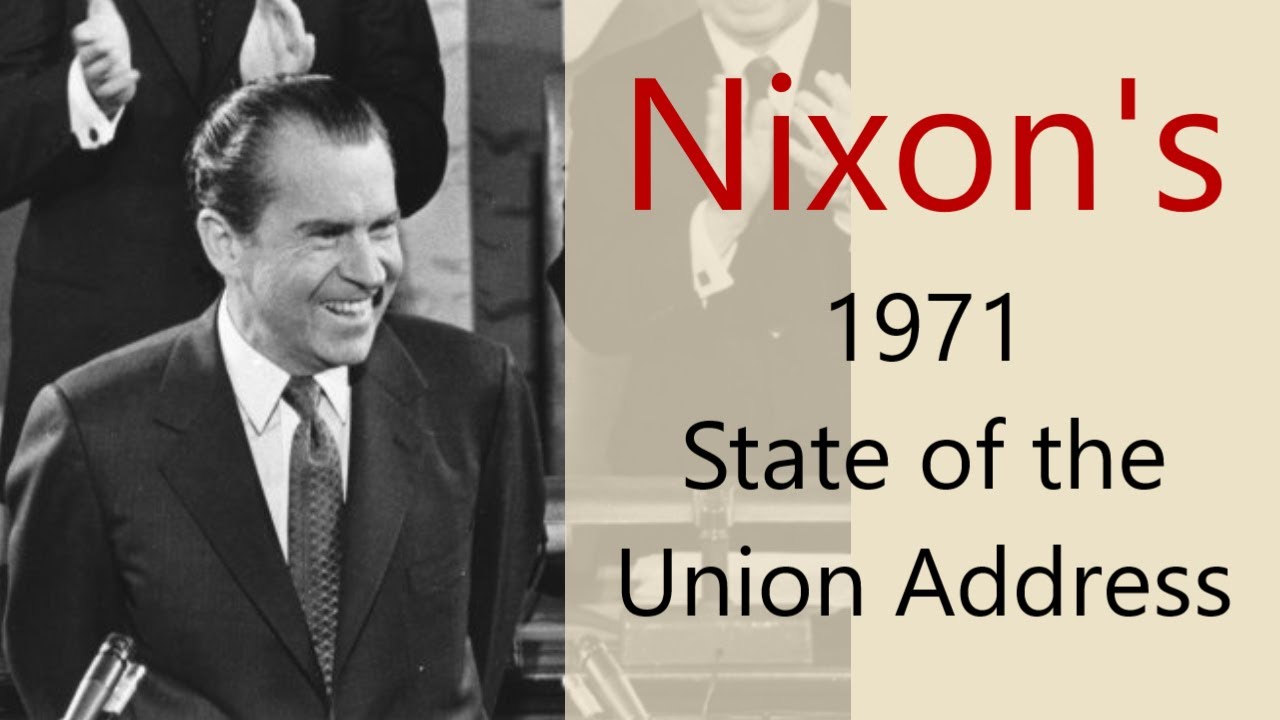
- Nixon's 1971 State of the Union Address
Nixon’s Second Annual Message January 22, 1971 Mr. Speaker, Mr. President, my colleagues in the Congress, our distinguished guests, my fellow Americans: As this 92d Congress begins its session, America has lost a great Senator, and all of us who had the privilege to know him have lost a loyal friend. I had the privilege of visiting Senator Russell in the hospital just a few days before he died. He never spoke about himself. He only spoke eloquently about the need for a strong national defense. In tribute to one of the most magnificent Americans of all time, I respectfully ask that all those here will rise in silent prayer for Senator Russell. [Moment of silence] Thank you. Mr. Speaker, before I begin my formal address, I want to use this opportunity to congratulate all of those who were winners in the rather spirited contest for leadership positions in the House and the Senate and, also, to express my condolences to the losers. I know how both of you feel. And I particularly want to join with all of the Members of the House and the Senate as well in congratulating the new Speaker of the United States Congress. To those new Members of this House who may have some doubts about the possibilities for advancement in the years ahead, I would remind you that the Speaker and I met just 24 years ago in this Chamber as freshmen Members of the 80th Congress. As you see, we both have come up in the world a bit since then. Mr. Speaker, this 92d Congress has a chance to be recorded as the greatest Congress in America's history. In these troubled years just past, America has been going through a long nightmare of war and division, of crime and inflation. Even more deeply, we have gone through a long, dark night of the American spirit. But now that night is ending. Now we must let our spirits soar again. Now we are ready for the lift of a driving dream. The people of this Nation are eager to get on with the quest for new greatness. They see challenges, and they are prepared to meet those challenges. It is for us here to open the doors that will set free again the real greatness of this Nation-the genius of the American people. How shall we meet this challenge? How can we truly open the doors, and set free the full genius of our people? The way in which the 92d Congress answers these questions will determine its place in history. More importantly, it can determine this Nation's place in history as we enter the third century of our independence. Tonight I shall present to the Congress six great goals. I shall ask not simply for more new programs in the old framework. I shall ask to change the framework of government itself---to reform the entire structure of American government so we can make it again fully responsive to the needs and the wishes of the American people. If we act boldly--if we seize this moment and achieve these goals--we can close the gap between promise and performance in American government. We can bring together the resources of this Nation and the spirit of the American people. In discussing these great goals, I shall deal tonight only with matters on the domestic side of the Nation's agenda. I shall make a separate report to the Congress and the Nation next month on developments in foreign policy. The first of these great goals is already before the Congress. I urge that the unfinished business of the 91st Congress be made the first priority business of the 92d Congress. Over the next 2 weeks, I will call upon Congress to take action on more than 35 pieces of proposed legislation on which action was not completed last year. The most important is welfare reform. The present welfare system has become a monstrous, consuming outrage--an outrage against the community, against the taxpayer, and particularly against the children it is supposed to help. We may honestly disagree, as we do, on what to do about it. But we can all agree that we must meet the challenge, not by pouring more money into a bad program, but by abolishing the present welfare system and adopting a new one. So let us place a floor under the income of every family with children in America-and without those demeaning, soul-stifling affronts to human dignity that so blight the lives of welfare children today. But let us also establish an effective work incentive and an effective work requirement. Let us provide the means by which more can help themselves. This shall be our goal. Let us generously help those who are not able to help themselves. But let us stop helping those who are able to help themselves but refuse to do so. The second great goal is to achieve what Americans have not enjoyed since 1957--full prosperity in peacetime. The tide of inflation has turned. The rise in the cost of living, which had been gathering dangerous momentum in the late sixties, was reduced last year. Inflation will be further reduced this year. But as we have moved from runaway inflation toward reasonable price stability and at the same time as we have been moving from a wartime economy to a peacetime economy, we have paid a price in increased unemployment. We should take no comfort from the fact that the level of unemployment in this transition from a wartime to a peacetime economy is lower than in any peacetime year of the sixties. This is not good enough for the man who is unemployed in the seventies. We must do better for workers in peacetime and we will do better. To achieve this, I will submit an expansionary budget this year--one that will help stimulate the economy and thereby open up new job opportunities for millions of Americans. It will be a full employment budget, a budget designed to be in balance if the economy were operating at its peak potential. By spending as if we were at full employment, we will help to bring about full employment. I ask the Congress to accept these expansionary policies--to accept the concept of a full employment budget. At the same time, I ask the Congress to cooperate in resisting expenditures that go beyond the limits of the full employment budget. For as we wage a campaign to bring about a widely shared prosperity, we must not reignite the fires of inflation and so undermine that prosperity. With the stimulus and the discipline of a full employment budget, with the commitment of the independent Federal Reserve System to provide fully for the monetary needs of a growing economy, and with a much greater effort on the part of labor and management to make their wage and price decisions in the light of the national interest and their own self-interest--then for the worker, the farmer, the consumer, for Americans everywhere we shall gain the goal of a new prosperity: more jobs, more income, more profits, without inflation and without war. This is a great goal, and one that we can achieve together. The third great goal is to continue the effort so dramatically begun last year: to restore and enhance our natural environment. Building on the foundation laid in the 37-point program that I submitted to Congress last year, I will propose a strong new set of initiatives to clean up our air and water, to combat noise, and to preserve and restore our surroundings. I will propose programs to make better use of our land, to encourage a balanced national growth--growth that will revitalize our rural heartland and enhance the quality of life in America. And not only to meet today's needs but to anticipate those of tomorrow, I will put forward the most extensive program ever proposed by a President of the United States to expand the Nation's parks, recreation areas, open spaces, in a way that truly brings parks to the people where the people are. For only if we leave a legacy of parks will the next generation have parks to enjoy. As a fourth great goal, I will offer a far-reaching set of proposals for improving America's health care and making it available more fairly to more people. I will propose: --A program to insure that no American family will be prevented from obtaining basic medical care by inability to pay. --I will propose a major increase in and redirection of aid to medical schools, to greatly increase the number of doctors and other health personnel. --Incentives to improve the delivery of health services, to get more medical care resources into those areas that have not been adequately served, to make greater use of medical assistants, and to slow the alarming rise in the costs of medical care. --New programs to encourage better preventive medicine, by attacking the causes of disease and injury, and by providing incentives to doctors to keep people well rather than just to treat them when they are sick. I will also ask for an appropriation of an extra $100 million to launch an intensive campaign to find a cure for cancer, and I will ask later for whatever additional funds can effectively be used. The time has come in America when the same kind of concentrated effort that split the atom and took man to the moon should be turned toward conquering this dread disease. Let us make a total national commitment to achieve this goal. America has long been the wealthiest nation in the world. Now it is time we became the healthiest nation in the world. The fifth great goal is to strengthen and to renew our State and local governments. As we approach our 200th anniversary in 1976, we remember that this Nation launched itself as a loose confederation of separate States, without a workable central government. At that time, the mark of its leaders' vision was that they quickly saw the need to balance the separate powers of the States with a government of central powers. And so they gave us a constitution of balanced powers, of unity with diversity-and so clear was their vision that it survives today as the oldest written constitution still in force in the world. For almost two centuries since--and dramatically in the 1930's--at those great turning points when the question has been between the States and the Federal Government, that question has been resolved in favor of a stronger central Federal Government. During this time the Nation grew and the Nation prospered. But one thing history tells us is that no great movement goes in the same direction forever. Nations change, they adapt, or they slowly die. The time has now come in America to reverse the flow of power and resources from the States and communities to Washington, and start power and resources flowing back from Washington to the States and communities and, more important, to the people all across America. The time has come for a new partnership between the Federal Government and the States and localities--a partnership in which we entrust the States and localities with a larger share of the Nation's responsibilities, and in which we share our Federal revenues with them so that they can meet those responsibilities. To achieve this goal, I propose to the Congress tonight that we enact a plan of revenue sharing historic in scope and bold in concept. All across America today, States and cities are confronted with a financial crisis. Some have already been cutting back on essential services---for example, just recently San Diego and Cleveland cut back on trash collections. Most are caught between the prospects of bankruptcy on the one hand and adding to an already crushing tax burden on the other. As one indication of the rising costs of local government, I discovered the other day that my home town of Whittier, California-which has a population of 67,000--has a larger budget for 1971 than the entire Federal budget was in 1791. Now the time has come to take a new direction, and once again to introduce a new and more creative balance to our approach to government. So let us put the money where the needs are. And let us put the power to spend it where the people are. I propose that the Congress make a $ 16 billion investment in renewing State and local government. Five billion dollars of this will be in new and unrestricted funds to be used as the States and localities see fit. The other $11 billion will be provided by allocating $1 billion of new funds and converting one-third of the money going to the present narrow-purpose aid programs into Federal revenue sharing funds for six broad purposes for urban development, rural development, education, transportation, job training, and law enforcement but with the States and localities making their own decisions on how it should be spent within each category. For the next fiscal year, this would increase total Federal aid to the States and localities more than 25 percent over the present level. The revenue sharing proposals I send to the Congress will include the safeguards against discrimination that accompany all other Federal funds allocated to the States. Neither the President nor the Congress nor the conscience of this Nation can permit money which comes from all the people to be used in a way which discriminates against some of the people. The Federal Government will still have a large and vital role to play in achieving our national progress. Established functions that are clearly and essentially Federal in nature will still be performed by the Federal Government. New functions that need to be sponsored or performed by the Federal Government--such as those I have urged tonight in welfare and health--will be added to the Federal agenda. Whenever it makes the best sense for us to act as a whole nation, the Federal Government should and will lead the way. But where States or local governments can better do what needs to be done, let us see that they have the resources to do it there. Under this plan, the Federal Government will provide the States and localities with more money and less interference-and by cutting down the interference the same amount of money will go a lot further. Let us share our resources. Let us share them to rescue the States and localities from the brink of financial crisis. Let us share them to give homeowners and wage earners a chance to escape from ever-higher property taxes and sales taxes. Let us share our resources for two other reasons as well. The first of these reasons has to do with government itself, and the second has to do it, h each of us, with the individual. Let s face it. Most Americans today are simply fed up with government at all levels. They will not--and they should not--continue to tolerate the gap between promise and performance in government. The fact is that we have made the Federal Government so strong it grows muscle-bound and the States and localities so weak they approach impotence. If we put more power in more places, we can make government more creative in more places. That way we multiply the number of people with the ability to make things happen--and we can open the way to a new burst of creative energy throughout America. The final reason I urge this historic shift is much more personal, for each and for every one of us. As everything seems to have grown bigger and more complex in America, as the forces that shape our lives seem to have grown more distant and more impersonal, a great feeling of frustration has crept across this land. Whether it is the workingman who feels neglected, the black man who feels oppressed, or the mother concerned about her children, there has been a growing feeling that "Things are in the saddle, and ride mankind." Millions of frustrated young Americans today are crying out--asking not what will government do for me, but what can I do, how can I contribute, how can I matter? And so let us answer them. Let us say to them and let us say to all Americans, "We hear you. We will give you a chance. We are going to give you a new chance to have more to say about the decisions that affect your future--a chance to participate in government--because we are going to provide more centers of power where what you do can make a difference that you can see and feel in your own life and the life of your whole community." The further away government is from people, the stronger government becomes and the weaker people become. And a nation with a strong government and a weak people is an empty shell. I reject the patronizing idea that government in Washington, D.C., is inevitably more wise, more honest, and more efficient than government at the local or State level. The honesty and efficiency of government depends on people. Government at all levels has good people and bad people. And the way to get more good people into government is to give them more opportunity to do good things. The idea that a bureaucratic elite in Washington knows best what is best for people everywhere and that you cannot trust local governments is really a contention that you cannot trust people to govern themselves. This notion is completely foreign to the American experience. Local government is the government closest to the people, it is most responsive to the individual person. It is people's government in a far more intimate way than the Government in Washington can ever be. People came to America because they wanted to determine their own future rather than to live in a country where others determined their future for them. What this change means is that once again in America we are placing our trust in people. I have faith in people. I trust the judgment of people. Let us give the people of America a chance, a bigger voice in deciding for themselves those questions that so greatly affect their lives. The sixth great goal is a complete reform of the Federal Government itself. Based on a long and intensive study with the aid of the best advice obtainable, I have concluded that a sweeping reorganization of the executive branch is needed if the Government is to keep up with the times and with the needs of the people. I propose, therefore, that we reduce the present 12 Cabinet Departments to eight. I propose that the Departments of State, Treasury, Defense, and Justice remain, but that all the other departments be consolidated into four: Human Resources, Community Development, Natural Resources, and Economic Development. Let us look at what these would be: --First, a department dealing with the concerns of people--as individuals, as members of a family--a department focused on human needs. --Second, a department concerned with the community--rural communities and urban communities-and with all that it takes to make a community function as a community. --Third, a department concerned with our physical environment, with the preservation and balanced use of those great natural resources on which our Nation depends. --And fourth, a department concerned with our prosperity--with our jobs, our businesses, and those many activities that keep our economy running smoothly and well. Under this plan, rather than dividing up our departments by narrow subjects, we would organize them around the great purposes of government. Rather than scattering responsibility by adding new levels of bureaucracy, we would focus and concentrate the responsibility for getting problems solved. With these four departments, when we have a problem we will know where to go--and the department will have the authority and the resources to do something about it. Over the years we have added departments and created agencies at the Federal level, each to serve a new constituency, to handle a particular task--and these have grown and multiplied in what has become a hopeless confusion of form and function. The time has come to match our structure to our purposes---to look with a fresh eye, to organize the Government by conscious, comprehensive design to meet the new needs of a new era. One hundred years ago, Abraham Lincoln stood on a battlefield and spoke of a "government of the people, by the people, for the people." Too often since then, we have become a nation of the Government, by the Government, for the Government. By enacting these reforms, we can renew that principle that Lincoln stated so simply and so well. By giving everyone's voice a chance to be heard, we will have government that truly is of the people. By creating more centers of meaningful power, more places where decisions that really count can be made, by giving more people a chance to do something, we can have government that truly is by the people. And by setting up a completely modern, functional system of government at the national level, we in Washington will at last be able to provide government that is truly for the people. I realize that what I am asking is that not only the executive branch in Washington but that even this Congress will have to change by giving up some of its power. Change is hard. But without change there can be no progress. And for each of us the question then becomes, not "Will change cause me inconvenience?" but "Will change bring progress for America?" Giving up power is hard. But I would urge all of you, as leaders of this country, to remember that the truly revered leaders in world history are those who gave power to people, and not those who took it away. As we consider these reforms we will be acting, not for the next 2 years or for the next 10 years, but for the next 100 years. So let us approach these six great goals with a sense not only of this moment in history but also of history itself. Let us act with the willingness to work together and the vision and the boldness and the courage of those great Americans who met in Philadelphia almost 190 years ago to write a constitution. Let us leave a heritage as they did--not just for our children but for millions yet unborn--of a nation where every American will have a chance not only to live in peace and to enjoy prosperity and opportunity but to participate in a system of government where he knows not only his votes but his ideas count--a system of government which will provide the means for America to reach heights of achievement undreamed of before. Those men who met at Philadelphia left a great heritage because they had a vision--not only of what the Nation was but of what it could become. As I think of that vision, I recall that America was founded as the land of the open door--as a haven for the oppressed, a land of opportunity, a place of refuge, of hope. When the first settlers opened the door of America three and a half centuries ago, they came to escape persecution and to find opportunity--and they left wide the door of welcome for others to follow. When the Thirteen Colonies declared their independence almost two centuries ago, they opened the door to a new vision of liberty and of human fulfillment--not just for an elite but for all. To the generations that followed, America's was the open door that beckoned millions from the old world to the new in search of a better life, a freer life, a fuller life, and in which, by their own decisions, they could shape their own destinies. For the black American, the Indian, the Mexican-American, and for those others in our land who have not had an equal chance, the Nation at last has begun to confront the need to press open the door of full and equal opportunity, and of human dignity. For all Americans, with these changes I have proposed tonight we can open the door to a new era of opportunity. We can open the door to full and effective participation in the decisions that affect their lives. We can open the door to a new partnership among governments at all levels, between those governments and the people themselves. And by so doing, we can open wide the doors of human fulfillment for millions of people here in America now and in the years to come. In the next few weeks I will spell out in greater detail the way I propose that we achieve these six great goals. I ask this Congress to be responsive. If it is, then the 92d Congress, your Congress, our Congress, at the end of its term, will be able to look back on a record more splendid than any in our history. This can be the Congress that helped us end the longest war in the Nation's history, and end it in a way that will give us at last a genuine chance to enjoy what we have not had in this century: a full generation of peace. This can be the Congress that helped achieve an expanding economy, with full employment and without inflation--and without the deadly stimulus of war. This can be the Congress that reformed a welfare system that has robbed recipients of their dignity and robbed States and cities of their resources. This can be the Congress that pressed forward the rescue of our environment, and established for the next generation an enduring legacy of parks for the people. This can be the Congress that launched a new era in American medicine, in which the quality of medical care was enhanced while the costs were made less burdensome. But above all, what this Congress can be remembered for is opening the way to a new American revolution--a peaceful revolution in which power was turned back to the people--in which government at all levels was refreshed and renewed and made truly responsive. This can be a revolution as profound, as far-reaching, as exciting as that first revolution almost 200 years ago--and it can mean that just 5 years from now America will enter its third century as a young nation new in spirit, with all the vigor and the freshness with which it began its first century. My colleagues in the Congress, these are great goals. They can make the sessions of this Congress a great moment for America. So let us pledge together to go forward together--by achieving these goals to give America the foundation today for a new greatness tomorrow and in all the years to come, and in so doing to make this the greatest Congress in the history of this great and good country. Source: https://www.presidency.ucsb.edu/documents/annual-message-the-congress-the-state-the-union-1
- Trump vs Harris Second 2024 Presidential Debate
September 10, 2024 PARTICIPANTS: Vice President Kamala Harris (D) andFormer President Donald Trump (R) MODERATORS: Linsey Davis (ABC News) andDavid Muir (ABC News) MUIR: Good evening, I'm David Muir. And thank you for joining us for tonight's ABC News Presidential Debate. We want to welcome viewers watching on ABC and around the world tonight. Vice President Kamala Harris and President Donald Trump are just moments away from taking the stage in this unprecedented race for president. DAVIS: And I'm Linsey Davis. Tonight's meeting could be the most consequential event of their campaigns, with Election Day now less than two months away. For Vice President Kamala Harris, this is her first debate since President Biden withdrew from the race on July 21st. Of course, that decision followed his debate against President Donald Trump in June. Since then, this race has taken on an entirely new dynamic. MUIR: And that brings us to the rules of tonight's debate: 90 minutes with two commercial breaks. No topics or questions have been shared with the campaigns. The candidates will have two minutes to answer questions. And this is the clock. That's what they'll be seeing. Two minutes for rebuttals and one minute for follow-ups, clarifications or responses. Their microphones will only be turned on when it's their turn to speak. No prewritten notes allowed. There is no audience here tonight in this hall at the National Constitution Center. This is an intimate setting for two candidates who have never met. DAVIS: President Trump won the coin toss. He chose to deliver the final closing statement of the evening. Vice President Harris selected the podium to the right. MUIR: So let's now welcome the candidates to the stage. Vice President Kamala Harris and President Donald Trump. HARRIS: Kamala Harris. Let's have a good debate. TRUMP: Nice to see you. Have fun. HARRIS: Thank you. TRUMP: Thank you. MUIR: Welcome to you both. It's wonderful to have you. It's an honor to have you both here tonight. DAVIS: Good evening, we are looking forward to a spirited and thoughtful debate. MUIR: So let's get started. I want to begin tonight with the issue voters repeatedly say is their number one issue, and that is the economy and the cost of living in this country. Vice President Harris, you and President Trump were elected four years ago and your opponent on the stage here tonight often asks his supporters, are you better off than you were four years ago? When it comes to the economy, do you believe Americans are better off than they were four years ago? HARRIS: So, I was raised as a middle-class kid. And I am actually the only person on this stage who has a plan that is about lifting up the middle class and working people of America. I believe in the ambition, the aspirations, the dreams of the American people. And that is why I imagine and have actually a plan to build what I call an opportunity economy. Because here's the thing. We know that we have a shortage of homes and housing, and the cost of housing is too expensive for far too many people. We know that young families need support to raise their children. And I intend on extending a tax cut for those families of $6,000, which is the largest child tax credit that we have given in a long time. So that those young families can afford to buy a crib, buy a car seat, buy clothes for their children. My passion, one of them, is small businesses. I was actually -- my mother raised my sister and me but there was a woman who helped raise us. We call her our second mother. She was a small business owner. I love our small businesses. My plan is to give a $50,000 tax deduction to start-up small businesses, knowing they are part of the backbone of America's economy. My opponent, on the other hand, his plan is to do what he has done before, which is to provide a tax cut for billionaires and big corporations, which will result in $5 trillion to America's deficit. My opponent has a plan that I call the Trump sales tax, which would be a 20% tax on everyday goods that you rely on to get through the month. Economists have said that Trump's sales tax would actually result for middle-class families in about $4,000 more a year because of his policies and his ideas about what should be the backs of middle-class people paying for tax cuts for billionaires. MUIR: President Trump, I'll give you two minutes. TRUMP: First of all, I have no sales tax. That's an incorrect statement. She knows that. We're doing tariffs on other countries. Other countries are going to finally, after 75 years, pay us back for all that we've done for the world. And the tariff will be substantial in some cases. I took in billions and billions of dollars, as you know, from China. In fact, they never took the tariff off because it was so much money, they can't. It would totally destroy everything that they've set out to do. They've taken in billions of dollars from China and other places. They've left the tariffs on. When I had it, I had tariffs and yet I had no inflation. Look, we've had a terrible economy because inflation has -- which is really known as a country buster. It breaks up countries. We have inflation like very few people have ever seen before. Probably the worst in our nation's history. We were at 21%. But that's being generous because many things are 50, 60, 70, and 80% higher than they were just a few years ago. This has been a disaster for people, for the middle class, but for every class. On top of that, we have millions of people pouring into our country from prisons and jails, from mental institutions and insane asylums. And they're coming in and they're taking jobs that are occupied right now by African Americans and Hispanics and also unions. Unions are going to be affected very soon. And you see what's happening. You see what's happening with towns throughout the United States. You look at Springfield, Ohio. You look at Aurora in Colorado. They are taking over the towns. They're taking over buildings. They're going in violently. These are the people that she and Biden let into our country. And they're destroying our country. They're dangerous. They're at the highest level of criminality. And we have to get them out. We have to get them out fast. I created one of the greatest economies in the history of our country. I'll do it again and even better. MUIR: We are going to get to immigration and border security during this debate. But I would like to let Vice President Harris respond on the economy here. HARRIS: Well, I would love to. Let's talk about what Donald Trump left us. Donald Trump left us the worst unemployment since the Great Depression. Donald Trump left us the worst public health epidemic in a century. Donald Trump left us the worst attack on our democracy since the Civil War. And what we have done is clean up Donald Trump's mess. What we have done and what I intend to do is build on what we know are the aspirations and the hopes of the American people. But I'm going to tell you all, in this debate tonight, you're going to hear from the same old, tired playbook, a bunch of lies, grievances and name-calling. What you're going to hear tonight is a detailed and dangerous plan called Project 2025 that the former president intends on implementing if he were elected again. I believe very strongly that the American people want a president who understands the importance of bringing us together knowing we have so much more in common than what separates us. And I pledge to you to be a president for all Americans. MUIR: President Trump, I'll give you a minute here to respond. TRUMP: Number one, I have nothing to do, as you know and as she knows better than anyone, I have nothing to do with Project 2025. That's out there. I haven't read it. I don't want to read it, purposely. I'm not going to read it. This was a group of people that got together, they came up with some ideas. I guess some good, some bad. But it makes no difference. I have nothing to do -- everybody knows I'm an open book. Everybody knows what I'm going to do. Cut taxes very substantially. And create a great economy like I did before. We had the greatest economy. We got hit with a pandemic. And the pandemic was, not since 1917 where 100 million people died has there been anything like it? We did a phenomenal job with the pandemic. We handed them over a country where the economy and where the stock market was higher than it was before the pandemic came in. Nobody's ever seen anything like it. We made ventilators for the entire world. We got gowns. We got masks. We did things that nobody thought possible. And people give me credit for rebuilding the military. They give me credit for a lot of things. But not enough credit for the great job we did with the pandemic. But the only jobs they got were bounce-back jobs. These were jobs, bounce back. And it bounced back and it went to their benefit. But I was the one that created them. They know it and so does everybody else. MUIR: Vice President Harris, I'll let you respond. HARRIS: So, Donald Trump has no plan for you. And when you look at his economic plan, it's all about tax breaks for the richest people. I am offering what I describe as an opportunity economy, and the best economists in our country, if not the world, have reviewed our relative plans for the future of America. What Goldman Sachs has said is that Donald Trump's plan would make the economy worse. Mine would strengthen the economy. What the Wharton School has said is Donald Trump's plan would actually explode the deficit. Sixteen Nobel laureates have described his economic plan as something that would increase inflation and by the middle of next year would invite a recession. You just have to look at where we are and where we stand on the issues. And I'd invite you to know that Donald Trump actually has no plan for you, because he is more interested in defending himself than he is in looking out for you. TRUMP: That's just a sound bite. They gave her that to say. Look, I went to the Wharton School of Finance and many of those professors, the top professors, think my plan is a brilliant plan, it's a great plan. It's a plan that's going to bring up our worth, our value as a country. It's going to make people want to be able to go and work and create jobs and create a lot of good, solid money for our -- for our country. And just to finish off, she doesn't have a plan. She copied Biden's plan. And it's like four sentences, like run-Spot-run. Four sentences that are just oh, we'll try and lower taxes. She doesn't have a plan. Take a look at her plan. She doesn't have a plan. MUIR: Mr. President, I do want to drill down on something you both brought up. The vice president brought up your tariffs you responded and let's drill down on this because your plan is what she calls is a essentially a national sales tax. Your proposal calls for tariffs as you pointed out here, on foreign imports across the board. You recently said that you might double your plan, imposing tariffs up to 20% on good coming into this country. As you know many economists say that with tariffs at that level costs are then passed onto the consumer. Vice President Harris has argued it'll mean higher prices on gas, food, clothing medication arguing it costs the typical family nearly four thousand dollars a year. Do you believe Americans can afford higher prices because of tariffs. TRUMP: They aren't gonna have higher prices what's gonna have and who's gonna have higher prices is China and all of the countries that have been ripping us off for years. I charge, I was the only president ever China was paying us hundreds of billions of dollars and so were other countries and you know if she doesn't like 'em they should have gone out and they should have immediately cut the tariffs but those tariffs are there three and a half years now under their administration. We are gonna take in billions of dollars, hundreds of billions of dollars. I had no inflation, virtually no inflation, they had the highest inflation, perhaps in the history of our country because I've never seen a worse period of time. People can't go out and buy cereal bacon or eggs or anything else. These the people of our country are absolutely dying with what they've done. They've destroyed the economy and all you have to do it look at a poll. The polls say 80 and 85 and even 90% that the Trump economy was great that their economy was terrible. MUIR: Vice President Harris I do want to ask for your response and you heard what the president said there because the Biden administration did keep a number of the Trump tariffs in place so how do you respond? HARRIS: Well, let's be clear that the Trump administration resulted in a trade deficit, one of the highest we've ever seen in the history of America. He invited trade wars, you wanna talk about his deal with China what he ended up doing is under Donald Trump's presidency he ended up selling American chips to China to help them improve and modernize their military basically sold us out when a policy about China should be in making sure the United States of America wins the competition for the 21st century. Which means focusing on the details of what that requires, focusing on relationships with our allies, focusing on investing in American based technology so that we win the race on A.I. and quantum computing, focusing on what we need to do to support America's workforce, so that we don't end up having the on the short end of the stick in terms of workers' rights. But what Donald Trump did let's talk about this with COVID, is he actually thanked President XI for what he did during COVID. Look at his tweet. "Thank you, President XI," exclamation point. When we know that XI was responsible for lacking and not giving us transparency about the origins of COVID. MUIR: President Trump, I'll let you respond. TRUMP: First of all, they bought their chips from Taiwan. We hardly make chips anymore because of philosophies like they have and policies like they have. I don't say her because she has no policy. Everything that she believed three years ago and four years ago is out the window. She's going to my philosophy now. In fact, I was going to send her a MAGA hat. She's gone to my philosophy. But if she ever got elected, she'd change it. And it will be the end of our country. She's a Marxist. Everybody knows she's a Marxist. Her father's a Marxist professor in economics. And he taught her well. But when you look at what she's done to our country and when you look at these millions and millions of people that are pouring into our country monthly where it's I believe 21 million people, not the 15 that people say, and I think it's a lot higher than the 21. That's bigger than New York state. Pouring in. And just look at what they're doing to our country. They're criminals. Many of these people coming in are criminals. And that's bad for our economy too. You mentioned before, we'll talk about immigration later. Well, bad immigration is the worst thing that can happen to our economy. They have and she has destroyed our country with policy that's insane. Almost policy that you'd say they have to hate our country. MUIR: President trump, thank you. Linsey? DAVIS: I want to turn to the issue of abortion. President Trump, you've often touted that you were able to kill Roe V. Wade. Last year, you said that you were proud to be the most pro-life president in American history. Then last month you said that your administration would be great for women and their reproductive rights. In your home state of Florida, you surprised many with regard to your six-week abortion ban because you initially had said that it was too short and you said, "I'm going to be voting that we need more than six weeks." But then the very next day, you reversed course and said you would vote to support the six-week ban. Vice President Harris says that women shouldn't trust you on the issue of abortion because you've changed your position so many times. Therefore, why should they trust you? TRUMP: Well, the reason I'm doing that vote is because the plan is, as you know, the vote is, they have abortion in the ninth month. They even have, and you can look at the governor of West Virginia, the previous governor of West Virginia, not the current governor, who's doing an excellent job, but the governor before. He said the baby will be born and we will decide what to do with the baby. In other words, we'll execute the baby. And that's why I did that, because that predominates. Because they're radical. The Democrats are radical in that. And her vice presidential pick, which I think was a horrible pick, by the way for our country, because he is really out of it. But her vice presidential pick says abortion in the ninth month is absolutely fine. He also says execution after birth, it's execution, no longer abortion, because the baby is born, is okay. And that's not okay with me. Hence the vote. But what I did is something for 52 years they've been trying to get Roe V. Wade into the states. And through the genius and heart and strength of six supreme court justices we were able to do that. Now, I believe in the exceptions for rape, incest and life of the mother. I believe strongly in it. Ronald Reagan did also. 85% of Republicans do. Exceptions. Very important. But we were able to get it. And now states are voting on it. And for the first time you're going to see -- look, this is an issue that's torn our country apart for 52 years. Every legal scholar, every Democrat, every Republican, liberal, conservative, they all wanted this issue to be brought back to the states where the people could vote. And that's what happened, happened. Now, Ohio, the vote was somewhat liberal. Kansas the vote was somewhat liberal. Much more liberal than people would have thought. But each individual state is voting. It's the vote of the people now. It's not tied up in the federal government. I did a great service in doing it. It took courage to do it. And the supreme court had great courage in doing it. And I give tremendous credit to those six justices. DAVIS: There is no state in this country where it is legal to kill a baby after it's born. Madam vice president, I want to get your response to President Trump. HARRIS: Well, as I said, you're going to hear a bunch of lies. And that's not actually a surprising fact. Let's understand how we got here. Donald Trump hand-selected three members of the United States Supreme Court with the intention that they would undo the protections of Roe V. Wade. And they did exactly as he intended. And now in over 20 states there are Trump abortion bans which make it criminal for a doctor or nurse to provide health care. In one state it provides prison for life. Trump abortion bans that make no exception even for rape and incest. Which understand what that means. A survivor of a crime, a violation to their body, does not have the right to make a decision about what happens to their body next. That is immoral. And one does not have to abandon their faith or deeply held beliefs to agree the government, and Donald Trump certainly, should not be telling a woman what to do with her body. I have talked with women around our country. You want to talk about this is what people wanted? Pregnant women who want to carry a pregnancy to term suffering from a miscarriage, being denied care in an emergency room because the health care providers are afraid they might go to jail and she's bleeding out in a car in the parking lot? She didn't want that. Her husband didn't want that. A 12 or 13-year-old survivor of incest being forced to carry a pregnancy to term? They don't want that. And I pledge to you when Congress passes a bill to put back in place the protections of Roe V. Wade as president of the United States, I will proudly sign it into law. But understand, if Donald Trump were to be re-elected, he will sign a national abortion ban. Understand in his project 2025 there would be a national abortion ban. Understand in his project 2025 there would be a national abortion -- a monitor that would be monitoring your pregnancies, your miscarriages. I think the American people believe that certain freedoms, in particular the freedom to make decisions about one's own body, should not be made by the government. DAVIS: Thank you, Vice President Harris. TRUMP: Well, there she goes again. It's a lie. I'm not signing a ban. And there's no reason to sign a ban. Because we've gotten what everybody wanted. Democrats, Republicans and everybody else and every legal scholar wanted it to be brought back into the states. And the states are voting. And it may take a little time, but for 52 years this issue has torn our country apart. And they've wanted it back in the states. And I did something that nobody thought was possible. The states are now voting. What she says is an absolute lie. And as far as the abortion ban, no, I'm not in favor of abortion ban. But it doesn't matter because this issue has now been taken over by the states. DAVIS: Would you veto a national abortion ban if it came to -- TRUMP: Well, I won't have to because again -- two things. Number one, she said she'll go back to congress. She'll never get the vote. It's impossible for her to get the vote. Especially now with a 50-50 --essentially 50-50 in both senate and the house. She's not going to get the vote. She can't get the vote. She won't even come close to it. So it's just talk. You know what it reminds me of? When they said they're going to get student loans terminated and it ended up being a total catastrophe. The student loans -- and then her I think probably her boss, if you call him a boss, he spends all his time on the beach, but look, her boss went out and said we'll do it again, we'll do it a different way. He went out, got rejected again by the supreme court. So all these students got taunted with this whole thing about -- this whole idea. And how unfair that would have been. Part of the reason they lost. To the millions and millions of people that had to pay off their student loans. They didn't get it for free. But they were saying -- it's the same way that they talked about that, that they talk about abortion. DAVIS: But if I could just get a yes or no. Because your running mate J.D. Vance has said that you would veto if it did come to your desk. TRUMP: Well, I didn't discuss it with J.D. In all fairness. J.D. -- And I don't mind if he has a certain view but I think he was speaking for me but I really didn't. Look, we don't have to discuss it because she'd never be able to get it just like she couldn't get student loans. They couldn't get -- they didn't even come close to getting student loans. They didn't even come close to getting student loans. They taunted young people and a lot of other people that had loans. They can never get this approved. So it doesn't matter what she says about going to congress. Wonderful. Let's go to congress. Do it. But the fact is that for years they wanted to get it out of congress and out of the federal government and we did something that everybody said couldn't be done. And now you have a vote of the people on abortion. DAVIS: Vice President Harris, I want to give you your time to respond. But I do want to ask, would you support any restrictions on a woman's right to an abortion? HARRIS: I absolutely support reinstating the protections of Roe V. Wade. And as you rightly mentioned, nowhere in America is a woman carrying a pregnancy to term and asking for an abortion. That is not happening. It's insulting to the women of America. And understand what has been happening under Donald Trump's abortion bans. Couples who pray and dream of having a family are being denied IVF treatments. What is happening in our country, working people, working women who are working one or two jobs, who can barely afford childcare as it is, have to travel to another state to get on a plane sitting next to strangers, to go and get the health care she needs. Barely can afford to do it. And what you are putting her through is unconscionable. And the people of America have not -- the majority of Americans believe in a woman's right to make decisions about her own body. And that is why in every state where this issue has been on the ballot, in red and blue states both, the people of America have voted for freedom. DAVIS: Vice president Harris -- TRUMP: Excuse me, I have to respond. Another lie. It's another lie. I have been a leader on IVF which is fertilization. The IVF -- I have been a leader. In fact, when they got a very negative decision on IVF from the Alabama courts, I saw the people of Alabama and the legislature two days later voted it in. I've been a leader on it. They know that and everybody else knows it. I have been a leader on fertilization, IVF. And the other thing, they -- you should ask, will she allow abortion in the eighth month, ninth month, seventh month? HARRIS: Come on. TRUMP: Would you do that? Why don't you ask her that question -- HARRIS: Why don't you answer the question would you veto – TRUMP: That's the problem. Because under Roe v. Wade. HARRIS: Answer the question, would you veto-- TRUMP: You could do abortions in the seventh month, the eighth month, the ninth month - HARRIS: That's not true. TRUMP: And probably after birth. Just look at the governor, former governor of Virginia. The governor of Virginia said we put the baby aside and then we determine what we want to do with the baby. DAVIS: President Trump, thank you. MUIR: We're going to turn now to immigration and border security. We know it's an issue that's important to Republicans, Democrats, voters across the board in this country. Vice President Harris, you were tasked by President Biden with getting to the root causes of migration from Central America. We know that illegal border crossings reached a record high in the Biden administration. This past June, President Biden imposed tough new asylum restrictions. We know the numbers since then have dropped significantly. But my question to you tonight is why did the administration wait until six months before the election to act and would you have done anything differently from President Biden on this? HARRIS: So I'm the only person on this stage who has prosecuted transnational criminal organizations for the trafficking of guns, drugs, and human beings. And let me say that the United States Congress, including some of the most conservative members of the United States Senate, came up with a border security bill which I supported. And that bill would have put 1,500 more border agents on the border to help those folks who are working there right now over time trying to do their job. It would have allowed us to stem the flow of fentanyl coming into the United States. I know there are so many families watching tonight who have been personally affected by the surge of fentanyl in our country. That bill would have put more resources to allow us to prosecute transnational criminal organizations for trafficking in guns, drugs and human beings. But you know what happened to that bill? Donald Trump got on the phone, called up some folks in Congress, and said kill the bill. And you know why? Because he preferred to run on a problem instead of fixing a problem. And understand, this comes at a time where the people of our country actually need a leader who engages in solutions, who actually addresses the problems at hand. But what we have in the former president is someone who would prefer to run on a problem instead of fixing a problem. And I'll tell you something, he's going to talk about immigration a lot tonight even when it's not the subject that is being raised. And I'm going to actually do something really unusual and I'm going to invite you to attend one of Donald Trump's rallies because it's a really interesting thing to watch. You will see during the course of his rallies he talks about fictional characters like Hannibal Lecter. He will talk about windmills cause cancer. And what you will also notice is that people start leaving his rallies early out of exhaustion and boredom. And I will tell you the one thing you will not hear him talk about is you. You will not hear him talk about your needs, your dreams, and your, your desires. And I'll tell you, I believe you deserve a president who actually puts you first. And I pledge to you that I will. MUIR: Vice President Harris, thank you. President Trump, on that point I want to get your response. TRUMP: Well, I would like to respond. MUIR: Let me just ask, though, why did you try to kill that bill and successfully so? That would have put thousands of additional agents and officers on the border. TRUMP: First let me respond as to the rallies. She said people start leaving. People don't go to her rallies. There's no reason to go. And the people that do go, she's busing them in and paying them to be there. And then showing them in a different light. So, she can't talk about that. People don't leave my rallies. We have the biggest rallies, the most incredible rallies in the history of politics. That's because people want to take their country back. Our country is being lost. We're a failing nation. And it happened three and a half years ago. And what, what's going on here, you're going to end up in World War 3, just to go into another subject. What they have done to our country by allowing these millions and millions of people to come into our country. And look at what's happening to the towns all over the United States. And a lot of towns don't want to talk -- not going to be Aurora or Springfield. A lot of towns don't want to talk about it because they're so embarrassed by it. In Springfield, they're eating the dogs. The people that came in. They're eating the cats. They're eating -- they're eating the pets of the people that live there. And this is what's happening in our country. And it's a shame. As far as rallies are concerned, as far -- the reason they go is they like what I say. They want to bring our country back. They want to make America great again. It's a very simple phrase. Make America great again. She's destroying this country. And if she becomes president, this country doesn't have a chance of success. Not only success. We'll end up being Venezuela on steroids. MUIR: I just want to clarify here, you bring up Springfield, Ohio. And ABC News did reach out to the city manager there. He told us there have been no credible reports of specific claims of pets being harmed, injured or abused by individuals within the immigrant community -- TRUMP: Well, I've seen people on television MUIR: Let me just say here this ... TRUMP: The people on television say my dog was taken and used for food. So maybe he said that and maybe that's a good thing to say for a city manager. MUIR: I'm not taking this from television. I'm taking it from the city manager. TRUMP: But the people on television say their dog was eaten by the people that went there. MUIR: Again, the Springfield city manager says there's no evidence of that. TRUMP: We'll find out MUIR: Vice President Harris, I'll let you respond to the rest of what you heard. HARRIS: Talk about extreme. Um, you know, this is I think one of the reasons why in this election I actually have the endorsement of 200 Republicans who have formally worked with President Bush, Mitt Romney, and John McCain including the endorsement of former Vice President Dick Cheney and Congressmember Liz Cheney. And if you want to really know the inside track on who the former president is, if he didn't make it clear already, just ask people who have worked with him. His former chief of staff, a four-star general, has said he has contempt for the constitution of the United States. His former national security adviser has said he is dangerous and unfit. His former secretary of defense has said the nation, the republic would never survive another Trump term. And when we listen to this kind of rhetoric, when the issues that affect the American people are not being addressed, I think the choice is clear in this election. MUIR: President Trump, I'll give you a quick minute to respond. TRUMP: Yeah. Thank you. Because when I hear that -- see, I'm a different kind of a person. I fired most of those people. Not so graciously. They did bad things or a bad job. I fired them. They never fired one person. They didn't fire anybody having to do with Afghanistan and the Taliban and the 13 people whose, whose, were just killed viciously and violently killed and I got to know the parents and the family. They should have fired all those generals, all those top people because that was one of the most incompetently handled situations anybody has ever seen. So when somebody does a bad job I fire them. And you take a guy like Esper. He was no good, I fired him. So he writes a book. Another one writes a book. Because with me they can write books. With nobody else can they. But they have done such a poor job. And they never fire anybody. Look at the economy. Look at the inflation. They didn't fire any of their economists. They have the same people. That's a good way not to have books written about you. But just to finish, I got more votes than any Republican in history by far. In fact, I got more votes than any president, sitting president in history by far. MUIR: Let me continue on immigration. It was what you wanted to talk about earlier. So let's get back to your deportation proposal that the vice president has reacted to as well. President Trump, you called this the largest domestic deportation operation in the history of our country. You say you would use the National Guard. You say if things get out of control you'd have no problem using the U.S. military. TRUMP: With local police. MUIR: You also said you would use local police. How would you deport 11 million undocumented immigrants? I know you believe that number is much higher. Take us through this. What does this look like? Will authorities be going door to door in this country? TRUMP: Yeah. It is much higher because of them. They allowed criminals. Many, many, millions of criminals. They allowed terrorists. They allowed common street criminals. They allowed people to come in, drug dealers, to come into our country, and they're now in the United States. And told by their countries like Venezuela don't ever come back or we're going to kill you. Do you know that crime in Venezuela and crime in countries all over the world is way down? You know why? Because they've taken their criminals off the street and they've given them to her to put into our country. And this will be one of the greatest mistakes in history for them to allow -- and I think they probably did it because they think they're going to get votes. But it's not worth it. Because they're destroying the fabric of our country by what they've done. There's never been anything done like this at all. They've destroyed the fabric of our country. Millions of people let in. And all over the world crime is down. All over the world except here. Crime here is up and through the roof. Despite their fraudulent statements that they made. Crime in this country is through the roof. And we have a new form of crime. It's called migrant crime. And it's happening at levels that nobody thought possible. MUIR: President Trump, as you know, the FBI says overall violent crime is coming down in this country, but Vice President the... TRUMP: use me, the FBI -- they were defrauding statements. They didn't include the worst cities. They didn't include the cities with the worst crime. It was a fraud. Just like their number of 818,000 jobs that they said they created turned out to be a fraud. MUIR: President Trump, thank you. I'll let you respond, Vice President Harris. HARRIS: Well, I think this is so rich. Coming from someone who has been prosecuted for national security crimes, economic crimes, election interference, has been found liable for sexual assault and his next big court appearance is in November at his own criminal sentencing. And let's be clear where each person stands on the issue of what is important about respect for the rule of law and respect for law enforcement. The former vice president called for defunding, federal law enforcement, 45,000 agents, get this, on the day after he was arraigned on 34 felony counts. So let's talk about what is important in this race. It is important that we move forward, that we turn the page on this same old tired rhetoric. And address the needs of the American people, address what we need to do about the housing shortage, which I have a plan for. Address what we must do to support our small businesses. Address bringing down the price of groceries. But frankly, the American people are exhausted with the same old tired playbook. MUIR: Vice President Harris, thank you. TRUMP: Excuse me. Every one of those cases was started by them against their political opponent. And I'm winning most of them and I'll win the rest on appeal. And you saw that with the decision that came down just recently from the Supreme Court. I'm winning most of them. But those are cases, it's called weaponization. Never happened in this country. They weaponized the justice department. Every one of those cases was involved with the DOJ, from Atlanta and Fani Willis -- to the attorney general of New York and the D.A. In New York. Every one of those cases. And then they say oh, he was -- he's a criminal. They're the ones that made them go after me. By the way, Joe Biden was found essentially guilty on the documents case. And what happened in my documents case? They said oh, that's the toughest of them all. A complete and total victory. Two months ago it was thrown out. It's weaponization. And they used it. And it's never happened in this country. They used it to try and win an election. They're fake cases. MUIR: President Trump, thank you. A really quick response here, Vice President Harris, on this notion of weaponization of the justice department. HARRIS: Well let's talk about extreme. And understand the context in which this election in 2024 is taking place. The United States Supreme Court recently ruled that the former president would essentially be immune from any misconduct if he were to enter the white house again. Understand, this is someone who has openly said he would terminate, I'm quoting, terminate the constitution of the United States. That he would weaponize the Department of Justice against his political enemies. Someone who has openly expressed disdain for members of our military. Understand what it would mean if Donald Trump were back in the white house with no guardrails. Because certainly, we know now the court won't stop him. We know J.D. Vance is not going to stop him. It's up to the American people to stop him. MUIR: Vice President Harris, thank you. Linsey? DAVIS: Vice President Harris, in your last run for president... TRUMP: This is the one that weaponized. Not me. She weaponized. I probably took a bullet to the head because of the things that they say about me. They talk about democracy. I'm a threat to democracy. They're the threat to democracy – With the fake Russia Russia Russia investigation that went nowhere. MUIR: We have a lot to get to. Linsey? DAVIS: Vice President Harris, in your last run for president you said you wanted to ban fracking. Now you don't. You wanted mandatory government buyback programs for assault weapons. Now your campaign says you don't. You supported decriminalizing border crossings. Now you're taking a harder line. I know you say that your values have not changed. So then why have so many of your policy positions changed? HARRIS: So my values have not changed. And I'm going to discuss every one -- at least every point that you've made. But in particular, let's talk about fracking because we're here in Pennsylvania. I made that very clear in 2020. I will not ban fracking. I have not banned fracking as Vice President of the United States. And, in fact, I was the tie-breaking vote on the Inflation Reduction Act, which opened new leases for fracking. My position is that we have got to invest in diverse sources of energy so we reduce our reliance on foreign oil. We have had the largest increase in domestic oil production in history because of an approach that recognizes that we cannot over rely on foreign oil. As it relates to my values, let me tell you, I grew up a middle-class kid raised by a hard-working mother who worked and saved and was able to buy our first home when I was a teenager. The values I bring to the importance of home ownership knowing not everybody got handed $400 million on a silver platter and then filed bankruptcy six times, is a value that I bring to my work to say we are going to work with the private sector and home builders to increase 3 million homes, increase by 3 million homes by the end of my first term. My work that is related to having a friend when I was in high school who was sexually assaulted by her stepfather. And my focus then, on protecting women and children from violent crime, is based on a value that is deeply grounded in the importance of standing up for those who are most vulnerable. My work that is about protecting social security and Medicare is based on long-standing work that I have done. Protecting seniors from scams. My values have not changed. And what is important is that there is a president who actually brings values and a perspective that is about lifting people up and not beating people down and name-calling. The true measure of the leader is the leader who actually understands that strength is not in beating people down, it's in lifting people up. I intend to be that president. DAVIS: President Trump, your response. TRUMP: Well, first of all, I wasn't given $400 million. I wish I was. My father was a Brooklyn builder. Brooklyn, Queens. And a great father and I learned a lot from him. But I was given a fraction of that, a tiny fraction, and I built it into many, many billions of dollars. Many, many billions. And when people see it, they are even surprised. So, we don't have to talk about that. Fracking? She's been against it for 12 years. Uh, defund the police. She's been against that forever. She gave all that stuff up, very wrongly, very horribly. And everybody's laughing at it, okay? They're all laughing at it. She gave up at least 12 and probably 14 or 15 different policies. Like, she was big on defund the police. HARRIS: That's not true. [mouthed, not audible] TRUMP: In Minnesota, she went out -- wait a minute. I'm talking now. If you don't mind. Please. Does that sound familiar? HARRIS: Don't lie. [lie is audible] TRUMP: She went out -- she went out in Minnesota and wanted to let criminals that killed people, that burned down Minneapolis, she went out and raised money to get them out of jail. She did things that nobody would ever think of. Now she wants to do transgender operations on illegal aliens that are in prison. This is a radical left liberal that would do this. She wants to confiscate your guns and she will never allow fracking in Pennsylvania. If she won the election, fracking in Pennsylvania will end on day one. Just to finish one thing, so important in my opinion, so, I got the oil business going like nobody has ever done before. They took, when they took over, they got rid of it, started getting rid of it, and the prices were going up the roof. They immediately let these guys go to where they were. I would have been five times, four times, five times higher because you're talking about 3 1/2 years ago. They got it up to where I was because they had no choice. Because the prices of energy were quadrupling and doubling. You saw what happened to gasoline. So, they said let's go back to Trump. But if she won the election, the day after that election, they'll go back to destroying our country and oil will be dead, fossil fuel will be dead. We'll go back to windmills and we'll go back to solar, where they need a whole desert to get some energy to come out. You ever see a solar plant? By the way, I'm a big fan of solar. But they take 400, 500 acres of desert soil-- DAVIS: President Trump-- TRUMP: These are not good things for the environment that she understands. DAVIS: President Trump, we have a lot of issues that we have to get to. We're out of time. Thank you. MUIR: Linsey, thank you. We have an election in just 56 days. I want to talk about the peaceful transfer of power, which of course we all know was a cornerstone of our democracy and the role of a president in a moment of crisis. Mr. President, on January 6th you told your supporters to march to the Capitol. You said you would be right there with them. The country and the world saw what played out at the Capitol that day. The officers coming under attack. Aides in the West Wing say you watched it unfold on television off the Oval Office. You did send out tweets, but it was more than two hours before you sent out that video message telling your supporters to go home. Is there anything you regret about what you did on that day? TRUMP: You just said a thing that isn't covered. Peacefully and patriotically, I said during my speech. Not later on. Peacefully and patriotically. And nobody on the other side was killed. Ashli Babbitt was shot by an out-of-control police officer that should have never, ever shot her. It's a disgrace. But we didn't do -- this group of people that have been treated so badly. I ask, what about all the people that are pouring into our country and killing people? That she allowed to pour in. She was the border czar. Remember that. She was the border czar. She doesn't want to be called the border czar because she's embarrassed by the border. In fact, she said at the beginning, I'm surprised you're not talking about the border yet. That's because she knows what a bad job they've done. What about those people? What's, when are they going to be prosecuted -- when are these people from countries all over the world, not just South America, they're coming in from all over the world, David, all over the world. And crime rates are down all over the world because of it -- MUIR: But let me just ask you-- TRUMP: But when are those, David, when are those people going to be prosecuted? When are the people that burned down Minneapolis going to be prosecuted or in Seattle? They went into Seattle, they took over a big percentage of the city of Seattle. When are those people going to be prosecuted? MUIR: But let me just ask you-- TRUMP: You might ask her that question. MUIR: You were the president. You were watching it unfold on television. It's a very simple question as we move forward toward another election. Is there anything you regret about what you did on that day? Yes or no. TRUMP: I had nothing to do with that other than they asked me to make a speech. I showed up for a speech. I said, I think it's going to be big. I went to Nancy Pelosi and the mayor of Washington, D.C. And the mayor put it back in writing, as you know. I said, you know, this is going to be a very big rally or whatever you want to call it. And again, it wasn't done by me. It was done by others. I said I'd like to give you 10,000 National Guard or soldiers. They rejected me. Nancy Pelosi rejected me. It was just two weeks ago, her daughter has a tape of her saying she is fully responsible for what happened. They want to get rid of that tape. It would have never happened if Nancy Pelosi and the mayor of Washington did their jobs. I wasn't responsible for security. Nancy Pelosi was responsible. She didn't do her job. MUIR: The question was about you as president, not about Former Speaker Pelosi. But I do want Vice President Harris to respond here. HARRIS: I was at the Capitol on January 6th. I was the Vice President-Elect. I was also an acting senator. I was there. And on that day, the president of the United States incited a violent mob to attack our nation's Capitol, to desecrate our nation's Capitol. On that day, 140 law enforcement officers were injured. And some died. And understand, the former president has been indicted and impeached for exactly that reason. But this is not an isolated situation. Let's remember Charlottesville, where there was a mob of people carrying tiki torches, spewing antisemitic hate, and what did the president then at the time say? There were fine people on each side. Let's remember that when it came to the Proud Boys, a militia, the president said, the former president said, "Stand back and stand by." So for everyone watching who remembers what January 6th was, I say we don't have to go back. Let's not go back. We're not going back. It's time to turn the page. And if that was a bridge too far for you, well, there is a place in our campaign for you. To stand for country. To stand for our democracy. To stand for rule of law. And to end the chaos. And to end the approach that is about attacking the foundations of our democracy 'cause you don't like the outcome. And be clear on that point. Donald Trump the candidate has said in this election there will be a bloodbath, if this -- and the outcome of this election is not to his liking. Let's turn the page on this. Let's not go back. Let's chart a course for the future and not go backwards to the past. MUIR: Let me just follow up here-- TRUMP: I have said blood bash, bath. It was a different term, and it was a term that related to energy, because they have destroyed our energy business. That was where bloodbath was. Also, on Charlottesville, that story has been as you would say, debunked. Laura Ingraham, Sean Hannity, Jesse -- all of these people, they covered it. If they go an extra sentence, they will see it was perfect. It was debunked in almost every newspaper. But they still bring it up just like they bring 2025 up. They bring all of this stuff up. I ask you this. You talk about the Capitol. Why are we allowing these millions of people to come through on the southern border? How come she's not doing -- and I'll tell you what I would do. And I would be very proud to do it. I would say we would both leave this debate right now, I'd like to see her go down to Washington, D.C. during this debate 'cause we're wasting a lot of time. Go down to -- because she's been so bad, it's so ridiculous. Go down to Washington, D.C. And let her sign a bill to close up the border. Because they have the right to do it. They don't need bills. They have the right to do it. The President of the United States, you'll get him out of bed. You'll wake him up at 4:00 in the afternoon, you'll say come on. Come on down to the office, let's sign a bill. If he ... if he signs a bill that the border is closed, all he has to do is say it to the border patrol, who are phenomenal. If they do that, the border is closed. MUIR: Mr. President -- TRUMP: Those people are killing many people, unlike J-6. MUIR: We talked immigration here tonight. I do want to focus on this next issue to both of you. Because it really brings us, this into focus. Truth in these times that we're living in. Mr. President, for 3 and a half years after you lost the 2020 election you repeatedly falsely claimed that you won, many times saying you won in a landslide. In the past couple of weeks leading up to this debate, you have said, quote, you lost by a whisker, that you, quote, didn't quite make it, that you came up a little bit short. TRUMP: I said that? MUIR: Are you now acknowledging that you lost in 2020? TRUMP: No, I don't acknowledge that at all. MUIR: But you did say that. TRUMP: I said that sarcastically. You know that. It was said, oh we lost by a whisker. That was said sarcastically. Look, there's so much proof. All you have to do is look at it. And they should have sent it back to the legislatures for approval. I got almost 75 million votes. The most votes any sitting president has ever gotten. I was told if I got 63, which was what I got in 2016, you can't be beaten. The election, people should never be thinking about an election as fraudulent. We need two things. We need walls. We need -- and we have to have it. We have to have borders. And we have to have good elections. Our elections are bad. And a lot of these illegal immigrants coming in, they're trying to get them to vote. They can't even speak English. They don't even know what country they're in practically. And these people are trying to get them to vote. And that's why they're allowing them to come into our country. MUIR: I did watch all of these pieces of video. I didn't detect the sarcasm, lost by a whisker, we didn't quite make it, and we should just point out as clarification, and you know this, you and your allies, 60 cases in front of many judges. Many of them -- TRUMP: No judge looked at it. MUIR: And said there was no widespread fraud. TRUMP: They said we didn't have standing. That's the other thing. They said we didn't have standing. A technicality. Can you imagine a system where a person in an election doesn't have standing, the President of the United States doesn't have standing? That's how we lost. If you look at the facts, and I'd love to have you -- you'll do a special on it. I'll show you Georgia and I'll show you Wisconsin and I'll show you Pennsylvania and I'll show you -- we have so many facts and statistics. But you know what? That doesn't matter. Because we have to solve the problem that we have right now. That's old news. And the problem that we have right now is we have a nation in decline and they have put it into decline. We have a nation that is dying, David. MUIR: Mr. President, thank you. Vice President Harris, you heard the president there tonight. He said he didn't say that he lost by a whisker. So he still believes he did not lose the election. That was won by President Biden and yourself. But I do want to ask you about something that's come up in the last couple of days. This was a post from President Trump about this upcoming election just weeks away. He said, "When I win, those people who cheated," and then he lists donors, voters, election officials, he says "Will be prosecuted to the fullest extent of the law, which will include long-term prison sentences." One of your campaign's top lawyers responded saying, "We won't let Donald Trump intimidate us. We won't let him suppress the vote." Is that what you believe he's trying to do here? HARRIS: Donald Trump was fired by 81 million people. So, let's be clear about that. And clearly, he is having a very difficult time processing that. But we cannot afford to have a president of the United States who attempts as he did in the past to upend the will of the voters in a free and fair election. And I'm going to tell you that I have traveled the world as vice president of the United States. And world leaders are laughing at Donald Trump. I have talked with military leaders, some of whom worked with you. And they say you're a disgrace. And when you then talk in this way in a presidential debate and deny what over and over again are court cases you have lost, because you did in fact lose that election, it leads one to believe that perhaps we do not have in the candidate to my right the temperament or the ability to not be confused about fact. That's deeply troubling. And the American people deserve better. MUIR: I'll give you one minute to respond, Mr. President. TRUMP: Let me just tell you about world leaders. Viktor Orban, one of the most respected men -- they call him a strong man. He's a tough person. Smart. Prime Minister of Hungary. They said why is the whole world blowing up? Three years ago it wasn't. Why is it blowing up? He said because you need Trump back as president. They were afraid of him. China was afraid. And I don't like to use the word afraid but I'm just quoting him. China was afraid of him. North Korea was afraid of him. Look at what's going on with North Korea, by the way. He said Russia was afraid of him. I ended the Nord Stream 2 pipeline and Biden put it back on day one but he ended the XL pipeline. The XL pipeline in our country. He ended that. But he let the Russians build a pipeline going all over Europe and heading into Germany. The biggest pipeline in the world. Look, Viktor Orban said it. He said the most respected, most feared person is Donald Trump. We had no problems when Trump was president. But when this weak pathetic man that you saw at a debate just a few months ago that if he weren't in that debate he'd be running instead of her, she got no votes, he got 14 million votes, what you did, you talk about a threat to democracy. He got 14 million votes and they threw him out of office. And you know what? I'll give you a little secret. He hates her. He can't stand her. MUIR: Mr. President -- TRUMP: But he had 14 million votes. They threw them out. She got zero votes. And when she ran, she was the first one to leave because she failed. And now she's running. I don't understand it but I'm okay with it – because I think we're going to do pretty well. MUIR: Mr. President, your time is up. We've got a lot more to get to. DAVIS: Turning now to the Israel-Hamas war and the hostages who are still being held, Americans among them. Vice President Harris, in December you said, "Israel has a right to defend itself" but you added, "It matters how." Saying international humanitarian law must be respected, Israel must do more to protect innocent civilians. You said that nine months ago. Now an estimated 40,000 Palestinians are dead. Nearly 100 hostages remain. Just last week Prime Minister Benjamin Netanyahu said there's not a deal in the making. President Biden has not been able to break through the stalemate. How would you do it? HARRIS: Well, let's understand how we got here. On Oct. 7, Hamas, a terrorist organization, slaughtered 1,200 Israelis. Many of them young people who were simply attending a concert. Women were horribly raped. And so absolutely, I said then, I say now, Israel has a right to defend itself. We would. And how it does so matters. Because it is also true far too many innocent Palestinians have been killed. Children, mothers. What we know is that this war must end. It must when, end immediately, and the way it will end is we need a cease-fire deal and we need the hostages out. And so we will continue to work around the clock on that. Work around the clock also understanding that we must chart a course for a two-state solution. And in that solution, there must be security for the Israeli people and Israel and in equal measure for the Palestinians. But the one thing I will assure you always, I will always give Israel the ability to defend itself, in particular as it relates to Iran and any threat that Iran and its proxies pose to Israel. But we must have a two-state solution where we can rebuild Gaza, where the Palestinians have security, self-determination and the dignity they so rightly deserve. DAVIS: President Trump, how would you negotiate with Netanyahu and also Hamas in order to get the hostages out and prevent the killing of more innocent civilians in Gaza? TRUMP: If I were president it would have never started. If I were president Russia would have never, ever -- I know Putin very well. He would have never -- and there was no threat of it either, by the way, for four years. Have gone into Ukraine and killed millions of people when you add it up. Far worse than people understand what's going on over there. But when she mentions about Israel all of a sudden -- she hates Israel. She wouldn't even meet with Netanyahu when he went to Congress to make a very important speech. She refused to be there because she was at a sorority party of hers. She wanted to go to the sorority party. She hates Israel. If she's president, I believe that Israel will not exist within two years from now. And I've been pretty good at predictions. And I hope I'm wrong about that one. She hates Israel. At the same time in her own way she hates the Arab population because the whole place is going to get blown up, Arabs, Jewish people, Israel. Israel will be gone. It would have never happened. Iran was broke under Donald Trump. Now Iran has $300 billion because they took off all the sanctions that I had. Iran had no money for Hamas or Hezbollah or any of the 28 different spheres of terror. And they are spheres of terror. Horrible terror. They had no money. It was a big story, and you know it. You covered it. Very well, actually. They had no money for terror. They were broke. Now they're a rich nation. And now what they're doing is spreading that money around. Look at what's happening with the Houthis and Yemen. Look at what's going on in the Middle East. This would have never happened. I will get that settled and fast. And I'll get the war with Ukraine and Russia ended. If I'm President-Elect, I'll get it done before even becoming president. DAVIS: Vice President Harris, he says you hate Israel. HARRIS: That's absolutely not true. I have my entire career and life supported Israel and the Israeli people. He knows that. He's trying to again divide and distract from the reality, which is it is very well known that Donald Trump is weak and wrong on national security and foreign policy. It is well known that he admires dictators, wants to be a dictator on day one according to himself. It is well known that he said of Putin that he can do whatever the hell he wants and go into Ukraine. It is well known when that he said when Russia went into Ukraine it was brilliant. It is well known he exchanged love letters with Kim Jong un. And it is absolutely well known that these dictators and autocrats are rooting for you to be president again because they're so clear, they can manipulate you with flattery and favors. And that is why so many military leaders who you have worked with have told me you are a disgrace. That is why we understand that we have to have a president who is not consistently weak and wrong on national security including the importance of upholding and respecting in highest regard our military. DAVIS: Vice President Harris, thank you. TRUMP: They're the ones -- and she's the one that caused it, that's weak on national security by allowing every nation last month for the year, 168 different countries sending people into our country. Their crime rates are way down. Putin endorsed her last week. Said I hope she wins. And I think he meant it. Because what he's gotten away with is absolutely incredible. It wouldn't have happened with me. The leaders of other countries think that they're weak and incompetent. And they are. They're grossly incompetent. And I just ask one question. Why does Biden go in and kill the Keystone pipeline and approve the single biggest deal that Russia's ever made, Nordstream 2, the biggest pipeline anywhere in the world going to Germany and all over Europe? Because they're weak and they're ineffective. And Biden, by the way -- DAVIS: President Trump... TRUMP: Gets paid a lot of money -- DAVIS: Thank you. We have a lot of issues to get to. MUIR: We'll be right back with much more of this historic ABC News presidential debate from the National Constitution Center right here in Philadelphia. Back in a moment. [ commercial break ] And I want to turn to the war in Ukraine. We're now 2 1/2 years into this conflict. Mr. President, it has been the position of the Biden administration that we must defend Ukraine from Russia, from Vladimir Putin, to defend their sovereignty, their democracy, that it's in America's best interest to do so, arguing that if Putin wins he may be emboldened to move even further into other countries. You have said you would solve this war in 24 hours. You said so just before the break tonight. How exactly would you do that? And I want to ask you a very simple question tonight. Do you want Ukraine to win this war? TRUMP: I want the war to stop. I want to save lives that are being uselessly -- people being killed by the millions. It's the millions. It's so much worse than the numbers that you're getting, which are fake numbers. Look, we're in for 250 billion or more because they don't ask Europe, which is a much bigger beneficiary to getting this thing done than we are. They're in for $150 billion less because Biden and you don't have the courage to ask Europe like I did with NATO. They paid billions and billions, hundreds of billions of dollars when I said either you pay up or we're not going to protect you anymore. So that may be one of the reasons they don't like me as much as they like weak people. But you take a look at what's happening. We're in for 250 to 275 billion. They're into 100 to 150. They should be forced to equalize. With that being said, I want to get the war settled. I know Zelenskyy very well and I know Putin very well. I have a good relationship. And they respect your president. Okay? They respect me. They don't respect Biden. How would you respect him? Why? For what reason? He hasn't even made a phone call in two years to Putin. Hasn't spoken to anybody. They don't even try and get it. That is a war that's dying to be settled. I will get it settled before I even become president. If I win, when I'm President-Elect, and what I'll do is I'll speak to one, I'll speak to the other, I'll get them together. That war would have never happened. And in fact when I saw Putin after I left, unfortunately left because our country has gone to hell, but after I left when I saw him building up soldiers, he did it after I left, I said oh, he must be negotiating. It must be a good strong point of negotiation. Well, it wasn't because Biden had no idea how to talk to him. He had no idea how to stop it. And now you have millions of people dead and it's only getting worse and it could lead to World War 3. Don't kid yourself, David. We're playing with World War 3. And we have a president that we don't even know if he's -- where is our president? We don't even know if he's a president. MUIR: And just to clarify here. TRUMP: They threw him out of a campaign like a dog. We don't even know, is he our president? But we have a president... MUIR: Mr. President, TRUMP: ...that doesn't know he's alive. MUIR: Your time is up. Just to clarify the question, do you believe it's in the U.S. best interests for Ukraine to win this war? Yes or no? TRUMP: I think it's in the U.S. best interest to get this war finished and just get it done. All right. Negotiate a deal. Because we have to stop all of these human lives from being destroyed. MUIR: I want to take this to Vice President Harris. I want to get your thoughts on support for Ukraine in this moment. But also as commander in chief if elected how would you deal with Vladimir Putin and would it be any different from what we're seeing from President Biden? HARRIS: Well, first of all, it's important to remind the former president you're not running against Joe Biden, you're running against me. I believe the reason that Donald Trump says that this war would be over within 24 hours is because he would just give it up. And that's not who we are as Americans. Let's understand what happened here. I actually met with Zelenskyy a few days before Russia invaded, tried through force to change territorial boundaries to defy one of the most important international rules and norms, which is the importance of sovereignty and territorial integrity. And I met with President Zelenskyy. I shared with him American intelligence about how he could defend himself. Days later I went to NATO's eastern flank, to Poland and Romania. And through the work that I and others did we brought 50 countries together to support Ukraine in its righteous defense. And because of our support, because of the air defense, the ammunition, the artillery, the javelins, the Abrams tanks that we have provided, Ukraine stands as an independent and free country. If Donald Trump were president, Putin would be sitting in Kyiv right now. And understand what that would mean. Because Putin's agenda is not just about Ukraine. Understand why the European allies and our NATO allies are so thankful that you are no longer president and that we understand the importance of the greatest military alliance the world has ever known, which is NATO. And what we have done to preserve the ability of Zelenskyy and the Ukrainians to fight for their Independence. Otherwise, Putin would be sitting in Kyiv with his eyes on the rest of Europe. Starting with Poland. And why don't you tell the 800,000 Polish Americans right here in Pennsylvania how quickly you would give up for the sake of favor and what you think is a friendship with what is known to be a dictator who would eat you for lunch. MUIR: Vice President Harris Thank you. We heard from both of you on Ukraine tonight. Afghanistan came up in the last hour -- I wanted her to respond to something you said earlier. TRUMP: I have to respond. MUIR: Please I'll give you a minute here. TRUMP: Putin would be sitting in Moscow and he wouldn't have lost 300,000 men and women. But he would have been sitting in Moscow HARRIS: [ inaudible ] TRUMP: Quiet, please. He would have been sitting in Moscow much happier than he is right now. But eventually, you know, he's got a thing that other people don't have. He's got nuclear weapons. They don't ever talk about that. He's got nuclear weapons. Nobody ever thinks about that. And eventually uh maybe he'll use them. Maybe he hasn't been that threatening. But he does have that. Something we don't even like to talk about. Nobody likes to talk about it. But just so you understand, they sent her to negotiate peace before this war started. Three days later he went in and he started the war because everything they said was weak and stupid. They said the wrong things. That war should have never started. She was the emissary. They sent her in to negotiate with Zelenskyy and Putin. And she did and the war started three days later. MUIR: Vice president... TRUMP: And that's the kind of talent we have with her. She's worse than Biden. In my opinion, I think he's the worst president in the history of our country. She goes down as the worst vice president in the history of our country. But let me tell you something. She is a horrible negotiator. They sent her in to negotiate. As soon as they left Putin did the invasion. MUIR: President Trump, thank you. You did bring up something, you said she went to negotiate with Vladimir Putin. Vice President Harris, have you ever met Vladimir Putin, can you clarify tonight? HARRIS: Yet again, I said it at the beginning of this debate, you're going to hear a bunch of lies coming from this fella. And that is another one. When I went to meet with President Zelenskyy, I've now met with him over five times. The reality is, it has been about standing as America always should, as a leader upholding international rules and norms. As a leader who shows strength, understanding that the alliances we have around the world are dependent on our ability to look out for our friends and not favor our enemies because you adore strongmen instead of caring about democracy. And that is very much what is at stake here. The President of the United States is commander-in-chief. And the American people have a right to rely on a president who understands the significance of America's role and responsibility in terms of ensuring that there is stability and ensuring we stand up for our principles and not sell them for the benefit of personal flattery. MUIR: We've talked about Ukraine and Vladimir Putin. I do want to talk about Afghanistan. It came up in the first hour of this debate. TRUMP: David, one thing. MUIR: I want to move on to Afghanistan. TRUMP: Secretary General Stoltenberg said Trump did the most amazing thing I've ever seen, he got these countries, the 28 countries at the time, to pay up. He said I've never seen -- he's the head of NATO. He said I've never seen -- for years we were paying almost all of NATO. We were being ripped off by European nations both on trade and on NATO. I got them to pay up by saying one of the statements you made before, if you don't pay we're not going to protect you. MUIR: President Trump-- TRUMP: Otherwise we would've never gotten it. He said it was one of the most incredible jobs that he's ever seen done. MUIR: Thank you. I want to turn to Afghanistan. We witnessed a poignant moment today on Capitol Hill honoring the soldiers who died in the chaotic withdrawal from Afghanistan. I do want to ask the vice president, do you believe you bear any responsibility in the way that withdrawal played out? HARRIS: Well, I will tell you, I agreed with President Biden's decision to pull out of Afghanistan. Four presidents said they would, and Joe Biden did. And as a result, America's taxpayers are not paying the $300 million a day we were paying for that endless war. And as of today, there is not one member of the United States military who is in active duty in a combat zone in any war zone around the world, the first time this century. But let's understand how we got to where we are. Donald Trump when he was president negotiated one of the weakest deals you can imagine. He calls himself a dealmaker. Even his national security adviser said it was a weak, terrible deal. And here's how it went down. He bypassed the Afghan government. He negotiated directly with a terrorist organization called the Taliban. The negotiation involved the Taliban getting 5,000 terrorists, Taliban terrorists released. And get this -- no, get this. And the president at the time invited the Taliban to Camp David. A place of storied significance for us as Americans, a place where we honor the importance of American diplomacy, where we invite and receive respected world leaders. And this former president as president invited them to Camp David because he does not again appreciate the role and responsibility of the President of the United States to be commander in chief with a level of respect. And this gets back to the point of how he has consistently disparaged and demeaned members of our military, fallen soldiers, and the work that we must do to uphold the strength and the respect of the United States of America around the world. MUIR: Vice President Harris, thank you. President Trump, your response to her saying that you began the negotiations with the Taliban. TRUMP: Yeah, thank you. So if you take a look at that period of time, the Taliban was killing our soldiers, a lot of them, with snipers. And I got involved with the Taliban because the Taliban was doing the killing. That's the fighting force within Afghanistan. They don't bother doing that because you know, they deal with the wrong people all the time. But I got involved. And Abdul is the head of the Taliban. He is still the head of the Taliban. And I told Abdul don't do it anymore, you do it anymore you're going to have problems. And he said why do you send me a picture of my house? I said you're going to have to figure that out, Abdul. And for 18 months we had nobody killed. We did have an agreement negotiated by Mike Pompeo. It was a very good agreement. The reason it was good, it was -- we were getting out. We would have been out faster than them, but we wouldn't have lost the soldiers. We wouldn't have left many Americans behind. And we wouldn't have left -- we wouldn't have left $85 billion worth of brand new beautiful military equipment behind. And just to finish, they blew it. The agreement said you have to do this, this, this, this, this, and they didn't do it. They didn't do it. The agreement was, was terminated by us because they didn't do what they were supposed to do. MUIR: I want to move on. TRUMP: And these people did the worst withdrawal and in my opinion the most embarrassing moment in the history of our country. And by the way, that's why Russia attacked Ukraine. Because they saw how incompetent she and her boss are. MUIR: President Trump, thank you. I want to move on now to race and politics in this country. Mr. President, you recently said of Vice President Harris, "I didn't know she was Black until a number of years ago when she happened to turn Black, and now she wants to be known as Black." I want to ask a bigger-picture question here tonight. Why do you believe it's appropriate to weigh in on the racial identity of your opponent? TRUMP: I don't. And I don't care. I don't care what she is. I don't care. You make a big deal out of something. I couldn't care less. Whatever she wants to be is okay with me. MUIR: But those were your words. So, I'm asking -- TRUMP: I don't know. I don't know. All I can say is I read where she was not Black, that she put out. And, I'll say that. And then I read that she was black. And that's okay. Either one was okay with me. That's up to her. That's up to her. MUIR: Vice President Harris, your thoughts on this? HARRIS: I think it's – I mean honestly, I think it's a tragedy that we have someone who wants to be president who has consistently over the course of his career attempted to use race to divide the American people. You know, I do believe that the vast majority of us know that we have so much more in common than what separates us. And we don't want this kind of approach that is just constantly trying to divide us, and especially by race. And let's remember how Donald Trump started. He was a, a, a—land, he owned land, he owned buildings, and he was investigated because he refused to rent property to Black families. Let's remember, this is the same individual who took out a full-page ad in The New York Times calling for the execution of five young Black and Latino boys who were innocent, the Central Park Five. Took out a full-page ad calling for their execution. This is the same individual who spread birther lies about the first Black President of the United States. And I think the American people want better than that. Want better than this. Want someone who understands as I do, I travel our country, we see in each other a friend. We see in each other a neighbor. We don't want a leader who is constantly trying to have Americans point their fingers at each other. I meet with people all the time who tell me "Can we please just have discourse about how we're going to invest in the aspirations and the ambitions and the dreams of the American people?" Knowing that regardless of people's color or the language their grandmother speaks we all have the same dreams and aspirations and want a president who invests in those, not in hate and division. MUIR: Vice President Harris thank you. Linsey? DAVIS: President Trump, this is now your third time -- TRUMP: This is the most divisive presidency in the history of our country. There's never been anything like it. They're destroying our country. And they come up with things like what she just said going back many, many years when a lot of people including Mayor Bloomberg agreed with me on the Central Park Five. They admitted -- they said, they pled guilty. And I said, well, if they pled guilty they badly hurt a person, killed a person ultimately. And if they pled guilty -- then they pled we're not guilty. But this is a person that has to stretch back years, 40, 50 years ago because there's nothing now. I built one of the greatest economies in the history of the world and I'm going to build it again. It's going to be bigger, better and stronger. But they're destroying our economy. They have no idea what a good economy is. Their oil policies -- every single policy -- and remember this. She is Biden. She's trying to get away from Biden. I don't know the gentleman, she says. She is Biden. The worst inflation we've ever had. A horrible economy because inflation has made it so bad and she can't get away with that. MUIR: Mr. President, thank you, your time is up. Linsey -- HARRIS: I want to respond to that, though. I want to just respond briefly. Clearly, I am not Joe Biden, and I am certainly not Donald Trump. And what I do offer is a new generation of leadership for our country. One who believes in what is possible, one who brings a sense of optimism about what we can do instead of always disparaging the American people. I believe in what we can do to strengthen our small businesses, which is why I have a plan. Let's talk about our plans. And, and let's compare the plans. I have a plan to give startup businesses $50,000 tax deduction, to pursue their ambitions, their innovation, their ideas, their hard work. I have a plan. $6,000 for young families for the first year of your child's life. To help you in that most critical stage of your child's development. I have a plan that is about allowing people to be able to pursue what has been fleeting in terms of the American dream by offering help with down payment of $25,000, down payment assistance for first-time home buyers. That's the kind of conversation I believe, David, that people really want tonight as opposed to a conversation that is constantly about belittling and name-calling. Let's turn the page and move forward. MUIR: Vice President Harris, thank you. DAVIS: We have to move on. President trump -- TRUMP: She is destroying our country. She has a plan to defund the police. She has a plan to confiscate everybody's gun. She has a plan to not allow fracking in Pennsylvania or anywhere else. That's what her plan is until just recently. DAVIS: President Trump, President Trump. HARRIS: The former president has said something twice and I need to respond too. I just need to respond one time to what he has said multiple times. DAVIS: I'm sorry, we're going to move on, Vice President Harris. This is now your third time running for president. you have long vowed to repeal and replace the Affordable Care Act, also known as Obamacare. You have failed to accomplish that. You now say you're going to keep Obamacare. Quote, unless we can do something much better. Last month you said, quote, we're working on it. So tonight, nine years after you first started running, do you have a plan and can you tell us what it is? TRUMP: Obamacare was lousy health care. Always was. It's not very good today. And what I said, that if we come up with something, we are working on things, we're going to do it and we're going to replace it. But remember this. I inherited Obamacare because Democrats wouldn't change it. They wouldn't vote for it. They were unanimous. They wouldn't vote to change it. If they would have done that, we would have had a much better plan than Obamacare. But the Democrats came up, they wouldn't vote for it. I had a choice to make when I was president, do I save it and make it as good as it can be? Never going to be great. Or do I let it rot? And I felt I had an obligation, even though politically it would have been good to just let it rot and let it go away. I decided -- and I told my people, the top people, and they're very good people -- I have a lot of good people in this -- that administration. We read about the bad ones. We had some real bad ones too. And so do they. They have really bad ones. The difference is they don't get rid of them. But let me just explain. I had a choice to make do I save it and make it as good as it can be or let it rot? And I saved it. I did the right thing. But it's still never going to be great. And it's too expensive for people. And what we will do is we're looking at different plans. If we can come up with a plan that's going to cost our people, our population less money and be better health care than Obamacare, then I would absolutely do it. But until then I'd run it as good as it can be run. DAVIS: So just a yes or no, you still do not have a plan? TRUMP: I have concepts of a plan. I'm not president right now. But if we come up with something I would only change it if we come up with something better and less expensive. And there are concepts and options we have to do that. And you'll be hearing about it in the not-too-distant future. DAVIS: Vice president Harris, in 2017 you supported Bernie Sanders' proposal to do away with private insurance and create a government-run health care system. Two years later you proposed a plan that included a private insurance option. What is your plan today? HARRIS: Well, first of all, I absolutely support and over the last four years as vice president private health care options. But what we need to do is maintain and grow the affordable care act. But I, I'll get to that, linsey. I just need to respond to a previous point that the former president has made. I've made very clear my position on fracking. And then this business about taking everyone's guns away. Tim Walz and I are both gun owners. We're not taking anybody's guns away. So stop with the continuous lying about this stuff. As it relates to the affordable care act, understand, just look at the history to know where people stand. When Donald Trump was president, 60 times he tried to get rid of the affordable care act. 60 times. I was a senator at the time. When, I will never forget the early morning hours when it was up for a vote in the United States senate and the late great John McCain, who you have disparaged as being – uh, you don't like him, you said at the time, because he got caught, he was an American hero. The late great John McCain, I will never forget that night. Walked onto the senate floor and said no, you don't. No, you don't. No, you don't get rid of the affordable care act. You have no plan. And what the affordable care act has done is eliminate the ability of insurance companies to deny people with pre-existing conditions. I don't have to tell the people watching tonight, you remember what that was like? Remember when an insurance company could deny if a child had asthma, if someone was a breast cancer survivor, if a grandparent had diabetes? And thankfully, as I've been vice president and we over the last four years have strengthened the affordable care act, we have allowed for the first time medicare to negotiate drug prices on behalf of you the American people. Donald Trump said he was going to allow medicare to negotiate dr, drug prices. He never did. We did. And now we have capped the cost of insulin at $35 a month. Since I've been vice president we have capped the cost of prescription medication for seniors at $2,000 a year. And when I am president we will do that for all people understanding that the value I bring to this is that access to health care should be a right and not just a privilege of those who can afford it. And the plan has to be to strengthen the affordable care act, not get rid of it, [ inaudible ] in terms of where Donald Trump stands on that. DAVIS: I want to move to an issue that's important -- TRUMP: She made a mistake. Number one, John McCain fought Obamacare for ten years. But it wasn't only him. It was, All of the Democrats that kept it going. And you know what? We could do much better than Obamacare. Much less money. But she won't improve private insurance for people. Private, medical insurance. That's another thing she doesn't want DAVIS: President Trump. TRUMP: People are paying privately for insurance that have worked hard and made money and they want to have private. She wants everybody to be on government insurance where you wait six months for an operation that you need immediately. DAVIS: President trump, thank you. We have another issue that we'd like to get to that's important for a number of Americans, in particular younger voters, and that's climate change. President trump, with regard to the environment, you say that we have to have clean air and clean water. Vice president Harris, you call climate change an existential threat. The question to you both tonight is what would you do to fight climate change? And vice president Harris, we'll start with you. One minute for you each. HARRIS: Well, the former president had said that climate change is a hoax. And what we know is that it is very real. You ask anyone who lives in a state who has experienced these extreme weather occurrences who now is either being denied home insurance or is being jacked up. You ask anybody who has been the victim of what that means in terms of losing their home, having nowhere to go. We know that we can actually deal with this issue. The young people of America care deeply about this issue. And I am proud that as vice president over the last four years we have invested a trillion dollars in a clean energy economy while we have also increased domestic gas production to historic levels. We have created over 800,000 new manufacturing jobs while I have been vice president. We have invested in clean energy to the point that we are opening up factories around the world. Donald Trump said he was going to create manufacturing jobs. He lost manufacturing jobs. And I'm also proud to have the endorsement of the united auto workers and Shawn fain, who also know that part of building a clean energy economy includes investing in American-made products, American automobiles. It includes growing what we can do around American manufacturing and opening up auto plants, not closing them like happened under Donald Trump. DAVIS: Vice president Harris, thank you. TRUMP: That didn't happen under Donald Trump. Let me just tell you, they lost 10,000 manufacturing jobs this last month. It's going -- they're all leaving. They're building big auto plants in Mexico. In many cases owned by China. They're building these massive plants, and they think they're going to sell their cars into the United States because of these people. What they have given to China is unbelievable. But we're not going to let that. We'll put tariffs on those cars so they can't come into our country. Because they will kill the united auto workers and any auto worker, whether it's in Detroit or South Carolina or any other place. What they've done to business and manufacturing in this country is horrible. We have nothing because they refuse -- you know, Biden doesn't go after people because supposedly China paid him millions of dollars. He's afraid to do it. Between him and his son. They get all this money from Ukraine. They get all this money from all of these different countries. And then you wonder why is he so loyal to this one, that one Ukraine, China? Why is he? Why did he get 3 1/2 million dollars from the mayor of Moscow's wife? Why did he get -- why did she pay him 3 1/2 million dollars? This is a crooked administration, and they're selling our country down the tubes. DAVIS: President Trump, thank you. TRUMP: Thank you. MUIR: We'll be right back with closing statements from both of our candidates. An historic night, this ABC News Presidential Debate from Philadelphia. Back in a moment. [ commercial break ] The time has come for closing statements. And vice president Harris, we begin with you. HARRIS: So I think you've heard tonight two very different visions for our country. One that is focused on the future and the other that is focused on the past. And an attempt to take us backward. But we're not going back. And I do believe that the American people know we all have so much more in common than what separates us and we can chart a new way forward. And a vision of that includes having a plan, understanding the aspirations, the dreams, the hopes, the ambition of the American people, which is why I intend to create an opportunity economy, investing in small businesses, in new families, in what we can do around protecting seniors, what we can do that is about giving hard-working folks a break in bringing down the cost of living. I believe in what we can do together that is about sustaining America's standing in the world and ensuring we have the respect that we so rightly deserve including respecting our military and ensuring we have the most lethal fighting force in the world. I will be a president that will protect our fundamental rights and freedoms including the right of a woman to make decisions about her own body and not have her government tell her what to do. I'll tell you, I started my career as a prosecutor. I was a D.A. I was an attorney general. A United States senator. And now vice president. I've only had one client. The people. And I'll tell you, as a prosecutor I never asked a victim or a witness are you a Republican or a Democrat. The only thing I ever asked them, are you okay? And that's the kind of president we need right now. Someone who cares about you and is not putting themselves first. I intend to be a president for all Americans and focus on what we can do over the next 10 and 20 years to build back up our country by investing right now in you the American people. DAVIS: Vice President Harris, thank you. President Trump? TRUMP: So, she just started by saying she's going to do this, she's going to do that, she's going to do all these wonderful things. Why hasn't she done it? She's been there for 3 1/2 years. They've had 3 1/2 years to fix the border. They've had 3 1/2 years to create jobs and all the things we talked about. Why hasn't she done it? She should leave right now, go down to that beautiful white house, go to the capitol, get everyone together and do the things you want to do. But you haven't done it. And you won't do it. Because you believe in things that the American people don't believe in. You believe in things like we're not going to frack. We're not going to take fossil fuel. We're not going to do, things that are going to make this country strong, whether you like it or not. Germany tried that and within one year they were back to building normal energy plants. We're not ready for it. We can't sacrifice our country for the sake of bad vision. But I just ask one simple question. Why didn't she do it? We're a failing nation. We're a nation that's in serious decline. We're being laughed at all over the world. All over the world, they laugh, I know the leaders very well. They're coming to see me. They call me. We're laughed at all over the world. They don't understand what happened to us as a nation. We're not a leader. We don't have any idea what's going on. We have wars going on in the Middle East. We have wars going on with Russia and Ukraine. We're going to end up in a third World War. And it will be a war like no other because of nuclear weapons, the power of weaponry. I rebuilt our entire military. She gave a lot of it away to the Taliban. She gave it to Afghanistan. What these people have done to our country, and maybe toughest of all is allowing millions of people to come into our country, many of them are criminals, and they're destroying our country. The worst president, the worst vice president in the history of our country. DAVIS: President Trump thank you. And that is our ABC News presidential debate from here in Philadelphia at the national constitution center. I'm Linsey Davis. MUIR: And I'm David Muir. Thank you for watching here in the U.S. And all over the world. And from all of us here at ABC News, good night. Source: https://www.presidency.ucsb.edu/documents/presidential-debate-philadelphia-pennsylvania
- LBJ's Inaugural Address 1965
January 20, 1965: Lyndon B. Johnson Inaugural Address My fellow countrymen: On this occasion the oath I have taken before you and before God is not mine alone, but ours together. We are one nation and one people. Our fate as a nation and our future as a people rest not upon one citizen but upon all citizens. That is the majesty and the meaning of this moment. For every generation there is a destiny. For some, history decides. For this generation the choice must be our own. Even now, a rocket moves toward Mars. It reminds us that the world will not be the same for our children, or even for ourselves in a short span of years. The next man to stand here will look out on a scene that is different from our own. Ours is a time of change—rapid and fantastic change—bearing the secrets of nature, multiplying the nations, placing in uncertain hands new weapons for mastery and destruction, shaking old values and uprooting old ways. Our destiny in the midst of change will rest on the unchanged character of our people and on their faith. They came here—the exile and the stranger, brave but frightened—to find a place where a man could be his own man. They made a covenant with this land. Conceived in justice, written in liberty, bound in union, it was meant one day to inspire the hopes of all mankind. And it binds us still. If we keep its terms we shall flourish. First, justice was the promise that all who made the journey would share in the fruits of the land. In a land of great wealth, families must not live in hopeless poverty. In a land rich in harvest, children just must not go hungry. In a land of healing miracles, neighbors must not suffer and die untended. In a great land of learning and scholars, young people must be taught to read and write. For more than 30 years that I have served this Nation I have believed that this injustice to our people, this waste of our resources, was our real enemy. For 30 years or more, with the resources I have had, I have vigilantly fought against it. I have learned and I know that it will not surrender easily. But change has given us new weapons. Before this generation of Americans is finished, this enemy will not only retreat, it will be conquered. Justice requires us to remember: when any citizen denies his fellow, saying: "His color is not mine or his beliefs are strange and different," in that moment he betrays America, though his forebears created this Nation. Liberty was the second article of our covenant. It was self-government. It was our Bill of Rights. But it was more. America would be a place where each man could be proud to be himself: stretching his talents, rejoicing in his work, important in the life of his neighbors and his nation. This has become more difficult in a world where change and growth seem to tower beyond the control and even the judgment of men. We must work to provide the knowledge and the surroundings which can enlarge the possibilities of every citizen. The American covenant called on us to help show the way for the liberation of man. And that is today our goal. Thus, if as a nation, there is much outside our control, as a people no stranger is outside our hope. Change has brought new meaning to that old mission. We can never again stand aside, prideful in isolation. Terrific dangers and troubles that we once called "foreign" now constantly live among us. If American lives must end, and American treasure be spilled, in countries that we barely know, then that is the price that change has demanded of conviction and of our enduring covenant. Think of our world as it looks from that rocket that is heading toward Mars. It is like a child's globe, hanging in space, the continent stuck to its side like colored maps. We are all fellow passengers on a dot of earth. And each of us, in the span of time, has really only a moment among our companions. How incredible it is that in this fragile existence we should hate and destroy one another. There are possibilities enough for all who will abandon mastery over others to pursue mastery over nature. There is world enough for all to seek their happiness in their own way. Our Nation's course is abundantly clear. We aspire to nothing that belongs to others. We seek no dominion over our fellow man, but man's dominion over tyranny and misery. But more is required. Men want to be part of a common enterprise, a cause greater than themselves. And each of us must find a way to advance the purpose of the Nation, thus finding new purpose for ourselves. Without this, we will simply become a nation of strangers. The third article is union. To those who were small and few against the wilderness, the success of liberty demanded the strength of union. Two centuries of change have made this true again. No longer need capitalist and worker, farmer and clerk, city and countryside, struggle to divide our bounty. By working shoulder to shoulder together we can increase the bounty of all. We have discovered that every child who learns, and every man who finds work, and every sick body that is made whole—like a candle added to an altar—brightens the hope of all the faithful. So let us reject any among us who seek to reopen old wounds and rekindle old hatreds. They stand in the way of a seeking nation. Let us now join reason to faith and action to experience, to transform our unity of interest into a unity of purpose. For the hour and the day and the time are here to achieve progress without strife, to achieve change without hatred; not without difference of opinion but without the deep and abiding divisions which scar the union for generations. Under this covenant of justice, liberty, and union we have become a nation—prosperous, great, and mighty. And we have kept our freedom. But we have no promise from God that our greatness will endure. We have been allowed by Him to seek greatness with the sweat of our hands and the strength of our spirit. I do not believe that the Great Society is the ordered, changeless, and sterile battalion of the ants. It is the excitement of becoming—always becoming, trying, probing, falling, resting, and trying again—but always trying and always gaining. In each generation, with toil and tears, we have had to earn our heritage again. If we fail now then we will have forgotten in abundance what we learned in hardship: that democracy rests on faith, that freedom asks more than it gives, and the judgment of God is harshest on those who are most favored. If we succeed it will not be because of what we have, but it will be because of what we are; not because of what we own, but rather because of what we believe. For we are a nation of believers. Underneath the clamor of building and the rush of our day's pursuits, we are believers in justice and liberty and in our own union. We believe that every man must some day be free. And we believe in ourselves. And that is the mistake that our enemies have always made. In my lifetime, in depression and in war they have awaited our defeat. Each time, from the secret places of the American heart, came forth the faith that they could not see or that they could not even imagine. And it brought us victory. And it will again. For this is what America is all about. It is the uncrossed desert and the unclimbed ridge. It is the star that is not reached and the harvest that is sleeping in the unplowed ground. Is our world gone? We say farewell. Is a new world coming? We welcome it, and we will bend it to the hopes of man. And to these trusted public servants and to my family, and those close friends of mine who have followed me down a long winding road, and to all the people of this Union and the world, I will repeat today what I said on that sorrowful day in November last year: I will lead and I will do the best I can. But you, you must look within your own hearts to the old promises and to the old dreams. They will lead you best of all. For myself, I ask only in the words of an ancient leader: "Give me now wisdom and knowledge, that I may go out and come in before this people: for who can judge this thy people, that is so great?" Source: https://millercenter.org/the-presidency/presidential-speeches/january-20-1965-inaugural-address
- LBJ's 1966 State of the Union Address
LBJ’s Third Annual Message January 12, 1966 [ Delivered in person before a joint session at 9:04 p.m. ] Mr. Speaker, Mr. President, Members of the House and the Senate, my fellow Americans: I come before you tonight to report on the State of the Union for the third time. I come here to thank you and to add my tribute, once more, to the Nation's gratitude for this, the 89th Congress. This Congress has already reserved for itself an honored chapter in the history of America. Our Nation tonight is engaged in a brutal and bitter conflict in Vietnam. Later on I want to discuss that struggle in some detail with you. It just must be the center of our concerns. But we will not permit those who fire upon us in Vietnam to win a victory over the desires and the intentions of all the American people. This Nation is mighty enough, its society is healthy enough, its people are strong enough, to pursue our goals in the rest of the world while still building a Great Society here at home. And that is what I have come here to ask of you tonight. I recommend that you provide the resources to carry forward, with full vigor, the great health and education programs that you enacted into law last year. I recommend that we prosecute with vigor and determination our war on poverty. I recommend that you give a new and daring direction to our foreign aid program, designed to make a maximum attack on hunger and disease and ignorance in those countries that are determined to help themselves, and to help those nations that are trying to control population growth. I recommend that you make it possible to expand trade between the United States and Eastern Europe and the Soviet Union. I recommend to you a program to rebuild completely, on a scale never before attempted, entire central and slum areas of several of our cities in America. I recommend that you attack the wasteful and degrading poisoning of our rivers, and, as the cornerstone of this effort, clean completely entire large river basins. I recommend that you meet the growing menace of crime in the streets by building up law enforcement and by revitalizing the entire Federal system from prevention to probation. I recommend that you take additional steps to insure equal justice to all of our people by effectively enforcing nondiscrimination in Federal and State jury selection, by making it a serious Federal crime to obstruct public and private efforts to secure civil rights, and by outlawing discrimination in the sale and rental of housing. I recommend that you help me modernize and streamline the Federal Government by creating a new Cabinet level Department of Transportation and reorganizing several existing agencies. In turn, I will restructure our civil service in the top grades so that men and women can easily be assigned to jobs where they are most needed, and ability will be both required as well as rewarded. I will ask you to make it possible for Members of the House of Representatives to work more effectively in the service of the Nation through a constitutional amendment extending the term of a Congressman to 4 years, concurrent with that of the President. II. Because of Vietnam we cannot do all that we should, or all that we would like to do. We will ruthlessly attack waste and inefficiency. We will make sure that every dollar is spent with the thrift and with the commonsense which recognizes how hard the taxpayer worked in order to earn it. We will continue to meet the needs of our people by continuing to develop the Great Society. Last year alone the wealth that we produced increased $47 billion, and it will soar again this year to a total over $720 billion. Because our economic policies have produced rising revenues, if you approve every program that I recommend tonight, our total budget deficit will be one of the lowest in many years. It will be only $1.8 billion next year. Total spending in the administrative budget will be $112.8 billion. Revenues next year will be $111 billion. On a cash basis--which is the way that you and I keep our family budget--the Federal budget next year will actually show a surplus. That is to say, if we include all the money that your Government will take in and all the money that your Government will spend, your Government next year will collect one-half billion dollars more than it will spend in the year 1967. I have not come here tonight to ask for pleasant luxuries or for idle pleasures. I have come here to recommend that you, the representatives of the richest Nation on earth, you, the elected servants of a people who live in abundance unmatched on this globe, you bring the most urgent decencies of life to all of your fellow Americans. There are men who cry out: We must sacrifice. Well, let us rather ask them: Who will they sacrifice? Are they going to sacrifice the children who seek the learning, or the sick who need medical care, or the families who dwell in squalor now brightened by the hope of home? Will they sacrifice opportunity for the distressed, the beauty of our land, the hope of our poor? Time may require further sacrifices. And if it does, then we will make them. But we will not heed those who wring it from the hopes of the unfortunate here in a land of plenty. I believe that we can continue the Great Society while we fight in Vietnam. But if there are some who do not believe this, then, in the name of justice, let them call for the contribution of those who live in the fullness of our blessing, rather than try to strip it from the hands of those that are most in need. And let no one think that the unfortunate and the oppressed of this land sit stifled and alone in their hope tonight. Hundreds of their servants and their protectors sit before me tonight here in this great Chamber. III. The Great Society leads us along three roads--growth and justice and liberation. [1.] First is growth--the national prosperity which supports the well-being of our people and which provides the tools of our progress. I can report to you tonight what you have seen for yourselves already--in every city and countryside. This Nation is flourishing. Workers are making more money than ever--with after-tax income in the past 5 years up 33 percent; in the last year alone, up 8 percent. More people are working than ever before in our history--an increase last year of 2 1/2 million jobs. Corporations have greater after-tax earnings than ever in history. For the past 5 years those earnings have been up over 65 percent, and last year alone they had a rise of 20 percent. Average farm income is higher than ever. Over the past 5 years it is up 40 percent, and over the past year it is up 22 percent alone. I was informed this afternoon by the distinguished Secretary of the Treasury that his preliminary estimates indicate that our balance of payments deficit has been reduced from $2.8 billion in 1964 to $1.3 billion, or less, in 1965. This achievement has been made possible by the patriotic voluntary cooperation of businessmen and bankers working with your Government. We must now work together with increased urgency to wipe out this balance of payments deficit altogether in the next year. And as our economy surges toward new heights we must increase our vigilance against the inflation which raises the cost of living and which lowers the savings of every family in this land. It is essential, to prevent inflation, that we ask both labor and business to exercise price and wage restraint, and I do so again tonight. I believe it desirable, because of increased military expenditures, that you temporarily restore the automobile and certain telephone excise tax reductions made effective only 12 days ago. Without raising taxes--or even increasing the total tax bill paid--we should move to improve our withholding system so that Americans can more realistically pay as they go, speed up the collection of corporate taxes, and make other necessary simplifications of the tax structure at an early date. I hope these measures will be adequate. But if the necessities of Vietnam require it, I will not hesitate to return to the Congress for additional appropriations, or additional revenues if they are needed. [2.] The second road is justice. Justice means a man's hope should not be limited by the color of his skin. I propose legislation to establish unavoidable requirements for nondiscriminatory jury selection in Federal and State courts--and to give the Attorney General the power necessary to enforce those requirements. I propose legislation to strengthen authority of Federal courts to try those who murder, attack, or intimidate either civil rights workers or others exercising their constitutional rights--and to increase penalties to a level equal to the nature of the crime. Legislation, resting on the fullest constitutional authority of the Federal Government, to 'prohibit racial discrimination in the sale or rental of housing. For that other nation within a Nation--the poor--whose distress has now captured the conscience of America, I will ask the Congress not only to continue, but to speed up the war on poverty. And in so doing, we will provide the added energy of achievement with the increased efficiency of experience. To improve the life of our rural Americans and our farm population, we will plan for the future through the establishment of several new Community Development Districts, improved education through the use of Teacher Corps teams, better health measures, physical examinations, and adequate and available medical resources. For those who labor, I propose to improve unemployment insurance, to expand minimum wage benefits, and by the repeal of section 14(b) of the Taft-Hartley Act to make the labor laws in all our States equal to the laws of the 31 States which do not have tonight right-to-work measures. And I also intend to ask the Congress to consider measures which, without improperly invading State and local authority, will enable us effectively to deal with strikes which threaten irreparable damage to the national interest. [3.] The third path is the path of liberation. It is to use our success for the fulfillment of our lives. A great nation is one which breeds a great people. A great people flower not from wealth and power, but from a society which spurs them to the fullness of their genius. That alone is a Great Society. Yet, slowly, painfully, on the edge of victory, has come the knowledge that shared prosperity is not enough. In the midst of abundance modern man walks oppressed by forces which menace and confine the quality of his life, and which individual abundance alone will not overcome. We can subdue and we can master these forces--bring increased meaning to our lives--if all of us, Government and citizens, are bold enough to change old ways, daring enough to assault new dangers, and if the dream is dear enough to call forth the limitless capacities of this great people. This year we must continue to improve the quality of American life. Let us fulfill and improve the great health and education programs of last year, extending special opportunities to those who risk their lives in our Armed Forces. I urge the House of Representatives to complete action on three programs already passed by the Senate--the Teacher Corps, rent assistance, and home rule for the District of Columbia. In some of our urban areas we must help rebuild entire sections and neighborhoods containing, in some cases, as many as 100,000 people. Working together, private enterprise and government must press forward with the task of providing homes and shops, parks and hospitals, and all the other necessary parts of a flourishing community where our people can come to live the good life. I will offer other proposals to stimulate and to reward planning for the growth of entire metropolitan areas. Of all the reckless devastations of our national heritage, none is really more shameful than the continued poisoning of our rivers and our air. We must undertake a cooperative effort to end pollution in several river basins, making additional funds available to help draw the plans and construct the plants that are necessary to make the waters of our entire river systems clean, and make them a source of pleasure and beauty for all of our people. To attack and to overcome growing crime and lawlessness, I think we must have a stepped-up program to help modernize and strengthen our local police forces. Our people have a right to feel secure in their homes and on their streets--and that right just must be secured. Nor can we fail to arrest the destruction of life and property on our highways. I will propose a Highway Safety Act of 1966 to seek an end to this mounting tragedy. We must also act to prevent the deception of the American consumer--requiring all packages to state clearly and truthfully their contents--all interest and credit charges to be fully revealed--and keeping harmful drugs and cosmetics away from our stores. It is the genius of our Constitution that under its shelter of enduring institutions and rooted principles there is ample room for the rich fertility of American political invention. We must change to master change. I propose to take steps to modernize and streamline the executive branch, to modernize the relations between city and State and Nation. A new Department of Transportation is needed to bring together our transportation activities. The present structure--35 Government agencies, spending $5 billion yearly--makes it almost impossible to serve either the growing demands of this great Nation or the needs of the industry, or the right of the taxpayer to full efficiency and real frugality. I will propose in addition a program to construct and to flight-test a new supersonic transport airplane that will fly three times the speed of sound--in excess of 2,000 miles per hour. I propose to examine our Federal system-the relation between city, State, Nation, and the citizens themselves. We need a commission of the most distinguished scholars and men of public affairs to do this job. I will ask them to move on to develop a creative federalism to best use the wonderful diversity of our institutions and our people to solve the problems and to fulfill the dreams of the American people. As the process of election becomes more complex and more costly, we must make it possible for those without personal wealth to enter public life without being obligated to a few large contributors. Therefore, I will submit legislation to revise the present unrealistic restriction on contributions--to prohibit the endless proliferation of committees, bringing local and State committees under the act--to attach strong teeth and severe penalties to the requirement of full disclosure of contributions-and to broaden the participation of the people, through added tax incentives, to stimulate small contributions to the party and to the candidate of their choice. To strengthen the work of Congress I strongly urge an amendment to provide a 4-year term for Members of the House of Representatives-which should not begin before 1972. The present 2-year term requires most Members of Congress to divert enormous energies to an almost constant process of campaigning--depriving this Nation of the fullest measure of both their skill and their wisdom. Today, too, the work of government is far more complex than in our early years, requiring more time to learn and more time to master the technical tasks of legislating. And a longer term will serve to attract more men of the highest quality to political life. The Nation, the principle of democracy, and, I think, each congressional district, will all be better served by a 4-year term for Members of the House. And I urge your swift action. IV. Tonight the cup of peril is full in Vietnam. That conflict is not an isolated episode, but another great event in the policy that we have followed with strong consistency since World War II. The touchstone of that policy is the interest of the United States--the welfare and the freedom of the people of the United States. But nations sink when they see that interest only through a narrow glass. In a world that has grown small and dangerous, pursuit of narrow aims could bring decay and even disaster. An America that is mighty beyond description-yet living in a hostile or despairing world--would be neither safe nor free to build a civilization to liberate the spirit of man. In this pursuit we helped rebuild Western Europe. We gave our aid to Greece and Turkey, and we defended the freedom of Berlin. In this pursuit we have helped new nations toward independence. We have extended the helping hand of the Peace Corps and carried forward the largest program of economic assistance in the world. And in this pursuit we work to build a hemisphere of democracy and of social justice. In this pursuit we have defended against Communist aggression--in Korea under President Truman--in the Formosa Straits under President Eisenhower--in Cuba under President Kennedy--and again in Vietnam. Tonight Vietnam must hold the center of our attention, but across the world problems and opportunities crowd in on the American Nation. I will discuss them fully in the months to come, and I will follow the five continuing lines of policy that America has followed under its last four Presidents. [1.] The first principle is strength. Tonight I can tell you that we are strong enough to keep all of our commitments. We will need expenditures of $58.3 billion for the next fiscal year to maintain this necessary defense might. While special Vietnam expenditures for the next fiscal year are estimated to increase by $5.8 billion, I can tell you that all the other expenditures put together in the entire Federal budget will rise this coming year by only $.6 billion. This is true because of the stringent cost-conscious economy program inaugurated in the Defense Department, and followed by the other departments of Government. [2.] A second principle of policy is the effort to control, and to reduce, and to ultimately eliminate the modern engines of destruction. We will vigorously pursue existing proposals-and seek new ones--to control arms and to stop the spread of nuclear weapons. [3.] A third major principle of our foreign policy is to help build those associations of nations which reflect the opportunities and the necessities of the modern world. By strengthening the common defense, by stimulating world commerce, by meeting new hopes, these associations serve the cause of a flourishing world. We will take new steps this year to help strengthen the Alliance for Progress, the unity of Europe, the community of the Atlantic, the regional organizations of developing continents, and that supreme association--the United Nations. We will work to strengthen economic cooperation, to reduce barriers to trade, and to improve international finance. [4.] A fourth enduring strand of policy has been to help improve the life of man. From the Marshall plan to this very moment tonight, that policy has rested on the claims of compassion, and the certain knowledge that only a people advancing in expectation will build secure and peaceful lands. This year I propose major new directions in our program of foreign assistance to help those countries who will help themselves. We will conduct a worldwide attack on the problems of hunger and disease and ignorance. We will place the matchless skill and the resources of our own great America, in farming and in fertilizers, at the service of those countries committed to develop a modern agriculture. We will aid those who educate the young in other lands, and we will give children in other continents the same head start that we are trying to give our own children. To advance these ends I will propose the International Education Act of 1966. I will also propose the International Health Act of 1966 to strike at disease by a new effort to bring modern skills and knowledge to the uncared-for, those suffering in the world, and by trying to wipe out smallpox and malaria and control yellow fever over most of the world during this next decade; to help countries trying to control population growth, by increasing our research--and we will earmark funds to help their efforts. In the next year, from our foreign aid sources, we propose to dedicate $1 billion to these efforts, and we call on all who have the means to join us in this work in the world. [5.] The fifth and most important principle of our foreign policy is support of national independence--the right of each people to govern themselves--and to shape their own institutions. For a peaceful world order will be possible only when each country walks the way that it has chosen to walk for itself. We follow this principle by encouraging the end of colonial rule. We follow this principle, abroad as well as at home, by continued hostility to the rule of the many by the few--or the oppression of one race by another. We follow this principle by building bridges to Eastern Europe. And I will ask the Congress for authority to remove the special tariff restrictions which are a barrier to increasing trade between the East and the West. The insistent urge toward national independence is the strongest force of today's world in which we live. In Africa and Asia and Latin America it is shattering the designs of those who would subdue others to their ideas or their will. It is eroding the unity of what was once a Stalinist empire. In recent months a number of nations have east out those who would subject them to the ambitions of mainland China. History is on the side of freedom and is on the side of societies shaped from the genius of each people. History does not favor a single system or belief--unless force is used to make it so. That is why it has been necessary for us to defend this basic principle of our policy, to defend it in Berlin, in Korea, in Cuba-and tonight in Vietnam. For tonight, as so many nights before, young Americans struggle and young Americans die in a distant land. Tonight, as so many nights before, the American Nation is asked to sacrifice the blood of its children and the fruits of its labor for the love of its freedom. How many times--in my lifetime and in yours--have the American people gathered, as they do now, to hear their President tell them of conflict and tell them of danger? Each time they have answered. They have answered with all the effort that the security and the freedom of this Nation required. And they do again tonight in Vietnam. Not too many years ago Vietnam was a peaceful, if troubled, land. In the North was an independent Communist government. In the South a people struggled to build a nation, with the friendly help of the United States. There were some in South Vietnam who wished to force Communist rule on their own people. But their progress was slight. Their hope of success was dim. Then, little more than 6 years ago, North Vietnam decided on conquest. And from that day to this, soldiers and supplies have moved from North to South in a swelling stream that is swallowing the remnants of revolution in aggression. As the assault mounted, our choice gradually became clear. We could leave, abandoning South Vietnam to its attackers and to certain conquest, or we could stay and fight beside the people of South Vietnam. We stayed. And we will stay until aggression has stopped. We will stay because a just nation cannot leave to the cruelties of its enemies a people who have staked their lives and independence on America's solemn pledge--a pledge which has grown through the commitments of three American Presidents. We will stay because in Asia and around the world are countries whose independence rests, in large measure, on confidence in America's word and in America's protection. To yield to force in Vietnam would weaken that confidence, would undermine the independence of many lands, and would whet the appetite of aggression. We would have to fight in one land, and then we would have to fight in another--or abandon much of Asia to the domination of Communists. And we do not intend to abandon Asia to conquest. Last year the nature of the war in Vietnam changed again. Swiftly increasing numbers of armed men from the North crossed the borders to join forces that were already in the South. Attack and terror increased, spurred and encouraged by the belief that the United States lacked the will to continue and that their victory was near. Despite our desire to limit conflict, it was necessary to act: to hold back the mounting aggression, to give courage to the people of the South, and to make our firmness clear to the North. Thus. we began limited air action against military targets in North Vietnam. We increased our fighting force to its present strength tonight of 190,000 men. These moves have not ended the aggression but they have prevented its success. The aims of the enemy have been put out of reach by the skill and the bravery of Americans and their allies--and by the enduring courage of the South Vietnamese who, I can tell you, have lost eight men last year for every one of ours. The enemy is no longer close to victory. Time is no longer on his side. There is no cause to doubt the American commitment. Our decision to stand firm has been matched by our desire for peace. In 1965 alone we had 300 private talks for peace in Vietnam, with friends and adversaries throughout the world. Since Christmas your Government has labored again, with imagination and endurance, to remove any barrier to peaceful settlement. For 20 days now we and our Vietnamese allies have dropped no bombs in North Vietnam. Able and experienced spokesmen have visited, in behalf of America, more than 40 countries. We have talked to more than a hundred governments, all 113 that we have relations with, and some that we don't. We have talked to the United Nations and we have called upon all of its members to make any contribution that they can toward helping obtain peace. In public statements and in private communications, to adversaries and to friends, in Rome and Warsaw, in Paris and Tokyo, in Africa and throughout this hemisphere, America has made her position abundantly clear. We seek neither territory nor bases, economic domination or military alliance in Vietnam. We fight for the principle of self-determination--that the people of South Vietnam should be able to choose their own course, choose it in free elections without violence, without terror, and without fear. The people of all Vietnam should make a free decision on the great question of reunification. This is all we want for South Vietnam. It is all the people of South Vietnam want. And if there is a single nation on this earth that desires less than this for its own people, then let its voice be heard. We have also made it clear--from Hanoi to New York--that there are no arbitrary limits to our search for peace. We stand by the Geneva Agreements of 1954 and 1962. We will meet at any conference table, we will discuss any proposals--four points or fourteen or forty--and we will consider the views of any group. We will work for a cease-fire now or once discussions have begun. We will respond if others reduce their use of force, and we will withdraw our soldiers once South Vietnam is securely guaranteed the right to shape its own future. We have said all this, and we have asked-and hoped--and we have waited for a response. So far we have received no response to prove either success or failure. We have carried our quest for peace to many nations and peoples because we share this planet with others whose future, in large measure, is tied to our own action, and whose counsel is necessary to our own hopes. We have found understanding and support. And we know they wait with us tonight for some response that could lead to peace. I wish tonight that I could give you a blueprint for the course of this conflict over the coming months, but we just cannot know what the future may require. We may have to face long, hard combat or a long, hard conference, or even both at once. Until peace comes, or if it does not come, our course is clear. We will act as we must to help protect the independence of the valiant people of South Vietnam. We will strive to limit the conflict, for we wish neither increased destruction nor do we want to invite increased danger. But we will give our fighting men what they must have: every gun, and every dollar, and every decision--whatever the cost or whatever the challenge. And we will continue to help the people of South Vietnam care for those that are ravaged by battle, create progress in the villages, and carry forward the healing hopes of peace as best they can amidst the uncertain terrors of war. And let me be absolutely clear: The days may become months, and the months may become years, but we will stay as long as aggression commands us to battle. There may be some who do not want peace, whose ambitions stretch so far that war in Vietnam is but a welcome and convenient episode in an immense design to subdue history to their will. But for others it must now be clear--the choice is not between peace and victory, it lies between peace and the ravages of a conflict from which they can only lose. The people of Vietnam, North and South, seek the same things: the shared needs of man, the needs for food and shelter and education--the chance to build and work and till the soil, free from the arbitrary horrors of battle--the desire to walk in the dignity of those who master their own destiny. For many painful years, in war and revolution and infrequent peace, they have struggled to fulfill those needs. It is a crime against mankind that so much courage, and so much will, and so many dreams, must be flung on the fires of war and death. To all of those caught up in this conflict we therefore say again tonight: Let us choose peace, and with it the wondrous works of peace, and beyond that, the time when hope reaches toward consummation, and life is the servant of life. In this work, we plan to discharge our duty to the people whom we serve. V. This is the State of the Union. But over it all--wealth, and promise, and expectation--lies our troubling awareness of American men at war tonight. How many men who listen to me tonight have served their Nation in other wars? How very many are not here to listen? The war in Vietnam is not like these other wars. Yet, finally, war is always the same. It is young men dying in the fullness of their promise. It is trying to kill a man that you do not even know well enough to hate. Therefore, to know war is to know that there is still madness in this world. Many of you share the burden of this knowledge tonight with me. But there is a difference. For finally I must be the one to order our guns to fire, against all the most inward pulls of my desire. For we have children to teach, and we have sick to be cured, and we have men to be freed. There are poor to be lifted up, and there are cities to be built, and there is a world to be helped. Yet we do what we must. I am hopeful, and I will try as best I can, with everything I have got, to end this battle and to return our sons to their desires. Yet as long as others will challenge America's security and test the clearness of our beliefs with fire and steel, then we must stand or see the promise of two centuries tremble. I believe tonight that you do not want me to try that risk. And from that belief your President summons his strength for the trials that lie ahead in the days to come. The work must be our work now. Scarred by the weaknesses of man, with whatever guidance God may offer us, we must nevertheless and alone with our mortality, strive to ennoble the life of man on earth. Thank you, and goodnight. Source: https://www.presidency.ucsb.edu/documents/annual-message-the-congress-the-state-the-union-27