Search this site
1696 results found with an empty search
- Connecticut Ratifies the Constitution
Ratification of the Constitution by the State of Connecticut January 8, 1788 In the Name of the People of the State of Connecticut. We the Delegates of the People of sd State in general Convention assembled, pursuant to an Act of the Legislature in October last, Have assented to and ratified, and by these presents do assent to, ratify and adopt the Constitution, reported by the Convention of Delegates in Philadelphia, on the 17th day of September AD. 1787. for the United States of America. Done in Convention this 8th day of January AD. 1788. In witness whereof we have hereunto set our hands. MATTHEW GRISWOLD President: JEREH WADSWORTH JESSE ROOT ISAAC LEE SELAH HEART ZEBULON PECK jur ELISHA PITKIN ERASTUS WOLCOTT JOHN WATSON JOHN TREADWELL WILLIAM JUDD JOSEPH MOSELY WAIT GOODRICH JOHN CURTISS ASA BARNS STEPHEN MIX MITCHELL JOHN CHESTER OLIV ELLSWORTH ROGER NEWBERRY ROGER SHERMAN PIERPONT EDWARDS SAMUEL BEACH DANIEL HOLBROOK JOHN HOLBROOK GIDEON BUCKINGHAM LEWIS MALLET Jr JOSEPH HOPKINS JOHN WALTON RICHD LAW AMASA LEARNED NATHAN DAUCHY JAMES DAVENPORT JOHN DAVENPORT Junr WM SAML JOHNSON ELISHA MILLS ELEPHT DYER JEDA ELDERKIN SIMEON SMITH HENDRICK DOW SETH PAINE ASA WITTER MOSES CLEAVELAND SAMPSON HOWE WILLM DANIELSON WM WILLIAMS JAMES BRADFORD JOSHUA DUNLOP DANIEL LEARNED MOSES CAMPBELL BENJAMIN DOW OLIVER WOLCOTT JEDEDIAH STRONG MOSES HAWLEY CHARLES BURRALL NATHAN HALE DANIEL MILES ASAPH HALL ISAAC BURNHAM JOHN WILDER MARK PRINDLE JEDIDIAH HUBBELL AARON AUSTIN SAMUEL CANFIELD DANIEL EVERITT HEZ: FITCH SAML HUNTINGTON JED HUNTINGTON ISAAC HUNTINGTON ROBERT ROBBINS, DANTE FOOT ELI HYDE JOSEPH WOODBRIDGE STEPHEN BILLINGS ANDREW LEE WILLIAM NOYES JOSHUA RAYMOND Junr JERH HALSEY WHEELER COIT CHARLES PHELPS NATHANIEL MINOR JONATHAN STURGES THADDEUS BURR ELISHA WHITTELSEY JOSEPH MOSS WHITE AMOS MEAD JABEZ FITCH NEHEMIAH BEARDSLEY JAMES POTTER JOHN CHANDLER JOHN BEACH HEZH ROGERS LEML SANFORD WILLIAM HERON PHILIP BURR BRADLEY JOSHUA PORTER BENJN HINMAN EPAPHRAS SHELDON ELEAZER CURTISS JOHN WHITTLESEY DANL NATHL BRINSMADE THOMAS FENN DAVID SMITH ROBERT McCANE DANIEL SHERMAN SAMUEL ORTON ASHER MILLER SAML H. PARSONS EBENR WHITE HEZH GOODRICH DYAR THROOK JABEZ CHAPMAN CORNELIUS HIGGINS HEZEKIAH BRAINERD THEOPHILUS MORGAN HEZH LANE WILLIAM HART SAML SHIPMAN JEREMIAH WEST SAMUEL CHAPMAN ICHABOD WARNER SAMUEL CARVER JEREMIAH RIPLEY EPHRAIM ROOT JOHN PHELPS ISAAC FOOT ABIJAH SESSIONS CALEB HOLT SETH CROCKER State of Connecticut, ss. Hartford January ninth, Anno Domini one thousand, seven hundred and eighty eight. The foregoing Ratification was agreed to, and signed as above, by one hundred and twenty eight, and dissented to by forty Delegates in Convention, which is a Majority of eighty eight. Certified by MATTHEW GRISWOLD President. Teste JEDIDIAH STRONG Secretary- Source: https://avalon.law.yale.edu/18th_century/ratct.asp
- Georgia Ratifies the Constitution
Ratification of the Constitution by the State of Georgia January 2, 1788 In Convention; Wednesday, January the second, one thousand seven hundred and eighty eight: To all to whom these Presents shall come, Greeting. Whereas the form of a Constitution for the Government of the United States of America, was, on the seventeenth day of September, one thousand seven hundred and eighty-seven, agreed upon and reported to Congress by the Deputies of the said United States convened in Philiadelphia; which said Constitution is written in the words following, to wit; And Whereas the United States in Congress assembled did, on the twenty-eighth day of September, one thousand seven hundred and eighty-seven, Resolve, unanimously, That the said Report, with the resolutions and letter accompanying the same, be transmitted to the several Legislatures, in order to be submitted to a Convention of Delegates chosen in each State by the People thereof, in conformity to the Resolves of the Convention made and provided in that case. And Whereas the Legislature of the State of Georgia did, on the twenty-sixth day of October, one thousand seven hundred and eighty-seven, in pursuance of the above recited resolution of Congress, Resolve, That a convention be elected on the day of the next General Election, and in the same manner as representatives are elected; and that the said Convention consist of not more than three members from each County. And that the said Convention should meet at Augusta, on the fourth Tuesday in December then next, and as soon thereafter as convenient, proceed to consider the said Report, letter and resolutions, and to adopt or reject any part or the whole thereof. Now Know Ye, That We, the Delegates of the People of the State of Georgia in Convention met, pursuant to the Resolutions of the Legislature aforesaid, having taken into our serious consideration the said Constitution, Have assented to, ratified and adopted, and by these presents DO, in virtue of the powers and authority to Us given by the People of the said State for that purpose, for, and in behalf of ourselves and our Constituents, fully and entirely assent to, ratify and adopt the said Constitution. Done in Convention, at Augusta in the said State, on the second day of January, in the year of our Lord one thousand seven hundred and eighty eight, and of the Independence of the United States the twelfth. In Witness whereof we have hereunto subscribed our names. JOHN WEREAT.President and Delegate for the County of Richmond. W: STEPHENS JOSEPH HABERSHAM Chatham JENKINS DAVIS N BROWNSON Effingham EDWD TELFAIR H. TODD Burke WILLIAM FEW JAMES MCNEIL Richmond GEO MATHEWS FLORCE SULLIVAN JOHN KING Wilkes JAMES. POWELL JOHN ELLIOTT JAMES MAXWELL Liberty GEO: HANDLEY. CHRISTOPHER HILLARY J: MASON. Glynn HENRY OSBORNE JAMES SEAGROVE JACOB WEED Camden JARED IRWIN JOHN RUTHERFORD Washington ROBT CHRISTMAS THOMAS DANIELL R MIDDLETON Greene Source: https://avalon.law.yale.edu/18th_century/ratga.asp
- Ratification of the Constitution by the State of New Jersey
Ratification of the Constitution by the State of New Jersey December 18, 1787. In Convention of the State of New Jersey Whereas a convention of Delegates from the following States, vizt. New Hampshire, Massachusetts, Connecticut, New York, New Jersey, Pennsylvania, Delaware, Maryland, Virginia, North Carolina, South Carolina and Georgia, met at Philadelphia for the purpose of deliberating on, and forming a constitution for the United States of America, finished their Session on the seventeenth day of September last and reported to Congress the form which they had agreed upon, in the words following, Vizt And Whereas Congress on the twenty eighth day of September last unanimously did resolve " that the said report with the Resolutions and letter accompanying the same, be transmitted to the several Legislatures, in order to be submitted to a convention of Delegates, chosen in each State by the People thereof, in conformity to the Resolves of the convention made and provided in that case." And Whereas the Legislature of this State did on the twenty ninth day of October last Resolve in the words following, Vizt- " Resolved unanimously, That it be recommended to such of the Inhabitants of this State as are entitled to vote for Representatives in General Assembly, to meet in their respective counties on the fourth Tuesday in November next, at the several places fixed by law for holding the annual elections, to choose three suitable persons to serve as Delegates from each County in a State Convention, for the purposes herein before-mentioned, and that the same be conducted agreeably to the mode, and conformably with the Rules and Regulations prescribed for conducting such Elections." Resolved unanimously, That the Persons so Elected to serve in State Convention, do assemble and meet together on the second Tuesday in December next, at Trenton, in the County of Hunterdon, then and there to take into Consideration the aforesaid Constitution ; and if approved of by them, finally to Ratify the same in behalf and on the part of this State; and make Report thereof to the United States in Congress assembled, in Conformity with the Resolutions thereto annexed." " Resolved, That the Sheriffs of the respective Counties of this State shall be, and they are hereby required to give as timely Notice as may be, by Advertisements to the People of their Counties of the time, place and Purpose of holding Elections as aforesaid." And Whereas the Legislature of this State did also on the first day of November last make and pass the following Act, Vizt- "An Act to authorize the People of this State to meet in Convention, deliberate upon, agree to, and ratify the Constitution of the United States, proposed by the late General Convention. Be it Enacted by the Council and General Assembly of this State, and it is hereby enacted by the Authority of the same, That it shall and may be lawful for the People thereof, by their Delegates, to meet in Convention, to deliberate upon, and, if approved of by them, to ratify the Constitution for the United States, proposed by the General Convention, held at Philadelphia, and every Act, matter and clause therein contained, conformably to the Resolutions of the Legislature, passed the twenty-ninth day of October, Seventeen hundred and eighty seven, any Law, Usage or Custom to the contrary in any wise notwithstanding." Now be it known that we the Delegates of the State of New-Jersey chosen by the People thereof for the purposes aforesaid having maturely deliberated on, and considered the aforesaid proposed Constitution, do hereby for and on the behalf of the People of the said State of New-Jersey agree to, ratify and confirm the same and every part thereof. Done in Convention by the unanimous consent of the members present, this eighteenth day of December in the year of our Lord one thousand seven hundred and eighty seven, and of the Independence of the United States of America the twelfth.-In Witness whereof we have hereunto subscribed our names. Note, Before the Signing hereof, the following words, viz, " Cession of " were interlined between the fifteenth and sixteenth lines on the second sheet. JOHN STEVENS President- and Delegate from the County of Hunterdon County of Bergen JOHN FELL PETER ZABRISKIE CORNELIUS HENNION Essex JOHN CHETWOOD SAMUEL HAY DAVID CRANE Middlesex JOHN NEILSON JOHN BEATTY BENJAMIN MANNING Monmouth ELISHA LAWRENCE SAMUEL BREESE WILLIAM CRAWFORD Somersett JNo WITHERSPOON JACOB R HARDENBERGH FRED: FRELINGHUYSEN Burlington THOMAS REYNOLDS GEO. ANDERSON JOSHUA M. WALLACE Gloucester RD HOWELS ANDW HUNTER BENJAMIN WHITALL Salem WHITTEN CRIPPS EDMUND WETHERBY County of Cape-May JESSE HAND JEREMIAH ELDREDGE MATTHEW WHILLDIN Hunterdon DAVID BREARLEY JOSHUA CORSHON Morris WILLIAM WINDES WILLIAM WOODHULL JOHN JACOB FAESCH Cumberland DAVD POTTER JONATHAN BOWEN ELI ELMER Sussex ROBERT OGDEN THOMS ANDERSON ROBT HOOPS Attest. SAML W. STOCKTON Secy. Source: https://avalon.law.yale.edu/18th_century/ratnj.asp
- Reagan Announcing his candidacy for reelection
Reagan Announcing his candidacy for reelection
- Objections to Taxation, Considered by Soame Jenyns
The Objections to the Taxation of the American Colonies, by the Legislature of Great Britain Briefly Considered Written in the year 1765 The right of the legislature of Great Britain to impose taxes on her American Colonies, and the expediency of exerting that right in the present conjuncture, are propositions so indisputable clear, that I should never have thought it necessary to have undertaken their defence, had not many arguments been lately flung out, both in papers and conversation, which with insolence equal to their absurdity deny them both. As these are usually mixt up with several patriotic and favourite words, such as Liberty, Property, Englishmen, &c. which are apt to make strong impressions on that more numerous part of mankind, who have ears but no understanding, it will not, I think, be improperto give them some answers: to this therefore I shall singly confine myself, and do it in as few words as possible, being sensible that the fewest will give least trouble to myself, and probably most information to my reader. The great capital argument, which I find on this subject, and which, like an elephant at the head of Nabob’s army, being once overthrown, must put the whole into confusion, is this: that no Englishman is, or can be taxed, but by his own consent: by which must be meant one of these three propositions; either that no Englishman can be taxed without his own consent as an individual; or that no Englishman can be taxed without the consent of the persons he chuses to represent him; or that no Englishman can be taxed without the consent of the majority of all those, who are elected by himself and others of his fellow subjects to represent them. Now let us impartially consider, whether any one of these propositions are in fact true: if not, then this wonderful structure which has been erected upon them, falls at once to the ground, and like another Babel, perishes by a confusion of words, which the builders themselves are unable to understand. First then, that no Englishman is or can be taxed but by his own consent as an individual: this is so far from being true, that it is the very reverse of truth; for no man that I know of is taxed by his own consent; and an Englishman, I believe, is as little likely to be so taxed, as any man in the world.Secondly, that no Englishman is, or can be taxed, but by the consent of those persons whom he has chose to represent him; for the truth of this I shall appeal only to the candid representatives of those unfortunate countries which produce cyder, and shall willingly acquiesce under their determination. Lastly, that no Englishman is, or can be taxed, without the consent of the majority of those, who are elected by himself, and others of his fellow subjects, to represent them. This is certainly as false as the other two; for every Englishman is taxed, and not one in twenty represented: copyholders, leaseholders, and all men possessed of personal property only, chuse no representatives: Manchester, Birmingham, and many more of our richest and most flourishing trading towns send no members to parliament, consequently they cannot consent by their representatives, because they chuse none to represent them; yet are they not Englishmen? Or are they not taxed? I am well aware, that I shall hear Locke, Sidney, Selden, and many other great names quoted, to prove that every Englishman, whether he has a right to vote for a representative or not, is still represented in the British parliament; in which opinion they all agree: on what principle of common sense this opinion is founded I comprehend not, but on the authority of such respectable names I shall acknowledge its truth; but then I will ask one question, and on that I will rest the whole merits of the cause: why does not this imaginary representation extend to America, as well as over the whole island of Great Britain? If it can travel three hundred miles, why not three thousand; if it can jump over rivers and mountains, why cannot it sail over the ocean? If the towns of Manchester and Birmingham sending no representatives to parliament, are notwithstanding there represented, why are not the cities of Albany and Boston equally represented in that assembly? Are they not alike British subjects? Are they not Englishmen? or are they only Englishmen when they solicit for protection, but not Englishmen when taxes are required to enable this country to protect them? But it is urged, that the colonies are by their charters placed under distinct Governments, each of which has a legislative power within itself, by which alone it ought to be taxed; that if this privilege is once given up, that liberty which every Englishman has a right to, is torn from them, they are all slaves, and all is lost. The liberty of an Englishman is a phrase of so various a signification, having within these few years been used as a synonymous term for blasphemy, bawdy, treason, libels, strong beer, and cyder, that I shall not here presume to define its meaning; but I shallventure to assert what it cannot mean; that is, an exemption from taxes imposed by the authority of the parliament of Great Britain; nor is there any charter, that ever pretended to grant such a privilege to any colony in America; and had they granted it, it could have had no force: their charters being derived from the crown, and no charter from the crown can possibly supersede the right of the whole legislature: their charters are undoubtedly no more than those of all corporations, which empower them to make bye laws, and raise duties for the purposes of their own police, for ever subject to the superior authority of parliament; and in some of their charters, the manner of exercising these powers is specified in these express words, “according to the course of other corporations in Great Britain:” and therefore they can have no more pretence to plead an exemption from this parliamentary authority, than any other corporation in England. It has been moreover alleged, that, though parliament may have power to impose taxes on the colonies, they have no right to use it, because it would be an unjust tax; and no supreme or legislative power can have a right to enact any law in its nature unjust: to this, I shall only make this short reply, that if Parliament can impose no taxes but what are equitable, and the persons taxed are to be the judges of that equity, they will in effect have no power to lay any tax at all. No tax can be imposed exactly equal on all; and if it is not just, no power whatever can impose it; by which short syllogism, all taxation is at an end; but why it should not be used by Englishmen on this side the Atlantic, as well as by those on the other, I do not comprehend. Thus much for the right. Let us now a little enquire into the expediency of this measure; to which two objections have been made; that the time is improper, and the manner wrong. As to the first, can any time be more proper to require some assistance from our colonies, to preserve themselves their present safety, than when this country is almost undone by procuring? Can any time be more proper to impose some tax upon their trade, than when they are enabled to rival us in our manufactures, by the encouragement and protection which we have given them? Can any time be more proper to oblige them to settle handsome incomes on their governors, than when we find them unable to procure subsistence on any other terms than those of breaking all their instructions, and betraying the rights of their sovereign? Can there be a more proper time to compel them to fix certain salaries on their judge, than when we see them so dependent on the humours of their assem-blies, that they can obtain a livelihood no longer than quam diu se male gesserint? Can there be a more proper time to force them to maintain an army at their expence, than when that army is necessary for their own protection, and we are utterly unable to support it? Lastly, can there be a more proper time for this mother country to leave off feeding out of her own vitals, these children whom she has nursed up, than when they are arrived at such strength and maturity as to be well able to provide for themselves, and ought rather with filial duty to give some assistance to her distresses. As to the manner; that is, the imposing taxes on the colonies by the authority of parliament, it is said to be harsh and arbitrary; and that it would have been more consistent with justice, at least with maternal tenderness, for administration here to have settled quotas on each of the colonies, and have then transmitted them with injunctions, that the sums allotted should be immediately raised by their respective legislatures, on the penalty of their being imposed by parliament, in case of their non-compliance? But was this to be done, what would be the consequence? Have their assemblies shewn so much obedience to the orders of the Crown, that we could reasonably expect that they would immediately tax themselves on the arbitrary command of a minister? Would it be possible here to settle those quotas with justice, or would any one of the colonies submit to them, where they ever so just? Should we not be compared to those Roman tyrants, who used to send orders to their subjects to murder themselves within so many hours, most obligingly leaving the method to their own choice, but on their disobedience threatening a more severe fate from the hands of an executioner? And should we not receive votes, speeches, resolutions, petitions, and remonstrances in abundance, instead of taxes? In short, we either have a right to tax the colonies, or we have not: If parliament is possessed of this right, why should it be exercised with more delicacy in America, than it has ever been even in Great Britain itself? If on the other hand, they have no such right, sure it is below the dignity as well as justice of the legislature, to intimidate the colonies with vain threats, which they have really no right to put into execution. One method indeed has been hinted at, and but one, that might render the exercise of this power in a British parliament just and legal, which is the introduction of representatives from the several colonies into that body; but as this has never seriously been proposed, I shall not here consider the impracticability of this method, nor the effects of it, if it could be practised; but only say, that I have lately seen so many specimens of the great powers of speech, of which these American gentlemen are possessed, that I should be much afraid, that the sudden importation of so much eloquence at once, would greatly endanger the safety and government of this country; or in terms more fashionable, though less understood, this our most excellent constitution. If we can avail ourselves of these taxes on no other conditions, I shall never look upon it as a measure of frugality; being perfectly satisfied, that in the end, it will be much cheaper for us to pay their army, than their orators. I cannot omit taking notice of one prudential reason, which I have heard frequently urged against this taxation of the colonies, which is this: that if they are by this means impoverished, they will be unable to purchase our manufactures, and consequently we shall lose that trade, from which the principal benefit which we receive from them must arise. But surely, it requires but little sagacity to see the weakness of this argument; for should the colonies raise taxes for the purposes of their own government and protection, would the money so raised be immediately annihilated? What some pay, would not others receive? Would not those who so receive it, stand in need of as many of our manufactures as those who pay? Was the army there maintained at the expence of the Americans, would the soldiers want fewer coats, hats, shirts, or shoes, than at present? Had the judges salaries ascertained to them, would they not have occasion for as costly periwigs, or robes of as expensive scarlet, as marks of their legal abilities, as they now wear in their professional state of dependency? Or had their governors better incomes settled on them for observing their instructions, than they can now with difficulty obtain for disobeying them, would they expend less money in their several governments, or bring home at their return less riches, to lay out in the manufactories of their native country? It has been likewise asserted, that every shilling which our colonies can raise either by cultivation or commerce, finally centers in this country; and therefore it is argued, we can acquire nothing by their taxation since we can have no more than their all; and whether this comes in by taxes or by trade, the consequence is the same. But allowing this assertion to be true, which it is not, yet the reasoning upon it is glaringly false: for surely it is not the same, whether the wealth derived from these colonies flows immediately into the coffers of the public, or into the pockets of individuals, from whence it must be squeezed by various domestic taxes before it can be rendered of any service to the nation: surely it is by no means the same, whether this money brought in by taxes enables us to diminish part of that enormous debt contracted by the last expensive war, or whether coming in by trade it enables the merchant, by augmenting his influence together with his wealth, to plunge us into new wars and new debts for his private advantage. From what has been here said, I think that not only the right of the legislature of Great Britain to impose taxes on her Colonies, not only the expediency, but the absolute necessity of exercising that right in the present conjuncture, has been so clearly, though concisely proved, that it is to be hoped that in this great and important question, all parties and factions, or, in the more polite and fashionable term, all connections will most cordially unite; that every member of the British Parliament, whether in or out of humour with the administration, whether he has been turned out because he has opposed, or whether he opposes because he has been turned out, will endeavor to the utmost of his power to support this measure. A measure which must not only be approved by every man, who has any property or common sense, but which ought to be required by every English subject of an English administration. Source: https://classroom.monticello.org/view/72293/
- Considerations of Imposing Taxes
Considerations on the Propriety of Imposing Taxes in the British Colonies, for the Purpose of Raising a Revenue, by Act of Parliament by Daniel Dulany IN the constitution of England, the three principal forms of government, monarchy, aristocracy, and democracy, are blended together in certain proportions; but each of these orders, in the exercise of the legislative authority, hath its peculiar department, from which the others are excluded. In this division, the granting of supplies, or laying taxes, is deemed to be the province of the House of Commons, as the representative of the people. - All supplies are supposed to flow from their gift; and the other orders are permitted only to assent, or reject generally, not to propose any modification, amendment, or partial alteration of it. This observation being considered, it will undeniably appear, that, in framing the late Stamp Act, the Commons acted in the character of representative of the colonies. They assumed it as the principle of that measure, and the propriety of it must therefore stand, or fall, as the principle is true or false: For the preamble sets forth, that the Commons of Great-Britain had resolved to give and grant the several rates and duties imposed by the act; but what right had the Commons of Great-Britain to be thus munificent at the expence of the Commons of America? - To give property not belonging to the giver, and without the consent of the owner, is such evident and flagrant injustice, in ordinary cases, that few are hardy enough to avow it; and, therefore, when it really happens, the fact is disguised and varnished over by the most plausible pretences the ingenuity of the giver can suggest. - But it is alledged that there is a virtual, or implied, representation of the colonies springing out of the constitution of the British government: And it must be confessed on all hands, that, as the representation is not actual, it is virtual, or it doth not exist at all; for no third kind of representation can be imagined. The colonies claim the privilege, which is common to all British subjects, of being taxed only with their consent given by their representatives, and all the advocates for the Stamp Act admit this claim. Whether, therefore, upon the whole matter, the imposition of the Stamp Duties is a proper exercise of constitutional authority, or not, depends upon the single question, Whether the Commons of Great-Britain are virtually the representatives of the Commons of America, or not. The advocates for the Stamp Act admit, in express terms, that "the colonies do not choose members of Parliament," but they assert that "the colonies are virtually represented in the same manner with the non-electors resident in Great-Britain." How have they proved this position? Where have they defined, or precisely explained what they mean by the expression, virtual representation? As it is the very hinge upon which the rectitude of the taxation turns, something more satisfactory than mere assertion, more solid than a form of expression, is necessary; for, how can it be seriously expected, that men, who think themselves injuriously affected in their properties and privileges, will be convinced and reconciled by a fanciful phrase, the meaning of which can't be precisely ascertained by those who use it, or properly applied to the purpose for which it hath been advanced? They argue, that "the right of election being annexed to certain species of property, to franchises, and inhabitancy in some particular places, a very small part of the land, the property, and the people of England are comprehended in those descriptions. All landed property, not freehold, and all monied property, are excluded. The merchants of London, the proprietors of the public funds, the inhabitants of Leeds, Halifax, Birmingham, and Manchester, and that great corporation of the East-India Company, none of them choose their representatives, and yet are they all represented in Parliament, and the colonies being exactly in their situation, are represented in the same manner."Now, this argument, which is all that their invention hath been able to supply, is totally defective; for, it consists of facts not true, and of conclusions inadmissible. It is so far from being true, that all the persons enumerated under the character of non-electors, are in that predicament, that it is indubitably certain there is no species of property, landed, or monied, which is not possessed by very many of the British electors. I shall undertake to disprove the supposed similarity of situation, whence the same kind of representation is deduced, of the inhabitants of the colonies, and of the British non-electors; and, if I succeed, the notion of a virtual representation of the colonies must fail, which, in truth, is a mere cobweb, spread to catch the unwary, and intangle the weak. I would be understood: I am upon a question of propriety, not of power; and, though some may be inclined to think it is to little purpose to discuss the one, when the other is irresistible, yet are they different considerations; and, at the same time I invalidate the claim upon which it is founded, I may very consistently recommend a submission to the law, whilst it endures. I shall say nothing of the use I intend by the discussion; for if it should not be perceived by the sequel, there is no use in it, and, if it should appear then, it need not be premised. Lessees for years, copyholders, proprietors of the public funds, inhabitants of Birmingham, Leeds, Halifax, and Manchester, merchants of the city of London, or members of the corporation of the East-India Company, are, as such, under no personal incapacity to be electors; for they may acquire the right of election, and there are actually not only a considerable number of electors in each of the classes of lessees for years, etc. but in many of them, if not all, even Members of Parliament. The interests, therefore, of the non-electors, the electors, and the representatives, are individually the same; to say nothing of the connection among neighbours, friends, and relations. The security of the non-electors against oppression, is, that their oppression will fall also upon the electors and the representatives. The one can't be injured, and the other indemnified. Further, if the non-electors should not be taxed by the British Parliament, they would not be taxed at all; and it would be iniquitous as well as a solecism, in the political system, that they should partake of all the benefits resulting from the imposition, and application of taxes, and derive an immunity from the circumstance of not being qualified to vote. Under this constitution then, a double or virtual representation may be reasonably supposed. The electors, who are inseparably connected in their interests with the non-electors, may be justly deemed to be the representatives of the non-electors, at the same time they exercise their personal privilege in the right of election; and the members chosen, therefore, the representatives of both. This is the only rational explanation of the expression, virtual representation. None has been advanced by the assertors of it, and their meaning can only be inferred from the instances, by which they endeavour to elucidate it, and no other meaning can be stated, to which the instances apply. It is an essential principle of the English constitution, that the subject shall not be taxed without his consent, which hath not been introduced by any particular law, but necessarily results from the nature of that mixed government; for, without it, the order of democracy could not exist. Parliaments were not formerly so regular in point of form as they now are. Even the number of knights for each shire were not ascertained. The first writs now extant for their choice, are 22d Edward I by which, two, as at this day, were directed to be chosen for each county; but the king not being satisfied with that number, other writs were issued for choosing two more. This discretionary power being thought inconvenient, was afterwards restrained by the statutes of Richard II, Henry IV, and subsequent acts. In earlier times, there was more simplicity in the rules of government, and men were more solicitous about the essentials, than the forms of it. When the consent of those who were to perform, or pay anything extra-feudal, was fairly applied for and obtained, the manner was little regarded; but as the people had reason to be jealous of designs to impose contributions upon them without their consent, it was thought expedient to have formalities regulated, and fixed, to prevent this injury to their rights, not to destroy a principle, without which, they could not be said to have any rights at all. Before the introduction of those formalities, which were framed with a view to restrain the excursions of power, and to secure the privileges of the subject, as the mode of proceeding was more simple, so perhaps this foundation of consent was more visible than it is at present, wherefore it may be of use to adduce some instances, which directly point out this necessary and essential principle of British liberty. The Lords and Commons have separately given aids and subsidies to the crown. In 13th Edward III, the Lords granted the tenth of all the corn, etc., growing upon their demesnes, the Commons then granting nothing, nor concerning themselves with what the Lords thought fit to grant out of their own estates. At other times, the knights of shires, separating from the rest of the Commons, and joining with the Lords, have granted a subsidy, and the representatives of cities and boroughs have likewise granted subsidies to the Crown separately, as appears by a writ in 24th Edward I, which runs in these words: The earls, barons, and knights, having given unto us in parliament, the eleventh part, and the citizens and burgesses the seventh part of their goods and chattels, etc. When an affair happened, which affected only some individuals, and called for an aid to the Crown, it was common for those individuals alone to be summoned; to which purpose several writs are extant. In 35th Edward III, there is a writ (which Dugdale has printed in his collection of writs of summons to parliament) directed to the Earl of Northampton, which, after reciting the confusion the affairs of Ireland were in, and that he, and some other English Lords had possessions in that kingdom, and were therefore more particularly obliged to the defence of it, follows in these words: We will confer with you, and others of the same kingdom (viz. England) possessed of lands in the said country. But, that the reader may perceive how strictly the principle, of no persons being taxed without their consent, hath been regarded, it is proper to take notice, that, upon the same occasion, writs were likewise directed even to women, who were proprietors of land in Ireland, to send their deputies to consult, and consent to what should be judged necessary, to be done on the occasion:... We command you to send to Westminster, some person or persons, whom you may confide in, to confer with us, on the abovesaid affair, and to do and assent, in your name, to whatever shall be there decreed. A reflection naturally arises from the instances cited: When, on a particular occasion, some individuals only were to be taxed, and not the whole community, their consent only was called for, and in the last instance it appears, that they, who upon an occasion of a general tax, would have been bound by the consent of their virtual representatives (for in that case they would have had no actual representatives) were in an affair calling for a particular aid from them, separate from the rest of the community, required to send their particular deputies. But how different would be the principle of a statute, imposing duties without their consent who are to pay them, upon the authority of their Gift, who should undertake to give, what doth not belong to them. That great king, Edward I, inserted in his writs of summons, as a first principle of law, that what concerns all, must be approved by all, which by no torture can be made to signify that their approbation or consent only is to be required in the imposition of a tax, who are to pay no part of it. The situation of the non-electors in England - their capacity to become electors - their inseparable connection with those who are electors, and their representatives - their security against oppression resulting from this connection, and the necessity of imagining a double or virtual representation, to avoid iniquity and absurdity, have been explained - the inhabitants of the colonies are, as such, incapable of being electors, the privilege of election being exerciseable only in person, and therefore if every inhabitant of America had the requisite freehold, not one could vote, but upon the supposition of his ceasing to be an inhabitant of America, and becoming a resident of Great-Britain, a supposition which would be impertinent, because it shifts the question - should the colonies not be taxed by parliamentary impositions, their respective legislatures have a regular, adequate, and constitutional authority to tax them, and, therefore, there would not necessarily be an iniquitous and absurd exemption, from their not being represented by the House of Commons. There is not that intimate and inseparable relation between the electors of Great-Britain, and the inhabitants of the colonies, which must inevitably involve both in the same taxation; on the contrary, not a single actual elector in England might be immediately affected by a taxation in America, imposed by a statute which would have a general operation and effect, upon the properties of the inhabitants of the colonies. The latter might be oppressed in a thousand shapes, without any sympathy, or exciting any alarm in the former. Moreover, even acts, oppressive and injurious to the colonies in an extreme degree, might become popular in England, from the promise or expectation, that the very measures which depressed the colonies, would give ease to the inhabitants of Great-Britain. It is indeed true, that the interests of England and the colonies are allied, and an injury to the colonies produced into all its consequences, will eventually affect the mother country; yet, these consequences being generally remote, are not at once foreseen; they do not immediately alarm the fears, and engage the passions of the English electors; the connection between a freeholder of Great-Britain, and a British American being deducible only thro' a train of reasoning, which few will take the trouble, or can have opportunity, if they have capacity, to investigate; wherefore, the relation between the British Americans, and the English electors, is a knot too infirm to be relied on as a competent security, especially against the force of a present, counteracting expectation of relief. If it would have been a just conclusion, that the colonies being exactly in the same situation with the non-electors of England, and therefore represented in the same manner; it ought to be allowed, that the reasoning is solid, which, after having evinced a total dissimilarity of situation, infers, that their representation is different. If the commons of Great-Britain have no right by the constitution, to GIVE AND GRANT property not belonging to themselves or others, without their consent actually or virtually given - If the claim of the colonies not to be taxed without their consent, signified by their representatives, is well founded, if it appears that the colonies are not actually represented by the commons of Great-Britain, and that the notion of a double or virtual representation, doth not with any propriety apply to the people of America; then the principle of the Stamp Act, must be given up as indefensible on the point of representation, and the validity of it rested upon the power which they who framed it, have to carry it into execution. The colonies have a complete and adequate legislative authority, and are not only represented in their assemblies, but in no other manner. The power of making bye-laws vested in the common council is inadequate and incomplete, being bounded by a few particular subjects; and the common council are actually represented too, by having a choice of members to serve in parliament. How then can the reason of the exemption from internal parliamentary taxations, claimed by the colonies, apply to the citizens of London? The power described in the provincial charters is to make laws, and in the exercise of that power, the colonies are bounded by no other limitations than what result from their subordination to, and dependence upon, Great-Britain. The term bye-laws is as novel, and improper, when applied to the assemblies, as the expression Acts of Assembly would be, if applied to the Parliament of Great-Britain; and it is as absurd and insensible, to call a colony a common corporation, because not an independent kingdom, and the power of each to make laws and bye-laws, are limited, tho' not comparable in their extent, and the variety of their objects, as it would be to call Lake Erie, a Duck-puddle, because not the Atlantic Ocean. Should the analogy between the colonies and corporations be even admitted for a moment, in order to see what would be the consequence of the postulatum, it would only amount to this: The colonies are vested with as complete authority to all intents and purposes to tax themselves, as any English corporation is to make a bye-law, in any imaginable instance for any local purpose whatever, and the Parliament doth not make laws for corporations upon subjects, in every respect proper for bye-laws. But I don't rest the matter upon this, or any other circumstance, however considerable, to prove the impropriety of a taxation by the British Parliament. I rely upon the fact, that not one inhabitant in any colony is, or can be actually or virtually represented by the British House of Commons, and therefore, that the stamp duties are severely imposed. But it has been alledged, that if the right to give and grant the property of the colonies by an internal taxation is denied by the House of Commons, the subordination and dependence of the colonies, and the superintendence of the British Parliament can't be consistently establish'd. - That any supposed line of distinction between the two cases, is but "a whimsical imagination, a chimerical speculation against fact and experience." - Now, under favour, I conceive there is more confidence, than solidity in this assertion, and it may be satisfactorily and easily proved, that the subordination and dependence of the colonies may be preserved, and the supreme authority of the mother country be firmly supported, and yet the principle of representation, and the right of the British House of Commons flowing from it, to give and grant the property of the commons of America, be denied. The colonies are dependent upon Great-Britain, and the supreme authority vested in the King, Lords, and Commons, may justly be exercised to secure, or preserve their dependence, whenever necessary for that purpose. This authority results from, and is implied in the idea of the relation subsisting between England and her colonies; for, considering the nature of human affections, the inferior is not to be trusted with providing regulations to prevent his rising to an equality with his superior. But, though the right of the superior to use the proper means for preserving the subordination of his inferior is admitted, yet it does not necessarily follow, that he has a right to seize the property of his inferior when he pleases, or to command him in every thing; since, in the degrees of it, there may very well exist a dependence and inferiority, without absolute vassalage and slavery. In what the superior may rightfully controul, or compel, and in what the inferior ought to be at liberty to act without controul or compulsion, depends upon the nature of the dependence, and the degree of the subordination; and, these being ascertained, the measure of obedience, and submission, and the extent of the authority and superintendence will be settled. When powers, compatible with the relation between the superior and inferior, have, by express compact, been granted to, and accepted by, the latter, and have been, after that compact, repeatedly recognized by the former. - When they may be exercised effectually upon every occasion without any injury to that relation, the authority of the superior can't properly interpose; for, by the powers vested in the inferior, is the superior limited. By their constitutions of government, the colonies are empowered to impose internal taxes. This power is compatible with their dependence, and hath been expressly recognized by British ministers and the British Parliament, upon many occasions; and it may be exercised effectually without striking at, or impeaching, in any respect, the superintendence of the British Parliament. May not then the line be distinctly and justly drawn between such acts as are necessary, or proper, for preserving or securing the dependence of the colonies, and such as are not necessary or proper for that very important purpose? When the powers were conferred upon the colonies, they were conferred too as privileges and immunities, and accepted as such; or, to speak more properly, the privileges belonging necessarily to them as British subjects, were solemnly declared and confirmed by their charters, and they who settled in America under the encouragement and faith of these charters, understood, not only that they might, but that it was their right, to exercise those powers without controul, or prevention. In some of the charters the distinction is expressed, and the strongest declarations made, and the most solemn assurances given, that the settlers should not have their property taxed without their own consent by their representatives; though their legislative authority is limited at the same time, by the subordination implied in their relation, and they are therefore restrained for making acts of assembly repugnant to the laws of England; and, had the distinction not been expressed, the powers given would have implied it, for, if the Parliament may in any case interpose, when the authority of the colonies is adequate to the occasion, and not limited by their subordination to the mother country, it may in every case, which would make another appellation more proper to describe their condition, than the name by which their inhabitants have been usually called, and have gloried in. Because the Parliament may, when the relation between Great-Britain and her colonies calls for an exertion of her superintendence, bind the colonies by statute, therefore a parliamentary interposition in every other instance, is justifiable, is an inference that may be denied... A right to impose an internal tax on the colonies, without their consent for the single purpose of revenue, is denied, a right to regulate their trade without their consent is, admitted. The imposition of a duty, may, in some instances, be the proper regulation. If the claims of the mother country and the colonies should seem on such an occasion to interfere, and the point of right to be doubtful, (which I take to be otherwise) it is easy to guess that the determination will be on the side of power, and that the inferior will be constrained to submit… Any oppression of the colonies, would intimate an opinion of them I am persuaded they do not deserve, and their security as well as honour ought to engage them to confute. When contempt is mixed with injustice, and insult with violence, which is the case when an injury is done to him who hath the means of redress in his power; if the injured hath one inflammable grain of honour in his breast, his resentment will invigorate his pursuit of reparation, and animate his efforts to obtain an effectual security against a repetition of the outrage. If the case supposed should really happen, the resentment I should recommend would be a legal, orderly, and prudent resentment, to be expressed in a zealous and vigorous industry, in an immediate use and unabating application of the advantages we derive from our situation - a resentment which could not fail to produce effects as beneficial to the mother country as to the colonies, and which a regard to her welfare as well as our own, ought to inspire us with on such an occasion. The general assemblies would not, I suppose, have it in their power to encourage by laws, the prosecution of this beneficial, this necessary measure; but they might promote it almost as effectually by their example. I have in my younger days seen fine sights, and been captivated by their dazzling pomp and glittering splendor; but the sight of our representatives, all adorned in compleat dresses of their own leather, and flax, and wool, manufactured by the art and industry of the inhabitants of Virginia, would excite, not the gaze of admiration, the flutter of an agitated imagination, or the momentary amusement of a transient scene, but a calm, solid, heart-felt delight. Such a sight would give me more pleasure than the most splendid and magnificent spectacle the most exquisite taste ever painted, the richest fancy ever imagined, realized to the view - as much more pleasure as a good mind would receive from the contemplation of virtue, than of elegance; of the spirit of patriotism, than the ostentation of opulence. Not only, "as a friend to the colonies," but as an inhabitant having my all at stake upon their welfare, I desire an "exemption from taxes imposed without my consent," and I have reflected longer than "a moment upon the consequences:" I value it as one of the dearest privileges I enjoy: I acknowledge dependence on Great-Britain, but I can perceive a degree of it without slavery, and I disown all other. I do not expect that the interests of the colonies will be considered by some men, but in subserviency to other regards. The effects of luxury, and venality, and oppression, posterity may perhaps experience, and SUFFICIENT FOR THE DAY WILL BE THE EVIL THEREOF. Source: https://www.revolutionary-war-and-beyond.com/considerations-on-the-propriety-of-imposing-taxes-by-daniel-dulany.html
- Reagan's Remarks on the Social Security Amendment
Reagan's Remarks on the Social Security Amendment
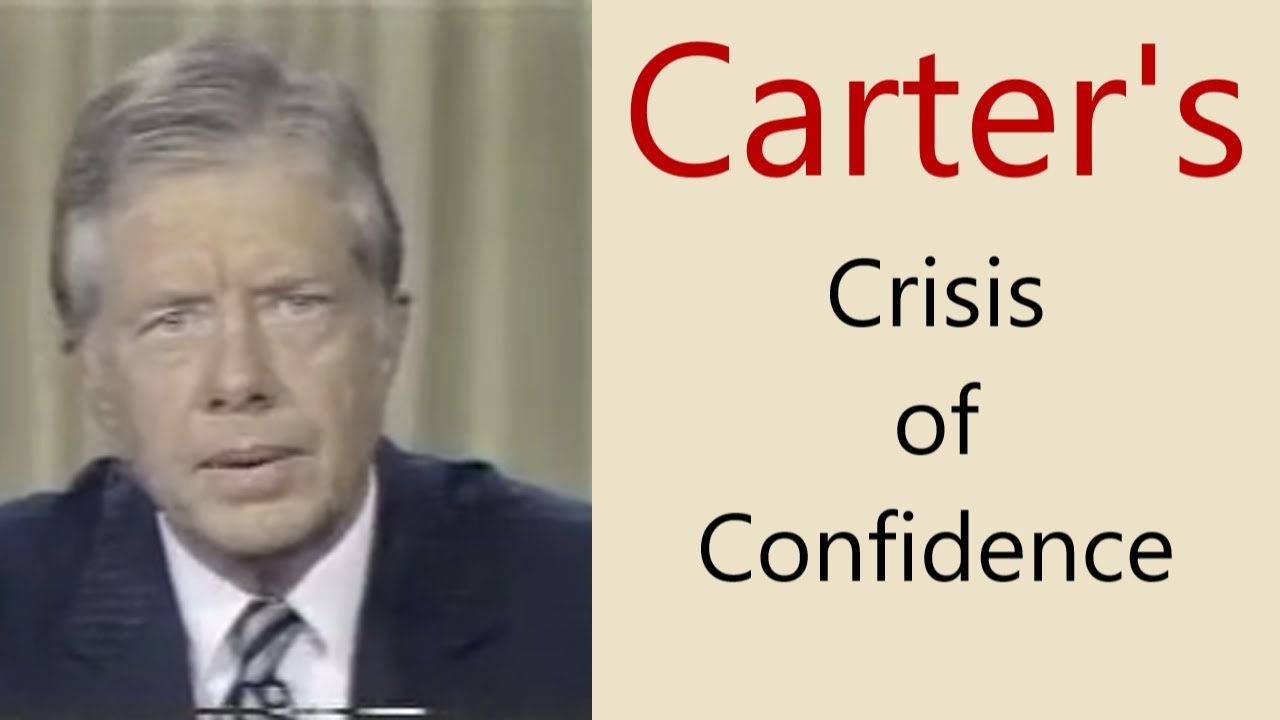
- Carter's "Crisis of Confidence"
Good Evening: This a special night for me. Exactly three years ago, on July 15, 1976, I accepted the nomination of my party to run for President of the United States. I promised you a President who is not isolated from the people, who feels your pain, and who shares your dreams, and who draws his strength and his wisdom from you. During the past three years I’ve spoken to you on many occasions about national concerns, the energy crisis, reorganizing the government, our nation’s economy, and issues of war and especially peace. But over those years the subjects of the speeches, the talks, and the press conferences have become increasingly narrow, focused more and more on what the isolated world of Washington thinks is important. Gradually, you’ve heard more and more about what the government thinks or what the government should be doing and less and less about our nation’s hopes, our dreams, and our vision of the future. Ten days ago, I had planned to speak to you again about a very important subject -- energy. For the fifth time I would have described the urgency of the problem and laid out a series of legislative recommendations to the Congress. But as I was preparing to speak, I began to ask myself the same question that I now know has been troubling many of you: Why have we not been able to get together as a nation to resolve our serious energy problem? It’s clear that the true problems of our nation are much deeper -- deeper than gasoline lines or energy shortages, deeper even than inflation or recession. And I realize more than ever that as President I need your help. So, I decided to reach out and to listen to the voices of America. I invited to Camp David people from almost every segment of our society -- business and labor, teachers and preachers, governors, mayors, and private citizens. And then I left Camp David to listen to other Americans, men and women like you. It has been an extraordinary ten days, and I want to share with you what I’ve heard. First of all, I got a lot of personal advice. Let me quote a few of the typical comments that I wrote down. This from a southern governor: “Mr. President, you are not leading this nation -- you’re just managing the government.” “You don’t see the people enough anymore.” “Some of your Cabinet members don’t seem loyal. There is not enough discipline among your disciples.” “Don’t talk to us about politics or the mechanics of government, but about an understanding of our common good.” “Mr. President, we’re in trouble. Talk to us about blood and sweat and tears.” “If you lead, Mr. President, we will follow.” Many people talked about themselves and about the condition of our nation. This from a young woman in Pennsylvania: “I feel so far from government. I feel like ordinary people are excluded from political power.” And this from a young Chicano: “Some of us have suffered from recession all our lives.” “Some people have wasted energy, but others haven’t had anything to waste.” And this from a religious leader: “No material shortage can touch the important things like God’s love for us or our love for one another.” And I like this one particularly from a black woman who happens to be the mayor of a small Mississippi town: “The big shots are not the only ones who are important. Remember, you can’t sell anything on Wall Street unless someone digs it up somewhere else first.” This kind of summarized a lot of other statements: “Mr. President, we are confronted with a moral and a spiritual crisis.” Several of our discussions were on energy, and I have a notebook full of comments and advice. I’ll read just a few. “We can’t go on consuming forty percent more energy than we produce. When we import oil we are also importing inflation plus unemployment.” “We’ve got to use what we have. The Middle East has only five percent of the world’s energy, but the United States has twenty-four percent.” And this is one of the most vivid statements: “Our neck is stretched over the fence and OPEC has a knife.” “There will be other cartels and other shortages. American wisdom and courage right now can set a path to follow in the future.” This was a good one: “Be bold, Mr. President. We may make mistakes, but we are ready to experiment.” And this one from a labor leader got to the heart of it: “The real issue is freedom. We must deal with the energy problem on a war footing.” And the last that I’ll read: “When we enter the moral equivalent of war, Mr. President, don’t issue us BB guns.” These ten days confirmed my belief in the decency and the strength and the wisdom of the American people, but it also bore out some of my longstanding concerns about our nation’s underlying problems. I know, of course, being President, that government actions and legislation can be very important. That’s why I’ve worked hard to put my campaign promises into law, and I have to admit, with just mixed success. But after listening to the American people, I have been reminded again that all the legislation in the world can’t fix what’s wrong with America. So, I want to speak to you first tonight about a subject even more serious than energy or inflation. I want to talk to you right now about a fundamental threat to American democracy. I do not mean our political and civil liberties. They will endure. And I do not refer to the outward strength of America, a nation that is at peace tonight everywhere in the world, with unmatched economic power and military might. The threat is nearly invisible in ordinary ways. It is a crisis of confidence. It is a crisis that strikes at the very heart and soul and spirit of our national will. We can see this crisis in the growing doubt about the meaning of our own lives and in the loss of a unity of purpose for our nation. The erosion of our confidence in the future is threatening to destroy the social and the political fabric of America. The confidence that we have always had as a people is not simply some romantic dream or a proverb in a dusty book that we read just on the Fourth of July. It is the idea which founded our nation and has guided our development as a people. Confidence in the future has supported everything else -- public institutions and private enterprise, our own families, and the very Constitution of the United States. Confidence has defined our course and has served as a link between generations. We’ve always believed in something called progress. We’ve always had a faith that the days of our children would be better than our own. Our people are losing that faith, not only in government itself but in the ability as citizens to serve as the ultimate rulers and shapers of our democracy. As a people we know our past and we are proud of it. Our progress has been part of the living history of America, even the world. We always believed that we were part of a great movement of humanity itself called democracy, involved in the search for freedom; and that belief has always strengthened us in our purpose. But just as we are losing our confidence in the future, we are also beginning to close the door on our past. In a nation that was proud of hard work, strong families, close-knit communities, and our faith in God, too many of us now tend to worship self-indulgence and consumption. Human identity is no longer defined by what one does, but by what one owns. But we’ve discovered that owning things and consuming things does not satisfy our longing for meaning. We’ve learned that piling up material goods cannot fill the emptiness of lives which have no confidence or purpose. The symptoms of this crisis of the American spirit are all around us. For the first time in the history of our country a majority of our people believe that the next five years will be worse than the past five years. Two-thirds of our people do not even vote. The productivity of American workers is actually dropping, and the willingness of Americans to save for the future has fallen below that of all other people in the Western world. As you know, there is a growing disrespect for government and for churches and for schools, the news media, and other institutions. This is not a message of happiness or reassurance, but it is the truth and it is a warning. These changes did not happen overnight. They’ve come upon us gradually over the last generation, years that were filled with shocks and tragedy. We were sure that ours was a nation of the ballot, not the bullet, until the murders of John Kennedy and Robert Kennedy and Martin Luther King, Jr. We were taught that our armies were always invincible and our causes were always just, only to suffer the agony of Vietnam. We respected the Presidency as a place of honor until the shock of Watergate. We remember when the phrase “sound as a dollar” was an expression of absolute dependability, until ten years of inflation began to shrink our dollar and our savings. We believed that our nation’s resources were limitless until 1973 when we had to face a growing dependence on foreign oil. These wounds are still very deep. They have never been healed. Looking for a way out of this crisis, our people have turned to the Federal Government and found it isolated from the mainstream of our nation’s life. Washington, D.C., has become an island. The gap between our citizens and our government has never been so wide. The people are looking for honest answers, not easy answers; clear leadership, not false claims and evasiveness and politics as usual. What you see too often in Washington and elsewhere around the country is a system of government that seems incapable of action. You see a Congress twisted and pulled in every direction by hundreds of well-financed and powerful special interests. You see every extreme position defended to the last vote, almost to the last breath by one unyielding group or another. You often see a balanced and a fair approach that demands sacrifice, a little sacrifice from everyone, abandoned like an orphan without support and without friends. Often you see paralysis and stagnation and drift. You don’t like it, and neither do I. What can we do? First of all, we must face the truth, and then we can change our course. We simply must have faith in each other, faith in our ability to govern ourselves, and faith in the future of this nation. Restoring that faith and that confidence to America is now the most important task we face. It is a true challenge of this generation of Americans. One of the visitors to Camp David last week put it this way: “We’ve got to stop crying and start sweating, stop talking and start walking, stop cursing and start praying. The strength we need will not come from the White House, but from every house in America.” We know the strength of America. We are strong. We can regain our unity. We can regain our confidence. We are the heirs of generations who survived threats much more powerful and awesome than those that challenge us now. Our fathers and mothers were strong men and women who shaped a new society during the Great Depression, who fought world wars and who carved out a new charter of peace for the world. We ourselves are the same Americans who just ten years ago put a man on the moon. We are the generation that dedicated our society to the pursuit of human rights and equality. And we are the generation that will win the war on the energy problem and in that process, rebuild the unity and confidence of America. We are at a turning point in our history. There are two paths to choose. One is a path I’ve warned about tonight, the path that leads to fragmentation and self-interest. Down that road lies a mistaken idea of freedom, the right to grasp for ourselves some advantage over others. That path would be one of constant conflict between narrow interests ending in chaos and immobility. It is a certain route to failure. All the traditions of our past, all the lessons of our heritage, all the promises of our future point to another path -- the path of common purpose and the restoration of American values. That path leads to true freedom for our nation and ourselves. We can take the first steps down that path as we begin to solve our energy problem. Energy will be the immediate test of our ability to unite this nation, and it can also be the standard around which we rally. On the battlefield of energy we can win for our nation a new confidence, and we can seize control again of our common destiny. In little more than two decades we’ve gone from a position of energy independence to one in which almost half the oil we use comes from foreign countries, at prices that are going through the roof. Our excessive dependence on OPEC has already taken a tremendous toll on our economy and our people. This is the direct cause of the long lines which have made millions of you spend aggravating hours waiting for gasoline. It’s a cause of the increased inflation and unemployment that we now face. This intolerable dependence on foreign oil threatens our economic independence and the very security of our nation. The energy crisis is real. It is worldwide. It is a clear and present danger to our nation. These are facts and we simply must face them. What I have to say to you now about energy is simple and vitally important. Point one: I am tonight setting a clear goal for the energy policy of the United States. Beginning this moment, this nation will never use more foreign oil than we did in 1977-- never. From now on, every new addition to our demand for energy will be met from our own production and our own conservation. The generation-long growth in our dependence on foreign oil will be stopped dead in its tracks right now and then reversed as we move through the 1980s, for I am tonight setting the further goal of cutting our dependence on foreign oil by one-half by the end of the next decade -- a saving of over four and a half million barrels of imported oil per day. Point two: To ensure that we meet these targets, I will use my presidential authority to set import quotas. I’m announcing tonight that for 1979 and 1980, I will forbid the entry into this country of one drop of foreign oil more than these goals allow. These quotas will ensure a reduction in imports even below the ambitious levels we set at the recent Tokyo summit. Point three: To give us energy security, I am asking for the most massive peacetime commitment of funds and resources in our nation’s history to develop America’s own alternative sources of fuel -- from coal, from oil shale, from plant products for gasohol, from unconventional gas, from the sun. I propose the creation of an energy security corporation to lead this effort to replace two and a half million barrels of imported oil per day by 1990. The corporation will issue up to five billion dollars in energy bonds, and I especially want them to be in small denominations so average Americans can invest directly in America’s energy security. Just as a similar synthetic rubber corporation helped us win World War II, so will we mobilize American determination and ability to win the energy war. Moreover, I will soon submit legislation to Congress calling for the creation of this nation’s first solar bank which will help us achieve the crucial goal of twenty percent of our energy coming from solar power by the year 2000. These efforts will cost money, a lot of money, and that is why Congress must enact the windfall profits tax without delay. It will be money well spent. Unlike the billions of dollars that we ship to foreign countries to pay for foreign oil, these funds will be paid by Americans, to Americans. These will go to fight, not to increase, inflation and unemployment. Point four: I’m asking Congress to mandate, to require as a matter of law, that our nation’s utility companies cut their massive use of oil by fifty percent within the next decade and switch to other fuels, especially coal, our most abundant energy source. Point five: To make absolutely certain that nothing stands in the way of achieving these goals, I will urge Congress to create an energy mobilization board which, like the War Production Board in World War II, will have the responsibility and authority to cut through the red tape, the delays, and the endless roadblocks to completing key energy projects. We will protect our environment. But when this nation critically needs a refinery or a pipeline, we will build it. Point six: I’m proposing a bold conservation program to involve every state, county, and city and every average American in our energy battle. This effort will permit you to build conservation into your homes and your lives at a cost you can afford. I ask Congress to give me authority for mandatory conservation and for standby gasoline rationing. To further conserve energy, I’m proposing tonight an extra ten billion dollars over the next decade to strengthen our public transportation systems. And I’m asking you for your good and for your nation’s security to take no unnecessary trips, to use carpools or public transportation whenever you can, to park your car one extra day per week, to obey the speed limit, and to set your thermostats to save fuel. Every act of energy conservation like this is more than just common sense, I tell you it is an act of patriotism. Our nation must be fair to the poorest among us, so we will increase aid to needy Americans to cope with rising energy prices. We often think of conservation only in terms of sacrifice. In fact, it is the most painless and immediate ways of rebuilding our nation’s strength. Every gallon of oil each one of us saves is a new form of production. It gives us more freedom, more confidence, that much more control over our own lives. So, the solution of our energy crisis can also help us to conquer the crisis of the spirit in our country. It can rekindle our sense of unity, our confidence in the future, and give our nation and all of us individually a new sense of purpose. You know we can do it. We have the natural resources. We have more oil in our shale alone than several Saudi Arabias. We have more coal than any nation on earth. We have the world’s highest level of technology. We have the most skilled work force, with innovative genius, and I firmly believe that we have the national will to win this war. I do not promise you that this struggle for freedom will be easy. I do not promise a quick way out of our nation’s problems, when the truth is that the only way out is an all-out effort. What I do promise you is that I will lead our fight, and I will enforce fairness in our struggle, and I will ensure honesty. And above all, I will act. We can manage the short-term shortages more effectively, and we will; but there are no short-term solutions to our long-range problems. There is simply no way to avoid sacrifice. Twelve hours from now I will speak again in Kansas City, to expand and to explain further our energy program. Just as the search for solutions to our energy shortages has now led us to a new awareness of our nation’s deeper problems, so our willingness to work for those solutions in energy can strengthen us to attack those deeper problems. I will continue to travel this country, to hear the people of America. You can help me to develop a national agenda for the 1980s. I will listen; and I will act. We will act together. These were the promises I made three years ago, and I intend to keep them. Little by little we can and we must rebuild our confidence. We can spend until we empty our treasuries, and we may summon all the wonders of science. But we can succeed only if we tap our greatest resources -- America’s people, America’s values, and America’s confidence. I have seen the strength of America in the inexhaustible resources of our people. In the days to come, let us renew that strength in the struggle for an energy-secure nation. In closing, let me say this: I will do my best, but I will not do it alone. Let your voice be heard. Whenever you have a chance, say something good about our country. With God’s help and for the sake of our nation, it is time for us to join hands in America. Let us commit ourselves together to a rebirth of the American spirit. Working together with our common faith we cannot fail. Thank you and good night.
- Carter's 1979 State of the Union Address
Carter’s Second Annual Message January 23, 1979 Mr. President, Mr. Speaker, Members of the 96th Congress, and my fellow citizens: Tonight I want to examine in a broad sense the state of our American Union-how we are building a new foundation for a peaceful and a prosperous world. Our children who will be born this year will come of age in the 21st century. What kind of society, what kind of world are we building for them? Will we ourselves be at peace? Will our children enjoy a better quality of life? Will a strong and united America still be a force for freedom and prosperity around the world? Tonight, there is every sign that the state of our Union is sound. Our economy offers greater prosperity for more of our people than ever before. Real per capita income and real business profits have risen substantially in the last 2 years. Farm exports are setting an all-time record each year, and farm income last year, net farm income, was up more than 25 percent. Our liberties are secure. Our military defenses are strong and growing stronger. And more importantly, tonight, America-our beloved country—is at peace. Our earliest national commitments, modified and reshaped by succeeding generations, have served us well. But the problems that we face today are different from those that confronted earlier generations of Americans. They are more subtle, more complex, and more interrelated. At home, we are recognizing ever more clearly that government alone cannot solve these problems. And abroad, few of them can be solved by the United States alone. But Americans as a united people, working with our allies and friends, have never been afraid to face problems and to solve problems, either here or abroad. The challenge to us is to build a new and firmer foundation for the future—for a sound economy, for a more effective government, for more political trust, and for a stable peace—so that the America our children inherit will be even stronger and even better than it is today. We cannot resort to simplistic or extreme solutions which substitute myths for common sense. In our economy, it is a myth that we must choose endlessly between inflation and recession. Together, we build the foundation for a strong economy, with lower inflation, without contriving either a recession with its high unemployment or unworkable, mandatory government controls. In our government, it is a myth that we must choose between compassion and competence. Together, we build the foundation for a government that works—and works for people. In our relations with our potential adversaries, it is a myth that we must choose between confrontation and capitulation. Together, we build the foundation for a stable world of both diversity and peace. Together, we've already begun to build the foundation for confidence in our economic system. During the last 2 years, in bringing our economy out of the deepest recession since the 1930's, we've created 7,100,000 new jobs. The unemployment rate has gone down 25 percent. And now we must redouble our fight against the persistent inflation that has wracked our country for more than a decade. That's our important domestic issue, and we must do it together. We know that inflation is a burden for all Americans, but it's a disaster for the poor, the sick, and the old. No American family should be forced to choose among food, warmth, health care, or decent housing because the cost of any of these basic necessities has climbed out of reach. Three months ago, I outlined to the Nation a balanced anti-inflation program that couples responsible government restraint with responsible wage and price restraint. It's based upon my knowledge that there is a more powerful force than government compulsion—the force created by the cooperative efforts of millions of Americans working toward a common goal. Business and labor have been increasingly supportive. It's imperative that we in government do our part. We must stop excessive government growth, and we must control government spending habits. I've sent to this Congress a stringent but a fair budget, one that, since I ran for President in 1976, will have cut the Federal deficit in half. And as a percentage of our gross national product, the deficit will have dropped by almost 75 percent. This Congress had a good record last year, and I now ask the 96th Congress to continue this partnership in holding the line on excess Federal spending. It will not be easy. But we must be strong, and we must be persistent. This budget is a clear message that, with the help of you and the American people, I am determined, as President, to bring inflation under control. The 1980 budget provides enough spending restraint to begin unwinding inflation, but enough support for our country to keep American workers productive and to encourage the investments that provide new jobs. We will continue to mobilize our Nation's resources to reduce our trade deficit substantially this year and to maintain the strength of the American dollar. We've demonstrated in this restrained budget that we can build on the gains of the past 2 years to provide additional support to educate disadvantaged children, to care for the elderly, to provide nutrition and legal services for the poor, and to strengthen the economic base of our urban communities and, also, our rural areas. This year, we will take our first steps to develop a national health plan. We must never accept a permanent group of unemployed Americans, with no hope and no stake in building our society. For those left out of the economy because of discrimination, a lack of skills, or poverty, we must maintain high levels of training, and we must continue to provide jobs. A responsible budget is not our only weapon to control inflation. We must act now to protect all Americans from health care costs that are rising $1 million per hour, 24 hours a day, doubling every 5 years. We must take control of the largest contributor to that inflation—skyrocketing hospital costs. There will be no clearer test of the commitment of this Congress to the anti-inflation fight than the legislation that I will submit again this year to hold down inflation in hospital care. Over the next 5 years, my proposals will save Americans a total of $60 billion, of which $25 billion will be savings to the American taxpayer in the Federal budget itself. The American people have waited long enough. This year we must act on hospital cost containment. We must also fight inflation by improvements and better enforcement of our antitrust laws and by reducing government obstacles to competition in the private sector. We must begin to scrutinize the overall effect of regulation in our economy. Through deregulation of the airline industry we've increased profits, cut prices for all Americans, and begun—for one of the few times in the history of our Nation-to actually dismantle a major Federal bureaucracy. This year, we must begin the effort to reform our regulatory processes for the railroad, bus, and the trucking industries. America has the greatest economic system in the world. Let's reduce government interference and give it a chance to work. I call on Congress to take other anti-inflation action—to expand our exports to protect American jobs threatened by unfair trade, to conserve energy, to increase production and to speed development of solar power, and to reassess our Nation's technological superiority. American workers who enlist in the fight against inflation deserve not just our gratitude, but they deserve the protection of the real wage insurance proposal that I have already made to the Congress. To be successful, we must change our attitudes as well as our policies. We cannot afford to live beyond our means. We cannot afford to create programs that we can neither manage nor finance, or to waste our natural resources, and we cannot tolerate mismanagement and fraud. Above all, we must meet the challenges of inflation as a united people. With the support of the American people, government in recent decades has helped to dismantle racial barriers, has provided assistance for the jobless and the retired, has fed the hungry, has protected the safety, health, and bargaining rights of American workers, and has helped to preserve our natural heritage. But it's not enough to have created a lot of government programs. Now we must make the good programs more effective and improve or weed out those which are wasteful or unnecessary. With the support of the Congress, we've begun to reorganize and to get control of the bureaucracy. We are reforming the civil service system, so that we can recognize and reward those who do a good job and correct or remove those who do not. This year, we must extend major reorganization efforts to education, to economic development, and to the management of our natural resources. We need to enact a sunshine [sunset] law that when government programs have outlived their value, they will automatically be terminated. There's no such thing as an effective and a noncontroversial reorganization and reform. But we know that honest, effective government is essential to restore public faith in our public action. None of us can be satisfied when two thirds of the American citizens chose not to vote last year in a national election. Too many Americans feel powerless against the influence of private lobbying groups and the unbelievable flood of private campaign money which threatens our electoral process. This year, we must regain the public's faith by requiring limited financial funds from public funds for congressional election campaigns. House bill 1 provides for this public financing of campaigns. And I look forward with a great deal of anticipation to signing it at an early date. A strong economy and an effective government will restore confidence in America. But the path of the future must be charted in peace. We must continue to build a new and a firm foundation for a stable world community. We are building that new foundation from a position of national strength—the strength of our own defenses, the strength of our friendships with other nations, and of our oldest American ideals. America's military power is a major force for security and stability in the world. We must maintain our strategic capability and continue the progress of the last 2 years with our NATO Allies, with whom we have increased our readiness, modernized our equipment, and strengthened our defense forces in Europe. I urge you to support the strong defense budget which I have proposed to the Congress. But our national security in this complicated age requires more than just military might. In less than a lifetime, world population has more than doubled, colonial empires have disappeared, and a hundred new nations have been born. Mass communications, literacy, and migration to the world's cities have all awakened new yearnings for economic justice and human rights among people everywhere. This demand for justice and human rights is a wave of the future. In such a world, the choice is not which super power will dominate the world. None can and none will. The choice instead is between a world of anarchy and destruction, or a world of cooperation and peace. In such a world, we seek not to stifle inevitable change, but to influence its course in helpful and constructive ways that enhance our values, our national interests, and the cause of peace. Towering over this volatile, changing world, like a thundercloud on a summer day, looms the awesome power of nuclear weapons. We will continue to help shape the forces of change, to anticipate emerging problems of nuclear proliferation and conventional arms sales, and to use our great strength and influence to settle international conflicts in other parts of the world before they erupt and spread. We have no desire to be the world's policeman. But America does want to be the world's peacemaker. We are building the foundation for truly global cooperation, not only with Western and industrialized nations but with the developing countries as well. Our ties with Japan and our European allies are stronger than ever, and so are our friendly relations with the people of Latin America, Africa, and the Western Pacific and Asia. We've won new respect in this hemisphere with the Panama Canal treaties. We've gained new trust with the developing world through our opposition to racism, our commitment to human rights, and our support for majority rule in Africa. The multilateral trade negotiations are now reaching a successful conclusion, and congressional approval is essential to the economic well-being of our own country and of the world. This will be one of our top priorities in 1979. We are entering a hopeful era in our relations with one-fourth of the world's people who live in China. The presence of Vice Premier Deng Xiaoping next week will help to inaugurate that new era. And with prompt congressional action on authorizing legislation, we will continue our commitment to a prosperous, peaceful, and secure life for the people of Taiwan. I'm grateful that in the past year, as in the year before, no American has died in combat anywhere in the world. And in Iran, Nicaragua, Cyprus, Namibia, and Rhodesia, our country is working for peaceful solutions to dangerous conflicts. In the Middle East, under the most difficult circumstances, we have sought to help ancient enemies lay aside deep-seated differences that have produced four bitter wars in our lifetime. Our firm commitment to Israel's survival and security is rooted in our deepest convictions and in our knowledge of the strategic importance to our own Nation of a stable Middle East. To promote peace and reconciliation in the region, we must retain the trust and the confidence both of Israel and also of the Arab nations that are sincerely searching for peace. I am determined, as President, to use the full, beneficial influence of our country so that the precious opportunity for lasting peace between Israel and Egypt will not be lost. The new foundation of international cooperation that we seek excludes no nation. Cooperation with the Soviet Union serves the cause of peace, for in this nuclear age, world peace must include peace between the super powers—and it must mean the control of nuclear arms. Ten years ago, the United States and the Soviet Union made the historic decision to open the strategic arms limitations talks, or SALT. The purpose of SALT, then as now, is not to gain a unilateral advantage for either nation, but to protect the security of both nations, to reverse the costly and dangerous momentum of the nuclear arms race, to preserve a stable balance of nuclear forces, and to demonstrate to a concerned world that we are determined to help preserve the peace. The first SALT agreement was concluded in 1972. And since then, during 6 years of negotiation by both Republican and Democratic leaders, nearly all issues of SALT II have been resolved. If the Soviet Union continues to negotiate in good faith, a responsible SALT agreement will be reached. It's important that the American people understand the nature of the SALT process. SALT II is not based on sentiment; it's based on self-interest—of the United States and of the Soviet Union. Both nations share a powerful common interest in reducing the threat of a nuclear war. I will sign no agreement which does not enhance our national security. SALT II does not rely on trust; it will be verifiable. We have very sophisticated, proven means, including our satellites, to determine for ourselves whether or not the Soviet Union is meeting its treaty obligations. I will sign no agreement which cannot he verified. The American nuclear deterrent will remain strong after SALT II. For example, just one of our relatively invulnerable Poseidon submarines—comprising less than 2 percent of our total nuclear force of submarines, aircraft, and landbased missiles—carries enough warheads to destroy every large- and medium-sized city in the Soviet Union. Our deterrent is overwhelming, and I will sign no agreement unless our deterrent force will remain overwhelming. A SALT agreement, of course, cannot substitute for wise diplomacy or a strong defense, nor will it end the danger of nuclear war. But it will certainly reduce that danger. It will strengthen our efforts to ban nuclear tests and to stop the spread of atomic weapons to other nations. And it can begin the process of negotiating new agreements which will further limit nuclear arms. The path of arms control, backed by a strong defense—the path our Nation and every President has walked for 30 years-can lead to a world of law and of international negotiation and consultation in which all peoples might live in peace. In this year 1979, nothing is more important than that the Congress and the people of the United States resolve to continue with me on that path of nuclear arms control and world peace. This is paramount. I've outlined some of the changes that have transformed the world and which are continuing as we meet here tonight. But we in America need not fear change. The values on which our Nation was founded—individual liberty, self-determination, the potential for human fulfillment in freedom—all of these endure. We find these democratic principles praised, even in books smuggled out of totalitarian nations and on wallposters in lands which we thought were closed to our influence. Our country has regained its special place of leadership in the worldwide struggle for human rights. And that is a commitment that we must keep at home, as well as abroad. The civil rights revolution freed all Americans, black and white, but its full promise still remains unrealized. I will continue to work with all my strength for equal opportunity for all Americans-and for affirmative action for those who carry the extra burden of past denial of equal opportunity. We remain committed to improving our labor laws to better protect the rights of American workers. And our Nation must make it clear that the legal rights of women as citizens are guaranteed under the laws of our land by ratifying the equal rights amendment. As long as I'm President, at home and around the world America's examples and America's influence will be marshaled to advance the cause of human rights. To establish those values, two centuries ago a bold generation of Americans risked their property, their position, and life itself. We are their heirs, and they are sending us a message across the centuries. The words they made so vivid are now growing faintly indistinct, because they are not heard often enough. They are words like "justice," "equality," "unity," "truth," "sacrifice," "liberty," "faith," and "love." These words remind us that the duty of our generation of Americans is to renew our Nation's faith—not focused just against foreign threats but against the threats of selfishness, cynicism, and apathy. The new foundation I've discussed tonight can help us build a nation and a world where every child is nurtured and can look to the future with hope, where the resources now wasted on war can be turned towards meeting human needs, where all people have enough to eat, a decent home, and protection against disease. It can help us build a nation and a world where all people are free to seek the truth and to add to human understanding, so that all of us may live our lives in peace. Tonight, I ask you, the Members of the Congress, to join me in building that new foundation—a better foundation-for our beloved country and our world. Thank you very much. Source: https://www.presidency.ucsb.edu/documents/the-state-the-union-address-delivered-before-joint-session-the-congress-0
- Reagan Signs the Economic Recover Act
August 13, 1981 The President . Good morning. Q . Typical California weather. The President . Yes, since this is the first day of this kind of weather, of fog, since we've been here, I shall refrain from saying that you're all responsible -- [ laughter ] -- for bringing it up with you. The Sun has been shining brightly here. These bills that I'm about to sign -- not every page -- this is the budget bill, and this is the tax program -- but I think they represent a turnaround of almost a half a century of a course this country's been on and mark an end to the excessive growth in government bureaucracy, government spending, government taxing. And we're indebted for all of this -- I can't speak too highly of the leadership, Republican leadership in the Congress and of those Democrats who so courageously joined in and made both of these truly bipartisan programs. But I think in reality, the real credit goes to the people of the United States who finally made it plain that they wanted a change and made it clear in Congress and spoke with a more authoritative voice than some of the special interest groups that they wanted these changes in government. This represents $130 billion in savings over the next 3 years. This represents $750 billion in tax cuts over the next 5 years. And this is only the beginning, because from here on now we are going to have to implement all of these, and it's going to be a job to make this whole turnaround work. It's going to be the number one priority -- or continue to be the number one priority of our administration. And again, I express my gratitude to the Congress, the 97th Congress, and to the administration, the people who worked so hard to make these come about. And, Joe, [Joseph W. Canzeri, Deputy Assistant to the President] I guess it is traditional that I have to use a lot of pens in these signatures. [ At this point, the President began signing H.R. 4242 .] Oops, one letter too many. I'll have to catch up here someplace. Q . One letter a pen, Mr. President? The President . That's the way it works out. There's a number that we have to have. Just think, if my name had had three more letters in it, we'd -- -- Q . Who gets the pens? The President . Some of those people that helped. There. That is the tax program. [ The President began signing H.R. 3982 .] I figured how to do it, Joe, on this one to come out even -- on the ``n'' -- I'll make one part of the ``n,'' and then the other part. They are signed, and now all we have to do is implement them. If you have any questions, perhaps, on any of the features of this, fire away. Q . How about another subject, Mr. President? [ Laughter ] The President . You mean in the face of all of this, you want to change the subject? Does someone have a question on the subject, first? The Nation's Economy Q . Yeah, I do. Mr. President, the Wall Street Journal carried a story yesterday that the revenue projections which you will be getting are going to be lower than your administration previously thought, and that means we're headed for a more severe economic downturn with higher interest rates. Are you ready to revise your own projections about the economy downward? Are we headed for a recession? The President . I don't know whether you'd call it a recession or not, but they're not saying anything that we haven't said over and over again. Our own projections have been that for the next several months this soft and soggy economy is going to continue and that we shouldn't be fooled by these last couple of months of seeming upturn, that this means a continued climb. We think that we are in a soggy economy and it's going to go on. Remember that it won't be until October that any of this will begin to be implemented. This is the budget that begins for the year in October. The tax programs, of course, won't be into effect until then either. And what we're counting on is when these , and these begin to take effect, that we will see the results when people begin to have the more money in their pockets from their earnings and when the lowered expenditures of government begin taking effect. But, no, we're not differing that. We've said, ourselves, to watch for a sagging economy for the next few months. Air Traffic Controllers Q . Mr. President, on the air controllers strike, the International Association of Air Controllers has called on you to negotiate with PATCO. Why do you continue to believe that you should not negotiate with them? The President . Well, now, this has changed the subject already, but -- Sam [Sam Donaldson, ABC News], you'll be next, since you wanted to change the subject. On that, there is no strike. There is a law that Federal unions cannot strike against their employers, their employers being the people of the United States. There was in addition to that an oath that is taken by each employee that he or she will not strike, and we warned in advance in the negotiations -- there were 7 months of negotiations. They resulted on June 22d in a settlement that was deemed satisfactory to the union negotiators. Then they came back several weeks later with demands that were -- said that this was not suitable and with demands that increased by 17 times what had been agreed to in June. It would have amounted to a $40,000 increase per year per controller. But we warned, under the threat of a strike, that there could not be a strike against the law, that this would be breaking the law, and that there, therefore, could be no negotiations. Now, in effect, what they did was terminate their own employment by quitting. And our obligation now -- or to the several thousand who are keeping this system working and who did abide by their oath -- -- Q . Wouldn't it be worth it, Mr. President, to go ahead and rehire these 12,000 people rather than have the American people suffer the inconvenience and the damage to the economy this is going to cause? The President . Well, how much inconvenience is there? Yesterday, flights were 80 percent of normal. And with regard to international flights, yesterday 117,000 people were carried on over-water flights, international flights. So, we feel that we are rebuilding the system now in view of the action of those controllers who decided to violate their oath and to violate the law. And I just don't see any way that it could be expected that we could now just go back and pretend that they weren't breaking the law or breaking their oath. Q . Are you absolutely ruling out use of Presidential pardon or amnesty? The President . Our obligation is to those several thousand that are in there working. And I must say they have my utmost gratitude and admiration, and I think they should have of all the people for what they're doing. Q . But you have the power of Presidential pardon and amnesty. Are you absolutely ruling that out with regard to the air traffic controllers? The President . Yes, although we have said that those -- and some have already -- those who come back and can show that they were, you might say, coerced or harassed, pressured into doing what they did and it was not their will, we have taken some of those back. U.S.-Soviet Relations Q . Mr. President, let me ask you about the Soviet Union's commentary today that your policy is one of sheer insanity and that relations between Moscow and Washington are now at the lowest ebb that they've been in modern times, since the cold war ended. Are we now in a new cold war, and do you fear that it may lead to an actual shooting war? The President. No, I don't fear the actual shooting war. And whatever they may want to term it, ``cold war'' or not, what we are in is a situation where we're being realistic about their military buildup, which has gone on unchecked in spite of all of the meetings having to do with arms control and so forth. And I can understand their anguish. They are squealing like they're sitting on a sharp nail simply because we now are showing the will that we're not going to let them get to the point of dominance, where they can someday issue to the free world an ultimatum of ``surrender or die,'' and they don't like that. But, no, I have made it plain -- and it isn't just language -- we are going to meet with them with regard to the theater nuclear weapons in Europe, but we are also going to meet, and I have asked that we meet to legitimately discuss the reduction of armaments on both sides, particularly in strategic weapons. Neutron Warhead Q . Mr. President, you made the decision to go ahead and manufacture the neutron weapon. Is this not an escalation on our part? The President . No, not really. The neutron weapon -- incidentally, we have information that the Soviet Union spent about a hundred million dollars in Western Europe alone a few years ago when the announcement was first made of the invention of the neutron warhead, and I don't know how much they're spending now, but they're starting the same kind of propaganda drive. The neutron warhead is a defensive weapon. It is a deterrent to a conflict. But we didn't start manufacturing it. The previous administration had authorized its manufacture quite some time ago, and what we have been doing -- they, however, did not put the actual neutron part of the warhead in the 8-inch shell of the Lance missile. And so you stored here, warehoused that and the casing that in time of need and necessity would be then put together. Well, this doesn't make very much sense. All we've done is simply say that we're going to continue warehousing this, but we're going to put that in the casing and warehouse it as a unit instead of two separate parts. Air Traffic Controllers Q . Mr. President, can I go back to PATCO for one minute, please? The President . Yes. Q . There is a report that you are considering offering controllers a Presidential pardon or an amnesty, giving them back their jobs if they admit that they were wrong. Is there any such consideration, and would you consider amnesty if they did? The President . No, and that goes with my answer again. No, there's never been -- I don't know where that could have started, because there has been no change in our feelings about this at all. Situation in Poland Q . Mr. President, there's been a report today that the Soviet Union will begin wargames next month in the Baltic States and the Baltic Sea under the direct direction of the Soviet Defense Minister. Do you consider that a reaction to your neutron bomb announcement, and is that something that surprises the administration, that we didn't know about? The President . No, because they -- we're not surprised -- they were preparing long before this news leaked out about the assembly of the neutron warhead. It leaked out that -- or we had the information that they were preparing for these wargames, so they couldn't have been dependent on the neutron warhead at all. Q . You don't consider those wargames any particular new threat to Poland, since they're in that area? The President . They might be directed against that, but I would have no way of knowing what's in their mind. But apparently they're going to include amphibious landings, coastal landings, and so forth. Neutron Warhead Q . Mr. President, do you foresee the eventual deployment of the neutron warhead in Western Europe? The President . No. Our intention is to simply stockpile it, warehouse it, you might say, as we do with other weapons, in the event that, heaven forbid, there ever is a necessity, a war that brings them about. This weapon was particularly designed to offset the great superiority that the Soviet Union has on the western front against the NATO nations, a tank advantage of better than four to one, and it is purely, as I say, a defensive weapon. And maybe this is why it's so painful to the Soviet Union, to realize that this could offset their great advantage there. But there is no question of deployment, and if ever there seemed to be a necessity for that, deployment would only follow full consultation with our NATO allies. Weapons Sales to Israel Q . Mr. President, what is the reason for continuing to withhold fighter planes from Israel that they have bought or are purchasing from us? The President. Well, the decision is going to be made very soon, and it is just some last details in the review that has been going on that started with the incident in the Middle East. And then I will be announcing a decision, probably next week. Q . It sounds as if you're moving toward a decision to go ahead and release them. The President . Well, if I answered that then I might be announcing a decision. I'll tell you, I'll announce what the decision is next week. Federal Spending Q . Back on the budget, many Governors, particularly Democratic Governors, say it's a shell game, that you've got to help them on the so-called safety net more, or they're not going to be able to take up the slack. The President . Well, some Governors did say that and yet I noticed that the whole Governors conference did support and vote for a resolution of continued cooperation with us in these packages. Now, it is true, we were not able to get all that we wanted in the line of real block grants and autonomy for local and State government. You know, one level of government -- they even have that conflict between local and State government, that each level is a little reluctant to give up autonomy and authority. We're going to continue to work with the Congress and work with the States and local government representatives to give them the autonomy they can have to make these programs work. It is true we did not get all that we had wanted in that regard. Q . I gather, sir, it's not autonomy so much as money that they need. The President . Well, the difference is -- and what our reductions were based on is that the block grant, giving them the flexibility at that level to use this as they saw fit, setting the priorities, really would result in a savings, and our reductions were based on those estimated savings in unnecessary administrative overhead, direction, and restrictions that caused unnecessary spending at the local level. And as a Governor I can testify that that was true, that in many of the categorical grant programs we could see how much more efficiently they could have been run without the redtape imposed by the Federal Government. Now, there was a hand over here, and then I'll go over there. U.S.-Soviet Relations Q . Secretary Haig recently called on the Russians to show restraint and reciprocity if they wanted better relations with the United States. In your communications with Brezhnev, what suggestions have you made to the Soviets of ways they can improve their behavior, or how would you suggest now the Soviets could improve so that you could get back to detente and reduce this war of words? The President . Well, I made a suggestion at one time in correspondence with Mr. Brezhnev that sometimes it seems that the governments sometimes get in the way of the people and that I think that the people of all countries have a great many things in common -- a desire to raise their families, a desire to choose the occupation or profession they want to work at, to have some control over their lives. And I suggested that maybe we might sit down sometime and see what it was the people really wanted. I doubt that the people have ever started a war. So, I made that suggestion. Q . Would you like to meet Brezhnev soon? The President . Well, when we are ready to come forward with a program of proposals for the -- and that will take some preliminary meetings at the ministerial level before we're ready to come in and actually negotiate, as I've said, legitimate arms reductions to remove this nightmare that hangs over the world today of the strategic weapons. Neutron Warhead Q . Mr. President, I wonder about the neutron bomb perhaps changing nuclear doctrine. If the Soviets attacked with tanks, might we become the first to use -- would we engage in first strike with that weapon? The President . Well, this is something that seems to be overlooked in all the propaganda that's now being uttered about this weapon, and that is that the present tactical battlefield weapons stationed in Europe are nuclear weapons, far more destructive, far longer in rendering areas uninhabitable because of radioactivity, than the neutron weapon. So, those tactical nuclear weapons are there on both sides already, and this, we think, is a more moderate but more effective version. You also have to remember that those who are crying the loudest, the Soviet Union, and many of those who under the name of pacifism in Western Europe, who are opposing things like this and opposing the theater nuclear forces and so forth, maybe some are sincere -- I'm sure they are -- but I think others are really carrying the progaganda ball for the Soviet Union, because there's no mention made of 200 SS-20's, strategic nuclear weapons of medium range, that are aimed at the cities of all of Europe today, and that are not being considered in any of the talk of reduction of theater forces, East and West -- just as in SALT II the Soviet Union called our aging B-52 a strategic weapon but did not call their Backfire, modern bomber, a strategic weapon. So, let's remember the SS-20's before we start worrying too much about what we're thinking about. But remember also that our present 8-inch guns and our present Lance missiles over there are tactical nuclear weapons. Federal Deficits Q . Mr. President, back on the budget for a minute. Given the so-called soggy conditions, it seems that you're going to have greater deficits over the next few years, less revenues, more deficits. What are those deficits now? How much more in budget cuts are you going to have to make over the next couple of years, and will you still be able to balance the budget in '84? The President . Well, this has always been our goal and will continue to be our goal. But remember that we always said that there were further budget cuts for the coming years, for '83 and '84. These are the ones that go into effect in '82. Q . How much more, though? The President . Well, we know, of course, that we will have a sizable deficit for '81. There was nothing we could do about that. And, as you know, the Government has been operating in '81 without a budget, just on appropriations, and we have tried to limit once we got into management what we could, but the die was already cast as to the amount of this deficit. Now, the possibility of increased deficits in the coming years over our previous figures are due in part to not getting totally what we had asked for in the budget cuts, but also that the tax package finally came out with additional reductions. As I say, those have possibly called for some reductions simply to recognize the realities of these two packages now, but we are going to continue to work on this and work for more budget cuts. And it just means that we're going to have to try to get more additional cuts than we might have had to get before. I'm not sure that we might not have been, however, too conservative in our estimates on the tax program, because, remember, our tax proposals were based on the belief that the cut in tax rates would not mean a comparable cut in tax revenues, that the stimulant to the economy would be such that the Government might find itself getting additional revenues, as it did last year in the cut of the capital gains tax. Interest Rates Q . Mr. President, are you still confident that high interest rates will come down toward the end of the year? The President . Yes. I noticed this morning's report in the paper, about a headline that said, ``Interest Rates Up.'' But then when you read the story, you found that that was simply in the bond market in New York and was reflecting bond buyers' competition for the limited amount of capital that was there for investment. That's part of what's in that tax program, is to make less limited that amount of money that's available for capital investment. MX and B - 1 Bomber Programs Q . Mr. President, do you expect to make a decision on the MX and the B - 1 before you return to Washington? The President . No. As a matter of fact, not before I return to Washington, but the MX and the B - 1 programs are -- we've still been discussing these and the various options, and very possibly we may wait for the return of Congress. Defense Spending Q. Mr. President, in view of your hard line against the Soviets, are you going to be willing to make a substantial scaledown in your defense spending plans, if that's necessary? The President . That would depend on the negotiating table and how willing they were to actually discuss arms reductions. You will recall that the previous President tried to introduce that once, and our Secretary of State was on his way home in 24 hours from Moscow, because they wouldn't even hear of a reduction. But they are the ones, with all of the talk that's going on, the Soviet Union has been engaged in the greatest military buildup in the history of man, and it cannot be described as necessary for their defense. It is plainly a buildup that is offensive in nature. Q . Then it'll lead to war. The President . What? Q . You said earlier you didn't think it would lead to war, but you're describing something that inevitably has -- -- The President . Well, no, not if they could achieve such a superiority by conning everyone else into being quiescent, that they could then say, ``Look at the difference in our relative strengths. Now, here's what we want.'' This is what I mean by an ultimatum, ``Surrender or die.'' And I think maybe they see that plan losing some of its potency now with our own plans. Secretary of the Interior Q . Are you ever going to let Jim Watt up here? [ Laughter ] The President . Yes. As a matter of fact, he would be very welcome here or anyplace else. Jim Watt has been doing what I think is a common sense job in the face of some environmental extremism that we've suffered from. And I can assure you Jim Watt does not want to destroy the beauty of America. He just wants to recognize that people are ecology, too. We have some needs, and there has to be provision for us to live. But if he does come up, I'd welcome his help, because we've got a woods back here that is full of downed limbs from trees, the result of a freak 8-inch snowstorm. Q . What if he strikes oil in the corral? [ Laughter ] The President . I'll cut him in. [ Laughter ] Bubonic Plague Q . Have you seen any evidence of the plague since you've been here other than the signs? [Laughter] Q . Killer rats! The President . No. No, I don't know where that was found -- they say someplace a mile from the ranch here. But we all have to recognize that that is not something startlingly new in California, and maybe in other parts of the country, but it was only a few years ago that we had a State park just east of Los Angeles that had to be closed for a period because of bubonic plague threat, carried by ground squirrels that were littering the place with their dead. And it was only a few years ago that we had -- I believe there was a petty officer in the Navy that was on a fishing trip down in the Ojai area and was brought in to the hospital desperately ill and was dead before they could diagnose that it was bubonic plague. And they went back into that area and found again the evidence that rodents had carried it, so it's -- -- Q . Do you really tuck your pants in your boots as a precaution? The President . No. Q . Let's see. [ Laughter ] The President . No. Q . That's what your Deputy Press Secretary has been telling us. The President . No, we've been out there in the woods working very hard at cleaning up, as I say, some of that brush. I wish the fog would lift so you could see some of the brush piles around here. Lee Clearwater, who was here the night that the snowfall came, said it sounded like an artillery barrage, hearing the limbs snapping off all over in the woods. And we had it pretty park-like around here until then. We'll be cutting for the next 10 years. If anyone wants some firewood -- [ laughter ] -- just bring a truck and a chainsaw, and we'll point you to all kinds of good oak firewood that you can have. Q . Will Mrs. Reagan be coming out to say hello? The President . I think she's back over there with -- -- Q . What are you going to do for the rest of your vacation? The President . What's that? Q . What are you going to do for the rest of the week while you're here? The President . Oh, the same thing we've been doing. This is the first morning we haven't ridden -- decided instead that we'd come out and be ridden. [ Laughter ] Q . Is it foggy like this every day? The President . No. This is the first day. As I say, I think you brought it with you. Q . What's the truth of this story? Does Mrs. Reagan like it up here, or does she just come up here because you want to do it? [ Laughter ] The President . I don't think after 29 years she could fool me that much. I think she likes it. We ride together every morning. Q . Women have been fooling men since Adam and Eve. [ Laughter ] Deputy Press Secretary Speakes. On that note, thank you. The President . Wait a minute. Do you want to answer for yourself? [ Referring to Mrs. Reagan ] Q . We have the best witness over there. The President . Speak for yourself. Q . Do you like it up here, Mrs. Reagan? Mrs. Reagan. I love it. The President . There. Q . Does she have a card in her hand? [ Laughter ] The President . Well, that does it there. Q . Thank you, sir. The President . Thank you all. I'm sorry that we couldn't have given you one of the mornings that we've had up here before. It's just been absolutely beautiful. Q . What's the name of the dog, by the way? The President. This was Lassie -- oh, Lassie. Millie! [ Laughter ] Q . No, that was an old movie. The President . Millie. Millie's her name. And if the golden retriever comes around, his name is Victory. That's the one that was given to Nancy as a little pup when we were back on the campaign trail. And he's now a big dog. Q . May we see your boots on this side? The President . You didn't get -- excuse me. This side was cheated. They want a shot of the boot up. [ Laughter ] The Cabinet Q . Can I ask you one more question? There have been specific reports that your Secretary of State and Secretary of Defense are not getting along and that they argue in front of you. Can you comment on those reports? The President . The whole Cabinet argues in front of me. [ Laughter ] That was the system that I wanted installed. Instead of the traditional Cabinet meeting with each Cabinet member making a brief report on how things were going in his agency, I wanted this operation where I have the benefit of the thinking of all of them, because most problems do overlap. There's hardly a problem that doesn't touch other Cabinet agencies and other departments of government. And so, what we do is we have an agenda, and it goes out on the table and there have been numerous differences. And the thing is, when there's been enough discussion and enough argument and I've joined in and I've heard enough, I make the decision. But no ill will and no feuds or turf battles of any kind have been going on. I've made it plain that I want each department to explain from that department's standpoint, such as State and Defense, what is their thinking and their reasoning as to why they take a certain position. And then I have to decide and weigh which way to go and which way is best for the national interest. Q . Is Maureen going to run for the Senate? The President . I hope not. [ Laughter] I don't know. I know she's talked of it. I don't know how serious she is about it. Q . How much will you take for the place? The President . Oh, you can't sell heaven. [ Laughter ] Mrs. Reagan . Where did Sam go? What ever gave you the idea that I didn't like it? Q . Well, these reporters have been writing these stories like that. You'd be surprised what they say. Mrs. Reagan . Oh. Well, you can straighten them all out. Q . Well, they say, for instance, that you come up here and stay on the phone talking to your friends in Los Angeles while the President's out chopping wood and clearing grass and all of that. Mrs. Reagan . I don't chop wood. But I don't stay on the phone all the time either. Q . Do you really like it up here? Mrs. Reagan . I really like it up here. The President . I've got to be honest and tell you some of those phone calls are to make it possible for me to go out and chop the brush. Q . You only have one line, is that it? [ Laughter ] Well, don't cut your leg off. [ Laughter ] Mrs. Reagan. ``Where's the rest of me?'' [ Laughter ] The President. You shouldn't have mentioned it. [ Laughter ] Q . Are you going to go in to Santa Barbara at all? The President . Not on this trip, not on this particular stretch here. I think next week -- I mean the week after next, I go down there. Source: https://www.reaganlibrary.gov/archives/speech/remarks-signing-economic-recovery-tax-act-1981-and-omnibus-budget-reconciliation
- Reagan "What does America want?"
Reagan "What does America want?"
- Reagan's "To Restore America"
March 31, 1976 Good evening to all of you from California. Tonight, Id like to talk to you about issues. Issues which I think are involvedor should be involved in this primary election season. Im a candidate for the Republican nomination for president. But I hope that you who are Independents and Democrats will let me talk to you also tonight because the problems facing our country are problems that just dont bear any party label. In this election season the White House is telling us a solid economic recovery is taking place. It claims a slight drop in unemployment. It says that prices arent going up as fast, but they are still going up, and that the stock market has shown some gains. But, in fact, things seem just about as they were back in the 1972 election year. Remember, we were also coming out of a recession then. Inflation had been running at round 6 percent. Unemployment about 7 (percent). Remember, too, the upsurge and the optimism lasted through the election year and into 1973. And then the roof fell in. Once again we had unemployment. Only this time not 7 percent, more than 10. And inflation wasnt 6 percent, it was 12 percent. Now, in this election year 1976, were told were coming out of this recession just because inflation and unemployment rates have fallen, to what they were at the worst of the previous recession. If history repeats itself, will we be talking recovery four years from now merely because weve reduced inflation from 25 percent to 12 percent? The fact is, well never build a lasting economic recovery by going deeper into debt at a faster rate than we ever have before. It took this nation 166 years until the middle of World War II to finally accumulate a debt of $95 billion. It took this administration just the last 12 months to add $95 billion to the debt. And this administration has run up almost one-fourth of the total national debt in just these short 19 months. Inflation is the cause of recession and unemployment. And were not going to have real prosperity or recovery until we stop fighting the symptoms and start fighting the disease. Theres only one cause for inflation- government spending more than government takes in. The cure is a balanced budget. Ah, but they tell us, 80 percent of the budget is uncontrollable. Its fixed by laws passed by Congress. Well, laws passed by Congress can be repealed by Congress. And, if Congress is unwilling to do this, then isnt it time we elect a Congress that will? Soon after he took office, Mr. Ford promised he would end inflation. Indeed, he declared war on inflation. And, we all donned those WIN buttons to Whip Inflation Now. Unfortunately the war if it ever really started was soon over. Mr. Ford without WIN button, appeared on TV, and promised he absolutely would not allow the Federal deficit to exceed $60 billion (which incidentally was $5 billion more than the biggest previous deficit wed ever had). Later he told us it might be as much as $70 billion. Now we learn its 80 billion or more. Then came a White House proposal for a $28 billion tax cut, to be matched by a $28 billion cut in the proposed spending not in present spending, but in the proposed spending in the new budget. Well, my question then and my question now is, if there was $28 billion in the new budget that could be cut, what was it doing there in the first place? Unfortunately, Washington doesnt feel the same pain from inflation that you and I do. As a matter of fact, government makes a profit on inflation. For instance, last July Congress vaccinated itself against that pain. It very quietly passed legislation (which the president signed into law) which automatically now gives a pay increase to every Congressman every time the cost of living goes up. It would have been nice if theyd thought of some arrangement like that for the rest of us. They could, for example, correct a great unfairness that now exists in our tax system. Today, when you get a cost of living pay raise one that just keeps you even with purchasing power it often moves you up into a higher tax bracket. This means you pay a higher percentage in tax, but you reduce your purchasing power. Last year, because of this inequity, the government took in $7 billion in undeserved profit in the income tax alone, and this year they'll do even better. Now isnt it time that Congress looked after your welfare as well as its own? Those whose spending policies cause inflation to begin with should be made to fee the painful effect just as you and I do. Repeal of Congresss automatic pay raise might leave it with more incentive to do something to curb inflation. Now, lets look at Social Security. Mr. Ford says he wants to preserve the integrity of Social Security. Well, I differ with him on one world. I would like to restore the integrity of Social Security. Those who depend on it see a continual reduction in their standard of living. Inflation strips the increase in their benefits. The maximum benefit today buys 80 fewer loaves of bread than it did when that maximum payment was only $85 a month. In the meantime, the Social Security payroll tax has become the most unfair tax any worker pays. Women are discriminated against, particularly working wives. And, people who reach Social Security age and want to continue working, should be allowed to do so without losing their benefits. I believe a presidential commission of experts should be appointed to study and present a plan to strengthen and improve Social Security while theres still time so that no person who has contributed to Social Security will ever lose a dime. Before leaving this subject of our economic problems, lets talk about unemployment. Ending inflation is the only long range and lasting answer to the problem of unemployment. The Washington Establishment is not the answer. Its the problem. Is tax policies, its harassing regulation, its confiscation of investment capital to pay for its deficits keeps business and industry from expanding to meet your needs and to provide the jobs we all need. No one who lived through the Great Depression can ever look upon an unemployed person with anything by compassion. To me, there is no greater tragedy than a breadwinner willing to work, with a job skill but unable to find a market for that job skill. Back in those dark depression days I saw my father on Christmas eve open what he thought was a Christmas greeting from his boss. Instead, it was the blue slip telling him he not longer had a job. The memory of him sitting there holding that slip of paper and then saying in a half whisper, Thats quite a Christmas present; it will stay with me as long as I live. Other problems go unsolved. Take energy. Only a short time ago we were lined up at the gas station turned our thermostats down as Washington announced project Independence. We were going to become self-sufficient, able to provide for our own energy needs. At the time, we were only importing a small percentage of our oil. Yet, the Arab boycott caused half a million Americans to lose their jobs when plants closed down for lack of fuel. Today, its almost three years later and Project Independence has become Project Dependence. Congress has adopted an energy bill so bad we were led to believe Mr. Ford would veto it. Instead, he signed it. And, almost instantly, drilling rigs all over our land started shutting down. Now for the first time in our history we are importing more oil than we produce. How many Americans will be laid off if theres another boycott? The energy bill is a disaster that never should have been signed. An effort has been made in this campaign to suggest that there arent any real differences between Mr. Ford and myself. Well, I believe there are and these differences are fundamental. One of them has to do with our approach to government. Before Richard Nixon appointed him Vice President, Mr. Ford was a Congressman for 25 years. His concern, of necessity, was the welfare of his congressional district. For most of his adult life he has been a part of the Washington Establishment. Most of my adult life has been spent outside of government. My experience in government was the eight years I served as governor of California. If it were a nation, California would be the 7th-ranking economic power in the world today. When I became governor, I inherited a state government that was in almost the same situation as New York City. The state payroll had been growing for a dozen years at a rate of from five to seven thousand new employees each year. State government was spending from a million to a million-and-a-half dollars more each day than it was taking in. The States great water project was unfinished and under-funded by a half a billion dollars. My predecessor had spent the entire years budget for Medicaid in the first six months of the fiscal year. And, we learned that the teachers retirement fund was unfunded a $4 billion liability hanging over every property owner in the state. I didnt know whether Id been elected governor or appointed receiver. California was faced with insolvency and on the verge of bankruptcy. We had to increase taxes. Well, this came very hard for me because I felt taxes were already too great a burden. I told the people the increase in my mind was temporary and that, as soon as we could, wed return their money to them. I had never in my life thought of seeking or holding public of office and Im still not quite sure how it all happened. In my own mind, I was a citizen representing my fellow citizens against the institution of government. I turned to the people, not to politicians, for help. Instead of a committee to screen applicants for jobs, I had a citizens recruiting committee, and I told this committee I wanted an administration made up of men and women who did not want government careers and whod be the first to tell me if their government job was unnecessary. And I had that happen. [A] young man from the aerospace industry dissolved his department in four months, handed me the key to this office, and told me wed never needed the department. And to this day, I not only have never missed it I dont know where it was. There was a reason for my seeking people who didnt want government careers. Dr. Parkinson summed it all up in his book on bureaucracy. He said, Government hires a rat-catcher and the first thing you know, hes become a rodent control officer. In those entire eight years, most of us never lost that feeling that we were there representing the people against what Cicero once called the arrogance of officialdom. We had a kind of watchword we used on each other. When we begin thinking of government as we instead of they, weve been here too long. Well, I believe that attitude would be beneficial in Washington. We didnt stop just with getting our administration from the ranks of the people. We also asked for help from expert people in a great many fields, and more than 250 of our citizens volunteered to form into task forces. They went into every department and agency of state government to see how modern business practices could make government more efficient, economical and responsive. The gave an average of 117 days apiece full time, away from their own jobs and careers at no cost to the taxpayers. They made eighteen hundred specific recommendations. We implemented more than sixteen hundred of those recommendations. This was government-by-the-people, proving that it works when the people work at it. When we ended our eight years, we turned over to the incoming administration a balanced budget, a $500 million surplus, and virtually the same number of employees wed stated with eight years before even though the increase in population had given some departments a two-thirds increase in work load. The water project was completed with $165 million left over. Our bonds had a triple A rating, the highest credit rating you can get. And the teachers retirement program was fully funded on a sound actuarial basis. And, we kept our word to the taxpayers we returned to them in rebates and tax cuts, $5 billion, $761 million. I believe that what we did in California can be done in Washington if government will have faith in the people and let them bring their common sense to bear on the problems bureaucracy hasnt solved. I believe in the people. Now, Mr. Ford places his faith in the Washington Establishment. This has been evident in his appointment of former Congressmen and longtime government workers to positions in his Administration. Well, I dont believe that those who have been part of the problem are necessarily the best qualified to solve those problems. The truth is, Washington has taken over functions that dont truly belong to it. In almost every case it has been a failure. Now, understand, Im speaking of those programs which logically should be administered at state and local levels. Welfare is a classic example. Voices that are raised now and then urging a federalization of welfare dont realize that the failure of welfare is due to federal interference. Washington doesnt even know how many people are on welfare how many cheaters are getting more than one check. It only knows how many checks its sending out. Its own rules keep it from finding out how many are getting more than one check. Well, California had a welfare problem. Sixteen percent of all welfare recipients in the country were drawing their checks in our state. We were sending welfare checks to families who decided to live abroad. On family was receiving its check in Russia. Our caseload was increasing by 40,000 people a month. Well, after a few years of trying to control this runaway program and being frustrated by bureaucrats here in California and in Washington, we turned again to a citizens task force. The result was the most comprehensive welfare reform ever attempted. And in less than three years we reduced the rolls by more than 300,000 people, saved the taxpayers $2 billion, and increased the grants to the truly deserving needy by an average of 43 percent. We also carried out a successful experiment which I believe is an answer to much of the welfare problem in the nation. We put able-bodied welfare recipients to work at useful community projects in return for their welfare grants. Now, lets look at housing. Washington has tried to solve this problem for the poor by building low-cost houses. So far its torn down three and a half homes for every one its built. Schools in America we created at the local level and administered at the local level for many years the greatest public school system in the world. Now through something called federal aid to education, we have something called federal interference, and education has been the loser. Quality has declined as federal intervention has increased. Nothing has created more bitterness, for example, than forced busing to achieve racial balance. It was born of a hope that we could increase understanding and reduce prejudice and antagonism. And Im sure we all approved of that goal. But busing has failed to achieve the goal. Instead, it has increased the bitterness and animosity it was supposed to reduce. Californias Superintendent of Public Instruction, Wilson Riles (himself a Black), says The concept that Black children cant learn unless they are sitting with white children is utter and complete nonsense. Well, I agree. The money now being wasted on this social experiment could be better spent to provide the kind of school facilities every child deserves. Forced busing should be ended by legislation if possible by constitutional amendment if necessary. And, control of education should be returned to local school districts. The other day Mr. Ford came out against gun control. But back in Washington, D.C., his Attorney General has proposed a seven-point program that amounts to just that: gun control. I dont think that making it difficult for law-abiding citizens to obtain guns will lower the crime rate - not when the criminals will always find a way to get them. In California I think we found an answer. We put into law what is practical gun control. Anyone convicted of having a gun in his possession while he committed a crime: add five to fifteen years to the prison sentence. Sometimes bureaucracys excesses are so great that we laugh at them. But they are costly laughs. Twenty-five years ago the Hoover Commission discovered that Washington files a million reports a year just reporting there is nothing to report. Independent business people, shopkeepers and farmers file billions of reports every year required of them by Washington. It amounts to some 10 billion pieces of paper each year, and it adds $50 billion a year to the cost of doing business. Now, Washington has been loud in its promise to do something about this blizzard of paperwork. And they made good. Last year they increased it by 20 percent. But there is one problem which must be solved or everything else is meaningless. I am speaking of the problem of our national security. Our nation is in danger, and the danger grows greater with each passing day. Like an echo from the past, the voice of Winston Churchills grandson was heard recently in Britains House of Commons warning that the spread of totalitarianism threatens the world once again the democracies are wandering without aim. Wandering without aim describes the United States foreign policy. Angola is a case in point. We gave just enough support to one side to encourage it to fight and die, but too little to give them a chance of winning. And while were disliked by the winner, distrusted by the loser, and viewed by the world as weak and unsure. If dente were the two-way street its supposed to be, we could have told the Soviet Union to stop its trouble-making and leave Angola to the Angolans. But it didnt work out that way. Now, we are told Washington is dropping the word dente, but keeping the policy. But whatever its called, the policy is whats at fault. What is our policy? Mr. Fords new Ambassador to the United Nations attacks our longtime ally, Israel. In Asia, our new relationship with mainland China can have practical benefits for both sides. But that doesnt mean it should include yielding to demands by them, as the administration has, to reduce our military presence on Taiwan where we have a longtime friend and ally, the Republic of China. And, its also revealed now that we seek to establish friendly relations with Hanoi. To make it more palatable, were told that this might help us learn the fate of the men still listed as Missing in Action. Well, theres no doubt our government has an obligation to end the agony of parents, wives and children whove lived so long with uncertainty. But, this should have been one of our first demands of Hanois patron saint, the Soviet Union, if dente had any meaning at all. To present it now as a reason for friendship with those who have already violated their promise to provide such information is hypocrisy. In the last few days, Mr. Ford and Dr. Kissinger had taken us from hinting at invasion of Cuba, to laughing it off as a ridiculous idea. Except, that it was their ridiculous idea. No one else suggested it. Once again what is their policy? During this last year, they carried on a campaign to befriend Castro. They persuaded the Organization of American States to lift its trade embargo, lifted some of the U.S. trade restrictions. They engaged in cultural exchanges. And then, on the eve of the Florida primary election, Mr. Ford went to Florida, called Castro an outlaw and said hed never recognize him. But he hasnt asked our Latin American neighbors to reimpose a single sanction, nor has he taken any action himself. Meanwhile, Castro continues to export revolution to Puerto Rico, to Angola, and who knows where else? As I talk to you tonight, negotiations with another dictator go forward negotiations aimed at giving up our ownership of the Panama Canal Zone. Apparently, everyone knows about this except the rightful owners of the Canal Zone you, the people of the United States. General Omar Torrijos, the dictator of Panama, seized power eight years ago by ousting the duly-elected government. There have been no elections since. No civil liberties. The press is censored. Torrijos is a friend and ally of Castro and, like him, is pro-Communist. He threatens sabotage and guerrilla attacks on our installations if we dont yield to his demands. His foreign minister openly claims that we have already agreed in principle to giving up the Canal Zone. Well, the Canal Zone is not a colonial possession. It is not a long-term lease. It is sovereign United States Territory every bit the same as Alaska and all the states that were carved from the Louisiana Purchase. We should end those negotiations and tell the General: We bought it, we paid for it, we built it, and we intend to keep it. Mr. Ford says dente will be replaced by peace through strength. Well now, that slogan has a a nice ring to it, but neither Mr. Ford nor his new Secretary of Defense will say that our strength is superior to all others. In one of the dark hours of the Great Depression, Franklin Delano Roosevelt said, It is time to speak the truth frankly and boldly. Well, I believe former Secretary of Defense James Schlesinger was trying to speak the truth frankly and boldly to his fellow citizens. And thats why he is no longer Secretary of Defense. The Soviet Army outnumbers ours more than two-to-one and in reserves four-to-one. They out-spend us on weapons by 50 percent. Their Navy outnumbers ours in surface ships and submarines two-to-one. Were outgunned in artillery three-to-one and their tanks outnumber ours four-to-one. Their strategic nuclear missiles are larger, more powerful and more numerous than ours. The evidence mounts that we are Number Two in a world where its dangerous, if not fatal, to be second best. Is this why Mr. Ford refused to invite Alexander Solzhenitsyn to the White House? Or, why Mr. Ford traveled halfway round the world to sign the Helsinki Pact, putting our stamp of approval on Russias enslavement of the captive nations? We gave away the freedom of millions of people freedom that was not ours to give. Now we must ask if someone is giving away our own freedom. Dr. Kissinger is quoted as saying that he thinks of the United States as Athens and the Soviet Union as Sparta. The day of the U.S. is past and today if the day of the Soviet Union. And he added, My Job as Secretary of State is to negotiate the most acceptable second-best position available. Well, I believe in the peace of which Mr. Ford spoke as much as any man. But peace does not come from weakness or from retreat. It comes from the restoration of American military superiority. Ask the people of Latvia, Estonia, Lithuania, Czechoslovakia, Poland, Hungary all the others: East Germany, Bulgaria, Romania ask them what its like to live in a world where the Soviet Union is Number One. I dont want to live in that kind of world; and I dont think you do either. Now we learn that another high official of the State Department, Helmut Sonnenfeldt, whom Dr. Kissinger refers to as his Kissinger, has expressed the belief that, in effect, the captive nations should give up any claim of national sovereignty and simply become part of the Soviet Union. He says, their desire to break out of the Soviet straightjacket threatens us with World War III. In other words, slaves should accept their fate. Well, I dont believe the people Ive met in almost every State of this Union are ready to consign this, the last island of freedom, to the dust bin of history, along with the bones of dead civilizations of the past. Call it mysticism, it you will, but I believe God had a divine purpose in placing this land between the two great oceans to be found by those who had a special love of freedom and the courage to leave the countries of their birth. From our forefathers to our modern-day immigrants, weve come from every corner of the earth, from every race and every ethnic background, and weve become a new breed in the world. Were Americans and we have a rendezvous with destiny. We spread across this land, building farms and towns and cities, and we did it without any federal land planning program or urban renewal. Indeed, we gave birth to an entirely new concept in mans relation to man. We created government as our servant, beholden to us and possessing no powers except those voluntarily granted to it by us. Now a self-anointed elite in our nations capital would have us believe we are incapable of guiding our own destiny. They practice government by mystery, telling us its too complex for our understanding. Believing this, they assume we might panic if we were to be told the truth about our problems. Why should we become frightened? No people who have ever lived on this earth have fought harder, paid a higher price for freedom, or done more to advance the dignity of man than the living Americans the Americans living in this land today. There isnt any problem we cant solve if government will give us the facts. Tell us what needs to be done. Then, get out of the way and let us have at it. Recently on one of my campaign trips I was doing a question-and-answer session, and suddenly I received a question from a little girl couldnt have been over six or seven years old standing in the very front row. Id heard the question before but somehow in her asking it, she threw me a little bit. She said, why do you want to be president? Well, I tried to tell her about giving government back to the people; I tried to tell her about turning authority back to the states and local communities, and so forth; winding down the bureaucracy. [It] might have been an answer for adults, but I knew that it wasnt what that little girl wanted, and I left very frustrated. It was on the way to the next stop that I turned to Nancy and I said I wish I had it to do over again because I Id like to answer her question. Well, maybe I can answer it now. I would like to go to Washington. I would like to be president, because I would like to see this country become once again a country where a little six-year old girl can grow up knowing the same freedom that I knew when I was six years old, growing up in America. If this is the America you want for yourself and your children; if you want to restore government not only of and for but by the people; to see the American spirit unleashed once again. To make this land a shining, golden hope God intended it to be, Id like to hear from you. Write, or send a wire. Id be proud to hear your thoughts and your ideas. Thank you, and good night Source: https://www.reaganlibrary.gov/archives/speech/restore-america