Search this site
1696 results found with an empty search
- Carter's 1981 State of the Union Part 2
II. CREATING ENERGY SECURITY Since I took office, my highest legislative priorities have involved the reorientation and redirection of U.S. energy activities and for the first time, to establish a coordinated national energy policy. The struggle to achieve that policy has been long and difficult, but the accomplishments of the past four years make clear that our country is finally serious about the problems caused by our overdependence on foreign oil. Our progress should not be lost. We must rely on and encourage multiple forms of energy production—coal, crude oil, natural gas, solar, nuclear, synthetics—and energy conservation. The framework put in place over the last four years will enable us to do this. NATIONAL ENERGY POLICY As a result of actions my Administration and the Congress have taken over the past four years, our country finally has a national energy policy: • Under my program of phased decontrol, domestic crude oil price controls will end September 30, 1981. As a result exploratory drilling activities have reached an all-time high; • Prices for new natural gas are being decontrolled under the Natural Gas Policy Act—and natural gas production is now at an all time high; the supply shortages of several years ago have been eliminated; • The windfall profits tax on crude oil has been enacted providing $227 billion over ten years for assistance to low-income households, increased mass transit funding, and a massive investment in the production and development of alternative energy sources; • The Synthetic Fuels Corporation has been established to help private companies build the facilities to produce energy from synthetic fuels; • Solar energy funding has been quadrupled, solar energy tax credits enacted, and a Solar Energy and Energy Conservation Bank has been established; • A route has been chosen to bring natural gas from the North Slope of Alaska to the lower 48 states; • Coal production and consumption incentives have been increased, and coal production is now at its highest level in history; • A gasoline rationing plan has been approved by Congress for possible use in the event of a severe energy supply shortage or interruption; • Gasohol production has been dramatically increased, with a program being put in place to produce 500 million gallons of alcohol fuel by the end of this year—an amount that could enable gasohol to meet the demand for 10 percent of all unleaded gasoline; • New energy conservation incentives have been provided for individuals, businesses and communities and conservation has increased dramatically. The U.S. has reduced oil imports by 25 percent—or 2 million barrels per day—over the past four years. INCREASED DEVELOPMENT OF DOMESTIC ENERGY SOURCES Although it is essential that the Nation reduce its dependence on imported fossil fuels and complete the transition to reliance on domestic renewable sources of energy, it is also important that this transition be accomplished in an orderly, economic, and environmentally sound manner. To this end, the Administration has launched several initiatives. Leasing of oil and natural gas on federal lands, particularly the outer continental shelf, has been accelerated at the same time as the Administration has reformed leasing procedures through the 1978 amendments to the Outer Continental Shelf Lands Act. In 1979 the Interior Department held six OCS lease sales, the greatest number ever, which resulted in federal receipts of $6.5 billion, another record. The five-year OCS Leasing schedule was completed, requiring 36 sales over the next five years. Since 1971 no general federal coal lease sales were suspended. Over the past four years the Administration has completely revised the federal coal leasing program to bring it into compliance with the requirements of 1976 Federal Land Planning and Management Act and other statutory provisions. The program is designed to balance the competing interests that affect resource development on public lands and to ensure that adequate supplies of coal will be available to meet national needs. As a result, the first general competitive federal coal lease sale in ten years will be held this month. In July 1980, I signed into law the Energy Security Act of 1980 which established the Synthetic Fuels Corporation. The Corporation is designed to spur the development of commercial technologies for production of synthetic fuels, such as liquid and gaseous fuels from coal and the production of oil from oil shale. The Act provides the Corporation with an initial $22 billion to accomplish these objectives. The principal purpose of the legislation is to ensure that the nation will have available in the late 1980's the option to undertake commercial development of synthetic fuels if that becomes necessary. The Energy Security Act also provides significant incentives for the development of gasohol and biomass fuels, thereby enhancing the nation's supply of alternative energy sources. COMMITMENT TO A SUSTAINABLE ENERGY FUTURE The Administration's 1977 National Energy Plan marked an historic departure from the policies of previous Administrations. The plan stressed the importance of both energy production and conservation to achieving our ultimate national goal of relying primarily on secure sources of energy. The National Energy Plan made energy conservation a cornerstone of our national energy policy. In 1978, I initiated the Administration's Solar Domestic Policy Review. This represented the first step towards widespread introduction of renewable energy sources into the Nation's economy. As a result of the Review, I issued the 1979 Solar Message to Congress, the first such message in the Nation's history. The Message outlined the Administration's solar program and established an ambitious national goal for the year 2000 of obtaining 20 percent of this Nation's energy from solar and renewable sources. The thrust of the federal solar program is to help industry develop solar energy sources by emphasizing basic research and development of solar technologies which are not currently economic, such as photovoltaics, which generate energy directly from the sun. At the same time, through tax incentives, education, and the Solar Energy and Energy Conservation Bank, the solar program seeks to encourage state and local governments, industry, and our citizens to expand their use of solar and renewable resource technologies currently available. As a result of these policies and programs, the energy efficiency of the American economy has improved markedly and investments in renewable energy sources have grown significantly. It now takes 3¼ percent less energy to produce a constant dollar of GNP than it did in January 1977. This increase in efficiency represents a savings of over 1.3 million barrels per day of oil equivalent, about the level of total oil production now occurring in Alaska. Over the same period, Federal support for conservation and solar energy has increased by more than 3000 percent, to $3.3 billion in FY 1981, including the tax credits for solar energy and energy conservation investments—these credits are expected to amount to $1.2 billion in FY 1981 and $1.5 billion in FY 1982. COMMITMENT TO NUCLEAR SAFETY AND SECURITY Since January 1977, significant progress has been achieved in resolving three critical problems resulting from the use of nuclear energy: radioactive waste management, nuclear safety and weapons proliferation. In 1977, the Administration announced its nuclear nonproliferation policy and initiated the International Fuel Cycle Evaluation. In 1978, Congress passed the Nuclear Nonproliferation Act, an historic piece of legislation. In February 1980, the Administration transmitted its nuclear waste management policy to the Congress. This policy was a major advance over all previous efforts. The principal aspects of that policy are: acknowledging the seriousness of the problem and the numerous technical and institutional issues; adopting a technically and environmentally conservative approach to the first permanent repository; and providing the states with significant involvement in nuclear waste disposal decisions by creating the State Planning Council. While much of the plan can be and is being implemented administratively, some new authorities are needed. The Congress should give early priority to enacting provisions for away-from-reactor storage and the State Planning Council. The accident at Three Mile Island made the nation acutely aware of the safety risks posed by nuclear power plants. In response, the President established the Kemeny Commission to review the accident and make recommendations. Virtually all of the Commission's substantive recommendations were adopted by the Administration and are now being implemented by the Nuclear Regulatory Commission. The Congress adopted the President's proposed plan for the Nuclear Regulatory Commission and the Nuclear Safety Oversight Committee was established to ensure that the Administration's decisions were implemented. Nuclear safety will remain a vital concern in the years ahead. We must continue to press ahead for the safe, secure disposal of radioactive wastes, and prevention of nuclear proliferation. While significant growth in foreign demand for U.S. steam coal is foreseen, congestion must be removed at major U.S. coal exporting ports such as Hampton Roads, Virginia, and Baltimore, Maryland. My Administration has worked through the Interagency Coal Task Force Study to promote cooperation and coordination of resources between shippers, railroads, vessel broker/operators and port operators, and to determine the most appropriate Federal role in expanding and modernizing coal export facilities, including dredging deeper channels at selected ports. As a result of the Task Force's efforts, administrative steps have been taken by the Corps of Engineers to reduce significantly the amount of time required for planning and economic review of port dredging proposals. The Administration has also recommended that the Congress enact legislation to give the President generic authority to recommend appropriations for channel dredging activities. Private industry will, of course, play the major role in developing the United States' coal export facilities, but the government must continue to work to facilitate transportation to foreign markets. Carter's 1981 State of the Union Part 1: Ensuring Economic Strength Part 2: Creating Energy Security Part 3: Enhancing Basic Human and Social Needs Part 4: Removing Governmental Waste and Inefficiency Part 5: Protecting Basic Rights and Liberties Part 6: Protecting and Developing our Natural Resources Part 7: Foreign Policy
- Carter's 1981 State of the Union Address Part 1
I. ENSURING ECONOMIC STRENGTH ECONOMY During the last decade our Nation has withstood a series of economic shocks unprecedented in peacetime. The most dramatic of these has been the explosive increases of OPEC oil prices. But we have also faced world commodity shortages, natural disasters, agricultural shortages and major challenges to world peace and security. Our ability to deal with these shocks has been impaired because of a decrease in the growth of productivity and the persistence of underlying inflationary forces built up over the past 15 years. Nevertheless, the economy has proved to be remarkably resilient. Real output has grown at an average rate of 3 percent per year since I took office, and employment has grown by 10 percent. We have added about 8 million productive private sector jobs to the economy. However, unacceptably high inflation—the most difficult economic problem I have faced—persists. This inflation—which threatens the growth, productivity, and stability of our economy—requires that we restrain the growth of the budget to the maximum extent consistent with national security and human compassion. I have done so in my earlier budgets, and in my FY '82 budget. However, while restraint is essential to any appropriate economic policy, high inflation cannot be attributed solely to government spending. The growth in budget outlays has been more the result of economic factors than the cause of them. We are now in the early stages of economic recovery following a short recession. Typically, a post-recessionary period has been marked by vigorous economic growth aided by anti-recessionary policy measures such as large tax cuts or big, stimulation spending programs. I have declined to recommend such actions to stimulate economic activity, because the persistent inflationary pressures that beset our economy today dictate a restrained fiscal policy. Accordingly, I am asking the Congress to postpone until January 1, 1982, the personal tax reductions I had earlier proposed to take effect on January 1 of this year. However, my 1982 budget proposes significant tax changes to increase the sources of financing for business investment. While emphasizing the need for continued fiscal restraint, this budget takes the first major step in a long-term tax reduction program designed to increase capital formation. The failure of our Nation's capital stock to grow at a rate that keeps pace with its labor force has clearly been one cause of our productivity slowdown. Higher investment rates are also critically needed to meet our Nation's energy needs, and to replace energy-inefficient plants and equipment with new energy-saving physical plants. The level of investment that is called for will not occur in the absence of policies to encourage it. Therefore, my budget proposes a major liberalization of tax allowances for depreciation, as well as simplified depreciation accounting, increasing the allowable rates by about 40 percent. I am also proposing improvements in the investment tax credit, making it refundable, to meet the investment needs of firms with no current earnings. These two proposals, along with carefully-phased tax reductions for individuals, will improve both economic efficiency and tax equity. I urge the Congress to enact legislation along the lines and timetable I have proposed. THE 1982 BUDGET The FY 1982 budget I have sent to the Congress continues our four-year policy of prudence and restraint. While the budget deficits during my term are higher than I would have liked, their size is determined for the most part by economic conditions. And in spite of these conditions, the relative size of the deficit continues to decline. In 1976, before I took office, the budget deficit equalled 4 percent of gross national product. It had been cut to 2.3 percent in the 1980 fiscal year just ended. My 1982 budget contains a deficit estimated to be less than 1 percent of our gross national product. The rate of growth in Federal spending has been held to a minimum. Nevertheless, outlays are still rising more rapidly than many had anticipated, the result of many powerful forces in our society: We face a threat to our security, as events in Afghanistan, the Middle East, and Eastern Europe make clear. We have a steadily aging population and, as a resuit, the biggest single increase in the Federal budget is the rising cost of retirement programs, particularly social security. We face other important domestic needs: to continue responsibility for the disadvantaged; to provide the capital needed by our cities and our transportation systems; to protect our environment; to revitalize American industry; and to increase the export of American goods and services so essential to the creation of jobs and a trade surplus. Yet the Federal Government itself may not always be the proper source of such assistance. For example, it must not usurp functions if they can be more appropriately decided upon, managed, and financed by the private sector or by State and local governments. My Administration has always sought to consider the proper focus of responsibility for the most efficient resolution of problems. We have also recognized the need to simplify the system of grants to State and local governments. I have again proposed several grant consolidations in the 1982 budget, including a new proposal that would consolidate several highway programs. The pressures for growth in Federal use of national resources are great. My Administration has initiated many new approaches to cope with these pressures. We started a multi-year budget system, and we began a system for controlling Federal credit programs. Yet in spite of increasing needs to limit spending growth, we have consistently adhered to these strong budget principles: • Our Nation's armed forces must always stand sufficiently strong to deter aggression and to assure our security. • An effective national energy plan is essential to increase domestic production of oil and gas, to encourage conservation of our scarce energy resources, to stimulate conversion to more abundant fuels, and to reduce our trade deficit. • The essential human needs for our citizens must be given the highest priority. • The Federal Government must lead the way in investment in the Nation's technological future. • The Federal Government has an obligation to nurture and protect our environment-the common resource, birthright, and sustenance of the American people. My 1982 budget continues to support these principles. It also proposes responsible tax reductions to encourage a more productive economy, and adequate funding of our highest priority programs within an overall policy of constraint. Fiscal restraint must be continued in the years ahead. Budgets must be tight enough to convince those who set wages and prices that the Federal Government is serious about fighting inflation but not so tight as to choke off all growth. Careful budget policy should be supplemented by other measures designed to reduce inflation at lower cost in lost output and employment. These other steps include measures to increase investment-such as the tax proposals included in my 1982 budget—and measures to increase competition and productivity in our economy. Voluntary incomes policies can also directly influence wages and prices in the direction of moderation and thereby bring inflation down faster and at lower cost to the economy. Through a tax-based incomes policy (TIP) we could provide tax incentives for firms and workers to moderate their wage and price increases. In the coming years, control of Federal expenditures can make possible periodic tax reductions. The Congress should therefore begin now to evaluate the potentialities of a TIP program so that when the next round of tax reductions is appropriate a TIP program will be seriously considered. EMPLOYMENT During the last four years we have given top priority to meeting the needs of workers and providing additional job opportunities to those who seek work. Since the end of 1976: • almost 9 million new jobs have been added to the nation's economy • total employment has reached 97 million. More jobs than ever before are held by women, minorities and young people. Employment over the past four years has increased by: —17% for adult women —11% for blacks, and —30% for Hispanics • employment of black teenagers increased by more than 5%, reversing the decline that occurred in the previous eight years. Major initiatives launched by this Administration helped bring about these accomplishments and have provided a solid foundation for employment and training policy in the 1980's. In 1977, as part of the comprehensive economic stimulus program: • 425,000 public service jobs were created • A $1 billion youth employment initiative funded 200,000 jobs • the doubling of the Job Corps to 44,000 slots began and I million summer youth jobs were approved—a 25 percent increase. In 1978: • the Humphrey-Hawkins Full Employment Act became law • the $400 million Private Sector Initiatives Program was begun • a targeted jobs tax credit for disadvantaged youth and others with special employment barriers was enacted • the Comprehensive Employment and Training Act was reauthorized for four years. In 1979: • a $6 billion welfare reform proposal was introduced with funding for 400,000 public service jobs • welfare reform demonstration projects were launched in communities around the country • the Vice President initiated a nationwide review of youth unemployment in this country. In 1980: • the findings of the Vice President's Task Force revealed the major education and employment deficits that exist for poor and minority youngsters. As a result a $2 billion youth education and jobs initiative was introduced to provide unemployed youth with the basic education and work experience they need to compete in the labor market of the 1980's. • As part of the economic revitalization program several steps were proposed to aid workers in high unemployment communities: —an additional 13 weeks of unemployment benefits for the long term unemployed. —$600 million to train the disadvantaged and unemployed for new private sector jobs. —positive adjustment demonstrations to aid workers in declining industries. • The important Title VII Private Sector Initiatives Program was reauthorized for an additional two years. In addition to making significant progress in helping the disadvantaged and unemployed, important gains were realized for all workers: • an historic national accord with organized labor made it possible for the views of working men and women to be heard as the nation's economic and domestic policies were formulated. • the Mine Safety and Health Act brought about improved working conditions for the nation's 500,000 miners. • substantial reforms of the Occupational Safety and Health Administration were accomplished to help reduce unnecessary burdens on business and to focus on major health and safety problems. • the minimum wage was increased over a four year period from $2.30 to $3.35 an hour. • the Black Lung Benefit Reform Act was signed into law. • attempts to weaken the Davis-Bacon Act were defeated. While substantial gains have been made in the last four years, continued efforts are required to ensure that this progress is continued: • government must continue to make labor a full partner in the policy decisions that affect the interests of working men and women • a broad, bipartisan effort to combat youth unemployment must be sustained • compassionate reform of the nation's welfare system should be continued with employment opportunities provided for those able to work • workers in declining industries should be provided new skills and help in finding employment TRADE Over the past year, the U.S. trade picture improved as a result of solid export gains in both manufactured and agricultural products. Agricultural exports reached a new record of over $40 billion, while manufactured exports have grown by 24 percent to a record $144 billion. In these areas the United States recorded significant surpluses of $24 billion and $19 billion respectively. While our oil imports remained a major drain on our foreign exchange earnings, that drain was somewhat moderated by a 19 percent decline in the volume of oil imports. U.S. trade negotiators made significant progress over the past year in assuring effective implementation of the agreements negotiated during the Tokyo Round of Multilateral Trade Negotiations. Agreements reached with the Japanese government, for example, will assure that the United States will be able to expand its exports to the Japanese market in such key areas as telecommunications equipment, tobacco, and lumber. Efforts by U.S. trade negotiators also helped to persuade a number of key developing countries to accept many of the non-tariff codes negotiated during the Multilateral Trade Negotiations. This will assure that these countries will increasingly assume obligations under the international trading system. A difficult world economic environment posed a challenge for the management of trade relations. U.S. trade negotiators were called upon to manage serious sectoral problems in such areas as steel, and helped to assure that U.S. chemical exports will have continued access to the European market. Close consultations with the private sector in the United States have enabled U.S. trade negotiators to pinpoint obstacles to U.S. trade in services, and to build a basis for future negotiations. Services have been an increasingly important source of export earnings for the United States, and the United States must assure continued and increased access to foreign markets. The trade position of the United States has improved. But vigorous efforts are needed in a number of areas to assure continued market access for U.S. exports, particularly agricultural and high technology products, in which the United States continues to have a strong competitive edge. Continued efforts are also needed to remove many domestic disincentives, which now hamper U.S. export growth. And we must ensure that countries do not manipulate investment, or impose investment performance requirements which distort trade and cost us jobs in this country. In short, we must continue to seek free—but fair—trade. That is the policy my Administration has pursued from the beginning, even in areas where foreign competition has clearly affected our domestic industry. In the steel industry, for instance, we have put a Trigger Price Mechanism into place to help prevent the dumping of steel. That action has strengthened the domestic steel industry. In the automobile industry, we have worked—without resort to import quotas—to strengthen the industry's ability to modernize and compete effectively. SMALL BUSINESS I have often said that there is nothing small about small business in America. These firms account for nearly one-half our gross national product; over half of new technology; and much more than half of the jobs created by industry. Because this sector of the economy is the very lifeblood of our National economy, we have done much together to improve the competitive climate for smaller firms. These concerted efforts have been an integral part of my program to revitalize the economy. They include my campaign to shrink substantially the cash and time consuming red tape burden imposed on business. They include my personally-directed policy of ambitiously increasing the Federal contracting dollars going to small firms, especially those owned by women and minorities. And they include my proposals to reinvigorate existing small businesses and assist the creation of new ones through tax reform; financing assistance; market expansion; and support of product innovation. Many of my initiatives to facilitate the creation and growth of small businesses were made in response to the White House Conference on Small Business, which I convened. My Administration began the implementation of most of the ideas produced last year by that citizen's advisory body; others need to be addressed. I have proposed the reconvening of the Conference next year to review progress; reassess priorities; and set new goals. In the interim I hope that the incoming Administration and the new Congress will work with the committee I have established to keep these business development ideas alive and help implement Conference recommendations. MINORITY BUSINESS One of the most successful developments of my Administration has been the growth and strengthening of minority business. This is the first Administration to put the issue on the policy agenda as a matter of major importance. To implement the results of our early efforts in this field I submitted legislation to Congress designed to further the development of minority business. We have reorganized the Office of Minority Business into the Minority Business Development Administration in the Department of Commerce. MBDA has already proven to be a major factor in assisting minority businesses to achieve equitable competitive positions in the marketplace. The Federal government's procurement from minority-owned firms has nearly tripled since I took office. Federal deposits in minority-owned banks have more than doubled and minority ownership of radio and television stations has nearly doubled. The SBA administered 8(a) Pilot Program for procurement with the Army proved to be successful and I recently expanded the number of agencies involved to include NASA and the Departments of Energy and Transportation. I firmly believe the critical path to full freedom and equality for America's minorities rests with the ability of minority communities to participate competitively in the free enterprise system. I believe the government has a fundamental responsibility to assist in the development of minority business and I hope the progress made in the last four years will continue. Carter's 1981 State of the Union Part 1: Ensuring Economic Strength Part 2: Creating Energy Security Part 3: Enhancing Basic Human and Social Needs Part 4: Removing Governmental Waste and Inefficiency Part 5: Protecting Basic Rights and Liberties Part 6: Protecting and Developing our Natural Resources Part 7: Foreign Policy
- Independence of the Philippines
The provisions of Proclamation 2695 of July 4, 1946 WHEREAS the United States of America by the Treaty of Peace with Spain of December 10, 1898, commonly known as the Treaty of Paris, and by the Treaty with Spain of November 7, 1900, did acquire sovereignty over the Philippines, and by the Convention of January 2, 1930, with Great Britain did delimit the boundary between the Philippine Archipelago and the State of North Borneo; and WHEREAS the United States of America has consistently and faithfully during the past forty-eight years exercised jurisdiction and control over the Philippines and its people; and WHEREAS it has been the repeated declaration of the legislative and executive branches of the Government of the United States of America that full independence would be granted the Philippines as soon as the people of the Philippines were prepared to assume this obligation; and WHEREAS the people of the Philippines have clearly demonstrated their capacity for self-government; and WHEREAS the Act of Congress approved March 24, 1934, known as the Philippine Independence Act, directed that, on the 4th day of July immediately following a ten-year transitional period leading to the independence of the Philippines, the President of the United States of America should by proclamation withdraw and surrender all rights of possession, supervision, jurisdiction, control, or sovereignty of the United States of America in and over the territory and people of the Philippines, except certain reservations therein or thereafter authorized to be made, and, on behalf of the United States of America, should recognize the independence of the Philippines: NOW, THEREFORE, I, HARRY S. TRUMAN, President of the United States of America, acting under and by virtue of the authority vested in me by the aforesaid act of Congress, do proclaim that, in accord with and subject to the reservations provided for in the applicable statutes of the United States, The United States of America hereby withdraws and surrenders all rights of possession, supervision, jurisdiction, control, or sovereignty now existing and exercised by the United States of America in and over the territory and people of the Philippines; and, On behalf of the United States of America, I do hereby recognize the independence of the Philippines as a separate and self-governing nation and acknowledge the authority and control over the same of the government instituted by the people thereof, under the constitution now in force. IN WITNESS WHEREOF, I have hereunto set my hand and caused the seal of the United States of America to be affixed. DONE at the City of Washington this Fourth day of July in the year of our Lord, nineteen hundred and forty-six, and of the Independence of the United States of America the one hundred and seventy-first. Source: https://www.archives.gov/federal-register/codification/proclamations/02695.html
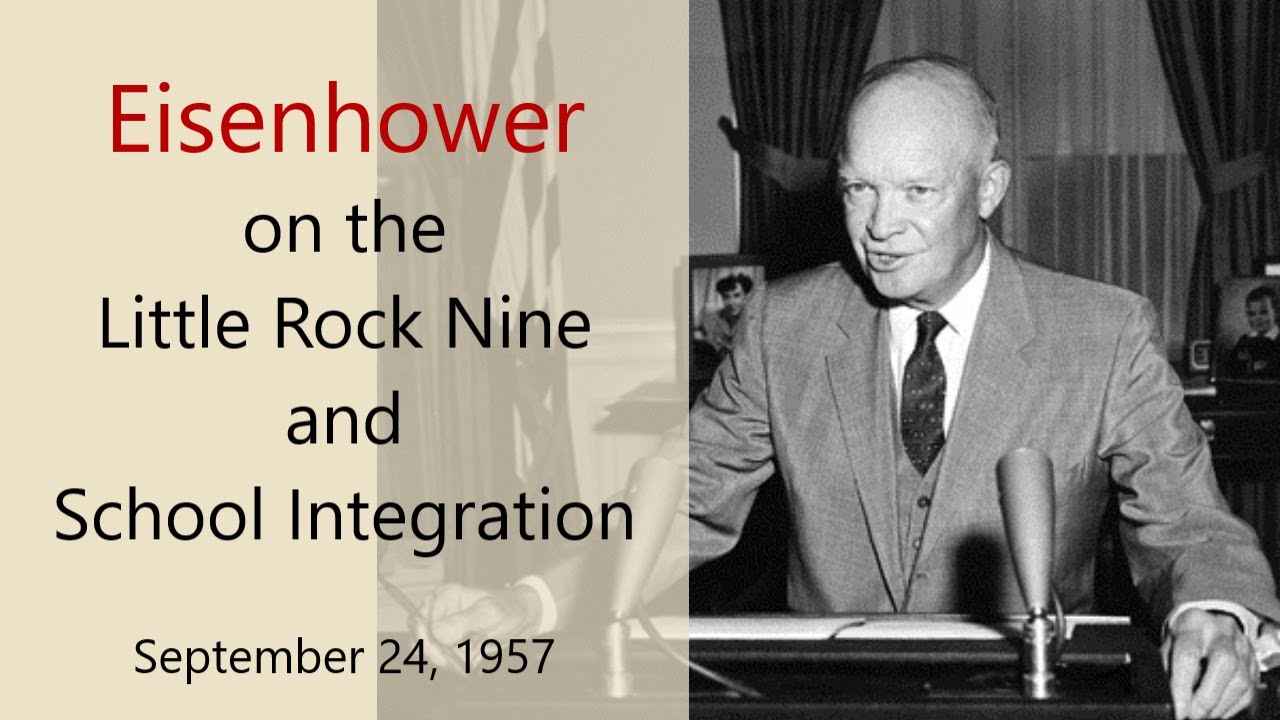
- Eisenhower's Little Rock Nine Speech
September 24, 1957 [Delivered from the President's Office at 9:00 p.m. ] Good Evening, My Fellow Citizens: For a few minutes this evening I want to speak to you about the serious situation that has arisen in Little Rock. To make this talk I have come to the President's office in the White House. I could have spoken from Rhode Island, where I have been staying recently, but I felt that, in speaking from the house of Lincoln, of Jackson and of Wilson, my words would better convey both the sadness I feel in the action I was compelled today to take and the firmness with which I intend to pursue this course until the orders of the Federal Court at Little Rock can be executed without unlawful interference. In that city, under the leadership of demagogic extremists, disorderly mobs have deliberately prevented the carrying out of proper orders from a Federal Court. Local authorities have not eliminated that violent opposition and, under the law, I yesterday issued a Proclamation calling upon the mob to disperse. This morning the mob again gathered in front of the Central High School of Little Rock, obviously for the purpose of again preventing the carrying out of the Court's order relating to the admission of Negro children to that school. Whenever normal agencies prove inadequate to the task and it becomes necessary for the Executive Branch of the Federal Government to use its powers and authority to uphold Federal Courts, the President's responsibility is inescapable. In accordance with that responsibility, I have today issued an Executive Order directing the use of troops under Federal authority to aid in the execution of Federal law at Little Rock, Arkansas. This became necessary when my Proclamation of yesterday was not observed, and the obstruction of justice still continues. It is important that the reasons for my action be understood by all our citizens. As you know, the Supreme Court of the United States has decided that separate public educational facilities for the races are inherently unequal and therefore compulsory school segregation laws are unconstitutional. Our personal opinions about the decision have no bearing on the matter of enforcement; the responsibility and authority of the Supreme Court to interpret the Constitution are very clear. Local Federal Courts were instructed by the Supreme Court to issue such orders and decrees as might be necessary to achieve admission to public schools without regard to race--and with all deliberate speed. During the past several years, many communities in our Southern States have instituted public school plans for gradual progress in the enrollment and attendance of school children of all races in order to bring themselves into compliance with the law of the land. They thus demonstrated to the world that we are a nation in which laws, not men, are supreme. I regret to say that this truth--the cornerstone of our liberties-was not observed in this instance. It was my hope that this localized situation would be brought under control by city and State authorities. If the use of local police powers had been sufficient, our traditional method of leaving the problems in those hands would have been pursued. But when large gatherings of obstructionists made it impossible for the decrees of the Court to be carried out, both the law and the national interest demanded that the President take action. Here is the sequence of events in the development of the Little Rock school case. In May of 1955, the Little Rock School Board approved a moderate plan for the gradual desegregation of the public schools in that city. It provided that a start toward integration would be made at the present term in the high school, and that the plan would be in full operation by 1963. Here I might say that in a number of communities in Arkansas integration in the schools has already started and without violence of any kind. Now this Little Rock plan was challenged in the courts by some who believed that the period of time as proposed in the plan was too long. The United States Court at Little Rock, which has supervisory responsibility under the law for the plan of desegregation in the public schools, dismissed the challenge, thus approving a gradual rather than an abrupt change from the existing system. The court found that the school board had acted in good faith in planning for a public school system free from racial discrimination. Since that time, the court has on three separate occasions issued orders directing that the plan be carried out. All persons were instructed to refrain from interfering with the efforts of the school board to comply with the law. Proper and sensible observance of the law then demanded the respectful obedience which the nation has a right to expect from all its people. This, unfortunately, has not been the case at Little Rock. Certain misguided persons, many of them imported into Little Rock by agitators, have insisted upon defying the law and have sought to bring it into disrepute. The orders of the court have thus been frustrated. The very basis of our individual rights and freedoms rests upon the certainty that the President and the Executive Branch of Government will support and insure the carrying out of the decisions of the Federal Courts, even, when necessary with all the means at the President's command. Unless the President did so, anarchy would result. There would be no security for any except that which each one of us could provide for himself. The interest of the nation in the proper fulfillment of the law's requirements cannot yield to opposition and demonstrations by some few persons. Mob rule cannot be allowed to override the decisions of our courts. Now, let me make it very clear that Federal troops are not being used to relieve local and state authorities of their primary duty to preserve the peace and order of the community. Nor are the troops there for the purpose of taking over the responsibility of the School Board and the other responsible local officials in running Central High School. The running of our school system and the maintenance of peace and order in each of our States are strictly local affairs and the Federal Government does not interfere except in a very few special cases and when requested by one of the several States. In the present case the troops are there, pursuant to law, solely for the purpose of preventing interference with the orders of the Court. The proper use of the powers of the Executive Branch to enforce the orders of a Federal Court is limited to extraordinary and compelling circumstances. Manifestly, such an extreme situation has been created in Little Rock. This challenge must be met and with such measures as will preserve to the people as a whole their lawfully-protected rights in a climate permitting their free and fair exercise. The overwhelming majority of our people in every section of the country are united in their respect for observance of the law--even in those cases where they may disagree with that law. They deplore the call of extremists to violence. The decision of the Supreme Court concerning school integration, of course, affects the South more seriously than it does other sections of the country. In that region I have many warm friends, some of them in the city of Little Rock. I have deemed it a great personal privilege to spend in our Southland tours of duty while in the military service and enjoyable recreational periods since that time. So from intimate personal knowledge, I know that the overwhelming majority of the people in the South--including those of Arkansas and of Little Rock--are of good will, united in their efforts to preserve and respect the law even when they disagree with it. They do not sympathize with mob rule. They, like the rest of our nation, have proved in two great wars their readiness to sacrifice for America. A foundation of our American way of life is our national respect for law. In the South, as elsewhere, citizens are keenly aware of the tremendous disservice that has been done to the people of Arkansas in the eyes of the nation, and that has been done to the nation in the eyes of the world. At a time when we face grave situations abroad because of the hatred that Communism bears toward a system of government based on human rights, it would be difficult to exaggerate the harm that is being done to the prestige and influence, and indeed to the safety, of our nation and the world. Our enemies are gloating over this incident and using it everywhere to misrepresent our whole nation. We are portrayed as a violator of those standards of conduct which the peoples of the world united to proclaim in the Charter of the United Nations. There they affirmed "faith in fundamental human rights" and "in the dignity and worth of the human person" and they did so "without distinction as to race, sex, language or religion." And so, with deep confidence, I call upon the citizens of the State of Arkansas to assist in bringing to an immediate end all interference with the law and its processes. If resistance to the Federal Court orders ceases at once, the further presence of Federal troops will be unnecessary and the City of Little Rock will return to its normal habits of peace and order and a blot upon the fair name and high honor of our nation in the world will be removed. Thus will be restored the image of America and of all its parts as one nation, indivisible, with liberty and justice for all. Good night, and thank you very much. Source: https://www.presidency.ucsb.edu/documents/radio-and-television-address-the-american-people-the-situation-little-rock
- Clouds over Hiroshima and Nagasaki
Hiroshima August 6, 1945 Nagasaki August 9, 1945
- Biden vs Trump Second 2020 Debate
Biden vs Trump Second 2020 Debate
- Harris vs Pence VP Debate
Harris vs Pence VP Debate
- Vance vs Walz VP Debate
Vance vs Walz VP Debate
- Truman's Farewell Address
President Truman’s Farewell Address January 15, 1953 My fellow Americans: I am happy to have this opportunity to talk to you once more before I leave the White House. Next Tuesday, General Eisenhower will be inaugurated as President of the United States. A short time after the new President takes his oath of office, I will be on the train going back home to Independence, Missouri. I will once again be a plain, private citizen of this great Republic. That is as it should be. Inauguration Day will be a great demonstration of our democratic process. I am glad to be a part of it-glad to wish General Eisenhower all possible success, as he begins his term--glad the whole world will have a chance to see how simply and how peacefully our American system transfers the vast power of the Presidency from my hands to his. It is a good object lesson in democracy. I am very proud of it. And I know you are, too. During the last 2 months I have done my best to make this transfer an orderly one. I have talked with my successor on the affairs of the country, both foreign and domestic, and my Cabinet officers have talked with their successors. I want to say that General Eisenhower and his associates have cooperated fully in this effort. Such an orderly transfer from one party to another has never taken place before in our history. I think a real precedent has been set. In speaking to you tonight, I have no new revelations to make--no political statements-no policy announcements. There are simply a few things in my heart that I want to say to you. I want to say "goodbye" and "thanks for your help." And I want to talk to you a little while about what has happened since I became your President. I am speaking to you from the room where I have worked since April 12, 1945. This is the President's office in the West Wing of the White House. This is the desk where I have signed most of the papers that embodied the decisions I have made as President. It has been the desk of many Presidents, and will be the desk of many more. Since I became President, I have been to Europe, Mexico, Canada, Brazil, Puerto Rico, and the Virgin Islands--Wake Island and Hawaii. I have visited almost every State in the Union. I have traveled 135,000 miles by air, 77,000 by rail, and 17,000 by ship. But the mail always followed me, and wherever I happened to be, that's where the office of the President was. The greatest part of the President's job is to make decisions--big ones and small ones, dozens of them almost every day. The papers may circulate around the Government for a while but they finally reach this desk. And then, there's no place else for them to go. The President--whoever he is--has to decide. He can't pass the buck to anybody. No one else can do the deciding for him. That's his job. That's what I've been doing here in this room, for almost 8 years. And over in the main part of the White House, there's a study on the second floor--a room much like this one--where I have worked at night and early in the morning on the papers I couldn't get to at the office. Of course, for more than 3 years Mrs. Truman and I were not living in the White House. We were across the street in the Blair House. That was when the White House almost fell down on us and had to be rebuilt. I had a study over at the Blair House, too, but living in the Blair House was not as convenient as living in the White House. The Secret Service wouldn't let me walk across the street, so I had to get in a car every morning to cross the street to the White House office, again at noon to go to the Blair House for lunch, again to go back to the office after lunch, and finally take an automobile at night to return to the Blair House. Fantastic, isn't it? But necessary, so my guards thought--and they are the bosses on such matters as that. Now, of course, we're back in the White House. It is in very good condition, and General Eisenhower will be able to take up his residence in the house and work right here. That will be much more convenient for him, and I'm very glad the renovation job was all completed before his term began. Your new President is taking office in quite different circumstances than when I became President 8 years ago. On April 1945, I had been presiding over the Senate in my capacity as Vice President. When the Senate recessed about 5 o'clock in the afternoon, I walked over to the office of the Speaker of the House, Mr. Rayburn, to discuss pending legislation. As soon as I arrived, I was told that Mr. Early, one of President Roosevelt's secretaries, wanted me to call. I reached Mr. Early, and he told me to come to the White House as quickly as possible, to enter by way of the Pennsylvania Avenue entrance, and to come to Mrs. Roosevelt's study. When I arrived, Mrs. Roosevelt told me the tragic news, and I felt the shock that all of you felt a little later--when the word came over the radio and appeared in the newspapers. President Roosevelt had died. I offered to do anything I could for Mrs. Roosevelt, and then I asked the Secretary of State to call the Cabinet together. At 7:09 p.m. I was sworn in as President by Chief Justice Stone in the Cabinet Room. Things were happening fast in those days. The San Francisco conference to organize the United Nations had been called for April 25th. I was asked if that meeting would go forward. I announced that it would. That was my first decision. After attending President Roosevelt's funeral, I went to the Hall of the House of Representatives and told a joint session of the Congress that I would carry on President Roosevelt's policies. On May 7th, Germany surrendered. The announcement was made on May 8th, my 61st birthday. Mr. Churchill called me shortly after that and wanted a meeting with me and Prime Minister Stalin of Russia. Later on, a meeting was agreed upon, and Churchill, Stalin, and I met at Potsdam in Germany. Meanwhile, the first atomic explosion took place out in the New Mexico desert. The war against Japan was still going on. I made the decision that the atomic bomb had to be used to end it. I made that decision in the conviction it would save hundreds of thousands of lives--Japanese as well as American. Japan surrendered, and we were faced with the huge problems of bringing the troops home and reconverting the economy from war to peace. All these things happened within just a little over 4 months--from April to August 1945. I tell you this to illustrate the tremendous scope of the work your President has to do. And all these emergencies and all the developments to meet them have required the President to put in long hours--usually 17 hours a day, with no payment for overtime. I sign my name, on the average, 600 times a day, see and talk to hundreds of people every month, shake hands with thousands every year, and still carry on the business of the largest going concern in the whole world. There is no job like it on the face of the earth--in the power which is concentrated here at this desk, and in the responsibility and difficulty of the decisions. I want all of you to realize how big a job, how hard a job, it is--not for my sake, because I am stepping out of it--but for the sake of my successor. He needs the understanding and the help of every citizen. It is not enough for you to come out once every 4 years and vote for a candidate, and then go back home and say, "Well, I've done my part, now let the new President do the worrying." He can't do the job alone. Regardless of your politics, whether you are Republican or Democrat, your fate is tied up with what is done here in this room. The President is President of the whole country. We must give him our support as citizens of the United States. He will have mine, and I want you to give him yours. I suppose that history will remember my term in office as the years when the "cold war" began to overshadow our lives. I have had hardly a day in office that has not been dominated by this all-embracing struggle-this conflict between those who love freedom and those who would lead the world back into slavery and darkness. And always in the background there has been the atomic bomb. But when history says that my term of office saw the beginning of the cold war, it will also say that in those 8 years we have set the course that can win it. We have succeeded in carving out a new set of policies to attain peace--positive policies, policies of world leadership, policies that express faith in other free people. We have averted world war III up to now, and we may already have succeeded in establishing conditions which can keep that war from happening as far ahead as man can see. These are great and historic achievements that we can all be proud of. Think of the difference between our course now and our course 30 years ago. After the First World War we withdrew from world affairs--we failed to act in concert with other peoples against aggression--we helped to kill the League of Nations--and we built up tariff barriers that strangled world trade. This time, we avoided those mistakes. We helped to found and sustain the United Nations. We have welded alliances that include the greater part of the free world. And we have gone ahead with other free countries to help build their economies and link us all together in a healthy world trade. Think back for a moment to the 1930's and you will see the difference. The Japanese moved into Manchuria, and free men did not act. The Fascists moved into Ethiopia, and we did not act. The Nazis marched into the Rhineland, into Austria, into Czechoslovakia, and free men were paralyzed for lack of strength and unity and will. Think about those years of weakness and indecision, and the World War II which was their evil result. Then think about the speed and courage and decisiveness with which we have moved against the Communist threat since World War II. The first crisis came in 1945 and 1946, when the Soviet Union refused to honor its agreement to remove its troops from Iran. Members of my Cabinet came to me and asked if we were ready to take the risk that a firm stand involved. I replied that we were. So we took our stand--we made it clear to the Soviet Union that we expected them to honor their agreement--and the Soviet troops were withdrawn from Iran. Then, in early 1947, the Soviet Union threatened Greece and Turkey. The British sent me a message saying they could no longer keep their forces in that area. Something had to be done at once, or the eastern Mediterranean would be taken over by the Communists. On March 12th, I went before the Congress and stated our determination to help the people of Greece and Turkey maintain their independence. Today, Greece is still free and independent; and Turkey is a bulwark of strength at a strategic corner of the world. Then came the Marshall plan which saved Europe, the heroic Berlin airlift, and our military aid programs. We inaugurated the North Atlantic Pact, the Rio Pact binding the Western Hemisphere together, and the defense pacts with countries of the Far Pacific. Most important of all, we acted in Korea. I was in Independence, Missouri, in June 1950, when Secretary Acheson telephoned me and gave me the news about the invasion of Korea. I told the Secretary to lay the matter at once before the United Nations, and I came on back to Washington. Flying back over the flatlands of the Middle West and over the Appalachians that summer afternoon, I had a lot of time to think. I turned the problem over in my mind in many ways, but my thoughts kept coming back to the 1930's--to Manchuria, to Ethiopia, the Rhineland, Austria, and finally to Munich. Here was history repeating itself. Here was another probing action, another testing action. If we let the Republic of Korea go under, some other country would be next, and then another. And all the time, the courage and confidence of the free world would be ebbing away, just as it did in the 1930's. And the United Nations would go the way of the League of Nations. When I reached Washington, I met immediately with the Secretary of State, the Secretary of Defense, and General Bradley, and the other civilian and military officials who had information and advice to help me decide on what to do. We talked about the problems long and hard. We considered those problems very carefully. It was not easy to make the decision to send American boys again into battle. I was a soldier in the First World War, and I know what a soldier goes through. I know well the anguish that mothers and fathers and families go through. So I knew what was ahead if we acted in Korea. But after all this was said, we realized that the issue was whether there would be fighting in a limited area now or on a much larger scale later on--whether there would be some casualties now or many more casualties later. So a decision was reached--the decision I believe was the most important in my time as President of the United States. In the days that followed, the most heartening fact was that the American people clearly agreed with the decision. And in Korea, our men are fighting as valiantly as Americans have ever fought-because they know they are fighting in the same cause of freedom in which Americans have stood ever since the beginning of the Republic. Where free men had failed the test before, this time we met the test. We met it firmly. We met it successfully. The aggression has been repelled. The Communists have seen their hopes of easy conquest go down the drain. The determination of free people to defend themselves has been made clear to the Kremlin. As I have thought about our worldwide struggle with the Communists these past 8 years--day in and day out--I have never once doubted that you, the people of our country, have the will to do what is necessary to win this terrible fight against communism. I know the people of this country have that will and determination, and I have always depended on it. Because I have been sure of that, I have been able to make necessary decisions even though they called for sacrifices by all of us. And I have not been wrong in my judgment of the American people. That same assurance of our people's determination will be General Eisenhower's greatest source of strength in carrying on this struggle. Now, once in a while, I get a letter from some impatient person asking, why don't we get it over with? Why don't we issue an ultimatum, make all-out war, drop the atomic bomb? For most Americans, the answer is quite simple: We are not made that way. We are a moral people. Peace is our goal, with justice and freedom. We cannot, of our own free will, violate the very principles that we are striving to defend. The whole purpose of what we are doing is to prevent world war III. Starting a war is no way to make peace. But if anyone still thinks that just this once, bad means can bring good ends, then let me remind you of this: We are living in the 8th year of the atomic age. We are not the only nation that is learning to unleash the power of the atom. A third world war might dig the grave not only of our Communist opponents but also of our own society, our world as well as theirs. Starting an atomic war is totally unthinkable for rational men. Then, some of you may ask, when and how will the cold war end? I think I can answer that simply. The Communist world has great resources, and it looks strong. But there is a fatal flaw in their society. Theirs is a godless system, a system of slavery; there is no freedom in it, no consent. The Iron Curtain, the secret police, the constant purges, all these are symptoms of a great basic weakness--the rulers' fear of their own people. In the long run the strength of our free society, and our ideals, will prevail over a system that has respect for neither God nor man. Last week, in my State of the Union Message to the Congress--and I hope you will all take the time to read it--I explained how I think we will finally win through. As the free world grows stronger, more united, more attractive to men on both sides of the Iron Curtain--and as the Soviet hopes for easy expansion are blocked--then there will have to come a time of change in the Soviet world. Nobody can say for sure when that is going to be, or exactly how it will come about, whether by revolution, or trouble in the satellite states, or by a change inside the Kremlin. Whether the Communist rulers shift their policies of their own free will--or whether the change comes about in some other way-I have not a doubt in the world that a change will occur. I have a deep and abiding faith in the destiny of free men. With patience and courage, we shall some day move on into a new era--a wonderful golden age--an age when we can use the peaceful tools that science has forged for us to do away with poverty and human misery everywhere on earth. Think what can be done, once our capital, our skills, our science--most of all atomic energy--can be released from the tasks of defense and turned wholly to peaceful purposes all around the world. There is no end to what can be done. I can't help but dream out loud just a little here. The Tigris and Euphrates Valley can be made to bloom as it did in the times of Babylon and Nineveh. Israel can be made the country of milk and honey as it was in the time of Joshua. There is a plateau in Ethiopia some 6,000 to 8,000 feet high, that has 65,000 square miles of land just exactly like the corn belt in northern Illinois. Enough food can be raised there to feed a hundred million people. There are places in South America--places in Colombia and Venezuela and Brazil-just like that plateau in Ethiopia--places where food could be raised for millions of people. These things can be done, and they are self-liquidating projects. If we can get peace and safety in the world under the United Nations, the developments will come so fast we will not recognize the world in which we now live. This is our dream of the future--our picture of the world we hope to have when the Communist threat is overcome. I've talked a lot tonight about the menace of communism--and our fight against it-because that is the overriding issue of our time. But there are some other things we've done that history will record. One of them is that we in America have learned how to attain real prosperity for our people. We have 62 1/2 million people at work. Businessmen, farmers, laborers, white-collar people, all have better incomes and more of the good things of life than ever before in the history of the world. There hasn't been a failure of an insured bank in nearly 9 years. No depositor has lost a cent in that period. And the income of our people has been fairly distributed, perhaps more so than at any other time in recent history. We have made progress in spreading the blessings of American life to all of our people. There has been a tremendous awakening of the American conscience on the great issues of civil rights--equal economic opportunities, equal rights of citizenship, and equal educational opportunities for all our people, whatever their race or religion or status of birth. So, as I empty the drawers of this desk, and as Mrs. Truman and I leave the White House, we have no regret. We feel we have done our best in the public service. I hope and believe we have contributed to the welfare of this Nation and to the peace of the world. When Franklin Roosevelt died, I felt there must be a million men better qualified than I, to take up the Presidential task. But the work was mine to do, and I had to do it. And I have tried to give it everything that was in me. Through all of it, through all the years that I have worked here in this room, I have been well aware I did not really work alone-that you were working with me. No President could ever hope to lead our country, or to sustain the burdens of this office, save as the people helped with their support. I have had that help--you have given me that support--on all our great essential undertakings to build the free world's strength and keep the peace. Those are the big things. Those are the things we have done together. For that I shall be grateful, always. And now, the time has come for me to say good night--and God bless you all. Source: https://www.presidency.ucsb.edu/documents/the-presidents-farewell-address-the-american-people
- Eisenhower's Second Inaugural Address
43rd Inauguration Second Inaugural Address of Eisenhower MONDAY, JANUARY 21, 1957 THE PRICE OF PEACE Mr. Chairman, Mr. Vice President, Mr. Chief Justice, Mr. Speaker, members of my family and friends, my countrymen, and the friends of my country, wherever they may be, we meet again, as upon a like moment four years ago, and again you have witnessed my solemn oath of service to you. I, too, am a witness, today testifying in your name to the principles and purposes to which we, as a people, are pledged. Before all else, we seek, upon our common labor as a nation, the blessings of Almighty God. And the hopes in our hearts fashion the deepest prayers of our whole people. May we pursue the right--without self-righteousness. May we know unity--without conformity. May we grow in strength--without pride in self. May we, in our dealings with all peoples of the earth, ever speak truth and serve justice. And so shall America--in the sight of all men of good will--prove true to the honorable purposes that bind and rule us as a people in all this time of trial through which we pass. We live in a land of plenty, but rarely has this earth known such peril as today. In our nation work and wealth abound. Our population grows. Commerce crowds our rivers and rails, our skies, harbors, and highways. Our soil is fertile, our agriculture productive. The air rings with the song of our industry--rolling mills and blast furnaces, dynamos, dams, and assembly lines--the chorus of America the bountiful. This is our home--yet this is not the whole of our world. For our world is where our full destiny lies--with men, of all people, and all nations, who are or would be free. And for them--and so for us--this is no time of ease or of rest. In too much of the earth there is want, discord, danger. New forces and new nations stir and strive across the earth, with power to bring, by their fate, great good or great evil to the free world's future. From the deserts of North Africa to the islands of the South Pacific one third of all mankind has entered upon an historic struggle for a new freedom; freedom from grinding poverty. Across all continents, nearly a billion people seek, sometimes almost in desperation, for the skills and knowledge and assistance by which they may satisfy from their own resources, the material wants common to all mankind. No nation, however old or great, escapes this tempest of change and turmoil. Some, impoverished by the recent World War, seek to restore their means of livelihood. In the heart of Europe, Germany still stands tragically divided. So is the whole continent divided. And so, too, is all the world. The divisive force is International Communism and the power that it controls. The designs of that power, dark in purpose, are clear in practice. It strives to seal forever the fate of those it has enslaved. It strives to break the ties that unite the free. And it strives to capture--to exploit for its own greater power--all forces of change in the world, especially the needs of the hungry and the hopes of the oppressed. Yet the world of International Communism has itself been shaken by a fierce and mighty force: the readiness of men who love freedom to pledge their lives to that love. Through the night of their bondage, the unconquerable will of heroes has struck with the swift, sharp thrust of lightning. Budapest is no longer merely the name of a city; henceforth it is a new and shining symbol of man's yearning to be free. Thus across all the globe there harshly blow the winds of change. And, we--though fortunate be our lot--know that we can never turn our backs to them. We look upon this shaken earth, and we declare our firm and fixed purpose--the building of a peace with justice in a world where moral law prevails. The building of such a peace is a bold and solemn purpose. To proclaim it is easy. To serve it will be hard. And to attain it, we must be aware of its full meaning--and ready to pay its full price. We know clearly what we seek, and why. We seek peace, knowing that peace is the climate of freedom. And now, as in no other age, we seek it because we have been warned, by the power of modern weapons, that peace may be the only climate possible for human life itself. Yet this peace we seek cannot be born of fear alone: it must be rooted in the lives of nations. There must be justice, sensed and shared by all peoples, for, without justice the world can know only a tense and unstable truce. There must be law, steadily invoked and respected by all nations, for without law, the world promises only such meager justice as the pity of the strong upon the weak. But the law of which we speak, comprehending the values of freedom, affirms the equality of all nations, great and small. Splendid as can be the blessings of such a peace, high will be its cost: in toil patiently sustained, in help honorably given, in sacrifice calmly borne. We are called to meet the price of this peace. To counter the threat of those who seek to rule by force, we must pay the costs of our own needed military strength, and help to build the security of others. We must use our skills and knowledge and, at times, our substance, to help others rise from misery, however far the scene of suffering may be from our shores. For wherever in the world a people knows desperate want, there must appear at least the spark of hope, the hope of progress--or there will surely rise at last the flames of conflict. We recognize and accept our own deep involvement in the destiny of men everywhere. We are accordingly pledged to honor, and to strive to fortify, the authority of the United Nations. For in that body rests the best hope of our age for the assertion of that law by which all nations may live in dignity. And, beyond this general resolve, we are called to act a responsible role in the world's great concerns or conflicts-- whether they touch upon the affairs of a vast region, the fate of an island in the Pacific, or the use of a canal in the Middle East. Only in respecting the hopes and cultures of others will we practice the equality of all nations. Only as we show willingness and wisdom in giving counsel--in receiving counsel--and in sharing burdens, will we wisely perform the work of peace. For one truth must rule all we think and all we do. No people can live to itself alone. The unity of all who dwell in freedom is their only sure defense. The economic need of all nations--in mutual dependence--makes isolation an impossibility; not even America's prosperity could long survive if other nations did not also prosper. No nation can longer be a fortress, lone and strong and safe. And any people, seeking such shelter for themselves, can now build only their own prison. Our pledge to these principles is constant, because we believe in their rightness. We do not fear this world of change. America is no stranger to much of its spirit. Everywhere we see the seeds of the same growth that America itself has known. The American experiment has, for generations, fired the passion and the courage of millions elsewhere seeking freedom, equality, and opportunity. And the American story of material progress has helped excite the longing of all needy peoples for some satisfaction of their human wants. These hopes that we have helped to inspire, we can help to fulfill. In this confidence, we speak plainly to all peoples. We cherish our friendship with all nations that are or would be free. We respect, no less, their independence. And when, in time of want or peril, they ask our help, they may honorably receive it; for we no more seek to buy their sovereignty than we would sell our own. Sovereignty is never bartered among freemen. We honor the aspirations of those nations which, now captive, long for freedom. We seek neither their military alliance nor any artificial imitation of our society. And they can know the warmth of the welcome that awaits them when, as must be, they join again the ranks of freedom. We honor, no less in this divided world than in a less tormented time, the people of Russia. We do not dread, rather do we welcome, their progress in education and industry. We wish them success in their demands for more intellectual freedom, greater security before their own laws, fuller enjoyment of the rewards of their own toil. For as such things come to pass, the more certain will be the coming of that day when our peoples may freely meet in friendship. So we voice our hope and our belief that we can help to heal this divided world. Thus may the nations cease to live in trembling before the menace of force. Thus may the weight of fear and the weight of arms be taken from the burdened shoulders of mankind. This, nothing less, is the labor to which we are called and our strength dedicated. And so the prayer of our people carries far beyond our own frontiers, to the wide world of our duty and our destiny. May the light of freedom, coming to all darkened lands, flame brightly--until at last the darkness is no more. May the turbulence of our age yield to a true time of peace, when men and nations shall share a life that honors the dignity of each, the brotherhood of all. Source: https://avalon.law.yale.edu/20th_century/eisen2.asp
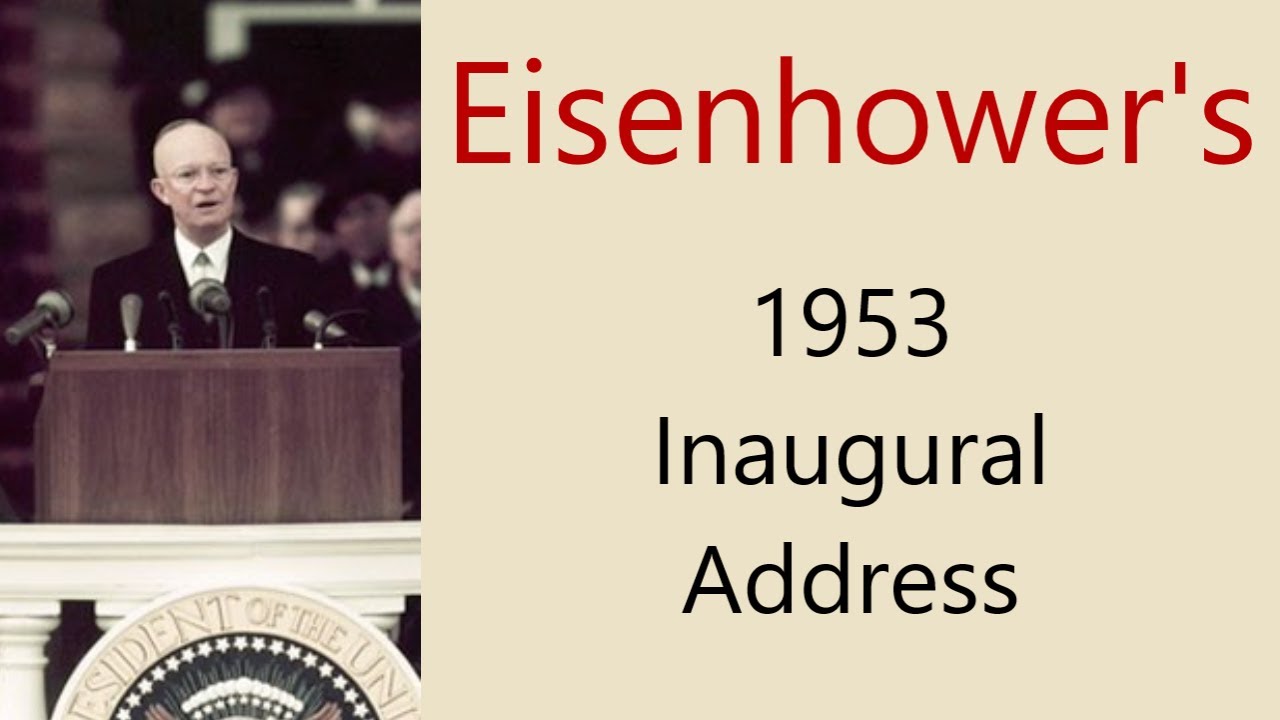
- Eisenhower's 1953 Inaugural Address
Eisenhower’s First Inaugural Address January 20, 1953 My friends, before I begin the expression of those thoughts that I deem appropriate to this moment, would you permit me the privilege of uttering a little private prayer of my own. And I ask that you bow your heads: Almighty God, as we stand here at this moment my future associates in the Executive branch of Government join me in beseeching that Thou will make full and complete our dedication to the service of the people in this throng, and their fellow citizens everywhere. Give us, we pray, the power to discern clearly right from wrong, and allow all our words and actions to be governed thereby, and by the laws of this land. Especially we pray that our concern shall be for all the people regardless of station, race or calling. May cooperation be permitted and be the mutual aim of those who, under the concepts of our Constitution, hold to differing political faiths; so that all may work for the good of our beloved country and Thy glory. Amen. My fellow citizens: The world and we have passed the midway point of a century of continuing challenge. We sense with all our faculties that forces of good and evil are massed and armed and opposed as rarely before in history. This fact defines the meaning of this day. We are summoned by this honored and historic ceremony to witness more than the act of one citizen swearing his oath of service, in the presence of God. We are called as a people to give testimony in the sight of the world to our faith that the future shall belong to the free. Since this century's beginning, a time of tempest has seemed to come upon the continents of the earth. Masses of Asia have awakened to strike off shackles of the past. Great nations of Europe have fought their bloodiest wars. Thrones have toppled and their vast empires have disappeared. New nations have been born. For our own country, it has been a time of recurring trial. We have grown in power and in responsibility. We have passed through the anxieties of depression and of war to a summit unmatched in man's history. Seeking to secure peace in the world, we have had to fight through the forests of the Argonne to the shores of Iwo Jima, and to the cold mountains of Korea. In the swift rush of great events, we find ourselves groping to know the full sense and meaning of these times in which we live. In our quest of understanding, we beseech God's guidance. We summon all our knowledge of the past and we scan all signs of the future. We bring all our wit and all our will to meet the question: How far have we come in man's long pilgrimage from darkness toward the light? Are we nearing the light--a day of freedom and of peace for all mankind? Or are the shadows of another night closing in upon us? Great as are the preoccupations absorbing us at home, concerned as we are with matters that deeply affect our livelihood today and our vision of the future, each of these domestic problems is dwarfed by, and often even created by, this question that involves all humankind. This trial comes at a moment when man's power to achieve good or to inflict evil surpasses the brightest hopes and the sharpest fears of all ages. We can turn rivers in their courses, level mountains to the plains. Oceans and land and sky are avenues for our colossal commerce. Disease diminishes and life lengthens. Yet the promise of this life is imperiled by the very genius that has made it possible. Nations amass wealth. Labor sweats to create--and turns out devices to level not only mountains but also cities. Science seems ready to confer upon us, as its final gift, the power to erase human life from this planet. At such a time in history, we who are free must proclaim anew our faith. This faith is the abiding creed of our fathers. It is our faith in the deathless dignity of man, governed by eternal moral and natural laws. This faith defines our full view of life. It establishes, beyond debate, those gifts of the Creator that are man's inalienable rights, and that make all men equal in His sight. In the light of this equality, we know that the virtues most cherished by free people--love of truth, pride of work, devotion to country--all are treasures equally precious in the lives of the most humble and of the most exalted. The men who mine coal and fire furnaces, and balance ledgers, and turn lathes, and pick cotton, and heal the sick and plant corn--all serve as proudly and as profitably for America as the statesmen who draft treaties and the legislators who enact laws. This faith rules our whole way of life. It decrees that we, the people, elect leaders not to rule but to serve. It asserts that we have the right to choice of our own work and to the reward of our own toil. It inspires the initiative that makes our productivity the wonder of the world. And it warns that any man who seeks to deny equality among all his brothers betrays the spirit of the free and invites the mockery of the tyrant. It is because we, all of us, hold to these principles that the political changes accomplished this day do not imply turbulence, upheaval or disorder. Rather this change expresses a purpose of strengthening our dedication and devotion to the precepts of our founding documents, a conscious renewal of faith in our country and in the watchfulness of a Divine Providence. The enemies of this faith know no god but force, no devotion but its use. They tutor men in treason. They feed upon the hunger of others. Whatever defies them, they torture, especially the truth. Here, then, is joined no argument between slightly differing philosophies. This conflict strikes directly at the faith of our fathers and the lives of our sons. No principle or treasure that we hold, from the spiritual knowledge of our free schools and churches to the creative magic of free labor and capital, nothing lies safely beyond the reach of this struggle. Freedom is pitted against slavery; lightness against the dark The faith we hold belongs not to us alone but to the free of all the world. This common bond binds the grower of rice in Burma and the planter of wheat in Iowa, the shepherd in southern Italy and the mountaineer in the Andes. It confers a common dignity upon the French soldier who dies in Indo-China, the British soldier killed in Malaya, the American life given in Korea. We know, beyond this, that we are linked to all free peoples not merely by a noble idea but by a simple need. No free people can for long cling to any privilege or enjoy any safety in economic solitude. For all our own material might, even we need markets in the world for the surpluses of our farms and our factories. Equally, we need for these same farms and factories vital materials and products of distant lands. This basic law of interdependence, so manifest in the commerce of peace, applies with thousand-fold intensity in the event of war. So we are persuaded by necessity and by belief that the strength of all free peoples lies in unity; their danger, in discord. To produce this unity, to meet the challenge of our time, destiny has laid upon our country the responsibility of the free world's leadership. So it is proper that we assure our friends once again that, in the discharge of this responsibility, we Americans know and we observe the difference between world leadership and imperialism; between firmness and truculence; between a thoughtfully calculated goal and spasmodic reaction to the stimulus of emergencies. We wish our friends the world over to know this above all: we face the threat--not with dread and confusion--but with confidence and conviction. We feel this moral strength because we know that we are not helpless prisoners of history. We are free men. We shall remain free, never to be proven guilty of the one capital offense against freedom, a lack of stanch faith. In pleading our just cause before the bar of history and in pressing our labor for world peace, we shall be guided by certain fixed principles. These principles are: 1. Abhorring war as a chosen way to balk the purposes of those who threaten us, we hold it to be the first task of statesmanship to develop the strength that will deter the forces of aggression and promote the conditions of peace. For, as it must be the supreme purpose of all free men, so it must be the dedication of their leaders, to save humanity from preying upon itself. In the light of this principle, we stand ready to engage with any and all others in joint effort to remove the causes of mutual fear and distrust among nations, so as to make possible drastic reduction of armaments. The sole requisites for undertaking such effort are that--in their purpose--they be aimed logically and honestly toward secure peace for all; and that--in their result--they provide methods by which every participating nation will prove good faith in carrying out its pledge. 2. Realizing that common sense and common decency alike dictate the futility of appeasement, we shall never try to placate an aggressor by the false and wicked bargain of trading honor for security. Americans, indeed, all free men, remember that in the final choice a soldier's pack is not so heavy a burden as a prisoner's chains. 3. Knowing that only a United States that is strong and immensely productive can help defend freedom in our world, we view our Nation's strength and security as a trust upon which rests the hope of free men everywhere. It is the firm duty of each of our free citizens and of every free citizen everywhere to place the cause of his country before the comfort, the convenience of himself. 4. Honoring the identity and the special heritage of each nation in the world, we shall never use our strength to try to impress upon another people our own cherished political and economic institutions. 5. Assessing realistically the needs and capacities of proven friends of freedom, we shall strive to help them to achieve their own security and well-being. Likewise, we shall count upon them to assume, within the limits of their resources, their full and just burdens in the common defense of freedom. 6. Recognizing economic health as an indispensable basis of military strength and the free world's peace, we shall strive to foster everywhere, and to practice ourselves, policies that encourage productivity and profitable trade. For the impoverishment of any single people in the world means danger to the well-being of all other peoples. 7. Appreciating that economic need, military security and political wisdom combine to suggest regional groupings of free peoples, we hope, within the framework of the United Nations, to help strengthen such special bonds the world over. The nature of these ties must vary with the different problems of different areas. In the Western Hemisphere, we enthusiastically join with all our neighbors in the work of perfecting a community of fraternal trust and common purpose. In Europe, we ask that enlightened and inspired leaders of the Western nations strive with renewed vigor to make the unity of their peoples a reality. Only as free Europe unitedly marshals its strength can it effectively safeguard, even with our help, its spiritual and cultural heritage. 8. Conceiving the defense of freedom, like freedom itself, to be one and indivisible, we hold all continents and peoples in equal regard and honor. We reject any insinuation that one race or another, one people or another, is in any sense inferior or expendable. 9. Respecting the United Nations as the living sign of all people's hope for peace, we shall strive to make it not merely an eloquent symbol but an effective force. And in our quest for an honorable peace, we shall neither compromise, nor tire, nor ever cease. By these rules of conduct, we hope to be known to all peoples. By their observance, an earth of peace may become not a vision but a fact. This hope--this supreme aspiration--must rule the way we live. We must be ready to dare all for our country. For history does not long entrust the care of freedom to the weak or the timid. We must acquire proficiency in defense and display stamina in purpose. We must be willing, individually and as a Nation, to accept whatever sacrifices may be required of us. A people that values its privileges above its principles soon loses both. These basic precepts are not lofty abstractions, far removed from matters of daily living. They are laws of spiritual strength that generate and define our material strength. Patriotism means equipped forces and a prepared citizenry. Moral stamina means more energy and more productivity, on the farm and in the factory. Love of liberty means the guarding of every resource that makes freedom possible--from the sanctity of our families and the wealth of our soil to the genius of our scientists. And so each citizen plays an indispensable role. The productivity of our heads, our hands and our hearts is the source of all the strength we can command, for both the enrichment of our lives and the winning of the peace. No person, no home, no community can be beyond the reach of this call. We are summoned to act in wisdom and in conscience, to work with industry, to teach with persuasion, to preach with conviction, to weigh our every deed with care and with compassion. For this truth must be clear before us: whatever America hopes to bring to pass in the world must first come to pass in the heart of America. The peace we seek, then, is nothing less than the practice and fulfillment of our whole faith among ourselves and in our dealings with others. This signifies more than the stilling of guns, casing the sorrow of war. More than escape from death, it is a way of life. More than a haven for the weary, it is a hope for the brave. This is the hope that beckons us onward in this century of trial. This is the work that awaits us all, to be done with bravery, with charity, and with prayer to Almighty God. My citizens--I thank you. Source: https://www.presidency.ucsb.edu/documents/inaugural-address-3
- LBJ's Remarks on Signing the Civil Rights Act & the Text of the Act
Civil Rights Act (1964) An Act To enforce the constitutional right to vote, to confer jurisdiction upon the district courts of the United States to provide injunctive relief against discrimination in public accommodations, to authorize the Attorney General to institute suits to protect constitutional rights in public facilities and public education, to extend the Commission on Civil Rights, to prevent discrimination in federally assisted programs, to establish a Commission on Equal Employment Opportunity, and for other purposes. Be it enacted by the Senate and House of Representatives of the United States of America in Congress assembled, That this Act may be cited as the "Civil Rights Act of 1964". TITLE I--VOTING RIGHTS SEC. 101. Section 2004 of the Revised Statutes (42 U.S.C. 1971), as amended by section 131 of the Civil Rights Act of 1957 (71 Stat. 637), and as further amended by section 601 of the Civil Rights Act of 1960 (74 Stat. 90), is further amended as follows: (a) Insert "1" after "(a)" in subsection (a) and add at the end of subsection (a) the following new paragraphs: "(2) No person acting under color of law shall-- "(A) in determining whether any individual is qualified under State law or laws to vote in any Federal election, apply any standard, practice, or procedure different from the standards, practices, or procedures applied under such law or laws to other individuals within the same county, parish, or similar political subdivision who have been found by State officials to be qualified to vote; "(B) deny the right of any individual to vote in any Federal election because of an error or omission on any record or paper relating to any application, registration, or other act requisite to voting, if such error or omission is not material in determining whether such individual is qualified under State law to vote in such election; or "(C) employ any literacy test as a qualification for voting in any Federal election unless (i) such test is administered to each individual and is conducted wholly in writing, and (ii) a certified copy of the test and of the answers given by the individual is furnished to him within twenty-five days of the submission of his request made within the period of time during which records and papers are required to be retained and preserved pursuant to title III of the Civil Rights Act of 1960 (42 U.S.C. 1974--74e; 74 Stat. 88): Provided, however, That the Attorney General may enter into agreements with appropriate State or local authorities that preparation, conduct, and maintenance of such tests in accordance with the provisions of applicable State or local law, including such special provisions as are necessary in the preparation, conduct, and maintenance of such tests for persons who are blind or otherwise physically handicapped, meet the purposes of this subparagraph and constitute compliance therewith. "(3) For purposes of this subsection-- "(A) the term 'vote' shall have the same meaning as in subsection (e) of this section; "(B) the phrase 'literacy test' includes any test of the ability to read, write, understand, or interpret any matter." (b) Insert immediately following the period at the end of the first sentence of subsection (c) the following new sentence: "If in any such proceeding literacy is a relevant fact there shall be a rebuttable presumption that any person who has not been adjudged an incompetent and who has completed the sixth grade in a public school in, or a private school accredited by, any State or territory, the District of Columbia, or the Commonwealth of Puerto Rico where instruction is carried on predominantly in the English language, possesses sufficient literacy, comprehension, and intelligence to vote in any Federal election." (c) Add the following subsection "(f)" and designate the present subsection "(f)" as subsection "(g)": "(f) When used in subsection (a) or (c) of this section, the words 'Federal election' shall mean any general, special, or primary election held solely or in part for the purpose of electing or selecting any candidate for the office of President, Vice President, presidential elector, Member of the Senate, or Member of the House of Representatives." (d) Add the following subsection "(h)": "(h) In any proceeding instituted by the United States in any district court of the United States under this section in which the Attorney General requests a finding of a pattern or practice of discrimination pursuant to subsection (e) of this section the Attorney General, at the time he files the complaint, or any defendant in the proceeding, within twenty days after service upon him of the complaint, may file with the clerk of such court a request that a court of three judges be convened to hear and determine the entire case. A copy of the request for a three-judge court shall be immediately furnished by such clerk to the chief judge of the circuit (or in his absence, the presiding circuit judge of the circuit) in which the case is pending. Upon receipt of the copy of such request it shall be the duty of the chief justice of the circuit or the presiding circuit judge, as the case may be, to designate immediately three judges in such circuit, of whom at least one shall be a circuit judge and another of whom shall be a district judge of the court in which the proceeding was instituted, to hear and determine such case, and it shall be the duty of the judges so designated to assign the case for hearing at the earliest practicable date, to participate in the hearing and determination thereof, and to cause the case to be in every way expedited. An appeal from the final judgment of such court will lie to the Supreme Court. "In any proceeding brought under subsection (c) of this section to enforce subsection (b) of this section, or in the event neither the Attorney General nor any defendant files a request for a three-judge court in any proceeding authorized by this subsection, it shall be the duty of the chief judge of the district (or in his absence, the acting chief judge) in which the case is pending immediately to designate a judge in such district to hear and determine the case. In the event that no judge in the district is available to hear and determine the case, the chief judge of the district, or the acting chief judge, as the case may be, shall certify this fact to the chief judge of the circuit (or, in his absence, the acting chief judge) who shall then designate a district or circuit judge of the circuit to hear and determine the case. "It shall be the duty of the judge designated pursuant to this section to assign the case for hearing at the earliest practicable date and to cause the case to be in every way expedited." TITLE II--INJUNCTIVE RELIEF AGAINST DISCRIMINATION IN PLACES OF PUBLIC ACCOMMODATION SEC. 201. (a) All persons shall be entitled to the full and equal enjoyment of the goods, services, facilities, and privileges, advantages, and accommodations of any place of public accommodation, as defined in this section, without discrimination or segregation on the ground of race, color, religion, or national origin. (b) Each of the following establishments which serves the public is a place of public accommodation within the meaning of this title if its operations affect commerce, or if discrimination or segregation by it is supported by State action: (1) any inn, hotel, motel, or other establishment which provides lodging to transient guests, other than an establishment located within a building which contains not more than five rooms for rent or hire and which is actually occupied by the proprietor of such establishment as his residence; (2) any restaurant, cafeteria, lunchroom, lunch counter, soda fountain, or other facility principally engaged in selling food for consumption on the premises, including, but not limited to, any such facility located on the premises of any retail establishment; or any gasoline station; (3) any motion picture house, theater, concert hall, sports arena, stadium or other place of exhibition or entertainment; and (4) any establishment (A)(i) which is physically located within the premises of any establishment otherwise covered by this subsection, or (ii) within the premises of which is physically located any such covered establishment, and (B) which holds itself out as serving patrons of such covered establishment. (c) The operations of an establishment affect commerce within the meaning of this title if (1) it is one of the establishments described in paragraph (1) of subsection (b); (2) in the case of an establishment described in paragraph (2) of subsection (b), it serves or offers to serve interstate travelers or a substantial portion of the food which it serves, or gasoline or other products which it sells, has moved in commerce; (3) in the case of an establishment described in paragraph (3) of subsection (b), it customarily presents films, performances, athletic teams, exhibitions, or other sources of entertainment which move in commerce; and (4) in the case of an establishment described in paragraph (4) of subsection (b), it is physically located within the premises of, or there is physically located within its premises, an establishment the operations of which affect commerce within the meaning of this subsection. For purposes of this section, "commerce" means travel, trade, traffic, commerce, transportation, or communication among the several States, or between the District of Columbia and any State, or between any foreign country or any territory or possession and any State or the District of Columbia, or between points in the same State but through any other State or the District of Columbia or a foreign country. (d) Discrimination or segregation by an establishment is supported by State action within the meaning of this title if such discrimination or segregation (1) is carried on under color of any law, statute, ordinance, or regulation; or (2) is carried on under color of any custom or usage required or enforced by officials of the State or political subdivision thereof; or (3) is required by action of the State or political subdivision thereof. (e) The provisions of this title shall not apply to a private club or other establishment not in fact open to the public, except to the extent that the facilities of such establishment are made available to the customers or patrons of an establishment within the scope of subsection (b). SEC. 202. All persons shall be entitled to be free, at any establishment or place, from discrimination or segregation of any kind on the ground of race, color, religion, or national origin, if such discrimination or segregation is or purports to be required by any law, statute, ordinance, regulation, rule, or order of a State or any agency or political subdivision thereof. SEC. 203. No person shall (a) withhold, deny, or attempt to withhold or deny, or deprive or attempt to deprive, any person of any right or privilege secured by section 201 or 202, or (b) intimidate, threaten, or coerce, or attempt to intimidate, threaten, or coerce any person with the purpose of interfering with any right or privilege secured by section 201 or 202, or (c) punish or attempt to punish any person for exercising or attempting to exercise any right or privilege secured by section 201 or 202. SEC. 204. (a) Whenever any person has engaged or there are reasonable grounds to believe that any person is about to engage in any act or practice prohibited by section 203, a civil action for preventive relief, including an application for a permanent or temporary injunction, restraining order, or other order, may be instituted by the person aggrieved and, upon timely application, the court may, in its discretion, permit the Attorney General to intervene in such civil action if he certifies that the case is of general public importance. Upon application by the complainant and in such circumstances as the court may deem just, the court may appoint an attorney for such complainant and may authorize the commencement of the civil action without the payment of fees, costs, or security. (b) In any action commenced pursuant to this title, the court, in its discretion, may allow the prevailing party, other than the United States, a reasonable attorney's fee as part of the costs, and the United States shall be liable for costs the same as a private person. (c) In the case of an alleged act or practice prohibited by this title which occurs in a State, or political subdivision of a State, which has a State or local law prohibiting such act or practice and establishing or authorizing a State or local authority to grant or seek relief from such practice or to institute criminal proceedings with respect thereto upon receiving notice thereof, no civil action may be brought under subsection (a) before the expiration of thirty days after written notice of such alleged act or practice has been given to the appropriate State or local authority by registered mail or in person, provided that the court may stay proceedings in such civil action pending the termination of State or local enforcement proceedings. (d) In the case of an alleged act or practice prohibited by this title which occurs in a State, or political subdivision of a State, which has no State or local law prohibiting such act or practice, a civil action may be brought under subsection (a): Provided, That the court may refer the matter to the Community Relations Service established by title X of this Act for as long as the court believes there is a reasonable possibility of obtaining voluntary compliance, but for not more than sixty days: Provided further, That upon expiration of such sixty-day period, the court may extend such period for an additional period, not to exceed a cumulative total of one hundred and twenty days, if it believes there then exists a reasonable possibility of securing voluntary compliance. SEC. 205. The Service is authorized to make a full investigation of any complaint referred to it by the court under section 204(d) and may hold such hearings with respect thereto as may be necessary. The Service shall conduct any hearings with respect to any such complaint in executive session, and shall not release any testimony given therein except by agreement of all parties involved in the complaint with the permission of the court, and the Service shall endeavor to bring about a voluntary settlement between the parties. SEC. 206. (a) Whenever the Attorney General has reasonable cause to believe that any person or group of persons is engaged in a pattern or practice of resistance to the full enjoyment of any of the rights secured by this title, and that the pattern or practice is of such a nature and is intended to deny the full exercise of the rights herein described, the Attorney General may bring a civil action in the appropriate district court of the United States by filing with it a complaint (1) signed by him (or in his absence the Acting Attorney General), (2) setting forth facts pertaining to such pattern or practice, and (3) requesting such preventive relief, including an application for a permanent or temporary injunction, restraining order or other order against the person or persons responsible for such pattern or practice, as he deems necessary to insure the full enjoyment of the rights herein described. (b) In any such proceeding the Attorney General may file with the clerk of such court a request that a court of three judges be convened to hear and determine the case. Such request by the Attorney General shall be accompanied by a certificate that, in his opinion, the case is of general public importance. A copy of the certificate and request for a three-judge court shall be immediately furnished by such clerk to the chief judge of the circuit (or in his absence, the presiding circuit judge of the circuit) in which the case is pending. Upon receipt of the copy of such request it shall be the duty of the chief judge of the circuit or the presiding circuit judge, as the case may be, to designate immediately three judges in such circuit, of whom at least one shall be a circuit judge and another of whom shall be a district judge of the court in which the proceeding was instituted, to hear and determine such case, and it shall be the duty of the judges so designated to assign the case for hearing at the earliest practicable date, to participate in the hearing and determination thereof, and to cause the case to be in every way expedited. An appeal from the final judgment of such court will lie to the Supreme Court. In the event the Attorney General fails to file such a request in any such proceeding, it shall be the duty of the chief judge of the district (or in his absence, the acting chief judge) in which the case is pending immediately to designate a judge in such district to hear and determine the case. In the event that no judge in the district is available to hear and determine the case, the chief judge of the district, or the acting chief judge, as the case may be, shall certify this fact to the chief judge of the circuit (or in his absence, the acting chief judge) who shall then designate a district or circuit judge of the circuit to hear and determine the case. It shall be the duty of the judge designated pursuant to this section to assign the case for hearing at the earliest practicable date and to cause the case to be in every way expedited. SEC. 207. (a) The district courts of the United States shall have jurisdiction of proceedings instituted pursuant to this title and shall exercise the same without regard to whether the aggrieved party shall have exhausted any administrative or other remedies that may be provided by law. (b) The remedies provided in this title shall be the exclusive means of enforcing the rights based on this title, but nothing in this title shall preclude any individual or any State or local agency from asserting any right based on any other Federal or State law not inconsistent with this title, including any statute or ordinance requiring nondiscrimination in public establishments or accommodations, or from pursuing any remedy, civil or criminal, which may be available for the vindication or enforcement of such right. TITLE III--DESEGREGATION OF PUBLIC FACILITIES SEC. 301. (a) Whenever the Attorney General receives a complaint in writing signed by an individual to the effect that he is being deprived of or threatened with the loss of his right to the equal protection of the laws, on account of his race, color, religion, or national origin, by being denied equal utilization of any public facility which is owned, operated, or managed by or on behalf of any State or subdivision thereof, other than a public school or public college as defined in section 401 of title IV hereof, and the Attorney General believes the complaint is meritorious and certifies that the signer or signers of such complaint are unable, in his judgment, to initiate and maintain appropriate legal proceedings for relief and that the institution of an action will materially further the orderly progress of desegregation in public facilities, the Attorney General is authorized to institute for or in the name of the United States a civil action in any appropriate district court of the United States against such parties and for such relief as may be appropriate, and such court shall have and shall exercise jurisdiction of proceedings instituted pursuant to this section. The Attorney General may implead as defendants such additional parties as are or become necessary to the grant of effective relief hereunder. (b) The Attorney General may deem a person or persons unable to initiate and maintain appropriate legal proceedings within the meaning of subsection (a) of this section when such person or persons are unable, either directly or through other interested persons or organizations, to bear the expense of the litigation or to obtain effective legal representation; or whenever he is satisfied that the institution of such litigation would jeopardize the personal safety, employment, or economic standing of such person or persons, their families, or their property. SEC. 302. In any action or proceeding under this title the United States shall be liable for costs, including a reasonable attorney's fee, the same as a private person. SEC. 303. Nothing in this title shall affect adversely the right of any person to sue for or obtain relief in any court against discrimination in any facility covered by this title. SEC. 304. A complaint as used in this title is a writing or document within the meaning of section 1001, title 18, United States Code. TITLE IV--DESEGREGATION OF PUBLIC EDUCATION DEFINITIONS SEC. 401. As used in this title-- (a) "Commissioner" means the Commissioner of Education. (b) "Desegregation" means the assignment of students to public schools and within such schools without regard to their race, color, religion, or national origin, but "desegregation" shall not mean the assignment of students to public schools in order to overcome racial imbalance. (c) "Public school" means any elementary or secondary educational institution, and "public college" means any institution of higher education or any technical or vocational school above the secondary school level, provided that such public school or public college is operated by a State, subdivision of a State, or governmental agency within a State, or operated wholly or predominantly from or through the use of governmental funds or property, or funds or property derived from a governmental source. (d) "School board" means any agency or agencies which administer a system of one or more public schools and any other agency which is responsible for the assignment of students to or within such system. SURVEY AND REPORT OF EDUCATIONAL OPPORTUNITIES SEC. 402. The Commissioner shall conduct a survey and make a report to the President and the Congress, within two years of the enactment of this title, concerning the lack of availability of equal educational opportunities for individuals by reason of race, color, religion, or national origin in public educational institutions at all levels in the United States, its territories and possessions, and the District of Columbia. TECHNICAL ASSISTANCE SEC. 403. The Commissioner is authorized, upon the application of any school board, State, municipality, school district, or other governmental unit legally responsible for operating a public school or schools, to render technical assistance to such applicant in the preparation, adoption, and implementation of plans for the desegregation of public schools. Such technical assistance may, among other activities, include making available to such agencies information regarding effective methods of coping with special educational problems occasioned by desegregation, and making available to such agencies personnel of the Office of Education or other persons specially equipped to advise and assist them in coping with such problems. TRAINING INSTITUTES SEC. 404. The Commissioner is authorized to arrange, through grants or contracts, with institutions of higher education for the operation of short-term or regular session institutes for special training designed to improve the ability of teachers, supervisors, counselors, and other elementary or secondary school personnel to deal effectively with special educational problems occasioned by desegregation. Individuals who attend such an institute on a full-time basis may be paid stipends for the period of their attendance at such institute in amounts specified by the Commissioner in regulations, including allowances for travel to attend such institute. GRANTS SEC. 405. (a) The Commissioner is authorized, upon application of a school board, to make grants to such board to pay, in whole or in part, the cost of-- (1) giving to teachers and other school personnel inservice training in dealing with problems incident to desegregation, and (2) employing specialists to advise in problems incident to desegregation. (b) In determining whether to make a grant, and in fixing the amount thereof and the terms and conditions on which it will be made, the Commissioner shall take into consideration the amount available for grants under this section and the other applications which are pending before him; the financial condition of the applicant and the other resources available to it; the nature, extent, and gravity of its problems incident to desegregation; and such other factors as he finds relevant. PAYMENTS SEC. 406. Payments pursuant to a grant or contract under this title may be made (after necessary adjustments on account of previously made overpayments or underpayments) in advance or by way of reimbursement, and in such installments, as the Commissioner may determine. SUITS BY THE ATTORNEY GENERAL SEC. 407. (a) Whenever the Attorney General receives a complaint in writing-- (1) signed by a parent or group of parents to the effect that his or their minor children, as members of a class of persons similarly situated, are being deprived by a school board of the equal protection of the laws, or (2) signed by an individual, or his parent, to the effect that he has been denied admission to or not permitted to continue in attendance at a public college by reason of race, color, religion, or national origin, and the Attorney General believes the complaint is meritorious and certifies that the signer or signers of such complaint are unable, in his judgment, to initiate and maintain appropriate legal proceedings for relief and that the institution of an action will materially further the orderly achievement of desegregation in public education, the Attorney General is authorized, after giving notice of such complaint to the appropriate school board or college authority and after certifying that he is satisfied that such board or authority has had a reasonable time to adjust the conditions alleged in such complaint, to institute for or in the name of the United States a civil action in any appropriate district court of the United States against such parties and for such relief as may be appropriate, and such court shall have and shall exercise jurisdiction of proceedings instituted pursuant to this section, provided that nothing herein shall empower any official or court of the United States to issue any order seeking to achieve a racial balance in any school by requiring the transportation of pupils or students from one school to another or one school district to another in order to achieve such racial balance, or otherwise enlarge the existing power of the court to insure compliance with constitutional standards. The Attorney General may implead as defendants such additional parties as are or become necessary to the grant of effective relief hereunder. (b) The Attorney General may deem a person or persons unable to initiate and maintain appropriate legal proceedings within the meaning of subsection (a) of this section when such person or persons are unable, either directly or through other interested persons or organizations, to bear the expense of the litigation or to obtain effective legal representation; or whenever he is satisfied that the institution of such litigation would jeopardize the personal safety, employment, or economic standing of such person or persons, their families, or their property. (c) The term "parent" as used in this section includes any person standing in loco parentis. A "complaint" as used in this section is a writing or document within the meaning of section 1001, title 18, United States Code. SEC. 408. In any action or proceeding under this title the United States shall be liable for costs the same as a private person. SEC. 409. Nothing in this title shall affect adversely the right of any person to sue for or obtain relief in any court against discrimination in public education. SEC. 410. Nothing in this title shall prohibit classification and assignment for reasons other than race, color, religion, or national origin. TITLE V--COMMISSION ON CIVIL RIGHTS SEC. 501. Section 102 of the Civil Rights Act of 1957 (42 U.S.C. 1975a; 71 Stat. 634) is amended to read as follows: "RULES OF PROCEDURE OF THE COMMISSION HEARINGS "SEC. 102. (a) At least thirty days prior to the commencement of any hearing, the Commission shall cause to be published in the Federal Register notice of the date on which such hearing is to commence, the place at which it is to be held and the subject of the hearing. The Chairman, or one designated by him to act as Chairman at a hearing of the Commission, shall announce in an opening statement the subject of the hearing. "(b) A copy of the Commission's rules shall be made available to any witness before the Commission, and a witness compelled to appear before the Commission or required to produce written or other matter shall be served with a copy of the Commission's rules at the time of service of the subpoena. "(c) Any person compelled to appear in person before the Commission shall be accorded the right to be accompanied and advised by counsel, who shall have the right to subject his client to reasonable examination, and to make objections on the record and to argue briefly the basis for such objections. The Commission shall proceed with reasonable dispatch to conclude any hearing in which it is engaged. Due regard shall be had for the convenience and necessity of witnesses. "(d) The Chairman or Acting Chairman may punish breaches of order and decorum by censure and exclusion from the hearings. "(e) If the Commission determines that evidence or testimony at any hearing may tend to defame, degrade, or incriminate any person, it shall receive such evidence or testimony or summary of such evidence o testimony in executive session. The Commission shall afford any person defamed, degraded, or incriminated by such evidence or testimony an opportunity to appear and be heard in executive session, with a reasonable number of additional witnesses requested by him, before deciding to use such evidence or testimony. In the event the Commission determines to release or use such evidence or testimony in such manner as to reveal publicly the identity of the person defamed, degraded, or incriminated, such evidence or testimony, prior to such public release or use, shall be given at a public session, and the Commission shall afford such person an opportunity to appear as a voluntary witness or to file a sworn statement in his behalf and to submit brief and pertinent sworn statements of others. The Commission shall receive and dispose of requests from such person to subpoena additional witnesses. "(f) Except as provided in sections 102 and 105 (f) of this Act, the Chairman shall receive and the Commission shall dispose of requests to subpoena additional witnesses. "(g) No evidence or testimony or summary of evidence or testimony taken in executive session may be released or used in public sessions without the consent of the Commission. Whoever releases or uses in public without the consent of the Commission such evidence or testimony taken in executive session shall be fined not more than $1,000, or imprisoned for not more than one year. "(h) In the discretion of the Commission, witnesses may submit brief and pertinent sworn statements in writing for inclusion in the record. The Commission shall determine the pertinency of testimony and evidence adduced at its hearings. "(i) Every person who submits data or evidence shall be entitled to retain or, on payment of lawfully prescribed costs, procure a copy or transcript thereof, except that a witness in a hearing held in executive session may for good cause be limited to inspection of the official transcript of his testimony. Transcript copies of public sessions may be obtained by the public upon the payment of the cost thereof. An accurate transcript shall be made of the testimony of all witnesses at all hearings, either public or executive sessions, of the Commission or of any subcommittee thereof. "(j) A witness attending any session of the Commission shall receive $6 for each day's attendance and for the time necessarily occupied in going to and returning from the same, and 10 cents per mile for going from and returning to his place of residence. Witnesses who attend at points so far removed from their respective residences as to prohibit return thereto from day to day shall be entitled to an additional allowance of $10 per day for expenses of subsistence including the time necessarily occupied in going to and returning from the place of attendance. Mileage payments shall be tendered to the witness upon service of a subpoena issued on behalf of the Commission or any subcommittee thereof. "(k) The Commission shall not issue any subpoena for the attendance and testimony of witnesses or for the production of written or other matter which would require the presence of the party subpoenaed at a hearing to be held outside of the State wherein the witness is found or resides or is domiciled or transacts business, or has appointed an agent for receipt of service of process except that, in any event, the Commission may issue subpoenas for the attendance and testimony of witnesses and the production of written or other matter at a hearing held within fifty miles of the place where the witness is found or resides or is domiciled or transacts business or has appointed an agent for receipt of service of process. "(l) The Commission shall separately state and currently publish in the Federal Register (1) descriptions of its central and field organization including the established places at which, and methods whereby, the public may secure information or make requests; (2) statements of the general course and method by which its functions are channeled and determined, and (3) rules adopted as authorized by law. No person shall in any manner be subject to or required to resort to rules, organization, or procedure not so published." SEC. 502. Section 103(a) of the Civil Rights Act of 1957 (42 U.S.C. 1975b(a); 71 Stat. 634) is amended to read as follows: "SEC. 103. (a) Each member of the Commission who is not otherwise in the service of the Government of the United States shall receive the sum of $75 per day for each day spent in the work of the Commission, shall be paid actual travel expenses, and per diem in lieu of subsistence expenses when away from his usual place of residence, in accordance with section 5 of the Administrative Expenses Act of 1946, as amended (5 U.S.C 73b-2; 60 Stat. 808)." SEC. 503. Section 103(b) of the Civil Rights Act of 1957 (42 U.S.C. 1975(b); 71 Stat. 634) is amended to read as follows: "(b) Each member of the Commission who is otherwise in the service of the Government of the United States shall serve without compensation in addition to that received for such other service, but while engaged in the work of the Commission shall be paid actual travel expenses, and per diem in lieu of subsistence expenses when away from his usual place of residence, in accordance with the provisions of the Travel Expenses Act of 1949, as amended (5 U.S.C. 835--42; 63 Stat. 166)." SEC. 504. (a) Section 104(a) of the Civil Rights Act of 1957 (42 U.S.C. 1975c(a); 71 Stat. 635), as amended, is further amended to read as follows: "DUTIES OF THE COMMISSION "SEC. 104. (a) The Commission shall-- "(1) investigate allegations in writing under oath or affirmation that certain citizens of the United States are being deprived of their right to vote and have that vote counted by reason of their color, race, religion, or national origin; which writing, under oath or affirmation, shall set forth the facts upon which such belief or beliefs are based; "(2) study and collect information concerning legal developments constituting a denial of equal protection of the laws under the Constitution because of race, color, religion or national origin or in the administration of justice; "(3) appraise the laws and policies of the Federal Government with respect to denials of equal protection of the laws under the Constitution because of race, color, religion or national origin or in the administration of justice; "(4) serve as a national clearinghouse for information in respect to denials of equal protection of the laws because of race, color, religion or national origin, including but not limited to the fields of voting, education, housing, employment, the use of public facilities, and transportation, or in the administration of justice; "(5) investigate allegations, made in writing and under oath or affirmation, that citizens of the United States are unlawfully being accorded or denied the right to vote, or to have their votes properly counted, in any election of presidential electors, Members of the United States Senate, or of the House of Representatives, as a result of any patterns or practice of fraud or discrimination in the conduct of such election; and "(6) Nothing in this or any other Act shall be construed as authorizing the Commission, its Advisory Committees, or any person under its supervision or control to inquire into or investigate any membership practices or internal operations of any fraternal organization, any college or university fraternity or sorority, any private club or any religious organization." (b) Section 104(b) of the Civil Rights Act of 1957 (42 U.S.C. 1975c(b); 71 Stat. 635), as amended, is further amended by striking out the present subsection "(b)" and by substituting therefor: "(b) The Commission shall submit interim reports to the President and to the Congress at such times as the Commission, the Congress or the President shall deem desirable, and shall submit to the President and to the Congress a final report of its activities, findings, and recommendations not later than January 31, 1968." SEC. 505. Section 105(a) of the Civil Rights Act of 1957 (42 U.S.C. 1975d(a); 71 Stat. 636) is amended by striking out in the last sentence thereof "$50 per diem" and inserting in lieu thereof "$75 per diem." SEC. 506. Section 105(f) and section 105(g) of the Civil Rights Act of 1957 (42 U.S.C. 1975d (f) and (g); 71 Stat. 636) are amended to read as follows: "(f) The Commission, or on the authorization of the Commission any subcommittee of two or more members, at least one of whom shall be of each major political party, may, for the purpose of carrying out the provisions of this Act, hold such hearings and act at such times and places as the Commission or such authorized subcommittee may deem advisable. Subpoenas for the attendance and testimony of witnesses or the production of written or other matter may be issued in accordance with the rules of the Commission as contained in section 102 (j) and (k) of this Act, over the signature of the Chairman of the Commission or of such subcommittee, and may be served by any person designated by such Chairman. The holding of hearings by the Commission, or the appointment of a subcommittee to hold hearings pursuant to this subparagraph, must be approved by a majority of the Commission, or by a majority of the members present at a meeting at which at least a quorum of four members is present. "(g) In case of contumacy or refusal to obey a subpoena, any district court of the United States or the United States court of any territory or possession, or the District Court of the United States for the District of Columbia, within the jurisdiction of which the inquiry is carried on or within the jurisdiction of which said person guilty of contumacy or refusal to obey is found or resides or is domiciled or transacts business, or has appointed an agent for receipt of service of process, upon application by the Attorney General of the United States shall have jurisdiction to issue to such person an order requiring such person to appear before the Commission or a subcommittee thereof, there to produce pertinent, relevant and nonprivileged evidence if so ordered, or there to give testimony touching the matter under investigation; and any failure to obey such order of the court may be punished by said court as a contempt thereof." SEC. 507. Section 105 of the Civil Rights Act of 1957 (42 U.S.C. 1975d; 71 Stat. 636), as amended by section 401 of the Civil Rights Act of 1960 (42 U.S.C. 1975d(h); 74 Stat. 89), is further amended by adding a new subsection at the end to read as follows: "(i) The Commission shall have the power to make such rules and regulations as are necessary to carry out the purposes of this Act." TITLE VI--NONDISCRIMINATION IN FEDERALLY ASSISTED PROGRAMS SEC. 601. No person in the United States shall, on the ground of race, color, or national origin, be excluded from participation in, be denied the benefits of, or be subjected to discrimination under any program or activity receiving Federal financial assistance. SEC. 602. Each Federal department and agency which is empowered to extend Federal financial assistance to any program or activity, by way of grant, loan, or contract other than a contract of insurance or guaranty, is authorized and directed to effectuate the provisions of section 601 with respect to such program or activity by issuing rules, regulations, or orders of general applicability which shall be consistent with achievement of the objectives of the statute authorizing the financial assistance in connection with which the action is taken. No such rule, regulation, or order shall become effective unless and until approved by the President. Compliance with any requirement adopted pursuant to this section may be effected (1) by the termination of or refusal to grant or to continue assistance under such program or activity to any recipient as to whom there has been an express finding on the record, after opportunity for hearing, of a failure to comply with such requirement, but such termination or refusal shall be limited to the particular political entity, or part thereof, or other recipient as to whom such a finding has been made and, shall be limited in its effect to the particular program, or part thereof, in which such non-compliance has been so found, or (2) by any other means authorized by law: Provided, however, That no such action shall be taken until the department or agency concerned has advised the appropriate person or persons of the failure to comply with the requirement and has determined that compliance cannot be secured by voluntary means. In the case of any action terminating, or refusing to grant or continue, assistance because of failure to comply with a requirement imposed pursuant to this section, the head of the federal department or agency shall file with the committees of the House and Senate having legislative jurisdiction over the program or activity involved a full written report of the circumstances and the grounds for such action. No such action shall become effective until thirty days have elapsed after the filing of such report. SEC. 603. Any department or agency action taken pursuant to section 602 shall be subject to such judicial review as may otherwise be provided by law for similar action taken by such department or agency on other grounds. In the case of action, not otherwise subject to judicial review, terminating or refusing to grant or to continue financial assistance upon a finding of failure to comply with any requirement imposed pursuant to section 602, any person aggrieved (including any State or political subdivision thereof and any agency of either) may obtain judicial review of such action in accordance with section 10 of the Administrative Procedure Act, and such action shall not be deemed committed to unreviewable agency discretion within the meaning of that section. SEC. 604. Nothing contained in this title shall be construed to authorize action under this title by any department or agency with respect to any employment practice of any employer, employment agency, or labor organization except where a primary objective of the Federal financial assistance is to provide employment. SEC. 605. Nothing in this title shall add to or detract from any existing authority with respect to any program or activity under which Federal financial assistance is extended by way of a contract of insurance or guaranty. TITLE VII--EQUAL EMPLOYMENT OPPORTUNITY DEFINITIONS SEC. 701. For the purposes of this title-- (a) The term "person" includes one or more individuals, labor unions, partnerships, associations, corporations, legal representatives, mutual companies, joint-stock companies, trusts, unincorporated organizations, trustees, trustees in bankruptcy, or receivers. (b) The term "employer" means a person engaged in an industry affecting commerce who has twenty-five or more employees for each working day in each of twenty or more calendar weeks in the current or preceding calendar year, and any agent of such a person, but such term does not include (1) the United States, a corporation wholly owned by the Government of the United States, an Indian tribe, or a State or political subdivision thereof, (2) a bona fide private membership club (other than a labor organization) which is exempt from taxation under section 501(c) of the Internal Revenue Code of 1954: Provided, That during the first year after the effective date prescribed in subsection (a) of section 716, persons having fewer than one hundred employees (and their agents) shall not be considered employers, and, during the second year after such date, persons having fewer than seventy-five employees (and their agents) shall not be considered employers, and, during the third year after such date, persons having fewer than fifty employees (and their agents) shall not be considered employers: Provided further, That it shall be the policy of the United States to insure equal employment opportunities for Federal employees without discrimination because of race, color, religion, sex or national origin and the President shall utilize his existing authority to effectuate this policy. (c) The term "employment agency" means any person regularly undertaking with or without compensation to procure employees for an employer or to procure for employees opportunities to work for an employer and includes an agent of such a person; but shall not include an agency of the United States, or an agency of a State or political subdivision of a State, except that such term shall include the United States Employment Service and the system of State and local employment services receiving Federal assistance. (d) The term "labor organization" means a labor organization engaged in an industry affecting commerce, and any agent of such an organization, and includes any organization of any kind, any agency, or employee representation committee, group, association, or plan so engaged in which employees participate and which exists for the purpose, in whole or in part, of dealing with employers concerning grievances, labor disputes, wages, rates of pay, hours, or other terms or conditions of employment, and any conference, general committee, joint or system board, or joint council so engaged which is subordinate to a national or international labor organization. (e) A labor organization shall be deemed to be engaged in an industry affecting commerce if (1) it maintains or operates a hiring hall or hiring office which procures employees for an employer or procures for employees opportunities to work for an employer, or (2) the number of its members (or, where it is a labor organization composed of other labor organizations or their representatives, if the aggregate number of the members of such other labor organization) is (A) one hundred or more during the first year after the effective date prescribed in subsection (a) of section 716, (B) seventy-five or more during the second year after such date or fifty or more during the third year, or (C) twenty-five or more thereafter, and such labor organization-- (1) is the certified representative of employees under the provisions of the National Labor Relations Act, as amended, or the Railway Labor Act, as amended; (2) although not certified, is a national or international labor organization or a local labor organization recognized or acting as the representative of employees of an employer or employers engaged in an industry affecting commerce; or (3) has chartered a local labor organization or subsidiary body which is representing or actively seeking to represent employees of employers within the meaning of paragraph (1) or (2); or (4) has been chartered by a labor organization representing or actively seeking to represent employees within the meaning of paragraph (1) or (2) as the local or subordinate body through which such employees may enjoy membership or become affiliated with such labor organization; or (5) is a conference, general committee, joint or system board, or joint council subordinate to a national or international labor organization, which includes a labor organization engaged in an industry affecting commerce within the meaning of any of the preceding paragraphs of this subsection. (f) The term "employee" means an individual employed by an employer. (g) The term "commerce" means trade, traffic, commerce, transportation, transmission, or communication among the several States; or between a State and any place outside thereof; or within the District of Columbia, or a possession of the United States; or between points in the same State but through a point outside thereof. (h) The term "industry affecting commerce" means any activity, business, or industry in commerce or in which a labor dispute would hinder or obstruct commerce or the free flow of commerce and includes any activity or industry "affecting commerce" within the meaning of the Labor-Management Reporting and Disclosure Act of 1959. (i) The term "State" includes a State of the United States, the District of Columbia, Puerto Rico, the Virgin Islands, American Samoa, Guam, Wake Island, The Canal Zone, and Outer Continental Shelf lands defined in the Outer Continental Shelf Lands Act. EXEMPTION SEC. 702. This title shall not apply to an employer with respect to the employment of aliens outside any State, or to a religious corporation, association, or society with respect to the employment of individuals of a particular religion to perform work connected with the carrying on by such corporation, association, or society of its religious activities or to an educational institution with respect to the employment of individuals to perform work connected with the educational activities of such institution. DISCRIMINATION BECAUSE OF RACE, COLOR, RELIGION, SEX, OR NATIONAL ORIGIN SEC. 703. (a) It shall be an unlawful employment practice for an employer-- (1) to fail or refuse to hire or to discharge any individual, or otherwise to discriminate against any individual with respect to his compensation, terms, conditions, or privileges of employment, because of such individual's race, color, religion, sex, or national origin; or (2) to limit, segregate, or classify his employees in any way which would deprive or tend to deprive any individual of employment opportunities or otherwise adversely affect his status as an employee, because of such individual's race, color, religion, sex, or national origin. (b) It shall be an unlawful employment practice for an employment agency to fail or refuse to refer for employment, or otherwise to discriminate against, any individual because of his race, color, religion, sex, or national origin, or to classify or refer for employment any individual on the basis of his race, color, religion, sex, or national origin. (c) It shall be an unlawful employment practice for a labor organization-- (1) to exclude or to expel from its membership, or otherwise to discriminate against, any individual because of his race, color, religion, sex, or national origin; (2) to limit, segregate, or classify its membership, or to classify or fail or refuse to refer for employment any individual, in any way which would deprive or tend to deprive any individual of employment opportunities, or would limit such employment opportunities or otherwise adversely affect his status as an employee or as an applicant for employment, because of such individual's race, color, religion, sex, or national origin; or (3) to cause or attempt to cause an employer to discriminate against an individual in violation of this section. (d) It shall be an unlawful employment practice for any employer, labor organization, or joint labor-management committee controlling apprenticeship or other training or retraining, including on-the-job training programs to discriminate against any individual because of his race, color, religion, sex, or national origin in admission to, or employment in, any program established to provide apprenticeship or other training. (e) Notwithstanding any other provision of this title, (1) it shall not be an unlawful employment practice for an employer to hire and employ employees, for an employment agency to classify, or refer for employment any individual, for a labor organization to classify its membership or to classify or refer for employment any individual, or for an employer, labor organization, or joint labor-management committee controlling apprenticeship or other training or retraining programs to admit or employ any individual in any such program, on the basis of his religion, sex, or national origin in those certain instances where religion, sex, or national origin is a bona fide occupational qualification reasonably necessary to the normal operation of that particular business or enterprise, and (2) it shall not be an unlawful employment practice for a school, college, university, or other educational institution or institution of learning to hire and employ employees of a particular religion if such school, college, university, or other educational institution or institution of learning is, in whole or in substantial part, owned, supported, controlled, or managed by a particular religion or by a particular religious corporation, association, or society, or if the curriculum of such school, college, university, or other educational institution or institution of learning is directed toward the propagation of a particular religion. (f) As used in this title, the phrase "unlawful employment practice" shall not be deemed to include any action or measure taken by an employer, labor organization, joint labor-management committee, or employment agency with respect to an individual who is a member of the Communist Party of the United States or of any other organization required to register as a Communist-action or Communist-front organization by final order of the Subversive Activities Control Board pursuant to the Subversive Activities Control Act of 1950. (g) Notwithstanding any other provision of this title, it shall not be an unlawful employment practice for an employer to fail or refuse to hire and employ any individual for any position, for an employer to discharge any individual from any position, or for an employment agency to fail or refuse to refer any individual for employment in any position, or for a labor organization to fail or refuse to refer any individual for employment in any position, if-- (1) the occupancy of such position, or access to the premises in or upon which any part of the duties of such position is performed or is to be performed, is subject to any requirement imposed in the interest of the national security of the United States under any security program in effect pursuant to or administered under any statute of the United States or any Executive order of the President; and (2) such individual has not fulfilled or has ceased to fulfill that requirement. (h) Notwithstanding any other provision of this title, it shall not be an unlawful employment practice for an employer to apply different standards of compensation, or different terms, conditions, or privileges of employment pursuant to a bona fide seniority or merit system, or a system which measures earnings by quantity or quality of production or to employees who work in different locations, provided that such differences are not the result of an intention to discriminate because of race, color, religion, sex, or national origin, nor shall it be an unlawful employment practice for an employer to give and to act upon the results of any professionally developed ability test provided that such test, its administration or action upon the results is not designed, intended or used to discriminate because of race, color, religion, sex or national origin. It shall not be an unlawful employment practice under this title for any employer to differentiate upon the basis of sex in determining the amount of the wages or compensation paid or to be paid to employees of such employer if such differentiation is authorized by the provisions of section 6(d) of the Fair Labor Standards Act of 1938, as amended (29 U.S.C. 206(d)). (i) Nothing contained in this title shall apply to any business or enterprise on or near an Indian reservation with respect to any publicly announced employment practice of such business or enterprise under which a preferential treatment is given to any individual because he is an Indian living on or near a reservation. (j) Nothing contained in this title shall be interpreted to require any employer, employment agency, labor organization, or joint labor-management committee subject to this title to grant preferential treatment to any individual or to any group because of the race, color, religion, sex, or national origin of such individual or group on account of an imbalance which may exist with respect to the total number or percentage of persons of any race, color, religion, sex, or national origin employed by any employer, referred or classified for employment by any employment agency or labor organization, admitted to membership or classified by any labor organization, or admitted to, or employed in, any apprenticeship or other training program, in comparison with the total number or percentage of persons of such race, color, religion, sex, or national origin in any community, State, section, or other area, or in the available work force in any community, State, section, or other area. OTHER UNLAWFUL EMPLOYMENT PRACTICES SEC. 704. (a) It shall be an unlawful employment practice for an employer to discriminate against any of his employees or applicants for employment, for an employment agency to discriminate against any individual, or for a labor organization to discriminate against any member thereof or applicant for membership, because he has opposed, any practice made an unlawful employment practice by this title, or because he has made a charge, testified, assisted, or participated in any manner in an investigation, proceeding, or hearing under this title. (b) It shall be an unlawful employment practice for an employer, labor organization, or employment agency to print or publish or cause to be printed or published any notice or advertisement relating to employment by such an employer or membership in or any classification or referral for employment by such a labor organization, or relating to any classification or referral for employment by such an employment agency, indicating any preference, limitation, specification, or discrimination, based on race, color, religion, sex, or national origin, except that such a notice or advertisement may indicate a preference, limitation, specification, or discrimination based on religion, sex, or national origin when religion, sex, or national origin is a bona fide occupational qualification for employment. EQUAL EMPLOYMENT OPPORTUNITY COMMISSION SEC. 705. (a) There is hereby created a Commission to be known as the Equal Employment Opportunity Commission, which shall be composed of five members, not more than three of whom shall be members of the same political party, who shall be appointed by the President by and with the advice and consent of the Senate. One of the original members shall be appointed for a term of one year, one for a term of two years, one for a term of three years, one for a term of four years, and one for a term of five years, beginning from the date of enactment of this title, but their successors shall be appointed for terms of five years each, except that any individual chosen to fill a vacancy shall be appointed only for the unexpired term of the member whom he shall succeed. The President shall designate one member to serve as Chairman of the Commission, and one member to serve as Vice Chairman. The Chairman shall be responsible on behalf of the Commission for the administrative operations of the Commission, and shall appoint, in accordance with the civil service laws, such officers, agents, attorneys, and employees as it deems necessary to assist it in the performance of its functions and to fix their compensation in accordance with the Classification Act of 1949, as amended. The Vice Chairman shall act as Chairman in the absence or disability of the Chairman or in the event of a vacancy in that office. (b) A vacancy in the Commission shall not impair the right of the remaining members to exercise all the powers of the Commission and three members thereof shall constitute a quorum. (c) The Commission shall have an official seal which shall be judicially noticed. (d) The Commission shall at the close of each fiscal year report to the Congress and to the President concerning the action it has taken; the names, salaries, and duties of all individuals in its employ and the moneys it has disbursed; and shall make such further reports on the cause of and means of eliminating discrimination and such recommendations for further legislation as may appear desirable. (e) The Federal Executive Pay Act of 1956, as amended (5 U.S.C. 2201-2209), is further amended-- (1) by adding to section 105 thereof (5 U.S.C. 2204) the following clause: "(32) Chairman, Equal Employment Opportunity Commission"; and (2) by adding to clause (45) of section 106(a) thereof (5 U.S.C. 2205(a)) the following: "Equal Employment Opportunity Commission (4)." (f) The principal office of the Commission shall be in or near the District of Columbia, but it may meet or exercise any or all its powers at any other place. The Commission may establish such regional or State offices as it deems necessary to accomplish the purpose of this title. (g) The Commission shall have power-- (1) to cooperate with and, with their consent, utilize regional, State, local, and other agencies, both public and private, and individuals; (2) to pay to witnesses whose depositions are taken or who are summoned before the Commission or any of its agents the same witness and mileage fees as are paid to witnesses in the courts of the United States; (3) to furnish to persons subject to this title such technical assistance as they may request to further their compliance with this title or an order issued thereunder; (4) upon the request of (i) any employer, whose employees or some of them, or (ii) any labor organization, whose members or some of them, refuse or threaten to refuse to cooperate in effectuating the provisions of this title, to assist in such effectuation by conciliation or such other remedial action as is provided by this title; (5) to make such technical studies as are appropriate to effectuate the purposes and policies of this title and to make the results of such studies available to the public; (6) to refer matters to the Attorney General with recommendations for intervention in a civil action brought by an aggrieved party under section 706, or for the institution of a civil action by the Attorney General under section 707, and to advise, consult, and assist the Attorney General on such matters. (h) Attorneys appointed under this section may, at the direction of the Commission, appear for and represent the Commission in any case in court. (i) The Commission shall, in any of its educational or promotional activities, cooperate with other departments and agencies in the performance of such educational and promotional activities. (j) All officers, agents, attorneys, and employees of the Commission shall be subject to the provisions of section 9 of the Act of August 2, 1939, as amended (the Hatch Act), notwithstanding any exemption contained in such section. PREVENTION OF UNLAWFUL EMPLOYMENT PRACTICES SEC. 706. (a) Whenever it is charged in writing under oath by a person claiming to be aggrieved, or a written charge has been filed by a member of the Commission where he has reasonable cause to believe a violation of this title has occurred (and such charge sets forth the facts upon which it is based) that an employer, employment agency, or labor organization has engaged in an unlawful employment practice, the Commission shall furnish such employer, employment agency, or labor organization (hereinafter referred to as the "respondent") with a copy of such charge and shall make an investigation of such charge, provided that such charge shall not be made public by the Commission. If the Commission shall determine, after such investigation, that there is reasonable cause to believe that the charge is true, the Commission shall endeavor to eliminate any such alleged unlawful employment practice by informal methods of conference, conciliation, and persuasion. Nothing said or done during and as a part of such endeavors may be made public by the Commission without the written consent of the parties, or used as evidence in a subsequent proceeding. Any officer or employee of the Commission, who shall make public in any manner whatever any information in violation of this subsection shall be deemed guilty of a misdemeanor and upon conviction thereof shall be fined not more than $1,000 or imprisoned not more than one year. (b) In the case of an alleged unlawful employment practice occurring in a State, or political subdivision of a State, which has a State or local law prohibiting the unlawful employment practice alleged and establishing or authorizing a State or local authority to grant or seek relief from such practice or to institute criminal proceedings with respect thereto upon receiving notice thereof, no charge may be filed under subsection (a) by the person aggrieved before the expiration of sixty days after proceedings have been commenced under the State or local law, unless such proceedings have been earlier terminated, provided that such sixty-day period shall be extended to one hundred and twenty days during the first year after the effective date of such State or local law. If any requirement for the commencement of such proceedings is imposed by a State or local authority other than a requirement of the filing of a written and signed statement of the facts upon which the proceeding is based, the proceeding shall be deemed to have been commenced for the purposes of this subsection at the time such statement is sent by registered mail to the appropriate State or local authority. (c) In the case of any charge filed by a member of the Commission alleging an unlawful employment practice occurring in a State or political subdivision of a State, which has a State or local law prohibiting the practice alleged and establishing or authorizing a State or local authority to grant or seek relief from such practice or to institute criminal proceedings with respect thereto upon receiving notice thereof, the Commission shall, before taking any action with respect to such charge, notify the appropriate State or local officials and, upon request, afford them a reasonable time, but not less than sixty days (provided that such sixty-day period shall be extended to one hundred and twenty days during the first year after the effective day of such State or local law), unless a shorter period is requested, to act under such State or local law to remedy the practice alleged. (d) A charge under subsection (a) shall be filed within ninety days after the alleged unlawful employment practice occurred, except that in the case of an unlawful employment practice with respect to which the person aggrieved has followed the procedure set out in subsection (b), such charge shall be filed by the person aggrieved within two hundred and ten days after the alleged unlawful employment practice occurred, or within thirty days after receiving notice that the State or local agency has terminated the proceedings under the State or local, law, whichever is earlier, and a copy of such charge shall be filed by the Commission with the State or local agency. (e) If within thirty days after a charge is filed with the Commission or within thirty days after expiration of any period of reference under subsection (c) (except that in either case such period may be extended to not more than sixty days upon a determination by the Commission that further efforts to secure voluntary compliance are warranted), the Commission has been unable to obtain voluntary compliance with this title, the Commission shall so notify the person aggrieved and a civil action may, within thirty days thereafter, be brought against the respondent named in the charge (1) by the person claiming to be aggrieved, or (2) if such charge was filed by a member of the Commission, by any person whom the charge alleges was aggrieved by the alleged unlawful employment practice. Upon application by the complainant and in such circumstances as the court may deem just, the court may appoint an attorney for such complainant and may authorize the commencement of the action without the payment of fees, costs, or security. Upon timely application, the court may, in its discretion, permit the Attorney General to intervene in such civil action if he certifies that the case is of general public importance. Upon request, the court may, in its discretion, stay further proceedings for not more than sixty days pending the termination of State or local proceedings described in subsection (b) or the efforts of the Commission to obtain voluntary compliance. (f) Each United States district court and each United States court of a place subject to the jurisdiction of the United States shall have jurisdiction of actions brought under this title. Such an action may be brought in any judicial district in the State in which the unlawful employment practice is alleged to have been committed, in the judicial district in which the employment records relevant to such practice are maintained and administered, or in the judicial district in which the plaintiff would have worked but for the alleged unlawful employment practice, but if the respondent is not found within any such district, such an action may be brought within the judicial district in which the respondent has his principal office. For purposes of sections 1404 and 1406 of title 28 of the United States Code, the judicial district in which the respondent has his principal office shall in all cases be considered a district in which the action might have been brought. (g) If the court finds that the respondent has intentionally engaged in or is intentionally engaging in an unlawful employment practice charged in the complaint, the court may enjoin the respondent from engaging in such unlawful employment practice, and order such affirmative action as may be appropriate, which may include reinstatement or hiring of employees, with or without back pay (payable by the employer, employment agency, or labor organization, as the case may be, responsible for the unlawful employment practice). Interim earnings or amounts earnable with reasonable diligence by the person or persons discriminated against shall operate to reduce the back pay otherwise allowable. No order of the court shall require the admission or reinstatement of an individual as a member of a union or the hiring, reinstatement, or promotion of an individual as an employee, or the payment to him of any back pay, if such individual was refused admission, suspended, or expelled or was refused employment or advancement or was suspended or discharged for any reason other than discrimination on account of race, color, religion, sex or national origin or in violation of section 704(a). (h) The provisions of the Act entitled "An Act to amend the Judicial Code and to define and limit the jurisdiction of courts sitting in equity, and for other purposes," approved March 23, 1932 (29 U.S.C. 101-115), shall not apply with respect to civil actions brought under this section. (i) In any case in which an employer, employment agency, or labor organization fails to comply with an order of a court issued in a civil action brought under subsection (e), the Commission may commence proceedings to compel compliance with such order. (j) Any civil action brought under subsection (e) and any proceedings brought under subsection (i) shall be subject to appeal as provided in sections 1291 and 1292, title 28, United States Code. (k) In any action or proceeding under this title the court, in its discretion, may allow the prevailing party, other than the Commission or the United States, a reasonable attorney's fee as part of the costs, and the Commission and the United States shall be liable for costs the same as a private person. SEC. 707. (a) Whenever the Attorney General has reasonable cause to believe that any person or group of persons is engaged in a pattern or practice of resistance to the full enjoyment of any of the rights secured by this title, and that the pattern or practice is of such a nature and is intended to deny the full exercise of the rights herein described, the Attorney General may bring a civil action in the appropriate district court of the United States by filing with it a complaint (1) signed by him (or in his absence the Acting Attorney General), (2) setting forth facts pertaining to such pattern or practice, and (3) requesting such relief, including an application for a permanent or temporary injunction, restraining order or other order against the person or persons responsible for such pattern or practice, as he deems necessary to insure the full enjoyment of the rights herein described. (b) The district courts of the United States shall have and shall exercise jurisdiction of proceedings instituted pursuant to this section, and in any such proceeding the Attorney General may file with the clerk of such court a request that a court of three judges be convened to hear and determine the case. Such request by the Attorney General shall be accompanied by a certificate that, in his opinion, the case is of general public importance. A copy of the certificate and request for a three-judge court shall be immediately furnished by such clerk to the chief judge of the circuit (or in his absence, the presiding circuit judge of the circuit) in which the case is pending. Upon receipt of such request it shall be the duty of the chief judge of the circuit or the presiding circuit judge, as the case may be, to designate immediately three judges in such circuit, of whom at least one shall be a circuit judge and another of whom shall be a district judge of the court in which the proceeding was instituted, to hear and determine such case, and it shall be the duty of the judges so designated to assign the case for hearing at the earliest practicable date, to participate in the hearing and determination thereof, and to cause the case to be in every way expedited. An appeal from the final judgment of such court will lie to the Supreme Court. In the event the Attorney General fails to file such a request in any such proceeding, it shall be the duty of the chief judge of the district (or in his absence, the acting chief judge) in which the case is pending immediately to designate a judge in such district to hear and determine the case. In the event that no judge in the district is available to hear and determine the case, the chief judge of the district, or the acting chief judge, as the case may be, shall certify this fact to the chief judge of the circuit (or in his absence, the acting chief judge) who shall then designate a district or circuit judge of the circuit to hear and determine the case. It shall be the duty of the judge designated pursuant to this section to assign the case for hearing at the earliest practicable date and to cause the case to be in every way expedited. EFFECT ON STATE LAWS SEC. 708. Nothing in this title shall be deemed to exempt or relieve any person from any liability, duty, penalty, or punishment provided by any present or future law of any State or political subdivision of a State, other than any such law which purports to require or permit the doing of any act which would be an unlawful employment practice under this title. INVESTIGATIONS, INSPECTIONS, RECORDS, STATE AGENCIES SEC. 709. (a) In connection with any investigation of a charge filed under section 706, the Commission or its designated representative shall at all reasonable times have access to, for the purposes of examination, and the right to copy any evidence of any person being investigated or proceeded against that relates to unlawful employment practices covered by this title and is relevant to the charge under investigation. (b) The Commission may cooperate with State and local agencies charged with the administration of State fair employment practices laws and, with the consent of such agencies, may for the purpose of carrying out its functions and duties under this title and within the limitation of funds appropriated specifically for such purpose, utilize the services of such agencies and their employees and, notwithstanding any other provision of law, may reimburse such agencies and their employees for services rendered to assist the Commission in carrying out this title. In furtherance of such cooperative efforts, the Commission may enter into written agreements with such State or local agencies and such agreements may include provisions under which the Commission shall refrain from processing a charge in any cases or class of cases specified in such agreements and under which no person may bring a civil action under section 706 in any cases or class of cases so specified, or under which the Commission shall relieve any person or class of persons in such State or locality from requirements imposed under this section. The Commission shall rescind any such agreement whenever it determines that the agreement no longer serves the interest of effective enforcement of this title. (c) Except as provided in subsection (d), every employer, employment agency, and labor organization subject to this title shall (1) make and keep such records relevant to the determinations of whether unlawful employment practices have been or are being committed, (2) preserve such records for such periods, and (3) make such reports therefrom, as the Commission shall prescribe by regulation or order, after public hearing, as reasonable, necessary, or appropriate for the enforcement of this title or the regulations or orders thereunder. The Commission shall, by regulation, require each employer, labor organization, and joint labor-management committee subject to this title which controls an apprenticeship or other training program to maintain such records as are reasonably necessary to carry out the purpose of this title, including, but not limited to, a list of applicants who wish to participate in such program, including the chronological order in which such applications were received, and shall furnish to the Commission, upon request, a detailed description of the manner in which persons are selected to participate in the apprenticeship or other training program. Any employer, employment agency, labor organization, or joint labor-management committee which believes that the application to it of any regulation or order issued under this section would result in undue hardship may (1) apply to the Commission for an exemption from the application of such regulation or order, or (2) bring a civil action in the United States district court for the district where such records are kept. If the Commission or the court, as the case may be, finds that the application of the regulation or order to the employer, employment agency, or labor organization in question would impose an undue hardship, the Commission or the court, as the case may be, may grant appropriate relief. (d) The provisions of subsection (c) shall not apply to any employer, employment agency, labor organization, or joint labor-management committee with respect to matters occurring in any State or political subdivision thereof which has a fair employment practice law during any period in which such employer, employment agency, labor organization, or joint labor-management committee is subject to such law, except that the Commission may require such notations on records which such employer, employment agency, labor organization, or joint labor-management committee keeps or is required to keep as are necessary because of differences in coverage or methods of enforcement between the State or local law and the provisions of this title. Where an employer is required by Executive Order 10925, issued March 6, 1961, or by any other Executive order prescribing fair employment practices for Government contractors and subcontractors, or by rules or regulations issued thereunder, to file reports relating to his employment practices with any Federal agency or committee, and he is substantially in compliance with such requirements, the Commission shall not require him to file additional reports pursuant to subsection (c) of this section. (e) It shall be unlawful for any officer or employee of the Commission to make public in any manner whatever any information obtained by the Commission pursuant to its authority under this section prior to the institution of any proceeding under this title involving such information. Any officer or employee of the Commission who shall make public in any manner whatever any information in violation of this subsection shall be guilty of a misdemeanor and upon conviction thereof, shall be fined not more than $1,000, or imprisoned not more than one year. INVESTIGATORY POWERS SEC. 710. (a) For the purposes of any investigation of a charge filed under the authority contained in section 706, the Commission shall have authority to examine witnesses under oath and to require the production of documentary evidence relevant or material to the charge under investigation. (b) If the respondent named in a charge filed under section 706 fails or refuses to comply with a demand of the Commission for permission to examine or to copy evidence in conformity with the provisions of section 709(a), or if any person required to comply with the provisions of section 709 (c) or (d) fails or refuses to do so, or if any person fails or refuses to comply with a demand by the Commission to give testimony under oath, the United States district court for the district in which such person is found, resides, or transacts business, shall, upon application of the Commission, have jurisdiction to issue to such person an order requiring him to comply with the provisions of section 709 (c) or (d) or to comply with the demand of the Commission, but the attendance of a witness may not be required outside the State where he is found, resides, or transacts business and the production of evidence may not be required outside the State where such evidence is kept. (c) Within twenty days after the service upon any person charged under section 706 of a demand by the Commission for the production of documentary evidence or for permission to examine or to copy evidence in conformity with the provisions of section 709(a), such person may file in the district court of the United States for the judicial district in which he resides, is found, or transacts business, and serve upon the Commission a petition for an order of such court modifying or setting aside such demand. The time allowed for compliance with the demand in whole or in part as deemed proper and ordered by the court shall not run during the pendency of such petition in the court. Such petition shall specify each ground upon which the petitioner relies in seeking such relief, and may be based upon any failure of such demand to comply with the provisions of this title or with the limitations generally applicable to compulsory process or upon any constitutional or other legal right or privilege of such person. No objection which is not raised by such a petition may be urged in the defense to a proceeding initiated by the Commission under subsection (b) for enforcement of such a demand unless such proceeding is commenced by the Commission prior to the expiration of the twenty-day period, or unless the court determines that the defendant could not reasonably have been aware of the availability of such ground of objection. (d) In any proceeding brought by the Commission under subsection (b), except as provided in subsection (c) of this section, the defendant may petition the court for an order modifying or setting aside the demand of the Commission. SEC. 711. (a) Every employer, employment agency, and labor organization, as the case may be, shall post and keep posted in conspicuous places upon its premises where notices to employees, applicants for employment, and members are customarily posted a notice to be prepared or approved by the Commission setting forth excerpts from or, summaries of, the pertinent provisions of this title and information pertinent to the filing of a complaint. (b) A willful violation of this section shall be punishable by a fine of not more than $100 for each separate offense. VETERANS' PREFERENCE SEC. 712. Nothing contained in this title shall be construed to repeal or modify any Federal, State, territorial, or local law creating special rights or preference for veterans. RULES AND REGULATIONS SEC. 713. (a) The Commission shall have authority from time to time to issue, amend, or rescind suitable procedural regulations to carry out the provisions of this title. Regulations issued under this section shall be in conformity with the standards and limitations of the Administrative Procedure Act. (b) In any action or proceeding based on any alleged unlawful employment practice, no person shall be subject to any liability or punishment for or on account of (1) the commission by such person of an unlawful employment practice if he pleads and proves that the act or omission complained of was in good faith, in conformity with, and in reliance on any written interpretation or opinion of the Commission, or (2) the failure of such person to publish and file any information required by any provision of this title if he pleads and proves that he failed to publish and file such information in good faith, in conformity with the instructions of the Commission issued under this title regarding the filing of such information. Such a defense, if established, shall be a bar to the action or proceeding, notwithstanding that (A) after such act or omission, such interpretation or opinion is modified or rescinded or is determined by judicial authority to be invalid or of no legal effect, or (B) after publishing or filing the description and annual reports, such publication or filing is determined by judicial authority not to be in conformity with the requirements of this title. FORCIBLY RESISTING THE COMMISSION OR ITS REPRESENTATIVES SEC. 714. The provisions of section 111, title 18, United States Code, shall apply to officers, agents, and employees of the Commission in the performance of their official duties. SPECIAL STUDY BY SECRETARY OF LABOR SEC. 715. The Secretary of Labor shall make a full and complete study of the factors which might tend to result in discrimination in employment because of age and of the consequences of such discrimination on the economy and individuals affected. The Secretary of Labor shall make a report to the Congress not later than June 30, 1965, containing the results of such study and shall include in such report such recommendations for legislation to prevent arbitrary discrimination in employment because of age as he determines advisable. EFFECTIVE DATE SEC. 716. (a) This title shall become effective one year after the date of its enactment. (b) Notwithstanding subsection (a), sections of this title other than sections 703, 704, 706, and 707 shall become effective immediately. (c) The President shall, as soon as feasible after the enactment of this title, convene one or more conferences for the purpose of enabling the leaders of groups whose members will be affected by this title to become familiar with the rights afforded and obligations imposed by its provisions, and for the purpose of making plans which will result in the fair and effective administration of this title when all of its provisions become effective. The President shall invite the participation in such conference or conferences of (1) the members of the President's Committee on Equal Employment Opportunity, (2) the members of the Commission on Civil Rights, (3) representatives of State and local agencies engaged in furthering equal employment opportunity, (4) representatives of private agencies engaged in furthering equal employment opportunity, and (5) representatives of employers, labor organizations, and employment agencies who will be subject to this title. TITLE VIII--REGISTRATION AND VOTING STATISTICS SEC. 801. The Secretary of Commerce shall promptly conduct a survey to compile registration and voting statistics in such geographic areas as may be recommended by the Commission on Civil Rights. Such a survey and compilation shall, to the extent recommended by the Commission on Civil Rights, only include a count of persons of voting age by race, color, and national origin, and determination of the extent to which such persons are registered to vote, and have voted in any statewide primary or general election in which the Members of the United States House of Representatives are nominated or elected, since January 1, 1960. Such information shall also be collected and compiled in connection with the Nineteenth Decennial Census, and at such other times as the Congress may prescribe. The provisions of section 9 and chapter 7 of title 13, United States Code, shall apply to any survey, collection, or compilation of registration and voting statistics carried out under this title: Provided, however, That no person shall be compelled to disclose his race, color, national origin, or questioned about his political party affiliation, how he voted, or the reasons therefore, nor shall any penalty be imposed for his failure or refusal to make such disclosure. Every person interrogated orally, by written survey or questionnaire or by any other means with respect to such information shall be fully advised with respect to his right to fail or refuse to furnish such information. TITLE IX--INTERVENTION AND PROCEDURE AFTER REMOVAL IN CIVIL RIGHTS CASES SEC. 901. Title 28 of the United States Code, section 1447(d), is amended to read as follows: "An order remanding a case to the State court from which it was removed is not reviewable on appeal or otherwise, except that an order remanding a case to the State court from which it was removed pursuant to section 1443 of this title shall be reviewable by appeal or otherwise." SEC. 902. Whenever an action has been commenced in any court of the United States seeking relief from the denial of equal protection of the laws under the fourteenth amendment to the Constitution on account of race, color, religion, or national origin, the Attorney General for or in the name of the United States may intervene in such action upon timely application if the Attorney General certifies that the case is of general public importance. In such action the United States shall be entitled to the same relief as if it had instituted the action. TITLE X--ESTABLISHMENT OF COMMUNITY RELATIONS SERVICE SEC. 1001. (a) There is hereby established in and as a part of the Department of Commerce a Community Relations Service (hereinafter referred to as the "Service"), which shall be headed by a Director who shall be appointed by the President with the advice and consent of the Senate for a term of four years. The Director is authorized to appoint, subject to the civil service laws and regulations, such other personnel as may be necessary to enable the Service to carry out its functions and duties, and to fix their compensation in accordance with the Classification Act of 1949, as amended. The Director is further authorized to procure services as authorized by section 15 of the Act of August 2, 1946 (60 Stat. 810; 5 U.S.C. 55(a)), but at rates for individuals not in excess of $75 per diem. (b) Section 106(a) of the Federal Executive Pay Act of 1956, as amended (5 U.S.C. 2205(a)), is further amended by adding the following clause thereto: "(52) Director, Community Relations Service." SEC. 1002. It shall be the function of the Service to provide assistance to communities and persons therein in resolving disputes, disagreements, or difficulties relating to discriminatory practices based on race, color, or national origin which impair the rights of persons in such communities under the Constitution or laws of the United States or which affect or may affect interstate commerce. The Service may offer its services in cases of such disputes, disagreements, or difficulties whenever, in its judgment, peaceful relations among the citizens of the community involved are threatened thereby, and it may offer its services either upon its own motion or upon the request of an appropriate State or local official or other interested person. SEC. 1003. (a) The Service shall, whenever possible, in performing its functions, seek and utilize the cooperation of appropriate State or local, public, or private agencies. (b) The activities of all officers and employees of the Service in providing conciliation assistance shall be conducted in confidence and without publicity, and the Service shall hold confidential any information acquired in the regular performance of its duties upon the understanding that it would be so held. No officer or employee of the Service shall engage in the performance of investigative or prosecuting functions of any department or agency in any litigation arising out of a dispute in which he acted on behalf of the Service. Any officer or other employee of the Service, who shall make public in any manner whatever any information in violation of this subsection, shall be deemed guilty of a misdemeanor and, upon conviction thereof, shall be fined not more than $1,000 or imprisoned not more than one year. SEC. 1004. Subject to the provisions of sections 205 and 1003(b), the Director shall, on or before January 31 of each year, submit to the Congress a report of the activities of the Service during the preceding fiscal year. TITLE XI--MISCELLANEOUS SEC. 1101. In any proceeding for criminal contempt arising under title II, III, IV, V, VI, or VII of this Act, the accused, upon demand therefor, shall be entitled to a trial by jury, which shall conform as near as may be to the practice in criminal cases. Upon conviction, the accused shall not be fined more than $1,000 or imprisoned for more than six months. This section shall not apply to contempts committed in the presence of the court, or so near thereto as to obstruct the administration of justice, nor to the misbehavior, misconduct, or disobedience of any officer of the court in respect to writs, orders, or process of the court. No person shall be convicted of criminal contempt hereunder unless the act or omission constituting such contempt shall have been intentional, as required in other cases of criminal contempt. Nor shall anything herein be construed to deprive courts of their power, by civil contempt proceedings, without a jury, to secure compliance with or to prevent obstruction of, as distinguished from punishment for violations of, any lawful writ, process, order, rule, decree, or command of the court in accordance with the prevailing usages of law and equity, including the power of detention. SEC. 1102. No person should be put twice in jeopardy under the laws of the United States for the same act or omission. For this reason, an acquittal or conviction in a prosecution for a specific crime under the laws of the United States shall bar a proceeding for criminal contempt, which is based upon the same act or omission and which arises under the provisions of this Act; and an acquittal or conviction in a proceeding for criminal contempt, which arises under the provisions of this Act, shall bar a prosecution for a specific crime under the laws of the United States based upon the same act or omission. SEC. 1103. Nothing in this Act shall be construed to deny, impair, or otherwise affect any right or authority of the Attorney General or of the United States or any agency or officer thereof under existing law to institute or intervene in any action or proceeding. SEC. 1104. Nothing contained in any title of this Act shall be construed as indicating an intent on the part of Congress to occupy the field in which any such title operates to the exclusion of State laws on the same subject matter, nor shall any provision of this Act be construed as invalidating any provision of State law unless such provision is inconsistent with any of the purposes of this Act, or any provision thereof. SEC. 1105. There are hereby authorized to be appropriated such sums as are necessary to carry out the provisions of this Act. SEC. 1106. If any provision of this Act or the application thereof to any person or circumstances is held invalid, the remainder of the Act and the application of the provision to other persons not similarly situated or to other circumstances shall not be affected thereby. Approved July 2, 1964. Source: https://www.ourdocuments.gov/print_friendly.php?flash=false&page=transcript&doc=97&title=Transcript+of+Civil+Rights+Act+%281964%29