Search this site
1696 results found with an empty search
- 2024 Presidential Election Results
2024 Presidential Election Results
- Daisy Ad
First Aired September 7, 1964
- Eisenhower's 1953 State of the Union Address
February 02, 1953 Mr. President, Mr. Speaker, Members of the Eighty-third Congress: I welcome the honor of appearing before you to deliver my first message to the Congress. It is manifestly the joint purpose of the congressional leadership and of this administration to justify the summons to governmental responsibility issued last November by the American people. The grand labors of this leadership will involve: Application of America's influence in world affairs with such fortitude and such foresight that it will deter aggression and eventually secure peace; Establishment of a national administration of such integrity and such efficiency that its honor at home will ensure respect abroad; Encouragement of those incentives that inspire creative initiative in our economy, so that its productivity may fortify freedom everywhere; and Dedication to the well-being of all our citizens and to the attainment of equality of opportunity for all, so that our Nation will ever act with the strength of unity in every task to which it is called. The purpose of this message is to suggest certain lines along which our joint efforts may immediately be directed toward realization of these four ruling purposes. The time that this administration has been in office has been too brief to permit preparation of a detailed and comprehensive program of recommended action to cover all phases of the responsibilities that devolve upon our country's new leaders. Such a program will be filled out in the weeks ahead as, after appropriate study, I shall submit additional recommendations for your consideration. Today can provide only a sure and substantial beginning. II. Our country has come through a painful period of trial and disillusionment since the victory of 1945. We anticipated a world of peace and cooperation. The calculated pressures of aggressive communism have forced us, instead, to live in a world of turmoil. From this costly experience we have learned one clear lesson. We have learned that the free world cannot indefinitely remain in a posture of paralyzed tension, leaving forever to the aggressor the choice of time and place and means to cause greatest hurt to us at least cost to himself. This administration has, therefore, begun the definition of a new, positive foreign policy. This policy will be governed by certain fixed ideas. They are these: (1) Our foreign policy must be clear, consistent, and confident. This means that it must be the product of genuine, continuous cooperation between the executive and the legislative branches of this Government. It must be developed and directed in the spirit of true bipartisanship. (2) The policy we embrace must be a coherent global policy. The freedom we cherish and defend in Europe and in the Americas is no different from the freedom that is imperiled in Asia. (3) Our policy, dedicated to making the free world secure, will envision all peaceful methods and devices--except breaking faith with our friends. We shall never acquiesce in the enslavement of any people in order to purchase fancied gain for ourselves. I shall ask the Congress at a later date to join in an appropriate resolution making clear that this Government recognizes no kind of commitment contained in secret understandings of the past with foreign governments which permit this kind of enslavement. (4) The policy we pursue will recognize the truth that no single country, even one so powerful as ours, can alone defend the liberty of all nations threatened by Communist aggression from without or subversion within. Mutual security means effective mutual cooperation. For the United States, this means that, as a matter of common sense and national interest, we shall give help to other nations in the measure that they strive earnestly to do their full share of the common task. No wealth of aid could compensate for poverty of spirit. The heart of every free nation must be honestly dedicated to the preserving of its own independence and security. (5) Our policy will be designed to foster the advent of practical unity in Western Europe. The nations of that region have contributed notably to the effort of sustaining the security of the free world. From the jungles of Indochina and Malaya to the northern shores of Europe, they have vastly improved their defensive strength. Where called upon to do so, they have made costly and bitter sacrifices to hold the line of freedom. But the problem of security demands closer cooperation among the nations of Europe than has been known to date. Only a more closely integrated economic and political system can provide the greatly increased economic strength needed to maintain both necessary military readiness and respectable living standards. Europe's enlightened leaders have long been aware of these facts. All the devoted work that has gone into the Schuman plan, the European Army, and the Strasbourg Conference has testified to their vision and determination. These achievements are the more remarkable when we realize that each of them has marked a victory--for France and for Germany alike over the divisions that in the past have brought such tragedy to these two great nations and to the world. The needed unity of Western Europe manifestly cannot be manufactured from without; it can only be created from within. But it is right and necessary that we encourage Europe's leaders by informing them of the high value we place upon the earnestness of their efforts toward this goal. Real progress will be conclusive evidence to the American people that our material sacrifices in the cause of collective security are matched by essential political, economic, and military accomplishments in Western Europe. (6) Our foreign policy will recognize the importance of profitable and equitable world trade. A substantial beginning can and should be made by our friends themselves. Europe, for example, is now marked by checkered areas of labor surplus and labor shortage, of agricultural areas needing machines and industrial areas needing food. Here and elsewhere we can hope that our friends will take the initiative in creating broader markets and more dependable currencies, to allow greater exchange of goods and services among themselves. Action along these lines can create an economic environment that will invite vital help from us. This help includes: First: Revising our customs regulations to remove procedural obstacles to profitable trade. I further recommend that the Congress take the Reciprocal Trade Agreements Act under immediate study and extend it by appropriate legislation. This objective must not ignore legitimate safeguarding of domestic industries, agriculture, and labor standards. In all executive study and recommendations on this problem labor and management and farmers alike will be earnestly consulted. Second: Doing whatever Government properly can to encourage the flow of private American investment abroad. This involves, as a serious and explicit purpose of our foreign policy, the encouragement of a hospitable climate for such investment in foreign nations. Third: Availing ourselves of facilities overseas for the economical production of manufactured articles which are needed for mutual defense and which are not seriously competitive with our own normal peacetime production. Fourth: Receiving from the rest of the world, in equitable exchange for what we supply, greater amounts of important raw materials which we do not ourselves possess in adequate quantities. III. In this general discussion of our foreign policy, I must make special mention of the war in Korea. This war is, for Americans, the most painful phase of Communist aggression throughout the world. It is clearly a part of the same calculated assault that the aggressor is simultaneously pressing in Indochina and in Malaya, and of the strategic situation that manifestly embraces the island of Formosa and the Chinese Nationalist forces there. The working out of any military solution to the Korean war will inevitably affect all these areas. The administration is giving immediate increased attention to the development of additional Republic of Korea forces. The citizens of that country have proved their capacity as fighting men and their eagerness to take a greater share in the defense of their homeland. Organization, equipment, and training will allow them to do so. Increased assistance to Korea for this purpose conforms fully to our global policies. In June 1950, following the aggressive attack on the Republic of Korea, the United States Seventh Fleet was instructed both to prevent attack upon Formosa and also to insure that Formosa should not be used as a base of operations against the Chinese Communist mainland. This has meant, in effect, that the United States Navy was required to serve as a defensive arm of Communist China. Regardless of the situation in 1950, since the date of that order the Chinese Communists have invaded Korea to attack the United Nations forces there. They have consistently rejected the proposals of the United Nations Command for an armistice. They recently joined with Soviet Russia in rejecting the armistice proposal sponsored in the United Nations by the Government of India. This proposal had been accepted by the United States and 53 other nations. Consequently there is no longer any logic or sense in a condition that required the United States Navy to assume defensive responsibilities on behalf of the Chinese Communists, thus permitting those Communists, with greater impunity, to kill our soldiers and those of our United Nations allies in Korea. I am, therefore, issuing instructions that the Seventh Fleet no longer be employed to shield Communist China. This order implies no aggressive intent on our part. But we certainly have no obligation to protect a nation fighting us in Korea. IV. Our labor for peace in Korea and in the world imperatively demands the maintenance by the United States of a strong fighting service ready for any contingency. Our problem is to achieve adequate military strength within the limits of endurable strain upon our economy. To amass military power without regard to our economic capacity would be to defend ourselves against one kind of disaster by inviting another. Both military and economic objectives demand a single national military policy, proper coordination of our armed services, and effective consolidation of certain logistics activities. We must eliminate waste and duplication of effort in the armed services. We must realize clearly that size alone is not sufficient. The biggest force is not necessarily the best--and we want the best. We must not let traditions or habits of the past stand in the way of developing an efficient military force. All members of our forces must be ever mindful that they serve under a single flag and for a single cause. We must effectively integrate our armament programs and plan them in such careful relation to our industrial facilities that we assure the best use of our manpower and our materials. Because of the complex technical nature of our military organization and because of the security reasons involved, the Secretary of Defense must take the initiative and assume the responsibility for developing plans to give our Nation maximum safety at minimum cost. Accordingly, the new Secretary of Defense and his civilian and military associates will, in the future, recommend such changes in present laws affecting our defense activities as may be necessary to clarify responsibilities and improve the total effectiveness of our defense effort. This effort must always conform to policies laid down in the National Security Council. The statutory function of the National Security Council is to assist the President in the formulation and coordination of significant domestic, foreign, and military policies required for the security of the Nation. In these days of tension it is essential that this central body have the vitality to perform effectively its statutory role. I propose to see that it does so. Careful formulation of policies must be followed by clear understanding of them by all peoples. A related need, therefore, is to make more effective all activities of the Government related to international information. I have recently appointed a committee of representative and informed citizens to survey this subject and to make recommendations in the near future for legislative, administrative, or other action. A unified and dynamic effort in this whole field is essential to the security of the United States and of the other peoples in the community of free nations. There is but one sure way to avoid total war--and that is to win the cold war. While retaliatory power is one strong deterrent to a would-be aggressor, another powerful deterrent is defensive power. No enemy is likely to attempt an attack foredoomed to failure. Because the building of a completely impenetrable defense against attack is still not possible, total defensive strength must include civil defense preparedness. Because we have incontrovertible evidence that Soviet Russia possesses atomic weapons, this kind of protection becomes sheer necessity. Civil defense responsibilities primarily belong to the State and local governments--recruiting, training, and organizing volunteers to meet any emergency. The immediate job of the Federal Government is to provide leadership, to supply technical guidance, and to continue to strengthen its civil defense stockpile of medical, engineering, and related supplies and equipment. This work must go forward without lag. V. I have referred to the inescapable need for economic health and strength if we are to maintain adequate military power and exert influential leadership for peace in the world. Our immediate task is to chart a fiscal and economic policy that can: (1) Reduce the planned deficits and then balance the budget, which means, among other things, reducing Federal expenditures to the safe minimum; (2) Meet the huge costs of our defense; (3) Properly handle the burden of our inheritance of debt and obligations; (4) Check the menace of inflation; (5) Work toward the earliest possible reduction of the tax burden; (6) Make constructive plans to encourage the initiative of our citizens. It is important that all of us understand that this administration does not and cannot begin its task with a clean slate. Much already has been written on the record, beyond our power quickly to erase or to amend. This record includes our inherited burden of indebtedness and obligations and deficits. The current year's budget, as you know, carries a 5.9 billion dollar deficit; and the budget, which was presented to you before this administration took office, indicates a budgetary deficit of 9.9 billion for the fiscal year ending June 30, 1954. The national debt is now more than 265 billion dollars. In addition, the accumulated obligational authority of the Federal Government for future payment totals over 80 billion dollars. Even this amount is exclusive of large contingent liabilities, so numerous and extensive as to be almost beyond description. The bills for the payment of nearly all of the 80 billion dollars of obligations will be presented during the next 4 years. These bills, added to the current costs of government we must meet, make a formidable burden. The present authorized Government-debt limit is 275 billion dollars. The forecast presented by the outgoing administration with the fiscal year 1954 budget indicates that--before the end of the fiscal year and at the peak of demand for payments during the year--the total Government debt may approach and even exceed that limit. Unless budgeted deficits are checked, the momentum of past programs will force an increase of the statutory debt limit. Permit me this one understatement: to meet and to correct this situation will not be easy. Permit me this one assurance: every department head and I are determined to do everything we can to resolve it. The first order of business is the elimination of the annual deficit. This cannot be achieved merely by exhortation. It demands the concerted action of all those in responsible positions in the Government and the earnest cooperation of the Congress. Already, we have begun an examination of the appropriations and expenditures of all departments in an effort to find significant items that may be decreased or canceled without damage to our essential requirements. Getting control of the budget requires also that State and local governments and interested groups of citizens restrain themselves in their demands upon the Congress that the Federal Treasury spend more and more money for all types of projects. A balanced budget is an essential first measure in checking further depreciation in the buying power of the dollar. This is one of the critical steps to be taken to bring an end to planned inflation. Our purpose is to manage the Government's finances so as to help and not hinder each family in balancing its own budget. Reduction of taxes will be justified only as we show we can succeed in bringing the budget under control. As the budget is balanced and inflation checked, the tax burden that today stifles initiative can and must be eased. Until we can determine the extent to which expenditures can be reduced, it would not be wise to reduce our revenues. Meanwhile, the tax structure as a whole demands review. The Secretary of the Treasury is undertaking this study immediately. We must develop a system of taxation which will impose the least possible obstacle to the dynamic growth of the country. This includes particularly real opportunity for the growth of small businesses. Many readjustments in existing taxes will be necessary to serve these objectives and also to remove existing inequities. Clarification and simplification in the tax laws as well as the regulations will be undertaken. In the entire area of fiscal policy--which must, in its various aspects, be treated in recommendations to the Congress in coming weeks--there can now be stated certain basic facts and principles. First. It is axiomatic that our economy is a highly complex and sensitive mechanism. Hasty and ill-considered action of any kind could seriously upset the subtle equation that encompasses debts, obligations, expenditures, defense demands, deficits, taxes, and the general economic health of the Nation. Our goals can be clear, our start toward them can be immediate--but action must be gradual. Second. It is clear that too great a part of the national debt comes due in too short a time. The Department of the Treasury will undertake at suitable times a program of extending part of the debt over longer periods and gradually placing greater amounts in the hands of longer-term investors. Third. Past differences in policy between the Treasury and the Federal Reserve Board have helped to encourage inflation. Henceforth, I expect that their single purpose shall be to serve the whole Nation by policies designed to stabilize the economy and encourage the free play of our people's genius for individual initiative. In encouraging this initiative, no single item in our current problems has received more thoughtful consideration by my associates, and by the many individuals called into our counsels, than the matter of price and wage control by law. The great economic strength of our democracy has developed in an atmosphere of freedom. The character of our people resists artificial and arbitrary controls of any kind. Direct controls, except those on credit, deal not with the real causes of inflation but only with its symptoms. In times of national emergency, this kind of control has a role to play. Our whole system, however, is based upon the assumption that, normally, we should combat wide fluctuations in our price structure by relying largely on the effective use of sound fiscal and monetary policy, and upon the natural workings of economic law. Moreover, American labor and American business can best resolve their wage problems across the bargaining table. Government should refrain from sitting in with them unless, in extreme cases, the public welfare requires protection. We are, of course, living in an international situation that is neither an emergency demanding full mobilization, nor is it peace. No one can know how long this condition will persist. Consequently, we are forced to learn many new things as we go along-clinging to what works, discarding what does not. In all our current discussions on these and related facts, the weight of evidence is clearly against the use of controls in their present forms. They have proved largely unsatisfactory or unworkable. They have not prevented inflation; they have not kept down the cost of living. Dissatisfaction with them is wholly justified. I am convinced that now--as well as in the long run--free and competitive prices will best serve the interests of all the people, and best meet the changing, growing needs of our economy. Accordingly, I do not intend to ask for a renewal of the present wage and price controls on April 30, 1953, when present legislation expires. In the meantime, steps will be taken to eliminate controls in an orderly manner, and to terminate special agencies no longer needed for this purpose. It is obviously to be expected that the removal of these controls will result in individual price changes--some up, some down. But a maximum of freedom in market prices as well as in collective bargaining is characteristic of a truly free people. I believe also that material and product controls should be ended, except with respect to defense priorities and scarce and critical items essential for our defense. I shall recommend to the Congress that legislation be enacted to continue authority for such remaining controls of this type as will be necessary after the expiration of the existing statute on June 30, 1953. I recommend the continuance of the authority for Federal control over rents in those communities in which serious housing shortages exist. These are chiefly the so-called defense areas. In these and all areas the Federal Government should withdraw from the control of rents as soon as practicable. But before they are removed entirely, each legislature should have full opportunity to take over, within its own State, responsibility for this function. It would be idle to pretend that all our problems in this whole field of prices will solve themselves by mere Federal withdrawal from direct controls. We shall have to watch trends closely. If the freer functioning of our economic system, as well as the indirect controls which can be appropriately employed, prove insufficient during this period of strain and tension, I shall promptly ask the Congress to enact such legislation as may be required. In facing all these problems--wages, prices, production, tax rates, fiscal policy, deficits--everywhere we remain constantly mindful that the time for sacrifice has not ended. But we are concerned with the encouragement of competitive enterprise and individual initiative precisely because we know them to be our Nation's abiding sources of strength. VI. Our vast world responsibility accents with urgency our people's elemental right to a government whose clear qualities are loyalty, security, efficiency, economy, and integrity. The safety of America and the trust of the people alike demand that the personnel of the Federal Government be loyal in their motives and reliable in the discharge of their duties. Only a combination of both loyalty and reliability promises genuine security. To state this principle is easy; to apply it can be difficult. But this security we must and shall have. By way of example, all principal new appointees to departments and agencies have been investigated at their own request by the Federal Bureau of Investigation. Confident of your understanding and cooperation, I know that the primary responsibility for keeping out the disloyal and the dangerous rests squarely upon the executive branch. When this branch so conducts itself as to require policing by another branch of the Government, it invites its own disorder and confusion. I am determined to meet this responsibility of the Executive. The heads of all executive departments and agencies have been instructed to initiate at once effective programs of security with respect to their personnel. The Attorney General will advise and guide the departments and agencies in the shaping of these programs, designed at once to govern the employment of new personnel and to review speedily any derogatory information concerning incumbent personnel. To carry out these programs, I believe that the powers of the executive branch under existing law are sufficient. If they should prove inadequate, the necessary legislation will be requested. These programs will be both fair to the rights of the individual and effective for the safety of the Nation. They will, with care and justice, apply the basic principle that public employment is not a right but a privilege. All these measures have two clear purposes: Their first purpose is to make certain that this Nation's security is not jeopardized by false servants. Their second purpose is to clear the atmosphere of that unreasoned suspicion that accepts rumor and gossip as substitutes for evidence. Our people, of course, deserve and demand of their Federal Government more than security of personnel. They demand, also, efficient and logical organization, true to constitutional principles. I have already established a Committee on Government Organization. The Committee is using as its point of departure the reports of the Hoover Commission and subsequent studies by several independent agencies. To achieve the greater efficiency and economy which the Committee analyses show to be possible, I ask the Congress to extend the present Government Reorganization Act for a period of 18 months or 2 years beyond its expiration date of April 1, 1953. There is more involved here than realigning the wheels and smoothing the gears of administrative machinery. The Congress rightfully-expects the Executive to take the initiative in discovering and removing outmoded functions and eliminating duplication. One agency, for example, whose head has promised early and vigorous action to provide greater efficiency is the Post Office. One of the oldest institutions of our Federal Government, its service should be of the best. Its employees should merit and receive the high regard and esteem of the citizens of the Nation. There are today in some areas of the postal service, both waste and incompetence to be corrected. With the cooperation of the Congress, and taking advantage of its accumulated experience in postal affairs, the Postmaster General will institute a program directed at improving service while at the same time reducing costs and decreasing deficits. In all departments, dedication to these basic precepts of security and efficiency, integrity, and economy can and will produce an administration deserving of the trust the people have placed in it. Our people have demanded nothing less than good, efficient government. They shall get nothing less. VII. Vitally important are the water and minerals, public lands and standing timber, forage and Mid-life of this country. A fast-growing population will have vast future needs in these resources. We must more than match the substantial achievements in the half-century since President Theodore Roosevelt awakened the Nation to the problem of conservation. This calls for a strong Federal program in the field of resource development. Its major projects should be timed, where possible to assist in leveling off peaks and valleys in our economic life. Soundly planned projects already initiated should be carried out. New ones will be planned for the future. The best natural resources program for America will not result from exclusive dependence on Federal bureaucracy. It will involve a partnership of the States and local communities, private citizens, and the Federal Government, all working together. This combined effort will advance the development of the great river valleys of our Nation and the power that they can generate. Likewise, such a partnership can be effective in the expansion throughout the Nation of upstream storage; the sound use of public lands; the wise conservation of minerals; and the sustained yield of our forests. There has been much criticism, some of it apparently justified, of the confusion resulting from overlapping Federal activities in the entire field of resource-conservation. This matter is being exhaustively studied and appropriate reorganization plans will be developed. Most of these particular resource problems pertain to the Department of the Interior. Another of its major concerns is our country's island possessions. Here, one matter deserves attention. The platforms of both political parties promised immediate statehood to Hawaii. The people of that Territory have earned that status. Statehood should be granted promptly with the first election scheduled for 1954. VIII. One of the difficult problems which face the new administration is that of the slow, irregular decline of farm prices. This decline, which has been going on for almost 2 years, has occurred at a time when most nonfarm prices and farm costs of production are extraordinarily high. Present agricultural legislation provides for the mandatory support of the prices of basic farm commodities at 90 percent of parity. The Secretary of Agriculture and his associates will, of course, execute the present act faithfully and thereby seek to mitigate the consequences of the downturn in farm income. This price-support legislation will expire at the end of 1954. So we should begin now to consider what farm legislation we should develop for 1955 and beyond. Our aim should be economic stability and full parity of income for American farmers. But we must seek this goal in ways that minimize governmental interference in the farmers' affairs, that permit desirable shifts in production, and that encourage farmers themselves to use initiative in meeting changing economic conditions. A continuing study reveals nothing more emphatically than the complicated nature of this subject. Among other things, it shows that the prosperity of our agriculture depends directly upon the prosperity of the whole country--upon the purchasing power of American consumers. It depends also upon the opportunity to ship abroad large surpluses of particular commodities, and therefore upon sound economic relationships between the United States and many foreign countries. It involves research and scientific investigation, conducted on an extensive scale. It involves special credit mechanisms and marketing, rural electrification, soil conservation, and other programs. The whole complex of agricultural programs and policies will be studied by a Special Agricultural Advisory Commission, as I know it will by appropriate committees of the Congress. A nonpartisan group of respected authorities in the field of agriculture has already been appointed as an interim advisory group. The immediate changes needed in agricultural programs are largely budgetary and administrative in nature. New policies and new programs must await the completion of the far-reaching studies which have already been launched. IX. The determination of labor policy must be governed not by the vagaries of political expediency but by the firmest principles and convictions. Slanted partisan appeals to American workers, spoken as if they were a group apart, necessitating a special language and treatment, are an affront to the fullness of their dignity as American citizens. The truth in matters of labor policy has become obscured in controversy. The very meaning of economic freedom as it affects labor has become confused. This misunderstanding has provided a climate of opinion favoring the growth of governmental paternalism in labor relations. This tendency, if left uncorrected, could end only by producing a bureaucratic despotism. Economic freedom is, in fact, the requisite of greater prosperity for every American who earns his own living. In the field of labor legislation, only a law that merits the respect and support of both labor and management can help reduce the loss of wages and of production through strikes and stoppages, and thus add to the total economic strength of our Nation. We have now had 5 years' experience with the Labor Management Act of 1947, commonly known as the Taft-Hartley Act. That experience has shown the need for some corrective action, and we should promptly proceed to amend that act. I know that the Congress is already proceeding with renewed studies of this subject. Meanwhile, the Department of Labor is at once beginning work to devise further specific recommendations for your consideration. In the careful working out of legislation, I know you will give thoughtful consideration--as will we in the executive branch--to the views of labor, and of management, and of the general public. In this process, it is only human that each of us should bring forward the arguments of self-interest. But if all conduct their arguments in the overpowering light of national interest--which is enlightened self-interest--we shall get the right answers. I profoundly hope that every citizen of our country will follow with understanding your progress in this work. The welfare of all of us is involved. Especially must we remember that the institutions of trade unionism and collective bargaining are monuments to the freedom that must prevail in our industrial life. They have a century of honorable achievement behind them. Our faith in them is proven, firm, and final. Government can do a great deal to aid the settlement of labor disputes without allowing itself to be employed as an ally of either side. Its proper role in industrial strife is to encourage the processes of mediation and conciliation. These processes can successfully be directed only by a government free from the taint of any suspicion that it is partial or punitive. The administration intends to strengthen and to improve the services which the Department of Labor can render to the worker and to the whole national community. This Department was created--just 40 years ago--to serve the entire Nation. It must aid, for example, employers and employees alike in improving training programs that will develop skilled and competent workers. It must enjoy the confidence and respect of labor and industry in order to play a significant role in the planning of America's economic future. To that end, I am authorizing the Department of Labor to establish promptly a tripartite advisory committee consisting of representatives of employers, labor, and the public. X. Our civil and social rights form a central part of the heritage we are striving to defend on all fronts and with all our strength. I believe with all my heart that our vigilant guarding of these rights is a sacred obligation binding upon every citizen. To be true to one's own freedom is, in essence, to honor and respect the freedom of all others. A cardinal ideal in this heritage we cherish is the equality of rights of all citizens of every race and color and creed. We know that discrimination against minorities persists despite our allegiance to this ideal. Such discrimination--confined to no one section of the Nation--is but the outward testimony to the persistence of distrust and of fear in the hearts of men. This fact makes all the more vital the fighting of these wrongs by each individual, in every station of life, in his every deed. Much of the answer lies in the power of fact, fully publicized; of persuasion, honestly pressed; and of conscience, justly aroused. These are methods familiar to our way of life, tested and proven wise. I propose to use whatever authority exists in the office of the President to end segregation in the District of Columbia, including the Federal Government, and any segregation in the Armed Forces. Here in the District of Columbia, serious attention should be given to the proposal to develop and authorize, through legislation, a system to provide an effective voice in local self-government. While consideration of this proceeds, I recommend an immediate increase of two in the number of District Commissioners to broaden representation of all elements of our local population. This will be a first step toward insuring that this Capital provide an honored example to all communities of our Nation. In this manner, and by the leadership of the office of the President exercised through friendly conferences with those in authority in our States and cities, we expect to make true and rapid progress in civil rights and equality of employment opportunity. There is one sphere in which civil rights are inevitably involved in Federal legislation. This is the sphere of immigration. It is a manifest right of our Government to limit the number of immigrants our Nation can absorb. It is also a manifest right of our Government to set reasonable requirements on the character and the numbers of the people who come to share our land and our freedom. It is well for us, however, to remind ourselves occasionally of an equally manifest fact: we are--one and all--immigrants or sons and daughters of immigrants. Existing legislation contains injustices. It does, in fact, discriminate. I am informed by Members of the Congress that it was realized, at the time of its enactment, that future study of the basis of determining quotas would be necessary. I am therefore requesting the Congress to review this legislation and to enact a statute that will at one and the same time guard our legitimate national interests and be faithful to our basic ideas of freedom and fairness to all. In another but related area--that of social rights--we see most clearly the new application of old ideas of freedom. This administration is profoundly aware of two great needs born of our living in a complex industrial economy. First, the individual citizen must have safeguards against personal disaster inflicted by forces beyond his control; second, the welfare of the people demands effective and economical performance by the Government of certain indispensable social services. In the light of this responsibility, certain general purposes and certain concrete measures are plainly indicated now. There is urgent need for greater effectiveness in our programs, both public and private, offering safeguards against the privations that too often come with unemployment, old age, illness, and accident. The provisions of the old-age and survivors insurance law should promptly be extended to cover millions of citizens who have been left out of the social-security system. No less important is the encouragement of privately sponsored pension plans. Most important of all, of course, is renewed effort to check the inflation which destroys so much of the value of all social-security payments. Our school system demands some prompt, effective help. During each of the last 9 years, more than 1 ½ million children have swelled the elementary and secondary school population of the country. Generally, the school population is proportionately higher in States with low per capita income. This whole situation calls for careful congressional study and action. I am sure that you share my conviction that the firm conditions of Federal aid must be proved need and proved lack of local income. One phase of the school problem demands special action. The school population of many districts has been greatly in- creased by the swift growth of defense activities. These activities have added little or nothing to the tax resources of the communities affected. Legislation aiding construction of schools in the districts expires on June 30. This law should be renewed; and likewise, the partial payments for current operating expenses for these particular school districts should be made, including the deficiency requirement of the current fiscal year. Public interest similarly demands one prompt specific action in protection of the general consumer. The Food and Drug Administration should be authorized to continue its established and necessary program of factory inspections. The invalidation of these inspections by the Supreme Court of December 8, 1952, was based solely on the fact that the present law contained inconsistent and unclear provisions. These must be promptly corrected. I am well aware that beyond these few immediate measures there remains much to be done. The health and housing needs of our people call for intelligently planned programs. Involved are the solvency of the whole security system; and its guarding against exploitation by the irresponsible. To bring clear purpose and orderly procedure into this field, I anticipate a thorough study of the proper relationship among Federal, State, and local programs. I shall shortly send you specific recommendations for establishing such an appropriate commission, together with a reorganization plan defining new administrative status for all Federal activities in health, education, and social security. I repeat that there are many important subjects of which I make no mention today. Among these is our great and growing body of veterans. America has traditionally been generous in caring for the disabled--and the widow and the orphan of the fallen. These millions remain close to all our hearts. Proper care of our uniformed citizens and appreciation of the past service of our veterans are part of our accepted governmental responsibilities. XI We have surveyed briefly some problems of our people and a portion of the tasks before us. The hope of freedom itself depends, in real measure, upon our strength, our heart, and our wisdom. We must be strong in arms. We must be strong in the source of all our armament, our productivity. We all--workers and farmers, foremen and financiers, technicians and builders--all must produce, produce more, and produce yet more. We must be strong, above all, in the spiritual resources upon which all else depends. We must be devoted with all our heart to the values we defend. We must know that each of these values and virtues applies with equal force at the ends of the earth and in our relations with our neighbor next door. We must know that freedom expresses itself with equal eloquence in the right of workers to strike in the nearby factory, and in the yearnings and sufferings of the peoples of Eastern Europe. As our heart summons our strength, our wisdom must direct it. There is, in world affairs, a steady course to be followed between an assertion of strength that is truculent and a confession of helplessness that is cowardly. There is, in our affairs at home, a middle way between untrammeled freedom of the individual and the demands for the welfare of the whole Nation. This way must avoid government by bureaucracy as carefully as it avoids neglect of the helpless. In every area of political action, free men must think before they can expect to win. In this spirit must we live and labor: confident of our strength, compassionate in our heart, clear in our mind. In this spirit, let us together turn to the great tasks before us. DWIGHT D. EISENHOWER Source: https://www.presidency.ucsb.edu/documents/annual-message-the-congress-the-state-the-union-16
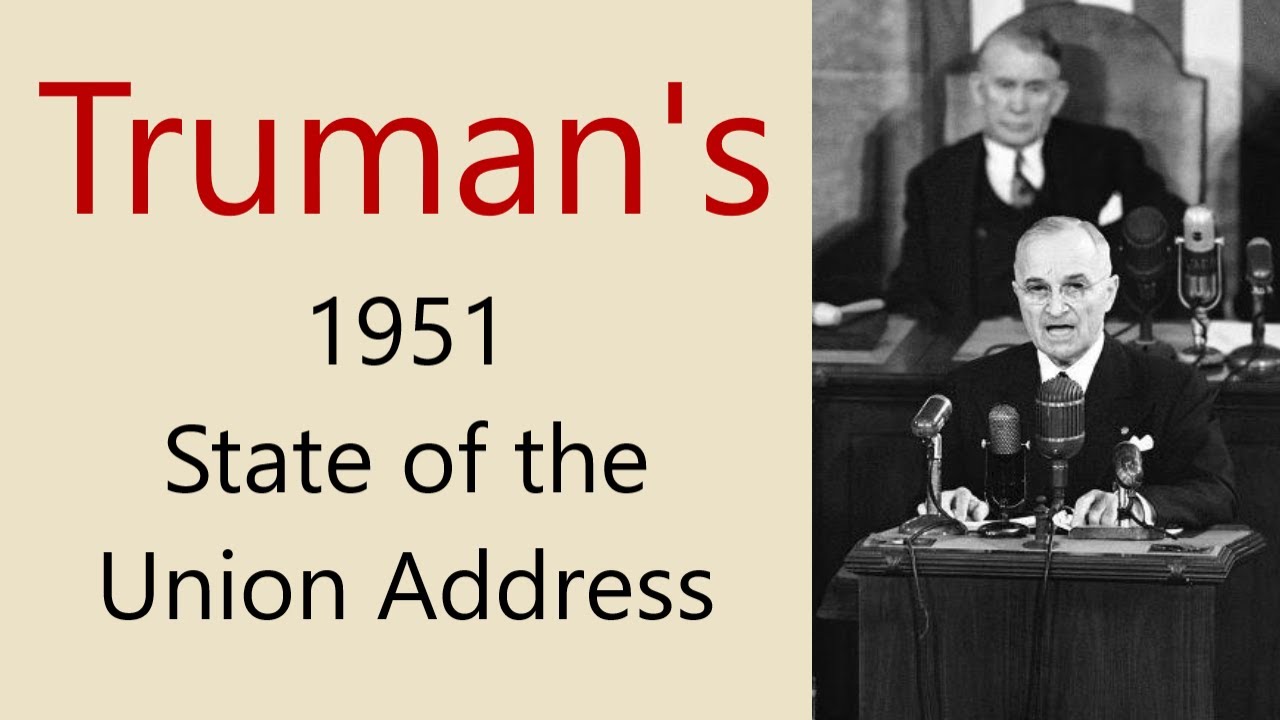
- Truman's 1951 State of the Union Address
January 08, 1951 Mr. President, Mr. Speaker, Members of the Congress: This 82d Congress faces as grave a task as any Congress in the history of our Republic. The actions you take will be watched by the whole world. These actions will measure the ability of a free people, acting through their chosen representatives and their free institutions, to meet a deadly challenge to their way of life. We can meet this challenge foolishly or wisely. We can meet it timidly or bravely, shamefully or honorably. I know that the 82d Congress will meet this challenge in a way worthy of our great heritage. I know that your debates will be earnest, responsible, constructive, and to the point. I know that from these debates there will come the great decisions needed to carry us forward. At this critical time, I am glad to say that our country is in a healthy condition. Our democratic institutions are sound and strong. We have more men and women at work than ever before. We are able to produce more than ever before--in fact, far more than any country ever produced in the history of the world. I am confident that we can succeed in the great task that lies before us. We will succeed, but we must all do our part. We must all act together as citizens of this great Republic. As we meet here today, American soldiers are fighting a bitter campaign in Korea. We pay tribute to their courage, devotion, and gallantry. Our men are fighting, alongside their United Nations allies, because they know, as we do, that the aggression in Korea is part of the attempt of the Russian Communist dictatorship to take over the world, step by step. Our men are fighting a long way from home, but they are fighting for our lives and our liberties. They are fighting to protect our right to meet here today--our right to govern ourselves as a free nation. The threat of world conquest by Soviet Russia endangers our liberty and endangers the kind of world in which the free spirit of man can survive. This threat is aimed at all peoples who strive to win or defend their own freedom and national independence. Indeed, the state of our Nation is in great part the state of our friends and allies throughout the world. The gun that points at them points at us, also. The threat is a total threat and the danger is a common danger. All free nations are exposed and all are in peril. Their only security lies in banding together. No one nation can find protection in a selfish search for a safe haven from the storm. The free nations do not have any aggressive purpose. We want only peace in the world--peace for all countries. No threat to the security of any nation is concealed in our plans and programs. We had hoped that the Soviet Union, with its security assured by the Charter of the United Nations, would be willing to live and let live. But I am sorry to say that has not been the case. The imperialism of the czars has been replaced by the even more ambitious, more crafty, and more menacing imperialism of the rulers of the Soviet Union. This new imperialism has powerful military forces. It is keeping millions of men under arms. It has a large air force and a strong submarine force. It has complete control of the men and equipment of its satellites. It has kept its subject peoples and its economy in a state of perpetual mobilization. The present rulers of the Soviet Union have shown that they are willing to use this power to destroy the free nations and win domination over the whole world. The Soviet imperialists have two ways of going about their destructive work. They use the method of subversion and internal revolution, and they use the method of external aggression. In preparation for either of these methods of attack, they stir up class strife and disorder. They encourage sabotage. They put out poisonous propaganda. They deliberately try to prevent economic improvement. If their efforts are successful, they foment a revolution, as they did in Czechoslovakia and China, and as they tried, unsuccessfully, to do in Greece. If their methods of subversion are blocked, and if they think they can get away with outright warfare, they resort to external aggression. This is what they did when they loosed the armies of their puppet states against the Republic of Korea, in an evil war by proxy. We of the free world must be ready to meet both of these methods of Soviet action. We must not neglect one or the other. The free world has power and resources to meet these two forms of aggression--resources that are far greater than those of the Soviet dictatorship. We have skilled and vigorous peoples, great industrial strength, and abundant sources of raw materials. And above all, we cherish liberty. Our common ideals are a great part of our strength. These ideals are the driving force of human progress. The free nations believe in the dignity and the worth of man. We believe in independence for all nations. We believe that free and independent nations can band together into a world order based on law. We have laid the cornerstone of such a peaceful world in the United Nations. We believe that such a world order can and should spread the benefits of modern science and industry, better health and education, more food and rising standards of living--throughout the world. These ideals give our cause a power and vitality that Russian communism can never command. The free nations, however, are bound together by more than ideals. They are a real community bound together also by the ties of self-interest and self-preservation. If they should fall apart, the results would be fatal to human freedom. Our own national security is deeply involved with that of the other free nations. While they need our support, we equally need theirs. Our national safety would be gravely prejudiced if the Soviet Union were to succeed in harnessing to its war machine the resources and the manpower of the free nations on the borders of its empire. If Western Europe were to fall to Soviet Russia, it would double the Soviet supply of coal and triple the Soviet supply of steel. If the free countries of Asia and Africa should fall to Soviet Russia, we would lose the sources of many of our most vital raw materials, including uranium, which is the basis of our atomic power. And Soviet command of the manpower of the free nations of Europe and Asia would confront us with military forces which we could never hope to equal. In such a situation, the Soviet Union could impose its demands on the world, without resort to conflict, simply through the preponderance of its economic and military power. The Soviet Union does not have to attack the United States to secure domination of the world. It can achieve its ends by isolating us and swallowing up all our allies. Therefore, even if we were craven enough I do not believe we could be--but, I say, even if we were craven enough to abandon our ideals, it would be disastrous for us to withdraw from the community of free nations. We are the most powerful single member of this community, and we have a special responsibility. We must take the leadership in meeting the challenge to freedom and in helping to protect the rights of independent nations. This country has a practical, realistic program of action for meeting this challenge. First, we shall have to extend economic assistance, where it can be effective. The best way to stop subversion by the Kremlin is to strike at the roots of social injustice and economic disorder. People who have jobs, homes, and hopes for the future will defend themselves against the underground agents of the Kremlin. Our programs of economic aid have done much to turn back Communism. In Europe the Marshall plan has had an electrifying result. As European recovery progressed, the strikes led by the Kremlin's agents in Italy and France failed. All over Western Europe the Communist Party took worse and worse beatings at the polls. The countries which have received Marshall plan aid have been able, through hard work, to expand their productive strength-in many cases, to levels higher than ever before in their history. Without this strength they would be completely incapable of defending themselves today. They are now ready to use this strength in helping to build a strong combined defense against aggression. We shall need to continue some economic aid to European countries. This aid should now be specifically related to the building of their defenses. In other parts of the world our economic assistance will need to be more broadly directed toward economic development. In the Near East, in Africa, in Asia, we must do what we can to help people who are striving to advance from misery, poverty, and hunger. We must also continue to help the economic growth of our good neighbors in this hemisphere. These actions will bring greater strength for the free world. They will give many people a real stake in the future and reason to defend their freedom. They will mean increased production of goods they need and materials we need. Second, we shall need to continue our military assistance to countries which want to defend themselves. The heart of our common defense effort is the North Atlantic community. The defense of Europe is the basis for the defense of the whole free world--ourselves included. Next to the United States, Europe is the largest workshop in the world. It is also a homeland of the great religious beliefs shared by many of our citizens beliefs which are now threatened by the tide of atheistic communism. Strategically, economically, and morally, the defense of Europe is a part of our own defense. That is why we have joined with the countries of Europe in the North Atlantic Treaty, pledging ourselves to work with them. There has been much discussion recently over whether the European countries are willing to defend themselves. Their actions are answering this question. Our North Atlantic Treaty partners have strict systems of universal military training. Several have recently increased the term of service. All have taken measures to improve the quality of training. Forces are being trained and expanded as rapidly as the necessary arms and equipment can be supplied from their factories and ours. Our North Atlantic Treaty partners, together, are building armies bigger than our own. None of the North Atlantic Treaty countries, including our own country, has done enough yet. But real progress is being made. Together, we have worked out defense 'plans. The military leaders of our own country took part in working out these plans, and are agreed that they are sound and within our capabilities. To put these plans into action, we sent to Europe last week one of our greatest military commanders, General Dwight D. Eisenhower. General Eisenhower went to Europe to assume command of the united forces of the North Atlantic Treaty countries, including our own forces in Germany. The people of Europe have confidence in General Eisenhower. They know his ability to put together a fighting force of allies. His mission is vital to our security. We should all stand behind him, and give him every bit of help we can. Part of our job will be to reinforce the military strength of our European partners by sending them weapons and equipment as our military production expands. Our program of military assistance extends to the nations in the Near East and the Far East which are trying to defend their freedom. Soviet communism is trying to make these nations into colonies, and to use their people as cannon fodder in new wars of conquest. We want their people to be free men and to enjoy peace. Our country has always stood for freedom for the peoples of Asia. Long, long ago it stood for the freedom of the peoples of Asia. Our history shows this. We have demonstrated it in the Philippines. We have demonstrated it in our relations with Indonesia, India, and with China. We hope to join in restoring the people of Japan to membership in the community of free nations. It is in the Far East that we have taken up arms, under the United Nations, to preserve the principle of independence for free nations. We are fighting to keep the forces of Communist aggression from making a slave state out of Korea. Korea has tremendous significance for the world. It means that free nations, acting through the United Nations, are fighting together against aggression. We will understand the importance of this best if we look back into history. If the democracies had stood up against the invasion of Manchuria in 1931, or the attack on Ethiopia in 1935, or the seizure of Austria in 1938, if they had stood together against aggression on those occasions as the United Nations has done in Korea, the whole history of our time would have been different. The principles for which we are fighting in Korea are right and just. They are the foundations of collective security and of the future of free nations. Korea is not only a country undergoing the torment of aggression; it is also a symbol. It stands for right and justice in the world against oppression and slavery. The free world must always stand for these principles--and we will stand with the free world. As the third part of our program, we will continue to work for peaceful settlements in international disputes. We will support the United Nations and remain loyal to the great principles of international cooperation laid down in its charter. We are willing, as we have always been, to negotiate honorable settlements with the Soviet Union. But we will not engage in appeasement. The Soviet rulers have made it clear that we must have strength as well as right on our side. If we build our strength--and we are building it--the Soviet rulers may face the facts and lay aside their plans to take over the world. That is what we hope will happen, and that is what we are trying to bring about. That is the only realistic road to peace. These are the main elements of the course our Nation must follow as a member of the community of free nations. These are the things we must do to preserve our security and help create a peaceful world. But they will be successful only if we increase the strength of our own country. Here at home we have some very big jobs to do. We are building much stronger military forces--and we are building them fast. We are preparing for full wartime mobilization, if that should be necessary. And we are continuing to build a strong and growing economy, able to maintain whatever effort may be required for as long as necessary. We are building our own Army, Navy, and Air Force to an active strength of nearly 3 1/2 million men and women. We are stepping up the training of the reserve forces, and establishing more training facilities, so that we can rapidly increase our active forces far more on short notice. We are going to produce all the weapons and equipment that such an armed force will need. Furthermore, we will make weapons for our allies, and weapons for our own reserve supplies. On top of this, we will build the capacity to turn out on short notice arms and supplies that may be needed for a full-scale war. Fortunately, we have a good start on this because of our enormous plant capacity and because of the equipment on hand from the last war. For example, many combat ships are being returned to active duty from the "mothball fleet" and many others can be put into service on very short notice. We have large reserves of arms and ammunition and thousands of workers skilled in arms production. In many cases, however, our stocks of weapons are low. In other cases, those on hand are not the most modern. We have made remarkable technical advances. We have developed new types of jet planes and powerful new tanks. We are concentrating on producing the newest types of weapons and producing them as fast as we can. This production drive is more selective than the one we had during World War II, but it is just as urgent and intense. It is a big program and it is a costly one. Let me give you two concrete examples. Our present program calls for expanding the aircraft industry so that it will have the capacity to produce 50,000 modern military planes a year. We are preparing the capacity to produce 35,000 tanks a year. We are not now ordering that many planes or that many tanks, and we hope that we never have to, but we mean to be able to turn them out if we need them. The planes we are producing now are much bigger, much better, and much more expensive than the planes we had during the last war. We used to think that the B-17 was a huge plane, and the blockbuster it carried a huge load. But the B-36 can carry five of these blockbusters in its belly, and it can carry them five times as far. Of course, the B-36 is much more complicated to build than the B-17, and far more expensive. One B-17 costs $275,000, while now one B-36 costs $3 ½ million. I ask you to remember that what we are doing is to provide the best and most modern military equipment in the world for our fighting forces. This kind of defense production program has two parts. The first part is to get our defense production going as fast as possible. We have to convert plants and channel materials to defense production. This means heavy cuts in civilian uses of copper, aluminum, rubber, and other essential materials. It means shortages in various consumer goods. The second part is to increase our capacity to produce and to keep our economy strong for the long pull. We do not know how long Communist aggression will threaten the world. Only by increasing our output can we carry the burden of preparedness for an indefinite period in the future. This means that we will have to build more power plants and more steel mills, grow more cotton, mine more copper, and expand our capacity in many other ways. The Congress will need to consider legislation, at this session, affecting all the aspects of our mobilization job. The main subjects on which legislation will be needed are: First, appropriations for our military buildup. Second, extension and revision of the Selective Service Act. Third, military and economic aid to help build up the strength of the free world. Fourth, revision and extension of the authority to expand production and to stabilize prices, wages, and rents. Fifth, improvement of our agricultural laws to help obtain the kinds of farm products we need for the defense effort. Sixth, improvement of our labor laws to help provide stable labor-management relations and to make sure that we have steady production in this emergency. Seventh, housing and training of defense workers and the full use of all our manpower resources. Eighth, means for increasing the supply of doctors, nurses, and other trained medical personnel critically needed for the defense effort. Ninth, aid to the States to meet the most urgent needs of our elementary and secondary schools. Some of our plans will have to be deferred for the time being. But we should do all we can to make sure our children are being trained as good and useful citizens in the critical times ahead. Tenth, a major increase in taxes to meet the cost of the defense effort. The Economic Report and the Budget Message will discuss these subjects further. In addition, I shall send to the Congress special messages containing detailed recommendations on legislation needed at this session. In the months ahead the Government must give priority to activities that are urgent--like military procurement and atomic energy and power development. It must practice rigid economy in its nondefense activities. Many of the things we would normally do must be curtailed or postponed. But in a long-term defense effort like this one, we cannot neglect the measures needed to maintain a strong economy and a healthy democratic society. The Congress, therefore, should give continued attention to the measures which our country will need for the long pull. And it should act upon such legislation as promptly as circumstances permit. To take just one example--we need to continue and complete the work of rounding out our system of social insurance. We still need to improve our protection against unemployment and old age. We still need to provide insurance against the loss of earnings through sickness, and against the high costs of modern medical care. And above all, we must remember that the fundamentals of our strength rest upon the freedoms of our people. We must continue our efforts to achieve the full realization of our democratic ideals. We must uphold the freedom of speech and the freedom of conscience in our land. We must assure equal rights and equal opportunities to all our citizens. As we go forward this year in the defense of freedom, let us keep dearly before us the nature of our present effort. We are building up our strength, in concert with other free nations, to meet the danger of aggression that has been turned loose on the world. The strength of the free nations is the world's best hope of peace. I ask the Congress for unity in these crucial days. Make no mistake about my meaning. I do not ask, or expect, unanimity. I do not ask for an end to debate. Only by debate can we arrive at decisions which are wise, and which reflect the desires of the American people. We do not have a dictatorship in this country, and we never will have one in this country. When I request unity, what I am really asking for is a sense of responsibility on the part of every Member of this Congress. Let us debate the issues, but let every man among us weigh his words and his deeds. There is a sharp difference between harmful criticism and constructive criticism. If we are truly responsible as individuals, I am sure that we will be unified as a government. Let us keep our eyes on the issues and work for the things we all believe in. Let each of us put our country ahead of our party, and ahead of our own personal interests. I had the honor to be a Member of the Senate during World War II, and I know from experience that unity of purpose and of effort is possible in the Congress without any lessening of the vitality of our two-party system. Let us all stand together as Americans. Let us stand together with all men everywhere who believe in human liberty. Peace is precious to us. It is the way of life we strive for with all the strength and wisdom we possess. But more precious than peace are freedom and justice. We will fight, if fight we must, to keep our freedom and to prevent justice from being destroyed. These are the things that give meaning to our lives, and which we acknowledge to be greater than ourselves. This is our cause--peace, freedom, justice. We will pursue this cause with determination and humility, asking divine guidance that in all we do we may follow the will of God. Source: https://www.presidency.ucsb.edu/documents/annual-message-the-congress-the-state-the-union-19
- Truman's 1950 State of the Union Address
January 04, 1950 Mr. President, Mr. Speaker, Members of the Congress: A year ago I reported to this Congress that the state of the Union was good. I am happy to be able to report to you today that the state of the Union continues to be good. Our Republic continues to increase in the enjoyment of freedom within its borders, and to offer strength and encouragement to all those who love freedom throughout the world. During the past year we have made notable progress in strengthening the foundations of peace and freedom, abroad and at home. We have taken important steps in securing the North Atlantic community against aggression. We have continued our successful support of European recovery. We have returned to our established policy of expanding international trade through reciprocal agreement. We have strengthened our support of the United Nations. While great problems still confront us, the greatest danger has receded--the possibility which faced us 3 years ago that most of Europe and the Mediterranean area might collapse under totalitarian pressure. Today, the free peoples of the world have new vigor and new hope for the cause of peace. In our domestic affairs, we have made notable advances toward broader opportunity and a better life for all our citizens. We have met and reversed the first significant downturn in economic activity since the war. In accomplishing this, Government programs for maintaining employment and purchasing power have been of tremendous benefit. As the result of these programs, and the wisdom and good judgment of our businessmen and workers, major readjustments have been made without widespread suffering. During the past year, we have also made a good start in providing housing for low-income groups; we have raised minimum wages; we have gone forward with the development of our natural resources; we have given a greater assurance of stability to the farmer; and we have improved the organization and efficiency of our Government. Today, by the grace of God, we stand a free and prosperous nation with greater possibilities for the future than any people ever had before in the history of the world. We are now, in this year of 1950, nearing the midpoint of the 20th century. The first half of this century will be known as the most turbulent and eventful period in recorded history. The swift pace of events promises to make the next 50 years decisive in the history of man on this planet. The scientific and industrial revolution which began two centuries ago has, in the last 50 years, caught up the peoples of the globe in a common destiny. Two worldshattering wars have proved that no corner of the earth can be isolated from the affairs of mankind. The human race has reached a turning point. Man has opened the secrets of nature and mastered new powers. If he uses them wisely, he can reach new heights of civilization. If he uses them foolishly, they may destroy him. Man must create the moral and legal framework for the world which will insure that his new powers are used for good and not for evil. In shaping the outcome, the people of the United States will play a leading role. Among all the great changes that have occurred in the last 50 years, none is more important than the change in the position of the United States in world affairs. Fifty years ago we were a country devoted largely to our own internal affairs. Our industry was growing, and we had new interests in the Far East and in the Caribbean, but we were primarily concerned with the development of vast areas of our own continental territory. Today, our population has doubled. Our national production has risen from about $50 billion, in terms of today's prices, to the staggering figure of $255 billion a year. We have a more productive economic system and a greater industrial potential than any other nation on the globe. Our standard of living is an inspiration for all other peoples. Even the slightest changes in our economic and social life have their effect on other countries all around the world. Our tremendous strength has brought with it tremendous responsibilities. We have moved from the outer edge to the center of world affairs. Other nations look to us for a wise exercise of our economic and military strength, and for vigorous support of the ideals of representative government and a free society. We will not fail them. Our objective in the world is peace. Our country has joined with others in the task of achieving peace. We know now that this is not an easy task, or a short one. But we are determined to see it through. Both of our great political parties are committed to working together--and I am sure they will continue to work together--to achieve this end. We are prepared to devote our energy and our resources to this task, because we know that our own security and the future of mankind are at stake. Right here, I want to say that no one appreciates more than I the bipartisan cooperation in foreign affairs which has been enjoyed by this administration. Our success in working with other nations to achieve peace depends largely on what we do at home. We must preserve our national strength. Strength is not simply a matter of arms and force. It is a matter of economic growth, and social health, and vigorous institutions, public and private. We can achieve peace only if we maintain our productive energy, our democratic institutions, and our firm belief in individual freedom. Our surest guide in the days that lie ahead will be the spirit in which this great Republic was rounded. We must make our decisions in the conviction that all men are created equal, that they are equally entitled to life, liberty, and the pursuit of happiness, and that the duty of government is to serve these ends. This country of ours has experienced many blessings, but none greater than its dedication to these principles. At every point in our history, these ideals have served to correct our failures and shortcomings, to spur us on to greater efforts, and to keep clearly before us the primary purpose of our existence as a nation. They have enshrined for us, a principle of government, the moral imperative to do justice, and the divine command to men to love one another. These principles give meaning to all that we do. In foreign policy, they mean that we can never be tolerant of oppression or tyranny. They mean that we must throw our weight on the side of greater freedom and a better life for all peoples. These principles confirm us in carrying out the specific programs for peace which we have already begun. We shall continue to give our wholehearted support to the United Nations. We believe that this organization can ultimately provide the framework of international law and morality without which mankind cannot survive. It has already set up new standards for the conduct of nations in the Declaration of Human Rights and the Convention on Genocide. It is moving ahead to give meaning to the concept of world brotherhood through a wide variety of cultural, economic, and technical activities. The events of the past year again showed the value of the United Nations in bringing about the peaceful adjustment of tense international controversies. In Indonesia and in Palestine the efforts of the United Nations have put a stop to bloodshed and paved the way to peaceful settlements. We are working toward the time when the United Nations will control weapons of mass destruction and will have the forces to preserve international law and order. While the world remains unsettled, however, and as long as our own security and the security of the free world require, we will maintain a strong and well-balanced defense organization. The Selective Service System is an essential part of our defense plans, and it must be continued. Under the principles of the United Nations Charter we must continue to share in the common defense of free nations against aggression. At the last session this Congress laid the basis for this joint effort. We now must put into effect the common defense plans that are being worked out. We shall continue our efforts for world economic recovery, because world prosperity is the only sure foundation of a permanent peace. As an immediate means to this end we must continue our support of the European recovery program. This program has achieved great success in the first 2 years of its operation, but it has not yet been completed. If we were to stop this program now, or cripple it, just because it is succeeding, we should be doing exactly what the enemies of democracy want us to do. We should be just as foolish as a man who, for reasons of false economy, failed to put a roof on his house after building the foundation and the walls. World prosperity also requires that we do all we can to expand world trade. As a major step in this direction we should promptly join the International Trade Organization. The purpose of this organization, which the United States has been foremost in creating, is to establish a code of fair practice, and an international authority for adjusting differences in international commercial relations. It is an effort to prevent the kind of anarchy and irresponsibility in world trade which did so much to bring about the world depression of the 1930's. An expanding world economy requires the improvement of living standards and the development of resources in areas where human poverty and misery now prevail. Without such improvement the recovery of Europe and the future of our own economy will not be secure. I urge that the Congress adopt the legislation now before it to provide for increasing the flow of technical assistance and capital investment in underdeveloped regions. It is more essential now than ever, if the ideals of freedom and representative government are to prevail in these areas, and particularly in the Far East, that their peoples experience, in their own lives, the benefits of scientific and economic advances. This program will require the movement of large amounts of capital from the industrial nations, and particularly from the United States, to productive uses in the underdeveloped areas of the world. Recent world events make prompt action imperative. This program is in the interest of all peoples-and has nothing in common with either the old imperialism of the last century or the new imperialism of the Communists. Our aim for a peaceful, democratic world of free peoples will be achieved in the long run, not by force of arms, but by an appeal to the minds and hearts of men. If the peace policy of the democratic nations is to be successful, they must demonstrate that the benefits of their way of life can be increased and extended to all nations and all races. In the world today we are confronted with the danger that the rising demand of people everywhere for freedom and a better life may be corrupted and betrayed by the false promises of communism. In its ruthless struggle for power, communism seizes upon our imperfections, and takes advantage of the delays and setbacks which the democratic nations experience in their effort to secure a better life for their citizens. This challenge to us is more than a military challenge. It is a challenge to the honesty of our profession of the democratic faith; it is a challenge to the efficiency and stability of our economic system; it is a challenge to the willingness to work with other peoples for world peace and for world prosperity. For my part I welcome that challenge. I believe that our country, at this crucial point in world history, will meet that challenge successfully. I believe that, in cooperation with the other free nations of the world, we shall extend the full benefits of the democratic way of life to millions who do not now enjoy them, and preserve mankind from dictatorship and tyranny. I believe that we shall succeed in our struggle for this peace, because I have seen the success we have had in our own country in following the principles of freedom. Over the last 50 years, the ideals of liberty and equal opportunity to which this Nation is dedicated have been increasingly realized in the lives of our people. The ideal of equal opportunity no longer means simply the opportunity which a man has to advance beyond his fellows. Some of our citizens do achieve greater success than others as a reward for individual merit and effort, and this is as it should be. At the same time our country must be more than a land of opportunity for a select few. It must be a land of opportunity for all of us. In such a land we can grow and prosper together. The simple truth that we can all go forward together is often questioned by selfish or shortsighted persons. It is strange that this is so, for this proposition is so clearly demonstrated by our national history. During the last 50 years, for example, our Nation has grown enormously in material well-being. This growth has come about, not by concentrating the benefits of our progress in the hands of a few, but by increasing the wealth of the great body of our Nation and our citizens. In the last 50 years the income of the average family has increased so greatly that its buying power has doubled. The average hours of work have declined from 60 to 40 a week, the whole hourly production of the average worker has tripled. Average wages, allowing for price changes, have increased from about 45 cents an hour to $1.40 an hour. We have accomplished what to earlier ages of mankind would have been a miracle--we work shorter hours, we produce more, and we live better. Increasing freedom from poverty and drudgery has given a fuller meaning to American life. Our people are better educated; we have more opportunities for travel and recreation and enjoyment of the arts. We enjoy more personal liberty in the United States today than ever before. If we can continue in the spirit of cooperative adventure which has marked the recent years of our progress, we can expect further scientific advances, further increases in our standard of living, and a still wider enjoyment of democratic freedom. No one, of course, can foretell the future exactly. However, if we assume that we shall grow as fast in the future as we have grown in the past, we can get a good idea of how much our country should grow in the next 50 years. At present our total national production is $255 billion a year. Our working population and our output per worker are increasing. If our productive power continues to increase at the same rate as it has increased over the past 50 years, our total national production 50 years from now will be nearly four times as much as it is today. Allowing for the expected growth in population, this would mean that the real income of the average family in the year 2000 A.D. would be about three times what it is today. These are estimates of what we can do in the future, but we can reach these heights only if we follow the right policies. We have learned by bitter experience that progress is not automatic--that wrong policies lead to depression and disaster. We cannot achieve these gains unless we have a stable economy and avoid the catastrophes of boom and bust that have set us back in the past. These gains cannot be achieved unless our businessmen maintain their spirit of initiative and enterprise and operate in a competitive economy. They cannot be achieved unless our workingmen and women and their unions help to increase productivity and obtain for labor a fair share of the benefits of our economic system. They cannot be achieved unless we have a stable and prosperous agriculture. They cannot be achieved unless we conserve and develop our natural resources in the public interest. Our system will not work unless our people are healthy, well-educated, and confident of the future. It will not work unless all citizens can participate fully in our national life. In achieving these gains the Government has a special responsibility to help create and maintain the conditions which will permit the growth we know is possible. Foremost among these conditions is the need for a fair distribution of our increasing prosperity among all the great groups of our population who help to bring it about-labor, business, agriculture. Businessmen must continue to have the incentives necessary for investment and for the development of new lines of enterprise. In the future growth of this country, lie possibilities for hundreds of thousands of new and independent businesses. As our national production increases, as it doubles and redoubles in the next 50 years, the number of independent and competing enterprises should also increase. If the number does not increase, our constantly growing economy will fall under the control of a few dominant economic groups whose powers will be so great that they will be a challenge to democratic institutions. To avoid this danger, we must curb monopoly and provide aids to independent business so that it may have the credit and capital to compete in a system of free enterprise. I recommend that the Congress complete action at this session on the pending bill to close the loopholes in the Clayton Act which now permit monopolistic mergers. I also hope before this session is over to transmit to the Congress a series of proposals to strengthen the antimonopoly laws, to assist small business, and to encourage the growth of new enterprises. In the case of labor, free collective bargaining must be protected and encouraged. Collective bargaining is not only a fundamental economic freedom for labor. It is also a strengthening and stabilizing influence for our whole economy. The Federal statute now governing labor relations is punitive in purpose and one-sided in operation. This statute is, and always has been, inconsistent with the practice of true and effective collective bargaining. It should be repealed and replaced by a law that is fair to all and in harmony with our democratic ideals. A full understanding of the problems of modern labor relations is of such importance that I recommend the establishment of a labor extension service to encourage educational activities in this field. Another essential for our continued growth is a stable and prosperous agriculture. For many years we have been building a program to give the farmer a reasonable measure of protection against the special hazards to which he is exposed. That program was improved at the last session of the Congress. However, our farm legislation is still not adequate. Although the Congress has properly declared as a matter of national policy that safeguards must be maintained against slumps in farm prices, there are serious shortcomings in the methods now available for carrying out this policy. Mandatory price supports should be provided for the commodities not now covered which are major sources of farm income. Moreover, we should provide a method of supporting farm income at fair levels which will, at the same time, avoid piling up unmanageable surpluses and allow consumers to obtain the full benefit of our abundant agricultural production. A system of production payments gives the greatest promise of accomplishing this purpose. I recommend that the use of such a system be authorized. One of the most important factors in our continued growth is the construction of more good, up-to-date housing. In a country such as ours there is no reason why decent homes should not be within the reach of all. With the help of various Government programs we have made great progress in the last few years in increasing the number of homes. Despite this increase, there is still an acute shortage of housing for the lower and middle-income groups, especially in large metropolitan areas. We have laid the groundwork for relieving the plight of lower-income families in the Housing Act of 1949. To aid the middle-income families, I recommend that the Congress enact new legislation authorizing a vigorous program to help cooperatives and other nonprofit groups build housing which these families can afford. Rent control has done a great deal to prevent the housing shortage from having had worse effects during this postwar period of adjustment. Rent control is still necessary to prevent widespread hardship and sharp curtailment of the buying power of millions of consumers in metropolitan areas. I recommend, therefore, that rent control be continued for another year. If we are to achieve a better life for all, the natural resources of the country must be regarded as a public trust. We must use our precious assets of soil, water, and forest, and grassland in such a way that they become constantly more productive and more valuable. Government investment in the conservation and development of our resources is necessary to the future economic expansion of the country. We need to enlarge the production and transmission of public power. That is true not only in those regions which have already received great benefits from Federal power projects, but also in regions such as New England where the benefits of large-scale public power development have not yet been experienced. In our hydroelectric and irrigation undertakings, as well as in our other resource programs, we must continue policies to assure that their benefits will be spread among the many and not restricted to the favored few. Important resource legislation which should be passed at this session includes the authorization of the St. Lawrence seaway and power project and the establishment of the Columbia Valley Administration--the establishment of the Columbia Valley Administration, I don't want you to miss that. Through wise Government policies and Government expenditures for the conservation and development of our natural resources, we can be sure of transmitting to our children and our children's children a country far richer and more productive than the one we know today. The value of our natural resources is constantly being increased by the progress of science. Research is finding new ways of using such natural assets as minerals, sea water, and plant life. In the peaceful development of atomic energy, particularly, we stand on the threshold of new wonders. The first experimental machines for producing useful power from atomic energy are now under construction. We have made only the first beginnings in this field, but in the perspective of history they may loom larger than the first airplane, or even the first tools that started man on the road to civilization. To take full advantage of the increasing possibilities of nature we must equip ourselves with increasing knowledge. Government has a responsibility to see that our country maintains its position in the advance of science. As a step toward this end, the Congress should complete action on the measure to create a National Science Foundation. Another duty of the Government is to promote the economic security, the health, and the education of its citizens. By so doing, we strengthen both our economy and the structure of our society. In a nation as rich as ours, all citizens should be able to live in decency and health. Our Social Security System should be developed into the main reliance of our people for basic protection against the economic hazards of old-age, unemployment, and illness. I earnestly hope that the Congress will complete action at this session on legislation to increase the benefits and extend the coverage of old-age and survivors' insurance. The widespread movement to provide pensions in private industry dramatizes the need for improvements in the public insurance system. I also urge that the Congress strengthen our unemployment compensation law to meet present-day needs more adequately. The economic downturn of the past year was the first real test that our system of unemployment insurance has had to meet. That test has proved the wisdom of the system, but it has also made strikingly apparent the need for improving its operation and increasing its coverage and its benefits. In the field of health there are immense opportunities to extend to more of our people the benefits of the amazing advances in medical science. We have made a good beginning in expanding our hospitals, but we must also go on to remedy the shortages of doctors, nurses, and public health services, and to establish a system of medical insurance which will enable all Americans to afford good medical care. We must take immediate steps to strengthen our educational system. In many parts of our country, young people are being handicapped for life because of a poor education. The rapidly increasing number of children of school age, coupled with the shortage of qualified teachers, makes this problem more critical each year. I believe that the Congress should no longer delay in providing Federal assistance to the States so that they can maintain adequate schools. As we go forward in achieving greater economic security and greater opportunity for all our people, we should make every effort to extend the benefits of our democratic institutions to every citizen. The religious ideals which we profess, and the heritage of freedom which we have received from the past, clearly place that duty upon us. I again urge the Congress to enact the civil rights proposals I made in February 1948. These proposals are for the enactment of Federal statutes which will protect all our people in the exercise of their democratic rights and their search for economic opportunity, grant statehood to Alaska and Hawaii, provide a greater measure of self-government for our island possessions, and accord home rule to the District of Columbia. Some of those proposals have been before the Congress for a long time. Those who oppose them, as well as those who favor them, should recognize that it is the duty of the elected representatives of the people to let these proposals come to a vote. Our democratic ideals, as well as our best interests, require that we do our fair share in providing homes for the unfortunate victims of war and tyranny. In so doing, we shall add strength to our democracy through the abilities and skills which these men and women will bring here. I urge the prompt enactment by the Congress of the legislation now before it to extend and broaden the existing displaced persons law and remove its discriminatory features. The measures I am recommending to the Congress concerning both our foreign and our domestic policies represent a carefully considered program to meet our national needs. It is a program which necessarily requires large expenditures of funds. More than 70 percent of the Government's expenditures are required to meet the costs of past wars and to work for world peace. This is the dominant factor in our fiscal policy. At the same time, the Government must make substantial expenditures which are necessary to the growth and expansion of the domestic economy. At present, largely because of the ill-considered tax reduction of the Both Congress, the Government is not receiving enough revenue to meet its necessary expenditures. To meet this situation, I am proposing that Federal expenditures be held to the lowest levels consistent with our international requirements and the essential needs of economic growth, and the well-being of our people. I think I had better read that over; you interrupted me in the middle. To meet this situation, I am proposing that Federal expenditures be held to the lowest levels consistent with our international requirements and the essential needs of economic growth, and the well-being of our people. Don't forget that last phrase. At the same time, we must guard against the folly of attempting budget slashes which would impair our prospects for peace or cripple the programs essential to our national strength. The budget recommendations I shall shortly transmit to the Congress show that we can expect a substantial improvement in our fiscal position over the next few years, as the cost of some of our extraordinary postwar programs declines, and as the Government revenue rises as a result of growth in employment and national income. To further improve our fiscal outlook, we should make some changes in our tax system which will reduce present inequities, stimulate business activity, and yield a moderate amount of additional revenue. I expect to transmit specific recommendations to the Congress on this subject at a very early date. The fiscal policy I am recommending is the quickest and safest way of achieving a balanced budget. As we move forward into the second half of the 20th century, we must always bear in mind the central purpose of our national life. We do not seek material prosperity for ourselves because we love luxury; we do not aid other nations because we wish to increase our power. We have not devised programs for the security and well-being of our people because we are afraid or unwilling to take risks. This is not the meaning of our past history or our present course. We work for a better life for all, so that all men may put to good use the great gifts with which they have been endowed by their Creator. We seek to establish those material conditions of life in which, without exception, men may live in dignity, perform useful work, serve their communities, and worship God as they see fit. These may seem simple goals, but they are not little ones. They are worth a great deal more than all the empires and conquests of history. They are not to be achieved by military aggression or political fanaticism. They are to be achieved by humbler means-by hard work, by a spirit of self-restraint in our dealings with one another, and by a deep devotion to the principles of justice and equality. It should make us truly thankful, as we look back to the beginnings of this country, that we have come so far along the road to a better life for all. It should make us humble to think, as we look ahead, how much farther we have to go to accomplish, at home and abroad, the objectives that were set out for us at the founding of this great Nation. As we approach the halfway mark of the 20th century, we should ask for continued strength and guidance from that Almighty Power who has placed before us such great opportunities for the good of mankind in the years to come. Source: https://www.presidency.ucsb.edu/documents/annual-message-the-congress-the-state-the-union-20
- Truman's 1949 State of the Union Address
January 05, 1949 Mr. President, Mr. Speaker, Members of the Congress: I am happy to report to this 81st Congress that the state of the Union is good. Our Nation is better able than ever before to meet the needs of the American people, and to give them their fair chance in the pursuit of happiness. This great Republic is foremost among the nations of the world in the search for peace. During the last 16 years, our people have been creating a society which offers new opportunities for every man to enjoy his share of the good things of life. In this society, we are conservative about the values and principles which we cherish; but we are forward-looking in protecting those values and principles and in extending their benefits. We have rejected the discredited theory that the fortunes of the Nation should be in the hands of a privileged few. We have abandoned the "trickledown" concept of national prosperity. Instead, we believe that our economic system should rest on a democratic foundation and that wealth should be created for the benefit of all. The recent election shows that the people of the United States are in favor of this kind of society and want to go on improving it. The American people have decided that poverty is just as wasteful and just as unnecessary as preventable disease. We have pledged our common resources to help one another in the hazards and struggles of individual life. We believe that no unfair prejudice or artificial distinction should bar any citizen of the United States of America from an education, or from good health, or from a job that he is capable of performing. The attainment of this kind of society demands the best efforts of every citizen in every walk of life, and it imposes increasing responsibilities on the Government. The Government must work with industry, labor, and the farmers in keeping our economy running at full speed. The Government must see that every American has a chance to obtain his fair share of our increasing abundance. These responsibilities go hand in hand. We cannot maintain prosperity unless we have a fair distribution of opportunity and a widespread consumption of the products of our factories and farms. Our Government has undertaken to meet these responsibilities. We have ,made tremendous public investments in highways, hydroelectric power projects, soil conservation, and reclamation. We have established a system of social security. We have enacted laws protecting the rights and the welfare of our working people and the income of our farmers. These Federal policies have paid for themselves many times over. They have strengthened the material foundations of our democratic ideals. Without them, our present prosperity would be impossible. Reinforced by these policies, our private enterprise system has reached new heights of production. Since the boom year of 1929, while our population has increased by only 20 percent, our agricultural production has increased by 45 percent, and our industrial production has increased by 75 percent. We are turning out far more goods and more wealth per worker than we have ever done before. This progress has confounded the gloomy prophets--at home and abroad who predicted the downfall of American capitalism. The people of the United States, going their own way, confident in their own powers, have achieved the greatest prosperity the world has even seen. But, great as our progress has been, we still have a long way to go. As we look around the country, many of our shortcomings stand out in bold relief. We are suffering from excessively high prices. Our production is still not large enough to satisfy our demands. Our minimum wages are far too low. Small business is losing ground to growing monopoly. Our farmers still face an uncertain future. And too many of them lack the benefits of our modern civilization. Some of our natural resources are still being wasted. We are acutely short of electric power, although the means for developing such power are abundant. Five million families are still living in slums and firetraps. Three million families share their homes with others. Our health is far behind the progress of medical science. Proper medical care is so expensive that it is out of the reach of the great majority of our citizens. Our schools, in many localities, are utterly inadequate. Our democratic ideals are often thwarted by prejudice and intolerance. Each of these shortcomings is also an opportunity-an opportunity for the Congress and the President to work for the good of the people. Our first great opportunity is to protect our economy against the evils of "boom and bust." This objective cannot be attained by government alone. Indeed, the greater part of the task must be performed by individual efforts under our system of free enterprise. We can keep our present prosperity, and increase it, only if free enterprise and free government work together to that end. We cannot afford to float along ceaselessly on a postwar boom until it collapses. It is not enough merely to prepare to weather a recession if it comes. Instead, government and business must work together constantly to achieve more and more jobs and more and more production--which mean more and more prosperity for all the people. The business cycle is man-made; and men of good will, working together, can smooth it out. So far as business is concerned, it should plan for steady, vigorous expansion--seeking always to increase its output, lower its prices, and avoid the vices of monopoly and restriction. So long as business does this, it will be contributing to continued prosperity, and it will have the help and encouragement of the Government. The Employment Act of 1946 pledges the Government to use all its resources to promote maximum employment, production, and purchasing power. This means that the Government is firmly committed to protect business and the people against the dangers of recession and against the evils of inflation. This means that the Government must adapt its plans and policies to meet changing circumstances. At the present time, our prosperity is threatened by inflationary pressures at a number of critical points in our economy. And the Government must be in a position to take effective action at these danger spots. To that end, I recommend that the Congress enact legislation for the following purposes: First, to continue the power to control consumer credit and enlarge the power to control bank credit. Second, to grant authority to regulate speculation on the commodity exchanges. Third, to continue export control authority and to provide adequate machinery for its enforcement. Fourth, to continue the priorities and allocation authority in the field of transportation. Fifth, to authorize priorities and allocations for key materials in short supply. Sixth, to extend and strengthen rent control. Seventh, to provide standby authority to impose price ceilings for scarce commodities which basically affect essential industrial production or the cost of living, and to limit unjustified wage adjustments which would force a break in an established price ceiling. Eighth, to authorize an immediate study of the adequacy of production facilities for materials in critically short supply, such as steel; and, if found necessary, to authorize Government loans for the expansion of production facilities to relieve such shortages, and to authorize the construction of such facilities directly, if action by private industry fails to meet our needs. The Economic Report, which I shall submit to the Congress shortly, will discuss in detail the economic background for these recommendations. One of the most important factors in maintaining prosperity is the Government's fiscal policy. At this time, it is essential not only that the Federal budget be balanced, but also that there be a substantial surplus to reduce inflationary pressures, and to permit a sizable reduction in the national debt, which now stands at $252 billion. I recommend, therefore, that the Congress enact new tax legislation to bring in an additional $4 billion of Government revenue. This should come principally from additional corporate taxes. A portion should come from revised estate and gift taxes. Consideration should be given to raising personal income rates in the middle and upper brackets. If we want to keep our economy running in high gear, we must be sure that every group has the incentive to make its full contribution to the national welfare. At present, the working men and women of the Nation are unfairly discriminated against by a statute that abridges their rights, curtails their constructive efforts, and hampers our system of free collective bargaining. That statute is the Labor-Management Relations Act of 1947, sometimes called the Taft-Hartley Act. That act should be repealed! The Wagner Act should be reenacted. However, certain improvements, which I recommended to the Congress 2 years ago, are needed. Jurisdictional strikes and unjustified secondary boycotts should be prohibited. The use of economic force to decide issues arising out of the interpretation of existing contracts should be prevented. Without endangering our democratic freedoms, means should be provided for setting up machinery for preventing strikes in vital industries which affect the public interest. The Department of Labor should be rebuilt and strengthened and those units properly belonging within that department should be placed in it. The health of our economy and its maintenance at high levels further require that the minimum wage fixed by law should be raised to at least 75 cents an hour. If our free enterprise economy is to be strong and healthy, we must reinvigorate the forces of competition. We must assure small business the freedom and opportunity to grow and prosper. To this purpose, we should strengthen our antitrust laws by closing those loopholes that permit monopolistic mergers and consolidations. Our national farm program should be improved-not only in the interest of the farmers, but for the lasting prosperity of the whole Nation. Our goals should be abundant farm production and parity income for agriculture. Standards of living on the farm should be just as good as anywhere else in the country. Farm price supports are an essential part of our program to achieve these ends. Price supports should be used to prevent farm price declines which are out of line with general price levels, to facilitate adjustments in production to consumer demands, and to promote good land use. Our price support legislation must be adapted to these objectives. The authority of the Commodity Credit Corporation to provide adequate storage space for crops should be restored. Our program for farm prosperity should also seek to expand the domestic market for agricultural products, particularly among low-income groups, and to increase and stabilize foreign markets. We should give special attention to extending modern conveniences and services to our farms. Rural electrification should be pushed forward. And in considering legislation relating to housing, education, health, and social security, special attention should be given to rural problems. Our growing population and the expansion of our economy depend upon the wise management of our land, water, forest, and mineral wealth. In our present dynamic economy, the task of conservation is not to lockup our resources but to develop and improve them. Failure, today, to make the investments which are necessary to support our progress in the future would be false economy. We must push forward the development of our rivers for power, irrigation, navigation, and flood control. We should apply the lessons of our Tennessee Valley experience to our other great river basins. I again recommend action be taken by the Congress to approve the St. Lawrence Seaway and Power project. This is about the fifth time I have recommended it. We must adopt a program for the planned use of the petroleum reserves under the sea, which are--and must remain--vested in the Federal Government. We must extend our programs of soil conservation. We must place our forests on a sustained yield basis, and encourage the development of new sources of vital minerals. In all this we must make sure that the benefits of these public undertakings are directly available to the people. Public power should be carried to consuming areas by public transmission lines where necessary to provide electricity at the lowest possible rates. Irrigation waters should serve family farms and not land speculators. The Government has still other opportunities--to help raise the standard of living of our citizens. These opportunities lie in the fields of social security, health, education, housing, and civil rights. The present coverage of the social security laws is altogether inadequate; the benefit payments are too low. One-third of our workers are not covered. Those who receive old-age and survivors insurance benefits receive an average payment of only $25 a month. Many others who cannot work because they are physically disabled are left to the mercy of charity. We should expand our social security program, both as to the size of the benefits and the extent of coverage, against the economic hazards due to unemployment, old age, sickness, and disability. We must spare no effort to raise the general level of health in this country. In a nation as rich as ours, it is a shocking fact that tens of millions lack adequate medical care. We are short of doctors, hospitals, nurses. We must remedy these shortages. Moreover, we need--and we must have without further delay--a system of prepaid medical insurance which will enable every American to afford good medical care. It is equally shocking that millions of our children are not receiving a good education. Millions of them are in overcrowded, obsolete buildings. We are short of teachers, because teachers' salaries are too low to attract new teachers, or to hold the ones we have. All these school problems will become much more acute as a result of the tremendous increase in the enrollment in our elementary schools in the next few years. I cannot repeat too strongly my desire for prompt Federal financial aid to the States to help them operate and maintain their school systems. The governmental agency which now administers the programs of health, education, and social security should be given full departmental status. The housing shortage continues to be acute. As an immediate step, the Congress should enact the provisions for low-rent public housing, slum clearance, farm housing, and housing research which I have repeatedly recommended. The number of lowrent public housing units provided for in the legislation should be increased to 1 million units in the next 7 years. Even this number of units will not begin to meet our need for new housing. Most of the houses we need will have to be built by private enterprise, without public subsidy. By producing too few rental units and too large a proportion of high-priced houses, the building industry is rapidly pricing itself out of the market. Building costs must be lowered. The Government is now engaged in a campaign to induce all segments of the building industry to concentrate on the production of lower priced housing. Additional legislation to encourage such housing will be submitted. The authority which I have requested, to allocate materials in short supply and to impose price ceilings on such materials, could be used, if found necessary, to channel more materials into homes large enough for family life at prices which wage earners can afford. The driving force behind our progress is our faith in our democratic institutions. That faith is embodied in the promise of equal rights and equal opportunities which the founders of our Republic proclaimed to their countrymen and to the whole world. The fulfillment of this promise is among the highest purposes of government. The civil rights proposals I made to the 80th Congress, I now repeat to the 81st Congress. They should be enacted in order that the Federal Government may assume the leadership and discharge the obligations dearly placed upon it by the Constitution. I stand squarely behind those proposals. Our domestic programs are the foundation of our foreign policy. The world today looks to us for leadership because we have so largely realized, within our borders, those benefits of democratic government for which most of the peoples of the world are yearning. We are following a foreign policy which is the outward expression of the democratic faith we profess. We are doing what we can to encourage free states and free peoples throughout the world, to aid the suffering and afflicted in foreign lands, and to strengthen democratic nations against aggression. The heart of our foreign policy is peace. We are supporting a world organization to keep peace and a world economic policy to create prosperity for mankind. Our guiding star is the principle of international cooperation. To this concept we have made a national commitment as profound as anything in history. To it we have pledged our resources and our honor. Until a system of world security is established upon which we can safely rely, we cannot escape the burden of creating and maintaining armed forces sufficient to deter aggression. We have made great progress in the last year in the effective organization of our Armed Forces, but further improvements in our national security legislation are necessary. Universal training is essential to the security of the United States. During the course of this session I shall have occasion to ask the Congress to consider several measures in the field of foreign policy. At this time, I recommend that we restore the Reciprocal Trade Agreements Act to full effectiveness, and extend it for 3 years. We should also open our doors to displaced persons without unfair discrimination. It should be clear by now to all citizens that we are not seeking to freeze the status quo. We have no intention of preserving the injustices of the past. We welcome the constructive efforts being made by many nations to achieve a better life for their citizens. In the European recovery program, in our good-neighbor policy and in the United Nations, we have begun to batter down those national walls which block the economic growth and the social advancement of the peoples of the world. We believe that if we hold resolutely to this course, the principle of international cooperation will eventually command the approval even of those nations which are now seeking to weaken or subvert it. We stand at the opening of an era which can mean either great achievement or terrible catastrophe for ourselves and for all mankind. The strength of our Nation must continue to be used in the interest of all our people rather than a privileged few. It must continue to be used unselfishly in the struggle for world peace and the betterment of mankind the world over. This is the task before us. It is not an easy one. It has many complications, and there will be strong opposition from selfish interests. I hope for cooperation from farmers, from labor, and from business. Every segment of our population and every individual has a right to expect from our Government a fair deal. In 1945, when I came down before the Congress for the first time on April 16, I quoted to you King Solomon's prayer that he wanted wisdom and the ability to govern his people as they should be governed. I explained to you at that time that the task before me was one of the greatest in the history of the world, and that it was necessary to have the complete cooperation of the Congress and the people of the United States. Well now, we are taking a new start with the same situation. It is absolutely essential that your President have the complete cooperation of the Congress to carry out the great work that must be done to keep the peace in this world, and to keep this country prosperous. The people of this great country have a right to expect that the Congress and the President will work in closest cooperation with one objective--the welfare of the people of this Nation as a whole. In the months ahead I know that I shall be able to cooperate with this Congress. Now, I am confident that the Divine Power which has guided us to this time of fateful responsibility and glorious opportunity will not desert us now. With that help from Almighty God which we have humbly acknowledged at every turning point in our national life, we shall be able to perform the great tasks which He now sets before us. Source: https://www.presidency.ucsb.edu/documents/annual-message-the-congress-the-state-the-union-21
- Reagan on Face the Nation 1975
Reagan on Face the Nation 1975
- Sixth Jan. 6 Hearing
Sixth Jan. 6 Hearing
- Fifth Jan. 6 Hearing
Fifth Jan. 6 Hearing
- Fourth Jan. 6 Hearing
Fourth Jan. 6 Hearing
- Third Jan. 6 Hearing
Third Jan. 6 Hearing
- Trump's 2016 Victory Speech
November 9th, 2016 Thank you. Thank you very much, everybody. Sorry to keep you waiting. Complicated business. Complicated. Thank you very much. I’ve just received a call from Secretary Clinton. She congratulated us. It’s about us. On our victory, and I congratulated her and her family on a very, very hard-fought campaign. I mean, she fought very hard. Hillary has worked very long and very hard over a long period of time, and we owe her a major debt of gratitude for her service to our country. I mean that very sincerely. Now it is time for America to bind the wounds of division, have to get together. To all Republicans and Democrats and independents across this nation, I say it is time for us to come together as one united people. It is time. I pledge to every citizen of our land that I will be President for all of Americans, and this is so important to me. For those who have chosen not to support me in the past, of which there were a few people, I’m reaching out to you for your guidance and your help so that we can work together and unify our great country. As I’ve said from the beginning, ours was not a campaign but rather an incredible and great movement, made up of millions of hard-working men and women who love their country and want a better, brighter future for themselves and for their family. It is a movement comprised of Americans from all races, religions, backgrounds, and beliefs, who want and expect our government to serve the people – and serve the people it will. Working together, we will begin the urgent task of rebuilding our nation and renewing the American dream. I’ve spent my entire life in business, looking at the untapped potential in projects and in people all over the world. That is now what I want to do for our country. Tremendous potential. I’ve gotten to know our country so well. Tremendous potential. It is going to be a beautiful thing. Every single American will have the opportunity to realize his or her fullest potential. The forgotten men and women of our country will be forgotten no longer. We are going to fix our inner cities and rebuild our highways, bridges, tunnels, airports, schools, hospitals. We’re going to rebuild our infrastructure, which will become, by the way, second to none. And we will put millions of our people to work as we rebuild it. We will also finally take care of our great veterans who have been so loyal, and I’ve gotten to know so many over this 18-month journey. The time I’ve spent with them during this campaign has been among my greatest honors. Our veterans are incredible people. We will embark upon a project of national growth and renewal. I will harness the creative talents of our people, and we will call upon the best and brightest to leverage their tremendous talent for the benefit of all. It is going to happen. We have a great economic plan. We will double our growth and have the strongest economy anywhere in the world. At the same time, we will get along with all other nations willing to get along with us. We will be. We will have great relationships. We expect to have great, great relationships. No dream is too big, no challenge is too great. Nothing we want for our future is beyond our reach. America will no longer settle for anything less than the best. We must reclaim our country’s destiny and dream big and bold and daring. We have to do that. We’re going to dream of things for our country, and beautiful things and successful things once again. I want to tell the world community that while we will always put America’s interests first, we will deal fairly with everyone, with everyone. All people and all other nations. We will seek common ground, not hostility; partnership, not conflict. And now I would like to take this moment to thank some of the people who really helped me with this, what they are calling tonight a very, very historic victory. First, I want to thank my parents, who I know are looking down on me right now. Great people. I’ve learned so much from them. They were wonderful in every regard. Truly great parents. I also want to thank my sisters, Marianne and Elizabeth, who are here with us tonight. Where are they? They’re here someplace. They’re very shy, actually. And my brother Robert, my great friend. Where is Robert? Where is Robert? My brother Robert, and they should be on this stage, but that’s okay. They’re great. And also my late brother Fred, great guy. Fantastic guy. Fantastic family. I was very lucky. Great brothers, sisters, great, unbelievable parents. To Melania and Don and Ivanka and Eric and Tiffany and Barron, I love you and I thank you, and especially for putting up with all of those hours. This was tough. This was tough. This political stuff is nasty, and it is tough. So I want to thank my family very much. Really fantastic. Thank you all. Thank you all. Lara, unbelievable job. Unbelievable. Vanessa, thank you. Thank you very much. What a great group. You’ve all given me such incredible support, and I will tell you that we have a large group of people. You know, they kept saying we have a small staff. Not so small. Look at all of the people that we have. Look at all of these people. And Kellyanne and Chris and Rudy and Steve and David. We have got tremendously talented people up here, and I want to tell you it’s been very, very special. I want to give a very special thanks to our former mayor, Rudy Giuliani. He’s unbelievable. Unbelievable. He traveled with us and he went through meetings, and Rudy never changes. Where is Rudy. Where is he? Gov. Chris Christie, folks, was unbelievable. Thank you, Chris. The first man, first senator, first major, major politician. Let me tell you, he is highly respected in Washington because he is as smart as you get. Sen. Jeff Sessions. Where is Jeff? A great man. Another great man, very tough competitor. He was not easy. He was not easy. Who is that? Is that the mayor that showed up? Is that Rudy? Up here. Really a friend to me, but I’ll tell you, I got to know him as a competitor because he was one of the folks that was negotiating to go against those Democrats, Dr. Ben Carson. Where’s Ben? Where is Ben? By the way, Mike Huckabee is here someplace, and he is fantastic. Mike and his family Sarah, thank you very much. Gen. Mike Flynn. Where is Mike? And Gen. Kellogg. We have over 200 generals and admirals that have endorsed our campaign and they are special people. We have 22 Congressional Medal of Honor people. A very special person who, believe me, I read reports that I wasn’t getting along with him. I never had a bad second with him. He’s an unbelievable star. He is … that’s right, how did you possibly guess? Let me tell you about Reince. I’ve said Reince. I know it. I know it. Look at all of those people over there. I know it, Reince is a superstar. I said, they can’t call you a superstar, Reince, unless we win it. Like Secretariat. He would not have that bust at the track at Belmont. Reince is really a star and he is the hardest-working guy, and in a certain way I did this. Reince, come up here. Get over here, Reince. Boy, oh, boy, oh, boy. It’s about time you did this right. My god. Nah, come here. Say something. Amazing guy. Our partnership with the RNC was so important to the success and what we’ve done, so I also have to say, I’ve gotten to know some incredible people. The Secret Service people. They’re tough and they’re smart and they’re sharp and I don’t want to mess around with them, I can tell you. And when I want to go and wave to a big group of people and they rip me down and put me back down in the seat, but they are fantastic people so I want to thank the Secret Service. And law enforcement in New York City, they’re here tonight. These are spectacular people, sometimes underappreciated unfortunately. We appreciate them. So it’s been what they call a historic event, but to be really historic, we have to do a great job, and I promise you that I will not let you down. We will do a great job. We will do a great job. I look very much forward to being your president, and hopefully at the end of two years or three years or four years or maybe even eight years you will say so many of you worked so hard for us, with you. You will say that – you will say that that was something that you were – really were very proud to do and I can — thank you very much. And I can only say that while the campaign is over, our work on this movement is now really just beginning. We’re going to get to work immediately for the American people, and we’re going to be doing a job that hopefully you will be so proud of your President. You will be so proud. Again, it’s my honor. It’s an amazing evening. It’s been an amazing two-year period, and I love this country. Thank you. Thank you very much. Thank you to Mike Pence.