Search this site
1696 results found with an empty search
- Hypocrisy of American Slavery - Frederick Douglass
Hypocrisy of American Slavery Frederick Douglass - July 4, 1852 Fellow citizens, pardon me, and allow me to ask, why am I called upon to speak here today? What have I or those I represent to do with your national independence? Are the great principles of political freedom and of natural justice, embodied in that Declaration of Independence, extended to us? And am I, therefore, called upon to bring our humble offering to the national altar, and to confess the benefits, and express devout gratitude for the blessings resulting from your independence to us? Would to God, both for your sakes and ours, that an affirmative answer could be truthfully returned to these questions. Then would my task be light, and my burden easy and delightful. For who is there so cold that a nation's sympathy could not warm him? Who so obdurate and dead to the claims of gratitude, that would not thankfully acknowledge such priceless benefits? Who so stolid and selfish that would not give his voice to swell the hallelujahs of a nation's jubilee, when the chains of servitude had been torn from his limbs? I am not that man. In a case like that, the dumb might eloquently speak, and the "lame man leap as an hart." But such is not the state of the case. I say it with a sad sense of disparity between us. I am not included within the pale of this glorious anniversary! Your high independence only reveals the immeasurable distance between us. The blessings in which you this day rejoice are not enjoyed in common. The rich inheritance of justice, liberty, prosperity, and independence bequeathed by your fathers is shared by you, not by me. The sunlight that brought life and healing to you has brought stripes and death to me. This Fourth of July is yours, not mine. You may rejoice, I must mourn. To drag a man in fetters into the grand illuminated temple of liberty, and call upon him to join you in joyous anthems, were inhuman mockery and sacrilegious irony. Do you mean, citizens, to mock me, by asking me to speak today? If so, there is a parallel to your conduct. And let me warn you, that it is dangerous to copy the example of a nation (Babylon) whose crimes, towering up to heaven, were thrown down by the breath of the Almighty, burying that nation in irrecoverable ruin. Fellow citizens, above your national, tumultuous joy, I hear the mournful wail of millions, whose chains, heavy and grievous yesterday, are today rendered more intolerable by the jubilant shouts that reach them. If I do forget, if I do not remember those bleeding children of sorrow this day, "may my right hand forget her cunning, and may my tongue cleave to the roof of my mouth!" To forget them, to pass lightly over their wrongs and to chime in with the popular theme would be treason most scandalous and shocking, and would make me a reproach before God and the world. My subject, then, fellow citizens, is "American Slavery." I shall see this day and its popular characteristics from the slave's point of view. Standing here, identified with the American bondman, making his wrongs mine, I do not hesitate to declare, with all my soul, that the character and conduct of this nation never looked blacker to me than on this Fourth of July. Whether we turn to the declarations of the past, or to the professions of the present, the conduct of the nation seems equally hideous and revolting. America is false to the past, false to the present, and solemnly binds herself to be false to the future. Standing with God and the crushed and bleeding slave on this occasion, I will, in the name of humanity, which is outraged, in the name of liberty, which is fettered, in the name of the Constitution and the Bible, which are disregarded and trampled upon, dare to call in question and to denounce, with all the emphasis I can command, everything that serves to perpetuate slavery -- the great sin and shame of America! "I will not equivocate - I will not excuse." I will use the severest language I can command, and yet not one word shall escape me that any man, whose judgment is not blinded by prejudice, or who is not at heart a slave-holder, shall not confess to be right and just. But I fancy I hear some of my audience say it is just in this circumstance that you and your brother Abolitionists fail to make a favorable impression on the public mind. Would you argue more and denounce less, would you persuade more and rebuke less, your cause would be much more likely to succeed. But, I submit, where all is plain there is nothing to be argued. What point in the anti-slavery creed would you have me argue? On what branch of the subject do the people of this country need light? Must I undertake to prove that the slave is a man? That point is conceded already. Nobody doubts it. The slave-holders themselves acknowledge it in the enactment of laws for their government. They acknowledge it when they punish disobedience on the part of the slave. There are seventy-two crimes in the State of Virginia, which, if committed by a black man (no matter how ignorant he be), subject him to the punishment of death; while only two of these same crimes will subject a white man to like punishment. What is this but the acknowledgment that the slave is a moral, intellectual, and responsible being? The manhood of the slave is conceded. It is admitted in the fact that Southern statute books are covered with enactments, forbidding, under severe fines and penalties, the teaching of the slave to read and write. When you can point to any such laws in reference to the beasts of the field, then I may consent to argue the manhood of the slave. When the dogs in your streets, when the fowls of the air, when the cattle on your hills, when the fish of the sea, and the reptiles that crawl, shall be unable to distinguish the slave from a brute, then I will argue with you that the slave is a man! For the present it is enough to affirm the equal manhood of the Negro race. Is it not astonishing that, while we are plowing, planting, and reaping, using all kinds of mechanical tools, erecting houses, constructing bridges, building ships, working in metals of brass, iron, copper, silver, and gold; that while we are reading, writing, and ciphering, acting as clerks, merchants, and secretaries, having among us lawyers, doctors, ministers, poets, authors, editors, orators, and teachers; that we are engaged in all the enterprises common to other men -- digging gold in California, capturing the whale in the Pacific, feeding sheep and cattle on the hillside, living, moving, acting, thinking, planning, living in families as husbands, wives, and children, and above all, confessing and worshipping the Christian God, and looking hopefully for life and immortality beyond the grave -- we are called upon to prove that we are men? Would you have me argue that man is entitled to liberty? That he is the rightful owner of his own body? You have already declared it. Must I argue the wrongfulness of slavery? Is that a question for republicans? Is it to be settled by the rules of logic and argumentation, as a matter beset with great difficulty, involving a doubtful application of the principle of justice, hard to understand? How should I look today in the presence of Americans, dividing and subdividing a discourse, to show that men have a natural right to freedom, speaking of it relatively and positively, negatively and affirmatively? To do so would be to make myself ridiculous, and to offer an insult to your understanding. There is not a man beneath the canopy of heaven who does not know that slavery is wrong for him. What! Am I to argue that it is wrong to make men brutes, to rob them of their liberty, to work them without wages, to keep them ignorant of their relations to their fellow men, to beat them with sticks, to flay their flesh with the lash, to load their limbs with irons, to hunt them with dogs, to sell them at auction, to sunder their families, to knock out their teeth, to burn their flesh, to starve them into obedience and submission to their masters? Must I argue that a system thus marked with blood and stained with pollution is wrong? No - I will not. I have better employment for my time and strength than such arguments would imply. What, then, remains to be argued? Is it that slavery is not divine; that God did not establish it; that our doctors of divinity are mistaken? There is blasphemy in the thought. That which is inhuman cannot be divine. Who can reason on such a proposition? They that can, may - I cannot. The time for such argument is past. At a time like this, scorching irony, not convincing argument, is needed. Oh! had I the ability, and could I reach the nation's ear, I would today pour out a fiery stream of biting ridicule, blasting reproach, withering sarcasm, and stern rebuke. For it is not light that is needed, but fire; it is not the gentle shower, but thunder. We need the storm, the whirlwind, and the earthquake. The feeling of the nation must be quickened; the conscience of the nation must be roused; the propriety of the nation must be startled; the hypocrisy of the nation must be exposed; and its crimes against God and man must be denounced. What to the American slave is your Fourth of July? I answer, a day that reveals to him more than all other days of the year, the gross injustice and cruelty to which he is the constant victim. To him your celebration is a sham; your boasted liberty an unholy license; your national greatness, swelling vanity; your sounds of rejoicing are empty and heartless; your shouts of liberty and equality, hollow mock; your prayers and hymns, your sermons and thanksgivings, with all your religious parade and solemnity, are to him mere bombast, fraud, deception, impiety, and hypocrisy - a thin veil to cover up crimes which would disgrace a nation of savages. There is not a nation of the earth guilty of practices more shocking and bloody than are the people of these United States at this very hour. Go search where you will, roam through all the monarchies and despotisms of the Old World, travel through South America, search out every abuse and when you have found the last, lay your facts by the side of the everyday practices of this nation, and you will say with me that, for revolting barbarity and shameless hypocrisy, America reigns without a rival. Frederick Douglass - July 4, 1852 Source: https://www.historyplace.com/speeches/douglass.htm
- Pacificus No. IV
[Philadelphia, July 10, 1793] A third objection to the Proclamation is, that it is inconsistent with the gratitude due to France, for the services rendered us in our own Revolution. Those who make this objection disavow at the same time all intention to advocate the position that the United States ought to take part in the War. They profess to be friends to our remaining at Peace. What then do they mean by the objection? If it be no breach of gratitude to refrain from joining France in the War—how can it be a breach of gratitude to declare that such is our disposition and intention? The two positions are at variance with each other; and the true inference is either that those who make the objection really wish to engage this country in the war, or that they seek a pretext for censuring the conduct of the chief Magistrate, for some purpose, very different from the public good. They endeavour in vain to elude this inference by saying, that the Proclamation places France upon an equal footing with her enemies; while our Treaties require distinctions in her favour, and our relative situation would dictate kind offices to her, which ought not to be granted to her adversaries. They are not ignorant, that the Proclamation is reconcileable with both those objects, as far as they have any foundation in truth or propriety. It has been shewn, that the promise of “a friendly and impartial conduct” towards all the belligerent powers is not inconsistent with the performance of any stipulations in our treaties, which would not include our becoming an associate in the Wars; and it has been observed, that the conduct of the Executive, in regard to the 17th and 22 articles of the Treaty of Commerce, is an unequivocal comment upon those terms. The expressions indeed were naturally to be understood with the exception of those matters of positive compact, which would not amount to taking part in the War; for a nation then observes a friendly and impartial conduct, towards two powers at war—when it only performs to one of them what it is obliged to do by the positive stipulations of antecedent treaties; those stipulations not amounting to a participation in the war. Neither do those expressions imply, that the UStates will not exercise their discretion, in doing kind offices to some of the parties, without extending them to the others; so long as those offices have no relation to war: For kind offices of that description may, consistently with neutrality, be shewn to one party and refused to another. If the objectors mean that the UStates ought to favour France, in things relating to war and where they are not bound to do it by Treaty—they must in this case also abandon their pretension of being friends to peace. For such a conduct would be a violation of neutrality, which could not fail to produce war. It follows then that the proclamation is reconcilable with all that those who censure it contend for; taking them upon their own ground—that nothing is to be done incompatible with the preservation of Peace. But though this would be a sufficient answer to the objection under consideration; yet it may not be without use to indulge some reflections on this very favourite topic of gratitude to France; since it is at this shrine we are continually invited to sacrifice the true interests of the Country; as if “All for love and the world well lost” were a fundamental maxim in politics. Faith and Justice between nations are virtues of a nature sacred and unequivocal. They cannot be too strongly inculcated nor too highly respected. Their obligations are definite and positive their utility unquestionable: they relate to objects, which with probity and sincerity generally admit of being brought within clear and intelligible rules. But the same cannot be said of gratitude. It is not very often between nations, that it can be pronounced with certainty, that there exists a solid foundation for the sentiment—and how far it can justifiably be permitted to operate is always a question of still greater difficulty. The basis of gratitude, is a benefit received or intended, which there was no right to claim, originating in a regard to the interest or advantage of the party, on whom the benefit is or is meant to be conferred. If a service is rendered from views chiefly relative to the immediate interest of the party, who renders it, and is productive of reciprocal advantages, there seems scarcely in such a case to be an adequate basis for a sentiment like that of gratitude. The effect would be disproportioned to the cause; if it ought to beget more than a disposition to render in turn a correspondent good office, founded on mutual interest and reciprocal advantage. But gratitude would require more than this; it would require, to a certain extent, even a sacrifice of the interest of the party obliged to the service or benefit of the party by whom the obligation had been conferred. Between individuals, occasion is not unfrequently given to the exercise of gratitude. Instances of conferring benefits, from kind and benevolent dispositions or feelings towards the person benefitted, without any other interest on the part of the person, who confers the benefit, than the pleasure of doing a good action, occur every day among individuals. But among nations they perhaps never occur. It may be affirmed as a general principle, that the predominant motive of good offices from one nation to another is the interest or advantage of the Nations, which performs them. Indeed the rule of morality is in this respect not exactly the same between Nations as between individuals. The duty of making its own welfare the guide of its actions is much stronger upon the former than upon the latter; in proportion to the greater magnitude and importance of national compared with individual happiness, to the greater permanency of the effects of national than of individual conduct. Existing Millions and for the most part future generations are concerned in the present measures of a government: While the consequences of the private actions of an individual, for the most part, terminate with himself or are circumscribed within a narrow compass. Whence it follows, that an individual may on numerous occasions meritoriously indulge the emotions of generosity and benevolence; not only without an eye to, but even at the expence of his own interest. But a Nation can rarely be justified in pursuing a similar course; and when it does so ought to confine itself within much stricter bounds. Good offices, which are indifferent to the Interest of a Nation performing them, or which are compensated by the existence or expectation of some reasonable equivalent or which produce an essential good to the nation, to which they are rendered, without real detriment to the affairs of the nation rendering them, prescribe the limits of national generosity or benevolence. It is not meant here to advocate a policy absolutely selfish or interested in nations; but to shew that a policy regulated by their own interest, as far as justice and good faith permit, is, and ought to be their prevailing policy: and that either to ascribe to them a different principle of action, or to deduce from the supposition of it arguments for a self-denying and self-sacrificing gratitude on the part of a Nation, which may have received from another good offices, is to misconceive or mistake what usually are and ought to be the springs of National Conduct. These general reflections will be auxiliary to a just estimate of our real situation with regard to France; of which a close view will be taken in a succeeding Paper. ADf, Hamilton Papers, Library of Congress; [Philadelphia] Gazette of the United States, July 10, 1793.
- Pacificus No. III
[Philadelphia, July 6, 1793] France at the time of issuing the proclamation was engaged & likely to be engaged in war, with all or almost all Europe; without a single ally in that quarter of the Globe. In such a state of things, it is evident, that however she may be able to defend herself at home (a thing probably still practicable if her factions can be appeased, and system and order introduced) she cannot make any external efforts, in any degree proportioned to those which can be made against her. By this situation of things alone, the UStates would be dispensed from an obligation to embark in her quarrel. It is known that we are wholly destitute of naval force. France, with all the great maritime Powers united against her, is unable to supply this deficiency. She can not afford us that species of cooperation, which is necessary to render our efforts useful to her and to prevent our experiencing the intire destruction of our Trade and the most calamitous inconveniences in other respects. Our guarantee does not respect France herself. It does not relate to her own immediate defence or preservation. It relates merely to the defence & preservation of her American colonies; objects of which (though of considerable importance) she might be deprived and yet remain a great and powerful and a happy Nation. In the actual situation of this Country, and in relation to an object so secondary to France, it may fairly be maintained, that an ability in her to supply in a competent degree our deficiency of naval force is a condition of our obligation to perform the Guarantee on our part. Had the United States a powerful marine or could they command one in time, this reasoning would not be solid; but circumstanced as they are, it is presumed to be well founded. There would be no proportion between the mischiefs and perils, to which the UStates would expose themselves by embarking in the War, and the benefit which the nature of their stipulation aims at securing to France, or that, which it would be in their power actually to render her, by becoming a party. This disproportion would be a valid reason for not executing the Guarantee. All contracts are to receive a reasonable construction. Self preservation is the first duty of a Nation; and though in the performance of stipulations relating to war, good faith requires that the ordinary hazards of war should be fairly encountered, because they are directly contemplated by such stipulations, yet it does not require that extraordinary and extreme hazards should be run; especially where the object, for which they are to be run, is only a partial and particular interest of the ally, for whom they are to to be run. As in the present instance good faith does not require, that the UStates should put in jeopardy their essential interests, perhaps their very existence, in one of the most unequal contests, in which a nation could be engaged—to secure to France what?—her West India Islands and other less important possessions in America. For it is to be remembered, that the stipulations of the UStates do in no event reach beyond this point. If they were upon the strength of their Guarantee, to engage in the War, and could make any arrangement with the Belligerent Powers, for securing to France those Islands and those possessions, they would be at perfect liberty instantly to withdraw. They would not be bound to prosecute the War one moment longer. They are under no obligation, in any event, as far as the faith of treaties is concerned; to assist France in the defence of her liberty; a topic on which so much has been said, so very little to the purpose as it regards the present question. The Contest in which the UStates would plunge themselves, were they to take part with France, would possibly be still more unequal, than that in which France herself is engaged. With the possessions of Great Britain and Spain on both Flanks, the numerous Indian tribes, under the influence and direction of those Powers, along our whole Interior frontier, with a long extended sea coast—with no maritime force of our own, and with the maritime force of all Europe against us, with no fortifications whatever and with a population not exceeding four Millions—it is impossible to imagine a more unequal contest, than that in which we should be involved in the case supposed; a contest from which, we are dissuaded by the most cogent motives of self preservation, as well as of Interest. We may learn from Vatel one of the best Writers on the laws of Nations that “If a State which has promised succours finds itself unable to furnish them, its very inability is its exemption; and if the furnishing the succours would expose it to an evident danger this also is a lawful dispensation. The case would render the Treaty pernicious to the state and therefore not obligatory. But this applies to an imminent danger threatening the safety of the State; the case of such a danger is tacitly and necessarily reserved in every Treaty.” If too (as no sensible and candid man will deny) the extent of the present combination against France is in a degree to be ascribed to imprudences on her part—the exemption to the UStates is still more manifest and complete. No country is bound to partake in hazards of the most critical kind, which may have been produced or promoted, by the Indiscretion and intemperance of another. This is an obvious dictate of reason, with which the common sense and common Practice of Mankind coincide. To the foregoing considerations it may perhaps be added, with no small degree of force, that military stipulations in national Treaties contemplate only the ordinary case of foreign war, and are irrelative to the contests which grow out of Revolutions of Government; unless where they have express reference to a Revolution begun, or where there is a guarantee of the existing constitution of a nation, or where there is a personal alliance for the defence of a prince and his family. The Revolution in France is the primitive source of the War, in which she is engaged. The restoration of the monarchy is the avowed object of some of her enemies—and the implied one of all of them. That question then is essentially involved in the principle of the war; a question certainly never in the contemplation of that Government, with which our Treaty was made, and it may thence be fairly inferred never intended to be embraced by it. The inference would be that the UStates have fulfilled the utmost that could be claimed by the Nation of France, when they so far respected its decision as to recognise the newly constituted Powers; giving operation to the Treaty of Alliance for future occasions, but considering the present war as a tacit exception. Perhaps too this exception is in other respects due to the circumstances under which the engagements between the two Countries were contracted. It is impossible, prejudice apart, not to perceive a delicate embarrassment between the theory and fact of our political relations to France. On these ground, also, as well as on that of the present War being offensive on the side of France—The UStates have valid and honorable pleas to offer against the Execution of the Guarantee, if it should be claimed of them by France. And the President was in every view fully justified in pronouncing, that the duty and interest of the UStates dictated a Neutrality in the War. ADfS, Hamilton Papers, Library of Congress; [Philadelphia] Gazette of the United States, July 6, 1793.
- Pacificus No. II
[Philadelphia, July 3, 1793] The second & principal objection to the Proclamation namely that it is inconsistent with the Treaties between the United States and France will now be examined. It has been already shewn, that it is not inconsistent with the performance of any of the stipulations in those Treaties, which would not make us an associate or party in the war and particularly, that it is compatible with the privileges secured to France by the 17 & 22d articles of the Treaty of Commerce; which, except the clause of Guarantee, constitute the most material discriminations to be found in our treaties in favour of that Country. Official documents have likewise appeared, in the public papers, which are understood to be authentic, that serve as a comment upon the sense of the proclamation in this particular; proving that it was not deemed by the Executive incompatible with the performance of the stipulations in those articles, and that in practice they are intended to be observed. It has however been admitted, that the declaration of neutrality excludes the idea of an execution of the clause of Guarantee. It becomes necessary therefore to examine whether the United States would have a valid justification for not complying with it, in case of their being called upon for that purpose by France. Without knowing how far the reasons, which have occurred to me, may have influenced the President, there appear to me to exist very good and substantial grounds for a refusal. The Alliance between the United States and France is a Defensive Alliance. In the Caption of it it is denominated a “Treaty of Alliance eventual and defensive.” In the body of it, (Article the 2) it is again called a defensive Alliance. The words of that Article are as follow “The essential and direct end of the present Defensive Alliance is to maintain effectually the liberty, sovereignty, and independence absolute and unlimited, of the United States, as well in matters of government as of commerce.” The predominant quality or character then of our alliance with France is that it is defensive in its principle. Of course, the meaning obligation and force of every stipulation in the Treaty must be tested and determined by that principle. It is not necessary (and would be absurd) that it should be repeated in every article. It is sufficient that it be once declared, to be understood in every part of the Treaty, unless coupled with express negative words excluding the implication. The great question consequently is—What are the nature and effect of a defensive alliance? When does the casus fœderis, or condition of the contract take place, in such an alliance? Reason the concurring opinions of Writers and the practice of Nations will answer—“When either of the allies is attacked, when war is made upon him not when he makes war upon another.” In other words, The stipulated assistance is to be given to the ally, when engaged in a defensive not when engaged in an offensive war. This obligation to assist only in a defensive war constitutes the essential difference between a defensive alliance and one which is both offensive and defensive. In the latter case there is an obligation to cooperate as well when the war on the part of our ally is offensive as when it is defensive. To affirm therefore that the UStates are bound to assist France in the War in which she is at present engaged would be to convert our Treaty with her into an Alliance Offensive and Defensive contrary to the express & reiterated declarations of the Instrument itself. This assertion implies that the War in question is an offensive war on the part of France. And so it undoubtedly is with regard to all the powers with whom she was at War at the time of issuing the Proclamation. No position is better established than that the Power which first declares or actually begins a War, whatever may have been the causes leading to it, is that which makes an offensive war. Nor is there any doubt that France first declared and began the War against Austria, Prussia, Savoy Holland England and Spain. Upon this point there is apt to be some incorrectness of ideas. Those, who have not examined subjects of such a Nature are led to imagine that the party which commits the first injury or gives the first provocation is on the offensive side in the war, though begun by the other party. But the cause or occasion of the War and the War itself are things entirely distinct. Tis the commencement of the War itself that decides the question of being on the offensive or defensive. All writers on the laws of Nations agree in this principle but it is more accurately laid down in the following extract from Burlamaqui.* “Neither are we to believe (says he) that he who first injures another begins by that an offensive War and that the other who demands the satisfaction for the Injury received is always on the Defensive. There are a great many unjust acts which may kindle a War and which however are not the war itself, as the ill treatment of a Princes Ambassador the plundering of his subjects &c.” “If therefore we take up arms to revenge such an unjust act we commence an offensive but a just war; and the Prince who has done the injury and will not give satisfaction makes a defensive but an unjust war.” “We must therefore affirm, in general, that the first who takes up arms whether justly or unjustly commences an offensive War & he who opposes him whether with or without reason, begins a defensive War. France then being on the offensive in the war, in which she is engaged, and our alliance with her being defensive only, it follows that the casus fœderis or condition of our guarantee cannot take place; and that the UStates are free to refuse a performance of that guarantee, if demanded. Those who are disposed to justify indiscriminately every thing, in the conduct of France, may reply that though the war in point of form may be offensive on her part, yet in point of principle it is defensive—was in each instance a mere anticipation of attacks meditated against her, and was justified by previous aggressions of the opposite parties. It is believed that it would be a sufficient answer to this observation to say that in determining the legal and positive obligations of the UStates the only point of inquiry is—whether the War was in fact begun by France or by her enemies; that All beyond this would be too vague, too liable to dispute, too much matter of opinion to be a proper criterion of National Conduct; that when a war breaks out between two Nations, all other nations, in regard to the positive rights of the parties and their positive duties towards them are bound to consider it as equally just on both sides—that consequently in a defensive alliance, when war is made upon one of the allies, the other is bound to fulfil the conditions stipulated on its part, without inquiry whether the war is rightfully begun or not—as on the other hand when war is begun by one of the allies the other is exempted from the obligation of assisting; however just the commencement of it may have been. The foundation of this doctrine, is the utility of clear and certain rules for determining the reciprocal duties of nations—that as little as possible may be left to opinion and the subterfuges of a refining or unfaithful casuistry. Some writers indeed of great authority affirm that it is a tacit condition of every Treaty of alliance, that one ally is not bound to assist the other in a war manifestly unjust. But this is questioned on the ground which has been stated by other respectable authorities. And though the manifest injustice of the war has been affirmed by some, to be a good cause for not executing the formal obligations of a treaty, I have no where found it maintained, that the justice of a war is a consideration, which can oblige a nation to do what its formal obligations do not require; as in the case of a defensive alliance, to furnish the succours stipulated, though the formal obligation did not exist, by reason of the ally having begun the war, instead of being the party attacked. But if this were not the true doctrine, an impartial examination would prove, that with respect to some of the powers, France is not blameless in the circumstances, which preceded and led to the war with those powers; that if she received, she also gave cause of offense, and that the justice of the War on her side is, in those cases, not a little problematical. There are prudential reasons which dissuade from going largely into this examination; unless it shall be rendered necessary by the future turn of the discussion. It will be sufficient here, to notice cursorily the following facts. France committed an aggression upon Holland in declaring free the navigation of the Scheldt and acting upon that declaration; contrary to Treaties in which she had explicitly acknowleged and even guaranteed the exclusive right of Holland to the navigation of that River and contrary to the doctrines of the best Writers and established usages of Nations, in such cases. She gave a general and just cause of alarm to Nations, by that Decree of the 19th. of November 1792 whereby the Convention, in the name of the French Nation, declare that they will grant fraternity and assistance to every People who wish to recover their liberty and charge the Executive Power to send the necessary orders to the Generals to give assistance to such people, and to defend those citizens who may have been or who may be vexed for the cause of liberty; which decree was ordered to be printed in all languages. When a Nation has actually come to a resolution to throw off a yoke, under which it may have groaned, and to assert its liberties—it is justifiable and meritorious in another nation to afford assistance to the one which has been oppressed & is in the act of liberating itself; but it is not warrantable for any Nation beforehand to hold out a general invitation to insurrection and revolution, by promising to assist every people who may wish to recover their liberty and to defend those citizens, of every country, who may have been or who may be vexed for the cause of liberty; still less to commit to the Generals of its armies the discretionary power of judging when the Citizens of a foreign Country have been vexed for the cause of Liberty by their own government. The latter part of the decree amounted exactly to what France herself has most complained of—an interference by one nation in the internal Government of another. Vatel justly observes, as a consequence of the Liberty & Independence of Nations—“That it does not belong to any foreign Power to take cognizance of the administration of the sovereign of another country, to set himself up as a judge of his Conduct or to oblige him to alter it.” Such a conduct as that indicated by this Decree has a natural tendency to disturb the tranquillity of nations, to excite fermentation and revolt every where; and therefore justified neutral powers, who were in a situation to be affected by it in taking measures to repress the spirit by which it had been dictated. But the principle of this Decree received a more particular application to Great Britain by some subsequent circumstances. Among the proofs of this are two answers, which were given by the President of the National Convention at a public sitting on the 28th. of November to two different addresses; one presented by a Deputation from “The Society for constitutional information in London” the other by a deputation of English & Irish Citizens at Paris. The following are extracts from these answers. “The shades of Penn, of Hambden and of Sydney hover over your heads; and the moment without doubt approaches, in which the French will bring congratulations to the National Convention of Great Britain.” “Nature and principles draw towards us England Scotland and Ireland. Let the cries of friendship resound through the two Republics.” “Principles are waging war against Tyranny, which will fall under the blows of philosophy. Royalty in Europe is either destroyed or on the point of perishing, on the ruins of feudality; and the Declaration of Rights placed by the side of thrones is a devouring fire which will consume them. Worthy Republicans &c.” Declarations of this sort cannot but be considered as a direct application of the principle of the Decree to Great Britain; as an open patronage of a Revolution in that Country; a conduct which proceeding from the head of the body that governed France in the presence and on behalf of that body was unquestionably an offense and injury to the Nation to which it related. The decree of the 15 of November is another cause of offence to all the Governments of Europe. By That Decree “The French Nation declares, that it will treat as enemies the people, who refusing or renouncing liberty and equality are desirous of preserving their Prince and privileged casts—or of entering into an accomodation with them &c.” This degree was little short of a declaration of War against all Nations, having princes and privileged classes. The incorporation of the territories, over which the arms of France had temporarily prevailed, with and as a part of herself is another violation of the rights of Nations into which the Convention was betrayed by an intemperate zeal, if not by a culpable ambition. The laws of Nations give to a Power at War nothing more than a usufructuary or possessory right to the territories, which it conquers; suspending the absolute dominion & property till a treaty of Peace or something equivalent shall cede or relinquish the conquered territory to the Conqueror. This principle is one of the greatest importance to the tranquillity and security of Nations; facilitating an adjustment of the quarrels and the preservation of ancient limits. But France, by incorporating with herself, in several instances, the territories she had acquired, violated this important principle and multiplied indefinitely the obstacles to peace and accommodation. The Doctrine, that a Nation cannot consent to its own dismemberment, but in a case of extreme necessity, immediately attached itself to all the incorporated territories. While the progressive augmentation of the dominions of the most powerful nation in Europe, on a principle not of temporary acquisition, but of permanent union, threatened the independence of all other countries and give to neighbouring neutral powers the justest cause of umbrage and alarm. It is a principle well agreed & founded on the best reasons, that whenever a particular nation adopts maxims of conduct contrary to those generally established among nations calculated to disturb their tranquillity & to expose their safety, they may justifiably make a common cause to oppose & controul such Nation. Whatever partial[it]y may be entertained for the general object of the French Revolution, it is impossible for any well informed or soberminded man not to condemn the proceedings which have been stated; as repugnant to the general rights of Nations, to the true principles of liberty, to the freedom of opinion of mankind; & not to acknowlege as a consequence of this, that the justice of the war on the part of France, with regard to some of the powers with which she is engaged, is from those causes questionable enough to free the UStates from all embarrassment on that score; if it be at all incumbent upon them to go into the inquiry. The policy of a defensive alliance is so essentially distinct from that of an offensive one, that it is every way important not to confound their effects. The first kind has in view the prudent object of mutual defence, when either of the allies is involuntarily forced into a war by the attack by some third power. The latter kind subjects the peace of each ally to the will of the other, and obliges each to partake in the wars of policy & interest, as well as in those of safety and defence, of the other. To preserve their boundaries distinct it is necessary that each kind should be governed by plain and obvious rules. This would not be the case, if instead of taking the simple fact of who begun the war as a guide, it was necessary to travel into metaphysical niceties about the justice or injustice of the cause which led to it. Since also the not furnishing a stipulated succour, when it is due, is itself a cause of War, it is very requisite, that there should be some palpable criterion for ascertaining when it is due. This criterion as before observed, in a defensive alliance is the commencement or not of the war by our ally, as a mere matter of fact. Other topics calculated to illustrate the position, that the UStates are not bound to execute the clause of guarantee; are reserved for another paper. ADf, Hamilton Papers, Library of Congress; [Philadelphia] Gazette of the United States, July 3, 1793.
- Pacificus No. I
[Philadelphia, June 29, 1793] As attempts are making very dangerous to the peace, and it is to be feared not very friendly to the constitution of the UStates—it becomes the duty of those who wish well to both to endeavour to prevent their success. The objections which have been raised against the Proclamation of Neutrality lately issued by the President have been urged in a spirit of acrimony and invective, which demonstrates, that more was in view than merely a free discussion of an important public measure; that the discussion covers a design of weakening the confidence of the People in the author of the measure; in order to remove or lessen a powerful obstacle to the success of an opposition to the Government, which however it may change its form, according to circumstances, seems still to be adhered to and pursued with persevering Industry. This Reflection adds to the motives connected with the measure itself to recommend endeavours by proper explanations to place it in a just light. Such explanations at least cannot but be satisfactory to those who may not have leisure or opportunity for pursuing themselves an investigation of the subject, and who may wish to perceive that the policy of the Government is not inconsistent with its obligations or its honor. The objections in question fall under three heads— 1 That the Proclamation was without authority 2 That it was contrary to our treaties with France 3 That it was contrary to the gratitude, which is due from this to that country; for the succours rendered us in our own Revolution. 4 That it was out of time & unnecessary. In order to judge of the solidity of the first of these objections, it is necessary to examine what is the nature and design of a proclamation of neutrality. The true nature & design of such an act is—to make known to the powers at War and to the Citizens of the Country, whose Government does the Act that such country is in the condition of a Nation at Peace with the belligerent parties, and under no obligations of Treaty, to become an associate in the war with either of them; that this being its situation its intention is to observe a conduct conformable with it and to perform towards each the duties of neutrality; and as a consequence of this state of things, to give warning to all within its jurisdiction to abstain from acts that shall contravene those duties, under the penalties which the laws of the land (of which the law of Nations is a part) annexes to acts of contravention. This, and no more, is conceived to be the true import of a Proclamation of Neutrality. It does not imply, that the Nation which makes the declaration will forbear to perform to any of the warring Powers any stipulations in Treaties which can be performed without rendering it an associate or party in the War. It therefore does not imply in our case, that the UStates will not make those distinctions, between the present belligerent powers, which are stipulated in the 17th and 22d articles of our Treaty with France; because these distinctions are not incompatible with a state of neutrality; they will in no shape render the UStates an associate or party in the War. This must be evident, when it is considered, that even to furnish determinate succours, of a certain number of Ships or troops, to a Power at War, in consequence of antecedent treaties having no particular reference to the existing war, is not inconsistent with neutrality; a position well established by the doctrines of Writers and the practice of Nations. But no special aids, succours or favors having relation to war, not positively and precisely stipulated by some Treaty of the above description, can be afforded to either party, without a breach of neutrality. In stating that the Proclamation of Neutrality does not imply the non performance of any stipulations of Treaties which are not of a nature to make the Nation an associate or party in the war, it is conceded that an execution of the clause of Guarantee contained in the 11th article of our Treaty of Alliance with France would be contrary to the sense and spirit of the Proclamation; because it would engage us with our whole force as an associate or auxiliary in the War; it would be much more than the case of a definite limited succour, previously ascertained. It follows that the Proclamation is virtually a manifestation of the sense of the Government that the UStates are, under the circumstances of the case, not bound to execute the clause of Guarantee. If this be a just view of the true force and import of the Proclamation, it will remain to see whether the President in issuing it acted within his proper sphere, or stepped beyond the bounds of his constitutional authority and duty. It will not be disputed that the management of the affairs of this country with foreign nations is confided to the Government of the UStates. It can as little be disputed, that a Proclamation of Neutrality, where a Nation is at liberty to keep out of a War in which other Nations are engaged and means so to do, is a usual and a proper measure. Its main object and effect are to prevent the Nation being immediately responsible for acts done by its citizens, without the privity or connivance of the Government, in contravention of the principles of neutrality. An object this of the greatest importance to a Country whose true interest lies in the preservation of peace. The inquiry then is—what department of the Government of the UStates is the proper one to make a declaration of Neutrality in the cases in which the engagements of the Nation permit and its interests require such a declaration. A correct and well informed mind will discern at once that it can belong neither to the Legislative nor Judicial Department and of course must belong to the Executive. The Legislative Department is not the organ of intercourse between the UStates and foreign Nations. It is charged neither with making nor interpreting Treaties. It is therefore not naturally that Organ of the Government which is to pronounce the existing condition of the Nation, with regard to foreign Powers, or to admonish the Citizens of their obligations and duties as founded upon that condition of things. Still less is it charged with enforcing the execution and observance of these obligations and those duties. It is equally obvious that the act in question is foreign to the Judiciary Department of the Government. The province of that Department is to decide litigations in particular cases. It is indeed charged with the interpretation of treaties; but it exercises this function only in the litigated cases; that is where contending parties bring before it a specific controversy. It has no concern with pronouncing upon the external political relations of Treaties between Government and Government. This position is too plain to need being insisted upon. It must then of necessity belong to the Executive Department to exercise the function in Question—when a proper case for the exercise of it occurs. It appears to be connected with that department in various capacities, as the organ of intercourse between the Nation and foreign Nations—as the interpreter of the National Treaties in those cases in which the Judiciary is not competent, that is in the cases between Government and Government—as that Power, which is charged with the Execution of the Laws, of which Treaties form a part—as that Power which is charged with the command and application of the Public Force. This view of the subject is so natural and obvious—so analogous to general theory and practice—that no doubt can be entertained of its justness, unless such doubt can be deduced from particular provisions of the Constitution of the UStates. Let us see then if cause for such doubt is to be found in that constitution. The second Article of the Constitution of the UStates, section 1st, establishes this general Proposition, That “The Executive Power shall be vested in a President of the United States of America.” The same article in a succeeding Section proceeds to designate particular cases of Executive Power. It declares among other things that the President shall be Commander in Cheif of the army and navy of the UStates and of the Militia of the several states when called into the actual service of the UStates, that he shall have power by and with the advice of the senate to make treaties; that it shall be his duty to receive ambassadors and other public Ministers and to take care that the laws be faithfully executed. It would not consist with the rules of sound construction to consider this enumeration of particular authorities as derogating from the more comprehensive grant contained in the general clause, further than as it may be coupled with express restrictions or qualifications; as in regard to the cooperation of the Senate in the appointment of Officers and the making of treaties; which are qualifications of the general executive powers of appointing officers and making treaties: Because the difficulty of a complete and perfect specification of all the cases of Executive authority would naturally dictate the use of general terms—and would render it improbable that a specification of certain particulars was designd as a substitute for those terms, when antecedently used. The different mode of expression employed in the constitution in regard to the two powers the Legislative and the Executive serves to confirm this inference. In the article which grants the legislative powers of the Governt. the expressions are—“All Legislative powers herein granted shall be vested in a Congress of the UStates;” in that which grants the Executive Power the expressions are, as already quoted “The Executive Power shall be vested in a President of the UStates of America.” The enumeration ought rather therefore to be considered as intended by way of greater caution, to specify and regulate the principal articles implied in the definition of Executive Power; leaving the rest to flow from the general grant of that power, interpreted in conformity to other parts of the constitution and to the principles of free government. The general doctrine then of our constitution is, that the Executive Power of the Nation is vested in the President; subject only to the exceptions and qualifications which are expressed in the instrument. Two of these have been already noticed—the participation of the Senate in the appointment of Officers and the making of Treaties. A third remains to be mentioned the right of the Legislature “to declare war and grant letters of marque and reprisal.” With these exceptions the Executive Power of the Union is completely lodged in the President. This mode of construing the Constitution has indeed been recognized by Congress in formal acts, upon full consideration and debate. The power of removal from office is an inportant instance. And since upon general principles for reasons already given, the issuing of a proclamation of neutrality is merely an Executive Act; since also the general Executive Power of the Union is vested in the President, the conclusion is, that the step, which has been taken by him, is liable to no just exception on the score of authority. It may be observed that this Inference would⟩ be just if the power of declaring war had not been vested in the Legislature, but that this power naturally includes the right of judging whether the Nation is under obligations to make war or not. The answer to this is, that however true it may be, that the right of the Legislature to declare war includes the right of judging whether the Nation be under obligations to make War or not—it will not follow that the Executive is in any case excluded from a similar right of Judgment, in the execution of its own functions. If the Legislature have a right to make war on the one hand—it is on the other the duty of the Executive to preserve Peace till war is declared; and in fulfilling that duty, it must necessarily possess a right of judging what is the nature of the obligations which the treaties of the Country impose on the Government; and when in pursuance of this right it has concluded that there is nothing in them inconsistent with a state of neutrality, it becomes both its province and its duty to enforce the laws incident to that state of the Nation. The Executive is charged with the execution of all laws, the laws of Nations as well as the Municipal law, which recognises and adopts those laws. It is consequently bound, by faithfully executing the laws of neutrality, when that is the state of the Nation, to avoid giving a cause of war to foreign Powers. This is the direct and proper end of the proclamation of neutrality. It declares to the UStates their situation with regard to the Powers at war and makes known to the Community that the laws incident to that situation will be enforced. In doing this, it conforms to an established usage of Nations, the operation of which as before remarked is to obviate a responsibility on the part of the whole Society, for secret and unknown violations of the rights of any of the warring parties by its citizens. Those who object to the proclamation will readily admit that it is the right and duty of the Executive to judge of, or to interpret, those articles of our treaties which give to France particular privileges, in order to the enforcement of those privileges: But the necessary consequence of this is, that the Executive must judge what are the proper bounds of those privileges—what rights are given to other nations by our treaties with them—what rights the law of Nature and Nations gives and our treaties permit, in respect to those Nations with whom we have no treaties; in fine what are the reciprocal rights and obligations of the United States & of all & each of the powers at War. The right of the Executive to receive ambassadors and other public Ministers may serve to illustrate the relative duties of the Executive and Legislative Departments. This right includes that of judging, in the case of a Revolution of Government in a foreign Country, whether the new rulers are competent organs of the National Will and ought to be recognised or not: And where a treaty antecedently exists between the UStates and such nation that right involves the power of giving operation or not to such treaty. For until the new Government is acknowleged, the treaties between the nations, as far at least as regards public rights, are of course suspended. This power of determining virtually in the case supposed upon the operation of national Treaties as a consequence, of the power to receive ambassadors and other public Ministers, is an important instance of the right of the Executive to decide the obligations of the Nation with regard to foreign Nations. To apply it to the case of France, if there had been a Treaty of alliance offensive and defensive between the UStates and that Country, the unqualified acknowlegement of the new Government would have put the UStates in a condition to become an associate in the War in which France was engaged—and would have laid the Legislature under an obligation, if required, and there was otherwise no valid excuse, of exercising its power of declaring war. This serves as an example of the right of the Executive, in certain cases, to determine the condition of the Nation, though it may consequentially affect the proper or improper exercise of the Power of the Legislature to declare war. The Executive indeed cannot control the exercise of that power—further than by the exercise of its general right of objecting to all acts of the Legislature; liable to being overruled by two thirds of both houses of Congress. The Legislature is free to perform its own duties according to its own sense of them—though the Executive in the exercise of its constitutional powers, may establish an antecedent state of things which ought to weigh in the legislative decisions. From the division of the Executive Power there results, in referrence to it, a concurrent authority, in the distributed cases. Hence in the case stated, though treaties can only be made by the President and Senate, their activity may be continued or suspended by the President alone. No objection has been made to the Presidents having acknowleged the Republic of France, by the Reception of its Minister, without having consulted the Senate; though that body is connected with him in the making of Treaties, and though the consequence of his act of reception is to give operation to the Treaties heretofore made with that Country: But he is censured for having declared the UStates to be in a state of peace & neutrality, with regard to the Powers at War; because the right of changing that state & declaring war belongs to the Legislature. It deserves to be remarked, that as the participation of the senate in the making of Treaties and the power of the Legislature to declare war are exceptions out of the general “Executive Power” vested in the President, they are to be construed strictly—and ought to be extended no further than is essential to their execution. While therefore the Legislature can alone declare war, can alone actually transfer the nation from a state of Peace to a state of War—it belongs to the “Executive Power,” to do whatever else the laws of Nations cooperating with the Treaties of the Country enjoin, in the intercourse of the UStates with foreign Powers. In this distribution of powers the wisdom of our constitution is manifested. It is the province and duty of the Executive to preserve to the Nation the blessings of peace. The Legislature alone can interrupt those blessings, by placing the Nation in a state of War. But though it has been thought adviseable to vindicate the authority of the Executive on this broad and comprehensive ground—it was not absolutely necessary to do so. That clause of the constitution which makes it his duty to “take care that the laws be faithfully executed” might alone have been relied upon, and this simple process of argument pursued. The President is the constitutional Executor of the laws. Our Treaties and the laws of Nations form a part of the law of the land. He who is to execute the laws must first judge for himself of their meaning. In order to the observance of that conduct, which the laws of nations combined with our treaties prescribed to this country, in reference to the present War in Europe, it was necessary for the President to judge for himself whether there was any thing in our treaties incompatible with an adherence to neutrality. Having judged that there was not, he had a right, and if in his opinion the interests of the Nation required it, it was his duty, as Executor of the laws, to proclaim the neutrality of the Nation, to exhort all persons to observe it, and to warn them of the penalties which would attend its non observance. The Proclamation has been represented as enacting some new law. This is a view of it entirely erroneous. It only proclaims a fact with regard to the existing state of the Nation, informs the citizens of what the laws previously established require of them in that state, & warns them that these laws will be put in execution against the Infractors of them. ADf, Hamilton Papers, Library of Congress; [Philadelphia] Gazette of the United States, June 29, 1793. “Pacificus No. I, [29 June 1793],” Founders Online, National Archives, https://founders.archives.gov/documents/Hamilton/01-15-02-0038. [Original source: The Papers of Alexander Hamilton, vol. 15, June 1793 – January 1794, ed. Harold C. Syrett. New York: Columbia University Press, 1969, pp. 33–43.]
- Who Are the Best Keepers of the People’s Liberties?
For the National Gazette Dec. 20. [1792] James Madison Republican.—The people themselves. The sacred trust can be no where so safe as in the hands most interested in preserving it. Anti-republican.—The people are stupid, suspicious, licentious. They cannot safely trust themselves. When they have established government they should think of nothing but obedience, leaving the care of their liberties to their wiser rulers. Republican.—Although all men are born free, and all nations might be so, yet too true it is, that slavery has been the general lot of the human race. Ignorant—they have been cheated; asleep—they have been surprized; divided—the yoke has been forced upon them. But what is the lesson? That because the people may betray themselves, they ought to give themselves up, blindfold, to those who have an interest in betraying them? Rather conclude that the people ought to be enlightened, to be awakened, to be united, that after establishing a government they should watch over it, as well as obey it. Anti-republican.—You look at the surface only, where errors float, instead of fathoming the depths where truth lies hid. It is not the government that is disposed to fly off from the people; but the people that are ever ready to fly off from the government. Rather say then, enlighten the government, warn it to be vigilant, enrich it with influence, arm it with force, and to the people never pronounce but two words—Submission and Confidence. Republican.—The centrifugal tendency then is in the people, not in the government, and the secret art lies in restraining the tendency, by augmenting the attractive principle of the government with all the weight that can be added to it. What a perversion of the natural order of things! to make power the primary and central object of the social system, and Liberty but its satellite. Anti-republican.—The science of the stars can never instruct you in the mysteries of government. Wonderful as it may seem, the more you increase the attractive force of power, the more you enlarge the sphere of liberty; the more you make government independent and hostile towards the people, the better security you provide for their rights and interests. Hence the wisdom of the theory, which, after limiting the share of the people to a third of the government, and lessening the influence of that share by the mode and term of delegating it, establishes two grand hereditary orders, with feelings, habits, interests, and prerogatives all inveterately hostile to the rights and interests of the people, yet by a mysterious operation all combining to fortify the people in both. Republican.—Mysterious indeed! But mysteries belong to religion, not to government; to the ways of the Almighty, not to the works of man. And in religion itself there is nothing mysterious to its author; the mystery lies in the dimness of the human sight. So in the institutions of man let there be no mystery, unless for those inferior beings endowed with a ray perhaps of the twilight vouchsafed to the first order of terrestrial creation. Anti-republican.—You are destitute, I perceive, of every quality of a good citizen, or rather of a good subject. You have neither the light of faith nor the spirit of obedience. I denounce you to the government as an accomplice of atheism and anarchy. Republican.—And I forbear to denounce you to the people, though a blasphemer of their rights and an idolater of tyranny. Liberty disdains to persecute. Source: https://founders.archives.gov/documents/Madison/01-14-02-0384
- Congressional Replies to Washington’s 1792 State of the Union Address
From the United States Senate [Philadelphia] November the 8th 1792. To the President of the United States— Accept, Sir, our grateful acknowledgments for your address at the opening of the present Session. We participate with you in the satisfaction arising from the continuance of the general prosperity of the nation, but it is not without the most sincere concern that we are informed, that the reiterated efforts which have been made to establish peace with the hostile Indians have hitherto failed to accomplish that desired object: hoping that the measures still depending may prove more successful than those which have preceded them, we shall, nevertheless concur in every necessary preparation for the alternative; and should the Indians on either side of the Ohio persist in their hostilities, fidelity to the Union, as well as affection to our fellow citizens on the frontiers will insure our decided co-operation in every measure, which shall be deemed requisite for their protection and safety. At the same time that we avow the obligation of the Government to afford its protection to every part of the Union, we cannot refrain from expressing our regret that even a small portion of our fellow Citizens in any quarter of it should have combined to oppose the operation of the law for the collection of duties on spirits distilled within the United States—a law repeatedly sanctioned by the authority of the Nation, and at this juncture materially connected with the safety and protection of those who oppose it—should the means already adopted, fail of securing obedience to this law, such further measures as may be thought necessary to carry the same into complet operation cannot fail to receive the approbation of the Legislature, and the support of every patriotic Citizen. It yields us particular pleasure to learn that the productiveness of the Revenue of the present year, will probably supersede the necessity of any additional tax for the service of the next. The organization of the Government of the State of Kentucky being an event peculiarly interesting to a part of our fellow Citizens and conducive to the general order affords us particular satisfaction. We are happy to learn that the high state of our Credit abroad has been evinced by the terms on which the new loans have been negotiated. In the course of the Session we shall proceed to take into consideration the several objects which you have been pleased to recommend to our Attention; and Keeping in view the importance of Union and Stability in the public Councils, we shall labor to render our decisions conducive to the safety and happiness of our Country. We repeat with pleasure our assurances of confidence in your administration, and our ardent wish, that your unabated zeal for the public good may be rewarded by the durable prosperity of the Nation and every ingredient of personal happiness. John Langdon, President, pro tempore, of the Senate Source: https://founders.archives.gov/documents/Washington/05-11-02-0199 From the United States House of Representatives [Philadelphia] Saturday the 10th of November, 1792. Sir, The House of Representatives, who always feel a satisfaction in meeting you, are much concerned that the occasion for mutual felicitation, afforded by the circumstances favorable to the national prosperity, should be abated by a continuance of the hostile spirit of many of the Indian tribes; and particularly, that the reiterated efforts for effecting a general pacification with them, should have issued in new proofs of persevering enmity, and the barbarous sacrifice of citizens who, as the messengers of peace, were distinguishing themselves by their zeal for the public service. In our deliberations on this important department of our affairs, we shall be disposed to pursue every measure that may be dictated by the sincerest desire, on one hand, of cultivating peace, and manifesting by every practicable regulation, our benevolent regard for the welfare of those misguided people: and by the duty we feel, on the other, to provide effectually for the safety and protection of our fellow citizens. While with regret we learn, that symptoms of opposition to the law imposing duties on spirits distilled within the United States, have manifested themselves, we reflect, with consolation, that they are confined to a small portion of our fellow-citizens. It is not more essential to the preservation of true liberty, that a government should be always ready to listen to the representations of its constituents, and to accommodate its measures to the sentiments and wishes of every part of them, as far as will consist with the good of the whole, than it is, that the just authority of the laws should be steadfastly maintained. Under this impression, every department of the Government and all good Citizens must approve the measures you have taken, and the purpose you have formed, to execute this part of your trust with firmness and energy; and be assured, Sir, of every constitutional aid and cooperation which may become requisite on our part. And we hope, that while the progress of contentment under the law in question, is as obvious as it is rational, no particular part of the community may be permitted to withdraw from the general burthens of the Country, by a conduct as irreconcilable to national justice as it is inconsistent with public decency. The productive state of the public revenue, and the confirmation of the Credit of the United States abroad, evinced by the loans at Antwerp and Amsterdam, are communications the more gratifying, as they enforce the obligation to enter on systematic and effectual arrangements for discharging the public debt, as fast as the conditions of it will permit; and we take pleasure in the opportunity to assure you of our entire concurrence in the opinion, that no measure can be more desirable, whether viewed with any eye to the urgent wish of the community, or the intrinsic importance of promoting so happy a change in our situation. The adoption of a Constitution for the State of Kentucky, is an event, on which we join in all the satisfaction you have expressed. It may be considered as particularly interesting; since, besides the immediate benefits resulting from it, it is another auspicious demonstration of the facility and success with which an enlightened people is capable of providing, by free and deliberate plans of government, for their own safety and happiness. The operation of the law establishing the Post-Office, as it relates to the transmission of news-papers, will merit our particular enquiry and attention; the circulation of political intelligence through these vehicles, being justly reckoned among the surest means of preventing the degeneracy of a free government, as well as of recommending every salutary public measure to the confidence and co-operation of all virtuous Citizens. The several other matters which you have communicated and recommended, will, in their order, receive the attention due to them. And our discussions will in all cases, we trust, be guided by a proper respect for harmony and stability in the public councils, and a desire to conciliate, more and more, the attachment of our Constituents to the Constitution, by measures accommodated to the true ends for which it was established. Signed by Order, and in behalf of the House Jona. Trumbull, Speaker. Attest. John Beckley, Clk Source: https://founders.archives.gov/documents/Washington/05-11-02-0204
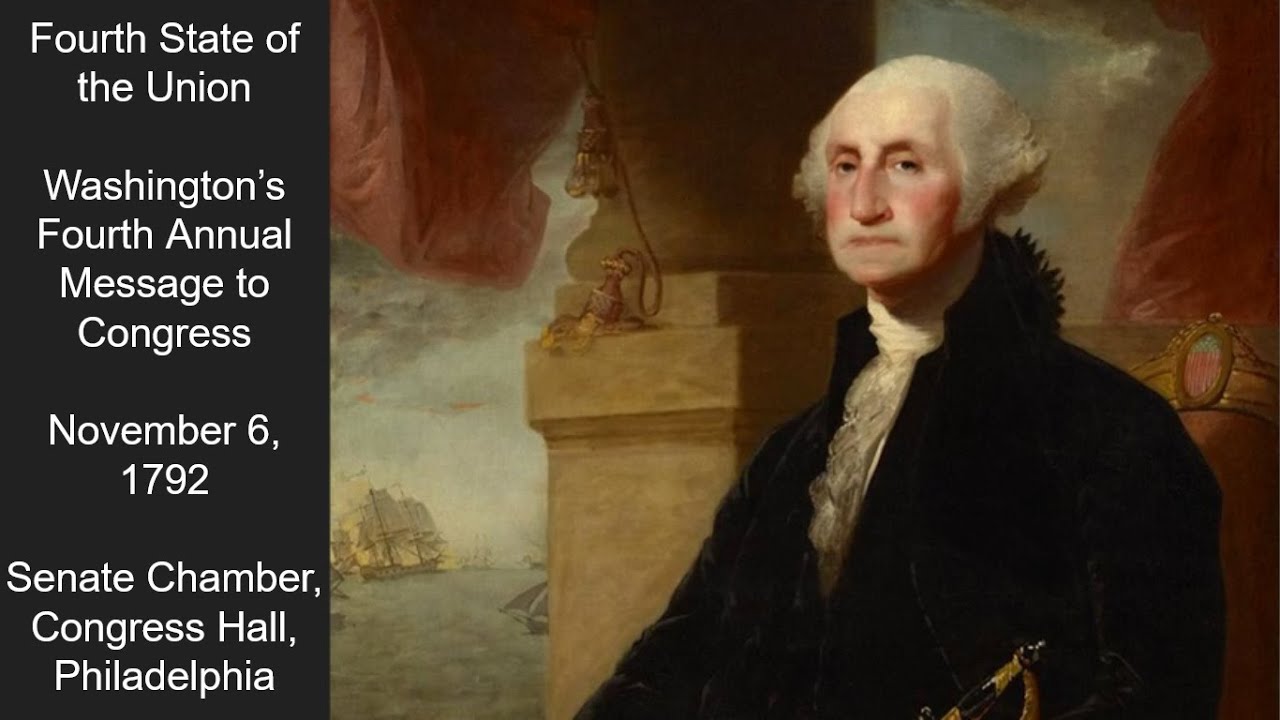
- Washington's 1792 State of the Union Address
Washington’s Fourth Annual Message United States, November 6, 1792 Fellow Citizens of the Senate and of the House of Representatives: It is some abatement of the satisfaction with which I meet you on the present occasion that, in felicitating you on a continuance of the national prosperity generally, I am not able to add to it information that the Indian hostilities which have for some time past distressed our Northwestern frontier have terminated. You will, I am persuaded, learn with no less concern than I communicate it that reiterated endeavors toward effecting a pacification have hitherto issued only in new and outrageous proofs of persevering hostility on the part of the tribes with whom we are in contest. An earnest desire to procure tranquillity to the frontier, to stop the further effusion of blood, to arrest the progress of expense, to forward the prevalent wish of the nation for peace has led to strenuous efforts through various channels to accomplish these desirable purposes; in making which efforts I consulted less my own anticipations of the event, or the scruples which some considerations were calculated to inspire, than the wish to find the object attainable, or if not attainable, to ascertain unequivocally that such is the case. A detail of the measures which have been pursued and of their consequences, which will be laid before you, while it will confirm to you the want of success thus far, will, I trust, evince that means as proper and as efficacious as could have been devised have been employed. The issue of some of them, indeed, is still depending, but a favorable one, though not to be despaired of, is not promised by anything that has yet happened. In the course of the attempts which have been made some valuable citizens have fallen victims to their zeal for the public service. A sanction commonly respected even among savages has been found in this instance insufficient to protect from massacre the emissaries of peace. It will, I presume, be duly considered whether the occasion does not call for an exercise of liberality toward the families of the deceased. It must add to your concern to be informed that, besides the continuation of hostile appearances among the tribes north of the Ohio, some threatening symptoms have of late been revived among some of those south of it. A part of the Cherokees, known by the name of Chickamaugas, inhabiting five villages on the Tennessee River, have long been in the practice of committing depredations on the neighboring settlements. It was hoped that the treaty of Holston, made with the Cherokee Nation in July, 1791, would have prevented a repetition of such depredations; but the event has not answered this hope. The Chickamaugas, aided by some banditti of another tribe in their vicinity, have recently perpetrated wanton and unprovoked hostilities upon the citizens of the United States in that quarter. The information which has been received on this subject will be laid before you. Hitherto defensive precautions only have been strictly enjoined and observed. It is not understood that any breach of treaty or aggression whatsoever on the part of the United States or their citizens is even alleged as a pretext for the spirit of hostility in this quarter. I have reason to believe that every practicable exertion has been made (pursuant to the provision by law for that purpose) to be prepared for the alternative of a prosecution of the war in the event of a failure of pacific overtures. A large proportion of the troops authorized to be raised have been recruited, though the number is still incomplete, and pains have been taken to discipline and put them in condition for the particular kind of service to be performed. A delay of operations (besides being dictated by the measures which were pursuing toward a pacific termination of the war) has been in itself deemed preferable to immature efforts. A statement from the proper department with regard to the number of troops raised, and some other points which have been suggested, will afford more precise information as a guide to the legislative consultations, and among other things will enable Congress to judge whether some additional stimulus to the recruiting service may not be advisable. In looking forward to the future expense of the operations which may be found inevitable I derive consolation from the information I receive that the product of the revenues for the present year is likely to supersede the necessity of additional burthens on the community for the service of the ensuing year. This, however, will be better ascertained in the course of the session, and it is proper to add that the information alluded to proceeds upon the supposition of no material extension of the spirit of hostility. I can not dismiss the subject of Indian affairs without again recommending to your consideration the expediency of more adequate provision for giving energy to the laws throughout our interior frontier and for restraining the commission of outrages upon the Indians, without which all pacific plans must prove nugatory. To enable, by competent rewards, the employment of qualified and trusty persons to reside among them as agents would also contribute to the preservation of peace and good neighborhood. If in addition to these expedients an eligible plan could be devised for promoting civilization among the friendly tribes and for carrying on trade with them upon a scale equal to their wants and under regulations calculated to protect them from imposition and extortion, its influence in cementing their interest with ours could not but be considerable. The prosperous state of our revenue has been intimated. This would be still more the case were it not for the impediments which in some places continue to embarrass the collection of the duties on spirits distilled within the United States. These impediments have lessened and are lessening in local extent, and, as applied to the community at large, the contentment with the law appears to be progressive. But symptoms of increased opposition having lately manifested themselves in certain quarters, I judged a special interposition on my part proper and advisable, and under this impression have issued a proclamation warning against all unlawful combinations and proceedings having for their object or tending to obstruct the operation of the law in question, and announcing that all lawful ways and means would be strictly put in execution for bringing to justice the infractors thereof and securing obedience thereto. Measures have also been taken for the prosecution of offenders, and Congress may be assured that nothing within constitutional and legal limits which may depend upon me shall be wanting to assert and maintain the just authority of the laws. In fulfilling this trust I shall count entirely upon the full cooperation of the other departments of the Government and upon the zealous support of all good citizens. I can not forbear to bring again into the view of the Legislature the subject of a revision of the judiciary system. A representation from the judges of the Supreme Court, which will be laid before you, points out some of the inconveniences that are experienced. In the course of the execution of the laws considerations arise out of the structure of the system which in some cases tend to relax their efficacy. As connected with this subject, provisions to facilitate the taking of bail upon processes out of the courts of the United States and a supplementary definition of offenses against the Constitution and laws of the Union and of the punishment for such offenses will, it is presumed, be found worthy of particular attention. Observations on the value of peace with other nations are unnecessary. It would be wise, however, by timely provisions to guard against those acts of our own citizens which might tend to disturb it, and to put ourselves in a condition to give that satisfaction to foreign nations which we may sometimes have occasion to require from them. I particularly recommend to your consideration the means of preventing those aggressions by our citizens on the territory of other nations, and other infractions of the law of nations, which, furnishing just subject of complaint, might endanger our peace with them; and, in general, the maintenance of a friendly intercourse with foreign powers will be presented to your attention by the expiration of the law for that purpose, which takes place, if not renewed, at the close of the present session. In execution of the authority given by the Legislature measures have been taken for engaging some artists from abroad to aid in the establishment of our mint. Others have been employed at home. Provision has been made of the requisite buildings, and these are now putting into proper condition for the purposes of the establishment. There has also been a small beginning in the coinage of half dimes, the want of small coins in circulation calling the first attention to them. The regulation of foreign coins in correspondency with the principles of our national coinage, as being essential to their due operation and to order in our money concerns, will, I doubt not, be resumed and completed. It is represented that some provisions in the law which establishes the post office operate, in experiment, against the transmission of news papers to distant parts of the country. Should this, upon due inquiry, be found to be the fact, a full conviction of the importance of facilitating the circulation of political intelligence and information will, I doubt not, lead to the application of a remedy. The adoption of a constitution for the State of Kentucky has been notified to me. The Legislature will share with me in the satisfaction which arises from an event interesting to the happiness of the part of the nation to which it relates and conducive to the general order. It is proper likewise to inform you that since my last communication on the subject, and in further execution of the acts severally making provision for the public debt and for the reduction thereof, three new loans have been effected, each for 3,000,000 florins - one at Antwerp, at the annual interest of 4.5%, with an allowance of 4% in lieu of all charges, in the other 2 at Amsterdam, at the annual interest of 4%, with an allowance of 5.5% in one case and of 5% in the other in lieu of all charges. The rates of these loans and the circumstances under which they have been made are confirmations of the high state of our credit abroad. Among the objects to which these funds have been directed to be applied, the payment of the debts due to certain foreign officers, according to the provision made during the last session, has been embraced. Gentlemen of the House of Representatives: I entertain a strong hope that the state of the national finances is now sufficiently matured to enable you to enter upon a systematic and effectual arrangement for the regular redemption and discharge of the public debt, according to the right which has been reserved to the Government. No measure can be more desirable, whether viewed with an eye to its intrinsic importance or to the general sentiment and wish of the nation. Provision is likewise requisite for the reimbursement of the loan which has been made of the Bank of the United States, pursuant to the eleventh section of the act by which it is incorporated. In fulfilling the public stipulations in this particular it is expected a valuable saving will be made. Appropriations for the current service of the ensuing year and for such extraordinaries as may require provision will demand, and I doubt not will engage, your early attention. Gentlemen of the Senate and of the House of Representatives: I content myself with recalling your attention generally to such objects, not particularized in my present, as have been suggested in my former communications to you. Various temporary laws will expire during the present session. Among these, that which regulates trade and intercourse with the Indian tribes will merit particular notice. The results of your common deliberations hitherto will, I trust, be productive of solid and durable advantages to our constituents, such as, by conciliating more and more their ultimate suffrage, will tend to strengthen and confirm their attachment to that Constitution of Government upon which, under Divine Providence, materially depend their union, their safety, and their happiness. Still further to promote and secure these inestimable ends there is nothing which can have a more powerful tendency than the careful cultivation of harmony, combined with a due regard to stability, in the public councils. George Washington Source: https://avalon.law.yale.edu/18th_century/washs04.asp
- Washington's Second Inaugural Address
[Philadelphia, 4 March 1793] Fellow-Citizens: I am again called upon, by the voice of my country, to execute the functions of its Chief Magistrate. When the occasion proper for it shall arrive, I shall endeavour to express the high sense I entertain of this distinguished honor, and of the confidence which has been reposed in me by the people of United America. Previous to the execution of any official act of the President, the Constitution requires an oath of office. This oath I am now about to take, and in your presence; that if it shall be found, during my administration of the Government, I have in any instance, violated, willingly or knowingly, the injunction thereof, I may (besides incurring Constitutional punishment) be subject to the upbraidings of all who are now witnesses of the present solemn ceremony.
- Adams' 1799 State of the Union Address
Adam’s Third Annual Message United States, December 3, 1799 Gentlemen of the Senate and Gentlemen of the House of Representatives: It is with peculiar satisfaction that I meet the 6th Congress of the United States of America. Coming from all parts of the Union at this critical and interesting period, the members must be fully possessed of the sentiments and wishes of our constituents. The flattering prospects of abundance from the labors of the people by land and by sea; the prosperity of our extended commerce, notwithstanding interruptions occasioned by the belligerent state of a great part of the world; the return of health, industry, and trade to those cities which have lately been afflicted with disease, and the various and inestimable advantages, civil and religious, which, secured under our happy frame of government, are continued to us unimpaired, demand of the whole American people sincere thanks to a benevolent Deity for the merciful dispensations of His providence. But while these numerous blessings are recollected, it is a painful duty to advert to the ungrateful return which has been made for them by some of the people in certain counties of Pennsylvania, where, seduced by the arts and misrepresentations of designing men, they have openly resisted the law directing the valuation of houses and lands. Such defiance was given to the civil authority as rendered hopeless all further attempts by judicial process to enforce the execution of the law, and it became necessary to direct a military force to be employed, consisting of some companies of regular troops, volunteers, and militia, by whose zeal and activity, in cooperation with the judicial power, order and submission were restored and many of the offenders arrested. Of these, some have been convicted of misdemeanors, and others, charged with various crimes, remain to be tried. To give due effect to the civil administration of Government and to insure a just execution of the laws, a revision and amendment of the judiciary system is indispensably necessary. In this extensive country it can not but happen that numerous questions respecting the interpretation of the laws and the rights and duties of officers and citizens must arise. On the one hand, the laws should be executed; on the other, individuals should be guarded from oppression. Neither of these objects is sufficiently assured under the present organization of the judicial department. I therefore earnestly recommend the subject to your serious consideration. Persevering in the pacific and humane policy which had been invariably professed and sincerely pursued by the Executive authority of the United States, when indications were made on the part of the French Republic of a disposition to accommodate the existing differences between the 2 countries, I felt it to be my duty to prepare for meeting their advances by a nomination of ministers upon certain conditions which the honor of our country dictated, and which its moderation had given it a right to prescribe. The assurances which were required of the French Government previous to the departure of our envoys have been given through their minister of foreign relations, and I have directed them to proceed on their mission to Paris. They have full power to conclude a treaty, subject to the constitutional advice and consent of the Senate. The characters of these gentlemen are sure pledges to their country that nothing incompatible with its honor or interest, nothing inconsistent with our obligations of good faith or friendship to any other nation, will be stipulated. It appearing probable from the information I received that our commercial intercourse with some ports in the island of St. Domingo might safely be renewed, I took such steps as seemed to me expedient to ascertain that point. The result being satisfactory, I then, in conformity with the act of Congress on the subject, directed the restraints and prohibitions of that intercourse to be discontinued on terms which were made known by proclamation. Since the renewal of this intercourse our citizens trading to those ports, with their property, have been duly respected, and privateering from those ports has ceased. In examining the claims of British subjects by the commissioners at Philadelphia, acting under the 6th article of the treaty of amity, commerce, and navigation with Great Britain, a difference of opinion on points deemed essential in the interpretation of that article has arisen between the commissioners appointed by the United States and the other members of that board, from which the former have thought it their duty to withdraw. It is sincerely to be regretted that the execution of an article produced by a mutual spirit of amity and justice should have been thus unavoidably interrupted. It is, however, confidently expected that the same spirit of amity and the same sense of justice in which it originated will lead to satisfactory explanations. In consequence of the obstacles to the progress of the commission in Philadelphia, His Britannic Majesty has directed the commissioners appointed by him under the 7th article of the treaty relating to the British captures of American vessels to withdraw from the board sitting in London, but with the express declaration of his determination to fulfill with punctuality and good faith the engagements which His Majesty has contracted by his treaty with the United States, and that they will be instructed to resume their functions whenever the obstacles which impede the progress of the commission at Philadelphia shall be removed. It being in like manner my sincere determination, so far as the same depends on me, that with equal punctuality and good faith the engagements contracted by the United States in their treaties with His Britannic Majesty shall be fulfilled, I shall immediately instruct our minister at London to endeavor to obtain the explanation necessary to a just performance of those engagements on the part of the United States. With such dispositions on both sides, I can not entertain a doubt that all difficulties will soon be removed and that the 2 boards will then proceed and bring the business committed to them respectively to a satisfactory conclusion. The act of Congress relative to the seat of the Government of the United States requiring that on the 1st Monday of December next it should be transferred from Philadelphia to the District chosen for its permanent seat, it is proper for me to inform you that the commissioners appointed to provide suitable buildings for the accommodation of Congress and of the President and of the public offices of the Government have made a report of the state of the buildings designed for those purposes in the city of Washington, from which they conclude that the removal of the seat of Government to that place at the time required will be practicable and the accommodation satisfactory. Their report will be laid before you. Gentlemen of the House of Representatives: I shall direct the estimates of the appropriations necessary for the service of the ensuing year, together with an account of the revenue and expenditure, to be laid before you. During a period in which a great portion of the civilized world has been involved in a war unusually calamitous and destructive, it was not to be expected that the United States could be exempted from extraordinary burthens. Although the period is not arrived when the measures adopted to secure our country against foreign attacks can be renounced, yet it is alike necessary for the honor of the Government and the satisfaction of the community that an exact economy should be maintained. I invite you, gentlemen, to investigate the different branches of the public expenditure. The examination will lead to beneficial retrenchments or produce a conviction of the wisdom of the measures to which the expenditure relates. Gentlemen of the Senate and Gentlemen of the House of Representatives: At a period like the present, when momentous changes are occurring and every hour is preparing new and great events in the political world, when a spirit of war is prevalent in almost every nation with whose affairs the interests of the United States have any connection, unsafe and precarious would be our situation were we to neglect the means of maintaining our just rights. The result of the mission to France is uncertain; but however it may terminate, a steady perseverance in a system of national defense commensurate with our resources and the situation of our country is an obvious dictate of wisdom; for, remotely as we are placed from the belligerent nations, and desirous as we are, by doing justice to all, to avoid offense to any, nothing short of the power of repelling aggressions will secure to our country a rational prospect of escaping the calamities of war or national degradation. As to myself, it is my anxious desire so to execute the trust reposed in me as to render the people of the United States prosperous and happy. I rely with entire confidence on your cooperation in objects equally your care, and that our mutual labors will serve to increase and confirm union among our fellow citizens and an unshaken attachment to our Government. Source: https://avalon.law.yale.edu/18th_century/adamsme3.asp
- Louisiana Purchase
Louisiana Purchase Treaty April 30, 1803 TREATY BETWEEN THE UNITED STATES OF AMERICA AND THE FRENCH REPUBLIC The President of the United States of America and the First Consul of the French Republic in the name of the French People desiring to remove all Source of misunderstanding relative to objects of discussion mentioned in the Second and fifth articles of the Convention of the 8th Vendémiaire an 9 (30 September 1800) relative to the rights claimed by the United States in virtue of the Treaty concluded at Madrid the 27 of October 1795, between His Catholic Majesty & the Said United States, & willing to Strengthen the union and friendship which at the time of the Said Convention was happily reestablished between the two nations have respectively named their Plenipotentiaries to wit The President of the United States, by and with the advice and consent of the Senate of the Said States; Robert R. Livingston Minister Plenipotentiary of the United States and James Monroe Minister Plenipotentiary and Envoy extraordinary of the Said States near the Government of the French Republic; And the First Consul in the name of the French people, Citizen Francis Barbé Marbois Minister of the public treasury who after having respectively exchanged their full powers have agreed to the following Articles. Article I Whereas by the Article the third of the Treaty concluded at St Ildefonso the 9th Vendémiaire an 9 (1st October) 1800 between the First Consul of the French Republic and his Catholic Majesty it was agreed as follows. "His Catholic Majesty promises and engages on his part to cede to the French Republic six months after the full and entire execution of the conditions and Stipulations herein relative to his Royal Highness the Duke of Parma, the Colony or Province of Louisiana with the Same extent that it now has in the hand of Spain, & that it had when France possessed it; and Such as it Should be after the Treaties subsequently entered into between Spain and other States." And whereas in pursuance of the Treaty and particularly of the third article the French Republic has an incontestible title to the domain and to the possession of the said Territory--The First Consul of the French Republic desiring to give to the United States a strong proof of his friendship doth hereby cede to the United States in the name of the French Republic for ever and in full Sovereignty the said territory with all its rights and appurtenances as fully and in the Same manner as they have been acquired by the French Republic in virtue of the above mentioned Treaty concluded with his Catholic Majesty. Art: II In the cession made by the preceeding article are included the adjacent Islands belonging to Louisiana all public lots and Squares, vacant lands and all public buildings, fortifications, barracks and other edifices which are not private property.--The Archives, papers & documents relative to the domain and Sovereignty of Louisiana and its dependances will be left in the possession of the Commissaries of the United States, and copies will be afterwards given in due form to the Magistrates and Municipal officers of such of the said papers and documents as may be necessary to them. Art: III The inhabitants of the ceded territory shall be incorporated in the Union of the United States and admitted as soon as possible according to the principles of the federal Constitution to the enjoyment of all these rights, advantages and immunities of citizens of the United States, and in the mean time they shall be maintained and protected in the free enjoyment of their liberty, property and the Religion which they profess. Art: IV There Shall be Sent by the Government of France a Commissary to Louisiana to the end that he do every act necessary as well to receive from the Officers of his Catholic Majesty the Said country and its dependances in the name of the French Republic if it has not been already done as to transmit it in the name of the French Republic to the Commissary or agent of the United States. Art: V Immediately after the ratification of the present Treaty by the President of the United States and in case that of the first Consul's shall have been previously obtained, the commissary of the French Republic shall remit all military posts of New Orleans and other parts of the ceded territory to the Commissary or Commissaries named by the President to take possession--the troops whether of France or Spain who may be there shall cease to occupy any military post from the time of taking possession and shall be embarked as soon as possible in the course of three months after the ratification of this treaty. Art: VI The United States promise to execute Such treaties and articles as may have been agreed between Spain and the tribes and nations of Indians until by mutual consent of the United States and the said tribes or nations other Suitable articles Shall have been agreed upon. Art: VII As it is reciprocally advantageous to the commerce of France and the United States to encourage the communication of both nations for a limited time in the country ceded by the present treaty until general arrangements relative to commerce of both nations may be agreed on; it has been agreed between the contracting parties that the French Ships coming directly from France or any of her colonies loaded only with the produce and manufactures of France or her Said Colonies; and the Ships of Spain coming directly from Spain or any of her colonies loaded only with the produce or manufactures of Spain or her Colonies shall be admitted during the Space of twelve years in the Port of New-Orleans and in all other legal ports-of-entry within the ceded territory in the Same manner as the Ships of the United States coming directly from France or Spain or any of their Colonies without being Subject to any other or greater duty on merchandize or other or greater tonnage than that paid by the citizens of the United States. During that Space of time above mentioned no other nation Shall have a right to the Same privileges in the Ports of the ceded territory--the twelve years Shall commence three months after the exchange of ratifications if it Shall take place in France or three months after it Shall have been notified at Paris to the French Government if it Shall take place in the United States; It is however well understood that the object of the above article is to favour the manufactures, Commerce, freight and navigation of France and of Spain So far as relates to the importations that the French and Spanish Shall make into the Said Ports of the United States without in any Sort affecting the regulations that the United States may make concerning the exportation of the produce and merchandize of the United States, or any right they may have to make Such regulations. Art: VIII In future and for ever after the expiration of the twelve years, the Ships of France shall be treated upon the footing of the most favoured nations in the ports above mentioned. Art: IX The particular Convention Signed this day by the respective Ministers, having for its object to provide for the payment of debts due to the Citizens of the United States by the French Republic prior to the 30th Sept. 1800 (8th Vendémiaire an 9) is approved and to have its execution in the Same manner as if it had been inserted in this present treaty, and it Shall be ratified in the same form and in the Same time So that the one Shall not be ratified distinct from the other. Another particular Convention Signed at the Same date as the present treaty relative to a definitive rule between the contracting parties is in the like manner approved and will be ratified in the Same form, and in the Same time and jointly. Art: X The present treaty Shall be ratified in good and due form and the ratifications Shall be exchanged in the Space of Six months after the date of the Signature by the Ministers Plenipotentiary or Sooner if possible. In faith whereof the respective Plenipotentiaries have Signed these articles in the French and English languages; declaring nevertheless that the present Treaty was originally agreed to in the French language; and have thereunto affixed their Seals. Done at Paris the tenth day of Floreal in the eleventh year of the French Republic; and the 30th of April 1803. Robt R Livingston Jas. Monroe Barbé Marbois A CONVENTION BETWEEN THE UNITED STATES OF AMERICA AND THE FRENCH REPUBLIC The President of the United States of America and the First Consul of the French Republic in the name of the French people, in consequence of the treaty of cession of Louisiana which has been Signed this day; wishing to regulate definitively every thing which has relation to the Said cession have authorized to this effect the Plenipotentiaries, that is to say the President of the United States has, by and with the advice and consent of the Senate of the Said States, nominated for their Plenipoten tiaries, Robert R. Livingston, Minister Plenipotentiary of the United States, and James Monroe, Minister Plenipotentiary and Envoy-Extraordinary of the Said United States, near the Government of the French Republic; and the First Consul of the French Republic, in the name of the French people, has named as Pleniopotentiary of the Said Republic the citizen Francis Barbé Marbois: who, in virtue of their full powers, which have been exchanged this day, have agreed to the followings articles: Art: 1 The Government of the United States engages to pay to the French government in the manner Specified in the following article the sum of Sixty millions of francs independant of the Sum which Shall be fixed by another Convention for the payment of the debts due by France to citizens of the United States. Art: 2 For the payment of the Sum of Sixty millions of francs mentioned in the preceeding article the United States shall create a Stock of eleven millions, two hundred and fifty thousand Dollars bearing an interest of Six percent per annum payable half yearly in London Amsterdam or Paris amounting by the half year to three hundred and thirty Seven thousand five hundred Dollars, according to the proportions which Shall be determined by the french Govenment to be paid at either place: The principal of the Said Stock to be reimbursed at the treasury of the United States in annual payments of not less than three millions of Dollars each; of which the first payment Shall commence fifteen years after the date of the exchange of ratifications:--this Stock Shall be transferred to the government of France or to Such person or persons as Shall be authorized to receive it in three months at most after the exchange of ratifications of this treaty and after Louisiana Shall be taken possession of the name of the Government of the United States. It is further agreed that if the french Government Should be desirous of disposing of the Said Stock to receive the capital in Europe at Shorter terms that its measures for that purpose Shall be taken So as to favour in the greatest degree possible the credit of the United States, and to raise to the highest price the Said Stock. Art 3 It is agreed that the Dollar of the United States Specified in the present Convention shall be fixed at five francs 3333/100000 or five livres eight Sous tournois. The present Convention Shall be ratified in good and due form, and the ratifications Shall be exchanged the Space of Six months to date from this day or Sooner it possible. In faith of which the respective Plenipotentiaries have Signed the above articles both in the french and english languages, declaring nevertheless that the present treaty has been originally agreed on and written in the french language; to which they have hereunto affixed their Seals. Done at Paris the tenth of Floreal eleventh year of the french Republic 30th April 1803 . Robt R Livingston Jas. Monroe Barbé Marbois CONVENTION BETWEEN THE UNITED STATES OF AMERICA AND THE FRENCH REPUBLIC The President of the United States of America and the First Consul of the French Republic in the name of the French People having by a Treaty of this date terminated all difficulties relative to Louisiana, and established on a Solid foundation the friendship which unites the two nations and being desirous in complyance with the Second and fifth Articles of the Convention of the 8th Vendémiaire ninth year of the French Republic (30th September 1800) to Secure the payment of the Sums due by France to the citizens of the United States have respectively nominated as Plenipotentiaries that is to Say The President of the United States of America by and with the advise and consent of their Senate Robert R. Livingston Minister Plenipotentiary and James Monroe Minister Plenipotentiary and Envoy Extraordinary of the Said States near the Government of the French Republic: and the First Consul in the name of the French People the Citizen Francis Barbé Marbois Minister of the public treasury; who after having exchanged their full powers have agreed to the following articles. Art: 1 The debts due by France to citizens of the United States contracted before the 8th Vendémiaire ninth year of the French Republic (30th September 1800) Shall be paid according to the following regulations with interest at Six per Cent; to commence from the period when the accounts and vouchers were presented to the French Government. Art: 2 The debts provided for by the preceeding Article are those whose result is comprised in the conjectural note annexed to the present Convention and which, with the interest cannot exceed the Sum of twenty millions of Francs. The claims comprised in the Said note which fall within the exceptions of the following articles, Shall not be admitted to the benefit of this provision. Art: 3 The principal and interests of the Said debts Shall be discharged by the United States, by orders drawn by their Minister Plenipotentiary on their treasury, these orders Shall be payable Sixty days after the exchange of ratifications of the Treaty and the Conventions Signed this day, and after possession Shall be given of Louisiana by the Commissaries of France to those of the United States. Art: 4 It is expressly agreed that the preceding articles Shall comprehend no debts but Such as are due to citizens of the United States who have been and are yet creditors of France for Supplies for embargoes and prizes made at Sea, in which the appeal has been properly lodged within the time mentioned in the Said Convention 8th Vendémiaire ninth year, (30th Sept 1800) Art: 5 The preceding Articles Shall apply only, First: to captures of which the council of prizes Shall have ordered restitution, it being well understood that the claimant cannot have recourse to the United States otherwise than he might have had to the Government of the French republic, and only in case of insufficiency of the captors--2d the debts mentioned in the Said fifth Article of the Convention contracted before the 8th Vendémiaire an 9 (30th September 1800) the payment of which has been heretofore claimed of the actual Government of France and for which the creditors have a right to the protection of the United States;-- the Said 5th Article does not comprehend prizes whose condemnation has been or Shall be confirmed: it is the express intention of the contracting parties not to extend the benefit of the present Convention to reclamations of American citizens who Shall have established houses of Commerce in France, England or other countries than the United States in partnership with foreigners, and who by that reason and the nature of their commerce ought to be regarded as domiciliated in the places where Such house exist.--All agreements and bargains concerning merchandize, which Shall not be the property of American citizens, are equally excepted from the benefit of the said Conventions, Saving however to Such persons their claims in like manner as if this Treaty had not been made. Art: 6 And that the different questions which may arise under the preceding article may be fairly investigated, the Ministers Plenipotentiary of the United States Shall name three persons, who Shall act from the present and provisionally, and who shall have full power to examine, without removing the documents, all the accounts of the different claims already liquidated by the Bureaus established for this purpose by the French Republic, and to ascertain whether they belong to the classes designated by the present Convention and the principles established in it or if they are not in one of its exceptions and on their Certificate, declaring that the debt is due to an American Citizen or his representative and that it existed before the 8th Vendémiaire 9th year (30 September 1800) the debtor shall be entitled to an order on the Treasury of the United States in the manner prescribed by the 3d Article. Art: 7 The Same agents Shall likewise have power, without removing the documents, to examine the claims which are prepared for verification, and to certify those which ought to be admitted by uniting the necessary qualifications, and not being comprised in the exceptions contained in the present Convention. Art: 8 The Same agents Shall likewise examine the claims which are not prepared for liquidation, and certify in writing those which in their judgement ought to be admitted to liquidation. Art: 9 In proportion as the debts mentioned in these articles Shall be admitted they Shall be discharged with interest at Six per Cent: by the Treasury of the United States. Art: 10 And that no debt shall not have the qualifications above mentioned and that no unjust or exorbitant demand may be admitted, the Commercial agent of the United States at Paris or such other agent as the Minister Plenipotentiary or the United States Shall think proper to nominate shall assist at the operations of the Bureaus and cooperate in the examinations of the claims; and if this agent Shall be of the opinion that any debt is not completely proved, or if he shall judge that it is not comprised in the principles of the fifth article above mentioned, and if notwithstanding his opinion the Bureaus established by the french Government should think that it ought to be liquidated, he shall transmit his observations to the board established by the United States, who, without removing documents, shall make a complete examination of the debt and vouchers which Support it, and report the result to the Minister of the United States.--The Minister of the United States Shall transmit his observations in all Such cases to the Minister of the treasury of the French Republic, on whose report the French Government Shall decide definitively in every case. The rejection of any claim Shall have no other effect than to exempt the United States from the payment of it, the French Government reserving to itself, the right to decide definitively on Such claim So far as it concerns itself. Art: 11 Every necessary decision Shall be made in the course of a year to commence from the exchange of ratifications, and no reclamation Shall be admitted afterwards. Art: 12 In case of claims for debts contracted by the Government of France with citizens of the United States Since the 8th Vendé miaire 9th year/30 September 1800 not being comprised in this Convention may be pursued, and the payment demanded in the Same manner as if it had not been made. Art: 13 The present convention Shall be ratified in good and due form and the ratifications Shall be exchanged in Six months from the date of the Signature of the Ministers Plenipotentiary, or Sooner if possible. In faith of which, the respective Ministers Plenipotentiary have signed the above Articles both in the french and english languages, declaring nevertheless that the present treaty has been originally agreed on and written in the french language, to which they have hereunto affixed their Seals. Done at Paris, the tenth of Floreal, eleventh year of the French Republic. 30th April 1803. Robt R Livingston Jas. Monroe Barbé Marbois Source: https://www.ourdocuments.gov/doc.php?flash=false&doc=18&page=transcript
- Admission of Ohio
ACT RECOGNIZING THE STATE OF OHIO February 19, 1803 [Seventh Congress, Second Session] An Act to provide for the due execution of the laws of the United States within the State of Ohio. Whereas the people of the eastern division of the Territory northwest of the river Ohio did, on the twenty-ninth day of November, one thousand eight hundred and two, form for themselves a constitution and State government, and did give to the said State the name of the “State of Ohio,” in pursuance of an act of Congress entitled “An act to enable the people of the eastern division of the territory northwest of the river Ohio to form a constitution and State government, and for the admission of such State into the Union on an equal footing with the original States, and for other purposes,” whereby the said State has become one of the United States of America; in order, therefore, to provide for the due execution of the laws of the United States within the said State of Ohio— Be it enacted by the Senate and House of Representatives of the United States of America in Congress assembled, That all the laws of the United States which are not locally inapplicable shall have the same force and effect within the said State of Ohio as elsewhere within the United States. Sec. 2. Be it further enacted, That the said State shall be one district and be called the Ohio district, and a district court shall be held therein, to consist of one judge, who shall reside in the said district, and be called a district judge. He shall hold at the seat of government of the said State three sessions annually; the first to commence on the first Monday in June next, and the two other sessions progressively on the like Monday of every fourth calendar month afterwards, and he shall, in all things, have and exercise the same jurisdiction and powers which are by law given to the judge of the Kentucky district; he shall appoint a clerk for the said district, who shall reside and keep the records of the court at the place of holding the same, and shall receive for the services performed by him the same fees to which the clerk of the Kentucky district is entitled for similar services. Sec. 3. Be it further enacted, That there shall be allowed to the judge of the said district court the annual compensation of one thousand dollars, to commence from the date of his appointment, to be paid quarter-yearly at the Treasury of the United States. Sec. 4. Be it further enacted, That there shall be appointed in the said district a person learned in the law to act as attorney for the United States, who shall, in addition to his stated fees, be paid by the United States two hundred dollars annually, as a full compensation for all extra services. Sec. 5. And be it further enacted, That a marshal shall be appointed for the said district, who shall perform the same duties, be subject to the same regulations and penalties, and be entitled to the same fees as are prescribed to marshals in other districts, and shall moreover be entitled to the sum of two hundred dollars annually, as a compensation for all extra services. Approved, February 19, 1803. Source: The Federal and State Constitutions, Colonial Charters, and other Organic Laws of the States and Territories now or heretofore forming the United States of America, compiled and edited by Francis Newton Thorpe (Washington: Government Printing Office, 1909). Vol. V New Jersey-Philippine Islands. https://oll.libertyfund.org/title/thorpe-the-federal-and-state-constitutions-vol-v-new-jersey-philippine-islands#lf1514-05_head_218