Search this site
1696 results found with an empty search
- First Slaves Sold in Virginia
Letter on the First African Slaves Sold in Virginia August 1619 Letter to Sir Edwin Sandys, treasurer of the Virginia Company of London, by the Jamestown colonist John Rolfe describes events in the Virginia colony in the years of 1619 and 1620. Honored Sir Studieng with my self what service I might doe yow, as a token of my gratefull rememberance for yor many favors and constant love shewed me, aswell in my absence as when I was present with yow I could not at this tyme devise a better, then to give yow notice of some pticulers both of our present estate, and what happened since the departure of the Diana. And though I am well assured, yow wilbe satisfied herin more fully by our Governor, yet I desire your kind acceptance of this my poore indeavor. Presently after the Diana hadd her dispatch Sir George Yeardley (according to a Commyssion directed unto him and to the Councell of State,) caused Burgesses to be chosen in all places who mett at James City, where all matters therin conteyned were debated by severall Commyttees and approved: and likewise such other lawes enacted, as were held expedient & requisite for the welfare and peaceable govermt of this Common-weale. Captaine Martines Burgesses for his Plataccon were not admitted to this Assembly, the reasons I am assured yow shall receive from our Governor, who sendeth home a report of all those proceedings. These principall men being at James Citie, Capten William Epps (who commandeth Smythes Hundred Company) was arraigned (as neere as might be) according to the lawdable Lawes of England, for killing one Captaine Edward Roecroft alias Stallenge. He came hether from the North Colony in a ship of Sir fferdinando Gorges (as he sayd) for some necessaries which he wanted; and to coast along the shoare to fynd and discover what Harbors and rivers he could: but through neglect of the Master of the shipp and others she was forced a ground in a storme neere Newports Newes, and there sprang so greate a leake, that he could not carry her back againe. This myschance happened through uncivill and unmanly words urged by Stallenge (there being no precedent malice) with which ot long after restored him to his Command. Captaine Henry Spelman being accused by Roberte Poole (one of the interpretors of the Indian language) of many crimes which might be prejudiciall to the State in generall, and to every mans safety in particular, received Censure at this generall Assembly. But the Governor hoping he might redeeme his faults being proceeding much of Childishe This document appears in the Compendium: Chapter 2 Arrival of the First Africans to Virginia — Sydney King Annotation: The first recorded sale of African slaves in Virginia took place in 1619 at Point Comfort (present-day Hampton, Virginia). A ship of approximately 20 Africans, captured from a Portuguese slave ship and traded by English privateers, was brought to the colony and sold to local planters. This event marked the beginning of the system of African chattel slavery in English North America, introducing a labor force that would become central to the colony’s tobacco economy and establishing a racialized institution that shaped the social, economic, and legal development of Virginia and other future colonies. Author: John Rolfe & Pocahontas — ca. 1850 Transcript Source: https://encyclopediavirginia.org/entries/twenty-and-odd-negroes-an-excerpt-from-a-letter-from-john-rolfe-to-sir-edwin-sandys-1619-1620/ . ignorance, pardoned the punishment upon hope of amendment. In trial whereof he was ymploied as interpretor to Patawamack to trade for Corne. About the latter end of August, a Dutch man of Warr of the burden of a 160 tunnes arrived at Point-Comfort, the Comandors name Capt Jope, his Pilott for the West Indies one Mr Marmaduke an Englishman. They mett with the Treasurer in the West Indyes, and determined to hold consort shipp hetherward, but in their passage lost one the other. He brought not any thing but 20. and odd Negroes, which the Governor and Cape Marchant bought for victualls (whereof he was in greate need as he pretended) at the best and easyest rates they could. He hadd a lardge and ample Commyssion from his Excellency to range and to take purchase in the West Indyes. Three or 4. daies after the Treasurer arrived. At his arrivall he sent word presently to the Governor to know his pleasure, who wrote to him, and did request myself and Leiftenante Peace and Mr Ewens to goe downe to him, to desyre him to come up to James Cytie. But before we gott downe he hadd sett saile and was gone out of the Bay. The occasion hereof happened by the unfrendly dealing of the Inhabitants of Keqnoughton, for he was in greate want of victualls, wherewith they would not releive him nor his Company upon any termes. He reported (whilst he staied at Keqnoughton) that if wee got not some Ord’nance planted at Point Comfort, the Colony would be quyte undone and that ere long: for that undoubtedly the Spanyard would be here the next spring wch he gathered (as was sayd) from some Spanyards in the West Indyes. This being spread abroade doth much disharten the people ingenerall. ffor wee have no place of strength to retreate unto, no shipping of certeynty (wch would be to us as the wodden walles of England) no sound and experienced souldyers to undertake, no Engineers and arthmen to erect works, few Ordenance, not a serviceable carriadge to mount them on; not Ammunycon of powlder, shott and leade, to fight and 2. wholl dayes, no not one gunner belonging to the Plantaccon, so your Honors our soveraignes dignity, your honors our poore reputacons lives and labors thus long spent lieth too open to a suddayne, and to an inevitable hazard, if a forroigne enemy oppose against us. Of this I cannot better doe, to give yow full satisfaccon, then to referr yow to the judgement and opynion of Capt Argall who hath often spoken and herof during his goverment, and knoweth (none better) these defects. About the begynnyng of September J-apazous (the King of Patawamacks brother) came to James Cyty to the Governor. Amongst other frivoulous messages he requested, that 2. shipps might be speedyly to Patawamack where they should trade for greate stoore of corne. Hereupon (according to his desyre) the Governor sent an Englishman with him by land, and in the begynning of October, Capt Wards ship and Sommer-Iselands frigate departed James Cyty hether-ward. Roberte Poole being whole ymployed by the Governor of messages to the greate King, perswaded Sir George, that if he would send Pledges he would, he would come to visite him. Our Corne and Tobacco being in great aboundance in our grounds (for a more plentyfull yere then this, it hath not pleased God to send us since the beginning of the Plantaccon, yet very contagious for sycknes, whereof many both old and new men died) the Governor sent two men unto him, who were returned with frivoulous aunsweres, sayng he never hadd any intent to come unto him. The Governor being jealous of them (the rather because wee hadd many straggling Plantaccons, much weakened by the greate mortality, Poole lykewise proving very dishonest) requested Captaine William Powell and myself (for Opachankano professeth much love to me, and giveth much credite to my words) to goe in a shallopp unto Pomonkey ryver: wch wee did. Going up that ryver within 5. myles of his house wee sent Capt Spelman and Tho: Hobson unto him with the Governors message. The shipp and frigate (being not farr out of their way to Patawamack) went in the night about 12. myles into the river, and wee hasting upp wth our shallopp, the messengers were with Opaihankano, before or asone as any newes came to him eyther of the shipps or our arrivall, wch much daunted them and putt then in greate feare. Their intertayment at first was harshe, (Poole being even turned heathen) but after their message was delyvered, it was kindly taken, they sent away lovingly, and Poole accused and Condemned by them, as an instrument that sought all the meanes he could to breake our league. They seemed also to be very weary of him. Sh Opachankano much wondered I would not goe to him, but (as I wished the messengers) they said I was syck of an ague, wherewith they was were satisfied. Wee hadd no order to bring Poole away, nor to make any shew of discontent to him, for feare he should perswade them to some myscheif in our corne feilds, hoping to gett him away by fayre meanes. So wee returned in greate love and amyty to the greate content of the Colony, wch before lived in dayly hazard, all messages being untruly delyvered by Poole on both sides. The Chikahomynies come not at us, but wee receyve no domage by them. Thus ffarr farr as parte of my duty (ever ready at your service) have I breifly made knowen unto yow, some partyculers of our estate: and withall in conclusion cannot chose but reveale unto yow the sorrow I conceyve, to heare of the many accusaccons heaped upon Captaine Argall, with whom my reputaccon hath bene unjustly jointed but I am perswaded he will aunswere well for himself. Here have also bene divers deposyccons taken and sent home by the Diana, I will tax no man therein: but when it shall come to farther triall, I assure yow that yow shall fynd many dishonest and faithles men to Captaine Argall, who have receyved much kindnes at his hands & to his face will contradict, and be ashamed of much, wch in his absence they have intymated against him. Lastly, I speake on my owne experience for these 11. yeres, I never amongst so few, have seene so many falseharted, envious and malicious people (yea amongst some who march in the better ranck) nor shall yow ever heare of any the justest Governor here, who shall live free, from their scandalls and shameles exclamaccons, if way be given to their reports. And so desyring your kind acceptance hereof, being unwilling to conceale any thing from yourself (who now, to myne and many others comforts, standeth at the helme to guide us and bring us to our the Port of our best happyness, wch of late wee say principally by your goodnes wee now injoy) eyther wch yow may be desirous to understand or wch may further yow for the advauncement of this Christian Plantaccon I take my leave, and will ever rest At your service and commaund in all faithfull dutyes Jo: Rolf
- Laws enacted by the First General Assembly of Virginia
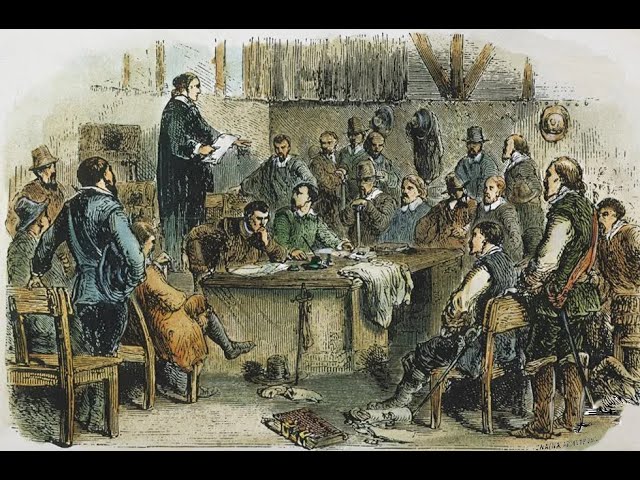
Laws enacted by the First General Assembly of Virginia July 30, 1619 Laws enacted by the First General Assembly of Virginia By this present General Assembly be it enacted that no injury or oppression be wrought by the English against the Indians whereby the present peace might be distributed and ancient quarrels might be revived. And farther be it ordained that the Chicohomini are not to be excepted out of this law, until either that such order come out of England or that they do provoke us by some new injury. Against idleness, gaming, drunkenness, and excess in apparel the assembly has enacted as follows. First, in detestation of idlers, be it enacted that if any man be found to live as an idler or renegade, though a freed man, it shall be lawful for that incorporation or plantation to which he belongs to appoint him a master to serve for wages till he shows apparent signs of amendment. Against gaming at dice and cards be it ordained by this present assembly that the winner or winners shall lose all his or their winnings and both winners and losers shall forfeit ten shillings a man, one ten shillings whereof to go to the discoverer and the rest to charitable and pious uses in the incorporation where the faults are committed. Against drunkeness be it also decreed that if any private prsons be found culpable thereof, for the first time he is to be reproved privately by the minister, the second time publicly, the third time to lie in bolts 12 hours in the house of the provost marshal and to pay his fees, and if he still continue in that vice to undergo such severe punishment as the Governor and Council of Estate shall thinke fit to be inflicted on him. But if any officer offend in this crime, the first time he shall receive a reproof from the Governor, the second time he shall openly be reproved in the church by the This document appears in the Compendium: Chapter 2 Annotation: The House of Burgesses convened for its first legislative assembly at Jamestown marking the beginning of representative government in English North America. Composed of elected burgesses from Virginia’s settlements and presided over by colonial officials such as Governor Sir George Yeardley, the body enacted local laws addressing trade, labor, and colonial governance, establishing a precedent for self-government that would later influence political development in British America. Author: First Legislature in the New World, etc. — Jack Clifton Transcript Source: https://oll.libertyfund.org/pages/1619-laws-enacted-by-the-first-general-assembly-of-virginia minister, and the third time he shall first be committed and then degraded. Provided it be understood that the Governor has always power to restore him when he shall, in his discretion, think fit. Against excess of apparel, that every man be assessed in the church for all public contributions, if he be unmarried according to his own apparel, if he be married, according to his own and his wife’s or either of their apparel. As touching the instruction of drawing some of the better disposed of the Indians to converse with our people and to live and labor among them, the assembly, who know well their dispositions, think it fit to enjoin at least to counsel those of the colony neither utterly to reject them nor yet to draw them to come in. But in case they will of themselves come voluntarily to places well peopled, there to do service in killing of deer, fishing, beating corn, and other works, that then five or six may be admitted into every such place and no more, and that with the consent of the Governor, provided that good guard in the night be kept upon them, for generally, though some among many may prove good, they are a most treacherous people and quickly gone when they have done a villainy. And it were fit a house were built for them to lodge in apart by themselves, and lone inhabitants by no means to entertain them. Be it enacted by this present assembly that for laying a surer foundation of the conversion of the Indians to Christian religion, each town, city, borough, and particular plantation do obtain unto themselves by just means a certain number of the native’s children to be educated by them in true religion and civil course of life. Of which children the most towardly boys in wit and graces of nature to be brought up by them in the first elements of literature, so as to be fitted for the college intended for them, that from thence they may be sent to that work of conversion. As touching the business of planting corn, this present assembly does ordain that, year by year, all and every householder and householders have in store for every servant he or they shall keep, and also for his or their own persons, whether they have any servants or no, one spare barrel of corn to be delivered out yearly either upon sale or exchange, as need shall require. For the neglect of which duty he shall be subject to the censure of the Governor and Council of Estate; provided always, that for the first year of every new man this law shall not be in force. About the plantation of mulberry trees, be it enacted that every man, as he is seated upon his division does, for seven years together, every year plant and maintain in growth six mulberry trees at the least and as many more as he shall think convenient and as his virtue and industry shall move him to plant; and that all such persons as shall neglect the yearly planting and maintaining of that small proportion shall be subject to the censure of the Governor and the Councel of Estate. Be it further enacted, as concerning silk flax, that those men that are upon their division or settled habitation do this next year plant and dress 100 plants which being found a commodity may farther be increased. And whosoever do fail in the performance of this shall be subject to the punishment of the Governor and Council of Estate. For hemp also, both English and Indian, and for English flax and aniseeds, we do require and enjoin all householders of this colony, that have any of those seeds, to make trial thereof the next season. Moreover, be it enacted by this present assembly that every householder does yearly plant and maintain ten vines, until they have attained to the art and experience of dressing a vineyard, either by their own industry or by the instruction of some vigneron. And that upon what penalty soever the Governor and Council of Estate shall think fit to impose upon the neglecters of this act. Be it also enacted that all necessary tradesmen, or so many as need shall require, such as are come over since the departure of Sir Thomas Dale or that shall hereafter come, shall work at their trades for any other man; each one being paid according to the quality of his trade and work, to be estimated, if he shall not be contented, by the Governor and officers of the place where he works. Be it further ordained by this General Assembly, and we do by these presents enact, that all contracts made in England between the owners of land and their tenants and servants which they shall send hither may be caused to be duly performed and that the offenders be punished as the Governor and Council of Estate shall think just and convenient. Be it established also by this present assembly that no crafty or advantageous means be suffered to be put in practice for the enticing away the tenants and servants of any particular plantation from the place where they are seated. And that it shall be the duty of the Governor and Council of Estate most severely to punish both the seducers and the seduced and to return these latter into their former places. Be it further enacted that the orders for the magazine lately made be exactly kept and that the magazine be preserved from wrong and sinister practices and that, according to the orders of court in England, all tobacco and sassafras be brought by the planters to the cape merchant till such time as all the goods now or heretofore sent for the magazine be taken off their hands at the prices agreed on, that by this means the same going for England into one hand the price thereof may be upheld the better. And to the end that all the whol colony may take notice of the last order of court made in England, and all those whom it concerns may know how to observe it, we hold it fit to publish it here for a law among the rest of our laws, the which orders is as follows. Upon the 26th of October 1618, it was ordered that the magazine should continue during the term formerly prefixed and that certain abuses now complained of should be reformed; and that for preventing of all impositions, save the allowance of 25 in the hundred profit the Governor shall have an invoice as well as the cape merchant, that if any abuse in the sale of goods be offered, he, upon intelligence and due examination thereof, shall see it corrected. And for the encouragement of particular hundreds, as Smith’s hundred, Martin’s hundred, Lawn’s hundred and the like, it shall be lawful for them to return the same to their own adventurers; provided that the same commodity be of their own growing, without trading with any other, in one entire lump and not dispersed, and that at the determination of the joint stock the goods then remaining in the magazine shall be bought by the said particular colonies before any other goods which shall be sent by private men. And it is, moreover, ordered that if the Lady La warre, the Lady Dale, Captain Bargrave, and the rest would unite themselves into a settled colony, they might be capable of the same privileges that are granted to any of the foresaid hundreds. Hitherto the order. All the General Assembly by voices concluded not only the acceptances and observation of this order, but of the instruction also to Sir George Yeardley next preceding the same; provided, first, that the cape merchant do accept of the tobacco of all and every the planters here in Virginia, either for goods or upon bills of exchange at three shillings the pound the best and 18 shillings the second sort; provided, also, that the bills be duly paid in England; provided, in the third place, that if any other besides the magazine have at any time any necessary commodity which the magazine does want, it shall and may be lawful for any of the colony to buy the said necessary commodity of the said party, but upon the terms of the magazine, viz., allowing no more gain than 25 in the hundred, and that with the leave of the Governor; provided, lastly, that it may be lawful for the governor to give leave to any mariner, or any other person that shall have any such necessary commodity wanting to the magazine, to carry home for England so much tobacco or other natural commodities of the country as his customers shall pay him for the said necessary commodity or commodities. And to the end we may not only persuade and incite men but enforce them also thoroughly and loyally to cure their tobacco before they bring it to the magazine, be it enacted, and by these presents we do enact, that if upon the judgment of four sufficient men of any corporation where the magazine shall reside, having first taken their oaths to give true sentence, two whereof to be chosen by the cape merchant and two by the incorporation, any tobacco whatsoever shall not prove vendible at the second price, that it shall there immediately be burned before the owner’s face. It shall be free for every man to trade with the Indians, servants only excepted, upon pain of whipping unless the master redeem it off with the payment of an angel, one-fourth part whereof to go to the provost marshal, one-fourth part to the discoverer, and the other moiety to the public uses of the incorporation where he dwells. That no man do sell or give any Indians any piece, shot, or powder, or any other arms offensive or defensive, upon pain of being held a traitor to the colony and of being hanged as soon as the fact is proved, without all redemption. That no man do sell or give any of the greater howes to the Indians, or any English dog of quality, as a mastive, greyhound, blood hound, land or water spaniel, or any other dog or bitch whatsoever, of the English race, upon pain of forfeiting five pounds sterling to the public uses of the incorporation where he dwells. That no man may go above twenty miles from his dwelling place, nor upon any voyage whatsoever shall be absent from thence for the space of seven days together, without first having made the Governor or commander of the same place acquainted therewith, upon pain of paying twenty shillings to the public uses of the same incorporation where the party delinquent dwells. That no man shall purposely go to any Indian towns, habitation, or places of resort without leave from the Governor or commander of that place where he lives, upon pain of paying 40 shillings to public uses as aforesaid. That no man living in this colony but shall between this and the first of January next ensuing come or send to the Secretary of State to enter his own and all his servants names and for what term or upon what conditions they are to serve, upon penalty of paying 40 shillings to the said Secretary of State. Also, whatsoever masters or people do come over to this plantation that within one month of their arrival, notice being first given them of this very law, they shall likewise report to the Secretary of State and shall certify him upon what terms or conditions they become hither, to the end that he may record their grants and commissions and for how long time and upon what conditions their servants, in case they have any, are to serve them, and that upon pain of the penalty next above mentioned. All ministers in the colony shall once a year, namely in the month of March, bring to the Secretary of Estate a true account of all the christenings, burials, and marriages, upon pain, if they fail, to be censured for their negligence by the Governor and Council of Estate; likewise, where there be no ministers, that the commanders of the place do supply the same duty. No man without leave from the governor shall kill any neat cattle whatsoever, young or old, especially kine, heifers, or cow calves, and shall be careful to preserve their steers and oxen and to bring them to plough and such profitable uses, and, without having obtained leave as aforesaid, shall not kill them upon penalty of forfeiting the value of the beast so killed. Whosoever shall take any of his neighbors boats, oars, or canoes without leave from the owner shall be held and esteemed as a felon and so proceeded against. Also, he that shall take away by violence or steals any canoes or other things from the Indians shall make valuable restitution to the said Indians and shall forfeit, if he be a freeholder, five pounds, if a servant 40 shillings, or endure a whipping; and anything under the value of 13 pence shall be accounted petty larceny. All ministers shall duly read divine service and exercise their ministerial function according to the ecclesiastical laws and orders of the Church of England and every Sunday in the afternoon shall catechize such as are not yet ripe to come to the communion. And whosoever of them be found negligent or faulty in this kind shall be subject to the censure of the Governor and Council of Estate. The ministers and church wardens shall seek to prevent all ungodly disorders; the committers whereof if, upon good admonitions and mild reproof, they will not forbear the said scandalous offences, as suspicions of whoredoms, dishonest company keeping with women, and such like, they are to be presented and punished accordingly. If any person, after two warnings, does not amend his or her life in point of evident suspicion of incontinency or of the commission of any other enormous sins, that then he or she be presented by the church wardens and suspended for a time from the church by the minister. In which interim, if the same person do not amend and humbly submit him or herself to the church, he is then fully to be excommunicated and soon after a writ or warrant to be sent from the Governor for the apprehending of his person and seizing all his goods. Provided always, that all the ministers do meet once a quarter, namely at the feast of St. Michael the Archangel, of the Nativity of our Saviour, of the Annunciation of the Blessed Virgin, and about mid-summer, at James City or any other place where the Governor shall reside, to determine whom it is fit to excommunicate, and that they first present their opinion to the Governor ere they proceed to the act of excommunication. For reformation of swearing, every freeman and master of a family after thrice admonition shall give 5 shillings of the value upon present demand to the use of the church where he dwells, and every servant after the like admonition, except his master discharge the fine, shall be subject to whipping; provided, that the payment of the fine notwithstanding, the said servant shall acknowledge his fault publicly in the church. No man whatsoever coming by water from above, as from Henrico, Charles City, or any place from the westward of James City, and being bound for Kiccowtan or any other part on this side of the same, shall presume to pass by either by day or by night without touching first here at James City, to know whether the Governor will command him any service, and the like shall they perform that come from Kiccowtanward or from any place between this and that to go upward, upon pain of forfeiting ten pounds sterling a time to the Governor; provided, that if a servant having had instructions from his master to observe his service does, notwithstanding, transgress the same, that then the said servant shall be punished at the governor’s discretion, otherwise that the master himself shall undergo the foresaid penalty. No man shall trade into the bay either in shallop, pinnace, or ship without the Governor’s license and without putting in security that neither himself nor his company shall force or wrong the Indians, upon pain that doing otherwise they shall be censured at their return by the Governor and Council of Estate. All persons whatsoever, upon Sabbath days, shall frequent divine service and sermons both forenoon and afternoon and all such as bear arms shall bring their pieces, swords, powder and shot. And every one that shall transgress this law shall forfeit three shillings a time to the use of the church, all lawful and necessary impediments excepted. But if a servant in this case shall willfully neglect his master’s command he shall suffer bodily punishment. No maid or woman servant, either now resident in the colony or hereafter to come, shall contract herself in marriage without either the consent of her parents or her master or masters or of the magistrate and minister of the place both together. And whatsoever minister shall marry or contract any such persons without some of the aforesaid consents shall be subject to the severe censure of the Governor and Council of Estate. Be it enacted by the present assembly that whatsoever servant has heretofore or shall hereafter contract himself in England, either by way of indenture or otherwise, to serve any master here in Virginia and shall afterward, against his said former contract, depart from his master without leave or, being once embarked, shall abandon the ship he is appointed to come in and so being left behind shall put himself into the service of any other man that will bring him hither, that then at the same servant’s arrival here, he shall first serve out his time with that master that brought him hither and afterward also shall serve out his time with his former master according to his covenant.
- Martin Luther's 95 Theses
95 Theses October 31, 1517 95 Theses Out of love for the truth and from desire to elucidate it, the Reverend Father Martin Luther, Master of Arts and Sacred Theology, and ordinary lecturer therein at Wittenberg, intends to defend the following statements and to dispute on them in that place. Therefore he asks that those who cannot be present and dispute with him orally shall do so in their absence by letter. In the name of our Lord Jesus Christ, Amen. When our Lord and Master Jesus Christ said, ``Repent'' (Mt 4:17), he willed the entire life of believers to be one of repentance. This word cannot be understood as referring to the sacrament of penance, that is, confession and satisfaction, as administered by the clergy. Yet it does not mean solely inner repentance; such inner repentance is worthless unless it produces various outward mortification of the flesh. The penalty of sin remains as long as the hatred of self (that is, true inner repentance), namely till our entrance into the kingdom of heaven. The pope neither desires nor is able to remit any penalties except those imposed by his own authority or that of the canons. The pope cannot remit any guilt, except by declaring and showing that it has been remitted by God; or, to be sure, by remitting guilt in cases reserved to his judgment. If his right to grant remission in these cases were disregarded, the guilt would certainly remain unforgiven. God remits guilt to no one unless at the same time he humbles him in all things and makes him submissive to the vicar, the priest. The penitential canons are imposed only on the living, and, according to the canons themselves, nothing should be imposed on the dying. Therefore the Holy Spirit through the pope is kind to us insofar as the pope in his decrees always makes exception of the article of death and of necessity. This document appears in the Compendium: Chapter 1 Annotation: a list of propositions criticizing the sale of indulgences and calling for debate over abuses within the Catholic Church. According to tradition, Luther posted the theses on the door of the Castle Church in Wittenberg. The Theses challenged the Church's authority over forgiveness and salvation, arguing that repentance and faith — not purchased indulgences — were central to Christian life. Author: Martin Luther ca. 1528 Transcript Source: https://www.luther.de/en/95thesen.html Those priests act ignorantly and wickedly who, in the case of the dying, reserve canonical penalties for purgatory. Those tares of changing the canonical penalty to the penalty of purgatory were evidently sown while the bishops slept (Mt 13:25). In former times canonical penalties were imposed, not after, but before absolution, as tests of true contrition. The dying are freed by death from all penalties, are already dead as far as the canon laws are concerned, and have a right to be released from them. Imperfect piety or love on the part of the dying person necessarily brings with it great fear; and the smaller the love, the greater the fear. This fear or horror is sufficient in itself, to say nothing of other things, to constitute the penalty of purgatory, since it is very near to the horror of despair. Hell, purgatory, and heaven seem to differ the same as despair, fear, and assurance of salvation. It seems as though for the souls in purgatory fear should necessarily decrease and love increase. Furthermore, it does not seem proved, either by reason or by Scripture, that souls in purgatory are outside the state of merit, that is, unable to grow in love. Nor does it seem proved that souls in purgatory, at least not all of them, are certain and assured of their own salvation, even if we ourselves may be entirely certain of it. Therefore the pope, when he uses the words ``plenary remission of all penalties,'' does not actually mean ``all penalties,'' but only those imposed by himself. Thus those indulgence preachers are in error who say that a man is absolved from every penalty and saved by papal indulgences. As a matter of fact, the pope remits to souls in purgatory no penalty which, according to canon law, they should have paid in this life. If remission of all penalties whatsoever could be granted to anyone at all, certainly it would be granted only to the most perfect, that is, to very few. For this reason most people are necessarily deceived by that indiscriminate and high-sounding promise of release from penalty. That power which the pope has in general over purgatory corresponds to the power which any bishop or curate has in a particular way in his own diocese and parish. The pope does very well when he grants remission to souls in purgatory, not by the power of the keys, which he does not have, but by way of intercession for them. They preach only human doctrines who say that as soon as the money clinks into the money chest, the soul flies out of purgatory. It is certain that when money clinks in the money chest, greed and avarice can be increased; but when the church intercedes, the result is in the hands of God alone. Who knows whether all souls in purgatory wish to be redeemed, since we have exceptions in St. Severinus and St. Paschal, as related in a legend. No one is sure of the integrity of his own contrition, much less of having received plenary remission. The man who actually buys indulgences is as rare as he who is really penitent; indeed, he is exceedingly rare. Those who believe that they can be certain of their salvation because they have indulgence letters will be eternally damned, together with their teachers. Men must especially be on guard against those who say that the pope's pardons are that inestimable gift of God by which man is reconciled to him. For the graces of indulgences are concerned only with the penalties of sacramental satisfaction established by man. They who teach that contrition is not necessary on the part of those who intend to buy souls out of purgatory or to buy confessional privileges preach unchristian doctrine. Any truly repentant Christian has a right to full remission of penalty and guilt, even without indulgence letters. Any true Christian, whether living or dead, participates in all the blessings of Christ and the church; and this is granted him by God, even without indulgence letters. Nevertheless, papal remission and blessing are by no means to be disregarded, for they are, as I have said (Thesis 6), the proclamation of the divine remission. It is very difficult, even for the most learned theologians, at one and the same time to commend to the people the bounty of indulgences and the need of true contrition. A Christian who is truly contrite seeks and loves to pay penalties for his sins; the bounty of indulgences, however, relaxes penalties and causes men to hate them -- at least it furnishes occasion for hating them. Papal indulgences must be preached with caution, lest people erroneously think that they are preferable to other good works of love. Christians are to be taught that the pope does not intend that the buying of indulgences should in any way be compared with works of mercy. Christians are to be taught that he who gives to the poor or lends to the needy does a better deed than he who buys indulgences. Because love grows by works of love, man thereby becomes better. Man does not, however, become better by means of indulgences but is merely freed from penalties. Christians are to be taught that he who sees a needy man and passes him by, yet gives his money for indulgences, does not buy papal indulgences but God's wrath. Christians are to be taught that, unless they have more than they need, they must reserve enough for their family needs and by no means squander it on indulgences. Christians are to be taught that they buying of indulgences is a matter of free choice, not commanded. Christians are to be taught that the pope, in granting indulgences, needs and thus desires their devout prayer more than their money. Christians are to be taught that papal indulgences are useful only if they do not put their trust in them, but very harmful if they lose their fear of God because of them. Christians are to be taught that if the pope knew the exactions of the indulgence preachers, he would rather that the basilica of St. Peter were burned to ashes than built up with the skin, flesh, and bones of his sheep. Christians are to be taught that the pope would and should wish to give of his own money, even though he had to sell the basilica of St. Peter, to many of those from whom certain hawkers of indulgences cajole money. It is vain to trust in salvation by indulgence letters, even though the indulgence commissary, or even the pope, were to offer his soul as security. They are the enemies of Christ and the pope who forbid altogether the preaching of the Word of God in some churches in order that indulgences may be preached in others. Injury is done to the Word of God when, in the same sermon, an equal or larger amount of time is devoted to indulgences than to the Word. It is certainly the pope's sentiment that if indulgences, which are a very insignificant thing, are celebrated with one bell, one procession, and one ceremony, then the gospel, which is the very greatest thing, should be preached with a hundred bells, a hundred processions, a hundred ceremonies. The true treasures of the church, out of which the pope distributes indulgences, are not sufficiently discussed or known among the people of Christ. That indulgences are not temporal treasures is certainly clear, for many indulgence sellers do not distribute them freely but only gather them. Nor are they the merits of Christ and the saints, for, even without the pope, the latter always work grace for the inner man, and the cross, death, and hell for the outer man. St. Lawrence said that the poor of the church were the treasures of the church, but he spoke according to the usage of the word in his own time. Without want of consideration we say that the keys of the church, given by the merits of Christ, are that treasure. For it is clear that the pope's power is of itself sufficient for the remission of penalties and cases reserved by himself. The true treasure of the church is the most holy gospel of the glory and grace of God. But this treasure is naturally most odious, for it makes the first to be last (Mt. 20:16). On the other hand, the treasure of indulgences is naturally most acceptable, for it makes the last to be first. Therefore the treasures of the gospel are nets with which one formerly fished for men of wealth. The treasures of indulgences are nets with which one now fishes for the wealth of men. The indulgences which the demagogues acclaim as the greatest graces are actually understood to be such only insofar as they promote gain. They are nevertheless in truth the most insignificant graces when compared with the grace of God and the piety of the cross. Bishops and curates are bound to admit the commissaries of papal indulgences with all reverence. But they are much more bound to strain their eyes and ears lest these men preach their own dreams instead of what the pope has commissioned. Let him who speaks against the truth concerning papal indulgences be anathema and accursed. But let him who guards against the lust and license of the indulgence preachers be blessed. Just as the pope justly thunders against those who by any means whatever contrive harm to the sale of indulgences. Much more does he intend to thunder against those who use indulgences as a pretext to contrive harm to holy love and truth. To consider papal indulgences so great that they could absolve a man even if he had done the impossible and had violated the mother of God is madness. We say on the contrary that papal indulgences cannot remove the very least of venial sins as far as guilt is concerned. To say that even St. Peter if he were now pope, could not grant greater graces is blasphemy against St. Peter and the pope. We say on the contrary that even the present pope, or any pope whatsoever, has greater graces at his disposal, that is, the gospel, spiritual powers, gifts of healing, etc., as it is written. (1 Co 12[:28]) To say that the cross emblazoned with the papal coat of arms, and set up by the indulgence preachers is equal in worth to the cross of Christ is blasphemy. The bishops, curates, and theologians who permit such talk to be spread among the people will have to answer for this. This unbridled preaching of indulgences makes it difficult even for learned men to rescue the reverence which is due the pope from slander or from the shrewd questions of the laity. Such as: ``Why does not the pope empty purgatory for the sake of holy love and the dire need of the souls that are there if he redeems an infinite number of souls for the sake of miserable money with which to build a church?'' The former reason would be most just; the latter is most trivial. Again, ``Why are funeral and anniversary masses for the dead continued and why does he not return or permit the withdrawal of the endowments founded for them, since it is wrong to pray for the redeemed?'' Again, ``What is this new piety of God and the pope that for a consideration of money they permit a man who is impious and their enemy to buy out of purgatory the pious soul of a friend of God and do not rather, because of the need of that pious and beloved soul, free it for pure love's sake?'' Again, ``Why are the penitential canons, long since abrogated and dead in actual fact and through disuse, now satisfied by the granting of indulgences as though they were still alive and in force?'' Again, ``Why does not the pope, whose wealth is today greater than the wealth of the richest Crassus, build this one basilica of St. Peter with his own money rather than with the money of poor believers?'' Again, ``What does the pope remit or grant to those who by perfect contrition already have a right to full remission and blessings?'' Again, ``What greater blessing could come to the church than if the pope were to bestow these remissions and blessings on every believer a hundred times a day, as he now does but once?'' ``Since the pope seeks the salvation of souls rather than money by his indulgences, why does he suspend the indulgences and pardons previously granted when they have equal efficacy?'' To repress these very sharp arguments of the laity by force alone, and not to resolve them by giving reasons, is to expose the church and the pope to the ridicule of their enemies and to make Christians unhappy. If, therefore, indulgences were preached according to the spirit and intention of the pope, all these doubts would be readily resolved. Indeed, they would not exist. Away, then, with all those prophets who say to the people of Christ, ``Peace, peace,'' and there is no peace! (Jer 6:14) Blessed be all those prophets who say to the people of Christ, ``Cross, cross,'' and there is no cross! Christians should be exhorted to be diligent in following Christ, their Head, through penalties, death and hell. And thus be confident of entering into heaven through many tribulations rather than through the false security of peace (Acts 14:22).
- Utopia — Thomas More
Utopia 1516 Utopia DISCOURSES OF RAPHAEL HYTHLODAY, OF THE BEST STATE OF A COMMONWEALTH Henry VIII., the unconquered King of England, a prince adorned with all the virtues that become a great monarch, having some differences of no small consequence with Charles the most serene Prince of Castile, sent me into Flanders, as his ambassador, for treating and composing matters between them. I was colleague and companion to that incomparable man Cuthbert Tonstal, whom the King, with such universal applause, lately made Master of the Rolls; but of whom I will say nothing; not because I fear that the testimony of a friend will be suspected, but rather because his learning and virtues are too great for me to do them justice, and so well known, that they need not my commendations, unless I would, according to the proverb, “Show the sun with a lantern.” Those that were appointed by the Prince to treat with us, met us at Bruges, according to agreement; they were all worthy men. The Margrave of Bruges was their head, and the chief man among them; but he that was esteemed the wisest, and that spoke for the rest, was George Temse, the Provost of Casselsee: both art and nature had concurred to make him eloquent: he was very learned in the law; and, as he had a great capacity, so, by a long practice in affairs, he was very dexterous at unravelling them. After we had several times met, without coming to an agreement, they went to Brussels for some days, to know the Prince’s pleasure; and, since our business would admit it, I went to Antwerp. While I was there, among many that visited me, there was one that was more acceptable to me than any other, Peter Giles, born at Antwerp, who is a man of great honour, and of a good rank in his town, though less than he deserves; for I do not know if there be anywhere to be found a more learned and a better bred young man; for as he is both a very worthy and a very knowing person, so he is so civil to all men, so particularly kind to his friends, and so full of candour and affection, that there is not, perhaps, above one or two anywhere to be found, that is in all respects so perfect a friend: he is extraordinarily modest, there is no artifice in him, and yet no man has more of a prudent simplicity. His conversation was so pleasant and so innocently cheerful, that his company in a great measure lessened any longings to go back to my country, and to my wife and children, which an absence of four months had quickened very much. One day, as I was returning home from mass at St. Mary’s, which is the chief church, and the most frequented of any in Antwerp, I saw him, by accident, talking with a stranger, who seemed past the flower of his age; his face was tanned, he had a long beard, and his cloak was hanging carelessly about him, so that, by his looks and habit, I concluded he was a seaman. As soon as Peter saw me, he came and saluted me, and as I was returning his civility, he took me aside, and pointing to him with whom he had been discoursing, he said, “Do you see that man? I was just thinking to bring him to you.” I answered, “He should have been very welcome on your account.” “And on his own too,” replied he, “if you knew the man, for there is none alive that can give so copious an account of unknown nations and countries as he can do, which I know you very much desire.” “Then,” said I, “I did not guess amiss, for at first sight I took him for a seaman.” “But you are much mistaken,” said he, “for he has not sailed as a seaman, but as a traveller, or rather a philosopher. This Raphael, who from his family carries the name of Hythloday, is not ignorant of the Latin tongue, but is eminently learned in This document appears in the Compendium: Chapter 1 Illustration for the 1516 first edition of Utopia Annotation: Thomas More’s Utopia was composed as a humanist critique of early modern European society, using satire to expose corruption, inequality, and the moral failures of politics in Tudor England and beyond. Framed as a dialogue describing an imaginary island, the work explores communal property, religious toleration, rational law, and civic virtue, inviting readers to question whether such ideals are achievable or even desirable. Its lasting influence lies in shaping political philosophy and social criticism—coining the very concept of “utopia”—while teaching readers to weigh ideal theory against human nature, power, and moral responsibility rather than accept reform schemes uncritically. Sections: DISCOURSES OF RAPHAEL HYTHLODAY, OF THE BEST STATE OF A COMMONWEALTH OF THEIR TOWNS, PARTICULARLY OF AMAUROT OF THEIR MAGISTRATES OF THEIR TRADES, AND MANNER OF LIFE OF THEIR TRAFFIC OF THE TRAVELLING OF THE UTOPIANS OF THEIR SLAVES, AND OF THEIR MARRIAGES OF THEIR MILITARY DISCIPLINE OF THE RELIGIONS OF THE UTOPIANS Author: Thomas More — Hans Holbein the Younger 1527 Transcript Source: https://www.gutenberg.org/files/2130/2130-h/2130-h.htm the Greek, having applied himself more particularly to that than to the former, because he had given himself much to philosophy, in which he knew that the Romans have left us nothing that is valuable, except what is to be found in Seneca and Cicero. He is a Portuguese by birth, and was so desirous of seeing the world, that he divided his estate among his brothers, ran the same hazard as Americus Vesputius, and bore a share in three of his four voyages that are now published; only he did not return with him in his last, but obtained leave of him, almost by force, that he might be one of those twenty-four who were left at the farthest place at which they touched in their last voyage to New Castile. The leaving him thus did not a little gratify one that was more fond of travelling than of returning home to be buried in his own country; for he used often to say, that the way to heaven was the same from all places, and he that had no grave had the heavens still over him. Yet this disposition of mind had cost him dear, if God had not been very gracious to him; for after he, with five Castalians, had travelled over many countries, at last, by strange good fortune, he got to Ceylon, and from thence to Calicut, where he, very happily, found some Portuguese ships; and, beyond all men’s expectations, returned to his native country.” When Peter had said this to me, I thanked him for his kindness in intending to give me the acquaintance of a man whose conversation he knew would be so acceptable; and upon that Raphael and I embraced each other. After those civilities were past which are usual with strangers upon their first meeting, we all went to my house, and entering into the garden, sat down on a green bank and entertained one another in discourse. He told us that when Vesputius had sailed away, he, and his companions that stayed behind in New Castile, by degrees insinuated themselves into the affections of the people of the country, meeting often with them and treating them gently; and at last they not only lived among them without danger, but conversed familiarly with them, and got so far into the heart of a prince, whose name and country I have forgot, that he both furnished them plentifully with all things necessary, and also with the conveniences of travelling, both boats when they went by water, and waggons when they travelled over land: he sent with them a very faithful guide, who was to introduce and recommend them to such other princes as they had a mind to see: and after many days’ journey, they came to towns, and cities, and to commonwealths, that were both happily governed and well peopled. Under the equator, and as far on both sides of it as the sun moves, there lay vast deserts that were parched with the perpetual heat of the sun; the soil was withered, all things looked dismally, and all places were either quite uninhabited, or abounded with wild beasts and serpents, and some few men, that were neither less wild nor less cruel than the beasts themselves. But, as they went farther, a new scene opened, all things grew milder, the air less burning, the soil more verdant, and even the beasts were less wild: and, at last, there were nations, towns, and cities, that had not only mutual commerce among themselves and with their neighbours, but traded, both by sea and land, to very remote countries. There they found the conveniencies of seeing many countries on all hands, for no ship went any voyage into which he and his companions were not very welcome. The first vessels that they saw were flat-bottomed, their sails were made of reeds and wicker, woven close together, only some were of leather; but, afterwards, they found ships made with round keels and canvas sails, and in all respects like our ships, and the seamen understood both astronomy and navigation. He got wonderfully into their favour by showing them the use of the needle, of which till then they were utterly ignorant. They sailed before with great caution, and only in summer time; but now they count all seasons alike, trusting wholly to the loadstone, in which they are, perhaps, more secure than safe; so that there is reason to fear that this discovery, which was thought would prove so much to their advantage, may, by their imprudence, become an occasion of much mischief to them. But it were too long to dwell on all that he told us he had observed in every place, it would be too great a digression from our present purpose: whatever is necessary to be told concerning those wise and prudent institutions which he observed among civilised nations, may perhaps be related by us on a more proper occasion. We asked him many questions concerning all these things, to which he answered very willingly; we made no inquiries after monsters, than which nothing is more common; for everywhere one may hear of ravenous dogs and wolves, and cruel men-eaters, but it is not so easy to find states that are well and wisely governed. As he told us of many things that were amiss in those new-discovered countries, so he reckoned up not a few things, from which patterns might be taken for correcting the errors of these nations among whom we live; of which an account may be given, as I have already promised, at some other time; for, at present, I intend only to relate those particulars that he told us, of the manners and laws of the Utopians: but I will begin with the occasion that led us to speak of that commonwealth. After Raphael had discoursed with great judgment on the many errors that were both among us and these nations, had treated of the wise institutions both here and there, and had spoken as distinctly of the customs and government of every nation through which he had past, as if he had spent his whole life in it, Peter, being struck with admiration, said, “I wonder, Raphael, how it comes that you enter into no king’s service, for I am sure there are none to whom you would not be very acceptable; for your learning and knowledge, both of men and things, is such, that you would not only entertain them very pleasantly, but be of great use to them, by the examples you could set before them, and the advices you could give them; and by this means you would both serve your own interest, and be of great use to all your friends.” “As for my friends,” answered he, “I need not be much concerned, having already done for them all that was incumbent on me; for when I was not only in good health, but fresh and young, I distributed that among my kindred and friends which other people do not part with till they are old and sick: when they then unwillingly give that which they can enjoy no longer themselves. I think my friends ought to rest contented with this, and not to expect that for their sakes I should enslave myself to any king whatsoever.” “Soft and fair!” said Peter; “I do not mean that you should be a slave to any king, but only that you should assist them and be useful to them.” “The change of the word,” said he, “does not alter the matter.” “But term it as you will,” replied Peter, “I do not see any other way in which you can be so useful, both in private to your friends and to the public, and by which you can make your own condition happier.” “Happier?” answered Raphael, “is that to be compassed in a way so abhorrent to my genius? Now I live as I will, to which I believe, few courtiers can pretend; and there are so many that court the favour of great men, that there will be no great loss if they are not troubled either with me or with others of my temper.” Upon this, said I, “I perceive, Raphael, that you neither desire wealth nor greatness; and, indeed, I value and admire such a man much more than I do any of the great men in the world. Yet I think you would do what would well become so generous and philosophical a soul as yours is, if you would apply your time and thoughts to public affairs, even though you may happen to find it a little uneasy to yourself; and this you can never do with so much advantage as by being taken into the council of some great prince and putting him on noble and worthy actions, which I know you would do if you were in such a post; for the springs both of good and evil flow from the prince over a whole nation, as from a lasting fountain. So much learning as you have, even without practice in affairs, or so great a practice as you have had, without any other learning, would render you a very fit counsellor to any king whatsoever.” “You are doubly mistaken,” said he, “Mr. More, both in your opinion of me and in the judgment you make of things: for as I have not that capacity that you fancy I have, so if I had it, the public would not be one jot the better when I had sacrificed my quiet to it. For most princes apply themselves more to affairs of war than to the useful arts of peace; and in these I neither have any knowledge, nor do I much desire it; they are generally more set on acquiring new kingdoms, right or wrong, than on governing well those they possess: and, among the ministers of princes, there are none that are not so wise as to need no assistance, or at least, that do not think themselves so wise that they imagine they need none; and if they court any, it is only those for whom the prince has much personal favour, whom by their fawning and flatteries they endeavour to fix to their own interests; and, indeed, nature has so made us, that we all love to be flattered and to please ourselves with our own notions: the old crow loves his young, and the ape her cubs. Now if in such a court, made up of persons who envy all others and only admire themselves, a person should but propose anything that he had either read in history or observed in his travels, the rest would think that the reputation of their wisdom would sink, and that their interests would be much depressed if they could not run it down: and, if all other things failed, then they would fly to this, that such or such things pleased our ancestors, and it were well for us if we could but match them. They would set up their rest on such an answer, as a sufficient confutation of all that could be said, as if it were a great misfortune that any should be found wiser than his ancestors. But though they willingly let go all the good things that were among those of former ages, yet, if better things are proposed, they cover themselves obstinately with this excuse of reverence to past times. I have met with these proud, morose, and absurd judgments of things in many places, particularly once in England.” “Were you ever there?” said I. “Yes, I was,” answered he, “and stayed some months there, not long after the rebellion in the West was suppressed, with a great slaughter of the poor people that were engaged in it. “I was then much obliged to that reverend prelate, John Morton, Archbishop of Canterbury, Cardinal, and Chancellor of England; a man,” said he, “Peter (for Mr. More knows well what he was), that was not less venerable for his wisdom and virtues than for the high character he bore: he was of a middle stature, not broken with age; his looks begot reverence rather than fear; his conversation was easy, but serious and grave; he sometimes took pleasure to try the force of those that came as suitors to him upon business by speaking sharply, though decently, to them, and by that he discovered their spirit and presence of mind; with which he was much delighted when it did not grow up to impudence, as bearing a great resemblance to his own temper, and he looked on such persons as the fittest men for affairs. He spoke both gracefully and weightily; he was eminently skilled in the law, had a vast understanding, and a prodigious memory; and those excellent talents with which nature had furnished him were improved by study and experience. When I was in England the King depended much on his counsels, and the Government seemed to be chiefly supported by him; for from his youth he had been all along practised in affairs; and, having passed through many traverses of fortune, he had, with great cost, acquired a vast stock of wisdom, which is not soon lost when it is purchased so dear. One day, when I was dining with him, there happened to be at table one of the English lawyers, who took occasion to run out in a high commendation of the severe execution of justice upon thieves, ‘who,’ as he said, ‘were then hanged so fast that there were sometimes twenty on one gibbet!’ and, upon that, he said, ‘he could not wonder enough how it came to pass that, since so few escaped, there were yet so many thieves left, who were still robbing in all places.’ Upon this, I (who took the boldness to speak freely before the Cardinal) said, ‘There was no reason to wonder at the matter, since this way of punishing thieves was neither just in itself nor good for the public; for, as the severity was too great, so the remedy was not effectual; simple theft not being so great a crime that it ought to cost a man his life; no punishment, how severe soever, being able to restrain those from robbing who can find out no other way of livelihood. In this,’ said I, ‘not only you in England, but a great part of the world, imitate some ill masters, that are readier to chastise their scholars than to teach them. There are dreadful punishments enacted against thieves, but it were much better to make such good provisions by which every man might be put in a method how to live, and so be preserved from the fatal necessity of stealing and of dying for it.’ ‘There has been care enough taken for that,’ said he; ‘there are many handicrafts, and there is husbandry, by which they may make a shift to live, unless they have a greater mind to follow ill courses.’ ‘That will not serve your turn,’ said I, ‘for many lose their limbs in civil or foreign wars, as lately in the Cornish rebellion, and some time ago in your wars with France, who, being thus mutilated in the service of their king and country, can no more follow their old trades, and are too old to learn new ones; but since wars are only accidental things, and have intervals, let us consider those things that fall out every day. There is a great number of noblemen among you that are themselves as idle as drones, that subsist on other men’s labour, on the labour of their tenants, whom, to raise their revenues, they pare to the quick. This, indeed, is the only instance of their frugality, for in all other things they are prodigal, even to the beggaring of themselves; but, besides this, they carry about with them a great number of idle fellows, who never learned any art by which they may gain their living; and these, as soon as either their lord dies, or they themselves fall sick, are turned out of doors; for your lords are readier to feed idle people than to take care of the sick; and often the heir is not able to keep together so great a family as his predecessor did. Now, when the stomachs of those that are thus turned out of doors grow keen, they rob no less keenly; and what else can they do? For when, by wandering about, they have worn out both their health and their clothes, and are tattered, and look ghastly, men of quality will not entertain them, and poor men dare not do it, knowing that one who has been bred up in idleness and pleasure, and who was used to walk about with his sword and buckler, despising all the neighbourhood with an insolent scorn as far below him, is not fit for the spade and mattock; nor will he serve a poor man for so small a hire and in so low a diet as he can afford to give him.’ To this he answered, ‘This sort of men ought to be particularly cherished, for in them consists the force of the armies for which we have occasion; since their birth inspires them with a nobler sense of honour than is to be found among tradesmen or ploughmen.’ ‘You may as well say,’ replied I, ‘that you must cherish thieves on the account of wars, for you will never want the one as long as you have the other; and as robbers prove sometimes gallant soldiers, so soldiers often prove brave robbers, so near an alliance there is between those two sorts of life. But this bad custom, so common among you, of keeping many servants, is not peculiar to this nation. In France there is yet a more pestiferous sort of people, for the whole country is full of soldiers, still kept up in time of peace (if such a state of a nation can be called a peace); and these are kept in pay upon the same account that you plead for those idle retainers about noblemen: this being a maxim of those pretended statesmen, that it is necessary for the public safety to have a good body of veteran soldiers ever in readiness. They think raw men are not to be depended on, and they sometimes seek occasions for making war, that they may train up their soldiers in the art of cutting throats, or, as Sallust observed, “for keeping their hands in use, that they may not grow dull by too long an intermission.” But France has learned to its cost how dangerous it is to feed such beasts. The fate of the Romans, Carthaginians, and Syrians, and many other nations and cities, which were both overturned and quite ruined by those standing armies, should make others wiser; and the folly of this maxim of the French appears plainly even from this, that their trained soldiers often find your raw men prove too hard for them, of which I will not say much, lest you may think I flatter the English. Every day’s experience shows that the mechanics in the towns or the clowns in the country are not afraid of fighting with those idle gentlemen, if they are not disabled by some misfortune in their body or dispirited by extreme want; so that you need not fear that those well-shaped and strong men (for it is only such that noblemen love to keep about them till they spoil them), who now grow feeble with ease and are softened with their effeminate manner of life, would be less fit for action if they were well bred and well employed. And it seems very unreasonable that, for the prospect of a war, which you need never have but when you please, you should maintain so many idle men, as will always disturb you in time of peace, which is ever to be more considered than war. But I do not think that this necessity of stealing arises only from hence; there is another cause of it, more peculiar to England.’ ‘What is that?’ said the Cardinal: ‘The increase of pasture,’ said I, ‘by which your sheep, which are naturally mild, and easily kept in order, may be said now to devour men and unpeople, not only villages, but towns; for wherever it is found that the sheep of any soil yield a softer and richer wool than ordinary, there the nobility and gentry, and even those holy men, the abbots! not contented with the old rents which their farms yielded, nor thinking it enough that they, living at their ease, do no good to the public, resolve to do it hurt instead of good. They stop the course of agriculture, destroying houses and towns, reserving only the churches, and enclose grounds that they may lodge their sheep in them. As if forests and parks had swallowed up too little of the land, those worthy countrymen turn the best inhabited places into solitudes; for when an insatiable wretch, who is a plague to his country, resolves to enclose many thousand acres of ground, the owners, as well as tenants, are turned out of their possessions by trick or by main force, or, being wearied out by ill usage, they are forced to sell them; by which means those miserable people, both men and women, married and unmarried, old and young, with their poor but numerous families (since country business requires many hands), are all forced to change their seats, not knowing whither to go; and they must sell, almost for nothing, their household stuff, which could not bring them much money, even though they might stay for a buyer. When that little money is at an end (for it will be soon spent), what is left for them to do but either to steal, and so to be hanged (God knows how justly!), or to go about and beg? and if they do this they are put in prison as idle vagabonds, while they would willingly work but can find none that will hire them; for there is no more occasion for country labour, to which they have been bred, when there is no arable ground left. One shepherd can look after a flock, which will stock an extent of ground that would require many hands if it were to be ploughed and reaped. This, likewise, in many places raises the price of corn. The price of wool is also so risen that the poor people, who were wont to make cloth, are no more able to buy it; and this, likewise, makes many of them idle: for since the increase of pasture God has punished the avarice of the owners by a rot among the sheep, which has destroyed vast numbers of them—to us it might have seemed more just had it fell on the owners themselves. But, suppose the sheep should increase ever so much, their price is not likely to fall; since, though they cannot be called a monopoly, because they are not engrossed by one person, yet they are in so few hands, and these are so rich, that, as they are not pressed to sell them sooner than they have a mind to it, so they never do it till they have raised the price as high as possible. And on the same account it is that the other kinds of cattle are so dear, because many villages being pulled down, and all country labour being much neglected, there are none who make it their business to breed them. The rich do not breed cattle as they do sheep, but buy them lean and at low prices; and, after they have fattened them on their grounds, sell them again at high rates. And I do not think that all the inconveniences this will produce are yet observed; for, as they sell the cattle dear, so, if they are consumed faster than the breeding countries from which they are brought can afford them, then the stock must decrease, and this must needs end in great scarcity; and by these means, this your island, which seemed as to this particular the happiest in the world, will suffer much by the cursed avarice of a few persons: besides this, the rising of corn makes all people lessen their families as much as they can; and what can those who are dismissed by them do but either beg or rob? And to this last a man of a great mind is much sooner drawn than to the former. Luxury likewise breaks in apace upon you to set forward your poverty and misery; there is an excessive vanity in apparel, and great cost in diet, and that not only in noblemen’s families, but even among tradesmen, among the farmers themselves, and among all ranks of persons. You have also many infamous houses, and, besides those that are known, the taverns and ale-houses are no better; add to these dice, cards, tables, football, tennis, and quoits, in which money runs fast away; and those that are initiated into them must, in the conclusion, betake themselves to robbing for a supply. Banish these plagues, and give orders that those who have dispeopled so much soil may either rebuild the villages they have pulled down or let out their grounds to such as will do it; restrain those engrossings of the rich, that are as bad almost as monopolies; leave fewer occasions to idleness; let agriculture be set up again, and the manufacture of the wool be regulated, that so there may be work found for those companies of idle people whom want forces to be thieves, or who now, being idle vagabonds or useless servants, will certainly grow thieves at last. If you do not find a remedy to these evils it is a vain thing to boast of your severity in punishing theft, which, though it may have the appearance of justice, yet in itself is neither just nor convenient; for if you suffer your people to be ill-educated, and their manners to be corrupted from their infancy, and then punish them for those crimes to which their first education disposed them, what else is to be concluded from this but that you first make thieves and then punish them?’ “While I was talking thus, the Counsellor, who was present, had prepared an answer, and had resolved to resume all I had said, according to the formality of a debate, in which things are generally repeated more faithfully than they are answered, as if the chief trial to be made were of men’s memories. ‘You have talked prettily, for a stranger,’ said he, ‘having heard of many things among us which you have not been able to consider well; but I will make the whole matter plain to you, and will first repeat in order all that you have said; then I will show how much your ignorance of our affairs has misled you; and will, in the last place, answer all your arguments. And, that I may begin where I promised, there were four things—’ ‘Hold your peace!’ said the Cardinal; ‘this will take up too much time; therefore we will, at present, ease you of the trouble of answering, and reserve it to our next meeting, which shall be to-morrow, if Raphael’s affairs and yours can admit of it. But, Raphael,’ said he to me, ‘I would gladly know upon what reason it is that you think theft ought not to be punished by death: would you give way to it? or do you propose any other punishment that will be more useful to the public? for, since death does not restrain theft, if men thought their lives would be safe, what fear or force could restrain ill men? On the contrary, they would look on the mitigation of the punishment as an invitation to commit more crimes.’ I answered, ‘It seems to me a very unjust thing to take away a man’s life for a little money, for nothing in the world can be of equal value with a man’s life: and if it be said, “that it is not for the money that one suffers, but for his breaking the law,” I must say, extreme justice is an extreme injury: for we ought not to approve of those terrible laws that make the smallest offences capital, nor of that opinion of the Stoics that makes all crimes equal; as if there were no difference to be made between the killing a man and the taking his purse, between which, if we examine things impartially, there is no likeness nor proportion. God has commanded us not to kill, and shall we kill so easily for a little money? But if one shall say, that by that law we are only forbid to kill any except when the laws of the land allow of it, upon the same grounds, laws may be made, in some cases, to allow of adultery and perjury: for God having taken from us the right of disposing either of our own or of other people’s lives, if it is pretended that the mutual consent of men in making laws can authorise man-slaughter in cases in which God has given us no example, that it frees people from the obligation of the divine law, and so makes murder a lawful action, what is this, but to give a preference to human laws before the divine? and, if this is once admitted, by the same rule men may, in all other things, put what restrictions they please upon the laws of God. If, by the Mosaical law, though it was rough and severe, as being a yoke laid on an obstinate and servile nation, men were only fined, and not put to death for theft, we cannot imagine, that in this new law of mercy, in which God treats us with the tenderness of a father, He has given us a greater licence to cruelty than He did to the Jews. Upon these reasons it is, that I think putting thieves to death is not lawful; and it is plain and obvious that it is absurd and of ill consequence to the commonwealth that a thief and a murderer should be equally punished; for if a robber sees that his danger is the same if he is convicted of theft as if he were guilty of murder, this will naturally incite him to kill the person whom otherwise he would only have robbed; since, if the punishment is the same, there is more security, and less danger of discovery, when he that can best make it is put out of the way; so that terrifying thieves too much provokes them to cruelty. “But as to the question, ‘What more convenient way of punishment can be found?’ I think it much easier to find out that than to invent anything that is worse; why should we doubt but the way that was so long in use among the old Romans, who understood so well the arts of government, was very proper for their punishment? They condemned such as they found guilty of great crimes to work their whole lives in quarries, or to dig in mines with chains about them. But the method that I liked best was that which I observed in my travels in Persia, among the Polylerits, who are a considerable and well-governed people: they pay a yearly tribute to the King of Persia, but in all other respects they are a free nation, and governed by their own laws: they lie far from the sea, and are environed with hills; and, being contented with the productions of their own country, which is very fruitful, they have little commerce with any other nation; and as they, according to the genius of their country, have no inclination to enlarge their borders, so their mountains and the pension they pay to the Persian, secure them from all invasions. Thus they have no wars among them; they live rather conveniently than with splendour, and may be rather called a happy nation than either eminent or famous; for I do not think that they are known, so much as by name, to any but their next neighbours. Those that are found guilty of theft among them are bound to make restitution to the owner, and not, as it is in other places, to the prince, for they reckon that the prince has no more right to the stolen goods than the thief; but if that which was stolen is no more in being, then the goods of the thieves are estimated, and restitution being made out of them, the remainder is given to their wives and children; and they themselves are condemned to serve in the public works, but are neither imprisoned nor chained, unless there happens to be some extraordinary circumstance in their crimes. They go about loose and free, working for the public: if they are idle or backward to work they are whipped, but if they work hard they are well used and treated without any mark of reproach; only the lists of them are called always at night, and then they are shut up. They suffer no other uneasiness but this of constant labour; for, as they work for the public, so they are well entertained out of the public stock, which is done differently in different places: in some places whatever is bestowed on them is raised by a charitable contribution; and, though this way may seem uncertain, yet so merciful are the inclinations of that people, that they are plentifully supplied by it; but in other places public revenues are set aside for them, or there is a constant tax or poll-money raised for their maintenance. In some places they are set to no public work, but every private man that has occasion to hire workmen goes to the market-places and hires them of the public, a little lower than he would do a freeman. If they go lazily about their task he may quicken them with the whip. By this means there is always some piece of work or other to be done by them; and, besides their livelihood, they earn somewhat still to the public. They all wear a peculiar habit, of one certain colour, and their hair is cropped a little above their ears, and a piece of one of their ears is cut off. Their friends are allowed to give them either meat, drink, or clothes, so they are of their proper colour; but it is death, both to the giver and taker, if they give them money; nor is it less penal for any freeman to take money from them upon any account whatsoever: and it is also death for any of these slaves (so they are called) to handle arms. Those of every division of the country are distinguished by a peculiar mark, which it is capital for them to lay aside, to go out of their bounds, or to talk with a slave of another jurisdiction, and the very attempt of an escape is no less penal than an escape itself. It is death for any other slave to be accessory to it; and if a freeman engages in it he is condemned to slavery. Those that discover it are rewarded—if freemen, in money; and if slaves, with liberty, together with a pardon for being accessory to it; that so they might find their account rather in repenting of their engaging in such a design than in persisting in it. “These are their laws and rules in relation to robbery, and it is obvious that they are as advantageous as they are mild and gentle; since vice is not only destroyed and men preserved, but they are treated in such a manner as to make them see the necessity of being honest and of employing the rest of their lives in repairing the injuries they had formerly done to society. Nor is there any hazard of their falling back to their old customs; and so little do travellers apprehend mischief from them that they generally make use of them for guides from one jurisdiction to another; for there is nothing left them by which they can rob or be the better for it, since, as they are disarmed, so the very having of money is a sufficient conviction: and as they are certainly punished if discovered, so they cannot hope to escape; for their habit being in all the parts of it different from what is commonly worn, they cannot fly away, unless they would go naked, and even then their cropped ear would betray them. The only danger to be feared from them is their conspiring against the government; but those of one division and neighbourhood can do nothing to any purpose unless a general conspiracy were laid amongst all the slaves of the several jurisdictions, which cannot be done, since they cannot meet or talk together; nor will any venture on a design where the concealment would be so dangerous and the discovery so profitable. None are quite hopeless of recovering their freedom, since by their obedience and patience, and by giving good grounds to believe that they will change their manner of life for the future, they may expect at last to obtain their liberty, and some are every year restored to it upon the good character that is given of them. When I had related all this, I added that I did not see why such a method might not be followed with more advantage than could ever be expected from that severe justice which the Counsellor magnified so much. To this he answered, ‘That it could never take place in England without endangering the whole nation.’ As he said this he shook his head, made some grimaces, and held his peace, while all the company seemed of his opinion, except the Cardinal, who said, ‘That it was not easy to form a judgment of its success, since it was a method that never yet had been tried; but if,’ said he, ‘when sentence of death were passed upon a thief, the prince would reprieve him for a while, and make the experiment upon him, denying him the privilege of a sanctuary; and then, if it had a good effect upon him, it might take place; and, if it did not succeed, the worst would be to execute the sentence on the condemned persons at last; and I do not see,’ added he, ‘why it would be either unjust, inconvenient, or at all dangerous to admit of such a delay; in my opinion the vagabonds ought to be treated in the same manner, against whom, though we have made many laws, yet we have not been able to gain our end.’ When the Cardinal had done, they all commended the motion, though they had despised it when it came from me, but more particularly commended what related to the vagabonds, because it was his own observation. “I do not know whether it be worth while to tell what followed, for it was very ridiculous; but I shall venture at it, for as it is not foreign to this matter, so some good use may be made of it. There was a Jester standing by, that counterfeited the fool so naturally that he seemed to be really one; the jests which he offered were so cold and dull that we laughed more at him than at them, yet sometimes he said, as it were by chance, things that were not unpleasant, so as to justify the old proverb, ‘That he who throws the dice often, will sometimes have a lucky hit.’ When one of the company had said that I had taken care of the thieves, and the Cardinal had taken care of the vagabonds, so that there remained nothing but that some public provision might be made for the poor whom sickness or old age had disabled from labour, ‘Leave that to me,’ said the Fool, ‘and I shall take care of them, for there is no sort of people whose sight I abhor more, having been so often vexed with them and with their sad complaints; but as dolefully soever as they have told their tale, they could never prevail so far as to draw one penny from me; for either I had no mind to give them anything, or, when I had a mind to do it, I had nothing to give them; and they now know me so well that they will not lose their labour, but let me pass without giving me any trouble, because they hope for nothing—no more, in faith, than if I were a priest; but I would have a law made for sending all these beggars to monasteries, the men to the Benedictines, to be made lay-brothers, and the women to be nuns.’ The Cardinal smiled, and approved of it in jest, but the rest liked it in earnest. There was a divine present, who, though he was a grave morose man, yet he was so pleased with this reflection that was made on the priests and the monks that he began to play with the Fool, and said to him, ‘This will not deliver you from all beggars, except you take care of us Friars.’ ‘That is done already,’ answered the Fool, ‘for the Cardinal has provided for you by what he proposed for restraining vagabonds and setting them to work, for I know no vagabonds like you.’ This was well entertained by the whole company, who, looking at the Cardinal, perceived that he was not ill-pleased at it; only the Friar himself was vexed, as may be easily imagined, and fell into such a passion that he could not forbear railing at the Fool, and calling him knave, slanderer, backbiter, and son of perdition, and then cited some dreadful threatenings out of the Scriptures against him. Now the Jester thought he was in his element, and laid about him freely. ‘Good Friar,’ said he, ‘be not angry, for it is written, “In patience possess your soul.”’ The Friar answered (for I shall give you his own words), ‘I am not angry, you hangman; at least, I do not sin in it, for the Psalmist says, “Be ye angry and sin not.”’ Upon this the Cardinal admonished him gently, and wished him to govern his passions. ‘No, my lord,’ said he, ‘I speak not but from a good zeal, which I ought to have, for holy men have had a good zeal, as it is said, “The zeal of thy house hath eaten me up;” and we sing in our church that those who mocked Elisha as he went up to the house of God felt the effects of his zeal, which that mocker, that rogue, that scoundrel, will perhaps feel.’ ‘You do this, perhaps, with a good intention,’ said the Cardinal, ‘but, in my opinion, it were wiser in you, and perhaps better for you, not to engage in so ridiculous a contest with a Fool.’ ‘No, my lord,’ answered he, ‘that were not wisely done, for Solomon, the wisest of men, said, “Answer a Fool according to his folly,” which I now do, and show him the ditch into which he will fall, if he is not aware of it; for if the many mockers of Elisha, who was but one bald man, felt the effect of his zeal, what will become of the mocker of so many Friars, among whom there are so many bald men? We have, likewise, a bull, by which all that jeer us are excommunicated.’ When the Cardinal saw that there was no end of this matter he made a sign to the Fool to withdraw, turned the discourse another way, and soon after rose from the table, and, dismissing us, went to hear causes. “Thus, Mr. More, I have run out into a tedious story, of the length of which I had been ashamed, if (as you earnestly begged it of me) I had not observed you to hearken to it as if you had no mind to lose any part of it. I might have contracted it, but I resolved to give it you at large, that you might observe how those that despised what I had proposed, no sooner perceived that the Cardinal did not dislike it but presently approved of it, fawned so on him and flattered him to such a degree, that they in good earnest applauded those things that he only liked in jest; and from hence you may gather how little courtiers would value either me or my counsels.” To this I answered, “You have done me a great kindness in this relation; for as everything has been related by you both wisely and pleasantly, so you have made me imagine that I was in my own country and grown young again, by recalling that good Cardinal to my thoughts, in whose family I was bred from my childhood; and though you are, upon other accounts, very dear to me, yet you are the dearer because you honour his memory so much; but, after all this, I cannot change my opinion, for I still think that if you could overcome that aversion which you have to the courts of princes, you might, by the advice which it is in your power to give, do a great deal of good to mankind, and this is the chief design that every good man ought to propose to himself in living; for your friend Plato thinks that nations will be happy when either philosophers become kings or kings become philosophers. It is no wonder if we are so far from that happiness while philosophers will not think it their duty to assist kings with their counsels.” “They are not so base-minded,” said he, “but that they would willingly do it; many of them have already done it by their books, if those that are in power would but hearken to their good advice. But Plato judged right, that except kings themselves became philosophers, they who from their childhood are corrupted with false notions would never fall in entirely with the counsels of philosophers, and this he himself found to be true in the person of Dionysius. “Do not you think that if I were about any king, proposing good laws to him, and endeavouring to root out all the cursed seeds of evil that I found in him, I should either be turned out of his court, or, at least, be laughed at for my pains? For instance, what could I signify if I were about the King of France, and were called into his cabinet council, where several wise men, in his hearing, were proposing many expedients; as, by what arts and practices Milan may be kept, and Naples, that has so often slipped out of their hands, recovered; how the Venetians, and after them the rest of Italy, may be subdued; and then how Flanders, Brabant, and all Burgundy, and some other kingdoms which he has swallowed already in his designs, may be added to his empire? One proposes a league with the Venetians, to be kept as long as he finds his account in it, and that he ought to communicate counsels with them, and give them some share of the spoil till his success makes him need or fear them less, and then it will be easily taken out of their hands; another proposes the hiring the Germans and the securing the Switzers by pensions; another proposes the gaining the Emperor by money, which is omnipotent with him; another proposes a peace with the King of Arragon, and, in order to cement it, the yielding up the King of Navarre’s pretensions; another thinks that the Prince of Castile is to be wrought on by the hope of an alliance, and that some of his courtiers are to be gained to the French faction by pensions. The hardest point of all is, what to do with England; a treaty of peace is to be set on foot, and, if their alliance is not to be depended on, yet it is to be made as firm as possible, and they are to be called friends, but suspected as enemies: therefore the Scots are to be kept in readiness to be let loose upon England on every occasion; and some banished nobleman is to be supported underhand (for by the League it cannot be done avowedly) who has a pretension to the crown, by which means that suspected prince may be kept in awe. Now when things are in so great a fermentation, and so many gallant men are joining counsels how to carry on the war, if so mean a man as I should stand up and wish them to change all their counsels—to let Italy alone and stay at home, since the kingdom of France was indeed greater than could be well governed by one man; that therefore he ought not to think of adding others to it; and if, after this, I should propose to them the resolutions of the Achorians, a people that lie on the south-east of Utopia, who long ago engaged in war in order to add to the dominions of their prince another kingdom, to which he had some pretensions by an ancient alliance: this they conquered, but found that the trouble of keeping it was equal to that by which it was gained; that the conquered people were always either in rebellion or exposed to foreign invasions, while they were obliged to be incessantly at war, either for or against them, and consequently could never disband their army; that in the meantime they were oppressed with taxes, their money went out of the kingdom, their blood was spilt for the glory of their king without procuring the least advantage to the people, who received not the smallest benefit from it even in time of peace; and that, their manners being corrupted by a long war, robbery and murders everywhere abounded, and their laws fell into contempt; while their king, distracted with the care of two kingdoms, was the less able to apply his mind to the interest of either. When they saw this, and that there would be no end to these evils, they by joint counsels made an humble address to their king, desiring him to choose which of the two kingdoms he had the greatest mind to keep, since he could not hold both; for they were too great a people to be governed by a divided king, since no man would willingly have a groom that should be in common between him and another. Upon which the good prince was forced to quit his new kingdom to one of his friends (who was not long after dethroned), and to be contented with his old one. To this I would add that after all those warlike attempts, the vast confusions, and the consumption both of treasure and of people that must follow them, perhaps upon some misfortune they might be forced to throw up all at last; therefore it seemed much more eligible that the king should improve his ancient kingdom all he could, and make it flourish as much as possible; that he should love his people, and be beloved of them; that he should live among them, govern them gently and let other kingdoms alone, since that which had fallen to his share was big enough, if not too big, for him:—pray, how do you think would such a speech as this be heard?” “I confess,” said I, “I think not very well.” “But what,” said he, “if I should sort with another kind of ministers, whose chief contrivances and consultations were by what art the prince’s treasures might be increased? where one proposes raising the value of specie when the king’s debts are large, and lowering it when his revenues were to come in, that so he might both pay much with a little, and in a little receive a great deal. Another proposes a pretence of a war, that money might be raised in order to carry it on, and that a peace be concluded as soon as that was done; and this with such appearances of religion as might work on the people, and make them impute it to the piety of their prince, and to his tenderness for the lives of his subjects. A third offers some old musty laws that have been antiquated by a long disuse (and which, as they had been forgotten by all the subjects, so they had also been broken by them), and proposes the levying the penalties of these laws, that, as it would bring in a vast treasure, so there might be a very good pretence for it, since it would look like the executing a law and the doing of justice. A fourth proposes the prohibiting of many things under severe penalties, especially such as were against the interest of the people, and then the dispensing with these prohibitions, upon great compositions, to those who might find their advantage in breaking them. This would serve two ends, both of them acceptable to many; for as those whose avarice led them to transgress would be severely fined, so the selling licences dear would look as if a prince were tender of his people, and would not easily, or at low rates, dispense with anything that might be against the public good. Another proposes that the judges must be made sure, that they may declare always in favour of the prerogative; that they must be often sent for to court, that the king may hear them argue those points in which he is concerned; since, how unjust soever any of his pretensions may be, yet still some one or other of them, either out of contradiction to others, or the pride of singularity, or to make their court, would find out some pretence or other to give the king a fair colour to carry the point. For if the judges but differ in opinion, the clearest thing in the world is made by that means disputable, and truth being once brought in question, the king may then take advantage to expound the law for his own profit; while the judges that stand out will be brought over, either through fear or modesty; and they being thus gained, all of them may be sent to the Bench to give sentence boldly as the king would have it; for fair pretences will never be wanting when sentence is to be given in the prince’s favour. It will either be said that equity lies of his side, or some words in the law will be found sounding that way, or some forced sense will be put on them; and, when all other things fail, the king’s undoubted prerogative will be pretended, as that which is above all law, and to which a religious judge ought to have a special regard. Thus all consent to that maxim of Crassus, that a prince cannot have treasure enough, since he must maintain his armies out of it; that a king, even though he would, can do nothing unjustly; that all property is in him, not excepting the very persons of his subjects; and that no man has any other property but that which the king, out of his goodness, thinks fit to leave him. And they think it is the prince’s interest that there be as little of this left as may be, as if it were his advantage that his people should have neither riches nor liberty, since these things make them less easy and willing to submit to a cruel and unjust government. Whereas necessity and poverty blunts them, makes them patient, beats them down, and breaks that height of spirit that might otherwise dispose them to rebel. Now what if, after all these propositions were made, I should rise up and assert that such counsels were both unbecoming a king and mischievous to him; and that not only his honour, but his safety, consisted more in his people’s wealth than in his own; if I should show that they choose a king for their own sake, and not for his; that, by his care and endeavours, they may be both easy and safe; and that, therefore, a prince ought to take more care of his people’s happiness than of his own, as a shepherd is to take more care of his flock than of himself? It is also certain that they are much mistaken that think the poverty of a nation is a means of the public safety. Who quarrel more than beggars? who does more earnestly long for a change than he that is uneasy in his present circumstances? and who run to create confusions with so desperate a boldness as those who, having nothing to lose, hope to gain by them? If a king should fall under such contempt or envy that he could not keep his subjects in their duty but by oppression and ill usage, and by rendering them poor and miserable, it were certainly better for him to quit his kingdom than to retain it by such methods as make him, while he keeps the name of authority, lose the majesty due to it. Nor is it so becoming the dignity of a king to reign over beggars as over rich and happy subjects. And therefore Fabricius, a man of a noble and exalted temper, said ‘he would rather govern rich men than be rich himself; since for one man to abound in wealth and pleasure when all about him are mourning and groaning, is to be a gaoler and not a king.’ He is an unskilful physician that cannot cure one disease without casting his patient into another. So he that can find no other way for correcting the errors of his people but by taking from them the conveniences of life, shows that he knows not what it is to govern a free nation. He himself ought rather to shake off his sloth, or to lay down his pride, for the contempt or hatred that his people have for him takes its rise from the vices in himself. Let him live upon what belongs to him without wronging others, and accommodate his expense to his revenue. Let him punish crimes, and, by his wise conduct, let him endeavour to prevent them, rather than be severe when he has suffered them to be too common. Let him not rashly revive laws that are abrogated by disuse, especially if they have been long forgotten and never wanted. And let him never take any penalty for the breach of them to which a judge would not give way in a private man, but would look on him as a crafty and unjust person for pretending to it. To these things I would add that law among the Macarians—a people that live not far from Utopia—by which their king, on the day on which he began to reign, is tied by an oath, confirmed by solemn sacrifices, never to have at once above a thousand pounds of gold in his treasures, or so much silver as is equal to that in value. This law, they tell us, was made by an excellent king who had more regard to the riches of his country than to his own wealth, and therefore provided against the heaping up of so much treasure as might impoverish the people. He thought that moderate sum might be sufficient for any accident, if either the king had occasion for it against the rebels, or the kingdom against the invasion of an enemy; but that it was not enough to encourage a prince to invade other men’s rights—a circumstance that was the chief cause of his making that law. He also thought that it was a good provision for that free circulation of money so necessary for the course of commerce and exchange. And when a king must distribute all those extraordinary accessions that increase treasure beyond the due pitch, it makes him less disposed to oppress his subjects. Such a king as this will be the terror of ill men, and will be beloved by all the good. “If, I say, I should talk of these or such-like things to men that had taken their bias another way, how deaf would they be to all I could say!” “No doubt, very deaf,” answered I; “and no wonder, for one is never to offer propositions or advice that we are certain will not be entertained. Discourses so much out of the road could not avail anything, nor have any effect on men whose minds were prepossessed with different sentiments. This philosophical way of speculation is not unpleasant among friends in a free conversation; but there is no room for it in the courts of princes, where great affairs are carried on by authority.” “That is what I was saying,” replied he, “that there is no room for philosophy in the courts of princes.” “Yes, there is,” said I, “but not for this speculative philosophy, that makes everything to be alike fitting at all times; but there is another philosophy that is more pliable, that knows its proper scene, accommodates itself to it, and teaches a man with propriety and decency to act that part which has fallen to his share. If when one of Plautus’ comedies is upon the stage, and a company of servants are acting their parts, you should come out in the garb of a philosopher, and repeat, out of Octavia, a discourse of Seneca’s to Nero, would it not be better for you to say nothing than by mixing things of such different natures to make an impertinent tragi-comedy? for you spoil and corrupt the play that is in hand when you mix with it things of an opposite nature, even though they are much better. Therefore go through with the play that is acting the best you can, and do not confound it because another that is pleasanter comes into your thoughts. It is even so in a commonwealth and in the councils of princes; if ill opinions cannot be quite rooted out, and you cannot cure some received vice according to your wishes, you must not, therefore, abandon the commonwealth, for the same reasons as you should not forsake the ship in a storm because you cannot command the winds. You are not obliged to assault people with discourses that are out of their road, when you see that their received notions must prevent your making an impression upon them: you ought rather to cast about and to manage things with all the dexterity in your power, so that, if you are not able to make them go well, they may be as little ill as possible; for, except all men were good, everything cannot be right, and that is a blessing that I do not at present hope to see.” “According to your argument,” answered he, “all that I could be able to do would be to preserve myself from being mad while I endeavoured to cure the madness of others; for, if I speak truth, I must repeat what I have said to you; and as for lying, whether a philosopher can do it or not I cannot tell: I am sure I cannot do it. But though these discourses may be uneasy and ungrateful to them, I do not see why they should seem foolish or extravagant; indeed, if I should either propose such things as Plato has contrived in his ‘Commonwealth,’ or as the Utopians practise in theirs, though they might seem better, as certainly they are, yet they are so different from our establishment, which is founded on property (there being no such thing among them), that I could not expect that it would have any effect on them. But such discourses as mine, which only call past evils to mind and give warning of what may follow, leave nothing in them that is so absurd that they may not be used at any time, for they can only be unpleasant to those who are resolved to run headlong the contrary way; and if we must let alone everything as absurd or extravagant—which, by reason of the wicked lives of many, may seem uncouth—we must, even among Christians, give over pressing the greatest part of those things that Christ hath taught us, though He has commanded us not to conceal them, but to proclaim on the housetops that which He taught in secret. The greatest parts of His precepts are more opposite to the lives of the men of this age than any part of my discourse has been, but the preachers seem to have learned that craft to which you advise me: for they, observing that the world would not willingly suit their lives to the rules that Christ has given, have fitted His doctrine, as if it had been a leaden rule, to their lives, that so, some way or other, they might agree with one another. But I see no other effect of this compliance except it be that men become more secure in their wickedness by it; and this is all the success that I can have in a court, for I must always differ from the rest, and then I shall signify nothing; or, if I agree with them, I shall then only help forward their madness. I do not comprehend what you mean by your ‘casting about,’ or by ‘the bending and handling things so dexterously that, if they go not well, they may go as little ill as may be;’ for in courts they will not bear with a man’s holding his peace or conniving at what others do: a man must barefacedly approve of the worst counsels and consent to the blackest designs: so that he would pass for a spy, or, possibly, for a traitor, that did but coldly approve of such wicked practices; and therefore when a man is engaged in such a society, he will be so far from being able to mend matters by his ‘casting about,’ as you call it, that he will find no occasions of doing any good—the ill company will sooner corrupt him than be the better for him; or if, notwithstanding all their ill company, he still remains steady and innocent, yet their follies and knavery will be imputed to him; and, by mixing counsels with them, he must bear his share of all the blame that belongs wholly to others. “It was no ill simile by which Plato set forth the unreasonableness of a philosopher’s meddling with government. ‘If a man,’ says he, ‘were to see a great company run out every day into the rain and take delight in being wet—if he knew that it would be to no purpose for him to go and persuade them to return to their houses in order to avoid the storm, and that all that could be expected by his going to speak to them would be that he himself should be as wet as they, it would be best for him to keep within doors, and, since he had not influence enough to correct other people’s folly, to take care to preserve himself.’ “Though, to speak plainly my real sentiments, I must freely own that as long as there is any property, and while money is the standard of all other things, I cannot think that a nation can be governed either justly or happily: not justly, because the best things will fall to the share of the worst men; nor happily, because all things will be divided among a few (and even these are not in all respects happy), the rest being left to be absolutely miserable. Therefore, when I reflect on the wise and good constitution of the Utopians, among whom all things are so well governed and with so few laws, where virtue hath its due reward, and yet there is such an equality that every man lives in plenty—when I compare with them so many other nations that are still making new laws, and yet can never bring their constitution to a right regulation; where, notwithstanding every one has his property, yet all the laws that they can invent have not the power either to obtain or preserve it, or even to enable men certainly to distinguish what is their own from what is another’s, of which the many lawsuits that every day break out, and are eternally depending, give too plain a demonstration—when, I say, I balance all these things in my thoughts, I grow more favourable to Plato, and do not wonder that he resolved not to make any laws for such as would not submit to a community of all things; for so wise a man could not but foresee that the setting all upon a level was the only way to make a nation happy; which cannot be obtained so long as there is property, for when every man draws to himself all that he can compass, by one title or another, it must needs follow that, how plentiful soever a nation may be, yet a few dividing the wealth of it among themselves, the rest must fall into indigence. So that there will be two sorts of people among them, who deserve that their fortunes should be interchanged—the former useless, but wicked and ravenous; and the latter, who by their constant industry serve the public more than themselves, sincere and modest men—from whence I am persuaded that till property is taken away, there can be no equitable or just distribution of things, nor can the world be happily governed; for as long as that is maintained, the greatest and the far best part of mankind, will be still oppressed with a load of cares and anxieties. I confess, without taking it quite away, those pressures that lie on a great part of mankind may be made lighter, but they can never be quite removed; for if laws were made to determine at how great an extent in soil, and at how much money, every man must stop—to limit the prince, that he might not grow too great; and to restrain the people, that they might not become too insolent—and that none might factiously aspire to public employments, which ought neither to be sold nor made burdensome by a great expense, since otherwise those that serve in them would be tempted to reimburse themselves by cheats and violence, and it would become necessary to find out rich men for undergoing those employments, which ought rather to be trusted to the wise. These laws, I say, might have such effect as good diet and care might have on a sick man whose recovery is desperate; they might allay and mitigate the disease, but it could never be quite healed, nor the body politic be brought again to a good habit as long as property remains; and it will fall out, as in a complication of diseases, that by applying a remedy to one sore you will provoke another, and that which removes the one ill symptom produces others, while the strengthening one part of the body weakens the rest.” “On the contrary,” answered I, “it seems to me that men cannot live conveniently where all things are common. How can there be any plenty where every man will excuse himself from labour? for as the hope of gain doth not excite him, so the confidence that he has in other men’s industry may make him slothful. If people come to be pinched with want, and yet cannot dispose of anything as their own, what can follow upon this but perpetual sedition and bloodshed, especially when the reverence and authority due to magistrates falls to the ground? for I cannot imagine how that can be kept up among those that are in all things equal to one another.” “I do not wonder,” said he, “that it appears so to you, since you have no notion, or at least no right one, of such a constitution; but if you had been in Utopia with me, and had seen their laws and rules, as I did, for the space of five years, in which I lived among them, and during which time I was so delighted with them that indeed I should never have left them if it had not been to make the discovery of that new world to the Europeans, you would then confess that you had never seen a people so well constituted as they.” “You will not easily persuade me,” said Peter, “that any nation in that new world is better governed than those among us; for as our understandings are not worse than theirs, so our government (if I mistake not) being more ancient, a long practice has helped us to find out many conveniences of life, and some happy chances have discovered other things to us which no man’s understanding could ever have invented.” “As for the antiquity either of their government or of ours,” said he, “you cannot pass a true judgment of it unless you had read their histories; for, if they are to be believed, they had towns among them before these parts were so much as inhabited; and as for those discoveries that have been either hit on by chance or made by ingenious men, these might have happened there as well as here. I do not deny but we are more ingenious than they are, but they exceed us much in industry and application. They knew little concerning us before our arrival among them. They call us all by a general name of ‘The nations that lie beyond the equinoctial line;’ for their chronicle mentions a shipwreck that was made on their coast twelve hundred years ago, and that some Romans and Egyptians that were in the ship, getting safe ashore, spent the rest of their days amongst them; and such was their ingenuity that from this single opportunity they drew the advantage of learning from those unlooked-for guests, and acquired all the useful arts that were then among the Romans, and which were known to these shipwrecked men; and by the hints that they gave them they themselves found out even some of those arts which they could not fully explain, so happily did they improve that accident of having some of our people cast upon their shore. But if such an accident has at any time brought any from thence into Europe, we have been so far from improving it that we do not so much as remember it, as, in aftertimes perhaps, it will be forgot by our people that I was ever there; for though they, from one such accident, made themselves masters of all the good inventions that were among us, yet I believe it would be long before we should learn or put in practice any of the good institutions that are among them. And this is the true cause of their being better governed and living happier than we, though we come not short of them in point of understanding or outward advantages.” Upon this I said to him, “I earnestly beg you would describe that island very particularly to us; be not too short, but set out in order all things relating to their soil, their rivers, their towns, their people, their manners, constitution, laws, and, in a word, all that you imagine we desire to know; and you may well imagine that we desire to know everything concerning them of which we are hitherto ignorant.” “I will do it very willingly,” said he, “for I have digested the whole matter carefully, but it will take up some time.” “Let us go, then,” said I, “first and dine, and then we shall have leisure enough.” He consented; we went in and dined, and after dinner came back and sat down in the same place. I ordered my servants to take care that none might come and interrupt us, and both Peter and I desired Raphael to be as good as his word. When he saw that we were very intent upon it he paused a little to recollect himself, and began in this manner:— “The island of Utopia is in the middle two hundred miles broad, and holds almost at the same breadth over a great part of it, but it grows narrower towards both ends. Its figure is not unlike a crescent. Between its horns the sea comes in eleven miles broad, and spreads itself into a great bay, which is environed with land to the compass of about five hundred miles, and is well secured from winds. In this bay there is no great current; the whole coast is, as it were, one continued harbour, which gives all that live in the island great convenience for mutual commerce. But the entry into the bay, occasioned by rocks on the one hand and shallows on the other, is very dangerous. In the middle of it there is one single rock which appears above water, and may, therefore, easily be avoided; and on the top of it there is a tower, in which a garrison is kept; the other rocks lie under water, and are very dangerous. The channel is known only to the natives; so that if any stranger should enter into the bay without one of their pilots he would run great danger of shipwreck. For even they themselves could not pass it safe if some marks that are on the coast did not direct their way; and if these should be but a little shifted, any fleet that might come against them, how great soever it were, would be certainly lost. On the other side of the island there are likewise many harbours; and the coast is so fortified, both by nature and art, that a small number of men can hinder the descent of a great army. But they report (and there remains good marks of it to make it credible) that this was no island at first, but a part of the continent. Utopus, that conquered it (whose name it still carries, for Abraxa was its first name), brought the rude and uncivilised inhabitants into such a good government, and to that measure of politeness, that they now far excel all the rest of mankind. Having soon subdued them, he designed to separate them from the continent, and to bring the sea quite round them. To accomplish this he ordered a deep channel to be dug, fifteen miles long; and that the natives might not think he treated them like slaves, he not only forced the inhabitants, but also his own soldiers, to labour in carrying it on. As he set a vast number of men to work, he, beyond all men’s expectations, brought it to a speedy conclusion. And his neighbours, who at first laughed at the folly of the undertaking, no sooner saw it brought to perfection than they were struck with admiration and terror. “There are fifty-four cities in the island, all large and well built, the manners, customs, and laws of which are the same, and they are all contrived as near in the same manner as the ground on which they stand will allow. The nearest lie at least twenty-four miles’ distance from one another, and the most remote are not so far distant but that a man can go on foot in one day from it to that which lies next it. Every city sends three of their wisest senators once a year to Amaurot, to consult about their common concerns; for that is the chief town of the island, being situated near the centre of it, so that it is the most convenient place for their assemblies. The jurisdiction of every city extends at least twenty miles, and, where the towns lie wider, they have much more ground. No town desires to enlarge its bounds, for the people consider themselves rather as tenants than landlords. They have built, over all the country, farmhouses for husbandmen, which are well contrived, and furnished with all things necessary for country labour. Inhabitants are sent, by turns, from the cities to dwell in them; no country family has fewer than forty men and women in it, besides two slaves. There is a master and a mistress set over every family, and over thirty families there is a magistrate. Every year twenty of this family come back to the town after they have stayed two years in the country, and in their room there are other twenty sent from the town, that they may learn country work from those that have been already one year in the country, as they must teach those that come to them the next from the town. By this means such as dwell in those country farms are never ignorant of agriculture, and so commit no errors which might otherwise be fatal and bring them under a scarcity of corn. But though there is every year such a shifting of the husbandmen to prevent any man being forced against his will to follow that hard course of life too long, yet many among them take such pleasure in it that they desire leave to continue in it many years. These husbandmen till the ground, breed cattle, hew wood, and convey it to the towns either by land or water, as is most convenient. They breed an infinite multitude of chickens in a very curious manner; for the hens do not sit and hatch them, but a vast number of eggs are laid in a gentle and equal heat in order to be hatched, and they are no sooner out of the shell, and able to stir about, but they seem to consider those that feed them as their mothers, and follow them as other chickens do the hen that hatched them. They breed very few horses, but those they have are full of mettle, and are kept only for exercising their youth in the art of sitting and riding them; for they do not put them to any work, either of ploughing or carriage, in which they employ oxen. For though their horses are stronger, yet they find oxen can hold out longer; and as they are not subject to so many diseases, so they are kept upon a less charge and with less trouble. And even when they are so worn out that they are no more fit for labour, they are good meat at last. They sow no corn but that which is to be their bread; for they drink either wine, cider or perry, and often water, sometimes boiled with honey or liquorice, with which they abound; and though they know exactly how much corn will serve every town and all that tract of country which belongs to it, yet they sow much more and breed more cattle than are necessary for their consumption, and they give that overplus of which they make no use to their neighbours. When they want anything in the country which it does not produce, they fetch that from the town, without carrying anything in exchange for it. And the magistrates of the town take care to see it given them; for they meet generally in the town once a month, upon a festival day. When the time of harvest comes, the magistrates in the country send to those in the towns and let them know how many hands they will need for reaping the harvest; and the number they call for being sent to them, they commonly despatch it all in one day. OF THEIR TOWNS, PARTICULARLY OF AMAUROT “He that knows one of their towns knows them all—they are so like one another, except where the situation makes some difference. I shall therefore describe one of them, and none is so proper as Amaurot; for as none is more eminent (all the rest yielding in precedence to this, because it is the seat of their supreme council), so there was none of them better known to me, I having lived five years all together in it. “It lies upon the side of a hill, or, rather, a rising ground. Its figure is almost square, for from the one side of it, which shoots up almost to the top of the hill, it runs down, in a descent for two miles, to the river Anider; but it is a little broader the other way that runs along by the bank of that river. The Anider rises about eighty miles above Amaurot, in a small spring at first. But other brooks falling into it, of which two are more considerable than the rest, as it runs by Amaurot it is grown half a mile broad; but, it still grows larger and larger, till, after sixty miles’ course below it, it is lost in the ocean. Between the town and the sea, and for some miles above the town, it ebbs and flows every six hours with a strong current. The tide comes up about thirty miles so full that there is nothing but salt water in the river, the fresh water being driven back with its force; and above that, for some miles, the water is brackish; but a little higher, as it runs by the town, it is quite fresh; and when the tide ebbs, it continues fresh all along to the sea. There is a bridge cast over the river, not of timber, but of fair stone, consisting of many stately arches; it lies at that part of the town which is farthest from the sea, so that the ships, without any hindrance, lie all along the side of the town. There is, likewise, another river that runs by it, which, though it is not great, yet it runs pleasantly, for it rises out of the same hill on which the town stands, and so runs down through it and falls into the Anider. The inhabitants have fortified the fountain-head of this river, which springs a little without the towns; that so, if they should happen to be besieged, the enemy might not be able to stop or divert the course of the water, nor poison it; from thence it is carried, in earthen pipes, to the lower streets. And for those places of the town to which the water of that small river cannot be conveyed, they have great cisterns for receiving the rain-water, which supplies the want of the other. The town is compassed with a high and thick wall, in which there are many towers and forts; there is also a broad and deep dry ditch, set thick with thorns, cast round three sides of the town, and the river is instead of a ditch on the fourth side. The streets are very convenient for all carriage, and are well sheltered from the winds. Their buildings are good, and are so uniform that a whole side of a street looks like one house. The streets are twenty feet broad; there lie gardens behind all their houses. These are large, but enclosed with buildings, that on all hands face the streets, so that every house has both a door to the street and a back door to the garden. Their doors have all two leaves, which, as they are easily opened, so they shut of their own accord; and, there being no property among them, every man may freely enter into any house whatsoever. At every ten years’ end they shift their houses by lots. They cultivate their gardens with great care, so that they have both vines, fruits, herbs, and flowers in them; and all is so well ordered and so finely kept that I never saw gardens anywhere that were both so fruitful and so beautiful as theirs. And this humour of ordering their gardens so well is not only kept up by the pleasure they find in it, but also by an emulation between the inhabitants of the several streets, who vie with each other. And there is, indeed, nothing belonging to the whole town that is both more useful and more pleasant. So that he who founded the town seems to have taken care of nothing more than of their gardens; for they say the whole scheme of the town was designed at first by Utopus, but he left all that belonged to the ornament and improvement of it to be added by those that should come after him, that being too much for one man to bring to perfection. Their records, that contain the history of their town and State, are preserved with an exact care, and run backwards seventeen hundred and sixty years. From these it appears that their houses were at first low and mean, like cottages, made of any sort of timber, and were built with mud walls and thatched with straw. But now their houses are three storeys high, the fronts of them are faced either with stone, plastering, or brick, and between the facings of their walls they throw in their rubbish. Their roofs are flat, and on them they lay a sort of plaster, which costs very little, and yet is so tempered that it is not apt to take fire, and yet resists the weather more than lead. They have great quantities of glass among them, with which they glaze their windows; they use also in their windows a thin linen cloth, that is so oiled or gummed that it both keeps out the wind and gives free admission to the light. OF THEIR MAGISTRATES “Thirty families choose every year a magistrate, who was anciently called the Syphogrant, but is now called the Philarch; and over every ten Syphogrants, with the families subject to them, there is another magistrate, who was anciently called the Tranibore, but of late the Archphilarch. All the Syphogrants, who are in number two hundred, choose the Prince out of a list of four who are named by the people of the four divisions of the city; but they take an oath, before they proceed to an election, that they will choose him whom they think most fit for the office: they give him their voices secretly, so that it is not known for whom every one gives his suffrage. The Prince is for life, unless he is removed upon suspicion of some design to enslave the people. The Tranibors are new chosen every year, but yet they are, for the most part, continued; all their other magistrates are only annual. The Tranibors meet every third day, and oftener if necessary, and consult with the Prince either concerning the affairs of the State in general, or such private differences as may arise sometimes among the people, though that falls out but seldom. There are always two Syphogrants called into the council chamber, and these are changed every day. It is a fundamental rule of their government, that no conclusion can be made in anything that relates to the public till it has been first debated three several days in their council. It is death for any to meet and consult concerning the State, unless it be either in their ordinary council, or in the assembly of the whole body of the people. “These things have been so provided among them that the Prince and the Tranibors may not conspire together to change the government and enslave the people; and therefore when anything of great importance is set on foot, it is sent to the Syphogrants, who, after they have communicated it to the families that belong to their divisions, and have considered it among themselves, make report to the senate; and, upon great occasions, the matter is referred to the council of the whole island. One rule observed in their council is, never to debate a thing on the same day in which it is first proposed; for that is always referred to the next meeting, that so men may not rashly and in the heat of discourse engage themselves too soon, which might bias them so much that, instead of consulting the good of the public, they might rather study to support their first opinions, and by a perverse and preposterous sort of shame hazard their country rather than endanger their own reputation, or venture the being suspected to have wanted foresight in the expedients that they at first proposed; and therefore, to prevent this, they take care that they may rather be deliberate than sudden in their motions. OF THEIR TRADES, AND MANNER OF LIFE “Agriculture is that which is so universally understood among them that no person, either man or woman, is ignorant of it; they are instructed in it from their childhood, partly by what they learn at school, and partly by practice, they being led out often into the fields about the town, where they not only see others at work but are likewise exercised in it themselves. Besides agriculture, which is so common to them all, every man has some peculiar trade to which he applies himself; such as the manufacture of wool or flax, masonry, smith’s work, or carpenter’s work; for there is no sort of trade that is in great esteem among them. Throughout the island they wear the same sort of clothes, without any other distinction except what is necessary to distinguish the two sexes and the married and unmarried. The fashion never alters, and as it is neither disagreeable nor uneasy, so it is suited to the climate, and calculated both for their summers and winters. Every family makes their own clothes; but all among them, women as well as men, learn one or other of the trades formerly mentioned. Women, for the most part, deal in wool and flax, which suit best with their weakness, leaving the ruder trades to the men. The same trade generally passes down from father to son, inclinations often following descent: but if any man’s genius lies another way he is, by adoption, translated into a family that deals in the trade to which he is inclined; and when that is to be done, care is taken, not only by his father, but by the magistrate, that he may be put to a discreet and good man: and if, after a person has learned one trade, he desires to acquire another, that is also allowed, and is managed in the same manner as the former. When he has learned both, he follows that which he likes best, unless the public has more occasion for the other. The chief, and almost the only, business of the Syphogrants is to take care that no man may live idle, but that every one may follow his trade diligently; yet they do not wear themselves out with perpetual toil from morning to night, as if they were beasts of burden, which as it is indeed a heavy slavery, so it is everywhere the common course of life amongst all mechanics except the Utopians: but they, dividing the day and night into twenty-four hours, appoint six of these for work, three of which are before dinner and three after; they then sup, and at eight o’clock, counting from noon, go to bed and sleep eight hours: the rest of their time, besides that taken up in work, eating, and sleeping, is left to every man’s discretion; yet they are not to abuse that interval to luxury and idleness, but must employ it in some proper exercise, according to their various inclinations, which is, for the most part, reading. It is ordinary to have public lectures every morning before daybreak, at which none are obliged to appear but those who are marked out for literature; yet a great many, both men and women, of all ranks, go to hear lectures of one sort or other, according to their inclinations: but if others that are not made for contemplation, choose rather to employ themselves at that time in their trades, as many of them do, they are not hindered, but are rather commended, as men that take care to serve their country. After supper they spend an hour in some diversion, in summer in their gardens, and in winter in the halls where they eat, where they entertain each other either with music or discourse. They do not so much as know dice, or any such foolish and mischievous games. They have, however, two sorts of games not unlike our chess; the one is between several numbers, in which one number, as it were, consumes another; the other resembles a battle between the virtues and the vices, in which the enmity in the vices among themselves, and their agreement against virtue, is not unpleasantly represented; together with the special opposition between the particular virtues and vices; as also the methods by which vice either openly assaults or secretly undermines virtue; and virtue, on the other hand, resists it. But the time appointed for labour is to be narrowly examined, otherwise you may imagine that since there are only six hours appointed for work, they may fall under a scarcity of necessary provisions: but it is so far from being true that this time is not sufficient for supplying them with plenty of all things, either necessary or convenient, that it is rather too much; and this you will easily apprehend if you consider how great a part of all other nations is quite idle. First, women generally do little, who are the half of mankind; and if some few women are diligent, their husbands are idle: then consider the great company of idle priests, and of those that are called religious men; add to these all rich men, chiefly those that have estates in land, who are called noblemen and gentlemen, together with their families, made up of idle persons, that are kept more for show than use; add to these all those strong and lusty beggars that go about pretending some disease in excuse for their begging; and upon the whole account you will find that the number of those by whose labours mankind is supplied is much less than you perhaps imagined: then consider how few of those that work are employed in labours that are of real service, for we, who measure all things by money, give rise to many trades that are both vain and superfluous, and serve only to support riot and luxury: for if those who work were employed only in such things as the conveniences of life require, there would be such an abundance of them that the prices of them would so sink that tradesmen could not be maintained by their gains; if all those who labour about useless things were set to more profitable employments, and if all they that languish out their lives in sloth and idleness (every one of whom consumes as much as any two of the men that are at work) were forced to labour, you may easily imagine that a small proportion of time would serve for doing all that is either necessary, profitable, or pleasant to mankind, especially while pleasure is kept within its due bounds: this appears very plainly in Utopia; for there, in a great city, and in all the territory that lies round it, you can scarce find five hundred, either men or women, by their age and strength capable of labour, that are not engaged in it. Even the Syphogrants, though excused by the law, yet do not excuse themselves, but work, that by their examples they may excite the industry of the rest of the people; the like exemption is allowed to those who, being recommended to the people by the priests, are, by the secret suffrages of the Syphogrants, privileged from labour, that they may apply themselves wholly to study; and if any of these fall short of those hopes that they seemed at first to give, they are obliged to return to work; and sometimes a mechanic that so employs his leisure hours as to make a considerable advancement in learning is eased from being a tradesman and ranked among their learned men. Out of these they choose their ambassadors, their priests, their Tranibors, and the Prince himself, anciently called their Barzenes, but is called of late their Ademus. “And thus from the great numbers among them that are neither suffered to be idle nor to be employed in any fruitless labour, you may easily make the estimate how much may be done in those few hours in which they are obliged to labour. But, besides all that has been already said, it is to be considered that the needful arts among them are managed with less labour than anywhere else. The building or the repairing of houses among us employ many hands, because often a thriftless heir suffers a house that his father built to fall into decay, so that his successor must, at a great cost, repair that which he might have kept up with a small charge; it frequently happens that the same house which one person built at a vast expense is neglected by another, who thinks he has a more delicate sense of the beauties of architecture, and he, suffering it to fall to ruin, builds another at no less charge. But among the Utopians all things are so regulated that men very seldom build upon a new piece of ground, and are not only very quick in repairing their houses, but show their foresight in preventing their decay, so that their buildings are preserved very long with but very little labour, and thus the builders, to whom that care belongs, are often without employment, except the hewing of timber and the squaring of stones, that the materials may be in readiness for raising a building very suddenly when there is any occasion for it. As to their clothes, observe how little work is spent in them; while they are at labour they are clothed with leather and skins, cut carelessly about them, which will last seven years, and when they appear in public they put on an upper garment which hides the other; and these are all of one colour, and that is the natural colour of the wool. As they need less woollen cloth than is used anywhere else, so that which they make use of is much less costly; they use linen cloth more, but that is prepared with less labour, and they value cloth only by the whiteness of the linen or the cleanness of the wool, without much regard to the fineness of the thread. While in other places four or five upper garments of woollen cloth of different colours, and as many vests of silk, will scarce serve one man, and while those that are nicer think ten too few, every man there is content with one, which very often serves him two years; nor is there anything that can tempt a man to desire more, for if he had them he would neither be the, warmer nor would he make one jot the better appearance for it. And thus, since they are all employed in some useful labour, and since they content themselves with fewer things, it falls out that there is a great abundance of all things among them; so that it frequently happens that, for want of other work, vast numbers are sent out to mend the highways; but when no public undertaking is to be performed, the hours of working are lessened. The magistrates never engage the people in unnecessary labour, since the chief end of the constitution is to regulate labour by the necessities of the public, and to allow the people as much time as is necessary for the improvement of their minds, in which they think the happiness of life consists. OF THEIR TRAFFIC “But it is now time to explain to you the mutual intercourse of this people, their commerce, and the rules by which all things are distributed among them. “As their cities are composed of families, so their families are made up of those that are nearly related to one another. Their women, when they grow up, are married out, but all the males, both children and grand-children, live still in the same house, in great obedience to their common parent, unless age has weakened his understanding, and in that case he that is next to him in age comes in his room; but lest any city should become either too great, or by any accident be dispeopled, provision is made that none of their cities may contain above six thousand families, besides those of the country around it. No family may have less than ten and more than sixteen persons in it, but there can be no determined number for the children under age; this rule is easily observed by removing some of the children of a more fruitful couple to any other family that does not abound so much in them. By the same rule they supply cities that do not increase so fast from others that breed faster; and if there is any increase over the whole island, then they draw out a number of their citizens out of the several towns and send them over to the neighbouring continent, where, if they find that the inhabitants have more soil than they can well cultivate, they fix a colony, taking the inhabitants into their society if they are willing to live with them; and where they do that of their own accord, they quickly enter into their method of life and conform to their rules, and this proves a happiness to both nations; for, according to their constitution, such care is taken of the soil that it becomes fruitful enough for both, though it might be otherwise too narrow and barren for any one of them. But if the natives refuse to conform themselves to their laws they drive them out of those bounds which they mark out for themselves, and use force if they resist, for they account it a very just cause of war for a nation to hinder others from possessing a part of that soil of which they make no use, but which is suffered to lie idle and uncultivated, since every man has, by the law of nature, a right to such a waste portion of the earth as is necessary for his subsistence. If an accident has so lessened the number of the inhabitants of any of their towns that it cannot be made up from the other towns of the island without diminishing them too much (which is said to have fallen out but twice since they were first a people, when great numbers were carried off by the plague), the loss is then supplied by recalling as many as are wanted from their colonies, for they will abandon these rather than suffer the towns in the island to sink too low. “But to return to their manner of living in society: the oldest man of every family, as has been already said, is its governor; wives serve their husbands, and children their parents, and always the younger serves the elder. Every city is divided into four equal parts, and in the middle of each there is a market-place. What is brought thither, and manufactured by the several families, is carried from thence to houses appointed for that purpose, in which all things of a sort are laid by themselves; and thither every father goes, and takes whatsoever he or his family stand in need of, without either paying for it or leaving anything in exchange. There is no reason for giving a denial to any person, since there is such plenty of everything among them; and there is no danger of a man’s asking for more than he needs; they have no inducements to do this, since they are sure they shall always be supplied: it is the fear of want that makes any of the whole race of animals either greedy or ravenous; but, besides fear, there is in man a pride that makes him fancy it a particular glory to excel others in pomp and excess; but by the laws of the Utopians, there is no room for this. Near these markets there are others for all sorts of provisions, where there are not only herbs, fruits, and bread, but also fish, fowl, and cattle. There are also, without their towns, places appointed near some running water for killing their beasts and for washing away their filth, which is done by their slaves; for they suffer none of their citizens to kill their cattle, because they think that pity and good-nature, which are among the best of those affections that are born with us, are much impaired by the butchering of animals; nor do they suffer anything that is foul or unclean to be brought within their towns, lest the air should be infected by ill-smells, which might prejudice their health. In every street there are great halls, that lie at an equal distance from each other, distinguished by particular names. The Syphogrants dwell in those that are set over thirty families, fifteen lying on one side of it, and as many on the other. In these halls they all meet and have their repasts; the stewards of every one of them come to the market-place at an appointed hour, and according to the number of those that belong to the hall they carry home provisions. But they take more care of their sick than of any others; these are lodged and provided for in public hospitals. They have belonging to every town four hospitals, that are built without their walls, and are so large that they may pass for little towns; by this means, if they had ever such a number of sick persons, they could lodge them conveniently, and at such a distance that such of them as are sick of infectious diseases may be kept so far from the rest that there can be no danger of contagion. The hospitals are furnished and stored with all things that are convenient for the ease and recovery of the sick; and those that are put in them are looked after with such tender and watchful care, and are so constantly attended by their skilful physicians, that as none is sent to them against their will, so there is scarce one in a whole town that, if he should fall ill, would not choose rather to go thither than lie sick at home. “After the steward of the hospitals has taken for the sick whatsoever the physician prescribes, then the best things that are left in the market are distributed equally among the halls in proportion to their numbers; only, in the first place, they serve the Prince, the Chief Priest, the Tranibors, the Ambassadors, and strangers, if there are any, which, indeed, falls out but seldom, and for whom there are houses, well furnished, particularly appointed for their reception when they come among them. At the hours of dinner and supper the whole Syphogranty being called together by sound of trumpet, they meet and eat together, except only such as are in the hospitals or lie sick at home. Yet, after the halls are served, no man is hindered to carry provisions home from the market-place, for they know that none does that but for some good reason; for though any that will may eat at home, yet none does it willingly, since it is both ridiculous and foolish for any to give themselves the trouble to make ready an ill dinner at home when there is a much more plentiful one made ready for him so near hand. All the uneasy and sordid services about these halls are performed by their slaves; but the dressing and cooking their meat, and the ordering their tables, belong only to the women, all those of every family taking it by turns. They sit at three or more tables, according to their number; the men sit towards the wall, and the women sit on the other side, that if any of them should be taken suddenly ill, which is no uncommon case amongst women with child, she may, without disturbing the rest, rise and go to the nurses’ room (who are there with the sucking children), where there is always clean water at hand and cradles, in which they may lay the young children if there is occasion for it, and a fire, that they may shift and dress them before it. Every child is nursed by its own mother if death or sickness does not intervene; and in that case the Syphogrants’ wives find out a nurse quickly, which is no hard matter, for any one that can do it offers herself cheerfully; for as they are much inclined to that piece of mercy, so the child whom they nurse considers the nurse as its mother. All the children under five years old sit among the nurses; the rest of the younger sort of both sexes, till they are fit for marriage, either serve those that sit at table, or, if they are not strong enough for that, stand by them in great silence and eat what is given them; nor have they any other formality of dining. In the middle of the first table, which stands across the upper end of the hall, sit the Syphogrant and his wife, for that is the chief and most conspicuous place; next to him sit two of the most ancient, for there go always four to a mess. If there is a temple within the Syphogranty, the Priest and his wife sit with the Syphogrant above all the rest; next them there is a mixture of old and young, who are so placed that as the young are set near others, so they are mixed with the more ancient; which, they say, was appointed on this account: that the gravity of the old people, and the reverence that is due to them, might restrain the younger from all indecent words and gestures. Dishes are not served up to the whole table at first, but the best are first set before the old, whose seats are distinguished from the young, and, after them, all the rest are served alike. The old men distribute to the younger any curious meats that happen to be set before them, if there is not such an abundance of them that the whole company may be served alike. “Thus old men are honoured with a particular respect, yet all the rest fare as well as they. Both dinner and supper are begun with some lecture of morality that is read to them; but it is so short that it is not tedious nor uneasy to them to hear it. From hence the old men take occasion to entertain those about them with some useful and pleasant enlargements; but they do not engross the whole discourse so to themselves during their meals that the younger may not put in for a share; on the contrary, they engage them to talk, that so they may, in that free way of conversation, find out the force of every one’s spirit and observe his temper. They despatch their dinners quickly, but sit long at supper, because they go to work after the one, and are to sleep after the other, during which they think the stomach carries on the concoction more vigorously. They never sup without music, and there is always fruit served up after meat; while they are at table some burn perfumes and sprinkle about fragrant ointments and sweet waters—in short, they want nothing that may cheer up their spirits; they give themselves a large allowance that way, and indulge themselves in all such pleasures as are attended with no inconvenience. Thus do those that are in the towns live together; but in the country, where they live at a great distance, every one eats at home, and no family wants any necessary sort of provision, for it is from them that provisions are sent unto those that live in the towns. OF THE TRAVELLING OF THE UTOPIANS If any man has a mind to visit his friends that live in some other town, or desires to travel and see the rest of the country, he obtains leave very easily from the Syphogrant and Tranibors, when there is no particular occasion for him at home. Such as travel carry with them a passport from the Prince, which both certifies the licence that is granted for travelling, and limits the time of their return. They are furnished with a waggon and a slave, who drives the oxen and looks after them; but, unless there are women in the company, the waggon is sent back at the end of the journey as a needless encumbrance. While they are on the road they carry no provisions with them, yet they want for nothing, but are everywhere treated as if they were at home. If they stay in any place longer than a night, every one follows his proper occupation, and is very well used by those of his own trade; but if any man goes out of the city to which he belongs without leave, and is found rambling without a passport, he is severely treated, he is punished as a fugitive, and sent home disgracefully; and, if he falls again into the like fault, is condemned to slavery. If any man has a mind to travel only over the precinct of his own city, he may freely do it, with his father’s permission and his wife’s consent; but when he comes into any of the country houses, if he expects to be entertained by them, he must labour with them and conform to their rules; and if he does this, he may freely go over the whole precinct, being then as useful to the city to which he belongs as if he were still within it. Thus you see that there are no idle persons among them, nor pretences of excusing any from labour. There are no taverns, no ale-houses, nor stews among them, nor any other occasions of corrupting each other, of getting into corners, or forming themselves into parties; all men live in full view, so that all are obliged both to perform their ordinary task and to employ themselves well in their spare hours; and it is certain that a people thus ordered must live in great abundance of all things, and these being equally distributed among them, no man can want or be obliged to beg. “In their great council at Amaurot, to which there are three sent from every town once a year, they examine what towns abound in provisions and what are under any scarcity, that so the one may be furnished from the other; and this is done freely, without any sort of exchange; for, according to their plenty or scarcity, they supply or are supplied from one another, so that indeed the whole island is, as it were, one family. When they have thus taken care of their whole country, and laid up stores for two years (which they do to prevent the ill consequences of an unfavourable season), they order an exportation of the overplus, both of corn, honey, wool, flax, wood, wax, tallow, leather, and cattle, which they send out, commonly in great quantities, to other nations. They order a seventh part of all these goods to be freely given to the poor of the countries to which they send them, and sell the rest at moderate rates; and by this exchange they not only bring back those few things that they need at home (for, indeed, they scarce need anything but iron), but likewise a great deal of gold and silver; and by their driving this trade so long, it is not to be imagined how vast a treasure they have got among them, so that now they do not much care whether they sell off their merchandise for money in hand or upon trust. A great part of their treasure is now in bonds; but in all their contracts no private man stands bound, but the writing runs in the name of the town; and the towns that owe them money raise it from those private hands that owe it to them, lay it up in their public chamber, or enjoy the profit of it till the Utopians call for it; and they choose rather to let the greatest part of it lie in their hands, who make advantage by it, than to call for it themselves; but if they see that any of their other neighbours stand more in need of it, then they call it in and lend it to them. Whenever they are engaged in war, which is the only occasion in which their treasure can be usefully employed, they make use of it themselves; in great extremities or sudden accidents they employ it in hiring foreign troops, whom they more willingly expose to danger than their own people; they give them great pay, knowing well that this will work even on their enemies; that it will engage them either to betray their own side, or, at least, to desert it; and that it is the best means of raising mutual jealousies among them. For this end they have an incredible treasure; but they do not keep it as a treasure, but in such a manner as I am almost afraid to tell, lest you think it so extravagant as to be hardly credible. This I have the more reason to apprehend because, if I had not seen it myself, I could not have been easily persuaded to have believed it upon any man’s report. “It is certain that all things appear incredible to us in proportion as they differ from known customs; but one who can judge aright will not wonder to find that, since their constitution differs so much from ours, their value of gold and silver should be measured by a very different standard; for since they have no use for money among themselves, but keep it as a provision against events which seldom happen, and between which there are generally long intervening intervals, they value it no farther than it deserves—that is, in proportion to its use. So that it is plain they must prefer iron either to gold or silver, for men can no more live without iron than without fire or water; but Nature has marked out no use for the other metals so essential as not easily to be dispensed with. The folly of men has enhanced the value of gold and silver because of their scarcity; whereas, on the contrary, it is their opinion that Nature, as an indulgent parent, has freely given us all the best things in great abundance, such as water and earth, but has laid up and hid from us the things that are vain and useless. “If these metals were laid up in any tower in the kingdom it would raise a jealousy of the Prince and Senate, and give birth to that foolish mistrust into which the people are apt to fall—a jealousy of their intending to sacrifice the interest of the public to their own private advantage. If they should work it into vessels, or any sort of plate, they fear that the people might grow too fond of it, and so be unwilling to let the plate be run down, if a war made it necessary, to employ it in paying their soldiers. To prevent all these inconveniences they have fallen upon an expedient which, as it agrees with their other policy, so is it very different from ours, and will scarce gain belief among us who value gold so much, and lay it up so carefully. They eat and drink out of vessels of earth or glass, which make an agreeable appearance, though formed of brittle materials; while they make their chamber-pots and close-stools of gold and silver, and that not only in their public halls but in their private houses. Of the same metals they likewise make chains and fetters for their slaves, to some of which, as a badge of infamy, they hang an earring of gold, and make others wear a chain or a coronet of the same metal; and thus they take care by all possible means to render gold and silver of no esteem; and from hence it is that while other nations part with their gold and silver as unwillingly as if one tore out their bowels, those of Utopia would look on their giving in all they possess of those metals (when there were any use for them) but as the parting with a trifle, or as we would esteem the loss of a penny! They find pearls on their coasts, and diamonds and carbuncles on their rocks; they do not look after them, but, if they find them by chance, they polish them, and with them they adorn their children, who are delighted with them, and glory in them during their childhood; but when they grow to years, and see that none but children use such baubles, they of their own accord, without being bid by their parents, lay them aside, and would be as much ashamed to use them afterwards as children among us, when they come to years, are of their puppets and other toys. “I never saw a clearer instance of the opposite impressions that different customs make on people than I observed in the ambassadors of the Anemolians, who came to Amaurot when I was there. As they came to treat of affairs of great consequence, the deputies from several towns met together to wait for their coming. The ambassadors of the nations that lie near Utopia, knowing their customs, and that fine clothes are in no esteem among them, that silk is despised, and gold is a badge of infamy, used to come very modestly clothed; but the Anemolians, lying more remote, and having had little commerce with them, understanding that they were coarsely clothed, and all in the same manner, took it for granted that they had none of those fine things among them of which they made no use; and they, being a vainglorious rather than a wise people, resolved to set themselves out with so much pomp that they should look like gods, and strike the eyes of the poor Utopians with their splendour. Thus three ambassadors made their entry with a hundred attendants, all clad in garments of different colours, and the greater part in silk; the ambassadors themselves, who were of the nobility of their country, were in cloth-of-gold, and adorned with massy chains, earrings and rings of gold; their caps were covered with bracelets set full of pearls and other gems—in a word, they were set out with all those things that among the Utopians were either the badges of slavery, the marks of infamy, or the playthings of children. It was not unpleasant to see, on the one side, how they looked big, when they compared their rich habits with the plain clothes of the Utopians, who were come out in great numbers to see them make their entry; and, on the other, to observe how much they were mistaken in the impression which they hoped this pomp would have made on them. It appeared so ridiculous a show to all that had never stirred out of their country, and had not seen the customs of other nations, that though they paid some reverence to those that were the most meanly clad, as if they had been the ambassadors, yet when they saw the ambassadors themselves so full of gold and chains, they looked upon them as slaves, and forbore to treat them with reverence. You might have seen the children who were grown big enough to despise their playthings, and who had thrown away their jewels, call to their mothers, push them gently, and cry out, ‘See that great fool, that wears pearls and gems as if he were yet a child!’ while their mothers very innocently replied, ‘Hold your peace! this, I believe, is one of the ambassadors’ fools.’ Others censured the fashion of their chains, and observed, ‘That they were of no use, for they were too slight to bind their slaves, who could easily break them; and, besides, hung so loose about them that they thought it easy to throw their away, and so get from them.” But after the ambassadors had stayed a day among them, and saw so vast a quantity of gold in their houses (which was as much despised by them as it was esteemed in other nations), and beheld more gold and silver in the chains and fetters of one slave than all their ornaments amounted to, their plumes fell, and they were ashamed of all that glory for which they had formed valued themselves, and accordingly laid it aside—a resolution that they immediately took when, on their engaging in some free discourse with the Utopians, they discovered their sense of such things and their other customs. The Utopians wonder how any man should be so much taken with the glaring doubtful lustre of a jewel or a stone, that can look up to a star or to the sun himself; or how any should value himself because his cloth is made of a finer thread; for, how fine soever that thread may be, it was once no better than the fleece of a sheep, and that sheep, was a sheep still, for all its wearing it. They wonder much to hear that gold, which in itself is so useless a thing, should be everywhere so much esteemed that even man, for whom it was made, and by whom it has its value, should yet be thought of less value than this metal; that a man of lead, who has no more sense than a log of wood, and is as bad as he is foolish, should have many wise and good men to serve him, only because he has a great heap of that metal; and that if it should happen that by some accident or trick of law (which, sometimes produces as great changes as chance itself) all this wealth should pass from the master to the meanest varlet of his whole family, he himself would very soon become one of his servants, as if he were a thing that belonged to his wealth, and so were bound to follow its fortune! But they much more admire and detest the folly of those who, when they see a rich man, though they neither owe him anything, nor are in any sort dependent on his bounty, yet, merely because he is rich, give him little less than divine honours, even though they know him to be so covetous and base-minded that, notwithstanding all his wealth, he will not part with one farthing of it to them as long as he lives! “These and such like notions have that people imbibed, partly from their education, being bred in a country whose customs and laws are opposite to all such foolish maxims, and partly from their learning and studies—for though there are but few in any town that are so wholly excused from labour as to give themselves entirely up to their studies (these being only such persons as discover from their childhood an extraordinary capacity and disposition for letters), yet their children and a great part of the nation, both men and women, are taught to spend those hours in which they are not obliged to work in reading; and this they do through the whole progress of life. They have all their learning in their own tongue, which is both a copious and pleasant language, and in which a man can fully express his mind; it runs over a great tract of many countries, but it is not equally pure in all places. They had never so much as heard of the names of any of those philosophers that are so famous in these parts of the world, before we went among them; and yet they had made the same discoveries as the Greeks, both in music, logic, arithmetic, and geometry. But as they are almost in everything equal to the ancient philosophers, so they far exceed our modern logicians for they have never yet fallen upon the barbarous niceties that our youth are forced to learn in those trifling logical schools that are among us. They are so far from minding chimeras and fantastical images made in the mind that none of them could comprehend what we meant when we talked to them of a man in the abstract as common to all men in particular (so that though we spoke of him as a thing that we could point at with our fingers, yet none of them could perceive him) and yet distinct from every one, as if he were some monstrous Colossus or giant; yet, for all this ignorance of these empty notions, they knew astronomy, and were perfectly acquainted with the motions of the heavenly bodies; and have many instruments, well contrived and divided, by which they very accurately compute the course and positions of the sun, moon, and stars. But for the cheat of divining by the stars, by their oppositions or conjunctions, it has not so much as entered into their thoughts. They have a particular sagacity, founded upon much observation, in judging of the weather, by which they know when they may look for rain, wind, or other alterations in the air; but as to the philosophy of these things, the cause of the saltness of the sea, of its ebbing and flowing, and of the original and nature both of the heavens and the earth, they dispute of them partly as our ancient philosophers have done, and partly upon some new hypothesis, in which, as they differ from them, so they do not in all things agree among themselves. “As to moral philosophy, they have the same disputes among them as we have here. They examine what are properly good, both for the body and the mind; and whether any outward thing can be called truly good, or if that term belong only to the endowments of the soul. They inquire, likewise, into the nature of virtue and pleasure. But their chief dispute is concerning the happiness of a man, and wherein it consists—whether in some one thing or in a great many. They seem, indeed, more inclinable to that opinion that places, if not the whole, yet the chief part, of a man’s happiness in pleasure; and, what may seem more strange, they make use of arguments even from religion, notwithstanding its severity and roughness, for the support of that opinion so indulgent to pleasure; for they never dispute concerning happiness without fetching some arguments from the principles of religion as well as from natural reason, since without the former they reckon that all our inquiries after happiness must be but conjectural and defective. “These are their religious principles:—That the soul of man is immortal, and that God of His goodness has designed that it should be happy; and that He has, therefore, appointed rewards for good and virtuous actions, and punishments for vice, to be distributed after this life. Though these principles of religion are conveyed down among them by tradition, they think that even reason itself determines a man to believe and acknowledge them; and freely confess that if these were taken away, no man would be so insensible as not to seek after pleasure by all possible means, lawful or unlawful, using only this caution—that a lesser pleasure might not stand in the way of a greater, and that no pleasure ought to be pursued that should draw a great deal of pain after it; for they think it the maddest thing in the world to pursue virtue, that is a sour and difficult thing, and not only to renounce the pleasures of life, but willingly to undergo much pain and trouble, if a man has no prospect of a reward. And what reward can there be for one that has passed his whole life, not only without pleasure, but in pain, if there is nothing to be expected after death? Yet they do not place happiness in all sorts of pleasures, but only in those that in themselves are good and honest. There is a party among them who place happiness in bare virtue; others think that our natures are conducted by virtue to happiness, as that which is the chief good of man. They define virtue thus—that it is a living according to Nature, and think that we are made by God for that end; they believe that a man then follows the dictates of Nature when he pursues or avoids things according to the direction of reason. They say that the first dictate of reason is the kindling in us a love and reverence for the Divine Majesty, to whom we owe both all that we have and, all that we can ever hope for. In the next place, reason directs us to keep our minds as free from passion and as cheerful as we can, and that we should consider ourselves as bound by the ties of good-nature and humanity to use our utmost endeavours to help forward the happiness of all other persons; for there never was any man such a morose and severe pursuer of virtue, such an enemy to pleasure, that though he set hard rules for men to undergo, much pain, many watchings, and other rigors, yet did not at the same time advise them to do all they could in order to relieve and ease the miserable, and who did not represent gentleness and good-nature as amiable dispositions. And from thence they infer that if a man ought to advance the welfare and comfort of the rest of mankind (there being no virtue more proper and peculiar to our nature than to ease the miseries of others, to free from trouble and anxiety, in furnishing them with the comforts of life, in which pleasure consists) Nature much more vigorously leads them to do all this for himself. A life of pleasure is either a real evil, and in that case we ought not to assist others in their pursuit of it, but, on the contrary, to keep them from it all we can, as from that which is most hurtful and deadly; or if it is a good thing, so that we not only may but ought to help others to it, why, then, ought not a man to begin with himself? since no man can be more bound to look after the good of another than after his own; for Nature cannot direct us to be good and kind to others, and yet at the same time to be unmerciful and cruel to ourselves. Thus as they define virtue to be living according to Nature, so they imagine that Nature prompts all people on to seek after pleasure as the end of all they do. They also observe that in order to our supporting the pleasures of life, Nature inclines us to enter into society; for there is no man so much raised above the rest of mankind as to be the only favourite of Nature, who, on the contrary, seems to have placed on a level all those that belong to the same species. Upon this they infer that no man ought to seek his own conveniences so eagerly as to prejudice others; and therefore they think that not only all agreements between private persons ought to be observed, but likewise that all those laws ought to be kept which either a good prince has published in due form, or to which a people that is neither oppressed with tyranny nor circumvented by fraud has consented, for distributing those conveniences of life which afford us all our pleasures. “They think it is an evidence of true wisdom for a man to pursue his own advantage as far as the laws allow it, they account it piety to prefer the public good to one’s private concerns, but they think it unjust for a man to seek for pleasure by snatching another man’s pleasures from him; and, on the contrary, they think it a sign of a gentle and good soul for a man to dispense with his own advantage for the good of others, and that by this means a good man finds as much pleasure one way as he parts with another; for as he may expect the like from others when he may come to need it, so, if that should fail him, yet the sense of a good action, and the reflections that he makes on the love and gratitude of those whom he has so obliged, gives the mind more pleasure than the body could have found in that from which it had restrained itself. They are also persuaded that God will make up the loss of those small pleasures with a vast and endless joy, of which religion easily convinces a good soul. “Thus, upon an inquiry into the whole matter, they reckon that all our actions, and even all our virtues, terminate in pleasure, as in our chief end and greatest happiness; and they call every motion or state, either of body or mind, in which Nature teaches us to delight, a pleasure. Thus they cautiously limit pleasure only to those appetites to which Nature leads us; for they say that Nature leads us only to those delights to which reason, as well as sense, carries us, and by which we neither injure any other person nor lose the possession of greater pleasures, and of such as draw no troubles after them. But they look upon those delights which men by a foolish, though common, mistake call pleasure, as if they could change as easily the nature of things as the use of words, as things that greatly obstruct their real happiness, instead of advancing it, because they so entirely possess the minds of those that are once captivated by them with a false notion of pleasure that there is no room left for pleasures of a truer or purer kind. “There are many things that in themselves have nothing that is truly delightful; on the contrary, they have a good deal of bitterness in them; and yet, from our perverse appetites after forbidden objects, are not only ranked among the pleasures, but are made even the greatest designs, of life. Among those who pursue these sophisticated pleasures they reckon such as I mentioned before, who think themselves really the better for having fine clothes; in which they think they are doubly mistaken, both in the opinion they have of their clothes, and in that they have of themselves. For if you consider the use of clothes, why should a fine thread be thought better than a coarse one? And yet these men, as if they had some real advantages beyond others, and did not owe them wholly to their mistakes, look big, seem to fancy themselves to be more valuable, and imagine that a respect is due to them for the sake of a rich garment, to which they would not have pretended if they had been more meanly clothed, and even resent it as an affront if that respect is not paid them. It is also a great folly to be taken with outward marks of respect, which signify nothing; for what true or real pleasure can one man find in another’s standing bare or making legs to him? Will the bending another man’s knees give ease to yours? and will the head’s being bare cure the madness of yours? And yet it is wonderful to see how this false notion of pleasure bewitches many who delight themselves with the fancy of their nobility, and are pleased with this conceit—that they are descended from ancestors who have been held for some successions rich, and who have had great possessions; for this is all that makes nobility at present. Yet they do not think themselves a whit the less noble, though their immediate parents have left none of this wealth to them, or though they themselves have squandered it away. The Utopians have no better opinion of those who are much taken with gems and precious stones, and who account it a degree of happiness next to a divine one if they can purchase one that is very extraordinary, especially if it be of that sort of stones that is then in greatest request, for the same sort is not at all times universally of the same value, nor will men buy it unless it be dismounted and taken out of the gold. The jeweller is then made to give good security, and required solemnly to swear that the stone is true, that, by such an exact caution, a false one might not be bought instead of a true; though, if you were to examine it, your eye could find no difference between the counterfeit and that which is true; so that they are all one to you, as much as if you were blind. Or can it be thought that they who heap up a useless mass of wealth, not for any use that it is to bring them, but merely to please themselves with the contemplation of it, enjoy any true pleasure in it? The delight they find is only a false shadow of joy. Those are no better whose error is somewhat different from the former, and who hide it out of their fear of losing it; for what other name can fit the hiding it in the earth, or, rather, the restoring it to it again, it being thus cut off from being useful either to its owner or to the rest of mankind? And yet the owner, having hid it carefully, is glad, because he thinks he is now sure of it. If it should be stole, the owner, though he might live perhaps ten years after the theft, of which he knew nothing, would find no difference between his having or losing it, for both ways it was equally useless to him. “Among those foolish pursuers of pleasure they reckon all that delight in hunting, in fowling, or gaming, of whose madness they have only heard, for they have no such things among them. But they have asked us, ‘What sort of pleasure is it that men can find in throwing the dice?’ (for if there were any pleasure in it, they think the doing it so often should give one a surfeit of it); ‘and what pleasure can one find in hearing the barking and howling of dogs, which seem rather odious than pleasant sounds?’ Nor can they comprehend the pleasure of seeing dogs run after a hare, more than of seeing one dog run after another; for if the seeing them run is that which gives the pleasure, you have the same entertainment to the eye on both these occasions, since that is the same in both cases. But if the pleasure lies in seeing the hare killed and torn by the dogs, this ought rather to stir pity, that a weak, harmless, and fearful hare should be devoured by strong, fierce, and cruel dogs. Therefore all this business of hunting is, among the Utopians, turned over to their butchers, and those, as has been already said, are all slaves, and they look on hunting as one of the basest parts of a butcher’s work, for they account it both more profitable and more decent to kill those beasts that are more necessary and useful to mankind, whereas the killing and tearing of so small and miserable an animal can only attract the huntsman with a false show of pleasure, from which he can reap but small advantage. They look on the desire of the bloodshed, even of beasts, as a mark of a mind that is already corrupted with cruelty, or that at least, by too frequent returns of so brutal a pleasure, must degenerate into it. “Thus though the rabble of mankind look upon these, and on innumerable other things of the same nature, as pleasures, the Utopians, on the contrary, observing that there is nothing in them truly pleasant, conclude that they are not to be reckoned among pleasures; for though these things may create some tickling in the senses (which seems to be a true notion of pleasure), yet they imagine that this does not arise from the thing itself, but from a depraved custom, which may so vitiate a man’s taste that bitter things may pass for sweet, as women with child think pitch or tallow taste sweeter than honey; but as a man’s sense, when corrupted either by a disease or some ill habit, does not change the nature of other things, so neither can it change the nature of pleasure. “They reckon up several sorts of pleasures, which they call true ones; some belong to the body, and others to the mind. The pleasures of the mind lie in knowledge, and in that delight which the contemplation of truth carries with it; to which they add the joyful reflections on a well-spent life, and the assured hopes of a future happiness. They divide the pleasures of the body into two sorts—the one is that which gives our senses some real delight, and is performed either by recruiting Nature and supplying those parts which feed the internal heat of life by eating and drinking, or when Nature is eased of any surcharge that oppresses it, when we are relieved from sudden pain, or that which arises from satisfying the appetite which Nature has wisely given to lead us to the propagation of the species. There is another kind of pleasure that arises neither from our receiving what the body requires, nor its being relieved when overcharged, and yet, by a secret unseen virtue, affects the senses, raises the passions, and strikes the mind with generous impressions—this is, the pleasure that arises from music. Another kind of bodily pleasure is that which results from an undisturbed and vigorous constitution of body, when life and active spirits seem to actuate every part. This lively health, when entirely free from all mixture of pain, of itself gives an inward pleasure, independent of all external objects of delight; and though this pleasure does not so powerfully affect us, nor act so strongly on the senses as some of the others, yet it may be esteemed as the greatest of all pleasures; and almost all the Utopians reckon it the foundation and basis of all the other joys of life, since this alone makes the state of life easy and desirable, and when this is wanting, a man is really capable of no other pleasure. They look upon freedom from pain, if it does not rise from perfect health, to be a state of stupidity rather than of pleasure. This subject has been very narrowly canvassed among them, and it has been debated whether a firm and entire health could be called a pleasure or not. Some have thought that there was no pleasure but what was ‘excited’ by some sensible motion in the body. But this opinion has been long ago excluded from among them; so that now they almost universally agree that health is the greatest of all bodily pleasures; and that as there is a pain in sickness which is as opposite in its nature to pleasure as sickness itself is to health, so they hold that health is accompanied with pleasure. And if any should say that sickness is not really pain, but that it only carries pain along with it, they look upon that as a fetch of subtlety that does not much alter the matter. It is all one, in their opinion, whether it be said that health is in itself a pleasure, or that it begets a pleasure, as fire gives heat, so it be granted that all those whose health is entire have a true pleasure in the enjoyment of it. And they reason thus:—‘What is the pleasure of eating, but that a man’s health, which had been weakened, does, with the assistance of food, drive away hunger, and so recruiting itself, recovers its former vigour? And being thus refreshed it finds a pleasure in that conflict; and if the conflict is pleasure, the victory must yet breed a greater pleasure, except we fancy that it becomes stupid as soon as it has obtained that which it pursued, and so neither knows nor rejoices in its own welfare.’ If it is said that health cannot be felt, they absolutely deny it; for what man is in health, that does not perceive it when he is awake? Is there any man that is so dull and stupid as not to acknowledge that he feels a delight in health? And what is delight but another name for pleasure? “But, of all pleasures, they esteem those to be most valuable that lie in the mind, the chief of which arise out of true virtue and the witness of a good conscience. They account health the chief pleasure that belongs to the body; for they think that the pleasure of eating and drinking, and all the other delights of sense, are only so far desirable as they give or maintain health; but they are not pleasant in themselves otherwise than as they resist those impressions that our natural infirmities are still making upon us. For as a wise man desires rather to avoid diseases than to take physic, and to be freed from pain rather than to find ease by remedies, so it is more desirable not to need this sort of pleasure than to be obliged to indulge it. If any man imagines that there is a real happiness in these enjoyments, he must then confess that he would be the happiest of all men if he were to lead his life in perpetual hunger, thirst, and itching, and, by consequence, in perpetual eating, drinking, and scratching himself; which any one may easily see would be not only a base, but a miserable, state of a life. These are, indeed, the lowest of pleasures, and the least pure, for we can never relish them but when they are mixed with the contrary pains. The pain of hunger must give us the pleasure of eating, and here the pain out-balances the pleasure. And as the pain is more vehement, so it lasts much longer; for as it begins before the pleasure, so it does not cease but with the pleasure that extinguishes it, and both expire together. They think, therefore, none of those pleasures are to be valued any further than as they are necessary; yet they rejoice in them, and with due gratitude acknowledge the tenderness of the great Author of Nature, who has planted in us appetites, by which those things that are necessary for our preservation are likewise made pleasant to us. For how miserable a thing would life be if those daily diseases of hunger and thirst were to be carried off by such bitter drugs as we must use for those diseases that return seldomer upon us! And thus these pleasant, as well as proper, gifts of Nature maintain the strength and the sprightliness of our bodies. “They also entertain themselves with the other delights let in at their eyes, their ears, and their nostrils as the pleasant relishes and seasoning of life, which Nature seems to have marked out peculiarly for man, since no other sort of animals contemplates the figure and beauty of the universe, nor is delighted with smells any further than as they distinguish meats by them; nor do they apprehend the concords or discords of sound. Yet, in all pleasures whatsoever, they take care that a lesser joy does not hinder a greater, and that pleasure may never breed pain, which they think always follows dishonest pleasures. But they think it madness for a man to wear out the beauty of his face or the force of his natural strength, to corrupt the sprightliness of his body by sloth and laziness, or to waste it by fasting; that it is madness to weaken the strength of his constitution and reject the other delights of life, unless by renouncing his own satisfaction he can either serve the public or promote the happiness of others, for which he expects a greater recompense from God. So that they look on such a course of life as the mark of a mind that is both cruel to itself and ungrateful to the Author of Nature, as if we would not be beholden to Him for His favours, and therefore rejects all His blessings; as one who should afflict himself for the empty shadow of virtue, or for no better end than to render himself capable of bearing those misfortunes which possibly will never happen. “This is their notion of virtue and of pleasure: they think that no man’s reason can carry him to a truer idea of them unless some discovery from heaven should inspire him with sublimer notions. I have not now the leisure to examine whether they think right or wrong in this matter; nor do I judge it necessary, for I have only undertaken to give you an account of their constitution, but not to defend all their principles. I am sure that whatever may be said of their notions, there is not in the whole world either a better people or a happier government. Their bodies are vigorous and lively; and though they are but of a middle stature, and have neither the fruitfullest soil nor the purest air in the world; yet they fortify themselves so well, by their temperate course of life, against the unhealthiness of their air, and by their industry they so cultivate their soil, that there is nowhere to be seen a greater increase, both of corn and cattle, nor are there anywhere healthier men and freer from diseases; for one may there see reduced to practice not only all the art that the husbandman employs in manuring and improving an ill soil, but whole woods plucked up by the roots, and in other places new ones planted, where there were none before. Their principal motive for this is the convenience of carriage, that their timber may be either near their towns or growing on the banks of the sea, or of some rivers, so as to be floated to them; for it is a harder work to carry wood at any distance over land than corn. The people are industrious, apt to learn, as well as cheerful and pleasant, and none can endure more labour when it is necessary; but, except in that case, they love their ease. They are unwearied pursuers of knowledge; for when we had given them some hints of the learning and discipline of the Greeks, concerning whom we only instructed them (for we know that there was nothing among the Romans, except their historians and their poets, that they would value much), it was strange to see how eagerly they were set on learning that language: we began to read a little of it to them, rather in compliance with their importunity than out of any hopes of their reaping from it any great advantage: but, after a very short trial, we found they made such progress, that we saw our labour was like to be more successful than we could have expected: they learned to write their characters and to pronounce their language so exactly, had so quick an apprehension, they remembered it so faithfully, and became so ready and correct in the use of it, that it would have looked like a miracle if the greater part of those whom we taught had not been men both of extraordinary capacity and of a fit age for instruction: they were, for the greatest part, chosen from among their learned men by their chief council, though some studied it of their own accord. In three years’ time they became masters of the whole language, so that they read the best of the Greek authors very exactly. I am, indeed, apt to think that they learned that language the more easily from its having some relation to their own. I believe that they were a colony of the Greeks; for though their language comes nearer the Persian, yet they retain many names, both for their towns and magistrates, that are of Greek derivation. I happened to carry a great many books with me, instead of merchandise, when I sailed my fourth voyage; for I was so far from thinking of soon coming back, that I rather thought never to have returned at all, and I gave them all my books, among which were many of Plato’s and some of Aristotle’s works: I had also Theophrastus on Plants, which, to my great regret, was imperfect; for having laid it carelessly by, while we were at sea, a monkey had seized upon it, and in many places torn out the leaves. They have no books of grammar but Lascares, for I did not carry Theodorus with me; nor have they any dictionaries but Hesichius and Dioscerides. They esteem Plutarch highly, and were much taken with Lucian’s wit and with his pleasant way of writing. As for the poets, they have Aristophanes, Homer, Euripides, and Sophocles of Aldus’s edition; and for historians, Thucydides, Herodotus, and Herodian. One of my companions, Thricius Apinatus, happened to carry with him some of Hippocrates’s works and Galen’s Microtechne, which they hold in great estimation; for though there is no nation in the world that needs physic so little as they do, yet there is not any that honours it so much; they reckon the knowledge of it one of the pleasantest and most profitable parts of philosophy, by which, as they search into the secrets of nature, so they not only find this study highly agreeable, but think that such inquiries are very acceptable to the Author of nature; and imagine, that as He, like the inventors of curious engines amongst mankind, has exposed this great machine of the universe to the view of the only creatures capable of contemplating it, so an exact and curious observer, who admires His workmanship, is much more acceptable to Him than one of the herd, who, like a beast incapable of reason, looks on this glorious scene with the eyes of a dull and unconcerned spectator. “The minds of the Utopians, when fenced with a love for learning, are very ingenious in discovering all such arts as are necessary to carry it to perfection. Two things they owe to us, the manufacture of paper and the art of printing; yet they are not so entirely indebted to us for these discoveries but that a great part of the invention was their own. We showed them some books printed by Aldus, we explained to them the way of making paper and the mystery of printing; but, as we had never practised these arts, we described them in a crude and superficial manner. They seized the hints we gave them; and though at first they could not arrive at perfection, yet by making many essays they at last found out and corrected all their errors and conquered every difficulty. Before this they only wrote on parchment, on reeds, or on the barks of trees; but now they have established the manufactures of paper and set up printing presses, so that, if they had but a good number of Greek authors, they would be quickly supplied with many copies of them: at present, though they have no more than those I have mentioned, yet, by several impressions, they have multiplied them into many thousands. If any man was to go among them that had some extraordinary talent, or that by much travelling had observed the customs of many nations (which made us to be so well received), he would receive a hearty welcome, for they are very desirous to know the state of the whole world. Very few go among them on the account of traffic; for what can a man carry to them but iron, or gold, or silver? which merchants desire rather to export than import to a strange country: and as for their exportation, they think it better to manage that themselves than to leave it to foreigners, for by this means, as they understand the state of the neighbouring countries better, so they keep up the art of navigation which cannot be maintained but by much practice. OF THEIR SLAVES, AND OF THEIR MARRIAGES “They do not make slaves of prisoners of war, except those that are taken in battle, nor of the sons of their slaves, nor of those of other nations: the slaves among them are only such as are condemned to that state of life for the commission of some crime, or, which is more common, such as their merchants find condemned to die in those parts to which they trade, whom they sometimes redeem at low rates, and in other places have them for nothing. They are kept at perpetual labour, and are always chained, but with this difference, that their own natives are treated much worse than others: they are considered as more profligate than the rest, and since they could not be restrained by the advantages of so excellent an education, are judged worthy of harder usage. Another sort of slaves are the poor of the neighbouring countries, who offer of their own accord to come and serve them: they treat these better, and use them in all other respects as well as their own countrymen, except their imposing more labour upon them, which is no hard task to those that have been accustomed to it; and if any of these have a mind to go back to their own country, which, indeed, falls out but seldom, as they do not force them to stay, so they do not send them away empty-handed. “I have already told you with what care they look after their sick, so that nothing is left undone that can contribute either to their ease or health; and for those who are taken with fixed and incurable diseases, they use all possible ways to cherish them and to make their lives as comfortable as possible. They visit them often and take great pains to make their time pass off easily; but when any is taken with a torturing and lingering pain, so that there is no hope either of recovery or ease, the priests and magistrates come and exhort them, that, since they are now unable to go on with the business of life, are become a burden to themselves and to all about them, and they have really out-lived themselves, they should no longer nourish such a rooted distemper, but choose rather to die since they cannot live but in much misery; being assured that if they thus deliver themselves from torture, or are willing that others should do it, they shall be happy after death: since, by their acting thus, they lose none of the pleasures, but only the troubles of life, they think they behave not only reasonably but in a manner consistent with religion and piety; because they follow the advice given them by their priests, who are the expounders of the will of God. Such as are wrought on by these persuasions either starve themselves of their own accord, or take opium, and by that means die without pain. But no man is forced on this way of ending his life; and if they cannot be persuaded to it, this does not induce them to fail in their attendance and care of them: but as they believe that a voluntary death, when it is chosen upon such an authority, is very honourable, so if any man takes away his own life without the approbation of the priests and the senate, they give him none of the honours of a decent funeral, but throw his body into a ditch. “Their women are not married before eighteen nor their men before two-and-twenty, and if any of them run into forbidden embraces before marriage they are severely punished, and the privilege of marriage is denied them unless they can obtain a special warrant from the Prince. Such disorders cast a great reproach upon the master and mistress of the family in which they happen, for it is supposed that they have failed in their duty. The reason of punishing this so severely is, because they think that if they were not strictly restrained from all vagrant appetites, very few would engage in a state in which they venture the quiet of their whole lives, by being confined to one person, and are obliged to endure all the inconveniences with which it is accompanied. In choosing their wives they use a method that would appear to us very absurd and ridiculous, but it is constantly observed among them, and is accounted perfectly consistent with wisdom. Before marriage some grave matron presents the bride, naked, whether she is a virgin or a widow, to the bridegroom, and after that some grave man presents the bridegroom, naked, to the bride. We, indeed, both laughed at this, and condemned it as very indecent. But they, on the other hand, wondered at the folly of the men of all other nations, who, if they are but to buy a horse of a small value, are so cautious that they will see every part of him, and take off both his saddle and all his other tackle, that there may be no secret ulcer hid under any of them, and that yet in the choice of a wife, on which depends the happiness or unhappiness of the rest of his life, a man should venture upon trust, and only see about a handsbreadth of the face, all the rest of the body being covered, under which may lie hid what may be contagious as well as loathsome. All men are not so wise as to choose a woman only for her good qualities, and even wise men consider the body as that which adds not a little to the mind, and it is certain there may be some such deformity covered with clothes as may totally alienate a man from his wife, when it is too late to part with her; if such a thing is discovered after marriage a man has no remedy but patience; they, therefore, think it is reasonable that there should be good provision made against such mischievous frauds. “There was so much the more reason for them to make a regulation in this matter, because they are the only people of those parts that neither allow of polygamy nor of divorces, except in the case of adultery or insufferable perverseness, for in these cases the Senate dissolves the marriage and grants the injured person leave to marry again; but the guilty are made infamous and are never allowed the privilege of a second marriage. None are suffered to put away their wives against their wills, from any great calamity that may have fallen on their persons, for they look on it as the height of cruelty and treachery to abandon either of the married persons when they need most the tender care of their consort, and that chiefly in the case of old age, which, as it carries many diseases along with it, so it is a disease of itself. But it frequently falls out that when a married couple do not well agree, they, by mutual consent, separate, and find out other persons with whom they hope they may live more happily; yet this is not done without obtaining leave of the Senate, which never admits of a divorce but upon a strict inquiry made, both by the senators and their wives, into the grounds upon which it is desired, and even when they are satisfied concerning the reasons of it they go on but slowly, for they imagine that too great easiness in granting leave for new marriages would very much shake the kindness of married people. They punish severely those that defile the marriage bed; if both parties are married they are divorced, and the injured persons may marry one another, or whom they please, but the adulterer and the adulteress are condemned to slavery, yet if either of the injured persons cannot shake off the love of the married person they may live with them still in that state, but they must follow them to that labour to which the slaves are condemned, and sometimes the repentance of the condemned, together with the unshaken kindness of the innocent and injured person, has prevailed so far with the Prince that he has taken off the sentence; but those that relapse after they are once pardoned are punished with death. “Their law does not determine the punishment for other crimes, but that is left to the Senate, to temper it according to the circumstances of the fact. Husbands have power to correct their wives and parents to chastise their children, unless the fault is so great that a public punishment is thought necessary for striking terror into others. For the most part slavery is the punishment even of the greatest crimes, for as that is no less terrible to the criminals themselves than death, so they think the preserving them in a state of servitude is more for the interest of the commonwealth than killing them, since, as their labour is a greater benefit to the public than their death could be, so the sight of their misery is a more lasting terror to other men than that which would be given by their death. If their slaves rebel, and will not bear their yoke and submit to the labour that is enjoined them, they are treated as wild beasts that cannot be kept in order, neither by a prison nor by their chains, and are at last put to death. But those who bear their punishment patiently, and are so much wrought on by that pressure that lies so hard on them, that it appears they are really more troubled for the crimes they have committed than for the miseries they suffer, are not out of hope, but that, at last, either the Prince will, by his prerogative, or the people, by their intercession, restore them again to their liberty, or, at least, very much mitigate their slavery. He that tempts a married woman to adultery is no less severely punished than he that commits it, for they believe that a deliberate design to commit a crime is equal to the fact itself, since its not taking effect does not make the person that miscarried in his attempt at all the less guilty. “They take great pleasure in fools, and as it is thought a base and unbecoming thing to use them ill, so they do not think it amiss for people to divert themselves with their folly; and, in their opinion, this is a great advantage to the fools themselves; for if men were so sullen and severe as not at all to please themselves with their ridiculous behaviour and foolish sayings, which is all that they can do to recommend themselves to others, it could not be expected that they would be so well provided for nor so tenderly used as they must otherwise be. If any man should reproach another for his being misshaped or imperfect in any part of his body, it would not at all be thought a reflection on the person so treated, but it would be accounted scandalous in him that had upbraided another with what he could not help. It is thought a sign of a sluggish and sordid mind not to preserve carefully one’s natural beauty; but it is likewise infamous among them to use paint. They all see that no beauty recommends a wife so much to her husband as the probity of her life and her obedience; for as some few are caught and held only by beauty, so all are attracted by the other excellences which charm all the world. “As they fright men from committing crimes by punishments, so they invite them to the love of virtue by public honours; therefore they erect statues to the memories of such worthy men as have deserved well of their country, and set these in their market-places, both to perpetuate the remembrance of their actions and to be an incitement to their posterity to follow their example. “If any man aspires to any office he is sure never to compass it. They all live easily together, for none of the magistrates are either insolent or cruel to the people; they affect rather to be called fathers, and, by being really so, they well deserve the name; and the people pay them all the marks of honour the more freely because none are exacted from them. The Prince himself has no distinction, either of garments or of a crown; but is only distinguished by a sheaf of corn carried before him; as the High Priest is also known by his being preceded by a person carrying a wax light. “They have but few laws, and such is their constitution that they need not many. They very much condemn other nations whose laws, together with the commentaries on them, swell up to so many volumes; for they think it an unreasonable thing to oblige men to obey a body of laws that are both of such a bulk, and so dark as not to be read and understood by every one of the subjects. “They have no lawyers among them, for they consider them as a sort of people whose profession it is to disguise matters and to wrest the laws, and, therefore, they think it is much better that every man should plead his own cause, and trust it to the judge, as in other places the client trusts it to a counsellor; by this means they both cut off many delays and find out truth more certainly; for after the parties have laid open the merits of the cause, without those artifices which lawyers are apt to suggest, the judge examines the whole matter, and supports the simplicity of such well-meaning persons, whom otherwise crafty men would be sure to run down; and thus they avoid those evils which appear very remarkably among all those nations that labour under a vast load of laws. Every one of them is skilled in their law; for, as it is a very short study, so the plainest meaning of which words are capable is always the sense of their laws; and they argue thus: all laws are promulgated for this end, that every man may know his duty; and, therefore, the plainest and most obvious sense of the words is that which ought to be put upon them, since a more refined exposition cannot be easily comprehended, and would only serve to make the laws become useless to the greater part of mankind, and especially to those who need most the direction of them; for it is all one not to make a law at all or to couch it in such terms that, without a quick apprehension and much study, a man cannot find out the true meaning of it, since the generality of mankind are both so dull, and so much employed in their several trades, that they have neither the leisure nor the capacity requisite for such an inquiry. “Some of their neighbours, who are masters of their own liberties (having long ago, by the assistance of the Utopians, shaken off the yoke of tyranny, and being much taken with those virtues which they observe among them), have come to desire that they would send magistrates to govern them, some changing them every year, and others every five years; at the end of their government they bring them back to Utopia, with great expressions of honour and esteem, and carry away others to govern in their stead. In this they seem to have fallen upon a very good expedient for their own happiness and safety; for since the good or ill condition of a nation depends so much upon their magistrates, they could not have made a better choice than by pitching on men whom no advantages can bias; for wealth is of no use to them, since they must so soon go back to their own country, and they, being strangers among them, are not engaged in any of their heats or animosities; and it is certain that when public judicatories are swayed, either by avarice or partial affections, there must follow a dissolution of justice, the chief sinew of society. “The Utopians call those nations that come and ask magistrates from them Neighbours; but those to whom they have been of more particular service, Friends; and as all other nations are perpetually either making leagues or breaking them, they never enter into an alliance with any state. They think leagues are useless things, and believe that if the common ties of humanity do not knit men together, the faith of promises will have no great effect; and they are the more confirmed in this by what they see among the nations round about them, who are no strict observers of leagues and treaties. We know how religiously they are observed in Europe, more particularly where the Christian doctrine is received, among whom they are sacred and inviolable! which is partly owing to the justice and goodness of the princes themselves, and partly to the reverence they pay to the popes, who, as they are the most religious observers of their own promises, so they exhort all other princes to perform theirs, and, when fainter methods do not prevail, they compel them to it by the severity of the pastoral censure, and think that it would be the most indecent thing possible if men who are particularly distinguished by the title of ‘The Faithful’ should not religiously keep the faith of their treaties. But in that new-found world, which is not more distant from us in situation than the people are in their manners and course of life, there is no trusting to leagues, even though they were made with all the pomp of the most sacred ceremonies; on the contrary, they are on this account the sooner broken, some slight pretence being found in the words of the treaties, which are purposely couched in such ambiguous terms that they can never be so strictly bound but they will always find some loophole to escape at, and thus they break both their leagues and their faith; and this is done with such impudence, that those very men who value themselves on having suggested these expedients to their princes would, with a haughty scorn, declaim against such craft; or, to speak plainer, such fraud and deceit, if they found private men make use of it in their bargains, and would readily say that they deserved to be hanged. “By this means it is that all sort of justice passes in the world for a low-spirited and vulgar virtue, far below the dignity of royal greatness—or at least there are set up two sorts of justice; the one is mean and creeps on the ground, and, therefore, becomes none but the lower part of mankind, and so must be kept in severely by many restraints, that it may not break out beyond the bounds that are set to it; the other is the peculiar virtue of princes, which, as it is more majestic than that which becomes the rabble, so takes a freer compass, and thus lawful and unlawful are only measured by pleasure and interest. These practices of the princes that lie about Utopia, who make so little account of their faith, seem to be the reasons that determine them to engage in no confederacy. Perhaps they would change their mind if they lived among us; but yet, though treaties were more religiously observed, they would still dislike the custom of making them, since the world has taken up a false maxim upon it, as if there were no tie of nature uniting one nation to another, only separated perhaps by a mountain or a river, and that all were born in a state of hostility, and so might lawfully do all that mischief to their neighbours against which there is no provision made by treaties; and that when treaties are made they do not cut off the enmity or restrain the licence of preying upon each other, if, by the unskilfulness of wording them, there are not effectual provisoes made against them; they, on the other hand, judge that no man is to be esteemed our enemy that has never injured us, and that the partnership of human nature is instead of a league; and that kindness and good nature unite men more effectually and with greater strength than any agreements whatsoever, since thereby the engagements of men’s hearts become stronger than the bond and obligation of words. OF THEIR MILITARY DISCIPLINE They detest war as a very brutal thing, and which, to the reproach of human nature, is more practised by men than by any sort of beasts. They, in opposition to the sentiments of almost all other nations, think that there is nothing more inglorious than that glory that is gained by war; and therefore, though they accustom themselves daily to military exercises and the discipline of war, in which not only their men, but their women likewise, are trained up, that, in cases of necessity, they may not be quite useless, yet they do not rashly engage in war, unless it be either to defend themselves or their friends from any unjust aggressors, or, out of good nature or in compassion, assist an oppressed nation in shaking off the yoke of tyranny. They, indeed, help their friends not only in defensive but also in offensive wars; but they never do that unless they had been consulted before the breach was made, and, being satisfied with the grounds on which they went, they had found that all demands of reparation were rejected, so that a war was unavoidable. This they think to be not only just when one neighbour makes an inroad on another by public order, and carries away the spoils, but when the merchants of one country are oppressed in another, either under pretence of some unjust laws, or by the perverse wresting of good ones. This they count a juster cause of war than the other, because those injuries are done under some colour of laws. This was the only ground of that war in which they engaged with the Nephelogetes against the Aleopolitanes, a little before our time; for the merchants of the former having, as they thought, met with great injustice among the latter, which (whether it was in itself right or wrong) drew on a terrible war, in which many of their neighbours were engaged; and their keenness in carrying it on being supported by their strength in maintaining it, it not only shook some very flourishing states and very much afflicted others, but, after a series of much mischief ended in the entire conquest and slavery of the Aleopolitanes, who, though before the war they were in all respects much superior to the Nephelogetes, were yet subdued; but, though the Utopians had assisted them in the war, yet they pretended to no share of the spoil. “But, though they so vigorously assist their friends in obtaining reparation for the injuries they have received in affairs of this nature, yet, if any such frauds were committed against themselves, provided no violence was done to their persons, they would only, on their being refused satisfaction, forbear trading with such a people. This is not because they consider their neighbours more than their own citizens; but, since their neighbours trade every one upon his own stock, fraud is a more sensible injury to them than it is to the Utopians, among whom the public, in such a case, only suffers, as they expect no thing in return for the merchandise they export but that in which they so much abound, and is of little use to them, the loss does not much affect them. They think, therefore, it would be too severe to revenge a loss attended with so little inconvenience, either to their lives or their subsistence, with the death of many persons; but if any of their people are either killed or wounded wrongfully, whether it be done by public authority, or only by private men, as soon as they hear of it they send ambassadors, and demand that the guilty persons may be delivered up to them, and if that is denied, they declare war; but if it be complied with, the offenders are condemned either to death or slavery. “They would be both troubled and ashamed of a bloody victory over their enemies; and think it would be as foolish a purchase as to buy the most valuable goods at too high a rate. And in no victory do they glory so much as in that which is gained by dexterity and good conduct without bloodshed. In such cases they appoint public triumphs, and erect trophies to the honour of those who have succeeded; for then do they reckon that a man acts suitably to his nature, when he conquers his enemy in such a way as that no other creature but a man could be capable of, and that is by the strength of his understanding. Bears, lions, boars, wolves, and dogs, and all other animals, employ their bodily force one against another, in which, as many of them are superior to men, both in strength and fierceness, so they are all subdued by his reason and understanding. “The only design of the Utopians in war is to obtain that by force which, if it had been granted them in time, would have prevented the war; or, if that cannot be done, to take so severe a revenge on those that have injured them that they may be terrified from doing the like for the time to come. By these ends they measure all their designs, and manage them so, that it is visible that the appetite of fame or vainglory does not work so much on there as a just care of their own security. “As soon as they declare war, they take care to have a great many schedules, that are sealed with their common seal, affixed in the most conspicuous places of their enemies’ country. This is carried secretly, and done in many places all at once. In these they promise great rewards to such as shall kill the prince, and lesser in proportion to such as shall kill any other persons who are those on whom, next to the prince himself, they cast the chief balance of the war. And they double the sum to him that, instead of killing the person so marked out, shall take him alive, and put him in their hands. They offer not only indemnity, but rewards, to such of the persons themselves that are so marked, if they will act against their countrymen. By this means those that are named in their schedules become not only distrustful of their fellow-citizens, but are jealous of one another, and are much distracted by fear and danger; for it has often fallen out that many of them, and even the prince himself, have been betrayed, by those in whom they have trusted most; for the rewards that the Utopians offer are so immeasurably great, that there is no sort of crime to which men cannot be drawn by them. They consider the risk that those run who undertake such services, and offer a recompense proportioned to the danger—not only a vast deal of gold, but great revenues in lands, that lie among other nations that are their friends, where they may go and enjoy them very securely; and they observe the promises they make of their kind most religiously. They very much approve of this way of corrupting their enemies, though it appears to others to be base and cruel; but they look on it as a wise course, to make an end of what would be otherwise a long war, without so much as hazarding one battle to decide it. They think it likewise an act of mercy and love to mankind to prevent the great slaughter of those that must otherwise be killed in the progress of the war, both on their own side and on that of their enemies, by the death of a few that are most guilty; and that in so doing they are kind even to their enemies, and pity them no less than their own people, as knowing that the greater part of them do not engage in the war of their own accord, but are driven into it by the passions of their prince. “If this method does not succeed with them, then they sow seeds of contention among their enemies, and animate the prince’s brother, or some of the nobility, to aspire to the crown. If they cannot disunite them by domestic broils, then they engage their neighbours against them, and make them set on foot some old pretensions, which are never wanting to princes when they have occasion for them. These they plentifully supply with money, though but very sparingly with any auxiliary troops; for they are so tender of their own people that they would not willingly exchange one of them, even with the prince of their enemies’ country. “But as they keep their gold and silver only for such an occasion, so, when that offers itself, they easily part with it; since it would be no convenience to them, though they should reserve nothing of it to themselves. For besides the wealth that they have among them at home, they have a vast treasure abroad; many nations round about them being deep in their debt: so that they hire soldiers from all places for carrying on their wars; but chiefly from the Zapolets, who live five hundred miles east of Utopia. They are a rude, wild, and fierce nation, who delight in the woods and rocks, among which they were born and bred up. They are hardened both against heat, cold, and labour, and know nothing of the delicacies of life. They do not apply themselves to agriculture, nor do they care either for their houses or their clothes: cattle is all that they look after; and for the greatest part they live either by hunting or upon rapine; and are made, as it were, only for war. They watch all opportunities of engaging in it, and very readily embrace such as are offered them. Great numbers of them will frequently go out, and offer themselves for a very low pay, to serve any that will employ them: they know none of the arts of life, but those that lead to the taking it away; they serve those that hire them, both with much courage and great fidelity; but will not engage to serve for any determined time, and agree upon such terms, that the next day they may go over to the enemies of those whom they serve if they offer them a greater encouragement; and will, perhaps, return to them the day after that upon a higher advance of their pay. There are few wars in which they make not a considerable part of the armies of both sides: so it often falls out that they who are related, and were hired in the same country, and so have lived long and familiarly together, forgetting both their relations and former friendship, kill one another upon no other consideration than that of being hired to it for a little money by princes of different interests; and such a regard have they for money that they are easily wrought on by the difference of one penny a day to change sides. So entirely does their avarice influence them; and yet this money, which they value so highly, is of little use to them; for what they purchase thus with their blood they quickly waste on luxury, which among them is but of a poor and miserable form. “This nation serves the Utopians against all people whatsoever, for they pay higher than any other. The Utopians hold this for a maxim, that as they seek out the best sort of men for their own use at home, so they make use of this worst sort of men for the consumption of war; and therefore they hire them with the offers of vast rewards to expose themselves to all sorts of hazards, out of which the greater part never returns to claim their promises; yet they make them good most religiously to such as escape. This animates them to adventure again, whenever there is occasion for it; for the Utopians are not at all troubled how many of these happen to be killed, and reckon it a service done to mankind if they could be a means to deliver the world from such a lewd and vicious sort of people, that seem to have run together, as to the drain of human nature. Next to these, they are served in their wars with those upon whose account they undertake them, and with the auxiliary troops of their other friends, to whom they join a few of their own people, and send some man of eminent and approved virtue to command in chief. There are two sent with him, who, during his command, are but private men, but the first is to succeed him if he should happen to be either killed or taken; and, in case of the like misfortune to him, the third comes in his place; and thus they provide against all events, that such accidents as may befall their generals may not endanger their armies. When they draw out troops of their own people, they take such out of every city as freely offer themselves, for none are forced to go against their wills, since they think that if any man is pressed that wants courage, he will not only act faintly, but by his cowardice dishearten others. But if an invasion is made on their country, they make use of such men, if they have good bodies, though they are not brave; and either put them aboard their ships, or place them on the walls of their towns, that being so posted, they may find no opportunity of flying away; and thus either shame, the heat of action, or the impossibility of flying, bears down their cowardice; they often make a virtue of necessity, and behave themselves well, because nothing else is left them. But as they force no man to go into any foreign war against his will, so they do not hinder those women who are willing to go along with their husbands; on the contrary, they encourage and praise them, and they stand often next their husbands in the front of the army. They also place together those who are related, parents, and children, kindred, and those that are mutually allied, near one another; that those whom nature has inspired with the greatest zeal for assisting one another may be the nearest and readiest to do it; and it is matter of great reproach if husband or wife survive one another, or if a child survives his parent, and therefore when they come to be engaged in action, they continue to fight to the last man, if their enemies stand before them: and as they use all prudent methods to avoid the endangering their own men, and if it is possible let all the action and danger fall upon the troops that they hire, so if it becomes necessary for themselves to engage, they then charge with as much courage as they avoided it before with prudence: nor is it a fierce charge at first, but it increases by degrees; and as they continue in action, they grow more obstinate, and press harder upon the enemy, insomuch that they will much sooner die than give ground; for the certainty that their children will be well looked after when they are dead frees them from all that anxiety concerning them which often masters men of great courage; and thus they are animated by a noble and invincible resolution. Their skill in military affairs increases their courage: and the wise sentiments which, according to the laws of their country, are instilled into them in their education, give additional vigour to their minds: for as they do not undervalue life so as prodigally to throw it away, they are not so indecently fond of it as to preserve it by base and unbecoming methods. In the greatest heat of action the bravest of their youth, who have devoted themselves to that service, single out the general of their enemies, set on him either openly or by ambuscade; pursue him everywhere, and when spent and wearied out, are relieved by others, who never give over the pursuit, either attacking him with close weapons when they can get near him, or with those which wound at a distance, when others get in between them. So that, unless he secures himself by flight, they seldom fail at last to kill or to take him prisoner. When they have obtained a victory, they kill as few as possible, and are much more bent on taking many prisoners than on killing those that fly before them. Nor do they ever let their men so loose in the pursuit of their enemies as not to retain an entire body still in order; so that if they have been forced to engage the last of their battalions before they could gain the day, they will rather let their enemies all escape than pursue them when their own army is in disorder; remembering well what has often fallen out to themselves, that when the main body of their army has been quite defeated and broken, when their enemies, imagining the victory obtained, have let themselves loose into an irregular pursuit, a few of them that lay for a reserve, waiting a fit opportunity, have fallen on them in their chase, and when straggling in disorder, and apprehensive of no danger, but counting the day their own, have turned the whole action, and, wresting out of their hands a victory that seemed certain and undoubted, while the vanquished have suddenly become victorious. “It is hard to tell whether they are more dexterous in laying or avoiding ambushes. They sometimes seem to fly when it is far from their thoughts; and when they intend to give ground, they do it so that it is very hard to find out their design. If they see they are ill posted, or are like to be overpowered by numbers, they then either march off in the night with great silence, or by some stratagem delude their enemies. If they retire in the day-time, they do it in such order that it is no less dangerous to fall upon them in a retreat than in a march. They fortify their camps with a deep and large trench; and throw up the earth that is dug out of it for a wall; nor do they employ only their slaves in this, but the whole army works at it, except those that are then upon the guard; so that when so many hands are at work, a great line and a strong fortification is finished in so short a time that it is scarce credible. Their armour is very strong for defence, and yet is not so heavy as to make them uneasy in their marches; they can even swim with it. All that are trained up to war practise swimming. Both horse and foot make great use of arrows, and are very expert. They have no swords, but fight with a pole-axe that is both sharp and heavy, by which they thrust or strike down an enemy. They are very good at finding out warlike machines, and disguise them so well that the enemy does not perceive them till he feels the use of them; so that he cannot prepare such a defence as would render them useless; the chief consideration had in the making them is that they may be easily carried and managed. “If they agree to a truce, they observe it so religiously that no provocations will make them break it. They never lay their enemies’ country waste nor burn their corn, and even in their marches they take all possible care that neither horse nor foot may tread it down, for they do not know but that they may have use for it themselves. They hurt no man whom they find disarmed, unless he is a spy. When a town is surrendered to them, they take it into their protection; and when they carry a place by storm they never plunder it, but put those only to the sword that oppose the rendering of it up, and make the rest of the garrison slaves, but for the other inhabitants, they do them no hurt; and if any of them had advised a surrender, they give them good rewards out of the estates of those that they condemn, and distribute the rest among their auxiliary troops, but they themselves take no share of the spoil. “When a war is ended, they do not oblige their friends to reimburse their expenses; but they obtain them of the conquered, either in money, which they keep for the next occasion, or in lands, out of which a constant revenue is to be paid them; by many increases the revenue which they draw out from several countries on such occasions is now risen to above 700,000 ducats a year. They send some of their own people to receive these revenues, who have orders to live magnificently and like princes, by which means they consume much of it upon the place; and either bring over the rest to Utopia or lend it to that nation in which it lies. This they most commonly do, unless some great occasion, which falls out but very seldom, should oblige them to call for it all. It is out of these lands that they assign rewards to such as they encourage to adventure on desperate attempts. If any prince that engages in war with them is making preparations for invading their country, they prevent him, and make his country the seat of the war; for they do not willingly suffer any war to break in upon their island; and if that should happen, they would only defend themselves by their own people; but would not call for auxiliary troops to their assistance. OF THE RELIGIONS OF THE UTOPIANS “There are several sorts of religions, not only in different parts of the island, but even in every town; some worshipping the sun, others the moon or one of the planets. Some worship such men as have been eminent in former times for virtue or glory, not only as ordinary deities, but as the supreme god. Yet the greater and wiser sort of them worship none of these, but adore one eternal, invisible, infinite, and incomprehensible Deity; as a Being that is far above all our apprehensions, that is spread over the whole universe, not by His bulk, but by His power and virtue; Him they call the Father of All, and acknowledge that the beginnings, the increase, the progress, the vicissitudes, and the end of all things come only from Him; nor do they offer divine honours to any but to Him alone. And, indeed, though they differ concerning other things, yet all agree in this: that they think there is one Supreme Being that made and governs the world, whom they call, in the language of their country, Mithras. They differ in this: that one thinks the god whom he worships is this Supreme Being, and another thinks that his idol is that god; but they all agree in one principle, that whoever is this Supreme Being, He is also that great essence to whose glory and majesty all honours are ascribed by the consent of all nations. “By degrees they fall off from the various superstitions that are among them, and grow up to that one religion that is the best and most in request; and there is no doubt to be made, but that all the others had vanished long ago, if some of those who advised them to lay aside their superstitions had not met with some unhappy accidents, which, being considered as inflicted by heaven, made them afraid that the god whose worship had like to have been abandoned had interposed and revenged themselves on those who despised their authority. “After they had heard from us an account of the doctrine, the course of life, and the miracles of Christ, and of the wonderful constancy of so many martyrs, whose blood, so willingly offered up by them, was the chief occasion of spreading their religion over a vast number of nations, it is not to be imagined how inclined they were to receive it. I shall not determine whether this proceeded from any secret inspiration of God, or whether it was because it seemed so favourable to that community of goods, which is an opinion so particular as well as so dear to them; since they perceived that Christ and His followers lived by that rule, and that it was still kept up in some communities among the sincerest sort of Christians. From whichsoever of these motives it might be, true it is, that many of them came over to our religion, and were initiated into it by baptism. But as two of our number were dead, so none of the four that survived were in priests’ orders, we, therefore, could only baptise them, so that, to our great regret, they could not partake of the other sacraments, that can only be administered by priests, but they are instructed concerning them and long most vehemently for them. They have had great disputes among themselves, whether one chosen by them to be a priest would not be thereby qualified to do all the things that belong to that character, even though he had no authority derived from the Pope, and they seemed to be resolved to choose some for that employment, but they had not done it when I left them. “Those among them that have not received our religion do not fright any from it, and use none ill that goes over to it, so that all the while I was there one man was only punished on this occasion. He being newly baptised did, notwithstanding all that we could say to the contrary, dispute publicly concerning the Christian religion, with more zeal than discretion, and with so much heat, that he not only preferred our worship to theirs, but condemned all their rites as profane, and cried out against all that adhered to them as impious and sacrilegious persons, that were to be damned to everlasting burnings. Upon his having frequently preached in this manner he was seized, and after trial he was condemned to banishment, not for having disparaged their religion, but for his inflaming the people to sedition; for this is one of their most ancient laws, that no man ought to be punished for his religion. At the first constitution of their government, Utopus having understood that before his coming among them the old inhabitants had been engaged in great quarrels concerning religion, by which they were so divided among themselves, that he found it an easy thing to conquer them, since, instead of uniting their forces against him, every different party in religion fought by themselves. After he had subdued them he made a law that every man might be of what religion he pleased, and might endeavour to draw others to it by the force of argument and by amicable and modest ways, but without bitterness against those of other opinions; but that he ought to use no other force but that of persuasion, and was neither to mix with it reproaches nor violence; and such as did otherwise were to be condemned to banishment or slavery. “This law was made by Utopus, not only for preserving the public peace, which he saw suffered much by daily contentions and irreconcilable heats, but because he thought the interest of religion itself required it. He judged it not fit to determine anything rashly; and seemed to doubt whether those different forms of religion might not all come from God, who might inspire man in a different manner, and be pleased with this variety; he therefore thought it indecent and foolish for any man to threaten and terrify another to make him believe what did not appear to him to be true. And supposing that only one religion was really true, and the rest false, he imagined that the native force of truth would at last break forth and shine bright, if supported only by the strength of argument, and attended to with a gentle and unprejudiced mind; while, on the other hand, if such debates were carried on with violence and tumults, as the most wicked are always the most obstinate, so the best and most holy religion might be choked with superstition, as corn is with briars and thorns; he therefore left men wholly to their liberty, that they might be free to believe as they should see cause; only he made a solemn and severe law against such as should so far degenerate from the dignity of human nature, as to think that our souls died with our bodies, or that the world was governed by chance, without a wise overruling Providence: for they all formerly believed that there was a state of rewards and punishments to the good and bad after this life; and they now look on those that think otherwise as scarce fit to be counted men, since they degrade so noble a being as the soul, and reckon it no better than a beast’s: thus they are far from looking on such men as fit for human society, or to be citizens of a well-ordered commonwealth; since a man of such principles must needs, as oft as he dares do it, despise all their laws and customs: for there is no doubt to be made, that a man who is afraid of nothing but the law, and apprehends nothing after death, will not scruple to break through all the laws of his country, either by fraud or force, when by this means he may satisfy his appetites. They never raise any that hold these maxims, either to honours or offices, nor employ them in any public trust, but despise them, as men of base and sordid minds. Yet they do not punish them, because they lay this down as a maxim, that a man cannot make himself believe anything he pleases; nor do they drive any to dissemble their thoughts by threatenings, so that men are not tempted to lie or disguise their opinions; which being a sort of fraud, is abhorred by the Utopians: they take care indeed to prevent their disputing in defence of these opinions, especially before the common people: but they suffer, and even encourage them to dispute concerning them in private with their priest, and other grave men, being confident that they will be cured of those mad opinions by having reason laid before them. There are many among them that run far to the other extreme, though it is neither thought an ill nor unreasonable opinion, and therefore is not at all discouraged. They think that the souls of beasts are immortal, though far inferior to the dignity of the human soul, and not capable of so great a happiness. They are almost all of them very firmly persuaded that good men will be infinitely happy in another state: so that though they are compassionate to all that are sick, yet they lament no man’s death, except they see him loath to part with life; for they look on this as a very ill presage, as if the soul, conscious to itself of guilt, and quite hopeless, was afraid to leave the body, from some secret hints of approaching misery. They think that such a man’s appearance before God cannot be acceptable to Him, who being called on, does not go out cheerfully, but is backward and unwilling, and is as it were dragged to it. They are struck with horror when they see any die in this manner, and carry them out in silence and with sorrow, and praying God that He would be merciful to the errors of the departed soul, they lay the body in the ground: but when any die cheerfully, and full of hope, they do not mourn for them, but sing hymns when they carry out their bodies, and commending their souls very earnestly to God: their whole behaviour is then rather grave than sad, they burn the body, and set up a pillar where the pile was made, with an inscription to the honour of the deceased. When they come from the funeral, they discourse of his good life, and worthy actions, but speak of nothing oftener and with more pleasure than of his serenity at the hour of death. They think such respect paid to the memory of good men is both the greatest incitement to engage others to follow their example, and the most acceptable worship that can be offered them; for they believe that though by the imperfection of human sight they are invisible to us, yet they are present among us, and hear those discourses that pass concerning themselves. They believe it inconsistent with the happiness of departed souls not to be at liberty to be where they will: and do not imagine them capable of the ingratitude of not desiring to see those friends with whom they lived on earth in the strictest bonds of love and kindness: besides, they are persuaded that good men, after death, have these affections; and all other good dispositions increased rather than diminished, and therefore conclude that they are still among the living, and observe all they say or do. From hence they engage in all their affairs with the greater confidence of success, as trusting to their protection; while this opinion of the presence of their ancestors is a restraint that prevents their engaging in ill designs. “They despise and laugh at auguries, and the other vain and superstitious ways of divination, so much observed among other nations; but have great reverence for such miracles as cannot flow from any of the powers of nature, and look on them as effects and indications of the presence of the Supreme Being, of which they say many instances have occurred among them; and that sometimes their public prayers, which upon great and dangerous occasions they have solemnly put up to God, with assured confidence of being heard, have been answered in a miraculous manner. “They think the contemplating God in His works, and the adoring Him for them, is a very acceptable piece of worship to Him. “There are many among them that upon a motive of religion neglect learning, and apply themselves to no sort of study; nor do they allow themselves any leisure time, but are perpetually employed, believing that by the good things that a man does he secures to himself that happiness that comes after death. Some of these visit the sick; others mend highways, cleanse ditches, repair bridges, or dig turf, gravel, or stone. Others fell and cleave timber, and bring wood, corn, and other necessaries, on carts, into their towns; nor do these only serve the public, but they serve even private men, more than the slaves themselves do: for if there is anywhere a rough, hard, and sordid piece of work to be done, from which many are frightened by the labour and loathsomeness of it, if not the despair of accomplishing it, they cheerfully, and of their own accord, take that to their share; and by that means, as they ease others very much, so they afflict themselves, and spend their whole life in hard labour: and yet they do not value themselves upon this, nor lessen other people’s credit to raise their own; but by their stooping to such servile employments they are so far from being despised, that they are so much the more esteemed by the whole nation. “Of these there are two sorts: some live unmarried and chaste, and abstain from eating any sort of flesh; and thus weaning themselves from all the pleasures of the present life, which they account hurtful, they pursue, even by the hardest and painfullest methods possible, that blessedness which they hope for hereafter; and the nearer they approach to it, they are the more cheerful and earnest in their endeavours after it. Another sort of them is less willing to put themselves to much toil, and therefore prefer a married state to a single one; and as they do not deny themselves the pleasure of it, so they think the begetting of children is a debt which they owe to human nature, and to their country; nor do they avoid any pleasure that does not hinder labour; and therefore eat flesh so much the more willingly, as they find that by this means they are the more able to work: the Utopians look upon these as the wiser sect, but they esteem the others as the most holy. They would indeed laugh at any man who, from the principles of reason, would prefer an unmarried state to a married, or a life of labour to an easy life: but they reverence and admire such as do it from the motives of religion. There is nothing in which they are more cautious than in giving their opinion positively concerning any sort of religion. The men that lead those severe lives are called in the language of their country Brutheskas, which answers to those we call Religious Orders. “Their priests are men of eminent piety, and therefore they are but few, for there are only thirteen in every town, one for every temple; but when they go to war, seven of these go out with their forces, and seven others are chosen to supply their room in their absence; but these enter again upon their employments when they return; and those who served in their absence, attend upon the high priest, till vacancies fall by death; for there is one set over the rest. They are chosen by the people as the other magistrates are, by suffrages given in secret, for preventing of factions: and when they are chosen, they are consecrated by the college of priests. The care of all sacred things, the worship of God, and an inspection into the manners of the people, are committed to them. It is a reproach to a man to be sent for by any of them, or for them to speak to him in secret, for that always gives some suspicion: all that is incumbent on them is only to exhort and admonish the people; for the power of correcting and punishing ill men belongs wholly to the Prince, and to the other magistrates: the severest thing that the priest does is the excluding those that are desperately wicked from joining in their worship: there is not any sort of punishment more dreaded by them than this, for as it loads them with infamy, so it fills them with secret horrors, such is their reverence to their religion; nor will their bodies be long exempted from their share of trouble; for if they do not very quickly satisfy the priests of the truth of their repentance, they are seized on by the Senate, and punished for their impiety. The education of youth belongs to the priests, yet they do not take so much care of instructing them in letters, as in forming their minds and manners aright; they use all possible methods to infuse, very early, into the tender and flexible minds of children, such opinions as are both good in themselves and will be useful to their country, for when deep impressions of these things are made at that age, they follow men through the whole course of their lives, and conduce much to preserve the peace of the government, which suffers by nothing more than by vices that rise out of ill opinions. The wives of their priests are the most extraordinary women of the whole country; sometimes the women themselves are made priests, though that falls out but seldom, nor are any but ancient widows chosen into that order. “None of the magistrates have greater honour paid them than is paid the priests; and if they should happen to commit any crime, they would not be questioned for it; their punishment is left to God, and to their own consciences; for they do not think it lawful to lay hands on any man, how wicked soever he is, that has been in a peculiar manner dedicated to God; nor do they find any great inconvenience in this, both because they have so few priests, and because these are chosen with much caution, so that it must be a very unusual thing to find one who, merely out of regard to his virtue, and for his being esteemed a singularly good man, was raised up to so great a dignity, degenerate into corruption and vice; and if such a thing should fall out, for man is a changeable creature, yet, there being few priests, and these having no authority but what rises out of the respect that is paid them, nothing of great consequence to the public can proceed from the indemnity that the priests enjoy. “They have, indeed, very few of them, lest greater numbers sharing in the same honour might make the dignity of that order, which they esteem so highly, to sink in its reputation; they also think it difficult to find out many of such an exalted pitch of goodness as to be equal to that dignity, which demands the exercise of more than ordinary virtues. Nor are the priests in greater veneration among them than they are among their neighbouring nations, as you may imagine by that which I think gives occasion for it. “When the Utopians engage in battle, the priests who accompany them to the war, apparelled in their sacred vestments, kneel down during the action (in a place not far from the field), and, lifting up their hands to heaven, pray, first for peace, and then for victory to their own side, and particularly that it may be gained without the effusion of much blood on either side; and when the victory turns to their side, they run in among their own men to restrain their fury; and if any of their enemies see them or call to them, they are preserved by that means; and such as can come so near them as to touch their garments have not only their lives, but their fortunes secured to them; it is upon this account that all the nations round about consider them so much, and treat them with such reverence, that they have been often no less able to preserve their own people from the fury of their enemies than to save their enemies from their rage; for it has sometimes fallen out, that when their armies have been in disorder and forced to fly, so that their enemies were running upon the slaughter and spoil, the priests by interposing have separated them from one another, and stopped the effusion of more blood; so that, by their mediation, a peace has been concluded on very reasonable terms; nor is there any nation about them so fierce, cruel, or barbarous, as not to look upon their persons as sacred and inviolable. “The first and the last day of the month, and of the year, is a festival; they measure their months by the course of the moon, and their years by the course of the sun: the first days are called in their language the Cynemernes, and the last the Trapemernes, which answers in our language, to the festival that begins or ends the season. “They have magnificent temples, that are not only nobly built, but extremely spacious, which is the more necessary as they have so few of them; they are a little dark within, which proceeds not from any error in the architecture, but is done with design; for their priests think that too much light dissipates the thoughts, and that a more moderate degree of it both recollects the mind and raises devotion. Though there are many different forms of religion among them, yet all these, how various soever, agree in the main point, which is the worshipping the Divine Essence; and, therefore, there is nothing to be seen or heard in their temples in which the several persuasions among them may not agree; for every sect performs those rites that are peculiar to it in their private houses, nor is there anything in the public worship that contradicts the particular ways of those different sects. There are no images for God in their temples, so that every one may represent Him to his thoughts according to the way of his religion; nor do they call this one God by any other name but that of Mithras, which is the common name by which they all express the Divine Essence, whatsoever otherwise they think it to be; nor are there any prayers among them but such as every one of them may use without prejudice to his own opinion. “They meet in their temples on the evening of the festival that concludes a season, and not having yet broke their fast, they thank God for their good success during that year or month which is then at an end; and the next day, being that which begins the new season, they meet early in their temples, to pray for the happy progress of all their affairs during that period upon which they then enter. In the festival which concludes the period, before they go to the temple, both wives and children fall on their knees before their husbands or parents and confess everything in which they have either erred or failed in their duty, and beg pardon for it. Thus all little discontents in families are removed, that they may offer up their devotions with a pure and serene mind; for they hold it a great impiety to enter upon them with disturbed thoughts, or with a consciousness of their bearing hatred or anger in their hearts to any person whatsoever; and think that they should become liable to severe punishments if they presumed to offer sacrifices without cleansing their hearts, and reconciling all their differences. In the temples the two sexes are separated, the men go to the right hand, and the women to the left; and the males and females all place themselves before the head and master or mistress of the family to which they belong, so that those who have the government of them at home may see their deportment in public. And they intermingle them so, that the younger and the older may be set by one another; for if the younger sort were all set together, they would, perhaps, trifle away that time too much in which they ought to beget in themselves that religious dread of the Supreme Being which is the greatest and almost the only incitement to virtue. “They offer up no living creature in sacrifice, nor do they think it suitable to the Divine Being, from whose bounty it is that these creatures have derived their lives, to take pleasure in their deaths, or the offering up their blood. They burn incense and other sweet odours, and have a great number of wax lights during their worship, not out of any imagination that such oblations can add anything to the divine nature (which even prayers cannot do), but as it is a harmless and pure way of worshipping God; so they think those sweet savours and lights, together with some other ceremonies, by a secret and unaccountable virtue, elevate men’s souls, and inflame them with greater energy and cheerfulness during the divine worship. “All the people appear in the temples in white garments; but the priest’s vestments are parti-coloured, and both the work and colours are wonderful. They are made of no rich materials, for they are neither embroidered nor set with precious stones; but are composed of the plumes of several birds, laid together with so much art, and so neatly, that the true value of them is far beyond the costliest materials. They say, that in the ordering and placing those plumes some dark mysteries are represented, which pass down among their priests in a secret tradition concerning them; and that they are as hieroglyphics, putting them in mind of the blessing that they have received from God, and of their duties, both to Him and to their neighbours. As soon as the priest appears in those ornaments, they all fall prostrate on the ground, with so much reverence and so deep a silence, that such as look on cannot but be struck with it, as if it were the effect of the appearance of a deity. After they have been for some time in this posture, they all stand up, upon a sign given by the priest, and sing hymns to the honour of God, some musical instruments playing all the while. These are quite of another form than those used among us; but, as many of them are much sweeter than ours, so others are made use of by us. Yet in one thing they very much exceed us: all their music, both vocal and instrumental, is adapted to imitate and express the passions, and is so happily suited to every occasion, that, whether the subject of the hymn be cheerful, or formed to soothe or trouble the mind, or to express grief or remorse, the music takes the impression of whatever is represented, affects and kindles the passions, and works the sentiments deep into the hearts of the hearers. When this is done, both priests and people offer up very solemn prayers to God in a set form of words; and these are so composed, that whatsoever is pronounced by the whole assembly may be likewise applied by every man in particular to his own condition. In these they acknowledge God to be the author and governor of the world, and the fountain of all the good they receive, and therefore offer up to him their thanksgiving; and, in particular, bless him for His goodness in ordering it so, that they are born under the happiest government in the world, and are of a religion which they hope is the truest of all others; but, if they are mistaken, and if there is either a better government, or a religion more acceptable to God, they implore His goodness to let them know it, vowing that they resolve to follow him whithersoever he leads them; but if their government is the best, and their religion the truest, then they pray that He may fortify them in it, and bring all the world both to the same rules of life, and to the same opinions concerning Himself, unless, according to the unsearchableness of His mind, He is pleased with a variety of religions. Then they pray that God may give them an easy passage at last to Himself, not presuming to set limits to Him, how early or late it should be; but, if it may be wished for without derogating from His supreme authority, they desire to be quickly delivered, and to be taken to Himself, though by the most terrible kind of death, rather than to be detained long from seeing Him by the most prosperous course of life. When this prayer is ended, they all fall down again upon the ground; and, after a little while, they rise up, go home to dinner, and spend the rest of the day in diversion or military exercises. “Thus have I described to you, as particularly as I could, the Constitution of that commonwealth, which I do not only think the best in the world, but indeed the only commonwealth that truly deserves that name. In all other places it is visible that, while people talk of a commonwealth, every man only seeks his own wealth; but there, where no man has any property, all men zealously pursue the good of the public, and, indeed, it is no wonder to see men act so differently, for in other commonwealths every man knows that, unless he provides for himself, how flourishing soever the commonwealth may be, he must die of hunger, so that he sees the necessity of preferring his own concerns to the public; but in Utopia, where every man has a right to everything, they all know that if care is taken to keep the public stores full no private man can want anything; for among them there is no unequal distribution, so that no man is poor, none in necessity, and though no man has anything, yet they are all rich; for what can make a man so rich as to lead a serene and cheerful life, free from anxieties; neither apprehending want himself, nor vexed with the endless complaints of his wife? He is not afraid of the misery of his children, nor is he contriving how to raise a portion for his daughters; but is secure in this, that both he and his wife, his children and grand-children, to as many generations as he can fancy, will all live both plentifully and happily; since, among them, there is no less care taken of those who were once engaged in labour, but grow afterwards unable to follow it, than there is, elsewhere, of these that continue still employed. I would gladly hear any man compare the justice that is among them with that of all other nations; among whom, may I perish, if I see anything that looks either like justice or equity; for what justice is there in this: that a nobleman, a goldsmith, a banker, or any other man, that either does nothing at all, or, at best, is employed in things that are of no use to the public, should live in great luxury and splendour upon what is so ill acquired, and a mean man, a carter, a smith, or a ploughman, that works harder even than the beasts themselves, and is employed in labours so necessary, that no commonwealth could hold out a year without them, can only earn so poor a livelihood and must lead so miserable a life, that the condition of the beasts is much better than theirs? For as the beasts do not work so constantly, so they feed almost as well, and with more pleasure, and have no anxiety about what is to come, whilst these men are depressed by a barren and fruitless employment, and tormented with the apprehensions of want in their old age; since that which they get by their daily labour does but maintain them at present, and is consumed as fast as it comes in, there is no overplus left to lay up for old age. “Is not that government both unjust and ungrateful, that is so prodigal of its favours to those that are called gentlemen, or goldsmiths, or such others who are idle, or live either by flattery or by contriving the arts of vain pleasure, and, on the other hand, takes no care of those of a meaner sort, such as ploughmen, colliers, and smiths, without whom it could not subsist? But after the public has reaped all the advantage of their service, and they come to be oppressed with age, sickness, and want, all their labours and the good they have done is forgotten, and all the recompense given them is that they are left to die in great misery. The richer sort are often endeavouring to bring the hire of labourers lower, not only by their fraudulent practices, but by the laws which they procure to be made to that effect, so that though it is a thing most unjust in itself to give such small rewards to those who deserve so well of the public, yet they have given those hardships the name and colour of justice, by procuring laws to be made for regulating them. “Therefore I must say that, as I hope for mercy, I can have no other notion of all the other governments that I see or know, than that they are a conspiracy of the rich, who, on pretence of managing the public, only pursue their private ends, and devise all the ways and arts they can find out; first, that they may, without danger, preserve all that they have so ill-acquired, and then, that they may engage the poor to toil and labour for them at as low rates as possible, and oppress them as much as they please; and if they can but prevail to get these contrivances established by the show of public authority, which is considered as the representative of the whole people, then they are accounted laws; yet these wicked men, after they have, by a most insatiable covetousness, divided that among themselves with which all the rest might have been well supplied, are far from that happiness that is enjoyed among the Utopians; for the use as well as the desire of money being extinguished, much anxiety and great occasions of mischief is cut off with it, and who does not see that the frauds, thefts, robberies, quarrels, tumults, contentions, seditions, murders, treacheries, and witchcrafts, which are, indeed, rather punished than restrained by the severities of law, would all fall off, if money were not any more valued by the world? Men’s fears, solicitudes, cares, labours, and watchings would all perish in the same moment with the value of money; even poverty itself, for the relief of which money seems most necessary, would fall. But, in order to the apprehending this aright, take one instance:— “Consider any year, that has been so unfruitful that many thousands have died of hunger; and yet if, at the end of that year, a survey was made of the granaries of all the rich men that have hoarded up the corn, it would be found that there was enough among them to have prevented all that consumption of men that perished in misery; and that, if it had been distributed among them, none would have felt the terrible effects of that scarcity: so easy a thing would it be to supply all the necessities of life, if that blessed thing called money, which is pretended to be invented for procuring them was not really the only thing that obstructed their being procured! “I do not doubt but rich men are sensible of this, and that they well know how much a greater happiness it is to want nothing necessary, than to abound in many superfluities; and to be rescued out of so much misery, than to abound with so much wealth: and I cannot think but the sense of every man’s interest, added to the authority of Christ’s commands, who, as He was infinitely wise, knew what was best, and was not less good in discovering it to us, would have drawn all the world over to the laws of the Utopians, if pride, that plague of human nature, that source of so much misery, did not hinder it; for this vice does not measure happiness so much by its own conveniences, as by the miseries of others; and would not be satisfied with being thought a goddess, if none were left that were miserable, over whom she might insult. Pride thinks its own happiness shines the brighter, by comparing it with the misfortunes of other persons; that by displaying its own wealth they may feel their poverty the more sensibly. This is that infernal serpent that creeps into the breasts of mortals, and possesses them too much to be easily drawn out; and, therefore, I am glad that the Utopians have fallen upon this form of government, in which I wish that all the world could be so wise as to imitate them; for they have, indeed, laid down such a scheme and foundation of policy, that as men live happily under it, so it is like to be of great continuance; for they having rooted out of the minds of their people all the seeds, both of ambition and faction, there is no danger of any commotions at home; which alone has been the ruin of many states that seemed otherwise to be well secured; but as long as they live in peace at home, and are governed by such good laws, the envy of all their neighbouring princes, who have often, though in vain, attempted their ruin, will never be able to put their state into any commotion or disorder.” When Raphael had thus made an end of speaking, though many things occurred to me, both concerning the manners and laws of that people, that seemed very absurd, as well in their way of making war, as in their notions of religion and divine matters—together with several other particulars, but chiefly what seemed the foundation of all the rest, their living in common, without the use of money, by which all nobility, magnificence, splendour, and majesty, which, according to the common opinion, are the true ornaments of a nation, would be quite taken away—yet since I perceived that Raphael was weary, and was not sure whether he could easily bear contradiction, remembering that he had taken notice of some, who seemed to think they were bound in honour to support the credit of their own wisdom, by finding out something to censure in all other men’s inventions, besides their own, I only commended their Constitution, and the account he had given of it in general; and so, taking him by the hand, carried him to supper, and told him I would find out some other time for examining this subject more particularly, and for discoursing more copiously upon it. And, indeed, I shall be glad to embrace an opportunity of doing it. In the meanwhile, though it must be confessed that he is both a very learned man and a person who has obtained a great knowledge of the world, I cannot perfectly agree to everything he has related. However, there are many things in the commonwealth of Utopia that I rather wish, than hope, to see followed in our governments.
- Laws Divine, Moral, and Martial - Sir Thomas Dale 1612
Laws Divine, Moral, and Martial 1612 For The Colony in Virginea Britannia. Lawes Divine, Morall and Martiall, &c. Alget qui non Ardet.Res nostrae subinde non sunt, quales quis optaret, sed quales esse possunt. Printed at London for Walter Burre. 1612. To the Right Honorable, the Lords of the Councell of Virginea. Noblest of men, though tis the fashion now Noblest to mixe with basest, for their gaine: Yet doth it fare farre otherwise with you, That scorne to turn to Chaos so againe, And follow your supreme distinction still, Till of most noble, you become divine And imitate your maker in his will, To have his truth in blackest nations shine. What had you beene, had not your Ancestors Begunne to you, that make their nobles good? And where white Christians turn in maners Mores You wash Mores white with sacred Christan bloud This wonder ye, that others nothing make Forth then (great L.L.) for your Lords Saviours sake. By him, all whose duty is tributary to your Lordships, and unto so excellent a cause. William Strachey. To the constant, mighty, and worthie friends, the Committies, Assistants unto his Majesties Councell for the Colonie in Virginea-Britannia. When I went forth upon this voyage, (Right worthy Gentlemen) true it is, I held it a service of dutie, (during the time of my unprofitable service, and purpose of stay in the Colonie, for which way else might I adde unto the least hight of so Heoricke and pious a building) to propose unto myself to be (though an unable) Remembrancer of all accidents, occurrences, and undertakings therunto, adventitiall: In most of which since the time our right famous sole Governour then, now Lieutenant Generall Sir Thomas Gates Knight, after the ensealing of his Commission hasted to our fleete in the West, there staying for him, I have both in the Bermudas, and since in Virginea beene a sufferer and an eie witnesse, and the full storie of both in due time shall consecrate unto your viewes, as unto whom by right it appertaineth, being vowed patrones of a worke, and enterprise so great, then which no object nor action (the best of bests) in these time, may carry with it the like fame, honour, or goodnesse. Howbet since many impediments, as yet must detaine such my observations in the shadow of darknesse, untill I shall be able to deliver them perfect unto your judgements why I shall provoke and challenge, I do in the meane time present a transcript of the Toparchia or State of those duties, by which their Colonie stands regulated and commaunded, that such may receive due checke, who malitiously and desperately heretofore have censured of it, and by examining of which they may be right sorie so to have defaulked from us as if we lived there lawlesse, without obedience to our Countrey, or observance of Religion to God. Nor let it afflict the patience of such full and well instructed judgments, unto whom many of these constitutions and Lawes Divine or Marshall may seeme auncient and common, since these grounds are the same constant, This document appears in the Compendium: Chapter 2 Title page of William Strachey's edition published in London in 1612 Annotation: A strict legal code imposed on the colony of Jamestown by the Virginia Company of London during a period of crisis and instability. Enforced under the leadership of Sir Thomas Dale, the laws established a harsh, military-style regime intended to restore order, discipline, and productivity among struggling settlers. The code prescribed severe punishments—including death—for offenses such as theft, desertion, blasphemy, or failure to work, while also mandating religious observance and obedience to authority. It tightly regulated daily life, reflecting the colony’s desperate need for survival following famine, disorder, and high mortality. Its purpose was to impose strict control and ensure the colony’s survival by transforming Jamestown into a disciplined, quasi-military outpost capable of sustaining itself and fulfilling the company’s expectations. Author: Sir Thomas Dale — Marcus Gheeraerts the Younger Transcript Source: https://www.virtualjamestown.org/exist/cocoon/jamestown/laws/J1056 Asterismes, and starres, which must guide all that travell in these perplexed wayes, and paths of publique affairs; & whosoever shall wander from them, shall but decline a hazardous and by-course to bring their purposes to good effect. Nor let another kind quarrell or traduce the Printing of them to be delivered in particular to officers and private Souldiers for their better instruction, especially unto a Company for the grievous, unsettled and unfurnished, since we know well how short our memories are oftentimes, and unwilling to give stoage to the better things, and such things as limit and bound mankind in their necessariest duties. For which it transcends not the reach of his understanding, who is conversant, if but as for a festivall exercise, (every privy Moone) in reading of a booke, that records and edicts for manners or civill duties, have usually beene fixed upon ingraven Tables, for the Commons daily to over-looke: a custome more especially cherished by those not many yeeres since in Magnuza who have restored (as I may say) after so great a floud and rage of abused goodnesse, all Lawes, literature and Vertue againe, which had well night perished, had not the force of piety and sacred reason remaining in the bosomes of some few, opposed itselfe against the fury of so great a calamity, of whom it is an undenyable truth, that the meanes and way whereby they reduced the generall defection, was by printing thereby so houlding uppe those involved principles, and Instructions wherein (as in a mirror, the blind and wandering judgement might survaye, what those knowledges were, which taught both how to governe, and how to obey, (the end indeed of sociable mankinds Creation) since without order and government, (the onely hendges, whereupon, not onely the safety, but the being of all states doe turne and depend) what society may possible subsist, or commutative goodnesse be practised. And thus lawes being published, every common eye may take survey of their duties, and carrying away the tenour of the same, meditate, & bethinke how safe, quiet, and comely it is to be honest, just, and civill. And indeed all the sacred powers of knowledge and wisedome are strengthened by thse two waies, either by a kind of divine nature, which his happy creation hath blessed him with, the vertue whereof comprehendeth, foreseeth and understandeth the truth and clearenesse of all things: or by instruction and tradition from others, which must improve his wants, and by experience render him perfect, awaking him in all seasons a vigilant observer of civill cautions and ordinances, an excellent reason in forcing no lesse unto the knowledge of him that will shine a starre in the firmament, where good men move, and that is, that no man doth more ill them hee that is ignorant. For the avoiding of which, and to take away the plea of I did not know in him that shall exorbitate or goe aside with any delinquencie which may be dangerous in example or execution, albeit true it is how hee is indeede the good and honest man that will be good, and to that needeth fewe other precepts. It hath appeared most necessary unto our present Ethnarches Deputy Governor Sir Thomas Dale knight Marshall, not onely to exemplifie the old Lawes of the Colony, by Sir Thomas Gates published & put in execution by our Lord Generall Laware during his time one whole yeere of being there, but by vertue of his office, to prescribe and draw new, with their due penaltyes, according unto which wee might live in the Colony justly one with another, and performe the generall service for which we first came thither, and with so great charges & expences, are now setled & maintained there. For my paines, and gathering of them, as I know they will be right welcom to such young souldiers in the Colony who are desirous to learne and performe their duties, so I assure me, that by you I shall bee encouraged to go on in the discharge of greater offices by examining and favouring my good intention in this, and in what else my poore knowledge or faithfulnesse may enable me to be a servant in so beloved and sacred a businesse. And even so committing to your still most abstract, grave and unsatisfied carefulnesse, both it and myselfe, I wish returne of seven fold into such his well inspired bosome, who hath lent his helping hand unto this new Sion. From my lodging in the Black Friers, At you best pleasures, either to returne unto the Colony, or to pray for the successe of it heere. William Strachey. Articles, Lawes, and Orders, Divine, Politique, and Martiall for the Colony in Virginea: first established by Sir Thomas Gates Knight, Lieutenant Generall, the 24. of May 1610. exemplified and approved by the Right Honourable Sir Thomas West Knight, Lord Lawair, Lord Governour and Captaine Generall the 12. of June 1610. Againe exemplified and enlarged by Sir Thomas Dale Knight, Marshall, and Deputie Governour, the 22. of June. 1611. Whereas his Majesty like himselfe a most zealous Prince hath in his owne Realmes a principall care of true Religion, and reverence to God, and hath alwaies strictly commaunded his Generals and Governours, with all his forces wheresoever, to let their waies be like his ends, for the glorie of God. And forasmuch as no good service can be performed, or warre well managed, where militarie discipline is not observed, and militarie discipline cannot be kept, where the rules or chiefe parts thereof, be not certainly set downe, and generally knowne, I have (with the advise and counsell of Sir Thomas Gates Knight, Lieutenant Generall) adhered unto the lawes divine, and orders politique, and martiall of his Lordship (the same exemplified) an addition of such others, as I have found either the necessitie of the present State of the Colonie to require, or the infancie, and weaknesse of the body thereof, as yet able to digest, and doe now publish them to all persons in the Colonie, that they may as well take knowledge of the Lawes themselves, as of the penaltie and punishment, which without partialitie shall be inflicted upon the breakers of the same. 1 First since we owe our highest and supreme duty, our greatest, and all our allegeance to him, from whom all power and authoritie is derived, and flowes as from the first, and onely fountaine, and being especiall souldiers emprest in this sacred cause, we must alone expect our successe from him, who is onely the blesser of all good attempts, the King of kings, the commaunder of commaunders, and Lord of Hosts, I do strictly commaund and charge all Captaines and Officers, of what qualitie or nature soever, whether commanders in the field, or in the towne, or townes, forts or fortresses, to have a care that the Almightie God bee duly and daily served, and that thy call upon their people to heare Sermons, as that also they diligently frequent Morning and Evening praier themselves by their owne exemplar and daily life, and dutie herein, encouraging others thereunto, and that such, who shall often and wilfully absent themselves, be duly punished according to the martiall law in that case provided. 2 That no man speake impiously or maliciously, against the holy and blessed Trinitie, or any of the three persons, that is to say, against God the Father, God the Son, and God the holy Ghost, or against the knowne Articles of the Christian faith, upon paine of death. 3 That no man blaspheme Gods holy name upon paine of death, or use unlawful oathes, taking the name of God in vaine, curse, or banne, upon paine of severe punishment for the first offence so committed, and for the second, to have a bodkin thrust through his tongue, and if he continue the blaspheming of Gods holy name, for the third time so offending, he shall be brought to a martiall court, and there receive censure of death for his offence. 4 No man shall use any traiterous words against his Majesties Person, or royall authority upon paine of death. 5 No man shall speake any word, or do any act, which may tend to the derision, or despight of Gods holy word upon paine of death: Nor shall any man unworthily demeane himselfe unto any Preacher, or Minister of the same, but generally hold them in all reverent regard, and dutiful intreatie, otherwise he the offender shall openly be whipt three times, and ask publike forgivenesse in the assembly of the congregation three several Saboth daies. 6 Everie man and woman duly twice a day upon the first Towling of the Bell shall upon the working daies repaire unto the Church, to hear divine Service upon pain of losing his or her dayes allowance for the first omission, for the second to be whipt, and for the third to be condemned to the Gallies for six Moneths. Likewise no man or woman shall dare to violate or breake the Sabboth by any gaming, publique, or private abroad, or at home, but duly sanctifie and observe the same, both himselfe and his familie, by preparing themselves at home with private prayer, that they may be the better fitted for the publique, according to the commandements of God, and the orders of our Church, as also every man and woman shall repaire in the morning to the divine service, and Sermons preached upon the Saboth day, and in the afternoon to divine service, and Catechising, upon paine for the first fault to lose their provision, and allowance for the whole weeke following, for the second to lose the said allowance, and also to be whipt, and for the third to suffer death. 7 All Preachers or Ministers within this our Colonie, or Colonies, shall in the Forts, where they are resident, after divine Service, duly preach every Sabbath day in the forenoone, and Catechise in the afternoone, and weekely say the divine service, twice every day, and preach every Wednesday, likewise every Minister where his is resident, within the same Fort, or Fortresse, Townes or Towne, shall chuse unto him, foure of the most religious and better disposed as well to informe of the abuses and neglects of the people in their duties, and service to God, as also to the due reparation, and keeping of the Church handsome, and fitted with all reverent observances thereunto belonging: likewise every Minister shall keepe a faithful and true Record, or Church Booke, of all Christenings, Marriages, and deaths of such our people, as shall happen within their Fort, or Fortresses, Townes or Towne at any time, upon the burthen of a neglectfull conscience, and upon paine of losing their Entertainement. 8 He that upon pretended malice, shall murther or take away the life of any man, shall bee punished with death. 9 No man shal commit the horrible, and detestable sins of Sodomie upon pain of death; & he or she that can be lawfully convict of Adultery shall be punished with death. No man shall ravish or force any woman, maid or Indian, or other, upon pain of death, and know ye that he or shee, that shall commit fornication, and evident proofe made thereof, for their first fault shall be whipt, for their second they shall be whipt, and for their third shall be whipt three times a weeke for one month, and aske publique forgivenesse in the Assembly of the Congregation. 10 No man shall bee found guilty of Sacriledge, which is a Trespasse as well committed in violating and abusing any sacred ministry, duty or office of the Church, irreverently, or prophanely, as by beeing a Church robber, to filch, steale or carry away any thing out of the Church appertaining thereunto, or unto any holy, and consecrated place, to the divine Service of God, which no man should doe upon paine of death: likewise he that shall rob the store of any commodities therein, of what quality soever, whether provisions of victuals, or of Arms, Trucking stuffe, Apparrell, Linnen, or Wollen, Hose or Shooes, Hats or Caps, Instruments or Tooles of Steeles, Iron, &c. or shall rob from his fellow souldier, or neighbour, any thing that is his, victuals, apparell, household stuffe, toole, or what necessary else soever, by water or land, out of boate, house, or knapsack, shall bee punished with death. 11 Hee that shall take an oath untruly, or beare false witnesse in any cause, or against any man whatsoever, shall be punished with death. 12 No manner of person whatsoever, shall dare to detract, slaunder, calumniate, or utter unseemely, and unfitting speeches, either against his Majesties Honourable Councell for this Colony, resident in England, or against the Committies, Assistants unto the said Councell, or against the zealous indeavors, & intentions of the whole body of Adventurers for this pious and Christian Plantation, or against any publique booke, or bookes, which by their mature advise, and grave wisedomes, shall be thought fit, to be set foorth and publisht, for the advancement of the good of this Colony, and the felicity thereof, upon paine for the first time so offending, to bee whipt three severall times, and upon his knees to acknowledge his offence and to aske forgivenesse upon the Saboth day in the assembly of the congregation, and for the second time so offending to be condemned to the Galley for three yeares, and for the third time so offending to be punished with death. 13 No manner of Person whatsoever, contrarie to the word of God (which tyes every particular and private man, for conscience sake to obedience, and duty of the Magistrate, and such as shall be placed in authoritie over them) shall detract, slaunder, calumniate, murmur, mutenie, resist, disobey, or neglect the commaundments, either of the Lord Governour, and Captaine Generall, the Lieutenant Generall, the Martiall, the Councell, or any authorised Captaine, Commaunder or publike Officer, upon paine for the first time so offending to be whipt three severall times, and upon his knees to acknowledge his offence, with asking forgivenesse upon the Saboth day in the assembly of the congregation, and for the second time so offending to be condemned to the Gally for three yeares: and for the third time so offending to be punished with death. 14 No man shall give any disgracefull words, or commit any act to the disgrace of any person in this Colonie, or any part thereof, upon paine of being tied head and feete together, upon the guard everie night for the space of one moneth, besides to bee publikely disgraced himselfe, and be made uncapable ever after to possesse any place, or execute any office in this imployment. 15 No man of what condition soever shall barter, trucke, or trade with the Indians, except he be thereunto appointed by lawful authority, upon paine of death. 16 No man shall rifle or dispoile, by force or violence, take away any thing from any Indian comming to trade, or otherwise, upon paine of death. 17 No Cape Marchant, or Provant Master, or Munition Master, or Truck Master, or keeper of any store, shall at any time imbezzell, sell, or give away any thing under his Charge to any Favorite, or his, more then unto any other, whome necessity shall require in that case to have extraordinary allowance of Provisions, nor shall they give a false accompt unto the Lord Governour, and Captaine Generall, unto the Lieuetenant Generall, unto the Marshall, or any deputed Governor, at any time having the commaund of the Colony, with intent to defraud the said Colony, upon paine of death. 18 No man shall imbezzel or take away the goods of any man that dyeth, or is imployed from the town or Fort where he dwelleth in any other occasioned remote service, for the time, upon pain of whipping three severall times, and restitution of the said goods againe, and in danger of incurring the penalty of the tenth Article, if so it may come under the construction of theft. And if any man die and make a will, his goods shall bee accordingly disposed; if he die intestate, his goods shall bee put into the store, and being valued by two sufficient praisers, his next of kinne (according to the common Lawes of England) shall from the Company, Committies, or adventurers, receive due satisfaction in monyes, according as they were praised, by which meanes the Colonie shall be the better furnished; and the goods more carefully preserved, for the right heire, and the right heire receive content for the same in England. 19 There shall no Capttain, Master, Marriner, saylor, or any else of what quality or condition soever, belonging to any Ship or Ships, at this time remaining, or which shall hereafter arrive within this our River, bargaine, buy, truck, or trade with any one member in this Colony, man, woman, or child, for any toole or instrument of iron, steel or what else, whether appertaining to Smith Carpenter, Joyner, Shipwright, or any manuall occupation, or handicraft man whatsoever, resident within our Colonie, nor shall they buy or bargaine, for any apparell, linnen, or wollen, householdstuffe, bedde, bedding, sheete towels, napkins, brasse, pewter, or such like, eyther for ready money, or provisions, nor shall they exchange their provisions, of what quality soever, whether Butter, Cheese, Bisket, meal, Oatmele, Aquavite, oyle, Bacon, any kind of Spice, or such like, for any such aforesaid instruments, or tooles, Apparell, or householdstuffe, at any time, or so long as they shall here remain, from the date of these presents upon paine of losse of their wages in England, confiscation and forfeiture of such their monies and provisions, and upon peril beside of such corporall punishment as shall be inflicted upon them by verdict and censure of a martiall Court: Nor shall any officer, souldier, or Trades man, or any else of what sort soever, members of this Colony, dare to sell any such Toole, or instruments, necessary and usefull, for the businesse of the Colonie, or trucke, sell, exchange, or give away his apparell, or household stuffe of what sort soever, unto any such Sea-man, either for money, or any such foresaid provisions, upon paine of 3 times severall whipping, for the one offender, and the other upon perill of incurring censure, whether of disgrace, or addition of such punishment, as shall bee thought fit by a Court martiall. 20 Whereas sometimes heeretofore the covetous and wide affections of some greedy and ill disposed Seamen, Saylers, and Marriners, laying hold upon the advantage of the present necessity, under which the Colony sometimes suffered, have sold unto our people, provisions of Meale, Oatmeale, Bisket, Butter, Cheese &c, at unreasonable rates, and prises unconscionable: for avoiding the like to bee now put in practise, there shall no Captain, Master, Marriner, or Saylor, or what Officer else belonging to any ship, or shippes, now within our river, or heereafter which shall arrive, shall dare to bargaine, exchange, barter, truck, trade, or sell, upon paine of death, unto any one Landman member of this present Colony, any provisions of what kind soever, above the determined valuations, and prises, set downe and proclaimed, and sent therefore unto each of your severall ships, to bee fixed uppon your Maine mast, to the intent that want of due notice, and ignorance in this case, be no excuse, or plea, for any one offender herein. 21 Sithence we are not to bee a little carefull, and our young Cattell, & Breeders may be cherished, that by the preservation, and increase of them, the Colony heere may receive in due time assured and great benefite, and the adventurers at home may be eased of so great a burthen, by sending unto us yeerely supplies of this kinde, which now heere for a while, carefully attended, may turne their supplies unto us into provisions of other qualities, when of these wee shall be able to subsist our selves, and which wee may in short time, be powerful enough to doe, if we wil according to our owne knowledge of what is good for our selves, forbeare to work into our owne wants, againe, by over hasty destroying, and devouring the stocks, apu authors of so profitable succeeding a Commodity, as increase of Cattel, Kine, Hogges, Goates, Poultrie &c. must of necessity bee granted, in every common mans judgement, to render unto us: Now know yee therefore, these promises carefully considered, that it is our will and pleasure, that every one, of what quality or condition soever hee bee, in this present Colony, to take due notice of this our Edict, whereby wee do strictly charge and command, that no man shall dare to kill, or destroy any Bull, Cow, Calfe, Mare, Horse, Colt, Goate, Swine, Cocke, Henne, Chicken, Dogge, Turkie, or any tame Cattel, or Poultry, of what condition soever; whether his owne, or appertaining to another man, without leave from the Generall, upon paine of death in the Principall, and in the accessary, burning in the Hand, and losse of his eares, and unto the concealer of the same foure and twenty houres whipping, with addition of further punishment, as shall be thought fitte by the censure, and verdict of a Martiall Court. 22 Ther shall no man or woman, Launderer or Launderesse, dare to wash any uncleane Linnen, drive bucks, or throw out the water or suds of fowle cloathes, in the open streete, within the Pallizadoes, or within forty foote of the same, nor rench, and make cleane, any kettle, pot, or pan, or such like vessell within twenty foote of the olde well, or new Pumpe: nor shall any one aforesaid, within lesse than a quarter of one mile from the Pallizadoes, dare to doe the necessities of nature, since by thse unmanly, slothfull, and loathsome immodesties, the whole Fort may bee choaked, and poisoned with ill aires, and so corrupt (as in all reason cannot but much infect the same) and this shall they take notice of, and avoide, upon paine of whipping and further punishment, as shall be thought meete, by the censure of a martiall Court. 23 No man shall imbezzell, lose, or willingly breake, or fraudulently make away, either Spade, Shovell, Hatchet, Axe, Mattocke, or other toole or instrument uppon paine of whipping. 24 Any man that hath any edge toole, either of his owne, or which hath heeretofore beene belonging to the store, see that he bring it instantly to the storehouse, where he shall receive it againe by a particular note, both of the toole, and of his name taken, that such a toole unto him appertaineth, at whose hands, upon any necessary occasion, the said toole may be required, and this shall he do, upon paine of severe punishment. 25 Every man shall have an especiall and due care, to keepe his house sweete and cleane, as also so much of the streete, as lieth before his door, and especially he shall so provide, and set his bedstead whereon he lieth, that it may stand three foote at least from the ground, as he will answere the contrarie at a martiall Court. 26 Every tradsman in their severall occupation, trade and function, shall duly and daily attend his worke upon his said trade or occupation, upon perill for his first fault, and negligence therin, to have his entertainment checkt for one moneth, for his second fault three moneth, for his third one yeare, and if he continue still unfaithfull and negligent therein, to be condemned to the Gally for three yeare. 27 All overseers of workemen, shall be carefull in seeing that performed, which is given them in charge, upon paine of such punishment as shall be inflicted upon him by a martiall Court. 28 No souldier or tradesman, but shall be readie, both in the morning, & in the afternoone, upon the beating of the Drum, to goe out unto his worke, nor shall hee return home, or from his worke, before the Drum beate againe, and the officer appointed for that businesse, bring him of, upon perill for the first fault to lie upon the Guard head and heeles together all night, for the second time so faulting to be whipt, and for the third time so offending to be condemned to the Gallies for a yeare. 29 No man or woman, (upon paine of death) shall runne away from the Colonie, to Powhathan, or any savage Weroance else whatsoever. 30 He that shall conspire any thing against the person of the Lord Governour, and Captaine Generall, against the Lieutenant Generall, or against the Marshall, or against any publike service commaunded by them, for the dignitie, and advancement of the good of the Colony, shall be punished with death: and he that shall have knowledge of any such pretended act of disloyalty of treason, and shall not reveale the same unto his Captaine, or unto the Governour of that fort or towne wherein he is, within the space of one houre, shall for the concealing of the same after that time, be not onely held an accessory, but alike culpalbe as the principall traitor or conspirer, and for the same likewise he shall suffer death. 31 What man or woman soever, shall rob any garden, publike or private, being set to weed the same, or wilfully pluck up therin any roote, herbe, or flower, to spoile and wast or steale the same, or robbe any vineyard, or gather up the grapes, or steale any eares of the corne growing, whether in the ground belonging to the same fort or towne where he dwelleth, or in any other, shall be punished with death. 32 Whosoever Seaman, or Landman of what qualitie, or in what place of commaund soever, shall be imployed upon any discovery, trade, or fishing voiage into any of the rivers within the precincts of our Colonie, shall for the safety of those men who are committed to his commaund, stand upon good and carefull guard, for the prevention of any treachery in the Indian, and if they touch upon any shore, they shal be no lesse circumspect, and warie, with good and carefull guard day and night, putting forth good Centinell, and observing the orders and discipline of watch and ward, and when they have finished the discovery, trade, or fishing, they shall make hast with all speed, with such Barke or Barkes, Pinisse, Gallie, Ship. &c. as they shall have the commaund of, for the same purpose, to James towne againe, not presuming to goe beyond their commission, or to carry any such Barke or Barkes, Gally, Pinnice, Ship. &c. for England or any other countrey in the actuall possession of any Christian Prince, upon perill to be held an enemie to this plantation, and traitor thereunto, and accordingly to lie liable unto such censure of punishment (if they arrive in England) as shall be thought fit by the Right Honourable Lords, his Majesties Councell for this Colonie, and if it shall so happen, that he or they shall be prevented, and brought backe hither againe into the Colonie, their trecherous flight to be punished with death. 33 There is not one man nor woman in this Colonie now present, or hereafter to arrive, but shall give up an account of his and their faith, and religion, and repaire unto the Minister, that by his conference with them, hee may understand, and gather, whether heretofore they have beene sufficiently instructed, and catechised in the principles and grounds of Religion, whose weakenesse and ignorance herein, the Minister finding, and advising them in all love and charitie, to repaire often unto him, to receive therin a greater measure of knowledge, if they shal refuse so to repaire unto him, and he the Minister give notice thereof unto the Governour, or that chiefe officer of that towne or fort, wherein he or she, the parties so offending shall remaine, the Governour shall cause the offender for his first time of refusall to be whipt, for the second time to be whipt twice, and to acknowledge his fault upon the Saboth day, in the assembly of the congregation, and for the third time to be whipt every day until he hath made the same acknowledgement, and asked forgivenesse for the same, and shall repaire unto the Minster, to be further instructed as aforesaid: and upon the Saboth when the Minister shall catechise, and of him demaund any question concerning his faith and knowledge, he shall not refuse to make answere upon the same perill. 34 What man or woman soever, Laundrer or Laundresse appointed to wash the foule linnen of any one labourer or souldier, or any one else as it is their duties so to doe, performing little, or no other service for their allowance out of the store, and daily provisions, and supply of other necessaries, unto the Colonie, and shall from the said labourer or souldier, or any one else, of what qualitie whatsoever, either take any thing for washing, or withhold or steale from him any such linnen committed to her charge to wash, or change the same willingly and wittingly, with purpose to give him worse, old and torne linnen for his good, and proofe shall be made thereof, she shall be whipped for the same, and lie in prision till she make restitution of such linnen, withheld or changed. 35 No Captaine, Master, or Mariner, of what condition soever, shall depart or carry out of our river, any Ship, Barke, Gally, Pinnace &c. Roaders belonging to the Colonie, either now therein, or hither arriving, without leave and commission from the Generall or chiefe Commaunder of the Colonie upon paine of death. 36 No man or woman whatsoever, members of this Colonie shall sell or give unto any Captaine, Marriner, Master, or Sailer, &c. any commoditie of this countrey, of what quality soever, to be transported out of the Colonie, for his or their owne private uses, upon paine of death. 37 If any souldier indebted, shall refuse to pay his debts unto his creditor, his creditor shall informe his Captaine, if the Captaine cannot agree the same, the creditor shall informe the Marshals civill & principall officer, who shall preferre for the creditor a bill of complaint at the Marshals Court, where the creditor shal have Justice. All such Bakers as are appointed to bake bread, or what else, either for the store to be given out in generall, or for any one in particular, shall not steale nor imbezzell, loose, or defraud any man of his due and proper weight and measure, nor use any dishonest and deceitfull tricke to make the bread weigh heavier, or make it coarser upon purpose to keepe backe any part or measure of the flower or meale committed unto him, nor aske, take, or detaine any one loafe more or lesse for his hire or paines for so baking, since whilst he who delivered unto him such meale or flower, being to attend the businesse of the Colonie, such baker or bakers are imposed upon no other service or duties, but onely so to bake for such as do worke, and this shall hee take notice of, upon paine for the first time offending herein of losing his eares, and for the second time to be condemned a yeare to the Gallies, and for the third time offending, to be condemned to the Gallies for three yeares. All such cookes as are appointed to seeth, bake or dresse any manner of way, flesh, fish, or what else, of what kind soever, either for the generall company, or for any private man, shall not make lesse, or cut away any part or parcel of such flesh, fish, &c. Nor detaine or demaund any part or parcell, as allowance or hire for his so dressing the same, since as aforesaid of the baker, hee or they such Cooke or Cookes, exempted from other publike works abroad, are to attend such seething and dressing of such publike flesh, fish, or other provisions of what kinde soever, as their service and duties expected from them by the Colony, and this shall they take notice of, upon paine for the first time offending herein, of losing his eares, and for the second time to be condemned a yeare to the Gallies: and for the third time offending to be condemned to the Gallies for three yeares. All fishermen, dressers of Sturgeon or such like appointed to fish, or to cure the said Sturgeon for the use of the Colonie, shall give a just and true account of all such fish as they shall take by day or night, of what kinde soever, the same to bring unto the Governour: As also of all such kegges of Sturgeon or Caviare as they shall prepare and cure upon perill for the first time offending heerein, of loosing his eares, and for the second time to be condemned a yeare to the Gallies, and for the third time offending, to be condemned to the Gallies for three yeares. Every Minister or Preacher shall every Sabboth day before Catechising, read all these lawes and ordinances, publikely in the assembly of the congregation upon paine of his entertainment checkt for that weeke. The Summarie of the Marshall Lawes. Yee are now further to understand, that all these prohibited, and forefended trespasses & misdemenors, with the injoyned observance of all these thus repeated, Civill and Politique Lawes, provided, and declared against what Crimes soever, whether against the divine Majesty of God, or our soveraigne, and Liege Lord, King James, the detestable crime of Sodomie, Incest, Blasphemie, Treason against the person of the principall Generals, and Commaunders of this Colonie, and their designs, against detracting, murmuring, calumniating, or slaundering of the Right Honourable the Councell resident in England, and the Committies there, the general Councell, and chiefe Commaunders heere, as also against intemperate raylings, and base unmanly speeches, uttered in the disgrace one of another by the worser sort, by the most impudent, ignorant, and prophane, such as have neither touch of humanitie, nor of conscience amongst our selves, against Adultery, Fornication, Rape, Murther, Theft, false witnessing in any cause, and other the rest of the Civill, and Politique Lawes and Orders, necessarily appertaining, & properly belonging to the Government of the State and Condition of the present Colony, as it now subsisteth: I say ye are to know, that all these thus joyned, with their due punishments, and perils heere declared, and published, are no lesse subject to the Martiall law, then unto the Civill Magistrate, and where the Alarum, Tumult, and practise of arms, are not exercised, and where these now following Lawes, appertaining only to Martiall discipline, are diligently to be observed, and shall be severely executed. 1 No man shall willingly absent himselfe, when hee is summoned to take the oath of Supremacy, upon paine of death. 2 Every Souldier comming into this Colonie, shall willingly take his oath to serve the King and the Colonie, and to bee faithfull, and obedient to such Officers, and Commaunders, as shall be appointed over him, during the time of his aboad therein, according to the tenor of the oath in that case provided, upon paine of being committed to the Gallies. 3 If any Souldier, or what maner of man else soever, of what quality or condition soever he be, shal tacitely compact, with any Sea-man, Captain, Master, or Marriner, to convay himselfe a Board any shippe, with intent to depart from, and abandon the Colony, without a lawful Passe from the Generall, or chiefe commander of the Colonie, at that time, and shall happen to bee prevented, and taken therwith, before the shippe shall depart out of our Bay, that Captaine, Maister or mariner, that shall so receive him, shall lose his wages, and be condemned to the Gallies for three yeeres, and he the sworne servant of the Colony, Souldier, or what else, shall bee put to death with the Armes which he carrieth. 4 When any select, and appointed Forces, for the execution and performance of any intended service, shall bee drawne into the field, and shall dislodge from one place unto another, that Souldier that shall quit, or forsake his Colors, shall be punished with death. 5 That Souldier that shall march upon any service, shall keepe his Ranke, and marching, the Drum beating, and the Ensigne displayed, shall not dare to absent himselfe, or stray and straggle from his ranke, without leave granted from the cheefe Officer, upon paine of death. 6 All Captaines shall command all Gentlemen, and Common Souldiers in their Companies, to obey their Sergeants, and Corporals, in their offices, without resisting, or injuring the said Officers, upon paine, if the injurie be by words, he the offender shal aske his Officer pardon in the place of Arms, in the mead of the troopes. If by Act, he the offender shall passe the pikes. 7 That Souldier that in quarrel with an other shall call upon any of his companions, or Countrimen to assist, and abette him, shall bee put to death with such Armes as he carrieth. 8 Hee that shall begin a mutiny, shall bee put to death with such Armes as he carrieth. 9 Where a quarrell shall happen betweene two or more, no man shall betake him unto any other Arms then his sword, except he be a Captaine or Officer, upon paine of being put to death with such Armes as he shall so take. 10 If a Captaine or Officer of a Companie shall come where two or more are fighting with their drawne swords, so soone as hee shall cry Hold, and charge them to forbeare, those that have their swords in their hands so drawne, shall not dare to strike or thrust once after upon paine of passing the Pikes. 11 That Souldier that having a quarrell with an other shall gather other of his acquaintance, and Associates, to make parties, to bandie, brave second, and assist him therin, he and those braves, seconds, and assistants shall passe the Pikes. 12 He that shall way-lay any man by advantage taken, thereby cowardly to wound, or murther him shall passe the Pikes. 13 If any discontentment shall happen betweene Officers, or Souldiers, so as the one shall give words of offence, unto the other, to moove quarrell, the Officer or Souldier shall give notice thereof, to his Corporall, or superior officer, and the Corporall, or superior officer, shall commit the offender, and if it happen between Commanders, the officer offended shall give notice to the Generall, or Marshal, that he may be committed, who for the first offence shall suffer three daies imprisionment, and make the officer wronged, satisfaction before his squadron to repaire him, and satisfie him, without base submission, which may unworthy him to carry Armes. And the officer, or Souldier so offended, having satisfaction offered, shall with all willingness receive it, for which both producing it to his Officer, and accepting of satisfaction, hee shall bee reputed an officer, or souldier well governed in himselfe, and so much the fitter to be advanced in Commaund over others, and if any shall upbraid him, for not having sought a savage headlong revenge against his fellow, the officer or souldier so upbraiding, shall bee punished and make satisfaction as the first offender, and if any shal so offend the second time he shall suffer ten nights lying head and heeles together, with Irons upon the guard, and have his entertainment checkt for one month, and make satisfaction to the officer or souldier, as before remembered, and for the third offence, hee shall bee committed to the Gallies three yeeres. And if upon the first offence given by any officer or souldier, unto any other, in words as aforesaid, and the other returne injurious words againe, they shall both be taken as like offenders, and suffer like punishment, saving that he who gave the first offence, shall offer first repaire unto the offended, which he the offended shall accept, and then shal hee proceed to returne the like satisfaction unto the other, and if any shall bee obstinate in this point of repaire, and satisfaction, hee shall suffer sharpe and severe punishment, until hee shall consent unto it, the words or manner of satisfaction, to be given unto the Party, or parties offended, shall be appointed by the chiefe officer of the Company, under whom the officer, or souldier shall happen to bee, with the knowledge of the provost Marshall, provided, that if the Officer or souldier shall desire it, hee may appeale unto the cheife officer of the Garrison, or unto the Marshall, if hee shall be present to Judge of the equity of the satisfaction. And if any Lanceprizado, Corporall, or other officer, shall happen to bee present, or shall take knowledge of any such offence offered of one partie, or Quarrell sought and accepted of more parties, he shall presently cause the partie, or parties so offending to bee committed to prison, that due execution may follow, as is formerly provided. And if any Lanceprizado, Corporall, or superior officer shall neglect his or their duty, or duties heerein appointed, by not bringing the offender, and their offences, to the knowledge of the superior office, that satisfaction as aforesaid, upon the fault committed, may orderly follow, the officer so offending, shal for his first omission, negligence, and contempt, suffer ten daies Imprisonment, for the second twenty, and for the third losse of his place, and to bee put to the duty of a Centinell: And if any officer or Souldier shall be present when two or more shall draw weapons, with intent to fight, or shall fight, they shall presently doe their best to part them, and if he be an officer he shall commit them, or put them under safe guard to bee committed, and if hee bee a private souldier, hee shal give notice to the provost, marshall, or unto the first officer that he shal meet with, of the parties offending, who shall presently take order, that they may be apprehended, and committed to the Provost Martialcy, and if any officer or souldier, shall happen to see any officer or souldier so fighting, and shall not doe his best to part them, without favouring one part or other, hee shall bee punished at the discretion of the officer in chiefe, and the punishment shall extend to the taking away of life, if the cause shal so require, and if any officer, or souldier shall know of any purpose in any to fight, and shall not stay them, or discover them to such officers, as are competent to stay them, but that they goe to fight, and doe accordingly fight, that officer, or souldier shall bee taken, and shall bee punished cleerely and in the same sort, as the offence deserveth punishment betweene them fighting. 14 That officer, or Souldier that shall challenge another to fight, and hee that shall carry any Challenge, knowing it to be a Challenge, and hee that accepteth any such Challenge with a purpose and returne of answere, to meete the saide Challenger to fight with him, in this case they shall all three be held alike culpable, and lie subject to the Censure of a Martiall Court. 15 That officer who shal command the guard and let such Challengers and Challenged, passe the ports, upon his knowledge to fight, shall be casseird, and if the officer be under the degree of a Captaine, hee shall bee put to doe the duty of a Centinell. 16 No officer shall strike any souldier, for any thing, not concerning the order, and duty of service, and the publique worke of the Colony, and if any officer shall so doe, hee shall bee punished as a private man in that case, and bee held unworthy to command, so perverting the power of his place and authority. 17 No man shall be Captaine of the watch at any time, under the degree of an Ensigne. 18 He that shall take the name of God in vain or shall play at Cards or dice, upon the Court of guard, for the first time so offending, he shall bee committed to prison, there to lie in Irons for three daies, for the second time so offending, hee shall bee whipt, and for the third time so offending hee shall bee condemned to the Gallies for one yeere. 19 Hee that shall absent himselfe from the Court of Guard, uppon his watch above one houre without leave of his Corporall or superior officer, shall for his first time so offending, at the relieving of the watch bee committed to prison, and there to lye in Irons for 3. dayes, for the second time he shall be committed to prison and there lye in irons for one weeke, and have his entertainement checkt for one weeke, and for the third time, hee shall be committed to the Gallies for sixe moneths. 20 He that shall swagger, and give injurious words upon the court of guard, for the first offence, hee shall aske forgivenesse upon his knees, of the officers, and rest of the Guard, before the Captain of the watch at that time: for his second time so offending, he shall bee committed to the Gallies for one yeere. 21 He that draweth his sword upon the Court of Guard, shall suffer death by the Armes which he weareth. 22 Hee that should draw his sword in a towne of Garrison, or in a Campe shall lose his right hand. 23 That souldier that shall goe out of the Fort, Towne or Campe, other then by the ordinary guards, issues, waies, or ports, shall suffer death by the Armes which he carrieth. 24 He that shall abuse and injure the Serjant Major, the provost Marshall, either by word, or deede, if hee bee a Captaine, hee shall be casseird, if a Souldier he shall passe the pikes. 25 When the Officer or Souldier shall have committed any Crime, or have made breach of the publique Lawes, his Captaine shall commit him unto the serjeant Major, who having taken his examination, shall send him to the Provost Marshall, committed unto prison, that he may bee brought to be censured by a court Marshall. 26 No Souldier shall withstand or hinder the Provost Marshall, or his men in the execution of his office, upon paine of death. 27 All Captaines, Lieutenants, Serjeants, and Corporals, shall be diligent at convenient times, to traine and exercise their Companies, & shall have a care of their Armes, as they tender their entertainment, and upon paine of casseiring, and other corporall punishment, as shall be inflicted by vertue of a Marshall court. 28 No man shall goe twelve score from the quarter, his colours, towne or fort, without leave of his Captaine, upon paine for the first time of whipping, for the second offence to be committed to the Gallies for one yeare, and for the third offence to suffer death. 29 No man shall sell, give, imbezzell, or play away his Armes, or any part thereof, upon paine of death. 30 No common Souldier shall sell, or make away any of his apparell, which is delivered unto him by the Colonie, or out of the store, upon paine of whipping. 31 No man shall depart from his guard without leave of his officer, upon paine of punishment: and who so shall be set Centinell, shall not depart from it, untill he be relieved, nor sleepe therof upon paine of death. 32 No man shall offer any violence, or contemptuously resist or disobey his Commaunder, or doe any act, or speake any words which may tend to the breeding of any disorder or mutinie in the towne or field, or disobey any principall Officers directions upon paine of death. 33 He that shall not appeare upon the guard, or not repaire unto his colours, when the Drum upon any occasion shall beate either upon an Alarum, or to attend the businesse which shall be then commaunded, shall for his first offence lie in Irons upon the court of guard all one night, and for his second be whipt, and for the third be condemned to the Gallies for one yeare. 34 That Souldier who fighting with an enemie, shall lose his Armes, or runne away cowardly, or yeeld himselfe but upon apparant and great constraints or without having performned, first the part of a good souldier, and an honest man, shall suffer death with the armes which he carrieth. 35 That Souldier that shall let go any caution delivered upon a treatie, or any prisoner of warre by his negligence, shall be punished with death. 36 No Souldier shall let goe any prisoner of war, which he hath taken without consent of his Captaine, who shall advertise the chiefe Commaunder, upon paine of being committed to the Gallies for one yeare. 37 That Souldier which upon an assault, or taking of any towne, that shall not follow his colours, and the victory, but shall fall to pillage for his private profit, after the place taken, shall suffer death with the armes which he weareth. 38 No Souldier may speake or have any private conference with any of the salvages, without leave of his Captaine, nor his Captaine without leave of his chiefe Officer, upon paine of death. 39 When the Marshall or Governour of a towne, shall demaund a Souldier that hath made breach of these lawes, that Captaine or any other that shall conceale him, or assist him to flie away, shall bee punished with the punishment which the fact of the said fugitive deserved. 40 That Captaine that shall ipso facto, find any Souldier breaking these fore declared lawes and ordinances, of whatsoever company he shall be, he shall commit him to the Provost Marshall to be punished according as the offence committed commeth under the construction of the Martiall law in that case provided. 41 No Souldier shall unprofitably waste his pouder, shot, or match, by shooting it idly away, or at birds, beasts, or fowle, but shall give an account unto his Corporall of the same, who shall certifie his Captain upon peril for his first fault so committed, to be committed to prison, there to lie in Irons head & heeles togither eight & forty hours, for the second to the condemned sixe moneths to the Gallies, and for the third offence to be condemned two yeares to the Gallies. 42 All Captaines, Officers, and common Souldiers, or others of what condition soever, members of the Colonie, shall doe their endeavours to detect, apprehend, and bring to punishment all offenders, and shall assist the officer of that place for that purpose, as they will answere the contrary at our Marshall court. 43 All other faults, disorders, and offences that are not mentioned in these Lawes, Articles, and Orders shall be & are supplied in the instructions which I have set downe, and now shall be delivered unto every Captain, and other Officer, so farre forth as the infancie, and as yet weake condition of this our present Colony will suffer, and which shall be punished according to the generall custome, and therfore I commaund all men to looke to their charges, and him that hath no charge to looke to his owne carriage, and to keepe himselfe within the bounds of dutie, for the discipline shall be strictly kept, and the offenders against the lawes thereof severely punished. 44 Whosoever shall give offence to the Indians in that nature, which truly examined, shall found to have beene cause of breach of their league, and friendship, which with so great travaile, desire, and circumspection, we have or shall at any time obtaine from them without commission so to doe, from him that hath authoritie for the same, shall be punished with death. 45 Whosoever shall wilfully, or negligently set fire on any Indian dwelling house, or Quioquisock house or temple, or upon any storehouse, or garner of graine, or provision of what quality soever, or disvaledge, ransacke, or ill intreat the people of the countrey, where any warre, or where through any march shall be made except it be proclaimed, or without commandement of the chiefe officers shall be punished with death. 46 Whosoever shall not do his endeavour and best to regaine & recover his colours, if by hap it fall into the Indians hands shall lie subject to the censure of a Marshall court. 47 Whosoever shall faine himself sick, upon the point of fight, or when any worke is to be done or slip away from the service of either, shall be punished by death. 48 Whosoever shall raise any question, brabble or braule in the watch, or Amboscado, or in Scout, or Sentinel in any other effect, or make any noise or rumor where silence, secrecie, and covert is to be required, shall be punished with death. 49 Whosoever shall not retreat when the drum or trumpet soundeth the same, whether it be upon any sallies, made out of any town or fortres, or in skirmish, or in any incounter, shall be punished with death. 50 It now resteth, that all Captaines and supreme officers, whether governor in towne, fort or fortes, or Captaine of companies shall be advised to do their indevors joyntly, and to agree in one accord, that the true and never failing Justice, may be executed with all integrity of all these foredeclared lawes, according to the dignitie, power, and censure of the Martiall court, that by the exemplar lives, and honourable practises of all that is good & vertuous, all things may be governed in good order, as no doubt, our Right Honorable Lord Generall doth assure himselfe, that all good and upright men that have the feare of God, and his service, and their owne honour in regard, will demean themselves no lesse, then according to the dignity of their place, and charge of their command, the united powers of his Lordships knowledge, being so full of approved noblenesse, and the well knowne, and long time exercised grounds of Piety, as without question he cannot but desire rather a little number of good men, obedient & tractable, submitting to good order & discipline, then a great armie, composed of vitious prophane, quarrellous, disobedient, and ignoble persons, wherefore in his Lordships behalfe, I must intreat all Governors, Captains, Officers, and Soldiers, and neverthelesse do injoyne, ordaine and command them to carry themselves in their severall duties and charges, according to the intention of his Lordship, declared by these present Ordinances. 51 Every Captaine shall cause to be read all these lawes which concerne martiall discipline, every weeke upon his guard day, unto his company upon paine of censure of a Martiall court. Instructions of the Marshall for better inhabling of the Colonell or Governour, to the executing of his or their charges in this present Colony the 22. of June. 1611. Albeit the zeale which I beare unto this businesse that we have all now in hand touching the subsistance of this plantation, might justly take up all my spirits, and would require a large and passionate explanation of mine owne thoughts and promptnesse to gaine & possesse the hearts of all understanding, noble and religious spirits therunto, yet I must crave pardon (considering at this time many present impediments) if I wrap up any impatient desires & good affection hereunto, to all such unto whom these necessarie effects of my dutie and office shall appertaine, and must be declared in few words and advises, appertinent yet (if not essentiall, as heat to bloud, to the advancement hereof) my desire then by these is chiefly to let all the worthier & better sort to understand, how well it shall become their Honors, birthes, breedings, reputations & faithes, to do their bests, and emulously to actuate in this worke, the upmost of their cleerest powers of body and mind, where the travaile of both is so deerely valued, and highly interpreted by al good and wise men, who knowing the grounds of all goodnes, cannot but know this, how this hazardous voyage (as yet in her earely daies, reflecting onely the comfort of faire hopes) is undertaken by you, more to honour God, your country, & to profit your knowledges, then for any other ends of profit, which speakes for you (in despight of envie and calumnie) that you have mindes much in love with vertue, & are right noble and worthy instruments, to be imployed in so sacred and heroicke a cause, if it were well knowne heere, the care that is had of this plantation in England, and the travel that is taken therein, and the fire that doth not only burne in the generall body of our deare countrymen, to the encouragemet & joy one of another amongst themselves, but flames out (even to the view of strange nations, as well our neighbours, as far remote) for the furtherance & advancement of this honorable enterprise, there is no man here would thinke that this my induction, had either fashion or purpose of a complement. If the wisest man that ever spake or writ (except him that was both God & man) summed up all the reckonings of worldly felicities in these two words Laetari & benefacere, imploying a cheereful mirth with well doing (from which it cannot be severed) who hath more cause to be cheerfull, and inlie glad then you that have the comfort of so great weldoing, to which no other may be compared? for what weldoing can be greater then to be stocks & authors of a people that shall serve and glorifie God, which is the end of all our Creation, & to redeeme them from ignorance and infidelity, to the true knowledge and worship of God, whereby you are made partakers of this promise, that they which lead others into Righteousnesse, shal shine like the starres in the firmament, wherein be right well assured, that your happinesse is envied by many a right knowing, and excellent vertuous man in England, who cannot happly by reason of their imployments and callings, bee partakers of that Comfort heere, as they are by their Endeavors there at home. I shall not need to advise any Colonel, or Governor here for the present how to carry himself, for each mans owne experience here hath made him out go al use of my admonition, which my affection wold willingly else afford if there were cause. Only to discharge my service to god whose souldier I doe now professe my selfe imprest, in this so glorious and great a cause of his, my duty to my Soveraigne Liege Lord and King, & to his Highnesse my Royall Prince and Master, to my Country and the expectation of many Honorable select, painful, and Religious adventurers, Patrones of this businesse, I have conceived no whit impertinent to deliver and publish to every imminent officer in this Colony heere present, and for the direction and guiding of such who may heereafter arrive heere such and so many few in structions as may the better inable them to execute their charges, no whit doubting, but every Colonell, Governour Captaine, and other Officer may sufficiently understand his and their duties, as they are Souldiers, but happily not yet as they are, or may be Coloni, members of a Colony, which compriseth and involveth here, as well as all the industrious knowledges & practises of the husbandman & of his spade, as of the Souldier, and of his Sword, since as Monie is the paiment & wages of the one, so of the other are the fruits of the earth the tillage and manuring of the Land, and in very truth of more necessity & use shall we heere be of the latter then of the other, whether of you be comprehended the souldier himselfe or his Salarie, since more easie it is to make a Husbandman a Souldier, then a Souldier a husbandman. And indeed the necessity of our subsisting, and the very daunger which our enemies of this Country can any way put us unto (our Companies and people well commaunded) requiring the choise rather of the one then the other. These being then the ends and intents of this work, and so understood, by every supreme and chiefe commander, I refer him to these following instructions. All Governors of Town or Towns, Fort or Forts, shall be ready (when so be it they shall be summoned thereunto) to take their Oaths of Allegeance unto his Majestie & of faithfulnes unto such his majesties Lieftenant, or to his Deputy or Deputies (authorised by Commission to command over and within the precincts of this whole Colony, or Colonies, by the Tenor of which Oathes they shall solemnly attest to perform all Integrity, uprightnesse, Justice and sincere administration of the discipline and Lawes in all causes and cases, for the good of the Colony or Colonies, provided and declared, and shal indevor the best they may, with all carefulnesse to advance the dignity, and subsistance of the same, as well by giving often in charge, and taking no lesse in to their owne care, both the particular preservation of all such helpes of what condition soever (especially of cattell, and all kinde of such breeders) which mayest soones redound unto the utility, and profit of the same, as by rendring the provisions of the store, and the well husbanding of the same, be they of what severall quality soever. Nor is he meanely to be watchfull, and jealous over his own waies and carriage in all particulars, makeing profession, and practise of all vertue and goodnes for examples unto others to imitate, it being true that examples at all times prevaile farre above precepts, men beeing readier to bee led by their eies, then their eare, for seeing a lively pattern of industry, order and comlinesse, wee are all of us rather swayed unto the same by a visible object, then by hearing much more in wel instructed Arguments. Every such Governor therefore shall make it his first duty to resort dayly and usually to the divine Service, next to put in execution the Lawes duly against offenders, and withall cherish and reward the well deserving, and lastly with all worthines & circumspection, abeare himselfe unto and towards his Garrison, intreating all men as well strangers as others, with al Grace, humanity, and sweetnes of a noble nature, & manlinesse, unto all which I hartily advise, and withall injoyne every such Governor of Town or Townes, to be most indulgent, and carefull to performe, as hee will answer the contrary (beside with the losse of his own Honor with such other penalties, as the neglect of so behoofefull and necessary businesse in him, may draw upon the Colony. Further he ought to be most vigilant, circumspect, and provident for the conservation, defending, & keeping the Town or Fort, for & unto his Majesty, wherin he is placed cheefe commander, & therfore ought the more duely to strengthen his Judgement, and remember his reputation, that he fall into neither of those extreames, which the needy and prodigall are most what culpable of, the one wasting the stocks, commodities and provisions of the store, by which he must subsist, and the other by being ravenous and corrupt in himselfe become likewise enforced to tolerate the same in his inferior captaines, and so leave the poore Souldier and Labourer, miserably pilled, oppressed, and starved. Further he ought to provide that the companies be trained, and that they may bee made ready for the publique service, and for that the condition of this country doth require rather shot then other Armes, either for offence or defence, and time being pretious with us in respect of our dayly labours and works abroad belonging to our subsisting, in so much, as a small portion therof may bee affoorded and allowed unto such exercising and training, therefore it is appointed by the Marshall, that the Captains that shall have the Guard, during their time of Guard (their people as then being exempted from their dayly labour and work abroad) and their Officers shall teach every Souldier to handle his peece, first to present it comely, and souldier like, and then to give fire, by false firing, and so to fall his Piece to the right side with the nose up, & when their souldiers are hardy and expert in this, they shall set up a convenient mark fast by the court of Guard, at which every Souldier shall twice discharge his peece, at the releeving of the watch, morning and evening, and he that shall shoot neerest the Governor shall do wel to allow some addition of victuals, or pay, or some prize of incouragement, that every one may therby emulously contend to do best: Concerning the training, and cleanely exercising of their Armes, & their postures, the captains shall have order and directions for the same under the Marshals hand which they shall put in Execution during the time of their Guard. 41 It is also required that the Governor never lie out of his Towne or Fort whereby hee may the better keepe good espiall upon all officers, that they perform their several duties each one in his place especially in good observation of the watch & Guard, for the more confident securing the charge committed to him: Hee shall not suffer in his Garrison any Souldier to enter into Guard, or to bee drawne out into the field without being armed according to the Marshals order, which is, that every shot shall either be furnished with a quilted coate of Canvas, a headpeece, and a sword, or else with a light Armor, and Bases quilted, with which hee shall be furnished: and every Targiteer with his Bases to the small of his legge, and his headpeece, sword and pistoll, or Scuppet provided for that end. And likewise every Officer armed as before, with a firelocke, or Snaphaunse, headpeece, and a Target, onely the Serjeant in Garrison shall use his Halbert, and in field his Snaphaunse and Target. The Governour shal have a Principall care, that he use his Garrison to the dayly wearing of these Armors, least in the field, the souldier do finde them the more uncouth strange and troublesome. Lastly the Governor shall have a singular care to put in execution all such Orders and Instructions as shall bee delivered unto him from the Generall, or his deputie or deputies, concerning the imployments of his Garrison upon such manuall works and duties, as shall be thought necessary and convenient for the better subsisting both of the Laborer, and the Garrison committed unto him: In which is not to bee forgotten the chary conservation of powder, and munition, which will the better inhable him for the defence of his Charge. The Governor shall be better instructed by taking notice of the Lawes published, that these following abuses are provided for, impious and malicious speaking against the holy and blessed Trinity, Blasphemy, and taking Gods holy name in vain, traiterous words against his majesties person, or Royall Authority, unreverent Demeanor towards the Ministers and preachers of the same, the detestable crime of Sodomie, incest, theft, murther, false witnessing, treason against the person of the Generall, and principall Commaunders of this Colony, and their designes, against Detraction, Murmuring or slaundering of the Right Honourable, the Councell resident in England, and the Committies there, the Generall Councel and Subalternate Commanders, heere, as also against intemperate raylings & base unmanly speeches uttered in the disgrace one of another, all which the Marshall Law, as well as the Civil Magistrate is to punish, but these which concerne in particular the military Discipline, to inable your judgement for your sentence to be required, that it may with greater cleerenes, and understanding, called to censure offences in the Marshal court be delivered, I have abstracted, as followeth 1 Conference with the enemy, without leave or warrent, from the Lord Generall, Lieutenant Generall, Marshal, or chief & principal command for the present. 2 The designes, enterprises, and estate of the Colony, revealed to what enemy soever, by privy messengers, or missives, or otherwise in what sort soever. 3 The not present advertising, & giving notice unto a cheefe Commaunder, of such things as any man knoweth intended any way, or by any body, for the domage, mischiefe, or ill of the Colony, or the concealement in any one of any matter of importance, and moment for the good of the Colony. 4 Running unto the enemy, or intending, and plotting to runne albeit prevented. 5 Of any one taken prisoner by the enemy, having meanes to escape, & not returning to the Colony againe, unlesse hee have given faith. 6 Of attempting commotion, giving occasion of sedition, or Muteny in the Colony, or seducing any labourer or souldier from their duty, divine, civill, or martiall, or from their appointed works and labours. 7 Of disclosing or giving the word unto the enemy, or unto any other, where it ought not to be given. 8 Of receiving, or protecting any Indian, stranger, or suspected spie, or supposed enemy, into house, or any covert, without making it knowne to the General, or chiefe officer, and without leave from him so to do. 9 Suspitious and privily entring into the Campe Town, or Fort, or going out by any other waies and issues, then those which are accustomed, as over the Ramparts, Pallizadoes, Trenches, &c. 10 Of doing any act, or contriving any practise, which may prejudice the service of his Majesty commanded for the good of the Colony, by the Generall, or chiefe Officer. 11 Of breaking the Truce, or peace at any time concluded with the Indian, without leave & warrent expresly given, by him who hath power so to doe. 12 Of pillaging, or violently forcing from any Indian to friend, without leave. 13 Of ransacking, ransoming, or violently outraging, and dispoiling the Country people, or making war upon them, be it in body or goods, unles they be declared enemies, & warrant given to make prise of. 14 Of laying violent hands on his Captaine or other superiour officer, and generally uppon any one whatsoever, to whom duty & obedience is due, especially if it be in the executing of his Office. 15 Of him who shall see his superior, or chiefe officer in danger, and shall not doe his indeavour to rescue and relieve him with all his force, and power. 16 Of him who shall violently or hardly intreate, or kill his souldier, without good, & lawfull occasion, or that he have deserved to be so intreated, not to satisfie his owne pleasure and appetite, to punish in colour, and revenge, thereby thinking to make himselfe more redoubted, a brave man, & to be feared, remembring well, the life of a souldier, or a laborer, belongs to none to take away, but to the Lord Generall, Lieftenent General, Marshal, or their deputy or deputies. 17 Of killing any one, except it be in his own defence. 18 Of striking or fighting with an other man, having a quarell unto him, and not holding his or their hands when an officer or third party comes between and cries, Holah. 19 Of making debate, raising question, or laying his hand on his sword, and drawing it in the Court of Guard, in Ambush, or other place, where he ought to be modest, peaceable, silent, & keep himself in covert. 20 Of assaying or indevouring by bravery, & chiefly by trechery, to outrage or injury any one without a cause, in deed or in words, privately behind his backe like a slie coward, or openly to his face, like an arrogant ruffian, since words are the parents of blowes, & from quarrels infinite disorders, and mischiefes gather head whether in Campe, Towne, or Fort. 21 Of revenging a new wrong, or old injury, by any course, contrary to the peace of the camp or Colony. 22 Of running where any quarrell is a foote, and companies gathered together, furnished with other Armes then his sword. 23 Of taking away any money in bravery, wonne from another, or gotten by play otherwise without the will and consent of him, from whom he wonne it, or cheating or cosenage in play. 24 Of not repairing to the place of Armes, or Colors at the publique beating of the Drum. 25 Of wilfully firing any place, without order from the superior officer. 26 Of sacriledge or taking any goods out of Churches, or Temples, be they sacred or prophane, without license from the chiefe commander. 27 Of a souldier enrowling himself in two companies at one time. 28 Of going out of one company into another, without leave of his Captaine. 29 Of absenting himselfe from the Campe, towne, or fort, without permission of a superior officer. 30 Of him that shall receive his pay, and shall go away without speaking a word, it is a case capital, and worthy of death. 31 Of suborning souldiers the one from the other, which is an evill example, and which doth draw many inconveniences with it. 32 Of quarrels, debates, and revenge. 33 Of failing to go, or refusing to follow, where his ensigne shall march, or else where that he shall be commaunded by those who have authoritie so to commaund without enquiring the cause. 34 Of abandoning his ensigne without leave or going from the place assigned him, be it in fight, in the court of guard, Centinels, or other part, not brought of by those who placed him there, or others having the same authority. 35 Of a Souldier not doing his endevour to recover his ensigne, if the enemie have taken it. 36 Of being wanting at his watch, upon his time appointed, or of going of the Guard without leave, albeit under a colour of espie. 37 Of being found sleeping in Centinell, or of him who placed upon some Guard or watch by his negligence hath given meanes to the enemie, to do some spoile in the campe, towne, or fort, and to surprise them at unawares. 38 Of running away from the battell, conflict, or assault, &c. and of him that marcheth too slowly, or maketh delaies in any other sort. 39 Of a Souldier faining himselfe sicke, when any service is to be performed. 40 Of yeelding unto the enemy, a place which he hath in gard, without doing first his duty to the uttermost, & be not constraind unto it, according to the quality of the same, & the state whereunto he shall be drawn. 41 Of being appointed to defend a breach, trench, or passage, comitted unto his charge, & do forsake it altogether, without being forced thereunto by the enemy. 42 Of entring into any place taken by force, & pillaging the same, not following his colors, or forsaking the same, without a publike proclamation, made by the chiefe commander, that it shal be lawful so to pillage. 43 Of a souldier being found unfurnished of his armes, and of such furniture, as he is appointed to weare and ought to have, by losing them in play, or in cowardly runing away, or otherwise by his default or negligence. 44 Of a souldiers going from his quarter, town, or fort, without he have leave from a superior officer. 45 Of a souldier advancing himselfe, to go before the troopes, be it to come first to his lodging, of for any other occasion, or wandring heere and there, and stragling when he should march. 46 Of not retiring so soone as the drum or trumpet shall sound retreat, whether it be comming out of any towne, or skirmish, or any other fight. 47 Of speaking loud, or making a noise in the battel or any other place, where silence is to be used, except those who have power to command. Instructions of the Marshall for the better inhabling of the Captaine of the watch, to the executing of his charge in this present Colony. the 22. of June. 1611. Sithence, as in every living creature, there be many and sundry members, & those distinct in place and office, and all yet under the regiment of the soule, and heart, so in every army, commonwealth, or Colonie (all bodies a like compounded) it cannot be otherwise for the establishment of the same in perfect order and vertue, but that there should be many differing parts, which directed by the chiefe, should helpe to governe and administer Justice under him. And if it be thus in this civill Audit, & courts of a well setled State, much more sure as it required, to be in their beginnings, and no lesse shall we read, how that first & great commander over the Colony of the children of Israel, conducting them from Ægypt to make their plantation in the land of Promise, appointed Captains over Tribes and hundreds for the wars, and Elders to sit upon the bench (whilest unto himselfe all great causes were brought, whether martial, or civil to direct and determine it otherwise being impossible, so many and infinite occasions both being to be thought upon, and requiring judiciall audience, should ever come by one man (of how indefatigable a spirit soever) to be decided or determined. Out of this example commended unto us by the holy writ, it may wel be, that many Officers are still continued in all united societites, religious and wel governed: having then thus religion, beside prescription and reason, (which mine owne breeding hath taught me how to make the best use of) to be my guids in this new settlement, and in this strange and heathenous (contending with all the strength and powers of my mind and body, I confesse to make it like our native country, I am not a little careful to adhere & take unto mine owne endevours, as many furtherances, as may helpe to worke out with me the ends of this great imployment, which hath now possessed and furnished all states of Christendom with discourse and expectation what may be the issue thereof, & to what perfection so great, & frequent levies of monies, & annuall transportations for these foure yeares of men, and provisions, may bring this English plantation unto. And as I have constituted subalterne officers according both to the ancient & moderne order of the wars, and well approved the government & magistracy, resembling and maintaining the lawes of England, so I have taken paines to present so many & such instructions to such speciall officers (whom our necessity teacheth to establish amongst us) as may most neerest concerne them for the present, (leaving our yet I confesse many appertinent ones) which the time & our earely daies here of settlement may not yet admit of. Let me advise therfore every officer now established, to hold it a service of duty faithfully to execute such orders and instructions, as I have made it my mindes labour to expresse and draw out for him: and amongst the rest (our no little safety consisting in our watch & guard as wel by day as night, we being set down in a stranger land, savage, and trecherous, and therfore many sodaine and barbarous accidents to be feared, I have as followeth extracted the duty of the captaine of the wrath an office not meanly appertaining and necessary unto this Colony, and whose ignorance, and supine negligence may much indanger the safetie thereof. That Captaine who is Captaine of the watch, must have a speciall care of the safeguard and preservation of the Towne or Fort committed to his charge, and of the lives and goods of the soldiers, and Inhabitants, that through his defect, negligence, or Ignorance in his charge, he gives not the opportunity to the enemie to execute any of his deseignes, for the indamaging of the place or the Inhabitants: Now for the more faithfull executing of his charge, he shall doe well to take notice, that being the chiefe commander of the watch, he is to answere for all Disorders, Misrules, Riots, Tumults and what unquietnesse soever, shall happen in the Towne or Fort, and that if any of these shall fall out to be, he is to commit the parties so offending, to the Provost Marshall, making the Governour there-with acquainted, that the offender may receive such punishment, as his fault shall deserve, of what quality soever he be. At the setting of the watch, he is to repayre to the place of Arms, with his Gorget about his neck, if his company have not the Guard, there to be present with the Sargeant Major, at the drawing of the Billets for the Guards, that he may the better know the strength of his watch, and how the companies are disposed upon their Guards. He is to remaine from the setting of the watch upon the main court of Guard, or Guard appointed for him & his Rounders, that if any occassion present it selfe wherin his endeavour is to be used, hee may be the readier found to receive the chiefe Officers direction, or to reforme any abuses that shall come to his knowledge, by the misdemeanors of any to bee found in the campe, towne or fort. The Ports being shut, and the word delivered out from the Governor, he is to see that al his Gentlemen, appointed for his assistants, doe come upon their guard, where he is so to order it that by drawing of Billets according to their lots, they may execute their rounds, whither first, second; third, &c. and after the Corporalls have set our their centinells, hee is to passe from his court of guard, with three or foure of his assistants, and so to make the round about the campe, towne, or fort, from guard to guard, receiving from every Corporall the word of the guet, that their be no error, or abuse, by variety of word: after which he is to goe into the court of guard, to see that such officers, rounders, and soldiers, apoynted for that guard, bee there present upon their guard, then hee shall search the peices whither they be charged with Bullet, and that the soldiers bee furnished with poulder and match for the better defence of the guard, committed to his charge, so commanding and injoyning every officer, and soldier to execute his duty, for ther better security of the campe, towne, or fort: hee shall depart to the next guard there to doe the like, and so from guard to guard, until he hath visited all the guards and centinells of his watch, giving in charge to the officers of each guard to send forth their rounders, according to their order and directions. Further hee shall command all disordered people untimely (sitting up late in usuall assemblies, whither in privat meetings, publike tap-houses or such like places) unto their rests, for which he shall cause all fire and candles to bee put out and raked up in the towne, and such night-walkers, or unruly persons whome hee shall meete in the streets, he shall either send to their lodgings, or to the Provost Marshall, according as their misdemeanour shall require. Hee being returned to his owne court of guard shall see his rounders set forth every one according to his order of Billet, from houre to houre, and he shall informe him-selfe from these rounders which walke their rounds, two howers before day breake, whither the Captaines and their guards, and their companies bee in armes according to their duties: if they bee not hee shall walke a round towards the morning unto those Guards, and cause them to be put in armes, and shall informe the governour of those Officers neglects, that they may receive punishment: after this at the discharge of the watch, hee is with his guard to attend the Serjeant Major for the safe opening of the Ports. At the opening of the Ports, hee shall cause the people to stay that are to goe out of the Towne, a pretty distance from his guard, that they may give no incombrance to his guard, untill such time, as he hath sent out certaine Serjeants to discover forth right, and upon each side, as farre as the limmits of that fort are prescribed: At the returne of the Serjeant, hee shall cause those of the Towne to goe out leisurely and without thronging or confusion, and those without to come in, in like manner, warning the Gards to stand in armes one houre after. From thence hee shall returne to the maine Guard or place of armes to assist the Serjeant Major for the disposing of such men as are appoynted unto their severall busines and workes of the Colony for the whole day following: and likewise to see that those Captaines, who have the Guard, do put in execution the commandements of the Marshall for the trayning and disciplining of their men for the better inabling them to the service of the Colony. After which he shall do well to present himselfe before the Governour, or chiefe Officer, to understand his further commaunds. It shall bee his duty the time beeing come, when the general morning worke is to be left off, to cause the Drum to beate, and with his Guard of Rounders to assist the Captaines or Capt. to bring the laborers into the Church to heare divine service, which beeing ended hee is to returne to the maine Court of Guard, there to be present for the ordering of all matters whatsoever to happen, during his time of being Captaine of the watch, and when it shall so fall out that the Indians do at any time come in way of trade or visitation unto the Camp, towne or fort, he shal leave order with the Guards that they suffer not them to enter before such time as they have made him acquainted first of their beeing there, who shall informe the Governor to know his pleasure, which beeing understood hee shal so accomplish, at al times, appointing Guards uppon such Indians, that they do not steale any of our Tooles, Axes, Howes, Swords, Peeces or what thing else; and that none of our people talke publickely or privately with them, or that they truck or trade with them, or doe any other unorderly Act, without leave granted for the same from the Governour, or chiefe Officer, the omission of which duty, will be required at his hands. Hee must likewise take notice of all such breaches of the publique Lawes and Articles, as shall bee committed in the time of his Guard, and accordingly command such persons to the Provost Marshall, as shall bee found trespassers and breakers of the said Lawes and Articles. At the time or houres appoynted for the afternoone worke of the Colony, every labourer to his worke, and every crafts man to his occupation, Smiths, Joyners, Carpenters, Brick makers &. He shall cause the drumme to beate againe, to draw and call forth the people unto their labour, when againe the worke on all hands towards night being to bee left off, hee is to cause the drumme likewise then to beate, and as before assist the Capt: with the whole company to bring them to evening prayer. If it shall so bee that hee bee Capt. of the watch upon Sonday, it shall be his duety to see that the Saboath be no waies prophaned, by any disorders, gaming, drunkennes, intemperate meeting, or such like, in publike or private, in the streetes or within the houses. It shall be his duty halfe an hour before the divine service, morning & evening, to shut the Ports and place Centinels, and the Bell having tolled the last time, he shal search all the houses of the towne, to command every one, of what quality soever (the sick and hurt excepted) to repaire to Church, after which he shall accompany all the guards with their armes, (himselfe being last) into the Church, and lay the keyes before the Governor. If at any time any alarme be taken, he is to strengthen himselfe from the maine court of gard, taking a compenent proportion of that guard, for the securing of his person, and so to repaire to the place where the alarme was given, to enforme himselfe by what means the alarum came, causing his rounders to command all guards to be in armes for the readier execution and resistance of any perill, and conservation of their charge, and if he find the alarum to be truly given, and that the enemy approch the Fort, towne, or campe, he is to send to advertise the Governor or chiefe officers to know his directions for the assembling of guards, and ordering and drawing a force for the better prevention of the enemies designes. Lastly, when the guard is set, and another Captaine hath the watch, hee shall present himselfe before the Governor or chiefe Commander, to give account unto him of all such accidents, trespasses and neglects, as have been committed during the time of his watch. Thus to conclude, though his office amongst many others be a chief and principall office, and there be many weighty and frequent duties required in this great duty of the Captaine of the watch, yet these are the most essentiall and necessariest which I can yet advise, the neerest to concerne us. Instructions of the Marshall, for the better inabling of a Captaine, to the executing of his charge in this present Colonie. June the 22. 1611 The Captaine that will honestly and religiously discharge himselfe, and the duty entrusted to him, shall doe well to conceive of himselfe, as the maister of a family, who is at all times so to governe himselfe, as knowing assuredly that all the crimes and trespasses of his people under him shall bee exacted at his hands, not onely by his superior officer and Judge here, but by the great Judge of Judges, who leaves not unpunished the sinnes of the people, upon the Magistrates, in whose hands the power and sword of Justice and authority is committed, to restraine them from all delinquences, misdeeds and trespasses. And moreover since the Captaine is to know, that not onely the command of their civill duties is at his directions, for which he is to answer, but likewise al their actions and practises which shall breake forth in them, contrary to the divine prescriptions of Piety and Religion: their perjuries, blasphemies, prophanenesse, ryots, and what disorders soever, and generally all their breaches of both the sacred Tables, divine, and morrall, to GOD and man, and in this place most especially, where the worke assumed, hath no other ends but such as may punctually advance the glory, and propagation of the heavenly goodnesse, for which so many religious lawes and ordinances are established, and declared, all tending to the subsisting of a Colony, the first seed-plot and settlement of such a new temporary kingdom and state, as may reduce, and bring poore misbeleeving miscreants, to the knowledge of the eternall kingdom of God (therefore by him first shut up in misbeliefe, that in due time, when it should so please him, hee might againe on them shew mercy) It is carefully therefore by each Captaine to be considered, how pretious the life of a poore souldier is, but how much more pretious his soule, and that he make conscience how he expose the first to apparant ruine and mischiefe, or suffer the other to run on into headlong destruction: for the first let his wisedom, knowledge, and circumspection be ever awake, and ready how to imploy, and when and with what assurances, regards and cautions, either left to his owne power, or prescribed him by vertue of these from the Marshall, and for the other, let him first be mindfull to give witnesses in his one life, how carefull hee is to please God, who must blesse all that he undertakes, and walke himselfe in a noble example of Justice and truth; which doth not onely enforce a reputation and respect from other men, but an imitation and following of the like by other men: And unto this may the diverse and frequent changes and strictnesse of the place where we are, and the hardnesse of the many with whom he shal have to do, with other changes & difficulties be motives sufficient to perswade him, in which yet let him remember this, that it is in vaine in such place as heere, to pretend onely to bee vertuous and religious, except a man bee vertuous and religious indeed, and that vertue extend it selfe to example. But since I assure my selfe that of this advice no Capt. voluntarily imploying himselfe in such a busines as this is, and onely for the businesse sake, hath any need, I commend him to the following instructions. Every Captaine shall (if conveniently hee may) present himselfe before his Colonel or Governor, once a day, to understand his commands, the which hee must bee carefull, neither to exceed at any time, nor bee defective in their full accomplishment, albeit he shall have a shew and presentment at any time of a better advantage, since concerning his imployment hee may bee ignorant of the chiefe commaunders ends. Hee shall doe well to have a speciall eye and regard over his company, that they as well breake not the publique lawes, and Orders prescribed them, but also performe all dueties and services unto which they shall bee for the present commaunded, the which that hee may with the better aptnesse and conveniency draw them unto, it shal be his duty to have knowledg, and take notice of every one of his under Officers, offices and duties; that he may the readier reforme faults committed, eyther by negligence, or ignorance, and at the time of watch he shall send his Serjeant to the Serjeant major for the word, and if he have the watch himselfe, hee shall after the word given out, call upon his court of guard, all his company (unlesse his Centinels) and assembled together, humbly present themselves on their knees, and by faithful and zealous prayer unto almighty God commend themselves and their indeavours to his mercifull protection. After prayer, either the Captaine himselfe, or some one of his under officers, shall accompany the Centinell to the place of Guet, after which he shall search all the pieces upon the court of guard, that they be charged with bullet against the Captaine of the watch or Serjeant Major shall come to visit them, and also that they be furnished with Poulder and Match, for the discharge of their duties, during the time of their watch and ward: and it is his duty, after that the Serjeant Major or Captaine of the watch have made their round some time after midnight to walke his round, to see that his Centinels do hold good watch in their guet, & that all things be quiet and peaceable, and no disorders in the towne, and that if alarum be given, he give order to his Centinels to take it with al secrecy, without any tumult or noise made, for the exact performace whereof, he must have especiall care that he weaken not his guard, by giving leave unto any of them to be absent from the guard, but upon just and lawfull cause, & reason to be allegded: likewise he is to appoint certaine gentlemen for rounders in his company, the which are to make their said rounds from houre to houre, according to the directions of the Captaine of the watch. Further, about two houres before day, the Captaine shall put on his armes, and cause all his company to arme themselves, and so to stand in armes until one houre after the discharge of the watch in the morning, which time expired, he shall returne with his company unto the court of guard, and there, with publike praier, give unto almighty God humble thankes and praises, for his mercifull and safe protection that night, and commend himselfe and his, to his no lesse mercifull protection and safegard for the day following. And because that, during the watch, that time is appointed for the exercising of his men, and fashioning them to their armes, he shall set up a convenient marke by his court of guard, where hee shall teach his men the exercise of their armes, both for the comely and needful use thereof, as the offensive practise against their enemies, at which marke his men shall discharge their pieces twice, both morning and evening, at the discharge of the watch, having procured from the Governor some prize of incouragement due unto him that shall shoot neerest, then he shall file and ranke, & exercise his men in such military actions, actions, according unto such forme and exercise, as he shall receive from the Marshall, not forgetting by the way, that all the Courts of guard, and all the members of the watch and ward, are under the command of the Capt. of the watch. Further, the Captaine is to make it his especial duty to have religious and manly care over the poore sick soldiers or labourers under his command, for which cause he shall visite such as are sick, and provide so that they bee attended, their lodgings kept sweet, and their beds standing the same height from the ground which is provided for in the publique Injunctions, as likewise hee shall call for such things for them out of the store, or from the Phisitions or Surgeons chest, as the necessitie of their sicknesse shall require. Further he is to know, because we are not onely to exercise the duty of a Souldier, but of the husbandman, and that in time of the vacancie of our watch and ward wee are not to live idely, therfore the Captaine sending his Serjeant to the Serjeant Major for the word, shall likewise give in charge unto his Serjeant to make demand of the Serjeant Major, what service, worke, and businesse he hath in charge, from the Governor, to command him and his men to goe uppon him the next morning, after notice whereof, he shall so provide, that he and his men be ready at the relieving of the morning watch, the Drum summoning him there-unto to effect the same, for which he shall bring his men unto the place of Armes, by the maine Court of guard, where the Serjeant Major, or the Captaine of the watch, shall conduct them to the place of the subsisting businesse, providing them such labouring and needfull Instruments or tooles, as the worke for the present shall require, in which worke the Captaine himselfe shall do exceeding worthily to take paines and labour, that his souldiers seeing his industry and carefulnesse, may with more cheerfulnesse love him, and bee incouraged to the performance of the like in that businesse whereupon they are imploied, contrariwise himselfe taking his ease, and injoying them to toile and worke, may breed both a weariness of the businesse in the imployed, and give a way unto much hatred, and contempt unto himselfe. Now concerning the tooles and instruments, and the furnishing his soldiers therewith, the Captaine shall send his Serjeant to the store to make demand thereof, and leaving a note under his hand for the receipt of the same, thereby charging him-selfe to the redeliverie of them againe at the finishing of the worke. The companies thus furnished, and being assembled in the place of armes, the Serjeant Major or Captaine of the watch, upon their knees shall make their publike and faithfull prayers unto almighty God for his blessing and protection to attend them in this their business the whole day after succeeding, which being done, the Serjeant Major or Captaine of the watch shal extract out of the companies howsoever devided, and deliver unto every Maister of the worke appointed, his propper and severall Ging, to take their wayes thereunto, where the said Maisters and overseers of such workes shal be present with them to labour, and hold to labour such his Ginge untill 9. or ten of the clock, according unto the coldnesse or heat of the day, at which time he shall not suffer any of his company to be negligent, and idle, or depart from his worke, untill the Serjeant Major, of Capt. of the watch causing the drum to beat shall fetch them in unto the Church to heare divine service, which beeing effected, every man shall repaire to his lodging, to provide himselfe of his dinner, and to ease and rest himselfe untill two or three of the clocke in the after-noone, acording to the heat and coldnesse of the day, at which time the drumme beating, the Capt: shall againe draw forth his company unto the place of Armes aforesaid, to bee disposed of as before uppon their worke until five or six of the clocke, at which time the drumme beating as before, at the command of the Sarjeant major or Capt: of the watch, they shalbe by one of them brought in againe unto the Church to Evening prayer, which beeing ended they shall dismisse the company; those that are to set the watch, with charge to prepare their Armes, the others unto their rests and lodgings. All these duties the Captaine must not be ignorant nor negligent to put in execution, as being duties which will be exactly required at his hands by the Marshall, as also so to behave himselfe that he may be as well beloved as obeyed of his souldiers, that thereby they may as well know, how to obey, as he to command, and that he endevour by all meanes to conserve his men, as annoy his enemy, & painefully to execute with al diligence such matters as he is injoyned by his superiors, and to have no apprehension of feare, but of shame and infamie. Instructions of the Marshall for the better enabling of a Lieftenant to the executing of his charge in this present Colonie June the 22. 1611. When the Captaine is present he is to be assisting to his Captaine, in providing that all directions that are commanded by the Superior Officer, as well his Captain as other, be put in execution, that the company be well and orderly governed, and such duties duly and dayly performed as are injoyned by the Governor or chiefe officer: and likewise that the duties of the inferiour officers or Soldiers be no lesse diligently and sedulously discharged, for he being, as is said, a helpe, and aide unto his Captaine, is therefore accountant to and with his Captain for such omissions, disorders and neglects, as the company shall be found faulty in. He ought faithfully to informe his Capt: of all abuses, disorders, neglects, and contempts that shall happen in the company, of what nature or condition soever they bee. If his Captain shal at any time demand his opinion in any matter of consequence, he shall faithfully and sincerely deliver it, but not presume to advise his Capt: undemanded, unles it be upon extraordinary occasion of present and imminent perill. It shalbe his duty in all quarrels, braules, debates, and discontentments of his soldiers to accord and agree them without partiallity, and with the least troubling of his Cap. with the same, & if he cannot with his curtesies, and gentle interposition worke them into peaceable agreement, hee shall them acquaint his Captaine, and afterwards faithfully put in execution his Captaines directions. He ought to traine & exercise the company that they may be expert in the use of their armes when they shall be commanded to publike service. He ought likewise to see that the inferiour officers be duly obei'd the one by the other without singularity or contradiction, & the soldiers obey them all in generall, each one according to his place. By his care every Squadron shal have his armes serviceable and cleane, and at the setting of the watch that they be provided of pouder, match, and bullet, for the defence of the guard, and if the company be unfurnished to advertise his Captaine, or send his Serjeant to the munition Maister, that order may bee presently taken for the supplie thereof. Hee shall doe well, if conveniently he may, morning and evening (or at least once a day) to present him-selfe before his Captaine, to know his commands, and to informe his Captaine of the state of his Companie. It shalbe his duty to have care that the company bee ready (as is exprest in the Captaines duty) to go forth and attend the daily businesse, and publike labour appertayning to the Colonie, which shalbe commaunded by the chiefe officer, In which hee shall have a hand in executing, and an eye in over-seeing , that every one take his due paines, and not loyter, and idlely mispend the time appoynted unto the dispatch of such businesse. Hee is to have a hearty and religious care that the souldiers doe not make breach of the lawes, and duties, divine, civill, or martiall, injoyned them to observe upon so necessary reasons and strict penalties, but that he informe, correct and punish to the utmost of his authority limited, the trespassers of the same, or the omission of any duty whatsoever, with the approbation of his Captaine. Hee is not to make it his least care to over-see and take charge of the lodging and bedding of all in generall in his company, that according to publike edict the preservation of their healths be provided for, and that one point of slothfullnesse in the common soldier prevented, and met with, of lying upon or to neere the ground, which neglect in the officer hath bin the losse of many a man. For his order of command and march in the field, and quartering he shal be appoynted the manner thereof by the Marshall, when occasion of service shall so require, like-wise the order of trayning and exercising his Captaines company he shall have under the marshalls hand. Hee is amongst other his duties most carefully, like a charitable and wel instructed Christian, mercifull and compassionate, make often and daily survey of such of his company as shalbe visited with sicknesse, or wounded by any casualty of warre, gunpoulder, or other-wise, in which hee shall take such order that the lodgings or such as shalbe so sicke or hurt, be sweet and cleanely kept, them-selves attended and drest, and to the uttermost of his power to procure either from the store, or Phisition and Surgeons chest, such comforts, healps, and remedies, as may be administred and applied unto them, and to have care that they be not defrauded of those meanes and remedies which are for them delivered out of the said store or chests. And for that this officer is in the abscence of his Captaine to be called unto the Marshall Court as his deputie, for the better inhabling or his judgement, when his opinion is to be required in the censure of offences and crimes of what quality soever, which shalbe brought thither to be sentenced, I refer him to the abstract of the lawes in breefe anexed unto the duty of his Capt. Instructions of the Marshall for the better enabling of an Ensigne to the executing of his charge in this present Colonie, June the 22. 1611. It is requisite for every soldier to stand upon his credit and reputation, proposing unto himselfe that there can be no lesse equall, or to be compared with dishonour, & sure in matters of armes and their execution, what dishonour can bee greater then the losse of the ensigne, for which it ought to be committed to the charge of a right valiant, and well governed soldier, who may not leave nor loose it, but where the losse of his life shall quit him of that duty. So farre as toucheth his command, or government in the company, he is to know that he hath no command where his Captaine or Lieftenant are present, but in their absence I referre him to the duty of the Capt: which he is to execute as religiously, painfully, and circumspectly as the Captaine: he beeing answerable unto his Captaine for all defects, neglects, disorders, and contempts of duties, in his company whatsoever. In the government of his company he is to be asistant unto his superiour officers, in teaching and inabling all his inferiours, every one his perticular duty, with faire perswasion and all gentlenes, and sweetnes of command, and if any thing shall happen, either disorders or neglects of duties, it shall be fit for him to advertise his superior officers that redresse may be had, for he hath no power of himselfe in their presence to punish, correct, or do any act of executions upon his companions. When the time of exercise and training shalbe of the companie, he shall be there ready and assistant unto his superiour officer (if so be it his colours be not drawne forth) for the better furtherance of him in the so training, and disciplining of the men. Hee shall see all commands of his superior Officers put in execution, and not stand ignorantly in defence (as some have) and it is the property of the ignorant so to do, that he is tyed to no other duties, but to the carrying of his colours. For no inferior officers duty, whether Sargeant or corporalls, but he is to performe and execute (if they shall be by any disaster, defeate, or visitation of sicknesse disabled personally to discharge it themselves) being so commanded by his Superior officers, during the time of guard, yea the duty of the Centinell he is to undergoe, and from which neither the Captaine nor Lieftenant are exempted upon urgent occasion. In the hapning of any dispute, quarrell, or debate amongst the soldiers, the same being brought to his knowledge, he shall do his best to end and compound, whose authority & perswasions, if they shal not be powerfull enough to reconcile & set at one, he shal then informe his Lieftenant, or Captaine: that order with the most speed & convenience, may be taken therein. He shall hold it his duty to visit the sick or hurt in his company, and to his power of them take the same care, and make the same charitable provision for, as is injoyned both the Captaine and Lieftenant. It is his duty to command the Corporalls to bring their squadrons to his lodging, who shal conduct them to his Lieftenant, and they both conduct them to their Captaine, at the beating of the Drum, whither for any manuall labour and worke, for the Colony, or whither to bee lead unto the Church at any time to heare divine service. He is to visit the armes of the Company, and at the setting of the watch to take care, and so at all time, that they be not unserviceable, and if any want bee then of match, poulder, or bullet, or what else defect, hee is to advertise his Superior Officers, that they may then and at all other times bee supplied and amended. To bee breefe hee is an assistant to the Lieftenant in the same nature that the Lieftenant is to the Captaine, and may not by any meanes intrude into the command of the one or other, they being present. In the absence of he Captaine, and Lieftenant (when hee is then to bee Captaine of the watch) I referre him to the duty of the sayd Captayne of the watch. For his Order of march, and flying of his collours, and his carriage in the field, and upon service, he shalbee ordred and instructed by word of mouth from the Marshall, when occasion shalbe offered. Thus mutch is needfull for him to know touching his command, and his carriage to his officers and company, so far forth as hee and they are soldiers, and as the necessity of this present state and condition which we are in doth require. But concerning the publike and dayly manuall businesse which appertaine to our setling there as Planters of a Colonie, he is to make it his duty, to be a diligent not onely over-seer, but labourer, himselfe accompanying therein, and seconding the example of his Captaine, and industrious Lieutenant, that the necessary and daily taskes of such workes and husbandry (without which we cannot here keepe footing, nor possibly subsist) may be in due time accomplisht and brought to passe. Instructions of the Marshall for the better enabling of a Serjeant to the executing of his charge in this present Colonie, June the 22. 1611 That Captaine who shall dispose of a Halbert, by vertue whereof a Serjeant is knowne, ought to make choise of a man well approoved, that hath passed the inferior grades of a resolute spirit, quick apprehension, and active body, for it is a place of great paines and promptitude, and that Serjeant who will be able to execute his duty in sinceritie and uprightnesse, must not be slack to punish where it is deserved, nor over rash to abuse his authority, unbefitting an officer of such moment. This officer hath in the absence of his superior officers the command of the company, to see them doe their duties, and observe lawes and orders in all things, and punishment of them by his Halbert, or otherwise in his discretion, for defect or negligence in any part of order. This officer is to attend upon the Serjeant Major for the word upon the shutting in of the Ports, at the Governors lodging or place of armes, according as the Serjeant Major shall appoint, then he is to give the word to his Captaine, Lieftenant, and Ensigne, and unto his corporall or corporalls having the guard. Hee must see the Soldiers of his company furnished and provided with munition, as shotte, poulder, and match, at the setting of the watch. Hee is to call, or cause to bee called the Corporalls roule, to see who are absent or negligent in the discharge of their duties. Hee is to see each souldiers armes cleanly kept, and serviceable, and if default be, he is to reproove the corporall for his negligence in the over-sight of that dutie, and to punish the souldier. Hee must see the souldiers practise their armes, and therefore it is requisite that he kwow the use of all sorts of armes himselfe. If the watch be set by squadrons, he shall leade that squadron, that is to watch to the Parado, and there draw Billets for his guard, and from thence lead them to the guard. He shall see the setting out of the Centinels, and after shall have care that silence and good order be kept upon the guard, and that no man depart from the guard without the leave of him, or his corporall, and that no man be absent above one halfe houre, having a special regard that hee weaken not his guard, by giving leave unto above two at a time to be absent, least he disable himselfe in the performance of that duty of trust and charge which is committed unto him of the guard. Hee shall see that his corporall or corporals, do put his or their squadrons into armes, two houres before the relieving of the watch, who shall so abide in armes, at least one whole houre after. If the watch be set by whole companies, it is his duty to place every souldier in his order, and to see them march in ranke and file, and himselfe being eldest Serjeant to march upon the right point in the vaunt-guard: if he be the yongest he is to march upon the left point in the rere-ward, each taking care of halfe of the company, unlesse when more companies march together, they be appointed any other place by a superior officer. When the Serjeant is appointed to lead out any shot, he shall goe upon the side of the utmost ranke, and see that they take their levell, & give fier, and do all things with comlinesse and leisure, & so likewise in the retrait. A Serjeant of each company, presently after the discharge of the watch shall bee in the place of armes, or market place, to attend the Captaine of the watch to the opening of the Ports, that they may be imploied by him, for the discovery without the forts, or any ambushes or attempts of the enemy, with such guard as hee shall appoint them, the Captaine of the watch having caused all those of the towne, about, to go forth, to forbeare and stay untill the said Serjeants returne, which Serjeants are to command those that are comming in, to stay untill those in the towne are comming forth, & and then they shal discover right forth before the Port, and to both sides of the Port, so farre until the discoverers of the other forts meete where they end; the discoverers being returned, those of the towne shall be suffered to passe out leisurely, & after those being without shal come in as leisurely, without throng or crowd, that they be the better discerned by the guard what they are. The Ports beeing open, the Serjeants shall returne to their guards, where they shall instruct their souldiers in the practise of their armes, and shall shew them the ready use of them, and do their indeavours by their best meanes, to incourage the towardly, and instruct the ignorant. If upon his guard, in the absence of his superior officer, any soldier of his guard shall offend, hee shall eyther punish him by his Halbert, or if the qualitie of the offence so deserve, he shall disarme him, and keepe him prisoner upon the guard, untill the watch bee relieved, and then hee shall bring him to his superior officers, that he may receive condigne punishment according to the condition of his offense. The Serjeant ought to know every souldier, and to take notice of their particular lodgings, and to make it a point of his duty to see that they keepe their lodgings cleane, and that their beds doe stand a yard above the ground, to have an eye into their diet, their thriftinesse and conversation, to advise them to the best, whereof he is to make report unto the Captaine or chiefe officer, that they may receive estimation for good, and punishment for evill behaviour. He is to informe himselfe of the sick, or hurt, in the company, and to visit them once a day, and to inquire whether they bee not defrauded by the Phisitons and Surgeons, of such necessary helps as are delivered unto them, for their preservations and recoveries, and to informe his Captaine of the negligence and abuse of such, who should in that case deale unjustly with them that their dishonesty may receive due punishment. He is likewise to addresse himselfe unto the Serjeant Major and Store-maister, for the supplying of his company with munition, and victuals, upon any occasion: and concerning the munition, he is to have a principall care, that the souldier doe not spend it away in vaine, but onely at such times as they are appointed for exercising and training. He is likewise to take notice of all defects and abuses in his company, and to enforme his superiour officers, that they may be redressed, and justice take place. He shall with great diligence attend the commands of his Captaine, and of the Serjeant Major, and at all times put them in present execution, rebuking such as do amisse, shewing them their faults, and teaching them by a good example in himselfe, to tread in the way of all civilitie and goodnesse. If any debate shall happen betweene souldier and souldier, hee having knowledge thereof, shall doe his indeavor to agree, and reconcile them, that it come not to his superior officers, and if through obstinacie hee cannot agree them, hee shall commit them, or informe his superior officers, who may take order therein. He is to provide that none of the company be absent when the Drum shall call them forth to worke, in which workes he is to be a president himselfe, both by labouring in the same, and calling upon others to doe the like. He is to goe to the Store, to take out such Tooles, as are required for the workes in hand, and there to under-write unto the booke of the store-Maister, or unto a note to be filed, thereby charging himselfe to be accountable for the said tooles, when the worke shall be performed, over which he is to have a regard, that they be not neglectfully layed up, spoyled nor broken without examining by what meanes they came so broken, that the wilfull breaker thereof may receive punishment, and the said toole or tooles so broken, withall the pieces, he shall bring unto the store, to shew the same for his better discharge. Instructions of the Marshall for the better enabling of a Corporall unto the discharge of his duty in this present Colonie, June the 22. 1611. The Corporall is in grade and dignity above the private soldier, and therefore care ought to bee had in the choosing of this officer, for that it is an office of good account, and by neglect of this duty, many inconveniences may come upon a camp, towne, or fort, therefore it is fit that hee surmount and excell his inferiors in valour, diligence and judgement, and likewise in the practise and use of all sorts of armes, whereby he may the better bee enabled to instruct and teach this squadron committed to his charge. The Corporall ought (having the third part of the company given him in command) to sort and assist them in their quartering or lodgings, to have a care that they be cleane and sweet, and that their beds in the same bee laide three foote from the ground, hee is to carry a hand over their dyet, thriftinesse, and conversation, and to advise and instruct them at all times to demeane themselves as good Christians ought to do, and to make report thereof unto his Captaine or chiefe officer, that from them they may receive credit and estimation for good behaviour, and punishment and disgrace for their misdemeanours. Hee is to have a speciall care of their Armes to see them duly furnished and kept in order, and when the Drum beateth to bee in a readinesse at the Colonies, and if any bee absent, hee shall make it knowne to his Serjeant or superior officer. When he marcheth, hee is to lead a file, hee ought to bee daily conversant with his little company committed unto his charge, and the company beeing in the field, to lodge with them, and provide to his power for their wants, and to instruct and teach them how to use and handle the weapon they carry: Likewise, to remember well how each one is armed and appointed when hee receiveth him into charge, then to see no part of his furniture or armes bee broken or spoiled, but to have care that they bee preserved cleane and service-able. Hee ought to have a vigilant eye upon the good behaviour of his company, not suffering them to use any unlawfull and prohibited games, nor that they give them selves to excesse of drinking, surfitting and ryot, but that they bee conformable to all the Martiall lawes: that they likewise make spare of their pay and victuals, the better to furnish themselves in comely and decent manner, with apparell and other necessities fitte and requisite for them, wherein the Corporall ought to use his utmost endeavour. In presence of his Captaine, or superior officer, he is to take uppon him no more then the condition of his office doth require, but diligently to attend and execute what they shall command, that his example may serve for a President to the rest of his squadron. At the setting of the watch hee is to see that they be furnished with poulder, Bullet and match, and that their armes be service-able and soldier-like. If the company watch by squadrons, he and his squadron shall be brought by the Serjeant unto the place of watch, and from him receive the word and directions, in what maner, and where he shall place his Centinels, whether by day or night, which hee is to see performed. When the Corporall with his squadron shall bee brought to the place where he and they shall watch, he and they must provide eft-soones for wood and fyring upon the guard, that beside for their owne comfort, they may have fire ready alwayes upon the guarde to light their match upon any proffered occasion. Hee is to cause silence to bee kept uppon the court of guard, and to guarde, and to governe the watch, so that the labour bee equally divided of his squadron, either in watch, worke, or service, and to take care in all respects, that they performe the duties of good and honest soldiers. His Centinels being placed, hee is to let none passe without the word, unlesse it bee the Captaine of the watch, or Serjeant Major, unto whom (after hee shall have perfect knowledge of them,) hee is to deliver the word at their first round, but before the delivery of the word, hee shall take the Captaine of the watch and Serjeant Major alone within his guard, the corporall beeing accompanied with halfe a dozen of shot with Match in Cock, to have an eye over the rest of the rounders that accompany the Captaine of the watch or Sarjeant Major, and not to suffer the rounders to come within the centinell, & if at any time of the night after their first round, the Serjeant Major or Captaine of the watch shall goe their round, as it is their duties, then they are to give the word to the Corporal, unlesse they mistrust and doubt the memory of any Corporall: the Corporall is not to goe out single to take the word of any round but to take two, or three, or more of his guard with him, and if it shalbe a round of more then two, then hee shall draw out all his men in his guard in their armes, the Corporall shall at no time (to receive the word) passe beyond the Centinell, but make him that hath the word to come forward within the Centinell, and shall cause the rest to stand without the Centinell, and those that are out by the Corporall for his guard shall keepe their eies and armes in a readinesse over him that is to give or take the word of the Corporall, untill such time as the Corporall be satisfied of him. He must make good his guard untill he bee releived the which hee shall the better doe if hee keepe his men together upon the guard; he must visite the Centinels sometimes unawares to them, and must be ready to go to them at the first call. He shall put his men in armes two houres before the discharge of the watch, so to remayne one houre after. Hee shall warne his Centinells to make no alarum but upon just cause, and then with as much silence as may be, and in like silence hee must advertise the Captaine of the watch, and the next guards unto him, and so without notice or signe of confusion from one guard unto another. If upon his guard any of his soldiers shal misdemeane himselfe, or offend in any of the publique lawes, divine, civill, or martiall, he shall bring him to his superior officer, then upon the guard, that he may receive punishment. His duty is to provide that none of his Squadron, be absent, when the drumme shall call to any labour, or worke, or at what time soever they shall be commanded thereunto for the service of the Colonie, in the performance of which said workes he is to be an example of the rest of his Squadron by his owne labouring therein, and by encouraging and calling upon others at any time negligent, idle and slothfull, that thereby giving encoraging to his superior officers he may be held by them worthy of a higher place. Hee must likewise receive such instruments and tooles, as spades, shovels, axes, &c. imployed in the worke, from his Sarjeant to dispose, and to deliver the same unto the labourers with all the care he may, to his utmost, that none of them be broken, lost, or wilfully spoiled, without drawing the parties so breaking, loosing and wilfully spoyling the same into punishment; and after the worke done he shall gather the said tooles in againe and re-deliver them up unto his Sargeant, all, and the same, who is to be accountable unto the maister of the store unto whose booke he hath underwritten for the receipt of them. And by reason he is well knowing of every man in his Squadron, and thereby cannot but misse the pretence of any man from any duty whatsoever, sooner then haply the superior officers may, his care shall bee to attend his squadron to the usuall workes and day-labours, and unto frequent prayers, and the devine service at all times, and uppon all the dayes in the weeke, giving due notice unto his superior officer, of the neglect of eyther duties in their kinde, that reformation may follow. He shall not suffer any gaming, heare any prophane lewd speeches, swearing, brawling, &c. or see any disorder whatsoever uppon his court of guard, or else-where, without present information given thereof unto his superior officer, that the offenders may be duly punished. Hee shall take notice of all bands and proclamations published by the Generall, procuring a copie of the same from the Provost Marshall, the same duly to bee read unto his squadron, that they may be made the perfecter in the knowledge of them, and thereby learne the better to forbeare the trespassing in forbidden things, remembring the penaltie of the same, and execute things commanded, considering the reward thereof, whether in Campe, Towne, or Forte, Field or garrison. Hee shall read, or cause to bee read, the Souldiers dutye, every time of his guarde in some convenient time and place, during the same, thereby to remember them the better of their generall duties. Instructions of the Marshall for the better enabling of a privat soldier, to the executing of his duty in this present Colonie. June 22. 1611 It is requisite that he who will enter into this function of a soldier, that he dedicate himselfe wholly for the planting and establishing of true religion, the honour of his Prince, the safety of his country, and to learne the art which he professeth, which is in this place to hold warre, and the service requisite to the subsisting of a colonie: There be may men of meane descent, who have this way attained to great dignity, credity, and honor. Having thus dedicated himselfe with a constant resolution, he ought to be diligent, carefull, vigilant and obedient, and principaly to have the feare of God, and his honor in greatest esteeme. In making choyse of his familiar acquaintance, let him have care that they be of religious and honest conditions, not factious nor mutenous murmurers, nor evill languaged and worse disposed persons: his choyse beeing made he is to carry him selfe discreete, temperate, quiet and friendly, withholding himselfe from being to lavish of speech, for such as take liberty unto themselves to talke licentiously, to slander, raile, and backbite others, do usually make bankrout of their friends, of estimation, and of their own peace and quiet of conscience. He must be carefull to serve God privately and publiquely; for all profession are thereunto tied, that carry hope with them to prosper, and none more highly then the souldier, for hee is ever in the mouth of death, and certainly hee that is thus religiously armed, fighteth more confidently and with greater courage, and is thereby protected through manifold dangers, and otherwise unpreventable events. He must bee no blasphemer nor swearer, for such an one is contemptible to God and the world, and shall be assured to be found out and punished by the divine Justice: whereof we have instant examples. He must refraine from dicing, carding, and Idle gaming: for common gamsters, although they may have many good parts in them, yet commonly they are not esteemed according to their better qualities, but censured according to their worst, procuring enemies, questions, brawles, and a thousand following inconveniences. He must not set his minde over-greedily upon his belly, and continuall feeding, but rest himselfe contented with such provisions as may be conveniently provided, his owne labour purchase, or his meanes reach unto: above all things he must eschew that detestable vice of drunkennesse; for then a man is not apt nor good for any thing, and by that beastly disorder, many great armies have miscarried, and much disquiet and tumults raised in campe, and civill townes, whereupon doth fall the sword of Justice upon their necks, which in that case they have compelled to be drawne. Chastitie is a vertue much commended in a souldier, when uncleannesse doth defile both body and soule, and makes a man stinke in the nostrils of God & man, and laith him open to the malice & sword of his enemy, for commonly it makes a man effeminate, cowardly, lasie, and full of diseases, & surely such who have unlawful women stil trudging about with them, or in whom custome hath taken away the sence of offending in that kind, commonly come to dishonorable ends. He is tyed in his entring or inrowling into any company, to take his oath of faithfulnesse, and sincere service to his Prince, Generall and Captaine: to be conformable to the lawes provided for the advancement for the intended businesse, and for the cherishing of the good therein, and punishment of the evill. He must be true-hearted to his Capt. and obey him and the rest of the officers of the Campe, Towne, or Fort, with great respect, for by the very oath which he taketh hee doth binde himselfe and promise to serve his Prince, and obey his officers: for the true order of warre is fitly resembled to true religion ordeined of God, which bindeth the souldier to observe justice, loyaltie, faith, constancie, patience, silence, and above all, obedience, through the which is easily obteined the perfection in armes, and is as a meanes to atchieve great enterprises, through never so difficult: certainly, who wanteth the vertue of obedience and patience, though never so valient otherwise, yet is he unworthy of the same name. A souldier must patiently suffer the adversities and travailes which do fall out in the courses and chances of warre: he must not be over-greedy, nor hasty of his pay, albeit he may stand in some want thereof, but must with a chearfull alacrity shew his constancy, avoyding by al possible meanes, rebellions and mutenies, which most upon such pettish occasiones are runne into: by no meanes must hee bee a pertaker with such mutiners, for the end of such is sharpe and shamefull death. If in Skirmishes Incounters, or surprise of towne the enimies be vanquished, let him set all his care and diligence in execution of the victorie with his Armes, & not in rifling and spoiling for trash, for so he shal be accounted an unruly free booter, beside innumerable are the disorders and mischefes which do happen by ravenous Pillagers, many times to the dishonor of the action, and to the losse of their lives, therfore he shall pursue the victorie until the enimy be wholy ended & and the place fully caried and possessed, the Guards placed, and liberty granted from the chiefe Commander to sack & spoile, wherein by any meanes let him avoid murther and crueltie, and violation of women, for those are odious to God and man, rather in such cases let him shew himselfe pittiful and mercifull unto the vanquished, rather defending the sillie women and Children then procuring their hurt and damage, for in so doing it will be right acceptable to God and his Commanders. Such Armes as he is apointed to serve with, whither Musket, Caliver or Target, let him be very dilligent to use all his industrie to excell in the use of them, for therby he may conserve his owne life and his fellows, for the which purpose he shall call upon his Serjeant and his Corporall to instruct him therein, untill hee come unto perfection. He must learne the severall sounds of the Drumme, whereby hee may obey that which he is commanded; for the Drum often-times is the voice of the Commander, hee shall carefully note and marke the signes made by the Captaine and officers, without talking or pratling unto his next companions: for that is unbefitting a Souldier, and makes him uncapable to heare what is given in command. In skirmishes and incounters he shal be resolute and valiant, for that souldier which is timorous and fearfull can never bring his heart to any hearty enterprise, nor dareth to attempt any hotte, bold, or audacious charge or service, by reason of his cowardly spirit and feare. Hee must bee carefull to bee alwayes vigilant and ready, beeing placed for a Centinell, or in the Court of guard, where he shall not put of his armes, untill hee have leave from the Captaine: for therein consisteth the security of the Campe, Towne, or Fort. Hee shall doe well to keepe his fidelity unspotted to his Prince and Generall, although his sufferings may bee intolerable and infinite, and shall not flye unto the enemy: for to bee branded with infamie of a traytor is a fowle and odious offence, and rigorously punished among all nations, and never yet traitor came to good end; of which we have examples infinite. Hee must not bee shifting from company to company, but serve in the company where hee first began, and if at any time hee shall depart for his preferment, let him demand the good liking of his Captaine, who if hee shall denie it him in such a case, it shall bee imputed no offense in him to appeale unto the Generall or chiefe officer. At the sound of the Drumme, for the setting of the watch with his armes being fix and serviceable he shall repaire to his colours, and it shall be commendable in him by the way to call upon his Corporall, so that all the Squadron meeting together at the Corporals lodging may attend the Corporall unto the colours, and if he be unprovided of munition he shall acquaint his Corporall therewith, who shall see him furnished. When the company or squadron march to the guard he shall hold that order in which he was placed by his Serjeant, marching in a comely and gracefull manner, and being armed at the place of guard he shall pose his armes according unto the Corporalls direction, and behave himselfe in all his actions as befitting a religious Soldier in that holy place of guard, without doing any act of prophanenesse, disorder, or ought els, tending to the pollution of the same either in word or deed. When his Corporall shall appoint him forth for Centinell, he shall souldier his peice, both ends of his match being alight, and his peice charged, and prined, and bullets in his mouth, there to stand with a carefull and waking eye, untill such time as his Corporall shall relieve him, and to let no man passe nor come up to him, but to force him to stand, and then to call his Corporall. He must harken diligently and looke well about him from his place of Centinell for the approch of any about the Camp, Towne, or Fort, or the dich thereof, or if he heare any noyse, to call his Corporall to advertise him of the same. He must have a speciall care that he sleepe not upon his Centinell, nor set his armes out of his hands: for therein he maketh himselfe subject for any passenger by to take away his life, beside the generall inconvenience that may come upon the Camp, Towne, or Fort. His Corporall having releived him and brought him to the guard, he shall do well to read the Lawes and ordinances for the government of the Camp, Towne, or Fort, constituted and prescribed by the Marshall, the better to enable him memory for the exact observance of those lawes whereby he shall not only avoyd the trespassing against the same, but also get the reputation of a well ordered and governed soldier. Such gentlemen or others, as are appointed by their Captaine for rounders, and approoved by the Serjeant Major or Captaine of the watch, amongst them those rounders that are appointed to attend the Captaine of the watch on his guard are to receive their directions from him, as Likewise those of the companies upon the guards for their order of rounding, according to the time of the night in what hower they shal make their Rounds. The Rounders from the guard, from the Captaine of the watch, are to visit the Centinells, and Courts of guards, making their rounds upon the rampart, harkning and listening and looking over into the ditches, if they can heare or see, or discover any troopes, or men neere the town, taking care besides that there be good watch kept both by the Centinells, and upon the court of guard, and if any noyse or tumult be neere the rampart, they may step downe and informe themselves of it, and bring the trespassers to the next guard, committing them there untill after the round made they have acquainted the Capt. of the watch of such disorders. The rounds from the Ports are to round the streets to take in charge that no disorders, breaking up, or fiering of houses of ye store, or roberies, magazin, riots or tumult in Taphouses, or in the streetes, or in privat houses at houres untimely be committed, and the offenders to bring the next guard, and to informe the Captaine of the watch; All rounders are to be subject and obedient unto the Captaine of the watch and his commands during his time of watch. Two houres before day he must be ready in armes with his peice charged & provided, & a match alight at both ends and bullets in mouth, there to attend the command of the Corporall untill further directions be given, and at the time appoynted for the exercise of his armes, he shall be tractable and obedient to his officers executing such commands as they shall impose upon him, that he may be the better trained and inhabled to offend his enemy, and to defend himselfe. He shal be carefull to observe al words of command, postures and actions, according to the order of training published by the marshall. The exercise being ended and the prise won and lost he shall pose his armes at the court of Guard, and ther give diligent attendance that he be at no time absent from his Guard, above one houre, without leave from his Officer, and that not without leave of his Officer. The watch being relieved and he free from the guard he is to dispose of the rest of the time for his owne perticular use untill next morning at the discharge of the watch: when at the call of the drumme, he shall attend at his corporalls lodging ther to receive such instrument, or toole as the busines of that day shall require, from whence he shall march to the place of armes or maine court of guard; there to be disposed of by the captaine of the watch for that day service of the Colonies, in which he shall doe his best indeavour like a painfull and industrious servant of the Colonies to discharge his duty for the furtherance of his worke, and incouragment of such who shall be the more stirred up by his example of goodnes, to the imitation of the like: and thus doing, he shall give cause unto the Generall, unto his Captaine, and chiefe officers, to take notice of his painfulnesse, who may according to his desert in time give him advancement for the same. He shall continue at his worke untill the drumme beate, and that his Captaine, his officers or overseers of the worke, give order unto a cessation for the time, and for the same purpose attendeth to lead him in, whom he shall orderly and comely follow into the Camp, Towne or Fort, by his said Captaine, officer or overseer him meeting, to be conducted unto the church to heare divine service, after which he may repayre to his house or lodging to prepare for his dinner, and to repose him untill the drumme shall call him forth againe in the afternoone, when so (as before) he shall acompany his chiefe officer unto the field, or where els the work lieth, and there to follow his easie taske untill againe the drumme beat to returne home: at which time according as in the forenoone, he shall follow his chiefe officer unto the church to heare divine service and after dispose of himselfe as he shall best please, and as his owne businesse shall require; with this caution carefully to preserve the toole or Instrument with which he wrought to serve his turne againe the next day as he will answere the contrary upon the perill prescribed. Concerning his order of march and carriage in the field when occasion shall present it selfe, he will easily acquire and learne the same by experience, provided that he be carefull to march, ranke, and file, and not straggle, or be disobedient unto proclamation of the General for therein consisteth the principall part of his duty, untill when I leave him with this caveat, that he diligently marke, consider and remember the orders, which the higher officers do observe, in ordering their files and rankes, and surveying their squadrons of footmen, and to the placing of the great Artillery in the march and setled campe, and the plot of the quartering, according to the disposition of the ground where the campe shall then be, with the manner of entrenching, placing of Ordinances & Guards for the defense of the same, that in the knowledge and execution of these duties, the Generall having understanding of his promptitude and diligence may conferre upon him, and call him unto place of preferment and commaund. That there be no neglect found in him, in his marching to the Guard or Field, and that in the same he doe not forget or leave behinde him any peece or parcell of his Armes appointed him by the Marshall for his owne defence, or offence of the enemie. A Praier duly said Morning and Evening upon the Court of Guard, either by the Captaine of the watch himselfe, or by some one of his principall officers. Merciful Father, and Lord of heaven and earth, we come before thy presence to worship thee in calling upon thy name, and giving thankes unto thee, and though our duties and our verie necessities call us heereunto: Yet we confesse our hearts to be so dull and untoward, that unlesse thou be mercifull to us to teach us how to pray, we shall not please thee, nor profit our selves in these duties. Wee therefore most humbly beseech thee to raise up our hearts with thy good spirit, and so to dispose us to praier, that with true fervencie of heart, feeling of our wants, humblenesse of minde, and faith in thy gracious promises, we may present our suites acceptably unto thee by our Lord and Saviour Jesus Christ. And thou our Father of al mercies, that hast called us unto thee, heare us and pitie thy poore servants, we have indeed sinned wonderously against thee through our blindnesse of mind, prophanesse of spirit, hardnesse of heart, selfe love, worldlinesse, carnall lusts, hypocrisie, pride, vanitie, unthankfulnesse, infidelitie, and other our native corruptions, which being bred in us, and with us, have defiled us even from the wombe, and unto this day, and have broken out as plague sores into unnumberable transgressions of all thy holy lawes, (the good waies whereof we have wilfully declined,) & have many times displeased thee, and our owne consciences in chusing those things which thou hast most justly & severely forbidden us. And besides all this wee have outstood the gracious time and meanes of our conversion, or at least not stooped and humbled our selves before thee, as wee ought, although we have wanted none of those helpes, which thou vouchsafest unto thy wandering children to fetch them home withall, for we have had together with thy glorious workes, thy word calling upon us without, and thy spirit within, and have been solicited by promises, by threatenings, by blessings, by chastisings, & by examples, on all hands: And yet our corrupted spirits cannot become wise before thee, to humble themselves, and to take heede as we ought, and wish to do. Wherefore O Lord God, we do acknowledge thy patience to have beene infinite and incomparable, in that thou hast been able to hold thy hands from revenging thy selfe upon us thus long, & yet pleasest to hold open the dore of grace, that we might come in unto thee and be saved. And now O blessed Lord God, we are desirous to come unto thee, how wretched soever in our selves, yea our very wretchednesse sends us unto thee: unto thee with whom the fatherlesse, and he that hath no helper findeth mercy, we come to thee in thy Sons name not daring to come in our owne: In his name that came for us, we come to thee, in his mediation whom thou hast sent: In him O Father, in whom thou hast professed thy selfe to be well pleased, we come unto thee, and doe most humbly beseech thee to pittie us, & to save us for thy mercies sake in him. O Lord our God our sins have not outbidden that bloud of thy holy Son which speakes for our pardon, nor can they be so infinite, as thou art in thy mercies, & our hearts (O God thou seest them,) our hearts are desirous to have peace with thee, and war with our lusts, and wish that they could melt before thee, and be dissolved into godly mourning for all that filth that hath gone through them, and defiled them. And our desires are now to serve and please thee, and our purposes to endeavour it more faithfully, we pray thee therefore for the Lord Jesus sake seale up on our consciences thy gracious pardon of all our sinnes past, and give us to feele the consolation of this grace shed abroad in our hearts for our eternall comfort and salvation: and that we may know this perswasion to be of thy spirit, and not of carnall presumption, (blessed God) let those graces of thy spirit, which doe accompanie salvation, be powred out more plentifully upon us, encrease in us all godly knowledge, faith, patience, temperance, meekenesse, wisedome, godlinesse, love to thy Saints and service, zeale of thy glory, judgement to discerne the difference of good & ill, and things present which are temporary, and things to come which are eternall. Make us yet at the last wise-hearted to lay up our treasure in heaven, and to set our affections more upon things that are above, where Christ sits at thy right hand: And let all the vaine and transitory inticements of this poore life, appeare unto us as they are, that our hearts may no more be intangled and bewitched with the love of them. O Lord, O God, our God, thou hast dearely bought us for thine owne selfe, give us so honest hearts as may be glad to yeeld the possession of thine owne. And be thou so gracious, as yet to take them up, though we have desperately held thee out of them in times past, and dwell in us, and raigne in us by thy spirit, that we may be sure to raigne with thee in thy glorious kingdome, according to thy promise through him that hath purchased that inheritance for all that trust in him. And seeing thou doest so promise these graces to us, as that thou requirest our industrie and diligence in the use of such meanes as serve thereto (good Lord) let us not so crosse our praiers for grace, as not to seeke that by diligence, which we make shew to seeke by prayer, least our owne waies condemne us of hypocrisie. Stirre us up therefore (O Lord) to the frequent use of prayer, to reading, hearing, and meditating of thy holy word, teach us to profit by the conversation of thy people, and to be profitable in our owne, make us wise to apprehend all oportunites of doing or receiving spiritual good, strengethen us with grace to observe our hearts and waies, to containe them in good order, or to reduce them quickly, let us never thinke any company so good as thine, nor any time so well spent, as that which is in thy service, and beautifying of thine Image in our selves or others. Particularly we pray thee open our eies to see our naturall infirmities, and to discover the advantages which Satan gets thereby. And give us care to strive most, where we are most assaulted and damaged. And thou O God, that hast promised to blesse thine owne ordinances, blesse all things unto us, that we may grow in grace & in knowledge, and so may shine as light in this darke world, giving good example to all men, and may in our time lie downe in peace of a good conscience, enbaulmed with a good report, and may leave thy blessings entailed unto ours after us for an inheritance. These O Father, are our speciall suits, wherein wee beseech thee to set forth the wonderful riches of thy grace towards us, as for this life, and the things thereof, we crave them of thee so farre as may be for our good, and thy glory, beseeching thee to provide for us as unto this day in mercy. And when thou wilt humble or exalt us, governe us so long, and so farre in all conditions and changes, as we may cleave fast unto thee our God unchangeably, esteeming thee our portion & sufficient inheritance for evermore. Now what graces we crave for our selves, which are here before thy presence, we humbly begge for all those that belong unto us, and that by dutie or promise wee owne our praiers unto, beseeching thee to be as gracious unto them, as unto our own souls, and specially to such of them, as in respect of any present affliction or temptation may be in speciall neede of some more speedie helpe or comfort from thy mighty hand. Yea our Lord God we humbly desire to blesse with our praiers the whole Church more specially our nation, and therein the kings Majestie our Soveraigne, his Queene and royall seede, with all that be in authoritie under him, beseeching thee to follow him and them with those blessings of thy protection and direction, which may preserve them safe from the malice of the world, and of Satan, and may yeeld them in their great places faithfull to thee for the good of thy people, and their owne eternall happinesse and honour. We beseech thee to furnish the Churches with faithfull and fruitfull ministers, and to blesse their lives and labours for those mercifull uses, to which thou hast ordained them, sanctifie thy people O God, and let them not deceive themselves with a formalitie of religion in steed of the power thereof, give them grace to profit both by those favours, and by those chasticements which thou hast sent successively or mixedly amongst them. And Lord represse that rage of sinne, and prophanesse in all Christian states which breeds so much Apostacy and defection, threatning the taking away of this light from them: Confound thou O God all the counsel and practices of Satan and his ministers, which are or shall be taken up against thee, and the kingdome of thy deare sonne. And call in the Jewes together with the fulnesse of the gentiles, that thy name may be glorious in al the world, the dayes of iniquity may come to an end, and we with all thine elect people may come to see thy face in glorie, and be filled with the light thereof for evermore. And now O Lord of mercie, O Father of the spirits of all flesh, looke in mercie upon the Gentiles, who yet know thee not, O gracious God be mercifull to us, and bless us, and not us alone, but let thy waies be knowne upon earth, & thy saving health amongst all nations: we praise thee, and we blesse thee: But let the people praise thee O God, yea let all the people praise thee, and let these ends of the world remember themsleves and turne to thee the God of their salvation. And seeing thou hast honoured us to choose us out to beare thy name unto the Gentiles: we therefore beseech thee to bless us, and this our plantation. which we and our nation have begun in thy feare, & and for thy glory. We know O Lord, we have the divel and all the gates of hel against us, but if thou O Lord be on our side, we care not who be against us. O therfore vouchsafe to be our God, & let us be a part and portion of thy people, confirme thy covenant of grace & mercy with us, which thou hast made to thy Church in Christ Jesus. And seeing Lord the highest end of our plantation here, is to set up the standard, & display the banner of Jesus Christ, even here where satans throne is Lord, let our labor be blessed in laboring the conversion of the heathen. And because thou usest not to work such mighty works by unholy means, Lord sanctifie our spirits, & give us holy harts, that so we may be thy instruments in this most glorious work: lord inspire our souls with thy grace, kindle in us zeal of thy glory: fill our harts with thy feare, & our tongues with thy praise, furnish us all from the highest to the lowest with all gifts & graces needful not onely for our salvation, but for the discharge of our duties in our severall places, adorne us with the garments of Justice, mercy, love, pitie, faithfulnesse, humility, & all vertues, & teach us to abhor al vice, that our lights may so shine before these heathen, that they may see our good works, & so be brought to glorifie thee our heavenly Father. And seeing Lord we professe our selves thy servants, & are about thy worke, Lord blesse us, arme us against difficulties, strength us against all base thoughts & temptations, that may make us looke backe againe. And seeing by thy motion & work in our harts, we have left our warme nests at home, & put our lives into our hands principally to honour thy name, & advance the kingdome of thy son, Lord give us leave to commit our lives into thy hands: let thy Angels be about us, & let us be as Angels of God sent to this people, And so blesse us Lord, & so prosper all our proceedings, that the heathen may never say unto us, where is now your God: Their Idols are not so good as silver & gold, but lead & copper, & the works of their own hands. But thou Jehovah art our God, & we are ye works of thy hands: O then let Dagon fall before thy Arke, let Satan be confounded at thy presence, & let the heathen see it & be ashamed, that they may seeke thy face, for their God is not our God, themselves being Judges. Arise therfore O Lord, & let thine enemies be scattered, & let them that hate thee flie before thee: As the smoke vanisheth, so let Satan & his delusions come to nought & as wax melteth before the fire, so let wickednes, superstition, ignorance & idolatry perish at ye presence of thee our God. And wheras we have by undertaking this plantation undergone the reproofs of the base world, insomuch as many of our owne brethren laugh us to scorne, O Lord we pray thee fortifie us against this temptation: let Sanballat, & Tobias, Papists & players, & such other Amonists & Horonits the scum & dregs of the earth, let them mocke such as helpe to build up the wals of Jerusalem, and they that be filthy, let them be filthy still, & let such swine still wallow in their mire, but let not ye rod of the wicked fal upon the lot of the righteous, let not them put forth their hands to such vanity, but let them that feare thee, rejoyce & be glad in thee, & let them know, that it is thou O Lord, that raignest in England, & unto the ends of the world. And seeing this work must needs expose us to many miseries, & dangers of soule & bodie, by land & sea, O Lord we earnestly beseech thee to receive us into thy favour & protection, defend us from the delusion of the divel, the malice of the heathen, the invasions of our enemies, & mutinies & dissentions of our own people, knit our hearts altogether in faith & feare of thee, & love one to another, give us patience, wisedome & constancy to goe on through all difficulties & temptations, til this blessed work be accomplished, for the honour of thy name, & glory of the Gospel of Jesus Christ: That when the heathen do know thee to be their God, and Jesus Christ to be their salvation, they may say, blessed by the King & Prince of England, & blessed be the English nation, and blessed for ever be the most high God, possessor of heaven & earth, that sent them amongst us: And heere O Lord we do upon the knees of our harts offer thee the sacrifice of praise & thanksgiving, for that thou hast moved our harts to undertake the performance of this blessed work, with the hazard of our person, and the hearts of so may hundreds of our nation to assist it with meanes & provision, and with their holy praiers, Lord looke mercifully upon them all, and for that portion of their substance which they willingly offer for thy honour & service in this action, recompence it to them and theirs, and reward it seven fold into their bosomes with better blessings: Lord blesse England our sweet native countrey, save it from Popery, this land from heathenisme, & both from Atheisme. And Lord heare their praiers for us, and us for them, and Christ Jesus our glorious Mediator for us all. Amen.
- George Wallace Inaugural Address for Alabama Governor
George Wallace Inaugural Address for Alabama Governorship January 14, 1963 Inaugural Address for Alabama Governor Thank you Governor Sparks, Governor Patterson, Governor Barnett, Governor Dixon, Governor Folsom, Lieutenant Governor Hardwick, Lieutenant Governor Ellis, Lieutenant Governor Inzer, Lieutenant Governor Boutwell. Ladies and gentlemen, also members of the Alabama Legislature and the Alabama Judiciary and members of the Alabama Congressional Delegation, members of the Alabama Legislature and distinguished guests and fellow Alabamians, before I begin my talk with you, I want to ask you for a few minutes' patience while I say something that is on my heart. I want to thank those home folks of my county who gave an anxious country boy his first opportunity to serve in state politics. I shall always owe a lot to those who gave me that first opportunity to serve. I will never forget the warm support and close loyalty of the folks at Sutton's, Store and Haigler's Mill, Eufaula, Beat 6 and Beat 14, Richards Cross Roads and Gammage Beat, at Baker Hill and Beat 8, Comer, Spring Hill, Adams Chapel and Mount Andrew, White Oak, Baxter Station, Clayton, Louisville and Cunningham Place, Hornes Crossroads, Texasville and Blue Springs where the vote was 304 Wallace and 1 for the opposition and the dear little lady whom I heard had made that one vote against me by mistake because she couldn't see too well and she had pulled the wrong lever. Bless her heart. At Clio, my birthplace and where I finished high school and Elamville. I shall never forget them. And may God bless those good people forever and I shall forever remember that Election Day morning as I waited, and suddenly at 10 o'clock that morning, the first return of a box was flashed over this state. It carried the message: Wallace 15; opposition 0. And it came it came from Hamrick Beat at Putman's Mountain where live the great hill people of our state. May God bless the mountain man. His loyalty is unshakable. He'll do to walk down the road with. I hope you forgive me these few moments of remembering but I wanted them and you to know that i shall never forget. I wish I could shake hands and thank all of you in the state who voted for me and even those of you who did not, for I know you voted your honest convictions, and now we must stand together and move this great state of Alabama forward. I would be remiss this day if I did not thank my wonderful wife and fine family for their patience, support, and loyalty and there is no man living who does not owe more to his mother than he can ever repay, and I want my mother to know that I realize my debt to her. This document appears in the Compendium: Chapter 22 George Wallace Giving his Inaugural Address for Alabama Governor — January 14, 1963 Annotation: George Wallace delivered his inaugural address as governor of Alabama, declaring his opposition to federal civil rights efforts and racial integration. The speech is most remembered for Wallace's pledge of "segregation now, segregation tomorrow, segregation forever," which became one of the defining statements of the era of Massive Resistance to desegregation in the American South. The address symbolized the conflict between state resistance to integration and the expanding federal enforcement of civil rights protections during the broader Civil Rights Movement. Author: Portrait of George Wallace, Governor of Alabama ca. 1962 Transcript and Video Source: https://digital.archives.alabama.gov/digital/collection/records/id/468/ This this is the day of my inauguration as Governor of the state of Alabama and this day I feel a deep obligation to renew my pledges, my covenants with you, the people of this great state. General Robert E. Lee said that duty is the most sublime word in the English language and I have come increasingly to realize what he meant. I shall do my duty to you, God helping, to every man, to every woman; yes, to every child in this state. I shall fulfill my duty toward honesty and economy in our state government so that no man shall have a part of his livelihood cheated and no child shall have a bit of his future stolen away. I said to you that I would eliminate the liquor agent in this state and that the money saved would be returned to our citizens. I'm happy to report to you that I am now sending orders for several hundred one-way tickets and stamped on the of them are these words: "For liquor agents, destination out of Alabama". I'm happy to report to you that the big freewheeling, cocktail party boys have gotten the word that their free whiskey and boat rides are over, that the farmer in the field, the worker in the factory, the businessman in his office, the housewife in her home have decided that the money can be better spent to help our children's education and our older citizens, and they have put a man in office to see that this should be done. And I can assure you that it will be done. And as I promised you in this campaign, no more liquor drinking in your governor's mansion. I shall fulfill my duty in working hard to bring industry into our state, not only by maintaining an honest, sober, and free enterprise climate of government, in which industry can have confidence, but in going out and getting it, so that our people can have industrial jobs in Alabama and provide a better life for their children. I shall not forget my duty to our senior citizens so that their lives can be lived in dignity and enrichment of the golden years nor to our sick, both mental and physical, and they will know we have not forsaken them. I want the farmer to know and to feel confident that in his state government, he has a partner who will work toward helping him raise his income and increase in his market. And I want the laboring man to know he has a friend who is sincerely striving to better his field of endeavor. I want to assure every child that this government is not afraid to invest in their future through education, so that they will not be handicapped on the very threshold of their lives. Today, I have stood where once Jefferson Davis stood and took an oath to our people. It is very appropriate that from this cradle of the confederacy, this very heart of the great anglo-saxon southland, that today we sound the drum for freedom as have our generation of forebears before us done time and again down through history. Let us rise to the call of freedom-loving blood that is in us and send our answer to the tyranny that clanks its chains upon the South in the name of the greatest people that have ever trod this earth. I draw the line in the dust and toss the gauntlet before the feet of tyranny and I say - segregation now, segregation tomorrow, and segregation forever. The Washington D.C. school riot report is disgusting and revealing. We will not sacrifice our children to any such type school system and you can write that down. The federal troops in Mississippi, Governor Barnett, and Governor Johnson, and distinguished citizens from that state could better be used in guarding the safety of the citizens of Washington D.C. where it is even unsafe to walk or go to a ball game, and that in the nation's capital. I was safer in a B-29 bomber over Japan during the war in an air raid than the people of Washington are walking in the White House neighborhood. A closer example is Atlanta, Georgia. The city officials fawn for political reasons over school integration and then build barricades to stop residential integration. What hypocrisy. Let us send this message back to Washington by the representatives who are here with us today, that from this day we are standing up, and the heel of tyranny does not fit the neck of an upright man, that we intend to take the offensive and carry our fight for freedom across this nation, wielding the balance of power we know we possess in the southland, that we, not the insipid block voters of some sections will determine in the next election who shall sit in the White House of the United States. But from this day, and from this hour, and from this minute, we give the word of a race of honor that we will tolerate their boot in our face no longer, and let those certain federal judges put that in their opium pipe of power and smoke it for what it is worth. Hear me, southerners. You sons and daughters who have moved north and west throughout this nation, we call on you from your native state soil to join with us in national support and vote, and we know wherever you are, away from the heart of the southland, that you will respond, for though you may live in the farthest regions of this vast country, your heart has never left Dixieland. And you native sons and daughters of all New England's rock-ribbed patriotism, and you study natives of the great midwest and you descendants of the far west flaming spirit of pioneer freedom, we invite you to come and be with us, for you are the southern mind and the southern spirit and the southern philosophy. You are southerners, too, and brothers with us in our fight. What I have said about segregation in the race for governor goes double this day, and what I have said,, too about some federal judges goes triple this day. Alabama has been blessed by God, as few states in this nation have been blessed. Our state owns 10% of all the natural resources of all the states in the country. Our inland waterway system is second to none and has the potential of being the greatest waterway transport system in the entire world. We possess over 30 minerals in usable quantities and our soil is rich and varied, suited to a wide variety of plants. Our native pine and forestry system produces timber faster than we can cut it and yet we have only pricked the surface of the great lumber and pulp potential. With ample rainfall and rich grasslands for our livestock industry, it is in the infancy of a giant future that can make us a center of the big and growing meat packing and prepared food industries and food marketing. We have the favorable climate, streams, woodlands, beaches, and natural beauty to make us a recreational mecca int the booming tourist and vacation industry. Nestled in the great Tennessee Valley, we possess the rocket center of the world and the keys to the space frontier. For the trade which they develop in Europe built the great port cities of the East Coast, our own fast developing port of Mobile faces as a magnetic gateway to the great continent of South America, well over twice as large and hundreds of times richer in resources, even now awakening to the growing probes of enterprising capital, with a potential of growth and wealth beyond any present dream, for our poor development and corresponding results throughout the connected waterways that thread our state. And while the manufacturing industries of free enterprise have been coming through our state in increasing numbers, attracted by our bountiful natural resources, our growing number of skilled workers and our favorable conditions, their present rate of settlement here can be increased from the trickle they now represent to a stream of enterprise and endeavor, capital and expansion that can join us in our work of development and enrichment of the educational future of our children, the opportunities of our citizens, and the fulfillment of our talents as God has given them to us. To realize our ambitions and to bring to fruition our dreams, we as Alabamians must take cognizance of the world about us. We must redefine our heritage, re-school our thoughts in the lessons our forefathers knew so well, in order to function and to grow and to prosper. We can no longer hide our heads in the sand and tell ourselves that the ideology of our free fathers is not being attacked and it's not being threatened by another idea, for it is. We are faced with an idea that if a centralized government assumes enough authority, enough power to dictate, to forbid, to require, to demand, to distribute, to edict, and to judge what is best and enforce that judgment upon us, its citizens, from one impeachable authority, then it will produce only good and it shall be our father and our God. It is an idea of government that encourages our fears and destroys our faith, for where there is faith, there is no fear, and where there is fear, there is no faith. In encouraging our fears of economic insecurity, it demands we place that economic management and control with government. In encouraging our fear of educational development, it demands we place that education and the minds of our children under management and control of government, and even in feeding our fears of physical infirmities and declining years, it offers and demands to follow us through it all even unto the grave. It is a government that claims to us that it is bountiful as it buys its power from us with the fruit from its appropriation of the wealth that free men before it have produced and builds on crumbling credit without responsibility to the debtors - our children. It is an ideology of government erected on the encouragement of fear and fails to recognize the basic law of our fathers that governments do not produce wealth. People produce wealth - free people - and as those people become less free as they learn there's little reward for ambition, that it requires faith to risk and they have none, as the government must restrict and penalize and tax incentive and endeavor, and must increase its expenditure of bounties, then this government must assume more and more police power, and we find we are becoming government-fearing people, not god-fearing people. We find we have replaced faith with fear and though we may give lip service to the Almighty, in reality government has become our god. it is therefore a basically ungodly government and its appeal to the pseudo-intellectual and the politician is to change their status from servant of the people the master of the people, to play a being God, without faith in God and without the wisdom of God. It is a system that is the very opposite of Christ, for it feeds and encourages everything degenerate and base in our people as it assumes the responsibilities that we ourselves should assume. Its pseudo-liberal spokesman and some Harvard advocates have never examined the logic of its substitution of what it calls human rights for individual rights, for its propaganda play upon words has appeal for the unthinking. Its logic is totally material and irresponsible as it runs the full gamut of human desires, including the theory that everyone has voting rights without the spiritual responsibility of preserving freedom. Our founding fathers recognized those rights, but only within the framework of those spiritual responsibilities. But the strong, simple faith and sane reasoning of our founding fathers has long since been forgotten as the so-called progressives and liberals tell us that our constitution was written for horse and buggy days. So were the Ten Commandments. Not long ago, men stood in marvel and awe at the cities, the buildings, the schools, the Autoubahn that the government of Hitler's Germany had built, just as centuries before, they stood in wonder at Rome's building, but they could not stand, for the system that built them had rotted the souls of the builders, and in turn, rotted the foundation of what God meant that men should be. Today that same system on an international scale is sweeping the world. It is the changing world of which we are told. It is called new and liberal. It is as old as the oldest dictator. It is degenerate and decadent. As the national racism of Hitler's Germany persecuted a national minority to the whim of a national majority, so the international racism of the liberals seek to persecute the international white minority to the whim of the international colored majority so that we are footballed about according to the favor of the Afro-Asian bloc. But the Belgian survivors of the Congo cannot present their case to a war crimes commission, nor the Portuguese of Angola, nor the survivors of Castro, nor the citizens of Oxford, Mississippi. It It is this theory of international power politics that led a group of men on the Supreme Court for the first time in American history to issue an edict based not on legal precedent but upon a volume, the editor of which has said our constitution is outdated and must be changed and the writers of which some have admittedly belong to as many as half a hundred communist-front organizations. It is this theory that led this same group of men to briefly bear the ungodly core of that philosophy in forbidding little school children to say a prayer, and we find the evidence of that ungodliness even in the removal of the words "In God We Trust" from some of our dollar bills which was placed there like evidence by our founding fathers as the faith upon which this system of government was built. It is a spirit of power thirst that caused a president in Washington to take up Caesar's pen and with one stoke of it, make a law, a law which the lawmaking body of Congress refused to pass, a law that tells us that we can or cannot buy or sell our very homes except by his condition, and except at his discretion. It is a spirit of power thirst that led that same president to launch a full offenses of 25 000 troops against the university in his own country and against his own people when this nation maintains only six thousand troops in the beleaguered city of Berlin. We have witnessed-- We have witnessed such acts of "might makes right" over the world as men yielded to the temptation to play God, but we have never before witnessed it in America. We reject such acts as free men. We do not defy, for there is nothing to defy since as free men we do not recognize any government's right to give freedom, or deny freedom. No government erected by man has that right. As Thomas Jefferson has said, "The god who gave us life gave us liberty at the same time. No king holds the right of liberty in his hands". Nor does any ruler in the American government, whether he be in Montgomery or Washington, D.C. We intend, quite simply, to practice the free heritage as bequeathed to us as sons of free fathers. We intend to revitalize the truly new and progressive form of government that is less than 200 years old, a government first founded in this nation simply and purely on faith, that there is a personal god who rewards good and punishes evil, that hard work will receive its just desserts, but ambition and ingenuity and incentiveness and profit of such are admirable traits and goals, that the individual is encouraged in his spiritual growth, and from that growth arrives at a character that enhances his charity toward others, and from that character and that charity, so is influenced business and labor and farmer and government. We intend to renew our faith as God-fearing men, not government-fearing men, nor any other kind of fearing men. We intend to roll up our sleeves and pitch in to develop this full bounty that God has given to us to live full and useful lives and in absolute freedom from all fear. Then can we enjoy the full richness of the great american dream. We have placed this sign both have been placed "In God We Trust" here at this state capitol on this inauguration day as physical evidence of determination to renew the faith of our fathers and to practice the free heritage they bequeathed to us. We do this with a clear and follow knowledge that such physical evidence is evidently a direct violation of the logic of that Supreme Court in Washington D.C., and if they or their spokesmen in this state wish to term this defiance, I say then let them make the most of it. This nation was never meant to be a unit of one but a united of the many. That is the exact reason our freedom loving forefathers established the state, so as to divide the rights and powers among the many states, ensuring that no central power could gain massive government control. In united effort, we were meant to live under this government, whether Baptist, Methodist, Presbyterian, Church of Christ, or whatever one's denomination or religious belief, each respecting the other's right to a separate denomination, each by working to develop his own, enriching the total of all our lives through united effort. And so it was meant in our political lives, whether Republican, Democrat, Prohibition or whatever political party, each striving from this separate political station, respecting the rights of others to be separate and work from within that political framework, and each separate political station making its contribution to our lives. And so it was meant in our racial lives, each race within its own framework has the freedom to teach, to instruct, to develop, to ask for and receive deserved help from others of separate racial stations. This is a great freedom of our American founding fathers. But if we amalgamate into the one unit as advocated by the communist philosophers, then the enrichment of our lives, the freedom of our development is gone forever. We become therefore. a mongrel unit of one under a single all-powerful government, and we stand for everything and for nothing. The true brotherhood of America, of respecting the separateness of others and united in effort has been so twisted and distorted from its original concept that there is small wonder that communism is today winning the world. We invite the Negro citizens of Alabama to work with us from his separate racial stations as we will work with him to develop, to grow in individual freedom and enrichment. We want jobs and a good future for both races. We want to have to physically and mentally sick of both races, the tubercular and the infirm. This is the basic heritage of my religion of which I make full practice, for we are all the handiwork of God. But we warn those of any group who would follow the false doctrine of communistic amalgamation that we will not surrender our system of government, our freedom of race and religion, for that freedom was won at a hard price and if it requires a hard price to retain it, we are able and quite willing to pay it. The liberals' theory that poverty, discrimination, and lack of opportunity is the cause of communism is a false theory. If it were true, the South would have been the biggest single communist bloc in the western hemisphere long ago. After the great War Between the States, our people faced a desolate land of burned universities, destroyed crops and homes, with manpower defeated and crippled, and even the mule, which was required to work the land, was so scarce that whole community shared one animal to make the spring farm. There was no government handout, no Marshall Aid plan, no coddling to make sure that our people would not suffer. Instead, the South was set upon by the vulturous carpetbagger and federal troops. All loyal Southerners were denied the right to vote at the point of a bayonet so that the infamous, illegal 14th Amendment might be passed. There was no money, no food, and no hope of either. But our grandfathers bent their knee only in church and bowed their head only to God. Not for one single instant did they ever consider the easy way of federal dictatorship that amalgamation in return for fat bellies. They fought. They dug sweet roots from the ground with their bare hands and boiled them in the old iron pot. They gathered poke salad from the woods and acorns from the ground. They fought. They followed no false doctrine. They knew what they wanted and they fought for freedom. They came up from their knees in the greatest display of sheer nerve, grit and guts, that has ever been set down in the pages of written history, and they won. The great writer Rudyard Kipling wrote of them that "There in the Southland of the United States of America lives the greatest fighting breed of man in all the world." And that is why today I stand ashamed of the fat well-fed whimperers who say that it is inevitable, that our cause is lost. I am ashamed of them and I am ashamed for them because they do not represent the viewpoint of the majority of Alabamians or the people of the Southland. And may we take note of one other fact, with all the trouble with communists that some sections of this country have. There are not enough native communists in the South to fill up a telephone booth and that is a matter of public FBI record. We remind all within the hearing of this Southland that a Southerner, Peyton Randolph, presided over the Continental Congress in our nation's beginning, that a Southerner, Thomas Jefferson, wrote the Declaration of Independence, that a Southerner, George Washington, is the father of our country, that a Southerner, James Madison, authored our constitution, that a Southerner, George Mason, authored the Bill of Rights and it was a Southerner who said "Give me liberty or give me death", Patrick Henry. Southerners have played such a most magnificent part in erecting this great divinely inspired system of freedom - (video cuts out)
- The Treaty of Tordesillas
The Treaty of Tordesillas June 7, 1494 Treaty of Tordesillas Don Ferdinand and Dona Isabella, by the grace of God king and queen of Castile, Leon, Aragon, Sicily, Granada, Toledo, Valencia, Galiciaj Majorca Seville, Sardinia, Cordova, Corsica, Murcia, Jaen, Algarve, Algeciras, Gibraltar, and the Canary Islands, count and countess of Barcelona, lord and lady of Biscay and Molina, duke and duchess of Athens and Neopatras, count and countess of Roussillon and Cerdagne, marquis and marchioness of Oristano and Gociano, together with the Prince Don John, our very dear and very beloved first-born son, heir of our aforesaid kingdoms and lordships. Whereas by Don Enrique Enriques, our chief steward, Don Gutierre de Cardenas, chief commissary of Leon, our chief auditor, and Doctor Rodrigo Maldonado, all members of our council, it was treated, adjusted, and agreed for us and in our name and by virtue of our power with the most serene Dom John, by the grace of God, king of Portugal and of the Algarves on this side and beyond the sea in Africa, lord of Guinea, our very dear and very beloved brother, and with Ruy de Sousa, lord of Sagres and Berenguel, Dom Joao de Sousa, his son, chief inspector of weights and measures of the said Most Serene King our brother, and Ayres de Almada, magistrate of the civil cases in his court and member of his desembargo, all members of the council of the aforesaid Most Serene King our brother, [and acting] in his name and by virtue of his power, his ambassadors, who came to us in regard to the controversy over what part belongs to us and what part to the said Most Serene King our brother, of that which up to this seventh day of the present month of June, the date of this instrument, is discovered in the ocean sea, in which said agreement our aforesaid representatives promised among other things that within a certain term specified in it we should sanction, confirm, swear to, ratify, and approve the above-mentioned agreement in person: we, wishing to fulfill and fulfilling all that which was thus adjusted, agreed upon, and authorized in our name in regard to the above-mentioned, ordered the said instrument of the aforesaid agreement and treaty to be brought before us that we might see and examine it, the tenor of which, word for word, is as follows: This document appears in the Compendium: Chapter I Treaty of Tordesillas — June 7, 1494 (UNESCO) Annotation: The Treaty of Tordesillas, concluded on June 7, 1494, and ratified later that year by Spain and Portugal, formalized an agreement between the two Iberian powers to divide newly encountered lands beyond Europe. Building on earlier papal decrees issued by Pope Alexander VI, the treaty established a longitudinal boundary 370 leagues west of the Cape Verde Islands, granting Portugal rights to lands east of the line and Spain to those west. While framed as a mechanism to prevent conflict between the two kingdoms, the treaty more significantly reveals the emerging European assumption that overseas territories could be claimed, divided, and governed by distant monarchs, disregarding the sovereignty of indigenous peoples and establishing a legal framework for imperial expansion. Transcript Source: https://avalon.law.yale.edu/15th_century/mod001.asp In the name of God Almighty, Father, Son, and Holy Ghost, three truly separate and distinct persons and only one divine essence. Be it manifest and known to all who shall see this public instrument, that at the village of Tordesillas, on the seventh day of the month of June, in the year of the nativity of our Lord Jesus Christ 1494, in the presence of us, the secretaries, clerks, and notaries public subscribed below, there being present the honorable Don Enrique Enriques, chief steward of the very exalted and very mighty princes, the lord and lady Don Ferdinand and Dona Isabella, by the grace of God king and queen of Castile, Leon, Aragon, Sicily, Granada, etc., Don Gutierre de Cardenas, chief auditor of the said lords, the king and queen, and Doctor Rodrigo Maldonado, all members of the council of the said lords, the king and queen of Castile, Leon, Aragon, Sicily, Granada, etc., their qualified representatives of the one part, and the honorable Ruy de Sousa, lord of Sagres and Berenguel, Dom Juan de Sousa, his son, chief inspector of weights and measures of the very exalted and very excellent lord Dom John, by the grace of God king of Portugal and of the Algarves on this side and beyond the sea in Africa, lord of Guinea, and Ayres de Almada, magistrate of civil cases in his court and member of his desembargo, all of the council of the said lord King of Portugal, and his qualified ambassadors and representatives, as was proved by both the said parties by means of the letters of authorization and procurations from the said lords their constituents, the tenor of which, word for word, is as follows: [Here follow the full powers granted by Ferdinand and Isabella to Don Enrique Enriques, Don Gutierre de Cardenas, and Dr. Rodrigo Maldonado on June 5, 1494; and the full powers granted by John II. to Ruy de Sousa, Joao de Sousa, and Ayres Almada on March 8, 1494.] "Thereupon it was declared by the above-mentioned representatives of the aforesaid King and Queen of Castile, Leon, Aragon, Sicily, Granada, etc., and of the aforesaid King of Portugal and the Algarves, etc.: [I.] That, whereas a certain controversy exists between the said lords, their constituents, as to what lands, of all those discovered in the ocean sea up to the present day, the date of this treaty, pertain to each one of the said parts respectively; therefore, for the sake of peace and concord, and for the preservation of the relationship and love of the said King of Portugal for the said King and Queen of Castile, Aragon, etc., it being the pleasure of their Highnesses, they, their said representatives, acting in their name and by virtue of their powers herein described, covenanted and agreed that a boundary or straight line be determined and drawn north and south, from pole to pole, on the said ocean sea, from the Arctic to the Antarctic pole. This boundary or line shall be drawn straight, as aforesaid, at a distance of three hundred and seventy leagues west of the Cape Verde Islands, being calculated by degrees, or by any other manner as may be considered the best and readiest, provided the distance shall be no greater than abovesaid. And all lands, both islands and mainlands, found and discovered already, or to be found and discovered hereafter, by the said King of Portugal and by his vessels on this side of the said line and bound determined as above, toward the east, in either north or south latitude, on the eastern side of the said bound provided the said bound is not crossed, shall belong to, and remain in the possession of, and pertain forever to, the said King of Portugal and his successors. And all other lands, both islands and mainlands, found or to be found hereafter, discovered or to be discovered hereafter, which have been discovered or shall be discovered by the said King and Queen of Castile, Aragon, etc., and by their vessels, on the western side of the said bound, determined as above, after having passed the said bound toward the west, in either its north or south latitude, shall belong to, and remain in the possession of, and pertain forever to, the said King and Queen of Castile, Leon, etc., and to their successors. [2.] Item, the said representatives promise and affirm by virtue of the powers aforesaid, that from this date no ships shall be despatched-namely as follows: the said King and Queen of Castile, Leon, Aragon, etc., for this part of the bound, and its eastern side, on this side the said bound, which pertains to the said King of Portugal and the Algarves, etc.; nor the said King of Portugal to the other part of the said bound which pertains to the said King and Queen of Castile, Aragon, etc.-for the purpose of discovering and seeking any mainlands or islands, or for the purpose of trade, barter, or conquest of any kind. But should it come to pass that the said ships of the said King and Queen of Castile, Leon, Aragon, etc., on sailing thus on this side of the said bound, should discover any mainlands or islands in the region pertaining, as abovesaid, to the said King of Portugal, such mainlands or islands shall pertain to and belong forever to the said King of Portugal and his heirs, and their Highnesses shall order them to be surrendered to him immediately. And if the said ships of the said King of Portugal discover any islands and mainlands in the regions of the said King and Queen of Castile, Leon, Aragon, etc., all such lands shall belong to and remain forever in the possession of the said King and Queen of Castile, Leon, Aragon, etc., and their heirs, and the said King of Portugal shall cause such lands to be surrendered immediately. [3.] Item, in order that the said line or bound of the said division may be made straight and as nearly as possible the said distance of three hundred and seventy leagues west of the Cape Verde Islands, as hereinbefore stated, the said representatives of both the said parties agree and assent that within the ten months immediately following the date of this treaty their said constituent lords shall despatch two or four caravels, namely, one or two by each one of them, a greater or less number, as they may mutually consider necessary. These vessels shall meet at the Grand Canary Island during this time, and each one of the said parties shall send certain persons in them, to wit, pilots, astrologers, sailors, and any others they may deem desirable. But there must be as many on one side as on the other, and certain of the said pilots, astrologers, sailors, and others of those sent by the said King and Queen of Castile, Aragon, etc., and who are experienced, shall embark in the ships of the said King of Portugal and the Algarves; in like manner certain of the said persons sent by the said King of Portugal shall embark in the ship or ships of the said King and Queen of Castile, Aragon, etc.; a like number in each case, so that they may jointly study and examine to better advantage the sea, courses, winds, and the degrees of the sun or of north latitude, and lay out the leagues aforesaid, in order that, in determining the line and boundary, all sent and empowered by both the said parties in the said vessels, shall jointly concur. These said vessels shall continue their course together to the said Cape Verde Islands, from whence they shall lay a direct course to the west, to the distance of the said three hundred and seventy degrees, measured as the said persons shall agree, and measured without prejudice to the said parties. When this point is reached, such point will constitute the place and mark for measuring degrees of the sun or of north latitude either by daily runs measured in leagues, or in any other manner that shall mutually be deemed better. This said line shall be drawn north and south as aforesaid, from the said Arctic pole to the said Antarctic pole. And when this line has been determined as abovesaid, those sent by each of the aforesaid parties, to whom each one of the said parties must delegate his own authority and power, to determine the said mark and bound, shall draw up a writing concerning it and affix thereto their signatures. And when determined by the mutual consent of all of them, this line shall be considered as a perpetual mark and bound, in such wise that the said parties, or either of them, or their future successors, shall be unable to deny it, or erase or remove it, at any time or in any manner whatsoever. And should, perchance, the said line and bound from pole to pole, as aforesaid, intersect any island or mainland, at the first point of such intersection of such island or mainland by the said line, some kind of mark or tower shall be erected, and a succession of similar marks shall be erected in a straight line from such mark or tower, in a line identical with the above-mentioned bound. These marks shall separate those portions of such land belonging to each one of the said parties; and the subjects of the said parties shall not dare, on either side, to enter the territory of the other, by crossing the said mark or bound in such island or mainland. [4.] Item, inasmuch as the said ships of the said King and Queen of Castile, Leon, Aragon, etc., sailing as before declared, from their kingdoms and seigniories to their said possessions on the other side of the said line, must cross the seas on this side of the line, pertaining to the said King of Portugal, it is therefore concerted and agreed that the said ships of the said King and Queen of Castile, Leon, Aragon, etc., shall, at any time and without any hindrance, sail in either direction, freely, securely, and peacefully, over the said seas of the said King of Portugal, and within the said line. And whenever their Highnesses and their successors wish to do so, and deem it expedient, their said ships may take their courses and routes direct from their kingdoms to any region within their line and bound to which they desire to despatch expeditions of discovery, conquest, and trade. They shall take their courses direct to the desired region and for any purpose desired therein, and shall not leave their course, unless compelled to do so by contrary weather. They shall do this provided that, before crossing the said line, they shall not seize or take possession of anything discovered in his said region by the said King of Portugal; and should their said ships find anything before crossing the said line, as aforesaid, it shall belong to the said King of Portugal, and their Highnesses shall order it surrendered immediately. And since it is possible that the ships and subjects of the said King and Queen of Castile, Leon, etc., or those acting in their name, may discover before the twentieth day of this present month of June, following the date of this treaty, some islands and mainlands within the said line, drawn straight from pole to pole, that is to say, inside the said three hundred and seventy leagues west of the Cape Verde Islands, as aforesaid, it is hereby agreed and determined, in order to remove all doubt, that all such islands and mainlands found and discovered in any manner whatsoever up to the said twentieth day of this said month of June, although found by ships and subjects of the said King and Queen of Castile, Aragon, etc., shall pertain to and remain forever in the possession of the said King of Portugal and the Algarves, and of his successors and kingdoms, provided that they lie within the first two hundred and fifty leagues of the said three hundred and seventy leagues reckoned west of the Cape Verde Islands to the above-mentioned line-in whatsoever part, even to the said poles, of the said two hundred and fifty leagues they may be found, determining a boundary or straight line from pole to pole, where the said two hundred and fifty leagues end. Likewise all the islands and mainlands found and discovered up to the said twentieth day of this present month of June by the ships and subjects of the said King and Queen of Castile, Aragon, etc., or in any other manner, within the other one hundred and twenty leagues that still remain of the said three hundred and seventy leagues where the said bound that is to be drawn from pole to pole, as aforesaid, must be determined, and in whatever part of the said one hundred and twenty leagues, even to the said poles,-they that are found up to the said day shall pertain to and remain forever in the possession of the said King and Queen of Castile, Aragon, etc., and of their successors and kingdoms; just as whatever is or shall be found on the other side of the said three hundred and seventy leagues pertaining to their Highnesses, as aforesaid, is and must be theirs, although the said one hundred and twenty leagues are within the said bound of the said three hundred and seventy leagues pertaining to the said King of Portugal, the Algarves, etc., as aforesaid. And if, up to the said twentieth day of this said month of June, no lands are discovered by the said ships of their Highnesses within the said one hundred and twenty leagues, and are discovered after the expiration of that time, then they shall pertain to the said King of Portugal as is set forth in the above. The said Don Enrique Enriques, chief steward, Don Gutierre de Cardenas, chief auditor, and Doctor Rodrigo Maldonado, representatives of the said very exalted and very mighty princes, the lord and lady, the king and queen of Castile, Leon, Aragon, Sicily, Granada, etc., by virtue of their said power, which is incorporated above, and the said Ruy de Sousa, Dom Joao de Sousa, his son, and Arias de Almadana, representatives and ambassadors of the said very exalted and very excellent prince, the lord king of Portugal and of the Algarves on this side and beyond the sea in Africa, lord of Guinea, by virtue of their said power, which is incorporated above, promised, and affirmed, in the name of their said constituents, [saying that they and their successors and kingdoms and lordships, forever and ever, would keep, observe, and fulfill, really and effectively, renouncing all fraud, evasion, deceit, falsehood, and pretense, everything set forth in this treaty, and each part and parcel of it; and they desired and authorized that everything set forth in this said agreement and every part and parcel of it be observed, fulfilled, and performed as everything which is set forth in the treaty of peace concluded and ratified between the said lord and lady, the king and queen of Castile, Aragon, etc., and the lord Dom Alfonso, king of Portugal (may he rest in glory) and the said king, the present ruler of Portugal, his son, then prince in the former year of 1479, must be observed, fulfilled, and performed, and under those same penalties, bonds, securities, and obligations, in accordance with and in the manner set forth in the said treaty of peace. Also they bound themselves [by the promise]that neither the said parties nor any of them nor their successors forever should violate or oppose that which is abovesaid and specified, nor any part or parcel of it, directly or indirectly, or in any other manner at any time, or in any manner whatsoever, premeditated or not premeditated, or that may or can be, under the penalties set forth in the said agreement of the said peace; and whether the fine be paid or not paid, or graciously remitted, that this obligation, agreement, and treaty shall continue in force and remain firm, stable, and valid forever and ever. That thus they will keep, observe, perform, and pay everything, the said representatives, acting in the name of their said constituents, pledged the property, movable and real, patrimonial and fiscal, of each of their respective parties, and of their subjects and vassals, possessed and to be possessed. They renounced all laws and rights of which the said parties or either of them might take advantage to violate or oppose the foregoing or any part of it; and for the greater security and stability of the aforesaid, they swore before God and the Blessed Mary and upon the sign of the Cross, on which they placed their right hands, and upon the words of the Holy Gospels, wheresoever they are written at greatest length, and on the consciences of their said constituents, that they, jointly and severally, will keep, observe, and fulfill all the aforesaid and each part and parcel of it, really and effectively, renouncing all fraud, evasion, deceit, falsehood, and pretense, and that they will not contradict it at any time or in any manner. And under the same oath they swore not to seek absolution or release from it from our most Holy Father or from any other legate or prelate who could give it to them. And even though, proprio motu, it should be given to them, they will not make use of it; rather, by this present agreement, they, acting in the said name, entreat our most Holy Father that his Holiness be pleased to confirm and approve this said agreement, according to what is set forth therein; and that he order his bulls in regard to it to be issued to the parties or to whichever of the parties may solicit them, with the tenor of this agreement incorporated therein, and that he lay his censures upon those who shall violate or oppose it at any time whatsoever. Likewise, the said representatives, acting in the said names, bound themselves under the same penalty and oath, that within the one hundred days next following, reckoned from the day of the date of this agreement, the parties would mutually exchange the approbation and ratification of this said agreement, written on parchment, signed with the names of the said lords, their constituents, and sealed with their hanging leaden seals; and that the instrument which the said lords, the king and queen of Castile, Aragon, etc., should have to issue, must be signed, agreed to, and sanctioned by the very noble and most illustrious lord, Prince Don Juan, their son. Of all the foregoing they authorized two copies, both of the same tenor exactly, which they signed with their names and executed before the undersigned secretaries and notaries public, one for each party. And whichever copy is produced, it shall be as valid as if both the copies which were made and executed in the said town of Tordesillas, on the said day, month, and year aforesaid, should be produced. The chief deputy, Don Enrique, Ruy de Sousa, Dom Juan de Sousa, Doctor Rodrigo Maldonado, Licentiate Ayres. Witnesses who were present and who saw the said representatives and ambassadors sign their names here and execute the aforesaid, and take the said oath: The deputy Pedro de Leon and the deputy Fernando de Torres, residents of the town of Valladolid, the deputy Fernando de Gamarra, deputy of Zagra and Cenete, contino of the house of the said king and queen, our lords, and Joao Suares de Sequeira, Ruy Leme, and Duarte Pacheco, continos of the house of the said King of Portugal, summoned for that purpose. And I, Fernando Alvarez de Toledo, secretary of the king and queen, our lords, member of their council, and their scrivener of the high court of justice, and notary public in their court and throughout their realms and lordships, witnessed all the aforesaid, together with the said witnesses and with Estevan Vaez, secretary of the said King of Portugal, who by the authority given him by the said king and queen, our lords, to certify to this act in their kingdoms, also witnessed the abovesaid; and at the request and with the authorization of all the said representatives and ambassadors, who in my presence and his here signed their names, I caused this public instrument of agreement to be written. It is written on these six leaves of paper, in entire sheets, written on both sides, together with this leaf, which contains the names of the aforesaid persons and my sign; and the bottom of every page is marked with the notarial mark of my name and that of the said Estevan Vaez. And in witness I here make my sign, which is thus. In testimony of truth: Fernando Alvarez. And I, the said Estevan Vaez (who by the authority given me by the said lords, the king and queen of Castile, and of Leon, to make it public throughout their kingdoms and lordships, together with the said Fernando Alvarez, at the request and summons of the said ambassadors and representatives witnessed everything), in testimony and assurance thereof signed it here with my public sign, which is thus. The said deed of treaty, agreement, and concord, above incorporated, having been examined and understood by us and by the said Prince Don John, our son, we approve, commend, confirm, execute, and ratify it, and we promise to keep, observe, and fulfill all the abovesaid that is set forth therein, and every part and parcel of it, really and effectively. We renounce all fraud, evasion, falsehood, and pretense, and we shall not violate or oppose it, or any part of it, at any time or in any manner whatsoever. For greater security, we and the said prince Don John, our son, swear before God and Holy Mary, and by the words of the Holy Gospels, wheresoever they are written at greatest length, and upon the sign of the Cross upon which we actually placed our right hands, in the presence of the said Ruy de Sousa, Dom Joao de Sousa, and Licentiate Ayres de Almada, ambassadors and representatives of the said Most Serene King of Portugal, our brother, thus to keep, observe, and fulfill it, and every part and parcel of it, so far as it is incumbent upon us, really and effectively, as is abovesaid, for ourselves and for our heirs and successors, and for our said kingdoms and lordships, and the subjects and natives of them, under the penalties and obligations, bonds and abjurements set forth in the said contract of agreement and concord above written. In attestation and corroboration whereof, we sign our name to this our letter and order it to be sealed with our leaden seal' hanging by threads of colored silk. Given in the town of Arevalo, on the second day of the month of July, in the year of the nativity of our Lord Jesus Christ, 1494. I, THE KING. I, THE QUEEN. I, THE PRINCE. I, FERNANDO ALVAREZ de Toledo, secretary of the king and of the queen, our lords, have caused it to be written by their mandate.
- Diary of the First Voyage of Christopher Columbus
Diary OF THE FIRST VOYAGE OF COLUMBUS August 3, 1492 — March 15, 1493 Diary of the First Voyage of Christopher Columbus This is the first voyage and the routes and direction taken by the Admiral Don Cristóbal Colon when he discovered the Indies, summarized; except the prologue made for the Sovereigns, which is given word for word and commences in this manner In the name of our Lord BECAUSE, O most Christian, and very high, very excellent, and puissant Princes, King and Queen of the Spains and of the islands of the Sea, our Lords, in this present year of 1492,after your Highnesses had given an end to the war with the Moors who reigned in Europe, and had finished it in the very great city of Granada, where in this present year, on the second day of the month of January, by force of arms, I saw the royal banners of your Highnesses placed on the towers of Alhambra, which is the fortress of that city, and I saw the Moorish King come forth from the gates of the city and kiss the royal hands of your Highnesses, and of the Prince my Lord, and presently in that same month, acting on the information that I had given to your Highnesses touching the land of India, and respecting a Prince who is called Gran Can, which means in our language King of Kings, how he and his ancestors had sent to Rome many times to ask for learned men of our holy faith to teach him, and how the Holy Father had never complied, insomuch that many people believing in idolatries were lost by receiving doctrine of perdition: YOUR HIGHNESSES, as Catholic Christians And Princes who love the holy Christian faith; and the propagation of it, and who are enemies to the sect of Mahoma and to all idolatries and heresies, resolved to send me, Cristóbal Colon, to the said parts of India to see the said princes, and the cities and lands, and their disposition, with a view that they might be converted to our holy faith; and ordered that I should not go by land to the eastward; as had been customary, but that I should go by way of the west, whither up to this day, we do not know for certain that any one; has gone. Thus, after having turned out all the Jews from all your kingdoms and lordships, in the same month of January, your Highnesses gave orders to me that with a sufficient fleet I should go to the said parts of India, and for this they made great concessions to me, and ennobled me, so that henceforward I should be called Don, and should be Chief Admiral of the Ocean Sea, perpetual Viceroy and Governor of all the islands and continents that I should discover and gain, and that I might hereafter discover and gain in the Ocean Sea, and that, my eldest son should succeed, and so on from generation to generation for ever. I left the city of Granada on the 12th day of May, in the same year of 1492, being Saturday, and came to the town of Palo, which is a seaport; where I equipped three vessels well suited for such service; and departed from that port, well supplied with provisions and with many sailors, on the 3d day of August of the same year, being Friday, half an hour before sunrise, taking the route to the islands of Canaria, belonging to your Highnesses, which are in the said Ocean Sea, that I might thence take my departure for navigating until I should arrive at the Indies, and give the letters of your Highnesses to those princes, so as to comply with my orders. As part of my duty I This document appears in the Compendium: Chapter 1 Landing of Columbus — John Vanderlyn 1847 Annotation: Columbus sailed west under the Spanish Crown in search of a maritime route to Asia, making landfall in the Bahamas on 12 October 1492, an event that initiated sustained contact between Europe and the Americas. During the voyage, he explored parts of Cuba and Hispaniola and established the short-lived settlement of La Navidad. His journal, originally composed between 1492 and 1493, provides the earliest detailed European narrative of the Caribbean. Although the original manuscript has been lost, it survives in an abstracted form through the transcription and paraphrase of Bartolomé de las Casas, whose version preserves substantial portions of Columbus’s daily entries. Voyages of Christopher Columbus - Simeon Netchev 2021 Authors: Christopher Columbus — Sebastiano del Piombo 1519 Fray Bartolome de las Casas — Felix Parra 1875 Transcript Source: https://archive.org/details/journalofchristo00colu_0/page/192/mode thought it well to write an account of all the voyage very punctually, noting from day to day all that I should do and see, and that should happen, as will be seen further on. Also, Lords Princes, I resolved to describe each night what passed in the day, and to note each day how I navigated at night. I propose to construct a new chart for navigating, on which I shall delineate all the sea and lands . of the Ocean in their proper positions under their bearings; and further, I propose to prepare a book, and to put down all as it were in a picture, by latitude from the equator, and western longitude. Above all, I shall have accomplished much, for I shall forget sleep, and shall work at the business of navigation, that so the service may be performed; all which will entail great labor. Friday, 3d of August We departed on Friday, the 3d of August, in the year 1492, from the bar of Saltes, at 8 o’clock, and proceeded with a strong sea breeze until sunset, towards the south, for 60 mile, equal to 15 leagues; afterwards S.W. and W.S.W., which was the course for the Canaries. Saturday, 4th of August They steered S.W. 1/4 S. 5. Sunday, 5th of August They continued their course day and night more than 40 leagues. Monday, 6th of August The rudder of the caravel Pinta became unshipped, and Martin Alonso Pinzon, who was in command, believed or suspected that it was by contrivance of Gomes Rascon and Cristóbal Quintero, to .whom the caravel belonged, for they dreaded to go on that voyage. The Admiral says that, before they sailed, these men had been displaying a certain backwardness, so to speak. The Admiral was much disturbed at not being able to help the said caravel without danger, and he says that he was eased of some anxiety when he reflected that Martin Alonso Pinzon was a man of energy and ingenuity. They made, during the day and night, 29 leagues. Tuesday, 7th of August The rudder of the Pinta was shipped and secured, and they proceeded on a course for the island of Lanzarote Wednesday, 8th of August Opinions respecting their position varied among the pilafs of the three caravels ; but that of the Admiral proved to be nearer the truth. He wished to go to Gran Canaria, to leave the caravel Pinta, because she was disabled by the faulty hanging of her rudder, and was making water. He intended to obtain another there if one could be found. They could not reach the place that day. Thursday, 9th of August The Admiral was not able to reach Gomera until the night of Sunday, while Martin Alonso remained on that coast of Gran Canaria by order of the Admiral, because his vessel could not be navigated. Afterwards the Admiral took her to Canaria, and they repaired the Pinta very thoroughly through the pains and labor of the Admiral, of Martin Alonso, and of the rest. Finally they came to Gomera. They saw a great fire issue from the mountain of the island of Tenerife, which is of great height. They rigged the Pinta with square sails, for she was lateen rigged; and the Admiral reached Gomera on Sunday, the 2nd of September, with the Pinta repaired. The Admiral says that many honorable Spanish gentlemen who were at Gomera with Doña Ines Peraza, mother of Guillen Peraza (who was afterwards the first Count of Gomera), and who were natives of the island of Hierro, declared that every year they saw land to the west of the Canaries; and others, natives of Gomera, affirmed the same on oath. The Admiral here says that he remembers, when in Portugal in the year 1484, a man came to the King from the island of Madeira, to beg for a caravel to go to this land that was seen, who swore that it could be seen every year, and always in the same way. He also says that he recollects the same thing being affirmed in the islands of the Azores; and all these lands were described as in the same direction, and as being like each other, and of the same size. Having taken in water, wood, and meat, and all else that the men had who were left at Gomera by the Admiral when he went to the island of Canaria to repair the caravel Pinta, he finally made sail from the said island of Gomera, with his three caravels, on Thursday, the 6th day of September. Thursday, 6th of September He departed on that day from the port of Gomera in the morning, and shaped a course to go on his voyage ; having received tidings from a caravel that came from the island of Hierro that three Portuguese caravels were off that island with the object of taking him. (This must have been the result of the King’s annoyance that Colon should have gone to Castile.) There was a calm all that day and night, and in the morning he found himself between Gomera and Tenerife. Friday, 7th of September The calm continued all Friday and Saturday, until the third hour of the night. Saturday, 8th of September At the third hour of Saturday night it began to blow from the N.E., and the Admiral shaped a course to the west. He took in much set, over the bows, which retarded progress, and 9 leagues were made in that day and night. Sunday, 9th of September This day the Admiral made 19 leagues, and he arranged to reckon less than the number run, because if the voyage was of long duration, the people would not be so terrified and heartened. In the night he made 120 miles, at the rate of 12miles an hour, which are 30 leagues. The sailors steered badly, letting the ship fall off to N.E., and even more, respecting which the Admiral complained many times. Monday, 10th of September In this day and night he made 60 leagues, at the rate of 10 miles an hour, which are 2 leagues; but he only counted 48 leagues, that the people might not be alarmed if the voyage should be long. Tuesday, 11th of September That day they sailed on their course, which was west, and made 20 leagues and more. They saw a large piece of the mast of a ship of 120 tons, but were unable to get it. In the night they made nearly 20 leagues, but only counted 16, for the reason already given. Wednesday, 12th of September That day, steering their course, they made 33 leagues during the day and night, counting less. Thursday, 13th of September That day and night, steering their course, which was west, they made 33 leagues, counting 3 or 4 less. The currents were against them. On this day, at the commencement of the night, the needles turned a half point to north-west, and in the morning they turned somewhat more north-west. Friday, 14th of September That day they navigated, on their westerly course, day and night, 20 leagues, counting a little less. Here those of the caravel Niña reported that they had seen a tern and a boatswain bird, and these birds never go more than 25 leagues from the land. Saturday, 15th of September That day and night they made 27 leagues and rather more on their west course ; and in the early part of the night there fell from heaven into, the sea a marvellous flame of fire, at a distance of- about 4 or 5 leagues from them. Sunday, 16th of September That day and night they steered their course west, making 39 leagues, but the Admiral only counted 36. There were some clouds and small rain. The Admiral says that on that day, and ever afterwards, they met with very temperate breezes, so that there was great pleasure in enjoying the mornings, nothing being wanted but the song of nightingales. He says that the weather was like April in Andalusia. Here they began to see many tufts of grass which were very green, and appeared to have been quite recently torn from the land. From this they judged that they were near some island, but not the main land, according to the Admiral, “because,” he says, ” I make the main land to be more distant.” Monday, 17th of September They proceeded on their west course, and made over 50 leagues in the day and night, but the Admiral only counted 47. They were aided by the current. They saw much very fine grass and herbs from rocks, which came from the west. They, therefore, considered that they were near land. The pilots observed the north point, and found that the needles turned a full point to the west of north. So the mariners were alarmed and dejected, and did not give their reason. But the Admiral knew, and ordered that the north should be again observed at dawn. They then found that the needles were true. The cause was that the star makes the movement, and not the needles. At dawn, on that Monday, they saw much more weed appearing, like herbs from rivers, in which they found a live crab, which the Admiral kept. He says that these crabs are certain signs of land. The sea-water was found to be less salt than it had been since leaving the Canaries. The breezes were always soft. Every one was pleased, and the best sailers went ahead to sight the first land. They saw many tunny fish, and the crew of the Niña killed one. The Admiral here says that these signs of land came from the west, “in which direction I trust in that high God in whose hands are all victories that very soon we shall sight land.” In that morning he says that a white bird was seen which has not the habit of sleeping on the sea, called rabo de junco (boatswain-bird). Tuesday, 18th of September This day and night they made over 55 leagues, the Admiral only counting 48. In all these days the sea was very smooth, like the river at Seville. This day Martin Alonso, with the Pinta, which was a fast sailer, did not wait, for he said to the Admiral, from his caravel, that he had seen a great multitude of birds flying westward, that he hoped to see land that night, and that he therefore pressed onward. A great cloud appeared in the north, which is a sign of the proximity of land. Wednesday, 19th of September The Admiral continued on his course, and during the day and night he made but 25 leagues because it was calm. He counted 22. This day, at 10 o’clock, a booby came to the ship, and in the afternoon another arrived, these birds not generally going more than 20 leagues from the land. There was also some drizzling rain without wind, which is a sure sign of land. The Admiral did not wish to cause delay by beating to windward to ascertain whether land was near, but he considered it certain that there were islands both to the north and south of his position, (as indeed there were, and he was passing through the middle of them). For his desire was to press onwards to the Indies, the weather being fine. For on his return, God willing, he could see all. These are his own words. Here the pilots found their positions. He of the Niña made the Canaries 440 leagues distant, the Pinta 420. The pilot of the Admiral’s ship made the distance exactly 400 leagues. Thursday, 20th of September This day the course was W.b.N., and as her head was all round the compass owing to the calm that prevailed, the ship made only 7 or 8 leagues. Two boobies came to the ship, and afterwards another, a sign of the proximity of land. They saw much weed, although none was seen on the previous day. They caught a bird with the hand, which was like a tern. But it was a river-bird, not a sea-bird, the feet being like those of a gull. At dawn two or three land-birds came singing to the ship, and they disappeared before sunset. Afterwards a booby came from W.N.W., and flew to the S.W., which was a sign that it left land in the W.N.W. ; for these birds sleep on shore, and go to sea in the mornings in search of food, not extending their flight more than 20 leagues from the land. Friday, 21st of September Most of the day it was calm, and later there was a little wind. During the day and night they did not make good more than 13 leagues. At dawn they saw so much weed that the sea appeared to be covered with it, and it came from the west. A booby was seen. The sea was very smooth, like a river, and the air the best in the world. They saw a whale, which is a sign that they were near land, because they always keep near the shore. Saturday, 22nd of September They shaped a course W.N.W. more or less, her head turning from one to the other point, and made 30 leagues. Scarcely any weed was seen. They saw some sandpipers and another bird. Here the Admiral says : “This contrary wind was very necessary for me, because my people were much excited at the thought that in these seas no wind ever blew in the direction of Spain.” Part of the day there was no weed, and later it was very thick. Sunday, 23rd of September They shaped a course N.W., and at times more northerly; occasionally they were on their course, which was west, and they made about 22 leagues. They saw a dove and a booby, another river-bird, and some white birds: There was a great deal of weed, and they found crabs in it. The sea being smooth and calm, the crew began to murmur, saying that here there was no great sea, and that the wind would never blow so that they could return to Spain. Afterwards the sea rose very much, without wind, which astonished them. The Admiral here says: ” Thus the high sea was very necessary to me, such as had not appeared but in the time of the Jews when they went out of Egypt and murmured against Moses, who delivered them out of captivity.” Monday, 24th of September The Admiral went on his west course all day and night, making 14 leagues. He counted 12. A booby came to the ship, and many sandpipers. Tuesday, 25th of September This day began with a calm, and afterwards there was wind. They were on their west course until night: The Admiral conversed with Martin Alonso Pinzon, captain of the other caravel Pinta, respecting a chart which he had sent to the caravel three days before, on which, as it would appear, the Admiral had certain islands depicted in that sea. Martin Alonso said that the ships were in the position on which the islands were placed, and the Admiral replied that so it appeared to him: but it might be that they had not fallen in with them, owing to the currents which had always set the ships to the N.E., and that they had not made so much as the pilots reported. The Admiral then asked for the chart to be returned, and it was sent back on a line. The Admiral then began to plot the position on it, with the pilot and mariners. At sunset Martin Alonso went up on the poop of his ship, and with much joy called to the Admiral, claiming the reward as he had sighted land. When the Admiral heard this positively declared, he says that he gave thanks to the Lord on his knees, while Martin Alonso said the Gloria in excelsis with his people. The Admiral’s crew did the same. Those of the Niña all went up on the mast and into the rigging, and declared that it was land. It so seemed to the Admiral, and that it was distant 25 leagues. They all continued to declare it was land until night. The Admiral ordered the course to be altered from W. to S.W., in which direction the land had appeared. That day they made 4 leagues on a west course, and 17 S.W. during the night, in all 21; but the people were told that 13 was the distance made good; for it was always feigned to them that the distances were less, so that the voyage might not appear so long. Thus two reckonings were kept on this voyage, the shorter being feigned, and the longer being the true one. The sea was very smooth, so that many sailors bathed alongside. They saw many dorados and other fish. Wednesday, 26th of September The Admiral continued on the west course until afternoon. Then he altered course to S. W., until he made out that what had been said to be land was only clouds. Day and night they made 31 leagues, counting 24 for the people. The sea was like a river, the air pleasant and very mild. Thursday, 27th of September The course west, and distance made good during day and night 24 leagues, 20 being counted for the people. Many dorados came. One was killed. A boatswain-bird came. Friday, 28th of September The course was west, and the distance, owing to calms, only 14 leagues in day and night, 13 leagues being counted. They met with little weed; but caught two dorados, and more in the other ships. Saturday, 29th of September The course was west, and they made 24 leagues, counting 21 for the people. Owing to calms, the distance made good during day and night was not much. They saw a bird called rabi forcado (man-o’-war bird), which makes the boobies vomit what they have swallowed, and eats it, maintaining itself on nothing else. It is a sea-bird, but does not sleep on the sea, and does not go more than 20 leagues from the land. There are many of them at the Cape Verde Islands. Afterwards they saw two boobies. The air was very mild and agreeable, and the Admiral says that nothing was wanting but to hear the nightingale. The sea smooth as a river. Later, three boobies and a man-o’-war bird were seen three times. There was much weed. Sunday, 30th of September The western course was steered, and during the day and night, owing to calms, only 14 leagues were made, 11 being counted. Four boatswain-birds came to the ship, which is a great sign of land, for so many birds of this kind together is a sign that they are not straying or lost. They also twice saw four boobies. There was much weed. Note that the stars which are called Las Guardias (the Pointers) when night comes on, are near the western point, and when dawn breaks they are near the N.E. point; so that, during the whole night, they do not appear to move more than three lines or 9 hours, and this on each night. The Admiral says this, and also that at nightfall the needles vary a point westerly, while at dawn they agree exactly with the star. From this it would appear that the north star has a movement like the other stars, while the needles always point correctly. Monday, lst of October Course west, and 25 leagues made good, counted for the crew as 20 leagues. There was a heavy shower of rain. At dawn the Admiral’s pilot made the distance from Hierro 578 leagues to the west: The reduced reckoning which the Admiral showed to the crew made it 584 leagues; but the truth which the Admiral observed and kept secret was 707. Tuesday, 2nd of October Course west, and during the day and night 39 leagues were made good, counted for the crew as 30. The sea always smooth. Many thanks be given to God, says the Admiral, that the weed is coming from east to west, contrary to its usual course. Many fish were seen, and one was killed. A white bird was also seen that appeared to be a gull. Wednesday, 3rd of October They navigated on the usual course, and made good 47 leagues, counted as 40. Sandpipers appeared, and much weed, some of it very old and some quite fresh and having fruit. They saw no birds. The Admiral, therefore, thought that they had left the islands behind them which were depicted on the charts. The Admiral here says that he did not wish to keep the ships beating about during the last week, and in the last few days when there were so many signs of land, although he had information of certain islands in this region. For he wished to avoid delay, his object being to reach the Indies. He says that to delay would not be wise. Thursday, 4th of October Course west, and 63 leagues made good during the day and night, counted as 46. More than forty sandpipers came to the ship in a flock; and two boobies, and a ship’s boy hit one with a stone. There also came a man-o’-war bird and a white bird like a gull. Friday, 5th of October The Admiral steered his course, going 11 miles an hour, and during the day and night they made good 57 leagues, as the wind increased somewhat during the night : 45 were counted. The sea was smooth and quiet. “To God,” he says, “be many thanks given, the air being pleasant and temperate, with no weed, many sandpipers, and flying-fish coming on the deckin numbers.” Saturday, 6th of October The Admiral continued his west course, and during day and night they made good 40 leagues, 33 being counted. This night Martin Alonso said that it would be well to steer south of west, and it appeared to the Admiral that Martin Alonso did not say this with respect to the island of Cipango. He saw that if an error was made the land would not be reached so quickly, and that consequently it would be better to go at once to the continent and afterwards to the islands. Sunday, 7th of October The west course was continued; for two hours they went at the rate of 12 miles an hour, and afterwards 8 miles an hour. They made good 23 leagues, counting 18 for the people. This day, at sunrise, the caravel Niña, which went ahead, being the best sailer, and pushed forward as much as possible to sight the land first, so as to enjoy the reward which the Sovereigns had promised to whoever should see it first, hoisted a flag at the mast-head and fired a gun, as a signal that she had sighted land, for such was the Admiral’s order. He had also ordered that, at sunrise and sunset, all the ships should join him; because those two times are most proper for seeing the greatest distance, the haze clearing away. No land was seen during the afternoon, as reported by the caravel Niña, and they passed a great number of birds flying from N. to S.W. This gave rise to the belief that the birds were either going to sleep on land, or were flying from the winter which might be supposed to be near in the land whence they were coming. The Admiral was aware that most of the islands held by the Portuguese were discovered by the flight of birds. For this reason he resolved to give up the west course, and to shape a course W.S.W. for the two following days. He began the new course one hour before sunset. They made good, during the night, about 5 leagues, and 23 in the day, altogether 28 leagues. Monday, 8th of October The course was W.S.W., and 11 or 12 leagues were made good in the day and night ; and at tunes it appears that they went at the rate of 15 miles an hour during the night (if the handwriting is not deceptive). The sea was like the river at Seville. “Thanks be to God,” says the Admiral, “the air is very soft like the April at Seville; and it is a pleasure to be here, so balmy are the breezes.” The weed seemed to be very fresh. There were many land-birds, and they took one that was flying to the S.W. Terns, ducks, and a booby were also seen. Tuesday, 9th of October The course was S.W., and they made 5 leagues. The wind then changed, and the Admiral steered W. by N. 4 leagues. Altogether, in day and night, they made 11 leagues by day and 20 leagues by night; counted as 17 leagues altogether. Throughout the night birds were heard passing. Wednesday. 10th of October The course was W.S.W., and they went at the rate of 10 miles an hour, occasionally 12 miles, and sometimes 7. During the day and night they made 59 leagues, counted as no more than 44. Here the people could endure no longer. They complained of the length of the voyage. But the Admiral cheered them up in the best way he could, giving them good hopes of the advantages they might gain from it. He added that, however much they might complain, he had to go to the Indies, and that he would go on until he found them, with the help of our Lord. Thursday, 11th of October The course was W.S.W., and there was more sea than there had been during the whole of the voyage. They saw sand pipers, and a green reed near the ship. Those of the caravel Pinta saw a cane and a pole, and they took up another small pole which appeared to have been worked with iron; also another bit of cane, a land-plant, and a small board. The crew of the caravel Niña also saw signs of land, and a small branch covered with berries. Every one breathed afresh and rejoiced at these signs. The run until sunset was 27 leagues. After sunset the Admiral returned to his original west course, and they went along at the rate of 12 miles an hour. Up to two hours after midnight they had gone 90 miles, equal to 22 leagues. As the caravel Pinta was a better sailer, and went ahead of the Admiral, she found the land, and made the signals ordered by the Admiral. The land was first seen by a sailor named Rodrigo de Triana. But the Admiral, at ten o’clock, being on the castle of the poop, saw a light, though it was so uncertain that he could not affirm it was land. He called Pero Gutierrez, a gentleman of the King’s bed-chamber, and said that there seemed to be a light, and that he should look at it. He did so, and saw it. The Admiral said the same to Rodrigo Sanchez of Segovia, whom the King and Queen had sent with the fleet as inspector, but he could see nothing, because he was not in a place whence anything could be seen. After the Admiral had spoken he saw the light once or twice, and it was like a wax candle rising and falling. It seemed to few to be an indication of land; but the Admiral made certain that land was close. When they said the Salve, which all the sailors were accustomed to sing in their way, the Admiral asked and admonished the men to keep a good look-out on the forecastle, and to watch well for land; Land to him who should first cry out that he saw land, he would give a silk doublet, besides the other rewards promised by the Sovereigns, which were 10,000 maravedis to him who should first see it. At two hours after midnight the land was sighted at a distance oftwo leagues. They shortened sail, and lay by under the mainsail without the bonnets. Friday, 12th of October The vessels were hove to, waiting for daylight; and on Friday they arrived at a small island of the Lucayos, called in the language of the Indians, Guanahani. Presently they saw naked people. The Admiral went on shore in the armed boat, and Martin Alonso Pinzon, and Vicente Yanez, his brother, who was captain of the Niña. The Admiral took the royal standard, and the captains went with two banners of the green cross, which the Admiral took in all the ships as a sign with an F and a Y and a crown over each letter, one on one side of the cross and the other on the other. Having landed they saw trees very green, and much water, and fruits of diverse kinds. The Admiral called to the two captains, and to the others who leaped on shore, and to Rodrigo Escovedo, secretary of the whole fleet, and to Rodrigo Sanchez of Segovia, and said that they should bear faithful testimony that he, in presence of all, had taken, as he now took, possession of the said island for the King and for the Queen his Lords, making the declarations that are required, as is now largely set forth in the testimonies which were then made in writing.50. Presently many inhabitants of the island assembled. What follows is in the actual words of the Admiral in his book of the first navigation and discovery of the Indies. “I,” he says, “that we might form great friendship, for I knew that they were a people who could be more easily freed and converted to our holy faith by love than by force, gave to some of them red caps, and glass beads to put round their necks, and many other things of little value, which gave them great pleasure, and made them so much our friends that it was a marvel to see. They afterwards came to the ship’s boats where we were, swimming and bringing us parrots, cotton threads in skeins, darts, and many other things; and we exchanged them for other things that we gave them, such as glass beads and small bells. In fine, they took all, and gave what they had with good will. It appeared to me to be a race of people very poor in everything. They go as naked as when their mothers bore them, and so do the women, although I did not see more than one young girl. All I saw were youths, none more than thirty years of age. They are very well made with very handsome bodies, and very good countenances. Their hair is short and coarse, almost like the hairs of a horsetail. They wear the hairs brought down to the eyebrows except a few locks behind, which they wear long and never cut. They paint themselves black, and they are the color of the Canarians, neither black nor white. Some paint themselves white, others red, and others of what color they find. Some paint their faces, others the whole body, some only round the eyes, others only on the nose. They neither care nor know anything of arms, for I showed them swords, and they took them by the blade and cut themselves through ignorance. They have no iron, their darts being wands witout iron, some of them having a fish’s tooth at the end, and others being pointed in various ways. They are all of fair stature and size, with good faces, and well made. I saw some with marks of wounds on their bodies, and I made signs to ask what it was, and they gave me to understand that people from other adjacent islands came with the intention of seeing them, and that they defended themselves. I believe and still believe, that they come here from the mainland to take them prisoners. They should be good servants and intelligent, for I observed that they quickly took in what was said to them, and I believe that they would easily be made Christians, as itappeared to me that they had no religion. I, our Lord being pleased, will take hence, at the time of my departure, six natives for your Highnesses, that they may learn to speak. I saw no beast of any kind except parrots, on this island.” The above is in the words of the Admiral. Saturday, 13th of October “As soon as dawn broke many of these people came to the beach, all youths, as I have said, and all of good stature, a very handsome people. Their hair is not curly, but loose and coarse, like horse hair. In all the forehead is broad, more so than in any other people I have hitherto seen. Their eyes are very beautiful and not small, and themselves far from black, but the color of the Canarians. Nor should anything else be expected, as this island is in a line east and west from the island of Hierroin the Canaries. Their legs are very straight, all in one line, and no belly, but very well formed. They came to the ship in small canoes, made out of the trunk of a tree like a long boat, and all of one piece, and wonderfully worked, considering the country. They are large, some of them holding 40 to 45 men, others smaller, and some only large enough to hold one man. They are propelled with a paddle like a baker’s shovel, and go at a marvelous rate. If the canoe capsizes, they all promptly begin to swim, and to bale it out with calabashes that they take with them. They brought skeins of cotton thread, parrots, darts, and other small things which it would be tedious to recount, and they give all in exchange for anything that may be given to them. I was attentive, and took trouble to ascertain if there was gold. I saw that some of them had a small piece fastened in a hole they have in the nose, and by signs I was able to make out that to the south, or going from the island to the south, there was a king who had great cups full, and who possessed a great quantity. I tried to get them to go there, but afterwards I saw that they had no inclination. I resolved to wait until to-morrow in the afternoon and then to depart, shaping a course to the S.W., for, according to what many of them told me, there was land to the S., to the S.W., and N.W., and that the natives from the N.W. often came to attack them, and went on to the S.W. in search of gold and precious stones. “This island is rather large and very flat, with bright green trees, much water, and a very large lake in the centre, without any mountain, and the whole land so green that it is a pleasure to look on it. The people are very docile, and for the longing to possess our things, and not having anything to give in return, they take what they can get, and presently swim away. Still, they give away all they have got, for whatever may begiven to them, down to broken bits of crockery and glass. I saw one give 16 skeins of cotton for three ceotis1 of Portugal, equalto one blanca of Spain, the skeins being as much as an arroba of cotton thread. I shall keep it, and shall allow no one to take it, preserving it all for your Highnesses, for it may be obtained in abundance. It is grown in this island, though the short time did not admit of my ascertaining this for a certainty. Here also is found the gold they wear fastened in their noses. But, in order not to lose time, I intend to go and see if I can find the island of Cipango. Now, as it is night, all the native shave gone on shore with their canoes.” Sunday, 14th of October “At dawn I ordered the ship’s boat and the boats of the caravels to begot ready, and I went along the coast of the island to the N.N.E., to see the other side, which was on the other side to the east, and also to see the villages. Presently I saw two or three, and the people all came to the shore, calling out and giving thanks to God. Some of them brought us water, others came with food, and when they saw that I did not want to land, they got into the sea, and came swimming to us. We understood that they asked us if we had come from heaven. One old man came into the boat, and others cried out, in loud voices, to all the men and women, to come and see the men who had come from heaven, and to bring them to eat and drink. Many came, including women, each bringing something, giving thanks to God, throwing themselves on the ground and shouting to us to come on shore. But I was afraid to land, seeing an extensive reef of rocks which surrounded the island, with deep water between it and the shore forming a port large enough for as many ships as there are in Christendom, but with a very narrow entrance. It is true that within this reef there are some sunken rocks, but the sea has no more motion than the water in a well. In order to see all this I went this morning, that I might be able to give a full account to your Highnesses, and also where a fortress might be established. I saw a piece of land which appeared like an island, although it is not one, and on it there were six houses. It might be converted into an island in two days, though I do not see that it would be necessary, for these people are very simple as regards the use of arms, as your Highnesses will see from the seven that I caused to be taken, to bring home and learn our language and return; unless your Highnesses should order them all to be brought to Castile, or to be kept as captives on the same island; for with fifty men they can all be subjugated and made to do what is required of them. Close to the above peninsula there are gardens of the most beautiful trees I ever saw, and with leaves as green as those of Castile in the month of April and May, and much water. I examined all that port, and afterwards I returned to the ship and made sail. I saw so many islands that I hardly knew how to determine to which I should go first. Those natives I had with me said, by signs, that there were so many that they could not be numbered, and they gave the names of more than a hundred. At last I looked out for the largest, and resolved to shape a course for it, and so I did. It will be distant five leagues from this of San Salvador, and the others some more, some less. All are very flat, and all are inhabited. The natives make war on each other, although these are very simple-minded and handsomely-formed people.” Monday, 15th of October “I had laid by during the night, with the fear of reaching the land to anchor before daylight, not knowing whether the coast was clear of rocks, and at dawn I made sail. As the island was more than 5 leagues distant and nearer 7, and the tide checked my way, it was noon when we arrived at the said island. I found that side facing towards the island of San Salvador tended north and south with a length of 5 leagues, and the other which I followed ran east and west for more than 10 leagues. As from this island I saw another larger one to the west, I clued up the sails, after having run all that day until night, otherwise I could not have reached the western cape. I gave the name of Santa Maria de la Conception to the island, and almost as the sun set I anchored near the said cape to ascertain if it contained gold. For the people I had taken from the island of San Salvador told me that here they wore very large rings of gold on their arms and legs. I really believed that all they said was nonsense, invented that they might escape. My desire was not to pass any island without taking possession, so that, one having been taken, the same maybe said of all. I anchored, and remained until to-day, Tuesday, when I went to the shore with the boats armed, and landed. The people, who were numerous, went naked, and were like those of the other island of San Salvador. They let us go over the island, and gave us what we required. As the wind changed to the S.E.,I did not like to stay, and returned to the ship. A large canoe was alongside the Niña, and one of the men of the island of San Salvador, who was on board jumped into the sea and got into the canoe. In the middle of the night before, another swam away behind the canoe, which fled, for there never was boat that could have overtaken her, seeing that in speed they have a great advantage. So they reached the land and left the canoe. Some of my people went on shore in chase of them, but they all fled like fowls and the canoe they had left was brought alongside the caravel Niña, whither, from another direction, another small canoe came, with a man who wished to barter with skeins of cotton. Some sailors jumped into the sea, because he would not come on board the caravel, and seized him. I was on the poop of my ship, and saw everything. So I sent for the man, gave him a red cap, some small beads of green glass, which I put on his arms, and small bells, which I put in his ears, and ordered his canoe, which was also on board, to be returned to him. I sent him on shore, and presently made sail to go to the other large island which was in sight to the west ward. I also ordered the other large canoe, which the caravel Niña was towing astern, to be cast adrift; and I soon saw that it reached the land at the same time as the man to whom I had given the above things. I had not wished to take the skein of cotton that he offered me. All the others came round him and seemed astonished, for it appeared clear to them that we were good people. The other man who had fled might do us some harm because we had carried him off, and for that reason I ordered this man to be set free and gave him the above things, that he might think well of us, otherwise, when your Highnesses again send an expedition, they might not be friendly. All the presents I gave were not worth four maravedis. At 10 we departed with the wind S.W., and made for the south, to reach that other island, which is very large, and respecting which all the men that I bring from San Salvador make signs that there is much gold, and that they wear it as bracelets on the arms, on the legs, in the ears and nose, and round the neck. The distance of this island from that of Santa Maria is9 leagues on a course east to west. All this part of the island trends N.W. and S.E., and it appeared that this coast must have a length of 28 leagues. It is very flat, without any mountain, like San Salvador and Santa Maria, all being beach without rocks, except that there are some sunken rocks near the land, whence it is necessary to keep a good lookout when it is desired to anchor, and not to come to very near the land; but the water is always very clear, and the bottom is visible. At a distance of two shots of a lombard, there is, off all these islands, such a depth that the bottom cannot be reached. These islands are very green and fertile, the climate very mild. They may contain many things of which I have no knowledge, for I do not wish to stop, in discovering and visiting many islands, to find gold. These people make signs that it is worn on the arms and legs; and it must be gold, for they point to some pieces that I have. I cannot err, with the help of our Lord, in finding out where this gold has its origin. Being in the middle of the channel between these two islands, that is to say, that of Santa Maria and this large one, to which I give the name of Fernandina, I came upon a man alone in a canoe going from Santa Maria to Fernandina. He had a little of their bread, about the size of a fist, a calabash of water, a piece of brown earth powdered and then kneaded, and some dried leaves, which must be a thing highly valued by them, for they bartered with it at San Salvador. He also had with him a native basket with a string of glass beads, and two blancas, by which I knew that he had come from the island of San Salvador, and had been to Santa Maria, and thence to Fernandina. He came alongside the ship, and I made him come on board as he desired, also getting the canoe inboard, and taking care of all his property. I ordered him to be given to eat bread and treacle, and also to drink: and so I shall take him on to Fernandina, where I shall return everything to him, in order that he may give a good account of us, that, our Lord pleasing, when your Highnesses shall send here, those who come may receive honor, and that the natives may give them all they require.” Tuesday, 16th of October “I sailed from the island of Santa Maria de la Conception at about noon, to go to Fernandina Island, which appeared very large to the westward, and I navigated all that day with light winds. I could not arrive in time to be able to see the bottom, so as to drop the anchor on a clear place, for it is necessary to be very careful not to lose the anchors. So I stood off and on all that night until day, when I came to an inhabited place where I anchored, and whence that man had come that I found yesterday in the canoe in mid channel. He had given such a good report of us that there was no want of canoes alongside the ship all that night, which brought us water and what they had to offer. I ordered each one to be given something, such as a few beads, ten or twelve of those made of glass on a thread, some timbrels made of brass such as are worth a maravedi in Spain, and some straps, all which they looked upon as most excellent. I also ordered them to be given treacle to eat when they came on board. At three o’clock I sent the ship’s boat on shore for water, and the natives with good will showed my people where the water was, and they themselves brought the full casks down to the boat and did all they could to please us. “This island is very large, and I have determined to sail round it, because, so far as I can understand, there is a mine in or near it. The island is eight leagues from Santa Maria, nearly east and west; and this point I had reached, as well as all the coast, trends N.N.W. and S.S.E. I saw at least 20 leagues of it, and then it had not ended. Now, as I am writing this, I made sail with the wind at the south, to sail round the island, and to navigate until I find Samaot, which is the island or city where there is gold, as all the natives say who are on board, and as those of San Salvador and Santa Maria told us. These people resemble those of the said islands, with the same language and customs, except that these appear to me a rather more domestic and tractable people, yet also more subtle. For I observed that those who brought cotton and other trifles to the ship, knew better than the others how to make a bargain. In this island I saw cotton cloths made like mantles. The people were better disposed, and the women wore in front of their bodies a small piece of cotton which scarcely covered them. “It is a very green island, level and very fertile, and I have no doubt that they sow and gather corn all the year round, as well as other things. I saw many trees very unlike those of our country. Many of them have their branches growing in different ways and all from one trunk, and one twig is one form, and another in a different shape, and so unlike that it is the greatest wonder in the world to see the great diversity; thus one branch has leaves like those of a cane, and others like those of a mastick tree: and on a single tree there are five or six different kinds. Nor are these grafted, for it may be said that grafting is unknown, the trees being wild, and untended by these people. They do not know any religion, and I believe they could easily be converted to Christianity, for they are very intelligent. Here the fish are so unlike ours that it is wonderful. Some are the shape of dories, and of the finest colors in the world, blue, yellow, red, and other tints, all painted in various ways, and the colors are so bright that there is not a man who would not be astonished, and would not take great delight in seeing them. There are also whales. I saw no beasts on the land of any kind, except parrots and lizards. A boy told me that he saw a large serpent. I saw neither sheep, nor goats, nor any other quadruped. It is true I have been here a short time, since noon, yet I could not have failed to see some if there had been any. I will write respecting the circuit of this island after I have been round it.” Wednesday, 17th of October “At noon I departed from the village off which I was anchored, and where I took in water, to sail round this island of Fernandina. The wind was S.W. and South. My wish was to follow the coast of this island to the S.E., from where I was, the whole coast tending N.N.W. and S.S.E.; because all the Indians I bring with me, and others, made signs to this southern quarter, as the direction of the island they call Samoet, where the gold is. Martin Alonso Pinzon, captain of the caravel Pinta, on board of which I had three of the Indians, came to me and said that one of them had given him to understand very positively that the island might be sailed round much quicker by shaping a N.N.W. course. I saw that the wind would not help me to take the course I desired, and that it was fair for the other, so I made sail to the N.N.W. When I was two leagues from the cape of the island, I discovered a very wonderful harbor. It has one mouth, or, rather, it maybe said to have two, for there is an islet in the middle. Both are very narrow, and within it is wide enough for a hundred ships, if there was depth and a clean bottom, and the entrance was deep enough. It seemed desirable to explore it and take soundings, so I anchored outside, and went in with all the ship’s boats, when we saw there was insufficient depth. As I thought, when I first saw it, that it was the mouth of some river, I ordered the water-casks to be brought. On shore I found eight or ten men, who presently came to us and showed us the village, whither I sent the people for water, some with arms, and others with the casks; and, as it was some little distance, I waited two hours for them. “During that time I walked among the trees, which was the most beautiful thing I had ever seen, beholding as much verdure as in the month of May in Andalusia. The trees are as unlike ours as night from day, as are the fruits, the herbs, the stones, and everything. It is true that some of the trees bore some resemblance to those in Castile, but most of them are very different, and some were so unlike that no one could compare them to any thing in Castile. The people were all like those already mentioned: like them naked, and the same size. They give what they possess in exchange for anything that may be given to them. I here saw some of the ship’s boys bartering broken bits of glass and crockery for darts. The men who went for water told me that they had been in the houses of the natives, and that they were very plain and clean inside. Their beds and bags for holding things were like nets of cotton. The houses are like booths, and very high, with good chimneys. But, among many villages that I saw, there was none that consisted of more than from twelve to fifteen houses. Here they found that the married women wore clouts of cotton, but not the young girls, except a few who were over eighteen years of age. They had dogs, mastiffs, and hounds; and here they found a man who had a piece of gold in his nose, the size of half a castellano, on which they saw letters. I quarrelled with these people because they would not exchange or give what was required; as I wished to see what and whose this money was; and they replied that they were not accustomed to barter. “After the water was taken I returned to the ship, made sail, and shaped a course N.W., until I had discovered all the part of the coast of the island which trends east to west. Then all the Indians turned round and said that this island was smaller than Samoet, and that it would be well to return back so as to reach it sooner. The wind presently went down and then sprang up from W.N.W., which was contrary for us to continue on the previous course. So I turned back, and navigated all that night to E.S.E., sometimes to east and to S.E. This course was steered to keep me clear of the land for there were very heavy clouds and thick weather, which did not admit of my approaching the land to anchor. On that night it rained very heavily from midnight until nearly dawn, and even afterwards the clouds threatened rain. We found ourselves at the S.W. end of the island, where I hoped to anchor until it cleared up, so as to see the other island whither I have to go. On all these days, since I arrived in these Indies, it has rained more or less. Your Highnesses may believe that this land is the best and most fertile, and with a good climate, level, and as good as there is in the world.” Thursday, 18th of October “After it had cleared up I went before the wind, approaching the island as near as I could, and anchored when it was no longer light enough to keep under sail. But I did not go on shore, and made sail at dawn. . . .” Friday, 19th of October “I weighed the anchors at daylight, sending the caravel Pinta on an E.S.E. course, the caravel Niña S.S.E., while I shaped a S.E. course, giving orders that these courses were to be steered until noon, and that then the two caravels should alter course so as to join company with me. Before we had sailed for three hours we saw an island to the east, for which we steered, and all three vessels arrived at the north point before noon. Here there is an islet, and a reef of rocks to seaward of it, beside sone between the islet and the large island. The men of San Salvador, whom I bring with me, called it Saomete, and I gave it the name of Isabella. The wind was north, and the said islet bore from the island of Fernandina, whence I had taken my departure, east and west. Afterwards we ran along the coast of the island, westward from the islet, and found its length to be 12 leagues as far as a cape, which I named Cabo Hermoso, at the western end. The island is beautiful, and the coast very deep, without sunken rocks off it. Outside the shore is rocky, but further in there is a sandy beach, and here I anchored on that Friday night until morning. This coast and the part of the island I saw is almost flat, and the island is very beautiful; for if the other islands are lovely, this is more so. It has many very green trees, which are very large. The land is higher than in the other islands, and in it there are some hills, which cannot be called mountains; and it appears that there is much water inland. From this point to the N.E. the coast makes a great angle, and there are many thick and extensive groves. I wanted to go and anchor there, so as to goon shore and see so much beauty; but the water was shallow, and we could only anchor at a distance from the land. The wind also was fair for going to this cape, where I am now anchored, to which I gave the name of Cabo Hermoso, because it is so. Thus it was that I do not anchor in that angle, but as I saw this cape so green and so beautiful, like all the other lands of these islands, I scarcely knew which to visit first; for I can never tire my eyes in looking at such lovely vegetation, so different from ours. I believe that there are many herbs and many trees that are worth much in Europe for dyes and for medicines; but I do not know them, and this causes me great sorrow. Arriving at this cape, I found the smell of the trees and flowers so delicious that it seemed the pleasantest thing in the world. To-morrow, before I leave this place, I shall go on shore to see what there is at this cape. There are no people, but there are villages in the interior, where, the Indians I bring with me say, there is a king who has much gold. To-morrow I intend to go so far inland as to find the village, and see and have some speech with this king, who, according to the signs they make, rules over all the neighboring islands, goes about clothed, and wears much gold on his person. I do not give much faith to what they say, as well because I do not understand them well as because they are so poor in gold that even a little that this king may have would appear much to them. This cape, to which I have given the name of Cabo Fermoso, is, I believe, on an island separated from Saometo, and there is another small islet between them. I did not try to examine them in detail, because it could not be done in 50 years. For my desire is to see and discover as much as I can before returning to your Highnesses, our Lord willing, in April. It is true that in the event of finding places where there is gold or spices in quantity I should stop until I had collected as much as I could. I, therefore, proceed in the hope of coming across such places.” Saturday, 20th of October “To-day, at sunrise, I weighed the anchors from where I was with the ship, and anchored off the S.W. point of the island of Saometo, to which I gave the name of Cabo de la Laguna, and to the island Isabella. My intention was to navigate to the north-east and east from the south-east and south, where, I understood from the Indians I brought with me, was the village of the king. I found the sea so shallow that I could not enter nor navigate in it, and I saw that to follow a route by the south-east would be a great round. So I determined to return by the route that I had taken from the N.N.E. to the western part, and to sail round this island to [reconnoitre it]. “I had so little wind that I never could sail along the coast, except during the night. As it was dangerous to anchor off these islands except in the day, when one can see where to let go the anchor, for the bottom is all in patches, some clear and some rocky, I lay to all this Sunday night. The caravels anchored because they found themselves near the shore, and they thought that, owing to the signals that they were in the habit of making, I would come to anchor, but I did not wish to do so.” Sunday, 21st of October “At ten o’clock I arrived here, off this islet, and anchored, as well as the caravels. After breakfast I went on shore, and found only one house, in which there was no one, and I supposed they had fled from fear, because all their property was left in the house. I would not allow anything to be touched, but set out with the captains and people to explore the island. If the others already seen are very beautiful, green, and fertile, this is much more so, with large trees and very green. Here there are large lagoons with wonderful vegetation on their banks. Throughout the island all is green, and the herbage like April in Andalusia. The songs of the birds were so pleasant that it seemed as if a man could never wish to leave the place. The flocks of parrots concealed the sun; and the birds were so numerous, and of so many different kinds, that it was wonderful. There are trees of a thousand sorts, and all have their several fruits; and I feel the most unhappy man in the world not to know them, for I am well assured that they are all valuable. I bring home specimens of them, and also of the land. Thus walking along round one of the lakes I saw a serpent, which we killed, and I bring home the skin for your Highnesses. As soon as it saw us it went into the lagoon, and we followed, as the water was not very deep, until we killed it with lances. It is 7 spans long, and I believe that there are many like it in these lagoons. Here I came upon some aloes, and I have determined to take ten quintals on board to-morrow, for they tell me that they are worth a good deal. Also, while in search of good water, we came to a village about half a league from our anchorage. The people, as soon as they heard us, all fled and left their houses, hiding their property in the wood. I would not allow a thing to be touched, even the value of a pin. Presently some men among them came to us, and one came quite close. I gave him some bells and glass beads, which made him very content and happy. That our friendship might be further increased, I resolved to ask him for something; I requested him to get some water. After I had gone on board, the natives came to the beach with calabashes full of water, and they delighted much in giving it to us. I ordered another string of glass beads to be presented to them, and they said they would come again to-morrow. I wished to fill up all the ships with water at this place, and, if there should be time, I intended to search the island untilI had had speech with the king, and seen whether he had the gold of which I had heard. I shall then shape a course for another much larger island, which I believe to be Cipango, judging from the signs made by the Indians I bring with me. They call it Cuba, and they say that there are ships and many skilful sailors there. Beyond this island there is another called Bosio, which they also say is very large, and others we shall see as we pass, lying between. According as I obtain tidings of gold or spices I shall settle what should be done. I am still resolved to go to the mainland and the city of Guisay, and to deliver the letters of your Highnesses to the Gran Can, requesting a reply and returning with it.” Monday, 22nd of October “All last night and to-day I was here, waiting to see if the king or other person would bring gold or anything of value. Many of these people came, like those of the other islands, equally naked, and equally painted, some white, some red, some black, and others in many ways. They brought darts and skeins of cotton to barter, which they exchanged with the sailors for bits of glass, broken crockery, and pieces of earthenware. Some of them had pieces of gold fastened in their noses, which they willingly gave for a hawk’s bell and glass beads. But there was so little that it counts for nothing. It is true that they looked upon any little thing that I gave them as a wonder, and they held our arrival to be a great marvel, believing that we came from heaven. We got water for the ships from a lagoon which is near the Cabo delIsleo (Cape of the Islet), as we named it. In the said lagoon Martin Alonso Pinzon, captain of the Pinta, killed another serpent7 spans long, like the one we got yesterday. I made them gather here as much of the aloe as they could find.” Tuesday, 23rd of October “I desired to set out to-day for the island of Cuba, which I think must be Cipango, according to the signs these people make, indicative of its size and riches, and I did not delay anymore here nor [attempt to sail] . . . round this island to the residence of this king or lord, and have speech with him, as I had intended. This would cause me much delay, and I see that there is no gold mine here. To sail round would need several winds, for it does not blow here as men may wish. It is better to go where there is great entertainment, so I say that it is not reasonable to wait, but rather to continue the voyage and inspect much land, until some very profitable country is reached, my belief being that it will be rich in spices. That I have no personal knowledge of these products causes me the greatest sorrow in the world, for I see a thousand kinds of trees, each one with its own special fruit, all green now as in Spain during the months of May and June, as well as a thousand kinds of herbs with their flowers; yet I know none of them except this aloe, of which I ordered a quantity to be brought on board to bring to your Highnesses. I have not made sail for Cuba because there is no wind, but a dead calm with much rain. It rained a great deal yesterday without causing any cold. On the contrary, the days are hot and the nights cool, like May in Andalusia.” Wednesday, 24th of October “At midnight I weighed the anchors and left the anchorage at Cabo del Isleo, in the island of Isabella. From the northern side, where I was, I intended to go to the island of Cuba, where I heard of the people who were very great, and had gold, spices, merchandise, and large ships. They showed me that the course thither would be W.S.W., and so I hold. For I believe that it is so, as all the Indians of these islands, as well as those I brought with me in the ships, told me by signs. I cannot understand their language, but I believe that it is of the island of Cipango that they recount these wonders. On the spheres I saw, and on the delineations of the map of the world, Cipango is in this region. So I shaped a course W.S.W. until daylight, but at dawn it fell calm and began to rain, and went on nearly all night. I remained thus, with little wind, until the afternoon, when it began to blow fresh. I set all the sails in the ship, the mainsail with the two bonnets, the foresail, spritsail, mizzen, main topsail, and the boat’s sail on the poop. So I proceeded until nightfall, when the Cabo Verde of the island of Fernandina, which is at the S.W. end, bore N.W. distant 7 leagues. As it was now blowing hard, and I did not know how far it was to this island of Cuba, I resolved not to go in search of it during the night; all these islands being very steep-to, with no bottom round them for a distance of two shots of a lombard. The bottom is all is patches, one bit of sand and another of rock, and for this reason it is not safe to anchor without inspection with the eye. So I determined to take in all sails except the foresail, and to go on under that reduced canvas. Soon the wind increased, while the route was doubtful, and there was very thick weather, with rain. I ordered the foresail to be furled, and we did not make two leagues during that night.” Thursday, 25th of October “I steered W.S.W. from after sunset until 9 o’clock, making 5 leagues. Afterwards I altered course to the west, and went 8 miles an hour until one in the afternoon; and from that time until three made good 44 miles. Then land was sighted, consisting of 7 or 8 islands, the group running north and south, distant from us 5 leagues.” Friday, 26th of October “The ship was on the south side of the islands, which were all low, distant 5 or 6 leagues. I anchored there. The Indians on board said that thence to Cuba was a voyage in their canoes of a day and a half; these being small dug-outs without a sail. Such are their canoes. I departed thence for Cuba, for by the signs the Indians made of its greatness, and of its gold and pearls, I thought that it must be Cipango.” Saturday, 27th of October “I weighed from these islands at sunrise, and gave them the name of Las Islas de Arena, owing to the little depth these a had for a distance of 6 leagues to the southward of them. We went 8 miles an hour on a S.S.W. course until one o’clock, having made 40 miles. Until night we had run 28 miles on the same course, and before dark the land was sighted. At night there was much rain. The vessels, on Saturday until sunset, made 17leagues on a S.S.W. course.” Sunday, 28th of October “I went thence in search of the island of Cuba on a S.S.W. course, making for the nearest point of it, and entered a very beautiful river without danger of sunken rocks or other impediments. All the coast was clear of dangers up to the shore. The mouth of the river was 12 brazas across, and it is wide enough for a vessel to beat in. I anchored about a lombard-shot inside.” The Admiral says that “he never beheld such a beautiful place, with trees bordering the river, handsome, green, and different from ours, having fruits and flowers each one according to its nature. There are many birds, which sing very sweetly. There are a great number of palm trees of a different kind from those in Guinea and from outs, of a middling height, the trunks without that covering, and the leaves very large, with which they thatch their houses. The country is very level.” The Admiral jumped into his boat and went on shore. He came to two houses, which he believed to belong to fishermen who had fled from fear. In one of them he found a kind of dog that never barks, and in both there were nets of palm-fibre and cordage, as well as horn fish-hooks, bone harpoons, and other apparatus “for fishing, and several hearths. He believed that many people lived together in one house. He gave orders that nothing in the houses should be touched, and so it was done.” The herbage was as thick as in Andalusia during April and May. He found much purslane and wild amaranth. He returned to the boat and went up the river for some distance, and he says it was great pleasure to see the bright verdure, and the birds, which he could not leave to go back. He says that this island is the most beautiful that eyes have seen, full of good harbors and deep rivers, and the sea appeared as if it never rose; for the herbage on the beach nearly reached the waves, which does not happen where the sea is rough. (Up to that time they had not experienced a rough sea among all those islands.) He says that the island is full of very beautiful mountains, although they are not very extensive as regards length, but high; and all the country is high like Sicily. It is abundantly supplied with water, as they gathered from the Indians they had taken with them from the island of Guanahani. These said by signs that there are ten great rivers, and that they cannot go round the island in twenty days. When they came near land with the ships, two canoes came out; and, when they saw the sailors get into a boat and row about to find the depth of the river where they could anchor, the canoes fled. The Indians say that in this island there are gold mines and pearls, and the Admiral saw a likely place for them and mussel-shells, which are signs of them. He understood that large ships of the Gran Can came here, and that from here to the mainland was a voyage of ten days. The Admiral called this river and harbor San Salvador. Monday, 29th of October The Admiral weighed anchor from this port and sailed to the westward, to go to the city, where, as it seemed, the Indians said that there was a king. They doubled a point six leagues to the N.W., and then another point, then east ten leagues. After another league he saw a river with no very large entrance, to which he gave the name of Rio de la Luna. He went on until the hour of vespers. He saw another river much larger than the others, as the Indians told him by signs, and near he saw goodly villages of houses. He called the river Rio de Mares. He sent two boats on shore to a village to communicate, and one of the Indians he had brought with him, for now they understood a little, and show themselves content with Christians. All the men, women, and children fled, abandoning their houses with all they contained. The Admiral gave orders that nothing should be touched. The houses were better than those he had seen before, and he believed that the houses would improve as he approached the mainland. They were made like booths, very large, and looking like tents in a camp without regular streets, but one here and another there. Within they were clean and well swept, with the furniture well made. All are of palm branches beautifully constructed. They found many images in the shape of women, and many heads like masks, very well carved. It was not known whether these were used asornaments, or to be worshipped. They had dogs which never bark, and wild birds tamed in their houses. There was a wonderful supply of nets and other fishing implements, but nothing was touched. He believed that all the people on the coast were fishermen, who took the fish inland, for this island is very large, and so beautiful, that he is never tired of praising it. He says he found trees and fruits of very marvellous taste; and adds that they must have cows or other cattle, for he saw skulls which were like those of cows. The songs of the birds and the chirping of crickets throughout the night lulled everyone to rest, while the air was soft and healthy, and the nights neither hot nor cold. On the voyage through the other islands there was great heat, but here it is tempered like the month of May. He attributed the heat of the other islands to their flatness, and to the wind coming from the east, which is hot. The water of the rivers was salt at the mouth, and they did not know whence the natives got their drinking-water, though they have sweet water in their houses. Ships are able to turn in this river, both entering and coming out, and there are very good leading-marks. He says that all this sea appears to be constantly smooth, like the river at Seville, and the water suitable for the growth of pearls. He found large shells unlike those of Spain. Remarking on the position of the river and port, to which he gave the name of San Salvador, he describes its mountains as lofty and beautiful, like the Penade las Enamoradas, and one of them has another little hill on its summit, like a graceful mosque. The other river and port, in which he now was, has two round mountains to the S.W., and a fine low cape running out to the W.S.W. Tuesday, 30th of October He left the Rio de Mares and steered N.W., seeing a cape covered with palm trees, to which he gave the name of Cabo de Palmas, after having made good 15 leagues. The Indians on board the caravel Pinta said that beyond that cape there was a river, and that from the river to Cuba it was four days’ journey. The captain of the Pinta reported that he understood from that, that this Cuba was a city, and that the land was a great continent tending far to the north. The king of that country, he gathered, was at war with the Gran Can, whom they called Cami, and his land or city Fava, with many other names. The Admiral resolved to proceed to that river, and to send a present, with the letter of the Sovereigns, to the king of that land. For this service there was a sailor who had been to Guinea, and some of the Indians of Guanahani wished to go with him, and afterwards to return to their homes. The Admiral calculated that he was forty-two degrees to the north of the equinoctial line (but the handwriting is here illegible). He says that he must attempt to reach the Gran Can, who he thought was here or at the city of Cathay, which belongs to him, and is very grand, as he was informed before leaving Spain. All this land, he adds, is low and beautiful, and the sea deep. Wednesday, 31st of October All Tuesday night he was beating to windward, and he saw a river, but could not enter it because the entrance was narrow. The Indians fancied that the ships could enter wherever their canoes could go. Navigating onwards, he came to a cape running out very far, and surrounded by sunken rocks, and he saw a bay where small vessels might take shelter. He could not proceed because the wind had come round to the north, and all the coast runs N.W. and S.E. Another cape further on ran out still more. For these reasons, and because the sky showed signs of a gale, he had to return to the Rio de Mares. Thursday, November the 1st At sunrise the Admiral sent the boats on shore to the houses that were there, and they found that all the people had fled. After some time a man made his appearance. The Admiral ordered that he should be left to himself, and the sailors returned to the boats. After dinner, one of the Indians on board was senton shore. He called out from a distance that there was nothing to fear, because the strangers were good people and would do no harm to anyone, nor were they people of the Gran Can, but they had given away their things in many islands where they had been. The Indian then swam on shore, and two of the natives took him by the arms and brought him to a house, where they heard what he had to say. When they were certain that no harm would be done to them they were reassured, and presently more than sixteen canoes came to the ships with cotton-thread and other trifles. The Admiral ordered that nothing should be taken from them, that they might understand that he sought for nothing but gold, which they call nucay. Thus they went to and fro between the ships and the shore all day, and they came to the Christians on shore with confidence. The Admiral saw no gold whatever among them, but he says that he saw one of them with a piece of worked silver fastened to his nose. They said, by signs, that within three days many merchants from inland would come to buy the things brought by the Christians, and would give information respecting the king of that land. So far as could be understood from their signs, he resided a ta distance of four days’ journey. They had sent many messengers in all directions, with news of the arrival of the Admiral. “These people,” says the Admiral, “are of the same appearance and have the same customs as those of the other islands, without any religion so far as I know, for up to this day I have never seen the Indians on board say any prayer; though they repeat the Salve and Ave Maria with their hands raised to heaven, and they make the sign of the cross. The language is also the same, and they are all friends; but I believe that all these islands are at war with the Gran Can, whom they called Cavila, and his province Bafan. They all go naked like the others.” This is what the Admiral says. “The river,” he adds, “is very deep, and the ships can enter the mouth, going close to the shore. The sweet water does not come within a league of the mouth. It is certain,” says the Admiral, “that this is the mainland, and that I am in front of Zayto and Guinsay, a hundred leagues, a little more or less, distant the one from the other. It is very clear that no one before has been so far as this by sea. Yesterday, with wind from the N.W., I found it cold.” Friday, 2nd of November The Admiral decided upon sending two Spaniards, one named Rodrigo de Jerez, who lived in Ayamonte, and the other Luis de Torres, who had served in the household of the Adelantado of Murcia, and had been a Jew, knowing Hebrew, Chaldee, and even some Arabic. With these men he sent two Indians, one from among those he had brought from Guanahani, and another a native of the houses by the river-side. He gave them strings of beads with which to buy food if they should be in need, and ordered them to return in six days. He gave them specimens of spices, to see if any were to be found. Their instructions were to ask for the king of that land, and they were told what to say on the part of the Sovereigns of Castile, how they had sent the Admiral with letters and a present, to inquire after his health and establish friendship, favoring him in what he might desire from them. They were to collect information respecting certain provinces, ports, and rivers of which the Admiral had notice, and to ascertain their distances from where he was. This night the Admiral took an altitude with a quadrant, and found that the distance from the equinoctial line was 42 degrees. He says that, by his reckoning, he finds that he has gone over 1142 leagues from the island of Hierro. He still believes that he has reached the mainland. Saturday, 3rd of November In the morning the Admiral got into the boat, and, as the river is like a great lake at the mouth, forming a very excellent port, very deep, and clear of rocks, with a good beach for careening ships, and plenty of fuel, he explored it until he came to freshwater at a distance of two leagues from the mouth. He ascended a small mountain to obtain a view of the surrounding country, but could see nothing, owing to the dense foliage of the trees, which were very fresh and odoriferous, so that he felt no doubt that there were aromatic herbs among them. He said that all he saw was so beautiful that his eyes could never tire of gazing upon such loveliness, nor his ears of listening to the songs of birds. That day many canoes came to the ships, to barter with cotton threads and with the nets in which they sleep, called hamacas. Sunday, 4th of November At sunrise the Admiral again went away in the boat, and landed to hunt the birds he had seen the day before. After a time, Martin Alonso Pinzon came to him with two pieces of cinnamon, and said that a Portuguese, who was one of his crew, had seen an Indian carrying two very large bundles of it; but he had not bartered for it, because of the penalty imposed by the Admiral on any one who bartered. He further said that this Indian carried some brown things like nutmegs. The master of the Pinta said that he had found the cinnamon trees. The Admiral went to the place, and found that they were not cinnamon trees. The Admiral showed the Indians some specimens of cinnamon and pepper he had brought from Castile, and they knew it, and said, by signs, that there was plenty in the vicinity, pointing to the S.E. He also showed them gold and pearls, on which certain old men said that there was an infinite quantity in a place called Bohio, and that the people wore it on their necks, ears, arms, and legs, as well as pearls. He further understood them to say that there were great ships and much merchandise, all to the S.E. He also understood that, far away, there were men with one eye, and others with dogs’ noses who were cannibals, and that when they captured an enemy, they beheaded him and drank his blood, and cut off his private parts. The Admiral then determined to return to the ship and wait for the return of the two men he had sent, intending to depart and seek for those lands, if his envoys brought some good news touching what he desired. The Admiral further says: “These people are very gentle and timid; they go naked, as I have said, without arms and without law. The country is very fertile. The people have plenty of mames which are like carrots and have the flavor of chestnuts; and they have faxones and beans of kinds very different from ours. They also have much cotton, which they do not sow, as it is wild in the mountains, and I believe they collect it throughout the year, because I saw pods empty, others full, and flowers all on one tree. There are a thousand other kinds off ruits, which it is impossible for me to write about, and all must be profitable.” All this the Admiral says. Monday, 5th of November This morning the Admiral ordered the ship to be careened, afterwards the other vessels, but not all at the same time. Two were always to beat the anchorage, as a precaution; although he says that these people were very safe, and that without fear all the vessels might have been careened at the same time. Things being in this state, the master of the Niña came to claim a reward from the Admiral because he had found mastic, but he did not bring the specimen, as he had dropped it. The Admiral promised him a reward, and sent Rodrigo Sanchez and master Diego to the trees. They collected some, which was kept to present to the Sovereigns, as well as the tree. The Admiral says that he knew it was mastic, though it ought to be gathered at the proper season. There is enough in that district for a yield of 1000 quintals every year. The Admiral also found here a great deal of the plant called aloe. He further says that the Puerto de Mares is the best in the world, with the finest climate and the most gentle people. As it has a high, rocky cape, a fortress might be built, so that, in the event of the place becoming rich and important, the merchants would be safe from any other nations. He adds: “The Lord, in whose hands are all victories, will ordain all things for his service. An Indian said by signs that the mastic was good for pains in the stomach.” Tuesday, 6th of November Yesterday, at night, says the Admiral, the two men came back who had been sent to explore the interior. They said that after walking 12 leagues they came to a village of 50 houses, where there were a thousand inhabitants, for many live in one house. These houses are like very large booths. They said that they were received with great solemnity, according to custom, and all, both men and women, came out to see them. They were lodged in the best houses, and the people touched them, kissing their hands and feet, marvelling and believing that they came from heaven, and so they gave them to understand. They gave them to eat of what they had. When they arrived, the chief people conducted them by the arms to the principal house, gave them two chairs on which to sit, and all the natives sat round them on the ground. The Indian who came with them described the manner of living of the Christians, and said that they were good people. Presently the men went out, and the women came sitting round them in the same way, kissing their hands and feet, and looking to see if they were of flesh and bones like themselves. They begged the Spaniards to remain with them at least five days. The Spaniards showed the natives specimens of cinnamon, pepper, and other spices which the Admiral had given them, and they said, by signs, that there was plenty at a short distance from thence to S.E., but that there they did not know whether there was any. Finding that they had no information respecting cities, the Spaniards returned; and if they had desired to take those who wished to accompany them, more than 500 men and women would have come, because they thought the Spaniards were returning to heaven. There came, however, a principal man of the village and his son, with a servant. The Admiral conversed with them, and showed them much honor. They made signs respecting many lands and islands in those parts. The Admiral thought of bringing them to the Sovereigns. He says that he knew not what fancy took them; either from fear, or owing to the dark night, they wanted to land. The ship was at the time high and dry, but, not wishing to make them angry, he let them go on their saying that they would return at dawn, but they never came back. The two Christians met with many people on the roadgoing home, men and women with a half-burnt weed in their hands, being the herbs they are accustomed to smoke. They did not find villages on the road of more than five houses, all receiving them with the same reverence. They saw many kinds of trees, herbs, and sweet-smelling flowers; and birds of many different kinds, unlike those of Spain, except the partridges, geese, of which there are many, and singing nightingales. They saw no quadrupeds except the dogs that do not bark. The land is very fertile, and is cultivated with yams and several kinds of beans different from ours, as well as corn. There were great quantities of cotton gathered, spun, and worked up. In a single house they saw more than 500 arrobas, and as much as 4000 quintals could be yielded every year. The Admiral said that “it did not appear to be cultivated, and that it bore all the year round. It is very fine, and has a large boll. All that was possessed by these people they gave at a very low price, and a great bundle of cotton was exchanged for the point of a needle or other trifle. They area people,” says the Admiral, “guileless and unwarlike. Men and women go as naked as when their mothers bore them. Itis true that the women wear a very small piece of cotton-cloth which covers their private parts and no more, and they are of very good appearance, not very dark, less so than the Canarians. I hold, most serene Princes, that if devout religious persons were here, knowing the language, they would all turn Christians. I trust in our Lord that your Highnesses will resolve upon this with much diligence, to bring so many great nations within the Church, and to convert them; as you have destroyed those who would not confess the Father, the Son, and the Holy Ghost. And after your days, all of us being mortal, may your kingdoms remain in peace, and free from heresy and evil, and may you be well received before the eternal Creator, to whom I pray that you may have long life and great increase of kingdoms and lordships, with the will and disposition to increase the holy Christian religion as you have done hitherto. Amen!” “To-day I got the ship afloat, and prepared to depart on Thursday, in the name of God, and to steer S.E. in search of gold and spices, and to discover land.” These are the words of the Admiral, who intended to depart on Thursday, but, the wind being contrary, he could not go until the 12th of November. Monday , 12th of November. The Admiral left the port and river of Mares before dawn to visit the island called Babeque so much talked of by the Indians on board, where, according to their signs, the people gather the gold on the beach at night with candles, and afterwards beat it into bars with hammers. To go thither it was necessary to shape a course E. b. S. After having made 8 leagues along the coast, a river was sighted, and another 4 leagues brought them to another river, which appeared to be of great volume, and larger than any they had yet seen. The Admiral did not wish to stop nor to enter any of these rivers, for two reasons : the first and principal one being that wind and weather were favourable for going in search of the said island of Babeque ; the other, that, if there was a populous and famous city near the sea, it would be visible, while, to go up the rivers, small vessels are necessary, which those of the expedition were not. Much time would thus be lost ; moreover, the exploration of such rivers is a separate enterprise. All that coast was peopled near the river, to which the name of Rio del Sol was given. The Admiral says that, on the previous Sunday, the nth of November, it seemed good to take some persons from amongst those at Rio de Mares , to bring to the Sovereigns, that they might learn our language, so as to be able to tell us what there is in their lands. Returning, they would be the mouthpieces of the Christians, and would adopt our customs and the things of the faith. “ I saw and knew” (says the Admiral) “ that these people are without any religion, not idolaters, but very gentle, not knowing what is evil, nor the sins of murder and theft, being without arms, and so timid that a hundred would fly before one Spaniard, although they joke with them. They, however, believe and know that there is a God in heaven, and say that we have come from heaven. At any prayer that we say, they repeat, and make the sign of the cross. Thus your Highnesses should resolve to make them Christians, for I believe that, if the work was begun, in a little time a multitude of nations would be converted to our faith, with the acquisition of great lordships, peoples, and riches for Spain. Without doubt, there is in these lands a vast quantity of gold, and the Indians I have on board do not speak without reason when they say that in these islands there are places where they dig out gold, and wear it on their necks, ears, arms, and legs, the rings being very large. There are also precious stones, pearls, and an infinity of spices. In this river of Mares, whence we departed to-night, there is undoubtedly a great quantity of mastick, and much more could be raised, because the trees may be planted, and will yield abundantly. The leaf and fruit are like the mastick, but the tree and leaf are larger. As Pliny describes it, I have seen it on the island of Chios in the Archipelago. I ordered many of these trees to be tapped, to see if any of them would yield resin ; but, as it rained all the time I was in that river, I could not get any, except a very little, which I am bringing to your Highnesses. It may not be the right season for tapping, which is, I believe, when the trees come forth after winter and begin to flower. But when I was there the fruit was nearly ripe. Here also there is a great quantity of cotton, and I believe it would have a good sale here without sending it to Spain, but to the great cities of the Gran Can, which will be discovered without doubt, and many others ruled over by other lords, who will be pleased to serve your Highnesses, and whither will be brought other commodities of Spain and of the Eastern lands ; but these are to the west as regards us. There is also here a great yield of aloes, though this is not a commodity that will yield great profit. The mastick, however, is important, for it is only obtained from the said island of Chios, and I believe the harvest is worth 50,000 ducats, if I remember right. There is here, in the mouth of the river, the best port I have seen up to this time, wide, deep, and clear of rocks. It is an excellent site for a town and fort, for any ship could come close up to the walls ; the land is high, with a temperate climate, and very good water. “Yesterday a canoe came alongside the ship, with six youths in it. Five came on board, and I ordered them to be detained. They are now here. I afterwards sent to a house on the western side of the river, and seized seven women, old and young, and three children. I did this because the men would behave better in Spain if they had women of their own land, than without them. For on many occasions the men of Guinea have been brought to learn the language in Portugal, and afterwards, when they returned, and it was expected that they would be useful in their land, owing to the good company they had enjoyed and the gifts they had received, they never appeared after arriving. Others may not act thus. But, having women, they have the wish to perform what they are required to do ; besides, the women would teach our people their language, which is the same in all these islands, so that those who make voyages in their canoes are understood everywhere. On the other hand, there are a thousand different languages in Guinea, and one native does not understand another. “The same night the husband of one of the women came alongside in a canoe, who was father of the three children — one boy and two girls. He asked me to let him come with them, and besought me much. They are now all consoled at being with one who is a relation of them all. He is a man of about 45 years of age.” All these are the words of the Admiral. He also says that he had felt some cold, and that it would not be wise to continue discoveries in a northerly direction in the winter. On this Monday, until sunset, he steered a course E. b. S., making 18 leagues, and reaching a cape, to which he gave the name of Cabo de Cuba. Tuesday , 13th of November. This night the ships were on a bowline, as the sailors say, beating to windward without making any progress. At sunset they began to see an opening in the mountains, where two very high peaks were visible. It appeared that here was the division between the land of Cuba and that of Bohio, and this was affirmed by signs, by the Indians who were on board. As soon as the day had dawned, the Admiral made sail towards the land, passing a point which appeared at night to be distant two leagues. He then entered a large gulf, 5 leagues to the S.S.E., and there remained 5 more, to arrive at the point where, between two great mountains, there appeared to be an opening ; but it could not be made out whether it was an inlet of the sea. As he desired to go to the island called Babeque, where, according to the information he had received, there was much gold ; and as it bore east, and as no large town was in sight, the wind freshening more than ever, he resolved to put out to sea, and work to the east with a northerly wind. The ship made 8 miles an hour, and from ten in the forenoon, when that course was taken, until sunset, 56 miles, which is 14 leagues to the eastward from the Cabo de Cuba. The other land of Bohio was left to leeward. Commencing from the cape of the said gulf, he discovered, according to his reckoning, 80 miles, equal to 20 leagues, all that coast running E.S.E. and W.N.W. Wednesday , 14th of November. All last night the Admiral was beating to windward (he said that it would be unreasonable to navigate among those islands during the night, until they had been explored), for the Indians said yesterday that it would take three days to go from Rio de Mares to the island of Babeque, by which should be understood days’ journeys in their canoes equal to about 7 leagues. The wind fell, and, the course being east, she could not lay her course nearer than S.E., and, owing to other mischances, he was detained until the morning. At sunrise he determined to go in search of a port, because the wind had shifted from north to N.E., and, if a port could not be found, it would be necessary to go back to the ports in the island of Cuba, whence they came. The Admiral approached the shore, having gone over 28 miles E.S.E. that night. He steered south miles to the land, where he saw many islets and openings. As the wind was high and the sea rough, he did not dare to risk an attempt to enter, but ran along the coast W.N.W., looking out for a port, and saw many, but none very clear of rocks. After having proceeded for 64 miles, he found a very deep opening, a quarter of a mile wide, with a good port and river. He ran in with her head S.S.W., afterwards south to S.E. The port was spacious and very deep, and he saw so many islands that he could not count them all, with very high land covered with trees of many kinds, and an infinite number of palms. He was much astonished to see so many lofty islands ; and assured the Sovereigns that the mountains and isles he had seen since yesterday seemed to him to be second to none in the world ; so high and clear of clouds and snow, with the sea at their bases so deep. He believes that these islands are those innumerable ones that are depicted on the maps of the world in the Far East. He believed that they yielded very great riches in precious stones and spices, and that they extend much further to the south, widening out in all directions. He gave the name of La Mar de Nucstra Senora , and to the haven, which is near the mouth of the entrance to these islands, Puerto del Principe. He did not enter it, but examined it from outside, until another time, on Saturday of the next week, as will there appear. He speaks highly of the fertility, beauty, and height of the islands which he found in this gulf, and he tells the Sovereigns not to wonder at his praise of them, for that he has not told them the hundredth part. Some of them seemed to reach to heaven, running up into peaks like diamonds. Others have a flat top like a table. At their bases the sea is of a great depth, with enough water for a very large carrack. All are covered with foliage and without rocks. Thursday, 15th of November. The Admiral went to examine these islands in the ships’ boats, and speaks marvels of them, how he found mastick, and aloes without end. Some of them were cultivated with the roots of which the Indians make bread ; and he found that fires had been lighted in several places. He saw no fresh water. There were some natives, but they fled. In all parts of the sea where the vessels were navigated he found a depth of 15 or 16 fathoms, and all basa , by which he means that the ground is sand, and not rocks ; a thing much desired by sailors, for the rocks cut their anchor cables. Friday , 16th of November. As in all parts, whether islands or mainlands, that he visited, the Admiral always left a cross ; so, on this occasion, he went in a boat to the entrance of these havens, and found two very large trees on a point of land, one longer than the other. One being placed over the other, made a cross, and he said that a carpenter could not have made it better. He ordered a very large and high cross to be made out of these timbers. He found canes on the beach, and did not know where they had grown, but thought they must have been brought down by some river, and washed up on the beach (in which opinion he had reason). He went to a creek on the south-east side of the entrance to the port. Here, under a height of rock and stone like a cape, there was depth enough for the largest carrack in the world close in shore, and there was a corner where six ships might lie without anchors as in a room. It seemed to the Admiral that a fortress might be built here at small cost, if at any time any famous should arise in that sea of islands. Returning to the ship, he found that the Indians who were on board had fished up very large shells found in those seas. He made the people examine them, to see if there was mother-o’-pearl, which is in the shells where pearls grow. They found a great deal, but no pearls, and their absence was attributed to its not being the season, which is May and June. The sailors found an animal which seemed to be a taso, or taxo? They also fished with nets, and, among many others, caught a fish which was exactly like a pig, not like a tunny, but all covered with a very hard shell, without a soft place except the eyes. It was ordered to be salted, to bring home for the Sovereigns to see. Saturday, 17th of November. The Admiral got into the boat, and went to visit the islands he had not yet seen to the S.W. He saw many more very fertile and pleasant islands, with a great depth between them. Some of them had springs of fresh water, and he believed that the water of those streams came from some sources at the summits of the mountains. He went on, and found a beach bordering on very sweet water, which was very cold. There was a beautiful meadow, and many very tall palms. They found a large nut of the kind belonging to India, great rats, and enormous crabs. He saw many birds, and there was a strong smell of musk, which made him think it must be there. This day the two eldest of the six youths brought from the Rio de Mares , who were on board the caravel Nina , made their escape. Sunday, 18th of November. The Admiral again went away with the boats, accompanied by many cf the sailors, to set up the cross which he had ordered to be made out of the two large trees at the entrance to the Puerto del Principe , on a fair site cleared of trees, whence there was an extensive and very beautiful view. He says that there is a greater rise and fall there than in any other port he has seen, and that this is no marvel, considering the numerous islands. The tide is the reverse of ours, because here, when the moon is S.S.W., it is low water in the port. He did not get under weigh, because it was Sunday. Monday, 19th of November. The Admiral got under weigh before sunrise, in a calm. In the afternoon there was some wind from the east, and he shaped a N.N.E. course. At sunset the Puerto del Principe bore S.S.W. 7 leagues. He saw the island of Babeque bearing due east about 60 miles. He steered N.E. all that night, making 60 miles, and up to ten o’clock of Tuesday another dozen ; altogether 18 leagues N.E. b. W. Tuesday, 20th of November. They left Babeque, or the islands of Babeque, to the E.S.E., the wind being contrary ; and, seeing that no progress was being made, and the sea was getting rough, the Admiral determined to return to the Puerto del Principe, whence he had started, which was 25 leagues distant. He did not wish to go to the island he had called Isabella, which was twelve leagues off, and where he might have anchored that night, for two reasons : one was that he had seen two islands to the south which he wished to explore ; the other, because the Indians he brought with him, whom he had taken at the island of Guanahani, which he named San Salvador, eight leagues from Isabella, might get away, and he said that he wanted them to take to Spain. They thought that, when the Admiral had found gold, he would let them return to their homes. He came near the Puerto del Principe , but could not reach it, because it was night, and because the current drifted them to the N.W. He turned her head to N.E. with a light wind. At three o’clock in the morning the wind changed, and a course was shaped E.N.E., the wind being S.S.W., and changing at dawn to south and S.E. At sunset Puerto del Principe bore nearly S.W. by W. 48 miles, which are 12 leagues. Wednesday, 21st of November. At sunrise the Admiral steered east, with a southerly wind, but made little progress, owing to a contrary sea. At vespers he had gone 24 miles. Afterwards the wind changed to east, and he steered S. b. E., at sunset having gone 12 miles. Here he found himself forty-two degrees north of the equinoctial line, as in the port of Mares , but he says that he kept the result from the quadrant in suspense until he reached the shore, that it might be adjusted (as it would seem that he thought this distance was too great, and he had reason, it not being possible, as these islands are only in 2 degrees). This day Martin Alonso Pinzon parted company with the caravel Pinta , in disobedience to and against the wish of the Admiral, and out of avarice, thinking that an Indian who had been put on board his caravel could show him where there was much gold. So he parted company, not owing to bad weather, but because he chose. Here the Admiral says : “ He had done and said many other things to me.” Thursday, 22nd of November. On Wednesday night the Admiral steered S.S.E., with the wind east, but it was nearly calm. At 3 it began to blow from N.N.E. ; and he continued to steer south to see the land he had seen in that quarter. When the sun rose he was as far off as the day before, owing to adverse currents, the land being 40 miles off. This night Martin Alonso shaped a course to the east, to go to the island of Babeque, where the Indians say there is much gold. He did this in sight of the Admiral, from whom he was distant 16 miles. The Admiral stood towards the land all night. He shortened sail, and showed a lantern, because Pinzon would thus have an opportunity of joining him, the night being very clear, and the wind fair to come, if he had wished to do so. Friday, 23rd of November. The Admiral stood towards the land all day, always steering south with little wind, but the current would never let them reach it, being as far off at sunset as in the morning. The wind was E.N.E., and they could shape a southerly course, but there was little of it. Beyond this cape there stretched out another land or cape, also trending east, which the Indians on board called Bohio. They said that it was very large, and that there were people in it who had one eye in their foreheads, and others who were cannibals, and of whom they were much afraid. When they saw that this course was taken, they said that they could not talk to these people because they would be eaten, and that they were very well armed. The Admiral says that he well believes that there were such people, and that if they are armed they must have some ability. He thought that they may have captured some of the Indians, and because they did not return to their homes, the others believed that they had been eaten. They thought the same of the Christians and of the Admiral when some of them first saw the strangers. Saturday, 24th of November. They navigated all night, and at 3 they reached the island at the very same point they had come to the week before, when they started for the island of Babeque. At first the Admiral did not dare to approach the shore, because it seemed that there would be a great surf in that mountain-girded bay. Finally he reached the sea of Nuestra Seiiora , where there are many islands, and entered a port near the mouth of the opening to the islands. He says that if he had known of this port before he need not have occupied himself in exploring the islands, and it would not have been necessary to go back. He, however, considered that the time was well spent in examining the islands. On nearing the land he sent in the boat to sound ; finding a good sandy bottom in 6 to 20 fathoms. He entered the haven, pointing the ship’s head S.W. and then west, the flat island bearing north. This, with another island near it, forms a harbour which would hold all the ships of Spain safe from all winds. This entrance on the S.W. side is passed by steering S.S.W., the outlet being to the west very deep and wide. Thus a vessel can pass amidst these islands, and he who approaches from the north, with a knowledge of them, can pass along the coast. These islands are at the foot of a great mountain-chain running east and west, which is longer and higher than any others on this coast, where there are many. A reef of rocks outside runs parallel with the said mountains, like a bench, extending to the entrance. On the side of the flat island, and also to the S.E., there is another small reef, but between them there is great width and depth. Within the port, near the S.E. side of the entrance, they saw a large and very fine river, with more volume than any they had yet met with, and fresh water could be taken from it as far as the sea. At the entrance there is a bar, but within it is very deep, 19 fathoms. The banks are lined with palms and many other trees. Sunday, 25th of November. Before sunrise the Admiral got into the boat, and went to see a cape or point of land to the S.E. of the flat island, about a league and a half distant, because there appeared to be a good river there. Presently, near to S.E. side of the cape, at a distance of two cross-bow shots, he saw a large stream of beautiful water falling from the mountains above, with a loud noise. He went to it, and saw some stones shining in its bed like gold.3 He remembered that in the river Tejo, near its junction with the sea, there was gold ; so it seemed to him that this should contain gold, and he ordered some of these stones to be collected, to be brought to the Sovereigns. Just then the sailor boys called out that they had found large pines. The Admiral looked up the hill, and saw that they were so wonderfully large that he could not exaggerate their height and straightness, like stout yet fine spindles. He perceived that here there was material for great store of planks and masts for the largest ships in Spain. He saw oaks and arbutus trees, with a good river, and the means of making water-power. The climate was temperate, owing to the height of the mountains. On the beach he saw many other stones of the colour of iron, and others that some said were like silver ore, all brought down by the river. Here he obtained a new mast and yard for the mizen of the caravel Nina. He came to the mouth of the river, and entered a creek which was deep and wide, at the foot of that S.E. part of the cape, which would accommodate a hundred ships without any anchor or hawsers. Eyes never beheld a better harbour. The mountains are very high, whence descend many limpid streams, and all the hills are covered with pines, and an infinity of diverse and beautiful trees. Two or three other rivers were not visited. The Admiral described all this, in much detail, to the Sovereigns, and declared that he had derived unspeakable joy and pleasure at seeing it, more especially the pines, because they enable as many ships as is desired to be built here, bringing out the rigging, but finding here abundant supplies of wood and provisions. He affirms that he has not enumerated a hundredth part of what there is here, and that it pleased our Lord always to show him one thing better than another, as well on the ground and among the trees, herbs, fruits, and flowers, as in the people, and always something different in each place. It had been the same as regards the havens and the waters. Finally, he says that if it caused him who saw it so much wonder, how much more will it affect those who hear about it ; yet no one can believe until he sees it. Monday, 26th of November. At sunrise the Admiral weighed the anchors in the haven of Santa Catalina , where he was behind the flat island, and steered along the coast in the direction of Cabo del Pico , which was S.E. He reached the cape late, because the wind failed, and then saw another cape, S.E. b. E. 60 miles, which, when 20 miles off, was named Cabo de Campana, but it could not be reached that day. They made good 32 miles during the day, which is 8 leagues. During this time the Admiral noted nine remarkable ports,1 which all the sailors thought wonderfully good, and five large rivers ; for they sailed close along the land, so as to see everything. All along the coast there are very high and beautiful mountains, not arid or rocky, but all accessible, and very lovely. The valleys, like the mountains, were full of tall and fine trees, so that it was a glory to look upon them, and there seemed to be many pines. Also, beyond the said Cabo de Pico to the S.E. there are two islets, each about two leagues round, and inside them three excellent havens and two large rivers. Along the whole coast no inhabited places were visible from the sea. There may have been some, and there were indications of them, for, when the men landed, they found signs of people and numerous remains of fires. The Admiral conjectured that the land he saw to-day S.E. of the Cabo de Campana was the island called by the Indians Bohio : it looked as if this cape was separated from the mainland. The Admiral says that all the people he has hitherto met with have very great fear of those of Caniba or Canima. They affirm that they live in the island of Bohio , which must be very large, according to all accounts. The Admiral understood that those of Caniba come to take people from their homes, they being very cowardly, and without knowledge of arms. For this cause it appears that these Indians do not settle on the sea-coast, owing to being near the land of Caniba. When the natives who were on board saw a course shaped for that land, they feared to speak, thinking they were going to be eaten ; nor could they rid themselves of their fear. They declared that the Canibas had only one eye and dogs’ faces. The Admiral thought they lied, and was inclined to believe that it was people from the dominions of the Gran Can who took them into captivity. Tuesday, 27th of November. Yesterday, at sunset, they arrived near a cape named Campana by the Admiral ; and, as the sky was clear and the wind light, he did not wish to run in close to the land and anchor, although he had five or six singularly good havens under his lee. The Admiral was attracted on the one hand by the longing and delight he felt to gaze upon the beauty and freshness of those lands, and on the other by a desire to complete the work he had undertaken. For these reasons he remained close hauled, and stood off and on during the night. But, as the currents had set him more than 5 or 6 leagues to the S.E. beyond where he had been at nightfall, passing the land of Campana, he came in sight of a great opening beyond that cape, which seemed to divide one land from another, leaving an island between them. He decided to go back, with the wind S.E., steering to the point where the opening had appeared, where he found that it was only a large bay; and at the end of it, on the S.E. side, there was a point of land on which was a high and square-cut hill, which had looked like an island. A breeze sprang up from the north, and the Admiral continued on a S.E. course, to explore the coast and discover all that was there. Presently he saw, at the foot of the Cabo de Campana , a wonderfully good port, and a large river, and, a quarter of a league on, another river, and a third, and a fourth to a seventh at similar distances, from the furthest one to Cabo de Campana being 20 miles S.E. Most of these rivers have wide and deep mouths, with excellent havens for large ships, without sandbanks or sunken rocks. Proceeding onwards from the last of these rivers, on a S.E. course, they came to the largest inhabited place they had yet seen, and a vast concourse of people came down to the beach with loud shouts, all naked, with their darts in their hands. The Admiral desired to have speech with them, so he furled sails and anchored. The boats qf the ship and the caravel were sent on shore, with orders to do no harm whatever to the Indians, but to give them presents. The Indians made as if they would resist the landing, but, seeing that the boats of the Spaniards continued to advance without fear, they retired from the beach. Thinking that they would not be terrified if only two or three landed, three Christians were put on shore, who told them not to be afraid, in their own language, for they had been able to learn a little from the natives who were on board. But all ran away, neither great nor small remaining. The Christians went to the houses, which were of straw, and built like the others they had seen, but found no one in any of them. They returned to the ships, and made sail at noon in the direction of a fine cape to the eastward, about 8 leagues distant. Having gone about half a league, the Admiral saw, on the south side of the same bay, a very remarkable harbour, and to the S.E. some wonderfully beautiful country like a valley among the mountains, whence much smoke arose, indicating a large population, with signs of much cultivation. So he resolved to stop at this port, and see if he could have any speech or intercourse with the inhabitants. It was so that, if the Admiral had praised the other havens, he must praise this still more for its lands, climate, and people. He tells marvels of the beauty of the country and of the trees, there being palms and pine trees ; and also of the great valley, which is not flat, but diversified by hill and dale, the most lovely scene in the world. Many streams flow from it, which fall from the mountains. As soon as the ship was at anchor the Admiral jumped into the boat, to get soundings in the port, which is the shape of a hammer. When he was facing the entrance he found the mouth of a river on the south side of sufficient width for a galley to enter it, but so concealed that it is not visible until close to. Entering it for the length of the boat, there was a depth of from 5 to 8 fathoms. In passing up it the freshness and beauty of the trees, the clearness of the water, and the birds, made it all so delightful that he wished never to leave them. He said to the men who were with him that to give a true relation to the Sovereigns of the things they had seen, a thousand tongues would not suffice, nor his hand to write it, for that it was like a scene of enchantment. He desired that many other prudent and credible witnesses might see it, and he was sure that they would be as unable to exaggerate the scene as he was. The Admiral also says : — “ How great the benefit that is to be derived from this country would be, I cannot say. It is certain that where there are such lands there must be an infinite number of things that would be profitable. But I did not remain long in one port, because I wished to see as much of the country as possible, in order to make a report upon it to your Highnesses ; and besides, I do not know the language, and these people neither understand me nor any other in my company ; while the Indians I have on board often misunderstand. Moreover, I have not been able to see much of the natives, because they often take to flight. But now, if our Lord pleases, I will see as much as possible, and will proceed by little and little, learning and comprehending ; and I will make some of my followers learn the language. For I have perceived that there is only one language up to this point. After they understand the advantages, I shall labour to make all these people Christians. They will become so readily, because they have no religion nor idolatry, and your Highnesses will send orders to build a city and fortress, and to convert the people. I assure your Highnesses that it does not appear to me that there can be a more fertile country nor a better climate under the sun, with abundant supplies of water. This is not like the rivers of Guinea, which are all pestilential. I thank our Lord that, up to this time, there has not been a person of my company who has so much as had a headache, or been in bed from illness, except an old man who has suffered from the stone all his life, and he was well again in two days. I speak of all three vessels. If it will please God that your Highnesses should send learned men out here, they will see the truth of all I have said. I have related already how good a place Rio de Mares would be for a town and fortress, and this is perfectly true ; but it bears no comparison with this place, nor with the Mar de Nuestra Senora. For here there must be a large population, and very valuable productions, which I hope to discover before I return to Castille. I say that if Christendom will find profit among these people, how much more will Spain, to whom the whole country should be subject. Your Highnesses ought not to consent that any stranger should trade here, or put his foot in the country, except Catholic Christians, for this was the beginning and end of the undertaking ; namely, the increase and glory of the Christian religion, and that no one should come to these parts who was not a good Christian.” All the above are the Admiral’s words. He ascended the river for some distance, examined some branches of it, and, returning to the mouth, he found some pleasant groves of trees, like a delightful orchard. Here he came upon a canoe, dug out of one tree, as big as a galley of twelve benches, fastened under a boat-house made of wood, and thatched with palm-leaves, so that it could be neither injured by sun nor by the water. He says that here would be the proper site for a town and fort, by reason of the good port, good water, good land, and abundance of fuel. Thursday, 27th of November. The rain and thick weather continuing, the Admiral did not get under weigh. Some of the Christians went to another village to the N.W., but found no one, and nothing in the houses. On the road they met an old man who could not run away, and caught him. They told him they did not wish to do him any harm, gave him a few presents, and let him go. The Admiral would have liked to have had speech with him, for he was exceedingly satisfied with the delights of that land, and wished that a settlement might be formed there, judging that it must support a large population. In one house they found a cake of wax, which was taken to the Sovereigns, the Admiral saying that where there was wax there were also a thousand other good things. The sailors also found, in one house, the head of a man in a basket, covered with another basket, and fastened to a post of the house. They found the same things in another village. The Admiral believed that they must be the heads of some founder, or principal ancestor of a lineage, for the houses are built to contain a great number of people in each ; and these should be relations, and descendants of a common ancestor. Wednesday, 28th of November. The Admiral remained during this day, in consequence of the rain and thick weather, though he might have run along the coast, the wind being S.W., but he did not weigh, because he was unacquainted with the coast beyond, and did not know what danger there might be for the vessels. The sailors of the two vessels went on shore to wash their clothes, and some of them walked inland for a short distance. They found indications of a large population, but the houses were all empty, everyone having fled. They returned by the banks of another river, larger than that which they knew of, at the port. Friday, 30th of November. They could not get under weigh to-day because the wind was east, and dead against them. The Admiral sent 8 men well armed, accompanied by two of the Indians he had on board, to examine the villages inland, and get speech with the people. They came to many houses, but found no one and nothing, all having fled. They saw four youths who were digging in their fields, but, as soon as they saw the Christians, they ran away, and could not be overtaken. They marched a long distance, and saw many villages and a most fertile land, with much cultivation and many streams of water. Near one river they saw a canoe dug out of a single tree, 95 palmos long, and capable of carrying 1 50 persons. Saturday, 1st of December. They did not depart, because there was still a foul wind, with much rain. The Admiral set up a cross at the entrance of this port, which he called Puerto Santo} on some bare rocks. The point is that which is on the S.E. side of the entrance ; but he who has to enter should make more over to the N.W. ; for at the foot of both, near the rock, there are 12 fathoms and a very clean bottom. At the entrance of the port, towards the S.E. point, there is a reef of rocks above sufficiently far from the shore to be able to pass between if it is necessary ; for both on the side of the rock and the shore there is a depth of 12 to 15 fathoms : and, on entering, a ship’s head should be turned S.W. Sunday, 2nd of December. The wind was still contrary, and they could not depart. Every night the wind blows on the land, but no vessel need be alarmed at all the gales in the world, for they cannot blow home by reason of a reef of rocks at the opening to the haven. A sailor-boy found, at the mouth of the river, some stones which looked as if they contained gold ; so they were taken to be shown to the Sovereigns. The Admiral says that there are great rivers at the distance of a lombard shot. Monday, 3rd of December. By reason of the continuance of an easterly wind the Admiral did not leave this port. He arranged to visit a very beautiful headland a quarter of a league to the S.E. of the anchorage. He went with the boats and some armed men. At the foot of the cape there was the mouth of a fair river, and on entering it they found the width to be a hundred paces, with a depth of one fathom. Inside they found 12, 5, 4, and 2 fathoms, so that it would hold all the ships there are in Spain. Leaving the river, they came to a cove in which were five very large canoes, so well constructed that it was a pleasure to look at them. They were under spreading trees, and a path led from them to a very well-built boat-house, so thatched that neither sun nor rain could do any harm. Within it there was another canoe made out of a single tree like the others, like a galley with 17 benches. It was a pleasant sight to look upon such goodly work. The Admiral ascended a mountain, and afterwards found the country level, and cultivated with many things of that land, including such calabashes, as it was a glory to look upon them. In the middle there was a large village, and they came upon the people suddenly ; but, as soon as they were seen, men and women took to flight. The Indian from on board, who was with the Admiral, cried out to them that they need not be afraid, as the strangers were good people. The Admiral made him give them bells, copper ornaments, and glass beads, green and yellow, with which they were well content. He saw that they had no gold nor any other precious thing, and that it would suffice to leave them in peace. The whole district was well peopled, the rest having fled from fear. The Admiral assures the Sovereigns that ten thousand of these men would run from ten, so cowardly and timid are they. No arms are carried by them, except wands, on the point of which a short piece of wood is fixed, hardened by fire, and these they are very ready to exchange. Returning to where he had left the boats, he sent back some men up the hill, because he fancied he had seen a large apiary. Before those he had sent could return, they were joined by many Indians, and they went to the boats, where the Admiral was waiting with all his people. One of the natives advanced into the river near the stern of the boat, and made a long speech, which the Admiral did not understand. At intervals the other Indians raised their hands to heaven, and shouted. The Admiral thought he was assuring him that he was pleased at his arrival ; but he saw the Indian who came from the ship change the colour of his face, and turn as yellow as wax, trembling much, and letting the Admiral know by signs that he should leave the river, as they were going to kill him. He pointed to a cross-bow which one of the Spaniards had, and showed it to the Indians, and the Admiral let it be understood that they would all be slain, because that cross-bow carried far and killed people. He also took a sword and drew it out of the sheath, showing it to them, and saying the same, which, when they had heard, they all took to flight ; while the Indian from the ship still trembled from cowardice, though he was a tall, strong man. The Admiral did not want to leave the river, but pulled towards the place where the natives had assembled in great numbers, all painted, and as naked as when their mothers bore them. Some had tufts of feathers on their heads, and all had their bundles of darts. The Admiral says : “ I came to them, and gave them some mouthfuls of bread, asking for the darts, for which I gave in exchange copper ornaments, bells, and glass beads. This made them peaceable, so that they came to the boats again, and gave us what they had. The sailors had killed a turtle, and the shell was in the boat in pieces. The sailor-boys gave them some in exchange for a bundle of darts. These are like the other people we have seen, and with the same belief that we came from heaven. They are ready to give whatever thing they have in exchange for any trifle without saying it is little ; and I believe they would do the same with gold and spices if they had any. I saw a fine house, not very large, and with two doors, as all the rest have. On entering, I saw a marvellous work, there being rooms made in a peculiar way, that I scarcely know how to describe it. Shells and other things were fastened to the ceiling. I thought it was a temple, and I called them and asked, by signs, whether prayers were offered up there. They said that they were not, and one of them climbed up and offered me all the things that were there, of which I took some." Tuesday, 4th of December. The Admiral made sail with little wind, and left that port, which he called Puerto Santo. After going two leagues, he saw the great river of which he spoke yesterday. Passing along the land, and beating to windward on S.E. and W.N.W. courses, they reached Cabo Lindo? which is E.S.E. 5 leagues from Cabo del Monte. A league and a half from Cabo del Monte there is an important but rather narrow river, which seemed to have a good entrance, and to be deep. Three-quarters of a league further on, the Admiral saw another very large river, and he thought it must have its source at a great distance. It had a hundred paces at its mouth, and no bar, with a depth of 8 fathoms. The Admiral sent the boat in, to take soundings, and they found the water fresh until it enters the sea. This river had great volume, and must have a large population on its banks. Beyond Cabo Lindo there is a great bay, which would be open for navigation to E.N.E. and S.E. and S.S.W. Wednesday, 5th of December. All this night they were beating to windward off Cape Lindo , to reach the land to the east, and at sunrise the Admiral sighted another cape, two and a half leagues to the east. Having passed it, he saw that the land trended S. and S.W., and presently saw a fine high cape in that direction, 7 leagues distant. He would have wished to go there, but his object was to reach the island of Babeque, which, according to the Indians, bore N.E. ; so he gave up the intention. He could not go to Babeque either, because the wind was Looking to the S.E., he saw land, which was a very large island, according to the information of the Indians, well peopled, and called by them Bohio? The Admiral says that the inhabitants of Cuba, or Juana, and of all the other islands, are much afraid of the inhabitants of Bohio, because they say that they eat people. The Indians relate other things, by signs, which are very wonderful ; but the Admiral did not believe them. He only inferred that those of Bohio must have more cleverness and cunning to be able to capture the others, who, however, are very poor-spirited. The wind veered from N.E. to North, so the Admiral determined to leave Cuba,, or Juana, which, up to this time, he had supposed to be the mainland, on account of its size, having coasted along it for 120 leagues. He shaped a course S.E. b. E., the land he had sighted bearing S.E. ; taking this precaution because the wind always veered from N. to N.E. again, and thence to east and S.E. The wind increased, and he made all sail, the current helping them ; so that they were making 8 miles an hour from the morning until one in the afternoon (which is barely 6 hours, for they say that the nights were nearly 15 hours). Afterwards they went 10 miles an hour, making good 88 miles by sunset, equal to 22 leagues, all to the S.E. As night was coming on, the Admiral ordered the caravel Nina , being a good sailer, to proceed ahead, so as to sight a harbour at daylight. Arriving at the entrance of a port which was like the Bay of Cadiz, while it was still dark, a boat was sent in to take soundings, which showed a light from a lantern. Before the Admiral could beat up to where the caravel was, hoping that the boat would show a leading-mark for entering the port, the candle in the lantern went out. The caravel, not seeing the light, showed a light to the Admiral, and, running down to him, related what had happened. The boat’s crew then showed another light, and the caravel made for it ; but the Admiral could not do so, and was standing off and on all night. Thursday, 6th of December. When daylight arrived the Admiral found himself four leagues from the port, to which he gave the name of Puerto Maria and to a fine cape bearing S.S.W. he gave the name of Cabo del Estrella. It seemed to be the furthest point of the island towards the south, distant 28 miles. Another point of land, like an island, appeared about 40 miles to the east. To another fine point, 54 miles to the east, he gave the name of Cabo del Elefante , and he called another, 28 miles to the S.E., Cabo de Cinquin. There was a great opening or bay, which might be the mouth of a river, distant 20 miles. It seemed that between Cabo del Elefante and that of Cinquin there was a great opening, and some of the sailors said that it formed an island, to which the name of Isla de la Tortuga was given. The island appeared to be very high land, not closed in with mountains, but with beautiful valleys, well cultivated, the crops appearing like the wheat on the plain of Cordova in May. That night they saw many fires, and much smoke, as if from workshops, in the day time ; it appeared to be a signal made by people who were at war. All the coast of this land trends to the east. At the hour of vespers the Admiral reached this port, to which he gave the name of Puerto de San Nicolas , in honour of St. Nicholas, whose day it was; and on entering it he was astonished at its beauty and excellence. Although he had given great praise to the ports of Cuba, he had no doubt that this one not only equalled, but excelled them, and none of them are like it. At the entrance it is a league and a half wide, and a vessel’s head should be turned S.S.E., though, owing to the great width, she may be steered on any bearing that is convenient ; proceeding on this course for two leagues. On the south side of the entrance the coast forms a cape, and thence the course is almost the same as far as a point where there is a fine beach, and a plain covered with fruit-bearing trees of many kinds ; so that the Admiral thought there must be nutmegs and other spices among them, but he did not know them, and they were not ripe. There is a river falling into the harbour, near the middle of the beach. The depth of this port is surprising, for, until reaching the land, for a distance of..... the lead did not reach the bottom at 40 fathoms ; and up to this length there are 15 fathoms with a very clean bottom. Throughout the port there is a depth of 15 fathoms, with a clean bottom, at a short distance from the shore ; and all along the coast there are soundings with clean bottom, and not a single sunken rock. Inside, at the length of a boat’s oar from the land, there are 5 fathoms. Beyond the limit of the port to the S.S.E. a thousand carracks could beat up. One branch of the port to the N.E. runs into the land for a long half league, and always the same width, as if it had been measured with a cord. Being in this creek, which is 25 paces wide, the principal entrance to the harbour is not in sight, so that it appears land-locked. The depth of this creek is 11 fathoms throughout, all with clean bottom; and close to the land, where one might put the gangboards on the grass, there are eight fathoms. The whole port is open to the air, and clear of trees. All the island appeared to be more rocky than any that had been discovered. The trees are smaller, and many of them of the same kinds as are found in Spain, such as the ilex, the arbutus, and others, and it is the same with the herbs. It is a very high country, all open and clear, with a very fine air, and no such cold has been met with elsewhere, though it cannot be called cold except by comparison. Towards the front of the haven there is a beautiful valley, watered by a river ; and in that district there must be many inhabitants, judging from the number of large canoes, like galleys, with 15 benches. All the natives fled as soon as they saw the ships. The Indians who were on board had such a longing to return to their homes that the Admiral considered whether he should not take them back when he should depart from here. They were already suspicious, because he did not shape a course towards their country ; whence he neither believed what they said, nor could he understand them, nor they him, properly. The Indians on board had the greatest fear in the world of the people of this island. In order to get speech of the people it would be necessary to remain some days in harbour ; but the Admiral did not do so, because he had to continue his discoveries, and because he could not tell how long he might be detained. He trusted in our Lord that the Indians he brought with him would understand the language of the people of this island ; and afterwards he would communicate with them, trusting that it might please God’s Majesty that he might find trade in gold before he returned. Friday, 7th of December. At daybreak the Admiral got under weigh, made sail, and left the port of St. Nicholas. He went on with the wind in the west for two leagues, until he reached the point which forms the Carenero , when the angle in the coast bore S.E., and the Cabo de la Estrella was 24 miles to the S.W. Thence he steered along the coast eastward to Cabo Cinquin about 48 miles, 20 of them being on an E.N.E. coast. All the coast is very high, with a deep sea. Close in shore there are 20 to 30 fathoms, and at the distance of a lombard-shot there is no bottom ; all which the Admiral discovered that day, as he sailed along the coast with the wind S.W., much to his satisfaction. The cape, which runs out in the port of St. Nicholas the length of a shot from a lombard, could be made an island by cutting across it, while to sail round it is a circuit of 3 or 4 miles. All that land is very high, not clothed with very high trees, but with ilex, arbutus, and others proper to the land of Castille. Before reaching Cape Cinquin by two leagues, the Admiral discovered an opening in the mountains, through which he could see a very large valley, covered with crops like barley, and he therefore judged that it must sustain a large population. Behind there was a high range of mountains. On reaching Cabo Cinquin , the Cabo de la Tortuga bore N.E. 32 miles. Off Cabo Cinquin , at the distance of a lombard-shot, there is a high rock, which is a good landmark. The Admiral being there, he took the bearing of Cabo del Elefante , which was E.S.E. about 70 miles, the intervening land being very high. At a distance of 6 leagues there was a conspicuous cape, and he saw many large valleys and plains, and high mountains inland, all reminding him of Spain. After 8 leagues he came to a very deep but narrow river, though a carrack might easily enter it, and the mouth without bar or rocks. After 16 miles there was a wide and deep harbour, with no bottom at the entrance, nor, at 3 paces from the shore, less than 15 fathoms ; and it runs inland a quarter of a league. It being yet very early, only one o’clock in the afternoon, and the wind being aft and blowing fresh, yet, as the sky threatened much rain, and it was very thick, which is dangerous even on a known coast, how much more in an unknown country, the Admiral resolved to enter the port, which he called Puerto de la Concepcion. He landed near a small river at the point of the haven, flowing from valleys and plains, the beauty of which was a marvel to behold. He took fishingnets with him ; and, before he landed, a skate, like those of Spain, jumped into the boat, this being the first time they had seen fish resembling the fish of Castille. The sailors caught and killed others. Walking a short distance inland, the Admiral found much land under cultivation, and heard the singing of nightingales and other birds of Castille. Five men were seen, but they would not stop, running away. The Admiral found myrtles and other Spanish plants, while land and mountains were like those of Castille. Saturday, 8th of December. In this port there was heavy rain, with a fresh breeze from the north. The harbour is protected from all winds except the north ; but even this can do no harm whatever, because there is a great surf outside, which prevents such a sea within the river as would make a ship work on her cables. After midnight the wind veered to N.E., and then to East, from which winds this port is well sheltered by the island of Tortuga, distant 36 miles. Sunday, 9th of December. To-day it rained, and the weather was wintry, like October in Castille. No habitations had been seen except a very beautiful house in the Puerto de S. Nicolas , which was better built than any that had been in other parts. “The island is very large,” says the Admiral : “it would not be much if it has a circumference of 200 leagues. All the parts he had seen were well cultivated. He believed that the villages must be at a distance from the sea, whither they went when the ships arrived ; for they all took to flight, taking everything with them, and they made smoke-signals, like a people at war.” This port has a width of a thousand paces at its entrance, equal to a quarter of a league. There is neither bank nor reef within, and there are scarcely soundings close in shore. Its length, running inland, is 3,000 paces, all clean, and with a sandy bottom ; so that any ship may anchor in it without fear, and enter it without precaution. At the upper end there are the mouths of two rivers, with the most beautiful campaign country, almost like the lands of Spain: these even have the advantage ; for which reasons the Admiral gave the name of the said island Isla Espanola. Monday, 10th of December. It blew hard from the N.E., which made them drag their anchors half a cable’s length. This surprised the Admiral, who had seen that the anchors had taken good hold of the ground. As he saw that the wind was foul for the direction in which he wanted to steer, he sent six men on shore, well armed, to go two or three leagues inland, and endeavour to open communications with the natives. They came and returned without having seen either people or houses. But they found some hovels, wide roads, and some places where many fires had been made. They saw excellent lands, and many mastick trees, some specimens of which they took ; but this is not the time for collecting it, as it does not coagulate. Tuesday, 11th of December. The Admiral did not depart, because the wind was still east and S.E. In front of this port, as has been said, is the island of La Tortuga. It appears to be a large island, with the coast almost like that of Espanola, and the distance between them is about ten It is well to know that from the Cabo de Cinquin , opposite Tortuga, the coast trends to the south. The Admiral had a great desire to see that channel between these two islands, and to examine the island of Espanola, which is the most beautiful thing in the world. According to what the Indians said who were on board, he would have to go to the island of Babeque. They declared that it was very large, with great mountains, rivers, and valleys ; and that the island of Bohio was larger than Juana, which they call Cuba, and that it is not surrounded by water. They seem to imply that there is mainland behind Espanola, and they call it Caritaba , and say it is of vast extent. They have reason in saying that the inhabitants are a clever race, for all the people of these islands are in great fear of those of Caniba. So the Admiral repeats, what he has said before, that Caniba is nothing else but the Gran Can, who ought now to be very near. He sends ships to capture the islanders ; and as they do not return, their countrymen believe that they have been eaten. Each day we understand better what the Indians say, and they us, so that very often we are intelligible to each other. The Admiral sent people on shore, who found a great deal of mastick, but did not gather it. He says that the rains make it, and that in Chios they collect it in March. In these lands, being warmer, they might take it in January. They caught many fish like those of Castille — dace, salmon, hake, dory, gilt heads, skates, corbinas , shrimps, and they saw sardines. They found many aloes. Wednesday, 12th of December. The Admiral did not leave the port to-day, for the same reason : a contrary wind. He set up a great cross on the west side of the entrance, on a very picturesque height, “in sign”, he says, “ that your Highnesses hold this land for your own, but chiefly as a sign of our Lord Jesus Christ.” This being done, three sailors strolled into the woods to see the trees and bushes. Suddenly they came upon a crowd of people, all naked like the rest. They called to them, and went towards them, but they ran away. At last they caught a woman ; for I had ordered that some should be caught, that they might be treated well, and made to lose their fear. This would be a useful event, for it could scarcely be otherwise, considering the beauty of the country. So they took the woman, who was very young and beautiful, to the ship, where she talked to the Indians on board ; for they all speak the same language. The Admiral caused her to be dressed, and gave her glass beads, hawks’ bells, and brass ornaments ; then he sent her back to the shore very courteously, according to his custom. He sent three of the crew with her, and three of the Indians he had on board, that they might open communications with her people. The sailors in the boat, who took her on shore, told the Admiral that she did not want to leave the ship, but would rather remain with the other women he had seized at the port of Mares, in the island of Juana or Cuba. The Indians who went to put the woman on shore said that the natives came in a canoe, which is their caravel, in which they navigate from one place to another ; but when they came to the entrance of the harbour, and saw the ships, they turned back, left the canoe, and took the road to the village. The woman pointed out the position of the village. She had a piece of gold in her nose, which showed that there was gold in that island. Thursday, 13th of December. The three men who had been sent by the Admiral with the woman returned at 3 o’clock in the morning, not having gone with her to the village, because the distance appeared to be long, or because they were afraid. They said that next day many people would come to the ships, as they would have been reassured by the news brought them by the woman. The Admiral, with the desire of a'scertaining whether there were any profitable commodities in that land, being so beautiful and fertile, and of having some speech with the people, and being desirous of serving the Sovereigns, determined to send again to the village, trusting in the news brought by the woman that the Christians were good people. For this service he selected nine men well armed, and suited for such an enterprise, with whom an Indian went from those who were on board. They reached the village, which is 4 1/2 leagues to the S.E., and found that it was situated in a very large and open valley. As soon as the inhabitants saw the Christians coming they all fled inland, leaving all their goods behind them. The village consisted of a thousand houses, with over three thousand inhabitants. The Indian whom the Christians had brought with them ran after the fugitives, saying that they should have no fear, for the Christians did not come from Cariba, but were from heaven, and that they gave many beautiful things to all the people they met. They were so impressed with what he said, that upwards of two thousand came close up to the Christians, putting their hands on their heads, which was a sign of great reverence and friendship ; and they were all trembling until they were reassured. The Christians related that, as soon as the natives had cast off their fear, they all went to the houses, and each one brought what he had to eat, consisting of yams, which are roots like large radishes, which they sow and cultivate in all their lands, and is their staple food. They make bread of it, and roast it. The yam has the smell of a chesnut, and anyone would think he was eating chesnuts. They gave their guests bread and fish, and all they had. As the Indians who came in the ship had understood that the Admiral wanted to have some parrots, one of those who accompanied the Spaniards mentioned this, and the natives brought out parrots, and gave them as many as they wanted, without asking anything for them. The natives asked the Spaniards not to go that night, and that they would give them many other things that they had in the mountains. While all these people were with the Spaniards, a great multitude was seen to come, with the husband of the woman whom the Admiral had honoured and sent away. They wore hair over their shoulders, and came to give thanks to the Christians for the honour the Admiral had done them, and for the gifts. The Christians reported to the Admiral that this was a handsomer and finer people than any that had hitherto been met with. But the Admiral says that he does not see how they can be a finer people than the others, giving to understand that all those he had found in the other islands were very well conditioned. As regards beauty, the Christians said there was no comparison, both men and women, and that their skins are whiter than the others. They saw two girls whose skins were as white as any that could be seen in Spain. They also said, with regard to the beauty of the country they saw, that the best land in Castille could not be compared with it. The Admiral also, comparing the lands they had seen before with these, said that there was no comparison between them, nor did the plain of Cordova come near them, the difference being as great as between night and day. They said that all these lands were cultivated, and that a very wide and large river passed through the centre of the valley, and could irrigate all the fields. All the trees were green and full of fruit, and the plants tall and covered with flowers. The roads were broad and good. The climate was like April in Castille ; the nightingale and other birds sang as they do in Spain during that month, and it was the most pleasant place in the world. Some birds sing sweetly at night. The crickets and frogs are heard a good deal. The fish are like those of Spain. They saw much aloe and mastick, and cotton-fields. Gold was not found, and it is not wonderful that it should not have been found in so short a time. Here the Admiral calculated the number of hours in the day and night, and from sunrise to sunset. He found that twenty half-hour glasses passed,1 though he says that here there may be a mistake, either because they were not turned with equal quickness, or because some sand may not have passed. He also observed with a quadrant, and found that he was 34 degrees from the equinoctial Friday, 14th of December. The Admiral left the Puerto de la Concepcion with the land-breeze, but soon afterwards it fell calm (and this is experienced every day by those who are on this coast). Later an east wind sprang up, so he steered N.N.E., and arrived at the island of Tortuga. He sighted a point which he named Punta Pierna , E.N.E. of the end of the island 12 miles ; and from thence another point was seen and named Punta Lanzada , in the same N.E. direction 16 miles. Thus from the end of Tortuga to Punta Aguda the distance is 44 miles, which is 11 leagues E.N.E. Along this route there are several long stretches of beach. The island of Tortuga is very high, but not mountainous, and is very beautiful and populous, like Espanola, and the land is cultivated, so that it looked like the plain of Cordova. Seeing that the wind was foul, and that he could not steer for the island of Banequef he determined to return to the Puerto de la Concepcion whence he had come ; but he could not fetch a river which is two leagues to the east of that port. Saturday, 15th of December. Once more the Admiral left the Puerto de la Concepcion , but, on leaving the port, he was again met by a contrary east wind. He stood over to Tortuga, and then steered with the object of exploring the river he had been unable to reach yesterday ; nor was he able to fetch the river this time, but he anchored half a league to leeward of it, where there was clean and good anchoring ground. As soon as the vessels were secured, he went with the boats to the river, entering an arm of the sea, which proved not to be the river. Returning, he found the mouth, there being only one, and the current very strong. He went in with the boats to find the villagers that had been seen the day before. He ordered a tow-rope to be got out and manned by the sailors, who hauled the boats up for a distance of two lombard-shots. They could not get further owing to the strength of the current. He saw some houses, and the large valley where the villages were, and he said that a more beautiful valley he had never seen, this river flowing through the centre of it. He also saw people at the entrance, but they all took to flight. He further says that these people must be much hunted, for they live in such a state of fear. When the ships arrived at any port, they presently made smoke signals throughout the country ; and this is done more in this island of Espanola and in Tortuga, which is also a large island, than in the others that were visited before. He called this valley Valle del Paraiso , and the river Guadalquivir ; because he says that it is the size of the Guadalquivir at Cordova. The banks consist of shingle, suitable for walking. Sunday, 16th of December. At midnight the Admiral made sail with the land-breeze to get clear of that gulf. Passing along the coast of Espanola on a bowline, for the wind had veered to the east, he met a canoe in the middle of the gulf, with a single Indian in it. The Admiral was surprised how he could have kept afloat with such a gale blowing. Both the Indian and his canoe were taken on board, and he was given glass beads, bells, and brass trinkets, and taken in the ship, until she was off a village 17 miles from the former anchorage, where the Admiral came to again. The village appeared to have been lately built, for all the houses were new. The Indian then went on shore in his canoe, bringing the news that the Admiral and his companions were good people ; although the intelligence had already been conveyed to the village from the place where the natives had their interview with the six Spaniards. Presently more than five hundred natives with their king came to the shore opposite the ships, which were anchored very close to the land. Presently one by one, then many by many, came to the ship without bringing anything with them, except that some had a few grains of very fine gold in their ears and noses, which they readily gave away. The Admiral ordered them all to be well treated ; and he says : “ for they are the best people in the world, and the gentlest ; and above all I entertain the hope in our Lord that your Highnesses will make them all Christians, and that they will be all your subjects, for as yours I hold them.” He also saw that they all treated the king with respect, who was on the sea-shore. The Admiral sent him a present, which he received in great state. He was a youth of about 21 years of age, and he had with him an aged tutor, and other councillors who advised and answered him, but he uttered very few words. One of the Indians who had come in the Admiral’s ship spoke to him, telling him how the Christians had come from heaven, and how they came in search of gold, and wished to find the island of Baneque. He said that it was well, and that there was much gold in the said island. He explained to the alguazil of the Admiral that the way they were going was the right way, and that in two days they would be there ; adding, that if they wanted anything from the shore he would give it them with great pleasure. This king, and all the others, go naked as their mothers bore them, as do the women without any covering, and these were the most beautiful men and women that had yet been met with. They are fairly white, and if they were clothed and protected from the sun and air, they would be almost as fair as people in Spain. This land is cool, and the best that words can describe. It is very high, yet the top of the highest mountain could be ploughed with bullocks ; and all is diversified with plains and valleys. In all Castille there is no land that can be compared with this for beauty and fertility. All this island, as well as the island of Tortuga, is cultivated like the plain of Cordova. They raise on these lands crops of yams, which are small branches, at the foot of which grow roots like carrots, which serve as bread. They powder and knead them, and make them into bread ; then they plant the same branch in another part, which again sends out four or five of the same roots, which are very nutritious, with the taste of chesnuts. Here they have the largest the Admiral had seen in any part of the world, for he says that they have the same plant in Guinea. At this place they were as thick as a man’s leg. All the people were stout and lusty, not thin, like the natives that had been seen before, and of a very pleasant manner, without religious belief. The trees were so luxuriant that the leaves left off being green, and were dark coloured with verdure. It was a wonderful thing to see those valleys, and rivers of sweet water, and the cultivated fields, and land fit for cattle, though they have none, for orchards, and for anything in the world that a man could seek for. In the afternoon the king came on board the ship, where the Admiral received him in due form, and caused him to be told that the ships belonged to the Sovereigns of Castille, who were the greatest Princes in the world. But neither the Indians who were on board, who acted as interpreters, nor the king, believed a word of it. They maintained that the Spaniards came from heaven, and that the Sovereigns of Castille must be in heaven, and not in this world. They placed Spanish food before the king to eat, and he ate a mouthful, and gave the rest to his councillors and tutor, and to the rest who came with him. “Your Highnesses may believe that these lands are so good and fertile, especially these of the island of Espanola, that there is no one who would know how to describe them, and no one who could believe if he had not seen them. And your Highnesses may believe that this island, and all the others, are as much yours as Castille. Here there is only wanting a settlement and the order to the people to do what is required. For I, with the force I have under me, which is not large, could march over all these islands without opposition. I have seen only three sailors land, without wishing to do harm, and a multitude of Indians fled before them. They have no arms, and are without warlike instincts ; they all go naked, and are so timid that a thousand would not stand before three of our men. So that they are good to be ordered about, to work and sow, and do all that may be necessary, and to build towns, and they should be taught to go about clothed and to adopt our customs,” Monday , 1 qth of December . It blew very hard during the night from E.N.E., but there was not much sea, as this part of the coast is enclosed and sheltered by the island of Tortuga. The sailors were sent away to fish with nets. They had much intercourse with the natives, who brought them certain arrows of the Caribas or Canibales. They are made of reeds, pointed with sharp bits of wood hardened by fire, and are very long. They pointed out two men who wanted certain pieces of flesh on their bodies, giving to understand that the Canibales had eaten them by mouthfuls. The Admiral did not believe it. Some Christians were again sent to the village, and, in exchange for glass beads, obtained some pieces of gold beaten out into fine leaf. They saw one man, whom the Admiral supposed to be Governor of that province, called by them Cacique , with a piece of gold leaf as large as a hand, and it appears that he wanted to barter with it. He went into his house, and the other remained in the open space outside. He cut the leaf into small pieces, and each time he came out he brought a piece and exchanged it. When he had no more left, he said by signs that he had sent for more, and that he would bring it another day. The Admiral says that all these things, and the manner of doing them, with their gentleness and the information they gave, showed these people to be more lively and intelligent than any that had hitherto been met with. In the afternoon a canoe arrived from the island of Tortuga with a crew of forty men ; and when they arrived on the beach, all the people of the village sat down in sign of peace, and nearly all the crew came on shore. The Cacique rose by himself, and, with words that appeared to be of a menacing character, made them go back to the canoe and shove off. He took up stones from the beach and threw them into the water, all having obediently gone back into the canoe. He also took a stone and put it in the hands of my Alguazil, that he might throw it. He had been sent on shore with the Secretary to see if the canoe had brought anything of value. The Alguazil did not wish to throw the stone. That Cacique showed that he was well disposed to the Admiral. Presently the canoe departed, and afterwards they said to the Admiral that there was more gold in Tortuga than in Espanola, because it is nearer to Baneque. The Admiral did not think that there were gold mines either in Espanola or Tortuga, but that the gold was brought from Baneque in small quantities, there being nothing to give in return. That land is so rich that there is no necessity to work much to sustain life, nor to clothe themselves, as they go naked. He believed that they were very near the source, and that our Lord would point out where the gold has its origin. He had information that from here to Baneque was four days’ journey, about 34 leagues, which might be traversed with a fair wind in a single day. Tuesday, 18th of December. The Admiral remained at the same anchorage, because there was no wind, and also because the Cacique had said that he had sent for gold. The Admiral did not expect much from what might be brought, but he wanted to understand better whence it came. Presently he ordered the ship and caravel to be adorned with arms and dressed with flags, in honour of the feast of Santa Maria de la or commemoration of the Annunciation, which was on that day, and many rounds were fired from the lombards. The king of that island of Espanola had got up very early and left his house, which is about five leagues away, reaching the village at three in the morning. There were several men from the ship in the village, who had been sent by the Admiral to see if any gold had arrived. They said that the king came with two hundred men ; that he was carried in a litter by four men ; and that he was a youth, as has already been said. To-day, when the Admiral was dining under the poop, the king came on board with all his people. The Admiral says to the Sovereigns : “ Without doubt, his state, and the reverence with which he is treated by all his people, would appear good to your Highnesses, though they all go naked. When he came on board, he found that I was dining at a table under the poop, and, at a quick walk, he came to sit down by me, and did not wish that I should give place by coming to receive him or rising from the table, but that I should go on with my dinner. I thought that he would like to eat of our viands, and ordered them to be brought for him to eat. When he came under the poop, he made signs with his hand that all the rest should remain outside, and so they did, with the greatest possible promptitude and reverence. They all sat on the deck, except the men of mature age, whom I believe to be his councillors and tutor, who came and sat at his feet. Of the viands which I put before him, he took of each as much as would serve to taste sending the rest to his people, who all partook of the dishes. The same thing in drinking : he just touched with his lips, giving the rest to his followers. They were all of fine presence and very few words. What they did say, so far as I could make out, was very clear and intelligent. The two at his feet watched his mouth, speaking to him and for him, and with much reverence. After dinner, an attendant brought a girdle, made like those of Castille, but of different material, which he took and gave to me, with pieces of worked gold, very thin. I believe they get very little here, but they say that they are very near the place where it is found, and where there is plenty. I saw that he was pleased with some drapery I had over my bed, so I gave it him, with some very good amber beads I wore on my neck, some coloured shoes, and a bottle of orange-flower water. He was marvellously well content, and both he and his tutor and councillors were very sorry that they could not understand me, nor Í them. However, I knew that they said that, if I wanted anything, the whole island was at my disposal. I sent for some beads of mine, with which, as a charm, I had a gold excelente } on which your Highnesses were stamped. I showed it to him, and said, as I had done yesterday, that your Highnesses ruled the best part of the world, and that there were no Princes so great. I also showed him the royal standards, and the others with a cross, of which he thought much. He said to his councillors what great lords your Highnesses must be to have sent me from so far, even from heaven to this country, without fear. Many other things passed between them which I did not understand, except that it was easy to see that they held everything to be very wonderful.” When it got late, and the king wanted to go, the Admiral sent him on shore in his boat very honourably, and saluted him with many guns. Having landed, he got into his litter, and departed with his 200 men, his son being carried behind on the shoulders of an Indian, a man highly respected. All the sailors and people from the ships were given to eat, and treated with much honour wherever they liked to stop. One sailor said that he had stopped in the road and seen all the things given by the Admiral. A man carried each one before the king, and these men appeared to be among those who were most respected. His son came a good distance behind the king, with a similar number of attendants, and the same with a brother of the king, except that the brother went on foot, supported under the arms by two honoured attendants. This brother came to the ship after the king, and the Admiral presented him with some of the things used for barter. It was then that the Admiral learnt that a king was called Cacique in their language. This day little gold was got by barter, but the Admiral heard from an old man that there were many neighbouring islands, at a distance of a hundred leagues or more, as he understood, in which much gold is found ; and there is even one island that was all gold. In the others there was so much that it was said they gather it with sieves, and they fuse it and make bars, and work it in a thousand ways. They explained the work by signs. This old man pointed out to the Admiral the direction and position, and he determined to go there, saying that if the old man had not been a principal councillor of the king he would detain him, and make him go, too ; or if he knew the language he would ask him, and he believed, as the old man was friendly with him and the other Christians, that he would go of his own accord. But as these people were now subjects of the King of Castille, and it would not be right to injure them, he decided upon leaving him. The Admiral set up a very large cross in the centre of the square of that village, the Indians giving much help ; they made prayers and worshipped it, and, from the feeling they show, the Admiral trusted in our Lord that all the people of those islands would become Christians. Wednesday, 19th of December. This night the Admiral got under weigh to leave the gulf formed between the islands of Tortuga and Espanola, but at dawn of day a breeze sprang up from the east, against which he was unable to get clear of the strait between the two islands during the whole day. At night he was unable to reach a port which was in sight. He made out four points of land, and a great bay with a river, and beyond he saw a large bay, where there was a village, with a valley behind it among high mountains covered with trees, which appeared to be pines. Over the Two there is a very high mountain-range running N.E. and S.W., and E.S.E. from the Cabo de Torres is a small island to which the Admiral gave the name of Santo Tomas , because to-morrow was his vigil. The whole circuit of this island alternates with capes and excellent harbours, so far as could be judged from the sea. Before coming to the island on the west side, there is a cape which runs far into the sea, in part high, the rest low ; and for this reason the Admiral named it Cabo alto y bajo} From the road of Torres to E.S.E. 60 miles, there is a mountain higher than any that reaches the sea, and from a distance it looks like an island, owing to a depression on the land side. It was named Monte Caribata , because that province was called Caribata * it is very beautiful, and covered with green trees, without snow or clouds. The weather was then, as regards the air and temperature, like March in Castille, and as regards vegetation, like May. The nights lasted 14 hours. Thursday, 20th of December. At sunrise* they entered a port between the island of Santo Tomas and the Cabo de Caribata, and anchored. This port is very beautiful, and would hold all the ships in Christendom. The entrance appears impossible from the sea to those who have never entered, owing to some reefs of rocks which run from the mountainous cape almost to the island. They are not placed in a row, but one here, another there, some towards the sea, others near the land. It is therefore necessary to keep a good look-out for the entrances, which are wide and with a depth of 7 fathoms, so that they can be used without fear. Inside the reefs there is a depth of 12 fathoms. A ship can lie with a cable made fast, against any wind that blows. At the entrance of this port there is a channel on the west side of a sandy islet with 7 fathoms, and many trees on its shore. But there are many sunken rocks in that direction, and a look-out should be kept up until the port is reached. Afterwards there is no need to fear the greatest storm in the world. From this port a very beautiful cultivated valley is in sight, descending from the S.E., surrounded by such lofty mountains that they appear to reach the sky, and covered with green trees. Without doubt there are mountains here which are higher than the island of Tenerife in the Canaries, which is held to be the highest yet known. On this side of the island of Santo Tomas , at a distance of a league, there is another islet, and beyond it another, forming wonderful harbours; though a good lookout must be kept for sunken rocks. The Admiral also saw villages, and smoke made by them. Friday, 21st of December. To-day the Admiral went with the ship’s boats to examine this port, which he found to be such that it could not be equalled by any he had yet seen ; but, having praised the others so much, he knew not how to express himself fearing that he will be looked upon as one who goes beyond the truth. He therefore contents himself with saying that he had old sailors with him who say the same. All the praises he has bestowed on the other ports are true, and that this is better than any of them is equally true. He further says : “ I have traversed the sea for 23 years, without leaving it for any time worth counting, and I saw all in the east and the west, going on the route of the north, which is England, and I have been to Guinea, but in all those parts there will not be found perfection of harbours .... always found.....better than another, that I, with good care, saw written ; and I again affirm it was well written, that this one is better than all others, and will hold all the ships of the world, secured with the oldest cables. From the entrance to the end is a distance of five leagues. The Admiral saw some very well cultivated lands, although they are all so, and he sent two of the boat’s crew to the top of a hill to see if any village was near, for none could be seen from the sea. At about ten o’clock that night, certain Indians came in a canoe to see the Admiral and the Christians, and they were given presents, with which they were much pleased. The two men returned, and reported that they had seen a very large village at a short distance from the sea.1 The Admiral ordered the boat to row towards the place where the village was until they came near the land, when he saw two Indians, who came to the shore apparently in a state of fear. So he ordered the boats to stop, and the Indians that were with the Admiral were told to assure the two natives that no harm whatever was intended to them. Then they came nearer the sea, and the Admiral nearer the land. As soon as the natives had got rid of their fear, so many came that they covered the ground, with women and children, giving a thousand thanks. They ran hither and thither to bring us bread made of yams, which they call ajes , which is very white and good, and water in calabashes, and in earthen jars made like those of Spain, and everything else they had and that they thought the Admiral could want, and all so willingly and cheerfully that it was wonderful. “It cannot be said that, because what they gave was worth little, therefore they gave liberally, because those who had pieces of gold gave as freely as those who had a calabash of water ; and it is easy to know when a thing is given with a hearty desire to give.” These are the Admiral’s words. “ These people have no spears nor any other arms, nor have any of the inhabitants of the whole island, which I believe to be very large. They go naked as when their mothers bore them, both men and women. In Cuba and the other islands the women wear a small clout of cotton in front, as well as the men, as soon as they have passed the age of twelve years, but here neither old nor young do so. Also, the men in the other islands jealously hide their women from the Christians, but here they do not.” The women have very beautiful bodies, and they were the first to come and give thanks to heaven, and to bring what they had, especially things to eat, such as bread of ajes (yams), nuts, and four or five kinds of fruits, some of which the Admiral ordered to be preserved, to be taken to the Sovereigns. He says that the women did not do less in other ports before they were hidden ; and he always gave orders that none of his people should annoy them ; that nothing should be taken against their wills, and that everything that was taken should be paid for. Finally, he says that no one could believe that there could be such good-hearted people, so free to give, anxious to let the Christians have all they wanted, and, when visitors arrived, running to bring everything to them. Afterwards the Admiral sent six Christians to the village to see what it was like, and the natives showed them all the honour they could devise, and gave them all they had ; for no doubt was any longer entertained that the Admiral and all his people had come from heaven ; and the same was believed by the Indians who were brought from the other islands, although they had now been told what they ought to think. When the six Christians had gone, some canoes came with people to ask the Admiral to come to their village when he left the place where he was. Canoa is a boat in which they navigate, some large and others small. Seeing that this village of the Chief was on the road, and that many people were waiting there for him, the Admiral went there ; but, before he could depart, an enormous crowd came to the shore, men, women, and children, crying out to him not to go, but to stay with them. The messengers from the other Chief, who had come to invite him, were waiting with their canoes, that he might not go away, but come to see their Chief, and so he did. On arriving where the Chief was waiting for him with many things to eat, he ordered that all the people should sit down, and that the food should be taken to the boats, where the Admiral was, on the sea-shore. When he saw that the Admiral had received what he sent, all or most of the Indians ran to the village, which was near, to bring more food, parrots, and other things they had, with such frankness of heart that it was marvellous. The Admiral gave them glass beads, brass trinkets, and bells : not because they asked for anything in return, but because it seemed right, and, above all, because he now looked upon them as future Christians, and subjects of the Sovereigns, as much as the people of Castille. He further says that they want nothing except to know the language and be under governance ; for all they may be told to do will be done without any contradiction. The Admiral left this place to go to the ships, and the people, men, women, and children, cried out to him not to go, but remain with them. After the boats departed, several canoes full of people followed after them to the ship, who were received with much honour, and given to eat. There had also come before another Chief from the west, and many people even came swimming, the ship being over a good half-league from the shore. I sent certain persons to the Chief, who had gone back, to ask him about these islands. He received them very well, and took them to his village, to give them some large pieces of gold. They arrived at a large river, which the Indians crossed by swimming. The Christians were unable, so they turned back. In all this district there are very high mountains which seem to reach the sky, so that the mountain in the island of Tenerife appears as nothing in height and beauty, and they are all green with trees. Between them there are very delicious valleys, and at the end of this port, to the south, there is a valley so large that the end of it is not visible, though no mountains intervene, so that it seems to be 15 or 20 leagues long. A river flows through it, and it is all inhabited and cultivated» and as green as Castille in May or June ; but the night contains 14 hours, the land being so far north. This port is very good for all the winds that can blow, being enclosed and deep, and the shores peopled by a good and gentle race without arms or evil designs. Any ship may lie within it without fear that other ships will enter at night to attack her, because, although the entrance is over two leagues wide, it is protected by reefs of rocks which are barely awash ; and there is only a very narrow channel through the reef, which looks as if it had been artificially made, leaving an open door by which ships may enter. In the entrance there are 7 fathoms of depth up to the shore of a small flat island, which has a beach fringed with trees. The entrance is on the west side, and a ship can come without fear until she is close to the rock. On the N.W. side there are three islands, and a great river a league from the cape on one side of the port. It is the best harbour in the world, and the Admiral gave it the name of Puerto de la mar de Santo Tomas, because to-day it was that Saint’s day. The Admiral called it a sea, owing to its size. Saturday, 22nd of December. At dawn the Admiral made sail to shape a course in search of the islands which the Indians had told him contained much gold, some of them having more gold than earth. But the weather was not favourable, so he anchored again, and sent away the boat to fish with a net. The Lord of that land,1 who had a place near there, sent a large canoe full of people, including one of his principal attendants, to invite the Admiral to come with the ships to his land, where he would give him all he wanted. The Chief sent, by this servant, a girdle which, instead of a bag, had attached to it a mask with two large ears made of beaten gold, the tongue, and the nose. These people are very open-hearted, and whatever they are asked for they give most willingly ; while, when they themselves ask for anything, they do so as if receiving a great favour. So says the Admiral. They brought the canoe alongside the boat, and gave the girdle to a boy ; then they came on board with their mission. It took a good part of the day before they could be understood. Not even the Indians who were on board understood them well, because they have some differences of words for the names of things. At last their invitation was understood by signs. The Admiral determined to start to-morrow, although he did not usually sail on a Sunday, owing to a devout feeling, and not on account of any superstition whatever. But in the hope that these people would become Christians through the willingness they show, and that they will be subjects of the Sovereigns of Castille, and because he now holds them to be so, and that they may serve with love, he wished and endeavoured to please them. Before leaving, to-day, the Admiral sent six men to a large village three leagues to the westward, because the Chief had come the day before and said that he had some pieces of gold. When the Christians arrived, the Secretary of the Admiral, who was one of them, took the Chief by the hand. The Admiral had sent him, to prevent the others from imposing upon the Indians. As the Indians are so simple, and the Spaniards so avaricious and grasping, it does not suffice that the Indians should give them all they want in exchange for a bead or a bit of glass, but the Spaniards would take everything without any return at all. The Admiral always prohibits this, although, with the exception of gold, the things given by the Indians are of little value. But the Admiral, seeing the simplicity of the Indians, and that they will give a piece of gold in exchange for six beads, gave the order that nothing should be received from them unless something had been given in exchange. Thus the Chief took the Secretary by the hand and led him to his house, followed by the whole village, which was very large. He made his guests eat, and the Indians brought them many cotton fabrics, and spun-cotton in skeins. In the afternoon the Chief gave them three very fat geese and some small pieces of gold. A great number of people went back with them, carrying all the things they had got by barter, and they also carried the Spaniards themselves across streams and muddy places. The Admiral ordered some things to be given to the Chief, and both he and his people were very well satisfied, truly believing that the Christians had come from heaven, so that they considered themselves fortunate in beholding them. On this day more than 120 canoes came to the ships, all full of people, and all bringing something, especially their bread and fish, and fresh water in earthen jars. They also brought seeds of good kinds, and there was a grain which they put into a porringer of water and drank it. The Indians who were on board said that this was very wholesome. Sunday, 23rd of December. The Admiral could not go with the ships to that land whither he had been invited by the Chief, because there was no wind. But he sent, with the three messengers who were waiting for the boats, some people, including the Secretary. While they were gone, he sent two of the Indians he had on board with him to the villages which were near the anchorage. They returned to the ship with a chief, who brought the news that there was a great quantity of gold in that island of Espanola, and that people from other parts came to buy it. They said that here the Admiral would find as much as he wanted. Others came, who confirmed the statement that there was much gold in the island, and explained the way it was collected. The Admiral understood all this with much difficulty ; nevertheless, he concluded that there was a very great quantity in those parts, and that, if he could find the place whence it was got, there would be abundance ; and, if not, there would be nothing. He believed there must be a great deal, because, during the three days that he had been in that port, he had got several pieces of gold, and he could not believe that it was brought from another land. “ Our Lord, who holds all things in his hands, look upon me, and grant what shall be for his service.” These are the Admiral’s words. He says that, according to his reckoning, a thousand people had visited the ship, all of them bringing something. Before they come alongside, at a distance of a crossbow-shot, they stand up in the canoe with what they bring in their hands, crying out, “Take it ! take it!” He also reckoned that 500 came to the ship swimming, because they had no canoes, the ship being near a league from the shore. Among the visitors, five chiefs had come, sons of chiefs, with all their families of wives and children, to see the Christians. The Admiral ordered something to be given to all, because such gifts were all well employed. “ May our Lord favour me by his clemency, that I may find this gold, I mean the mine of gold, which I hold to be here, many saying that they know it.” These are his words. The boats arrived at night, and said that there was a grand road as far as they went, and they found many canoes, with people who went to see the Admiral and the Christians, at the mountain of Caribatan. They held it for certain that, if the Christmas festival was kept in that port, all the people of the island would come, which they calculated to be larger than England. All the people went with them to the village,1 which they said was the largest, and the best laid out with streets, of any they had seen. The Admiral says it is part of the Punta Santa,2 almost three leagues S.E. The canoes go very fast with paddles ; so they went ahead to apprise the Cacique , as they call the chief. They also have another greater name — Nitayno ; but it was not clear whether they used it for lord, or governor, or judge. At last the Cacique came to them, and joined them in the square, which was cleanswept, as was all the village. The population numbered over 2,000 men. This king did great honour to the people from the ship, and every inhabitant brought them something to eat and drink. Afterwards the king gave each of them cotton cloths such as women wear, with parrots for the Admiral, and some pieces of gold. The people also gave cloths and other things from their houses to the sailors ; and as for the trifles they got in return, they seemed to look upon them as relics. When they wanted to return in the afternoon, he asked them to stay until the next day, and all the people did the same. When they saw that the Spaniards were determined to go, they accompanied them most of the way, carrying the gifts of the Cacique on their backs as far as the boats, which had been left at the mouth of the river. Monday, 24th of December. Before sunrise the Admiral got under weigh with the land-breeze. Among the numerous Indians who had come to the ship yesterday, and had made signs that there was gold in the island, naming the places whence it was collected, the Admiral noticed one who seemed more fully informed, or who spoke with more willingness, so he asked him to come with the Christians and show them the position of the gold mines. This Indian has a companion or relation with him, and among other places they mentioned where gold was found, they named Cipango, which they called Civao. Here they said that there was a great quantity of gold, and that the Cacique carried banners of beaten gold. But they added that it was very far off to the eastward. Here the Admiral addresses the following words to the .Sovereigns: “Your Highnesses may believe that there is no better nor gentler people in the world. Your Highnesses ought to rejoice that they will soon become Christians, and that they will be taught the good customs of your kingdom. A better race there cannot be, and both the people and the lands are in such quantity that I know not how to write it. I have spoken in the superlative degree of the country and people of Juana, which they call Cuba, but there is as much difference between them and this island and people as between day and night. I believe that no one who should see them could say less than I have said, and I repeat that the things and the great villages of this island of Espanola, which they call Bohio , are wonderful. All here have a loving manner and gentle speech, unlike the others, who seem to be menacing when they speak. Both men and women are of good stature, and not black. It is true that they all paint, some with black, others with other colours, but most with red. I know that they are tanned by the sun, but this does not affect them much. Their houses and villages are pretty, each with a chief, who acts as their judge, and who is obeyed by them. All these lords use few words, and have excellent manners. Most of their orders are given by a sign with the hand, which is understood with surprising quickness.” All these are the words of the Admiral. He who would enter the sea of Santo Toméx ought to stand for a good league across the mouth to a flat island in the middle, which was named La Amiga ,2 pointing her head towards it. When the ship is within a stone’s-throw of it the course should be altered to make for the eastern shore, leaving the west side, and this shore, and not the other, should be kept on board, because a great reef runs out from the west, and even beyond that there are three sunken rocks. This reef comes within a lombard-shot of the Amiga island. Between them there are seven fathoms at least, with a gravelly bottom. Within, a harbour will be found large enough for all the ships in the world, which would be there without need of cables. There is another reef, with sunken rocks, on the east side of the island of Amiga, which are extensive and run out to sea, reaching within two leagues of the cape. But it appeared that between them there was an entrance, within two lombardshots of Amiga, on the west side of Monte Caribatan, where there was a good and very large port.3 Tuesday, 25th of December. Christmas. Navigating yesterday, with little wind, from Santo Tomé to Punta Santa , and being a league from it, at about eleven o’clock at night the Admiral went down to get some sleep, for he had not had any rest for two days and a night. As it was calm, the sailor who steered the ship thought he would go to sleep, leaving the tiller in charge of a boy. The Admiral had forbidden this throughout the voyage, whether it was blowing or whether it was calm. The boys were never to be entrusted with the helm. The Admiral had no anxiety respecting sand-banks and rocks, because, when he sent the boats to that king on Sunday, they had passed to the east of Punta Santa at least three leagues and a half, and the sailors had seen all the coast, and the rocks there are from Punta Santa , for a distance of three leagues to the E.S.E. They saw the course that should be taken, which had not been the case before, during this voyage. It pleased our Lord that, at twelve o’clock at night, when the Admiral had retired to rest, and when all had fallen asleep, seeing that it was a dead calm and the sea like glass, the tiller being in the hands of a boy, the current carried the ship on one of the sand-banks. If it had not been night the bank could have been seen, and the surf on it could be heard for a good league. But the ship ran upon it so gently that it could scarcely be felt. The boy, who felt the helm and heard the rush of the sea, cried out. The Admiral at once came up, and so quickly that no one had felt that the ship was aground. Presently the master of the ship,1 whose watch it was, came on deck. The Admiral ordered him and others to launch the boat, which was on the poop, and lay out an anchor astern. The master, with several others, got into the boat, and the Admiral thought that they did so with the object of obeying his orders. But they did so in order to take refuge with the caravel, which was half a league to leeward. The caravel would not allow them to come on board, acting judiciously, and they therefore returned to the ship ; but the caravel’s boat arrived first. When the Admiral saw that his own people fled in this way, the water rising and the ship being across the sea, seeing no other course, he ordered the masts to be cut away and the ship to be lightened as much as possible, to see if she would come off. But, as the water continued to rise, nothing more could be done. Her side fell over across the sea, but it was nearly calm. Then the timbers1 opened, and the ship was lost. The Admiral went to the caravel to arrange about the reception of the ship’s crew, and as a light breeze was blowing from the land, and continued during the greater part of the night, while it was unknown how far the bank extended, he hove her to until daylight. He then went back to the ship, inside the reef ; first having sent a boat on shore with Diego de Arana of Cordova, Alguazil of the Fleet, and Pedro Gutierrez, Gentleman of the King’s Bedchamber, to inform the king, who had invited the ships to come on the previous Saturday. His town was about a league and a half from the sand-bank. They reported that he wept when he heard the news, and he sent all his people with large canoes to unload the ship. This was done, and they landed all there was between decks in a very short time. Such was the great promptitude and diligence shown by that king. He himself, with brothers and relations, were actively assisting as well in the ship as in the care of the property when it was landed, that all might be properly guarded. Now and then he sent one of his relations weeping to the Admiral, to console him, saying that he must not feel sorrow or annoyance, for he would supply all that was needed. The Admiral assured the Sovereigns that there could not have been such good watch kept in any part of Castille, for that there was not even a needle missing. He ordered that all the property should be placed by some houses which the king placed at his disposal, until they were emptied, when everything would be stowed and guarded in them. Armed men were placed round the stores to watch all night. “ The king and all his people wept. They are a loving people, without covetousness, and fit for anything ; and I assure your Highnesses that there is no better land nor people. They love their neighbours as themselves, and their speech is the sweetest and gentlest in the world, and always with a smile. Men and women go as naked as when their mothers bore them. Your Highnesses should believe that they have very good customs among themselves. The king is a man of remarkable presence, and with a certain selfcontained manner that is a pleasure to see. They have good memories, wish to see everything, and ask the use of what they see.” All this is written -by the Admiral. Wednesday, 26th of December. To-day, at sunrise, the king of that land came to the caravel Niiia , where the Admiral was, and said to him, almost weeping, that he need not be sorry, for that he would give him all he had ; that he had placed two large houses at the disposal of the Christians who were on shore, and that he would give more if they were required, and as many canoes as could load from the ship and discharge on shore, with as many people as were wanted. This had all been done yesterday, without so much as a needle being missed. “ So honest are they,” says the Admiral, “ without any covetousness for the goods of others, and so above all was that virtuous king.” While the Admiral was talking to him, another canoe arrived from a different place, bringing some pieces of gold, which the people in the canoe wanted to exchange for a hawk’s bell ; for there was nothing they desired more than these bells. They had scarcely come alongside when they called and held up the gold, saying Chuq chuq for the bells, for they are quite mad about them. After the king had seen this, and when the canoes which came from other places had departed, he called the Admiral and asked him to give orders that one of the bells was to be kept for another day, when he would bring four pieces of gold the size of a man’s hand. The Admiral rejoiced to hear this, and afterwards a sailor, who came from the shore, told him that it was wonderful what pieces of gold the men on shore were getting in exchange for next to nothing. For a needle they got a piece of gold worth two Castellanos , and that this was nothing to what it would be within a month. The king rejoiced much when he saw that the Admiral was pleased. He understood that his friend wanted much gold, and he said, by signs, that he knew where there was, in the vicinity, a very large quantity ; so that he must be in good heart, for he should have as much as he wanted. He gave some account of it, especially saying that in Cipango , which they call Cibao , it is so abundant that it is of no value, and that they will bring it, although there is also much more in the island of Espanola , which they call Bohio , and in the province of Caritaba. The king dined on board the caravel with the Admiral and afterwards went on shore, where he received the Admiral with much honour. He gave him a collation consisting of three or four kinds of yams, with shellfish and game, and other viands they have, besides the bread they call cazavi. He then took the Admiral to see some groves of trees near the houses, and they were accompanied by at least a thousand people, all naked. The Lord had on a shirt and a pair of gloves, given to him by the Admiral, and he was more delighted with the gloves than with anything else. In his manner of eating, both as regards the high-bred air and the peculiar cleanliness he clearly showed his nobility. After he had eaten, he remained some time at table, and they brought him certain herbs, with which he rubbed his hands. The Admiral thought that this was done to make them soft, and they also gave him water for his hands. After the meal he took the Admiral to the beach. The Admiral then sent for a Turkish bow and a quiver of arrows, and took a shot at a man of his company, who had been warned. The chief, who knew nothing about arms, as they neither have them nor use them, thought this a wonderful thing. He, however, began to talk of those of Caniba , whom they call Caribes. They come to capture the natives, and have bows and arrows without iron, of which there is no memory in any of these lands, nor of steel, nor any other metal except gold and copper. Of copper the Admiral had only seen very little. The Admiral said, by signs, that the Sovereigns of Castille would order the Caribs to be destroyed, and that all should be taken with their heads tied together. He ordered a lombard and a hand-gun to be fired off, and seeing the effect caused by its force and what the shots penetrated, the king was astonished. When his people heard the explosion they all fell on the ground. They brought the Admiral a large mask, which had pieces of gold for the eyes and ears and in other parts, and this they gave, with other trinkets of gold that the same king had put on the head and round the neck of the Admiral, and of other Christians, to whom they also gave many pieces. The Admiral received much pleasure and consolation from these things, which tempered the anxiety and sorrow he felt at the loss of the ship. He knew our Lord had caused the ship to stop here, that a settlement might be formed. “ From this”, he says, “ originated so many things that, in truth, the disaster was really a piece of good fortune. For it is certain that, if I had not lost the ship, I should have gone on without anchoring in this place, which is within a great bay, having two or three reefs of rock. I should not have left people in the country during this voyage, nor even, if I had desired to leave them, should I have been able to obtain so much information, nor such supplies and provisions for a fortress. And true it is that many people had asked me to give them leave to remain. Now I have given orders for a tower and a fort, both well built, and a large cellar, not because I believe that such defences will be necessary. I believe that with the force I have with me I could subjugate the whole island, which I believe to be larger than Portugal, and the population double. But they are naked and without arms, and hopelessly timid. Still, it is advisable to build this tower, being so far from your Highnesses. The people may thus know the skill of the subjects of your Highnesses, and what they can do ; and will obey them with love and fear. So they make preparations to build the fortress, with provision of bread and wine for more than a year, with seeds for sowing, the ship’s boat, a caulker and carpenter, a gunner and cooper. Many among these men have a great desire to serve your Highnesses and to please me, by finding out where the mine is whence the gold is brought. Thus everything is got in readiness to begin the work. Above all, it was so calm that there was scarcely wind nor wave when the ship ran aground.” This is what the Admiral says ; and he adds more to show that, it was great good luck, and the settled design of God, that the ship should be lost in order that people might be left behind. If it had not been for the treachery of the master and his boat’s crew, who were all or mostly his countrymen, in neglecting to lay out the anchor so as to haul the ship off in obedience to the Admiral’s orders, she would have been saved. In that case, the same knowledge of the land as has been gained in these days would not have been secured, for the Admiral always proceeded with the object of discovering, and never intended to stop more than a day at any one place, unless he was detained by the wind. Still, the ship was very heavy and unsuited for discovery. It was the people of Palos who obliged him to take such a ship, by not complying “ with what they had promised to the King and Queen, namely, to supply suitable vessels for this expedition. This they did not do. Of all that there was on board the ship, not a needle, nor a board, nor a nail was lost, for she remained as whole as when she sailed, except that it was necessary to cut away and level down in order to get out the jars and merchandise, which were landed and carefully guarded.” He trusted in God that, when he returned from Spain, according to his intention, he would find a ton of gold collected by barter by those he was to leave behind, and that they would have found the mine, and spices in such quantities that the Sovereigns would, in three years, be able to undertake and fit out an expedition to go and conquer the Holy Sepulchre. “ Thus”, he says, “ I protest to your Highnesses that all the profits of this my enterprise may be spent in the conquest of Jerusalem. Your Highnesses may laugh, and say that it is pleasing to you, and that, without this, you entertain that desire.” These are the Admiral’s words. Thursday, 27th of December. The king of that land came alongside the caravel at sunrise, and said that he had sent for gold, and that he would collect all he could before the Admiral departed ; but he begged him not to go. The king and one of his brothers, with another very intimate relation, dined with the Admiral, and the two latter said they wished to go to Castille with him. At this time the news came that the caravel Pinta was in a river at the end of this island. Presently the Cacique sent a canoe there, and the Admiral sent a sailor in it. For it was wonderful how devoted the Cacique was to the Admiral. The necessity was now evident of hurrying on preparations for the return to Castille. Friday, 28th of December. The Admiral went on shore to give orders and hurry on the work of building the fort, and to settle what men should remain behind. The king, it would seem, had watched him getting into the boat, and quickly went into his house, dissimulating, sending one of his brothers to receive the Admiral, and conduct him to one of the houses that had been set aside for the Spaniards, which was the largest and best in the town. In it there was a couch made of palm matting, where they sat down. Afterwards the brother sent an attendant to say that the Admiral was there, as if the king did not know that he had come. The Admiral, however, believed that this was a feint in order to do him more honour. The attendant gave the message, and the Cacique came in great haste, and put a large soft piece of gold he had in his hand round the Admiral’s neck. They remained together until the evening, arranging what had to be done. Saturday, 29th of December. A very youthful nephew of the king came to the caravel at sunrise, who showed a good understanding and disposition. As the Admiral was always working to find out the origin of the gold, he asked everyone, for he could now understand somewhat by signs. This youth told him that, at a distance of four days’ journey, there was an island to the eastward called Guarionex , and others called Macorix , Mayonic , Fuma , Cibao, and Coro ay} in which there was plenty of gold. The Admiral wrote these names down, and now understood what had been said by a brother of the king, who was annoyed with him, as the Admiral understood. At other times the Admiral had suspected that the king had worked against his knowing where the gold had its origin and was collected, that he might not go away to barter in another part of the island. For there are such a number of places in this same island that it is wonderful. After nightfall the king sent a large mask of gold, and asked for a washhand basin and jug. The Admiral thought he wanted them for patterns to copy from, and therefore sent them. Sunday, 30th of December. The Admiral went on shore to dinner, and came at a time when five kings had arrived, all with their crowns, who were subject to this king, named Guacanagari. They represented a very good state of affairs, and the Admiral says to the Sovereigns that it would have given them pleasure to see the manner of their arrival. On landing, the Admiral was received by the king, who led him by the arms to the same house where he was yesterday, where there were chairs, and a couch on which the Admiral sat. Presently the king took the crown off his head and put it on the Admiral’s head, and the Admiral took from his neck a collar of beautiful beads of several different colours, which looked very well in all its parts, and put it on the king. He also took off a cloak of fine material, in which he had dressed himself that day, and dressed the king in it, and sent for some coloured boots, which he put on his feet, and he put a large silver ring on his finger, because he had heard that he had admired greatly a silver ornament worn by one of the sailors. The king was highly delighted and well satisfied, and two of those kings who were with him came with him to where the Admiral was, and each gave him a large piece of gold. At this time an Indian came and reported that it was two days since he left the caravel Pinta in a port to the eastward. The Admiral returned to the caravel, and Vicente Anes, the captain, said that he had seen the rhubarb plant, and that they had it on the island Amiga , which is at the entrance of the sea of Santo Tomé, six leagues off, and that he had recognised the branches and roots. They say that rhubarb forms small branches above ground, and fruit like green mulberries, almost dry, and the stalk, near the root, is as yellow and delicate as the best colour for painting, and underground the root grows like a large pear. Monday, 31st of December. To-day the Admiral was occupied in seeing that water and fuel were taken on board for the voyage to Spain, to give early notice to the Sovereigns, that they might despatch ships to complete the discoveries. For now the business appeared to be so great and important that the Admiral was astonished. He did not wish to go until he had examined all the land to the eastward, and explored the coast, so as to know the route to Castille, with a view to sending sheep and cattle. But as he had been left with only a single vessel, it did not appear prudent to encounter the dangers that are inevitable in making discoveries. He complained that all this inconvenience had been caused by the caravel Pinta having parted company. Tuesday, 1st of January 1493. At midnight the Admiral sent a boat to the island Amiga to bring the rhubarb. It returned at vespers with a bundle of it. They did not bring more because they had no spade to dig it up with ; it was taken to be shown to the Sovereigns. The king of that land said that he had sent many canoes for gold. The canoe returned that had been sent for tidings of the Pinta , without having found her. The sailor who went in the canoe said that twenty leagues from there he had seen a king who wore two large plates of gold on his head, but when the Indians in the canoe spoke to him he took them off. He also saw much gold on other people. The Admiral considered that the King Guacanagari ought to have prohibited his people from selling gold to the Christians, in order that it might all pass through his hands. But the king knew the places, as before stated, where there was such a quantity that it was not valued. The spicery also is extensive, and is worth more than pepper or manegueta. He left instructions to those who wished to remain that they were to collect as much as they could. Wednesday, 2nd of January. In the morning the Admiral went on shore to take leave of the King Guacanagari, and to depart from him in the name of the Lord. He gave him one of his shirts. In order to show him the force of the lombards, and what effect they had, he ordered one to be loaded and fired into the side of the ship that was on shore, for this was apposite to the conversation respecting the Caribs, with whom Guacanagari was at war. The king saw whence the lombard-shot came, and how it passed through the side of the ship and went far away over the sea. The Admiral also ordered a skirmish of the crews of the ships, fully armed, saying to the Cacique that he need have no fear of the Caribs even if they should come. All this was done that the king might look upon the men who were left behind as friends, and that he might also have a proper fear of them. The king took the Admiral to dinner at the house where he was established, and the others who came with him. The Admiral strongly recommended to his friendship Diego de Arana, Pedro Gutierrez, and Rodrigo Escovedo, whom he left jointly as his lieutenants over the people who remained behind, that all might be well regulated and governed for the service of their Highnesses. The Cacique showed much love for the Admiral, and great sorrow at his departure, especially when he saw him go on board. A relation of that king said to the Admiral that he had ordered a statue of pure gold to be made, as big as the Admiral, and that it would be brought within ten days. The Admiral embarked with the intention of sailing presently, but there was no wind. He left on that island of Espanola, which the Indians called Bohio , 39 men with the and he says that they were great friends of Guacanagari. The lieutenants placed over them were Diego de Arana of Cordova, Pedro Gutierrez, Gentleman of the King’s Bedchamber, and Rodrigo de Escovedo, a native of Seogvia, nephew of Fray Rodrigo Perez, with all the powers he himself received from the Sovereigns. He left behind all the merchandise which had been provided for bartering, which was much, that they might trade for gold. He also left bread for a year’s supply, wine, and much artillery. He also left the ship’s boat, that they, most of them being sailors, might go, when the time seemed convenient, to discover the gold mine, in order that the Admiral, on his return, might find much gold. They were also to find a good site for a town, for this was not altogether a desirable port ; especially as the gold the natives brought came from the east ; also, the farther to the east the nearer to Spain. He also left seeds for sowing, and his officers, the Alguazil and Secretary, as well as a ship’s carpenter, a caulker, a good gunner well acquainted with artillery, a cooper, a physician, and a tailor, all being seamen as well. Thursday, 3rd of January. The Admiral did not go to-day, because three of the Indians whom he had brought from the islands, and who had staid behind, arrived, and said that the others with their women would be there at sunrise. The sea also was rather rough, so that they could not land from the boat. He determined to depart to-morrow, with the grace of God. The Admiral said that if he had the caravel Pinta with him he could make sure of shipping a ton of gold, because he could then follow the coasts of these islands, which he would not do alone, for fear some accident might impede his return to Castille, and prevent him from reporting all he had discovered to the Sovereigns. If it was certain that the caravel Pinta would arrive safely in Spain with Martin Alonso Pinzon, he would not hesitate to act as he desired ; but as he had no certain tidings of him, and as he might return and tell lies to the Sovereigns, that he might not receive the punishment he deserved for having done so much harm in having parted company without permission, and impeded the good service that might have been done ; the Admiral could only trust in our Lord that he would grant favourable weather, and remedy all things. Friday, 4th of January. At sunrise the Admiral weighed the anchor, with little wind, and turned her head N.W. to get clear of the reef, by another channel wider than the one by which he entered, which, with others, is very good for coming in front of the Villa de la Navidad , in all which the least depth is from 3 to 9 fathoms. These two channels run N.W. and S.E., and the reefs are long, extending from the Cabo Santo to the Cabo de Sierpe for more than six leagues, and then a good three leagues out to sea. At a league outside Cabo Santo there are not more than 8 fathoms of depth, and inside that cape, on the east side, there are many sunken rocks, and channels to enter between them. All this coast trends N.W. and S.E., and it is all beach, with the land very level for about a quarter of a league inland. After that distance there are very high mountains, and the whole is peopled with a very good race, as they showed themselves to the Christians. Thus the Admiral navigated to the east, shaping a course for a very high mountain, which looked like an island, but is not one, being joined to the mainland by a very low neck. The mountain has the shape of a very beautiful He gave it the name of Monte Cristi. It is due east of Cabo Santo , at a distance of 18 leagues. That day, owing to the light wind, they could not reach within six leagues of Monte Cristi. He discovered four very low and sandy islets, with a reef extending N.W. and S.E. Inside, there is a large gulf, which extends from this mountain to the S.E. at least twenty leagues, which must all be shallow, with many sand-banks, and inside numerous rivers which are not navigable. At the same time the sailor who was sent in the canoe to get tidings of the Pinta reported that he saw a river into which ships might enter. The Admiral anchored at a distance of six leagues from Monte Cristi , in 19 fathoms, and so kept clear of many rocks and reefs. Here he remained for the night. The Admiral gives notice to those who would go to the Villa de la Navidad that, to make Monte Cristi , he should stand off the land two leagues, etc. (But as the coast is now known it is not given here.) The Admiral concluded that Cipango was in that island, and that it contained much gold, spices, mastick, and rhubarb. Saturday, 5th of January. At sunrise the Admiral made sail with the land-breeze, and saw that to the S.S.E. of Monte Cristi , between it and an island, there seemed to be a good port to anchor in that night. He shaped an E.S.E. course, afterwards S.S.E., for six leagues round the high land, and found a depth of 17 fathoms, with a very clean bottom, going on for three leagues with the same soundings. Afterwards it shallowed to 12 fathoms up to the morro of the mountain, and off the morro , at one league, the depth of 9 fathoms was found, the bottom clean, and all fine sand. The Admiral followed the same course until he came between the mountain and the island, where he found 3 1/2 fathoms at low water, a very good port, and here he anchored. He went in the boat to the islet, where he found remains of fire and footmarks, showing that fishermen had been there. Here they saw many stones painted in colours, or a quarry of such stones, very beautifully worked by nature, suited for the building of a church or other public work, like those he found on the island of San Salvador. On this islet he also found many plants of mastick. He says that this Monte Cristi is very fine and high, but accessible, and of a very beautiful shape, all the land round it being low, a very fine plain, from which the height rises, looking at a distance like an island disunited from other land. Beyond the mountain, to the east, he saw a cape at a distance of 24 miles, which he named Cabo del Becerro , whence to the mountain for two leagues there are reefs of rocks, though it appeared as if there were navigable channels between them. It would, however, be advisable to approach in daylight, and to send a boat ahead to sound. From the mountain eastward to Cabo del Becerro , for four leagues, there is a beach, and the land is low, but the rest is very high, with beautiful mountains and some cultivation. Inland, a chain of mountains runs N.E. and S.W., the most beautiful he had seen, appearing like the hills of Cordova. Some other very lofty mountains appear in the distance towards the south and S.E., and very extensive green valleys with large rivers : all this in such quantity that he did not believe he had exaggerated a thousandth part. Afterwards he saw, to the eastward of the mountain, a land which appeared like that of Monte Cristi in size and beauty. Further to the east and N.E. there is land which is not so high, extending for some hundred miles or near it. Sunday, 6th of January. That port is sheltered from all winds, except north and N.W., and these winds seldom blow in this region. Even when the wind is from those quarters, shelter may be found near the islet in 3 or 4 fathoms. At sunset the Admiral made sail to proceed along the coast, the course being east, except that it is necessary to look out for several reefs of stone and sand, within which there are good anchorages, with channels leading to them. After noon it blew fresh from the east. The Admiral ordered a sailor to go to the mast-head to look out for reefs, and he saw the caravel Pinia coming, with the wind aft, and she joined the Admiral. As there was no place to anchor, owing to the rocky bottom, the Admiral returned for ten leagues to Monte Cristi , with the Pinta in company. Martin Alonso Pinzon came on board the caravel Nina , where the Admiral was, and excused himself by saying that he had parted company against his will, giving reasons for it. But the Admiral says that they were all false ; and that on the night when Pinzon parted company he was influenced by pride and covetousness. He could not understand whence had come the insolence and disloyalty with which Pinzon had treated him during the voyage. The Admiral had taken no notice, because he did not wish to give place to the evil works of Satan, who desired to impede the voyage. It appeared that one of the Indians, who had been put on board the caravel by the Admiral with others, had said that there was much gold in an island called Baneque , and, as Pinzon’s vessel was light and swift, he determined to go there, parting company with the Admiral, who wished to remain and explore the coasts of Juana and Espanola, with an easterly course. When Martin Alonso arrived at the island of Baneque he found no gold. He then went to the coast of Espanola, on information from the Indians that there was a great quantity of gold and many mines in that island of Espanola, which the Indians call Bohio. He thus arrived near the Villa de Navidad , about 15 leagues from it, having then been absent more than twenty days, so that the news brought by the Indians was correct, on account of which the King Guacanagari sent a canoe, and the Admiral put a sailor on board ; but the Pinta must have gone before the canoe arrived. The Admiral says that the Pinta obtained much gold by barter, receiving large pieces the size of two fingers in exchange for a needle. Martin Alonso took half, dividing the other half among the crew. The Admiral then says : “ Thus I am convinced that our Lord miraculously caused that vessel to remain here, this being the best place in the whole island to form a settlement, and the nearest to the gold mines.” He also says that he knew “ of another great island, to the south of the island of Juana, in which there is more gold than in this island, so that they collect it in bits the size of beans, while in Espanola they find the pieces the size of grains of corn. They call that island Yatnaye. The Admiral also heard of an island further east, in which there were only women, having been told this by many people. He was also informed that Yamaye and the island of Espanola were ten days’ journey in a canoe from the mainland, which would be about 70 or 80 leagues, and that there the people wore clothes. Monday, 7th of January. This day the Admiral took the opportunity of caulking the caravel, and the sailors were sent to cut wood. They found mastick and aloes in abundance. Tuesday , 8th of January. As the wind was blowing fresh from the east and S.E., the Admiral did not get under weigh this morning. He ordered the caravel to be filled up with wood and water and with all other necessaries for the voyage. He wished to explore all the coast of Espanola in this direction. But those he appointed to the caravels as captains were brothers, namely, Martin Alonso Pinzon and Vicente Anes. They also had followers who were filled with pride and avarice, considering that all now belonged to them, and unmindful of the honour the Admiral had done them. They had not and did not obey his orders, but did and said many unworthy things against him ; while Martin Alonso had deserted him from the 21st of November until the 6th of January without cause or reason, but from disaffection. All these things had been endured in silence by the Admiral in order to secure a good end to the voyage. He determined to return as quickly as possible, to get rid of such an evil company, with whom he thought it necessary to dissimulate, although they were a mutinous set, and though he also had with him many good men ; for it was not a fitting time for dealing out punishment. The Admiral got into the boat and went up the river which is near, towards the S.S.W. of Monte Cristi , a good league. This is where the sailors went to get fresh water for the ships. He found that the sand at the mouth of the river, which is very large and deep, was full of very fine gold, and in astonishing quantity. The Admiral thought that it was pulverized in the drift down the river, but in a short time he found many grains as large as horse-beans, while there was a great deal of the fine powder. As the fresh water mixed with the salt when it entered the sea, he ordered the boat to go up for the distance of a stone’s-throw. They filled the casks from the boat, and when they went back to the caravel they found small bits of gold sticking to the hoops of the casks and of the barrel. The Admiral gave the name of Rio del Oro to the river. Inside the bar it is very deep, though the mouth is shallow and very wide. The distance to the Villa de la Navidad is 17 leagues, and there are several large rivers on the intervening coast, especially three which probably contain much more gold than this one, because they are larger. This river is nearly the size of the Guadalquivir at Cordova, and from it to the gold mines the distance is not more than 20 leagues. The Admiral further says that he did not care to take the sand containing gold, because their Highnesses would have it all as their property at their town of Navidad ; and because his first object was now to bring the news and to get rid of the evil company that was with him, whom he had always said were a mutinous set. Wednesday, 9th of January. The Admiral made sail at midnight, with the wind S.E., and shaped an E.N.E. course, arriving at a point named Punta Roja , which is 60 miles5 east of Monte Cristi , and anchored under its lee three hours before nightfall. He did not venture to go out at night, because there are many reefs, until they are known. Afterwards, if, as will probably be the case, channels are found between them, the anchorage, which is good and well sheltered, will be profitable. The country between Monte Cristi and this point where the Admiral anchored is very high land, with beautiful plains, the range running east and west, all green and cultivated, with numerous streams of water, so that it is wonderful to see such beauty. In all this country there are many turtles, and the sailors took several when they came on shore to lay their eggs at Monte Cristi , as large as a great wooden buckler. On the previous day, when the Admiral went to the Rio del Oro, he saw three mermaids, which rose well out of the sea ; but they are not so beautiful as they are painted, though to some extent they have the form of a human face. The Admiral says that he had seen some, at other times, in Guinea, on the coast of the Manequeta. The Admiral says that this night, in the name of our Lord, he would set out on his homeward voyage without any further delay whatever, for he had found what he sought, and he did not wish to have further cause of offence with Martin Alonso until their Highnesses should know the news of the voyage and what had been done. Afterwards he says, “ I will not suffer the deeds of evil-disposed persons, with little worth, who, without respect for him to whom they owe their positions, presume to set up their own wills with little ceremony.” Thursday, 10th of January. He departed from the place where he had anchored, and at sunset he reached a river, to which he gave the name of Rio de Gracia , three leagues to the S.E. He came to at the where there is good anchorage on the east side. There is a bar with no more than two fathoms of water, and very narrow across the entrance. It is a good and well-sheltered port, except that there it is often misty, owing to which the caraval Pinta , under Martin Alonso, received a good deal of damage. He had been here bartering for 16 days, and got much gold, which was what Martin Alonso wanted. As soon as he heard from the Indians that the Admiral was on the coast of the same island of Espanola, and that he could not avoid him, Pinzon came to him. He wanted all the people of the ship to swear that he had not been there more than six days. But his treachery was so public that it could not be concealed. He had made a law that half of all the gold that was collected was his. When he left this port he took four men and two girls by force. But the Admiral ordered that they should be clothed and put on shore to return to their homes. “This”, the Admiral says, “is a service of your Highnesses. For all the men and women are subjects of your Highnesses, as well in this island as in the others. Here, where your Highnesses already have a settlement, the people ought to be treated with honour and favour, seeing that this island has so much gold and such good spice-yielding lands.” Friday, 11th of January. At midnight the Admiral left the Rio de Gracia with the land-breeze, and steered eastward until he came to a cape named Belprado , at a distance of four leagues. To the S.E. is the mountain to which he gave the name of Monte de Plata } eight leagues distant. Thence from the cape Belprado to E.S.E. is the point named Angel \ eighteen leagues distant ; and from this point to the Monte de Plata there is a gulf, with the most beautiful lands in the world, all high and fine lands which extend far inland. Beyond there is a range of high mountains running east and west, very grand and beautiful. At the foot of this mountain there is a very good with 14 fathoms in the entrance. The mountain is very high and beautiful, and all the country is well peopled. The Admiral believed there must be fine rivers and much gold. At a distance of 4 leagues E.S.E. of Cabo del Angel there is a cape named Punta del Hierro , l and on the same course, 4 more leagues, a point is reached named Punta Seca. Thence, 6 leagues further on, is Cabo Redondo , and further on Cabo Frances , where a large bay is formed, but there did not appear to be anchorage in it. A league further on is Cabo del Buen Tiempo , and thence, a good league S.S.E., is Cabo Tajado . Thence, to the south, another cape was sighted at a distance of about 15 leagues. To-day great progress was made, as wind and tide were favourable. The Admiral did not venture to anchor for fear of the rocks, so he was hove-to all night. Saturday, 12th of January. Towards dawn the Admiral filled and shaped a course to the east with a fresh wind, running 20 miles before daylight, and in two hours afterwards 24 miles. Thence he saw land to the south, and steered towards it, distant 48 miles. During the night he must have run 28 miles N.N.E., to keep the vessels out of danger. When he saw the land, he named one cape that he saw Cabo de Padre y Hijo , because at the east point there are two rocks, one larger than the other. Afterwards, at two leagues to the eastward, he saw a very fine bay between two grand mountains. He saw that it was a very large port with a very good approach ; but, as it was very early in the morning, and as the greater part of the time it was blowing from the east, and then they had a N.N.W. breeze, he did not wish to delay any more. He continued his course to the east as far as a very high and beautiful cape, all of scarped rock, to which he gave the name of Cabo del Enamorado. which was 32 miles to the east of the port named Puerto Sacro? On rounding the cape, another finer and loftier point came in like Cape St. Vincent in Portugal, 12 miles east of Cabo del Enamorado . As soon as he was abreast of the Cabo del Enamorado , the Admiral saw that there was a great bay between this and the next point, three leagues across, and, in the middle of it a small island. The depth is great at the entrance close to the land. He anchored here in twelve fathoms, and sent the boat on shore for water, and to see if intercourse could be opened with the natives, but they all fled. He also anchored to ascertain whether this was all one land with the island of Espanola, and to make sure that this was a gulf, and not a channel, forming another island. He remained astonished at the great size of Espanola. Sunday, 13th of January. The Admiral did not leave the port, because there was no land-breeze with which to go out. He wished to shift to another better port, because this was rather exposed. He also wanted to wait, in that haven, the conjunction of the sun and moon, which would take place on the 17th of this month, and their opposition with Jupiter and conjunction with Mercury, the sun being in opposition to Jupiter, which is the cause of high winds. He sent the boat on shore to a beautiful beach to obtain yams for food. They found some men with bows and arrows, with whom they stopped to speak, buying two bows and many arrows from them. They asked one of them to come on board the caravel and see the Admiral ; who says that he was very wanting in reverence, more so than any native he had yet seen. His face was all stained with charcoal, but in all parts there is the custom of painting the body different colours. He wore his hair very long, brought together and fastened behind, and put into a small net of parrots’ He was naked, like all the others. The Admiral supposed that he belonged to the who eat men, and that the gulf he had seen yesterday formed this part of the land into an island by itself. The Admiral asked about the Caribs, and he pointed to the east, near at hand, which means that he saw the Admiral yesterday before he entered the bay. The Indian said there was much gold to the east, pointing to the poop of the caravel, which was a good size, meaning that there were pieces as large. He called gold tuob , and did not understand caonaf as they call it in the first part of the island that was visited, nor nozay , the name in San Salvador and the other islands. Copper is called tuob in Espanola. He also spoke of the island of Goanin. where there was much tuob. The Admiral says that he had received notices of these islands from many persons ; that in the other islands the natives were in great fear of the Caribs , called by some of them Caniba , but in Espanola Carib. He thought they must be an audacious race, for they go to all these islands and eat the people they can capture. He understood a few words, and the Indians who were on board comprehended more, there being a difference in the languages owing to the great distance between the various islands. The Admiral ordered that the Indian should be fed, and given pieces of green and red cloth, and glass beads, which they like very much, and then sent on shore. He was told to bring gold if he had any, and it was believed that he had, from some small things he brought with him. When the boat reached the shore there were fifty-five men behind the trees, naked, and with very long as the women wear it in Castille. Behind the head they wore plumes of feathers of parrots and other birds, and each man carried a bow. The Indian landed, and signed to the others to put down their bows and arrows, and a piece of a staff, which is like , very heavy, carried instead of a sword. As soon as they came to the boat the crew landed, and began to buy the bows and arrows and other arms, in accordance with an order of the Admiral. Having sold two bows, they did not want to give more, but began to attack the Spaniards, and to take hold of them. They were running back to pick up their bows and arrows where they had laid them aside, and took cords in their hands to bind the boat’s crew. Seeing them rushing down, and being prepared — for the Admiral always warned them to be on their guard — the Spaniards attacked the Indians, and gave one a stab with a knife in the buttocks, wounding another in the breast with an arrow. Seeing that they could gain little, although the Christians were only seven and they numbered over fifty, they fled, so that none were left, throwing bows and arrows away. The Christians would have killed many, if the pilot, who was in command, had not prevented them. The Spaniards presently returned to the caravel with the boat. The Admiral regretted the affair for one reason, and was pleased for another. They would have fear of the Christians, and they were no doubt an ill-conditioned people, probably Caribs, who eat men. But the Admiral felt alarm lest they should do some harm to the 39 men left in the fortress and town of Navidad , in the event of their coming here in their boat. Even if they are not Caribs, they are a neighbouring people, with similar habits, and fearless, unlike the other inhabitants of the island, who are timid, and without arms. The Admiral says all this, and adds that he would have liked to have captured some of them. He says that they lighted many smoke signals, as is the custom in this island of Espanola. Monday, 14th of January. This evening the Admiral wished to find the houses of the Indians and to capture some of them, believing them to be Caribs. Following to the strong east and north-east winds and the heavy sea, he had remained during the day. Many Indians were seen on shore. The Admiral, therefore, ordered the boat to be sent on shore, with the crew well armed. Presently the Indians came to the stern of the boat, including the man who had been on board the day before, and had received presents from the Admiral. With him there came a king, who had given to the said Indian some beads in token of safety and peace for the boat’s crew. This king, with three of his followers, went on board the boat and came to the caravel. The- Admiral ordered them to be given biscuit and treacle to eat, and gave the chief a red cap, some beads, and a piece of red cloth. The others were also given pieces of cloth. The chief said that next day he would bring a mask made of gold, affirming that there was much here, and in Carib and Matinino . They afterwards went on shore well satisfied. The Admiral here says that the caravels were making much water, which entered by the keel ; and he complains of the caulkers at Palos, who caulked the vessels very badly, and ran away when they saw that the Admiral had detected the badness of their work, and intended to oblige them to repair the defect. But, notwithstanding that the caravels were making much water, he trusted in the favour and mercy of our Lord, for his high Majesty well knew how much controversy there was before the expedition could be despatched from Castille, that no one was in the Admiral’s favour save Him alone who knew his heart, and after God came your Highnesses, while all others were against him without any reason. He further says : “And this has been the cause that the royal crown of your Highnesses has not a hundred cuentos of revenue more than after I entered your service, which is seven years ago in this very month, the 20th of January. The increase will take place from now onwards. For the almighty God will remedy all things.” These are his words. Tuesday, 15th of January. The Admiral now wished to depart, for there was nothing to be gained by further delay, after these occurrences and the tumult with the Indians. To-day he had heard that all the gold was in the district of the town of Navidad , belonging to their Highnesses ; and that in the island of Carib 1 there was much copper, as well as in Matinino . The intercourse at Carib would, however, be difficult, because the natives are said to eat human flesh. Their island would be in sight from thence, and the Admiral determined to go there, as it was on the route, and thence to Matinino , which was said to be entirely peopled by women, without men. He would thus see both islands, and might take some of the natives. The Admiral sent the boat on shore, but the king of that district had not come, for his village was distant. He, however, sent his crown of gold, as he had promised ; and many other natives came with cotton, and bread made from yams, all writh their bows and arrows. After the bartering was finished, four youths came to the caravel. They appeared to the Admiral to give such a clear account of the islands to the eastward, on the same route as the Admiral would have to take, that he determined to take them to Castille with him. He says that they had no iron nor other metals ; at least none was seen, but it was impossible to know much of the land in so short a time, owing to the difficulty with the language, which the Admiral could not understand except by guessing, nor could they know what was said to them, in such a few days. The bows of these people are as large as those of France or England. . The arrows are similar to the darts of the natives who have been met with previously, which are made of young canes, which grow very straight, and a vara and a half or two varas in length. They point them with a piece of sharp wood, a palmo and a half long, and at the end some of them fix a fish’s tooth, but most of them anoint it with an herb. They do not shoot as in other parts, but in a certain way which cannot do much harm. Here they have a great deal of fine and long cotton, and plenty of mastick. The bows appeared to be of yew, and there is gold and copper. There is also plenty of aji} which is their pepper, which is more valuable than pepper, and all the people eat nothing else, it being very wholesome. Fifty caravels might be annually loaded with it from Espanola. The Admiral says that he found a great deal of weed in this bay, the same as was met with at sea when he came on this discovery. He therefore supposed that there were islands to the eastward, in the direction of the position where he began to meet with it; for he considers it certain that this weed has its origin in shallow water near the land, and, if this is the case, these Indies must be very near the Canary Islands. For this reason he thought the distance must be less than 400 leagues. Wednesday, 16th of January. They got under weigh three hours before daylight, and left the gulf, which was named Golfo de las Flechas with the land-breeze. Afterwards there was a west wind, which was fair to go to the island of Carib on an E.N.E. course. This was where the people live of whom all the natives of the other islands are so frightened, because they roam over the sea in canoes without number, and eat the men they can capture. The Admiral steered the course indicated by one of the four Indians he took yesterday in the Puerto de las Flechas. After having sailed about 64 miles, the Indians made signs that the island was to the S.E.1 The Admiral ordered the sails to be trimmed for that course, but, after having proceeded on it for two leagues, the wind freshened from a quarter which was very favourable for the voyage to Spain. The Admiral had noticed that the crew were downhearted when he deviated from the direct route home, reflecting that both caravels were leaking badly, and that there was no help but in God. He therefore gave up the course leading to the islands, and shaped a direct course for Spain E.N.E. He sailed on this course, making 48 miles, which is 12 leagues, by sunset. The Indians said that by that route they would fall in with the island of Matinino , peopled entirely by women without men, and the Admiral wanted very much to take five or six of them to the Sovereigns. But he doubted whether the Indians understood the route well, and he could not afford to delay, by reason of the leaky condition of the caravels. He, however, believed the story, and that, at certain seasons, men came to them from the island of Carib, distant ten or twelve leagues. If males were born, they were sent to the island of the men ; and if females, they remained with their mothers. The Admiral says that these two islands cannot have been more than 15 or 20 leagues to the S.E. from where he altered course, the Indians not understanding how to point out the direo tion. After losing sight of the cape, which was named San Theramo , which was left 16 leagues to the west, they went for 12 leagues E.N.E. The weather was very fine. Thursday, 17th of January. The wind went down at sunset yesterday, the caravels having sailed 14 glasses, each a little less than half-anhour, at 4 miles an hour, making 28 miles. Afterwards the wind freshened, and they ran all that watch, which was 10 glasses. Then another six until sunrise at 8 miles an hour, thus making altogether 84 miles, equal to 21 leagues, to the E.N.E., and until sunset 44 miles, or 11 leagues, to the east. Here a booby came to the caravel, and afterwards another. The Admiral saw a great deal of gulf-weed. Friday, 18th of January. During the night they steered E.S.E., with little wind, for 40 miles, equal to 10 leagues, and then 30 miles, or leagues, until sunrise. All day they proceeded with little wind to E.N.E. and N.E. by E., more or less, her head being sometimes north and at others N.N.E., and, counting one with the other, they made 60 miles, or 15 leagues. There was little weed, but yesterday and to-day the sea appeared to be full of tunnies. The Admiral believed that they were on their way to the tunny-fisheries of the Duke, at Conil and Cadiz.1 He also thought they were near some islands, because a frigate-bird flew round the caravel, and afterwards went away to the S.S.E. He said that to the S.E. of the island of Espanola were the islands of Carib, Matinino , and many others. Saturday, 19th of January. During the night they made good 56 miles N.N.E., and 64 N.E. by N. After sunrise they steered N.E. with the wind fresh from S.W., and afterwards W.S.W. 84 miles, equal to 21 leagues. The sea was again full of small tunnies. There were boobies, frigate-birds, and terns. Sunday, 20th of January. It was calm during the night, with occasional slants of wind, and they only made 20 miles to the N.E. After sunrise they went 11 miles S.E., and then 36 miles N.N.E., equal to 9 leagues. They saw an immense quantity of small tunnies, the air very soft and pleasant, like Seville in April or May, and the sea, for which God be given many thanks, always very smooth. Frigatebirds, sandpipers, and other birds were seen. Monday, 21st of January. Yesterday, before sunset, they steered N.E. b, E., with the wind east, at the rate of 8 miles an hour until midnight, equal to 56 miles. Afterwards they steered N.N.E. 8 miles an hour, so that they made 104 miles, or 26 leagues, during the night N.E. by N. After sunrise they steered N.N.E. with the same wind, which at times veered to N.E., and they made good 88 miles in the eleven hours of daylight, or 21 leagues: except one that was lost by delay caused by closing with the Pinta to communicate. The air was colder, and it seemed to get colder as they went further north, and also that the nights grew longer owing to the narrowing of the sphere. Many boatswainbirds and terns were seen, as well as other birds, but not so many fish, perhaps owing to the water being colder. Much weed was seen. Tuesday, 22nd of January. Yesterday, after sunset, they steered N.N.E. with an east wind. They made 8 miles an hour during five glasses, and three before the watch began, making eight glasses, equal to 72 miles, or 18 leagues. Afterwards they went N.E. by N. for six glasses, which would be another 18 miles. Then, during four glasses of the, second watch N.E. at six miles an hour, or three leagues. From that time to sunset, for eleven glasses, E.N.E. .at 6 leagues an hour,1 equal to seven leagues. Then E.N.E. until 11 o’clock, 32 miles. Then the wind fell, and they made no more during that day. The Indians swam about. They saw boatswain-birds and much weed. Wednesday, 23rd of January. To-night the wind was very changeable, but, making the allowances applied by good sailors, they made 84 miles, or 21 leagues, N.E. by N. Many times the caravel Nina had to wait for the Pinta , because she sailed badly when on a bowline, the mizen being of little use owing to the weakness of the mast. If her captain, Martin Alonso Pinzon, had taken the precaution to provide her with a good mast in the Indies, where there are so many and such excellent spars, instead of deserting his commander from motives of avarice, he would have done better. They saw many boatswain-birds and much weed. The heavens have been clouded over during these last days, but there has been no rain. The sea has been as smooth as a river, for which many thanks be given to God. After sunrise they went free, and made 30 miles, or 7 1/2 leagues N.E. During the rest of the day E.N.E. another 30 miles. Thursday, 24th of January. They made 44 miles, or 11 leagues, during the night, allowing for many changes in the wind, which was generally N.E. After sunrise until sunset E.N.E. 14 leagues. Friday, 25th of January. They steered during part of the night E.N.E. for 13 glasses, making leagues. Then N.N.E. 6 miles. The wind fell, and during the day they only made 28 miles E.N.E., or 7 leagues. The sailors killed a tunny and a very large shark, which was very welcome, as they now had nothing but bread and wine, and some yams from the Indies. Saturday, 26th of January. This night they made 56 miles, or 14 leagues, E.S.E. After sunrise they steered E.S.E., and sometimes S.E., making 40 miles up to 1 1 o’clock. Afterwards they went on another tack, and then on a bowline, 24 miles, or 6 leagues, to the north, until night. Sunday, 27th of January. Yesterday, after sunset, they steered N.E. and N.E. by N. at the rate of five miles an hour, which in thirteen hours would be 65 miles, or 16^- leagues. After sunrise they steered N.E. 24 miles, or 6 leagues, until noon, and from that time until sunset 3 leagues E.N.E. Monday, 28th of January. All night they steered E.N.E. 36 miles, or 9 leagues. After sunrise until sunset E.N.E. 20 miles, or 5 leagues. The weather was temperate and pleasant. They saw boatswain-birds, sandpipers, and much weed. Tuesday, 29th of January. They steered E.N.E. 39 miles, or 9 1/2 leagues, and during the whole day 8 leagues. The air was very pleasant, like April in Castille, the sea smooth, and fish they call dorados came on board. Wednesday, 30th of January. All this night they made 6 leagues E.N.E. , and in the day S.E. by S. 13J leagues. Boatswain-birds, much weed, and many tunnies. Thursday, 31st of January. This night they steered N.E. by N. 30 miles, and afterwards N.E. 35 miles, or 16 leagues. From sunrise to night E.N.E. 13 1/2 leagues. They saw boatswain-birds and terns. Friday, 1st of February. They made 16 1/2 leagues E.N.E. during the night, and went on the same course during the day 29 1/2 leagues. The sea very smooth, thanks be to God. Saturday, 2nd of February. They made 40 miles, or 10 leagues, E.N.E. this night. In the daytime, with the same wind aft, they went 7 miles an hour, so that in eleven hours they had gone 77 miles, or leagues. The sea was very smooth, thanks be to God, and the air very soft. They saw the sea so covered with weed that, if they had not known about it before, they would have been fearful of sunken rocks. They saw terns. Sunday, 3rd of February. This night, the wind being aft and the sea very smooth, thanks be to God, they made 29 leagues. The North Star appeared very high, as it does off Cape St. Vincent. The Admiral was unable to take the altitude, either with the astrolabe or with the quadrant, because the rolling caused by the waves prevented it That day he steered his course E.N.E., going 10 miles an hour, so that in eleven hours he made 27 leagues. Monday, 4th of February. During the night the course was N.E. by E., going twelve miles an hour part of the time, and the rest ten miles. Thus they made 130 miles, or 32 leagues and a half. The sky was very threatening and rainy, and it was rather cold, by which they knew that they had not yet reached the Azores. After sunrise the course was altered to east. During the whole day they made 77 miles, or 19 1/4 leagues. Tuesday, 5th of February. This night they steered east, and made 55 miles, or 131leagues. In the day they were going ten miles an hour, and in eleven hours made no miles, or 27 1/2 leagues. They saw sandpipers, and some small sticks, a sign that they were near land. Wednesday, 6th of February. They steered east during the night, going at the rate of eleven miles an hour, so that in the thirteen hours of the night they made 143 miles, or 35 1/2 leagues. They saw many birds. In the day they went 14 miles an hour, and made 154 miles, or 38 1/2 leagues; so that, including night and day, they made 74 leagues, more or less. Vicente Anes1 said that they had left the island of Flores to the north and Madeira to the east. Roldan said that the island of Fayal, or San Gregorio, was to the N.N.E. and Puerto Santo to east. There was much weed. Thursday, 7th of February. This night they steered east, going ten miles an hour, so that in thirteen hours they made 130 miles, or 32 1/4 leagues. In the daytime the rate was eight miles an hour, in eleven hours 88 miles, or 22 leagues. This morning the Admiral found himself 65 leagues south of the island of Piores, and the pilot Pedro Alonso, being further north, according to his reckoning, passed between Terceira and Santa Maria to the east, passing to windward of the island of Madeira, twelve leagues further north. The sailors saw a new kind of weed, of which there is plenty in the islands of the Azores. Friday, 8th of February. They went three miles an hour to the eastward for some time during the night, and afterwards E.S.E., going twelve miles an hour. From sunrise to noon they made 27 miles, and the same distance from noon till sunset, equal to 13 leagues S.S.E. Saturday, 9th of February. For part of this night they went 3 leagues S.S.E., and afterwards S. by E., then N.E. 5 leagues until ten o’clock in the forenoon, then 9 leagues east until dark. Sunday, 10th of February. From sunset they steered east all night, making 130 miles, or 32 1/2 leagues. During the day they went at the rate of nine miles an hour, making 99 miles, or 24 1/2 leagues, in eleven hours. In the caravel of the Admiral, Vicente Yanez and the two pilots, Sancho Ruiz and Pedro Alonso Nino, and Roldan,1 made charts and plotted the route. They all made the position a good deal beyond the islands of the Azores to the east, and, navigating to the north, none of them touched Santa Maria, which is the last of all the Azores. They made the position five leagues beyond it, and were in the vicinity of the islands of Madeira and Puerto Santo. But the Admiral was very different from them in his reckoning, finding the position very much in rear of theirs. This night he found the island of Flores to the north, and to the east he made the direction to be towards Nafe in Africa, passing to leeward of the island of Madeira to the north leagues. So that the pilots were nearer to Castille than the Admiral by 150 leagues. The Admiral says that, with the grace of God, when they reach the land they will find out whose reckoning was most correct. He also says that he went 263 leagues from the island of Hierro to the place where he first saw the gulf-weed. Monday, 11th of February. This night they went twelve miles an hour on their course, and during the day they ran 16 1/2 leagues. They saw many birds, from which they judged that land was near. Tuesday, 12th of February. They went six miles an hour on an east course during the night, altogether 73 miles, or 18J leagues. At this time they began to encounter bad weather with a heavy sea ; and, if the caravel had not been very well managed, she must have been lost. During the day they made 1 1 or 12 leagues with much difficulty and danger. Wednesday, 13th of February. From sunset until daylight there was great trouble with the wind, and the high and tempestuous sea. There was lightning three times to the N.N.E. — a sign of a great storm coming either from that quarter or its opposite. They were lying-to most of the night, afterwards showing a little sail, and made 52 miles, which is 13 leagues. In the day the wind moderated a little, but it soon increased again. The sea was terrific, the waves crossing each other, and straining the vessels. They made 55 miles more, equal to 13I- leagues. Thursday, 14th of February. This night the wind increased, and the waves were terrible, rising against each other, and so shaking and straining the vessel that she could make no headway, and was in danger of being stove in. They carried the mainsail very closely reefed, so as just to give her steerageway, and proceeded thus for three hours, making 20 miles. Meanwhile, the wind and sea increased, and, seeing the great danger, the Admiral began to run before it, there being nothing else to be done. The caravel Pinta began to run before the wind at the same time, and Martin Alonso ran her out of sight, although the Admiral kept showing lanterns all night, and the other answered. It would seem that she could do no more, owing to the force of the tempest, and she was taken far from the route of the Admiral. He steered that night E.N.E., and made 54 miles, equal to 13 leagues. At sunrise the wind blew still harder, and the cross sea was terrific. They continued to show the closely-reefed mainsail, to enable her to rise from between the waves, or she would otherwise have been swamped. An E.N.E. course was steered, and afterwards N.E. by E. for six hours, making 7 1/2 leagues. The Admiral ordered that a pilgrimage should be made to Our Lady of Guadaloupe, carrying a candle of 6 lbs. of weight in wax, and that all the crew should take an oath that the pilgrimage should be made by the man on whom the lot fell. As many beans were got as there were persons on board, and on one a cross was cut with a knife. They were then put into a cap and shaken up. The first who put in his hand was the Admiral, and he drew out the bean with a cross, so the lot fell on him ; and he was bound to go on the pilgrimage and fulfil the vow. Another lot was drawn, to go on pilgrimage to Our Lady of Loreto, which is in the march of Ancona, in the Papal territory, a house where Our Lady works many and great miracles. The lot fell on a sailor of the port of Santa Maria, named Pedro de Villa, and the Admiral promised to pay his travelling expenses. Another pilgrimage was agreed upon, to watch for one night in Santa at Moguer, and have a Mass said, for which they again used the beans, including the one with a cross. The lot again fell on the Admiral. After this the Admiral and all the crew made a vow that, on arriving at the first land, they would all go in procession, in their shirts, to say their prayers in a church dedicated to Our Lady. Besides these general vows made in common, each sailor made a special vow; for no one expected to escape, holding themselves for lost, owing to the fearful weather from which they were suffering. The want of ballast increased the danger of the ship, which had become light, owing to the consumption of the provisions and water. On account of the favourable weather enjoyed among the islands, the Admiral had omitted to make provision for this need, thinking that ballast might be taken on board at the island inhabited by women, which he had intended to visit. The only thing to do was to fill the barrels that had contained wine or fresh water with water from the sea, and this supplied a remedy. Here the Admiral writes of the causes which made him fear that he would perish, and of others that gave him hope that God would work his salvation, in order that such news as he was bringing to the Sovereigns might not be lost. It seemed to him that the strong desire he felt to bring such great news, and to show that all he had said and offered to discover had turned out true, suggested the fear that he would not be able to do so, and that each stinging insect would be able to thwart and impede the work. He attributes this fear to his little faith, and to his want of confidence in Divine Providence. He was comforted, on the other hand, by the mercies of God in having vouchsafed him such a victory, in the discoveries he had made, and in that God had complied with all his desires in Castille, after much adversity and many misfortunes. As he had before put all his trust in God, who had heard him and granted all he sought, he ought now to believe that God would permit the completion of what had been begun, and ordain that he should be saved. Especially as he had freed him on the voyage out, when he had still greater reason to fear, from the trouble caused by the sailors and people of his company, who all with one voice declared their intention to return, and protested that they would rise against him. But the eternal God gave him force and valour to withstand them all, and in many other marvellous ways had God shown his will in this voyage besides those known to their Highnesses. Thus he ought not to fear the present tempest, though his weakness and anxiety prevent him from giving tranquillity to his mind. He says further that it gave him great sorrow to think of the two sons he had left at their studies in Cordova, who would be left orphans, without father or mother, in a strange land ; while the Sovereigns would not know of the services he had performed in this voyage, nor would they receive the prosperous news which would move them to help the orphans. To remedy this, and that their Highnesses might know how our Lord had granted a victory in all that could be desired respecting the Indies, and that they might understand that there were no storms in those parts, which may be known by the herbs and trees which grow even within the sea; also that the Sovereigns might still have information, even if he perished in the storm, he took a parchment and wrote on it as good an account as he could of all he had discovered, entreating anyone who might pick it up to deliver it to the Sovereigns. He rolled this parchment up in waxed cloth, fastened it very securely, ordered a large wooden barrel to be brought, and put it inside, so that no one else knew what it was. They thought that it was some act of devotion, and so he ordered the barrel to be thrown into the sea. Afterwards, in the showers and squalls, the wind veered to the west, and they went before it, only with the foresail, in a very confused sea, for five hours. They made 2 1/2 leagues N.E. They had taken in the reefed mainsail, for fear some wave of the sea should carry all away. Friday, 15th of February. Last night, after sunset, the sky began to clear towards the west, showing that the wind was inclined to come from that quarter. The Admiral added the bonnet to the mainsail. The sea was still very high, although it had gone down slightly. They steered E.N.E., and went four miles an hour, which made 13 leagues during the eleven hours of the night. After sunrise they sighted land. It appeared from the bows to bear E.N.E. Some said it was the island of Madeira, others that it was the rock of Cintra, in Portugal, near Lisbon. Presently the wind headed to E.N.E. , and a heavy sea came from the west, the caravel being 5 leagues from the land. The Admiral found by his reckoning that he was close to the Azores, and believed that this was one of them. The pilots and sailors thought it was the land of Castille. Saturday, 16th of February. All that night the Admiral was standing off and on to keep clear of the land, which they now knew to be an island, sometimes standing N.E., at others N.N.E., until sunrise, when they tacked to the south to reach the island, which was now concealed by a great mist. Another island was in sight from the poop, at a distance of eight leagues. Afterwards, from sunrise until dark, they were tacking to reach the land against a strong wind and head sea. At the time of repeating the Salve , which is just before dark, some of the men saw a light to leeward, and it seemed that it must be on the island they first saw yesterday. All night they were beating to windward, and going as near as they could, so as to see some way to the island at sunrise. That night the Admiral got a little rest, for he had not slept nor been able to sleep since Wednesday, and his legs were very sore from long exposure to the wet and cold. At sunrise1 he steered S.S.W., and reached the island at night, but could not make out what island it was, owing to the thick weather. Monday, 18th of February. Yesterday, after sunset, the Admiral was sailing round the island, to see where he could anchor and open communications. He let go one anchor, which he presently lost, and then stood off and on all night. After sunrise he again reached the north side of the island, where he anchored, and sent the boat on shore. They had speech with the people, and found that it was the island of Santa Maria, one of the Azores. They pointed out the port to which the caravel should go. They said that they had never seen such stormy weather as there had been for the last fifteen days, and they wondered how the caravel could have escaped. They gave many thanks to God, and showed great joy at the news that the Admiral had discovered the Indies. The Admiral says that his navigation had been very certain, and that he had laid the discoveries down on the chart. Many thanks were due to our Lord, although there had been some delay. But he was sure that he was in the region of the Azores, and that this was one of them. He pretended to have gone over more ground, to mislead the pilots and mariners who pricked off the charts, in order that he might remain master of that route to the Indies, as, in fact, he did. For none of the others kept an accurate reckoning, so that no one but himself could be sure of the route to the Indies. Tuesday, 19th of February. After sunset three natives of the island came to the beach and hailed. The Admiral sent the boat, which returned with fowls and fresh bread. It was carnival time, and they brought other things which were sent by the captain of the island, named Juan de Castaneda, saying that he knew the Admiral very well, and that he did not come to see him because it was night, but that at dawn he would come with more refreshments, bringing with him three men of the boat’s crew, whom he did not send back owing to the great pleasure he derived from hearing their account of the voyage. The Admiral ordered much respect to be shown to the messengers, and that they should be given beds to sleep in that night, because it was late, and the town was far off. As on the previous Thursday, when they were in the midst of the storm, they had made a vow to go in procession to a church of Our Lady as soon as they came to land, the Admiral arranged that half the crew should go to comply with their obligation to a small chapel, like a hermitage, near the shore ; and that he would himself go afterwards with the rest. Believing that it was a peaceful land, and confiding in the offers of the captain of the island, and in the peace that existed between Spain and Portugal, he asked the three men to go to the town and arrange for a priest to come and say Mass. The half of the crew then went in their shirts, in compliance with their vow. While they were at their prayers, all the people of the town, horse and foot, with the captain at their head, came and took them all prisoners. The Admiral, suspecting nothing, was waiting for the boat to take him and the rest to accomplish the vow. At 11 o’clock, seeing that they did not come back, he feared that they had been detained, or that the boat had been swamped, all the island being surrounded by high rocks. He could not see what had taken place, because the hermitage was round a point. He got up the anchor* and made sail until he was in full view of the hermitage, and he saw many of the horsemen dismount and get into the boat with arms. They came to the caravel to seize the Admiral. The captain stood up in the boat, and asked for an assurance of safety from the Admiral, who replied that he granted it ; but, what outrage was this, that he saw none of his people in the boat ? The Admiral added that they might come on board, and that he would do all that might be proper. The Admiral tried, with fair words, to get hold of this captain, that he might recover his own people, not considering that he broke faith by giving him security, because he had offered peace and security, and had then broken his word. The captain, as he came with an evil intention, would not come on board. Seeing that he did not come alongside, the Admiral asked that he might be told the reason for the detention of his men, an act which would displease the King of Portugal, because the Portuguese received much honour in the territories of the King of Castille, and were as safe as if they were in Lisbon. He further said that the Sovereigns had given him letters of recommendation to all the Lords and Princes of the world, which he would show the captain if he would come on board ; that he was the Admiral of the Ocean Sea, and Viceroy of the Indies, which belonged to their Highnesses, and that he would show the commissions signed with their signatures, and attested by their seals, which he held up from a distance. He added that his Sovereigns were in friendship and amity with the King of Portugal, and had ordered that all honour should be shown to ships that came from Portugal. Further, that if the captain did not surrender his people, he would still go on to Castille, as he had quite sufficient to navigate as far as Seville, in which case the captain and his followers would be severely punished for their offence. Then the captain and those with him replied that they did not know, the King and Queen of Castille there, nor their letters, nor were they afraid of them, and they would give the Admiral to understand that this was Portugal, almost menacing him. On hearing this the Admiral was much moved, thinking that some cause of disagreement might have arisen between the two kingdoms during his absence, yet he could not endure that they should not be answered reasonably. Afterwards he turned to the captain, and said that he should go to the port with the caravel, and that all that had been done would be reported to the King his Lord. The Admiral made those who were in the caravel bear witness to what he said, calling to the captain and all the others, and promising that he would not leave the caravel until a hundred Portuguese had been taken to Castille, and all that island had been laid waste. He then returned to anchor in the port where he was first, the wind being very unfavourable for doing anything else. Wednesday, 20th of February. The Admiral ordered the ship to be repaired, and the casks to be filled alongside for ballast. This was a very bad port, and he feared he might have to cut the cables. This was so, and he made sail for the island of San Miguel ; but there is no good port in any of the Azores for the weather they then experienced, and there was no other remedy but to go to sea. Thursday, 21st of February. Yesterday the Admiral left that island of Santa Maria for that of San Miguel, to see if a port could be found to shelter his vessel from the bad weather. There was much wind and a high sea, and he was sailing until night without being able to see either one land or the other, owing to the thick weather caused by wind and sea. The Admiral says he was in much anxiety, because he only had three sailors who knew their business, the rest knowing nothing of seamanship. He was lying-to all that night, in great danger and trouble. Our Lord showed him mercy in that the waves came in one direction, for if there had been a cross sea they would have suffered much more. After sunrise the island of San Miguel was not in sight, so the Admiral determined to return to Santa Maria, to see if he could recover his people and boat, and the anchors and cables he had left there. The Admiral says that he was astonished at the bad weather he encountered in the region of these islands. In the Indies he had navigated throughout the winter without the necessity for anchoring, and always had fine weather, never having seen the sea for a single hour in such a state that it could not be navigated easily. But among these islands he had suffered from such terrible storms. The same had happened in going out as far as the Canary Islands, but as soon as they were passed there was always fine weather, both in sea and air. In concluding these remarks, he observes that the sacred theologians and wise men said well when they placed the terrestrial paradise in the Far East, because it is a most temperate region. Hence these lands that he had now discovered must, he says, be in the extreme East. Friday, 22nd of February. Yesterday the Admiral came-to off Santa Maria, in the place or port where he had first anchored. Presently a man came down to some rocks at the edge of the beach, hailing that they were not to remain there. Soon afterwards the boat came with five sailors, two priests, and a scrivener. They asked for safety, and when it was granted by the Admiral, they came on board, and, as it was night they slept on board, the Admiral showing them all the civility he could. In the morning they asked to be shown the authority of the Sovereigns of Castille, by which the voyage had been made. The Admiral felt that they did this to give some colour of right to what they had done, and to show that they had right on their side. As they were unable to secure the person of the Admiral, whom they intended to get into their power when they came with the boat armed, they now feared that their game might not turn out so well, thinking, with some fear, of what the Admiral had threatened, and which he proposed to put into execution. In order to get his people released, the Admiral displayed the general letter of the Sovereigns to all Princes and Lords, and other documents, and having given them of what he had, the Portuguese went on shore contented, and presently released all the crew and the boat. The Admiral heard from them that if he had been captured also, they never would have been released, for the captain said that those were the orders of the King his Lord. Saturday, 23rd of February. Yesterday the weather began to improve, and the Admiral got under weigh to seek a better anchorage, where he could take in wood and stones for ballast ; but he did not find one until late. Sunday, 24th of February. He anchored yesterday in the afternoon, to take in wood and stones, but the sea was so rough that they could not land from the boat, and during the first watch it came on to blow from the west and S.W. He ordered sail to be made, owing to the great danger there is off these islands in being at anchor with a southerly gale, and as the wind was S.W. it would go round to south. As it was a good wind for Castille, he gave up his intention of taking in wood and stones, and shaped an easterly course until sunset, going seven miles an hour for six hours and a half, equal to 45 | miles. After sunset he made six miles an hour, or 66 miles in eleven hours, altogether 1 1 1 miles, equal to 28 leagues. Monday, 25th of February. Yesterday, after sunset, the caravel went at the rate of five miles an hour on an easterly course, and in the eleven hours of the night she made 65 miles, equal to 16 1/2 leagues. From sunrise to sunset they made another 16 1/2 leagues with a smooth sea, thanks be to God. A very large bird, like an eagle, came to the caravel. Tuesday, 26th of February. Yesterday night the caravel steered her course in a smooth sea, thanks be to God. Most of the time she was going eight miles an hour, and made a hundred miles, equal to 25 leagues. After sunrise there was little wind and some rain-showers. They made about 8 leagues E.N.E. Wednesday, 27th of February. During the night and day she was off her course, owing to contrary winds and a heavy sea. She was found to be 125 leagues from Cape St. Vincent, and 80 from the island of Madeira, 106 from Santa Maria. It was very troublesome to have such bad weather just when they were at the very door of their home. Thursday, 28th of February. The same weather during the night, with the wind from south and S.E., sometimes shifting to N.E. and E.N.E, , and it was the same all day. Friday, 1st of March. To-night the course was E.N.E., and they made twelve leagues. During the day, 23 1/2 leagues on the same course. Saturday, 2nd of March. The course was E.N.E., and distance made good 28 leagues during the night, and 20 in the day. Sunday, 3rd of March. After sunset the course was east; but a squall came down, split all the sails, and the vessel was in great danger; but God was pleased to deliver them. They drew lots for sending a pilgrim in a shirt to Santa Maria de la Cinta at Huelva, and the lot fell on the Admiral. The whole crew also made a vow to fast on bread and water during the first Saturday after their arrival in port. They had made 60 miles before the sails were split. Afterwards they ran under bare poles, owing to the force of the gale and the heavy sea. They saw signs of the neighbourhood of land, finding themselves near Lisbon. Monday, 4th of March. During the night they were exposed to a terrible storm, expecting to be overwhelmed by the cross-seas, while the wind seemed to raise the caravel into the air, and there was rain and lightning in several directions. The Admiral prayed to our Lord to preserve them, and in the first watch it pleased our Lord to show land, which was reported by the sailors. As it was advisable not to reach it before it was known whether there was any port to which he could run for shelter, the Admiral set the mainsail, as there was no other course but to proceed, though in great danger. Thus God preserved them until daylight, though all the time they were in infinite fear and trouble. When it was light, the Admiral knew the land, which was the rock of Cintra, near the river of Lisbon, and he resolved to run in because there was nothing else to be done. So terrible was the storm, that in the village of Cascaes, at the mouth of the river, the people were praying for the little vessel all that morning. After they were inside, the people came off, looking upon their escape as a miracle. At the third hour they passed Rasteio, within the river of Lisbon, where they were told that such a winter, with so many storms, had never before been known, and that 25 ships had been lost in Flanders, while others had been wind-bound in the river for four months. Presently the Admiral wrote to the King of Portugal, who was then at a distance of nine leagues, to state that the Sovereigns of Castille had ordered him to enter the ports of his Highness, and ask for what he required for payment, and requesting that the King would give permission for the caravel to come to Lisbon, because some ruffians, hearing that he had much gold on board, might attempt a robbery in an unfrequented port, knowing that they did not come from Guinea, but from the Indies.1 Tuesday, 5th of March. To-day the great ship of the King of Portugal was also at anchor off Rasteio, with the best provision of artillery and arms that the Admiral had ever seen. The master of her, named Bartolomé Diaz, of Lisbon, came in an armed boat to the caravel, and ordered the Admiral to get into the boat, to go and give an account of himself to the agents of the king and to the captain of that ship. The Admiral replied that he was the Admiral of the Sovereigns of Castille, and that he would not give an account to any such persons, nor would he leave the ship except by force, as he had not the power to resist. The master replied that he must then send the master of the caravel. The Admiral answered that neither the master nor any other person should go except by force, for if he allowed anyone to go, it would be as if he went himself ; and that such was the custom of the Admirals of the Sovereigns of Castille, rather to die than to submit, or to let any of their people submit. The master then moderated his tone, and told the Admiral that if that was his determination he might do as he pleased. He, however, requested that he might be shown the letters of the Kings of Castille, if they were on board. The Admiral readily showed them, and the master returned to the ship and reported what had happened to the captain, named Alvaro Dama. That officer, making great festival with trumpets and drums, came to the caravel to visit the Admiral, and offered to do all that he might require. Wednesday, 6th of March. As soon as it was known that the Admiral came from the Indies, it was wonderful how many people came from Lisbon to see him and the Indians, giving thanks to our Lord, and saying that the heavenly Majesty had given all this to the Sovereigns of Castille as a reward for their faith and their great desire to serve God. Thursday, 7th of March. To-day an immense number of people came to the caravel, including many knights, and amongst them the agents of the king, and all gave infinite thanks to our Lord for so wide an increase of Christianity granted by our Lord to the Sovereigns of Castille ; and they said that they received it because their Highnesses had worked and laboured for the increase of the religion of Christ. Friday, 8th of March. To-day the Admiral received a letter from the King of Portugal, brought by Don Martin de Norona, asking him to visit him where he was, as the weather was not suitable for the departure of the caravel. He complied, to prevent suspicion, although he did not wish to go, and went to pass the night at Sacanben. The king had given orders to his officers that all that the Admiral, his crew, and the caravel were in need of should be given without payment, and that all the Admiral wanted should be complied with. Saturday, 9th of March. To-day the Admiral left Sacanben, to go where the king was residing, which was at Valparaiso, nine leagues from Lisbon. Owing to the rain, he did not arrive until night The king caused him to be received very honourably by the principal officers of his household ; and the king himself received the Admiral with great favour, making him sit down, and talking very pleasantly. He offered to give orders that everything should be done for the service of the Sovereigns of Castille, and said that the successful termination of the voyage had given him great pleasure. He said further that he understood that, in the capitulation between the Sovereigns and himself, that conquest belonged to him. The Admiral replied that he had not seen the capitulation, nor knew more than that the Sovereigns had ordered him not to go either to Lamina or to any other port of Guinea, and that this had been ordered to be proclaimed in all the ports of Andalusia before he sailed. The king graciously replied that he held it for certain that there would be no necessity for any arbitrators. The Admiral was assigned as a guest to the Prior of Crato, who was the principal person present, and from whom he received many favours and civilities. Sunday, 10th of March. To-day, after Mass, the king repeated that if the Admiral wanted anything he should have it. He conversed much with the Admiral respecting his voyage, always ordering him to sit down, and treating him with great favour. Monday, 11th of March. To-day the Admiral took leave of the king, who entrusted him with some messages to the Sovereigns, and always treating him with much friendliness. He departed after dinner, Don Martin de Norona being sent with him, and all the knights set out with him, and went with him some distance, to do him honour. Afterwards he came to a monastery of San Antonio, near a place called Villafranca, where the Queen was residing. The Admiral went to do her reverence and to kiss her hand, because she had sent to say that he was not to go without seeing her. The Duke and the Marquis were with her, and the Admiral was received with much honour. He departed at night, and went to sleep at Llandra. Tuesday, 12th of March. To-day, as he was leaving Llandra to return to the caravel, an esquire of the king arrived, with an offer that if he desired to go to Castille by land, that he should be supplied with lodgings, and beasts, and all that was necessary. When the Admiral took leave of him, he ordered a mule to be supplied to him, and another for his pilot, who was with him, and he says that the pilot received a present of twenty espadines. He said this that the Sovereigns might know all that was done. He arrived on board the caravel that night. Wednesday, 13th of March. To-day, at 8 o’clock, with the flood tide, and the wind N.N.W., the Admiral got under weigh and made sail for Seville. Thursday, 14th of March. Yesterday, after sunset, a southerly course was steered, and before sunrise they were off Cape St. Vincent, which is in Portugal. Afterwards he shaped a course to the east for Saltes, and went on all day with little wind, “ until now that the ship is off Furon”. Friday, 15th of March. Yesterday, after sunset, she went on her course with little wind, and at sunrise she was off Saltes. At noon, with the tide rising, they crossed the bar of Saltes, and reached the port which they had left on the 3rd of August of the year before. The Admiral says that so ends this journal, unless it becomes necessary to go to Barcelona by sea, having received news that their Highnesses are in that city, to give an account of all his voyage which our Lord had permitted him to make, and saw fit to set forth in him. For, assuredly, he held with a firm and strong knowledge that his high Majesty made all things good, and that all is good except sin. Nor can he value or think of anything being done without His consent. “ I know respecting this voyage”, says the Admiral, “ that he has miraculously shown his will, as may be seen from this journal, setting forth the numerous miracles that have been displayed in the voyage, and in me who was so long at the court of your Highnesses, working in opposition to and against the opinions of so many chief persons of your household, who were all against me, looking upon this enterprise as folly. But I hope, in our Lord, that it will be a great benefit to Christianity, for so it has ever appeared.” These are the final words of the Admiral Don Cristoval Colon respecting his first voyage to the Indies and their discovery.
- Thomas Jefferson's Letter on the Missouri Compromise April 22, 1820
Thomas Jefferson's Letter on the Missouri Compromise April 22, 1820 Letter from Thomas Jefferson to John Holmes Monticello Apr. 22. 20. I thank you, Dear Sir, for the copy you have been so kind as to send me of the letter to your constituents on the Missouri question. it is a perfect justification to them. I had for a long time ceased to read newspapers or pay any attention to public affairs, confident they were in good hands, and content to be a passenger in our bark to the shore from which I am not distant. but this momentous question, like a fire bell in the night, awakened and filled me with terror. I considered it at once as the knell of the Union. it is hushed indeed for the moment. but this is a reprieve only, not a final sentence. a geographical line, coinciding with a marked principle, moral and political, once concieved and held up to the angry passions of men, will never be obliterated; and every new irritation will mark it deeper and deeper. I can say with conscious truth that there is not a man on earth who would sacrifice more than I would, to relieve us from this heavy reproach, in any practicable way. the cession of that kind of property, for so it is misnamed, is a bagatelle which would not cost me a second thought, if, in that way, a general emancipation and expatriation could be effected: and, gradually, and with due sacrifices, I think it might be. but, as it is, we have the wolf by the ear, and we can neither hold him, nor safely let him go. justice is in one scale, and self-preservation in the other. of one thing I am certain, that as the passage of slaves from one state to another would not make a slave of a single human being who would not be so without it, so their diffusion over a greater surface would make them individually happier and proportionally facilitate the accomplishment of their emancipation; by dividing the burthen on a greater number of co-adjutors. an abstinence too from this act of power would remove the jealousy excited by the undertaking of Congress; to regulate the condition of the different descriptions of men composing a state. this certainly is the exclusive right of every state, which nothing in the constitution has taken from them and given to the general government. could congress, for example say that the Non-freemen of Connecticut, shall be freemen, or that they shall not emigrate into any other state? I regret that I am now to die in the belief that the useless sacrifice of themselves, by the generation of ’76. to acquire self government and happiness to their country, is to be thrown away by the unwise and unworthy passions of their sons, and that my only consolation is to be that I live not to weep over it. if they would but dispassionately weigh the blessings they This document appears in the Compendium: Chapter 9 Letter from Thomas Jefferson to John Holmes — April 22, 1820 Annotation: Thomas Jefferson wrote a letter to John Holmes responding to Holmes’ role in the Missouri Compromise debates over the expansion of slavery into new territories. Jefferson warned that the sectional conflict over slavery threatened the stability of the Union and famously described the issue as a “fire bell in the night,” expressing alarm that it revealed deep and potentially destabilizing divisions between North and South. Author: Thomas Jefferson Transcript Source: https://founders.archives.gov/documents/Jefferson/03-15-02-0518 Image Source: https://encyclopediavirginia.org/primary-documents/letter-from-thomas-jefferson-to-john-holmes-april-22-1820/ would throw away against an abstract principle more likely to be effected by union than by scission, they would pause before they would perpetrate this act of suicide on themselves and of treason against the hopes of the world. to yourself as the faithful advocate of union I tender the offering of my high esteem and respect. Th: Jefferson
- A SUMMARY VIEW OF THE RIGHTS OF BRITISH AMERICA — Thomas Jefferson
A SUMMARY VIEW OF THE RIGHTS OF BRITISH AMERICA August 14, 1775 A SUMMARY VIEW OF THE RIGHTS OF BRITISH AMERICA Resolved, that it be an instruction to the said deputies, when assembled in general congress with the deputies from the other states of British America, to propose to the said congress that an humble and dutiful address be presented to his majesty, begging leave to lay before him, as chief magistrate of the British empire, the united complaints of his majesty's subjects in America; complaints which are excited by many unwarrantable encroachments and usurpations, attempted to be made by the legislature of one part of the empire, upon those rights which God and the laws have given equally and independently to all. To represent to his majesty that these his states have often individually made humble application to his imperial throne to obtain, through its intervention, some redress of their injured rights, to none of which was ever even an answer condescended; humbly to hope that this their joint address, penned in the language of truth, and divested of those expressions of servility which would persuade his majesty that we are asking favours, and not rights, shall obtain from his majesty a more respectful acceptance. And this his majesty will think we have reason to expect when he reflects that he is no more than the chief officer of the people, appointed by the laws, and circumscribed with definite powers, to assist in working the great machine of government, erected for their use, and consequently subject to their superintendance. And in order that these our rights, as well as the invasions of them, may be laid more fully before his majesty, to take a view of them from the origin and first settlement of these countries. To remind him that our ancestors, before their emigration to America, were the free inhabitants of the British dominions in Europe, and possessed a right which nature has given to all men, of departing from the country in which chance, not choice, has placed them, of going in quest of new habitations, and of there establishing new societies, under such laws and regulations as to them shall seem most likely to promote public happiness. That their Saxon ancestors had, under this universal law, in like manner left their native wilds and woods in the north of Europe, had possessed themselves of the island of Britain, then less charged with inhabitants, and had established there that system of laws which has so long been the glory and protection of that country. Nor was ever any claim of superiority or dependence asserted over them by that mother country from which they had migrated; and were such a claim made, it is believed that his majesty's subjects in Great Britain have too firm a feeling of the rights derived to them from their ancestors, to bow down the sovereignty of their state before such visionary pretensions. And it is thought that no circumstance has occurred to distinguish materially the British from the Saxon emigration. America was conquered, and her settlements made, and firmly established, at the expence of individuals, and not of the British public. Their own blood was spilt in acquiring lands for their settlement, their own fortunes expended in making that settlement effectual; for themselves they fought, for themselves they conquered, and for themselves alone they have right to hold. Not a shilling was ever issued from the public treasures of his majesty, or his ancestors, for This document appears in the Compendium: Chapter 4 A Summary View of the Rights of British America — Published by Clementina Rind August 14, 1775 Annotation: Thomas Jefferson provided Virginia’s delegates to the First Continental Congress with a bold, legal argument against Parliamentary authority, proposing that the colonies were bound only by voluntary allegiance to the King. While the Virginia Convention deemed his radical assertions too extreme for official adoption, the publication secured Jefferson's reputation as a key intellectual figure in the pre-revolutionary movement. Author: Thomas Jefferson — Mather Brown 1786 Transcript Source: https://avalon.law.yale.edu/18th_century/jeffsumm.asp their assistance, till of very late times, after the colonies had become established on a firm and permanent footing. That then, indeed, having become valuable to Great Britain for her commercial purposes, his parliament was pleased to lend them assistance against an enemy, who would fain have drawn to herself the benefits of their commerce, to the great aggrandizement of herself, and danger of Great Britain. Such assistance, and in such circumstances, they had often before given to Portugal, and other allied states, with whom they carry on a commercial intercourse; yet these states never supposed, that by calling in her aid, they thereby submitted themselves to her sovereignty. Had such terms been proposed, they would have rejected them with disdain, and trusted for better to the moderation of their enemies, or to a vigorous exertion of their own force. We do not, however, mean to under-rate those aids, which to us were doubtless valuable, on whatever principles granted; but we would shew that they cannot give a title to that authority which the British parliament would arrogate over us, and that they may amply be repaid by our giving to the inhabitants of Great Britain such exclusive privileges in trade as may be advantageous to them, and at the same time not too restrictive to ourselves. That settlements having been thus effected in the wilds of America, the emigrants thought proper to adopt that system of laws under which they had hitherto lived in the mother country, and to continue their union with her by submitting themselves to the same common sovereign, who was thereby made the central link connecting the several parts of the empire thus newly multiplied. But that not long were they permitted, however far they thought themselves removed from the hand of oppression, to hold undisturbed the rights thus acquired, at the hazard of their lives, and loss of their fortunes. A family of princes was then on the British throne, whose treasonable crimes against their people brought on them afterwards the exertion of those sacred and sovereign rights of punishment reserved in the hands of the people for cases of extreme necessity, and judged by the constitution unsafe to be delegated to any other judicature. While every day brought forth some new and unjustifiable exertion of power over their subjects on that side the water, it was not to be expected that those here, much less able at that time to oppose the designs of despotism, should be exempted from injury. Accordingly that country, which had been acquired by the lives, the labours, and the fortunes, of individual adventurers, was by these princes, at several times, parted out and distributed among the favourites and followers of their fortunes, and, by an assumed right of the crown alone, were erected into distinct and independent governments; a measure which it is believed his majesty's prudence and understanding would prevent him from imitating at this day, as no exercise of such a power, of dividing and dismembering a country, has ever occurred in his majesty's realm of England, though now of very antient standing; nor could it be justified or acquiesced under there, or in any other part of his majesty's empire. That the exercise of a free trade with all parts of the world, possessed by the American colonists, as of natural right, and which no law of their own had taken away or abridged, was next the object of unjust encroachment. Some of the colonies having thought proper to continue the administration of their government in the name and under the authority of his majesty king Charles the first, whom, notwithstanding his late deposition by the commonwealth of England, they continued in the sovereignty of their state; the parliament for the commonwealth took the same in high offence, and assumed upon themselves the power of prohibiting their trade with all other parts of the world, except the island of Great Britain. This arbitrary act, however, they soon recalled, and by solemn treaty, entered into on the 12th day of March, 1651, between the said commonwealth by their commissioners, and the colony of Virginia by their house of burgesses, it was expressly stipulated, by the 8th article of the said treaty, that they should have "free trade as the people of England do enjoy to all places and with all nations, according to the laws of that commonwealth." But that, upon the restoration of his majesty king Charles the second, their rights of free commerce fell once more a victim to arbitrary power; and by several acts of his reign, as well as of some of his successors, the trade of the colonies was laid under such restrictions, as shew what hopes they might form from the justice of a British parliament, were its uncontrouled power admitted over these states. History has informed us that bodies of men, as well as individuals, are susceptible of the spirit of tyranny. A view of these acts of parliament for regulation, as it has been affectedly called, of the American trade, if all other evidence were removed out of the case, would undeniably evince the truth of this observation. Besides the duties they impose on our articles of export and import, they prohibit our going to any markets northward of Cape Finesterre, in the kingdom of Spain, for the sale of commodities which Great Britain will not take from us, and for the purchase of others, with which she cannot supply us, and that for no other than the arbitrary purposes of purchasing for themselves, by a sacrifice of our rights and interests, certain privileges in their commerce with an allied state, who in confidence that their exclusive trade with America will be continued, while the principles and power of the British parliament be the same, have indulged themselves in every exorbitance which their avarice could dictate, or our necessities extort; have raised their commodities, called for in America, to the double and treble of what they sold for before such exclusive privileges were given them, and of what better commodities of the same kind would cost us elsewhere, and at the same time give us much less for what we carry thither than might be had at more convenient ports. That these acts prohibit us from carrying in quest of other purchasers the surplus of our tobaccoes remaining after the consumption of Great Britain is supplied; so that we must leave them with the British merchant for whatever he will please to allow us, to be by him reshipped to foreign markets, where he will reap the benefits of making sale of them for full value. That to heighten still the idea of parliamentary justice, and to shew with what moderation they are like to exercise power, where themselves are to feel no part of its weight, we take leave to mention to his majesty certain other acts of British parliament, by which they would prohibit us from manufacturing for our own use the articles we raise on our own lands with our own labour. By an act passed in the 5th Year of the reign of his late majesty king George the second, an American subject is forbidden to make a hat for himself of the fur which he has taken perhaps on his own soil; an instance of despotism to which no parallel can be produced in the most arbitrary ages of British history. By one other act, passed in the 23d year of the same reign, the iron which we make we are forbidden to manufacture, and heavy as that article is, and necessary in every branch of husbandry, besides commission and insurance, we are to pay freight for it to Great Britain, and freight for it back again, for the purpose of supporting not men, but machines, in the island of Great Britain. In the same spirit of equal and impartial legislation is to be viewed the act of parliament, passed in the 5th year of the same reign, by which American lands are made subject to the demands of British creditors, while their own lands were still continued unanswerable for their debts; from which one of these conclusions must necessarily follow, either that justice is not the same in America as in Britain, or else that the British parliament pay less regard to it here than there. But that we do not point out to his majesty the injustice of these acts, with intent to rest on that principle the cause of their nullity; but to shew that experience confirms the propriety of those political principles which exempt us from the jurisdiction of the British parliament. The true ground on which we declare these acts void is, that the British parliament has no right to exercise authority over us. That these exercises of usurped power have not been confined to instances alone, in which themselves were interested, but they have also intermeddled with the regulation of the internal affairs of the colonies. The act of the 9th of Anne for establishing a post office in America seems to have had little connection with British convenience, except that of accommodating his majesty's ministers and favourites with the sale of a lucrative and easy office. That thus have we hastened through the reigns which preceded his majesty's, during which the violations of our right were less alarming, because repeated at more distant intervals than that rapid and bold succession of injuries which is likely to distinguish the present from all other periods of American story. Scarcely have our minds been able to emerge from the astonishment into which one stroke of parliamentary thunder has involved us, before another more heavy, and more alarming, is fallen on us. Single acts of tyranny may be ascribed to the accidental opinion of a day; but a series of oppressions, begun at a distinguished period, and pursued unalterably through every change of ministers, too plainly prove a deliberate and systematical plan of reducing us to slavery. That the act passed in the 4th year of his majesty's reign, intitled "An act for granting certain duties in the British colonies and plantations in America, &c." One other act, passed in the 5th year of his reign, intitled "An act for granting and applying certain stamp duties and other duties in the British colonies and plantations in America, &c." One other act, passed in the 6th year of his reign, intitled "An act for the better securing the dependency of his majesty's dominions in America upon the crown and parliament of Great Britain;" and one other act, passed in the 7th year of his reign, intitled "An act for granting duties on paper, tea, &c." form that connected chain of parliamentary usurpation, which has already been the subject of frequent applications to his majesty, and the houses of lords and commons of Great Britain; and no answers having yet been condescended to any of these, we shall not trouble his majesty with a repetition of the matters they contained. But that one other act, passed in the same 7th year of the reign, having been a peculiar attempt, must ever require peculiar mention; it is intitled "An act for suspending the legislature of New York." One free and independent legislature hereby takes upon itself to suspend the powers of another, free and independent as itself; thus exhibiting a phoenomenon unknown in nature, the creator and creature of its own power. Not only the principles of common sense, but the common feelings of human nature, must be surrendered up before his majesty's subjects here can be persuaded to believe that they hold their political existence at the will of a British parliament. Shall these governments be dissolved, their property annihilated, and their people reduced to a state of nature, at the imperious breath of a body of men, whom they never saw, in whom they never confided, and over whom they have no powers of punishment or removal, let their crimes against the American public be ever so great? Can any one reason be assigned why 160,000 electors in the island of Great Britain should give law to four millions in the states of America, every individual of whom is equal to every individual of them, in virtue, in understanding, and in bodily strength? Were this to be admitted, instead of being a free people, as we have hitherto supposed, and mean to continue ourselves, we should suddenly be found the slaves, not of one, but of 160,000 tyrants, distinguished too from all others by this singular circumstance, that they are removed from the reach of fear, the only restraining motive which may hold the hand of a tyrant. That by "an act to discontinue in such manner and for such time as are therein mentioned the landing and discharging, lading or shipping, of goods, wares, and merchandize, at the town and within the harbour of Boston, in the province of Massachusetts Bay, in North America," which was passed at the last session of British parliament; a large and populous town, whose trade was their sole subsistence, was deprived of that trade, and involved in utter ruin. Let us for a while suppose the question of right suspended, in order to examine this act on principles of justice: An act of parliament had been passed imposing duties on teas, to be paid in America, against which act the Americans had protested as inauthoritative. The East India company, who till that time had never sent a pound of tea to America on their own account, step forth on that occasion the assertors of parliamentary right, and send hither many ship loads of that obnoxious commodity. The masters of their several vessels, however, on their arrival in America, wisely attended to admonition, and returned with their cargoes. In the province of New England alone the remonstrances of the people were disregarded, and a compliance, after being many days waited for, was flatly refused. Whether in this the master of the vessel was governed by his obstinancy, or his instructions, let those who know, say. There are extraordinary situations which require extraordinary interposition. An exasperated people, who feel that they possess power, are not easily restrained within limits strictly regular. A number of them assembled in the town of Boston, threw the tea into the ocean, and dispersed without doing any other act of violence. If in this they did wrong, they were known and were amenable to the laws of the land, against which it could not be objected that they had ever, in any instance, been obstructed or diverted from their regular course in favour of popular offenders. They should therefore not have been distrusted on this occasion. But that ill fated colony had formerly been bold in their enmities against the house of Stuart, and were now devoted to ruin by that unseen hand which governs the momentous affairs of this great empire. On the partial representations of a few worthless ministerial dependents, whose constant office it has been to keep that government embroiled, and who, by their treacheries, hope to obtain the dignity of the British knighthood, without calling for a party accused, without asking a proof, without attempting a distinction between the guilty and the innocent, the whole of that antient and wealthy town is in a moment reduced from opulence to beggary. Men who had spent their lives in extending the British commerce, who had invested in that place the wealth their honest endeavours had merited, found themselves and their families thrown at once on the world for subsistence by its charities. Not the hundredth part of the inhabitants of that town had been concerned in the act complained of; many of them were in Great Britain and in other parts beyond sea; yet all were involved in one indiscriminate ruin, by a new executive power, unheard of till then, that of a British parliament. A property, of the value of many millions of money, was sacrificed to revenge, not repay, the loss of a few thousands. This is administering justice with a heavy hand indeed! and when is this tempest to be arrested in its course? Two wharfs are to be opened again when his majesty shall think proper. The residue which lined the extensive shores of the bay of Boston are forever interdicted the exercise of commerce. This little exception seems to have been thrown in for no other purpose than that of setting a precedent for investing his majesty with legislative powers. If the pulse of his people shall beat calmly under this experiment, another and another will be tried, till the measure of despotism be filled up. It would be an insult on common sense to pretend that this exception was made in order to restore its commerce to that great town. The trade which cannot be received at two wharfs alone must of necessity be transferred to some other place; to which it will soon be followed by that of the two wharfs. Considered in this light, it would be an insolent and cruel mockery at the annihilation of the town of Boston. By the act for the suppression of riots and tumults in the town of Boston, passed also in the last session of parliament, a murder committed there is, if the governor pleases, to be tried in the court of King's Bench, in the island of Great Britain, by a jury of Middlesex. The witnesses, too, on receipt of such a sum as the governor shall think it reasonable for them to expend, are to enter into recognizance to appear at the trial. This is, in other words, taxing them to the amount of their recognizance, and that amount may be whatever a governor pleases; for who does his majesty think can be prevailed on to cross the Atlantic for the sole purpose of bearing evidence to a fact? His expences are to be borne, indeed, as they shall be estimated by a governor; but who are to feed the wife and children whom he leaves behind, and who have had no other subsistence but his daily labour? Those epidemical disorders, too, so terrible in a foreign climate, is the cure of them to be estimated among the articles of expence, and their danger to be warded off by the almighty power of parliament? And the wretched criminal, if he happen to have offended on the American side, stripped of his privilege of trial by peers of his vicinage, removed from the place where alone full evidence could be obtained, without money, without counsel, without friends, without exculpatory proof, is tried before judges predetermined to condemn. The cowards who would suffer a countryman to be torn from the bowels of their society, in order to be thus offered a sacrifice to parliamentary tyranny, would merit that everlasting infamy now fixed on the authors of the act! A clause for a similar purpose had been introduced into an act, passed in the 12th year of his majesty's reign, intitled "An act for the better securing and preserving his majesty's dockyards, magazines, ships, ammunition, and stores;" against which, as meriting the same censures, the several colonies have already protested. That these are the acts of power, assumed by a body of men, foreign to our constitutions, and unacknowledged by our laws, against which we do, on behalf of the inhabitants of British America, enter this our solemn and determined protest; and we do earnestly entreat his majesty, as yet the only mediatory power between the several states of the British empire, to recommend to his parliament of Great Britain the total revocation of these acts, which, however nugatory they be, may yet prove the cause of further discontents and jealousies among us. That we next proceed to consider the conduct of his majesty, as holding the executive powers of the laws of these states, and mark out his deviations from the line of duty: By the constitution of Great Britain, as well as of the several American states, his majesty possesses the power of refusing to pass into a law any bill which has already passed the other two branches of legislature. His majesty, however, and his ancestors, conscious of the impropriety of opposing their single opinion to the united wisdom of two houses of parliament, while their proceedings were unbiassed by interested principles, for several ages past have modestly declined the exercise of this power in that part of his empire called Great Britain. But by change of circumstances, other principles than those of justice simply have obtained an influence on their determinations; the addition of new states to the British empire has produced an addition of new, and sometimes opposite interests. It is now, therefore, the great office of his majesty, to resume the exercise of his negative power, and to prevent the passage of laws by any one legislature of the empire, which might bear injuriously on the rights and interests of another. Yet this will not excuse the wanton exercise of this power which we have seen his majesty practise on the laws of the American legislatures. For the most trifling reasons, and sometimes for no conceivable reason at all, his majesty has rejected laws of the most salutary tendency. The abolition of domestic slavery is the great object of desire in those colonies, where it was unhappily introduced in their infant state. But previous to the enfranchisement of the slaves we have, it is necessary to exclude all further importations from Africa; yet our repeated attempts to effect this by prohibitions, and by imposing duties which might amount to a prohibition, have been hitherto defeated by his majesty's negative: Thus preferring the immediate advantages of a few African corsairs to the lasting interests of the American states, and to the rights of human nature, deeply wounded by this infamous practice. Nay, the single interposition of an interested individual against a law was scarcely ever known to fail of success, though in the opposite scale were placed the interests of a whole country. That this is so shameful an abuse of a power trusted with his majesty for other purposes, as if not reformed, would call for some legal restrictions. With equal inattention to the necessities of his people here has his majesty permitted our laws to lie neglected in England for years, neither confirming them by his assent, nor annulling them by his negative; so that such of them as have no suspending clause we hold on the most precarious of all tenures, his majesty's will, and such of them as suspend themselves till his majesty's assent be obtained, we have feared, might be called into existence at some future and distant period, when time, and change of circumstances, shall have rendered them destructive to his people here. And to render this grievance still more oppressive, his majesty by his instructions has laid his governors under such restrictions that they can pass no law of any moment unless it have such suspending clause; so that, however immediate may be the call for legislative interposition, the law cannot be executed till it has twice crossed the atlantic, by which time the evil may have spent its whole force. But in what terms, reconcileable to majesty, and at the same time to truth, shall we speak of a late instruction to his majesty's governor of the colony of Virginia, by which he is forbidden to assent to any law for the division of a county, unless the new county will consent to have no representative in assembly? That colony has as yet fixed no boundary to the westward. Their western counties, therefore, are of indefinite extent; some of them are actually seated many hundred miles from their eastern limits. Is it possible, then, that his majesty can have bestowed a single thought on the situation of those people, who, in order to obtain justice for injuries, however great or small, must, by the laws of that colony, attend their county court, at such a distance, with all their witnesses, monthly, till their litigation be determined? Or does his majesty seriously wish, and publish it to the world, that his subjects should give up the glorious right of representation, with all the benefits derived from that, and submit themselves the absolute slaves of his sovereign will? Or is it rather meant to confine the legislative body to their present numbers, that they may be the cheaper bargain whenever they shall become worth a purchase. One of the articles of impeachment against Tresilian, and the other judges of Westminister Hall, in the reign of Richard the second, for which they suffered death, as traitors to their country, was, that they had advised the king that he might dissolve his parliament at any time; and succeeding kings have adopted the opinion of these unjust judges. Since the establishment, however, of the British constitution, at the glorious revolution, on its free and antient principles, neither his majesty, nor his ancestors, have exercised such a power of dissolution in the island of Great Britain; and when his majesty was petitioned, by the united voice of his people there, to dissolve the present parliament, who had become obnoxious to them, his ministers were heard to declare, in open parliament, that his majesty possessed no such power by the constitution. But how different their language and his practice here! To declare, as their duty required, the known rights of their country, to oppose the usurpations of every foreign judicature, to disregard the imperious mandates of a minister or governor, have been the avowed causes of dissolving houses of representatives in America. But if such powers be really vested in his majesty, can he suppose they are there placed to awe the members from such purposes as these? When the representative body have lost the confidence of their constituents, when they have notoriously made sale of their most valuable rights, when they have assumed to themselves powers which the people never put into their hands, then indeed their continuing in office becomes dangerous to the state, and calls for an exercise of the power of dissolution. Such being the causes for which the representative body should, and should not, be dissolved, will it not appear strange to an unbiassed observer, that that of Great Britain was not dissolved, while those of the colonies have repeatedly incurred that sentence? But your majesty, or your governors, have carried this power beyond every limit known, or provided for, by the laws: After dissolving one house of representatives, they have refused to call another, so that, for a great length of time, the legislature provided by the laws has been out of existence. From the nature of things, every society must at all times possess within itself the sovereign powers of legislation. The feelings of human nature revolt against the supposition of a state so situated as that it may not in any emergency provide against dangers which perhaps threaten immediate ruin. While those bodies are in existence to whom the people have delegated the powers of legislation, they alone possess and may exercise those powers; but when they are dissolved by the lopping off one or more of their branches, the power reverts to the people, who may exercise it to unlimited extent, either assembling together in person, sending deputies, or in any other way they may think proper. We forbear to trace consequences further; the dangers are conspicuous with which this practice is replete. That we shall at this time also take notice of an error in the nature of our land holdings, which crept in at a very early period of our settlement. The introduction of the feudal tenures into the kingdom of England, though antient, is well enough understood to set this matter in a proper light. In the earlier ages of the Saxon settlement feudal holdings were certainly altogether unknown; and very few, if any, had been introduced at the time of the Norman conquest. Our Saxon ancestors held their lands, as they did their personal property, in absolute dominion, disencumbered with any superior, answering nearly to the nature of those possessions which the feudalists term allodial. William, the Norman, first introduced that system generally. The lands which had belonged to those who fell in the battle of Hastings, and in the subsequent insurrections of his reign, formed a considerable proportion of the lands of the whole kingdom. These he granted out, subject to feudal duties, as did he also those of a great number of his new subjects, who, by persuasions or threats, were induced to surrender them for that purpose. But still much was left in the hands of his Saxon subjects; held of no superior, and not subject to feudal conditions. These, therefore, by express laws, enacted to render uniform the system of military defence, were made liable to the same military duties as if they had been feuds; and the Norman lawyers soon found means to saddle them also with all the other feudal burthens. But still they had not been surrendered to the king, they were not derived from his grant, and therefore they were not holden of him. A general principle, indeed, was introduced, that "all lands in England were held either mediately or immediately of the crown," but this was borrowed from those holdings, which were truly feudal, and only applied to others for the purposes of illustration. Feudal holdings were therefore but exceptions out of the Saxon laws of possession, under which all lands were held in absolute right. These, therefore, still form the basis, or ground-work, of the common law, to prevail wheresoever the exceptions have not taken place. America was not conquered by William the Norman, nor its lands surrendered to him, or any of his successors. Possessions there are undoubtedly of the allodial nature. Our ancestors, however, who migrated hither, were farmers, not lawyers. The fictitious principle that all lands belong originally to the king, they were early persuaded to believe real; and accordingly took grants of their own lands from the crown. And while the crown continued to grant for small sums, and on reasonable rents; there was no inducement to arrest the error, and lay it open to public view. But his majesty has lately taken on him to advance the terms of purchase, and of holding to the double of what they were; by which means the acquisition of lands being rendered difficult, the population of our country is likely to be checked. It is time, therefore, for us to lay this matter before his majesty, and to declare that he has no right to grant lands of himself. From the nature and purpose of civil institutions, all the lands within the limits which any particular society has circumscribed around itself are assumed by that society, and subject to their allotment only. This may be done by themselves, assembled collectively, or by their legislature, to whom they may have delegated sovereign authority; and if they are alloted in neither of these ways, each individual of the society may appropriate to himself such lands as he finds vacant, and occupancy will give him title. That in order to enforce the arbitrary measures before complained of, his majesty has from time to time sent among us large bodies of armed forces, not made up of the people here, nor raised by the authority of our laws: Did his majesty possess such a right as this, it might swallow up all our other rights whenever he should think proper. But his majesty has no right to land a single armed man on our shores, and those whom he sends here are liable to our laws made for the suppression and punishment of riots, routs, and unlawful assemblies; or are hostile bodies, invading us in defiance of law. When in the course of the late war it became expedient that a body of Hanoverian troops should be brought over for the defence of Great Britain, his majesty's grandfather, our late sovereign, did not pretend to introduce them under any authority he possessed. Such a measure would have given just alarm to his subjects in Great Britain, whose liberties would not be safe if armed men of another country, and of another spirit, might be brought into the realm at any time without the consent of their legislature. He therefore applied to parliament, who passed an act for that purpose, limiting the number to be brought in and the time they were to continue. In like manner is his majesty restrained in every part of the empire. He possesses, indeed, the executive power of the laws in every state; but they are the laws of the particular state which he is to administer within that state, and not those of any one within the limits of another. Every state must judge for itself the number of armed men which they may safely trust among them, of whom they are to consist, and under what restrictions they shall be laid. To render these proceedings still more criminal against our laws, instead of subjecting the military to the civil powers, his majesty has expressly made the civil subordinate to the military. But can his majesty thus put down all law under his feet? Can he erect a power superior to that which erected himself? He has done it indeed by force; but let him remember that force cannot give right. That these are our grievances which we have thus laid before his majesty, with that freedom of language and sentiment which becomes a free people claiming their rights, as derived from the laws of nature, and not as the gift of their chief magistrate: Let those flatter who fear; it is not an American art. To give praise which is not due might be well from the venal, but would ill beseem those who are asserting the rights of human nature. They know, and will therefore say, that kings are the servants, not the proprietors of the people. Open your breast, sire, to liberal and expanded thought. Let not the name of George the third be a blot in the page of history. You are surrounded by British counsellors, but remember that they are parties. You have no ministers for American affairs, because you have none taken from among us, nor amenable to the laws on which they are to give you advice. It behoves you, therefore, to think and to act for yourself and your people. The great principles of right and wrong are legible to every reader; to pursue them requires not the aid of many counsellors. The whole art of government consists in the art of being honest. Only aim to do your duty, and mankind will give you credit where you fail. No longer persevere in sacrificing the rights of one part of the empire to the inordinate desires of another; but deal out to all equal and impartial right. Let no act be passed by any one legislature which may infringe on the rights and liberties of another. This is the important post in which fortune has placed you, holding the balance of a great, if a well poised empire. This, sire, is the advice of your great American council, on the observance of which may perhaps depend your felicity and future fame, and the preservation of that harmony which alone can continue both to Great Britain and America the reciprocal advantages of their connection. It is neither our wish, nor our interest, to separate from her. We are willing, on our part, to sacrifice every thing which reason can ask to the restoration of that tranquillity for which all must wish. On their part, let them be ready to establish union and a generous plan. Let them name their terms, but let them be just. Accept of every commercial preference it is in our power to give for such things as we can raise for their use, or they make for ours. But let them not think to exclude us from going to other markets to dispose of those commodities which they cannot use, or to supply those wants which they cannot supply. Still less let it be proposed that our properties within our own territories shall be taxed or regulated by any power on earth but our own. The God who gave us life gave us liberty at the same time; the hand of force may destroy, but cannot disjoin them. This, sire, is our last, our determined resolution; and that you will be pleased to interpose with that efficacy which your earnest endeavours may ensure to procure redress of these our great grievances, to quiet the minds of your subjects in British America, against any apprehensions of future encroachment, to establish fraternal love and harmony through the whole empire, and that these may continue to the latest ages of time, is the fervent prayer of all British America!
- James I Proclamation Banishing Vagabonds to Newfoundland and West Indies
James I Proclamation Banishing Vagabonds to Newfoundland and West Indies September 17, 1603 BY THE KING A Proclamation for the due and speedy execution of the Statute against Rogues, Vagabonds, Idle, and dissolute persons. Whereas at a Parliament holden at Westminster in the nine and thirtieth yeere of the Reigne of his Majesties late deare Sister deceased Queene Elizabeth, a profitable and necessary Law was made for the repressing of Rogues, Vagabonds, idle and dissolute persons, wherewith this Realme was then much infested, by the due execution of which Lawe, great good ensued to the whole Commonweale of this Realme, but now of late by the remissenesse, negligence, and connivencie of some Justices of the Peace, and other Officers in divers parts of the Realme, they have swarmed and abounded every where more frequently then in times past, which will grow to the great and imminent danger of the whole Realme, if by the goodness of God Almighty, and the due and timely execution of the said Law the same be not prevented. And where to the end that no impediment might be to the due and full execution of the same Law, his Highnesse Privie Councell, according to the power to them in that behalfe given by the sayd Law, have by their Order assigned places and parts beyond the Seas, unto which such incorrigible or dangerous Rogues should according to the same Lawe be banished and conveyed, as by the Order in that behalfe made, and under this present Proclamation particularly mentioned and set downe, more at large appeareth: His Majestie purposing (for the universall good of the whole Realme) to have the same Law duely and fully executed, doth by advice of his Privie Councell require all Justices of Peace, Maiors,[2] Bayliffes, Hedboroughs, Constables, and other Officers whatsoever to whom it appertaineth, to see that the said Law be in all the parts, and branches of the same carefully, duely and exactly executed, as they and every of them will answere the contrary at their uttermost perils. This document appears in the Compendium: Chapter 2 Annotation: Issued by James I of England to address poverty and social unrest in England while supporting colonial expansion. It ordered that “idle” or vagrant individuals be removed from English society and sent to early colonial outposts such as Newfoundland and the West Indies. The policy aimed to relieve domestic disorder, enforce social control, and provide labor for nascent colonies, representing an early example of using colonization as a means of managing marginalized populations in the English Empire. Author: James I Transcript Source: https://www.gutenberg.org/files/46167/46167-h/46167-h.htm#x1603_September_17 Given at his Majesties Mannour of Woodstocke the seventeenth day of September, 1603, in the first yeere of his Highnesse Reigne of England, France, and Ireland, and of Scotland the seven and thirtieth. God Save the King. The Order. Forasmuch as it hath appeared unto us aswell by our owne viewes in our travailes in this present Progresse of his Majestie, as also by good and credible information from divers and sundrie partes of the Realme, that Rogues grow againe and increase to bee incorrigible, and dangerous not onely to his Majesties loving Subjects abroad, but also to his Majestie and his Honourable Houshold and attendants in and about his Court, which growing partly through the remissenes of some Justices of the Peace, and other Officers in the Countrey, and partly for that there hath beene no Suite made for assigning some place beyond the Seas, to which such incorrigible or dangerous Rogues might bee banished, according to the Statute in that behalfe made: We therfore of his Majesties privie Councel, whose names are hereunto subscribed, finding it of necessitie to reforme great abuses, and to have the due execution of so good and necessarie a Law, doe according to the power limitted unto us by the same Statute, hereby Assigne and thinke it fit and expedient, that the places and partes beyond the Seas to which any such incorrigible or dangerous Rogues shall bee banished and conveyed according to the said Statute, shall bee these Countries and places following, viz. The New-found Land, the East and West Indies, France, Germanie, Spaine, and the Low-countries, or any of them. T. Buckhurst. Lenox. Nottingham. Suffolke. Devonshire. Mar. Ro. Cecill. E. Wotton. Jo. Stanhop. Imprinted at London by Robert Barker, Printer to the Kings most Excellent Majestie. Anno 1603.
- Sir Humphrey Gilbert's Patent
Patent to Sir Humphrey Gilbert June 11, 1578 Letters Patent to Sir Humfrey Gylberte Elizabeth by the grace of God Queene of England, &c. To all people to whom these presents shall come, greeting. Know ye that of our especiall grace, certaine science and meere motion, we have given and granted, and by these presents for us, our heires and successours, doe give and graunt to our trustie and welbeloved servaunt Sir Humphrey Gilbert of Compton, in our castle of Devonshire Knight, and to his heires and assignee for ever, free libertie and licence from time to time, and at all times for ever hereafter, to discover, finde, search out, and view such remote, heathen and barbarous lands, countreys and territories not actually possessed of any Christian prince or people, as to him, his heirs & assignee, and to every or any of them, shall seeme good: and the fame to have, hold, occupie and enjoy to him, his heires and assignee for ever, with all commodities, jurisdictions, and royalties both by sea and land; and the said sir Humfrev and all such as from time to time by licence of us, our heiress and successours, shall goe and travell thither, to inhabits or romaine there, to build and fortifie at the discretion of the sayde Sir Humfrey, and of his heires and assignee, the statutes or actes of Parliament made against Fugitives, or against such as shall depart, romaine or continue out of our Realme of England without licence, or any other acte, statute, lawe or matter whatsoever to the contrary in any wise notwithstanding. And wee doe likewise by these presents, for US, our heires and successours, give full authoritie and power to the saide Sir Humfrey, his heires and assignee, and every of them, that tree and they, and every of any of them, shall and may at all and every time and times hereafter, have, take and lead in the same voyages, to travell thitherward, and to inhabits there with him, and every or any of them, such and so many of our subjects as shall willingly accompany him and them, and every or any of them, with sufficient shipping and furniture for their transportations, so that none of the same persons, nor any of them be such as hereafter shall be specially restrained by us, our heires and successors. And further, that he the said Humfrey, his heires and assignee, and every or any of them shall have, hold, occupy and enjoy to him, his heires and assignee, and every of them for ever, all the soyle of all such lands, countries, & territories so to be discovered or This document appears in the Compendium: Chapter 1 Annotation: Elizabeth I granted letters patent to Sir Humphrey Gilbert, authorizing him to discover, claim, and govern remote “heathen and barbarous lands” not already possessed by any Christian prince in the name of England. The patent empowered Gilbert to establish colonies, exercise civil and criminal jurisdiction over settlers, and retain a share of profits, laying early legal foundations for English overseas expansion. Author: Queen Elizabeth I, “The Armada Portrait” (Circa 1588, Woburn Abbey) Recipient: Sir Humphrey Gilbert Transcript Source: https://avalon.law.yale.edu/16th_century/humfrey.asp possessed as aforesaid, and of all Cities, Castles, Townes and Villages, and places in the same, with the rites, royalties and jurisdictions, as well marine as other, within sayd lands or countreys of the seas thereunto adjovning, to be had or used with ful power to dispose thereof, & of every part thereof in fee simple or otherwise, according to the order of the laws of England, as near as the same conveniently may be, at his, and their will & pleasure, to any person then being, or that shall romaine within the allegiance of us, our heires and successours, paying unto us for all services, dueties and demaunds, the fift part of all the oare of gold and silver, that from time to time, and at all times after such discoverie, subduing and possessing shall be there gotten: all which hands, countreys and territories, shall for ever bee holden by the said Sir Humfrey, his heires and assignee of us, our heires and successors by homage, and by the sayd payment of the sayd fift part before reserved onely for all services. And moreover, we doe by these presents for us, our heires and successours, give and graunt licence to the sayde Sir Humfray Gilbert, his heires or assignee, and to every of them, that tree and they, and every or any of them shall, and may from time to time, and all times for ever hereafter, for his and their defence, encounter, expulse, repell and resift, as well by Sea as by land, and by all other wayes whatsoever, all and every such person and persons whatsoever, as without the special licence and liking of the sayd Sir Humfrey, and of his heires and assignee, shall attempt to inhabits within the sayd countreys, or any of them, or within the space of two hundreth leagues nerre to the place or places within such countreys as aforesayd, if they shall not bee before planted or inhabited within the limiter aforesayd, with the subjects of any Christian prince, being amitie with her-Majesty, where the said sir Humfrey, his heires or assignee, or any of them, or his, or their or any of their associates or companies, shall within sixe yeeres next ensuing, make their dwellings and abidings, or that shall enterprise or attempt at any time hereafter unlawfully to annoy either by Sea or land, the said sir Humfrey, his heires or assignee, or any of them, or his, or their, or any of their companies: giving and graunting by these presents, further power and authorite to the sayd sir Humfrey, his heires and assignee, and every of them from time to time, and at all times for ever hereafter to take and surprise by all maner of meanes whatsoever all and every person and persons, with their shipper, vessels, and other goods and furniture, which without the licence of the sayd sir Humfrey, or his heires or assignee as aforesayd, shall bee found traffiquing into any harborough or harboroughs creeke or creekes within the limites aforesayde, the subjects of our Realmes and dominions, and all other persons in amitie with us, being driven by force of tempest or shipwracke onely excepted, and those persons and every of them with their ships, vessels, goods, and furniture, to detaine and possesse, as of good and lawful prize, according to the discretion of him the sayd sir Humfrey, his heires and assignee, and of every or any of them. And for uniting in more perfect league and amitie of such countreys, lances and territories so to bee possessed and inhabited as aforesayde, with our Realmes of England and Ireland, and for the better encouragement of men to this enterprise: wee doe by these presents graunt, and declare, that all such countreys so hereafter to bee possessed and inhabited as aforesayd, from thencefoorth shall bee of the allegiance of us' our heiress and successours. And wee doe graunt to the sayd sir Humfrey, his heires and assignee, and to all and every of them, and to all and every other person and persons, being of our allegiance, whose names shall be noted or entred in some of our courts of Record, within this our Realme of England, and that with the assent of the said sir Humfrey, his heires or assignee, shall nowe in this journey for discoverie, or in the second journey for conquest hereafter, travel to such lands, countries and territories as aforesaid, and to their and every of their heires: that they and every or any of them being either borne within our sayd Realmes of England or Ireland, or within any other place within our allegiance, and which hereafter shall be inhabiting within any the lands, countreys and territories, with such licence as aforesayd, shall and may have, and enjoy all the priveleges of free denizens and persons native of England, and within our allegiance: any law, custome, or usage to the contrary notwithstanding And forasmuch, as upon the finding out, discovering and inhabiting of such remote lands, countreys and territories, as aforesayd, it shall be neeessarie for the safetie of all men that shall adventure themselves in those journeys or voiages, to determine to live together In Christian peace and civil quietnesse each with other, whereby every one may with more pleasure and profit, enjoy that whereunto they shall attaine with great Paine and perill: wee for us, our heires and successours are likewise pleased and contented, and by these presents doe give and graunt to the sayd sir Humfrey and his heires and assignee for ever, that he and they, and every or any of them, shall and may, from time to time, for ever hereafter within the sayd mentioned remote lands and countreys, and in the way by the Seas thither, and from thence, have full and meere power and authoritie to correct, punish, pardon, governe and rule by their, and every or any of their good discretions and policies, as well in causes capitall or criminall, as chill, both marine and other, all such our subjects and others, as shall from time to time hereafter adventure themselves in the sayd journeys or voyages habitative or possessive, or that shall at any time hereafter inhabite any such lands, countreys or territories as aforesayd, or that shall abide within two hundred leagues of any sayd place or places, where the sayd sir Humfrey or his heires, or assignee, or any of them, or any of his, or their associate or companies, shall inhabite within sixe yeers next ensuing the date hereof, according to such statutes, lawes and ordinances, as shall be by him the said sir Humfrey, his heires and assignee, or every, or any of them, devised or established for the better governement of the said people as aforesayd: so alwayes that the sayd statutes, lawes and ordinances may be as neere as conveniently may, agreeable to the forme of the lawes & pollicy of England: and also, that they be not against the true Christian faith or religion now professed in the Church of England, nor in any wise to withdraw any of the subjects or people of those lands or places from the allegiance of us, our heires or successours, as their immediate Soveraignes under God. And further we do by these presents for us, our heires and successours, give and graunt full power and authority to our trustie and well-beloved counsellor, sir William Cecill Knight, lord Burleigh, our high treasurer of England, and to the.lord treasurer of England of us, for the time being and to the privie counsel! of us, our heires and successours, or any fours of them, for the time being that he, they, or any foure of them, shall, and may from time to time, and at all times hereafter, under his or their handes or scales by vertue of these presents, authorize and licence the sayd sir Humfrey Gilbert, his heires and assignee, and every or any of them by him and themselves, or by their or any of their sufficient attorneys, deputies, officers, ministers, factors and servants, to imbarke and transport out of our Realmes of England and Ireland, all, or any of his or their goods, and all or any of the Roods or his or their associates and companies, and every or any of them, with such other necessaries and commodities of any of our Realmes, as to the said lord treasurer or foure of the privie counsel! of us, our heires, or successours for the time being, as aforesayd, shall be from time to time by his or their wisedoms or discretions thought meete and convenient for the better reliefe and supportation of him the sayd sir Humfrey, his heires and assignee, and every or any of them, and his and their, and every or any of their said associates and companies, any act, statute, lawe, or other thing to the contrary in any wise notwithstanding. Provided alwayes, and our will and pleasure is, and wee doe hereby declare to all Christian Kings, princes and states, that if the said sir Humfrey, his heires or assignee, or any of them, or any other by their licence or appointment, shall at any time or times hereafter robbe or spoile by Sea or by land, or doe any act of unjust and unlawful! hostilitie to any of the Subjects of us, our heires, or successours, or any of the Subjects of any King, prince, ruler, governour or state being then in perfect league and amitie with us, our heires or successours: and that upon such injurie, or upon just complaint of any such prince, ruler, governour or state, or their subjects, wee, our heires or successours shall make open proclamation within any of the portes of our Realme of England commodious, that the said Sir Humfrey, his heires or assignee or any other to whom these our Letters patents may extend, shall within the terme to be limited by such proclamations, make such restitution and satisfaction of all such injuries done, so as both we and the said Princes, or others so complayning, may horde us and themselves fully contented: And if the saide Sir Humfrey, his heires and assignee, shall not make or cause to bee made satisfaction accordingly, within such time so to be limited; that then it shall be lawfull to us, our heires and successours, to put the said Sir Humfrey, his heires and assignee, and adherents, and all the inhabitants of the said places to be discovered as is aforesaide, or any of them out of our allegiance and protection, and that from and after such time of putting out of protection the saide Sir Humfrey, and his heires, assignes, adherents and others so to be put out, and the said places within their habitation, possession and rule, shall be out of our protection and allegiance, and free for all princes and others to pursue with hostilitie as being not our Subjects, nor by us any way to be advowed, maintained or defended, nor to be holden as any of ours, nor to our protection, dominion or allegiance any way belonging, for that expresse mention, &c. In witnesse whereof, &c. Witnesse ourselfe at Westminster the 11, day of June, the twentieth yeere of our raigne. Anno Dom 1578.