Search this site
1696 results found with an empty search
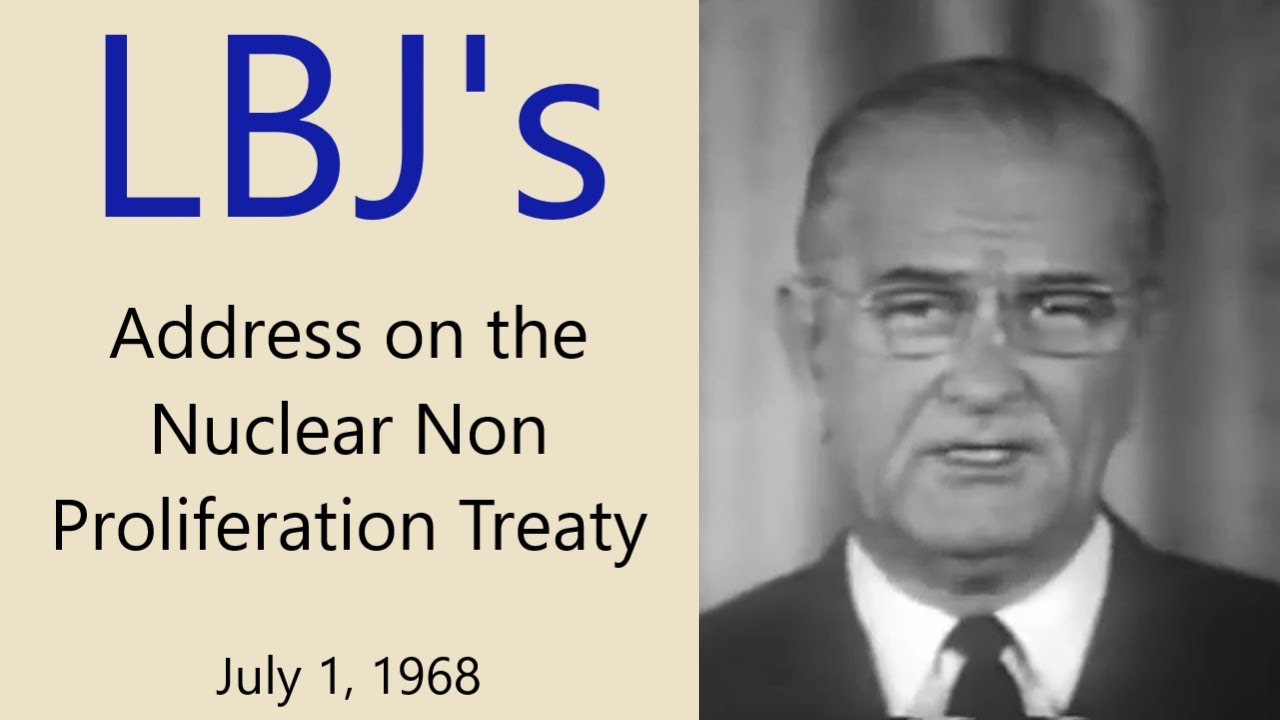
- LBJ's Address and Signing of the Nuclear Non Proliferation Treaty
Secretary Rusk, Your Excellencies, honored Members of Congress, distinguished guests, ladies and gentlemen: This is a very reassuring and hopeful moment in the relations among nations. We have come here today to the East Room of the White House to sign a treaty which limits the spread of nuclear weapons. More than 55 nations are here in Washington this morning to commit their governments to this treaty. Their representatives are also signing today in Moscow and in London. We hope and expect that virtually all the nations will move in the weeks and months ahead to accept this treaty which was commended to the world by the overwhelming majority of the members of the United Nations General Assembly. The treaty's purposes are very simple: —to commit the nations of the world which do not now have nuclear weapons not to produce or receive them in the future; —to assure equally that such nations have the full peaceful benefits of the atom; and —to commit the nuclear powers to move forward toward effective measures of arms control and disarmament. It was just a year ago that Chairman Kosygin and I agreed at Glassboro that we would work intensively in the time ahead to try to achieve this result. After nearly a quarter century of danger and fear—reason and sanity have prevailed to reduce the danger and to greatly lessen the fear. Thus, all mankind is reassured. As the moment is reassuring, so it is, even more, hopeful and heartening. For this treaty is evidence that amid the tensions, the strife, the struggle, and the sorrow of these years, men of many nations have not lost the way—or have not lost the will—toward peace. The conclusion of this treaty encourages the hope that other steps may be taken toward a peaceful world. It is for these reasons—and in this perspective—that I have described this treaty as the most important international agreement since the beginning of the nuclear age. It enhances the security of all nations by significantly reducing the danger of nuclear war among nations. It encourages the peaceful use of nuclear energy by assuring safeguards against its destructive use. But, perhaps most significantly, the signing of this treaty keeps alive and keeps active the impulse toward a safer world. We are inclined to neglect and to overlook what that impulse has brought about in recent years. These have been fruitful times for the quiet works of diplomacy. After long seasons of patient and painstaking negotiation, we have concluded, just within the past 5 years: —the Limited Test Ban Treaty, —the Outer Space Treaty, and —the treaty creating a nuclear-free zone in Latin America. The march of mankind is toward the summit—not the chasm. We must not, we shall not, allow that march to be interrupted. This treaty, like the treaties it follows, is not the work, as Secretary Rusk said, of any one particular nation. It is the accomplishment of nations which seek to exercise their responsibilities for maintaining peace and maintaining a stable world order. It is my hope—and the common will of mankind—that all nations will agree that this treaty affords them some added protection. We hope they will accept the treaty and thereby contribute further to international peace and security. As one of the nations having nuclear weapons, the United States—all through these years—has borne an awesome responsibility. This treaty increases that rest for we have pledged that we shall use our weapons only in conformity with the Charter of the United Nations. Furthermore, we have made clear to United Nations Security Council what would like to repeat today: If a state has accepted this treaty does not have weapons and is a victim of aggression, or is subject to a threat of aggression, involving nuclear weapons, the United States shall prepared to ask immediate Security Council action to provide assistance in accordance with the Charter. In welcoming the treaty that prevents the spread of nuclear weapons, I should like to repeat the United States commitment to honor all our obligations under existing treaties of mutual security. Such agreements have added greatly, we think, to the security of our Nation and the nations with which such agreements exist. They have created a degree of stability in a sometimes unstable world. This treaty is a very important security measure. But it also lays an indispensable foundation: —for expanded cooperation in the peaceful application of nuclear energy; —for additional measures to halt the nuclear arms race. We will cooperate fully to bring the treaty safeguards into being. We shall thus help provide the basis of confidence that is necessary for increased cooperation in the peaceful nuclear field. After the treaty has come into force we will permit the International Atomic Energy Agency to apply its safeguards to all nuclear activities in the United States—excluding only those with direct national security significance. Thus, the United States is not asking any country to accept any safeguards that we are not willing to accept ourselves. As the treaty requires, we shall also engage in the fullest possible exchange of equipment, materials, and scientific and technological information for the peaceful uses of nuclear energy. The needs of the developing nations will be given especially particular attention. We shall make readily available to the nonnuclear treaty partners the benefits of nuclear explosions for peaceful purposes. And we shall do so without delay and under the treaty's provisions. Now at this moment of achievement and great hope, I am gratified to be able to report and announce to the world a significant agreement—an agreement that we have actively sought and worked for since January 1964: Agreement has been reached between the Governments of the Union of Soviet Socialist Republics and the United States to enter in the nearest future into discussions on the limitation and the reduction of both offensive strategic nuclear weapons delivery systems and systems of defense against ballistic missiles. Discussion of this most complex subject will not be easy. We have no illusions that it will be. I know the stubborn, patient persistence that it has required to come this far. We do not underestimate the difficulties that may lie ahead. I know the fears, the suspicions, and the anxieties that we shall have to overcome. But we do believe that the same spirit of accommodation that is reflected in the negotiation of the present treaty can bring us to a good and fruitful result. Man can still shape his destiny in the nuclear age—and learn to live as brothers. Toward that goal—the day when the world moves out of the night of war into the light of sanity and security—I solemnly pledge the resources, the resolve, and the unrelenting efforts of the people of the United States and their Government. Text of the Treaty The States concluding this Treaty, hereinafter referred to as the “Parties to the Treaty”, Considering the devastation that would be visited upon all mankind by a nuclear war and the consequent need to make every effort to avert the danger of such a war and to take measures to safeguard the security of peoples, Believing that the proliferation of nuclear weapons would seriously enhance the danger of nuclear war, In conformity with resolutions of the United Nations General Assembly calling for the conclusion of an agreement on the prevention of wider dissemination of nuclear weapons, Undertaking to co-operate in facilitating the application of International Atomic Energy Agency safeguards on peaceful nuclear activities, Expressing their support for research, development and other efforts to further the application, within the framework of the International Atomic Energy Agency safeguards system, of the principle of safeguarding effectively the flow of source and special fissionable materials by use of instruments and other techniques at certain strategic points, Affirming the principle that the benefits of peaceful applications of nuclear technology, including any technological by-products which may be derived by nuclear-weapon States from the development of nuclear explosive devices, should be available for peaceful purposes to all Parties to the Treaty, whether nuclear-weapon or non-nuclear-weapon States, Convinced that, in furtherance of this principle, all Parties to the Treaty are entitled to participate in the fullest possible exchange of scientific information for, and to contribute alone or in co-operation with other States to, the further development of the applications of atomic energy for peaceful purposes, Declaring their intention to achieve at the earliest possible date the cessation of the nuclear arms race and to undertake effective measures in the direction of nuclear disarmament, Urging the co-operation of all States in the attainment of this objective, Recalling the determination expressed by the Parties to the 1963 Treaty banning nuclear weapons tests in the atmosphere, in outer space and under water in its Preamble to seek to achieve the discontinuance of all test explosions of nuclear weapons for all time and to continue negotiations to this end, Desiring to further the easing of international tension and the strengthening of trust between States in order to facilitate the cessation of the manufacture of nuclear weapons, the liquidation of all their existing stockpiles, and the elimination from national arsenals of nuclear weapons and the means of their delivery pursuant to a Treaty on general and complete disarmament under strict and effective international control, Recalling that, in accordance with the Charter of the United Nations, States must refrain in their international relations from the threat or use of force against the territorial integrity or political independence of any State, or in any other manner inconsistent with the Purposes of the United Nations, and that the establishment and maintenance of international peace and security are to be promoted with the least diversion for armaments of the world’s human and economic resources, Have agreed as follows: Article I Each nuclear-weapon State Party to the Treaty undertakes not to transfer to any recipient whatsoever nuclear weapons or other nuclear explosive devices or control over such weapons or explosive devices directly, or indirectly; and not in any way to assist, encourage, or induce any non-nuclear-weapon State to manufacture or otherwise acquire nuclear weapons or other nuclear explosive devices, or control over such weapons or explosive devices. Article II Each non-nuclear-weapon State Party to the Treaty undertakes not to receive the transfer from any transferor whatsoever of nuclear weapons or other nuclear explosive devices or of control over such weapons or explosive devices directly, or indirectly; not to manufacture or otherwise acquire nuclear weapons or other nuclear explosive devices; and not to seek or receive any assistance in the manufacture of nuclear weapons or other nuclear explosive devices. Article III 1. Each non-nuclear-weapon State Party to the Treaty undertakes to accept safeguards, as set forth in an agreement to be negotiated and concluded with the International Atomic Energy Agency in accordance with the Statute of the International Atomic Energy Agency and the Agency’s safeguards system, for the exclusive purpose of verification of the fulfilment of its obligations assumed under this Treaty with a view to preventing diversion of nuclear energy from peaceful uses to nuclear weapons or other nuclear explosive devices. Procedures for the safeguards required by this Article shall be followed with respect to source or special fissionable material whether it is being produced, processed or used in any principal nuclear facility or is outside any such facility. The safeguards required by this Article shall be applied on all source or special fissionable material in all peaceful nuclear activities within the territory of such State, under its jurisdiction, or carried out under its control anywhere. 2. Each State Party to the Treaty undertakes not to provide: (a) source or special fissionable material, or (b) equipment or material especially designed or prepared for the processing, use or production of special fissionable material, to any non-nuclear-weapon State for peaceful purposes, unless the source or special fissionable material shall be subject to the safeguards required by this Article. 3. The safeguards required by this Article shall be implemented in a manner designed to comply with Article IV of this Treaty, and to avoid hampering the economic or technological development of the Parties or international co-operation in the field of peaceful nuclear activities, including the international exchange of nuclear material and equipment for the processing, use or production of nuclear material for peaceful purposes in accordance with the provisions of this Article and the principle of safeguarding set forth in the Preamble of the Treaty. 4. Non-nuclear-weapon States Party to the Treaty shall conclude agreements with the International Atomic Energy Agency to meet the requirements of this Article either individually or together with other States in accordance with the Statute of the International Atomic Energy Agency. Negotiation of such agreements shall commence within 180 days from the original entry into force of this Treaty. For States depositing their instruments of ratification or accession after the 180-day period, negotiation of such agreements shall commence not later than the date of such deposit. Such agreements shall enter into force not later than eighteen months after the date of initiation of negotiations. Article IV 1. Nothing in this Treaty shall be interpreted as affecting the inalienable right of all the Parties to the Treaty to develop research, production and use of nuclear energy for peaceful purposes without discrimination and in conformity with Articles I and II of this Treaty. 2. All the Parties to the Treaty undertake to facilitate, and have the right to participate in, the fullest possible exchange of equipment, materials and scientific and technological information for the peaceful uses of nuclear energy. Parties to the Treaty in a position to do so shall also co-operate in contributing alone or together with other States or international organizations to the further development of the applications of nuclear energy for peaceful purposes, especially in the territories of non-nuclear-weapon States Party to the Treaty, with due consideration for the needs of the developing areas of the world. Article V Each Party to the Treaty undertakes to take appropriate measures to ensure that, in accordance with this Treaty, under appropriate international observation and through appropriate international procedures, potential benefits from any peaceful applications of nuclear explosions will be made available to non-nuclear-weapon States Party to the Treaty on a non-discriminatory basis and that the charge to such Parties for the explosive devices used will be as low as possible and exclude any charge for research and development. Non-nuclear-weapon States Party to the Treaty shall be able to obtain such benefits, pursuant to a special international agreement or agreements, through an appropriate international body with adequate representation of non-nuclear-weapon States. Negotiations on this subject shall commence as soon as possible after the Treaty enters into force. Non-nuclear-weapon States Party to the Treaty so desiring may also obtain such benefits pursuant to bilateral agreements. Article VI Each of the Parties to the Treaty undertakes to pursue negotiations in good faith on effective measures relating to cessation of the nuclear arms race at an early date and to nuclear disarmament, and on a treaty on general and complete disarmament under strict and effective international control. Article VII Nothing in this Treaty affects the right of any group of States to conclude regional treaties in order to assure the total absence of nuclear weapons in their respective territories. Article VIII 1. Any Party to the Treaty may propose amendments to this Treaty. The text of any proposed amendment shall be submitted to the Depositary Governments which shall circulate it to all Parties to the Treaty. Thereupon, if requested to do so by one-third or more of the Parties to the Treaty, the Depositary Governments shall convene a conference, to which they shall invite all the Parties to the Treaty, to consider such an amendment. 2. Any amendment to this Treaty must be approved by a majority of the votes of all the Parties to the Treaty, including the votes of all nuclear-weapon States Party to the Treaty and all other Parties which, on the date the amendment is circulated, are members of the Board of Governors of the International Atomic Energy Agency. The amendment shall enter into force for each Party that deposits its instrument of ratification of the amendment upon the deposit of such instruments of ratification by a majority of all the Parties, including the instruments of ratification of all nuclear-weapon States Party to the Treaty and all other Parties which, on the date the amendment is circulated, are members of the Board of Governors of the International Atomic Energy Agency. Thereafter, it shall enter into force for any other Party upon the deposit of its instrument of ratification of the amendment. 3. Five years after the entry into force of this Treaty, a conference of Parties to the Treaty shall be held in Geneva, Switzerland, in order to review the operation of this Treaty with a view to assuring that the purposes of the Preamble and the provisions of the Treaty are being realised. At intervals of five years thereafter, a majority of the Parties to the Treaty may obtain, by submitting a proposal to this effect to the Depositary Governments, the convening of further conferences with the same objective of reviewing the operation of the Treaty. Article IX 1. This Treaty shall be open to all States for signature. Any State which does not sign the Treaty before its entry into force in accordance with paragraph 3 of this Article may accede to it at any time. 2. This Treaty shall be subject to ratification by signatory States. Instruments of ratification and instruments of accession shall be deposited with the Governments of the United Kingdom of Great Britain and Northern Ireland, the Union of Soviet Socialist Republics and the United States of America, which are hereby designated the Depositary Governments. 3. This Treaty shall enter into force after its ratification by the States, the Governments of which are designated Depositaries of the Treaty, and forty other States signatory to this Treaty and the deposit of their instruments of ratification. For the purposes of this Treaty, a nuclear-weapon State is one which has manufactured and exploded a nuclear weapon or other nuclear explosive device prior to 1 January 1967. 4. For States whose instruments of ratification or accession are deposited subsequent to the entry into force of this Treaty, it shall enter into force on the date of the deposit of their instruments of ratification or accession. 5. The Depositary Governments shall promptly inform all signatory and acceding States of the date of each signature, the date of deposit of each instrument of ratification or of accession, the date of the entry into force of this Treaty, and the date of receipt of any requests for convening a conference or other notices. 6. This Treaty shall be registered by the Depositary Governments pursuant to Article 102 of the Charter of the United Nations. Article X 1. Each Party shall in exercising its national sovereignty have the right to withdraw from the Treaty if it decides that extraordinary events, related to the subject matter of this Treaty, have jeopardized the supreme interests of its country. It shall give notice of such withdrawal to all other Parties to the Treaty and to the United Nations Security Council three months in advance. Such notice shall include a statement of the extraordinary events it regards as having jeopardized its supreme interests. 2. Twenty-five years after the entry into force of the Treaty, a conference shall be convened to decide whether the Treaty shall continue in force indefinitely, or shall be extended for an additional fixed period or periods. This decision shall be taken by a majority of the Parties to the Treaty. Article XI This Treaty, the English, Russian, French, Spanish and Chinese texts of which are equally authentic, shall be deposited in the archives of the Depositary Governments. Duly certified copies of this Treaty shall be transmitted by the Depositary Governments to the Governments of the signatory and acceding States. IN WITNESS WHEREOF the undersigned, duly authorized, have signed this Treaty. DONE in triplicate, at the cities of London, Moscow and Washington, this first day of July, one thousand nine hundred and sixty-eight. Source of Johnson's Address: https://millercenter.org/the-presidency/presidential-speeches/july-1-1968-remarks-signing-nuclear-nonproliferation-treaty Source of Treaty Text: https://treaties.unoda.org/t/npt
- LBJ's Address on the Cessation of Bombing North Vietnam
Good evening, my fellow Americans: I speak to you this evening about very important developments in our search for peace in Vietnam. We have been engaged in discussions with the North Vietnamese in Paris since last May. The discussions began after I announced on the evening of March 31st in a television speech to the Nation that the United States—in an effort to get talks started on a settlement of the Vietnam war—had stopped the bombing of North Vietnam in the area where 90 percent of the people live. When our representatives—Ambassador Harriman and Ambassador Vance—were sent to Paris, they were instructed to insist throughout the discussions that the legitimate elected Government of South Vietnam must take its place in any serious negotiations affecting the future of South Vietnam. Therefore, our Ambassadors Harriman and Vance made it abundantly clear to the representatives of North Vietnam in the beginning that—as I had indicated on the evening of March 31st—we would stop the bombing of North Vietnamese territory entirely when that would lead to prompt and productive talks, meaning by that talks in which the Government of Vietnam was free to participate. Our ambassadors also stressed that we could not stop the bombing so long as by doing so we would endanger the lives and the safety of our troops. For a good many weeks, there was no movement in the talks at all. The talks appeared to really be deadlocked. Then a few weeks ago, they entered a new and a very much more hopeful phase. As we moved ahead, I conducted a series of very intensive discussions with our allies, and with the senior military and diplomatic officers of the United States Government, on the prospects for peace. The President also briefed our congressional leaders and all of the presidential candidates. Last Sunday evening, and throughout Monday, we began to get confirmation of the essential understanding that we had been seeking with the North Vietnamese on the critical issues between us for some time. I spent most of all day Tuesday reviewing every single detail of this matter with our field commander, General Abrams, whom I had ordered home, and who arrived here at the White House at 2:30 in the morning and went into immediate conference with the President and the appropriate members of his Cabinet. We received General Abrams' judgment and we heard his recommendations at some length. Now, as a result of all of these developments, I have now ordered that all air, naval, and artillery bombardment of North Vietnam cease as of 8 a.m., Washington time, Friday morning. I have reached this decision on the basis of the developments in the Paris talks. And I have reached it in the belief that this action can lead to progress toward a peaceful settlement of the Vietnamese war. I have already informed the three presidential candidates, as well as the congressional leaders of both the Republican and the Democratic Parties of the reasons that the Government has made this decision. This decision very closely conforms to the statements that I have made in the past concerning a bombing cessation. It was on August 19th that the President said: "This administration does not intend to move further until it has good reason to believe that the other side intends seriously"—seriously—"to join us in deescalating the war and moving seriously toward peace." And then again on September 10th, I said: "The bombing will not stop until we are confident that it will not lead to an increase in American casualties." The Joint Chiefs of Staff, all military men, have assured me—and General Abrams very firmly asserted to me on Tuesday in that early, 2:30 a.m. meeting—that in their military judgment this action should be taken now, and this action would not result in any increase in American casualties. A regular session of the Paris talks is going to take place next Wednesday, November 6th, at which the representatives of the Government of South Vietnam are free to participate. We are informed by the representatives of the Hanoi Government that the representatives of the National Liberation Front will also be present. I emphasize that their attendance in no way involves recognition of the National Liberation Front in any form. Yet, it conforms to the statements that we have made many times over the years that the NLF would have no difficulty making its views known. But what we now expect—what we have a right to expect—are prompt, productive, serious, and intensive negotiations in an atmosphere that is conducive to progress. We have reached the stage where productive talks can begin. We have made clear to the other side that such talks cannot continue if they take military advantage of them. We cannot have productive talks in an atmosphere where the cities are being shelled and where the demilitarized zone is being abused. I think I should caution you, my fellow Americans, that arrangements of this kind are never foolproof. For that matter, even formal treaties are never foolproof, as we have learned from our experience. But in the light of the progress that has been made in recent weeks, and after carefully considering and weighing the unanimous military and diplomatic advice and judgment rendered to the Commander in Chief, I have finally decided to take this step now and to really determine the good faith of those who have assured us that progress will result when bombing ceases and to try to ascertain if an early peace is possible. The overriding consideration that governs us at this hour is the chance and the opportunity that we might have to save human lives, save human lives on both sides of the conflict. Therefore, I have concluded that we should see if they are acting in good faith. We could be misled—and we are prepared for such a contingency. We pray God it does not occur. But it should be clear to all of us that the new phase of negotiations which opens on November 6th does not—repeat, does not—mean that a stable peace has yet come to Southeast Asia. There may well be very hard fighting ahead. Certainly, there is going to be some very hard negotiating, because many difficult and critically important issues are still facing these negotiators. But I hope and I believe that with good will we can solve them. We know that negotiations can move swiftly if the common intent of the negotiators is peace in the world. The world should know that the American people bitterly remember the long, agonizing Korean negotiations of 1951 through 1953—and that our people will just not accept deliberate delay and prolonged procrastination again. Well then, how has it come about that now, on November 1st, we have agreed to stop the bombardment of North Vietnam? I would have given all I possess if the conditions had permitted me to stop it months ago; if there had just been any movement in the Paris talks that would have justified me in saying to you, "Now it can be safely stopped." But I, the President of the United States, do not control the timing of the events in Hanoi. The decisions in Hanoi really determine when and whether it would be possible for us to stop the bombing. We could not retract our insistence on the participation of the Government of South Vietnam in serious talks affecting the future of their people—the people of South Vietnam. For though we have allied with South Vietnam for many years in this struggle, we have never assumed and we shall never demand the role of dictating the future of the people of South Vietnam. The very principle for which we are engaged in South Vietnam—the principle of self-determination—requires that the South Vietnamese people themselves be permitted to freely speak for themselves at the Paris talks and that the South Vietnamese delegation play a leading role in accordance with our agreement with President Thieu at Honolulu. It was made just as clear to North Vietnam that a total bombing halt must not risk the lives of our men. When I spoke last March 31st, I said that evening: "Whether a complete bombing halt becomes possible in the future will be determined by events." Well, I cannot tell you tonight specifically in all detail why there has been progress in Paris. But I can tell you that a series of hopeful events has occurred in South Vietnam: —The Government of South Vietnam has grown steadily stronger. —South Vietnam's Armed Forces have been substantially increased to the point where a million men are tonight under arms, and the effectiveness of these men has steadily improved. —The superb performance of our own men, under the brilliant leadership of General Westmoreland and General Abrams, has produced truly remarkable results. Now, perhaps some or all of these factors played a part in bringing about progress in the talks. And when at last progress did come, I believe that my responsibilities to the brave men—our men—who bear the burden of battle in South Vietnam tonight, and my duty to seek an honorable settlement of the war, required me to recognize and required me to act without delay. I have acted tonight. There have been many long days of waiting for new steps toward peace—days that began in hope, only to end at night in disappointment. Constancy to our national purpose—which is to seek the basis for a durable peace in Southeast Asia—has sustained me in all of these hours when there seemed to be no progress whatever in these talks. But now that progress has come, I know that your prayers are joined with mine and with those of all humanity, that the action I announce tonight will be a major step toward a firm and an honorable peace in Southeast Asia. It can be. So, what is required of us in these new circumstances is exactly that steady determination and patience which has brought us to this more hopeful prospect. What is required of us is a courage and a steadfastness, and a perseverance here at home, that will match that of our men who fight for us tonight in Vietnam. So, I ask you not only for your prayers but for the courageous and understanding support that Americans always give their President and their leader in an hour of trial. With that understanding, and with that support, we shall not fail. Seven months ago I said that I would not permit the Presidency to become involved in the partisan divisions that were then developing in this political year. Accordingly, on the night of March 31st, I announced that I would not seek nor accept the nomination of my party for another term as President. I have devoted every resource of the Presidency to the search for peace in Southeast Asia. Throughout the entire summer and fall I have kept all of the presidential candidates fully briefed on developments in Paris as well as in Vietnam. I have made it abundantly clear that no one candidate would have the advantage over others—either in information about those developments, or in advance notice of the policy the Government intended to follow. The chief diplomatic and military officers of this Government all were instructed to follow the same course. Since that night on March 31st, each of the candidates has had differing ideas about the Government's policy. But generally speaking, however, throughout the campaign we have been able to present a united voice supporting our Government and supporting our men in Vietnam. I hope, and I believe, that this can continue until January 20th of next year when a new President takes office. Because in this critical hour, we just simply cannot afford more than one voice speaking for our Nation in the search for peace. I do not know who will be inaugurated as the 37th President of the United States next January. But I do know that I shall do all that I can in the next few months to try to lighten his burdens as the contributions of the Presidents who preceded me have greatly lightened mine. I shall do everything in my power to move us toward the peace that the new President—as well as this President and, I believe, every other American—so deeply and urgently desires. Thank you for listening. Good night and God bless all of you. Source: https://millercenter.org/the-presidency/presidential-speeches/october-31-1968-remarks-cessation-bombing-north-vietnam
- Woodrow Wilson's Second Inaugural Address
Second Inaugural Address of Woodrow Wilson MONDAY, MARCH 5, 1917 My Fellow Citizens: The four years which have elapsed since last I stood in this place have been crowded with counsel and action of the most vital interest and consequence. Perhaps no equal period in our history has been so fruitful of important reforms in our economic and industrial life or so full of significant changes in the spirit and purpose of our political action. We have sought very thoughtfully to set our house in order, correct the grosser errors and abuses of our industrial life, liberate and quicken the processes of our national genius and energy, and lift our politics to a broader view of the people's essential interests. It is a record of singular variety and singular distinction. But I shall not attempt to review it. It speaks for itself and will be of increasing influence as the years go by. This is not the time for retrospect. It is time rather to speak our thoughts and purposes concerning the present and the immediate future. Although we have centered counsel and action with such unusual concentration and success upon the great problems of domestic legislation to which we addressed ourselves four years ago, other matters have more and more forced themselves upon our attention-- matters lying outside our own life as a nation and over which we had no control, but which, despite our wish to keep free of them, have drawn us more and more irresistibly into their own current and influence. It has been impossible to avoid them. They have affected the life of the whole world. They have shaken men everywhere with a passion and an apprehension they never knew before. It has been hard to preserve calm counsel while the thought of our own people swayed this way and that under their influence. We are a composite and cosmopolitan people. We are of the blood of all the nations that are at war. The currents of our thoughts as well as the currents of our trade run quick at all seasons back and forth between us and them. The war inevitably set its mark from the first alike upon our minds, our industries, our commerce, our politics and our social action. To be indifferent to it, or independent of it, was out of the question. And yet all the while we have been conscious that we were not part of it. In that consciousness, despite many divisions, we have drawn closer together. We have been deeply wronged upon the seas, but we have not wished to wrong or injure in return; have retained throughout the consciousness of standing in some sort apart, intent upon an interest that transcended the immediate issues of the war itself. As some of the injuries done us have become intolerable we have still been clear that we wished nothing for ourselves that we were not ready to demand for all mankind--fair dealing, justice, the freedom to live and to be at ease against organized wrong. It is in this spirit and with this thought that we have grown more and more aware, more and more certain that the part we wished to play was the part of those who mean to vindicate and fortify peace. We have been obliged to arm ourselves to make good our claim to a certain minimum of right and of freedom of action. We stand firm in armed neutrality since it seems that in no other way we can demonstrate what it is we insist upon and cannot forget. We may even be drawn on, by circumstances, not by our own purpose or desire, to a more active assertion of our rights as we see them and a more immediate association with the great struggle itself. But nothing will alter our thought or our purpose. They are too clear to be obscured. They are too deeply rooted in the principles of our national life to be altered. We desire neither conquest nor advantage. We wish nothing that can be had only at the cost of another people. We always professed unselfish purpose and we covet the opportunity to prove our professions are sincere. There are many things still to be done at home, to clarify our own politics and add new vitality to the industrial processes of our own life, and we shall do them as time and opportunity serve, but we realize that the greatest things that remain to be done must be done with the whole world for stage and in cooperation with the wide and universal forces of mankind, and we are making our spirits ready for those things. We are provincials no longer. The tragic events of the thirty months of vital turmoil through which we have just passed have made us citizens of the world. There can be no turning back. Our own fortunes as a nation are involved whether we would have it so or not. And yet we are not the less Americans on that account. We shall be the more American if we but remain true to the principles in which we have been bred. They are not the principles of a province or of a single continent. We have known and boasted all along that they were the principles of a liberated mankind. These, therefore, are the things we shall stand for, whether in war or in peace: That all nations are equally interested in the peace of the world and in the political stability of free peoples, and equally responsible for their maintenance; that the essential principle of peace is the actual equality of nations in all matters of right or privilege; that peace cannot securely or justly rest upon an armed balance of power; that governments derive all their just powers from the consent of the governed and that no other powers should be supported by the common thought, purpose or power of the family of nations; that the seas should be equally free and safe for the use of all peoples, under rules set up by common agreement and consent, and that, so far as practicable, they should be accessible to all upon equal terms; that national armaments shall be limited to the necessities of national order and domestic safety; that the community of interest and of power upon which peace must henceforth depend imposes upon each nation the duty of seeing to it that all influences proceeding from its own citizens meant to encourage or assist revolution in other states should be sternly and effectually suppressed and prevented. I need not argue these principles to you, my fellow countrymen; they are your own part and parcel of your own thinking and your own motives in affairs. They spring up native amongst us. Upon this as a platform of purpose and of action we can stand together. And it is imperative that we should stand together. We are being forged into a new unity amidst the fires that now blaze throughout the world. In their ardent heat we shall, in God's Providence, let us hope, be purged of faction and division, purified of the errant humors of party and of private interest, and shall stand forth in the days to come with a new dignity of national pride and spirit. Let each man see to it that the dedication is in his own heart, the high purpose of the nation in his own mind, ruler of his own will and desire. I stand here and have taken the high and solemn oath to which you have been audience because the people of the United States have chosen me for this august delegation of power and have by their gracious judgment named me their leader in affairs. I know now what the task means. I realize to the full the responsibility which it involves. I pray God I may be given the wisdom and the prudence to do my duty in the true spirit of this great people. I am their servant and can succeed only as they sustain and guide me by their confidence and their counsel. The thing I shall count upon, the thing without which neither counsel nor action will avail, is the unity of America--an America united in feeling, in purpose and in its vision of duty, of opportunity and of service. We are to beware of all men who would turn the tasks and the necessities of the nation to their own private profit or use them for the building up of private power. United alike in the conception of our duty and in the high resolve to perform it in the face of all men, let us dedicate ourselves to the great task to which we must now set our hand. For myself I beg your tolerance, your countenance and your united aid. The shadows that now lie dark upon our path will soon be dispelled, and we shall walk with the light all about us if we be but true to ourselves--to ourselves as we have wished to be known in the counsels of the world and in the thought of all those who love liberty and justice and the right exalted. Source: https://avalon.law.yale.edu/20th_century/wilson2.asp
- Reagan's Address on Deficit Reduction
Reagan's Address on Deficit Reduction
- Declaration of Independence
In Congress, July 4, 1776 The unanimous Declaration of the thirteen united States of America, When in the Course of human events, it becomes necessary for one people to dissolve the political bands which have connected them with another, and to assume among the powers of the earth, the separate and equal station to which the Laws of Nature and of Nature's God entitle them, a decent respect to the opinions of mankind requires that they should declare the causes which impel them to the separation. We hold these truths to be self-evident, that all men are created equal, that they are endowed by their Creator with certain unalienable Rights, that among these are Life, Liberty and the pursuit of Happiness.--That to secure these rights, Governments are instituted among Men, deriving their just powers from the consent of the governed, --That whenever any Form of Government becomes destructive of these ends, it is the Right of the People to alter or to abolish it, and to institute new Government, laying its foundation on such principles and organizing its powers in such form, as to them shall seem most likely to effect their Safety and Happiness. Prudence, indeed, will dictate that Governments long established should not be changed for light and transient causes; and accordingly all experience hath shewn, that mankind are more disposed to suffer, while evils are sufferable, than to right themselves by abolishing the forms to which they are accustomed. But when a long train of abuses and usurpations, pursuing invariably the same Object evinces a design to reduce them under absolute Despotism, it is their right, it is their duty, to throw off such Government, and to provide new Guards for their future security.--Such has been the patient sufferance of these Colonies; and such is now the necessity which constrains them to alter their former Systems of Government. The history of the present King of Great Britain is a history of repeated injuries and usurpations, all having in direct object the establishment of an absolute Tyranny over these States. To prove this, let Facts be submitted to a candid world. He has refused his Assent to Laws, the most wholesome and necessary for the public good. He has forbidden his Governors to pass Laws of immediate and pressing importance, unless suspended in their operation till his Assent should be obtained; and when so suspended, he has utterly neglected to attend to them. He has refused to pass other Laws for the accommodation of large districts of people, unless those people would relinquish the right of Representation in the Legislature, a right inestimable to them and formidable to tyrants only. He has called together legislative bodies at places unusual, uncomfortable, and distant from the depository of their public Records, for the sole purpose of fatiguing them into compliance with his measures. He has dissolved Representative Houses repeatedly, for opposing with manly firmness his invasions on the rights of the people. He has refused for a long time, after such dissolutions, to cause others to be elected; whereby the Legislative powers, incapable of Annihilation, have returned to the People at large for their exercise; the State remaining in the mean time exposed to all the dangers of invasion from without, and convulsions within. He has endeavoured to prevent the population of these States; for that purpose obstructing the Laws for Naturalization of Foreigners; refusing to pass others to encourage their migrations hither, and raising the conditions of new Appropriations of Lands. He has obstructed the Administration of Justice, by refusing his Assent to Laws for establishing Judiciary powers. He has made Judges dependent on his Will alone, for the tenure of their offices, and the amount and payment of their salaries. He has erected a multitude of New Offices, and sent hither swarms of Officers to harrass our people, and eat out their substance. He has kept among us, in times of peace, Standing Armies without the Consent of our legislatures. He has affected to render the Military independent of and superior to the Civil power. He has combined with others to subject us to a jurisdiction foreign to our constitution, and unacknowledged by our laws; giving his Assent to their Acts of pretended Legislation: For Quartering large bodies of armed troops among us: For protecting them, by a mock Trial, from punishment for any Murders which they should commit on the Inhabitants of these States: For cutting off our Trade with all parts of the world: For imposing Taxes on us without our Consent: For depriving us in many cases, of the benefits of Trial by Jury: For transporting us beyond Seas to be tried for pretended offences For abolishing the free System of English Laws in a neighbouring Province, establishing therein an Arbitrary government, and enlarging its Boundaries so as to render it at once an example and fit instrument for introducing the same absolute rule into these Colonies: For taking away our Charters, abolishing our most valuable Laws, and altering fundamentally the Forms of our Governments: For suspending our own Legislatures, and declaring themselves invested with power to legislate for us in all cases whatsoever. He has abdicated Government here, by declaring us out of his Protection and waging War against us. He has plundered our seas, ravaged our Coasts, burnt our towns, and destroyed the lives of our people. He is at this time transporting large Armies of foreign Mercenaries to compleat the works of death, desolation and tyranny, already begun with circumstances of Cruelty & perfidy scarcely paralleled in the most barbarous ages, and totally unworthy the Head of a civilized nation. He has constrained our fellow Citizens taken Captive on the high Seas to bear Arms against their Country, to become the executioners of their friends and Brethren, or to fall themselves by their Hands. He has excited domestic insurrections amongst us, and has endeavoured to bring on the inhabitants of our frontiers, the merciless Indian Savages, whose known rule of warfare, is an undistinguished destruction of all ages, sexes and conditions. In every stage of these Oppressions We have Petitioned for Redress in the most humble terms: Our repeated Petitions have been answered only by repeated injury. A Prince whose character is thus marked by every act which may define a Tyrant, is unfit to be the ruler of a free people. Nor have We been wanting in attentions to our Brittish brethren. We have warned them from time to time of attempts by their legislature to extend an unwarrantable jurisdiction over us. We have reminded them of the circumstances of our emigration and settlement here. We have appealed to their native justice and magnanimity, and we have conjured them by the ties of our common kindred to disavow these usurpations, which, would inevitably interrupt our connections and correspondence. They too have been deaf to the voice of justice and of consanguinity. We must, therefore, acquiesce in the necessity, which denounces our Separation, and hold them, as we hold the rest of mankind, Enemies in War, in Peace Friends. We, therefore, the Representatives of the united States of America, in General Congress, Assembled, appealing to the Supreme Judge of the world for the rectitude of our intentions, do, in the Name, and by Authority of the good People of these Colonies, solemnly publish and declare, That these United Colonies are, and of Right ought to be Free and Independent States; that they are Absolved from all Allegiance to the British Crown, and that all political connection between them and the State of Great Britain, is and ought to be totally dissolved; and that as Free and Independent States, they have full Power to levy War, conclude Peace, contract Alliances, establish Commerce, and to do all other Acts and Things which Independent States may of right do. And for the support of this Declaration, with a firm reliance on the protection of divine Providence, we mutually pledge to each other our Lives, our Fortunes and our sacred Honor. Source: https://www.archives.gov/founding-docs/declaration-transcript
- Eisenhower's Address on his Foreign Policy Goals
June 24, 1952 My Fellow Citizens: In the quiet of my room here in Denver, I would like to talk to you this evening in your home. I want to discuss simply and seriously the problem that is closest to all our heart: the problem of peace. Since the time we thought peace had been won in 1945, the tragedy of the death of a son on a distant battlefield has been visited upon thousands of our homes. The prayer of the American family is that their son will be spared. I want to talk tonight especially to those families. I want to talk to the young man facing his turn to serve in the armed forces; to the student whose studies may be interrupted; to the young husband separated from his family and to his wife who is left alone. Secondly, these people should know something of the aims and aspirations and programs that can justify their heavy sacrifices. May I make this one personal observation? I have entered upon a serious political undertaking. Among the reasons which led me to take that step, one consideration that weighed heavily on me was the argument of my friends that the responsibilities entrusted to me through the last ten critical years and the knowledge derived from that experience would enable me to serve my country, effectively, in the cause of peace. No other cause could so completely enlist my energies. In brief, I occupy my present position in this political primarily because I believe that peace may well be at stake. 'We Can Have Peace' our race Let me first affirm for you my deep faith. I believe we can have peace. I believe we can diminish the likelihood of global war; that we can dispel the clouds over the future and lift many of the heavy burdens now laid upon us. But I would not be honest if I led you to believe that there is any easy way to peace. There is none. There is no painless political short cut; no glib solution. our But on our success depends the achievement of almost all objectives; the elimination of casualty lists; the easing of our heavy tax load; the stemming of inflation that raises the cost of everything we buy; the dispelling continued ad- of pessimism; vancement in living standards. Clearly, our foreign policy must based, as is that of other nations, upon our own enlightened self-interest. Before every step we must ask: Is this good for the United States; does it promote our security, our well-being? This is not selfishness. It is recognition of the fact that a strong, confident, peaceful America is the great hope of the free world. In this problem of security there is one central fact from which all our reckonings must proceed. That central fact is a shrunken world in which distance has been almost obliterated and there has developed an unprecedented interdependence among the nations. By inventions, by advanced methods of production and the skills of labor, each portion of the world, including mighty America, depends upon other parts for materials it must have. Today, into this interdependent world has come a threatening force-the force of aggressive communism. It is cunning, it is Godless, it aims to destroy all freedom-and most of all yours and mine because America is its final and chief target. The men who direct that force have a vast power. Already, without a scratch on a single Russian soldier, they have swept nation after nation into slavery. They have moved closer to sources of supply on which our existence depends. Their strategy is to continue to close in until, finally, they can destroy our economy and our freedom. The Communist threat against the free world creates a need for political and military arrangements that will preserve the safety of all and assure the continuance of vital commerce. Because of the fact of the world situation, I should like to say something to you with all the earnestness I can summon. Those who assert that America can live solely within its own borders; those who seem to think we have little or no stake in the rest of the world and what happens to it; those who act as though we had no need for friends to share in the defense of freedom-such persons are taking an unjustified gamble with peace. They are no friends of America's security. Theirs is 'not the counsel of enlightened self-interest. It is the counsel of eventual self-destruction. And the American people have shown time and again that they will not support this stupid and myopic doctrine. The bleak scene of an America surrounded by a savage wolf pack could be our lot if we heed the false prophets of living alone -who preach that we need do nothing except maintain a destructive retaliatory force for use in the event the Russian army should march. Why should armies march if the Communists can count more and more political conquests such as they achieved in Czechoslovakia? This will be the result of a retreat by us into isolationism. But it will not happen if we firmly maintain a real collective security. I can give you this evening only the briefest outline of the practical program which I believe fits the situation. First, we must make sure that every nation ourselves, our friends and the Iron Curtain countries understand the sincerity of our devotion to peace. We reject all talk of preventive war-there is no such thing. Live men and happy families-not synthetic doves-are the symbols of our purpose. No Wavering on U. N. Second, there must be no wavering in our support of the United Nations. Some regard the United Nations in terms of its shortcomings; and would reduce our support for it to a reluctant minimum. True, the United Nations, in seven years of life has fallen short of its peace objectives. But the whole world has fallen short-and for reasons which are plain. Should we then surrender our objective? Of course not. For our objective is peace. The United Nations is an instrument of peace. Our aim must be to make it more vital and effective. There must be no wavering in our support for the North Atlantic Alliance. Even those who blindly opposed its launching admit that it has stopped the spread of communism in Europe and the Mediterranean. Our security agreements with other American countries and the peoples of Asia and the Pacific must be similarly supported. Third, we must state our purposes in positive terms, rather than in terms of negative containment. We cannot always be picking ourselves up off the floor. We must cease hand-to-mouth operations in foreign affairs. Only through positive pronouncement of our long term intentions in the international field can we ourselves be sure of our nation's aims. We should boldly announce that we will never lose interest in a people who want to be free-who live unwillingly behind the Iron Curtain. Strong U. S. Is Required This means the launching of a concerted political program that will establish our peaceful intent; encourage our Allies; and assure all the world that as long as any nation is enslaved we shall never be indifferent to its people's lot. Fourth, we must be strong! I look forward to the day when, from a position of unassailable security, we will be able to present to the masters of the Kremlin a just and practical plan for freeing the world from the burden of armaments. When we are that strong, they will probably see in such a proposal their own self-interest and will feel obliged to accept, even if grudgingly and slowly. This would be a true plan for peace and disarmament. To be strong, we must have an unshakeable spiritual strength. Let us constantly proclaim to all peoples our belief in God and our devotion to the ideals and causes that spring from such belief. For you and for me and for our children the cause we support is that of freedom; the right of each of us to live and work and speak and worship according to the dictates of our conscience. That community of belief, of aspiration and of striving is, I deeply believe, our strongest bulwark and our best defense. Increased Production Urged Along with spiritual strength, we must, at all costs, increase our power to produce what we need for ourselves and an additional margin for the support of our armed forces and for necessary military assistance to our Allies. To retain our economic soundness we must be watchful that we get the maximum return on every dollar spent for defense. A bankrupt America is a defenseless America. Another necessary element is military power. Manifestly the United States cannot station its troops all over the world to protect every area in which we have a vital interest. The essence of collective security as rapidly as possible to lodge the responsibility for the defense of those areas upon their own populations. Finally, we must lead the free world-East and West-toward a unity of purpose that we ourselves must exemplify. There is unity in the world of communism-a singleness of performance based upon fear and terror. Sometimes in contrast our own apparent disunities seem so serious as to be the mark of a fatal weakness. Our unity must be voluntary. We need a broadly based, inspired leadership that will promote understanding of all these issues. It must preach faith instead of cynicism; courage and confidence instead of defeatism; hope instead of despair. Peace Called Living Force I know something about war: its strategy, its requirements, its tragic cost in blood and treasure, its criminal waste. I shall not rest as long as I believe I can contribute to the cause of peace. The peace America seeks is not a matter of formula alone. It is a vital, living, driving force. That kind of peace will come if we work for it persistently and intelligently. When it does then our sons can return to tasks of constructive achievement. Then all our people of every color, race and creed can be free to follow their opportunities for the full life to which all among us is entitled and to which every true American is dedicated. My fellow Americans, this can be done. We can begin now to make sure that it is done. No other people can take the lead. Just as we are the ultimate Communist objective, so the ultimate answer lies with us. It lies with us because here, in this land of ours, free men have built for freedom such strong support as the world has never seen before. Faced with momentous issues, confronting danger, it is not in our American character to fail. We will not fail now. Hope, faith and work will see us through. Source:
- John Brown's Final Speech
Nov 2, 1859 I have, may it please the court, a few words to say. In the first place, I deny everything but what I have all along admitted, the design on my part to free the slaves. I intended certainly to have made a clean thing of that matter, as I did last winter, when I went into Missouri and there took slaves without the snapping of a gun on either side, moved them through the country, and finally left them in Canada. I designed to have done the same thing again, on a larger scale. That was all I intended. I never did intend murder, or treason, or the destruction of property, or to excite or incite slaves to rebellion, or to make insurrection. I have another objection; and that is, it is unjust that I should suffer such a penalty. Had I interfered in the manner which I admit, and which I admit has been fairly proved (for I admire the truthfulness and candor of the greater portion of the witnesses who have testified in this case), had I so interfered in behalf of the rich, the powerful, the intelligent, the so-called great, or in behalf of any of their friends, either father, mother, brother, sister, wife, or children, or any of that class, and suffered and sacrificed what I have in this interference, it would have been all right; and every man in this court would have deemed it an act worthy of reward rather than punishment. This court acknowledges, as I suppose, the validity of the law of God. I see a book kissed here which I suppose to be the Bible, or at least the New Testament. That teaches me that "all things whatsoever I would that men should do to me, I should do even so to them" [Matthew 7:12]. It teaches me, further, to "remember them that are in bonds, as bound with them" [Hebrews 13:3]. I endeavored to act up to that instruction. I say, I am yet too young to understand that God is any respecter of persons. I believe that to have interfered as I have done as I have always freely admitted I have done in behalf of His despised poor, was not wrong, but right. Now, if it is deemed necessary that I should forfeit my life for the furtherance of the ends of justice, and mingle my blood further with the blood of my children and with the blood of millions in this slave country whose rights are disregarded by wicked, cruel, and unjust enactments, I submit; so let it be done! Let me say one word further. I feel entirely satisfied with the treatment I have received on my trial. Considering all the circumstances, it has been more generous than I expected. But I feel no consciousness of guilt. I have stated from the first [day] what was my intention and what was not. I never had any design against the life of any person, nor any disposition to commit treason, or excite slaves to rebel, or make any general insurrection. I never encouraged any man to do so, but always discouraged any idea of that kind. Let me say, also, a word in regard to the statements made by some of those connected with me. I hear it has been stated by some of them that I have induced them to join me. But the contrary is true. I do not say this to injure them, but as regretting their weakness. There is not one of them but joined me of his own accord, and the greater part of them at their own expense. A number of them I never saw, and never had a word of conversation with, till the day they came to me; and that was for the purpose I have stated. Now I have done. Source: https://www.gilderlehrman.org/history-resources/spotlight-primary-source/john-browns-final-speech-1859
- Massachusetts Riot Act of 1786
An Act for Preventing Tumults and Riotous Assemblies, and for the More Effectual Suppression of Riots, and for the Preservation of the Peace. Passed July 13, 1786 Be it enacted by the Senate and House of Representatives in General Court assembled, and by the authority of the same, That if any person or persons shall unlawfully assemble together in a tumultuous and riotous manner, to the disturbance of the public peace, it shall and may be lawful for any justice of the peace, sheriff, or any other peace officer within this Commonwealth, upon reasonable notice given or known to such persons so assembled, to command such persons to disperse themselves and peaceably to depart to their habitations or to their lawful business. And if such persons or any of them shall neglect or refuse to obey such order, it shall be lawful for such justice, sheriff, or other peace officer to command the assistance of any number of the inhabitants of the said Commonwealth, to cause such persons to disperse by force if necessary. And every person so unlawfully assembled, who shall refuse or neglect to disperse after such proclamation made and order given, shall be guilty of a misdemeanor, and shall be punished by a fine not exceeding [amount] or imprisonment not exceeding [term], at the discretion of the court. And the militia shall be called out and employed for the preservation of the peace and suppression of riots whenever the civil authority shall be unable to suppress the same.
- The Address and Reasons of Dissent of the Minority of the Convention, of the state of Pennsylvania, to their Constituents.
Appeared in the Pennsylvania Packet and Daily Advertiser on December 18, 1787 IT was not until after the termination of the late glorious contest, which made the people of the United States an Independent nation, that any defect was discovered in the present confederation. It was formed by some of the ablest patriots in America. It carried us successfully through the war; and in the virtue and patriotism of the people, with their disposition to promote the common cause, supplied the want of power in Congress. The requisition of Congress for the five per cent. impost was made before the peace, so early as the first of February 1781, but was prevented taking effect by the refusal of one state; yet it is probable every state in the union would have agreed to this measure at that period, had it not been for the extravagant terms in which it was demanded. The requisition was new moulded in the year 1783, and accompanied with additional demand of certain supplementary funds for 25 years. Peace had now taken place, and the United States found themselves laboring under a considerable foreign and domestic, debt, incurred during the war. The requisition of 1783, was commensurate with the interest of the debt as it was then calculated; but it has been more accurately ascertained since that time. The domestic debt has been found to fall several millions of dollars short of the calculation, and it has lately been considerably diminished by large sales of the western lanes. The states have been called on by congress annually for supplies until the general system of finance proposed in 1783 should take place. It was at this time that the want of an efficient federal government was first complained of, and that the powers vested in congress were found to be inadequate to the procuring of the benefits that should result from the union. The impost was granted by most of the states, but many refused the supplementary funds; the annual requisitions were set at nought by some of the states, while others complied with them by legislative acts, but were tardy in their payments, and congress found themselves incapable of complying with their engagements, and supporting the federal government. It was found that our national character was sinking to the opinion of foreign nations. The congress could make treaties of commerce, but could not enforce the observance of them. We were suffering from the restrictions of foreign nations, who had shackled our commerce, while we were unable to retaliate: and all now agreed that it would be advantageous to the union to enlarge the powers of congress; that they should be enabled in the amplest manner to regulate commerce, and to lay and collect duties on the imports throughout the United States. With this view a convention was first proposed by Virginia, and finally recommended by congress for the different states to appoint deputies to meet in convention, " for the purposes of revising and amending the present articles of confederation so as to make them adequate to the exigencies of the union." This recommendation the legislatures of twelve states complied with so hastily as not to consult their constituents on the subject; and though the different legislatures had no authority from their constituents for the purpose, they probably apprehended the necessity would justify the measure; and none of them extended their ideas at that time further than " revising and amending the present articles of confederation." Pennsylvania by the act appointing deputies expressly confined their powers to this object; and through it is probable that some of the members of the assembly of this state, had at that time in contemplation to annihilate the present confederation, as well as the constitution of Pennsylvania, yet the plan was not sufficiently matured to communicate it to the public. The majority of the legislature of this commonwealth, were at that time under the influence of the members from the city of Philadelphia. They agreed that the deputies sent by them to convention should have no compensation for their services, which determination was calculated to prevent the election of any member who resided at a distance from the city. It was in vain for the minority to attempt electing delegates to the convention, who understood the circumstances, and the feelings of the people, and had a common interest with them. They found a disposition in the leaders of the majority of the house to chuse themselves and some of their dependants---The minority attempted to prevent this by agreeing to vote for some of the leading members, who they knew had influence to be appointed at any rate, in hopes of carrying with them some respectable citizens of Philadelphia, in whose principles and integrity they could have more confidence; but even in this they were disappointed, except in one member:--the eighth member was added at a subsequent session of the assembly. The Continental convention met in the city of Philadelphia at the time appointed. It was composed of some men of excellent characters; of others who were more remarkable for their ambition and cunning, than their patriotism; and of some who had been opponents to the independence of the United States.--The delegates from Pennsylvania were, six of them, uniform and decided opponents to the constitution of this commonwealth. The convention sat upwards of four months. The doors were kept shut, and the members brought under the most solemn engagements of secrecy.* Some of those who opposed their going so far beyond their powers, retired, hopeless, from the convention, others had the firmness to refuse signing the plan altogether: and many who did sign it, did it not as a system they wholly approved, but as the best that could be then obtained, and notwithstanding the time spent on this subject it is agreed on all hands to be a work of haste and accommodation. The Journals of the conclave are still concealed. Whilst the gilded chains were forging in the secret conclave, the meaner instruments of despotism, without, were busily employed in alarming the fears of the people, with dangers which did not exist, and exciting their hopes of greater advantages from the expected plan than even the best government on earth could produce. The proposed plan had not many hours issued forth from the womb of suspicious secrecy, until such as were prepared for the purpose, were carrying about petitions for people to sign, signifying their approbation of the system, and requesting the legislature to call a convention. While every measure was taken to intimidate the people against opposing it, the public papers teemed with the most violent threats against those who should dare to think for them selves, and tar and feathers were liberally promised to all those who would not immediately join in supporting the proposed government be it what it would.-- Under each circumstances petitions in favor of calling a convention were signed by great numbers in and about the city, before they had leisure to read and examine the system, many of whom, now they are better acquainted with it, and have had time to investigate its principles, are heartily opposed to it. The petitions were speedily handed in to the legislature. Affairs were in this situation when on the 28th of September last, a resolution was proposed to the assembly by a member of the house who had been also a member of the federal convention, for calling a state convention, to be elected within ten days for the purpose of examining and adopting the proposed constitution of the United States, though at this time the house had not received it from Congress. This attempt was opposed by a minority, who after offering every argument in their power to prevent the precipitate measure, without effect, absented themselves from the house as the only alternative left them, to prevent the measure taking place previous to their constituents being acquainted with the business--That violence and outrage which had been so often threatened was now practised; some of the members were seized the next day by a mob collected for the purpose, and forcibly dragged to the house, and there detained by force whilst the quorum of the legislature, so formed, compleated their resolution. We shall dwell no longer on this subject, the people of Pennsylvania have been already acquainted therewith. We would only further observe that every member of the legislature, previously to taking his seat, by solemn oath or affirmation, declares, "that he will not do or consent to any act or thing whatever that shall have a tendency to lessen or abridge their rights and privileges, as declared in the constitution of this state." And that constitution which they are so solemnly sworn to support cannot legally be altered but by a recommendation of the council of censors, who alone are authorised to propose alterations and amendments, and even these must be published at least six months, for the consideration of the people,-- The proposed system of government for the United States, if adopted, will alter and may annihilate the constitution of Pennsylvania; and therefore the legislature had no authority whatever to recommend the calling a convention for that purpose. The proceeding could not be considered as binding on the people of this commonwealth. The house was formed by violence, some of the members composing it were detained there by force, which alone would have vitiated any proceedings, to which they were otherwise competent; but had the legislature been legally formed, this business was absolutely without their power. In this situation of affairs were the subscribers elected members of the convention of Pennsylvania.--A convention called by a legislature in direct violation of their duty, and composed in part of members, who were compelled to attend for that purpose, to consider a constitution proposed by a convention of the United States, who were not appointed for the purpose of framing a new form of government, but whose powers were expressly confined to altering and amending the present articles of confederation.--Therefore the members of the continental convention in proposing the plan acted as individuals, and not as deputies from Pennsylvania.† --The assembly who called the state convention acted as individuals, and not as the legislature of Pennsylvania; nor could they or the convention chosen on their recommendation have authority to do any act or thing, that can alter or annihilate the constitution of Pennsylvania (both of which will be done by the new constitution) nor are their proceedings in our opinion, at all binding on the people. † The continental convention in direct violation of the 13th article of confederation, have declared "that the ratification of nine states shall be sufficient for the establishment of this constitution, between the states so ratifying the same."---Thus has the plighted faith of the states been sported with! They had solemnly engaged that the confederation now subsisting should be inviolably preserved by each of them, and the union thereby formed. Should be perpetual, unless the same should be altered by mutual consent. The election for members of the convention was held at so early a period and the want of information was so great, that some of us did not know of it until after it was over, and we have reason to believe that great numbers of the people of Pennsylvania have not yet had an opportunity of sufficiently examining the proposed constitution.--We apprehend that no change can take place that will affect the internal government or constitution of this commonwealth, unless a majority of the people should evidence a wish for such a change; but on examining the number of votes given for members of the present state convention, we find that of upwards of seventy thousand freemen who are entitled to vote in Pennsylvania, the whole convention has been elected by about thirteen thousand voters, and though two thirds of the members of the convention have thought proper to ratify the proposed constitution, yet those two thirds were elected by the votes on only six thousand and eight hundred freemen. In the city of Philadelphia and some of the eastern counties, the junto that took the lead in the business agreed to vote for none but such as would solemnly promise to adopt the system in toto, without exercising their judgement. In many of the counties the people did not attend the elections as they had not an opportunity of judging of the plan. Others did not consider them selves bound by the call of a set of men who assembled at the State House in Philadelphia, and assumed the name of the legislature of Pennsylvania; and some were prevented from voting by the violence of the party who were determined at all events to force down the measure. To such lengths did the tools of despotism carry their outrage, that in the night of the election for members of convention, in the city of Philadelphia, several of the subscribers (being then in the city to transact your business) were grossly abused, ill-treated and insulted while they were quiet in their lodgings, though they did not interfere, nor had any thing to do with the said election, but as they apprehend, because they were suppose to be adverse to the proposed constitution, and would not namely surrender those sacred rights, which you had committed to their charge. The convention met, and the same disposition was soon manifested in considering the proposed constitution, that had been exhibited in every other stage of the business. We were prohibited by an express vote of the convention, from taking any question on the separate articles of the plan, and reduced to the necessity of adopting or rejecting in toto. ---'Tis true the majority permitted us to debate on each article, but restrained us from proposing amendments.--They also determined not to permit us to enter on the minutes our reasons of dissent against any of the articles nor even on the final question our reasons of dissent against the whole. Thus situated we entered on the examination of the proposed system of government, and found it to be such as we could not adopt, without, as we conceived, surrendering up your dearest rights. We offered our objections to the convention, and opposed those parts of the plan, which, in our opinion, would be injurious to you, in the best manner we were able; and closed our arguments, by offering the following propositions to the convention. First. The right of conscience shall be held inviolable; and neither the legislative, executive nor judicial powers of the United States, shall have authority to alter, abrogate, or infringe any part of the constitution of the several states, which provide for the preservation of liberty in matters of religion. Second. That in controversies respecting property, and in suits between man and man, trial by jury shall remain as heretofore, as well in the federal courts, as in these of the several states. Third. That in all capital and criminal prosecutions, a man has a right to demand that cause and nature of this accusation, as well in the federal courts, as in those of the several states; to be heard by and ; to be confronted with the accusers and witnesses; to all for evidence in his favor, and a speedy trial by an impartial jury of his vicinage, without whose unanimous consent, he cannot be found guilty, nor can he be compelled to five evidence against himself; and that no man be deprived of his liberty, except by the law of the land or the judgment of his peers. Fourth. That excessive bail ought not to be required, nor excessive fines imposed nor cruel nor unusual punishments inflicted. Fifth. That warrants unsupported by evidence, whereby any officer or messenger may be commanded or required to search suspected places, or to seize any person or persons, his or their property, not particularly described, are grievous and oppressive, and shall not be granted either by the magistrates of the federal government or others. Sixth. That the people have a right to the freedom of speech, of writing and publishing their sentiments, therefore, the freedom of the press shall not be restrained by any law of the United States. Seventh. That the people have a right to bear arms for the defence of themselves and their own state, or the United States, or for the purpose of killing game, and no law shall be passed for disarming the people or any of them, unless for crimes committed, or real danger of public injury from individuals; and as standing armies in the time of peace are dangerous to liberty, they ought not to be kept up; and that the military shall be kept under strict subordination to and be governed by the civil powers. Eighth. The inhabitants of the several states shall have liberty to fowl and hunt in seasonable times, on the lands' they hold, and on all other lands in the United States not inclosed, and in like manner to fish in all navigable waters, and others not private property, without being restrained therein by any laws to be passed by the legislature of the United States. Ninth. That no law shall be passed to restrain the legislatures of the several states, from enacting laws for imposing taxes, except imposts and duties on goods imported or exported, and that no taxes except imposts and duties on goods imported and exported, and postage on letters, shall be levied by the authority of Congress. Tenth. That the house of representatives be properly increased in number; that elections shall remain free; that the several states shall have power to regulate the elections for senators and representatives, without being controuled either directly or indirectly by any interference on the part of the Congress; and that elections of representatives be annual. Eleventh. That the power of organizing, arming and disciplining the militia (the manner of disciplining the militia to be prescribed by Congress) remain with the individual states, and that Congress shall not have authority to call or march any of the militia out of their own state, without the consent of such state, and for such length of time only as such state shall agree. That the sovereignty, freedom and independency of the several states shall be retained, and every power, jurisdiction and right, which is not by this constitution expressly delegated to the United States in Congress assembled. Twelfth. That the legislative, executive, and judicial powers be kept separate; and to this end, that a constitutional council be appointed, to advise and assist the president, who shall be responsible for the advice they give, hereby the senators would be relieved from almost constant attendence; and also that the judges be made completely independent. Thirteenth. That no treaty which shall be directly opposed to the existing laws of the United States in Congress assembled, shall be valid until such laws shall be repealed or made conformable to such treaty; neither shall any treaties be valid which are in contradiction to the constitution of the United States, or the constitutions of the several states. Fourteenth. That the judiciary power of the United States shall be confined to cases affecting ambassadors, other public ministers and consuls; to cases of admiralty and maritime jurisdiction; to controversies to which the United States shall be a party; to controversies between two or more states--between a state and citizens of different states --between citizens claiming lands under grants of different states; and between a state or the citizens thereof and foreign states; and in criminal cases to such only as are expressly enumerated in the constitution, and that the United States in Congress assembled, shall not have power to enact laws, which shall alter the laws of descents and distribution of the effects of deceased persons, the titles of land or goods, or the regulation of contracts in the individual states. After reading these propositions, we declared our willingness to agree to the plan, provided it was so amended as to meet those propositions, or something similar to them: and finally move the convention to adjourn, to give the people of Pennsylvania time to consider the subject, and determine for themselves; but these were all rejected, and the final vote was take, when our duty to you induced us to vote against the proposed plan, and to decline signing the ratification of the same. During the discussion we met with many insults, and some personal abuse; we were not even treated with decency, during the sitting of the convention, by the persons in the gallery of the house; however, we flatter ourselves that in contending for the preservation of those invaluable rights you have thought proper to commit to our charge, we acted with spirit becoming freemen, and being desirous that you might know the principles which actuated our conduct, and being prohibited from inserting our reasons of dissent on the minutes of the convention, we have subjoined them for your consideration, as to you alone we are accountable. It remains with you whether you will think those inestimable privileges, which you have so ably contended for, should be sacrificed at the shrine of despotism, or whether you mean to contend for them with the same spirit that has often baffled the attempts of an aristocratic faction, to rivet the shackles of slavery on you, and your unborn posterity. Our objections are comprised under three general heads of dissent, viz. WE DISSENT, First, Because it is the opinion of the most celebrated writers on government, and confirmed by uniform experience, that very extensive territory cannot be governed on the principles of freedom, otherwise than by a confederation of republics, possessing all the powers of internal government; but united in the management of their general, and foreign concerns. If any doubt could have been entertained of the truth of the foregoing principle, it has been fully removed by the concession of Mr. Wilson, one of the majority on this question, and who was one of the deputies in the late general convention. In justice to him, we will give his own words; they are as follows, viz. "The extent of country for which the new constitution was required; produced another difficulty in the business of the federal convention. It is the opinion of some celebrated writers, that to a small territory, the democratical; to a middling territory (as Montesquieu has termed it) the monarchical; and to an extensive territory, the despotic form of government, is best adapted. Regarding then the wide and almost unbounded jurisdiction of the United States, at first view, the hand of despotism seemed necessary to controul, connect, and protect it; and hence the chief embarrassment role. For, we knew that, although our constituents would chearfully submit to the legislative restraints of a free government, they would spurn at every attempt to shackle them with despotic power."--And again in another part of his speech he continues.--" Is it probable that the dissolution of the state governments, and the establishment of one consolidated empire would be eligible in its nature, and satisfactory to the people in its administration? I think not, as I have given reasons to shew that so extensive a territory could not be governed, connected, and preserved, but by the supremacy of despotic power. All the exertions of the most potent emperors of Rome were not capable of keeping that empire together, which in extent was far inferior to the dominion of America." We dissent, secondly, because the powers vested in Congress by this constitution, must necessarily annihilate and absorb the legislative, executive, and judicial powers of the several states, and produce from their ruins one consolidated government, which from the nature of things will be an iron handed despotism, as nothing short of the supremacy of despotic sway could connect and govern these United States under one government. As the truth of this position is of such decisive importance, it ought to be fully investigated, and if it is founded to be clearly ascertained; for, should demonstrated, that the powers vested by this constitution in Congress, will have such an effect, as necessarily to produce one consolidated government, the question then will be reduced to this short issue, viz. whether satiated with the blessings of liberty; whether repenting of the folly of so recently asserting their unalienable rights, against foreign despots, at the expence of so much blood and treasure, and such painful and arduous struggles, the people of America are now willing to resign every privilege of freemen, and submit to the domination of an absolute government, that will embrace all America in one chain of despotism; or whether they will with virtuous indignation, spurn at the shackles prepared for them, and confirm their liberties by a conduct becoming freemen. That the new government will not be a confederacy of states, as it ought, but one consolidated government, founded upon the destruction of the several governments of the states, we shall now shew. The powers of Congress under the new constitution, are compleat and unlimited over the purse and the sword, and are perfectly independent of, and supreme over, the state governments: whose intervention in these great points is entirely destroyed. By virtue of their power of taxation, Congress may command the whole, or any part of the property of the people. They may impose what imposts upon commerce; they may impose what land-taxes, poll-taxes, excises, duties on all written instruments, and duties on every other article that may judge proper; in short, every species of taxation, whether of an external or internal nature is comprised in section the 8th, of article the 1st, viz. "The Congress shall have power to lay and collect taxes, duties, imposts, and excises, to pay the debts, and provide for the common defence and general welfare of the United States." As there is no one article of taxation reserved to the state governments, the Congress may monopolise every source of revenue, and thus indirectly demolish the state governments, for without funds they could not exist, the taxes, duties and excises imposed by Congress may be so high as to render it impracticable to levy further sums on the same articles; but whether this should be the case or not, if the state governments should presume to impose taxes, duties or excises, on the same articles with Congress, the latter may abrogate and repeal the laws whereby they are imposed, upon the allegation that they interfere with the due collection of their taxes, duties or excises, by virtue of the following clause, part of section 8th, article 1st, via. "To make all laws which shall be necessary and proper for carrying into execution the foregoing powers, and all other powers vested by this constitution in the government of the United States, or in any department or officer thereof." The congress might gloss over this conduct by construing every purpose for which the state legislatures now lay taxes, to be for the "general welfare," and therefore as of their jurisdiction. And the supremacy of the laws of the United States is established by article 6th, viz. "That this constitution and the laws of the United States, which shall be made in pursuance thereof, and all treaties made, or which shall be made, under the authority of the United States, shall be the supreme law of the land, and the judges in every state shall be bound thereby, any thing in the constitution or laws of any state to be contrary notwithstanding." It has been alledged that the words "pursuant to the constitution," are a restriction upon the authority of Congress; but when it is considered that by other sections they are invested with every efficient power of government, and which may be exercised to the absolute destruction of the state governments, without any violation of ever the forms of the constitution, this seeming restriction, as well as every other restriction in it, appears to us to be nugatory and delusive; and only introduced as a nd upon the real nature of the government. In our opinion, "pursuant to the constitution," will be co-extensive with the will and pleasure of Congress, which, indeed, will be the only limitation of their powers. We apprehend, that two co-ordinate sovereignties would be a solecism in politics. That therefore there is no line of distinction drawn between the general, and state governments; as the sphere of their jurisdiction is undefined; it would be contrary to the nature of things, that both should exit together, one or the other would necessarily triumph in the fullness of dominion. However the contest could not be of long continuance, as the state governments are divested of every means of defence, and will be obliged by "the supreme law of the land" to yield at discretion. It has been objected to this total destruction of the state governments, that the existence of their legislatures is made essential to the organization of Congress; that they must assemble for the appointment of the senators and president general of the United States. True, the state legislatures may be continued for some years, as boards of appointment, merely, after they are divested of every other function; but the framers of the constitution foreseeing that the people will soon be disgusted with this solemn mockery of a government without power and usefulness, have made a provision for relieving them from the imposition, in section 4th, of article 1st, viz. " The times, places, and manner of holding elections for senators and representatives, shall be prescribed in each state by legislature thereof; but the Congress may at any time, by law make or alter such regulations; except as to the place of chusing senators. As Congress have the controul over the time of the appointment of the president general, of the senators and of the representatives of the United States, they may prolong their existence in office, for life, by postponing the time of their election and appointment, from period to period, under various pretences, such, as an apprehension of invasion, the factious disposition of the people, or any other plausible pretence that the occasion may suggest; and having thus obtained the life-estates in the government, they may fill up the vacancies themselves, by their controul over the mode of appointment; with this exception in regard to the senators, that as the place of appointment for them, must, by the constitution, be in the particular state, they may depute some body in the respective states, to fill up the vacancies in the senate, occasioned by death, until they can venture to assume it themselves. In this manner, may the only restriction in this cause, be evaded. By virtue of the foregoing section, when the spirit of the people shall be gradually broken; when the general government shall be firmly established, and when a numerous standing army shall render opposition vain, the Congress may compleat the system of despotism, in renouncing all dependance on the people, by continuing themselves, and children in the government. The celebrated Montesquieu, in his Spirit of Laws, vol. 1, page 12th, says " That in a democracy there can be no exercise of sovereignty, but by the suffrages of the people, which are their will; now the sovereigns will is the sovereign himself; the laws therefore, which establish the right of suffrage, are fundamental to this government. In fact it is as important to regulate in a republic in what manner, by whom, and concerning what, suffrages are to be given, as it is in a monarch to know who is the prince, and after what manner he ought to govern." The time, mode, and place of the election of representatives, senators and president general of the United States, ought not to be under the controul of Congress, but fundamentally ascertained an established. The new constitution, consistently with the plan of consolidation, contains no reservation of the rights and priviledges of the state governments, which was made in the confederation of the year 1778, by article the 2d, viz. "That each state retains its sovereignty, freedom and independence, and every power, jurisdiction and right, which is not by this confederation expressly delegated to the United States in Congress assembled." The legislative power vested in Congress by the foregoing recited sections, is so unlimited in its nature; may be so comprehensive and boundless in its exercise, that this alone would be amply sufficient to annihilate the state governments, and swallow them up in the grand vortex of general empire. The judicial powers vested in Congress are also so various and extensive, that by legal ingenuity they may be extended to every case, and thus absorb the state judiciaries, and when to consider the decisive influence that a general judiciary would have over the civil polity of the several states, we do not hesitate to pronounce that this power, unaided by the legislative, would effect a consolidation of the states under one government. The powers of a court of equity, vested by this constitution, in the tribunals of Congress; powers which do not exist in Pennsylvania, unless so far as they can be incorporated with jury trial, would, in this state, greatly contribute to this event. The rich and wealthy suitors would eagerly lay hold of the infinite mazes, perplexities and delays, which a court of chancery, with the appellate powers of the supreme court in fact as well as law would furnish him with, and thus the poor man being plunged in the bottomless pit of legal discussion, would drop his demand in despair. In short, consolidation pervades the whole constitution. It begins with an annunciation that such was the intention. The main pillars of the fabric correspond with it, and the concluding paragraph is a confirmation of it--The preamble begins with the words, "We the people of the United States," which is the style of a compact between individuals entering into a state of society, and not that of a confederation of states. The other features of consolidation, we have before noticed. Thus we have fully established the position, that the powers vested by this constitution in Congress, will effect a consolidation of the states under one government, which even the advocates of this constitution admit, could not be done, without the sacrifice of all liberty. 3. We dissent, Thirdly, Because if it were practicable to govern so extensive a territory as these United States, includes, on the plan of a consolidated government, consistent with the principles of liberty and the happiness of the people, yet the construction of this constitution is not calculated to attain the object, for independent of the nature of the case, it would of itself, necessarily, produce a despotism, and that not by the usual gradations, but with the celerity that has hitherto only attended revolutions affected by the sword. To establish the truth of this position, a cursory investigation of the principles and form of this constitution will suffice The first consideration that this review suggests, is the omission of a BILL OF RIGHTS, ascertaining and fundamentally establishing those unalienable and personal rights of men, without the full, free and secure enjoyment of which there can be no liberty, and over which it is not necessary for a good government to have the controul. The principal of which are the rights of conscience, personal liberty by the clear and unequivocal establishment of the writ of habeas corpus, jury trial in criminal and civil cases, by an impartial jury of the vicinage or county, with the common law proceedings, for the safety of the accused in criminal prosecutions; and the liberty of the press, that scourge of tyrants, and the grand bulwark of every other liberty and privilege: the stipulations heretofore made in favour of them in the state constitutions, are entirely superceded by this constitution. The legislature of a free country should be so formed as to have a competent knowledge of its constituents, and enjoy their confidence.--To produce these essential requisites, the representation ought to be fair, equal and sufficiently numerous, to possess the same interests, feelings, opinions and views, which the people themselves would possess, were they all assembled; and so numerous as to prevent bribery and undue influence, and so responsible to the people, by frequent and fair elections, as to prevent their neglecting, or sacrificing the views and interests of their constituents, to their own pursuits. We will now bring the legislature under this constitution to the test of the foregoing principles, which will demonstrate, that it is deficient in every essential quality of a just and safe representation. The house of representatives is to consist of 65 members; that is one for every 50,000 inhabitants, to be chosen every two years. Thirty-three members will form a quorum for doing business, and seventeen of these, being the majority, determine the sense of the house. The senate, the other constituent branch of the legislature, consists of 26 members, being two from each state, appointed by their legislatures every six years--fourteen senators make a quorum; the majority of whom, eight, determines the sense of that body: except in judging on impeachments, or in making treaties, or in expelling a member, when two thirds of the senators present, must concur. The president is to have the controul over the enacting of laws, so far as to make the concurrence of two thirds of the representatives and senators present necessary, if he should object to the laws. Thus it appears, that the liberties, happiness, interests, and great concerns, of the whole United States, may be dependent upon the integrity, virtue, wisdom. and knowledge of 25 or 26 men. How inadequate and unsafe a representation! Inadequate, because the sense and views of 3 or 4 millions of people diffused over so extensive a territory, comprising such various climates, products, habits, interests, and opinions, can not be collected in so small a body; and besides, it is not a fair and equal representation of the people, even in proportion to its number, for the smallest state has as much weight in the senate as the largest, and from the smallest of the number to be chosen for both branches of the legislature; and from the mode of election and appointment; which is under the controul of Congress; and from the nature of the thing, men of the most elevated rank in life, will alone be chosen. The other orders in the society, such as farmers, traders, and mechanics, who all ought to have a competent number of their best informed men in the legislature, will be totally unrepresented. The representation is unsafe, because in the exercise of such great powers and trusts, it is so exposed to corruption and undue influence, by the gift of the numerous places of honor and emolument, at the disposal of the executive; by the arts and address of the great and designing; and by direct bribery. The representation is moreover inadequate and unsafe, because of the long terms for which it is appointed, and the mode of its appointment, by which congress may not only controul the choice of the people, but may so manage as to divest the people of this fundamental right, and become self-elected. The number of members in the house of representatives may be encreased to one for every 30,000 inhabitants. But when we consider, that this cannot be done without the consent of the senate, who from their share i the legislative, in the executive, and judicial departments, and permanency of appointment, will be the great efficient body in this government, and whose weight and predominancy would be abridged by an encrease of the representatives, we are persuaded that this is a circumstance that cannot be expected. On the contrary, the number of representatives will probably be continued at 65, although the population of the country may swell to treble what it now is; unless a revolution should effect a change. We have before noticed the judicial power as it would effect a consolidation of the states into one government; we will now examine it, as it would affect the liberties and welfare of the people, supporting such a government were practicable and proper. The judicial power, under the proposed constitution, is founded on the well-known principles of the civil law, by which the judge determines both on law and fact, and appeals are allowed from the inferior tribunals to the superior, upon the whole question; so that facts, as well as law, would be re-examined, and even new facts brought forward in the court of appeals; and to use the words of a very eminent Civilian, " The cause is many times another thing before the court of appeals, than what it was at the time of the first sentence." That this mode of proceeding is the one which must be adopted under this constitution, is evident form the following circumstances; 1st. That the trial by jury; which is the grand characteristic of the common law is secured by the constitution, only in criminal cases.--2d. That the appeal from both law and fact is expressly established, which is utterly inconsistent with the principles of the common law, and trials by jury. The only mode in which an appeal from law and fact can be established, is by adopting the principles and practice of the civil law; unless the United States should be drawn into the absurdity of calling and swearing juries, merely, for the purpose of contradicting the verdicts, which would render juries contemptible and worse than useless.--3d. That the courts to be established would decide on all cases of law and equity, which is a well known characteristic of the civil law, and these courts would have conusance not only of the laws of the United States and treaties, and of cases affecting ambassadors, but of all cases of admiralty and maritime jurisdiction, which last are matters belonging exclusively to the civil law, in every nation in Christendom. Not to enlarge upon the loss of the invaluable right of trial by an unbiassed jury, so dear to every friend of liberty, the monstrous expence and inconveniences of the mode of proceedings to be adopted, are such, as will prove intolerable to the people of this country. The lengthy proceedings of the civil law courts in the chancery of England, and in the courts of Scotland and France, are such that few men of moderate fortune can endure the expence of; the poor man must therefore submit to the wealthy. Length of purse will too often prevail against right and justice. For instance, we are told by the learned judge Blackstone, that a question, only on the property of an ox, of the value of three guineas, originating under the civil law proceedings in Scotland, after many interlocutory orders and sentences below, was carried at length from the court of sessions, the highest court in that part of Great Britain, by way of appeal to the house of lords, where the question of law and fact was finally determined. He adds, that no pique or spirit, could in the court of king's bench or common pleas at Westminster, have given continuance to such a cause for a tenth part of the time, nor have cost a twentieth part of the expence. Yet the costs in the courts of king's bench and common pleas in England, are infinitely greater than those which the people of this country have ever experienced. We abhor the idea of losing the transcendant privilege of trial by jury, with the loss of which, it remarked by the same learned author, that in Sweden, the liberties of the commons were extinguished by an aristocratic senate; and that trial by jury and the liberty of the people went out together. At the same time we regret the intolerable delay, the enormous expences and infinite vexation to which the people of this country will be exposed from the voluminous proceedings of the courts of civil law and especially from the appellate jurisdiction, by means of which a man may be drawn from the utmost boundaries of this extensive country to the seat of the supreme court of the nation to contend, perhaps, with a wealthy and powerful adversary. The consequence of this establishment will be an absolute confirmation of the power of aristocratical influence in the courts of justice; for the common people will not be able to contend or struggle against it. Trial by jury in criminal cases may also be excluded by declaring that the libeller for instance shall be liable to an action of debt for a specified sum; thus evading the common law prosecution by indictment and trial by jury. And the common course of proceeding against a ship for breach of revenue laws by information (which will be classed among civil causes,) will, at the civil law be within the resort of a court, where no jury intervenes. Besides, the benefit of jury trial, in cases of a criminal nature, which cannot be evaded, will be rendered of little value by calling the accused to answer far from home; there being no provision that the trial be by a jury of the neighbourhood or country. Thus an inhabitant of Pittsburgh; on a charge of crime committed on the banks of the Ohio, may be obliged to defend himself at the side of the Delaware, and so vice versa. To conclude this head: We observe that the judges of the courts of Congress would not be independent, as they are not debarred from holding other offices, during the pleasure of the president and senate, and as they may derive their support in part from fees, alterable by the legislature. The next consideration that the constitution presents, is the undue and dangerous mixture of the powers of government; the same body a possessing legislative, executive, and judicial powers. The senate is a constituent branch of the legislature, it has judicial power in judging on impeachments, and in this case unites in some measure, the characters of judge and party, as all the principal officers are appointed by the president-general, with the concurrence of the senate, and therefore they derive their offices in part from the senate. This may biass the judgements of the senators and tend to skreen great delinquents from punishment. And the senate has, moreover, various and great executive powers, viz. in concurrence with the president-general, they form treaties with foreign nations that may controul and abrogate the constitutions and laws of the several states. Indeed, there is no power, privilege or liberty of the state governments, or of the people, but what may be affected by virtue of this power. For all treaties, made by them, are to be the "supreme law of the land, any thing in the constitution or laws of any state, to the contrary notwithstanding." And this great power may be exercised by the president and 10 senators, (being two-thirds of 14, which is a quorum of that body) what an inducement would this offer to the ministers of foreign powers to compass by bribery such concessions, as could not otherwise be obtained. It is the unvaried usage of all free states, whenever treaties interfere with the positive laws of the land, to make the intervention of the legislature necessary to give them operation. This became necessary and was afforded by the parliament of Great Britain, in consequence of the late commercial treaty between that kingdom and France.- As the senate judges on impeachments, who is to try the members of the senate for the abuse of this power! And none of the great appointments to office can be made without the consent of the senate. Such various, extensive, and important powers combined in one body of men, are inconsistent with all freedom; the celebrated Montesquieu tells us, that "when the legislative and executive powers are united in the same person, or in the same body of magistrates, there can be no liberty, because apprehensions may arise, lest the same monarch or s e should enact tyrannical laws, to execute them [in?] a tyrannical manner." "Again, there is no liberty, if the power of judging be not separated rom the legislative and executive powers. Were it joined with the legislative, the life and liberty of the subject, would be exposed to arbitrary controul; for the judge would then be legislator. Were it joined to the executive power, the judge might behave with all the violence of an oppressor. There would be an end of everything, were the same man, or the same body of the nobles, or of the people, to exercise these three powers; that of enacting laws; that of executing the public resolutions; and that of judging the crimes or differences of individuals." The president general is dangerously connected with the senate, his coincidence with the views of the ruling junto in that body,is made essential to his weight and importance in the government, which will destroy all independency and purity in the executive department, and having the power of pardoning without the concurrence of a council, he may skreen from punishment the most treasonable attempts that may be made on the liberties of the people, when instigated by his coadjutors in the senate. Instead of this dangerous and improper mixture of the executive with the legislative and judicial, the supreme executive powers ought to have been placed in the president, with a small independent council, made personally responsible for every appointment to office, or other act, by having their opinions recorded; and that without the concurrence of the majority of the quorum of this council, the president should not be capable of taking any step. We have before considered internal taxation, as it would effect the destruction of the state governments, and produce on consolidated government. We will now consider that subject as it affects the personal concerns of the people. The power of direct taxation applies to every individual, as congress under this government is expressly vested with the authority of laying a capitation or poll-tax upon every person to any amount. This is a tax that, however oppressive in its nature, and unequal in its operation, is certain as to its produce and simple in it collection; it cannot be evaded like the objects of imposts or excise, and will be paid, because all that a man hath will he give for his head. This tax is so congenial to the nature of despotism, that it has ever been a favorite under such governments. Some of those who were in the late general convention from this state, have long labored to introduce a poll-tax among us. The power of direct taxation will further apply to every individual, as congress may tax land, cattle, trades, occupations, &c. to any amount, and every object of internal taxation is of that nature, that however oppressive, the people will have but this alternative, either to pay the tax, or let their property be taken for all resistance will be vain. The standing army and select militia would enforce the collection. For the moderate exercise of this power, there is no controul left in the state governments, whose intervention is destroyed. No relief, or redress of grievances can be extended, as heretofore by them. There is not even a declaration of RIGHTS to which the people may appeal for the vindication of their wrongs in the courts of justice. They must therefore, implicitly, obey the most arbitrary laws, as the worst of them, will be pursuant to the principles and form of the constitution, and that strongest of all checks upon the conduct of administration, responsibility to the people, will not exist in this government. The permanency of the appointments of senators and representatives, and the controul the congress have over their election, will place them independent of the sentiments and resentment of the people, and the administration having a greater interest in the government than in the community, there will be no consideration to restrain them from oppression and tyranny. In the government of this state, under the old confederation, the members of the legislature are taken from among the people and their interests and welfare are so inseparably connected with those of their constituents, that they can derive no advantage from oppressive laws and taxes, for they would suffer in common with their fellow citizens; would participate in the burthens they impose on the community, as they must return to the common level, after a short period; and notwithstanding every exertion of influence, every means of corruption, a necessary rotation excludes them from permanency in the legislature. This large state is to have but ten members in that congress which is to have the liberty, property and dearest concerns of every individual of this vast country at absolute command; and ever these ten persons, who are to be our only guardians; who are to supercede the legislature of Pennsylvania, will not be of the choice of the people, nor amenable to them. From the mode of their election and appointment they will consist of the lordly and high-minded; of men who will have no congenial feelings with the people, but a perfect indifference for, and contempt of them, they will consist of those harpies of power, that prey upon the very vitals; that riot on the miseries of the community. But we will suppose, although in all probability it may never be realised in fact, that our deputies in congress have the welfare of their constituents at heart, and will exert themselves in their behalf, what security could even this afford; what relief could they extend to their oppressed constituents? To attain this, the majority of the deputies of the twelve other states in congress must be alike well disposed; must alike forego the sweets of power, and relinquish the pursuits of ambition, which from the nature of things is not to be expected. If the people part with a responsible representation in the legislature, founded upon fair, certain and frequent election, they have nothing left they can call their own. Miserable is the let of that people whose every concern depends on the WILL and PLEASURE of their rulers. Our soldiers will become Janissaries, and our officers of government Bashaws; in the short the system of despotism would soon be compleated. From the foregoing investigation, it appears that the congress under this constitution, will not possess the confidence of the people, which is an essential requisite in a good government; for unless the laws command the confidence and respect of the great body of the people, so as to induce them to support them, when called on by the civil magistrate, they must be executed by the aid of a numerous standing army, which would be inconsistent with every idea of liberty; for the same force that may be employed to compel obedience to good laws, might and probably would be used to wrest from the people their constitutional liberties. The framers of this constitution appear to have been aware of this great deficiency; to have been sensible that no dependence could be placed on the people for their support: but on the contrary, that the government must be executed by force. They have therefore, made a provision for this purpose in a permanent STANDING ARMY, and a MILITIA that may be subjected to a strict discipline and government. A standing army in the hands of a government placed so independent of the people, may be made a fatal instrument to overturn the public liberties; it may be employed to enforce the collection of the most oppressive taxes, and to carry into execution the most arbitrary measures. An ambitious man who may have the army at his devotion, may step up into the throne, and seize upon absolute power. The absolute unqualified command that congress have over the militia may be made instrumental to the destruction of all liberty, both public and private; whether of a personal, civil, or religious nature. First, The personal liberty of every man probably from sixteen to sixty years of age, may be destroyed by the power congress have in organizing and governing of the militia. As militia they may be subjected to fines to any amount, levied in a military manner; they may be subjected to corporal punishments of the most disgraceful and humiliating kind, and to death itself by the sentence of a court martial: To this our young men will be more immediately subjected, as a select militia, composed of them, will best answer the purposes of government. Secondly, The rights of conscience maybe violated, as there is no exemption of those persons, who are conscientiously scrupulous of bearing arms. These compose a respectable proportion of the community in the state. This is the more remarkable, because even when the distresses of the late war, and the evident disaffection of many citizens of that description, inflamed our passions, and when every person, who was obliged to risque his own life, must have been exasperated, against such as on any account kept back from the common danger, yet even then, when outrage and violence might have been expected, the rights of conscience were held sacred. At this momentous crisis, the framers of our state constitution, made the most express and decided declaration and stipulations in favor of the rights of conscience: but now when no necessity exists, those dearest rights of men are left insecure. Thirdly, the absolute command of congress over the militia, may be destructive of public liberty; for under the guidance of an arbitrary government, they may be made the unwilling instruments of tyranny. The militia of Pennsylvania may be march to New-England or Virginia to quell an insurrection occasioned by the most galling oppression, and aided by the standing army, they will, no doubt, be successful in subduing their liberty and independency; but in so doing, although the magnanimity of their minds will be extinguished, yet the meaner passions of resentment and revenge will be encreased, and those in turn will be the ready and obedient instruments of despotism to enslave the others; and that with an irritated vengeance. Thus may the militia be made the instruments of crushing the last efforts of expiring liberty, of rivetting the chains of despotism on their fellow citizens and on one another. This power can be exercised not only without violating the constitution but in strict conformity with it, it is calculated for this express purpose, and will doubtless be executed accordingly. As this government will not enjoy the confidence of the people, but be executed by force, it will be a very expensive and burthensome government. The standing army must be numerous, and as a further support, it will be the policy of this government to multiply officers in every department; judges, collectors, tax-gathers, excisemen, and the whole host of revenue officers will swarm over the land, devouring the hard earnings of the industrious. Like the locusts of old, impoverishing and desolating all before them. We have not noticed the smaller, nor many of the considerable blemishes, but have confined our objections to the great and essential defects; the main pillars of the constitution; which we have shewn to be inconsistent with the liberty and happiness of the people, as its establishment will annihilate the state governments, and produce one consolidated government that will eventually and speedily issue in the supremacy of despotism. In this investigation, we have not confined our view to the interests or welfare of this state, in preference to the others. We have over looked all local circumstances--we have considered this subject on the broad scale of the general good; we have asserted the cause of the present and future ages; the cause of liberty and mankind. Nathaniel Breading, John Ludwig, John Smilie, Abraham Lincoln, Richard Baird, John Bishop, Adam Orth, Joseph Heister, John A. Hanna, Joseph Powel, John Whitehill, James Martin, John Harris, William Findley, Robert Whitehill, John Baird, John Reynolds, James Edgar, Jonathan Hoge, William Todd, Nicholas Lutz The yeas and nays upon the final vote were as follows, viz. YEAS. YEAS. George Latimer, John Hubley, Benjamin Rush, Jasper Yates, Hilary Baker, Henry Slagle, James Wilson, Thomas Campbell, Thomas M'Kean, Thomas Hartley, William M'Pherson, David Grier, John Hunn, John Black, George Gray, Benjamin Pedan, Samuel Ashmead, John Arndt, Enoch Edwards, Stephen Balliott, Henry Wynkoop, Joseph Horsefield, John Barclay, David Deshler, Thomas Yardley, William Wilson, Abraham Stout, John Boyd, Thomas Bull, Thomas Scott, Anthony Wayne, John Nevill, William Gibbons, John Allison, Richard Downing, Jonathan Roberts, Thomas Cheyney, John Richards John Hannah, F.A. Muhlenberg, Stephen Chambers, James Morris, Robert Coleman, Timothy Pickering, Sebastian Graff, Benjamin Elliot, 46 NAYS. NAYS. John Whitehill, William Findley, John Harris, John Baird, John Reynolds, William Todd, Robert Whitehill, James Marshall, Jonathan Hoge, James Edgar, Nicholas Lutz, Nathaniel Breading, John Ludwig, John Smilie, Abraham Lincoln, Richard Baird, John Bishop, William Brown, Joseph Heisler, Adam Orth, James Martin, John Andre Hannah, Joseph Powell, 23 Philadelphia, December 12, 1787. Source: https://www.loc.gov/resource/bdsdcc.c0401/?sp=1&st=image
- Trump's Address on Bombing Iran
Trump's Address on Bombing Iran