Search this site
1696 results found with an empty search
- Aide Memoire
The Secretary of State to the Allied Ambassadors: Aide Memoire The whole heart of the people of the United States is in the winning of this war. The controlling purpose of the Government of the United States is to do everything that is necessary and effective to win it. It wishes to cooperate in every practicable way with the allied governments, and to cooperate ungrudgingly; for it has no ends of its own to serve and believes that the war can be won only by common council and intimate concert of action. It has sought to study every proposed policy or action in which its cooperation has been asked in this spirit, and states the following conclusions in the confidence, that if it finds itself obliged to decline participation in any undertaking or course of action, it will be understood that it does so only because it deems itself precluded from participating by imperative considerations either of policy or fact. In full agreement with the allied governments and upon unanimous advice of the Supreme War Council, the Government of the United States adopted, upon its entrance into the war, a plan for taking part in the fighting on the western front into which all its resources of men and material were to be put, and put as rapidly as possible, and it has carried out this plan with energy and success, pressing its execution more and more rapidly forward and literally putting into it the entire energy and executive force of the nation. This was its response, its very willing and hearty response, to what was the unhesitating judgment alike of its own military advisers and of the advisers of the allied governments. It is now considering, at the suggestion of the Supreme War Council, the possibility of making very considerable additions even to this immense programme which, if they should prove feasible at all, will tax the industrial processes of the United States and the shipping facilities of the whole group of associated nations to the utmost. It has thus concentrated all its plans and all its resources upon this single absolutely necessary object. In such circumstances it feels it to be its duty to say that it cannot, so long as the military situation on the western front remains critical, consent to break or slacken the force of its present effort by diverting part of its military force to other points or objectives. The United States is at a great distance from the field of action on the western front; it is at a much greater distance from any other field of action. The instrumentalities by which it is to handle its armies and its stores have at great cost and with great difficulty been created in France. They do not exist elsewhere. It is practicable for her to do a great deal in France; it is not practicable for her to do anything of importance or on a large scale upon any other field. The American Government, therefore, very respectfully requested its Associates to accept its deliberate judgment that it should not dissipate its force by attempting important operations elsewhere. It regards the Italian front as closely coordinated with the western front, however, and is willing to divert a portion of its military forces from France to Italy if it is the judgment and wish of the Supreme War Council that it should do so. It wishes to defer to the decision of the Commander-in-Chief in this matter, as it could wish to defer in all others, particularly because it considers these two fronts so related as to be practically but separate parts of a single line and because it would be necessary that any American troops sent to Italy should be subtracted from the number used in France and be actually transported across French territory from the ports now used by armies of the United States. It is the clear and fixed judgment of the Government of the United States, arrived at after repeated and very searching reconsiderations of the whole situation in Russia, that military intervention there would add to the present sad confusion in Russia rather than cure it, injure her rather than help her, and that it would be of no advantage in the prosecution of our main design, to win the war against Germany. It cannot, therefore, take part in such intervention or sanction it in principle. Military intervention would, in its judgment, even supposing it to be efficacious in its immediate avowed object of delivering an attack upon Germany from the east, be merely a method of making use of Russia, not a method of serving her. Her people could not profit by it, if they profitted by it at all, in time to save them from their present distresses, and their substance would be used to maintain foreign armies, not to reconstitute their own. Military action is admissible in Russia, as the Government of the United States sees the circumstances, only to help the Czecho-Slovaks consolidate their forces and get into successful cooperation with their Slavic kinsmen and to steady any efforts at self government or self defense in which the Russians themselves may be willing to accept assistance. Whether from Vladivostok or from Murmansk and Archangel, the only legitimate object for which American or allied troops can be employed, it submits, is to guard military stores which may subsequently be needed by Russian forces and to render such aid as may be acceptable to the Russians in the organization of their own self-defense. For helping the Czecho-Slovaks there is immediate necessity and sufficient justification. Recent developments have made it evident that that it is in the interest of what the Russian people themselves desire, and the Government of the United States is glad to contribute the small force at its disposal for that purpose. It yields, also, to the judgment of the Supreme Command in the matter of establishing a small force at Murmansk, to guard the military stores at Kola and to make it safe for Russian forces to come together in organized bodies in the north. But it owes it to frank counsel to say that it can go no further than these modest and experimental plans. It is not in a position and has no expectation of being in a position, to take part in organized intervention in adequate force from either Vladivostok or Murmansk and Archangel. It feels that it ought to add, also, that it will feel at liberty to use the few troops it can spare only for the purposes here stated and shall feel obliged to withdraw these forces, in order to add them to the forces at the western front, if the plans in whose execution it is now intended that they should develop into others inconsistent with the policy to which the Government of the United States feels constrained to restrict itself. At the same time the Government of the United States wishes to say with the utmost cordiality and good will that none of the conclusions here stated is meant to wear the least color of criticism of what other governments associated against Germany may think it wise to undertake. It wishes in no way to embarrass their choices of policy. All that is intended here is a perfectly frank and definite statement of the policy which the United States feels obliged to adopt for herself and in the use of her own military forces. The Government of the United States does not wish it to be understood that in so restricting its own activities it is seeking, even by implication, to set limits to the action or to define the policies of its Associates. It hopes to carry out the plans for safeguarding the rear of the Czecho-Slovaks operating from Vladivostok in a way that will place it and keep it in close cooperation with a small military force like its own from Japan, and if necessary from the other Allies, and that it will assure it of the cordial accord of all the allied powers; and it proposes to ask all associated in this course of action to unite in assuring the people of Russia in the most public and solemn manner that none of the governments uniting in action either in Siberia or in northern Russia contemplates any interference of any kind with the political sovereignty of Russia, any intervention in her internal affairs, or any impairment of her territorial integrity either now or hereafter, but that each of the associated powers has the single object of affording such aid as shall be acceptable, and only such aid as shall be acceptable, to the Russian people in their endeavour to regain control their own affairs, their own territory and their own destiny. It is the hope and purpose of the Government of the United States to take advantage of the earliest opportunity to send to Siberia a commission of merchants, agricultural experts, labour advisers, Red Cross Representatives, and agents of the Young Men's Christian Association accustomed to organizing the best methods of spreading useful information and rendering educational help of a modest sort, in order in some systematic manner to relieve the immediate economic necessities of the people there in every way for which opportunity may open. The execution of this plan will follow and will not be permitted to embarrass the military assistance rendered in the rear of the westward-moving forces of the Czecho-Slovaks. Department of State, Washington, July 17, 1918. Source: George F. Kennan, The Decision to Intervene (Princeton: Princeton University Press, 1958), 482-485.
- The Irrepressible Conflict - William Seward
William Seward, The Irrepressible Conflict (Oct 25, 1858) FELLOW-CITIZENS: The unmistakable outbreaks of zeal which occur all around me show that you are earnest men-and such a man am I. Let us, therefore, at least for a time, pass all secondary and collateral questions, whether of a personal or of a general nature, and consider the main subject of the present canvass. The Democratic party, or, to speak more accurately, the party which wears that attractive name-is in possession of the federal government. The Republicans propose to dislodge that party, and dismiss it from its high trust. The main subject, then, is whether the Democratic party deserves to retain the confidence of the American people. In attempting to prove it unworthy, I think that I am not actuated by prejudices against that party, or by prepossessions in favor of its adversary; for I have learned, by some experience, that virtue and patriotism, vice and selfishness, are found in all parties, and that they differ less in their motives than in the policies they pursue. Our country is a theatre, which exhibits, in full operation, two radically different political systems; the one resting on the basis of servile or slave labor, the other on voluntary labor of freemen. The laborers who are enslaved are all negroes, or persons more or less purely of African derivation. But this is only accidental. The principle of the system is, that labor in every society, by whomsoever performed, is necessarily unintellectual, grovelling and base; and that the laborer, equally for his own good and for the welfare of the State, ought to be enslaved. The white laboring man, whether native or foreigner, is not enslaved, only because he cannot, as yet, be reduced to bondage. You need not be told now that the slave system is the older of the two, and that once it was universal. The emancipation of our own ancestors, Caucasians and Europeans as they were, hardly dates beyond a period of five hundred years. The great melioration of human society which modern times exhibits is mainly due to the incomplete substitution of the system of voluntary labor for the one of servile labor, which has already taken place. This African slave system is one which, in its origin and in its growth, has been altogether foreign from the habits of the races which colonized these States, and established civilization here. It was introduced on this continent as an engine of conquest, and for the establishment of monarchical power, by the Portuguese and the Spaniards, and was rapidly extended by them all over South America, Central America, Louisiana, and Mexico. Its legitimate fruits are seen in the poverty, imbecility, and anarchy which now pervade all Portuguese and Spanish America. The free-labor system is of German extraction, and it was established in our country by emigrants from Sweden, Holland, Germany, Great Britain, and Ireland. We justly ascribe to its influences the strength, wealth, greatness, intelligence, and freedom, which the whole American people now enjoy. One of the chief elements of the value of human life is freedom in the pursuit of happiness. The slave system is not only intolerable, unjust, and inhuman, toward the laborer, whom, only because he is a laborer, it loads down with chains and converts into merchandise, but is scarcely less severe upon the freeman, to whom, only because he is a laborer from necessity , it denies facilities for employment, and whom it expels from the community because it cannot enslave and convert into merchandise also. It is necessarily improvident and ruinous, because, as a general truth, communities prosper and flourish, or droop and decline, in just the degree that they practise or neglect to practise the primary duties of justice and humanity. The free-labor system conforms to the divine law of equality, which is written in the hearts and consciences of man, and therefore is always and everywhere beneficent. The slave system is one of constant danger, distrust, suspicion, and watchfulness. It debases those whose toil alone can produce wealth and resources for defence, to the lowest degree of which human nature is capable, to guard against mutiny and insurrection, and thus wastes energies which otherwise might be employed in national development and aggrandizement. The free-labor system educates all alike, and by opening all the fields of industrial employment and all the departments of authority, to the unchecked and equal rivalry of all classes of men, at once secures universal contentment, and brings into the highest possible activity all the physical, moral, and social energies of the whole state. In states where the slave system prevails, the masters, directly or indirectly, secure all political power, and constitute a ruling aristocracy. In states where the free-labor system prevails, universal suffrage necessarily obtains, and the state inevitably becomes, sooner or later, a republic or democracy. Russia yet maintains slavery, and is a despotism. Most of the other European states have abolished slavery, and adopted the system of free labor. It was the antagonistic political tendencies of the two systems which the first Napoleon was contemplating when he predicted that Europe would ultimately be either all Cossack or all republican. Never did human sagacity utter a more pregnant truth. The two systems are at once perceived to be incongruous. But they are more than incongruous-they are incompatible. They never have permanently existed together in one country, and they never can. It would be easy to demonstrate this impossibility, from the irreconcilable contrast between their great principles and characteristics. But the experience of mankind has conclusively established it. Slavery, as I have intimated, existed in every state in Europe. Free labor has supplanted it everywhere except in Russia and developed in modern times are now Turkey. State necessities developed in modern times are now obliging even those two nations to encourage and employ free labor; and already, despotic as they are, we find them engaged in abolishing slavery. In the United States, slavery came into collision with free labor at the close of the last century, and fell before it in New England, New York, New Jersey, and Pennsylvania, but triumphed over it effectually, and excluded it for a period yet undetermined, from Virginia, the Carolinas, and Georgia. Indeed, so incompatible are the two systems, that every new State which is organized within our ever-extending domain makes its first political act a choice of the one and the exclusion of the other, even at the cost of civil war, if necessary. The slave States, without law, at the last national election, successfully forbade, within their own limits, even the casting of votes for a candidate for President of the United States supposed to be favorable to the establishment of the free-labor system in new States. Hitherto, the two systems have existed in different States, but side by side within the American Union. This has happened because the Union is a confederation of States. But in another aspect the United States constitute only one nation. Increase of population, which is filling the States out to their very borders, together with a new and extended network of railroads and other avenues,, and an internal commerce which daily becomes more intimate, is rapidly bringing the States into a higher and more perfect social unity or consolidation. Thus, these antagonistic systems are continually coming into closer contact, and collision results. Shall I tell you what this collision means? They who think that it is accidental, unnecessary, the work of interested or fanatical agitators, and therefor ephemeral, mistake the case altogether. It is an irrepressible conflict between opposing and enduring forces, and it means that the United States must and will, sooner or later, become either entirely a slaveholding nation, or entirely a free-labor nation. Either the cotton and rice fields of South Carolina and the sugar plantations of Louisiana will ultimately be tilled by free labor, and Charleston and New Orleans become marts of legitimate merchandise alone, or else the rye-fields and wheat-fields of Massachusetts and New York must again be surrendered by their farmers to slave culture and to the production of slaves, and Boston and New York becomes once more markets for trade in the bodies and souls of men. It is the failure to apprehend this great truth that induces so many unsuccessful attempts at final compromises between the slave and free States, and it is the existence of this great fact that renders all such pretended compromises, when made, vain and ephemeral. Startling as this saying may appear to you, fellow-citizens, it is by no means an original or even a modern one. Our forefathers knew it to be true, and unanimously acted upon it when they framed the constitution of the United States. They regarded the existence of the servile system in so many of the States with sorrow and shame, which they openly confessed, and they looked upon the collision between them, which was then just revealing itself, and which we are now accustomed to deplore, with favor and hope. They knew that one or the other system must exclusively prevail. Unlike too many of those who in modem time invoke their authority, they had a choice between the two. They preferred the system of free labor, and they determined to organize the government, and so direct its activity, that that system should surely and certainly prevail. For this purpose, and no other, they based the whole structure of the government broadly on the principle that all men are created equal, and therefore free – little dreaming that, within the short period of one hundred years, their descendants would bear to be told by any orator, however popular, that the utterance of that principle was merely a rhetorical rhapsody; or by any judge, however venerated, that it was attended by mental reservation, which rendered it hypocritical and false. By the ordinance of 1787 they dedicated all of the national domain not yet polluted by slavery to free labor immediately, thenceforth and forever; while by the new constitution and laws they invited foreign free labor from all lands under the sun, and interdicted the importation of African slave labor, at all times, in all places, and under all circumstances whatsoever. It is true that they necessarily and wisely modified this policy of freedom by leaving it to the several States, affected as they were by different circumstances, to abolish slavery in their own way and at their own pleasure, instead of confiding that duty to Congress; and that they secured to the slave States, while yet retaining the system of slavery, a three-fifths representation of slaves in the federal government, until they. should find themselves able to relinquish it with safety. But the very nature of these modifications fortifies my position, that the fathers knew that the two systems could not endure within the Union, and expected within a short period slavery would disappear forever. Moreover, in order that these modifications might not altogether defeat their grand design of a republic maintaining universal equality, they provided that two thirds of the States might amend the constitution. It remains to say on this point only one word, to guard against misapprehension. If these States are to again become universally slaveholding, I do not pretend to say with what violations of the constitution that end shall be accomplished. On the other hand, while I do confidently believe and hope that my country will yet become a land of universal freedom, I do not expect that it will be made so otherwise than through the action of the several States co-operating with the federal government, and all acting in strict conformity with their respective constitutions. The strife and contentions concerning slavery, which gently disposed persons so habitually deprecate, are nothing more than the ripening of the conflict which the fathers themselves not only thus regarded with favor, but which they may be said to have instituted. It is not to be denied, however, that thus far the course of that contest has not been according to their humane anticipations and wishes. In the field of federal politics, slavery, deriving unlooked-for advantages from commercial changes, and energies unforeseen from the facilities of combination between members of the slaveholding class and between that class and other property classes, early rallied, and has at length made a stand, not merely to retain its original defensive position, but to extend its sway throughout the whole Union. It is certain that the slaveholding class of American citizens indulge this high ambition, and that they derive encouragement for it from the rapid and effective political successes which they have already obtained. The plan of operation is this: By continued appliances of patronage and threats of disunion, they will keep a majority favorable to these designs in the Senate, where each State has an equal representation. Through that majority they will defeat, as they best can, the admission of free States and secure the admission of slave States. Under the protection of the judiciary, they will, on the principle of the Dred Scott case, carry slavery into all the territories of the United States now existing and hereafter to be organized. By the action of the President and Senate, using the treaty-making power, they will annex foreign slaveholding States. In a favorable conjuncture they will induce Congress to repeal the act of 1808 which prohibits the foreign slave trade, and so they will import from Africa, at a cost of only twenty dollars a head, slaves enough to fill up the interior of the continent. Thus relatively increasing the number of slave States, they will allow no amendment to the constitution prejudicial to their interest; and so, having permanently established their power, they expect the federal judiciary to nullify all State laws which shall interfere with internal or foreign commerce in slaves. When the free States shall be sufficiently demoralized to tolerate these designs, they reasonably conclude that slavery will be accepted by those States themselves. I shall not stop to show how speedy or how complete would be the ruin which the accomplishment of these slaveholding schemes would bring upon the country. For one, I should not remain in the country to test the sad experiment. Having spent my manhood, though not my whole life, in a free State, no aristocracy of any kind, much less an aristocracy of slaveholders, shall ever make the laws of the land in which I shall be content to live. Having seen the society around me universally engaged in agriculture, manufactures, and trade, which were innocent and beneficent, I shall never be a denizen of a State where men and women are reared as cattle, and bought and sold as merchandise. When that evil day shall come, and all further effort at resistance shall be impossible, then, if there shall be no better hope for redemption than I can now foresee, I shall say with Franklin, while looking abroad over the whole earth for a new and more congenial home, “Where liberty dwells, there is my country.” You will tell me that these fears are extravagant and chimerical. I answer, they are so; but they are so only because the designs of the slaveholders must and can be defeated. But it is only the possibility of defeat that renders them so. They cannot be defeated by inactivity. There is no escape from them compatible with non-resistance. How, then, and in what way, shall the necessary resistance be made,? There is only one way. The Democratic party must be permanently dislodged from the government. The reason is, that the Democratic party is inextricably committed to the designs of the slaveholders, which I have described. Let me be well understood. I do not charge that the Democratic candidates for public office now before the people are pledged to-much less that the Democratic masses who support them really adopt-those atrocious and dangerous designs. Candidates may, and generally do, mean to act justly, wisely, and patriotically, when they shall be elected; but they become the ministers and servants, not the dictators, of the power which elects them. The policy which a party shall pursue at a future period is only gradually developed, depending on the occurrence of events never fully foreknown. The motives of men, whether acting as electors or in any other capacity, are generally pure. Nevertheless, it is not more true that ” hell is paved with good intentions,” than it is that earth is covered with wrecks resulting from innocent and amiable motives. The very constitution of the Democratic party commits it to execute all the designs of the slaveholders, whatever they may be. It is not a party of the whole Union, of all the free States and of all the slave States; nor yet is it a party of the free States in the North and in the Northwest; but it is a sectional and local party, having practically its seat within the slave States, and counting its constituency chiefly and almost exclusively there. Of all its representatives in Congress and in the electoral colleges, two-thirds uniformly come from these States. Its great element of strength lies in the vote of the slaveholders, augmented by the representation of three-fifths of the slaves. Deprive the Democratic party of this strength, and it would be a helpless and hopeless minority, incapable of continued organization. The Democratic party, being thus local and sectional, acquires new strength from the admission of ever new slave State, and loses relatively by the admission of every new free State into the Union. A party is, in one sense, a joint stock association, in which those who contribute most direct the action and management of the concern. The slaveholders contributing in an overwhelming proportion to the capital strength of the Democratic party, they necessarily dictate and prescribe its policy. The inevitable caucus system enables them to do so with a show of fairness and justice. If it were possible to conceive for a moment that the Democratic party should disobey the behests of the slaveholders, we should then see a withdrawal of the slaveholders, which would leave the party to perish. The portion of the party which is found in the free States is a mere appendage, convenient to modify its sectional character, without impairing its sectional constitution, and is less effective in regulating its movements than the nebulous tail of the corset is in determining the appointed, though apparently eccentric, course of the fiery sphere from which it emanates. To expect the Democratic party to resist slavery and favor freedom is as unreasonable as to look for Protestant missionaries to the Catholic propaganda of Rome. The history of the Democratic party commits it to the policy of slavery. It has been the Democratic party, and no other agency, which has carried that policy up to its present alarming culmination. Without stopping to ascertain, critically, the origin of the present Democratic party, we may concede its claim to date from the era of good feeling which occurred under the administration of President Monroe. At that time, in this State, and about that time in many others of the free States, the Democratic party deliberately disfranchised the free colored or African citizen, and it has pertinaciously continued this disfranchisement ever since. This was an effective aid to slavery; for, while the slaveholder votes for his slaves against freedom, the freed slave in the free States is prohibited from voting against slavery. In 1824 the democracy resisted the election of John Quincy Adams-himself before that time an acceptable Democrat and in 1828 it expelled him from the presidency and put a slaveholder in his place, although the office had been filled by slaveholders thirty-two out of forty years. In 1836, Martin Van Buren-the first non-slaveholding citizen of a free State to whose election the Democratic party ever consented-signalized his inauguration into the presidency by a gratuitous announcement that under no circumstances would he ever approve a bill for the abolition of slavery in the District of Columbia. From 1838 to 1844 the subject of abolishing slavery in the District of Columbia and in the national dockyards and arsenals, was brought before Congress by repeated popular appeals. The Democratic party thereupon promptly denied the right of petition, and effectually suppressed the freedom of speech in Congress, so far as the institution of slavery was concerned. From 1840 to 1843 good and wise men counselled that Texas should remain outside the Union until she should consent to relinquish her self-instituted slavery; but the Democratic party precipitated her admission into the Union, not only without that condition, but even with a covenant that the State might be divided and reorganized so as to constitute four slave States instead of one. In 1846, when the United States became involved in a war with Mexico, and it was apparent that the struggle would end in the dismemberment of that republic, which was a non-slaveholding power, the Democratic party rejected a declaration that slavery should not be established within the territory to be acquired. When, in 1850, governments were to be instituted in the territories of California and New Mexico, the fruits of that war, the Democratic party refused to admit New Mexico as a free State, and only consented to admit California as a free State on the condition, as it has since explained the transaction, of leaving all of New Mexico and Utah open to slavery, to which was also added the concession of perpetual slavery in the District of Columbia, and the passage of an unconstitutional, cruel, and humiliating law, for the recapture of fugitive slaves, with a further stipulation that the subject of slavery should never again be agitated in either chamber of Congress. When, in 1854, the slaveholders were contentedly reposing on these great advantages, then so recently won, the Democratic party unnecessarily, officiously, and with super-serviceable liberality, awakened them from their slumber, to offer and force on their acceptance the abrogation of the law which declared that neither slavery nor involuntary servitude should ever exist within that part of the ancient territory of Louisiana which lay outside of the State of Missouri, and north of the parallel of 36′ 30′ of north latitudes law which, with the exception of one other, was the only statute of freedom then remaining in the federal code. In 1856, when the people of Kansas had organized a new State within the region thus abandoned to slavery, and applied to be admitted as a free State into the Union, the Democratic party contemptuously rejected their petition, and drove them with menaces and intimidations from the halls of Congress, and armed the President with military power to enforce their submission to a slave code, established over them by fraud and usurpation. At every subsequent stage of a long contest which has since raged in Kansas, the Democratic party- has lent its sympathies, its aid, and all the powers of the government which it controlled, to enforce slavery upon that unwilling and injured people. And now, even at this day, while it mocks us with the assurance that Kansas is free, the Democratic party keeps the State excluded from her just and proper place in the Union, under the hope that she may be dragooned into the acceptance of slavery. The Democratic party, finally, has procured from a supreme judiciary, fixed in its interest, a decree that slavery exists by force of the constitution in every territory of the United States, paramount to all legislative authority, either within the territory or residing in Congress. Such is the Democratic party. It has no policy, state or federal, for finance, or trade, or manufacture, or commerce, or education, or internal improvements, or for the protection or even the security of civil or religious liberty. It is positive and uncompromising in the interest of slavery-negative, compromising, and vacillating, in regard to everything else. It boasts its love of equality, and wastes its strength, and even its life, in fortifying the only aristocracy known in the land. It professes fraternity, and, so often as slavery requires, allies itself with proscription. It magnifies itself for conquests in foreign lands, but it sends the national eagle forth always with chains, and not the olive branch, in his fangs. This dark record shows you, fellow-citizens, what I was unwilling to announce at an earlier stage of this argument, that of the whole nefarious schedule of slaveholding designs which I have submitted to you, the Democratic party has left only one yet to be consummated-the abrogation of the law which forbids the African slave-trade. I know-few, I think, know better than I-the resources and energies of the Democratic party, which is identical with the slave power. I do ample justice to its traditional popularity. I know further-few, I think, know better than I-the difficulties and disadvantages of organizing a new political force, like the Republican party, and the obstacles it must encounter in laboring without prestige and without patronage. But, understanding all this, I know that the Democratic party must go down, and that the Republican party must rise into its place. The Democratic party derived its strength, originally, from its adoption of the principles of equal and exact justice to all men. So long as it practised this principle faithfully it was invulnerable. It became vulnerable when it renounced the principle, and since that time it has maintained itself, not by virtue of its own strength, or even of its traditional merits, but because there as yet had appeared in the political field no other party that had the conscience and the courage to take up, and avow, and practise the life-inspiring principle which the Democratic party had surrendered. At last, the Republican party has appeared. It avows, now, as the Republican party of 1800 did, in one word, its faith and its works, ” Equal and exact justice to all men.” Even when it first entered the field, only half organized, it struck a blow which only just failed to secure complete and triumphant victory. In this, its second campaign, it has already won advantages which render that triumph now both easy and certain. The secret of its assured success lies in that very characteristic which, in the mouth of scoffers, constitutes its great and lasting imbecility and reproach. It lies in the fact that it is a party of one idea; but that is a noble one-an idea that fills and expands all generous souls; the idea of equality-the equality of all men before human tribunals and human laws, as they all are equal before the divine tribunal and divine laws. I know, and you know, that a revolution has begun. I know, and all the world knows, that revolutions never go backward. Twenty, senators and a hundred representatives proclaim boldly in Congress to-day sentiments and opinions and principles of freedom which hardly so many men, even in this free State, dared to utter in their own homes twenty years ago. While the government of the United States, under the conduct of the Democratic party, has been all that time surrendering one plain and castle after another to slavery, the people of the United States have been no less steadily and perseveringly gathering together the forces with which to recover back again all the fields and all the castles which have been lost, and to confound and overthrow, by one decisive blow, the betrayers of the constitution and freedom forever. Source: Library of Congress https://www.loc.gov/item/09024023/
- Mississippi's Secession Ordinance
AN ORDINANCE to dissolve the union between the State of Mississippi and other States united with her under the compact entitled "The Constitution of the United States of America." The people of the State of Mississippi, in convention assembled, do ordain and declare, and it is hereby ordained and declared, as follows, to wit: Section First That all the laws and ordinances by which the said State of Mississippi became a member of the Federal Union of the United States of America be, and the same are hereby, repealed, and that all obligations on the part of the said State or the people thereof to observe the same be withdrawn, and that the said State doth hereby resume all the rights, functions, and powers which by any of said laws or ordinances were conveyed to the Government of the said United States, and is absolved from all the obligations, restraints, and duties incurred to the said Federal Union, and shall from henceforth be a free, sovereign, and independent State. Section Second That so much of the first section of the seventh article of the constitution of this State as requires members of the Legislature and all officers, executive and judicial, to take an oath or affirmation to support the Constitution of the United States be, and the same is hereby, abrogated and annulled. Section Third That all rights acquired and vested under the Constitution of the United States, or under any act of Congress passed, or treaty made, in pursuance thereof, or under any law of this State, and not incompatible with this ordinance, shall remain in force and have the same effect as if this ordinance had not been passed. Section Fourth That the people of the State of Mississippi hereby consent to form a federal union with such of the States as may have seceded or may secede from the Union of the United States of America, upon the basis of the present Constitution of the said United States, except such parts thereof as embrace other portions than such seceding States. Thus ordained and declared in convention the 9th day of January, in the year of our Lord 1861. Source: https://www.loc.gov/resource/rbc0001.2022pe57265/?sp=1
- Louisiana's Secession Ordinance
AN ORDINANCE to dissolve the union between the State of Louisiana and other States united with her under the compact entitled "The Constitution of the United States of America.” We, the people of the State of Louisiana, in convention assembled, do declare and ordain, and it is hereby declared and ordained, That the ordinance passed by us in convention on the November 22, in the year eighteen hundred and eleven, whereby the Constitution of the United States of America and the amendments of the said Constitution were adopted, and all laws and ordinances by which the State of Louisiana became a member of the Federal Union, be, and the same are hereby, repealed and abrogated; and that the union now subsisting between Louisiana and other States under the name of "The United States of America" is hereby dissolved. We do further declare and ordain, That the State of Louisiana hereby resumes all rights and powers heretofore delegated to the Government of the United States of America; that her citizens are absolved from all allegiance to said Government; and that she is in full possession and exercise of all those rights of sovereignty which appertain to a free and independent State. We do further declare and ordain, That all rights acquired and vested under the Constitution of the United States, or any act of Congress, or treaty, or under any law of this State, and not incompatible with this ordinance, shall remain in force and have the same effect as if this ordinance had not been passed. Adopted in convention at Baton Rouge this January 26, 1861. Source: https://en.wikipedia.org/wiki/Louisiana_secession#:~:text=The%20U.S.%20state%20of%20Louisiana,U.S.%20and%20joined%20the%20C.S .
- "Annexation" - John O’Sullivan
United States Magazine and Democratic Review 17, no. 1 (July-August 1845): 5-10. It is now time for the opposition to the Annexation of Texas to cease, all further agitation of the waters of bitterness and strife, at least in connexion with this question,–even though it may perhaps be required of us as a necessary condition of the freedom of our institutions, that we must live on for ever in a state of unpausing struggle and excitement upon some subject of party division or other. But, in regard to Texas, enough has now been given to party. It is time for the common duty of Patriotism to the Country to succeed;–or if this claim will not be recognized, it is at least time for common sense to acquiesce with decent grace in the inevitable and the irrevocable. Texas is now ours. Already, before these words are written, her Convention has undoubtedly ratified the acceptance, by her Congress, of our proffered invitation into the Union; and made the requisite changes in her already republican form of constitution to adapt it to its future federal relations. Her star and her stripe may already be said to have taken their place in the glorious blazon of our common nationality; and the sweep of our eagle’s wing already includes within its circuit the wide extent of her fair and fertile land. She is no longer to us a mere geographical space–a certain combination of coast, plain, mountain, valley, forest and stream. She is no longer to us a mere country on the map. She comes within the dear and sacred designation of Our Country; no longer a ‘pays,’ she is a part of ‘la patrie;’ and that which is at once a sentiment and a virtue, Patriotism, already begins to thrill for her too within the national heart. It is time then that all should cease to treat her as alien, and even adverse–cease to denounce and vilify all and everything connected with her accession–cease to thwart and oppose the remaining steps for its consummation; or where such efforts are felt to be unavailing, at least to embitter the hour of reception by all the most ungracious frowns of aversion and words of unwelcome. There has been enough of all this. It has had its fitting day during the period when, in common with every other possible question of practical policy that can arise, it unfortunately became one of the leading topics of party division, of presidential electioneering. But that period has passed, and with it let its prejudices and its passions, its discords and its denunciations, pass away too. The next session of Congress will see the representatives of the new young State in their places in both our halls of national legislation, side by side with those of the old Thirteen. Let their reception into ‘the family’ be frank, kindly, and cheerful, as befits such an occasion, as comports not less with our own self-respect than patriotic duty towards them. Ill betide those foul birds that delight to file their own nest, and disgust the ear with perpetual discord of ill-omened croak. Why, were other reasoning wanting, in favor of now elevating this question of the reception of Texas into the Union, out of the lower region of our past party dissensions, up to its proper level of a high and broad nationality, it surely is to be found, found abundantly, in the manner in which other nations have undertaken to intrude themselves into it, between us and the proper parties to the case, in a spirit of hostile interference against us, for the avowed object of thwarting our policy and hampering our power, limiting our greatness and checking the fulfillment of our manifest destiny to overspread the continent allotted by Providence for the free development of our yearly multiplying millions. This we have seen done by England, our old rival and enemy; and by France, strangely coupled with her against us, under the influence of the Anglicism strongly tinging the policy of her present prime minister, Guizot. The zealous activity with which this effort to defeat us was pushed by the representatives of those governments, together with the character of intrigue accompanying it, fully constituted that case of foreign interference, which Mr. Clay himself declared should, and would unite us all in maintaining the common cause of our country against foreigner and the foe. We are only astonished that this effect has not been more fully and strongly produced, and that the burst of indignation against this unauthorized, insolent and hostile interference against us, has not been more general even among the party before opposed to Annexation, and has not rallied the national spirit and national pride unanimously upon that policy. We are very sure that if Mr. Clay himself were now to add another letter to his former Texas correspondence, he would express this sentiment, and carry out the idea already strongly stated in one of them, in a manner which would tax all the powers of blushing belonging to some of his party adherents. It is wholly untrue, and unjust to ourselves, the pretence that the Annexation has been a measure of spoliation, unrightful and unrighteous–of military conquest under forms of peace and law–of territorial aggrandizement at the expense of justice, and justice due by a double sanctity to the weak. This view of the question is wholly unfounded, and has been before so amply refuted in these pages, as well as in a thousand other modes, that we shall not again dwell upon it. The independence of Texas was complete and absolute. It was an independence, not only in fact, but of right. No obligation of duty towards Mexico tended in the least degree to restrain our right to effect the desired recovery of the fair province once our own–whatever motives of policy might have prompted a more deferential consideration of her feelings and her pride, as involved in the question. If Texas became peopled with an American population; it was by no contrivance of our government, but on the express invitation of that of Mexico herself; accompanied with such guaranties of State independence, and the maintenance of a federal system analogous to our own, as constituted a compact fully justifying the strongest measures of redress on the part of those afterwards deceived in this guaranty, and sought to be enslaved under the yoke imposed by its violation. She was released, rightfully and absolutely released, from all Mexican allegiance, or duty of cohesion to the Mexican political body, by the acts and fault of Mexico herself, and Mexico alone. There never was a clearer case. It was not revolution; it was resistance to revolution: and resistance under such circumstances as left independence the necessary resulting state, caused by the abandonment of those with whom her former federal association had existed. What then can be more preposterous than all this clamor by Mexico and the Mexican interest, against Annexation, as a violation of any rights of hers, any duties of ours? We would not be understood as approving in all its features the expediency or propriety of the mode in which the measure, rightful and wise as it is in itself, has been carried into effect. Its history has been a sad tissue of diplomatic blundering. How much better it might have been managed–how much more smoothly, satisfactorily, and successfully! Instead of our present relations with Mexico–instead of the serious risks which have been run, and those plausibilities of opprobrium which we have had to combat, not without great difficulty, nor with entire success–instead of the difficulties which now throng the path to a satisfactory settlement of all our unsettled questions with Mexico–Texas might, by a more judicious and conciliatory diplomacy, have been as securely in the Union as she is now–her boundaries defined–California probably ours–and Mexico and ourselves united by closer ties than ever; of mutual friendship and mutual support in resistance to the intrusion of European interference in the affairs of the American republics. All this might have been, we little doubt, already secured, had counsels less violent, less rude, less one-sided, less eager in precipitation from motives widely foreign to the national question, presided over the earlier stages of its history. We cannot too deeply regret the mismanagement which has disfigured the history of this question; and especially the neglect of the means which would have been so easy of satisfying even the unreasonable pretensions and the excited pride and passion of Mexico. The singular result has been produced, that while our neighbor has, in truth, no real right to blame or complain–when all the wrong is on her side, and there has been on ours a degree of delay and forbearance, in deference to her pretensions, which is to be paralleled by few precedents in the history of other nations–we have yet laid ourselves open to a great deal of denunciation hard to repel, and impossible to silence; and all history will carry it down as a certain fact, that Mexico would have declared war against us, and would have waged it seriously, if she had not been prevented by that very weakness which should have constituted her best defence. We plead guilty to a degree of sensitive annoyance–for the sake of the honor of our country, and its estimation in the public opinion of the world–which does not find even in satisfied conscience full consolation for the very necessity of seeking consolation there. And it is for this state of things that we hold responsible that gratuitous mismanagement–wholly apart from the main substantial rights and merits of the question, to which alone it is to be ascribed; and which had its origin in its earlier stages, before the accession of Mr. Calhoun to the department of State. California probably, next fall away from the loose adhesion which, in such a country as Mexico, holds a remote province in a slight equivocal kind of dependence on the metropolis. Imbecile and distracted, Mexico never can exert any real governmental authority over such a country. The impotence of the one and the distance of the other, must make the relation one of virtual independence; unless, by stunting the province of all natural growth, and forbidding that immigration which can alone develop its capabilities and fulfil the purposes of its creation, tyranny may retain a military dominion, which is no government in the legitimate sense of the term. In the case of California this is now impossible. The Anglo-Saxon foot is already on its borders. Already the advance guard of the irresistible army of Anglo-Saxon emigration has begun to pour down upon it, armed with the plough and the rifle, and marking its trail with schools and colleges, courts and representative halls, mills and meeting-houses. A population will soon be in actual occupation of California, over which it will be idle for Mexico to dream of dominion. They will necessarily become independent. All this without agency of our government, without responsibility of our people–in the natural flow of events, the spontaneous working of principles, and the adaptation of the tendencies and wants of the human race to the elemental circumstances in the midst of which they find themselves placed. And they will have a right to independence–to self-government–to the possession of the homes conquered from the wilderness by their own labors and dangers, sufferings and sacrifices– a better and a truer right than the artificial tide of sovereignty in Mexico, a thousand miles distant, inheriting from Spain a title good only against those who have none better. Their right to independence will be the natural right of self-government belonging to any community strong enough to maintain it–distinct in position, origin and character, and free from any mutual obligations of membership of a common political body, binding it to others by the duty of loyalty and compact of public faith. This will be their title to independence; and by this title, there can be no doubt that the population now fast streaming down upon California will both assert and maintain that independence. Whether they will then attach themselves to our Union or not, is not to be predicted with any certainty. Unless the projected railroad across the continent to the Pacific be carried into effect, perhaps they may not; though even in that case, the day is not distant when the Empires of the Atlantic and Pacific would again flow together into one, as soon as their inland border should approach each other. But that great work, colossal as appears the plan on its first suggestion, cannot remain long unbuilt. Its necessity for this very purpose of binding and holding together in its iron clasp our fast-settling Pacific region with that of the Mississippi valley–the natural facility of the route–the ease with which any amount of labor for the construction can be drawn in from the overcrowded populations of Europe, to be paid in the lands made valuable by the progress of the work itself–and its immense utility to the commerce of the world with the whole east- ern Asia, alone almost sufficient for the support of such a road–these coast of considerations give assurance that the day cannot be distant which shall witness the conveyance of the representatives from Oregon and California to Washington within less time than a few years ago was devoted to a similar journey by those from Ohio; while the magnetic telegraph will enable the editors of the ‘San Francisco Union,’ the ‘Astoria Evening Post,’ or the ‘Nootka Morning News,’ to set up in type the first half of the President’s Inaugural before the echoes of the latter half shall have died away beneath the lofty porch of the Capitol, as spoken from his lips. Away, then, with all idle French talk of balances of power on the American Continent. There is no growth in Spanish America! What- ever progress of population there may be in the British Canadas, is only for their own early severance of their present colonial relation to the little island three thousand miles across the Atlantic; soon to be followed by Annexation, and destined to swell the still accumulating momentum of our progress. And whosoever may hold the balance, though they should cast into the opposite scale all the bayonets and cannon, not only of France and England, but of Europe entire, how would it kick the beam against the simple, solid weight of the two hundred and fifty, or three hundred millions–and American mil- lions–destined to gather beneath the flutter of the stripes and stars, in the fast hastening year of the Lord 1945! Source: John O’Sullivan: Annexation (1845) [United States Magazine and Democratic Review 17, no. 1 (JulyAugust 1845): 5-10.]
- Cleveland's Second Inaugural Address
SATURDAY, MARCH 4, 1893 My Fellow-Citizens: In obedience of the mandate of my countrymen I am about to dedicate myself to their service under the sanction of a solemn oath. Deeply moved by the expression of confidence and personal attachment which has called me to this service, I am sure my gratitude can make no better return than the pledge I now give before God and these witnesses of unreserved and complete devotion to the interests and welfare of those who have honored me. I deem it fitting on this occasion, while indicating the opinion I hold concerning public questions of present importance, to also briefly refer to the existence of certain conditions and tendencies among our people which seem to menace the integrity and usefulness of their Government. While every American citizen must contemplate with the utmost pride and enthusiasm the growth and expansion of our country, the sufficiency of our institutions to stand against the rudest shocks of violence, the wonderful thrift and enterprise of our people, and the demonstrated superiority of our free government, it behooves us to constantly watch for every symptom of insidious infirmity that threatens our national vigor. The strong man who in the confidence of sturdy health courts the sternest activities of life and rejoices in the hardihood of constant labor may still have lurking near his vitals the unheeded disease that dooms him to sudden collapse. It can not be doubted that, our stupendous achievements as a people and our country's robust strength have given rise to heedlessness of those laws governing our national health which we can no more evade than human life can escape the laws of God and nature. Manifestly nothing is more vital to our supremacy as a nation and to the beneficent purposes of our Government than a sound and stable currency. Its exposure to degradation should at once arouse to activity the most enlightened statesmanship, and the danger of depreciation in the purchasing power of the wages paid to toil should furnish the strongest incentive to prompt and conservative precaution. In dealing with our present embarrassing situation as related to this subject we will be wise if we temper our confidence and faith in our national strength and resources with the frank concession that even these will not permit us to defy with impunity the inexorable laws of finance and trade. At the same time, in our efforts to adjust differences of opinion we should be free from intolerance or passion, and our judgments should be unmoved by alluring phrases and unvexed by selfish interests. I am confident that such an approach to the subject will result in prudent and effective remedial legislation. In the meantime, so far as the executive branch of the Government can intervene, none of the powers with which it is invested will be withheld when their exercise is deemed necessary to maintain our national credit or avert financial disaster. Closely related to the exaggerated confidence in our country's greatness which tends to a disregard of the rules of national safety, another danger confronts us not less serious. I refer to the prevalence of a popular disposition to expect from the operation of the Government especial and direct individual advantages. The verdict of our voters which condemned the injustice of maintaining protection for protection's sake enjoins upon the people's servants the duty of exposing and destroying the brood of kindred evils which are the unwholesome progeny of paternalism. This is the bane of republican institutions and the constant peril of our government by the people. It degrades to the purposes of wily craft the plan of rule our fathers established and bequeathed to us as an object of our love and veneration. It perverts the patriotic sentiments of our countrymen and tempts them to pitiful calculation of the sordid gain to be derived from their Government's maintenance. It undermines the self-reliance of our people and substitutes in its place dependence upon governmental favoritism. It stifles the spirit of true Americanism and stupefies every ennobling trait of American citizenship. The lessons of paternalism ought to be unlearned and the better lesson taught that while the people should patriotically and cheerfully support their Government its functions do not include the support of the people. The acceptance of this principle leads to a refusal of bounties and subsidies, which burden the labor and thrift of a portion of our citizens to aid ill-advised or languishing enterprises in which they have no concern. It leads also to a challenge of wild and reckless pension expenditure, which overleaps the bounds of grateful recognition of patriotic service and prostitutes to vicious uses the people's prompt and generous impulse to aid those disabled in their country's defense. Every thoughtful American must realize the importance of checking at its beginning any tendency in public or private station to regard frugality and economy as virtues which we may safely outgrow. The toleration of this idea results in the waste of the people's money by their chosen servants and encourages prodigality and extravagance in the home life of our countrymen. Under our scheme of government the waste of public money is a crime against the citizen, and the contempt of our people for economy and frugality in their personal affairs deplorably saps the strength and sturdiness of our national character. It is a plain dictate of honesty and good government that public expenditures should be limited by public necessity, and that this should be measured by the rules of strict economy; and it is equally clear that frugality among the people is the best guaranty of a contented and strong support of free institutions. One mode of the misappropriation of public funds is avoided when appointments to office, instead of being the rewards of partisan activity, are awarded to those whose efficiency promises a fair return of work for the compensation paid to them. To secure the fitness and competency of appointees to office and remove from political action the demoralizing madness for spoils, civil- service reform has found a place in our public policy and laws. The benefits already gained through this instrumentality and the further usefulness it promises entitle it to the hearty support and encouragement of all who desire to see our public service well performed or who hope for the elevation of political sentiment and the purification of political methods. The existence of immense aggregations of kindred enterprises and combinations of business interests formed for the purpose of limiting production and fixing prices is inconsistent with the fair field which ought to be open to every independent activity. Legitimate strife in business should not be superseded by an enforced concession to the demands of combinations that have the power to destroy, nor should the people to be served lose the benefit of cheapness which usually results from wholesome competition. These aggregations and combinations frequently constitute conspiracies against the interests of the people, and in all their phases they are unnatural and opposed to our American sense of fairness. To the extent that they can be reached and restrained by Federal power the General Government should relieve our citizens from their interference and exactions. Loyalty to the principles upon which our Government rests positively demands that the equality before the law which it guarantees to every citizen should be justly and in good faith conceded in all parts of the land. The enjoyment of this right follows the badge of citizenship wherever found, and, unimpaired by race or color, it appeals for recognition to American manliness and fairness. Our relations with the Indians located within our border impose upon us responsibilities we can not escape. Humanity and consistency require us to treat them with forbearance and in our dealings with them to honestly and considerately regard their rights and interests. Every effort should be made to lead them, through the paths of civilization and education, to self- supporting and independent citizenship. In the meantime, as the nation's wards, they should be promptly defended against the cupidity of designing men and shielded from every influence or temptation that retards their advancement. The people of the United States have decreed that on this day the control of their Government in its legislative and executive branches shall be given to a political party pledged in the most positive terms to the accomplishment of tariff reform. They have thus determined in favor of a more just and equitable system of Federal taxation. The agents they have chosen to carry out their purposes are bound by their promises not less than by the command of their masters to devote themselves unremittingly to this service. While there should be no surrender of principle, our task must be undertaken wisely and without heedless vindictiveness. Our mission is not punishment, but the rectification of wrong. If in lifting burdens from the daily life of our people we reduce inordinate and unequal advantages too long enjoyed, this is but a necessary incident of our return to right and justice. If we exact from unwilling minds acquiescence in the theory of an honest distribution of the fund of the governmental beneficence treasured up for all, we but insist upon a principle which underlies our free institutions. When we tear aside the delusions and misconceptions which have blinded our countrymen to their condition under vicious tariff laws, we but show them how far they have been led away from the paths of contentment and prosperity. When we proclaim that the necessity for revenue to support the Government furnishes the only justification for taxing the people, we announce a truth so plain that its denial would seem to indicate the extent to which judgment may be influenced by familiarity with perversions of the taxing power. And when we seek to reinstate the self-confidence and business enterprise of our citizens by discrediting an abject dependence upon governmental favor, we strive to stimulate those elements of American character which support the hope of American achievement. Anxiety for the redemption of the pledges which my party has made and solicitude for the complete justification of the trust the people have reposed in us constrain me to remind those with whom I am to cooperate that we can succeed in doing the work which has been especially set before us only by the most sincere, harmonious, and disinterested effort. Even if insuperable obstacles and opposition prevent the consummation of our task, we shall hardly be excused; and if failure can be traced to our fault or neglect we may be sure the people will hold us to a swift and exacting accountability. The oath I now take to preserve, protect, and defend the Constitution of the United States not only impressively defines the great responsibility I assume, but suggests obedience to constitutional commands as the rule by which my official conduct must be guided. I shall to the best of my ability and within my sphere of duty preserve the Constitution by loyally protecting every grant of Federal power it contains, by defending all its restraints when attacked by impatience and restlessness, and by enforcing its limitations and reservations in favor of the States and the people. Fully impressed with the gravity of the duties that confront me and mindful of my weakness, I should be appalled if it were my lot to bear unaided the responsibilities which await me. I am, however, saved from discouragement when I remember that I shall have the support and the counsel and cooperation of wise and patriotic men who will stand at my side in Cabinet places or will represent the people in their legislative halls. I find also much comfort in remembering that my countrymen are just and generous and in the assurance that they will not condemn those who by sincere devotion to their service deserve their forbearance and approval. Above all, I know there is a Supreme Being who rules the affairs of men and whose goodness and mercy have always followed the American people, and I know He will not turn from us now if we humbly and reverently seek His powerful aid. Source: https://avalon.law.yale.edu/19th_century/cleve2.asp
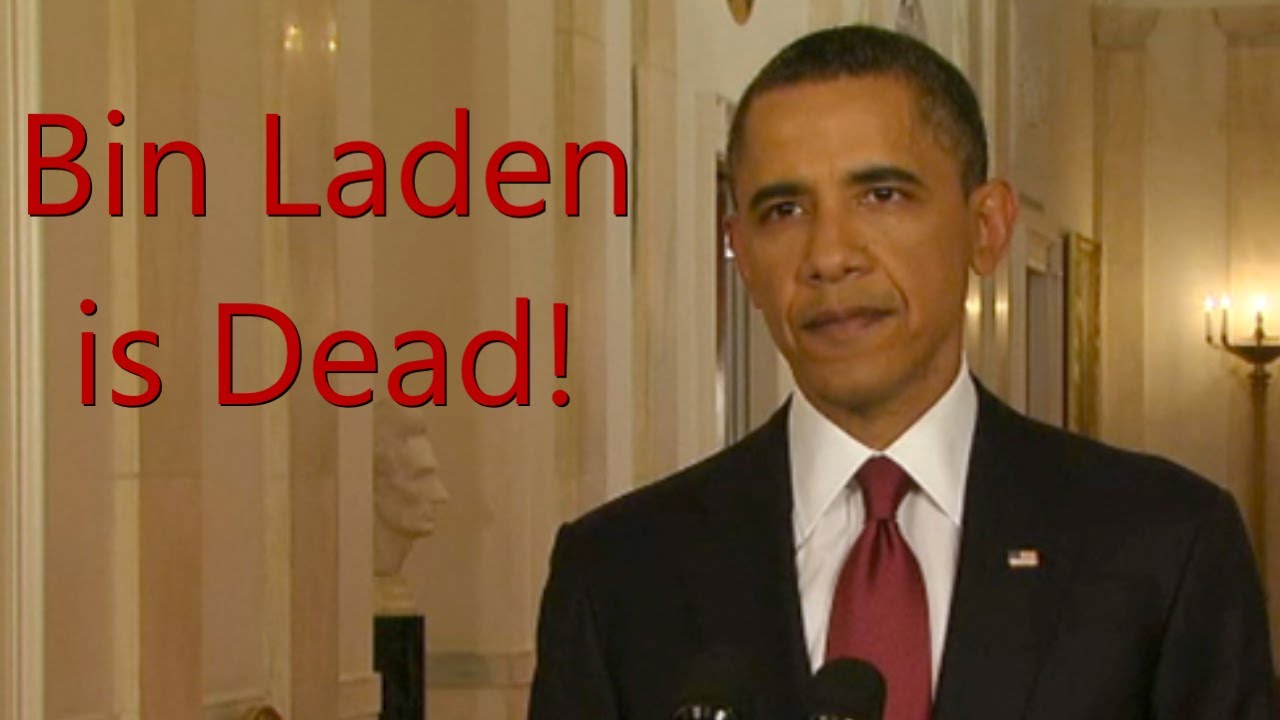
- Obama Announces the Death of Osama bin Laden
Obama Announces the Death of Osama bin Laden
- Madison's Message to Congress on renewed trade with Britain
Fellow-Citizens of the Senate and of the House of Representatives, On this first occasion of meeting you it affords me much satisfaction to be able to communicate the commencement of a favorable change in our foreign relations, the critical state of which induced a session of Congress at this early period. In consequence of the provisions of the act interdicting commercial intercourse with Great Britain and France, our ministers at London and Paris were without delay instructed to let it be understood by the French and British Governments that the authority vested in the Executive to renew commercial intercourse with their respective nations would be exercised in the case specified by that act. Soon after these instructions were dispatched it was found that the British Government, anticipating from early proceedings of Congress at their last session the state of our laws, which has had the effect of placing the two belligerent powers on a footing of equal restrictions, and relying on the conciliatory disposition of the United States, had transmitted to their legation here provisional instructions not only to offer satisfaction for the attack on the frigate Chesapeake, and to make known the determination of His Britannic Majesty to send an Envoy Extraordinary with powers to conclude a treaty on all the points between the two countries, but, moreover, to signify his willingness in the meantime to withdraw his orders in council, in the persuasion that the intercourse with Great Britain would be renewed on the part of the United States. These steps of the British Government led to the correspondence and the proclamation now laid before you; by virtue of which, the commerce between the two countries will be renewable after the tenth day of June next. Whilst I take pleasure in doing justice to the councils of His Britannic Majesty, which, no longer adhering to the policy which made an abandonment by France of her decrees a prerequisite to a revocation of the British orders, have substituted the amicable course which has issued thus happily, I cannot do less than refer to the proposal heretofore made on the part of the United States, embracing a like restoration of the suspended commerce, as a proof of the spirit of accommodation which has at no time been intermitted, and to the result which now calls for our congratulations, as corroborating the principles by which the public councils have been guided during a period of the most trying embarrassments. The discontinuance of the British orders as they respect the United States having been thus arranged, a communication of the event has been forwarded in one of our public vessels to our minister plenipotentiary at Paris, with instructions to avail himself of the important addition thereby made to the considerations which press on the justice of the French Government a revocation of its decrees or such a modification of them as that they shall cease to violate the neutral commerce of the United States. The revision of our commercial laws proper to adapt them to the arrangement which has taken place with Great Britain will doubtless engage the early attention of Congress. It will be worthy, at the same time, of their just and provident care to make such further alterations in the laws as will more especially protect and foster the several branches of manufacture which have been recently instituted or extended by the laudable exertions of our citizens. Under the existing aspect of our affairs I have thought it not inconsistent with a just precaution to have the gunboats, with the exception of those at New Orleans, placed in a situation incurring no expense beyond that requisite for their preservation and conveniency for future service, and to have the crews of those at New Orleans reduced to the number required for their navigation and safety. I have thought also, that our citizens detached in quotas of militia amounting to one hundred thousand under the act of March, 1808, might not improperly be relieved from the state in which they were held for immediate service. A discharge of them has been accordingly directed. The progress made in raising and organizing the additional military force, for which provision was made by the act of April 1808, together with the disposition of the troops, will appear by a report which the Secretary of War is preparing, and which will be laid before you. Of the additional frigates required by an act of the last session to be fitted for actual service, two are in readiness, one nearly so, and the fourth is expected to be ready in the month of July. A report which the Secretary of the Navy is preparing on the subject, to be laid before Congress, will shew at the same time the progress made in officering and manning these ships. It will shew also the degree in which the provisions of the act relating to the other public armed ships have been carried into execution. It will rest with the judgment of Congress to decide how far the change in our external prospects may authorize any modifications of the laws relating to the army and navy establishments. The works of defense for our seaport towns and harbors have proceeded with as much activity as the season of the year and other circumstances would admit. It is necessary, however, to state that, the appropriations hitherto made being found to be deficient, a further provision will claim the early consideration of Congress. The whole of the eight per cent. stock remaining due by the United States, amounting to five millions three hundred thousand dollars, had been reimbursed on the last day of the year 1808. And on the first day of April last the sum in the Treasury exceeded nine and a half millions of dollars. This, together with the receipts of the current year on account of former revenue bonds, will probably be nearly if not altogether sufficient to defray the expenses of the year. But the suspension of exports and the consequent decrease of importations during the last twelve months will necessarily cause a great diminution in the receipts of the year 1810. After that year, should our foreign relations be undisturbed, the revenue will again be more than commensurate to all the expenditures. Aware of the inconveniences of a protracted session at the present season of the year, I forbear to call the attention of the Legislature to any matters not particularly urgent. It remains, therefore, only to assure you of the fidelity and alacrity with which I shall cooperate for the welfare and happiness of our country, and to pray that it may experience a continuance of the divine blessings by which it has been so signally favored. JAMES MADISON. May 23, 1809. Source: https://www.sethkaller.com/item/2287-30051.005-Madison%E2%80%99s-Optimistic-First-Message-to-Congress:-A-Prelude-to-the-War-of-1812
- Jefferson Davis' Farewell Address to the Senate
Jefferson Davis' Farewell Address Senate Chamber, U.S. Capitol, January 21, 1861 I rise, Mr. President [John C. Breckinridge], for the purpose of announcing to the Senate that I have satisfactory evidence that the State of Mississippi, by a solemn ordinance of her people in convention assembled, has declared her separation from the United States. Under these circumstances, of course my functions are terminated here. It has seemed to me proper, however, that I should appear in the Senate to announce that fact to my associates, and I will say but very little more. The occasion does not invite me to go into argument; and my physical condition would not permit me to do so if it were otherwise; and yet it seems to become me to say something on the part of the State I here represent, on an occasion so solemn as this. It is known to Senators who have served with me here, that I have for many years advocated, as an essential attribute of State sovereignty, the right of a State to secede from the Union. Therefore, if I had not believed there was justifiable cause; if I had thought that Mississippi was acting without sufficient provocation, or without an existing necessity, I should still, under my theory of the Government, because of my allegiance to the State of which I am a citizen, have been bound by her action. I, however, may be permitted to say that I do think she has justifiable cause, and I approve of her act. I conferred with her people before that act was taken, counseled them then that if the state of things which they apprehended should exist when the convention met, they should take the action which they have now adopted. I hope none who hear me will confound this expression of mine with the advocacy of the right of a State to remain in the Union, and to disregard its constitutional obligations by the nullification of the law. Such is not my theory. Nullification and secession, so often confounded, are indeed antagonistic principles. Nullification is a remedy which it is sought to apply within the Union, and against the agent of the States. It is only to be justified when the agent has violated his constitutional obligation, and a State, assuming to judge for itself, denies the right of the agent thus to act, and appeals to the other States of the Union for a decision; but when the States themselves, and when the people of the States, have so acted as to convince us that they will not regard our constitutional rights, then, and then for the first time, arises the doctrine of secession in its practical application. A great man who now reposes with his fathers, and who has been often arraigned for a want of fealty to the Union, advocated the doctrine of nullification, because it preserved the Union. It was because of his deep-seated attachment to the Union, his determination to find some remedy for existing ills short of a severance of the ties which bound South Carolina to the other States, that Mr. [John C.] Calhoun advocated the doctrine of nullification, which he proclaimed to be peaceful, to be within the limits of State power, not to disturb the Union, but only to be a means of bringing the agent before the tribunal of the States for their judgment. Secession belongs to a different class of remedies. It is to be justified upon the basis that the States are sovereign. There was a time when none denied it. I hope the time may come again, when a better comprehension of the theory of our Government, and the inalienable rights of the people of the States, will prevent any one from denying that each State is a sovereign, and thus may reclaim the grants which it has made to any agent whomsoever. I therefore say I concur in the action of the people of Mississippi, believing it to be necessary and proper, and should have been bound by their action if my belief had been otherwise; and this brings me to the important point which I wish on this last occasion to present to the Senate. It is by this confounding of nullification and secession that the name of a great man, whose ashes now mingle with his mother earth, has been invoked to justify coercion against a seceded State. The phrase "to execute the laws," was an expression which General Jackson applied to the case of a State refusing to obey the laws while yet a member of the Union. That is not the case which is now presented. The laws are to be executed over the United States, and upon the people of the United States. They have no relation to any foreign country. It is a perversion of terms, at least it is a great misapprehension of the case, which cites that expression for application to a State which has withdrawn from the Union. You may make war on a foreign State. If it be the purpose of gentlemen, they may make war against a State which has withdrawn from the Union; but there are no laws of the United States to be executed within the limits of a seceded State. A State finding herself in the condition in which Mississippi has judged she is, in which her safety requires that she should provide for the maintenance of her rights out of the Union, surrenders all the benefits, (and they are known to be many,) deprives herself of the advantages, (they are known to be great,) severs all the ties of affection, (and they are close and enduring,) which have bound her to the Union; and thus divesting herself of every benefit, taking upon herself every burden, she claims to be exempt from any power to execute the laws of the United States within her limits. I well remember an occasion when Massachusetts was arraigned before the bar of the Senate, and when then the doctrine of coercion was rife and to be applied against her because of the rescue of a fugitive slave in Boston. My opinion then was the same that it is now. Not in a spirit of egotism, but to show that I am not influenced in my opinion because the case is my own, I refer to that time and that occasion as containing the opinion which I then entertained, and on which my present conduct is based. I then said, if Massachusetts, following her through a stated line of conduct, chooses to take the last step which separates her from the Union, it is her right to go, and I will neither vote one dollar nor one man to coerce her back; but will say to her, God speed, in memory of the kind associations which once existed between her and the other States. It has been a conviction of pressing necessity, it has been a belief that we are to be deprived in the Union of the rights which our fathers bequeathed to us, which has brought Mississippi into her present decision. She has heard proclaimed the theory that all men are created free and equal, and this made the basis of an attack upon her social institutions; and the sacred Declaration of Independence has been invoked to maintain the position of the equality of the races. That Declaration of Independence is to be construed by the circumstances and purposes for which it was made. The communities were declaring their independence; the people of those communities were asserting that no man was born--to use the language of Mr. Jefferson--booted and spurred to ride over the rest of mankind; that men were created equal--meaning the men of the political community; that there was no divine right to rule; that no man inherited the right to govern; that there were no classes by which power and place descended to families, but that all stations were equally within the grasp of each member of the body-politic. These were the great principles they announced; these were the purposes for which they made their declaration; these were the ends to which their enunciation was directed. They have no reference to the slave; else, how happened it that among the items of arraignment made against George III was that he endeavored to do just what the North has been endeavoring of late to do--to stir up insurrection among our slaves? Had the Declaration announced that the negroes were free and equal, how was the Prince to be arraigned for stirring up insurrection among them? And how was this to be enumerated among the high crimes which caused the colonies to sever their connection with the mother country? When our Constitution was formed, the same idea was rendered more palpable, for there we find provision made for that very class of persons as property; they were not put upon the footing of equality with white men--not even upon that of paupers and convicts; but, so far as representation was concerned, were discriminated against as a lower caste, only to be represented in the numerical proportion of three fifths. Then, Senators, we recur to the compact which binds us together; we recur to the principles upon which our Government was founded; and when you deny them, and when you deny to us the right to withdraw from a Government which thus perverted threatens to be destructive of our rights, we but tread in the path of our fathers when we proclaim our independence, and take the hazard. This is done not in hostility to others, not to injure any section of the country, not even for our own pecuniary benefit; but from the high and solemn motive of defending and protecting the rights we inherited, and which it is our sacred duty to transmit unshorn to our children. I find in myself, perhaps, a type of the general feeling of my constituents towards yours. I am sure I feel no hostility to you, Senators from the North. I am sure there is not one of you, whatever sharp discussion there may have been between us, to whom I cannot now say, in the presence of my God, I wish you well; and such, I am sure, is the feeling of the people whom I represent towards those whom you represent. I therefore feel that I but express their desire when I say I hope, and they hope, for peaceful relations with you, though we must part. They may be mutually beneficial to us in the future, as they have been in the past, if you so will it. The reverse may bring disaster on every portion of the country; and if you will have it thus, we will invoke the God of our fathers, who delivered them from the power of the lion, to protect us from the ravages of the bear; and thus, putting our trust in God and in our own firm hearts and strong arms, we will vindicate the right as best we may. In the course of my service here, associated at different times with a great variety of Senators, I see now around me some with whom I have served long; there have been points of collision; but whatever of offense there has been to me, I leave here; I carry with me no hostile remembrance. Whatever offense I have given which has not been redressed, or for which satisfaction has not been demanded, I have, Senators, in this hour of our parting, to offer you my apology for any pain which, in heat of discussion, I have inflicted. I go hence unencumbered of the remembrance of any injury received, and having discharged the duty of making the only reparation in my power for any injury offered. Mr. President, and Senators, having made the announcement which the occasion seemed to me to require, it only remains to me to bid you a final adieu. Source: The Papers of Jefferson Davis , Volume 7, pp. 18-23. Transcribed from the Congressional Globe , 36th Congress, 2d Session, p. 487.
- Congress Proclaims the Cessation of Arms
By the UNITED STATES of America In Congress Assembled. A PROCLAMATION, Declaring the Cessation of Arms, as well by Sea as by Land, agreed upon between the United States of America and His Britannic Majesty; and enjoining the Observance thereof. Whereas Provisional Articles were signed at Paris on the Thirtieth Day of November last, between the Ministers Plenipotentiary of the United States of America for treating of Peace, and the Minister Plenipotentiary of His Britannic Majesty, to be inserted in and to constitute the Treaty of Peace proposed to be concluded between the United States of America and his Britannic Majesty, when Terms of Peace should be agreed upon between their Most Christian and Britannic Majesties: And Whereas Preliminaries for restoring Peace between their Most Christian and Britannic Majesties were signed at Versailles, on the Twentieth Day of January last, by the Ministers of their Most Christian and Britannic Majesties: And Whereas Preliminaries for restoring Peace between the said King of Great Britain and the King of Spain were also signed at Versailles, on the same Twentieth Day of January last. By which said Preliminary Articles it hath been agreed, That as soon as the same were ratified, Hostilities between the said Kings, their Kingdoms, States and Subjects, should Cease in all Parts of the World; and it was farther agreed That all Vessels and Effects that might be taken in the Channel and in the North Seas, after the Space of Twelve Days from the Ratification of the said Preliminary Articles, should be restored; that the Term should be One Month from the Channel and North Seas as far as the Canary Islands inclusively, whether in the Ocean or the Mediterranean, Two Months from the said Canary Islands as far as the Equinoctial Line or Equator; and lastly, Five Months in all other Parts of the World, without any Exception or more particular Description of time or Place: And Whereas it was Declared by the Minister Plenipotentiary of the King of Great Britain, in the Name and by the express Order of the King his Master, on the said Twentieth day of January last, that the said United States of America, their Subjects and their Possessions shall be comprised in the above mentioned Suspension of Arms, at the same Epochs, and in the same manner, as the three Crowns above mentioned, their Subjects and Possessions respectively; upon Condition that on the Part, and in the Name of the United States of America, a similar Declaration shall be Delivered, expressly Declaring their Assent to the said Suspension of Arms, and containing an Assurance of the most perfect Reciprocity on their Part: And Whereas the Ministers Plenipotentiary of these United States, did, on the same Twentieth Day of January, in the Name and by the Authority of the said United States, accept the said Declaration, and declare, that the said States should cause all Hostilities to Cease against His Britannic Majesty, his Subjects and his Possessions, at the Terms and Epochs agreed upon between His said Majesty the King of Great-Britain, His Majesty the King of France, and His Majesty the King of Spain, so, and in the same Manner, as had been agreed upon between those Three Crowns, and to produce the same Effects: And Whereas the Ratifications of the said Preliminary Articles their Most Christian and Britannic Majesties were exchanged by their Ministers on the Third Day of February last, and between His Britannic Majesty and the King of Spain on the Ninth Day of February last: And Whereas it is Our Will and Pleasure that the Cessation of Hostilities between the United States of America and his Britannic Majesty, should be conformable to the Epochs fixed between their Most Christian and Britannic Majesties. We have thought fit to make known the same to the Citizens of these States, and we hereby strictly Charge and Command all our Officers, both by Sea and Land, and others, Subjects of these United States, to Forbear all Acts of Hostility, either by Sea or by Land, against His Britannic Majesty or his Subjects, from and after the respective Times agreed upon between their Most Christian and Britannic Majesties as aforesaid. And We do further require all Governors and others, the Executive Powers of these United States respectively, to cause this our Proclamation to be made Public, to the end that the same be duly observed within their several Jurisdictions. Done in Congress, at Philadelphia, this Eleventh Day of April, in the Year of our Lord One Thousand Seven Hundred and Eighty-Three, and of our Sovereignty and Independence the Seventh. Attest CHA THOMSON Secy ELIAS BOUDINOT Presid Source: https://avalon.law.yale.edu/18th_century/pre782n.asp?utm_source=chatgpt.com