

Revolutionary Era
Chapter 5: Independence 1775 ― 1784
Dissolving the Bands 1775-1776
The Great Revolution 1776-1782
Novus Ordo Seclorum 1782-1784


Join or Die 1763 ― 1775
More Perfect Union 1784 ― 1789
.png)
Documents
Master Index

Biographies

Thomas R. Marshall (1854-1925) was an Indiana lawyer and governor who became Woodrow Wilson's vice president in 1913. He served for eight years, including during World War I and the constitutional uncertainty surrounding Wilson's incapacitation in 1919. After leaving office, Marshall returned to law and public speaking before dying in Washington in 1925.
Thomas
Marshall
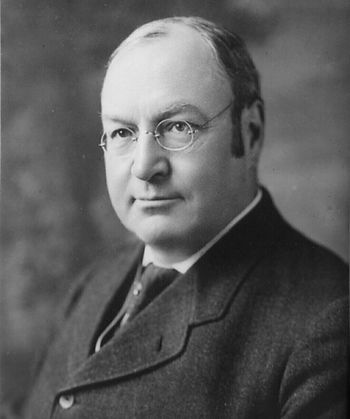
James S. Sherman (1855-1912) was a New York lawyer and longtime Republican congressman who became William Howard Taft's vice president in 1909. He served as a congressional leader and presided over the Senate while the Republican Party increasingly divided between Taft and Theodore Roosevelt. Sherman died six days before the 1912 election, and the Republican Party substituted Nicholas Murray Butler as his electoral running mate.
James
Sherman

Woodrow Wilson (1856-1924) was the 28th president of the United States, serving from 1913 to 1921. His administration established the Federal Reserve, strengthened federal regulation of business, and ultimately brought the United States into World War I, after which Wilson championed his Fourteen Points and the League of Nations. His legacy is complicated by his administration’s racial segregation, suppression of speech, and expansion of presidential power.
Woodrow
Wilson

William H. Taft (1857-1930) was the 27th President of the United States, serving from 1909 to 1913, and later became the 10th Chief Justice of the United States Supreme Court. Taft served in several important government positions before becoming president, including Governor of the Philippines and Secretary of War. As President, Taft strengthened federal antitrust enforcement, expanded railroad regulation, and promoted American economic influence abroad through his policy of Dollar Diplomacy.
William
H. Taft

Theodore Roosevelt (1858-1919) was the 26th president of the United States. After becoming president following William McKinley’s assassination, he advanced the “Square Deal,” strengthened federal regulation of corporations and railroads, protected millions of acres of public land, and expanded America’s influence abroad. Roosevelt left a lasting legacy as one of the most influential presidents of the Progressive Era.
Theodore
Roosevelt
